Search Results: "mak"

26 March 2025

Dirk Eddelbuettel: crc32c 0.0.3 on CRAN: Accommodate Unreleased (!!) cmake Version

A third release of the crc32c package is now on CRAN. The package bring the Google library crc32c to R and offers cyclical checksums with parity in hardware-accelerated form on (recent enough) intel cpus as well as on arm64. This release is one hundred percent maintenance. Brian Ripley reached out as he already tests the (still very much unreleased) cmake 4.0.0 release, currently at rc5. And that version is now picky about minimum cmake version statements in CMakeLists.txt. As we copied the upstream one here, with its setting of the jurassic 3.1 version, our build conked out. A simple switch to 3.5..4.0, declaring a from .. to scheme with a minimally supported version (here 3.5, released in 2016) up to a tested version works. No other changes, really, besides an earlier helping hand from Jeroen concerning cross-compilation support he needed or encountered (and that happened right after the 0.0.2 release). The NEWS entry for this (as well the initial release) follows.

Changes in version 0.0.3 (2025-03-25)
  • Support cross-compilation by setting CC and CXX in Makevars.in (Jeroen Ooms in #1)
  • Support pre-release 4.0.0 of cmake by moving the minimum stated version from 3.1 to 3.5 per CRAN request, also sent PR upstream

My CRANberries service provides a comparison to the previous release. The code is available via the GitHub repo, and of course also from its CRAN page and via install.packages("crc32c"). Comments and suggestions are welcome at the GitHub repo.

This post by Dirk Eddelbuettel originated on his Thinking inside the box blog. If you like this or other open-source work I do, you can sponsor me at GitHub.

25 March 2025

Dirk Eddelbuettel: littler 0.3.21 on CRAN: Lots Moar Features!

max-heap image The twentysecond release of littler as a CRAN package landed on CRAN just now, following in the now nineteen year history (!!) as a (initially non-CRAN) package started by Jeff in 2006, and joined by me a few weeks later. littler is the first command-line interface for R as it predates Rscript. It allows for piping as well for shebang scripting via #!, uses command-line arguments more consistently and still starts faster. It also always loaded the methods package which Rscript only began to do in recent years. littler lives on Linux and Unix, has its difficulties on macOS due to some-braindeadedness there (who ever thought case-insensitive filesystems as a default were a good idea?) and simply does not exist on Windows (yet the build system could be extended see RInside for an existence proof, and volunteers are welcome!). See the FAQ vignette on how to add it to your PATH. A few examples are highlighted at the Github repo:, as well as in the examples vignette. This release, the first is almost exactly one year, brings enhancements to six scripts as well as three new ones. The new ones crup.r offers CRan UPloads from the command-line, deadliners.r lists CRAN package by CRAN deadline, and wb.r uploads to win-builder (replacing an older shell script of mine). Among the updated ones, kitten.r now creates more complete DESCRIPTION files in the packages it makes, and several scripts support additional options. A number of changes were made to packaging as well, some of which were contributed by Jon and Michael which is of course always greatly appreciated. The trigger for the release was, just like for RQuantLib earlier today, a CRAN nag on bashisms half of which actually false here it was in a comment only. Oh well. The full change description follows.

Changes in littler version 0.3.21 (2025-03-24)
  • Changes in examples scripts
    • Usage text for ciw.r is improved, new options were added (Dirk)
    • The noble release is supported by r2u.r (Dirk)
    • The installRub.r script has additional options (Dirk)
    • The ttlt.r script has a new load_package argument (Dirk)
    • A new script deadliners.r showing CRAN packages 'under deadline' has been added, and then refined (Dirk)
    • The kitten.r script can now use whoami and argument githubuser on the different *kitten helpers it calls (Dirk)
    • A new script wb.r can upload to win-builder (Dirk)
    • A new script crup.r can upload a CRAN submission (Dirk)
    • In rcc.r, the return from rcmdcheck is now explicitly printed (Dirk)
    • In r2u.r the dry-run option is passed to the build command (Dirk)
  • Changes in package
    • Regular updates to badges, continuous integration, DESCRIPTION and configure.ac (Dirk)
    • Errant osVersion return value are handled more robustly (Michael Chirico in #121)
    • The current run-time path is available via variable LITTLER_SCRIPT_PATH (Jon Clayden in #122)
    • The cleanup script remove macOS debug symbols (Jon Clayden in #123)

My CRANberries service provides a comparison to the previous release. Full details for the littler release are provided as usual at the ChangeLog page, and also on the package docs website. The code is available via the GitHub repo, from tarballs and now of course also from its CRAN page and via install.packages("littler"). Binary packages are available directly in Debian as well as (in a day or two) Ubuntu binaries at CRAN thanks to the tireless Michael Rutter. Comments and suggestions are welcome at the GitHub repo.

This post by Dirk Eddelbuettel originated on his Thinking inside the box blog. If you like this or other open-source work I do, you can sponsor me at GitHub.

Dirk Eddelbuettel: RQuantLib 0.4.25 on CRAN: Fix Bashism in Configure

A new minor release 0.4.25 of RQuantLib arrived on CRAN this morning, and has just now been uploaded to Debian too. QuantLib is a rather comprehensice free/open-source library for quantitative finance. RQuantLib connects (some parts of) it to the R environment and language, and has been part of CRAN for nearly twenty-two years (!!) as it was one of the first packages I uploaded to CRAN. This release of RQuantLib is tickled by a request to remove bashisms in shell scripts, or, as in my case here, configure.ac where I used the non-portable form of string comparison. That has of course been there for umpteen years and not bitten anyone as the default shell for most is in fact bash but the change has the right idea. And is of course now mandatory affecting quite a few packages is I tooted yesterday. It also contains an improvement to the macOS 14 build kindly contributed by Jeroen.

Changes in RQuantLib version 0.4.25 (2025-03-24)
  • Support macOS 14 with a new compiler flag (Jeroen in #190)
  • Correct two bashisms in configure.ac

One more note, though: This may however be the last release I make with Windows support. CRAN now also checks for forbidden symbols (such as assert or (s)printf or ) in static libraries, and this release tickled one such warning from the Windows side (which only uses static libraries). I have no desire to get involved in also maintaing QuantLib (no R here) for Windows and may simply turn the package back to OS_type: unix to avoid the hassle. To avoid that, it would be fabulous if someone relying on RQuantLib on Windows could step up and lend a hand looking after that library build. Courtesy of my CRANberries, there is also a diffstat report for the this release. As always, more detailed information is on the RQuantLib page. Questions, comments etc should go to the rquantlib-devel mailing list. Issue tickets can be filed at the GitHub repo. If you like this or other open-source work I do, you can now sponsor me at GitHub.

This post by Dirk Eddelbuettel originated on his Thinking inside the box blog. Please report excessive re-aggregation in third-party for-profit settings.

Otto Kek l inen: Debian Salsa CI in Google Summer of Code 2025

Featured image of post Debian Salsa CI in Google Summer of Code 2025Are you a student aspiring to participate in the Google Summer of Code 2025? Would you like to improve the continuous integration pipeline used at salsa.debian.org, the Debian GitLab instance, to help improve the quality of tens of thousands of software packages in Debian? This summer 2025, I and Emmanuel Arias will be participating as mentors in the GSoC program. We are available to mentor students who propose and develop improvements to the Salsa CI pipeline, as we are members of the Debian team that maintains it. A post by Santiago Ruano Rinc n in the GitLab blog explains what Salsa CI is and its short history since inception in 2018. At the time of the article in fall 2023 there were 9000+ source packages in Debian using Salsa CI. Now in 2025 there are over 27,000 source packages in Debian using it, and since summer 2024 some Ubuntu developers have started using it for enhanced quality assurance of packaging changes before uploading new package revisions to Ubuntu. Personally, I have been using Salsa CI since its inception, and contributing as a team member since 2019. See my blog post about GitLab CI for MariaDB in Debian for a description of an advanced and extensive use case. Helping Salsa CI is a great way to make a global impact, as it will help avoid regressions and improve the quality of Debian packages. The benefits reach far beyond just Debian, as it will also help hundreds of Debian derivatives, such as Ubuntu, Linux Mint, Tails, Purism PureOS, Pop!_OS, Zorin OS, Raspberry Pi OS, a large portion of Docker containers, and even the Windows Subsystem for Linux.

Improving Salsa CI: more features, robustness, speed While Salsa CI with contributions from 71 people is already quite mature and capable, there are many ideas floating around about how it could be further extended. For example, Salsa CI issue #147 describes various static analyzers and linters that may be generally useful. Issue #411 proposes using libfaketime to run autopkgtest on arbitrary future dates to test for failures caused by date assumptions, such as the Y2038 issue. There are also ideas about making Salsa CI more robust and code easier to reuse by refactoring some of the yaml scripts into independent scripts in #230, which could make it easier to run Salsa CI locally as suggested in #169. There are also ideas about improving the Salsa CI s own CI to avoid regressions from pipeline changes in #318. The CI system is also better when it s faster, and some speed improvement ideas have been noted in #412. Improvements don t have to be limited to changes in the pipeline itself. A useful project would also be to update more Debian packages to use Salsa CI, and ensure they adopt it in an optimal way as noted in #416. It would also be nice to have a dashboard with statistics about all public Salsa CI pipeline runs as suggested in #413. These and more ideas can be found in the issue list by filtering for tags Newcomer, Nice-To-Have or Accepting MRs. A Google Summer of Code proposal does not have to be limited to these existing ideas. Participants are also welcome to propose completely novel ideas!

Good time to also learn Debian packaging Anyone working with Debian team should also take the opportunity to learn Debian packaging, and contribute to the packaging or maintenance of 1-2 packages in parallel to improving the Salsa CI. All Salsa CI team members are also Debian Developers who can mentor and sponsor uploads to Debian. Maintaining a few packages is a great way to eat your own cooking and experience Salsa CI from the user perspective, and likely to make you better at Salsa CI development.

Apply now! The contributor applications opened yesterday on March 24, so to participate act now! If you are an eligible student and want to attend, head over to summerofcode.withgoogle.com to learn more. There are over a thousand participating organizations, with Debian, GitLab and MariaDB being some examples. Within these organizations there may be multiple subteams and projects to choose from. The full list of participating Debian projects can be found in the Debian wiki. If you are interested in GSoC for Salsa CI specifically, feel free to
  1. Reach out to me and Emmanuel by email at otto@ and eamanu@ (debian.org).
  2. Sign up at salsa.debian.org for an account (note it takes a few days due to manual vetting and approval process)
  3. Read the project README, STRUCTURE and CONTRIBUTING to get a developer s overview
  4. Participate in issue discussions at https://salsa.debian.org/salsa-ci-team/pipeline/-/issues/
Note that you don t have to wait for GSoC to officially start to contribute. In fact, it may be useful to start immediately by submitting a Merge Request to do some small contribution, just to learn the process and to get more familiar with how everything works, and the team maintaining Salsa CI. Looking forward to seeing new contributors!

24 March 2025

Jonathan McDowell: Who pays the cost of progress in software?

I am told, by friends who have spent time at Google, about the reason Google Reader finally disappeared. Apparently it had become a 20% Project for those who still cared about it internally, and there was some major change happening to one of it upstream dependencies that was either going to cause a significant amount of work rearchitecting Reader to cope, or create additional ongoing maintenance burden. It was no longer viable to support it as a side project, so it had to go. This was a consequence of an internal culture at Google where service owners are able to make changes that can break downstream users, and the downstream users are the ones who have to adapt. My experience at Meta goes the other way. If you own a service or other dependency and you want to make a change that will break things for the users, it s on you to do the migration, or at the very least provide significant assistance to those who own the code. You don t just get to drop your new release and expect others to clean up; doing that tends to lead to changes being reverted. The culture flows the other way; if you break it, you fix it (nothing is someone else s problem). There are pluses and minuses to both approaches. Users having to drive the changes to things they own stops them from blocking progress. Service/code owners having to drive the changes avoids the situation where a wildly used component drops a new release that causes a lot of high priority work for folk in order to adapt. I started thinking about this in the context of Debian a while back, and a few incidents since have resulted in my feeling that we re closer to the Google model than the Meta model. Anyone can upload a new version of their package to unstable, and that might end up breaking all the users of it. It s not quite as extreme as rolling out a new service, because it s unstable that gets affected (the clue is in the name, I really wish more people would realise that), but it can still result in release critical bugs for lots other Debian contributors. A good example of this are toolchain changes. Major updates to GCC and friends regularly result in FTBFS issues in lots of packages. Now in this instance the maintainer is usually diligent about a heads up before the default changes, but it s still a whole bunch of work for other maintainers to adapt (see the list of FTBFS bugs for GCC 15 for instance - these are important, but not serious yet). Worse is when a dependency changes and hasn t managed to catch everyone who might be affected, so by the time it s discovered it s release critical, because at least one package no longer builds in unstable. Commercial organisations try to avoid this with a decent CI/CD setup that either vendors all dependencies, or tracks changes to them and tries rebuilds before allowing things to land. This is one of the instances where a monorepo can really shine; if everything you need is in there, it s easier to track the interconnections between different components. Debian doesn t have a CI/CD system that runs for every upload, allowing us to track exact causes of regressions. Instead we have Lucas, who does a tremendous job of running archive wide rebuilds to make sure we can still build everything. Unfortunately that means I am often unfairly grumpy at him; my heart sinks when I see a bug come in with his name attached, because it often means one of my packages has a new RC bug where I m going to have to figure out what changed elsewhere to cause it. However he s just (very usefully) surfacing an issue someone else created, rather than actually being the cause of the problem. I don t know if I have a point to this post. I think it s probably that I wish folk in Free Software would try and be mindful of the incompatible changes they might introducing, and the toil they create for other volunteer developers, often not directly visible to the person making the change. The approach done by the Debian toolchain maintainers strikes me as a good balance; they do a bunch of work up front to try and flag all the places that might need to make changes, far enough in advance of the breaking change actually landing. However they don t then allow a tardy developer to block progress.

Simon Josefsson: Reproducible Software Releases

Around a year ago I discussed two concerns with software release archives (tarball artifacts) that could be improved to increase confidence in the supply-chain security of software releases. Repeating the goals for simplicity: While implementing these ideas for a small project was accomplished within weeks see my announcement of Libntlm version 1.8 adressing this in complex projects uncovered concerns with tools that had to be addressed, and things stalled for many months pending that work. I had the notion that these two goals were easy and shouldn t be hard to accomplish. I still believe that, but have had to realize that improving tooling to support these goals takes time. It seems clear that these concepts are not universally agreed on and implemented generally. I m now happy to recap some of the work that led to releases of libtasn1 v4.20.0, inetutils v2.6, libidn2 v2.3.8, libidn v1.43. These releases all achieve these goals. I am working on a bunch of more projects to support these ideas too. What have the obstacles so far been to make this happen? It may help others who are in the same process of addressing these concerns to have a high-level introduction to the issues I encountered. Source code for projects above are available and anyone can look at the solutions to learn how the problems are addressed. First let s look at the problems we need to solve to make git-archive style tarballs usable:

Version Handling To build usable binaries from a minimal tarballs, it need to know which version number it is. Traditionally this information was stored inside configure.ac in git. However I use gnulib s git-version-gen to infer the version number from the git tag or git commit instead. The git tag information is not available in a git-archive tarball. My solution to this was to make use of the export-subst feature of the .gitattributes file. I store the file .tarball-version-git in git containing the magic cookie like this:
$Format:%(describe)$
With this, git-archive will replace with a useful version identifier on export, see the libtasn1 patch to achieve this. To make use of this information, the git-version-gen script was enhanced to read this information, see the gnulib patch. This is invoked by ./configure to figure out which version number the package is for.

Translations We want translations to be included in the minimal source tarball for it to be buildable. Traditionally these files are retrieved by the maintainer from the Translation project when running ./bootstrap, however there are two problems with this. The first one is that there is no strong authentication or versioning information on this data, the tools just download and place whatever wget downloaded into your source tree (printf-style injection attack anyone?). We could improve this (e.g., publish GnuPG signed translations messages with clear versioning), however I did not work on that further. The reason is that I want to support offline builds of packages. Downloading random things from the Internet during builds does not work when building a Debian package, for example. The translation project could solve this by making a monthly tarball with their translations available, for distributors to pick up and provide as a separate package that could be used as a build dependency. However that is not how these tools and projects are designed. Instead I reverted back to storing translations in git, something that I did for most projects back when I was using CVS 20 years ago. Hooking this into ./bootstrap and gettext workflow can be tricky (ideas for improvement most welcome!), but I used a simple approach to store all directly downloaded po/*.po files directly as po/*.po.in and make the ./bootstrap tool move them in place, see the libidn2 commit followed by the actual make update-po commit with all the translations where one essential step is:
# Prime po/*.po from fall-back copy stored in git.
for poin in po/*.po.in; do
    po=$(echo $poin   sed 's/.in//')
    test -f $po   cp -v $poin $po
done
ls po/*.po   sed 's .*/ ; s \.po$ ' > po/LINGUAS

Fetching vendor files like gnulib Most build dependencies are in the shape of You need a C compiler . However some come in the shape of source-code files intended to be vendored , and gnulib is a huge repository of such files. The latter is a problem when building from a minimal git archive. It is possible to consider translation files as a class of vendor files, since they need to be copied verbatim into the project build directory for things to work. The same goes for *.m4 macros from the GNU Autoconf Archive. However I m not confident that the solution for all vendor files must be the same. For translation files and for Autoconf Archive macros, I have decided to put these files into git and merge them manually occasionally. For gnulib files, in some projects like OATH Toolkit I also store all gnulib files in git which effectively resolve this concern. (Incidentally, the reason for doing so was originally that running ./bootstrap took forever since there is five gnulib instances used, which is no longer the case since gnulib-tool was rewritten in Python.) For most projects, however, I rely on ./bootstrap to fetch a gnulib git clone when building. I like this model, however it doesn t work offline. One way to resolve this is to make the gnulib git repository available for offline use, and I ve made some effort to make this happen via a Gnulib Git Bundle and have explained how to implement this approach for Debian packaging. I don t think that is sufficient as a generic solution though, it is mostly applicable to building old releases that uses old gnulib files. It won t work when building from CI/CD pipelines, for example, where I have settled to use a crude way of fetching and unpacking a particular gnulib snapshot, see this Libntlm patch. This is much faster than working with git submodules and cloning gnulib during ./bootstrap. Essentially this is doing:
GNULIB_REVISION=$(. bootstrap.conf >&2; echo $GNULIB_REVISION)
wget -nv https://gitlab.com/libidn/gnulib-mirror/-/archive/$GNULIB_REVISION/gnulib-mirror-$GNULIB_REVISION.tar.gz
gzip -cd gnulib-mirror-$GNULIB_REVISION.tar.gz   tar xf -
rm -fv gnulib-mirror-$GNULIB_REVISION.tar.gz
export GNULIB_SRCDIR=$PWD/gnulib-mirror-$GNULIB_REVISION
./bootstrap --no-git
./configure
make

Test the git-archive tarball This goes without saying, but if you don t test that building from a git-archive style tarball works, you are likely to regress at some point. Use CI/CD techniques to continuously test that a minimal git-archive tarball leads to a usable build.

Mission Accomplished So that wasn t hard, was it? You should now be able to publish a minimal git-archive tarball and users should be able to build your project from it. I recommend naming these archives as PROJECT-vX.Y.Z-src.tar.gz replacing PROJECT with your project name and X.Y.Z with your version number. The archive should have only one sub-directory named PROJECT-vX.Y.Z/ containing all the source-code files. This differentiate it against traditional PROJECT-X.Y.Z.tar.gz tarballs in that it embeds the git tag (which typically starts with v) and contains a wildcard-friendly -src substring. Alas there is no consistency around this naming pattern, and GitLab, GitHub, Codeberg etc all seem to use their own slightly incompatible variant. Let s go on to see what is needed to achieve reproducible make dist source tarballs. This is the release artifact that most users use, and they often contain lots of generated files and vendor files. These files are included to make it easy to build for the user. What are the challenges to make these reproducible?

Build dependencies causing different generated content The first part is to realize that if you use tool X with version A to generate a file that goes into the tarball, version B of that tool may produce different outputs. This is a generic concern and it cannot be solved. We want our build tools to evolve and produce better outputs over time. What can be addressed is to avoid needless differences. For example, many tools store timestamps and versioning information in the generated files. This causes needless differences, which makes audits harder. I have worked on some of these, like Autoconf Archive timestamps but solving all of these examples will take a long time, and some upstream are reluctant to incorporate these changes. My approach meanwhile is to build things using similar environments, and compare the outputs for differences. I ve found that the various closely related forks of GNU/Linux distributions are useful for this. Trisquel 11 is based on Ubuntu 22.04, and building my projects using both and comparing the differences only give me the relevant differences to improve. This can be extended to compare AlmaLinux with RockyLinux (for both versions 8 and 9), Devuan 5 against Debian 12, PureOS 10 with Debian 11, and so on.

Timestamps Sometimes tools store timestamps in files in a way that is harder to fix. Two notable examples of this are *.po translation files and Texinfo manuals. For translation files, I have resolved this by making sure the files use a predictable POT-Creation-Date timestamp, and I set it to the modification timestamps of the NEWS file in the repository (which I set to the git commit of the latest commit elsewhere) like this:
dist-hook: po-CreationDate-to-mtime-NEWS
.PHONY: po-CreationDate-to-mtime-NEWS
po-CreationDate-to-mtime-NEWS: mtime-NEWS-to-git-HEAD
  $(AM_V_GEN)for p in $(distdir)/po/*.po $(distdir)/po/$(PACKAGE).pot; do \
    if test -f "$$p"; then \
      $(SED) -e 's,POT-Creation-Date: .*\\n",POT-Creation-Date: '"$$(env LC_ALL=C TZ=UTC0 stat --format=%y $(srcdir)/NEWS   cut -c1-16,31-)"'\\n",' < $$p > $$p.tmp && \
      if cmp $$p $$p.tmp > /dev/null; then \
        rm -f $$p.tmp; \
      else \
        mv $$p.tmp $$p; \
      fi \
    fi \
  done
Similarily, I set a predictable modification time of the texinfo source file like this:
dist-hook: mtime-NEWS-to-git-HEAD
.PHONY: mtime-NEWS-to-git-HEAD
mtime-NEWS-to-git-HEAD:
  $(AM_V_GEN)if test -e $(srcdir)/.git \
                && command -v git > /dev/null; then \
    touch -m -t "$$(git log -1 --format=%cd \
      --date=format-local:%Y%m%d%H%M.%S)" $(srcdir)/NEWS; \
  fi
However I ve realized that this needs to happen earlier and probably has to be run during ./configure time, because the doc/version.texi file is generated on first build before running make dist and for some reason the file is not rebuilt at release time. The Automake texinfo integration is a bit inflexible about providing hooks to extend the dependency tracking. The method to address these differences isn t really important, and they change over time depending on preferences. What is important is that the differences are eliminated.

ChangeLog Traditionally ChangeLog files were manually prepared, and still is for some projects. I maintain git2cl but recently I ve settled with gnulib s gitlog-to-changelog because doing so avoids another build dependency (although the output formatting is different and arguable worse for my git commit style). So the ChangeLog files are generated from git history. This means a shallow clone will not produce the same ChangeLog file depending on how deep it was cloned. For Libntlm I simply disabled use of generated ChangeLog because I wanted to support an even more extreme form of reproducibility: I wanted to be able to reproduce the full make dist source archives from a minimal git-archive source archive. However for other projects I ve settled with a middle ground. I realized that for git describe to produce reproducible outputs, the shallow clone needs to include the last release tag. So it felt acceptable to assume that the clone is not minimal, but instead has some but not all of the history. I settled with the following recipe to produce ChangeLog's covering all changes since the last release.
dist-hook: gen-ChangeLog
.PHONY: gen-ChangeLog
gen-ChangeLog:
  $(AM_V_GEN)if test -e $(srcdir)/.git; then			\
    LC_ALL=en_US.UTF-8 TZ=UTC0					\
    $(top_srcdir)/build-aux/gitlog-to-changelog			\
       --srcdir=$(srcdir) --					\
       v$(PREV_VERSION)~.. > $(distdir)/cl-t &&			\
         printf '\n\nSee the source repo for older entries\n'	\
         >> $(distdir)/cl-t &&					\
         rm -f $(distdir)/ChangeLog &&				\
         mv $(distdir)/cl-t $(distdir)/ChangeLog;  		\
  fi
I m undecided about the usefulness of generated ChangeLog files within make dist archives. Before we have stable and secure archival of git repositories widely implemented, I can see some utility of this in case we lose all copies of the upstream git repositories. I can sympathize with the concept of ChangeLog files died when we started to generate them from git logs: the files no longer serve any purpose, and we can ask people to go look at the git log instead of reading these generated non-source files.

Long-term reproducible trusted build environment Distributions comes and goes, and old releases of them goes out of support and often stops working. Which build environment should I chose to build the official release archives? To my knowledge only Guix offers a reliable way to re-create an older build environment (guix gime-machine) that have bootstrappable properties for additional confidence. However I had two difficult problems here. The first one was that I needed Guix container images that were usable in GitLab CI/CD Pipelines, and this side-tracked me for a while. The second one delayed my effort for many months, and I was inclined to give up. Libidn distribute a C# implementation. Some of the C# source code files included in the release tarball are generated. By what? You guess it, by a C# program, with the source code included in the distribution. This means nobody could reproduce the source tarball of Libidn without trusting someone elses C# compiler binaries, which were built from binaries of earlier releases, chaining back into something that nobody ever attempts to build any more and likely fail to build due to bit-rot. I had two basic choices, either remove the C# implementation from Libidn (which may be a good idea for other reasons, since the C and C# are unrelated implementations) or build the source tarball on some binary-only distribution like Trisquel. Neither felt appealing to me, but a late christmas gift of a reproducible Mono came to Guix that resolve this.

Embedded images in Texinfo manual For Libidn one section of the manual has an image illustrating some concepts. The PNG, PDF and EPS outputs were generated via fig2dev from a *.fig file (hello 1985!) that I had stored in git. Over time, I had also started to store the generated outputs because of build issues. At some point, it was possible to post-process the PDF outputs with grep to remove some timestamps, however with compression this is no longer possible and actually the grep command I used resulted in a 0-byte output file. So my embedded binaries in git was no longer reproducible. I first set out to fix this by post-processing things properly, however I then realized that the *.fig file is not really easy to work with in a modern world. I wanted to create an image from some text-file description of the image. Eventually, via the Guix manual on guix graph, I came to re-discover the graphviz language and tool called dot (hello 1993!). All well then? Oh no, the PDF output embeds timestamps. Binary editing of PDF s no longer work through simple grep, remember? I was back where I started, and after some (soul- and web-) searching I discovered that Ghostscript (hello 1988!) pdfmarks could be used to modify things here. Cooperating with automake s texinfo rules related to make dist proved once again a worthy challenge, and eventually I ended up with a Makefile.am snippet to build images that could be condensed into:
info_TEXINFOS = libidn.texi
libidn_TEXINFOS += libidn-components.png
imagesdir = $(infodir)
images_DATA = libidn-components.png
EXTRA_DIST += components.dot
DISTCLEANFILES = \
  libidn-components.eps libidn-components.png libidn-components.pdf
libidn-components.eps: $(srcdir)/components.dot
  $(AM_V_GEN)$(DOT) -Nfontsize=9 -Teps < $< > $@.tmp
  $(AM_V_at)! grep %%CreationDate $@.tmp
  $(AM_V_at)mv $@.tmp $@
libidn-components.pdf: $(srcdir)/components.dot
  $(AM_V_GEN)$(DOT) -Nfontsize=9 -Tpdf < $< > $@.tmp
# A simple sed on CreationDate is no longer possible due to compression.
# 'exiftool -CreateDate' is alternative to 'gs', but adds ~4kb to file.
# Ghostscript add <1kb.  Why can't 'dot' avoid setting CreationDate?
  $(AM_V_at)printf '[ /ModDate ()\n  /CreationDate ()\n  /DOCINFO pdfmark\n' > pdfmarks
  $(AM_V_at)$(GS) -q -dBATCH -dNOPAUSE -sDEVICE=pdfwrite -sOutputFile=$@.tmp2 $@.tmp pdfmarks
  $(AM_V_at)rm -f $@.tmp pdfmarks
  $(AM_V_at)mv $@.tmp2 $@
libidn-components.png: $(srcdir)/components.dot
  $(AM_V_GEN)$(DOT) -Nfontsize=9 -Tpng < $< > $@.tmp
  $(AM_V_at)mv $@.tmp $@
pdf-recursive: libidn-components.pdf
dvi-recursive: libidn-components.eps
ps-recursive: libidn-components.eps
info-recursive: $(top_srcdir)/.version libidn-components.png
Surely this can be improved, but I m not yet certain in what way is the best one forward. I like having a text representation as the source of the image. I m sad that the new image size is ~48kb compared to the old image size of ~1kb. I tried using exiftool -CreateDate as an alternative to GhostScript, but using it to remove the timestamp added ~4kb to the file size and naturally I was appalled by this ignorance of impending doom.

Test reproducibility of tarball Again, you need to continuously test the properties you desire. This means building your project twice using different environments and comparing the results. I ve settled with a small GitLab CI/CD pipeline job that perform bit-by-bit comparison of generated make dist archives. It also perform bit-by-bit comparison of generated git-archive artifacts. See the Libidn2 .gitlab-ci.yml 0-compare job which essentially is:
0-compare:
  image: alpine:latest
  stage: repro
  needs: [ B-AlmaLinux8, B-AlmaLinux9, B-RockyLinux8, B-RockyLinux9, B-Trisquel11, B-Ubuntu2204, B-PureOS10, B-Debian11, B-Devuan5, B-Debian12, B-gcc, B-clang, B-Guix, R-Guix, R-Debian12, R-Ubuntu2404, S-Trisquel10, S-Ubuntu2004 ]
  script:
  - cd out
  - sha256sum */*.tar.* */*/*.tar.*   sort   grep    -- -src.tar.
  - sha256sum */*.tar.* */*/*.tar.*   sort   grep -v -- -src.tar.
  - sha256sum */*.tar.* */*/*.tar.*   sort   uniq -c -w64   sort -rn
  - sha256sum */*.tar.* */*/*.tar.*   grep    -- -src.tar.   sort   uniq -c -w64   grep -v '^      1 '
  - sha256sum */*.tar.* */*/*.tar.*   grep -v -- -src.tar.   sort   uniq -c -w64   grep -v '^      1 '
# Confirm modern git-archive tarball reproducibility
  - cmp b-almalinux8/src/*.tar.gz b-almalinux9/src/*.tar.gz
  - cmp b-almalinux8/src/*.tar.gz b-rockylinux8/src/*.tar.gz
  - cmp b-almalinux8/src/*.tar.gz b-rockylinux9/src/*.tar.gz
  - cmp b-almalinux8/src/*.tar.gz b-debian12/src/*.tar.gz
  - cmp b-almalinux8/src/*.tar.gz b-devuan5/src/*.tar.gz
  - cmp b-almalinux8/src/*.tar.gz r-guix/src/*.tar.gz
  - cmp b-almalinux8/src/*.tar.gz r-debian12/src/*.tar.gz
  - cmp b-almalinux8/src/*.tar.gz r-ubuntu2404/src/*v2.*.tar.gz
# Confirm old git-archive (export-subst but long git describe) tarball reproducibility
  - cmp b-trisquel11/src/*.tar.gz b-ubuntu2204/src/*.tar.gz
# Confirm really old git-archive (no export-subst) tarball reproducibility
  - cmp b-debian11/src/*.tar.gz b-pureos10/src/*.tar.gz
# Confirm 'make dist' generated tarball reproducibility
  - cmp b-almalinux8/*.tar.gz b-rockylinux8/*.tar.gz
  - cmp b-almalinux9/*.tar.gz b-rockylinux9/*.tar.gz
  - cmp b-pureos10/*.tar.gz b-debian11/*.tar.gz
  - cmp b-devuan5/*.tar.gz b-debian12/*.tar.gz
  - cmp b-trisquel11/*.tar.gz b-ubuntu2204/*.tar.gz
  - cmp b-guix/*.tar.gz r-guix/*.tar.gz
# Confirm 'make dist' from git-archive tarball reproducibility
  - cmp s-trisquel10/*.tar.gz s-ubuntu2004/*.tar.gz
Notice that I discovered that git archive outputs differ over time too, which is natural but a bit of a nuisance. The output of the job is illuminating in the way that all SHA256 checksums of generated tarballs are included, for example the libidn2 v2.3.8 job log:
$ sha256sum */*.tar.* */*/*.tar.*   sort   grep -v -- -src.tar.
368488b6cc8697a0a937b9eb307a014396dd17d3feba3881e6911d549732a293  b-trisquel11/libidn2-2.3.8.tar.gz
368488b6cc8697a0a937b9eb307a014396dd17d3feba3881e6911d549732a293  b-ubuntu2204/libidn2-2.3.8.tar.gz
59db2d045fdc5639c98592d236403daa24d33d7c8db0986686b2a3056dfe0ded  b-debian11/libidn2-2.3.8.tar.gz
59db2d045fdc5639c98592d236403daa24d33d7c8db0986686b2a3056dfe0ded  b-pureos10/libidn2-2.3.8.tar.gz
5bd521d5ecd75f4b0ab0fc6d95d444944ef44a84cad859c9fb01363d3ce48bb8  s-trisquel10/libidn2-2.3.8.tar.gz
5bd521d5ecd75f4b0ab0fc6d95d444944ef44a84cad859c9fb01363d3ce48bb8  s-ubuntu2004/libidn2-2.3.8.tar.gz
7f1dcdea3772a34b7a9f22d6ae6361cdcbe5513e3b6485d40100b8565c9b961a  b-almalinux8/libidn2-2.3.8.tar.gz
7f1dcdea3772a34b7a9f22d6ae6361cdcbe5513e3b6485d40100b8565c9b961a  b-rockylinux8/libidn2-2.3.8.tar.gz
8031278157ce43b5813f36cf8dd6baf0d9a7f88324ced796765dcd5cd96ccc06  b-clang/libidn2-2.3.8.tar.gz
8031278157ce43b5813f36cf8dd6baf0d9a7f88324ced796765dcd5cd96ccc06  b-debian12/libidn2-2.3.8.tar.gz
8031278157ce43b5813f36cf8dd6baf0d9a7f88324ced796765dcd5cd96ccc06  b-devuan5/libidn2-2.3.8.tar.gz
8031278157ce43b5813f36cf8dd6baf0d9a7f88324ced796765dcd5cd96ccc06  b-gcc/libidn2-2.3.8.tar.gz
8031278157ce43b5813f36cf8dd6baf0d9a7f88324ced796765dcd5cd96ccc06  r-debian12/libidn2-2.3.8.tar.gz
acf5cbb295e0693e4394a56c71600421059f9c9bf45ccf8a7e305c995630b32b  r-ubuntu2404/libidn2-2.3.8.tar.gz
cbdb75c38100e9267670b916f41878b6dbc35f9c6cbe60d50f458b40df64fcf1  b-almalinux9/libidn2-2.3.8.tar.gz
cbdb75c38100e9267670b916f41878b6dbc35f9c6cbe60d50f458b40df64fcf1  b-rockylinux9/libidn2-2.3.8.tar.gz
f557911bf6171621e1f72ff35f5b1825bb35b52ed45325dcdee931e5d3c0787a  b-guix/libidn2-2.3.8.tar.gz
f557911bf6171621e1f72ff35f5b1825bb35b52ed45325dcdee931e5d3c0787a  r-guix/libidn2-2.3.8.tar.gz
I m sure I have forgotten or suppressed some challenges (sprinkling LANG=C TZ=UTC0 helps) related to these goals, but my hope is that this discussion of solutions will inspire you to implement these concepts for your software project too. Please share your thoughts and additional insights in a comment below. Enjoy Happy Hacking in the course of practicing this!

22 March 2025

Antoine Beaupr : Minor outage at Teksavvy business

This morning, internet was down at home. The last time I had such an issue was in February 2023, when my provider was Oricom. Now I'm with a business service at Teksavvy Internet (TSI), in which I pay 100$ per month for a 250/50 mbps business package, with a static IP address, on which I run, well, everything: email services, this website, etc.

Mitigation

Email The main problem when the service goes down like this for prolonged outages is email. Mail is pretty resilient to failures like this but after some delay (which varies according to the other end), mail starts to drop. I am actually not sure what the various settings are among different providers, but I would assume mail is typically kept for about 24h, so that's our mark. Last time, I setup VMs at Linode and Digital Ocean to deal better with this. I have actually kept those VMs running as DNS servers until now, so that part is already done. I had fantasized about Puppetizing the mail server configuration so that I could quickly spin up mail exchangers on those machines. But now I am realizing that my Puppet server is one of the service that's down, so this would not work, at least not unless the manifests can be applied without a Puppet server (say with puppet apply). Thankfully, my colleague groente did amazing work to refactor our Postfix configuration in Puppet at Tor, and that gave me the motivation to reproduce the setup in the lab. So I have finally Puppetized part of my mail setup at home. That used to be hand-crafted experimental stuff documented in a couple of pages in this wiki, but is now being deployed by Puppet. It's not complete yet: spam filtering (including DKIM checks and graylisting) are not implemented yet, but that's the next step, presumably to do during the next outage. The setup should be deployable with puppet apply, however, and I have refined that mechanism a little bit, with the run script. Heck, it's not even deployed yet. But the hard part / grunt work is done.

Other The outage was "short" enough (5 hours) that I didn't take time to deploy the other mitigations I had deployed in the previous incident. But I'm starting to seriously consider deploying a web (and caching) reverse proxy so that I endure such problems more gracefully.

Side note on proper servics Typically, I tend to think of a properly functioning service as having four things:
  1. backups
  2. documentation
  3. monitoring
  4. automation
  5. high availability
Yes, I miscounted. This is why you have high availability.

Backups Duh. If data is maliciously or accidentally destroyed, you need a copy somewhere. Preferably in a way that malicious joe can't get to. This is harder than you think.

Documentation I have an entire template for this. Essentially, it boils down to using https://diataxis.fr/ and this "audit" guide. For me, the most important parts are:
  • disaster recovery (includes backups, probably)
  • playbook
  • install/upgrade procedures (see automation)
You probably know this is hard, and this is why you're not doing it. Do it anyways, you'll think it sucks, but you'll be really grateful for whatever scraps you wrote when you're in trouble.

Monitoring If you don't have monitoring, you'll know it fails too late, and you won't know it recovers. Consider high availability, work hard to reduce noise, and don't have machine wake people up, that's literally torture and is against the Geneva convention. Consider predictive algorithm to prevent failures, like "add storage within 2 weeks before this disk fills up". This is harder than you think.

Automation Make it easy to redeploy the service elsewhere. Yes, I know you have backups. That is not enough: that typically restores data and while it can also include configuration, you're going to need to change things when you restore, which is what automation (or call it "configuration management" if you will) will do for you anyways. This also means you can do unit tests on your configuration, otherwise you're building legacy. This is probably as hard as you think.

High availability Make it not fail when one part goes down. Eliminate single points of failures. This is easier than you think, except for storage and DNS (which, I guess, means it's harder than you think too).

Assessment In the above 5 items, I check two:
  1. backups
  2. documentation
And barely: I'm not happy about the offsite backups, and my documentation is much better at work than at home (and even there, I have a 15 year backlog to catchup on). I barely have monitoring: Prometheus is scraping parts of the infra, but I don't have any sort of alerting -- by which I don't mean "electrocute myself when something goes wrong", I mean "there's a set of thresholds and conditions that define an outage and I can look at it". Automation is wildly incomplete. My home server is a random collection of old experiments and technologies, ranging from Apache with Perl and CGI scripts to Docker containers running Golang applications. Most of it is not Puppetized (but the ratio is growing). Puppet itself introduces a huge attack vector with kind of catastrophic lateral movement if the Puppet server gets compromised. And, fundamentally, I am not sure I can provide high availability in the lab. I'm just this one guy running my home network, and I'm growing older. I'm thinking more about winding things down than building things now, and that's just really sad, because I feel we're losing (well that escalated quickly).

Resolution In the end, I didn't need any mitigation and the problem fixed itself. I did do quite a bit of cleanup so that feels somewhat good, although I despaired quite a bit at the amount of technical debt I've accumulated in the lab.

Timeline Times are in UTC-4.
  • 6:52: IRC bouncer goes offline
  • 9:20: called TSI support, waited on the line 15 minutes then was told I'd get a call back
  • 9:54: outage apparently detected by TSI
  • 11:00: no response, tried calling back support again
  • 11:10: confirmed bonding router outage, no official ETA but "today", source of the 9:54 timestamp above
  • 12:08: TPA monitoring notices service restored
  • 12:34: call back from TSI; service restored, problem was with the "bonder" configuration on their end, which was "fighting between Montr al and Toronto"

21 March 2025

Reproducible Builds (diffoscope): diffoscope 291 released

The diffoscope maintainers are pleased to announce the release of diffoscope version 291. This version includes the following changes:
[ Chris Lamb ]
* Make two required adjustments for the new version of the src:file package:
  - file(1) version 5.46 now emits "XHTML document" for .xhtml files, such as
    those found nested within our .epub tests. Therefore, match this string
    when detecting XML files. This was causing an FTBFS due to inconsistent
    indentation in diffoscope's output.
  - Require the new, upcoming, version of file(1) for a quine-related
    testcase after adjusting the expected output. Previous versions of
    file(1) had a duplicated "last modified, last modified" string for some
    Zip archives that has now been removed.
* Add a missing subprocess import.
* Bump Standards-Version to 4.7.2.
You find out more by visiting the project homepage.

20 March 2025

Sven Hoexter: k8s deployment build-in preStop sleep

Seems in the k8s world there are sufficient enough race conditions in shutting down pods and removing those from endpoint slices in time. Thus people started to do all kind of workarounds like adding a statically linked sleep binary to otherwise "distroless" and rather empty OCI images to just run a sleep command on shutdown before really shutting down. Or even base64 encoding the sleep binary and shipping it via configMap. Or whatever else. Eventually the situation was so severe that upstream decided to implement a sleep feature in the deployment resource directly. In short it looks like this:
apiVersion: apps/v1
kind: Deployment
metadata:
  name: foo
spec:
  template:
    spec:
      lifecycle:
        preStop:
          sleep:
            seconds: 10
Maybe highlighting that "feature" helps some more people to get rid of their own preStop sleep commands and make some deployments a tiny bit simpler.

18 March 2025

Christian Kastner: 15th Anniversary of My First Debian Upload

Time flies! 15 years ago, on 2010-03-18, my first upload to the Debian archive was accepted. Debian had replaced Windows as my primary OS in 2005, but it was only when I saw that package zd1211-firmware had been orphaned that I thought of becoming a contributor. I owned a Zyxel G-202 USB WiFi fob that needed said firmware, and as is so often is with open-source software, I was going to scratch my own itch. Bart Martens thankfully helped me adopt the package, and sponsored my upload. I then joined Javier Fern ndez-Sanguino Pe a as a cron maintainer and upstream, and also worked within the Debian Python Applications, Debian Python Modules, and Debian Science Teams, where Jakub Wilk and Yaroslav Halchenko were kind enough to mentor me and eventually support my application to become a Debian Maintainer. Life intervened, and I was mostly inactive in Debian for the next two years. Upon my return in 2014, I had Vincent Cheng to thank for sponsoring most of my newer work, and for eventually supporting my application to become a Debian Developer. It was around that time that I also attended my first DebConf, in Portland, which remains one of my fondest memories. I had never been to an open-source software conference before, and DebConf14 really knocked it out of the park in so many ways. After another break, I returned in 2019 to work mostly on Python and machine learning libraries. In 2020, I finally completed a process that I had first started in 2012 but had never managed to finish before: converting cron from source format 1.0 (one big diff) to source format 3.0 (quilt) (a series of patches). This was a process where I converted 25 years worth of organic growth into a minimal series of logically grouped changes (more here). This was my white whale. In early 2023, shortly after the launch of ChatGPT which triggered an unprecedented AI boom, I started contributing to the Debian ROCm Team, where over the following year, I bootstrapped our CI at ci.rocm.debian.net. Debian's current tooling lack a way to express dependencies on specific hardware other than CPU ISA, nor does it have the means to run autopkgtests using such hardware. To get autopkgtests to make use of AMD GPUs in QEMU VMs and in containers, I had to fork autopkgtest, debci, and a few other components, as well as create a fair share of new tooling for ourselves. This worked out pretty well, and the CI has grown to support 17 different AMD GPU architectures. I will share more on this in upcoming posts. I have mentioned a few contributors by name, but I have countless others to thank for collaborations over the years. It has been a wonderful experience, and I look forward to many years more.

Sergio Talens-Oliag: Using actions to build this site

As promised on my previous post, on this entry I ll explain how I ve set up forgejo actions on the source repository of this site to build it using a runner instead of doing it on the public server using a webhook to trigger the operation.

Setting up the systemThe first thing I ve done is to disable the forgejo webhook call that was used to publish the site, as I don t want to run it anymore. After that I added a new workflow to the repository that does the following things:
  • build the site using my hugo-adoc image.
  • push the result to a branch that contains the generated site (we do this because the server is already configured to work with the git repository and we can use force pushes to keep only the last version of the site, removing the need of extra code to manage package uploads and removals).
  • uses curl to send a notification to an instance of the webhook server installed on the remote server that triggers a script that updates the site using the git branch.

Setting up the webhook serviceOn the server machine we have installed and configured the webhook service to run a script that updates the site. To install the application and setup the configuration we have used the following script:
#!/bin/sh
set -e
# ---------
# VARIABLES
# ---------
ARCH="$(dpkg --print-architecture)"
WEBHOOK_VERSION="2.8.2"
DOWNLOAD_URL="https://github.com/adnanh/webhook/releases/download"
WEBHOOK_TGZ_URL="$DOWNLOAD_URL/$WEBHOOK_VERSION/webhook-linux-$ARCH.tar.gz"
WEBHOOK_SERVICE_NAME="webhook"
# Files
WEBHOOK_SERVICE_FILE="/etc/systemd/system/$WEBHOOK_SERVICE_NAME.service"
WEBHOOK_SOCKET_FILE="/etc/systemd/system/$WEBHOOK_SERVICE_NAME.socket"
WEBHOOK_TML_TEMPLATE="/srv/blogops/action/webhook.yml.envsubst"
WEBHOOK_YML="/etc/webhook.yml"
# Config file values
WEBHOOK_USER="$(id -u)"
WEBHOOK_GROUP="$(id -g)"
WEBHOOK_LISTEN_STREAM="172.31.31.1:4444"
# ----
# MAIN
# ----
# Install binary from releases (on Debian only version 2.8.0 is available, but
# I need the 2.8.2 version to support the systemd activation mode).
curl -fsSL -o "/tmp/webhook.tgz" "$WEBHOOK_TGZ_URL"
tar -C /tmp -xzf /tmp/webhook.tgz
sudo install -m 755 "/tmp/webhook-linux-$ARCH/webhook" /usr/local/bin/webhook
rm -rf "/tmp/webhook-linux-$ARCH" /tmp/webhook.tgz
# Service file
sudo sh -c "cat >'$WEBHOOK_SERVICE_FILE'" <<EOF
[Unit]
Description=Webhook server
[Service]
Type=exec
ExecStart=webhook -nopanic -hooks $WEBHOOK_YML
User=$WEBHOOK_USER
Group=$WEBHOOK_GROUP
EOF
# Socket config
sudo sh -c "cat >'$WEBHOOK_SOCKET_FILE'" <<EOF
[Unit]
Description=Webhook server socket
[Socket]
# Set FreeBind to listen on missing addresses (the VPN can be down sometimes)
FreeBind=true
# Set ListenStream to the IP and port you want to listen on
ListenStream=$WEBHOOK_LISTEN_STREAM
[Install]
WantedBy=multi-user.target
EOF
# Config file
BLOGOPS_TOKEN="$(uuid)" \
  envsubst <"$WEBHOOK_TML_TEMPLATE"   sudo sh -c "cat >$WEBHOOK_YML"
chmod 0640 "$WEBHOOK_YML"
chwon "$WEBHOOK_USER:$WEBHOOK_GROUP" "$WEBHOOK_YML"
# Restart and enable service
sudo systemctl daemon-reload
sudo systemctl stop "$WEBHOOK_SERVICE_NAME.socket"
sudo systemctl start "$WEBHOOK_SERVICE_NAME.socket"
sudo systemctl enable "$WEBHOOK_SERVICE_NAME.socket"
# ----
# vim: ts=2:sw=2:et:ai:sts=2
As seen on the code, we ve installed the application using a binary from the project repository instead of a package because we needed the latest version of the application to use systemd with socket activation. The configuration file template is the following one:
- id: "update-blogops"
  execute-command: "/srv/blogops/action/bin/update-blogops.sh"
  command-working-directory: "/srv/blogops"
  trigger-rule:
    match:
      type: "value"
      value: "$BLOGOPS_TOKEN"
      parameter:
        source: "header"
        name: "X-Blogops-Token"
The version on /etc/webhook.yml has the BLOGOPS_TOKEN adjusted to a random value that has to exported as a secret on the forgejo project (see later). Once the service is started each time the action is executed the webhook daemon will get a notification and will run the following update-blogops.sh script to publish the updated version of the site:
#!/bin/sh
set -e
# ---------
# VARIABLES
# ---------
# Values
REPO_URL="ssh://git@forgejo.mixinet.net/mixinet/blogops.git"
REPO_BRANCH="html"
REPO_DIR="public"
MAIL_PREFIX="[BLOGOPS-UPDATE-ACTION] "
# Address that gets all messages, leave it empty if not wanted
MAIL_TO_ADDR="blogops@mixinet.net"
# Directories
BASE_DIR="/srv/blogops"
PUBLIC_DIR="$BASE_DIR/$REPO_DIR"
NGINX_BASE_DIR="$BASE_DIR/nginx"
PUBLIC_HTML_DIR="$NGINX_BASE_DIR/public_html"
ACTION_BASE_DIR="$BASE_DIR/action"
ACTION_LOG_DIR="$ACTION_BASE_DIR/log"
# Files
OUTPUT_BASENAME="$(date +%Y%m%d-%H%M%S.%N)"
ACTION_LOGFILE_PATH="$ACTION_LOG_DIR/$OUTPUT_BASENAME.log"
# ---------
# Functions
# ---------
action_log()  
  echo "$(date -R) $*" >>"$ACTION_LOGFILE_PATH"
 
action_check_directories()  
  for _d in "$ACTION_BASE_DIR" "$ACTION_LOG_DIR"; do
    [ -d "$_d" ]   mkdir "$_d"
  done
 
action_clean_directories()  
  # Try to remove empty dirs
  for _d in "$ACTION_LOG_DIR" "$ACTION_BASE_DIR"; do
    if [ -d "$_d" ]; then
      rmdir "$_d" 2>/dev/null   true
    fi
  done
 
mail_success()  
  to_addr="$MAIL_TO_ADDR"
  if [ "$to_addr" ]; then
    subject="OK - updated blogops site"
    mail -s "$ MAIL_PREFIX $ subject " "$to_addr" <"$ACTION_LOGFILE_PATH"
  fi
 
mail_failure()  
  to_addr="$MAIL_TO_ADDR"
  if [ "$to_addr" ]; then
    subject="KO - failed to update blogops site"
    mail -s "$ MAIL_PREFIX $ subject " "$to_addr" <"$ACTION_LOGFILE_PATH"
  fi
  exit 1
 
# ----
# MAIN
# ----
ret="0"
# Check directories
action_check_directories
# Go to the base directory
cd "$BASE_DIR"
# Remove the old build dir if present
if [ -d "$PUBLIC_DIR" ]; then
  rm -rf "$PUBLIC_DIR"
fi
# Update the repository checkout
action_log "Updating the repository checkout"
git fetch --all >>"$ACTION_LOGFILE_PATH" 2>&1   ret="$?"
if [ "$ret" -ne "0" ]; then
  action_log "Failed to update the repository checkout"
  mail_failure
fi
# Get it from the repo branch & extract it
action_log "Downloading and extracting last site version using 'git archive'"
git archive --remote="$REPO_URL" "$REPO_BRANCH" "$REPO_DIR" \
    tar xf - >>"$ACTION_LOGFILE_PATH" 2>&1   ret="$?"
# Fail if public dir was missing
if [ "$ret" -ne "0" ]   [ ! -d "$PUBLIC_DIR" ]; then
  action_log "Failed to download or extract site"
  mail_failure
fi
# Remove old public_html copies
action_log 'Removing old site versions, if present'
find $NGINX_BASE_DIR -mindepth 1 -maxdepth 1 -name 'public_html-*' -type d \
  -exec rm -rf   \; >>"$ACTION_LOGFILE_PATH" 2>&1   ret="$?"
if [ "$ret" -ne "0" ]; then
  action_log "Removal of old site versions failed"
  mail_failure
fi
# Switch site directory
TS="$(date +%Y%m%d-%H%M%S)"
if [ -d "$PUBLIC_HTML_DIR" ]; then
  action_log "Moving '$PUBLIC_HTML_DIR' to '$PUBLIC_HTML_DIR-$TS'"
  mv "$PUBLIC_HTML_DIR" "$PUBLIC_HTML_DIR-$TS" >>"$ACTION_LOGFILE_PATH" 2>&1  
    ret="$?"
fi
if [ "$ret" -eq "0" ]; then
  action_log "Moving '$PUBLIC_DIR' to '$PUBLIC_HTML_DIR'"
  mv "$PUBLIC_DIR" "$PUBLIC_HTML_DIR" >>"$ACTION_LOGFILE_PATH" 2>&1  
    ret="$?"
fi
if [ "$ret" -ne "0" ]; then
  action_log "Site switch failed"
  mail_failure
else
  action_log "Site updated successfully"
  mail_success
fi
# ----
# vim: ts=2:sw=2:et:ai:sts=2

The hugo-adoc workflowThe workflow is defined in the .forgejo/workflows/hugo-adoc.yml file and looks like this:
name: hugo-adoc
# Run this job on push events to the main branch
on:
  push:
    branches:
      - 'main'
jobs:
  build-and-push:
    if: $  vars.BLOGOPS_WEBHOOK_URL != '' && secrets.BLOGOPS_TOKEN != ''  
    runs-on: docker
    container:
      image: forgejo.mixinet.net/oci/hugo-adoc:latest
    # Allow the job to write to the repository (not really needed on forgejo)
    permissions:
      contents: write
    steps:
      - name: Checkout the repo
        uses: actions/checkout@v4
        with:
          submodules: 'true'
      - name: Build the site
        shell: sh
        run:  
          rm -rf public
          hugo
      - name: Push compiled site to html branch
        shell: sh
        run:  
          # Set the git user
          git config --global user.email "blogops@mixinet.net"
          git config --global user.name "BlogOps"
          # Create a new orphan branch called html (it was not pulled by the
          # checkout step)
          git switch --orphan html
          # Add the public directory to the branch
          git add public
          # Commit the changes
          git commit --quiet -m "Updated site @ $(date -R)" public
          # Push the changes to the html branch
          git push origin html --force
          # Switch back to the main branch
          git switch main
      - name: Call the blogops update webhook endpoint
        shell: sh
        run:  
          HEADER="X-Blogops-Token: $  secrets.BLOGOPS_TOKEN  "
          curl --fail -k -H "$HEADER" $  vars.BLOGOPS_WEBHOOK_URL  
The only relevant thing is that we have to add the BLOGOPS_TOKEN variable to the project secrets (its value is the one included on the /etc/webhook.yml file created when installing the webhook service) and the BLOGOPS_WEBHOOK_URL project variable (its value is the URL of the webhook server, in my case http://172.31.31.1:4444/hooks/update-blogops); note that the job includes the -k flag on the curl command just in case I end up using TLS on the webhook server in the future, as discussed previously.

ConclusionNow that I have forgejo actions on my server I no longer need to build the site on the public server as I did initially, a good thing when the server is a small OVH VPS that only runs a couple of containers and a web server directly on the host. I m still using a notification system to make the server run a script to update the site because that way the forgejo server does not need access to the remote machine shell, only the webhook server which, IMHO, is a more secure setup.

Dima Kogan: Eigen macro specializations crashes

There's an issue in the Eigen linear algebra library where linking together objects compiled with different flags causes the resulting binary to crash. Some details are written-up in this mailing list thread. I just encountered a situation where a large application sometimes crashes for unknown reasons, and needed a method to determine whether this Eigen issue could be the cause. I ended up doing this by using the DWARF data to see if the linked binary contains the different incompatible flavors of malloc / free or not. I downloaded the small demo program showing the problem. I built it:
CCXXXFLAGS=-g make
Here if you run ./main, the bug is triggered, and a crash occurs. I looked at the debug info for the code in question:
for o (main lib.so)  
  echo "======== $o";
  readelf --debug-dump=decodedline $o \
    awk \
    '$1 ~ /^Memory.h/
      
       if(180 <= $2 && $2 <= 186)  
         have["malloc_glibc"]=1
        
       if(188 == $2)  
         have["malloc_handmade"]=1
        
       if(201 <= $2 && $2 <= 204)  
         have["free_glibc"]=1
        
       if(206 == $2)  
         have["free_handmade"]=1
        
      
     END
      
       for (var in have)  
         print(var);
        
      '
 
It says:
======== main
free_handmade
======== lib.so
malloc_glibc
free_glibc
Here I looked at main and lib.so (the build products from this little demo). In a real case you'd look at every shared library linked into the binary and the binary itself. On my machine /usr/include/eigen3/Eigen/src/Core/util/Memory.h looks like this, starting on line 174:
174 EIGEN_DEVICE_FUNC inline void* aligned_malloc(std::size_t size)
175  
176   check_that_malloc_is_allowed();
177 
178   void *result;
179   #if (EIGEN_DEFAULT_ALIGN_BYTES==0)   EIGEN_MALLOC_ALREADY_ALIGNED
180 
181     EIGEN_USING_STD(malloc)
182     result = malloc(size);
183 
184     #if EIGEN_DEFAULT_ALIGN_BYTES==16
185     eigen_assert((size<16   (std::size_t(result)%16)==0) && "System's malloc returned an unaligned pointer. Compile with EIGEN_MALLOC_ALREADY_ALIGNED=0 to fallback to handmade aligned memory allocator.");
186     #endif
187   #else
188     result = handmade_aligned_malloc(size);
189   #endif
190 
191   if(!result && size)
192     throw_std_bad_alloc();
193 
194   return result;
195  
196 
197 /** \internal Frees memory allocated with aligned_malloc. */
198 EIGEN_DEVICE_FUNC inline void aligned_free(void *ptr)
199  
200   #if (EIGEN_DEFAULT_ALIGN_BYTES==0)   EIGEN_MALLOC_ALREADY_ALIGNED
201 
202     EIGEN_USING_STD(free)
203     free(ptr);
204 
205   #else
206     handmade_aligned_free(ptr);
207   #endif
208  
The above awk script looks at the two malloc paths and the two free paths, and we can clearly see that it only ever calls malloc_glibc(), but has both flavors of free(). So this can crash. We want to see that the whole executable (shared libraries and all) should only have one type of malloc() and free(), and that would guarantee no crashing. There are a more functions in that header that should be instrumented (realloc() for instance) and the different alignment paths should be instrumented similarly (as described in the mailing list thread above), but here we see that this technique works.

17 March 2025

James Valleroy: What s New for FreedomBox in Debian 13 trixie

FreedomBox is a Debian blend that makes it easier to run your own server. Approximately every two years, there is a new stable release of Debian. This year s release will be called Debian 13 "trixie". This post will provide an overview of changes between FreedomBox 23.6 (the version that shipped in Debian 12 "bookworm") and 25.5 (the latest release). Note: Debian 13 "trixie" is not yet released, so things may still change, be added or removed, before the official release. General Diagnostics Name Services Networks Privacy Users and Groups Deluge Ejabberd Feather Wiki GitWeb GNOME ikiwiki Kiwix Matrix Synapse MediaWiki MiniDLNA Miniflux Nextcloud OpenVPN Postfix/Dovecot Shadowsocks Server SOGo TiddlyWiki Tor Proxy Transmission Conclusion Over the past two years, FreedomBox has been increasing the number of features and applications available to its users. We have also focused on improving the reliability of the system, detecting unexpected situations, and providing means to return to a known good state. With these improvements, FreedomBox has become a good solution for people with limited time or energy to set up and start running a personal server, at home or in the cloud. Looking forward, we would like to focus on making more powerful hardware available with FreedomBox pre-installed and ready to be used. This hardware would also support larger storage devices, making it suitable as a NAS or media server. We are also very interested in exploring new features such as atomic updates, which will further enhance the reliability of the system.

15 March 2025

Bits from Debian: Debian Med Sprint in Berlin

Debian Med sprint in Berlin on 15 and 16 February The Debian Med team works on software packages that are associated with medicine, pre-clinical research, and life sciences, and makes them available for the Debian distribution. Seven Debian developers and contributors to the team gathered for their annual Sprint, in Berlin, Germany on 15 and 16 February 2025. The purpose of the meeting was to tackle bugs in Debian-Med packages, enhance the quality of the team's packages, and coordinate the efforts of team members overall. This sprint allowed participants to fix dozens of bugs, including release-critical ones. New upstream versions were uploaded, and the participants took some time to modernize some packages. Additionally, they discussed the long-term goals of the team, prepared a forthcoming invited talk for a conference, and enjoyed working together. More details on the event and individual agendas/reports can be found at https://wiki.debian.org/Sprints/2025/DebianMed.

14 March 2025

Dima Kogan: Getting precise timings out of RS-232 output

For uninteresting reasons I need very regular 58Hz pulses coming out of an RS-232 Tx line: the time between each pulse should be as close to 1/58s as possible. I produce each pulse by writing an \xFF byte to the device. The start bit is the only active-voltage bit being sent, and that produces my pulse. I wrote this obvious C program:
#include <stdio.h>
#include <stdlib.h>
#include <stdbool.h>
#include <sys/ioctl.h>
#include <unistd.h>
#include <fcntl.h>
#include <termios.h>
#include <stdint.h>
#include <sys/time.h>
static uint64_t gettimeofday_uint64()
 
    struct timeval tv;
    gettimeofday(&tv, NULL);
    return (uint64_t) tv.tv_sec * 1000000ULL + (uint64_t) tv.tv_usec;
 
int main(int argc, char* argv[])
 
    // open the serial device, and make it as raw as possible
    const char* device = "/dev/ttyS0";
    const speed_t baud = B9600;
    int fd = open(device, O_WRONLY O_NOCTTY);
    tcflush(fd, TCIOFLUSH);
    struct termios options =  .c_iflag = IGNBRK,
                              .c_cflag = CS8   CREAD   CLOCAL ;
    cfsetspeed(&options, baud);
    tcsetattr(fd, TCSANOW, &options);
    const uint64_t T_us = (uint64_t)(1e6 / 58.);
    const uint64_t t0 = gettimeofday_uint64();
    for(int i=0; ; i++)
     
        const uint64_t t_target = t0 + T_us*i;
        const uint64_t t1       = gettimeofday_uint64();
        if(t_target > t1)
            usleep(t_target - t1);
        write(fd, &((char) '\xff' ), 1);
     
    return 0;
 
This tries to make sure that each write() call happens at 58Hz. I need these pulses to be regular, so I need to also make sure that the time between each userspace write() and when the edge actually hits the line is as short as possible or, at least, stable. Potential reasons for timing errors:
  1. The usleep() doesn't wake up exactly when it should. This is subject to the Linux scheduler waking up the trigger process
  2. The write() almost certainly ends up scheduling a helper task to actually write the \xFF to the hardware. This helper task is also subject to the Linux scheduler waking it up.
  3. Whatever the hardware does. RS-232 doesn't give you any guarantees about byte-byte timings, so this could be an unfixable source of errors
The scheduler-related questions are observable without any extra hardware, so let's do that first. I run the ./trigger program, and look at diagnostics while that's running. I look at some device details:
# ls -lh /dev/ttyS0
crw-rw---- 1 root dialout 4, 64 Mar  6 18:11 /dev/ttyS0
# ls -lh /sys/dev/char/4:64/
total 0
-r--r--r-- 1 root root 4.0K Mar  6 16:51 close_delay
-r--r--r-- 1 root root 4.0K Mar  6 16:51 closing_wait
-rw-r--r-- 1 root root 4.0K Mar  6 16:51 console
-r--r--r-- 1 root root 4.0K Mar  6 16:51 custom_divisor
-r--r--r-- 1 root root 4.0K Mar  6 16:51 dev
lrwxrwxrwx 1 root root    0 Mar  6 16:51 device -> ../../../0000:00:16.3:0.0
-r--r--r-- 1 root root 4.0K Mar  6 16:51 flags
-r--r--r-- 1 root root 4.0K Mar  6 16:51 iomem_base
-r--r--r-- 1 root root 4.0K Mar  6 16:51 iomem_reg_shift
-r--r--r-- 1 root root 4.0K Mar  6 16:51 io_type
-r--r--r-- 1 root root 4.0K Mar  6 16:51 irq
-r--r--r-- 1 root root 4.0K Mar  6 16:51 line
-r--r--r-- 1 root root 4.0K Mar  6 16:51 port
drwxr-xr-x 2 root root    0 Mar  6 16:51 power
-rw-r--r-- 1 root root 4.0K Mar  6 16:51 rx_trig_bytes
lrwxrwxrwx 1 root root    0 Mar  6 16:51 subsystem -> ../../../../../../../class/tty
-r--r--r-- 1 root root 4.0K Mar  6 16:51 type
-r--r--r-- 1 root root 4.0K Mar  6 16:51 uartclk
-rw-r--r-- 1 root root 4.0K Mar  6 16:51 uevent
-r--r--r-- 1 root root 4.0K Mar  6 16:51 xmit_fifo_size
Unsurprisingly, this is a part of the tty subsystem. I don't want to spend the time to really figure out how this works, so let me look at all the tty kernel calls and also at all the kernel tasks scheduled by the trigger process, since I suspect that the actual hardware poke is happening in a helper task. I see this:
# bpftrace -e 'k:*tty* /comm=="trigger"/
                 printf("%d %d %s\n",pid,tid,probe);  
               t:sched:sched_wakeup /comm=="trigger"/
                 printf("switching to %s(%d); current backtrace:", args.comm, args.pid); print(kstack());   '
...
3397345 3397345 kprobe:tty_ioctl
3397345 3397345 kprobe:tty_check_change
3397345 3397345 kprobe:__tty_check_change
3397345 3397345 kprobe:tty_wait_until_sent
3397345 3397345 kprobe:tty_write
3397345 3397345 kprobe:file_tty_write.isra.0
3397345 3397345 kprobe:tty_ldisc_ref_wait
3397345 3397345 kprobe:n_tty_write
3397345 3397345 kprobe:tty_hung_up_p
switching to kworker/0:1(3400169); current backtrace:
        ttwu_do_activate+268
        ttwu_do_activate+268
        try_to_wake_up+605
        kick_pool+92
        __queue_work.part.0+582
        queue_work_on+101
        rpm_resume+1398
        __pm_runtime_resume+75
        __uart_start+85
        uart_write+150
        n_tty_write+1012
        file_tty_write.isra.0+373
        vfs_write+656
        ksys_write+109
        do_syscall_64+130
        entry_SYSCALL_64_after_hwframe+118
3397345 3397345 kprobe:tty_update_time
3397345 3397345 kprobe:tty_ldisc_deref
... repeated with each pulse ...
Looking at the sources I see that uart_write() calls __uart_start(), which schedules a task to call serial_port_runtime_resume() which eventually calls serial8250_tx_chars(), which calls some low-level functions to actually send the bits. I look at the time between two of those calls to quantify the scheduler latency:
pulserate=58
sudo zsh -c \
  '( echo "# dt_write_ns dt_task_latency_ns";
     bpftrace -q -e "k:vfs_write /comm==\"trigger\" && arg2==1/
                      \$t=nsecs(); if(@t0)   @dt_write = \$t-@t0;   @t0=\$t; 
                     k:serial8250_tx_chars /@dt_write/
                      \$t=nsecs(); printf(\"%d %d\\n\", @dt_write, \$t-@t0); "
   )' \
  vnl-filter                  \
    --stream -p dt_write_ms="dt_write_ns/1e6 - 1e3/$pulserate",dt_task_latency_ms=dt_task_latency_ns/1e6 \
  feedgnuplot  \
    --stream   \
    --lines    \
    --points   \
    --xlen 200 \
    --vnl      \
    --autolegend \
    --xlabel 'Pulse index' \
    --ylabel 'Latency (ms)'
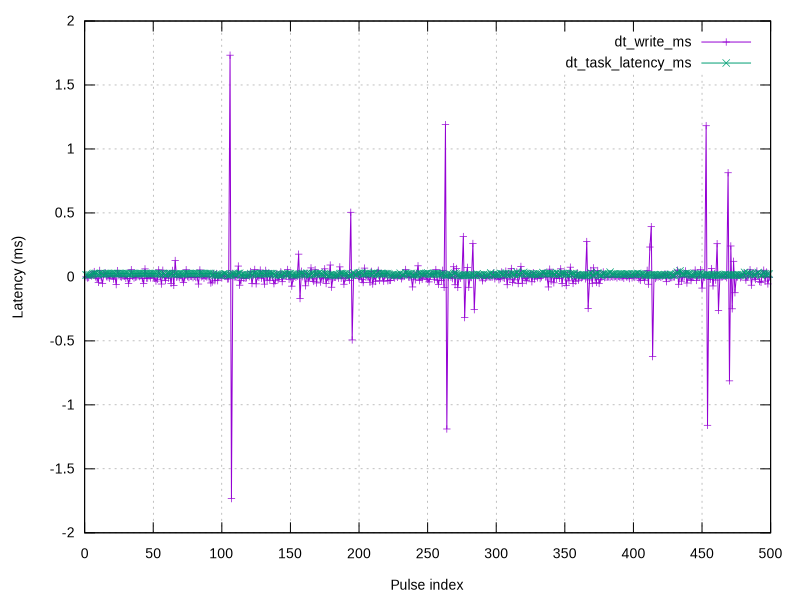
Here I'm making a realtime plot showing The raw data as I tweak things lives here. Initially I see big latency spikes:
timings.scheduler.1.noise.svg
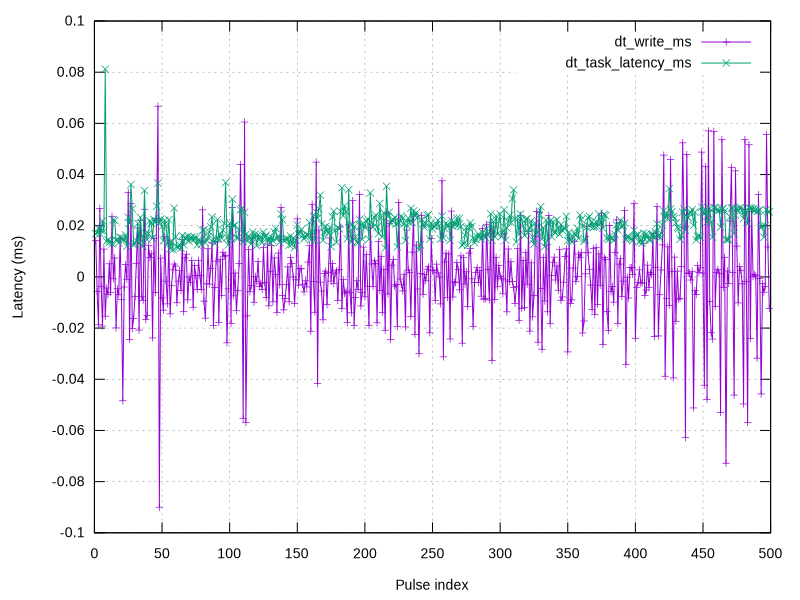
These can be fixed by adjusting the priority of the trigger task. This tells the scheduler to wake that task up first, even if something else is currently using the CPU. I do this:
sudo chrt -p 90  pidof trigger 
And I get better-looking latencies:
timings.scheduler.2.clean.svg
During some experiments (not in this dataset) I would see high helper-task timing instabilities as well. These could be fixed by prioritizing the helper task. In this kernel (6.12) the helper task is called kworker/N where N is the CPU index. I tie the trigger process to cpu 0, and priorities all the relevant helpers:
taskset -c 0 ./trigger 58
pgrep -f kworker/0   while   read pid     sudo chrt -p 90 $pid  
This fixes the helper-task latency spikes. OK, so it looks like on the software side we're good to within 0.1ms of the true period. This is in the ballpark of the precision I need; even this might be too high. It's possible to try to push the software to do better: one could look at the kernel sources a bit more, to do smarter things with priorities or to try an -rt kernel. But all this doesn't matter if the serial hardware adds unacceptable delays. Let's look. Let's look at it with a logic analyzer. I use a saleae logic analyzer with sigrok. The tool spits out the samples as it gets them, and an awk script finds the edges and reports the timings to give me a realtime plot.
samplerate=500000;
pulserate=58.;
sigrok-cli -c samplerate=$samplerate -O csv --continuous -C D1 \
  mawk -Winteractive  \
    "prev_logic==0 && \$0==1 \
       
       iedge = NR;
       if(prev_iedge)
        
         di = iedge -prev_iedge;
         dt = di/$samplerate;
         print(dt*1000);
        
       prev_iedge = iedge;
      
      
       prev_logic=\$0;
       "   feedgnuplot --stream --ylabel 'Period (ms)' --equation "1000./$pulserate title \"True $ pulserate Hz period\""
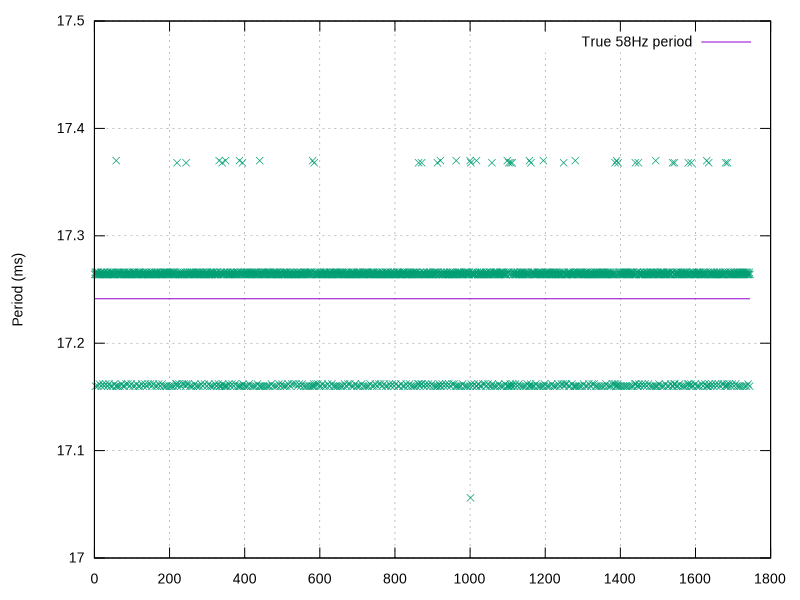
On the server I was using (physical RS-232 port, ancient 3.something kernel):
timings.hw.serial-server.svg
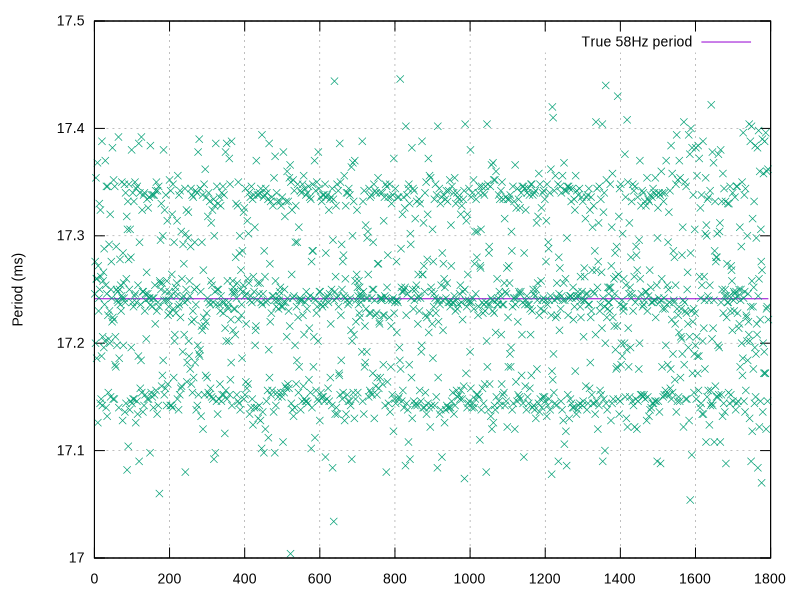
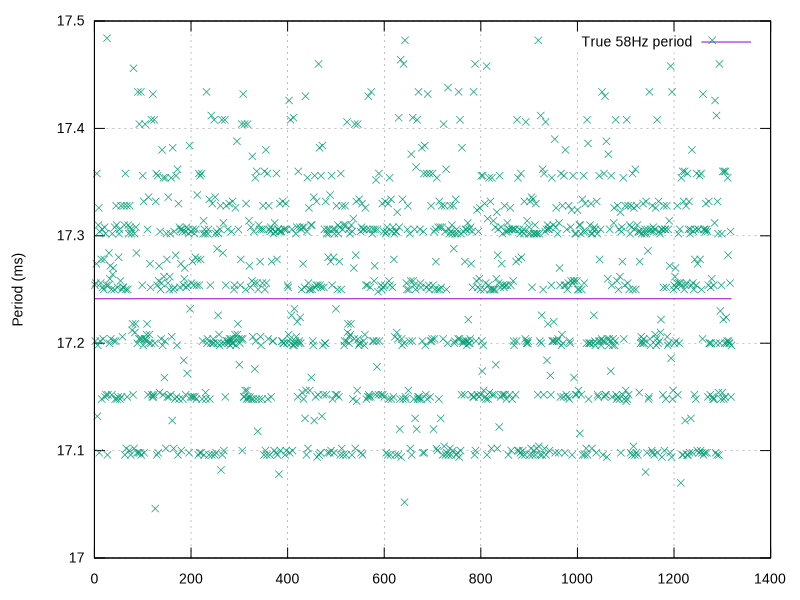
OK This is very discrete for some reason, and generally worse than 0.1ms. What about my laptop (physical RS-232 port, recent 6.12 kernel)?
timings.hw.serial-laptop.svg
Not discrete anymore, but not really any more precise. What about using a usb-serial converter? I expect this to be worse.
timings.hw.usbserial.svg
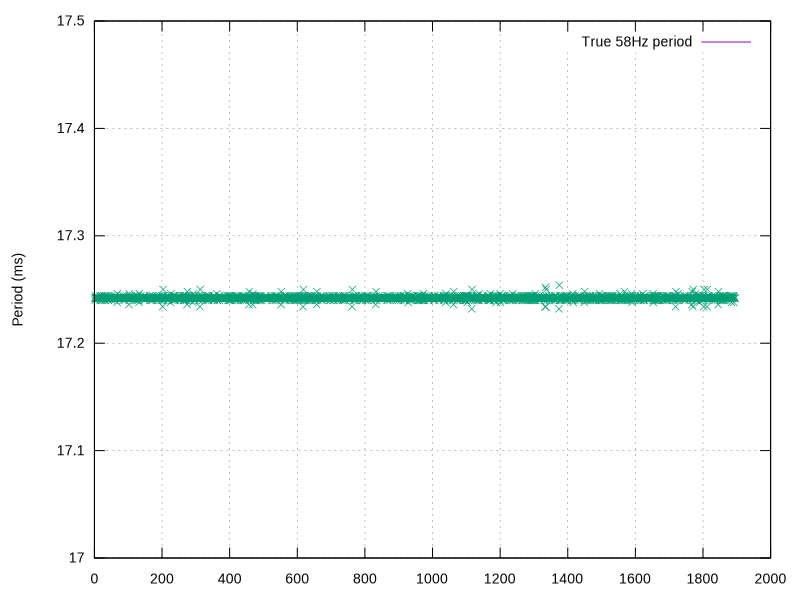
Yeah, looks worse. For my purposes, an accuracy of 0.1ms is marginal, and the hardware adds non-negligible errors. So I cut my losses, and use an external signal generator:
timings.hw.generator.svg
Yeah. That's better, so that's what I use.

Junichi Uekawa: Filing tax this year was really painful.

Filing tax this year was really painful. But mostly because my home network. It was ipv4 over ipv6 was not working correctly. First I swapped the Router which was trying to reinitialize the MAP-E table every time there was a dhcp client reconfiguration and overwhelming the server. Then I changed the DNS configuration not use ipv4 UDP lookup which was overwhelming the ipv4 ports. Tax return itself is a painful process. Debugging network issues is making things was just making everything more painful.

11 March 2025

Freexian Collaborators: Debian Contributions: Debian.Social administration, DebConf 25 preparations, Fixing Time-based test failure in Python requests package and more! (by Anupa Ann Joseph)

Debian Contributions: 2025-02 Contributing to Debian is part of Freexian s mission. This article covers the latest achievements of Freexian and their collaborators. All of this is made possible by organizations subscribing to our Long Term Support contracts and consulting services.

Debian.Social administration, by Stefano Rivera Over the last year, the Debian.social services outgrew the infrastructure that was supporting them. The matrix bridge in particular was hosted on a cloud instance backed by a large expensive storage volume. Debian.CH rented a new large physical server to host all these instances, earlier this year. Stefano set up Incus on the new physical machine and migrated all the old debian.social LXC Containers, libvirt VMs, and cloud instances into Incus-managed LXC containers. Stefano set up Prometheus monitoring and alerts for the new infrastructure and a Grafana dashboard. The current stack of debian.social services seem to comfortably fit on the new machine, with good room to grow.

DebConf 25, by Santiago Ruano Rinc n and Stefano Rivera DebConf 25 preparations continue. The team is currently finalizing a budget. Stefano helped to review the current budget proposals and suggest approaches for balancing it. Stefano installed a Zammad instance to organize queries from attendees, for the registration and visa teams. Santiago continued discussions with possible caterers so we can have options for the different diet requirements and that could fit into the DebConf budget. Also, in collaboration with Anupa, Santiago pushed the first draft changes to document the venue information in the DebConf 25 website and how to get to Brest.

Time-based test failure in requests, by Colin Watson Colin fixed a fun bug in the Python requests package. Santiago Vila has been running tests of what happens when Debian packages are built on a system in which time has been artificially set to somewhere around the end of the support period for the next Debian release, in order to make it easier to do things like issuing security updates for the lifetime of that release. In this case, the failure indicated an expired test certificate, and since the repository already helpfully included scripts to regenerate those certificates, it seemed natural to try regenerating them just before running tests. However, this failed for more obscure reasons and Colin spent some time investigating. This turned out to be because the test CA was missing the CA constraint and so recent versions of OpenSSL reject it; Colin sent a pull request to fix this.

Priority list for outdated packages, by Santiago Ruano Rinc n Santiago started a discussion on debian-devel about packages that have a history of security issues and that are outdated regarding new upstream releases. The goal of the mentioned effort is to have a prioritized list of packages needing some work, from a security point of view. Moreover, the aim of publicly sharing the list of packages with the Debian Developers community is to make it easier to look at the packages maintained by teams, or even other maintainers where help could be welcome. Santiago is planning to take into account the feedback provided in debian-devel and to propose a tooling that could help to regularly bring collective awareness of these packages.

Miscellaneous contributions
  • Carles worked on English to Catalan po-debconf translations: reviewed translations, created merge requests and followed up with developers for more than 30 packages using po-debconf-manager.
  • Carles helped users, fixed bugs and implemented downloading updated templates on po-debconf-manager.
  • Carles packaged a new upstream version of python-pyaarlo.
  • Carles improved reproducibility of qnetload (now reported as reproducible) and simplemonitor (followed up with upstream and pending update of Debian package).
  • Carles collaborated with debian-history package: fixed FTBFS from master branch, enabled salsa-ci and investigated reproducibility.
  • Emilio improved support for automatically marking CVEs as NOT-FOR-US in the security-tracker, closing #1073012.
  • Emilio updated xorg-server and xwayland in unstable, fixing the last round of security vulnerabilities.
  • Stefano prepared a few PyPy and cPython uploads, and started the python3.13-only transition.
  • Helmut Grohne sent patches for 24 cross build failures.
  • Helmut fixed two problems in the Debian /usr-merge analysis tool. In one instance, it would overmatch Debian bugs to issues and in another it would fail to recognize Pre-Depends as a conflict mechanism.
  • Helmut attempted making rebootstrap work for gcc-15 with limited success as very many packages FTBFS with gcc-15 due to using function declarations without arguments.
  • Helmut provided a change to the security-tracker that would pre-compute /data/json during database updates rather than on demand resulting in a reduced response time.
  • Colin uploaded OpenSSH security updates for testing/unstable, bookworm, bullseye, buster, and stretch.
  • Colin fixed upstream monitoring for 26 Python packages, and upgraded 54 packages (mostly Python-related, but also PuTTY) to new upstream versions.
  • Colin updated python-django in bookworm-backports to 4.2.18 (issuing BSA-121), and added new backports of python-django-dynamic-fixture and python-django-pgtrigger, all of which are dependencies of debusine.
  • Thorsten Alteholz finally managed to upload hplip to fix two release critical and some normal bugs. The next step in March would be to upload the latest version of hplip.
  • Faidon updated crun in unstable & trixie, resolving a long-standing request of enabling criu support and thus enabling podman with checkpoint/restore functionality (With gratitude to Salvatore Bonaccorso and Reinhard Tartler for the cooperation and collaboration).
  • Faidon uploaded a number of packages (librdkafka, libmaxminddb, python-maxminddb, lowdown, tox, tox-uv, pyproject-api, xiccd and gdnsd) bringing them up to date with new upstream releases, resolving various bugs.
  • Lucas Kanashiro uploaded some ruby packages involved in the Rails 7 transition with new upstream releases.
  • Lucas triaged a ruby3.1 bug (#1092595)) and prepared a fix for the next stable release update.
  • Lucas set up the needed wiki pages and updated the Debian Project status in the Outreachy portal, in order to send out a call for projects and mentors for the next round of Outreachy.
  • Anupa joined Santiago to prepare a list of companies to contact via LinkedIn for DebConf 25 sponsorship.
  • Anupa printed Debian stickers and sponsorship brochures, flyers for DebConf 25 to be distributed at FOSS ASIA summit 2025.
  • Anupa participated in the Debian publicity team meeting and discussed the upcoming events and tasks.
  • Rapha l packaged zim 0.76.1 and integrated an upstream patch for another regression that he reported.
  • Rapha l worked with the Debian System Administrators for tracker.debian.org to better cope with gmail s requirement for mails to be authenticated.

10 March 2025

Joachim Breitner: Extrinsic termination proofs for well-founded recursion in Lean

A few months ago I explained that one reason why this blog has become more quiet is that all my work on Lean is covered elsewhere. This post is an exception, because it is an observation that is (arguably) interesting, but does not lead anywhere, so where else to put it than my own blog Want to share your thoughts about this? Please join the discussion on the Lean community zulip!

Background When defining a function recursively in Lean that has nested recursion, e.g. a recusive call that is in the argument to a higher-order function like List.map, then extra attention used to be necessary so that Lean can see that xs.map applies its argument only elements of the list xs. The usual idiom is to write xs.attach.map instead, where List.attach attaches to the list elements a proof that they are in that list. You can read more about this my Lean blog post on recursive definitions and our new shiny reference manual, look for Example Nested Recursion in Higher-order Functions . To make this step less tedious I taught Lean to automatically rewrite xs.map to xs.attach.map (where suitable) within the construction of well-founded recursion, so that nested recursion just works (issue #5471). We already do such a rewriting to change if c then else to the dependent if h : c then else , but the attach-introduction is much more ambitious (the rewrites are not definitionally equal, there are higher-order arguments etc.) Rewriting the terms in a way that we can still prove the connection later when creating the equational lemmas is hairy at best. Also, we want the whole machinery to be extensible by the user, setting up their own higher order functions to add more facts to the context of the termination proof. I implemented it like this (PR #6744) and it ships with 4.18.0, but in the course of this work I thought about a quite different and maybe better way to do this, and well-founded recursion in general:

A simpler fix Recall that to use WellFounded.fix
WellFounded.fix : (hwf : WellFounded r) (F : (x :  )   ((y :  )   r y x   C y)   C x) (x :  ) : C x
we have to rewrite the functorial of the recursive function, which naturally has type
F : ((y :  )    C y)   ((x :  )   C x)
to the one above, where all recursive calls take the termination proof r y x. This is a fairly hairy operation, mangling the type of matcher s motives and whatnot. Things are simpler for recursive definitions using the new partial_fixpoint machinery, where we use Lean.Order.fix
Lean.Order.fix : [CCPO  ] (F :      ) (hmono : monotone F) :  
so the functorial s type is unmodified (here will be ((x : ) C x)), and everything else is in the propositional side-condition montone F. For this predicate we have a syntax-guided compositional tactic, and it s easily extensible, e.g. by
theorem monotone_mapM (f :         m  ) (xs : List  ) (hmono : monotone f) :
    monotone (fun x => xs.mapM (f x)) 
Once given, we don t care about the content of that proof. In particular proving the unfolding theorem only deals with the unmodified F that closely matches the function definition as written by the user. Much simpler!

Isabelle has it easier Isabelle also supports well-founded recursion, and has great support for nested recursion. And it s much simpler! There, all you have to do to make nested recursion work is to define a congruence lemma of the form, for List.map something like our List.map_congr_left
List.map_congr_left : (h :   a   l, f a = g a) :
    List.map f l = List.map g l
This is because in Isabelle, too, the termination proofs is a side-condition that essentially states the functorial F calls its argument f only on smaller arguments .

Can we have it easy, too? I had wished we could do the same in Lean for a while, but that form of congruence lemma just isn t strong enough for us. But maybe there is a way to do it, using an existential to give a witness that F can alternatively implemented using the more restrictive argument. The following callsOn P F predicate can express that F calls its higher-order argument only on arguments that satisfy the predicate P:
section setup
variable   : Sort u 
variable   :     Sort v 
variable   : Sort w 
def callsOn (P :     Prop) (F : (  y,   y)    ) :=
    (F': (  y, P y     y)    ),   f, F' (fun y _ => f y) = F f
variable (R :         Prop)
variable (F : (  y,   y)   (  x,   x))
local infix:50 "   " => R
def recursesVia : Prop :=   x, callsOn (    x) (fun f => F f x)
noncomputable def fix (wf : WellFounded R) (h : recursesVia R F) : (  x,   x) :=
  wf.fix (fun x => (h x).choose)
def fix_eq (wf : WellFounded R) h x :
    fix R F wf h x = F (fix R F wf h) x := by
  unfold fix
  rw [wf.fix_eq]
  apply (h x).choose_spec
This allows nice compositional lemmas to discharge callsOn predicates:
theorem callsOn_base (y :  ) (hy : P y) :
    callsOn P (fun (f :   x,   x) => f y) := by
  exists fun f => f y hy
  intros; rfl
@[simp]
theorem callsOn_const (x :  ) :
    callsOn P (fun (_ :   x,   x) => x) :=
   fun _ => x, fun _ => rfl 
theorem callsOn_app
      : Sort uu    : Sort ww 
    (F  :  (  y,   y)        ) -- can this also support dependent types?
    (F  :  (  y,   y)    )
    (h  : callsOn P F )
    (h  : callsOn P F ) :
    callsOn P (fun f => F  f (F  f)) := by
  obtain  F ', h  := h 
  obtain  F ', h  := h 
  exists (fun f => F ' f (F ' f))
  intros; simp_all
theorem callsOn_lam
      : Sort uu 
    (F :     (  y,   y)    ) -- can this also support dependent types?
    (h :   x, callsOn P (F x)) :
    callsOn P (fun f x => F x f) := by
  exists (fun f x => (h x).choose f)
  intro f
  ext x
  apply (h x).choose_spec
theorem callsOn_app2
      : Sort uu    : Sort ww 
    (g :          )
    (F  :  (  y,   y)    ) -- can this also support dependent types?
    (F  :  (  y,   y)    )
    (h  : callsOn P F )
    (h  : callsOn P F ) :
    callsOn P (fun f => g (F  f) (F  f)) := by
  apply_rules [callsOn_app, callsOn_const]
With this setup, we can have the following, possibly user-defined, lemma expressing that List.map calls its arguments only on elements of the list:
theorem callsOn_map (  : Type uu) (  : Type ww)
    (P :     Prop) (F : (  y,   y)        ) (xs : List  )
    (h :   x, x   xs   callsOn P (fun f => F f x)) :
    callsOn P (fun f => xs.map (fun x => F f x)) := by
  suffices callsOn P (fun f => xs.attach.map (fun  x, h  => F f x)) by
    simpa
  apply callsOn_app
    apply callsOn_app
      apply callsOn_const
      apply callsOn_lam
      intro  x', hx' 
      dsimp
      exact (h x' hx')
    apply callsOn_const
end setup
So here is the (manual) construction of a nested map for trees:
section examples
structure Tree (  : Type u) where
  val :  
  cs : List (Tree  )
-- essentially
-- def Tree.map (f :      ) : Tree     Tree   :=
--   fun t =>  f t.val, t.cs.map Tree.map )
noncomputable def Tree.map (f :      ) : Tree     Tree   :=
  fix (sizeOf   < sizeOf  ) (fun map t =>  f t.val, t.cs.map map )
    (InvImage.wf (sizeOf  ) WellFoundedRelation.wf) <  by
  intro  v, cs 
  dsimp only
  apply callsOn_app2
    apply callsOn_const
    apply callsOn_map
    intro t' ht'
    apply callsOn_base
    -- ht' : t'   cs -- !
    --   sizeOf t' < sizeOf   val := v, cs := cs  
    decreasing_trivial
end examples
This makes me happy! All details of the construction are now contained in a proof that can proceed by a syntax-driven tactic and that s easily and (likely robustly) extensible by the user. It also means that we can share a lot of code paths (e.g. everything related to equational theorems) between well-founded recursion and partial_fixpoint. I wonder if this construction is really as powerful as our current one, or if there are certain (likely dependently typed) functions where this doesn t fit, but the above is dependent, so it looks good. With this construction, functions defined by well-founded recursion will reduce even worse in the kernel, I assume. This may be a good thing.

The cake is a lie What unfortunately kills this idea, though, is the generation of the functional induction principles, which I believe is not (easily) possible with this construction: The functional induction principle is proved by massaging F to return a proof, but since the extra assumptions (e.g. for ite or List.map) only exist in the termination proof, they are not available in F. Oh wey, how anticlimactic.

PS: Path dependencies Curiously, if we didn t have functional induction at this point yet, then very likely I d change Lean to use this construction, and then we d either not get functional induction, or it would be implemented very differently, maybe a more syntactic approach that would re-prove termination. I guess that s called path dependence.

Thorsten Alteholz: My Debian Activities in February 2025

Debian LTS This was my hundred-twenty-eighth month that I did some work for the Debian LTS initiative, started by Raphael Hertzog at Freexian. During my allocated time I uploaded or worked on: Last but not least I did some days of FD this month and attended the monthly LTS/ELTS meeting. Debian ELTS This month was the seventy-ninth ELTS month. During my allocated time I uploaded or worked on: Last but not least I did some days of FD this month and attended the monthly LTS/ELTS meeting. Debian Printing This month I uploaded new packages or new upstream or bugfix versions of: This work is generously funded by Freexian! Debian Matomo This month I uploaded new packages or new upstream or bugfix versions of: Finally matomo was uploaded. Thanks a lot to Utkarsh Gupta and William Desportes for doing most of the work to make this happen. This work is generously funded by Freexian! Debian Astro Unfortunately I didn t found any time to upload packages.Have you ever heard of poliastro? It was a package to do calculations related to astrodynamics and orbital mechanics? It was archived by upstream end of 2023. I am now trying to revive it under the new name boinor and hope to get it back into Debian over the next months. This is almost the last month that Patrick, our Outreachy intern for the Debian Astro project, is handling his tasks. He is working on automatic updates of the indi 3rd-party driver. Debian IoT Unfortunately I didn t found any time to work on this topic. Debian Mobcom This month I uploaded new packages or new upstream or bugfix versions of: misc Unfortunately I didn t found any time to work on this topic. FTP master This month I accepted 437 and rejected 64 packages. The overall number of packages that got accepted was 445.

9 March 2025

Dirk Eddelbuettel: RcppNLoptExample 0.0.2: Minor Updates

An update to our package RcppNLoptExample arrived on CRAN earlier today marking the first update since the intial release more than four year ago. The nloptr package, created by Jelmer Ypma, has long been providing an excellent R interface to NLopt, a very comprehensive library for nonlinear optimization. In particular, Jelmer carefully exposed the API entry points such that other R packages can rely on NLopt without having to explicitly link to it (as one can rely on R providing sufficient function calling and registration to make this possible by referring back to nloptr which naturally has the linking information and resolution). This package demonstrates this in a simple-to-use Rcpp example package that can serve as a stanza. More recent NLopt versions appear to have changed behaviour a little so that an example we relied upon in simple unit test now converges to a marginally different numerical value, so we adjusted a convergence treshold. Other than that we did a number of the usual small updates to package metadata, to the README.md file, and to continuous integration. The (very short) NEWS entry follows:

Changes in version 0.0.2 (2025-03-09)
  • Updated tolerance in simple test as newer upstream nlopt change behaviour ever so slightly leading to an other spurious failure
  • Numerous small and standard updates to DESCRIPTION, README.md, badges, and continuous integration setup

Courtesy of my CRANberries, there is also a diffstat report for this release. For questions, suggestions, or issues please use the issue tracker at the GitHub repo.

This post by Dirk Eddelbuettel originated on his Thinking inside the box blog. If you like this or other open-source work I do, you can now sponsor me at GitHub.

Next.

Previous.