Search Results: "joey"

4 February 2008

Julian Andres Klode: Experiences with git and pristine-tar


In the last days, I used git very often. It was almost the first time I really used it, but I quickly understand the basic commands. As some of you may know, the readahead-list package is now maintained in a git repo in the collab-maint project. I decided to use git instead of bzr (which I used for everything before), because of its speed and because I wanted to learn more about git, how it works. I used git-import-dsc to import the first revision, and used debdiffs from 1 to 2 and from 2 to 3 to import the next revisions. Afterwards, I run git-import-orig on the new upstream tarball, which I downloaded and recompressed. Then, I did the packaging changes, added them using ‘git add changed-file‘ and committed them using git commit. After I had done this, I read Planet Debian and saw Joey Hess’s post about the new features of pristine-tar 0.5, i.e. the integration with git. Running Ubuntu at the moment, I fetched the source package, built it and installed it. I then opened a shell in my git repo and ran pristine-tar commit path-to-orig upstream/0.20050517.0220 to import the delta for the first tarball. Afterwards I did it for the second tarball. Because I use git-buildpackage to build the package and Joey said he would like to see support for pristine-tar in git-buildpackage, I then wrote a patch for the programs in git-buildpackage to import and export the orig.tar.gz when needed. The patch can be seen in gitweb, and the maintainer responded in Bug#463580 will integrate the patch with some minor modifications.
Both git and pristine-tar are great works, and it makes it so easy to maintain the readahead-list package. The combination of git, git-buildpackage and pristine-tar is the most powerful I ever used to maintain a Debian package, especially when you are not upstream.

31 January 2008

Joey Hess: generating pristine tarballs from git repositories

With pristine-tar version 0.5, I've added a new feature: The ability to easily inject enough information into a git repository so that a pristine tarball can later be regenerated from that repository. If a package's upstream branch contains the upstream source corresponding to the tarball to be imported, it's very simple to use.
joey@kodama:~/src/fbreader> pristine-tar commit ~/lib/debian/unstable/fbreader_0.8.12.orig.tar.gz 
pristine-tar: committed fbreader_0.8.12.orig.tar.gz.delta to branch pristine-tar
Otherwise, you also have to specify a tag (or any tree-ish really) where the upstream source can be found.
joey@kodama:~/src/fbreader> pristine-tar commit ~/fbreader_0.8.9.orig.tar.gz upstream/0.8.9
pristine-tar: committed fbreader_0.8.9.orig.tar.gz.delta to branch pristine-tar
Here's what it puts in the pristine-tar branch that it creates. In this example, the delta files are 40-some kilobytes, which is much nicer than if I'd had to check the 2 megabyte tarballs into git directly.
joey@kodama:~/src/fbreader> git checkout pristine-tar 
Switched to branch "pristine-tar"
joey@kodama:~/src/fbreader> ls -l
total 104
-rw-r--r-- 1 joey joey 46583 Jan 31 21:26 fbreader_0.8.12.orig.tar.gz.delta
-rw-r--r-- 1 joey joey    40 Jan 31 21:26 fbreader_0.8.12.orig.tar.gz.id
-rw-r--r-- 1 joey joey 45267 Jan 31 21:26 fbreader_0.8.9.orig.tar.gz.delta
-rw-r--r-- 1 joey joey    40 Jan 31 21:26 fbreader_0.8.9.orig.tar.gz.id
Don't forget to push the pristine-tar branch to your server for safekeeping.
joey@kodama:~/src/fbreader> git push origin pristine-tar
Once a tarball's delta is checked in, you can easily and quickly regenerate the original tarball.
joey@kodama:~/src/fbreader> pristine-tar checkout ../fbreader_0.8.12.orig.tar.gz
pristine-tar: successfully generated ../fbreader_0.8.12.orig.tar.gz
Yes, it's really the same file. :-)
joey@kodama:~/src/fbreader> md5sum ~/lib/debian/unstable/fbreader_0.8.12.orig.tar.gz ../fbreader_0.8.12.orig.tar.gz 
8045abe1acc75dbdd220400df541f23f  /home/joey/lib/debian/unstable/fbreader_0.8.12.orig.tar.gz
8045abe1acc75dbdd220400df541f23f  ../fbreader_0.8.12.orig.tar.gz
The above example is from the perspective of a maintainer of a Debian package. But this can also be used by the authors who generate the pristine tarballs in the first place. Check them into git using pristine-tar. Then you can regenerate any tarball you've ever released using just your project's git repository.
joey@kodama:~/src/pristine-tar> pristine-tar commit ../pristine-tar_0.5.tar.gz tags/0.5
pristine-tar: committed pristine-tar_0.5.tar.gz.delta to branch pristine-tar
One word of warning: For pristine-tar to check out the tarball, git needs to be able to check out the tree that you referred to when you committed it in the first place. If that was a tag that you've told git to delete, you're SOL. If it was a branch and the branch has changed in the meantime, that's fine, so long as git can find the original id that is stored in the .tar.gz.id file.
I hope that tools like git-import-orig and git-debimport can get support for automatically calling pristine-tar commit when importing tarballs into git, and that tools like git-buildpackage and gitpkg can use it to check out the tarballs.

26 January 2008

Joey Hess: doorbell

Bee-dum Bee-dum 5 minutes later: Bee-dum 2 minutes later: Bee-dum 1 minute later: Bee-dum Bee-dum Bee-dum Bee-dum Bee-dum Bee-dum
Bee-dum Bee-dum Bee-dum Bee-dum Bee-dum Bee-dum Bee- At this point I ripped my doorbell out and threw it away. Hurrah.

25 January 2008

Neil Williams: collaborative maintenance, source packages, patches and other disagreements

Firstly, I haven't been following debian-devel as closely as in recent months and some things have passed me by. Secondly, I am rather pre-occupied with my own small world of Embedded Debian. One result of this is that I wasn't really paying attention to arguments over the source package format and took longer than I expected to respond to a request to take a look at tslib - a touchscreen library for embedded devices. When I did start work on it I managed to upset Joey Hess by implementing dpatch support which he had recently decried as unhelpful. I also added some extra fuel by getting myself in a two-and-eight over svn-buildpackage and it's broken bias towards native packages.
I happen to disagree with the idea that maintainers should alter upstream files directly, merely relying on the .diff.gz or some weird $RCS runes. Instead, I seek to ensure that the .diff.gz contains no changes outside the debian/ directory. I'm not happy keeping the entire upstream source in yet another RCS (for any reason) and would much rather make updates to my Debian packages by simply copying the debian/ contents into an unpacked pristine upstream source (preferably via uscan). I find it really useful to simply check out the latest CVS/SVN/$RCS, dump debian/ into place and call 'debuild' when testing various upstream development issues. Maybe this is because I have relatively few Debian packages that need debian/patches/* and certainly few that need more than a couple of patch files. It certainly has a lot to do with my embedded work where I need to make changes to the contents of debian/ to make an Emdebian package whilst retaining the same upstream code as is used in existing embedded projects like Open Embedded and Familiar. I don't want to be chasing changes through the upstream source - I want all the changes in a single place so that I can create Emdebian patches against the Debian source. (I'd rather not have patches in the Debian source at all but this is only realistic for either my own packages or those released as part of GPE for various embedded-native compatibility reasons.) I certainly do not want any Debian $RCS to be lumbered with yet another set of upstream sources that will always be out of date compared to the real upstream sources.
I am also a great fan of CDBS - much to the horror of some in Debian - primarily for one very simple reason, it cross builds so easily. Considering my workload, it should not be a surprise that the ability to support cross building without requiring any changes to the Debian package is incredibly persuasive when selecting a build system for a package of my own. debhelper really is woeful at cross building - each package needs customised cross building support painstakingly devised and tested, making script-based mass bug filing impossible. CDBS shows that with a little wrapping, debhelper can support cross building in a clean and completely non-intrusive manner.
This means I can concentrate on those changes that are actually important - the changes that provide the benefits of cross-building and justify the effort of actually cross building the entire dependency chain: the ability to fully control Debian-specifics like "Essential: yes" and to disable, modify or adapt components of any package such that the installed system has a fraction of the dependencies of the Debian version of precisely the same package. TDeb support is good too but that can be implemented against any build, it doesn't need to be a cross build.
Sadly, the end result of all this for tslib is that it will be removed from collab-maint very soon, Joey does not wish to be associated with the new version because although it includes some features which he is happy to see implemented, my use of dpatch and the hacks I had to devise to workaround svn-buildpackage do not fit with his workload patterns. Once tslib is removed from collab-maint, these hacks become redundant and I can use my normal packaging methods. Equally, his methods (in particular the lack of debian/patches/*) do not fit with my workload patterns and although I do not have as many packages as Joey, I have enough (when the 200 Emdebian source packages are also considered) to make the issue into a blocker. The new version of tslib uses the upstream SONAME and adds a -dbg package so it will spend some time in NEW. I am also likely to migrate it to CDBS once removed from collab-maint.
I suspect these issues will be revisited during discussions at Fosdem 2008 where I'll be presenting two talks - one in the Debian developer room and one in the Embedded developer room. Feel free to harangue me if you feel strongly that there is a sane way of cross building that does a better job than CDBS. :-)

Lucas Nussbaum: Re: a problem with tools

Joey has a problem with tools used over dpkg-dev’s core tools to help maintainers maintain their debian packages. I was wondering about the adoption of those tools, so I simply grepped the logs from my last rebuild for “^Setting up $TOOL “, which is more accurate than looking at build-deps, since someteam-pkg-tools could depend on cdbs, and hide cdbs usage. Results, with lists of packages “affected”:
Tool Packages
debhelper 11434 (95.8%)
cdbs 2665 (22.3%)
dpatch 1714 (14.4%)
quilt 935 (7.8%)
dbs 57 (0.47%)
yada 32 (0.27%)
debmake 2 (0.017%)
(if you want me to check the logs for another tool, just tell me) My personal opinion on this is that tools that make sense are slowly getting adopted (that probably includes debhelper, cdbs, dpatch and quilt). The main difference between debhelper and the other tools is that the other tools don’t try to solve a problem for everybody. cdbs perfectly makes sense for some packages: the simple ones, where you only have to modify 4-5 lines in the output from dh_make to build properly. Patch systems are also a good way to track changes made to upstream source, and probably encourage giving back patches to upstream. Note that my stats don’t include packages using cdbs’ simple-patchsys, so there are probably really close to 1/4 or 1/3 of our packages using some sort of patch system. How course, having simple-patchsys, dpatch and quilt sounds a bit stupid. But last time I checked, nobody took the time to blog a comparison of those tools, saying why quilt,dpatch is better than simple-patchsys,dpatch,quilt . Also, simple-patchsys probably makes a good-enough job for its users, so they don’t see the point in changing. Of course, it’s easier to bury your head in the sand, and ignore the fact that those tools solve real problems for so many people and packages, and make their lives easier. :-)

23 January 2008

Joey Hess: a problem with tools

We have a problem with our tools in Debian, and it's this: Above the core tools in dpkg-dev, and the nearly core tools in debhelper and devscripts, and the many different -- but all slowly converging -- revision control systems, there is the potential for infinite cruft to pollute the source package. Note that one developer's cruft is another developer's use of an excellent tool. If you don't believe that, you haven't read a lot of crufy upstream build systems, because Debian isn't the only project with this problem. The source of this cruft is a near-constant stream of new tools that are each developed in good faith by someone who needs that tool, and then adopted and used in packages of a generally small percentage of developers, who think that tool might be a good fit for their problems. The tool isn't yet suitable for everyone to use, and most of these tools never become suitable for everyone, because
  1. making the leap from a special-purpose, poorly-designed hack to a general-purpose tool is hard
  2. getting the project to standardise on a tool is hard
  3. a tool often doesn't become general purpose until enough people use it, no matter how well designed it is to start out with
So after a while, a better, or at least different, solution to some of the same problems will come along, and some generally small percentage of developers will choose to use it in their source packages. Meanwhile, the developers who chose the old thing will be set in their ways and not want to use the new thing, and generally cannot be budged to stop using the old thing by any amount of argument. Which in a sense is normal, and fine, until you have to collaborate with them. I don't care if someone I'm collaborating with uses emacs to my vim, but I do care if they use cdbs to my debhelper. I care because their tool-choice encrufts the source that I'm supposed to be working on. Once a significant percentage of all the source packages in Debian are encrufted for a wide array of different tools, it will become harder and harder to work with Debian's source packages. We're already seeing this happen. Another way of looking at it is that we've invented dozens of source package formats that all work differently, aside from a small shared core, and we expect our developers to be able to use all of them. At this point I see this as a huge, potentially killer problem, that is making Debian development become worse with every passing year. But I have no real solution. Obviously pointing out that tools are obsoleted or bad doesn't work; we still have dozens of packages using yada, which everyone agrees is horrible. That doesn't bode well, does it? One partial solution is to design a category killer, and get it embedded in acknowledged core tools. That's what I have tried, and so far, failed, to do with an evolutionary change to the Debian source package format, which I'd hope would give people a reason to stop using dpatch, dbs, and their ilk. As noted, this approach is Hard.
For now, I have no interest in being on a team that requires I use any of the following things: This means that I can't be on the security or release teams, and even teams like the perl team are getting sticky to be on.
PS, this doesn't mean I dislike quilt. I dislike quilt encrufting Debian source packages, which is entirely different. PPS, In case you're wondering why debhelper gets a pass, it's because it's gone through the three numbered steps above to become a standard, general purpose tool, and has no serious competators. (Though it does have parasites, like cdbs.)

21 January 2008

Christian Perrier: Syncing translations when releasing?

Joey, just don't delay your releases waiting for incoming translations. Gettext is anyway smart enough to not use translations when they're non-existing (aha) of fuzzy. So, an incomplete translation for a program will just end up in a partially translated program. That's actually the case for *many* localized software, including the big ones. I suggest that you apply such a schedule: But, as you suspected, releasing without synchronised translations is the better choice....as long as you care abou tsending call for updates when needed. BTW, if you need some help to coordinate incoming translations for apt-key, maybe ask on debian-i18n and someone will eventually pop up (hopefully, not /me).

20 January 2008

Joey Hess: thoughts

In the woods on a chilly day. I've been walking around enjoying ice covered waterfalls and creek. I was up late last night reading Julain Dibbell's My Tiny Life, and wandering around a deserted LamdaMOO as Rosy Guest, finding some of the places in the book still there with little change over a decade later. This was engrossing, but mostly depressing, I kept finding too many parallels to things I don't like about the communities I'm active in online. I was on LambdaMOO briefly myself ten years ago, but only long enough to decide I needed to set up my own moo so I could freely build. Reading this book makes me glad I missed all the drama. I didn't realize how cold it was last night until the heat just wouldn't stay off, though I had it on the lowest setting. Having the heat on explains why I woke up with a scratchy eye and stuffed nose -- but not why only one side of my face was affected and the other side fine. Brr, my hands are getting cold..

19 January 2008

Christian Perrier: Half goodbye, dselect

The dpkg maintenance team just changed the priority of the good old dselect from Important to Optional. Simultaneously, overrides were changed by FTP masters. As a consequence, dselect will no longer be installed by default when installing a "standard" Debian system. Thanks to the dpkg maintainers for the first move (Required->Important), as well as Joey Hess who suggested to downgrade from Important to Optional. Old timers, this is time for a little tear in memory of dselect..:-)...as well as a thought to people who wrote and maintained it (it is still in the archive and part of dpkg source package but noone really maintains it, now). Time to hunt a few more "Important" packages that should be downgraded.

15 January 2008

Joey Hess: high country

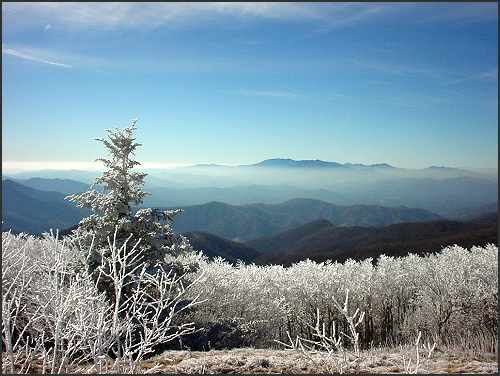
The past few weekends I've been drawn to the mountains. Two weeks ago I went up on Holston mtn after the snow had melted down here, and enjoyed a snowy hike on the AT. From there I drove over to Shady valley, and found the only gas station I've seen with a wood stove in it. I've never enved a gas station attendant their workplace before, but that was nice. Last weekend Maggie and I went up to Roan mtn. On road up we began to get glimpses of the peak in between the fog, and it looked strange, almost like there was snow, but not as white as you'd expect. While the ground was clear of snow, the windward side of each pine, rhododendron, and leaf of grass in the balds was outlined in a thick coat of frost. Gorgeous. As a sheltered Southerner, I've never seen anything like it, but I think it was soft rime, formed from the fog. We wished we'd brought a camera, but thanks to the magic of the 'net, here's a similar rime on Roan: rimeonroan.jpg

11 January 2008

Joey Hess: my first terabyte

I bought one of the new terabyte drives, to double the storage space on my home network. I put it in a Thecus, so I have a terabyte of storage in a computer about the size of my first computer's floppy disk drive.

9 January 2008

Joey Hess: Mar del Plata

Porte os greeted the new year by fleeing the city as fast as gridlocked roads could take them. January is the month Buenos Aires takes its summer vacation, and the destination of choice is Mar del Plata, a seaside resort I have never visited. Given my love for crowds, heat and strangers' children it sounds it would be my own personal Mordor. "You can't even see the sand for all the people! It's an absolute madhouse!" Argentine friends tell me in horror, as they pack up their cars to head down there.
-- from Idle Words Makes me glad that I'll be there in the August chill for DebConf 8. I hope.

8 January 2008

Joey Hess: ship in a bottle

I'm about to release debhelper 6.0.0. But this blog is really about CDBS, and why it's entirely unlike debhelper despite being based on it.
With CDBS you're building a ship in a bottle. You have all the same tools available, but there's this bottle in the way, which doesn't let you bring any of them fully to bear, and requires all your techniques be changed around to fit its limited interface. This is a beautiful example of the kind of fun you're setting yourself up for by chosing CDBS. With debhelper, two commands can be easily reordered. With CDBS, you need three magic environment variables and either a hardcoded package name or some grody Makefile code: http://lists.debian.org/debian-python/2008/01/msg00039.html

6 January 2008

Christian Perrier: Number of bugs reported in Debian per year

This week-end, among other things, I played a little to get the number of bugs reported overs years in the Debian BTS. Here are the results:
2007: 53337
2006: 59665
2005: 57436
2004: 62327
2003: 50836
2002: 47618
2001: 46289
2000: 27181
1999: 22448
1998: 15002
1997:  9987
1996:  4205
1995: 2158
First bug for each year:
2008: 458489 Petter Reinholdtsen -> sysqrd Closed (in unstable)
2007: 405152 Martin-Eric Racine -> myspell-lv Closed
2006: 345487 Erich Schubert -> lintian Opened
2005: 288051 Nick Sillik -> gstreamer-misc Closed
2004: 225724 Peter van Rossum -> mldonkey-server Closed
2003: 174888 Chris Garguzi -> hotkeys Closed
2002: 127270 root@ttimo.net ->libapache-mod-auth-pam Closed
2001: 80981  William Steve Applegate -> php4 Closed
2000: 53800  Hamish Moffatt -> sattrack Closed
1999: 31352  Richard Stallman -> dselect Opened LOOK THIS ONE
1998: 16350  Joey Hess -> xbase-clients Closed
1997:  6363  Andreas Jellinghaus -> mgetty-fax Closed
1996:  2158  Ian Jackson -> ncurses3.0 Closed
1995:   563  Ian Jackson -> tar Closed
A few interesting things there: Anyone feeling like doing the same for Launchpad? And, for those who wonder, I of course did all this by hand. No fancy automated script, just my hands and some (little) hammering of the BTS.

4 January 2008

Joey Hess: announcement: alioth ikiwiki upgrade

Yesterday alioth's ikiwiki was upgraded from 1.x to 2.x. About 15 or so people seem to use ikiwiki on alioth. If you do, please read this page for instructions about the upgrade and some other hints. There are some incompatible changes in 2.x, most notably usedirs.

Joey Hess: git tube map

Does anyone else enjoy using git just to produce images like this in gitk? I can't look at this without imagining it as a london-tube-esque map of a public transport system that wisked my code up to its current exaulted state at the top of the Red Line. gitk.png (Officially a git fanboy now obviously.)

Anthony Towns: User configuration

Inspired mostly by Joey’s nonchalant way of dealing with the death of his laptop…
This seems less of a disaster than other times a laptop’s disk has died on me. When did it start to become routine? […] My mr and etckeeper setup made it easy to check everything back out from revision control. […]
…I’ve been looking at getting all my stuff version controlled too. I’ve just gotten round to checking all my dotfiles into git, and it crossed my mind that it’d be nice if I could just set an environment variable to tell apps to create their random new dot-files directly in my “.etc-garbage” repo. I figured using “$USER_ETC/foo” instead of “$HOME/.foo” would be pretty easy, and might be a fun release goal that other Debian folks might be interested in, so I did a quick google to see if something similar had already been suggested. The first thing I stumbled upon was a mail from the PLD Linux folks who apparently were using $HOME_ETC at one time which sounded pretty good, though it doesn’t seem to have gotten anywhere. That thread included a pointer to the system that has gotten somewhere which is the XDG spec. It’s actually pretty good, if you don’t mind it being ugly as all hell. They define three classes of directory – configuration stuff, non-essential/cached data, and other data. That more or less matches the /etc, /var/cache and /var/lib directories for the system-wide equivalents, though if the “other data” is stuff that can be distributed by the OS vendor it might go in /usr/lib or /usr/share (or the /usr/local/ equivalents) too. Which is all well and good. Where it gets ugly is the naming. For the “/etc” configuration stuff, we have the environment variable $XDG_CONFIG_HOME, which defaults to ~/.config, and has a backup path defined by $XDG_CONFIG_DIRS, which defaults to /etc/xdg. For the “/var/lib” other data stuff, we have the environment variable $XDG_DATA_HOME, which defaults to ~/.local/share, and has a backup path defined by $XDG_DATA_DIRS, which defaults to /usr/local/share:/usr/share. (Though if you’re using gdm, it’ll get set for you to also include /usr/share/gdm) And for the “/var/cache” stuff, we have the environment variable $XDG_CACHE_HOME, which defaults to ~/.cache. That seems to me like exactly the right idea, with way too much crap on it. If you simplify it obsessively – using existing names, dropping the desktop-centrism, you end up with: Put configuration files in $HOME_ETC/foo or $HOME/.foo. For shared/fallback configuration, search $PATH_ETC if it’s set, or just /etc if it’s not. Put data files in $HOME_LIB/foo or $HOME/.foo. For shared data, search $PATH_LIB if it’s set, or look through /var/lib, /usr/local/ lib,share and /usr/ lib,share if it’s not. Put caches in $HOME_CACHE/foo or $HOME/.foo. For shared caches, search $PATH_CACHE if it’s set, or just look in /var/cache if it’s not. That seems much simpler to me to the point of being self-explanatory, and much more in keeping with traditional Unix style. It’s also backwards compatabile if you use both old and new versions of a program with the same home directory (or you happen to like dotfiles). And having the XDG variables set based on the above seems pretty easy too. I wonder what other people think – does HOME,PATH _ ETC,LIB,CACHE seem sensible, or is XDG_ CONFIG,DATA,CACHE _ HOME,DIRS already entrenched enough that it’s best just to accept what’s fated?

3 January 2008

Anthony Towns: tempus fugit

I blogged a fair bit about darcs some time ago, but since then I’ve not been able to get comfortable with the patch algebra’s approach to dealing with conflicting merges – I think mostly because it doesn’t provide a way for the user to instruct darcs on how to recover from a conflict and continue on. I’ve had a look at bzr since then, but it just feels slow, to the point where I tend to rsync things around instead of using it properly, and it just generally hasn’t felt comfortable. On the other hand, a whole bunch of other folks I respect have been a bit more decisive than I have on this, and from where I sit, there’s been a notable trend:
Keith Packard, Oct 2006
Repository formats matter, Tyrannical SCM selection
Ted Tso, Mar 2007
Git and hg
Joey Hess, Oct 2007
Git transitions, etckeeper, git archive as distro package format
Of course, Rusty swings the other way, as do the OpenSolaris guys. The OpenSolaris conclusions seem mostly out of date if you’re able to use git 1.5, and I haven’t learnt quilt to miss its mode of operation the way Rusty does. And as far as the basics go, Carl Worth did an interesting exercise in translating an introduction to Mercurial into the equivalent for git, so that looks okay for git too.

1 January 2008

Joey Hess: leap second mystery

Clock: inserting leap second 23:59:60 UTC
Happy leap second, everyone. The earth's rotation slowed by another second, and the extra second was added just before the new year. Or did it? According to the NIST "NOTE: No leap second will be added at the end of December 2007" So why did some of my machines see one and some not? All are running NTP, all using pool.ntp.org. Perhaps some NTP servers in the pool falsely inserted a leap second? According to this thread I'm not the only one to notice spurious leap seconds, one also happened in July 07, and this page documents one in July 06 with some great graphs. Figuring out whodonit is tricky.. (Insert conspiracy theory,thriller plot here.)

Joey Hess: big storm coming

Somewhere at the beginning of the holiday madness, which seems like a long couple of weeks ago, my laptop crashed and came up with a bad superblock. That's Not Good, but fsck fixed it, and I was too busy preparing for company and parties and trips and stuff to do anything about it. And forgot about it. Of course it died. Right before new years, and with only 5 minutes advance warning from SMART before it started spewing IO errors and corrupting files. I have a new drive on order, and am running diskless from NFS over wireless, which is an amusing way to use a laptop, but acceptable if you don't plan to go anywhere for a few days. Maybe they'll be snowbound days. This seems less of a disaster than other times a laptop's disk has died on me. When did it start to become routine? Maybe this will be the second to last time -- I certianly hope that my next laptop has a flash disk. The Debian Live CDs were quite helpful before I set up the NFS, and I even managed to use the default gnome desktop for an evening with them, without utterly hating it. My mr and etckeeper setup made it easy to check everything back out from revision control. So the tools for dealing with a dead laptop disk are improved, though d-i still doesn't support installs over NFS, which would have saved me some time setting that up. The first snow is starting to fall..

Next.

Previous.