Search Results: "jan"

1 February 2016

Mike Gabriel: My FLOSS activities in January 2016

In January 2016 I was finally able to work on various FLOSS topics again (after two months of heavily focussed local customer work): Upload of MATE 1.12 to Debian testing/unstable At the beginning of the new year, I finalized the bundle upload of MATE 1.12 to Debian unstable [1]. All uploaded packages are available in Debian testing (stretch) and Ubuntu xenial by now. MATE 1.12 will also be the version shipped in Ubuntu MATE 16.04 LTS. Additionally, I finally uploaded caja-dropbox to Debian unstable (non-free), thanks to Vangelis Mouhtsis and Martin Wimpress for doing first steps preparations. The package has already left Debian's NEW queue, but unfortunately has been removed from Debian testing (stretch) again due to build failures in one of its dependencies. Debian LTS work In January 2016 I did my first round of Debian LTS front desk work [2]. Before actually starting with my front desk duty, I worked myself through the documentation and found it difficult to understand the output of the lts-cve-triage.py script. So, I proposed various improvments to the output of that script (all committed by now). During the second week of January then, I triaged the following packages regarding known/open CVE issues: read more

Stein Magnus Jodal: January contributions

The following is a short summary of my open source work in January, just like I did back in November and December.

Debian

Mopidy
  • PR #1381: Made lookup() ignore tracks without URI.
  • Updated docs for Raspberry Pi installation to match Raspbian jessie.
  • Rewrote docs for running Mopidy as a service, more focused on systemd than Debian specifics to also cater for Arch users.
  • PR #1397: Added missing MPD volume command.
  • Merged a bunch of contributed fixes and released Mopidy 1.1.2.
  • Updated all extensions hosted under the Mopidy GitHub organization with either the name of the primary maintainer or a call for a new maintainer. The extensions in need of a new maintainer are: If you re a user of any of these and want to contribute, please step up. Instructions can be found in the README of any of these projects.
  • The feature/gst1 branch is complete as far as I know. There are no known regressions from Mopidy 1.1.2. PR #1419 is hopefully the last iteration of the pull request and GStreamer 1.x support will land in Mopidy 1.2.
  • Wrapping up the 1.2 release is now the focus. We might want to include this in Debian/Ubuntu before the Ubuntu 16.04 import freeze February 18, depending on feedback over the next week or two.

Comics
  • Added one new crawler.
  • Released comics 2.4.2.
  • Merged one new crawler and a crawler update.

31 January 2016

Thorsten Alteholz: My Debian Activities in January 2016

FTP assistant This month I marked 281 package for accept and rejected 58, so almost back to normal processing. I also sent 19 emails to maintainers asking questions. As mentioned in October the accept-number has reached another milestone. I accepted package 6666 on 20151221, it was python-skbio_0.4.1-1. The winner of a fast processed package with the best guess of this date is: *tata* Javi. Ok, he was the only participant :-) . So, who can guess the date of 7777? Squeeze LTS This was my nineteenth month that I did some work for the Squeeze LTS initiative, started by Raphael Hertzog at Freexian. This month several people had to reduce their contribution, so all in all I got a workload of 30h. Altogether I uploaded those DLAs: For the first time this month, I was also involved in three embargoed uploads. Ben and I were informed about some security issues before they got published and I prepared the DLAs. Although the real upload for all suites were still done by the security team, it was really exciting. I also spent some time on #796095 and prepared another patch for review. Further I am almost done with the next upload of PHP 5.3. Just before starting dupload, another issue appeared. As I think that this will be the last upload of PHP for Squeeze LTS, I also want to take care of this latecomer. The upload of krb5 is waiting in the pipeline, I am just waiting for a confirmation that everything is fine. This month I also had another term of doing frontdesk work and looked for CVEs that are important for Squeeze LTS or could be ignored. As Wheezy LTS is just before the start, I already prepared the new build environment. So either now or later in April, I am ready Other stuff Due to the high LTS workload, there was no time for other stuff :-( .

Chris Lamb: Free software activities in January 2016

Here is my monthly update covering a large part of what I have been doing in the free software world (previously):
Debian
  • Had a talk proposal accepted (Reproducible Builds - fulfilling the original promise of free software) at FOSSASIA 16.
My work in the Reproducible Builds project was also covered in more depth in Lunar's weekly reports (#35, #36, #37, #38, #39)
LTS

This month I have been paid to work 18 hours on Debian Long Term Support (LTS). In that time I did the following:
  • Sevend days of "frontdesk" duties, triaging CVEs, etc.
  • Issued DLA 386-1 for cacti to patch an SQL injection vulnerability.
  • Issued DLA 388-1 for dwarfutils fixing a NULL deference issue.
  • Issued DLA 391-1 for prosody correcting the use of a weak pseudo-random number generator.
  • Issued DLA 404-1 for nginx to prevent against an invalid pointer deference.

Uploads
  • redis (2:3.0.7-1) New upstream stable release, also ensure that test processes are cleaned up and replacing an existing reproducibility patch with a SOURCE_DATE_EPOCH solution.
  • python-django (1.9.1-1) New upstream release.
  • disque (1.0~rc1-4) Make the build reproducible via SOURCE_DATE_EPOCH, ensure that test processes are cleaned up and that the nocheck flag is correctly honoured.
  • gunicorn (19.4.5-1) New upstream release.
  • redis (2:3.2~rc3-1) New upstream RC release (to experimental).


RC bugs


I also filed 100 FTBFS bugs against apache-log4j2, awscli, binutils, brian, ccbuild, coala, commons-beanutils, commons-vfs, composer, cyrus-sasl2, debiandoc-sgml-doc-pt-br, dfvfs, dillo, django-compat, dulwich, git-annex, grpc, hdf-eos5, hovercraft, ideviceinstaller, ircp-tray, isomd5sum, javamail, jhdf, jsonpickle, kivy, klog, libcloud, libcommons-jexl2-java, libdata-objectdriver-perl, libdbd-sqlite3-perl, libpam-krb5, libproc-waitstat-perl, libslf4j-java, libvmime, linuxdcpp, lsh-utils, mailutils, mdp, menulibre, mercurial, mimeo, molds, mugshot, nose, obex-data-server, obexfs, obexftp, orafce, p4vasp, pa-test, pgespresso, pgpool2, pgsql-asn1oid, php-doctrine-cache-bundle, php-net-ldap2, plv8, pngtools, postgresql-mysql-fdw, pyfftw, pylint-common, pylint-django, pylint-django, python-ase, python-axiom, python-biopython, python-dcos, python-falcon, python-instagram, python-markdown, python-pysam, python-requests-toolbelt, python-ruffus, pytsk, pyviennacl, ros-class-loader, ros-ros-comm, ros-roscpp-core, roxterm, ruby-celluloid-extras, ruby-celluloid-fsm, ruby-celluloid-supervision, ruby-eye, ruby-net-scp, ruby-net-ssh, ruby-sidekiq, ruby-sidekiq-cron, ruby-sinatra-contrib, seaview, smc, spatial4j-0.4, swift-plugin-s3, tilecache, typecatcher, ucommon, undertaker, urdfdom, ussp-push, xserver-xorg-video-intel & yt.

FTP Team

As a Debian FTP assistant I ACCEPTed 201 packages: abi-tracker, android-platform-build, android-platform-frameworks-native, android-platform-libcore, android-platform-system-core, animate.css, apitrace, argon2, autosize.js, bagel, betamax, bittorrent, bls-standalone, btfs, caja-dropbox, cegui-mk2, complexity, corebird, courier-authlib, cpopen, ctop, dh-haskell, django-python3-ldap, e2fsprogs1.41, emacs-async, epl, fast5, fastkml, flask-restful, flask-silk, gcc-6, gitlab, golang-github-kolo-xmlrpc, golang-github-kr-fs, golang-github-pkg-sftp, golang-github-prometheus-common, google-auth-library-php, h5py, haskell-aeson-compat, haskell-userid, heroes, hugo, ioprocess, iptables, ivy-debian-helper, ivyplusplus, jquery-timer.js, klaus, kpatch, lazarus, libatteanx-store-sparql-perl, libbrowserlauncher-java, libcgi-test-perl, libdata-sah-normalize-perl, libfsntfs, libjs-fuzzaldrin-plus, libjung-free-java, libmongoc, libmygpo-qt, libnet-nessus-rest-perl, liborcus, libperinci-sub-util-propertymodule-perl, libpodofo, librep, libsodium, libx11-xcb-perl, linux, linux-grsec-base, list.js, lombok, lua-mediator, luajit, maven-script-interpreter, midicsv, mimeo, miniasm, mlpack, mom, mosquitto-auth-plugin, moxie.js, msgpuck, nanopolish, neovim, netcdf, network-manager-applet, network-manager-ssh, node-esprima-fb, node-mocks-http, node-schlock, nomacs, ns3, openalpr, openimageio, openmpi, openms, orafce, pbsim, pd-iemutils, pd-nusmuk, pd-puremapping, pd-purest-json, pg-partman, pg-rage-terminator, pgfincore, pgmemcache, pgsql-asn1oid, php-defaults, php-jwt, php-mf2, php-redis, pkg-info-el, plr, pnmixer, postgresql-multicorn, postgresql-mysql-fdw, powa-archivist, previsat, pylint-flask, pyotherside, python-caldav, python-cookies, python-dcos, python-flaky, python-flickrapi, python-frozendict, python-genty, python-git, python-greenlet, python-instagram, python-ironic-inspector-client, python-manilaclient, python-neutronclient, python-openstackclient, python-openstackdocstheme, python-prometheus-client, python-pymzml, python-pysolr, python-reno, python-requests-toolbelt, python-scales, python-socketio-client, qdox2, qgis, r-cran-biasedurn, rebar.js, repmgr, rfcdiff, rhythmbox-plugin-alternative-toolbar, ripe-atlas-cousteau, ripe-atlas-sagan, ripe-atlas-tools, ros-image-common, ruby-acts-as-list, ruby-allocations, ruby-appraiser, ruby-appraiser-reek, ruby-appraiser-rubocop, ruby-babosa, ruby-combustion, ruby-did-you-mean, ruby-fixwhich, ruby-fog-xenserver, ruby-hamster, ruby-jeweler, ruby-mime-types-data, ruby-monkey-lib, ruby-net-telnet, ruby-omniauth-azure-oauth2, ruby-omniauth-cas3, ruby-puppet-forge, ruby-racc, ruby-reek, ruby-rubinius-debugger, ruby-rubysl, ruby-rubysl-test-unit, ruby-sidekiq-cron, ruby-threach, ruby-wavefile, ruby-websocket-driver, ruby-xmlhash, rustc, s-nail, scrm, select2.js, senlin, skytools3, slurm-llnl, sphinx-argparse, sptk, sunpy, swauth, swift, tdiary, three.js, tiny-initramfs, tlsh, ublock-origin, vagrant-cachier, xapian-core, xmltooling, & yp-tools. I additionally REJECTed 29 packages.

30 January 2016

Lars Wirzenius: Obnam 1.19.1 released (backup software)

I have just released version 1.19.1 of Obnam, the backup program. See the website at http://obnam.org for details on what the program does. The new version is available from git (see http://git.liw.fi) and as Debian packages from http://code.liw.fi/debian, and uploaded to Debian, and soon in unstable. The NEWS file extract below gives the highlights of what's new in this version. Basically, it fixes a bug. NOTE: Obnam has an EXPERIMENTAL repository format under development, called green-albatross. It is NOT meant for real use. It is likely to change in incompatible ways without warning. Do not use it unless you're willing to lose your backup. Version 1.19.1, released 2016-01-30 Bug fix:

29 January 2016

Jan Wagner: Oxidized - silly attempt at (Really Awesome New Cisco confIg Differ)

Since ages I wanted have replaced this freaking backup solution of our Network Equipment based on some hacky shell scripts and expect uploading the configs on a TFTP server. Years ago I stumbled upon RANCID (Really Awesome New Cisco confIg Differ) but had no time to implement it. Now I returned to my idea to get rid of all our old crap.
I don't know where, I think it was at DENOG2, I saw RANCID coupled with a VCS, where the NOC was notified about configuration (and inventory) changes by mailing the configuration diff and the history was indeed in the VCS.
The good old RANCID seems not to support to write into a VCS out of the box. But for the rescue there is rancid-git, a fork that promises git extensions and support for colorized emails. So far so good. While I was searching for a VCS capable RANCID, somewhere under a stone I found Oxidized, a 'silly attempt at rancid'. Looking at it, it seems more sophisticated, so I thought this might be the right attempt. Unfortunately there is no Debian package available, but I found an ITP created by Jonas. Anyway, for just looking into it, I thought the Docker path for a testbed might be a good idea, as no Debian package ist available (yet). For oxidized configuration is only a configfile needed and as nodes source a rancid compatible router.db file can be used (beside SQLite and http backend). A migration into a production environment seems pretty easy. So I gave it a go. I assume Docker is installed already. There seems to be a Docker image on Docker Hub, that looks official, but it seems not maintained (actually). An issue is open for automated building the image.

Creating Oxidized container image The official documentation describes the procedure. I used a slightly different approach.
docking-station:~# mkdir -p /srv/docker/oxidized/  
docking-station:~# git clone https://github.com/ytti/oxidized \  
 /srv/docker/oxidized/oxidized.git
docking-station:~# docker build -q -t oxidized/oxidized:latest \  
 /srv/docker/oxidized/oxidized.git
I thought it might be a good idea to also tag the image with the actual version of the gem.
docking-station:~# docker tag oxidized/oxidized:latest \  
 oxidized/oxidized:0.11.0
docking-station:~# docker images   grep oxidized  
oxidized/oxidized   latest    35a325792078  15 seconds ago  496.1 MB  
oxidized/oxidized   0.11.0    35a325792078  15 seconds ago  496.1 MB  
Create initial default configuration like described in the documentation.
docking-station:~# mkir -p /srv/docker/oxidized/.config/  
docking-station:~# docker run -e CONFIG_RELOAD_INTERVAL=600 \  
 -v /srv/docker/oxidized/.config/:/root/.config/oxidized \
 -p 8888:8888/tcp -t oxidized/oxidized:latest oxidized

Adjusting configuration After this I adjusted the default configuration for writing a log, the nodes config into a bare git, having nodes secrets in router.db and some hooks for debugging.

Creating node configuration
docking-station:~# echo "7204vxr.lab.cyconet.org:cisco:admin:password:enable" >> \  
 /srv/docker/oxidized/.config/router.db
docking-station:~# echo "ccr1036.lab.cyconet.org:routeros:admin:password" >> \  
 /srv/docker/oxidized/.config/router.db

Starting the oxidized beast
docking-station:~# docker run -e CONFIG_RELOAD_INTERVAL=600 \  
 -v /srv/docker/oxidized/.config/:/root/.config/oxidized \
 -p 8888:8888/tcp -t oxidized/oxidized:latest oxidized
Puma 2.16.0 starting...  
* Min threads: 0, max threads: 16
* Environment: development
* Listening on tcp://127.0.0.1:8888
If you want to have the container get started with the docker daemon automatically, you can start the container with --restart always and docker will take care of it. If I wanted to make it running permanent, I would use a systemd unitfile.

Reload configuration immediately If you don't want to wait to automatically reload of the configuration, you can trigger it.
docking-station:~# curl -s http://localhost:8888/reload?format=json \  
 -O /dev/null
docking-station:~# tail -2 /srv/docker/oxidized/.config/log/oxidized.log  
I, [2016-01-29T16:50:46.971904 #1]  INFO -- : Oxidized starting, running as pid 1  
I, [2016-01-29T16:50:47.073307 #1]  INFO -- : Loaded 2 nodes  

Writing nodes configuration
docking-station:/srv/docker/oxidized/.config/oxidized.git# git shortlog  
Oxidizied (2):  
      update 7204vxr.lab.cyconet.org
      update ccr1036.lab.cyconet.org
Writing the nodes configurations into a local bare git repository is neat but far from perfect. It would be cool to have all the stuff in a central VCS. So I'm pushing it every 5 minutes into one with a cron job.
docking-station:~# cat /etc/cron.d/doxidized  
# m h dom mon dow user  command                                                 
*/5 * * * *    root    $(/srv/docker/oxidized/bin/oxidized_cron_git_push.sh)
docking-station:~# cat /srv/docker/oxidized/bin/oxidized_cron_git_push.sh  
#!/bin/bash
DOCKER_OXIDIZED_BASE="/srv/docker/oxidized/"  
OXIDIZED_GIT_DIR=".config/oxidized.git"
cd $ DOCKER_OXIDIZED_BASE /$ OXIDIZED_GIT_DIR   
git push origin master --quiet  
Now having all the nodes configurations in a source code hosting system, we can browse the configurations, changes, history and even establish notifications for changes. Mission accomplished! Now I can test the coverage of our equipment. The last thing that would make me super happy, a oxidized Debian package!

24 January 2016

Lunar: Reproducible builds: week 39 in Stretch cycle

What happened in the reproducible builds effort between January 17th and January 23rd:

Toolchain fixes James McCoy uploaded subversion/1.9.3-2 which removes -Wdate-time from CPPFLAGS passed to swig enabling several packages to build again. The switch made in binutils/2.25-6 to use deterministic archives by default had the unfortunate effect of breaking a seldom used feature of make. Manoj Srivastava asked on debian-devel the best way to communicate the changes to Debian users. Lunar quickly came up with a patch that displays a warning when Make encounters deterministic archives. Manoj made it available in make/4.1-2 together with a NEWS file advertising the change. Following Guillem Jover's comment on the latest patch to make mtimes of packaged files deterministic, Daniel Kahn Gillmor updated and extended the patch adding the --clamp-mtime option to GNU Tar. Mattia Rizzolo updated texlive-bin in the reproducible experimental repository.

Packages fixed The following packages became reproducible after getting fixed: Some uploads fixed some reproducibility issues, but not all of them: Patches submitted which have not made their way to the archive yet:

reproducible.debian.net Transition from reproducible.debian.net to the more general tests.reproducible-builds.org has started. More visual changes are coming. (h01ger) A plan on how to run tests for F-Droid has been worked out. (hc, mvdan, h01ger) A first step has been made by adding a Jenkins job to setup an F-Droid build environment. (h01ger)

diffoscope development diffoscope 46 has been released on January 19th, followed-up by version 47 made available on January 23rd. Try it online at try.diffoscope.org! The biggest visible change is the improvement to ELF file handling. Comparisons are now done section by section, using the most appropriate tool and options to get meaningful results, thanks to Dhole's work and Mike Hommey's suggestions. Also suggested by Mike, symbols for IP-relative ops are now filtered out to remove clutter. Understanding differences in ELF files belonging to Debian packages should also be much easier as diffoscope will now try to extract debug information from the matching dbgsym package. This means objdump disassembler should output line numbers for packages built with recent debhelper as long as the associated debug package is in the same directory. As diff tends to consume huge amount of memory on large inputs, diffoscope has a limit in place to prevent crashes. diffoscope used to display a difference every time the limit was hit. Because this was confusing in case there were actually no differences, a hash is now internally computed to only report a difference when one exists. Files in archives and other container members are now compared in the original order. This should not matter in most case but overall give more predictable results. Debian .buildinfo files are now supported. Amongst other minor fixes and improvements, diffoscope will now properly compare symlinks in directories. Thanks Tuomas Tynkkynen for reporting the problem.

Package reviews 70 reviews have been removed, 125 added and 33 updated in the previous week, gcc-5 amongst others. 25 FTBFS issues have been filled by Chris Lamb, Daniel Stender, Martin Michlmayr.

Misc. The 16th FOSDEM will happen in Brussels, Belgium on January 30-31st. Several talks will be about reproducible builds: h01ger about the general ecosystem, Fabian Keil about the security oriented ElectroBSD, Baptiste Daroussin about FreeBSD packages, Ludovic Court s about Guix.

21 January 2016

Jan Wagner: Using nginx as reverse proxy (for containered Ghost)

In some cases it might be a good idea to use a reverse proxy in front of a web application. Nginx is a very common solution for this scenario these days. As I started with containers for some of my playgrounds, I decided to go this route.

Container security When looking around to implement a nginx in front of a Docker web application, in most cases nginx itself is also a Docker container.
In my eyes Docker containers have a huge disadvantage. To get updated software (at least security related) into production, you have to hope that your container image is well maintained or you have to care about it yourself. If this not the case, you might worry.
As long as you don't have container solutions deployed in large scale (and make use of automatically rebuilding and deploying your container images) I would recommend to keep the footprint of your containered applications as small as possible from security point of view. So I decided to run my nginx on the same system where the Docker web applications are living, but you can also have it placed on a system in front of your container systems. Updates are supplied via usual Distribution security updates.

Installing nginx
# aptitude install nginx
I don't will advise you on the usual steps about setting up nginx, but will focus on things required to proxy into your container web application.

Configuration of nginx As our Docker container for Ghost exposes port 2368, we need to define our upstream server. I've done that in conf.d/docker-ghost.conf.
upstream docker-ghost    
  server localhost:2368;
 
The vHost configuration can be taken into /etc/nginx/nginx.conf but I would recommend to use a config file in /etc/nginx/sites-available/ instead.
server    
  listen 80;
  server_name log.cyconet.org;
  include /etc/nginx/snippets/ghost_vhost.conf;
  location /  
    proxy_pass                          http://docker-ghost;
    proxy_set_header  Host              $http_host;   # required for docker client's sake
    proxy_set_header  X-Real-IP         $remote_addr; # pass on real client's IP
    proxy_set_header  X-Forwarded-For   $proxy_add_x_forwarded_for;
    proxy_set_header  X-Forwarded-Proto $scheme;
    proxy_read_timeout                  900;
   
 
Let's enable the configuration and reload nginx:
# ln -s ../sites-available/ghost.conf /etc/nginx/sites-enabled/ghost.conf && \
 service nginx configtest && service nginx reload

Going further This is a very basic configuration. You might think about delivering static content (like images) directly from your Docker data volume, caching and maybe encryption.

19 January 2016

Jan Wagner: Trying icinga2 and icingaweb2 with Docker

In case you ever wanted to look at Icinga2, even into distributed features, without messing with installing whole server setups, this might interesting for you. At first, you need to have a running Docker on your system. For more information, have a look into my previous post!

Initiating Docker images
$ git clone https://github.com/joshuacox/docker-icinga2.git && \
  cd docker-icinga2
$ make temp
[...]
$ make grab
[...]
$ make prod
[...]

Setting IcingaWeb2 password (Or using the default one)
$ make enter
docker exec -i -t  cat cid  /bin/bash  
root@ce705e592611:/# openssl passwd -1 f00b4r  
$1$jgAqBcIm$aQxyTPIniE1hx4VtIsWvt/
root@ce705e592611:/# mysql -h mysql icingaweb2 -p -e \  
  "UPDATE icingaweb_user SET password_hash='$1$jgAqBcIm$aQxyTPIniE1hx4VtIsWvt/' WHERE name='icingaadmin';"
Enter password:  
root@ce705e592611:/# exit  

Setting Icinga Classic UI password
$ make enter
docker exec -i -t  cat cid  /bin/bash  
root@ce705e592611:/# htpasswd /etc/icinga2-classicui/htpasswd.users icingaadmin  
New password:  
Re-type new password:  
Adding password for user icingaadmin  
root@ce705e592611:/# exit  

Cleaning things up and making permanent
$ docker stop icinga2 && docker stop icinga2-mysql
icinga2  
icinga2-mysql  
$ cp -a /tmp/datadir ~/docker-icinga2.datadir
$ echo "~/docker-icinga2.datadir" > ./DATADIR
$ docker start icinga2-mysql && rm cid && docker rm icinga2 && \
  make runprod
icinga2-mysql  
icinga2  
chmod 777 /tmp/tmp.08c34zjRMpDOCKERTMP  
d34d56258d50957492560f481093525795d547a1c8fc985e178b2a29b313d47a  
Now you should be able to access the IcingaWeb2 web interface on http://localhost:4080/icingaweb2 and the Icinga Classic UI web interface at http://localhost:4080/icinga2-classicui. For further information about this Docker setup please consult the documentation written by Joshua Cox who has worked on this project. For information about Icinga2 itself, please have a look into the Icinga2 Documentation.

17 January 2016

Lunar: Reproducible builds: week 38 in Stretch cycle

What happened in the reproducible builds effort between January 10th and January 16th:

Toolchain fixes Benjamin Drung uploaded mozilla-devscripts/0.43 which sorts the file list in preferences files. Original patch by Reiner Herrmann. Lunar submitted an updated patch series to make timestamps in packages created by dpkg deterministic. To ensure that the mtimes in data.tar are reproducible, with the patches, dpkg-deb uses the --clamp-mtime option added in tar/1.28-1 when available. An updated package has been uploaded to the experimental repository. This removed the need for a modified debhelper as all required changes for reproducibility have been merged or are now covered by dpkg.

Packages fixed The following packages have become reproducible due to changes in their build dependencies: angband-doc, bible-kjv, cgoban, gnugo, pachi, wmpuzzle, wmweather, wmwork, xfaces, xnecview, xscavenger, xtrlock, virt-top. The following packages became reproducible after getting fixed: Some uploads fixed some reproducibility issues, but not all of them: Untested changes:

reproducible.debian.net Once again, Vagrant Cascadian is providing another armhf build system, allowing to run 6 more armhf builder jobs, right there. (h01ger) Stop requiring a modified debhelper and adapt to the latest dpkg experimental version by providing a predetermined identifier for the .buildinfo filename. (Mattia Rizzolo, h01ger) New X.509 certificates were set up for jenkins.debian.net and reproducible.debian.net using Let's Encrypt!. Thanks to GlobalSign for providing certificates for the last year free of charge. (h01ger)

Package reviews 131 reviews have been removed, 85 added and 32 updated in the previous week. FTBFS issues filled: 29. Thanks to Chris Lamb, Mattia Rizzolo, and Niko Tyni. New issue identified: timestamps_in_manpages_added_by_golang_cobra.

Misc. Most of the minutes from the meetings held in Athens in December 2015 are now available to the public.

Lars Wirzenius: Obnam survey (January 2016)

Survey URL: http://goo.gl/forms/hdoQZKjs80 I am doing an Obnam survey. The goal of this survey is to collect feedback from those who use Obnam, or have tried it, to guide the project in the future. The survey will run until February 29, 2016. Goals: All questions in this survey are optional. I do not collect personal information at all. The survey is implemented using Google Forms, and so Google probably collects some information; sorry. You don't need to log in to Google to fill in the survey, though, and I encourage you to use all the privacy protection tools you have. I hope as many Obnam users as possible fill in the survey.

15 January 2016

Ian Wienand: Australia, ipv6 and dd-wrt

It seems that other than Internode, no Australian ISP has any details at all about native IPv6 deployment. Locally I am on Optus HFC, which I believe has been sold to the NBN, who I believe have since discovered that it is not quite what they thought it was. i.e. I think they have more problems than rolling out IPv6 and I won't hold my breath. So the only other option is to use a tunnel of some sort, and it seems there is really only one option with local presence via SixXS. There are other options, notably He.net, but they do not have Australian tunnel-servers. SixXS is the only one I could find with a tunnel in Sydney. So first sign up for an account there. The process was rather painless and my tunnel was provided quickly. After getting this, I got dd-wrt configured and working on my Netgear WNDR3700 V4. Here's my terse guide, cobbled together from other bits and pieces I found. I'm presuming you have a recent dd-wrt build that includes the aiccu tool to create the tunnel, and are pretty familiar with logging into it, etc. Firstly, on dd-wrt make sure you have JFFS2 turned on for somewhere to install scripts. Go Administration, JFFS2 Support, Internal Flash Storage, Enabled. Next, add the aiccu config file to /jffs/etc/aiccu.conf
# AICCU Configuration
# Login information
username USERNAME
password PASSWORD
# Protocol and server listed on your tunnel
protocol tic
server tic.sixxs.net
# Interface names to use
ipv6_interface sixxs
# The tunnel_id to use
# (only required when there are multiple tunnels in the list)
#tunnel_id <your tunnel id>
# Be verbose?
verbose false
# Daemonize?
daemonize true
# Require TLS?
requiretls true
# Set default route?
defaultroute true
Now you can add a script to bring up the tunnel and interface to /jffs/config/sixxs.ipup (make sure you make it executable) where you replace your tunnel address in the ip commands.
# wait until time is synced
while [  date +%Y  -eq 1970 ]; do
sleep 5
done
# check if aiccu is already running
if [ -n " ps grep etc/aiccu grep -v grep " ]; then
aiccu stop
sleep 1
killall aiccu
fi
# start aiccu
sleep 3
aiccu start /jffs/etc/aiccu.conf
sleep 3
ip -6 addr add 2001:....:....:....::/64 dev br0
ip -6 route add 2001:....:....:....::/64 dev br0
sleep 5
#### BEGIN FIREWALL RULES ####
WAN_IF=sixxs
LAN_IF=br0
#flush tables
ip6tables -F
#define policy
ip6tables -P INPUT DROP
ip6tables -P FORWARD DROP
ip6tables -P OUTPUT ACCEPT
# Input to the router
# Allow all loopback traffic
ip6tables -A INPUT -i lo -j ACCEPT
#Allow unrestricted access on internal network
ip6tables -A INPUT -i $LAN_IF -j ACCEPT
#Allow traffic related to outgoing connections
ip6tables -A INPUT -i $WAN_IF -m state --state RELATED,ESTABLISHED -j ACCEPT
# for multicast ping replies from link-local addresses (these don't have an
# associated connection and would otherwise be marked INVALID)
ip6tables -A INPUT -p icmpv6 --icmpv6-type echo-reply -s fe80::/10 -j ACCEPT
# Allow some useful ICMPv6 messages
ip6tables -A INPUT -p icmpv6 --icmpv6-type destination-unreachable -j ACCEPT
ip6tables -A INPUT -p icmpv6 --icmpv6-type packet-too-big -j ACCEPT
ip6tables -A INPUT -p icmpv6 --icmpv6-type time-exceeded -j ACCEPT
ip6tables -A INPUT -p icmpv6 --icmpv6-type parameter-problem -j ACCEPT
ip6tables -A INPUT -p icmpv6 --icmpv6-type echo-request -j ACCEPT
ip6tables -A INPUT -p icmpv6 --icmpv6-type echo-reply -j ACCEPT
# Forwarding through from the internal network
# Allow unrestricted access out from the internal network
ip6tables -A FORWARD -i $LAN_IF -j ACCEPT
# Allow some useful ICMPv6 messages
ip6tables -A FORWARD -p icmpv6 --icmpv6-type destination-unreachable -j ACCEPT
ip6tables -A FORWARD -p icmpv6 --icmpv6-type packet-too-big -j ACCEPT
ip6tables -A FORWARD -p icmpv6 --icmpv6-type time-exceeded -j ACCEPT
ip6tables -A FORWARD -p icmpv6 --icmpv6-type parameter-problem -j ACCEPT
ip6tables -A FORWARD -p icmpv6 --icmpv6-type echo-request -j ACCEPT
ip6tables -A FORWARD -p icmpv6 --icmpv6-type echo-reply -j ACCEPT
#Allow traffic related to outgoing connections
ip6tables -A FORWARD -i $WAN_IF -m state --state RELATED,ESTABLISHED -j ACCEPT
Now you can reboot, or run the script, and it should bring the tunnel up and you should be correclty firewalled such that packets get out, but nobody can get in. Back to the web-interface, you can now enable IPv6 with Setup, IPV6, Enable. You leave "IPv6 Type" as Native IPv6 from ISP. Then I enabled Radvd and added a custom config in the text-box to get DNS working with google DNS on hosts with:
interface br0
 
AdvSendAdvert on;
prefix 2001:....:....:....::/64
  
  ;
 RDNSS 2001:4860:4860::8888 2001:4860:4860::8844
  
  ;
 ;
(again, replace the prefix with your own) That is pretty much it; at this point, you should have an IPv6 network and it's most likely that all your network devices will "just work" with it. I got full scores on the IPv6 test sites on a range of devices. Unfortunately, even a geographically close tunnel still really kills latency; compare these two traceroutes:
$ mtr -r -c 1 google.com
Start: Fri Jan 15 14:51:18 2016
HOST: jj                          Loss%   Snt   Last   Avg  Best  Wrst StDev
1.  -- 2001:....:....:....::      0.0%     1    1.4   1.4   1.4   1.4   0.0
2.  -- gw-163.syd-01.au.sixxs.ne  0.0%     1   12.0  12.0  12.0  12.0   0.0
3.  -- ausyd01.sixxs.net          0.0%     1   13.5  13.5  13.5  13.5   0.0
4.  -- sixxs.sydn01.occaid.net    0.0%     1   13.7  13.7  13.7  13.7   0.0
5.  -- 15169.syd.equinix.com      0.0%     1   11.5  11.5  11.5  11.5   0.0
6.  -- 2001:4860::1:0:8613        0.0%     1   14.1  14.1  14.1  14.1   0.0
7.  -- 2001:4860::8:0:79a0        0.0%     1  115.1 115.1 115.1 115.1   0.0
8.  -- 2001:4860::8:0:8877        0.0%     1  183.6 183.6 183.6 183.6   0.0
9.  -- 2001:4860::1:0:66d6        0.0%     1  196.6 196.6 196.6 196.6   0.0
10. -- 2001:4860:0:1::72d         0.0%     1  189.7 189.7 189.7 189.7   0.0
11. -- kul01s07-in-x09.1e100.net  0.0%     1  194.9 194.9 194.9 194.9   0.0
$ mtr -4 -r -c 1 google.com
Start: Fri Jan 15 14:51:46 2016
HOST: jj                          Loss%   Snt   Last   Avg  Best  Wrst StDev
1. -- gateway                    0.0%     1    1.3   1.3   1.3   1.3   0.0
2. -- 10.50.0.1                  0.0%     1   11.0  11.0  11.0  11.0   0.0
3. -- ???                       100.0     1    0.0   0.0   0.0   0.0   0.0
4. -- ???                       100.0     1    0.0   0.0   0.0   0.0   0.0
5. -- ???                       100.0     1    0.0   0.0   0.0   0.0   0.0
6. -- riv4-ge4-1.gw.optusnet.co  0.0%     1   12.1  12.1  12.1  12.1   0.0
7. -- 198.142.187.20             0.0%     1   10.4  10.4  10.4  10.4   0.0
When you watch what is actually using ipv6 (the ipvfoo plugin for Chrome is pretty cool, it shows you what requests are going where), it's mostly all just traffic to really big sites (Google/Google Analytics, Facebook, Youtube, etc) who have figured out IPv6. Since these are exactly the type of places that have made efforts to get caching as close as possible to you (Google's mirror servers are within Optus' network, for example) and so you're really shooting yourself in the foot going around it using an external tunnel. The other thing is that I'm often hitting IPv6 mirrors and downloading larger things for work stuff (distro updates, git clones, image downloads, etc) which is slower and wasting someone else's bandwith for really no benefit. So while it's pretty cool to have an IPv6 address (and a fun experiment) I think I'm going to turn it off. One positive was that after running with it for about a month, nothing has broken -- which suggests that most consumer level gear in a typical house (phones, laptops, TVs, smart-watches, etc) is either ready or ignores it gracefully. Bring on native IPv6!

14 January 2016

Lunar: Reproducible builds: week 37 in Stretch cycle

What happened in the reproducible builds effort between January 3rd and January 9th 2016:

Toolchain fixes David Bremner uploaded dh-elpa/0.0.18 which adds a --fix-autoload-date option (on by default) to take autoload dates from changelog. Lunar updated and sent the patch adding the generation of .buildinfo to dpkg.

Packages fixed The following packages have become reproducible due to changes in their build dependencies: aggressive-indent-mode, circe, company-mode, db4o, dh-elpa, editorconfig-emacs, expand-region-el, f-el, geiser, hyena, js2-mode, markdown-mode, mono-fuse, mysql-connector-net, openbve, regina-normal, sml-mode, vala-mode-el. The following packages became reproducible after getting fixed: Some uploads fixed some reproducibility issues, but not all of them: Patches submitted which have not made their way to the archive yet:
  • #809780 on flask-restful by Chris Lamb: implement support for SOURCE_DATE_EPOCH in the build system.
  • #810259 on avfs by Chris Lamb: implement support for SOURCE_DATE_EPOCH in the build system.
  • #810509 on apt by Mattia Rizzolo: ensure a stable file order is given to the linker.

reproducible.debian.net Add 2 more armhf build nodes provided by Vagrant Cascadian. This added 7 more armhf builder jobs. We now run around 900 tests of armhf packages each day. (h01ger) The footer of each page now indicates by which Jenkins jobs build it. (h01ger)

diffoscope development diffoscope 45 has been released on January 4th. It features huge memory improvements when comparing large files, several fixes of squashfs related issues that prevented comparing two Tails images, and improve the file list of tar and cpio archive to be more precise and consistent over time. It also fixes a typo that prevented the Mach-O to work (Rainer M ller), improves comparisons of ELF files when specified on the command line, and solves a few more encoding issues.

Package reviews 134 reviews have been removed, 30 added and 37 updated in the previous week. 20 new fail to build from source issues were reported by Chris Lamb and Chris West. prebuilder will now skip installing diffoscope to save time if the build results are identical. (Reiner Herrmann)

Jan Wagner: Running Ghost blogging platform via Docker

When I was thinking about using Ghost, I did read the installations guide and then I just closed the browser window.
I didn't wanted to install npm, yet another package manager, and just hack init scripts. Not speaking about updating Ghost itself. Some weeks later I did think about using Ghost again. It has a nice Markdown Editor and some nice other features. Since everybody is jumping on the Docker band wagon actually and I had used it for some tests already, I thought trying the Ghost Docker image might be a good idea. If you are interested into how I did that, read on. I suppose you have installed a stock Debian Jessie.

Installing Docker

Pulling the Docker image Just in case you didn't, you need to (re)start docker to work with service docker restart
# docker pull ghost

Making Ghost (container image) run forever I did not like systemd in the first place for many reasons. But in some circumstances it makes sense. In case of handling a Docker container, using a systemd unit file makes life much easier.
# mkdir -p /srv/docker/ghost/
# cat > /etc/systemd/system/ghost.service << EOF
[Unit]
Description=GHost Service  
After=docker.service  
Requires=docker.service
[Service]
ExecStartPre=-/usr/bin/docker kill ghost  
ExecStartPre=-/usr/bin/docker rm ghost  
ExecStartPre=-/usr/bin/docker pull ghost  
ExecStart=/usr/bin/docker run  --name ghost --publish 2368:2368 --env 'NODE_ENV=production' --volume /srv/docker/ghost/:/var/lib/ghost ghost  
ExecStop=/usr/bin/docker stop ghost
[Install]
WantedBy=multi-user.target  
EOF  
# systemctl enable ghost && systemctl daemon-reload && systemctl start ghost 
This will start your container on start and even is looking for a new Docker image and is fetching it, if needed. If you don't like this behavior, just comment out the line in the config and reread it with systemctl daemon-reload. Now you should have listening something on port 2368:
# netstat -tapn   grep 2368
tcp6       0      0 :::2368                 :::*                    LISTEN      7061/docker-proxy  
Update: Jo l Dinel did send me a mail, that starting your Docker container with --restart always will take care that it is brought up again if Docker or (even) the whole system will get restarted. For real I used that before and might be a lightweight solution, but I liked the systemd unit file solution a lot more.

Persistent Data Thanks to the Docker mount option you can find all your data in /srv/docker/ghost/. So your blog will still have content, even if the ghost Docker images is updated:
# ls /srv/docker/ghost/
apps  config.js  data  images  themes  

Accessing the container To kick your ghost into production, it might be useful if you make it available on port 80 at least. This can be done for example by changing your Docker publish configuration or adding a DNAT to your firewall. But I would recommand using a proxy in front of your Docker container. This might be part of one of my next articles.

13 January 2016

Rapha&#235;l Hertzog: Freexian s report about Debian Long Term Support, December 2015

A Debian LTS logoLike each month, here comes a report about the work of paid contributors to Debian LTS. Individual reports In December, 113.50 work hours have been dispatched among 9 paid contributors. Their reports are available: Evolution of the situation We lost our first silver sponsor (Gandi.net, they prefer to give the same amount of money to Debian directly) and another sponsor reduced his sponsorship level. While this won t show in the hours dispatched in January, we will do a small jump backwards in February (unless we get new sponsors replacing those in the next 3 weeks). This is a bit unfortunate as we are rather looking at reinforcing the amount of sponsorship we get as we approach Wheezy LTS and we will need more support to properly support virtualization related packages and other packages that were formerly excluded from Squeeze LTS. Can you convince your company and help us reach our second goal? In terms of security updates waiting to be handled, the situation is close to last month. It looks like that having about 20 packages needing an update is the normal situation and that we can t really get further down given the time required to process some updates (sometimes we wait until the upstream authors provides a patch, and so on). Thanks to our sponsors We got one new bronze sponsor but he s not listed (he did not fill the form where we request their permission to be listed).

2 comments Liked this article? Click here. My blog is Flattr-enabled.

Rhonda D'Vine: 2016 Resolutions

People these days often do think about what worked well in the last year that they are proud of, what didn't work so well and what they plan to change the coming year. For me a fair amount of the resolutions were about my name. One of them was getting rid of my old name from the Debian Project Participants page. Actually, I started with it on new year's eve already:
DatePackageVersion
Dec 31abook0.6.1-1
Jan 01tworld1.3.2-1
Jan 01blosxom2.1.2-2
Jan 02netris0.52-10
Jan 03t-prot3.4-4
Jan 04rungetty1.2-16
Jan 05tworld1.3.2-2
Jan 06tetrinet0.11+CVS20070911-2
Jan 07xblast-tnt-musics20050106-3
Jan 08xblast-tnt-sounds20040429-3
Jan 09xblast-tnt-levels20050106-3
Jan 10xblast-tnt-images20050106-3
Jan 11tetradraw2.0.3-9
Jan 12ldapvi1.7-10
So far I've done a fair amount of my job. There are eight source package left to get tweaked. Those might be a bit more difficult and require more attention though. What I also did during those efforts: Convert all packages to source format 3.0 (quilt), and use a dh style debian/rules file. The latter enabled the packages to build reproducible too, which is also an added benefit. So this is a win situation on many levels. One of the most prominent reasons why I didn't convert to a dh style debian/rules file yet was that I considered it making easy things easy and difficult things difficult. Finding out what to override and how to do that was something I was unable to figure out, and speaking with people didn't help me there neither. Only recently someone told me that there is dh binary --no-act to figure out what would be called, and then you just prefix it with override_ in debian/rules to get to where you want to go. This worked extremely well for me.
I'm personally still not a big fan of source format 3.0 (quilt) with respect to that it insists on patches to be applied and leaves them that way after building the source package, which makes it difficult to deal with when having upstream source in the VCS too, but I managed to find my way around so many things in the past that I can live with that. The benefit of not having to repack upstream source if it isn't in .gz form is a far bigger benefit. So, I hope to stay productive and be able to get the remaining package also adjusted and fixed. Guess that's doable until the end of the month, and getting rid of all reproducible build bugreports against my packages along that lines. I will check those packages that carry my name already too after my old name is gone from the overview page.

/debian permanent link Comments: 5 Flattr this

12 January 2016

Russell Coker: Sociological Images 2015

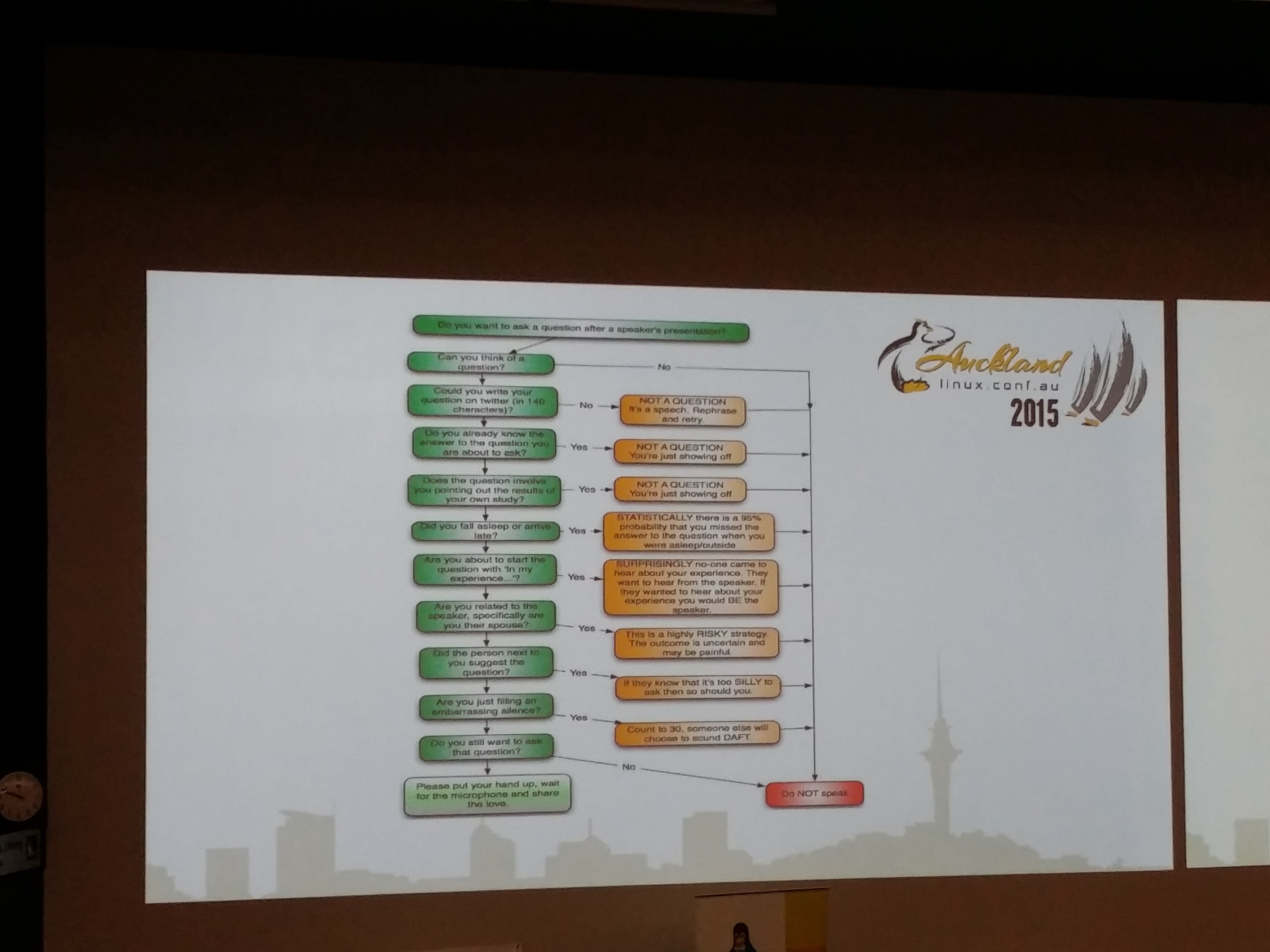
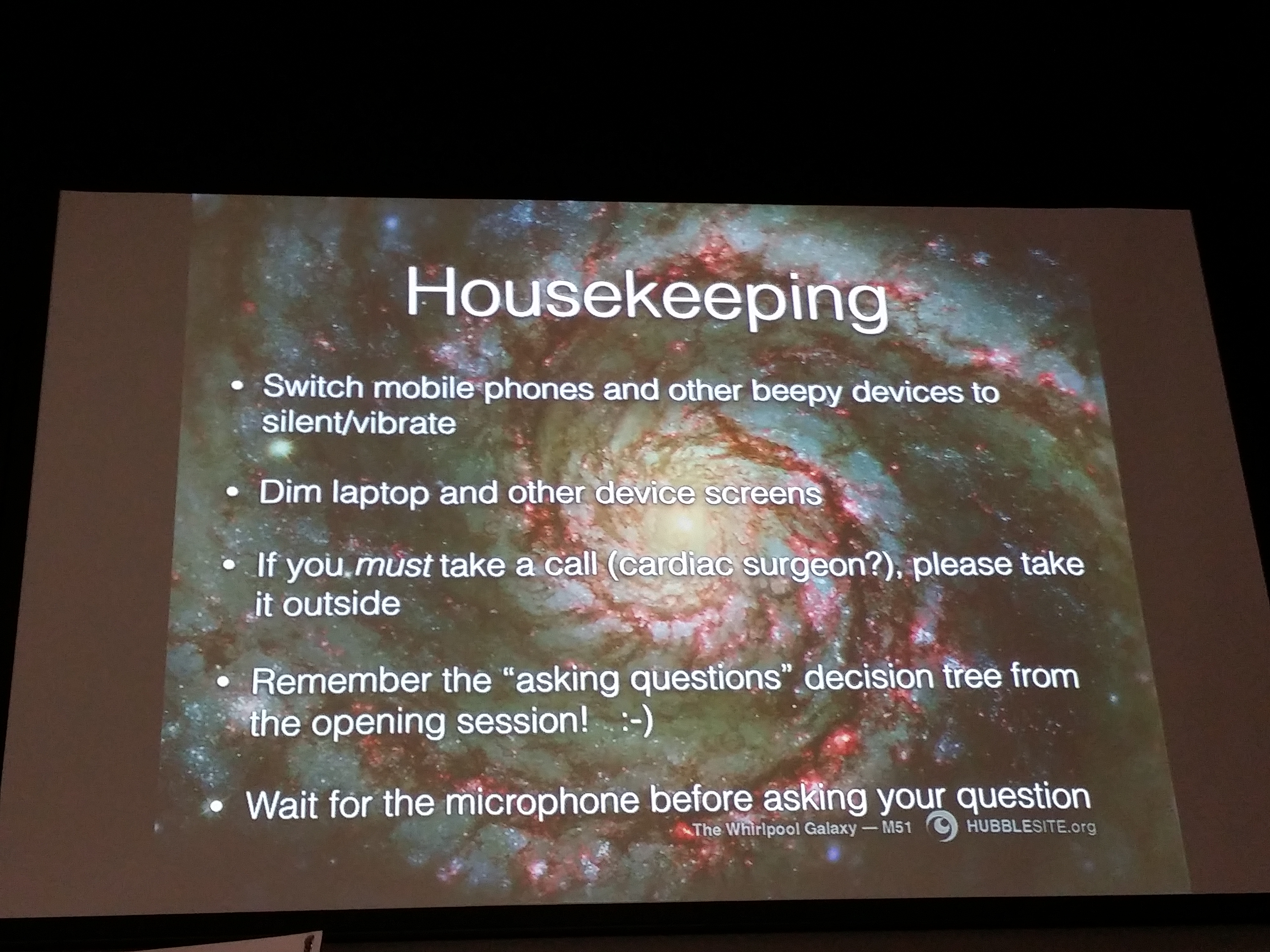
3 men 1 women on lift sign The above sign was at the Melbourne Docks in December 2014 when I was returning from a cruise. I have no idea why there are 3 men and 1 woman on the sign (and a dock worker was also surprised when I explained why I was photographing it). I wonder whether a sign that had 3 women and 1 man would ever have been installed or not noticed if it was installed. rules for asking questions at LCA2015 At the start of the first day of LCA 2015 the above was displayed at the keynote as a flow-chart for whether someone should ask a question at a lecture. Given that the first real item in the list is that a question should fit in a tweet I think it was inspired by my blog post about the length of conference questions [1]. Astronomy Miniconf suggestions for delegates At the introduction to the Astronomy Miniconf the above slide was displayed. In addition to referencing the flow-chart for asking questions it recommends dimming laptop screens (among other things). sign saying men to the left because women are always right The above sign was at a restaurant in Auckland in January 2015. I thought that sort of sexist joke went out of fashion a few decades ago. gendered nerf weaponary The above photo is from a Melbourne department store in February 2015. Why gender a nerf gun? That just doesn t make sense. Also it appeared that the only nerf crossbow was the purple/pink one, is a crossbow considered feminine nowadays? Picture of Angela appropriating Native American clothing The above picture is a screen-shot of one of the Talking Angela series of Android games from March. Appropriating the traditional clothing of marginalised groups is a bad thing. People of Native American heritage who want to wear their traditional clothing face discrimination when they do so, when white people play dress-up in clothing that is a parody of Native American style it s really offensive. The site Racialicious.com has a tag for articles about appropriation [2]. The above was in a library advertising an Ebook reader. In this case they didn t even have pointlessly gendered products they just had pointlessly gendered adverts for the same product. They also perpetuate the myth that only girls read vampire books and only boys read about space. Also why is the girl lying down to read while the boy is sitting up? Above is an Advent calendar on sale in a petrol station. Having end of year holiday presents that have nothing to do with religious festivals makes sense. But Advent is a religious observance. I think this would be a better candidate for war on Christmas paranoia than a coffee cup of the wrong colour. The above photo is of boys and girls pipette suckers. Pointlessly gendered recreational products like Nerf guns is one thing, but I think that doing it to scientific equipment is a bigger problem. Are scientists going to stop work if they can t find a pipette sucker of the desired gender? Is worrying about this going to distract them from their research (really bad if working with infectious or carcinogenic solutions). The Integra advertising claims to be doing this to promote breast cancer research which is also bogus. Here is a Sociological Images article about the problems of using pink to market breast cancer research [3] and the Sociological Images post about pinkwashing (boobies against breast cancer) is also worth reading [4]. As an aside I made a mistake in putting a pipette sucker over the woman s chest in that picture. The way that Integra portreyed her chest is relevant to analysis of this advert. But unfortunately I didn t photograph that. Here is a link to my sociological images post from 2014 [5].

11 January 2016

Norbert Preining: 10 years TeX Live in Debian

I recently dug through my history of involvement with TeX (Live), and found out that in January there are a lot of anniversaries I should celebrate: 14 years ago I started building binaries for TeX Live, 11 years ago I proposed the packaging TeX Live for Debian, 10 years ago the TeX Live packages entered Debian. There are other things to celebrate next year (2017), namely the 10 year anniversary of the (not so new anymore) infrastructure in short tlmgr of TeX Live packaging, but this will come later. In this blog post I want to concentrate on my involvement in TeX Live and Debian. TeX Live/Debian Those of you not interested in boring and melancholic look-back onto history can safely skip reading this one. For those a bit interested in the history of TeX in Debian, please read on. Debian releases and TeX systems The TeX system of choice has been for long years teTeX, curated by Thomas Esser. Digging through the Debian Archive and combining it with changelog entries as well as personal experiences since I joined Debian, here is a time line of TeX in Debian, all to my best knowledge.
Date Version Name teTeX/TeX Live Maintainers
1993-96 <1 ? ? Christoph Martin
6/1996 1.1 Buzz ?
12/1996 1.2 Rec ?
6/1997 1.3 Bo teTeX 0.4
7/1998 2.0 Ham teTeX 0.9
3/1999 2.1 Slink teTeX 0.9.9N
8/2000 2.2 Potato teTeX 1.0
7/2002 3.0 Woody teTeX 1.0
6/2005 3.1 Sarge teTeX 2.0 Atsuhito Kohda
4/2007 4.0 Etch teTeX 3.0, TeX Live 2005 Frank K ster, NP
2/2009 5.0 Lenny TeX Live 2007 NP
2/2011 6.0 Squeeze TeX Live 2009
5/2013 7.0 Whezzy TeX Live 2012
4/2015 8.0 Jessie TeX Live 2014
??? ??? Stretch TeX Live 2015
The history of TeX in Debian is thus split more or less in 10 years teTeX, and 10 years TeX Live. While I cannot check back to the origins, my guesses are that already in the very first releases (te)TeX was included. The first release I can confirm (via the Debian archive) shipping teTeX is the release Bo (June 1997). Maintainership during the first 10 years showed some fluctuation: The first years/releases (till about 2002) were dominated by Christoph Martin with Adrian Bunk and few others, who did most packaging work on teTeX version 1. After this Atsuhito Kohda with help from Hilmar Preusse and some people brought teTeX up to version 2, and from 2004 to 2007 Frank K ster, again with help of Hilmar Preusse and some other, took over most of the work on teTeX. Other names appearing throughout the changelog are (incomplete list) Julian Gilbey, Ralf Stubner, LaMont Jones, and C.M Connelly (and many more bug-reporters and fixers). Looking at the above table I have to mention the incredible amount of work that both Atsuhito Kohda and Frank K ster have put into the teTeX packages, and many of their contributions have been carried over into the TeX Live packages. While there haven t been many releases during their maintainership, their work has inspired and supported the packaging of TeX Live to a huge extend. Start of TeX Live I got involved in TeX Live back in 2002 when I started building binaries for the alpha-linux architecture. I can t remember when I first had the idea to package TeX Live for Debian, but here is a time line from my first email to the Debian Developers mailing list concerning TeX Live, to the first accepted upload:
Date Subject/Link Comment
2005-01-11 binaries for different architectures in debian packages The first question concerning packaging TeX Live, about including pre-built binaries
2005-01-25 Debian-TeXlive Proposal II A better proposal, but still including pre-built binaries
2005-05-17 Proposal for a tex-base package Proposal for tex-base, later tex-common, as basis for both teTeX and TeX live packages
2015-06-10 Bug#312897: ITP: texlive ITP bug for TeX Live
2005-09-17 Re: Take over of texinfo/info packages Taking over texinfo which was somehow orphaned started here
2005-11-28 Re: texlive-basic_2005-1_i386.changes REJECTED My answer to the rejection by ftp-master of the first upload. This email sparked a long discussion about packaging and helped improve the naming of packages (but not really the packaging itself).
2006-01-12 Upload of TeX Live 2005-1 to Debian The first successful upload
2006-01-22 Accepted texlive-base 2005-1 (source all) TeX Live packages accepted into Debian/experimental
One can see from the first emails that at that time I didn t have any idea about Debian packaging and proposed to ship the binaries built within the TeX Live system on Debian. What followed was first a long discussion about whether there is any need for just another TeX system. The then maintainer Frank K ster took a clear stance in favor of including TeX Live, and after several rounds of proposals, tests, rejections and improvements, the first successful upload of TeX Live packages to Debian/experimental happened on 12 January 2006, so exactly 10 years ago. Packaging Right from the beginning I used a meta-packaging approach. That is, instead of working directly with the source packages, I wrote (Perl) scripts that generated the source packages from a set of directives. There were several reasons why I choose to introduce this extra layer: Till now I am not 100% sure whether it was the best idea, but the scripts remain in place till now, only adapted to the new packaging paradigm in TeX Live (without xml) and adding new functionality. This allows me to just kick off one script that does do all the work, including building .orig.tar.gz, source packages, binary packages. For those interested to follow the frantic activity during the first years, there is a file CHANGES.packaging which for the years from 2005 to 2011 documents very extensively the changes I made in these years. I don t want to count the hours the went into all this  Development over the years TeX Live 2005 was just another TeX system but not the preferred one in Debian Etch and beyond. But then in May 2006, Thomas Esser announced the end of development of teTeX, which cleared the path for TeX Live as main TeX system in Debian (and the world!). The next release of Debian, Lenny (1/2009), already carried only TeX Live. Unfortunately it was only TeX Live 2007 and not 2008, mostly due to me having been involved in rewriting the upstream infrastructure based on Debian package files instead of the notorious xml files. This took quite a lot of attention and time from Debian away to upstream development, but this will be discussed in a different post. Similarly, the release of TeX Live included in Debian Squeeze (released 2/2011) was only TeX Live 2009 (instead of 2010), but since then (Wheezy and Jessie) the releases of TeX Live in Debian were always the latest released ones. Current status Since about 2013 I am trying to keep a regular schedule of new TeX Live packages every month. These helps me to keep up with the changes in upstream packaging and reduces the load of packaging a new release of TeX Live. It also bring to users of unstable and testing a very up-to-date TeX system, where packages at most lack 1 month of behind the TeX Live net updates. Future As most of the readers here know, besides caring for TeX (Live) and related packages in Debian, I am also responsible for the TeX Live Manager (tlmgr) and most of upstream s infrastructure including network distribution. Thus, my (spare, outside work) time needs to be distributed between all these projects (and some others) which leaves less and less time for Debian packaging. Fortunately the packaging is in a state that making regular updates once a month is less of a burden, since most steps are automatized. What is still a bit of a struggle is adapting the binary package (src:texlive-bin) to new releases. But also this has become simpler due to less invasive changes over the years. All in all, I don t have many plans for TeX Live in Debian besides keeping the current system running as it is. Search for and advise to future maintainers and collaborators I would be more than happy if new collaborators appear, with fresh ideas and some spare time. Unfortunately, my experience over these 10 years with people showing up and proposing changes (anyone remembers the guy proposing a complete rewrite in ML or so?) is that nobody really wants to invest time and energy, but search for quick solutions. This is not something that will work with a package like TeX Live, sized of several gigabyte (the biggest in the Debian archive), and complicated inner workings. I advise everyone being interested in helping to package TeX Live for Debian, to first install normal TeX Live from TUG, get used to what actions happen during updates (format rebuilds, hyphenation patters, map file updates). One does not need to have a perfect understanding of what exactly happens down there in the guts (I didn t have in the beginning, either), but if you want to help packaging and never heard about what format dumps or map files are, then this might be a slight obstacle. Conclusion TeX Live is the only TeX system in wide use across lots of architectures and operating systems, and the only comparable system, MikTeX, is Windows specific (also there are traces of ports to Unix). Backed by all the big user groups of TeX, TeX Live will remain the prime choice for the foreseeable future, and thus also TeX Live in Debian.

9 January 2016

Norbert Preining: Kobo firmware 3.19.5761 mega update (KSM, nickel patch, ssh, fonts)

Since 3.18.0 there have been two new firmwares for the Kobo eInk devices. For the very recently released firmware release 3.19.5761 I have updated my collection of patches and features. As with previous mega-package, I prepared updates for all three hardwares, Mark4 (Glo), Mark5 (Aura), and Mark6 (GloHD), but only the one for Mark6 is tested by myself. Kobo Logo Changes since last release: Included patches from the Metazoa firmware patches: Custom reading footer style, My 15 line spacing values, Custom left & right margins, Brightness fine control, Search in Library by default, Custom page refresh options (1,2,3, ,12), Fix three KePub fullScreenReading bugs, Always display chapter name on navigation menu. Other things that are included are as usual: koreader, pbchess, coolreader, the ssh part of kobohack, and some side-loaded fonts. For details on the respective parts please see the previous post Download Mark6 Kobo GloHD firmware: Kobo 3.19.5761 for GloHD Mega update: Kobo-3.19.5761-combined/Mark6/KoboRoot.tgz Mark5 Aura firmware: Kobo 3.19.5761 for Aura Mega update: Kobo-3.19.5761-combined/Mark5/KoboRoot.tgz Mark4 Kobo Glo, Aura HD firmware: Kobo 3.19.5761 for Glo and AuraHD Mega update: Kobo-3.19.5761-combined/Mark4/KoboRoot.tgz Enjoy.

Iain R. Learmonth: Trust

This is not a new world, this is simply an extension of the old one. I'm not going to write here about sweeping changes that are happening now, but changes that have been taking place in plain sight for many decades. No one has flipped a switch, only tweaked and tuned variables here and there to lead us down this path. I'd like to reflect on where we are now but there is no way I could describe how it is we got here, the journey was far too complex and filled with ommissions, half-truths and outright lies. It's likely we will never know what has brought us here. I live in Scotland, a country that is a part of the United Kingdom and a member of the European Union. We have a Scottish Government, although certain matters are still handled by the UK Government. The European Government also handles some matters and these can take effect across the entire European Union. I do not feel that I can hold trust in any of these bodies anymore. The European Convention on Human Rights was, for me at least, a beacon of hope. A series of fundamental rights guaranteed to be upheld for every person within the European Union. A series of fundamental rights that has been ignored by governments repeatedly: This is not an exhaustive list, just select cross-sections of our recent history. It is important to remember that in each of these cases, it took a citizen to take the case to the European Court of Human Rights. These rights were violated by the UK government until the actions were challenged, the legislation that allowed them was currently enacted into UK law without regard for the ECHR. It should also be noted that the ban on prisoners voting is still in effect in the UK. We've learnt that the ECHR is not an effective safeguard against the abuse of powers by government. The UK government also sees the Human Rights Act as a problem, although at least scrapping it has been delayed for now. Much of these breaches of human rights are justified by the government as in the interest of the runaway train known as "national security". I have recently had direct contact with one aspect of this during my journey home from 32c3. You can read about my experiences with airport security here and here. My experiences at these airports angered me for a number of reasons. The first of which was that I was asked to expose my genitals as part of the routine screening, which I do not believe to be proportionate at all. At Luton, I was at the point where I was intending to leave the airport and take the train instead before I was allowed to excercise my right to opt-out of the nude body scanner. Since these incidents, I have conducted some research into these scanners and started an article on the Open Rights Group wiki. While the security officer at Luton had tried to tell me that the radio waves used could not penetrate clothing, they in fact can and this is the entire purpose of them. While the security officer at Luton told me that the machines did not generate an image, they are in fact doing exactly that, even if that image is processed by computer vision algorithms as opposed to being viewed by a human reviewer. A leaflet by the Department for Transport, made available on the Aberdeen Airport website, also states that no image is created, and yet this is exactly how the scanners work. I have never seen this leaflet printed and available in the airport itself, although I admit I do not fly regularly and may have missed it. That said, it does not provide a true representation of the scan process and I would go as far to say it contains an outright lie. In a document published by the UK Government titled "Response to the consultation on the use of security scanners in an aviation security environment", they state:
"nearly all passengers, if they fully understand the procedures, would be unlikely to opt for [the alternative of a private search]"
Even with this display of confidence that they believe the public are happy with the invasion of privacy brought by the security scanners, they have still chosen to not fully inform the public in the way in which the scanner operates. It is the lies that anger me the most. We claim to live in a democracy and you cannot have a democracy without transparency. It is not too late for the Government to earn back my trust, but for now, they haven't given me good reason to believe anything they produce. If you have read this article and you would like to support efforts for change in the United Kingdom, please consider joining the Open Rights Group and perhaps getting involved in their work.

Next.

Previous.