Search Results: "gio"

1 January 2012

Russ Allbery: 2011 Book Reading in Review

For the year of 2011, I finished and reviewed 60 books. This is a huge milestone for me; it's the first time since the second year I started doing this that the number of books I read actually increased. This gives me more confidence that I've stabilized the year-by-year decline in my reading. I did that while substantially increasing the amount of time I spent enjoying video games, which was another major goal of the year. Only two books received a 10 out of 10 this year, one fiction and one non-fiction. The novel was Jo Walton's Among Others: the best book I read this year. It's a delightful look at the process of finding a place for oneself in the world and features one of the best protagonists that I've seen. The non-fiction book was Rory Stewart's The Prince of the Marshes, which means that both of Stewart's books that I've read have received 10 ratings. The Prince of the Marshes is his look at his time spent in the provisional government of Iraq after the overthrow of Saddam Hussein. I think it should be required reading for anyone expressing an opinion on what the US and other western powers should or should not have done in Iraq. It lays bare the difficulties, confusion, and frequent stupidity of going into someone else's country and trying to fix it, and I think seriously calls into question whether this sort of international intervention can ever work. Other fiction highlights of the year were Kelley Eskridge's Solitaire, a startling and deep look at identity and social connection, and Mira Grant's Feed, a zombie apocalypse story that completely overcame my deep dislike of zombie apocalypse stories. Feed should have won the Hugo in 2011, despite some unbelievable politics and a bit too much cheering for bloggers. This was the year for excellent protagonists, with all three of my top-rated fiction books featuring unique and memorable characters who left a deep and lasting emotional impact. The two other non-fiction standouts were both a bit dry, but if you have the patience and attention, they reward persistance. Richard Hofstadter's Anti-Intellectualism in American Life is a deserved classic that gave me an eye-opening perspective on the long history of interactions between intellectualism and populism in US politics and culture. David Levering Lewis's God's Crucible is a wonderful history of Islam as it related to Europe and filled in some large gaps in my knowledge of world and religious history. 60 books a year, or five books a month, feels like a comfortable and sustainable level, although I'm going to keep my formal goal at a book a week (52 in the year) to give myself some leeway to either get distracted by video games or by other projects. My reading did concentrate more than usual in science fiction and fantasy this year, and I'd like to add more mainstream fiction and more non-fiction. The full analysis includes some additional personal reading statistics, probably only of interest to me.

31 December 2011

Russell Coker: My Blog Server was Cracked

On the 1st of August I noticed that the server which runs my blog among other things was having an occasional SEGV from a sshd process. Unfortunately I was busy and didn t pay much attention to this, which turned out to be a big mistake. On the 12th of September I started investigating this properly and noticed that when someone tried to connect to ssh with password authentication sshd would SEGV after it was denied access to a shared memory region or a semaphore which had a SE Linux type of unconfined_t. I added some SE Linux auditallow rules and discovered that the memory region in question was created by the ssh client. Shortly after that I came to the conclusion that this wasn t some strange feature of ssh (or one of the many shared objects it uses) but hostile activity. The ssh client appeared to be storing passwords that it used in a shared memory region and sshd was also collecting passwords in the same region and presumably offering them to a ssh client which uses some extension to the ssh protocol. The sshd process was crashing because it couldn t handle EPERM on access to shared memory or semaphores. Presumably if the system in question wasn t running SE Linux then the exploit would have remained undetected for a lot longer. At this stage we don t know how the attacker got in. Presumably one of the people with root access ran a ssh client on a compromised system and had their password sniffed. One such client system was mysteriously reinstalled at about that time, the sysadmin of the system in question claimed to have no backups which made it impossible to determine if that system had been compromised. I believe that the sysadmin of the client system knew that their system was compromised, kept that information secret, and allowed other systems to become and remain compromised. The attacker made no good effort to conceal their presence, they replaced ssh, sshd, and ssh-add and didn t bother changing the Debian checksums so the debsums program flagged the files as modified. Note that I have kept copies of the files in question and am willing to share them with anyone who wants to analyse them. Steinar H. Gunderson has named this trojan Ebury [1]. Recovery By the evening of the 13th of September I had the system mostly working again. Jabber still isn t working because ejabberd is difficult to get working at the best of times, I am now investigating whether there is a better Jabber server to use, but as I don t use Jabber often this hasn t been a priority for me. Some of the WordPress plugins I use and all of the WordPress themes that are installed were outside the Debian packaging system, as I couldn t be sure that they hadn t been altered (because the people who wrote WordPress plugins don t keep old versions online) I had to upgrade to the newer versions. Of course the newer versions weren t entirely compatible so I had to use a different theme and I couldn t get all plugins working. Link Within no longer works, not that it ever worked properly [2], I wanted to try Outbrain again but their web site won t let me login (and they haven t responded to my support request). Does anyone know of a good WordPress plugin to provide links to related content? Either related content on my blog or on the Internet in general will be OK. Some people have asked me about the change in appearance of my blog. It was simply impossible (for someone with my PHP skills) to get my blog looking the same way as it did before the server was cracked. I think that the new look is OK and don t mind if people think it looks likw a VW advert VW make great cars, I was very satisfied with the VW Passat I used to drive. Future Plans I had bought some Yubikeys (USB devices that generate one-time passwords) [3] to control access to that server, if I had configured the software to use them then this might not have happened. The use of one-time password devices can prevent passive password-sniffing attacks. It would still allow active attacks (such as using ControlPath/ControlMaster options on the ssh client to allow a hostile party to connect later (EG the -M, -S, and -o ControlPersist options for the ssh client). It s a pity that there doesn t seem to be a way to configure the ssh server to disable ControlMaster. Conclusion It would be good to have some changes to sshd to allow more restrictions on what a client can request, as ControlMaster functionality isn t needed by most users it should be possible to disable it. SE Linux doesn t protect against a compromised client system or any other way of stealing passwords. It did do a good job of stopping Ebury from doing all the things it wanted to do and thus making me aware of the problem. So I count this as a win for SE Linux. Yubikeys are the cheapest and easiest way of managine one-time passwords. I had already bought some for use on the system in question but hadn t got around to configuring them. I have to make that a priority.

28 December 2011

Gustavo Noronha Silva: The Blocks C extension and GIO asynchronous calls

So, I intended to be completely away from my computer during my vacations, but hey. I have been interested in this new extension Apple added to the C language a little while ago which introduces the equivalent of closures to C. Today I spent a few minutes looking into it and writing a few tests with the help of clang. Here s something I came up with, to use a block as the callback for a GIO asynchronous call:
#include <Block.h>
#include <gio/gio.h>
typedef void (^Block)();
static void async_result_cb(GObject* source,
                            GAsyncResult* res,
                            gpointer data)
 
    Block block = (Block)data;
    block(res);
 
int main(int argc, char** argv)
 
    g_type_init();
    if (argc != 2)  
        g_error("Blah.");
        return 1;
     
    GMainLoop* loop = g_main_loop_new(NULL, TRUE);
    GFile* file = g_file_new_for_path(argv[1]);
    g_file_query_info_async(file,
                            G_FILE_ATTRIBUTE_STANDARD_CONTENT_TYPE,
                            G_FILE_QUERY_INFO_NONE, G_PRIORITY_DEFAULT,
                            NULL, async_result_cb, (gpointer) ^ (GAsyncResult* res)  
        GError* error = NULL;
        GFileInfo* info = g_file_query_info_finish(file, res, &error);
        if (error)  
            g_error("Failed: %s", error->message);
            g_error_free(error);
            return;
         
        g_message("Content Type: %s",
                  g_file_info_get_attribute_string(info, G_FILE_ATTRIBUTE_STANDARD_CONTENT_TYPE));
        g_object_unref(info);
        g_main_loop_quit(loop);
     );
    g_main_loop_run(loop);
    g_object_unref(file);
    return 0;
 
Pretty neat, don t you think? To build you need to use clang and have the blocks runtime installed (libblocksruntime-dev in Debian). Here s the command I use:
$ clang -fblocks -o gio gio.c -lBlocksRuntime  pkg-config --cflags --libs gio-2.0 

17 December 2011

Lior Kaplan: Can t select my country on the Ubuntu installation map

In 1977 Tal Brody said after winning the Euroleague Basketball cup with Maccabi Tel Aviv as sentence which became quite famous in Israel:
We are on the map! And we are staying on the map not only in sports, but in everything.
I found out through Invar Hovav that there s a regression in the Ubuntu installation doesn t believe this is true anymore, as according to lp#905754, you can t select Israel or its major cities, and instead get suggestions for Gaza and Hebron. This is a regression from past installers when you could at least choose Tel Aviv, Jerusalem and Gaza. It used to be hard to pin point each location, but was still possible. This might be part of a bigger problem of selecting close/adjacent cities, but the default behavior in the past was different. From the technical point of view, the Gaza and Hebron TZ files are weird (tzdata version 2011n-1). Both don t have info for 2012 daylight saving time (usually start in late March or early April). Hebron switches twice a year to DST, hopefully nothing critical uses this time zone.
$ zdump -v Asia/Hebron grep 2011
Asia/Hebron Fri Apr 1 10:00:59 2011 UTC = Fri Apr 1 12:00:59 2011 EET isdst=0 gmtoff=7200
Asia/Hebron Fri Apr 1 10:01:00 2011 UTC = Fri Apr 1 13:01:00 2011 EEST isdst=1 gmtoff=10800
Asia/Hebron Sun Jul 31 20:59:59 2011 UTC = Sun Jul 31 23:59:59 2011 EEST isdst=1 gmtoff=10800
Asia/Hebron Sun Jul 31 21:00:00 2011 UTC = Sun Jul 31 23:00:00 2011 EET isdst=0 gmtoff=7200
Asia/Hebron Mon Aug 29 21:59:59 2011 UTC = Mon Aug 29 23:59:59 2011 EET isdst=0 gmtoff=7200
Asia/Hebron Mon Aug 29 22:00:00 2011 UTC = Tue Aug 30 01:00:00 2011 EEST isdst=1 gmtoff=10800
Asia/Hebron Thu Sep 29 23:59:59 2011 UTC = Fri Sep 30 02:59:59 2011 EEST isdst=1 gmtoff=10800
Asia/Hebron Fri Sep 30 00:00:00 2011 UTC = Fri Sep 30 02:00:00 2011 EET isdst=0 gmtoff=7200
And Gaza only have a 3 months daylight saving time, while Israel has 6 and European eastern time has 7 months (all are UTC+2 region).
$ zdump -v Asia/Gaza grep 2011
Asia/Gaza Sat Apr 2 10:00:59 2011 UTC = Sat Apr 2 12:00:59 2011 EET isdst=0 gmtoff=7200
Asia/Gaza Sat Apr 2 10:01:00 2011 UTC = Sat Apr 2 13:01:00 2011 EEST isdst=1 gmtoff=10800
Asia/Gaza Sun Jul 31 20:59:59 2011 UTC = Sun Jul 31 23:59:59 2011 EEST isdst=1 gmtoff=10800
Asia/Gaza Sun Jul 31 21:00:00 2011 UTC = Sun Jul 31 23:00:00 2011 EET isdst=0 gmtoff=7200
p.s.
This isn t a political post, don t make it into one.
Filed under: Debian GNU/Linux, Ubuntu

Matthew Palmer: Rethtool: How I Learned to Stop Worrying and Love the ioctl

Damn those unshaven yaks I m trying to write a Nagios plugin for work that will comprehensively monitor network interfaces and make sure they re up, passing traffic, all those sorts of things. Of course, I m doing it all in Ruby, because that s how I roll. So, I need to Know Things about the interface. Everyone does that with ethtool. Right? Sure, if your eyeballs are parsing it. But have you ever tried to machine parse it? To put it as eloquently as possible:
# ethtool eth0
Settings for eth0:
 Supported ports: [ TP MII ]
 Supported link modes:   10baseT/Half 10baseT/Full 
                         100baseT/Half 100baseT/Full 
                         1000baseT/Half 1000baseT/Full 
 Supports auto-negotiation: Yes
 Advertised link modes:  10baseT/Half 10baseT/Full 
                         100baseT/Half 100baseT/Full 
                         1000baseT/Half 1000baseT/Full 
 Advertised pause frame use: No
 Advertised auto-negotiation: Yes
 Link partner advertised link modes:  10baseT/Half 10baseT/Full 
                                      100baseT/Half 100baseT/Full 
                                      1000baseT/Half 1000baseT/Full 
 Link partner advertised pause frame use: No
 Link partner advertised auto-negotiation: Yes
 Speed: 1000Mb/s
 Duplex: Full
 Port: MII
 PHYAD: 0
 Transceiver: internal
 Auto-negotiation: on
 Supports Wake-on: pumbg
 Wake-on: g
 Current message level: 0x00000033 (51)
 Link detected: yes
Parse that, bitch!
Or perhaps not. At any rate, I decided that it would be most advantageous if I went straight to the source and twiddle the ioctl until it did my bidding. And thus, about 5 hours later, was Rethtool born. Once I worked out a less-than-entirely-crackful way of dealing with C structs in Ruby (after a bit of digging around, I went with the appallingly-undocumented-but-sufficiently-featureful CStruct), and after I finally worked out I was passing the wrong damned struct to ioctl(SIOCETHTOOL) (speaking of appallingly-undocumented: fuck you, ioctl, and all your twisty-passages children), it was smooth sailing. So, if you re one of the eight or so people on earth who will ever need to get at the grubby internals of your network interfaces using Ruby (and can t do it via some sysfs magic), Rethtool is for you.

7 December 2011

Gustavo Noronha Silva: WebKitGTK+ hackfest \o/

It s been a couple days since I returned from this year s WebKitGTK+ hackfest in A Coru a, Spain. The weather was very nice, not too cold and not too rainy, we had great food, great drinks and I got to meet new people, and hang out with old friends, which is always great!
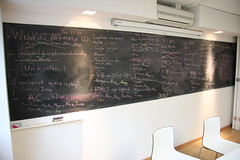
Hackfest black board, photo by Mario

I think this was a very productive hackfest, and as usual a very well organized one! Thanks to the GNOME Foundation for the travel sponsorship, to our friends at Igalia for doing an awesome job at making it happen, and to Collabora for sponsoring it and granting me the time to go there! We got a lot done, and although, as usual, our goals list had many items not crossed, we did cross a few very important ones. I took part in discussions about the new WebKit2 APIs, got to know the new design for GNOME s Web application, which looks great, discussed about Accelerated Compositing along with Joone, Alex, Nayan and Martin Robinson, hacked libsoup a bit to port the multipart/x-mixed-replace patch I wrote to the awesome gio-based infrastructure Dan Winship is building, and some random misc. The biggest chunk of time, though, ended up being devoted to a very uninteresting (to outsiders, at least), but very important task: making it possible to more easily reproduce our test results. TL;DR? We made our bots and development builds use jhbuild to automatically install dependencies; if you re using tarballs, don t worry, your usual autogen/configure/make/make install have not been touched. Now to the more verbose version! The need
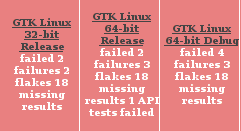
Our three build slaves reporting a few failures

For a couple years now we have supported an increasingly complex and very demanding automated testing infrastructure. We have three buildbot slaves, one provided by Collabora (which I maintain), and two provided by Igalia (maintained by their WebKitGTK+ folks). Those bots build as many check ins as possible with 3 different configurations: 32 bits release, 64 bits release, and 64 bits debug. In addition to those, we have another bot called the EWS, or Early Warning System. There are two of those at this moment: one VM provided by Collabora and my desktop, provided by myself. These bots build every patch uploaded to the bugzilla, and report build failures or passes (you can see the green bubbles). They are very important to our development process because if the patch causes a build failure for our port people can often know that before landing, and try fixes by uploading them to bugzilla instead of doing additional commits. And people are usually very receptive to waiting for EWS output and acting on it, except when they take way too long. You can have an idea of what the life of an EWS bot looks like by looking at the recent status for the WebKitGTK+ bots. Maintaining all of those bots is at times a rather daunting task. The tests require a very specific set of packages, fonts, themes and icons to always report the same size for objects in a render. Upgrades, for instance, had to be synchronized, and usually involve generating new baselines for a large number of tests. You can see in these instructions, for instance, how strict the environment requirements are yes, we need specific versions of fonts, because they often cause layouts to change in size! At one point we had tests fail after a compiler upgrade, which made rounding act a bit different! So stability was a very important aspect of maintaining these bots. All of them have the same version of Debian, and most of the packages are pinned to the same version. On the other hand, and in direct contradition to the stability requirement, we often require bleeding edge versions of some libraries we rely on, such as libsoup. Since we started pushing WebKitGTK+ to be libsoup-only, its own progress has been pretty much driven by WebKitGTK+ s requirements, and Dan Winship has made it possible to make our soup backend much, much simpler and way more featureful. That meant, though, requiring very recent versions of soup. To top it off, for anyone not running Debian testing and tracking the exact same versions of packages as the bots it was virtually impossible to get the tests to pass, which made it very difficult for even ourselves to make sure all patches were still passing before committing something. Wow, what a mess. The explosion^Wsolution So a few weeks back Martin Robinson came up with a proposed solution, which, as he says, is the nuclear bomb solution. We would have a jhbuild environment which would build and install all of the dependencies necessary for reproducing the test expectations the bots have. So over the first three days of the hackfest Martin and myself hacked away in building scripts, buildmaster integration, a jhbuild configuration, a jhbuild modules file, setting up tarballs, and wiring it all in a way that makes it convenient for the contributors to get along with. You ll notice that our buildslaves now have a step just before compiling called updated gtk dependencies (gtk is the name we use for our port in the context of WebKit), which runs jhbuild to install any new dependencies or version bumps we added. You can also see that those instructions I mentioned above became a tad simpler. It took us way more time than we thought for the dust to settle, but it eventually began to. The great thing of doing it during the hackfest was that we could find and fix issues with weird configurations on the spot! Oh, you build with AR_FLAGS=cruT and something doesn t like it? OK, we fix it so that the jhbuild modules are not affected by that variable. Oh, turns out we missed a dependency, no problem, we add it to the modules file or install them on the bots, and then document the dependency. I set up a very clean chroot which we could use for trying out changes so as to not disrupt the tree too much for the other hackfest participants, and I think overall we did good. The aftermath By the time we were done our colleagues who ran other distributions such as Fedora were already being able to get a substantial improvements to the number of tests passing, and so did we! Also, the ability to seamlessly upgrade all the bots with a simple commit made it possible for us to very easily land a change that required a very recent (as in unreleased) version of soup which made our networking backend way simpler. All that red looks great, doesn t it? And we aren t done yet, we ll certainly be making more tweaks to this infrastructure to make it more transparent and more helpful to the users (contributors and other people interested in running the tests). If you ve been hit by the instability we caused, sorry about that, poke mrobinson or myself in the #webkitgtk+ IRC channel on FreeNode, and we ll help you out or fix any issues. If you haven t, we hope you enjoy all the goodness that a reproducible testing suite has to offer! That s it for now, folks, I ll have more to report on follow-up work started at the hackfest soon enough, hopefully =).

Kees Cook: how to throw an EC2 party

Prepare a location to run juju and install it:
mkdir ~/party
cd ~/party
sudo apt-get install juju
Initialize your juju environment. Be sure to add juju-origin: ppa to your environment, along with filling in your access-key and secret-key from your Amazon AWS account. Note that control-bucket and admin-secret should not be used by any other environment or juju won t be able to distinguish them. Other variables are good to set now too. I wanted my instances close to me, use I set region: us-west-1 . I also wanted a 64bit system, so using the AMI list, I chose default-series: oneiric , default-instance-type: m1.large and default-image-id: ami-7b772b3e
juju
$EDITOR ~/.juju/environments.yaml
Get my sbuild charm, and configure some types of builders. The salt should be something used only for this party; it is used to generate the random passwords for the builder accounts. The distro and releases can be set to whatever the mk-sbuild tool understands.
bzr co lp:~kees/charm/oneiric/sbuild/trunk sbuild-charm
cat >local.yaml <<EOM
builder-debian:
    salt: some-secret-phrase-for-this-party
    distro: debian
    releases: unstable
builder-ubuntu:
    salt: some-secret-phrase-for-this-party
    distro: ubuntu
    releases: precise,oneiric
EOM
Bootstrap juju and wait for ec2 instance to come up.
juju bootstrap
Before running the status, you can either accept the SSH key blindly, or use ec2-describe-instances to find the instance and public host name, and use my wait-for-ssh tool to inject the SSH host key into your ~/.ssh/known_hosts file. This requires having set up the environment variables needed by ec2-describe-instances , though.
ec2-describe-instances --region REGION
./sbuild-charm/wait-for-ssh INSTANCE HOST REGION
Get status:
juju status
Deploy a builder:
juju deploy --config local.yaml --repository $PWD local:sbuild-charm builder-debian
Deploy more of the same type:
juju add-unit builder-debian
Now you have to wait for them to finish installing, which will take a while. Once they re at least partially up (the builder user has been created), you can print out the slips of paper to hand out to your party attendees:
./sbuild-charm/slips   mpage -1 > /tmp/slips.ps
ps2pdf /tmp/slips.ps /tmp/slips.pdf
They look like this:
Unit: builder-debian/3
Host: ec2-256-1-1-1.us-west-1.compute.amazonaws.com
SSH key fingerprints:
  1024 3e:f7:66:53:a9:e8:96:c7:27:36:71:ce:2a:cf:65:31 (DSA)
  256 53:a9:e8:96:c7:20:6f:8f:4a:de:b2:a3:b7:6b:34:f7 (ECDSA)
  2048 3b:29:99:20:6f:8f:4a:de:b2:a3:b7:6b:34:bc:7a:e3 (RSA)
Username: builder
Password: 68b329da9893
To admin the machines, you can use juju itself, where N is the machine number from the juju status output:
juju ssh N
To add additional chroots to the entire builder service, add them to the config:
juju set builder-debian release=unstable,testing,stable
juju set builder-ubuntu release=precise,oneiric,lucid,natty
Notes about some of the terrible security hacks this charm does: Enjoy!

2011, Kees Cook. This work is licensed under a Creative Commons Attribution-ShareAlike 3.0 License.
Creative Commons License

5 December 2011

Ana Beatriz Guerrero Lopez: RCBSaturday

On Saturday evening I started talking with M nica about Bug Squashing Parties and how they work. I am not sure how it happened, we started doing one. Then it was too fun to stop :P NMUs by M nica: Funny, there were a couple of NMUs by others uploading patchs by M nica. NMUs by Ana: I also closed #646449 (libosip2) that has been fixed in a new release upload, sponsored a NMU to Sven Joachim who had a patch sitting in the BTS for a month NMU-fixing #646147 (lie), sponsored dbus-c++ and reviewed for sponsoring a new version inspircd.

1 December 2011

Dirk Eddelbuettel: Wicked Webapps with R, err, Wt

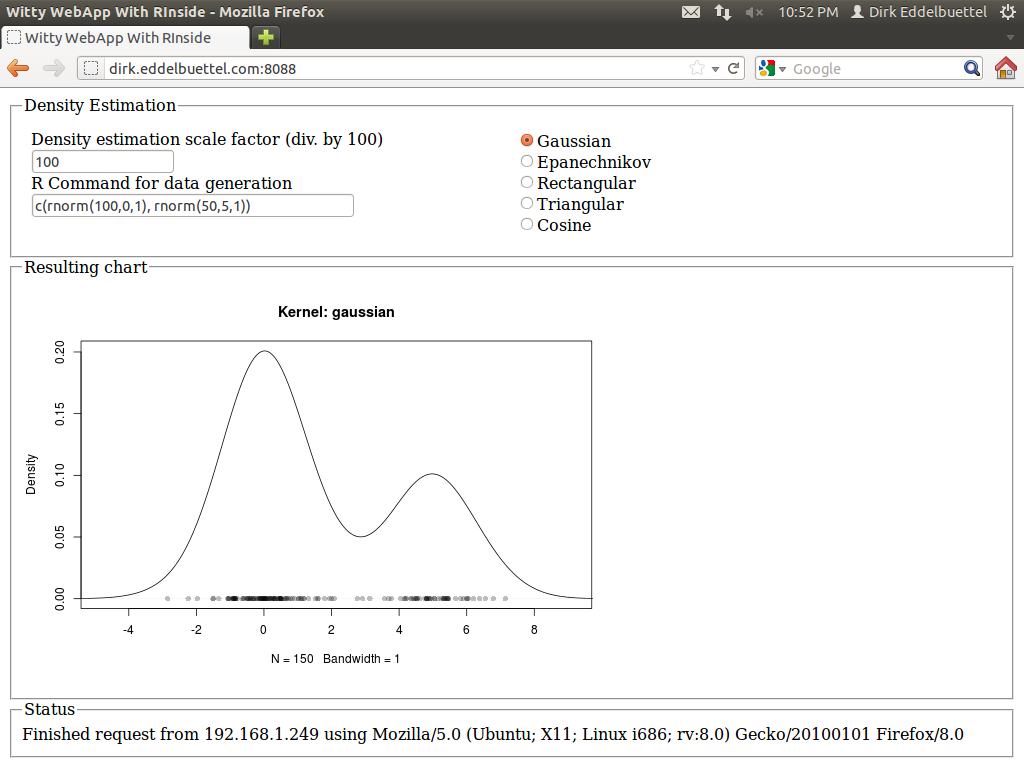
A few months ago, I had blogged about using R inside of Qt. This used our RInside package for embedding the statistical programming environment and language R inside of a C++ application, and further relies on our Rcpp package for R and C++ integration and object mapping. The example was simple yet powerful: a reimplementation of the standard GUI application of a standard density estimate. Here the user can pick a kernel density function from a selection, and also slide a bandwidth parameter. One nice addition was an entry field already populated with a simple expression for a mixture of Normals, allowing for arbitrary random distributions over which to estimate. The example is pretty (thanks to Qt), and was added to RInside with the last CRAN release 0.2.4. The blog post has a nice screenshot. I had long wondered how to do something similar 'on the web'. Web integration and application frameworks are of course a dime a dozen: Just about any language offers this, with more or less ease. But I wanted something simple yet powerful and fast. And I did not like the idea of a multi-tier app, or of a multi-language mix. I remember having seen something about a web-application framework not unlike Qt, and studying the very useful Wikipedia web application framework comparison I re-discovered Wt (pronounced "Witty"). So there it is, using C++ which brings us ample performance, the ability to connect to a number of libraries and applications (which is important in my quantitatively-minded workd) and avoid the whole multi-tier, multi-language combination. The Wt website has a few more good reason why this may be a suitable idea; the toolkit also offers a very decent amount of features and is amply documented with a fair number of examples. And after just a little bit poking around during two weekends, I now have the following webapp committed in the SVN repository of RInside, and it is all implemented in in less than two hundred (generously commented) lines of code. Example of embedding R via RInside into a Wt C++ application: density estimation for a mixture It is currently up and running at the address shown in the screenshot, so give it a go (though I may take it down at another point in time). I quite like it: The application is responsive: changes in the radio buttons (for the density), or the bandwidth, each trigger reestimation of the density, and a new and updated chart is displayed immediately with no noticeable delay---just like the desktop application did. Best of all, the code logic is essentially unchanged from the Qt-based app. Signals and slots related events to actions, the layout is in terms of standard GUI boxen and containers. And best of all, I did not have to write a line of html, javascript, css or ajax: it is all handled by the Wt toolkit. I was able to drive the app from an Android phone, my tablet, various computers around the house, and had a few friends poke a stick at it from afar. There is at one open issue. Wt launches new instances of the application object with each connection, which is a very clean model. That doesn't map perfectly with R (which is single-threaded) and RInside (which runs as a singleton for the same reason). So right now, each action sends its state back to the client. In other words, each clients own its parameters and well as vector of random numbers. Each new action sends these back to the app which passes it to R, launches the re-estimation and gets an updated chart back which is then shown by the the client. That is not perfect, and maybe a forking model as used by Simon's RServe would be better, though it would require a rewrite of RInside. Not sure if we get there anytime soon. And for simple applications not facing legions of concurrent users, the singleton should still work. It's a proof of concept at this point. Feedback welcome, and RInside and Rcpp questions should go to the rcpp-devel list as usual.
23 November 2011

Jon Dowland: In response to Andrew Cowie

Andrew Cowie blogs about 'A good GNOME 3 Experience'. He writes
I think it s a bit odd not to expect that something that was widely advertised as being such a different user experience is different.
and
if they had gone and bought an Apple laptop with Mac OS X on it they would be perfectly reasonably working through learning how to use a new Desktop and not complaining about it at all. But here we are admonishing the GNOME hackers had the temerity to do something new and different.
I think Andrew's phrasing here is a bit disingeneous. Or perhaps he genuinely mistakes the frustration that has been felt by GNOME 3. I don't want to whine on too much, so I'll try to get this out of the way in one paragraph. F/OSS users are members of a community. There is inevitably a wall between the majority of community members and the blessed: the decision makers, the developers. The art of maintaining a good community is partly to do with making this wall as invisible as possible: encouraging participation, lowering the barrier for contributions; welcoming feedback; etc.1. The GNOME community have invested a lot into the GNOME 2 way of doing things, and GNOME 3, by breaking away from that so fundamentally, has devalued the community's investment. It screams: we don't want your panel widgets! We don't want your themes! Your working practices are wrong: this is the right way! GNOME 3 is opinionated software, and it's opinion differs from a large body of the GNOME community. The result? resentment. Remember: GNOME 3 is not just something new: it's the abrupt termination of something old, tried and tested. and hopefully that's the last time I need to vent about my GNOME 3 frustration. It's hear to stay, the question for the frustrated is: are you? Moving on Andrew goes on to recommend:
One thing I do recommend is mapping (say) CapsLock as an additional Hyper You do the mapping in: System Settings Keyboard Layout Layout tab Options..
I used to do this with GNOME 2, but I couldn't find how to do it on GNOME 3. Andrew's post gave me the important hint that it was still possible, but the precise location doesn't match: On my Fedora 16 / GNOME 3.2 system, it's System Settings Region and Language Layouts Options ". This is especially useful on my beloved UltraNav keyboard which lacks the Windows 95 keys. Sadly it does not work very well through various remote desktop tools: I get an inconsistent capslock state within VMs connected to via VNC. rdesktop seems ok.

  1. I have more to write about GNOME in this context in a future post.

22 November 2011

Jonas Smedegaard: Asia 2011

In september I visited Brussels, Belgium. EPFSUG had kindly invited me to give a talk about FreedomBox in the European Parliament, and together we extended to also visit other organizations - both grassroots and more formal. I returned home exhausted but also fuelled with renewed energy and passion, and decided to engage in more such activities. Also, an old promise of mine to visit friends in the Aceh region of Indonesia (whom I met in Taiwan a few years back) rumbled in the back of my head. After a bit of juggling with travel routes and sponsoring options, my course was set for a 2 month journey with Debian Pure Blends as main theme:

  1. England: London
  2. India: Khammam, Hyderabad, Mangaluru, Bengaluru
  3. Vietnam: Ho Chi Minh City, Can Tho
  4. Thailand: Bangkok
  5. Malaysia: Putrajaya
  6. Indonesia: Surabaya, Yogyakarta, Bogor, Banda Aceh, Takengon
  7. England: Cambridge
Debian will be sponsoring East Asia part, and Debian enthusiasts in India seek sponsorship for India part.

12 November 2011

John Goerzen: Greece part 5: Friends and Radios

See also parts 1, 2, 3, and 4. This is the biggest highlight of our trip to Greece for me. I enjoy having the chance to meet people, visit for awhile, and make new friends and that certainly happened in Greece. In one of the shops we happened to step into, I noticed a radio behind the counter. That s not unusual itself; radios often catch my eye these days. But this radio was tuned to 21.070, an amateur radio frequency. So I asked the shop owner if he happened to be a ham. And indeed he was. He was Lakis (SV5KKU), and Terah and I had a great time visiting with him. Terah took some photos of us, and then we made our purchases and headed out. I had brought my HT (handheld radio, weighs a few ounces and is powered by batteries) with me, and Lakis told me about the repeaters in the area. I had known about some of that since I had emailed Panos of the amatuer radio club in Rhodes before leaving home (I found his name via Google). A couple of days later, on Tuesday, we found ourselves back in Lindos. It was mid-afternoon, so the shops were quiet. After a late lunch, I thought it would be nice to drop in on Lakis one more time, since we were scheduled to fly back the following morning. I m not sure how long we stayed it must have been at least an hour and enjoyed the fresh orange juice he prepared. After we got back to our hotel Tuesday, I learned that our flights on Wednesday were canceled due to a nationwide air traffic controller strike in Greece. After 3 hours on the phone with Delta (more on that experience later), we got rescheduled to fly back Friday. On Wednesday morning, I remembered that the Rhodes amateur radio club meets every Wednesday evening, and now I would be able to go! I knew how to contact Lakis by email and on the radio, and he kindly offered to pick me up and take me there. So that evening, I got a tour of his impressive mountaintop installation, and then it was on to the club the Radio Amateur Association of the Dodecanese (SZ5RDS). There I met Panos, whom I had emailed earlier (and I think surprised him a bit). It was a friendly group, and they translated into English for me every so often so I knew what was being discussed. When I was about to leave, they gave me this: The translation, partly from my memory and partly with the help of Google Translate, is:
Radio Amateur Association of the Dodecanese, SZ5RDS Our friend and radio colleague KR0L JOHN GOERZEN, who visited the island, has our recognition as an HONORARY CLUB MEMBER. PRESIDENT KAVALAKIS PANAGIOTIS SV5AZK (Panos) SECRETARY PAPADIMITRIOU CHRISTOS SV5DDT RHODES Oct. 5, 2011
(I hope that any Greeks reading this will send me corrections.) I truly appreciated that gesture and meeting all the people in the club. On the way back to the hotel, Lakis and I stopped by a restaurant, which I believe had the best souvlaki I ve ever tasted thanks! We brought some back for Terah. She had chosen to stay at the hotel that evening and had a small hotel meal earlier, but enjoyed the souvlaki and pita. Terah had explained to the ma tre d that I wasn t along that evening because I had gone to an amateur radio club meeting. Judging by the surprised reaction, this was probably the first time they had heard that particular comment! Experiences like this make travel fun and worthwhile. Thank you very much, Lakis and everyone in the club I hope to have a chance to visit again.

3 November 2011

Josselin Mouette: The lies of Merkozy

When George Papandreou announced its will to submit the European help program to the approbation of the Greek people, I don t know whether he wanted to scare people, but man, he really achieved something. From Wall Street to the Bundestag, through the lys e Palace, they are all in a state of advanced panic. There s a joke that s been circulating since: for next Hallowe en, disguise yourself as a referendum. Yes, these guys are afraid. Afraid of the people. They are afraid because it is now clear that their interests are not the same as the interests of the people. And what do you do when you are afraid? Well, you find yourself some way out, often by lying. And indeed, Mrs Merkel and Mr Sarkozy have been repeating over and over something that has been then repeated over and over by most so-called journalists: that Greeks can only choose between two endings:
  1. they pay their debts to banks and rich people, and stay in the Euro zone;
  2. they don t pay their debts to banks and rich people, and find themselves another currency.
That s it: Mrs Merkel and Mr Sarkozy are outrageous liars. There is another option for Greek people:
3. they don t pay their debts to banks and rich people, and they stay in the Euro zone.
It s as simple as that: nothing in European treaties can force a country to leave the Euro zone. And nothing in these treaties can force a country to honor their bonds. Greece is a sovereign state and, as such, can choose not to honor its sovereign debt. And choose to stay in the Euro zone: why would they want to go out? What does it have to do with the currency those bonds have been emitted in? If California were to cease payment of its public debt (something not likely to happen at all, hmm?), would it have to abandon the Dollar? But here is a thing that has been forbidden for a long time in European treaties: for a country to help financially another one to pay its debts. This rule was introduced by Jacques Delors (a man who knows what being European means) precisely in order to avoid the contagion we are facing currently because of stupid help plans all across Europe. Yes: the whole idea of Merkozy s grand plan to save Euro while helping Greece (a weird kind of help, starving people, really) is illegal. So in addition to being liars, Mrs Merkel and Mr Sarkozy are delinquents. So let Greece cease payment of its debt. A few banks will sink: so what? This will create less unemployment than letting our whole economy sink. European States will guarantee citizens savings up to 30 k , that s one of the other clever European rules (some countries guarantee more). Other people, rich people only, will lose their savings. Will that prevent you from sleeping? Not me. But that could prevent from sleeping a number of friends of Mrs Merkel s and Mr Sarkozy s. And wouldn t that be a good reason for lying and violating European treaties?

31 October 2011

Russell Coker: Links October 2011

Ron has written an interesting blog post about the US as a lottery economy [1]. Most people won t win the lottery (literally or metaphorically) so they remain destined for poverty. Tim Connors wrote an informative summary of the issues relating to traffic light timing and pedestrians/cyclists [2]. I have walked between Southgate and the Crown Casino area many times and have experienced the problem he describes many times. Scientific American has an interesting article about a new global marketplace for scientific research [3]. The concept is that instead of buying a wide range of research equipment (and hiring people to run it) you can outsource non-core research for a lower cost. Svante P bo gave an interesting TED talk about his work analysing human DNA to determine prehistoric human migration patterns [4]. Among other things he determined that 2.5% of the DNA from modern people outside Africa came from the Neandertals. Lisa wrote an informative article about Emotional Support Animals (as opposed to Service Animals such as guide dogs) for disabled people [5]. It seems that the US law is quite similar to Australian law in that reasonable accommodations have to be made for disabled people which includes allowing pets in rental properties even if such pets aren t officially ESAs. Beyond Zero Emissions has an interesting article about electricity prices which explains how wind power forces prices down [6]. This should offset the new carbon tax . Problogger has an article listing some of the ways that infographics can be used on the web [7]. This can be for blog posts or just for your personal understanding. Petter Reinholdtsen wrote a handy post about ripping DVDs which also explains how to do it when the DVD has errors [8], I haven t yet ripped a DVD but this one is worth noting for when I do. Miriam has written about the Fantastic Park ICT training for 8-12yo kids [9]. It s run in Spain (and all the links are in Spanish but Google Translation works well) and is a camp to teach children about computers and robotics using Lego Wedo among other things. We need to have more of these things in other countries. The Atlantic Cities has an interesting article comparing grid and cul-de-sac based urban designs [10]. Apparently the cul-de-sac design forces an increase in car use and therefore an increase in fatal accidents while also decreasing the health benefits of walking. Having lived in both grid and cul-de-sac based urban areas I have personally experienced the benefits of the grid based layout. Sarah Chayes wrote an interesting LA Times article about governments being taken over by corruption [11]. She argues that arbitrary criminal government leads to an increase in religious fundamentelism. Michael Lewis has an insightful article in Vanity Fair about the bankruptcy of US states and cities [12]. Ben Goldacre gave an interesting TED talk about bad medical science [13]. He starts with the quackery that is published in tabloid newspapers and then moves on to deliberate scientific fraud by medical companies. Geoff Mulgan gave an interesting TED talk about the Studio Schools in the UK which are based around group project work [14]. The main thing I took from this is that the best method of teaching varies by subject and by student. So instead of having a monolithic education department controlling everything we should have schools aimed at particular career paths and learning methods. Sophos has an interesting article about the motion sensors of smart phones being used to transcribe keyboard input based on vibration [15]. This attack could be launched by convincing a target to install a trojan application on their phone. It s probably best to regard your phone with suspicion nowadays. Simon Josefsson wrote a good article explaining how to use a GPG smart-card to authenticate ssh sessions with particular reference to running backups over ssh [16]. C ran wrote a good article explaining how to use all the screen space when playing DVDs on a wide screen display with mplayer [17]. Charles Stross has an informative blog post about Wall St Journal circulation fraud [18]. Apparently the WSJ was faking readership numbers to get more money from advertisers, this should lead to law suits and more problems for Rupert Murdoch. Is everything associated with Wall St corrupt?

22 October 2011

Adnan Hodzic: My DebConf11 summary and its after effects

Even though some three months have passed since DebConf11 has successfully ended, I still wanted to give you just a glimpse on how some parts were played through the eyes of a lunatic (read: organizer). Of course, blog post can t come close near of explaining anything but at least it should give some insight and hopefully some pointers to the future DebConf organizers. If you don t feel like reading this much text you can listen to last episode of This Week In Debian podcast and after it just head to Beginning of the end part. DebConf11 First of all I d like to apologize if I offended or hurt anyone in this whole process as it wasn t my intention and during DebConf organization this is nothing irregular, for you to get hurt or you hurting somebody else. One thing that got stuck with me this whole time is when Mart n Ferrari approached me after I did bid proposal of Bosnia/Herzegovina for DebConf11 back on DebConf9 and told me you have no idea what you just got yourself into I played cool and said something along the line of coure I do and boy did I lie. During DebConf organization you re bound to make some of your decisions instantaneously in which you ll lose something, the most you can do is assess what s the thing you can cut the cord on, even though if that thing or a person for that matter might have meant something to you. You ll lose things, relationships, friendships, contacts at the times sense of humor and maybe even common logic. Some of it comes back to you, some the very next day and for some it may take longer. Some of it was lost irreversibly, but even in that case it wasn t lost and could even be traced to some other cause. One thing that I m thankful for is that I didn t lose, not lose but even get distanced from those close to me, and that I didn t lose guy who was with me in this from very first day, my right hand, my partner in crime Velimir ( aroundthfur ). It s not even losing I m talking about here, because even by losing you re gaining something and this is part of your everyday life, it s just that your life frame kinda gets stuck on fast forward button. So once the ride s over you may feel bit dizzy asking yourself what just happened. During this time I was also contacted by Google recruiter regrading software engineer internship but to make a long story short I didn t make it due to my heavy involvement and my lack of time (read: fail). But I don t find this as losing either, first time I was contacted by them, next time they ll be contacted by me maybe even for different position this time (project manager? Big Smile. Even this DebConf wasn t our first bid we lost DebConf7 bid to Edinburgh, but it is perseverance that got us here. The moral I m trying to tell here is if you have a goal never back down from it. What I found to be our biggest problem and what I personally found as most painstaking in all of this was having and reporting to so many different sides and different groups while trying to keep them in same communication channel. Even my right hand (Velimir) was apart from me (Vienna), then place where two of us are coming from is not the place where DebConf is getting organized in. As in the end we ended up having all the parties separated and pulling to their own side, from Government of Republika Srpska to NGO to Debian to local team and to those who remained as undeclared . Option of cutting the cord in this case was missing as these were the components that DebCon11 was made of. Of course this meant you ll be missing workforce and there were days you d wake up driving >= 200 km/h (literally) with one hand on the wheel, other on the phone and your other right hand (Velimir) holding your RedBull. But you wouldn t do this just because you had to and there was no one else to do it, you d do it because you re responsible for the sake of the project and won t be just sitting there because by some unwritten hierarchy rules you re supposed to sit and supervise things. I d advise you do the same thing when you see there s no one else to do something, even if it means making coffee for one of the teams. I m not trying to scare you away from organizing your own DebConf, on the contrary after all I ve been through in past two years if someone asked me would I do it if I knew it was like this, without a doubt my answer would still be fsck yea . All the previous DebConf organizers told me about all of this, but why didn t I give up? For the same reason you won t give up and for the same reason why we believe in the same goal. If anything this is one of the stories you ll want to tell your kids about so When I was your age I used to sleep naked in the snow would turn to When I was your age I organized DebConf11 in Maybe this blog post wasn t even necessary and some things weren t supposed to be said, I guess sometimes I just can t shut up Smile For those who were on DebConf11 I hope you enjoyed and had a great time, otherwise I m saying all of this in vein. As organizer all you see is problems and you miss most of the confrence, but by what I know there are 11 candidate bids for DebConf13 and for me hearing that tells me the results of our efforts. DebConf11 after effects I could write a whole novel about this, but to keep it as short as possible, for last two years as a side project I was working on an idea of Government or some of its institutions migrating to Linux. At first I was somewhat loud about it, then after Microsoft heard about it and after they tried stopping the idea by trying to scare me by trying to interfere with my private life; as that didn t work its lobbyist came even near of obstructing the whole conference within the Government. For the sake of the conference, I convinced the Government that by supporting DebConf it doesn t mean they need to move to Linux and publicly stopped talking about it. I also convinced them that our only goal was to have successful conference and promote alternative options and open ideas. I wasn t lying as I saw this as new opportunity of them concluding on their own why they should or shouldn t not move, the better conference was the more chances of success we had. That s why I tried pushing as many representatives from various companies as in this case we would use reverse psychology where basically no one or few know what Linux or Debian for that matter is, but everybody knows who Google is, so if you have participants from i.e: Google or Austrian E-Health care system talking about how they are using your technology is better way to explain what s it all about really. Eventually Microsoft even had their first ever conference in Bosnia/Herzegovina and you wanna take a wild guess where it was held? Smile In the end we had a great conference, after the conference we were the ones that were approached by some big local companies interested in future co-operation and in the end a meeting with Mark Shuttleworth and President along with the core of Government was scheduled. Topic? Migration to Linux. For me personally this meeting went better then I could possibly even picture it, many topics were discussed and basically it was up to us/me to make a draft of the project plan and submit request for proposal to the Government. There was still some lobbying but it seemed as it all disappeared, runway was clear and open for the lift off. Necessary contacts with potential future partners were made and before any meetings were scheduled I announced I ll be taking a short break. I missed this years vacation, for matter of a fact I missed going to a vacation for last two years. I decided going to Dubrovnik for few days, just to recollect my thoughts, recompile my kernel and switch to lower gear as I was stuck in 6th gear for way too long. Beginning of the end Being on this vacation , even if it was only for few days this gave me an opportunity to look at it all from a different prospective, different angle and that s when it came to me. I realized that even before I was finished with one project without even realizing I was already involved with another one, one that would take much more time and one that might leave me wondering ~5 years later with question what if? After all if get involved with something I m not going to back out, it s either failure is not an option or I won t start doing it at all. Even if it brought me everything I wanted, how would you know if that s what you wanted if you haven t thought about it first? Having DebConf for the first time in this region already showed some (positive) results, but for seeing the actual results it may take a bit longer. We sowed the seeds now the best thing we can do is leave them as it is and see if anything grows out. Of course I could lean over them and protect them from any natural or any other type of hazards, this would also mean when I m not around it wouldn t know how to protect itself on its own. Besides all, interfering with natures way of doing things is rarely a good option. I consider myself to still be relatively young and threatening my well being over safe keeping some seeds and watching over if they grow into something or not doesn t really seem that attractive to me. Maybe one day I ll decide to leave the land, maybe I won t even get to see if anything grows out after all. Maybe some day someone will find this fruit, recognize its worth and claim it as it s own, maybe over time everybody forgets everything and even that this land once was a fertile ground. Maybe, maybe not. I m still a student, I was supposed to graduate last year but I took less classes last year so I wouldn t snap under all the pressure. That s why this year I have less classes and am supposed to graduate in May, that s less then a year until then and I just want to devote some time to myself, figure out what I want with me life, learn the things I want to learn, do the things I want to do. I want to turn back to working on Eclipse, I have some good plans for Eclipse and Android developers, lately I ve been slacking off way too much but I think I have a good excuse Smile In the end, all I know is that I still want to change the world, whether it s doing that inside of Google or in my own company, or some third place; or I ll just be laughing at this statement only time will show. I m hoping that now with all of this out of me I can finally finish the DebConf11 chapter of my life.

13 October 2011

John Goerzen: An Incredible Story From Soviet Times

This was written by Tom Dailey, and I ve lightly edited it:
In 1965, I was stationed at the Fleet Anti-Submarine Warfare Center in San Diego. I was a Radioman 2nd. Class in the USN, at the time. One evening, at our radio club station (W6DCM different license holder, now), I called CQ and got UA KKC (it s no longer around), with Ivan at the mic. After a time of the usual signal reports and such, we asked what each did in their lives I said that I was US Navy radio operator. He answered that HE ALSO was a Navy radio operator in the Soviet navy. Then we discovered that his station was at the SUBMARINE base at Vladivostok, and I of course was his DIRECT opponent. Yes we really DID laugh at that, and I shall never forget what he said (that I heartily agreed with): Thomas, isn t it shame that we re supposed to hate each other? Yes, Ivan, it is someday we ll share a vodka, da? Da , he replied.
We re often told we should hate people. Messages I have heard on the media over the last 10 years have said we ought to hate illegal immigrants, CEOs, radical Muslims, the French, Iranians, Mexicans, presidents, UN diplomats, climate scientists, oil company employees, Chinese people, conservatives, liberals, religious people, atheists, and oh yes, still Russians. But I get to choose who to hate, and in fact, I choose NO HATE. Not only does it keep my stress level way lower, but it also lets me enjoy life more, and makes the world a better place. We can all talk to people in other countries and with other backgrounds and viewpoints so easily thanks to the Internet. Sadly we rarely have very deep online conversations to the point of getting to know people. For whatever reason, ham radio lends itself to that better. Even better: visit other places. I wonder how many people that say they hate some group of people have visited them and made an effort to make a connection? It is, after all, really hard to hate someone that is kind to you. Perhaps they re afraid to let go of their hate. Think also about this: for whom is it convenient if you hate people? There is usually a reason that hatred is stoked, and it doesn t usually lead to good things for individual people. Tom W0EAJ added:
I actually tried to locate him and the station, but both appear to have vanished. Ivan (his name was pronounced Eee-von) could have, it occured to me later, gotten into trouble for saying such things. I think both of us realized AT THE TIME, what an astounding counterpoint each of us was to the other. Proof that if it were left up to the simple little guys like us, and not to the politicians, we might actually pull off living in peace.

7 October 2011

Jan Wagner: cyrus/lmtpunix: db4: Logging region out of memory / kmail2 sucks

Today I was wondering that I had almost no new mail in my inbox in the morning. After a while I decided to have a look into the server logfiles . so I learned that postfix wasn t able to deliver mails via lmtp cause of:

Oct 7 07:45:56 post cyrus/lmtpunix[307]: DBERROR db4: Logging region out of memory; you may need to increase its size
Oct 7 07:45:56 post cyrus/lmtpunix[307]: DBERROR: opening /var/lib/cyrus/deliver.db: Cannot allocate memory
Oct 7 07:45:56 post cyrus/lmtpunix[307]: DBERROR: opening /var/lib/cyrus/deliver.db: cyrusdb error
Oct 7 07:45:56 post cyrus/lmtpunix[307]: FATAL: lmtpd: unable to init duplicate delivery database
Oct 7 07:45:56 post cyrus/master[754]: service lmtpunix pid 307 in READY state: terminated abnormally Seems like this can be fixed with:

/etc/init.d/cyrus2.2 stop
cat< /var/lib/cyrus/db/DB_CONFIG
set_cachesize 0 2097152 1
set_lg_regionmax 1048576
EOM
/etc/init.d/cyrus2.2 start Looking more closer into the logs, it turned out that this trouble started last night when I connected with a client running the soon to be released Ubuntu Oneiric Ocelot using the new kmail2. So it looks like the KDE/Ubuntu folks broke again kmail (or any KDE subsystem), as it also has troubles when migrating over from kmail(1) and it looks like it s not able to access most of the imap subfolders. Well done!

1 October 2011

Sergio Talens-Oliag: Static website generators

The last month I was supposed to work on a OpenStack related project, but for administrative reasons it has been delayed and I've tried to do small tasks to be able to finish them quickly and start the work on the main project when the issues get solved. As the delay has been longer than expected last Wednesday I've realized than on the last weeks I did a lot of small system administration tasks: With all the changes I did I noticed that I had to do something with our Intranet server; it is just a reverse proxy for a lot of different web services and its main page was one static HTML page with links to them, nothing else. In the long term maybe we will replace it with something based on Drupal or Lifeay, but for now I just wanted something to be able to organize the links and provide some information about the services for the new users without having to write HTML (I really like Agile Documentation Tools that let me focus on the content and forget about the markup), and started to look at some of them. My first idea was to use ikiwiki, as it has all the features I was looking for: I can use Markdown or reStructuredText to write the contents, the source pages are easily handled on a Version Control System, it supports the use of templates for the HTML, etc., but it seemed to me that using ikiwiki was like killing flies with a cannon (that's a Spanish say, I guess it's easy to understand it in English, no?) and I decided to review other tools to build static web sites. To make a long story short, I selected some tools that met my requirements and looked nice on their demo sites; after my first review I thought that Hyde was going to be my bet, as it uses technologies I'm already familiar with, but after trying it I saw that I was going to have a problem with documentation (the current Hyde version lacks it) and it was going to be more complicated that using ikiwiki. Before giving up I decided to review simpler tools, just in case, and after looking some of them I ended up using poole, a simple python script (the source is just one file and it only requires python-markdown to work). Before moving to the content I tried to adapt a couple of free themes to be used by the tool, but I didn't liked the result, so I went back to the plain style provided by the tool and added a logo and a background. With that simple look and feel I started to work with the content, splitting it into eight markdown files and a python macro to include a file that has all the links used on the site. While trying to make the main page look good I noticed how little I know about CSS, but using search engines I was able to build a two column block into the main page and publish the contents and with the help of some CSS enabled co-workers I changed the look and feel of the site in about 30 minutes. In summary, if you want a really simple website, you know a little bit of python and don't want to spend much time learning how to use a website generator then Poole is a good option. If you want something more complex I still think that ikiwiki is a good option, but YMMV.

16 September 2011

Wouter Verhelst: Dear lazyweb,

Is there a syscall to ask the system whether a file is sparse in a particular region? I.e., if I say dd if=/dev/zero of=./foo seek=10 count=10, then I should get a "yes" for the first half of the file, but a "no" for the second half. Case in point: I need to write a test for the newly-implemented NBD_CMD_TRIM which uses fallocate with the FALLOC_FL_PUNCH_HOLE option to sparsify a file. kthxbye,

12 September 2011

Wouter Verhelst: "Yoe" or "wouter"?

For the longest time, I went by the nick "Yoe" when I went on IRC. When I chose this nick for myself, I was sixteen, and the Internet computer at the local public library had an IRC client installed that I tried out. Obviously, my first choice of nick -- "wouter", a fairly common first name in Dutch-speaking regions -- was already chosen, so I had to come up with something else. If I'd realized that I'd still be using this nick today, seventeen years later, I might have chosen that nick with a bit more care... Over the years, some people have asked me what the nickname meant, where it came from. I've never really told anyone the entire story, mainly because it was somewhat embarrasing. But hey, we've all been 16, right? In the early nineties, there was a show on TV called "Het huis van wantrouwen". On this show, they had a running joke involving a short clip of Belgian members of parliament informally voting on a subject by raising hands (literally); the joke was that this clip was dubbed with a bunch of people saying "Yoe, de manne" -- which is dutch for something along the lines of "Yo, guys". As a young geeky teenager, I found this joke way more funny than it actually was; and as such, a few years later, during one of the more weird episodes of my life, I started pranking people by sneaking up to them from behind and shouting "Yoe, de manne" right next to their ears. I even managed to do this to one of our teachers who was walking on the playground. This was just around the time when I first tried out this "IRC" thing. It didn't take me too long to realize I was the only person who thought this "joke" was funny; but somehow the nick stuck, and here we are, 17 years later, I'm still using it. Or, well, I was. As of today, if you want to catch me on IRC, you'll find me going by "wouter" instead of "Yoe". Of course someone had registered that nick several years ago, but then he hadn't been using it in years, and so after a quick request to the OFTC admins they made it available for me. Whee.

Next.

Previous.