Search Results: "ghe"

15 May 2013

Bastian Venthur: How to get the most precise time, comparable between processes in Python?

Let s consider the following scenario: I have two Python processes receiving the same events and I have to measure the delay between when process A received the event and when process B received it, as precisely as possible (i.e. less than 1ms). Using Python 2.7 and a Unix system you can use the time.time method which provides the time in seconds since Epoch and has a typical resolution of a fraction of a ms on Unix. You can use it on different processes and still compare the results, since both processes receive the time since Epoch, a defined and fixed time in the past. On Windows time.time also provides the time since Epoch, but the resolution is in the range of 10ms, which is not suitable for my application. There is also time.clock which is super precise on Windows, and much less precise on Unix. The mayor drawback is that it returns the time since the process started or since the first call of time.clock within that processes. This means you cannot compare the results of time.clock between two processes as they are not calibrated to a common t-zero. I had high hopes for Python 3.3 where the time module was revamped and I was reading about time.monotonic and time.perf_counter. Especially time.perf_counter looked like it would suit my needs as the documentation said it provides the highest available resolution for the system and was system-wide , in contrast to for example the new time.process_time which was process_wide . Unfortunately it turned out that time.perf_counter acts similar to time.clock on Python 2.7 as it provides you with the time since the process started or the first time the method was called within the process. The results of time.monotonic are comparable between processes, but again not precise enough on Windows. Here is a small script which demonstrates how the times provided by time.clock and time.perf_counter are not comparable between processes. It starts two processes and lets both of them print out the output of the timer to stdout. In the output the times should be monotonically increasing. Since I let process 2 sleep for one second before calling the timer method for the first time, the output of this process is usually one second smaller when using time.clock or time.perf_counter.
#!/usr/bin/env python
from multiprocessing import Process
import time
timers = ['clock', 'time', 'monotonic', 'perf_counter']
def proc(timer):
    timer = getattr(time, timer)
    time.sleep(1)
    for i in range(3):
        print('P2  time '.format(time=timer()))
        time.sleep(1)
if __name__ == '__main__':
    for t in timers:
        print("Using  timer ".format(timer=t))
        p = Process(target=proc, args=(t,))
        timer = getattr(time, t)
        p.start()
        for i in range(3):
            print('P1  time '.format(time=timer()))
            time.sleep(1)
        p.join()
The result when running on Windows with Python 3.3:
$ python timertest.py
Using clock
P1 6.146032526480321e-06
P1 0.9926582847820045
P2 2.9612702173041547e-05
P1 1.9941743992602412
P2 1.0008579302676737
P2 2.0022709590185346
Using time
P1 1368614235.509732
P1 1368614236.511172
P2 1368614236.601301
P1 1368614237.512612
P2 1368614237.602741
P2 1368614238.604181
Using monotonic
P1 484.636
P1 485.63800000000003
P2 485.738
P1 486.639
P2 486.73900000000003
P2 487.741
Using perf_counter
P1 12.390910576623565
P1 13.39050745276285
P2 7.542858100680394e-06
P1 14.39190763071843
P2 1.0014012954160376
P2 2.0041399116368144
So as far as I see it, there is no way of getting comparable times between two processes on Windows with more precision than 10ms. Is that correct or am I missing something?

9 May 2013

Benjamin Mako Hill: The Remixing Dilemma: The Trade-off Between Generativity and Originality

This post was written with Andr s Monroy-Hern ndez. It is a summary of a paper just published in American Behavioral Scientist. You can also read the full paper: The remixing dilemma: The trade-off between generativity and originality. It is part of a series of papers I have written with Monroy-Hern ndez using data from Scratch. You can find the others on my academic website.
Remixing the reworking and recombination of existing creative artifacts represents a widespread, important, and controversial form of social creativity online. Proponents of remix culture often speak of remixing in terms of rich ecosystems where creative works are novel and highly generative. However, examples like this can be difficult to find. Although there is a steady stream of media being shared freely on the web, only a tiny fraction of these projects are remixed even once. On top of this, many remixes are not very different from the works they are built upon. Why is some content more attractive to remixers? Why are some projects remixed in deeper and more transformative ways?
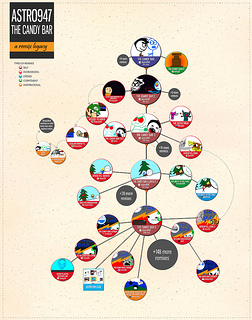
Remix Diagram
We try to shed light on both of these questions using data from Scratch a large online remixing community. Although we find support for several popular theories, we also present evidence in support of a persistent trade-off that has broad practical and theoretical implications. In what we call the remixing dilemma, we suggest that characteristics of projects that are associated with higher rates of remixing are also associated with simpler and less transformative types of derivatives.

Our study is focused on two interrelated research questions. First, we ask why some projects shared in remixing communities are more or less generative than others. Generativity a term we borrow from Jonathan Zittrain describes creative works that are likely to inspire follow-on work. Several scholars have offered suggestions for why some creative works might be more generative than others. We focus on three central theories:
  1. Projects that are moderately complicated are more generative. The free and open source software motto release early and release often suggests that simple projects will offer more obvious opportunities for contribution than more polished projects. That said, projects that are extremely simple (e.g., completely blank slates) may also uninspiring to would-be contributors.
  2. Projects by prominent creators are more generative. The reasoning for this claim comes from the suggestion that remixing can act as a form of cultural conversation and that the work of popular creators can act like a common medium or language.
  3. Projects that are remixes themselves are more generative. The reasoning for this final claim comes from the idea that remixing thrives through the accumulation of contributions from groups of people building on each other s work.
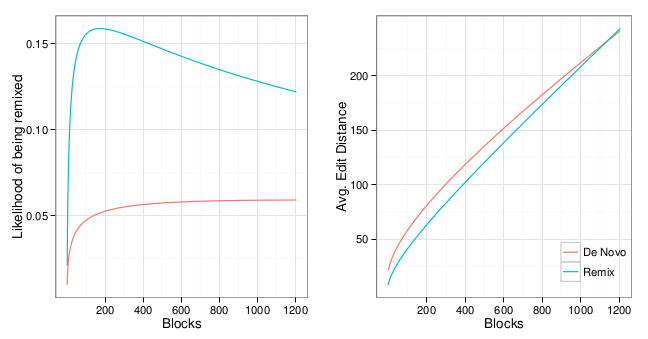
Our second question focuses on the originality of remixes and asks when more or less transformative remixing occurs. For example, highly generative projects may be less exciting if the projects produced based on them are all near-identical copies of antecedent projects. For a series of reasons including the fact that increased generativity might come by attracting less interested, skilled, or motivated individuals we suggest that each of the factors associated with generativity will also be associated with less original forms of remixing. We call this trade-off the remixing dilemma. We answer both of our research questions using a detailed dataset from Scratch, where young people build, share, and collaborate on interactive animations and video games. The community was built to support users of the Scratch programming environment, a desktop application with functionality similar to Flash created by the Lifelong Kindergarten Group at the MIT Media Lab. Scratch is designed to allow users to build projects by integrating images, music, sound, and other media with programming code. Scratch is used by more than a million users, most of them under 18 years old. To test our three theories about generativity, we measure whether or not, as well as how many times, Scratch projects were remixed in a dataset that includes every shared project. Although Scratch is designed as a remixing community, only around one tenth of all Scratch projects are ever remixed. Because more popular projects are remixed more frequently simply because of exposure, we control for the number of times each project is viewed. Our analysis shows at least some support for all three theories of generativity described above. (1) Projects with moderate amounts of code are remixed more often than either very simple or very complex projects. (2) Projects by more prominent creators are more generative. (3) Remixes are more likely to attract remixers than de novo projects. To test our theory that there is a trade-off between generativity and originality, we build a dataset that includes every Scratch remix and its antecedent. For each pair, we construct a measure of originality by comparing the remix to its antecedent and computing an edit distance (a concept we borrow from software engineering) to determine how much the projects differ. We find strong evidence of a trade-off: (1) Projects of moderate complexity are remixed more lightly than more complicated projects. (2) Projects by more prominent creators tend to be remixed in less transformative ways. (3) Cumulative remixing tends to be associated with shallower and less transformative derivatives. That said, our support for (1) is qualified in that we do not find evidence of the increased originality for the simplest projects as our theory predicted.
Two plots of estimated values for prototypical projects. Panel 1 (left) display predicted probabilities of being remixed. Panel 2 (right) display predicted edit distances. Both panels show predicted values for both remixes and de novo projects from 0 to 1,204 blocks (99th percentile).

Two plots of estimated values for prototypical projects. Panel 1 (left) displays predicted probabilities of being remixed. Panel 2 (right) displays predicted edit distances. Both panels show predicted values for both remixes and de novo projects from 0 to 1,204 blocks (99th percentile).

We feel that our results raise difficult but important challenges, especially for the designers of social media systems. For example, many social media sites track and display user prominence with leaderboards or lists of aggregate views. This technique may lead to increased generativity by emphasizing and highlighting creator prominence. That said, it may also lead to a decrease in originality of the remixes elicited. Our results regarding the relationship of complexity to generativity and originality of remixes suggest that supporting increased complexity, at least for most projects, may have fewer drawbacks. As supporters and advocates of remixing, we feel that although highly generative works that lead to highly original derivatives may be rare and difficult for system designers to support, understanding remixing dynamics and encouraging these rare projects remain a worthwhile and important goal. Benjamin Mako Hill, Massachusetts Institute of Technology
Andr s Monroy-Hern ndez, Microsoft Research
For more, see our full paper, The remixing dilemma: The trade-off between generativity and originality. Published in American Behavioral Scientist. 57-5, Pp. 643 663. (Official Link, Pay-Walled ).

6 May 2013

Martin Michlmayr: Upgrading to Debian 7.0 (wheezy) on ARM

Debian 7.0 (wheezy) has been released. Here are some notes if you're running Debian on an ARM-based NAS device or plug computer and are planning to upgrade. First of all, if you're running Debian on a plug computer, such as the SheevaPlug, make sure that you have u-boot version 2011.12-3 (or higher). If you're using an older version, the Linux kernel in wheezy will not boot! You can read my u-boot upgrade instructions on how to check the version of u-boot and upgrade it. Second, check your /etc/kernel-img.conf file. If it still contains the following line, please remove this line.
postinst_hook = flash-kernel
This postinst_hook directive was needed in the past but flash-kernel is called automatically nowadays whenever you install a new kernel. Now you're almost ready to start with your upgrade. Before you start, make sure to read the release notes for Debian 7.0 on ARM. This document contains a lot of information on performing a successful upgrade. During the kernel upgrade, you'll get the following message about the boot loader configuration:
The boot loader configuration for this system was not recognized. These
settings in the configuration may need to be updated:
 * The root device ID passed as a kernel parameter;
 * The boot device ID used to install and update the boot loader.
On ARM-based NAS devices and plug computers, you can simply ignore this warning. We put the root device into the ramdisk so it will be updated automatically. There are no other issues I'm aware of, so good luck with your upgrade and have fun with Debian wheezy!

25 April 2013

Julien Danjou: OpenStack Design Summit Havana, from a Ceilometer point of view

Last week was the OpenStack Design Summit in Portland, OR where we, developers, discussed and designed the new OpenStack release (Havana) coming up. The summit has been wonderful. It was my first OpenStack design summit -- even more as a PTL -- and bumping into various people I've never met so far and worked with online only was a real pleasure! <figure> <figcaption>Me and Nick ready to talk about Ceilometer new features.</figcaption> </figure> Nick Barcet from eNovance, our dear previous Ceilometer PTL, and myself, talked about Ceilometer and presented the work that bas been done for Grizzly, with some previews of what we'll like to see done for its Havana release. You can take a look at the slides if you're curious. Design sessions Ceilometer had his design sessions during the last days of the summit. We noted a lot of things and commented during the sessions in our Etherpads instances. The first session was a description of Ceilometer core architecture for interested people, and was a wonderful success considering that the room was packed. Our Doug Hellmann did a wonderful job introducing people to Ceilometer and answering question. <figure> <figcaption>Doug explaining Ceilometer architecture.</figcaption> </figure> The next session was about getting feedbacks from our users. We had a lot of surprise to discover wonderful real use-cases and deployments, like the CERN using Ceilometer and generating 2 GB of data per day! The following sessions ran on Thursday and were much more about new features discussion. A lot ot already existing blueprints were discussed and quickly validated during the first morning session. Then, Sandy Walsh introduced the architecture they use inside StackTach, so we can start thinking about getting things from it into Ceilometer. API improvements were discussed without surprises and with a good consensus on what needs to be done. The four following sessions that occupied a lot of the days were related to alarming. All were lead by Eoghan Glynn, from RedHat, who did an amazing job presenting the possible architectures with theirs pros and cons. Actually, all we had to do was to nod to his designs and acknowledge the plan on how to build this. That last two sessions were about discussing advanced models for billing where we got some interesting feedback from Daniel Dyer from HP, and then were a quick follow-up of the StackTach presentation from the morning session. Havana roadmap The list of blueprints targetting Havana is available and should be finished by next week. If you want to propose blueprints, you're free to do so and inform us about it so we can validate it. The same applies if you wish to implement one of them! API extension I do think the API version 2 is going to be heavily extended during this release cycle. We need more feature, like the group-by functionnality. Healthnmon In parallel of the design sessions, discussions took place in the unconference room with the Healthnmon developers to figure out a plan in order to merge some of their efforts into Ceilometer. They should provide a component to help Ceilometer supports more hypervisors than it currently does. Alarming Alarming is definitely going to be the next big project for Ceilometer. Today, Eoghan and I started building blueprints on alarming, centralized in a general blueprint. We know this is going to happen for real and very soon, thanks to the engagements of eNovance and RedHat who are commiting resources to this amazing project!

18 April 2013

Daniel Pocock: Getting to Switzerland, travel costs

With so many people contemplating the cost of travel to Switzerland this summer, I thought I would share some eye-opening insights into how to get a better deal. Let's look at some costs for a hypothetical DebConf13 visitor coming from New York. Flight prices taken today from a comparison site for 8 - 18 August, car hire prices from Europcar and rail prices from SBB (regular tickets) and Swiss Travel System (tourist rail passes):
Departure airport Arrival airport Flight cost Bus to Swiss border Rail pass Total (Flight+bus/train) Airport car hire, 10 days Total (Flight+car)
New York Geneva $1,153 n/a CHF 82
Return ticket
$1,235 CHF 668 $1,823
New York Milan $990 $20 CHF 315
Flexi pass
$1,350 EUR 413
CHF 496
$1,490
Warning: car rental prices based on advance booking - if you just arrive at a Swiss airport and hire a car on the spot, it is likely to be much more expensive, maybe CHF 200 per day For a single traveler, it is slightly cheaper to fly into Geneva (closest airport) and buy a return train ticket, as long as no other travel in Switzerland is desired and sleeping on-site at Vaumarcus, not using a bus every day. If traveling in Switzerland to see the mountains, then it works out cheaper to fly into Milan, Italy, which is very close to the Swiss border. Most of the journey from Milan to Vaumarcus can be covered using one of the Swiss railway travel passes, with stops for sight-seeing on the way, and the other days on the pass used for sight-seeing. Now imagine people arriving in a group: the rail ticket prices quickly add up. For a family of four, 4 * 315 = CHF 1,260. Car rental may be a better option. Hiring a car in Switzerland is expensive, hiring in Italy is much cheaper, the plane tickets to Italy are cheaper too, so there is a lot of money to be saved. But who wants the hassle of travelling to Switzerland via Italy? Of course that is the silliest rhetorical question you are going to see this week: visiting Italy is not a hassle at all. Even the Swiss enjoy going there so much that they just built the world's longest rail tunnel under the Alps to bring Como and Milan that little bit closer, the Gotthard Base Tunnel. The Italian connection could involve a few days in Como or Brunate. If designer fashion labels are appealing to you (or as a gift), Vertemate has one well known outlet for a major brand and the prices really are much cheaper than any of the cities. If you want a laugh, it's worth comparing the hotel prices in Lugano on the Swiss side of the border against prices in nearby Como. Traveling north from Como, taking a train to Luzern (and a connection to Vaumarcus), it is possible to stop in Goschenen and go up into the mountains to experience the Glacier Express featured in my earlier video or get off the train at Arth-Goldau to cross Rigi on the Rigi Bahn (from my other video), take a boat across the lake to Luzern and then continue to Vaumarcus. The Italian entry point isn't just an option for those coming from the US. Even a traveler from London will find that the budget airlines have largely snubbed the Swiss airports with their high operating costs. Easyjet offers a limited number of flights to Geneva and Zurich, but the prices are always higher than their other destinations. Ryanair offers flight's to Milan's Bergamo airport and Easyjet flies to Milan Malpensa.

12 April 2013

Daniel Pocock: Switzerland Schilthorn with 007 (leg 2)

What has DebConf13 got in common with James Bond? The connection with Switzerland of course. Bond creator Ian Flemming actually spent time living in Switzerland and this beautiful alpine country was featured in more than one of his books/movies, including Goldfinger On Her Majesty's Secret Service took Commander Bond to the summit of the Schilthorn, a distinctive peak of 2,970m altitude in the center of Switzerland. To follow up on my recent Glacier Express and Righ Bahn rack railway videos, here is a video of the second leg of the dramatic four-stage cable car journey to the top of Schilthorn: <video controls="" height="340" poster="http://upload.wikimedia.org/wikipedia/commons/thumb/0/03/Schilthorn_with_Bernese_Alps%2C_2012_August.jpg/800px-Schilthorn_with_Bernese_Alps%2C_2012_August.jpg" width="560">
<source src="http://video.danielpocock.com/VID_20121025_121324.m4v" type="video/mp4"></source>
<source src="http://video.danielpocock.com/VID_20121025_121324.webm" type="video/webm"></source>
</video> Download and watch later:
.m4v
.webm Some observations about Schilthorn visits:
  • There is a revolving restaurant at the top - to get a seat by the window, which is by far the best place to sit, ring and make a reservation the day before. Meal prices are no more extraordinary than any other Swiss restaurant, so it is worthwhile spending some time up there enjoying lunch and the views.
  • Jungfrau is higher - but from Schilthorn, you can see Jungfrau, which is a spectacular view, yet without paying the extraordinary price of a ticket for Jungfrau. The ride to Jungfrau (high altitude railway) is also slightly less spectacular, as much of it is in a tunnel through the rock, while the ride to Schilthorn is all cable car.
  • Almost all rail ticket passes give a 50% discount on the Schilthorn cable car.
  • The SBB sometimes offers an extra 30% discount on Schilthorn tickets, see the monthly railaway' offers, which can be combined with the 50% discount. This type of ticket can't be purchased in the same region, (e.g. within about 20km of Schilthorn)
  • An easy way to save another 50% on the ticket is to walk down from the top. If you do this, plan to start very early, but it is a spectacular walk (requires hiking boots and protective clothing, snowy/slippery at most times of the year)
  • All those discounts are cumulative: so if you use them all and walk down, you only pay 0.5 * 0.7 * 0.5 (which is 17.5%) of the full price.
The next leg of the cable car journey will appear soon...

11 April 2013

Bdale Garbee: Batteries and Pyro Circuits

Keith and I have discovered a change in the behavior of the protection circuits integrated in the LiPo batteries we sell for use with Altus Metrum products that poses a risk for our customers. This post is meant to document what we now know, communicate changes we're planning as a result, and explain what we think flyers of our existing electronics and batteries may want to do to maximize their chances of successful flights. Background Choosing batteries and designing pyro circuits for high power rocketry avionics involves a variety of trade-offs. Reliability is the highest concern, both because nobody wants to lose an airframe due to a failed pyro event, and also because airframes recovering anomalously have safety implications. But we also care about other factors including cost and weight, and usually want to minimize the complexity of both the electronics and the overall installation. The objective of a pyro circuit is to dump enough energy rapidly into an electric match to cause it to catch fire. We need batteries both to power the electronics that decide when to fire the charge, and to provide the energy that actually ignites the match. The two most common battery types seen in the rocketry hobby are alkaline cells, often the nominal 9V rectangular variety, and rechargeable batteries based on Lithium Polymer (LiPo) chemistry. LiPo cells are 3.7 volts per cell nominal voltage, are very light, and have a high energy density. LiPo capacity is measured in units of current times time, so an 850mAh cell should be able to deliver 850 milliamps for an hour. The battery industry also uses something called a "C rate" to describe how fast the battery can be usefully discharged, wich is a multiplier relative to the battery capacity. So a battery with 850mAh capacity and a "2C" rating can deliver current at a sustained rate of 1700mA until discharged, while the same capacity at a "5C" rating can deliver 4250mA. By comparison, most 9V alkaline batteries are actually composed of 6 individual 1.5V cells enclosed in a wrapper. It's hard to get hard numbers for capacity and discharge rate, since in an alkaline cell the two are not independent, and the discharge rate is related to the volume of each individual cell. The data sheet for an Energizer 522 shows just over 600mAh at a 25mA discharge rate, dropping to about 300mAh at a 500mA discharge rate. Importantly for use in pyro circuits, LiPo cells have a very low source impedance, which means they can source immense amounts of current. It's not unusual for cells in the 1000mAh range to have ratings in excess of 30C! Because this rapid discharge ability can pose a risk of fire, it's common for LiPo cells to come with a "protection board" integrated into the battery assembly that is designed to limit the current to some rate such as 2C continuous duty. In large airframes, or projects that involve staging, air-starts, or other complex pyro event sequences, the most reliable approach will always be to use separate batteries for the control electronics and the source of pyro firing power. In the limit, having separate pyro batteries for each pyro charge with the control electronics only providing the switching to connect the batteries to the charges could even make sense. But for most airframes, this is overkill, and the increases in mass, volume, and wiring complexity just don't make sense. The challenge, then, is how to design electronics that will robustly initiate pyro events without negatively affecting the rest of the electronics when operating from a single shared battery. Altus Metrum Pyro Circuits The very first prototypes of TeleMetrum were designed to use a single-cell LiPo battery, and had an on-board 100mA charging circuit. Because we needed 5 volts to power the accelerometer, we had a small switching regulator that up-converted the LiPo voltage, and we used some of that regulator's output to charge a 1000uF capacitor. The pyro circuit used Fairchild FDN335N N-channel MOSFET switches in a low-side switching configuration to dump the energy stored in the capacitor through an attached ematch. Those FETs had an on resistance of under a tenth of an ohm in our operating conditions. The circuit worked very reliably, but the 1000uF electrolytic cap was huge and we struggled with the mechanics of such a large part hanging off the board... It turns out that 3.7 volts is way more than enough to fire a typical low-current e-match or equivalents like the Quest Q2G2 igniters. In fact, bench testing with a good digital oscilloscope showed that a typical e-match with resistance of 1.3-1.8 ohms will fire in approximately 13 microseconds when hit with the nominal 3.7 volts from a LiPo. So, starting with our v0.2 boards, we switched to using the LiPo battery voltage directly to fire the pyro charges, eliminating the clunky electrolytic capacitor entirely. We also switched to the Fairchild FDS9926A dual N-channel MOSFET whose specs are better in all regards for our application. The on resistance is down around 40 milli-ohms in our circuit, such that the current ratings are much higher (FET current limits are primarily driven by how much heat is generated due to current flowing through the channel's on resistance). Because using the LiPo voltage directly means we're effectively temporarily putting a very low resistance across the battery during the pyro events, the input voltage to the voltage regulator gets pulled down. To ensure the processor could "ride through" these events, we added a 100uF surface mount bulk capacitor on the 3.3 volt regulated voltage rail, which bench testing demonstrated was more than sufficient to maintain processor operation through pyro events. And that is essentially the same pyro circuit on all the boards, both TeleMetrum and TeleMini, that we have shipped to date. What's Changed The LiPo batteries we source and sell with our electronics come with a protection board and cable terminated in a 2-pin, 2mm "JST" connector. The specs on the protection board have always been "2C continuous", but we observed the ability to source much higher currents for short periods such as the 13 micro-seconds or so required to fire an e-match. Thus these protection circuits seemed just fine .. we could fire e-matches with a burst of current but were protected against short circuits in the wiring or our boards by the 2C continuous limit. Unfortunately, the most recent batch of batteries we sourced seem to have a much "twitchier" protection circuit. We can draw more than 2C for short bursts, but not as much as with prior boards, and not for as long an interval. With a 1 ohm power resistor on the pyro terminals of one of our boards, we get about 9 milliseconds of power before the protection circuit cuts in and shuts the battery down. The power stays down until all load is removed, which at least means the board is turned off and back on again, and in some cases could even mean the battery is unplugged and re-plugged since we draw trace current to keep the GPS memory alive even when the power is turned off, and at least some of the new batteries see that as enough to keep the power turned off after an over-current event. For many e-matches, this isn't an issue, since 9 milliseconds is way longer than the 13 microseconds needed to fire the charge. Unfortunately, we've discovered that many of the e-matches bought and used in the rocketry hobby are actually made for use in the fireworks industry, where it is desireable to retain continuity after firing so that series connections of e-matches all can fire even if some fire faster than others! This means that while the resistance goes up some after firing, sometimes the drain on the battery remains sufficient to cause the protection circuit to kick in even after the pyro charge has fired. What We're Doing About It If we remove the protection circuit from the LiPo (or jumper around it), all existing Altus Metrum products will operate successfully with pyro charges thave have an effective resistance of as low as 1 ohm. That's lower than any e-match or Q2G2 we've ever seen, so in effect what this means is that if you have an existing Altus Metrum flight computer, and you remove the LiPo protection circuit, you're good to go. This does not really make things any more "dangerous", since our battery chargers are all current limited and our discharge patterns will never cause heating of the battery. Frankly, in a rocket, the most likely way to cause a problem with a LiPo is by smashing or puncturing the actual battery during bench work or during a crash... and those cause the same problems with or without a protection board present. In the future, we will ship batteries that have either a much higher C rating on the protection circuit, or have no protection circuit at all. The number of problems reported by actual customers that we think should be attributed to LiPo protection circuit boards is very low, and we suspect most of our customers who are happily flying their boards can continue to do so. Ground testing where you fire pyro charges (or at least e-matches) using RF to issue the commands (not USB, since the LiPo charger is running any time USB is connected!) will confirm whether there's a problem. If the board resets (does startup beeps) after a pyro event, or shuts down completely (no LED activity), then you have a problem. If the matches light and the board keeps running, you're good to go. However, any Altus Metrum customer with LiPo batteries sourced from us or our distributors who is worried about this problem (even if you haven't seen problems in ground testing or previous flights), and who doesn't want to try soldering on the battery circuit board yourself, is welcome to contact us about removing the protection circuit for you. We won't charge anything other than shipping. To take advantage of this offer, just send email to fixmybattery@altusmetrum.org telling us how many of which capacity batteries you have that you'd like updated, and we'll respond with an RMA number and shipping details. Going Even Further As previously indicated, with the LiPo protection circuits removed, all of our current products will work reliably with at least 1 ohm across the pyro terminals. That should cover all real-world flying conditions just fine, but we're not satisfied yet. We've designed a new pyro control circuit that transfers the maximum possible energy to the load regardless of battery voltage without ever allowing the voltage to the processor to droop at all. We're testing this new circuit in various prototypes now, and if it pans out it will probably show up first in MegaMetrum and then trickle down to TeleMetrum and TeleMini as those products are updated later this year. The new pyro circuit tolerates 0 ohms (dead shorts) on the pyro terminals for as long as the battery can provide current, which is as good as it gets. We think the circuit is clever enough that we'll probably write more about it once we're finished validating it.

14 March 2013

Russ Allbery: Review: Higher Order Perl

Review: Higher Order Perl, by Mark Jason Dominus
Publisher: Morgan Kaufmann
Copyright: 2005
ISBN: 1-55860-701-3
Format: Trade paperback
Pages: 563
Disclaimer: The author and I both used to be (technically still are, but the newsgroup is dead) moderators of comp.lang.perl.moderated, and I knew him electronically from answering questions on the Perl Usenet newsgroups many years ago. Perl is, in general construction, a typical imperative language in the style of C, with object-oriented capabilities bolted (somewhat awkwardly) on. Most Perl code looks remarkably like C code with more powerful built-in data types and no memory management. A minority of Perl programs embrace object-oriented techniques and remind one of C++ or Java (or Python). But Perl also has powerful capabilities borrowed from functional programming languages and the Lisp tradition, even though many Perl programmers rarely use them and aren't familiar with them. Higher Order Perl focuses on those capabilities and how to use them effectively, starting with callbacks and uses of function pointers and moving into recursion and analysis of recursive functions, iterators, currying, and parsers. It concludes with a fully-worked example of constructing a declarative programming system using the techniques developed earlier in the book. Higher Order Perl is a programming book for an intermediate to advanced Perl programmer, already a rare topic. This is not a look at how to apply Perl to another area of programming, or a cookbook of techniques. It's an attempt to help a Perl programmer think about and use the language differently, and it follows through on that. It's refreshing and rare to read a programming technique book that's targeted at the practicing expert. (I think the size of the audience is often too small for publishers to target it.) Even the most experienced Perl programmer is probably going to learn something fundamental from this book, not just interesting trivia around the edges. On the negative side, though, I found the book a bit too focused on computer science and mathematics problems, particularly in the choice of examples and sample scripts. (And I say this as someone who has a master's degree in computer science with a software theory focus.) This is a bit hard to avoid for topics like recursion, where problems like computing Fibonacci numbers are classic, but throughout the book I struggled to focus past feelings of "but why would I ever do that"? The extended discussion of the Newton-Raphson method is the most memorable; I'm not sure that's a problem many Perl programmers would have and need a higher-order technique for. There's also a lot of discussion of recursion analysis and transformations between recursive and iterative expressions of problems, which is ground I remember well from my degree but which I've rarely had any practical use for in day-to-day programming. This is not a uniform problem, though, just a tendency. There are some great examples that I think are more in the mainstream of Perl problems, including a reinvention of File::Find that shows how to add more flexibility, a web spider, and a great discussion on how to construct a conventional queryable database on top of a flat file (a topic that's near and dear to my heart). And then there's the chapter on infinite streams. Dominus presents a method of using closures to create a version of an interator: a sort of infinite linked list that can keep generating additional elements. He presents this in several contexts, but one of them is log parsing, and that turned out to be exactly the solution that I needed for a problem I was working on while reading this book. I've written about this elsewhere, but this was a wonderful idea that helped me think about both Perl and a major application area in a completely new way, and I wrote an application using that knowledge that would have taken me much longer using different techniques and would have been much less fun. So, for me, this chapter was more than worth the entire book, and blankets the rest of it in a delighted feeling. Other people may or may not have that experience. I think it will depend on whether one of these techniques hits home for you the way that one did for me. This is a book with some idiosyncracies, and some sections that may drag. Having lots of fully-worked examples is a major plus, but some of those are so comprehensive that one can get a bit lost in the details. That particularly hit me with the last couple of chapters on parsing and on the example declarative programming application. Quite a bit of that text involved reinventing a recursive descent parser (another very computer science example), when I'm not quite sure why one wouldn't use one of the existing parser generators on CPAN for practical purposes, and inventing a lot of new syntax to try to make parser Perl code more readable. But one certainly can't complain that Dominus omits necessary details, and there is some appeal in watching an experienced programmer work through a problem from analysis to implementation. But, despite the idiosyncracies, I recommend this book to any experienced Perl programmer who wants to expand their view of the language. The techniques here closures, higher-order functions, iterators and streams, and formal parsers are powerful and underused in the Perl community. You may want to pick and choose which sections you pay close attention to, but I think everyone will find something of interest here. In the weeks since I read this book, my opinion of it has only grown. And I can't tell you just how much I loved the infinite stream concept. Rating: 8 out of 10

9 March 2013

Francesca Ciceri: Female participation in Debian (reloaded)

This dent by M nica Ram rez Arceda finally gave me the energy to update the statistics about female participation in Debian, first published by Margarita Manterola back in 2010. So, here the new graph updated to February 2013. Female participation in Debian graph The necessary caveat is that is not easy (at least for me) to tell the gender just based on first names, so the actual numbers may be higher. In addition, you should be warned that there are some contributions not easily traceable: it's the case of translators, graphic artists and documentation writers, as well as event organizers. For instance, Beatrice Torracca doesn't appear in these stats, and she is the co-coordinator of the Italian translation team and a long term Debian (and free software in general) contributor. There was a proposal to better track non packaging contributors, but no news on that front yet (at least that I'm aware of). Sources: You can find the data used as well as the updated graph here. TODO:

22 February 2013

Richard Hartmann: Finland I

Finland. Helsinki, Lahti, streets Arriving at Helsinki airport, we filed a claim with Lufthansa as a hard shell suitcase had a splintered corner. We were surprised that so many Finns arrived from Munich with skis, more on that later. We picked up our car and started on our way towards Koli; driving with a top speed of 100 km/h and often being limited to 80 km/h or even 60 km/h is... unusual... Finnish police/authorities seem to be obsessed with enforcing those speed limits as there are a lot of speed cameras along the way. Finnish people seem to be similarly obsessed with slot machines; there is an incredible amount of them at gas stations and a constant stream of people playing them. From an outsider's perspective, it's weird that a country as strict about one form of addiction, alcohol, and working against it vigorously, by means of taxes, would allow another form of addiction, gambling, run as freely and this allow so many slot machines. Speaking of taxes on alcohol: a single 0.33 l bottle of beer is more expensive in a Finnish supermarket than 0.5 l of beer in a German restaurant. Which also explains why supermarkets tend to have a rather large section with relatively cheap alcohol free beer. Anyway, coming back to streets: Highway intersections don't have continuous on/off ramps from which you change from one highway to another; you drive off of the highway, stop at a traffic light, and then continue onto the other highway. Weird system, but given the amount of traffic we witnessed, it's probably Good Enough (tm). Stopping for a short time in Lohti simply because it's apparently famous for winter sports competitions, we arrived at Future Freetime in Koli national park after about five to six gruelling hours of net driving through somewhat bad weather and behind slow drivers. Koli Hiking up to Ukko-Koli and its sister peaks proved to be rather exhausting as we kept on breaking through the snow cover to our knees and sometimes even our hips. Once we were up there, we realized that even though you couldn't see it in between the trees, there was fog all over the plains so we couldn't see anything. Still, it was a nice hike even if somewhat short. Note to self: Even when a trail is marked locally, if OpenStreetMap does not know about it... don't walk along it. Especially not when the going's rough already. And if there's a sign suggesting you wear snow shoes... wear snow shoes. Returning to Koli Hotel and the museum next to it, we walked over to the ski slope. The highest peak within Koli,Ukko-Koli, is 347 meters high, the local ski slope starts a good way below that. This would explain why a lot of Finns came back from Munich with their skis... Afterwards, we rented a snow mobile, without guide or supervision, and drove from Loma-Koli over lake Pielien towards Purnuniemi and in a large circle down towards lake Ryyn skyl where we turned around and went back the same way. If we thought Finnish streets don't have a lot of signs we soon realized that snow mobile tracks have even less. There are at most two or three signs pointing you in the right direction, but on the plus side, there are no posted speed limits for snow mobiles, either. In somewhat related news, snow mobiles can go at least 95 km/h. At that point, the scratched and dirty visor of your rental helmet will keep slamming down, forcing you to take one hand off the handle and thus stop accelerating to maintain stability. To round off the day, we heated up the sauna built into our little wooden hut. Running outside three times to rub myself off with snow from head to toes, I almost slipped and fell while standing still. When your feet are too hot for the snowy ground, you'll start to melt your own little pools of slippery water/snow mush within seconds. File that one under "I would never have guessed unless I had experienced it myself". Generic The MarkDown source of this blog post is not even 5 kiB in size; even in a worst case scenario, pushing this to my ikiwiki instance via git will eat up less 10 kiB of mobile data. Which is good because I have 78 MiB of international data left on this plan. This is also the reason why there are no links in this blog post: I am writing everything off line and don't want to search for the correct URLs to link to. I really wish EU regulators would start to tackle data roaming now that SMS and voice calls are being forced down into somewhat sane pricing regions by regulations. PS:
-rw-r--r-- 1 richih richih 4.6K Feb 11 22:55 11-Finland-I.mdwn
[...]
Writing objects: 100% (7/7), 2.79 KiB, done.

Russell Coker: iPhone vs Android

A friend who s a long-time iPhone user just asked for my advice about whether to get a Samsung Galaxy S3, a Samsung Galaxy Note 2, or a iPhone 5. Advantages for Android I think that liberty should be the first consideration, I ve previously written about how Android phones won t necessarily give you as much freedom as you desire if you buy on the basis of price and features [1]. But even the least free Android options are way better than the iOS (iPhone and iPad) environment. This isn t necessarily a big deal for my friend, like most of the population he usually just wants things to work being able to hack them isn t such an issue. However unlike most of the population he does make a reasonable portion of his income from software development and it could be that he will have a contract for developing an app on a mobile device in which case the freedom to tinker on Android will help him. He could use an iPhone for his personal use and develop on an Android platform for his clients, but generally it s more efficient if your personal use of technology is similar to that of your clients. The Nexus devices are very good for liberty and they also have nice hardware at a low price, I ve just got a Nexus 4 for my wife and it s very nice. The next issue is that of hardware standards, I ve previously written about the potential for developing a standard form factor for Android phones [2] although this doesn t seem likely to be implemented in the near future. The wide range of Android hardware means that the range of cases etc on the market is rather small. But the advantage of the wide range is that with an Android phone you can have a device that s bigger, smaller, cheaper, cuter, or faster than an iPhone. There are Android devices which have a higher resolution, more RAM, more storage (if you include SD storage), or has other benefits over an iPhone. For whatever reasonable range of specs appeal to you you can probably find a device to match. I ve previously written about the way the ideal size for devices depends on your hand size and your preferred manner of gripping the device [3], so the lack of size range in Apple devices is not just a limitation on personal choice but also a failure to properly support people with different size hands. Depending on the preferred manner of gripping a phone the iPhone 5 is either too big for an average woman or too small for a tall man. The Google Play store apparently has more applications than the iPhone/iPad App Market. This difference can be expected to increase now that the Samsung Galaxy S3 is outselling the iPhone 5. Comparing the number of unit sales of the iPhone vs Android phones is no longer interesting, comparing Samsung to Apple is the interesting thing. Advantages for the iPhone By all accounts it s quite an easy process to backup and restore all iPhone settings. You can expect that after losing an iPhone you can just connect the new one to your PC and have it work in exactly the same way after all the data is transferred. Trying to do such things on Android is merely difficult if you have root access to your phone and the source and destination phones are of exactly the same make and model. But if you have different versions of the phone or if you don t have root access then it may be impossible. I welcome comments from anyone who knows of good solutions to this problem. The iPhone achieved a reasonable share of the smart-phone market before Android really started going well so there are a lot of people who are used to the iPhone. Simply by being unfamiliar Android will be a more difficult option for people who have used the iPhone such as my friend. But it is possible to learn other systems. Generally I think that this may be a big issue for people who use Macs for all their other computing. But if the only Apple product you use is an iPhone then switching to Android shouldn t be a big deal. Update: One feature of the iPhone that is very important to my friend is the ability to add arbitrary tags in the contacts. In addition to name, address, phone number, etc he wants to add arbitrary notes related to his business. While he could put that sort of thing into the Notes field in Android he would rather have several fields with his own names. Android 4.1.x definitely doesn t have this and I can t test Android 4.2.x at this time. Is there any way of doing such things on Android? Conclusion It seems to me that Android devices are better in every way apart from backup, restore, and general management. If I was about to buy 100 phones then I d probably consider the iPhone (not necessarily buy but definitely consider). But for a single user I definitely recommend Android devices. The Android devices which seem good at the moment are the Galaxy S3 (which I m using now), the Nexus 4 (which is really good apart from being unable to change the battery or add more storage), and the Galaxy Note 2 (which is about the biggest phone available). One of the things that my friend wants to do is to use a phone instead of a tablet or laptop. I think that the Galaxy Note 2 is the only option for him.

16 February 2013

Ingo Juergensmann: right2water.eu - Water is a Human Right

I don't know how the water supply is organised in your country, whether it is a public water supply or private, but when you are living in the European Union it may change soon to private water supply. The EU Commission wants to liberalise the water supply and sanitation in the EU, but this would mean higher prices and less quality for the citizens. There is a citizens' initiative against this plan, because water and sanitation is a human right and not a commoditiy that can be (ab)used by private companies to make money. Please sign the petition on right2water.eu: Currently the petition already reached its goal of 1 Million signers, but unfortunately the rules are somewhat more complex: A certain quorum must be reached in every member country of the EU. At the moment the most signers came from Germany, so the quorum for Germany was reached. But according to a statistic posted on Twitter the quorum needs to be reached at least in 7 countries. Only Germany, Belgium and Austria did so. So please sign the petition on right2water.eu and spread the word in your country! But why is privatization a bad idea? Especially when it is done in a Public Private Partnership (PPP)? As said, water and sanitation is a human right and must not be object for profit. What happens when water supply is done by a private corporation can be seen in the documentary "Water Makes Money" which was aired on French-German TV station "Arte" last week. You can watch it online in German and French. The petition is running until September. There's enough time to sign it and - even more important - to contact your Members of European Parliament and request a "No!" to privatization of water and sanitation!
Kategorie:

15 February 2013

Robert Collins: More subunit needs

Of course, as happens sadly often, the scope creeps.. Additional pain points Zope s test runner runs things that are not tests, but which users want to know about layers . At the moment these are reported as individual tests, but this is problematic in a couple of ways. Firstly, the same test runs on multiple backend runners, so timing and stats get more complex. Secondly, if a layer fails to setup or teardown, tools like testrepository that have watched the stream will think a test failed, and on the next run try to explicitly run that test but that test doesn t really exist, so it won t run [unless an actual test that needs the layer is being run]. Openstack uses python coverage to gather coverage statistics during test runs. Each worker running tests needs to gather and return such statistics. The current subunit protocol has no space to hand this around, without it pretending to be a test [see a pattern here?]. And that has the same negative side effect test runners like testrepository will try to run that test . While testrepository doesn t want to know about coverage itself, it would be nice to be able to pass everything around and have a local hook handle the aggregation of that data. The way TAP is reflected into subunit today is to mangle each tap test into a subunit test , but for full benefits subunit tests have a higher bar they are individually addressable and runnable. So a TAP test script is much more equivalent to a subunit test. A similar concept is landing in Python s unittest soon subtests which will give very lightweight additional assertions within a larger test concept. Many C test runners that emit individual tests as simple assertions have this property as well there may be 5 or 10 executables each with dozens of assertions, but only the executables are individually addressable there is no way to run just one assertion from an executable as a test . It would be nice to avoid the friction that currently exists when dealing with that situation. Minimum requirements to support these Layers can be supported via timestamped stdout output, or fake tests. Neither is compelling, as the former requires special casing in subunit processors to data mine it, and the latter confuses test runners. A way to record something that is structured like a test (has an id the layer, an outcome in progress / ok / failed, and attachment data for showing failure details) but isn t a test would allow the data to flow around without causing confusion in the system. TAP support could change to just show the entire output as progress on one test and then fail or not at the end. This would result in a cognitive mismatch for folk from the TAP world, as TAP runners report each assertion as a test , and this would be hidden from subunit. Having a way to record something that is associated with an actual test, and has a name, status, attachment content for the TAP comments field that would let subunit processors report both the addressable tests (each TAP script) and the individual items, but know that only the overall scripts are runnable. Python subtests could use a unique test for each subtest, but that has the same issue has layers. Python will ensure a top level test errors if a subtest errors, so strictly speaking we probably don t need an associated-with concept, but we do need to be able to say that a test-like thing happened that isn t actually addressable. Coverage information could be about a single test, or even a subtest, or it could be about the entire work undertaken by the test process. I don t think we need a single standardised format for Coverage data (though that might be an excellent project for someone to undertake). It is also possible to overthink things :) . We have the idea of arbitrary attachments for tests. Perhaps arbitrary attachments outside of test scope would be better than specifying stdout/stderr as specific things. On the other hand stdout and stderr are well known things. Proposal version 2 A packetised length prefixed binary protocol, with each packet containing a small signature, length, routing code, a binary timestamp in UTC, a set of UTF8 tags (active only, no negative tags), a content tag one of (estimate + number, stdin, stdout, stderr, file, test), test-id, runnable, test-status (one of exists/inprogress/xfail/xsuccess/success/fail/skip), an attachment name, mime type, a last-block marker and a block of bytes. The std/stdout/stderr content tags are gone, replaced with file. The names stdin,stdout,stderr can be placed in the attachment name field to signal those well known files, and any other files that the test process wants to hand over can be simply embedded. Processors that don t expect them can just pass them on. Runnable is a boolean, indicating whether this packet is describing a test that can be executed deliberately (vs an individual TAP assertion, Python sub-test etc). This permits describing things like zope layers which are top level test-like things (they start, stop and can error) though they cannot be run.. and it doesn t explicitly model the setup/teardown aspect that they have. Should we do that? Testid is for identifying tests. With the runnable flag to indicate whether a test really is a test, subtests can just be namespaced by the generator reporters can choose whether to be naive and report every test , or whether to use simple string prefix-with-non-character-seperator to infer child elements. Impact on Python API If we change the API to:
class TestInfo(object):
    id = unicode
    status = ('exists', 'inprogress', 'xfail', 'xsuccess', 'success', 'fail', 'error', 'skip')
    runnable = boolean
class StreamingResult(object):
    def startTestRun(self):
        pass
    def stopTestRun(self):
        passs
    def estimate(self, count, route_code=None, timestamp=None):
        pass
    def file(self, name, bytes, eof=False, mime=None, test_info=None, route_code=None, timestamp=None):
        """Inform the result about the contents of an attachment."""
    def status(self, test_info, route_code=None, timestamp=None):
        """Inform the result about a test status with no attached data."""
This would permit the full semantics of a subunit stream to be represented I think, while being a narrow interface that should be easy to implement. Please provide feedback! I ll probably start implementing this soon.

14 February 2013

Jon Dowland: Managing Puppet modules with puppet

Over the last few days I've done quite a lot of work to try and get our puppet configuration up to modern best practises. The Puppet Labs folks strongly encourage you to make as much use of puppet modules as possible. A puppet module gathers together puppet manifests, facter facts and other bits and pieces into a reusable component that you could potentially share with others. Many modules (of very mixed quality) are available on the web, in particular at github and via Puppet Lab's own Forge. Since version 2.7.14, the puppet command-line tool has built-in support for managing modules:

# puppet module list
/etc/puppet/modules
  auth (???)
  interfaces (???)
 
# puppet module install puppetlabs-apt
 
However, they have not provided support for managing modules in puppet manifests themselves. This strikes me as a bit odd: the whole point of using puppet to manage your machines is to capture the configuration in one place. If your configuration depends on a collection of modules and module versions, you'd ideally record that in the puppet configuration itself. Otherwise building a new puppet master is a mixture of manually installing modules and setting it up as a client of your existing master. Other people to the rescue: Ryan Coleman (and Pieter van de Bruggen) have written puppet_module_provider which does exactly this. (Note that they both work for Puppet Labs). Now I can define which modules and what versions are necessary:
class puppetmaster  
   
  module   'rcoleman/puppet_module': ensure => '0.0.3',  
  module   'puppetlabs/firewall':    ensure => '0.0.4',  
  module   'puppetlabs/lvm':         ensure => '0.1.1',  
  module   'puppetlabs/ntp':         ensure => '0.2.0',  
   
I've decided to pin specific versions given the highly variable nature of module quality. There's no guarantee of backwards compatibility except by reputation of the publisher. The puppetlabs modules are likely to be of higher quality than average, so over time I'll probably gain confidence to change the specific versioning to 'latest' or similar. I also want to double-check how secure the module selection and downloading is (whether it's over HTTPS or cryptographic signatures are checked etc.)

13 February 2013

Lars Wirzenius: Public libraries bad for authors and publishers?

Brett points at a Guardian article on Terry Deary and his opinion that libraries are no longer relevant. In fact, Mr. Deary goes further: he thinks libraries are destroying the book business by preventing authors, publishers, and bookshops from getting paid. From the article:
As one of the most popular library authors his books were borrowed more than 500,000 times during 2011/12 Deary will have received the maximum amount possible for a writer from the Public Lending Right scheme, which gives authors 6.2p every time one of their books is borrowed, up to a cap of 6,600. "If I sold the book I'd get 30p per book. I get six grand, and I should be getting 180,000. But never mind my selfish author perception what about the bookshops? The libraries are doing nothing for the book industry. They give nothing back, whereas bookshops are selling the book, and the author and the publisher get paid, which is as it should be. What other entertainment do we expect to get for free?" he asked.
He's making several of the same false claims that people in the media business always make whenever they see people enjoying any kind of cultural products without paying for them.
  1. Every loan from a library is not a lost sale. More than 500 thousand loans does not mean 500 thousand lost sales. When borrowing a book is free, people will do it even if they aren't sure if they're going to like a book. The cheapest book by Mr. Deary I Amazon UK is 4.27 when sold as new by amazon (I'll ignored used books for the moment). The threshold for buying a book at that price is much, much higher than borrowing on for free.
  2. Letting people have stuff for free does not automatically mean they won't pay for other stuff. Indeed, they may well pay for the very stuff they got for free. See the several experiments to let customers set their own price for music, books, or computer games, or the success Cory Doctorow has letting people download e-books of his novels for free, and then letting people donate one or more hardcopies of the book to schools and libraries. This is not a model that will work well for everyone, but it proves the point: charging people money for each copy is not necessary to make good profit. In fact, studies of "Internet pirates", or people who download music and movies (and books) more or less illegally from the Internet, show that such people tend to spend more money on music and movies (and books!) than the average person. That's not something the publishers want to talk about, or hear. (I am talking here about real research, not the propganda material that lobbying organisations produce.)
  3. Why would people buy a book in the first place? They need to know they'll like it, but more importantly, they need to like reading in the first place. See point 1: if books cost any amount of money, the threshold for getting one is high. If you don't have easy, convenient access to books when you're a child, you're unlikely to be a reader of books when you're an adult. Public libraries are the perfect way to give people access to a wide variety of literature. In fact, they're about the most perfect marketing ploy in the history of media: the libraries pay for the books, and they pay each time they loan out a book, and every time a new future customer is brainwashed that much more into getting more stuff in the future. Libraries are not just for children, of course. Adult readers use them as well, and they're just as important as children, as far as the marketing ploy is concerned.
It's a bit sad that bookshops are dying out. Public libraries have, however, nothing to do with it. Online booksellers are usually cheaper, and have vastly larger catalogues, and that's a much more likely culprit. Also, bookshops have no intrinsic right to exist: they're middle-men who make a living by making it more convenient for customers to get what they want, and if they get out-competed, that's business life. Now, I neglected above to consider the possibility of buying used books. The reason for that is that media companies, and their lobbying organisations, would like to make selling of used books, music recordings, movies, and computer games not happen anymore. For example, Sony, and files patents for, stopping people from playing used games on its game consoles, even without Internet access. Mr. Deary seems to be following the MPAA and RIAA checklist on how to talk about those evil people who enjoy something without paying for it every time. It can't be long before he starts asking for a ban on selling used books. Let's hope, however, that reality and facts and sense win this time, and that we can let Mr. Deary live alone in his little horrible hallucination.

Jan Wagner: Searching painting: Strawberry and Man on Pumps with Sparkling wine

We are searching a motive for a painting or a painting itself for a quite while now. This should find it's place in our living room. Unfortunately we didn't found one, which matched our both prospect and/or wasn't compatible with the rest of our living room. Yesterday we stumbled upon a motive which was quite nice, but was too small and it was neighter possible to get it in a bigger size nor to find out who was the origin painter of the picture. Now we are searching for the name of the picture and/or the painter. Any hints appreciated at 'blog - at - waja - dot - info'. A photo with higher resolution can be found here Update: Okay ... an unknown people (many thanks) hinted me, that google image search is the tool that could be very usefull. Google revealed that the painter is Inna Panasenko. P.S. Is it noticeable that I'm in vacation mode? ;)

10 February 2013

Bernhard R. Link: Debian version strings

As I did not find a nice explanation of Debian version numbers to point people at, here some random collection of information about: All our packages have a version. For the package managers to know which to replace with which, those versions needs an ordering. As version orderings are like opinions (everyone has one), none of them would match any single one chosen for our tools to implement. So maintainers of Debian packages sometimes have to translate those versions into something the Debian tools understand. But first let's start with some basics: A Debian version string is of the form: [Epoch:]Upstream-Version[-Debian-Revision] To make this form unique, the Upstream-Version may not contain an colon if there is no epoch and not contain a minus, if there is no Debian-Revision. The Epoch must be an integer (so no colons allowed). And the Debian-Revision may not contain a minus sign (so the Debian-Revision is everything right of the right-most minus sign, or empty if there is no such sign). Two versions are compared by comparing all three parts. If the epochs differ, the biggest epoch wins. With same epochs, the biggest upstream version wins. With same epochs and same upstream versions, the biggest revision wins. Comparing first the upstream version and then the revision is the only sensible thing to do, but it can have counter-intuitive effects if you try to compare versions with minus signs as Debian versions:
$ dpkg --compare-versions '1-2' '<<' '1-1-1' && echo true   echo false
true
$ dpkg --compare-versions '1-2-1' '<<' '1-1-1-1' && echo true   echo false
false
To compare two version parts (Upstream-Version or Debian-Revision), the string is split into pairs of digits and non digits. Consecutive digits are treated as a number and compared numerrically. Non-digit parts are compared just like ASCII strings with the exception that letters are sorted before non-letters and the tilde is treated specially (see below). So 3pl12 and 3pl3s are slit into (3, 'pl', 12, '') and (3, 'pl', 3, 's') and the first is the larger version. Comparing digits as characters makes not sense at least at the beginning of the string (otherweise version 10.1 would be smaller than 9.3). For digits later in the string there are two different version schemes competing here: There is GNU style 0.9.0 followed by 0.10.0 and decimal fractions like 0.11 < 0.9. Here a version comparison algorithm has to choose one and the one chosen by dpkg is both the one supporting the GNU numbering and also the one easier supporting the other scheme: Imagine one software going 0.8 0.9 0.10 and one going 1.1 1.15 1.2. With out versioning scheme the first just works, while the second has to be translated into 1.1 1.15 1.20 to still be monotonic. The other way around, we would have to translate the first form to 0.08 0.09 0.10, or better 0.008 0.009 0.010 as we do not know how big those numbers will be, i.e. one would have to know beforehand where the numbers will end up, while adding zeros as needed for our scheme can be done with only knowing the previous numbers. Another decision to be taken is how to treat non-numbers. The way dpkg did this was assuming adding stuff to the end increases numbers. This has the advantage to not needing to special case dots, as say 0.9.6.9 will be bigger than 0.9.6 naturally. I think back then this decision was also easier as usually anything attached was making the version bigger and one often saw versions like 3.3.bl.3 to denote some patches done atop of 3.3 in the 3th revision. But this scheme has the disadvantage that version schemes like 1.0rc1 1.0rc2 1.0 do not map naturally. The classic way to work arround this is to translate that into 1.0rc1 1.0rc2 1.0.0 which works because the dot is a non-letter (it also works with 1.0-rc1 and 1.0+rc1 as the dot has a bigger ASCII number than minus or plus). The new way is the specially treated tilde character. This character was added some years ago to sort before anything else, including an empty string. This means that 1.0~rc1 is less than 1.0:
dpkg --compare-versions '1.0~rc1-1' '<<' '1.0-1' && echo true   echo false
This scheme is especially useful if you want to create a package sorting before a package already there, as you for example do want with backports (as a user having a backport installed upgrading to the next distribution should get the backport replaced with the actual package). That's why backport usually having versions like 1.0-2~bpo60+1. Here 1.0-2 is the version of the un-backported version; bpo60 is a note that this is backported to Debian 6 (AKA squeeze) and the +1 is the number of the backport in case there are multiple tries necessary. (Note the use of the plus sign as the minus sign is not allowed in revisions and would make the part before a part of the upstream version). Now, when to use which technique? Some common examples:

7 February 2013

Craig Sanders: Dead Can Dance

I saw Dead Can Dance at the Palais in St Kilda last night their first tour back in Australia in over 20 years. I ve wanted to see them perform live since I first discovered their music in the dim dark past bought the tickets as soon as the tour was announced last year and have been waiting impatiently ever since. The first act was percussionist David Kuckhermann who played solo and then joined DCD for the main act. He mostly played the handpan, which looks a lot like an upside-down wok with dimples on it. His tambourine solo was oustanding. Overall, a great start to the evening. I hadn t heard of him before, but I think I ll be ordering some of his CDs. Lisa Gerrard s voice was, as always, trance-inducingly sublime and Brendan Perry with a fine voice of his own really shines in a live performance. Definitely not a disappointment around three hours of amazing performance, old favourites and new, and the discovery (for me) of a new performer. If I have one (minor) complaint, it s that the volume was a little too loud, causing occasional distortion and difficulty distinguishing the lyrics on some of Brendan Perry s singing. Lisa Gerrard sings without words glossolalia and much higher than Perry so wasn t affected as much. If you haven t heard DCD or Lisa Gerrard s solo albums before, do so you re in for a treat labelled as world fusion , they re impossible to describe accurately while they started out as Dark Wave or as-goth-as-it-gets in the early 80s, they play across many genres and have strong influences from Middle Eastern, Mediaeval, world music, ambient, and more, they re in a genre of their own. You can t even say they re a bit like so-and-so because they aren t. Dead Can Dance is a post from: Errata

6 February 2013

Thomas Goirand: Openstack Folsom fully uploaded to Experimental

It s been a long time I wanted to blog about my recent work on the Openstack packaging. I finally can find a bit of time to do it. For those who don t know yet Openstack, it s a fairly recent (less than 3 years) cloud computing suite, which is becoming quite huge. If you plan on deploying a private cloud, you should definitively have a look into it. When the Openstack project started, I immediately was interested. I started packaging the Cactus release (that is, the 3rd version of Openstack), created the Alioth group (at the exact moment when Alioth was migrated to new hardware which added some fun so lucky I was!), and began to work on the Debian version (Openstack used to be an Ubuntu only project). After some success in integrating some Debian specific patches into the Ubuntu packages, I left it a bit aside, and skipped completely the Diablo release (which was never uploaded in Debian). Then, I worked a bit on the Essex release before the freeze of Wheezy last June, together with other DDs (big up to Julien, Loic, Ghe, Sileth!). I (re-)started serious packaging work for Openstack just right after Folsom (eg: version 2012.2) was released early last October. I literally worked days and nights on it, in order to provide more automation so that it could become more easy to install. Indeed, it used to be very complicated and painful, with lots of manual tasks to perform on the shell. It s hopefully a lot easier now, with most of the manual boring shell work replaced by debconf and scripts. But I m sure there s more that can be done still. After 4 months of effort, I finally pressed the red button and uploaded everything at once to Debian Experimental since Openstack Essex (version 2012.1) is in Wheezy, I can t of course upload to SID unless Wheezy is out -. This represent 32 sources packages in total (some of them are already uploaded and approved by the FTP masters: sorry to give you so much more work guys ), and 104 binary packages (and counting ). So this isn t exactly small And I already have some fixes for what s currently waiting in the NEW queue: CVE fixes, missing build-depends which we ve found using the Jenkins server of eNovance who sponsors the packaging work, etc. I probably will post again here to announce when Folsom is completely approved by the FTP masters and reaches Debian experimental. In the mean while, it s available on GPLHost non-official repositories (see the howto linked bellow). If you would like to test the latest Openstack release (called Folsom, or 2012.2, if you are following well ), you can read the quite verbose howto I wrote here: https://wiki.debian.org/OpenStackHowto/Folsom If you do test it (don t be afraid, it s not that hard ), I will be very happy to hear from you, and receive any feedback / critics you may have. Note that I would strongly recommend to use the Folsom release, rather than what is currently in Wheezy, for many reasons which would be too long to list in this blog post (let me still drop a few reasons here: less bugs, more automations and it s more easy to install). Now, Openstack is a constantly evolving software, with so many companies and developers involved. I don t think my work on this beast will ever be finished. But it doesn t mater, as it s been quite some fun, and I will enjoy to do more. The next release of Openstack is schedule for next April (they release at the same time as Ubuntu). I hope to be able to join the Portland summit, and see all the persons I have worked with over IRC and mailing list. This time, I hope to be able to release Openstack packages at the same time as the upstream source code is released (Debian packages have historically been lagging a few months behind). The pre-version is by the way already in Alioth. Last, a (private) message for our famous cheese-master: please wait until everything leaves the NEW queue before bugging everyone with translations. We probably should have a serious talk about how to make it less redundant, easier to translate, and probably find a way to avoid duplication of messages across all packages.

1 February 2013

Martin F. Krafft: A botnet for configuration management

Following my last rant about configuration management, I've had a closer look at Salt, both for my personal use, as well as for a client who would like to deploy something that is not Puppet. Salt has some very good ideas, for instance: But there are also a couple of downsides to Salt: Those are the big issues. There are many small issues two, but those won't be around for too long as the project is moving along quickly and the community is vibrant. This is surely an important point that speaks for Salt. However, the above issues seem to hint at design choices that might well turn out to stand in the way later. Following a day of frustration, I now feel the overpowering urge to write my own configuration management system, because of course I feel that I could do it better than everyone else. Does this sound familiar to you? Let's just say hypothetically that I would, then I'd want to reuse as much existing functionality as possible. For instance, I'd want the entire remote execution framework to be independent from any configuration management implemented on top. So what does this mean? What would such a remote execution framework need? Here are some thoughts: Doesn't this sound like a Unix botnet to you? ;) I could imagine whacking this up with a bit of Python, some shell glue, socat and SSH: the server would have an authorized_keys file with forced commands connecting the client to the server process via sockets. Or I could imagine using twisted for that. But I would prefer if something like this already existed. Anyone? Comments are broken on my blog, and I cannot be bothered to work on them. If you have any input, please write to me. I will (eventually) condense all feedback into a new article. NP: Mouse on Mars: Parastrophics

Next.

Previous.