Search Results: "edd"

9 October 2021

Dirk Eddelbuettel: corels 0.0.3 on CRAN: Update

An updated version of the corels package is now on CRAN! The change is chiefly an updated configure.ac (just like RcppGSL yesterday, RQuantLib two days ago, and littler three days ago. If you like this or other open-source work I do, you can now sponsor me at GitHub.

This post by Dirk Eddelbuettel originated on his Thinking inside the box blog. Please report excessive re-aggregation in third-party for-profit settings.

8 October 2021

Dirk Eddelbuettel: RcppGSL 0.3.10: Small Update

A new release 0.3.10 of RcppGSL is now on CRAN. upload](https://dirk.eddelbuettel.com/blog/2020/06/21#rcppgsl_0.3.8). The RcppGSL package provides an interface from R to the GNU GSL by relying on the Rcpp package. This release brings a requested configure.ac update (just like RQuantLib yesterday and littler two days ago, along with the at-work tiledb update today). It also adds a small testing improvement. No user-visible changes, no new features. Details follow from the NEWS file.

Changes in version 0.3.10 (2021-10-07)
  • Tests of the client package now skip of no LIB_GSL is set
  • The configure files were updated to the standard of version 2.69 following a CRAN request

Courtesy of CRANberries, a summary of changes in the most recent release is also available. More information is on the RcppGSL page. Questions, comments etc should go to the issue tickets at the GitHub repo. If you like this or other open-source work I do, you can now sponsor me at GitHub.

This post by Dirk Eddelbuettel originated on his Thinking inside the box blog. Please report excessive re-aggregation in third-party for-profit settings.

7 October 2021

Dirk Eddelbuettel: RQuantLib 0.4.14: More Calendars plus Update

A new release 0.4.14 of RQuantLib was uploaded to CRAN earlier today, and has by now been uploaded to Debian as well. QuantLib is a very comprehensice free/open-source library for quantitative finance; RQuantLib connects it to the R environment and language. The release of RQuantLib comes just one months after the previous release, and brings three changes. First, we added both two more US-based calendars (including FederalReserve ) along with a bunch of not-yet-included other calendars which should complete the coverage in the R package relative to the upstream library. Should we have forgotten any, feel free to open an issue. Second, CRAN currently aims to have older autoconf conventions updated and notified maintainers of affected packages. I received a handful of these, and just like yesterday s update to littler refreshed this here. Third, we set up automated container builds on GitHub. No other changes were made, details follow.

Changes in RQuantLib version 0.4.14 (2021-10-06)
  • Changes in RQuantLib code:
    • Several new calendars were added (Dirk in #159 closing #155)
  • Changes in RQuantLib package and setup:
    • Docker containers are now updated on a monthly schedule via GitHub Actions
    • The configure files were updated to the standard of version 2.69 following a CRAN request

Courtesy of my CRANberries, there is also a diffstat report for the this release. As always, more detailed information is on the RQuantLib page. Questions, comments etc should go to the new rquantlib-devel mailing list. Issue tickets can be filed at the GitHub repo. If you like this or other open-source work I do, you can now sponsor me at GitHub.

This post by Dirk Eddelbuettel originated on his Thinking inside the box blog. Please report excessive re-aggregation in third-party for-profit settings.

6 October 2021

Reproducible Builds: Reproducible Builds in September 2021

The goal behind reproducible builds is to ensure that no deliberate flaws have been introduced during compilation processes via promising or mandating that identical results are always generated from a given source. This allowing multiple third-parties to come to an agreement on whether a build was compromised or not by a system of distributed consensus. In these reports we outline the most important things that have been happening in the world of reproducible builds in the past month:
First mentioned in our March 2021 report, Martin Heinz published two blog posts on sigstore, a project that endeavours to offer software signing as a public good, [the] software-signing equivalent to Let s Encrypt . The two posts, the first entitled Sigstore: A Solution to Software Supply Chain Security outlines more about the project and justifies its existence:
Software signing is not a new problem, so there must be some solution already, right? Yes, but signing software and maintaining keys is very difficult especially for non-security folks and UX of existing tools such as PGP leave much to be desired. That s why we need something like sigstore - an easy to use software/toolset for signing software artifacts.
The second post (titled Signing Software The Easy Way with Sigstore and Cosign) goes into some technical details of getting started.
There was an interesting thread in the /r/Signal subreddit that started from the observation that Signal s apk doesn t match with the source code:
Some time ago I checked Signal s reproducibility and it failed. I asked others to test in case I did something wrong, but nobody made any reports. Since then I tried to test the Google Play Store version of the apk against one I compiled myself, and that doesn t match either.

BitcoinBinary.org was announced this month, which aims to be a repository of Reproducible Build Proofs for Bitcoin Projects :
Most users are not capable of building from source code themselves, but we can at least get them able enough to check signatures and shasums. When reputable people who can tell everyone they were able to reproduce the project s build, others at least have a secondary source of validation.

Distribution work Fr d ric Pierret announced a new testing service at beta.tests.reproducible-builds.org, showing actual rebuilds of binaries distributed by both the Debian and Qubes distributions. In Debian specifically, however, 51 reviews of Debian packages were added, 31 were updated and 31 were removed this month to our database of classified issues. As part of this, Chris Lamb refreshed a number of notes, including the build_path_in_record_file_generated_by_pybuild_flit_plugin issue. Elsewhere in Debian, Roland Clobus posted his Fourth status update about reproducible live-build ISO images in Jenkins to our mailing list, which mentions (amongst other things) that:
  • All major configurations are still built regularly using live-build and bullseye.
  • All major configurations are reproducible now; Jenkins is green.
    • I ve worked around the issue for the Cinnamon image.
    • The patch was accepted and released within a few hours.
  • My main focus for the last month was on the live-build tool itself.
Related to this, there was continuing discussion on how to embed/encode the build metadata for the Debian live images which were being worked on by Roland Clobus.
Ariadne Conill published another detailed blog post related to various security initiatives within the Alpine Linux distribution. After summarising some conventional security work being done (eg. with sudo and the release of OpenSSH version 3.0), Ariadne included another section on reproducible builds: The main blocker [was] determining what to do about storing the build metadata so that a build environment can be recreated precisely . Finally, Bernhard M. Wiedemann posted his monthly reproducible builds status report.

Community news On our website this month, Bernhard M. Wiedemann fixed some broken links [ ] and Holger Levsen made a number of changes to the Who is Involved? page [ ][ ][ ]. On our mailing list, Magnus Ihse Bursie started a thread with the subject Reproducible builds on Java, which begins as follows:
I m working for Oracle in the Build Group for OpenJDK which is primary responsible for creating a built artifact of the OpenJDK source code. [ ] For the last few years, we have worked on a low-effort, background-style project to make the build of OpenJDK itself building reproducible. We ve come far, but there are still issues I d like to address. [ ]

diffoscope diffoscope is our in-depth and content-aware diff utility. Not only can it locate and diagnose reproducibility issues, it can provide human-readable diffs from many kinds of binary formats. This month, Chris Lamb prepared and uploaded versions 183, 184 and 185 as well as performed significant triaging of merge requests and other issues in addition to making the following changes:
  • New features:
    • Support a newer format version of the R language s .rds files. [ ]
    • Update tests for OCaml 4.12. [ ]
    • Add a missing format_class import. [ ]
  • Bug fixes:
    • Don t call close_archive when garbage collecting Archive instances, unless open_archive definitely returned successfully. This prevents, for example, an AttributeError where PGPContainer s cleanup routines were rightfully assuming that its temporary directory had actually been created. [ ]
    • Fix (and test) the comparison of R language s .rdb files after refactoring temporary directory handling. [ ]
    • Ensure that RPM archives exists in the Debian package description, regardless of whether python3-rpm is installed or not at build time. [ ]
  • Codebase improvements:
    • Use our assert_diff routine in tests/comparators/test_rdata.py. [ ]
    • Move diffoscope.versions to diffoscope.tests.utils.versions. [ ]
    • Reformat a number of modules with Black. [ ][ ]
However, the following changes were also made:
  • Mattia Rizzolo:
    • Fix an autopkgtest caused by the androguard module not being in the (expected) python3-androguard Debian package. [ ]
    • Appease a shellcheck warning in debian/tests/control.sh. [ ]
    • Ignore a warning from h5py in our tests that doesn t concern us. [ ]
    • Drop a trailing .1 from the Standards-Version field as it s required. [ ]
  • Zbigniew J drzejewski-Szmek:
    • Stop using the deprecated distutils.spawn.find_executable utility. [ ][ ][ ][ ][ ]
    • Adjust an LLVM-related test for LLVM version 13. [ ]
    • Update invocations of llvm-objdump. [ ]
    • Adjust a test with a one-byte text file for file version 5.40. [ ]
And, finally, Benjamin Peterson added a --diff-context option to control unified diff context size [ ] and Jean-Romain Garnier fixed the Macho comparator for architectures other than x86-64 [ ].

Upstream patches The Reproducible Builds project detects, dissects and attempts to fix as many currently-unreproducible packages as possible. We endeavour to send all of our patches upstream where appropriate. This month, we wrote a large number of such patches, including:

Testing framework The Reproducible Builds project runs a testing framework at tests.reproducible-builds.org, to check packages and other artifacts for reproducibility. This month, the following changes were made:
  • Holger Levsen:
    • Drop my package rebuilder prototype as it s not useful anymore. [ ]
    • Schedule old packages in Debian bookworm. [ ]
    • Stop scheduling packages for Debian buster. [ ][ ]
    • Don t include PostgreSQL debug output in package lists. [ ]
    • Detect Python library mismatches during build in the node health check. [ ]
    • Update a note on updating the FreeBSD system. [ ]
  • Mattia Rizzolo:
    • Silence a warning from Git. [ ]
    • Update a setting to reflect that Debian bookworm is the new testing. [ ]
    • Upgrade the PostgreSQL database to version 13. [ ]
  • Roland Clobus (Debian live image generation):
    • Workaround non-reproducible config files in the libxml-sax-perl package. [ ]
    • Use the new DNS for the snapshot service. [ ]
  • Vagrant Cascadian:
    • Also note that the armhf architecture also systematically varies by the kernel. [ ]

Contributing If you are interested in contributing to the Reproducible Builds project, please visit our Contribute page on our website. However, you can get in touch with us via:

Dirk Eddelbuettel: littler 0.3.14: Updates

max-heap image The fifteenth release of littler as a CRAN package just landed, following in the now fifteen year history (!!) as a package started by Jeff in 2006, and joined by me a few weeks later. littler is the first command-line interface for R as it predates Rscript. It allows for piping as well for shebang scripting via #!, uses command-line arguments more consistently and still starts faster. It also always loaded the methods package which Rscript only started to do in recent years. littler lives on Linux and Unix, has its difficulties on macOS due to yet-another-braindeadedness there (who ever thought case-insensitive filesystems as a default were a good idea?) and simply does not exist on Windows (yet the build system could be extended see RInside for an existence proof, and volunteers are welcome!). See the FAQ vignette on how to add it to your PATH. A few examples are highlighted at the Github repo, as well as in the examples vignette. This release updates the helper scripts to download nighlies of RStudio Server and Desktop to their new naming scheme, adds a downloader for Quarto, extends the roxy.r wrapper with a new option, and updates the configure setting as requestion by CRAN and more. See the NEWS file entry below for more.

Changes in littler version 0.3.14 (2021-10-05)
  • Changes in examples
    • Updated RStudio download helper to changed file names
    • Added a new option to roxy.r wrapper
    • Added a downloader for Quarto command-line tool
  • Changes in package
    • The configure files were updated to the standard of autoconf version 2.69 following a CRAN request

My CRANberries provides a comparison to the previous release. Full details for the littler release are provided as usual at the ChangeLog page, and now also on the new package docs website. The code is available via the GitHub repo, from tarballs and now of course also from its CRAN page and via install.packages("littler"). Binary packages are available directly in Debian as well as soon via Ubuntu binaries at CRAN thanks to the tireless Michael Rutter. Comments and suggestions are welcome at the GitHub repo. If you like this or other open-source work I do, you can now sponsor me at GitHub.

This post by Dirk Eddelbuettel originated on his Thinking inside the box blog. Please report excessive re-aggregation in third-party for-profit settings.

30 September 2021

Dirk Eddelbuettel: RcppArmadillo 0.10.7.0.0 on CRAN: New Upstream

armadillo image Armadillo is a powerful and expressive C++ template library for linear algebra aiming towards a good balance between speed and ease of use with a syntax deliberately close to a Matlab. RcppArmadillo integrates this library with the R environment and language and is widely used by (currently) 912 other packages on CRAN. This new release brings us Armadillo 10.7.0 released this morning by Conrad. Leading up to this were three runs of reverse dependencies the first of which uncovered the need for a small PR for subview_cols support which Conrad kindly supplied. The full set of changes follows. We include the last interim release (sent as usual to the drat repo) as well.

Changes in RcppArmadillo version 0.10.7.0.0 (2021-09-30)
  • Upgraded to Armadillo release 10.7.0 (Entropy Maximizer)
    • faster handling of submatrix views accessed by X.cols(first_col,last_col)
    • faster handling of element-wise min() and max() in compound expressions
    • expanded solve() with solve_opts::force_approx option to force use of the approximate solver

Changes in RcppArmadillo version 0.10.6.2.0 (2021-08-05)
  • Upgraded to Armadillo release 10.6.2 (Keep Calm)
    • fix incorrect use of constexpr for handling fixed-size matrices and vectors
    • improved documentation
  • GitHub- and drat-only release

Courtesy of my CRANberries, there is a diffstat report relative to previous release. More detailed information is on the RcppArmadillo page. Questions, comments etc should go to the rcpp-devel mailing list off the R-Forge page. If you like this or other open-source work I do, you can sponsor me at GitHub.

This post by Dirk Eddelbuettel originated on his Thinking inside the box blog. Please report excessive re-aggregation in third-party for-profit settings.

28 September 2021

Jonathan McDowell: Adding Zigbee to my home automation

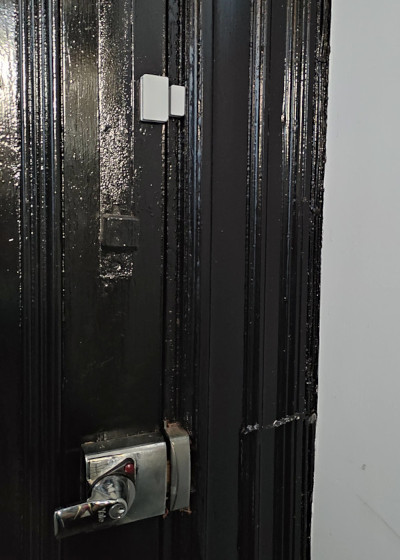
SonOff Zigbee Door Sensor My home automation setup has been fairly static recently; it does what we need and generally works fine. One area I think could be better is controlling it; we have access Home Assistant on our phones, and the Alexa downstairs can control things, but there are no smart assistants upstairs and sometimes it would be nice to just push a button to turn on the light rather than having to get my phone out. Thanks to the fact the UK generally doesn t have neutral wire in wall switches that means looking at something battery powered. Which means wifi based devices are a poor choice, and it s necessary to look at something lower power like Zigbee or Z-Wave. Zigbee seems like the better choice; it s a more open standard and there are generally more devices easily available from what I ve seen (e.g. Philips Hue and IKEA TR DFRI). So I bought a couple of Xiaomi Mi Smart Home Wireless Switches, and a CC2530 module and then ignored it for the best part of a year. Finally I got around to flashing the Z-Stack firmware that Koen Kanters kindly provides. (Insert rant about hardware manufacturers that require pay-for tool chains. The CC2530 is even worse because it s 8051 based, so SDCC should be able to compile for it, but the TI Zigbee libraries are only available in a format suitable for IAR s embedded workbench.) Flashing the CC2530 is a bit of faff. I ended up using the CCLib fork by Stephan Hadinger which supports the ESP8266. The nice thing about the CC2530 module is it has 2.54mm pitch pins so nice and easy to jumper up. It then needs a USB/serial dongle to connect it up to a suitable machine, where I ran Zigbee2MQTT. This scares me a bit, because it s a bunch of node.js pulling in a chunk of stuff off npm. On the flip side, it Just Works and I was able to pair the Xiaomi button with the device and see MQTT messages that I could then use with Home Assistant. So of course I tore down that setup and went and ordered a CC2531 (the variant with USB as part of the chip). The idea here was my test setup was upstairs with my laptop, and I wanted something hooked up in a more permanent fashion. Once the CC2531 arrived I got distracted writing support for the Desk Viking to support CCLib (and modified it a bit for Python3 and some speed ups). I flashed the dongle up with the Z-Stack Home 1.2 (default) firmware, and plugged it into the house server. At this point I more closely investigated what Home Assistant had to offer in terms of Zigbee integration. It turns out the ZHA integration has support for the ZNP protocol that the TI devices speak (I m reasonably sure it didn t when I first looked some time ago), so that seemed like a better option than adding the MQTT layer in the middle. I hit some complexity passing the dongle (which turns up as /dev/ttyACM0) through to the Home Assistant container. First I needed an override file in /etc/systemd/nspawn/hass.nspawn:
[Files]
Bind=/dev/ttyACM0:/dev/zigbee
[Network]
VirtualEthernet=true
(I m not clear why the VirtualEthernet needed to exist; without it networking broke entirely but I couldn t see why it worked with no override file.) A udev rule on the host to change the ownership of the device file so the root user and dialout group in the container could see it was also necessary, so into /etc/udev/rules.d/70-persistent-serial.rules went:
# Zigbee for HASS
SUBSYSTEM=="tty", ATTRS idVendor =="0451", ATTRS idProduct =="16a8", SYMLINK+="zigbee", \
	MODE="660", OWNER="1321926676", GROUP="1321926676"
In the container itself I had to switch PrivateDevices=true to PrivateDevices=false in the home-assistant.service file (which took me a while to figure out; yay for locking things down and then needing to use those locked down things). Finally I added the hass user to the dialout group. At that point I was able to go and add the integration with Home Assistant, and add the button as a new device. Excellent. I did find I needed a newer version of Home Assistant to get support for the button, however. I was still on 2021.1.5 due to upstream dropping support for Python 3.7 and not being prepared to upgrade to Debian 11 until it was actually released, so the version of zha-quirks didn t have the correct info. Upgrading to Home Assistant 2021.8.7 sorted that out. There was another slight problem. Range. Really I want to use the button upstairs. The server is downstairs, and most of my internal walls are brick. The solution turned out to be a TR DFRI socket, which replaced the existing ESP8266 wifi socket controlling the stair lights. That was close enough to the server to have a decent signal, and it acts as a Zigbee router so provides a strong enough signal for devices upstairs. The normal approach seems to be to have a lot of Zigbee light bulbs, but I have mostly kept overhead lights as uncontrolled - we don t use them day to day and it provides a nice fallback if the home automation has issues. Of course installing Zigbee for a single button would seem to be a bit pointless. So I ordered up a Sonoff door sensor to put on the front door (much smaller than expected - those white boxes on the door are it in the picture above). And I have a 4 gang wireless switch ordered to go on the landing wall upstairs. Now I ve got a Zigbee setup there are a few more things I m thinking of adding, where wifi isn t an option due to the need for battery operation (monitoring the external gas meter springs to mind). The CC2530 probably isn t suitable for my needs, as I ll need to write some custom code to handle the bits I want, but there do seem to be some ARM based devices which might well prove suitable

24 September 2021

Dirk Eddelbuettel: digest 0.6.28 on CRAN: Small Enhancements

Release 0.6.28 of the digest package arrived at CRAN earlier today, and has already been uploaded Debian as well. digest creates hash digests of arbitrary R objects (using the md5, sha-1, sha-256, sha-512, crc32, xxhash32, xxhash64, murmur32, spookyhash, and blake3 algorithms) permitting easy comparison of R language objects. It is a mature and widely-used as many tasks may involve caching of objects for which it provides convenient general-purpose hash key generation. This release comes eleven months after the previous releases and rounds out a number of corners. Continuous Integration was updated using r-ci. Several contribututors help with a small fix applied to avoid unaligned reads, a rewording for a help page as well as windows path encoding for in the vectorised use case. My CRANberries provides the usual summary of changes to the previous version. For questions or comments use the issue tracker off the GitHub repo. If you like this or other open-source work I do, you can now sponsor me at GitHub. For the first year, GitHub will match your contributions.

This post by Dirk Eddelbuettel originated on his Thinking inside the box blog. Please report excessive re-aggregation in third-party for-profit settings.

23 September 2021

Dirk Eddelbuettel: prrd 0.0.5: Incremental Mode

prrd facilitates the parallel running [of] reverse dependency [checks] when preparing R packages. It is used extensively for Rcpp, RcppArmadillo, RcppEigen, BH, and others. prrd screenshot image The key idea of prrd is simple, and described in some more detail on its webpage and its GitHub repo. Reverse dependency checks are an important part of package development that is easily done in a (serial) loop. But these checks are also generally embarassingly parallel as there is no or little interdependency between them (besides maybe shared build depedencies). See the (dated) screenshot (running six parallel workers, arranged in a split byobu session). This release brings some new features I used of late when testing and re-testing reverse dependencies for Rcpp. Enqueuing jobs can now consider the most recent prior job queue file. This allows us to find new packages that were not part of the previous runs. We added a second toggle to also add those packages who failed in the previous run. Finally, the dequeue interface allows to specify a date (rather than defaulting to the current date, useful for long-running jobs or restarts). The release is summarised in the NEWS entry:

Changes in prrd version 0.0.5 (2021-09-22)
  • Some remaing http URLs were changed to https.
  • The dequeueJobs script has a new argument date to help specify a queue file.
  • The enqueueJobs can now compute just a delta of (new) packages relative to a given prior queuefile and run.
  • When running in delta mode, previously failed packages can also be selected.

My CRANberries provides the usual summary of changes to the previous version. See the aforementioned webpage and its repo for details. For more questions or comments use the issue tracker off the GitHub repo. If you like this or other open-source work I do, you can now sponsor me at GitHub.

This post by Dirk Eddelbuettel originated on his Thinking inside the box blog. Please report excessive re-aggregation in third-party for-profit settings.

18 September 2021

Mike Gabriel: X2Go, Remmina and X2GoKdrive

In this blog post, I will cover a few related but also different topics around X2Go - the GNU/Linux based remote computing framework. Introduction and Catch Up For those, who haven't come across X2Go, so far... With X2Go [0] you can log into remote GNU/Linux machines graphically and launch headless desktop environments, seamless/published applications or access an already running desktop session (on a local Xserver or running as a headless X2Go desktop session) via X2Go's session shadowing / mirroring feature. Graphical backend: NXv3 For several years, there was only one graphical backend available in X2Go, the NXv3 software. In NXv3, you have a headless or nested (it can do both) Xserver that has some remote magic built-in and is able to transfer the Xserver's graphical data to a remote client (NX proxy). Over the wire, the NX protocol allows for data compression (JPEG, PNG, etc.) and combines it with bitmap caching, so that the overall result is a fast and responsive desktop experience even on low latency and low bandwidth connections. This especially applies to X desktop environments that use many native X protocol operations for drawing windows and widget onto the screen. The more bitmaps involved (e.g. in applications with client-side rendering of window controls and such), the worse the quality of a session experience. The current main maintainer of NVv3 (aka nx-libs [1]) is Ulrich Sibiller. Uli has my and the X2Go community's full appreciation, admiration and gratitude for all the work he does on nx-libs, constantly improving NXv3 without breaking compatibility with legacy use cases (yes, FreeNX is still alive, by the way). NEW: Alternative Graphical Backend: X2Go Kdrive Over the past 1.5 years, Oleksandr Shneyder (Alex), co-founder of X2Go, has been working on a re-implementation of an alternative, less X11-dependent graphical backend. The underlying Xserver technology is the kdrive part of the X.org server project. People on GNU/Linux might have used kdrive technology already: The Xephyr nested Xserver uses the kdrive implementation. The idea of the X2Go Kdrive [2] implementation in X2Go is providing a headless Xserver on the X2Go Server side for running X11 based desktop sessions inside while using an X11-agnostic data protocol for sending the graphical desktop data to the client-side for rendering. Whereas, with NXv3 technology, you need a local Xserver on the client side, with X2Go Kdrive you only need a client app(lication) that can draw bitmaps into some sort of framebuffer, such as a client-side X11 Xserver, a client-side Wayland compositor or (hold your breath) an HTMLv5 canvas in a web browser. X2Go Kdrive Client Implementations During first half of this year, I tested and DEB-packaged Alex's X2Go HTMLv5 client code [3] and it has been available for testing in the X2Go nightly builds archive for a while now. Of course, the native X2Go Client application has X2Go Kdrive support for a while, too, but it requires a Qt5 application in the background, the x2gokdriveclient (which is still only available in X2Go nightly builds or from X2Go Git [4]). X2Go and Remmina As currently posted by the Remmina community [5], one of my employees has been working on finalizing an already existing draft of mine for the last couple of months: Remmina Plugin X2Go. This project has been contracted by BAUR-ITCS UG (haftungsbeschr nkt) already a while back and has been financed via X2Go funding from one of their customers. Unfortunately, I never got around really to finalizing the project. Apologies for this. Daniel Teichmann, who has been in the company for a while now, but just recently switched to an employment model with considerably more work hours per week, now picked up this project two months ago and achieved awesome things on the way. Daniel Teichmann and Antenore Gatta (Remmina core developer, aka tmow) have been cooperating intensely on this, recently, with the objective of getting the X2Go plugin code merged into Remmina asap. We are pretty close to the first touchdown (i.e. code merge) of this endeavour. Thanks to Antenore for his support on this. This is much appreciated. Remmina Plugin X2Go - Current Challenges The X2Go Plugin for Remmina implementation uses Python X2Go (PyHoca-CLI) under the bonnet and basically does a system call to pyhoca-cli according to the session settings configured in the Remmina session profile UI. When using NXv3 based sessions, the session window appears on the client-side Xserver and immediately gets caught by Remmina and embedded into the Remmina frame (via Xembed protocol) where its remote sessions are supposed to appear. (Thanks that GtkSocket is still around in GTK-3). The knowing GTK-3 experts among you may have noticed: GtkSocket is obsolete and has been removed from GTK-4. Also, GtkSocket support is only available in GTK-3 when using its X11 rendering backend. For the X2Go Kdrive implementation, we tested a similar approach (embedding the x2gokdriveclient Qt5 window via Xembed/GtkSocket), but it seems that GtkSocket and Qt5 applications don't work well together and we did not succeed in embedding the Qt5 window of the x2gokdriveclient application into Remmina, so far. Also, this would be a work-around for the bigger problem: We want, long-term, provide X2Go Kdrive support in Remmina, not only for Remmina running with GTK-3/X11, but also when Remmina is used natively on top of Wayland. So, the more sustainable approach for showing an X2Go Kdrive based X2Go session in Remmina would be a GTK-3/4 or a Glib-2.0 + Cairo based rendering client provided as a shared library. This then could be used by Remmina for drawing the session bitmaps into the Remmina session frame. This would require a port of the x2gokdriveclient Qt code into a non-Qt implementation. However, we are running out of funding to make this happen at the moment. More Funding Needed for this Journey As you might guess, such a project as proposed is a project that some people do in their spare time, others do it for a living. I'd love to continue this project and have Daniel Teichmann continue his work on this, so that Remmina might soon be able to provide native X2Go Kdrive Client support. If people read this and are interested in supporting such a project, please get in touch [6]. Thanks so much! light+love
Mike (aka sunweaver) [0] https://wiki.x2go.org/
[1] https://github.com/ArcticaProject/nx-libs
[2] https://code.x2go.org/gitweb?p=x2gokdrive.git;a=tree
[3] https://code.x2go.org/gitweb?p=x2gohtmlclient.git;a=tree
[4] https://code.x2go.org/gitweb?p=x2gokdriveclient.git;a=tree
[5] https://remmina.org/x2go/
[6] https://das-netzwerkteam.de/

17 September 2021

Dirk Eddelbuettel: tidyCpp 0.0.5 on CRAN: More Protect ion

Another small release of the tidyCpp package arrived on CRAN overnight. The packages offers a clean C++ layer (as well as one small C++ helper class) on top of the C API for R which aims to make use of this robust (if awkward) C API a little easier and more consistent. See the vignette for motivating examples. The Protect class now uses the default methods for copy and move constructors and assignment allowing for wide use of the class. The small NumVec class now uses it for its data member. The NEWS entry (which I failed to update for the releases) follows.

Changes in tidyCpp version 0.0.5 (2021-09-16)
  • The Protect class uses default copy and move assignments and constructors
  • The data object in NumVec is now a Protect object

Thanks to my CRANberries, there is also a diffstat report for this release. For questions, suggestions, or issues please use the issue tracker at the GitHub repo. If you like this or other open-source work I do, you can now sponsor me at GitHub.

This post by Dirk Eddelbuettel originated on his Thinking inside the box blog. Please report excessive re-aggregation in third-party for-profit settings.

9 September 2021

Dirk Eddelbuettel: RcppSMC 0.2.5 on CRAN: Build Update

A week after the 0.2.5 release bringing the recent Google Summer of Code for RcppSMC to CRAN, we have a minor bug-fix release consistently, essentially, of one line. Everybody s favourite OS and toolchain did not know what to make of pow(), and I seemingly failed to test there, so shame on me. But now all is good thanks to proper use of std::pow(). RcppSMC provides Rcpp-based bindings to R for the Sequential Monte Carlo Template Classes (SMCTC) by Adam Johansen described in his JSS article. Sequential Monte Carlo is also referred to as Particle Filter in some contexts. The package now features the Google Summer of Code work by Leah South in 2017, and by Ilya Zarubin in 2021. This release is summarized below.

Changes in RcppSMC version 0.2.5 (2021-09-09)
  • Compilation under Solaris is aided via std::pow use (Dirk in #65 fixing #64)

Courtesy of my CRANberries, there is a diffstat report for this release. More information is on the RcppSMC page. Issues and bugreports should go to the GitHub issue tracker. If you like this or other open-source work I do, you can now sponsor me at GitHub.

This post by Dirk Eddelbuettel originated on his Thinking inside the box blog. Please report excessive re-aggregation in third-party for-profit settings.

Bits from Debian: DebConf21 online closes

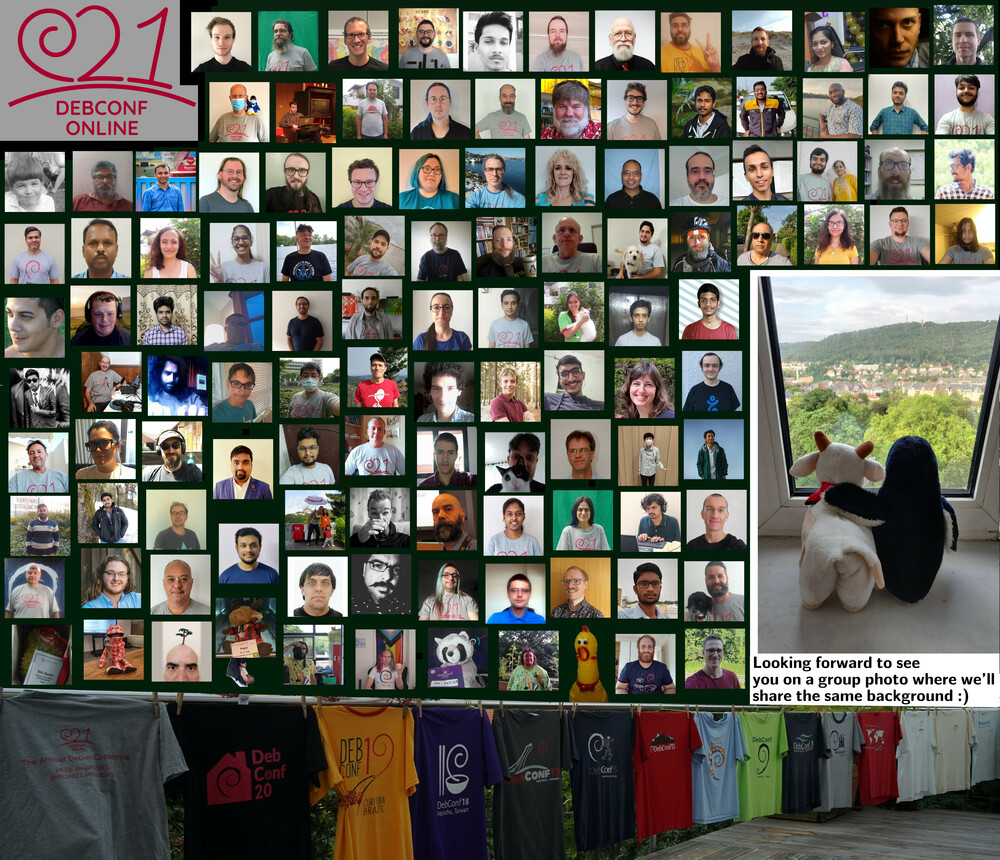
DebConf21 group photo - click to enlarge On Saturday 28 August 2021, the annual Debian Developers and Contributors Conference came to a close. DebConf21 has been held online for the second time, due to the coronavirus (COVID-19) disease pandemic. All of the sessions have been streamed, with a variety of ways of participating: via IRC messaging, online collaborative text documents, and video conferencing meeting rooms. With 740 registered attendees from more than 15 different countries and a total of over 70 event talks, discussion sessions, Birds of a Feather (BoF) gatherings and other activities, DebConf21 was a large success. The setup made for former online events involving Jitsi, OBS, Voctomix, SReview, nginx, Etherpad, a web-based frontend for voctomix has been improved and used for DebConf21 successfully. All components of the video infrastructure are free software, and configured through the Video Team's public ansible repository. The DebConf21 schedule included a wide variety of events, grouped in several tracks: The talks have been streamed using two rooms, and several of these activities have been held in different languages: Telugu, Portuguese, Malayalam, Kannada, Hindi, Marathi and English, allowing a more diverse audience to enjoy and participate. Between talks, the video stream has been showing the usual sponsors on the loop, but also some additional clips including photos from previous DebConfs, fun facts about Debian and short shout-out videos sent by attendees to communicate with their Debian friends. The Debian publicity team did the usual live coverage to encourage participation with micronews announcing the different events. The DebConf team also provided several mobile options to follow the schedule. For those who were not able to participate, most of the talks and sessions are already available through the Debian meetings archive website, and the remaining ones will appear in the following days. The DebConf21 website will remain active for archival purposes and will continue to offer links to the presentations and videos of talks and events. Next year, DebConf22 is planned to be held in Prizren, Kosovo, in July 2022. DebConf is committed to a safe and welcome environment for all participants. During the conference, several teams (Front Desk, Welcome team and Community team) have been available to help so participants get their best experience in the conference, and find solutions to any issue that may arise. See the web page about the Code of Conduct in DebConf21 website for more details on this. Debian thanks the commitment of numerous sponsors to support DebConf21, particularly our Platinum Sponsors: Lenovo, Infomaniak, Roche, Amazon Web Services (AWS) and Google. About Debian The Debian Project was founded in 1993 by Ian Murdock to be a truly free community project. Since then the project has grown to be one of the largest and most influential open source projects. Thousands of volunteers from all over the world work together to create and maintain Debian software. Available in 70 languages, and supporting a huge range of computer types, Debian calls itself the universal operating system. About DebConf DebConf is the Debian Project's developer conference. In addition to a full schedule of technical, social and policy talks, DebConf provides an opportunity for developers, contributors and other interested people to meet in person and work together more closely. It has taken place annually since 2000 in locations as varied as Scotland, Argentina, and Bosnia and Herzegovina. More information about DebConf is available from https://debconf.org/. About Lenovo As a global technology leader manufacturing a wide portfolio of connected products, including smartphones, tablets, PCs and workstations as well as AR/VR devices, smart home/office and data center solutions, Lenovo understands how critical open systems and platforms are to a connected world. About Infomaniak Infomaniak is Switzerland's largest web-hosting company, also offering backup and storage services, solutions for event organizers, live-streaming and video on demand services. It wholly owns its datacenters and all elements critical to the functioning of the services and products provided by the company (both software and hardware). About Roche Roche is a major international pharmaceutical provider and research company dedicated to personalized healthcare. More than 100.000 employees worldwide work towards solving some of the greatest challenges for humanity using science and technology. Roche is strongly involved in publicly funded collaborative research projects with other industrial and academic partners and have supported DebConf since 2017. About Amazon Web Services (AWS) Amazon Web Services (AWS) is one of the world's most comprehensive and broadly adopted cloud platform, offering over 175 fully featured services from data centers globally (in 77 Availability Zones within 24 geographic regions). AWS customers include the fastest-growing startups, largest enterprises and leading government agencies. About Google Google is one of the largest technology companies in the world, providing a wide range of Internet-related services and products such as online advertising technologies, search, cloud computing, software, and hardware. Google has been supporting Debian by sponsoring DebConf for more than ten years, and is also a Debian partner sponsoring parts of Salsa's continuous integration infrastructure within Google Cloud Platform. Contact Information For further information, please visit the DebConf21 web page at https://debconf21.debconf.org/ or send mail to press@debian.org.

8 September 2021

Dirk Eddelbuettel: RcppSimdJson 0.1.6 on CRAN: New Upstream 1.0.0 !!

The RcppSimdJson team is happy to share that a new version 0.1.6 arrived on CRAN earlier today. Its release coincides with release 1.0.0 of simdjson itself, which is included in this release too! RcppSimdJson wraps the fantastic and genuinely impressive simdjson library by Daniel Lemire and collaborators. Via very clever algorithmic engineering to obtain largely branch-free code, coupled with modern C++ and newer compiler instructions, it results in parsing gigabytes of JSON parsed per second which is quite mindboggling. The best-case performance is faster than CPU speed as use of parallel SIMD instructions and careful branch avoidance can lead to less than one cpu cycle per byte parsed; see the video of the talk by Daniel Lemire at QCon (also voted best talk). This version brings the new upstream release, thanks to a comprehensive pull request by Daniel Lemire. The short NEWS entry follows.

Changes in version 0.1.6 (2021-09-07)
  • The C++17 dependency was stated more clearly in the DESCRIPTION file (Dirk)
  • The simdjson version was updated to release 1.0.0 (Daniel Lemire in #70)

We should point out that the package still has a dependency on C++17 even though simdjson no longer does. Some of our earlier wrapping code uses it, this could be changed. If you, dear reader, would like to work on this please get in touch. Courtesy of my CRANberries, there is also a diffstat report for this release. For questions, suggestions, or issues please use the issue tracker at the GitHub repo. If you like this or other open-source work I do, you can now sponsor me at GitHub.

This post by Dirk Eddelbuettel originated on his Thinking inside the box blog. Please report excessive re-aggregation in third-party for-profit settings.

7 September 2021

Russell Coker: Oracle Cloud Free Tier

It seems that every cloud service of note has a free tier nowadays and the Oracle Cloud is the latest that I ve discovered (thanks to r/homelab which I highly recommend reading). Here s Oracle s summary of what they offer for free [1]. Oracle s always free tier (where presumable always is defined as until we change our contract ) currently offers ARM64 VMs to a total capacity of 4 CPU cores, 24G of RAM, and 200G of storage with a default VM size of 1/4 that (1 CPU core and 6G of RAM). It also includes 2 AMD64 VMs that each have 1G of RAM, but a 64bit VM with 1G of RAM isn t that useful nowadays. Web Interface The first thing to note is that the management interface is a massive pain to use. When a login times out for security reasons it redirects to a web page that gives a 404 error, maybe the redirection works OK if you are using it when it times out, but if you go off and spend an hour doing something else you will return to a 404 page. A web interface should never refer you to a page with a 404. There doesn t seem to be a way of bookmarking the commonly used links (as AWS does) and the set of links on the left depend on the section you are in with no obvious way of going between sections. Sometimes I got stuck in a set of pages about authentication controls (the identity cloud ) and there seems to be no link I could click on to get me back to cloud computing, I had to go to a bookmarked link for the main cloud login page. A web interface should never force the user to type in the main URL or go to a bookmark, you should be able to navigate from every page to every other page in a logical manner. An advanced user might have their own bookmarks in their browser to suit their workflow. But a beginner should be able to go to anywhere without breaking the session. Some parts of the interface appear to be copied from AWS, but unfortunately not the good parts. The way AWS manages IP access control is not easy to manage and it s not clear why packets are dropped, Oracle copies all this. On the upside Oracle has some good Datadog style analytics so for a new deployment you can debug IP access control by seeing records of rejected packets. Just to make it extra annoying when you create a rule with multiple ports specified the web interface will expand it out to multiple rules for one port each, having ports 80 and 443 on separate lines doesn t make things easier. Also it forces you to have IPv4 and IPv6 as separate rules, so if you want HTTP and HTTPS on both IPv4 and IPv6 (a common requirement) then you need 4 separate rules. One final annoying thing is that the web interface doesn t make your previous settings a default. As I ve created many ARM images and haven t created a single AMD image it should know that the probability that I want to create an AMD image is very low and stop defaulting to that. Recovery When trying a new system you will inevitably break things and have to recover things. The way to recover from a configuration error that prevents your VM from booting and getting to a state of allowing a login is to go to stop the VM, then go to the Boot volume section under Resources and use the settings button to detach the boot volume. Then you go to another VM (which must be running), go to the Attached block volumes menu and attach it as Paravirtualised (not iSCSI and not default which will probably be iSCSI). After some time the block device will appear and you can mount it and do stuff to it. Then after umounting it you detach it from the recovery VM and attach it again to the original VM (where it will still have an entry in the Boot volume section) and boot the original VM. As an aside it s really annoying that you can t attach a volume to a VM that isn t running. My first attempt at image recovery started with making a snapshot of the Boot volume, this didn t work well because the image uses EFI and therefore GPT and because the snapshot was larger than the original block device (which incidentally was the default size). I admit that I might have made a mistake making the snapshot, but if so it shouldn t be so easy to do. With GPT if you have a larger block device then partitioning tools complain about the backup partition table not being found, and they complain even more if you try to go back to the smaller size later on. Generally GPT partition tables are a bad idea for VMs, when I run the host I don t use partition tables, I have a separate block device for each filesystem or swap space. Snapshots aren t needed for recovery, they don t seem to work very well, and if it s possible to attach a snapshot to a VM in place of it s original Boot volume I haven t figured out how to do it. Console Connection If you boot Oracle Linux a derivative of RHEL that has SE Linux enabled in enforcing mode (yay) then you can go to the Console connection . The console is a Javascript console which allows you to login on a virtual serial console on device /dev/ttyAMA0. It tells you to type help but that isn t accepted, you have a straight Linux console login prompt. If you boot Ubuntu then you don t get a working serial console, it tells you to type help for help but doesn t respond to that. It seems that the Oracle Linux kernel 5.4.17-2102.204.4.4.el7uek.aarch64 is compiled with support for /dev/ttyAMA0 (the default ARM serial device) while the kernel 5.11.0-1016-oracle compiled by Oracle for their Ubuntu VMs doesn t have it. Performance I haven t done any detailed tests of VM performance. As a quick test I used zstd to compress a 154MB file, on my home workstation (E5-2620 v4 @ 2.10GHz) it took 11.3 seconds of CPU time to compress with zstd -9 and 7.2s to decompress. On the Oracle cloud it took 7.2s and 5.4s. So it seems that for some single core operations the ARM CPU used by the Oracle cloud is about 30% to 50% faster than a E5-2620 v4 (a slightly out of date server processor that uses DDR4 RAM). If you ran all the free resources in a single VM that would make a respectable build server. If you want to contribute to free software development and only have a laptop with 4G of RAM then an ARM build/test server with 24G of RAM and 4 cores would be very useful. Ubuntu Configuration The advantage of using EFI is that you can manage the kernel from within the VM. The default Oracle kernel for Ubuntu has a lot of modules included and is compiled with a lot of security options including SE Linux. Competitors https://aws.amazon.com/free AWS offers 750 hours (just over 31 days) per month of free usage of a t2.micro or t3.micro EC2 instance (which means 1GB of RAM). But that only lasts for 12 months and it s still only 1GB of RAM. AWS has some other things that could be useful like 1 million free Lambda requests per month. If you want to run your personal web site on Lambda you shouldn t hit that limit. They also apparently have some good offers for students. https://cloud.google.com/free The Google Cloud Project (GCP) offers $300 of credit. https://cloud.google.com/free/docs/gcp-free-tier#free-tier-usage-limits GCP also has ongoing free tier usage for some services. Some of them are pretty much unlimited use (50GB of storage for Cloud Source Repositories is a heap of source code). But for VMs you get the equivalent of 1*e2-micro instance running 24*7. A e2-micro has 1G of RAM. You also only get 30G of storage and 1GB of outbound data. It s clearly not as generous an offer as Oracle, but Oracle is the underdog so they have to try harder. https://azure.microsoft.com/en-us/free/ Azure appears to be much the same as AWS, free Linux VM for a year and then other less popular services free forever (or until they change the contract). https://www.ibm.com/cloud/free The IBM cloud free tier is the least generous offer, a VM is only free for 30 days. But what they offer for 30 days is pretty decent. If you want to try the IBM cloud and see if it can do what your company needs then this will do well. If you want to have free hosting for your hobby stuff then it s no good. Oracle seems like the most generous offer if you want to do stuff, but also one of the least valuable if you want to learn things that will help you at a job interview. For job interviews AWS seems the most useful and then GCP and Azure vying for second place.

6 September 2021

Vincent Bernat: Switching to the i3 window manager

I have been using the awesome window manager for 10 years. It is a tiling window manager, configurable and extendable with the Lua language. Using a general-purpose programming language to configure every aspect is a double-edged sword. Due to laziness and the apparent difficulty of adapting my configuration about 3000 lines to newer releases, I was stuck with the 3.4 version, whose last release is from 2013. It was time for a rewrite. Instead, I have switched to the i3 window manager, lured by the possibility to migrate to Wayland and Sway later with minimal pain. Using an embedded interpreter for configuration is not as important to me as it was in the past: it brings both complexity and brittleness.
i3 dual screen setup
Dual screen desktop running i3, Emacs, some terminals, including a Quake console, Firefox, Polybar as the status bar, and Dunst as the notification daemon.
The window manager is only one part of a desktop environment. There are several options for the other components. I am also introducing them in this post.

i3: the window manager i3 aims to be a minimal tiling window manager. Its documentation can be read from top to bottom in less than an hour. i3 organize windows in a tree. Each non-leaf node contains one or several windows and has an orientation and a layout. This information arbitrates the window positions. i3 features three layouts: split, stacking, and tabbed. They are demonstrated in the below screenshot:
Example of layouts
Demonstration of the layouts available in i3. The main container is split horizontally. The first child is split vertically. The second one is tabbed. The last one is stacking.
Tree representation of the previous screenshot
Tree representation of the previous screenshot.
Most of the other tiling window managers, including the awesome window manager, use predefined layouts. They usually feature a large area for the main window and another area divided among the remaining windows. These layouts can be tuned a bit, but you mostly stick to a couple of them. When a new window is added, the behavior is quite predictable. Moreover, you can cycle through the various windows without thinking too much as they are ordered. i3 is more flexible with its ability to build any layout on the fly, it can feel quite overwhelming as you need to visualize the tree in your head. At first, it is not unusual to find yourself with a complex tree with many useless nested containers. Moreover, you have to navigate windows using directions. It takes some time to get used to. I set up a split layout for Emacs and a few terminals, but most of the other workspaces are using a tabbed layout. I don t use the stacking layout. You can find many scripts trying to emulate other tiling window managers but I did try to get my setup pristine of these tentatives and get a chance to familiarize myself. i3 can also save and restore layouts, which is quite a powerful feature. My configuration is quite similar to the default one and has less than 200 lines.

i3 companion: the missing bits i3 philosophy is to keep a minimal core and let the user implements missing features using the IPC protocol:
Do not add further complexity when it can be avoided. We are generally happy with the feature set of i3 and instead focus on fixing bugs and maintaining it for stability. New features will therefore only be considered if the benefit outweighs the additional complexity, and we encourage users to implement features using the IPC whenever possible. Introduction to the i3 window manager
While this is not as powerful as an embedded language, it is enough for many cases. Moreover, as high-level features may be opinionated, delegating them to small, loosely coupled pieces of code keeps them more maintainable. Libraries exist for this purpose in several languages. Users have published many scripts to extend i3: automatic layout and window promotion to mimic the behavior of other tiling window managers, window swallowing to put a new app on top of the terminal launching it, and cycling between windows with Alt+Tab. Instead of maintaining a script for each feature, I have centralized everything into a single Python process, i3-companion using asyncio and the i3ipc-python library. Each feature is self-contained into a function. It implements the following components:
make a workspace exclusive to an application
When a workspace contains Emacs or Firefox, I would like other applications to move to another workspace, except for the terminal which is allowed to intrude into any workspace. The workspace_exclusive() function monitors new windows and moves them if needed to an empty workspace or to one with the same application already running.
implement a Quake console
The quake_console() function implements a drop-down console available from any workspace. It can be toggled with Mod+ . This is implemented as a scratchpad window.
back and forth workspace switching on the same output
With the workspace back_and_forth command, we can ask i3 to switch to the previous workspace. However, this feature is not restricted to the current output. I prefer to have one keybinding to switch to the workspace on the next output and one keybinding to switch to the previous workspace on the same output. This behavior is implemented in the previous_workspace() function by keeping a per-output history of the focused workspaces.
create a new empty workspace or move a window to an empty workspace
To create a new empty workspace or move a window to an empty workspace, you have to locate a free slot and use workspace number 4 or move container to workspace number 4. The new_workspace() function finds a free number and use it as the target workspace.
restart some services on output change
When adding or removing an output, some actions need to be executed: refresh the wallpaper, restart some components unable to adapt their configuration on their own, etc. i3 triggers an event for this purpose. The output_update() function also takes an extra step to coalesce multiple consecutive events and to check if there is a real change with the low-level library xcffib.
I will detail the other features as this post goes on. On the technical side, each function is decorated with the events it should react to:
@on(CommandEvent("previous-workspace"), I3Event.WORKSPACE_FOCUS)
async def previous_workspace(i3, event):
    """Go to previous workspace on the same output."""
The CommandEvent() event class is my way to send a command to the companion, using either i3-msg -t send_tick or binding a key to a nop command. The latter is used to avoid spawning a shell and a i3-msg process just to send a message. The companion listens to binding events and checks if this is a nop command.
bindsym $mod+Tab nop "previous-workspace"
There are other decorators to avoid code duplication: @debounce() to coalesce multiple consecutive calls, @static() to define a static variable, and @retry() to retry a function on failure. The whole script is a bit more than 1000 lines. I think this is worth a read as I am quite happy with the result.

dunst: the notification daemon Unlike the awesome window manager, i3 does not come with a built-in notification system. Dunst is a lightweight notification daemon. I am running a modified version with HiDPI support for X11 and recursive icon lookup. The i3 companion has a helper function, notify(), to send notifications using DBus. container_info() and workspace_info() uses it to display information about the container or the tree for a workspace.
Notification showing i3 tree for a workspace
Notification showing i3 s tree for a workspace

polybar: the status bar i3 bundles i3bar, a versatile status bar, but I have opted for Polybar. A wrapper script runs one instance for each monitor. The first module is the built-in support for i3 workspaces. To not have to remember which application is running in a workspace, the i3 companion renames workspaces to include an icon for each application. This is done in the workspace_rename() function. The icons are from the Font Awesome project. I maintain a mapping between applications and icons. This is a bit cumbersome but it looks great.
i3 workspaces in Polybar
For CPU, memory, brightness, battery, disk, and audio volume, I am relying on the built-in modules. Polybar s wrapper script generates the list of filesystems to monitor and they get only displayed when available space is low. The battery widget turns red and blinks slowly when running out of power. Check my Polybar configuration for more details.
Various modules for Polybar
Polybar displaying various information: CPU usage, memory usage, screen brightness, battery status, Bluetooth status (with a connected headset), network status (connected to a wireless network and to a VPN), notification status, and speaker volume.
For Bluetooh, network, and notification statuses, I am using Polybar s ipc module: the next version of Polybar can receive an arbitrary text on an IPC socket. The module is defined with a single hook to be executed at the start to restore the latest status.
[module/network]
type = custom/ipc
hook-0 = cat $XDG_RUNTIME_DIR/i3/network.txt 2> /dev/null
initial = 1
It can be updated with polybar-msg action "#network.send.XXXX". In the i3 companion, the @polybar() decorator takes the string returned by a function and pushes the update through the IPC socket. The i3 companion reacts to DBus signals to update the Bluetooth and network icons. The @on() decorator accepts a DBusSignal() object:
@on(
    StartEvent,
    DBusSignal(
        path="/org/bluez",
        interface="org.freedesktop.DBus.Properties",
        member="PropertiesChanged",
        signature="sa sv as",
        onlyif=lambda args: (
            args[0] == "org.bluez.Device1"
            and "Connected" in args[1]
            or args[0] == "org.bluez.Adapter1"
            and "Powered" in args[1]
        ),
    ),
)
@retry(2)
@debounce(0.2)
@polybar("bluetooth")
async def bluetooth_status(i3, event, *args):
    """Update bluetooth status for Polybar."""
The middle of the bar is occupied by the date and a weather forecast. The latest also uses the IPC mechanism, but the source is a Python script triggered by a timer.
Date and weather in Polybar
Current date and weather forecast for the day in Polybar. The data is retrieved with the OpenWeather API.
I don t use the system tray integrated with Polybar. The embedded icons usually look horrible and they all behave differently. A few years back, Gnome has removed the system tray. Most of the problems are fixed by the DBus-based Status Notifier Item protocol also known as Application Indicators or Ayatana Indicators for GNOME. However, Polybar does not support this protocol. In the i3 companion, The implementation of Bluetooth and network icons, including displaying notifications on change, takes about 200 lines. I got to learn a bit about how DBus works and I get exactly the info I want.

picom: the compositor I like having slightly transparent backgrounds for terminals and to reduce the opacity of unfocused windows. This requires a compositor.1 picom is a lightweight compositor. It works well for me, but it may need some tweaking depending on your graphic card.2 Unlike the awesome window manager, i3 does not handle transparency, so the compositor needs to decide by itself the opacity of each window. Check my configuration for details.

systemd: the service manager I use systemd to start i3 and the various services around it. My xsession script only sets some environment variables and lets systemd handles everything else. Have a look at this article from Micha G ral for the rationale. Notably, each component can be easily restarted and their logs are not mangled inside the ~/.xsession-errors file.3 I am using a two-stage setup: i3.service depends on xsession.target to start services before i3:
[Unit]
Description=X session
BindsTo=graphical-session.target
Wants=autorandr.service
Wants=dunst.socket
Wants=inputplug.service
Wants=picom.service
Wants=pulseaudio.socket
Wants=policykit-agent.service
Wants=redshift.service
Wants=spotify-clean.timer
Wants=ssh-agent.service
Wants=xiccd.service
Wants=xsettingsd.service
Wants=xss-lock.service
Then, i3 executes the second stage by invoking the i3-session.target:
[Unit]
Description=i3 session
BindsTo=graphical-session.target
Wants=wallpaper.service
Wants=wallpaper.timer
Wants=polybar-weather.service
Wants=polybar-weather.timer
Wants=polybar.service
Wants=i3-companion.service
Wants=misc-x.service
Have a look on my configuration files for more details.

rofi: the application launcher Rofi is an application launcher. Its appearance can be customized through a CSS-like language and it comes with several themes. Have a look at my configuration for mine.
Rofi as an application launcher
It can also act as a generic menu application. I have a script to control a media player and another one to select the wifi network. It is quite a flexible application.
Rofi as a wifi network selector
Rofi to select a wireless network

xss-lock and i3lock: the screen locker i3lock is a simple screen locker. xss-lock invokes it reliably on inactivity or before a system suspend. For inactivity, it uses the XScreenSaver events. The delay is configured using the xset s command. The locker can be invoked immediately with xset s activate. X11 applications know how to prevent the screen saver from running. I have also developed a small dimmer application that is executed 20 seconds before the locker to give me a chance to move the mouse if I am not away.4 Have a look at my configuration script.
Demonstration of xss-lock, xss-dimmer and i3lock with a 4 speedup.

The remaining components
  • autorandr is a tool to detect the connected display, match them against a set of profiles, and configure them with xrandr.
  • inputplug executes a script for each new mouse and keyboard plugged. This is quite useful to load the appropriate the keyboard map. See my configuration.
  • xsettingsd provides settings to X11 applications, not unlike xrdb but it notifies applications for changes. The main use is to configure the Gtk and DPI settings. See my article on HiDPI support on Linux with X11.
  • Redshift adjusts the color temperature of the screen according to the time of day.
  • maim is a utility to take screenshots. I use Prt Scn to trigger a screenshot of a window or a specific area and Mod+Prt Scn to capture the whole desktop to a file. Check the helper script for details.
  • I have a collection of wallpapers I rotate every hour. A script selects them using advanced machine learning algorithms and stitches them together on multi-screen setups. The selected wallpaper is reused by i3lock.

  1. Apart from the eye candy, a compositor also helps to get tear-free video playbacks.
  2. My configuration works with both Haswell (2014) and Whiskey Lake (2018) Intel GPUs. It also works with AMD GPU based on the Polaris chipset (2017).
  3. You cannot manage two different displays this way e.g. :0 and :1. In the first implementation, I did try to parametrize each service with the associated display, but this is useless: there is only one DBus user session and many services rely on it. For example, you cannot run two notification daemons.
  4. I have only discovered later that XSecureLock ships such a dimmer with a similar implementation. But mine has a cool countdown!

Dirk Eddelbuettel: tidyCpp 0.0.4 on CRAN: Adding a Simple Numeric Vector Class

Another release of the tidyCpp package arrived on CRAN earlier today. The packages offers a clean C++ layer on top of the C API for R which aims to make its use a little easier and more consistent. The vignette has been extended once more with a new example, and added a table of contents. The package now supports a (truly minimal) C++ class for a numeric vector which is the most likely use case. The NEWS entry follows and includes the 0.0.3 release earlier in the year which did not get the usual attention of post-release blog post.

Changes in tidyCpp version 0.0.4 (2021-09-05)
  • Minor updates to DESCRIPTION
  • New snippet rollminmaxExample with simple vector use
  • New class NumVec motivated from rolling min/max example
  • Expand the vignette with C++ example based on NumVec
  • Add a table of contents to the vignette

Changes in tidyCpp version 0.0.3 (2021-03-07)
  • Switch CI use to r-ci
  • Protect nil object definition

Thanks to my CRANberries, there is also a diffstat report for this release. For questions, suggestions, or issues please use the issue tracker at the GitHub repo. If you like this or other open-source work I do, you can now sponsor me at GitHub.

This post by Dirk Eddelbuettel originated on his Thinking inside the box blog. Please report excessive re-aggregation in third-party for-profit settings.

5 September 2021

Antoine Beaupr : Automating major Debian upgrades

It's major upgrade time again! The Debian project just published the Debian 11 "bullseye" release, and it's pretty awesome! This makes me realized that I have never written here about my peculiar upgrade process, and figured it was worth bringing that up to a wider audience. My upgrade process also has a notable changes section which includes major version changes (e.g. Inkscape 1.0!), new packages (e.g. podman!) and important behavior changes (e.g. driverless scanning and printing!). I'm particularly interested to hear about any significant change I might have missed. If you know of a cool new package that shipped with bullseye and that I forgot, do let me know! But that's for the cool new stuff. We need to talk about the problems with Debian major upgrades.

Background I have been maintaining detailed upgrade guides, on my wiki, starting with the jessie release, but I have actually written such guides for Koumbit.org as far back as Debian squeeze in 2011 (another worker wrote the older Debian lenny upgrade guide in 2009). Koumbit, since then, has kept maintaining those guides all the way to the latest bullseye upgrade, through 7 major releases! Over the years, those guides evolved from a quick "cheat-sheet" format copied from the release notes into a more or less "scripted" form that I currently use. Each guide has a procedure made of a few steps that can be basically copy-pasted to batch-upgrade a host (or multiple hosts in parallel) as quickly as possible. There is also the predict-os script which allows you to keep track of progress of the upgrades in a Puppet cluster.

Limitations of the official procedure In comparison with my procedure, the official upgrade guide is mostly designed to upgrade a single machine, typically a workstation, with a rather slow and exhaustive process. The PDF version of the upgrade guide is 14 pages long! This, obviously, does not work when you have tens or hundreds of machines to upgrade. Debian upgrades are notorious for being extremely reliable, but we have a lot of packages, and there are always corner cases where the upgrade will just fail because of a bug specific to your environment. Those will only be fixed after some back and forth in the community (and that's assuming users report those bugs, which is not always the case). There's no obvious way to deploy "hot fixes" in this context, at least not without fixing the package and publishing it on an unofficial Debian archive while the official ones catch up. This is slow and difficult. Or some packages require manual labor. Examples of this are the PostgreSQL or Ganeti packages which require you to upgrade your clusters by hand, while the old and new packages live side by side. Debian packages bring you far in the upgrade process, but sometimes not all the way. Which means every Debian install needs to be manually upgraded and inspected when a new release comes out. That's slow and error prone and we can do better.

How to automate major upgrades I have a proposal to automate this. It's been mostly dormant in the Debian wiki, for 5 years now. Fundamentally, this is a hard problem: Debian gets installed in so many different environments, from workstations to physical servers to virtual machines, embedded systems and so on, that it's extremely hard to come up with a "one size fits all" system. The (manual) procedure I'm using is mostly targeting servers, but I'm also using it on workstations. And I'll note that it's specific to my home setup: I have a different procedure at work, although it has a lot of common code. To automate this, I would factor out that common code with hooks where you could easily inject special code like "you need to upgrade ferm first", "you need an extra reboot here", or "this is how you finish the PostgreSQL upgrade". With Debian getting closer to a 2 year release cycle, with the previous release being supported basically only one year after the new stable comes out, I feel more and more strongly that this needs better automation. So I'm thinking that I should write a prototype for this. Ubuntu has do-release-upgrade that is too Ubuntu-specific to be reused. An attempt at collaborating on this has been mostly met with silence from Ubuntu's side as well. I'm thinking that using something like Fabric, Mitogen, or Transilience: anything that will allow me to write simple, portable Python code that can run transparently on a local machine (for single systems upgrades, possibly with a GUI frontend) to remote servers (for large clusters of servers, maybe with canaries and grouping using Cumin). I'll note that Koumbit started experimenting with Puppet Bolt in the bullseye upgrade process, but that feels too site-specific to be useful more broadly.

Trade-offs I am not sure where this stands in the XKCD time trade-off evaluation, because the table doesn't actually cover the time frequency of Debian release (which is basically "biennial") and the amount of time the upgrade would take across a cluster (which varies a lot, but that I estimate to be between one to 6 hours per machine). Assuming I have 80 machines to upgrade, that is 80 to 480 hours (between ~3 to 20 days) of work! It's unclear how much work such an automated system would shave off, however. Assuming things are an order of magnitude faster (say I upgrade 10 machines at a time), I would shave off between 3 and 18 days of work, which implies I might allow myself to spend a minimum of 5 days working on such a project.

The other option: never upgrade Before people mention those: I am aware of containers, Kubernetes, and other deployment mechanisms. Indeed, those may be a long-term solution, we currently can't afford to migrate everything over to containers right now: that is a huge migration and a total paradigm shift. At that point, whatever is left might not even be Debian in the first place. And besides, if you run Kubernetes, you still need to run some OS underneath and upgrade that, so that problem never completely disappears. Still, maybe that's the final answer: never upgrade. For some stateless machines like DNS replicas or load balancers, that might make a lot of sense as there's no or little data to carry to the new host. But this implies a seamless and fast provisioning process, and we don't have that either: at my work, installing a machine takes about as long as upgrading it, and that's after a significant amount of work automating that process, partly writing my own Debian installer with Fabric (!).

What is your process? I'm curious to hear what people think of those ideas. It strikes me as really odd that no one has really tackled that problem yet, considering how many clusters of Debian machines are out there. Surely people are upgrading those, and not following that slow step by step guide, right? I suspect everyone is doing the same thing: we all have our little copy-paste script we batch onto multiple machines, sometimes in parallel. That is what the Debian.org sysadmins are doing as well. There must be a better way. What is yours?

My upgrades so far So far, I have upgraded 2 out of my 3 home machines running buster -- others have been installed directly in bullseye -- with only my main, old, messy server left. Upgrades have been pretty painless so far (see another report, for example), much better than the previous buster upgrade. Obviously, for me personal use, automating this is pointless. Work-side, however, is another story: we have over 80 boxes to upgrade there and that will take a while. The last stretch to buster cycle took about two years to complete, so we might be done by the time the next release (12, "bookworm") is released, but that's actually a full year after "buster" becomes EOL, so it's actually too late... At least I fixed the installers so that new the machines we create all ship with bullseye, so we stopped accumulating new buster hosts...
Thanks to lelutin and pabs for reviewing a draft of this post.

Reproducible Builds: Reproducible Builds in August 2021

Welcome to the latest report from the Reproducible Builds project. In this post, we round up the important things that happened in the world of reproducible builds in August 2021. As always, if you are interested in contributing to the project, please visit the Contribute page on our website.
There were a large number of talks related to reproducible builds at DebConf21 this year, the 21st annual conference of the Debian Linux distribution (full schedule):
PackagingCon (@PackagingCon) is new conference for developers of package management software as well as their related communities and stakeholders. The virtual event, which is scheduled to take place on the 9th and 10th November 2021, has a mission is to bring different ecosystems together: from Python s pip to Rust s cargo to Julia s Pkg, from Debian apt over Nix to conda and mamba, and from vcpkg to Spack we hope to have many different approaches to package management at the conference . A number of people from reproducible builds community are planning on attending this new conference, and some may even present. Tickets start at $20 USD.
As reported in our May report, the president of the United States signed an executive order outlining policies aimed to improve the cybersecurity in the US. The executive order comes after a number of highly-publicised security problems such as a ransomware attack that affected an oil pipeline between Texas and New York and the SolarWinds hack that affected a large number of US federal agencies. As a followup this month, however, a detailed fact sheet was released announcing a number large-scale initiatives and that will undoubtedly be related to software supply chain security and, as a result, reproducible builds.
Lastly, We ran another productive meeting on IRC in August (original announcement) which ran for just short of two hours. A full set of notes from the meeting is available.

Software development kpcyrd announced an interesting new project this month called I probably didn t backdoor this which is an attempt to be:
a practical attempt at shipping a program and having reasonably solid evidence there s probably no backdoor. All source code is annotated and there are instructions explaining how to use reproducible builds to rebuild the artifacts distributed in this repository from source. The idea is shifting the burden of proof from you need to prove there s a backdoor to we need to prove there s probably no backdoor . This repository is less about code (we re going to try to keep code at a minimum actually) and instead contains technical writing that explains why these controls are effective and how to verify them. You are very welcome to adopt the techniques used here in your projects. ( )
As the project s README goes on the mention: the techniques used to rebuild the binary artifacts are only possible because the builds for this project are reproducible . This was also announced on our mailing list this month in a thread titled i-probably-didnt-backdoor-this: Reproducible Builds for upstreams. kpcyrd also wrote a detailed blog post about the problems surrounding Linux distributions (such as Alpine and Arch Linux) that distribute compiled Python bytecode in the form of .pyc files generated during the build process.

diffoscope diffoscope is our in-depth and content-aware diff utility. Not only can it locate and diagnose reproducibility issues, it can provide human-readable diffs from many kinds of binary formats. This month, Chris Lamb made a number of changes, including releasing version 180), version 181) and version 182) as well as the following changes:
  • New features:
    • Add support for extracting the signing block from Android APKs. [ ]
    • If we specify a suffix for a temporary file or directory within the code, ensure it starts with an underscore (ie. _ ) to make the generated filenames more human-readable. [ ]
    • Don t include short GCC lines that differ on a single prefix byte either. These are distracting, not very useful and are simply the strings(1) command s idea of the build ID, which is displayed elsewhere in the diff. [ ][ ]
    • Don t include specific .debug-like lines in the ELF-related output, as it is invariably a duplicate of the debug ID that exists better in the readelf(1) differences for this file. [ ]
  • Bug fixes:
    • Add a special case to SquashFS image extraction to not fail if we aren t the superuser. [ ]
    • Only use java -jar /path/to/apksigner.jar if we have an apksigner.jar as newer versions of apksigner in Debian use a shell wrapper script which will be rejected if passed directly to the JVM. [ ]
    • Reduce the maximum line length for calculating Wagner-Fischer, improving the speed of output generation a lot. [ ]
    • Don t require apksigner in order to compare .apk files using apktool. [ ]
    • Update calls (and tests) for the new version of odt2txt. [ ]
  • Output improvements:
    • Mention in the output if the apksigner tool is missing. [ ]
    • Profile diffoscope.diff.linediff and specialize. [ ][ ]
  • Logging improvements:
    • Format debug-level messages related to ELF sections using the diffoscope.utils.format_class. [ ]
    • Print the size of generated reports in the logs (if possible). [ ]
    • Include profiling information in --debug output if --profile is not set. [ ]
  • Codebase improvements:
    • Clarify a comment about the HUGE_TOOLS Python dictionary. [ ]
    • We can pass -f to apktool to avoid creating a strangely-named subdirectory. [ ]
    • Drop an unused File import. [ ]
    • Update the supported & minimum version of Black. [ ]
    • We don t use the logging variable in a specific place, so alias it to an underscore (ie. _ ) instead. [ ]
    • Update some various copyright years. [ ]
    • Clarify a comment. [ ]
  • Test improvements:
    • Update a test to check specific contents of SquashFS listings, otherwise it fails depending on the test systems user ID to username passwd(5) mapping. [ ]
    • Assign seen and expected values to local variables to improve contextual information in failed tests. [ ]
    • Don t print an orphan newline when the source code formatting test passes. [ ]

In addition Santiago Torres Arias added support for Squashfs version 4.5 [ ] and Felix C. Stegerman suggested a number of small improvements to the output of the new APK signing block [ ]. Lastly, Chris Lamb uploaded python-libarchive-c version 3.1-1 to Debian experimental for the new 3.x branch python-libarchive-c is used by diffoscope.

Distribution work In Debian, 68 reviews of packages were added, 33 were updated and 10 were removed this month, adding to our knowledge about identified issues. Two new issue types have been identified too: nondeterministic_ordering_in_todo_items_collected_by_doxygen and kodi_package_captures_build_path_in_source_filename_hash. kpcyrd published another monthly report on their work on reproducible builds within the Alpine and Arch Linux distributions, specifically mentioning rebuilderd, one of the components powering reproducible.archlinux.org. The report also touches on binary transparency, an important component for supply chain security. The @GuixHPC account on Twitter posted an infographic on what fraction of GNU Guix packages are bit-for-bit reproducible: Finally, Bernhard M. Wiedemann posted his monthly reproducible builds status report for openSUSE.

Upstream patches The Reproducible Builds project detects, dissects and attempts to fix as many currently-unreproducible packages as possible. We endeavour to send all of our patches upstream where appropriate. This month, we wrote a large number of such patches, including: Elsewhere, it was discovered that when supporting various new language features and APIs for Android apps, the resulting APK files that are generated now vary wildly from build to build (example diffoscope output). Happily, it appears that a patch has been committed to the relevant source tree. This was also discussed on our mailing list this month in a thread titled Android desugaring and reproducible builds started by Marcus Hoffmann.

Website and documentation There were quite a few changes to the Reproducible Builds website and documentation this month, including:
  • Felix C. Stegerman:
    • Update the website self-build process to not use the buster-backports suite now that Debian Bullseye is the stable release. [ ]
  • Holger Levsen:
    • Add a new page documenting various package rebuilder solutions. [ ]
    • Add some historical talks and slides from DebConf20. [ ][ ]
    • Various improvements to the history page. [ ][ ][ ]
    • Rename the Comparison protocol documentation category to Verification . [ ]
    • Update links to F-Droid documentation. [ ]
  • Ian Muchina:
    • Increase the font size of titles and de-emphasize event details on the talk page. [ ]
    • Rename the README file to README.md to improve the user experience when browsing the Git repository in a web browser. [ ]
  • Mattia Rizzolo:
    • Drop a position:fixed CSS statement that is negatively affecting with some width settings. [ ]
    • Fix the sizing of the elements inside the side navigation bar. [ ]
    • Show gold level sponsors and above in the sidebar. [ ]
    • Updated the documentation within reprotest to mention how ldconfig conflicts with the kernel variation. [ ]
  • Roland Clobus:
    • Added a ticket number for the issue with the live Cinnamon image and diffoscope. [ ]

Testing framework The Reproducible Builds project runs a testing framework at tests.reproducible-builds.org, to check packages and other artifacts for reproducibility. This month, the following changes were made:
  • Holger Levsen:
    • Debian-related changes:
      • Make a large number of changes to support the new Debian bookworm release, including adding it to the dashboard [ ], start scheduling tests [ ], adding suitable Apache redirects [ ] etc. [ ][ ][ ][ ][ ]
      • Make the first build use LANG=C.UTF-8 to match the official Debian build servers. [ ]
      • Only test Debian Live images once a week. [ ]
      • Upgrade all nodes to use Debian Bullseye [ ] [ ]
      • Update README documentation for the Debian Bullseye release. [ ]
    • Other changes:
      • Only include rsync output if the $DEBUG variable is enabled. [ ]
      • Don t try to install mock, a tool used to build Fedora packages some time ago. [ ]
      • Drop an unused function. [ ]
      • Various documentation improvements. [ ][ ]
      • Improve the node health check to detect zombie jobs. [ ]
  • Jessica Clarke (FreeBSD-related changes):
    • Update the location and branch name for the main FreeBSD Git repository. [ ]
    • Correctly ignore the source tarball when comparing build results. [ ]
    • Drop an outdated version number from the documentation. [ ]
  • Mattia Rizzolo:
    • Block F-Droid jobs from running whilst the setup is running. [ ]
    • Enable debugging for the rsync job related to Debian Live images. [ ]
    • Pass BUILD_TAG and BUILD_URL environment for the Debian Live jobs. [ ]
    • Refactor the master_wrapper script to use a Bash array for the parameters. [ ]
    • Prefer YAML s safe_load() function over the unsafe variant. [ ]
    • Use the correct variable in the Apache config to match possible existing files on disk. [ ]
    • Stop issuing HTTP 301 redirects for things that not actually permanent. [ ]
  • Roland Clobus (Debian live image generation):
    • Increase the diffoscope timeout from 120 to 240 minutes; the Cinnamon image should now be able to finish. [ ]
    • Use the new snapshot service. [ ]
    • Make a number of improvements to artifact handling, such as moving the artifacts to the Jenkins host [ ] and correctly cleaning them up at the right time. [ ][ ][ ]
    • Where possible, link to the Jenkins build URL that created the artifacts. [ ][ ]
    • Only allow only one job to run at the same time. [ ]
  • Vagrant Cascadian:
    • Temporarily disable armhf nodes for DebConf21. [ ][ ]

Lastly, if you are interested in contributing to the Reproducible Builds project, please visit the Contribute page on our website. You can get in touch with us via:

3 September 2021

Dirk Eddelbuettel: RQuantLib 0.4.13: Routine Update

A new release 0.4.13 of RQuantLib arrived on CRAN yesterday, and has been uploaded to Debian as well. QuantLib is a very comprehensice free/open-source library for quantitative finance; RQuantLib connects it to the R environment and language. This updates RQuantLib to a few now-deprecated (daycount convention) interfaces in QuantLib release 1.23. As the last release was sixteen months ago, we also updated a few standard packaging aspects (such as use of r-ci), updated README.md and DESCRIPTION and fixed an old typo. No other changes, no new interfaces.

Changes in RQuantLib version 0.4.13 (2021-09-02)
  • Changes in RQuantLib code:
    • Small updates to DESCRIPTION and README.md
    • Switch CI use to r-ci
    • An eleven-year old typo was correct in a manual page (Dirk in #156 fixing #155 with thanks to @klin133)
    • Daycount convention calls deprecated in QuantLib 1.23 were updated (Dirk in #157)
    • Updated remaining http:// URLs in documentation to https://

Courtesy of my CRANberries, there is also a diffstat report for the this release. As always, more detailed information is on the RQuantLib page. Questions, comments etc should go to the new rquantlib-devel mailing list. Issue tickets can be filed at the GitHub repo. If you like this or other open-source work I do, you can now sponsor me at GitHub.

This post by Dirk Eddelbuettel originated on his Thinking inside the box blog. Please report excessive re-aggregation in third-party for-profit settings.

Next.

Previous.