Search Results: "nic"

8 June 2010

Dirk Eddelbuettel: Rcpp 0.8.1

Early this morning I sent Rcpp version 0.8.1 off to CRAN and Debian. In the meantime, Romain has already provided a very nice blog post about it. There are a few fairly visible new things in this release. As we want to focus the next few minor releases on completing the documentation, we started by adding a total of four (!!) new vignettes: The most interesting new feature is what we call Rcpp modules and is modeled after Boost::Python. This makes it pretty easy to expose C++ functions and classes to R -- without having to write glue code. This is pretty new and may change a tad over the coming releases, but it is also quite exciting. Other changes concern more improvements for use of inline which should now allow packages like our RcppArmadillo to be used with it, and some bug fixes. The full NEWS entry for this release follows below:
0.8.1   2010-06-08
    o   This release adds Rcpp modules. An Rcpp module is a collection of
        internal (C++) functions and classes that are exposed to R. This
        functionality has been inspired by Boost.Python.
        
        Modules are created internally using the RCPP_MODULE macro and
        retrieved in the R side with the Module function. This is a preview 
        release of the module functionality, which will keep improving until
        the Rcpp 0.9.0 release. 
        The new vignette "Rcpp-modules" documents the current feature set of
        Rcpp modules.
        
    o   The new vignette "Rcpp-package" details the steps involved in making a
        package that uses Rcpp.
    o   The new vignette "Rcpp-FAQ" collects a number of frequently asked
        questions and answers about Rcpp.
    o   The new vignette "Rcpp-extending" documents how to extend Rcpp
        with user defined types or types from third party libraries. Based on
        our experience with RcppArmadillo
        
    o   Rcpp.package.skeleton has been improved to generate a package using 
        an Rcpp module, controlled by the "module" argument
    o   Evaluating a call inside an environment did not work properly
        
    o   cppfunction has been withdrawn since the introduction of the more
        flexible cxxfunction in the inline package (0.3.5). Rcpp no longer
        depends on inline since many uses of Rcpp do not require inline at
        all. We still use inline for unit tests but this is now handled
        locally in the unit tests loader runTests.R. 
        Users of the now-withdrawn function cppfunction can redefine it as:
        
           cppfunction <- function(...) cxxfunction( ..., plugin = "Rcpp" )
    o   Support for std::complex was incomplete and has been enhanced.
    o   The methods XPtr<t>::getTag and XPtr<t>::getProtected are deprecated, 
        and will be removed in Rcpp 0.8.2. The methods tag() and prot() should
        be used instead. tag() and prot() support both LHS and RHS use. 
    o   END_RCPP now returns the R Nil values; new macro VOID_END_RCPP
        replicates prior behabiour
        
As always, even fuller details are in Rcpp Changelog page and the Rcpp page which also leads to the downloads, the browseable doxygen docs and zip files of doxygen output for the standard formats. A local directory has source and documentation too. Questions, comments etc should go to the rcpp-devel mailing list off the R-Forge page

Mike Hommey: Playing with icegrind

In the past few days, I ve been playing with icegrind, a little valgrind plugin that Taras Glek wrote to investigate how Firefox startup spends its time in libxul.so reading/initialization, mostly. I invite you to check out his various posts on the subject, it s an interesting read. After some fiddling with the original icegrind patch in the bug linked above, I got some better understanding on the binary initialization phase (more on that in another post), as we could call it, and hit some problems due to problems in icegrind and elflog. The latest version of the icegrind patch as of writing solved my main problem half way (though it needs further modifications to work properly, see below). What icegrind actually does is to track memory accesses in mmap()ed memory. When the program being profiled mmap()s a file, icegrind looks for a corresponding sections file next to it (e.g. libxul.so.sections for libxul.so ). The sections file contains offsets, sizes, and sections names, that will be used by icegrind to report the accesses. Whenever the profiled program makes memory accesses (whether it is for instructions or data) within the mmap()ed range, icegrind will add the corresponding section name in a log file (e.g. libxul.so.log for libxul.so ). Please note it will only do so for the first access in the given section. To generate section information for ELF files, Taras also hacked an elflog program that scans an ELF binary (program or library) and will output sections for symbols present in its symtab. This means the binary needs not to be stripped, though the full fledged debugging symbols are not needed. It outputs the sections names in a form that would be reusable in a linker script after a build with the -ffunction-sections and -fdata-sections compiler options, but that s mostly irrelevant when what you are after is only to see what is going on, not to reorder the sections at link time. There are glitches in the way elflog works that makes the section names for .bss symbols wrong (they will start with .symtab, .shstrtab, .comment, etc. instead of .bss). Also, technically, the .bss section is not mapped from the file. Note icegrind has rough edges, is still experimental, and isn t very user friendly, as in unix permissions, because its input and output files need to be next to the file being mmap()ed, and when that is a library in /usr/lib, well, you need write access there ; or you need to copy the library in a different directory and adjust LD_LIBRARY_PATH. Anyways, it s already useful as it currently is. If you want to play with it yourself, here are steps that worked well for me: Once you re done with this setup, you are ready to start playing: Obviously, you don t have to play around with Firefox. You can try with other libraries, or even programs. You ll see in a subsequent post, however, that to get more interesting information, the elflog output is unfortunately not enough.

Uwe Hermann: flashrom 0.9.2 released -- Open-Source, crossplatform BIOS / EEPROM / flash chip programmer

The long-pending 0.9.2 version of the open-source, cross-platform, commandline flashrom utility has been released. From the announce:
New major user-visible features:
* Dozens of newly supported mainboards, chipsets and flash chips.
* Support for Dr. Kaiser PC-Waechter PCI devices (FPGA variant).
* Support for flashing SPI chips with the Bus Pirate.
* Support for the Dediprog SF100 external programmer.
* Selective blockwise erase for all flash chips.
* Automatic chip unlocking.
* Support for each programmer can be selected at compile time.
* Generic detection for unknown flash chips.
* Common mainboard features are now detected automatically.
* Mainboard matching via DMI strings.
* Laptop detection which triggers safety measures.
* Test flags for all part of flashrom operation.
* Windows support for USB-based and serial-based programmers.
* NetBSD support.
* DOS support.
* Slightly changed command line invocation. Please see the man page for details. Experimental new features:
* Support for some NVIDIA graphics cards.
* Chip test pattern generation.
* Bit-banging SPI infrastructure.
* Nvidia MCP6*/MCP7* chipset detection.
* Support for Highpoint ATA/RAID controllers. Infrastructural improvements and fixes:
* Lots of cleanups.
* Various bugfixes and workarounds for broken third-party software.
* Better error messages.
* Reliability fixes.
* Adjustable severity level for messages.
* Programmer-specific chip size limitation warnings.
* Multiple builtin frontends for flashrom are now possible.
* Increased strictness in board matching.
* Extensive selfchecks on startup to protect against miscompilation.
* Better timing precision for touchy flash chips.
* Do not rely on Linux kernel bugs for mapping memory.
* Improved documentation.
* Split frontend and backend functionality.
* Print runtime and build environment information.
The list of supported OSes and architectures is slowly getting longer, e.g. these have been tested: Linux, FreeBSD, NetBSD, DragonFly BSD, Nexenta, Solaris and Mac OS X. There's partial support for DOS (no USB/serial flashers) and Windows (no PCI flashers). Initial (partial) PowerPC and MIPS support has been merged, ARM support and other upcoming. Also, the list of external (non-mainboard) programmers increases, e.g. there is support for NICs (3COM, Realtek, SMC, others upcoming), SATA/IDE cards from Silicon Image and Highpoint, some NVIDIA cards, and various USB- or parallelport- or serialport- programmers such as the Busirate, Dediprog SF100, FT2232-based SPI programmers and more. More details at flashrom.org and in the list of supported chips, chipsets, baords, and programmers. I uploaded an svn version slightly more recent than 0.9.2 to Debian unstable, which should reach Debian testing (and Ubuntu I guess) soonish.

Matt Zimmerman: DevOps and Cloud

DevOps I first heard about DevOps from Lindsay Holmwood at linux.conf.au 2010. Since then, I ve been following the movement with interest. It seems to be about cross-functional involvement in software teams, specifically between software development and system administration (or operations). In many organizations, especially SaaS shops, these two groups are placed in opposition to each other: developers are driven to deliver new features to users, while system administrators are held accountable for the operation of the service. In the best case, they maintain a healthy balance by pushing in opposite directions, but more typically, they resent each other for getting in the way, as a result of this dichotomy:
Development Operations
is responsible for creating products offering services
is measured on delivery of new features high reliability
optimizes by increasing velocity controlling change
and so is perceived as reckless and irresponsible obstructing progress
Of course, both functions are essential to a viable service, and so DevOps aims to replace this opposition with cooperation. By removing this friction from the organization, we hope to improve efficiency, lower costs, and generally get more work done.
So, DevOps promotes the formation of cross-functional teams, where individuals still take on specialist development or operations roles, but work together toward the common goal of delivering a great experience to users. By working as teammates, rather than passing work over the wall , they can both contribute to development, deployment and maintenance according to their skills and expertise. The team becomes a devops team, and is responsible for the entire product life cycle. Particular tasks may be handled by specialists, but when there s a problem, it s the team s problem. Some take it a step further, and feel that what s needed is to combine the two disciplines, so that individuals contribute in both ways. Rather than thinking of themselves as developers or sysadmins , these folks consider themselves devops . They work to become proficient in both roles, and to synthesize new ways of working by drawing on both types of skills and experience. A common crossover activity is the development of sophisticated tools for automating deployment, monitoring, capacity management and failure resolution. DevOps meets Cloud Like DevOps, cloud is not a specific technology or method, but a reorganization of the model (as I ve written previously). It s about breaking down the problem in a different way, splitting and merging its parts, and creating a new representation which doesn t correspond piece-for-piece to the old one. DevOps drives cloud because it offers a richer toolkit for the way they work: fast, flexible, efficient. Tools like Amazon EC2 and Google App Engine solve the right sorts of problems. Cloud also drives DevOps because it calls into question the traditional way of organizing software teams. A development/operations division just doesn t fit cloud as well as a DevOps model. Deployment is a classic duty of system administrators. In many organizations, only the IT department can implement changes in the production environment. Reaping the benefits of an IaaS environment requires deploying through an API, and therefore deployment requires development. While it is already common practice for system administrators to develop tools for automating deployment, and tools like Puppet and Chef are gaining momentum, IaaS makes this a necessity, and raises the bar in terms of sophistication. Doing this well requires skills and knowledge from both sides of the fence between development and operations, and can accelerate development as well as promote stability in production.
This is exemplified by infrastructure service providers like Amazon Web Services, where customers pay by the hour for black box access to computing resources. How those resources are provisioned and maintained is entirely Amazon s problem, while its customers must decide how to deploy and manage their applications within Amazon s IaaS framework. In this scenario, some operations work has been explicitly outsourced to Amazon, but IaaS is not a substitute for system administration. Deployment, monitoring, failure recovery, performance management, OS maintenance, system configuration, and more are still needed. A development team which is lacking the experience or capacity for this type of work cannot simply switch to an IaaS model and expect these needs to be taken care of by their service provider.
With platform service providers, the boundaries are different. Developers, if they build their application on the appropriate platform, can effectively outsource (mostly) the management of the entire production environment to their service provider. The operating system is abstracted away, and its maintenance can be someone else s problem. For applications which can be built with the available facilities, this will be a very attractive option for many organizations. The customers of these services may be traditional developers, who have no need for operations expertise. PaaS providers, though, will require deep expertise in both disciplines in order to build and improve their platform and services, and will likely benefit from a DevOps approach. Technical architecture draws on both development and operations expertise, because design goals like performance and robustness are affected by all layers of the stack, from hardware, power and cooling all the way up to application code. DevOps itself promotes greater collaboration on architecture, by involving experts in both disciplines, but cloud is a great catalyst because cloud architecture can be described in code. Rather than talking to each other about their respective parts of the system, they can work together on the whole system at once. Developers, sysadmins and hybrids can all contribute to a unified source tree, containing both application code and a description of the production environment: how many virtual servers to deploy, their specifications, which components run on which servers, how they are configured, and so on. In this way, system and network architecture can evolve in lockstep with application architecture. Cloudy promises such as dynamic scaling and fault tolerance call for a DevOps approach in order to be realized in a real-world scenario. These systems involve dynamically manipulating production infrastructure in response to changing conditions, and the application must adapt to these changes. Whether this takes the form of an active, intelligent response or a passive crash-only approach, development and operational considerations need to be aligned. So what? DevOps and cloud will continue to reinforce each other and gain momentum. Both individuals and organizations will need to adapt in order to take advantage of the opportunities provided by these new models. Because they re complementary, it makes sense to adopt them together, so those with expertise in both will be at an advantage.

Russell Coker: Is the PC Dying?

I just read an interesting article about the dispute between Microsoft and Apple about types of PC [1]. Steve Jobs predicted a switch from desktop PCs to portable devices, while Steve Ballmer of Microsoft claimed that the iPad is just a new PC. Defining a PC I think that the defining characteristic of the IBM Compatible PC was it s open architecture. Right from the start the PC could have it s hardware expanded by adding new circuit boards into slots on the motherboard (similar to other PC systems of that era such as the Apple 2 and the S-100 bus). The deal with IBM included Intel sharing all it s CPU designs with other manufacturers such as NEC and AMD from the 8086 until the mid-90 s. AMD specialised in chips that were close copies of Intel chips at low prices and higher clock rates while NEC added new instructions. Compaq started the PC clone market as well as the laptop market, and system software for the IBM compatible PCs was primarily available from IBM and Microsoft in the early days, along with less popular variants such as CP/M86, Novell Netware and others. In the late 80 s there was OS/2 as an alternate OS and Windows as one of several optional GUI environments to run on top of MS-DOS or PC-DOS. In the mid 90 s PCs were used for running protected mode OSs such as Linux and Windows/NT. Now if we look at a system such as a Netbook then it clearly misses some of the defining characteristics of the desktop PC. I can t upgrade a Netbook in any meaningful way changing a storage device or adding more RAM does not compare to adding an ISA/MCA/EISA/VL-Bus/PCI/PCIe expansion card. With my EeePC 701 I don t even have an option of replacing the storage as it is soldered to the motherboard! A laptop allows me to add a PCMCIA or PC-Card device to expand it, but with a maximum of two cards and a high price this isn t a great option. What is Best for Home Users? For a while now my parents have been using 3G net access for their home Internet use [2]. So it seems that a laptop provides greater benefits for their use now than it previously did when they used Cable and ADSL net access. My parents have been considering getting a new monitor (1920*1080 resolution monitors are getting insanely cheap nowadays) and driving such a monitor effectively might require a more capable PC. I recently bought myself a nice refurbished Thinkpad for $796 [3], it seems likely that I could find a refurbished Thinkpad at auction which is a little older and slower for a lower price, even buying an old T41p would be a reasonable option. This would give my parents not only the option of using the Internet when on holidays, but also in a different part of their house when they are at home. The Apple iPad would probably be quite a reasonable Internet platform for my parents if it wasn t for the fact that it uses DRM. While it s not a great platform for writing, my parents probably don t do enough that it would be a huge problem for them. So I might look for a less restrictive tablet platform for my parents. At the moment the best resolution for a tablet seems to be 1024*768, but I expect that some tablets (maybe with a hybrid tablet/laptop design like the Always Innovating Smartbook [4]) with a higher resolution will be released soon. I hope that the iPad and other closed devices don t get any serious market share, but it seems likely that OSs such as Android which are only slightly more open will have a significant market share. Ultra-Mobile Design vs PCs Design One significant problem with ultra-mobile devices is that they make significant engineering trade-offs to get the small size. For a desktop system there are lots of ways of doing things inefficiently, running the AMD64 or i386 architecture which is wasteful of energy and having lots of unused space inside the box in case you decide to upgrade it. But for a laptop there are few opportunities for being inefficient, and for a tablet or smart phone everything has to be optimised. When the optimisation of a device starts by choosing a CPU that s unlike most other systems (note that there is a significant range of ARM CPUs that are not fully compatible with each other) it makes it very difficult to produce free software to run it. I can salvage a desktop PC from a rubbish bin and run Linux on it (and I ve done that many times), but I wouldn t even bother trying to run Linux on an old mobile phone. It seems that in the near future my parents (and many other people with similar needs) will be best suited by having a limited device such as a tablet that stores all data on the Internet and not having anything that greatly resembles a PC. In many ways it would be easier for me to support my parents by storing their data in the cloud and then automatically backing it up to removable SATA disks than with my current situation of supporting a fully capable PC and backing it up to a USB device whenever I visit them. I m also considering what to do for some relatives who are about to go on a holiday in Europe, they want to be able to send email etc. It might not be possible just yet, but it seems like an ideal way of doing this would be to provide them with something like an iPad that they can use with a local 3G SIM for the country that they stay in and they could then upload all their best photos to some server that I can backup and send email to everyone they know. An iPad isn t good for this now as you don t want to go on holidays in another country while carrying something that is really desirable to thieves. Ultra Mobile Devices are Killing PCs It seems to me that Google Android and the Apple iPad/iPhone OS are taking over significant parts of the PC market. The people who are doing traditional PC things are increasingly using Laptops and Netbooks, and the number of people who get the freedom that a PC user did in the 80 s and 90 s is decreasing rapidly. I predict that by 2012 the majority of Linux systems will be running Google Android on hardware that doesn t easily allow upgrading to more open software. At the moment probably the majority of Linux systems are wireless routers and other embedded devices that people don t generally think about. But when iPad type devices running a locked-down Linux installation start replacing Ubuntu and Fedora desktop systems people will take notice. I don t think that the death of the PC platform as we know it will kill Linux, but it certainly won t do us any good. If there were smarter people at Microsoft then they would be trying to work with the Linux community on developing innovative new ways of using desktop PCs. Of all the attempts that Microsoft has made to leave the PC platform the only success has been the X-Box which is apparently doing well. Tablet devices such as the iPad could work really well in a corporate environment (where MS makes most of it s money). On many occasions I ve been in a meeting and we had to adjourn due to someone needing to go to their desk to look something up. If everyone had an iPad type device at their desk that used a wired network when it was available and encrypted wireless otherwise then for a meeting everyone could take their tablet without it s keyboard and be able to consult all the usual sources of data without any interruption. Could a high-resolution version of the iPad kill MS-Windows in the corporate environment?

7 June 2010

John Goerzen: Boys

Yesterday afternoon, it was nice outside. Terah, Jacob, Oliver, and I went outside. I had my camera to take photos while Jacob and Oliver mostly played. We did try to pose them a bit, but the overall plan was to just take some photos of them doing their own thing. So I wound up taking 824 photos. Hurray for digital cameras. We narrowed that down to a few of our favorites, which you can view as a slideshow. I ll highlight few of those below. IMG_3926.JPG
Jacob walking down the drive way, gazing at all the beans coming up off in the distance IMG_3910.JPG
Hmm, Oliver, let me see too IMG_3823.JPG
Running is fun! IMG_3818.JPG
Peek-a-boo IMG_3802.JPG
Goerzen s Law of Child Photography: If you attempt to get them to pose, a minimum of one boy will have a weird expression at any given time. IMG_3763.JPG
Also, chances are good that a cat will sneak in and also do something. IMG_3710.JPG
My imagined conversation for this one: Here Oliver, this is how you use a piece of bark. Quiet, I m trying to eat this grass. IMG_3718.JPG
Oliver decides that grass stuck on his teeth isn t fun IMG_3684.JPG
No explanation for this one. IMG_3644.JPG
Classic brothers. Jacob is using a piece of bark to mess around in some dirt, while Oliver quietly learns how to do it. He never said it, but I can easily imagine him saying, Here Oliver, here s what you do with bark: you dig up dirt like this! It s funny! IMG_3619.JPG
BONZAI!!! IMG_3580.JPG
Guess I better watch where I point that camera IMG_3477.JPG
Here kitty get ready for some more petting *thwack* Strangely the cat seemed to love it. Our other cat avoids Oliver. IMG_3404.JPG
Jacob deriving a great deal of joy from telling us that his shirt says big SPIDER . He came up with that joke himself and thought it was hilarious. IMG_3366.JPG
This is one of a few photos of Jacob wearing a suit that I once wore. IMG_3292.JPG
It s hard to stand still when the hammock has a great train whistle on it. IMG_3241.JPG
I have no idea what he s planning here. But really, I think I should be afraid. IMG_3191.JPG
It s a fridge door. Yay?

Mart&iacute;n Ferrari: Python WTF

Lately, I have recurring WTF moments when working with Python. I'm still more or less a novice in Python, as I started to use it in my day job last year, so sometimes it could be blamed to ignorance. Today I was writing some code that takes any file descriptor as argument, and thought it could be nice to accept also objects that represent one. But it seems there is no common ancestor to file objects and socket objects, for example. In Perl, I'd just check for IO::Handle. Then, I wrote code to check if a passed argument was a socket, or a file descriptor to one, with some obvious check: isinstance(s, socket.socket). WRONG, when you create sockets with socketpair, they are of an undocumented type which is not a descendant of socket, nor of SocketType! (There is a patch for this since 2007) In general, I have found a lack of any reasonable object hierarchy, and many inconsistencies in the low-level interfaces, which is a pity, because Python is in general quite tidy. Comparing with Perl is unavoidable, and I would have expected that Python had learnt more from it. Another thing that amazes me is the lack of anything like CPAN, which is one of the reasons Perl was so successful. The cheese factory doesn't come close, as you need to publish your files somewhere else, there is no automated testing, no automatically generated documentation, or anything that requires access to the source code. In Perl-land, many people loathe the venerable MakeMaker, and some of the alternatives are ugly as hell. The Python equivalent (or so) to Makemaker, distutils, looks to me like a bad joke: advanced customisation is black magic (if possible at all), and doesn't provide absolutely basic things like running your unit tests! After fighting with it for some days, I decided to go back writing my own Makefile and calling distutils just to build and install. Tags: Planet Debian, Planet Lugfi, Programaci n

Sjoerd Simons: Is that a tea cosy on your head?

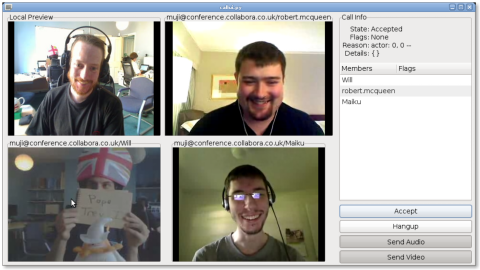
Since some time the good people at NlNet have been sponsoring Collabora to add multi-party audio/video calling to XMPP and do an implementation of this in Telepathy. This project is otherwise known as Muji. This work has resulted in: To proof it actually works, a nice screenshot of the demo client in a 4-way call: 4-way Muji Call The screenshot is featuring myself in Collabora's UK office (top-left), Robert McQueen from a hotelroom in Taipei (top-right), Will Thompson and Magical trevor also from the Collabora UK office (bottom-left) and Mike Ruprecht from somewhere in Missouri. So we were quite spread out over our little planet. Both audio and video quality was quite good, even though the network in robs hotel was a bit flaky from time to time. In case you want to try it out have a look at the MujiDemoClient page.

Julien Danjou: Announcing erc-track-score

A couple of months ago, I've started using ERC to hang out on IRC. I've read all the pages on EmacsWiki about it, just to see how far I could customize it. I must admit that I was not disappointed, even if I expected to be. It's quite a nice software, and once well configured it's more convenient that my old irssi setup. While browsing EmacsWiki, I read an interesting idea about channel scoring/temperature on the erc-track page. The idea is to see if it's worth jumping to an IRC channel to see what people are talking about. Challenge accepted! I sat up and started to dig though ERC source code to find the information I needed about variables and functions. I finally did write something nice, which I called erc-track-score. And yet another piece of software I wrote for my lovely Emacs! How does it work? Ha-ha, I was sure you would ask. You're so predictable, dude! Read the following, and you'll know everything you ever wanted to know about it since the moment you read the title of that blog entry. Which probably turned you on. Nasty you. First of all, the score of a channel starts at zero. Zero means "seriously, don't bother, nothing is happening here". Upon each new message arrival, the score is incremented by 1. If a new message contains a keyword, your nickname or is sent by a pal, the score is increased by configurable values, by default between 2 and 20 points, depending on the match type. On the other hand, when a message is send by some fool, the score is decreased by 1 by default. Obviously, if the score is going negative, you really should not jump to the channel. Finally, the score is permanently and slowly brought back to 0. By default, the score is decreased by 1 point every 10 seconds. Overall, reading the score should gives you a good idea of the channel temperature. I'm still not sure what is the best formula to compute the score, but so far the default values seem quite good. We'll see.

6 June 2010

Lucas Nussbaum: #debian-ubuntu on OFTC

If you are a Debian developer and need realtime interaction with an Ubuntu developer about the state of your packages in Ubuntu (or vice-versa), #debian-ubuntu on irc.oftc.net might be useful. I had forgotten about that channel, but it resurfaced during the discussions about improving communication between both projects.

4 June 2010

Adrian von Bidder: Filesystems Quo Vadis: Clients

Probably it's just a question of me not paying enough attention to the news... So: pointers welcome. There are quie a few shiny new filesystems for local storage, like btrfs or HAMMER (and nilfs, Tux3, ext4, Reiser4...) It seems the distributed storage side is covered as well, with ceph being merged recently. There are other systems (like, for example, Lustre), but they haven't appeared much in the news channels I tend to read. What I'd be curious is if any of these support hierarchical storage architectures like pushing out rarely used data to tape libraries. (But this is just idle speculation, I don't need this anywhere.) But what I would really need is a replacement for NFS (v3): a classical client-server filesystem. I'm not sure NFSv4 is the right solution (where I'd use it, I currently can't because we rely too much on POSIX ACLs there, making the transition to NFSv4 quite a chore.) I think POHMELFS might be a solution in the long term, or CRFS, but I'm not sure how much progress there is on these; apt-cache search is silent, not a good sign. There's Samba 4 I guess I'll have to look at it, since it's supposed to be much cleaner and nicer to use than its predecessors and might be a good solution even if no Microsoft systems are involved. Is this what small environments (a fileserver and 100 clients or so) will want to use? Comments are very welcome.

Wouter Verhelst: Re: beid

Sometimes help is just around the corner, and all you have to do is ask. Not so long ago, I asked for help on the support software for the Belgian electronic ID card. I'd been packaging that since it came out back in 2004, but recently I've had some issues with getting the most recent version of this software to work properly. Since Debian 6.0 "squeeze" is fairly near, and since I don't want a horribly outdated version of beid to be part of that release, I realized that something needed to happen, and rather soon. My request got quite some response; much more than I'd expected. There have been answers from people with various amounts of experience in Debian packaging; one of the people to reply to my request was Laurent Bigonville, who's also a Debian Developer. So we've now set up a mailinglist, a git repository, and work seems to be proceeding nicely. I've also asked for the removal of the old belpic source package. However, due to a mistake on my end, the beid source package rather than the belpic one was removed, which means that it'll have to be re-added to the archive now. That should happen sometime during the next few days, after the worst problems have been fixed. However, since I now asked for belpic to be removed, too, this means that for the time being, there is no eID software in unstable. We'll fix that in due time; stay tuned.

Russ Allbery: NVIDIA, bug handling, and patience

Recently, the long-time maintainer of the NVIDIA packages for Debian stepped down, after having not had much time to work on the packages for some time. I don't really like maintaining non-free packages, but I have some NVIDIA hardware and nouveau isn't quite far enough along yet for me to feel comfortable just switching, so I decided to help, despite having very little spare time. Thankfully, Andreas Beckmann stepped up and has been submitting patches like crazy, so I've not had to do a lot of the work. This is a very difficult package to maintain, since it's completely non-free. Nearly all the code is a binary object, which we cannot change in any way, so it's frustrating because we can't do anything about basically any bugs. Upstream distributes their code in a weird, annoying package format. It's also very complicated, full of random upstream libraries for providing various interfaces to the GPU to do computing, and it conflicts with and replaces various X bits like the GL library. And on top of that, it comes in four different variants, all of which need to be separately packaged, plus a bunch of supporting packages and libraries (some non-free and some free). Oh, and it builds a kernel module. And we historically provided pre-built kernel modules and meta-packages. And the packaging infrastructure hadn't been overhauled in quite some time, so it wasn't using current packaging techniques. Did I mention the RC bugs and the nearly 200 open bugs on just the main non-legacy package (now much lower thanks to Andreas's hard work). We're slowly making progress. nvidia-graphics-drivers migrated to testing for the first time since around the lenny release and now supports DKMS, and Andreas has massively modernized the packaging. We also have just about finished the transition to using the free libvdpao library rather than the one included with the NVIDIA packages. But given that background, you might understand why one might find blog posts like this one (about a bug that was first reported for KDE just one week ago!) just a little demotivating. (The problem had been previously observed with GDM, but it appeared to be fixed somehow in GDM 3.) I'm sure there are better ways that I could have communicated the bug status, and I probably stressed a bit more than I need to the point that the module is completely opaque and non-free and there isn't much that we can do to change its behavior. But reading negative comments about one's work on Planet Debian is really kind of frustrating, particularly when that work is on something that it's hard to get Debian to care about and that's kind of thankless to start with. I'm not trolling for praise here; I have a thick skin. But this does seem like a good opportunity for a reminder that this is a volunteer project, some packages are kind of annoying to maintain, and things take time. If you don't agree with a maintainer's determination of whether or not something is RC (I still don't think this bug is RC), one can certainly have that conversation. But unless the maintainer marks the bug wontfix, please don't jump to the conclusion that no one cares about trying to find a resolution. And one week is a rather short time period to arrive at that conclusion, even if the maintainer is fairly negative about the bug. Sometimes that just means that you caught them on a bad day. For the record, I'm currently pondering asking the people with this bug to try adding nvidia to /etc/modules and see if forcing the module load earlier works around this problem. I think what's happening is that the module is doing some sort of prolonged initialization, and it just needs more lead time before it's expected to respond to the X server.

3 June 2010

Steve Kemp: Everybody loves me, and I intend to keep it that way.

Would it be wrong to make a new blog entry just to test the blogging platform? If so I'm wrong. To pretend that isn't the case I'll briefly document some recent events:
Coding
I've been making changes to the blogging software, chronicle, to support RSS feeds on comments, and to allow outgoing Pings on new entries. I've also been flirting with an OpenID-backed image upload and sharing site, provisionally named picshare. Why? Partly for fun, partly because I like comments, and partly to flirt with RESTful design and API construction.
Photography
I've provisionally agreed to be the photographer for a special event at a local hair-dressers. This will either be fun, or all end badly. No money, but free food and the chance to experiment more. So all good.
There. Almost like a real entry, right? ObSubject: Cruel Intentions

Matthew Garrett: Poulsbo still makes me sad

Meego 1.0 was released last month. Predictably enough, it lacks any form of support for the GMA500 graphics chipset[1], which is reasonably in line with Intel's placing of US15W as an embedded product for MID-type devices rather than having anything to do with netbooks. Of course, the market pretty much ignored that detail, so we're left with the release of a netbook experience that's incompatible with a large number of netbooks.

There's been hints that there might be some sort of new driver coming, though, and Intel's rapidly heading towards the release of Moorestown - their new MID platform that's x86 but not a PC, that replaces Poulsbo (unless you want to run Windows) and which has the same SGX 3D core[2] as Poulsbo. Moorestown support has started landing in the mainline Linux kernel and Intel are talking about devices shipping with it this year, so we ought to see the graphics driver soon, right?

Well, kind of. Digging through the Meego kernel git tree reveals an updated driver with Moorestown support. The blob is too big for gitorious to display, so I've put up a copy here. Things to note - this isn't a new driver (it's clearly derived from the PSB one), it includes a huge blob of Imagination's platform-independent code, the front end of the driver is still pretty much the i915 driver with a small number of PSB-specfic changes and despite the cheerily optimistic "Patch-mainline: 2.6.35?" at the top it stands pretty much no chance whatsoever of going mainline given that it's even more offensive than the previous version and that one got rejected out of hand.

So it's not clear what Intel's doing here. If this is the driver that Intel are developing for upstream then there's been a pretty serious breakdown in communication over what their driver has to look like. If it's not, Intel have another and presumably better driver somewhere that they're developing entirely behind closed doors despite having shipped millions of units of hardware that people would dearly love to be able to run mainline kernels on. Neither case looks especially good, so the continuing perception would seem to be that only a subset of the company understands the Linux development model - we'll see how this ends up interacting with Meego as a whole.

(Huh. I was about to hit "Post" on this, and then found that another and entirely different driver was submitted for the Meego kernel last week. A copy of it's here. "IVI" in this context appears to stand for "In-vehicle interface" and is aimed at those contexts rather than generic ones. It includes much the same Imagination glue code as the Moorestown driver, appears to be derived from a driver that has support for other Intel chipsets, was written to be at least partially OS-independent given that it abstracts things like PCI and stands even less chance of going upstream than the other driver - as acknowledged by "Patch-mainline: Never". Hilariously, if we include IEGD, that makes three different drivers for the same hardware from the same company, each having no chance to go upstream. Thintel.)

[1] Weirdly, it includes the kernel DRM for Matrox cards. No X driver though.
[2] It's clocked higher, though

Stefano Zacchiroli: mancoosi-contest

submit your own dependency-resolution issue, a-la popcon [ repost from the original, with updates ] During the question time of my FOSDEM 2010 talk about cross-distro dependency resolution several interested people, mostly sysadms, asked how they could contribute upgrade scenarios to the Mancoosi project. The underlying idea is simple: we are working on improving dependency resolution techniques, algorithms, and tools; to that end we need a corpus of upgrade scenarios where shortcomings of state of the art tools can be observed. We already have quite some of such scenarios (partly provided by members of the project, partly generated in vitro, etc.), but we could use more. So, I'm hereby happy to announce the public availability of the mancoosi-contest package, for Debian-based distributions. mancoosi-contest essentially offers a wrapper, called dudf-save, that you can prepend to usual invocations of package managers such as apt-get and aptitude. What it does is to capture all package meta-data concerning your request, as well as the request itself and the package manager output. All these data are first compacted using snapshot.d.o hashes, then collected into a DUDF document, and finally (optionally) uploaded to a DUDF collector service. All in all it is very similar to the popularity-contest architecture, but instead of collecting installed packages it collects specific upgrade attempts. The similarity of course extends to privacy concerns, which we do take very seriously (censoring IP addresses and offering all the software we write and run available under FOSS licenses for scrutiny). Obviously, participation is completely optional and the mancoosi-contest package is currently being provided only unofficially by the Mancoosi project (even though it is signed by my key, in case you want a trust path from the Debian keyring). All that said, if, one day, you feel like having stumbled upon a challenging upgrade scenario, please consider contributing it using mancoosi-contest. We, for once, would be grateful :-) , and you will be helping in improving the state of the art in dependency solving. Some of the most interesting upgrade scenarios already received are currently being used as material for the ongoing MISC 2010 competition, which we plan to repeat in the future. Technically, dudf-save is still quite hackish and while apt-get support is OK-ish, aptitude support is sub-optimal. In particular it will work properly only for "completely batch" aptitude sessions (or, better, it will not catch any intermediate solving attempt that aptitude goes through when interactively asking questions to the user). You can get mancoosi-contest from mancoosi.debian.net, i.e. simply doing apt-get install mancoosi-contest after having added the following APT repository to your sources.list:
    deb http://mancoosi.debian.net/debian/ unstable/

For the time being, bug reports can be sent to me.

Jan Hauke Rahm: Berlin, next week

It seems I ve missed quite a few weeks in my countdown to our Mini DebConf. Fortunately, it s not too late for you to join even if, right now, you don t know why you should! So what s the status? Well, we ve had out problems in the beginning to start the whole thing but we managed. There are a few minor issues left, I admit. If you happen to have a bit time on 10th or 11th to hold the camera for an hour or so, contact us! Or if there is *anything* you would wanna do to help us out a bit, don t be shy. You don t need to be a known Debian contributor, you don t need to know us. Arguably, you should know Debian but then, if you re able to spell the name correctly, you re probably in. :-) Apart from that, we really think it s gonna be awesome. Not only will there be a few Debian Developers from outside Germany, like our project leader zack who we have the honor of listening to for he has the first talk on Thursday. There will also be quite a few German faces that some of us haven t met yet have you met Sebastian, the chief of our beloved debianforum.de, yet? We are going to have a great time and you re a fool not to join. Thus, a last time for all of you who still don t know what I m talking about: Next week there ll be the famous LinuxTag in Berlin from Wednesday to Saturday. Right in the middle, on Thursday and Friday, we, the Debian community, will have a Mini DebConf right there. There will be talks about different Debian related things. And many active developers will be there happy to talk to you about whatever you always wanted to know or say about Debian. And then, not to forget, we ll have a hacklab where you can easily plug in your notebook and start hacking with us. Have an idea to improve Debian? Always wanted to know how to fix a bug? You want to make Debian Squeeze the best Debian release ever? Join us it seems we re fighting on the same side. See you there, guys! PS: The latest and hottest news about it.

2 June 2010

Axel Beckert: xen-tools back in Debian Unstable

After xen-tools had been removed from Debian Unstable by the upstream developer last December due to no more upstream development, I took over upstream development as well as Debian package maintainership in January. Since then a lot happened: But despite all the things which were to fix after Steve discontinued the xen-tools developement, Steve Kemp did a great job to bring xen-tools so far initially. I m really happy that this software exists and that s the reason why I won t let it die so fast. :-) xen-tools 4.2 beta 1 released Last weekend I released xen-tools 4.2 beta 1 which I also uploaded to Debian Unstable. And thanks to the active ftp-master team, xen-tools went through the NEW queue in less than 12 hours and is now available again in Debian Unstable. 4.2 beta 1 still has some known bugs, the worst ones are in xen-delete-image. But no fear, it doesn t delete more than wanted, just not enough or things which don t exist anyway. :-) There are also some smaller issues to fix for a final 4.2 release. We may also create an PPA for Ubuntu Lucid in the future to work around the lack of xen-tools in Ubuntu Lucid. What about Fedora/RedHat/CentOS support? Since rinse is out of date with regards to current Fedora releases, rpmstrap seems to be out of date for even longer (it has been removed from Debian before the Lenny release) and febootstrap neither seems to work out of the box nor seems to support bootstrapping to mount points (because it wants to delete them first and fails), bootstrapping Fedora ist currently not supported. The copy installation method should work though. rinse still is able to bootstrap CentOS 4 and 5, but the installation seems incomplete. We ll try to work around these issues for the final 4.2 release. We haven t looked at mach and mock so far, but according to Lucas, both are out of date, too. Sure, implementing Lucas howto in form of a script would be a possible way, but we think it would just create yet another not so well supported clone of rinse, rpmstrap, mach, mock or febootstrap. Because of that, Dmitry works on support for the installation of Xen DomUs via kickstart. Fate of xen-shell? Xen-shell has also been removed from Debian Unstable last December because Steve stopped its developement, too. But in comparison to xen-tools itself, we didn t resurrect xen-shell since none of us currently has use for it. So if you are currently using xen-shell and intend to continue to do so, you should hurry up if you want to see it in Debian Squeeze. We can also help you, but we surely can t and won t do it alone nor will we take the majority of the necessary workload.

1 June 2010

Steve Langasek: bzr-git case study

Robert Collins did a very nice writeup not so long ago of creating a Debian package with bzr-builddeb, but he starts from the assumption that upstream also uses bzr. As we all know, there are many projects that have their upstream sources in a VCS, but don't use bzr. Can we still get reasonable results from bzr-builddeb, including the ability to merge new upstream releases direct from the VCS, if, say, upstream is using git? Yes, we can! Of course, if you're happy with using git as the VCS for your Debian packaging already, there's probably no compelling reason for you to switch to bzr. But if you prefer to use bzr and have been frustrated at having to choose between being able to use the VCS client of your choice for your packages and being able to use your VCS client to access upstream revision history, read on. Thanks to the fine work of Jelmer Vernooij and friends, bzr-git has been usable for a while if you just want to track the default git branch. But what if you care about tracking multiple upstream branches? Enter bzr git-import, which we'll use to set up a bzr repo from scratch for our cifs-utils package, with a full import of all the branches of upstream's git tree. First we do some work to set up a shared bzr repository. As long as we're going to the effort of mirroring all the git branches, we probably want to publish them for other people to use, so we make sure our bzr repository is reasonably configured for sharing data between branches:
$ bzr init-repo --no-trees cifs-utils.server
Shared repository (format: 2a)
Location:
  shared repository: cifs-utils.server
$ cd cifs-utils.server
Then we use bzr git-import, provided by the bzr-git plugin, to do a full import of the upstream branches into a cleverly named subdirectory:
$ bzr git-import git://git.samba.org/cifs-utils.git upstream
[/                   ] Counting objects: 181, done.
Now we create our own local 'trunk' for the package, by branching from the upstream tag matching the release version we're going to package.
$ bzr branch -r tag:cifs-utils-4.0rc1 upstream/HEAD trunk
Branched 42 revision(s).
Do a little more prep work for future branches...
$ mkdir branches
And that's it. Now we have a bzr repo locally that we can push out to our hosting server of choice (N.B.: we could do this all directly on the server, but alioth doesn't currently have bzr-git installed):
$ rsync -az . alioth.debian.org:/bzr/pkg-samba/cifs-utils/
$
Now that we have a bzr repository, it's time to get ourselves a working directory and do some packaging. We're probably going to work with multiple branches locally as well, so we create another shared repository for local use, and get a copy of the trunk branch we created before.
$ bzr init-repo cifs-utils
Shared repository with trees (format: 2a)
Location:
  shared repository: cifs-utils
$ cd cifs-utils
$ bzr co bzr+ssh://bzr.debian.org/bzr/pkg-samba/cifs-utils/trunk
Now we grab the upstream tarball, and whip up some quick packaging with (what else?) debhelper 7:
$ wget ftp://ftp.samba.org/pub/samba/cifs-utils/cifs-utils-4.0rc1.tar.bz2
$ ln -s cifs-utils-4.0rc1.tar.bz2 cifs-utils_4.0~rc1.orig.tar.bz2
$ cd trunk
$ mkdir -p debian/source
$ echo '3.0 (quilt)' > debian/source/format
$ echo 7 > debian/compat
$ cp /usr/share/doc/debhelper/examples/rules.tiny debian/rules
$ dch --package cifs-utils --versio 4.0~rc1-1 --create 'Initial package'
Create debian/control by hand, generate an initial source package, and import it into bzr with bzr-builddeb.
$ debuild -uc -us -S -i
$ rm -r debian
$ bzr import-dsc ../*.dsc
$
Since we want to continue tracking upstream development, we need to periodically sync our bzr import of the git tree.
$ bzr git-import git://git.samba.org/cifs-utils.git bzr+ssh://bzr.debian.org/bzr/pkg-samba/cifs-utils/upstream
$
And when we find a new upstream version in that import that we want to package, bzr-builddeb makes this a snap, too.
$ cd cifs-utils
$ wget ftp://ftp.samba.org/pub/samba/cifs-utils/cifs-utils-$version.tar.bz2
$ cd trunk
$ bzr merge-upstream --v3 --version $version_with_epoch \
    ../cifs-utils-$version.tar.bz2 -r tag:cifs-utils-$version \
    bzr+ssh://bzr.debian.org/bzr/pkg-samba/cifs-utils/upstream/HEAD
No distribution specified, and no changelog, assuming 'debian'
Committing to: /tmp/tmpbzOVMs/upstream/
Committed revision 2.
All changes applied successfully.
The new upstream version has been imported.
You should now review the changes and then commit.
$ bzr diff
<review changes>
$ bzr commit -m "merge upstream $version"
Committing to: bzr+ssh://bzr.debian.org/bzr/pkg-samba/cifs-utils/trunk
modified debian/changelog
Committed revision 50.
$
And that's it! It's exciting to see signs of real interoperability between DVCSes at last. Thanks to everyone who's helped make it possible!

Julien Danjou: Thoughts and rambling on the X protocol

Two years ago, while working on awesome, I joined the Freedesktop initiative to work on XCB. I had to learn the arcane of the X11 protocol and all the mysterious and old world that goes with it. Now that I've swum all this months in this mud, I just feel like I need to share my thoughts about what become a mess over the decades. When I was unborn

the Toto band were releasing their song "Africa" and some smart guys were working on a windowing system: the X Window System (this is its full name) which therefore has a (too) long history. The latest version of its protocol, the 11th one, has been designed in the 80's. You can learn more about the history in the Wikipedia article about X. In 2010, we still listen disco music and we still use various protocols designed in the 80's and even before X. Music have evolved, protocols have evolved, and so did X11. The problem is that X11 did not evolve that well. The guys at MIT-and-some other-places-with-very-smart-people-in-it created X version 1 in 1984, and updated it until X version 11 (the one we're still using) in 1987. Eleven version in 3 years, that was following the "release early, release often" model. But I don't know why, it just stopped to happen for the last 23 years1. I don't know what changes have been made in the first 11 major versions of the X protocol, but I'm rather sure we should have deserve a couple of major version updates this last 2 decades. In my humble opinion, X11 was not designed to live 23 years. But hey, I'm not blaming anyone here: I was 4 years old and playing Lego when they released this latest version of the X protocol, so there is little chance I'd have done something better.

1. That's not totally true: they added (and then deprecated) many extensions. We won't fix. We'll work-around.

That is probably one of the guideline of the X protocol for the last years. And don't misread me: I'm not bashing anyone thereafter. Since the X11 protocol was aging, the X guys started to add extensions. They added tons of them over the years. This, in application of one of the early principles of X:

It is as important to decide what a system is not as to decide what it is. Do not serve all the world's needs; rather, make the system extensible so that additional needs can be met in an upwardly compatible fashion.

All of them with no exception were added because, bad luck, the X11 protocol did not anticipated the things that happened in the last 23 years, like video, OpenGL, multiple monitors, or the pleasure to draw oval windows. Some of this extensions are still in use, while some of them have been dropped. While this is not a bad thing to extends the protocol, it seems like a bad thing to try to fix the protocol with for example the XFixes extension, even with all the good intentions Keith Packard might have in his greatness. Actually it's even worst than you think

The X11 protocol (without extensions) defines about 120 types of requests: create a window, move a window, etc. Nowadays, there's at least 25 % of them which are useless: usage of server-side font, or the drawing of squares and polygon, are unused by any modern application or toolkit. All of this is superseded by requests from extensions, like the XRender one. The handling of multiple monitors displays has totally been screwed up. X11 has been designed to work in Zaphod mode (independent monitors). But Xinerama, and nowadays XRandR have replaced it up: recent X servers (released after ~2007) does not support Zaphod mode anymore, even if it's a core piece of the X11 protocol. Worst: on many requests, there's limitation or design flaws, like described in this document: Why X Is Not Our Ideal Window System by DEC researchers. We'll add more broken standard on top of that

Following its early principle, X does not define policies but only mechanisms, which seems like a good thing, Consequently, people started writing specifications to determine a number of stuff and dogmas: ICCCM. That was 22 years ago in 1988. It's useless to add that many things in this specification are now obsolete, useless, or that it misses many modern stuff. I was not the only one to think that. The people from what will be the major desktop environments, KDE and GNOME, saw that too in the 90's while I was learning to count. So they wrote EWMH, another standard that comes on top of ICCCM and extends it with nifty features like maximization, full screen mode, etc. The problem is that this standard has also been written by narrow-minded people who at that time, were working on GNOME or KDE (and maybe others). This desktop environments were having and still have some strong concepts of how should work a desktop: "it should have work-spaces", "a window is only on one workspace", "we only see a workspace at a time", "you do not have multiple screens", etc. Dude, we don't care: we have toolkits!

This vision of how the desktop should work have now been written in marble in all applications and libraries implementing EWMH, like GTK+ or Qt. Nowadays, everybody forgot about all of this standards. Toolkits have implemented this, circumvented the X11 protocol limitation and flaws, and nobody wants to look back. Like all standards, obviously some people implemented them badly. This had some side effects, like OpenOffice acting like a pager. We don't look back? Worst, we forgot where we came from!

With all these layers of bad designed standards, the desktop continued to evolve for more than a decade. They continued to add more standard, the more recent ones being based on D-Bus like the Desktop Notification Specification or the latest Status Notifier Specification developed by KDE. The Status Notifier is a new implementation of the good old system tray based on XEmbed, using D-Bus instead of the X11 mechanisms, and adding the possibility to show the system tray with something else than icons. This specification draft saw an important issue and design flaw raised by Wolfgang Draxinger in this thread on the XDG mailing-list. What Wolfgang points out, is that X is network-oriented, and D-Bus is not. Therefore, making the Status Notifier specification to use D-Bus to pass system tray messages around is a bad idea, since running a X application from host A on host B will draw the system tray on the wrong host! Apparently, reading the thread, this does not fear some of the KDE people:

of course this is a bizarre corner case not worth much thought. at least that's what you'll think until you actually run into it yourself (be it because you are testing something or because you are setting up some weird kiosk environment).

What Oswald describes as a corner case is an actual common use case for many of us. Of course, YMMV. From my point of view, this is a step back in the wrong direction. But we can conclude that the network part of X is now worthless, to at least KDE. I used to believe in XCB

When I joined Freedesktop, it was to work on XCB, the X C Binding. XCB is a nice, clean, 21st century technology based API to play with the X11 protocol. Its code is auto generated based on XML file describing the protocol. In comparison, Xlib is 80's obfuscated code with almost no comments and hard-coded things. Only a few people can understand some of its corner like its i18n or XKB implementations. And all its code is synchronous. For people not knowing it yet, X is a network protocol where you send request (like a GET in HTTP) and then get a response. Xlib forces the application to wait for the reply to its request, so the application is blocked until the X server sends the reply to the request. XCB on the other hand does not block and allows the application to send a batch of requests, do some other stuff in the mean time, and then gets the replies. It's like your Web browser would send one request at a time to a Web server, and would wait until you downloaded all the images one by one to display the page. In cases where X and all its clients are on the same host, the latency is small and not really visible, therefore the gain for XCB to be asynchronous is small. On slow network however, the gain can be huge, as proved in the rewrite of xlsclients with XCB by Peter Harris. One of the long standing goal of the XCB folks is to kick-out Xlib, to increase speed and hides latency in X11 applications. That requires to port many libraries, because almost none of them (Cairo being an exception) supports XCB. From where I stand, I don't really see if the work is worth it now. The desktop world is trusted by GNOME and KDE, meaning GTK+ and Qt. It seems none of this toolkits are interested to work on XCB, neither on the X protocol. They probably put hard effort in bypassing X limitation and flaws, and they now sit on top of crap of workarounds and broken-by-design-standard implementation. It seems to me they don't want to go back in the layers and improves things. They're too high to go back down and they don't see what the gain would be. Enlightenment with its EFL was the first toolkit to have an XCB back-end with the work of Vincent Torri. Unfortunately, the back-end is not maintained and nobody cares about it. Last time I tried it, it did not compile at all. X12 ?

There's a page called X12 on the Freedesktop wiki, listing all the things that should be fixed some days. Unfortunately, the list continues to grow up an no one talks about working on X12. On the other hand, there's a handset of people trying to work when they will have time on XKB2, the second version of the "let's-try-to-fix-up-the keyboard-part-of-the-protocol-we-wrote-23-years-ago-a-second-time" extension. To me, it does not seem X12 will happen in the next decade neither. Alternative ?

Do we got alternative to X ? There's Wayland, but it's far from being usable. There's DirectFB, but that's not very portable. None seems candidate to replace X some days to me. Anyhow, none of the main toolkits around support this alternative. GTK+ once supported DirectFB, but as far as I know, it is not supported nor works nowadays, as stated by Josselin Mouette. This is why recent versions of the Debian installer have migrated to X for the graphic part, thanks to Cyril Brulebois work. Conclusion

XCB has been around for more than half-a-decade, and very few people showed interested in it. As far as I can see, nobody is interested to use the X protocol and everybody tries to encapsulate it in some higher-level API as soon as possible to stop seeing it. This leads to poorly written application and toolkits, with a lot of ugly hack. All of that also means that starting to write applications and graphical toolkits based on XCB would be a very interesting project, but that would lead to spend too much time learning to circumvent the X protocol flaws, things that have been done in years by predecessors like Qt and GTK+. Major toolkits implementations have almost nothing to win in going back in the dark water of X. I guess most of their folks prefer to work on shiny 3D effects based on your GPS location, rather than redefining better basis for everyone. The manpower available in the X world is very small. Debian lacking of X maintainers is just the summit of that. There is very smart and very competent and skilled guys in the X world, as you can see by simply reading blog posts on Planet Freedesktop for example (me excluded). Unfortunately, there's not enough of them to cover all the things involved in X: input devices, graphics devices, new protocol extension specification and so on. The X server is really late, and it seems most of the developers prefers to work on the server itself than on the protocol behalf. Which is understandable. I'm curious to see where all of that will lead in the upcoming years. I've been walking in the X world hallways for about 3 years now, and I feel desktop alternatives to KDE and GNOME will all die sooner or later. The time were you could choose between a dozen "modern" window managers has passed away. After all, maybe that is simply Darwinism applied to computer software.

Next.

Previous.