Search Results: "mak"

10 October 2012

Jonathan Carter: LTSP By The Sea 2012


Last weekend I was in Southwest Harbour, Maine again for the annual LTSP hackfest (called By The Sea). It s a fun and productive event and as always it s been good catching up with LTSP folk, even though we were missing Oliver, Alkis and Vagrant. Here is a summary of what I can recall from the discussions of the weekend Recent Happenings in LTSP Going Forward
  • Libpamssh - This has been ongoing work in the LTSP project that will allow you to authenticate against another machine using SSH with local PAM. This will make it somewhat trivial to adapt LightDM (Light Display Manager) as a remote login manager and we can then do away with LDM (LTSP Display Manager) which currently has several big limitations. Scott Balneaves and St phane Graber made big progress on this over the weekend and it s close to an initial release.
  • New LTSP Cluster Control Center - Simon Poirier has been working on a new LTSP Cluster Control Center, the old one has been rusting away and other attempts at rewriting it didn t quite work out. He did a demonstration of the proof-of-concept code and it s looking quite nice already.
  • Squashed Bugs - Marc Gari py took some time to squash some bugs: LP: #996533, LP: #1048689 and LP: #1062947
  • Documentation - I m taking it upon myself to fix some problems we have with documentation. The lts.conf documentation is incomplete and difficult to maintain, so I will be going through the client/server code and tag all the possible settings that there are so that we can auto-generate documentation from it. David Trask will be helping out there and will be writing some nice descriptions for the config settings.
  • LTSP 6.0 and the Future of LTSP - There was a good opening discussion about the future of LTSP. The combination of all the recent partial rewrites that Alkis has been doing combined with the deprecation of LDM will culminate in what will be called LTSP 6.0. There was also some interest in having an LTSP standalone distribution again (that can be installed on none-integrated distributions) and things like an LTSP live client disc. We were also wondering about the future of pure thin clients, many upstreams are writing software that aren t at all thin client friendly (Clutter-based software like Gnome Shell and Totem, Unity, etc) and at the same time, thin client hardware is becoming increasingly powerful. It s possible that there may be a focus on making diskless fat clients working even better with LTSP and make it easier to use remote-apps for running only certain applications the application servers. We re also quite interested in projects like FreeRDP for users who would still require pure thin clients.
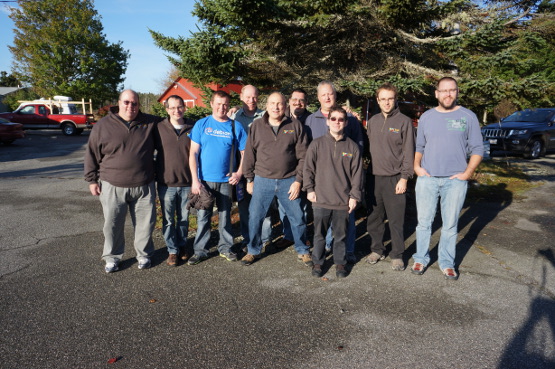
Social It was great seeing everyone again. I first started using LTSP around 9 years ago and never imagined back then that I d get to meet the people behind it. Ron Colcernian sourced us some really cool LTSP tops that you can see us wearing in the group photo. I hope to get to BTS again next year!

9 October 2012

David Welton: Fast, Light and Asynchronous

I am a big fan of Ruby on Rails: it does a lot of things, and it does most of them pretty well. When starting a new web project, it's the first thing I would reach for: most of the time, your problem is going to be figuring out a good product/market fit, or whipping up some internal tool without wasting a lot of programmer time. Once you've got a firm grasp of the problem, then maybe you can consider optimizing. Who cares if you do something that no one wants really really fast? However, Ruby on Rails is not beautiful in terms of being particularly fast or lightweight. No complaints from me: most of the time, I'm happy to have something that does so much for me, leaving me to work on the actual problem at hand. Once in a while, though, you do need fast and relatively lightweight, and that space has been getting more interesting over the past few years, at least in terms of the web. First of all, technologies like "Comet", utilizing web sockets or some other always-on connection are becoming more common, where a socket with the server remains open in order to quickly exchange data from the server to the client - and back. That seems to be a poor fit for something like Rails, where it can tie up a lot of resources if one isn't careful. And while computing costs continue to decline, no one minds getting more for less in terms of what their server can do. Furthermore, with frameworks like Backbone.js, pushing more and more code to the client, the server can afford to be a bit simpler and do less, so it may as well be snappy to boot. Java has long been fairly popular for "heavy lifting" types of applications, partially because it does end up being reasonably fast. But it's not something I've ever had much fun using and is usually kind of wordy, and makes you feel like you need a crew of people in Palo Alto, one in Bangalore, and one in Stockholm just to churn out all the code. And it certainly is no lightweight in terms of memory either. So... while it can certainly do pretty much anything you need, I don't see it as being the strongest player when someone needs "real time web" code, and needs it to be reasonably light weight. Ruby, outside of standard Rails stuff like Passenger, seems to offer some interesting possibilities for this kind of work, like Reel but they don't seem to have the traction other solutions do. Python is in a similar situation: the Twisted framework has been around for a while, and while it has some success stories, never seems to have really 'caught fire'. Neither of these languages was built for "concurrency" from the ground up, and that seems to have, to date, inhibited people from using them extensively for this kind of job. My gut feeling is that the need for speed and "concurrency" (or at least handling a lot of concurrent users) will drive adoption of languages heretofore not so popular on the server. Let's have a look at them. Erlang: This is by no means a new language, having been developed in Ericsson in the late 1980ies; and it implements several interesting concepts. First and foremost, concurrency is handled in the form of many small "processes", which are not actually Unix processes at all, but processes internal to the Erlang VM. The Erlang system contains a scheduler that allocates resources to all of these processes, so even if one of them dies or behaves badly, it's not a problem: the system as a whole can continue to function well. The way Erlang is built, the scheduler is preemptive: the internal "processes" don't need to yield to let other processes run. Beyond the scheduler and simple processes, Erlang gives you the tools to create elaborate trees of supervisors and workers that are quite robust to failures in any one portion of the system, as well as giving you the tools to set up a system to run on multiple, distributed computers. This kind of thinking is necessary when you write applications, such as phone switches, where downtime is really, really not ok. Erlang processes comunicate almost exclusively via message passing, meaning that state is not shared. Altogether, this makes for a fast, rock solid system that can easily handle thousands of concurrent connections without breaking a sweat. The computing world being what it is though, Erlang is likely to be more of a Lisp or Smalltalk: it's a trailblazer that did many things years before their time in other languages, but I don't see it as ever quite catching on amongst 'the masses'. It has a wonky syntax, it's a functional programming language, and because it is used in environments where too much experimentation is not good, it does not have a lot of room to break with its own past and innovate in terms of the language itself: it's slow to change and improve, even where the need to is clearly perceived. Node.js: is the opposite, in some ways: being based on Javascript, it draws on a huge number of potential programmers - orders of magnitude more than Erlang. And thanks to design decisions enforcing the use of asynchronous code and callbacks for anything that could block, it deals quite well with concurrent connections, even if the language and libraries don't really give you much in terms of "true" concurrency. This is a simple model that works pretty well, even if, theoretically, all it would take is one "while (1)" loop in a callback to block the entire system. In practice, this doesn't seem to be a big problem, though. More of a problem is writing maintainable code, when everything is a callback. Keeping the network of callbacks straight can be a bit of a chore, and is probably not an optimal model in terms of programmer productivity. That said, people seem to do make due with it, although Node is young enough that we haven't seem projects that are 5 or 6 years old and maintained by people who didn't write them. One of the advantages of being such a popular language is that lots of people have a strong interest in seeing Javascript being very, very performant. That need begat the V8 Javascript engine, from Google, which they were kind enough to release as free software. So one of the advantages that Node has is that the underlying implementation is extremely fast for a dynamic language. For many people who know Javascript, picking up Node.js is also an easy choice, even though people used to browser side programming with Javascript will have to adjust their way of thinking to succesfully tackle server projects. Go language: this is an interesting one, written by some luminaries who work at Google. It can best be described as something akin to C with some updated features, such as garbage collection, that make it more suitable for working on large projects, where things like memory leaks are going to make life very frustrating. It has the feel of a "real language, for real programmers" in that it doesn't stray far too far from what people are used to - it's not going to cause the "what the hell is this?!" reactions that Erlang might in more close-minded circles. Between the big company backing it, and the approachable syntax and concepts, Go looks like it has a good shot at the mainstream. Where it gets interesting is their concurrency model, which is apparently based on something called "communicating sequential processes" which, superficially at least, looks like it has some things in common with Erlang's "actor model" of concurrency. Under the hood, Go apparently hives off its "goroutines" to different OS level threads, but does not have a preemptive scheduler like Erlang: http://code.google.com/p/go/issues/detail?id=543 - although according to this, they may change that in the future. I'm not enough of a computer science guy to comment much on the details of CSP vs Actors, but both seem like valid models with strengths compared to trying to keep threads straight, which always seems to be a source of problems for programmers. Conclusions So, what's actually going to happen? I see Node.js as the clear front runner. It takes a worse-is-better approach that seems to work well enough as people get started. If they encounter difficulties later, they can always rewrite in something else, if needs be, but by "luring people in", Node.js has gathered a large group of users who continue, in turn, to churn out more code for use with the system, making it more attractive to new users. Programming languages are not winner-take-all markets though, so perhaps there is room for a few more languages to have decent followings in this space. Hopefully the competition will lead to ever better tools for those of us utilizing them! What do you think?

Christian Perrier: Bug #690000

(doh, I nearly had it. I just got #690019, #690020 and #690022 for l10n stuff) Bartek Krawczyk reported Debian bug #690000 on Monday October 8th, against guake. And my friend Sylvestre Ledru, the package maintainer, now has to fix it instead of trying to promote the use of Scilab over proprietary alternatives in the French aerospace research organizations..:-) Bug #680000 was reported as of July 2nd: 3 months and 8 days for 10,000 bugs. This is a VERY significant drop in the bug reporting rate in Debian. Last time, I wrote: "How will the wheezy freeze affect this? We'll see in two months!". We have the answer: the wheezy freeze triggerred an important drop in bug reporting rate in Debian. My general feeling is somehow different: for whatever reason, I feel like the *overall* activity in the project has dropped significantly. I seem to have less mails to read, less bugs reported against my packages, even less heated discussions here and there, as well as several very quiet channels on IRC. Am I pessimistic when feeling that the overall momentum is sliding out of Debian? Maybe I am, so, folks, please make me optimistic and move you fingers out of the place where they are and help releasing that damn penguin. Apart from that, our next milestone (apart from the wheezy release!) will be bug #700000. Remember the bet?. It looks like the probability of Kartik Mistry winning it is now away (he bet for Now 8th 2012) and the best position is hel by David Pr vot (he bet for December 12th). On the other hand, my own chances are increasing if the bug rate drop is confirmed and if bug #700000 is reported in more than 3 months (I bet for February 14th 2013, guess why?). We'll see that in a few weeks!

8 October 2012

Luke Faraone: Where I've gone off to

For those of you back at my university, you may have noticed I'm not there this semester.

Google's 2012 FEP team

I spent this past summer at Google, Inc, developing internal tools for the AdSense team, specifically Google Programmable Ads. Being at Google was great; I loved my team and my intern cohort, the rest of the interns in the Freshman Engineering Practicum.

I'm not currently at Google; my internship ended at the beginning of August. Although it was a blast, all good things must come to an end.

I'm not at Mason, either. I was super excited to return to university, and was just about to buy my books and get ready to move in when I got an email from a former coworker at Ksplice, a startup Oracle acquired while I interned there last year. He was starting a new company which would focus on business communications. I'd be working with a bunch of my former coworkers, and based on what I had heard of the company's plans I was confident in their ability to make an awesome product.

Needless to say, when they decided to offer me a position working there full time, I jumped on it.

From an academic point of view, Mason didn't really have much of a mechanism to support this. Co-ops are uncommon there, and not really supported for more than one semester; a full year away had never been done, according to our career services. My department was fully supportive, however, so we managed to find a way to make it work. This involved filling out some oddly-named forms, such as Special Registration for Graduation Request, which the registrar asserted was the right form, trust us on this one.

Myself and Obey Arthur Liu
at a SIPB hackathon
But that's all neither here nor there. I'm now up in Cambridge, MA, working with awesome people (including but not limited to tabbott, wdaher, jesstess, and keegan), and exploring the city. I'm hanging out with MIT SIPB, helping with the maintenance of Sugar Labs' servers in E15 and spending more time working on various open source projects.

To my friends at Mason: I miss you all. I know regardless of how the next year+ turns out, it'll be one one hell of a ride.

Rudy Godoy: MySQL data enconding conversion latin1 utf8

I was about to post a different story but things turned out differently, for good. Now I ll post tips that may save the day in the event of encoding issues when dealing with MySQL table data. Hopefully you find it useful. Say you have a MySQL table that has collation set to latin1 but you have utf8-encoded data stored. This happened when importing a dump, or because of Murphy s law. When querying the data from your application or from mysql s tools you get awful results for non-ascii characters such tildes. Changing the table s collation definition will only work for new columns and records. Altering the collation for the said column would make things worse. So what to do? Fortunately MySQL offers a nice way to save the day. You can use a transition conversion and then set the table encoding back to utf8, so it pairs accordingly with the encoding type for the data it has stored. ALTER TABLE table_name CHANGE column_name column_name BLOB; Issuing the previous command will make the table change it s type to BLOB. Why? Because by doing it the stored data is kept untouched. This is important. If you use the CONVERT or MODIFY commands the data will be converted by MySQL. We don t want that since the data is already in the encoding type we want. You can note that column_name is repeated twice, this is because the CHANGE command copies the data and we want the resulting column to have the same name. Now, we have to put the data back on the encoding we want, so everything is under control again. This is done by issuing the following command. ALTER TABLE table_name CHANGE column_name column_name COLUMN_TYPE CHARACTER SET utf8; COLUMN_TYPE depends on the content s column type. For instance, for a TEXT column it should be. ALTER TABLE table_name CHANGE column_name column_name TEXT CHARACTER SET utf8; It works for VARCHAR, LONGTEXT and other data types that are used to store characters.

7 October 2012

Sune Vuorela: Playing with webstuff

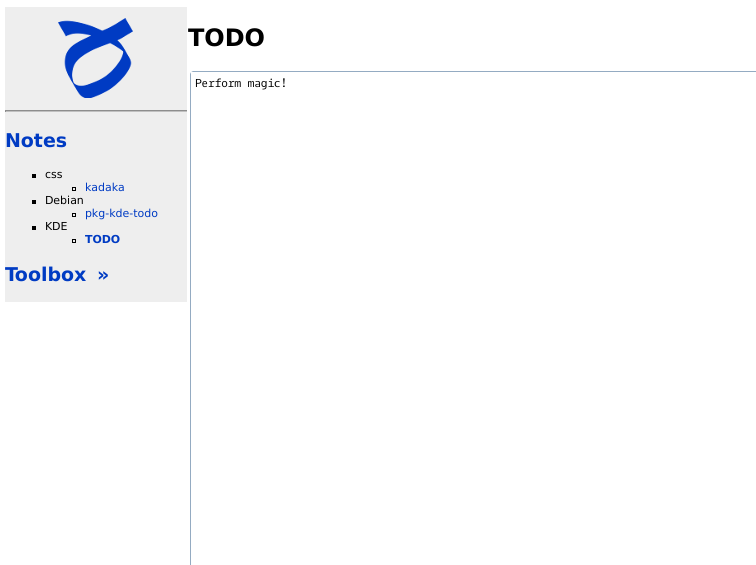
So, the other day, I wrote a blog post asking people to make sure their private hacks become published somehow. So in the sprit of that, I should also publish my recent hacks. I have been toying around as a web dude and created two nice pieces of oldschool webby software. So. Time to introductions: Dodoma is a simple online note taking application. I have created a boring homepage for it on http://sune.vuorela.dk/dodoma and I have a screenshot here:
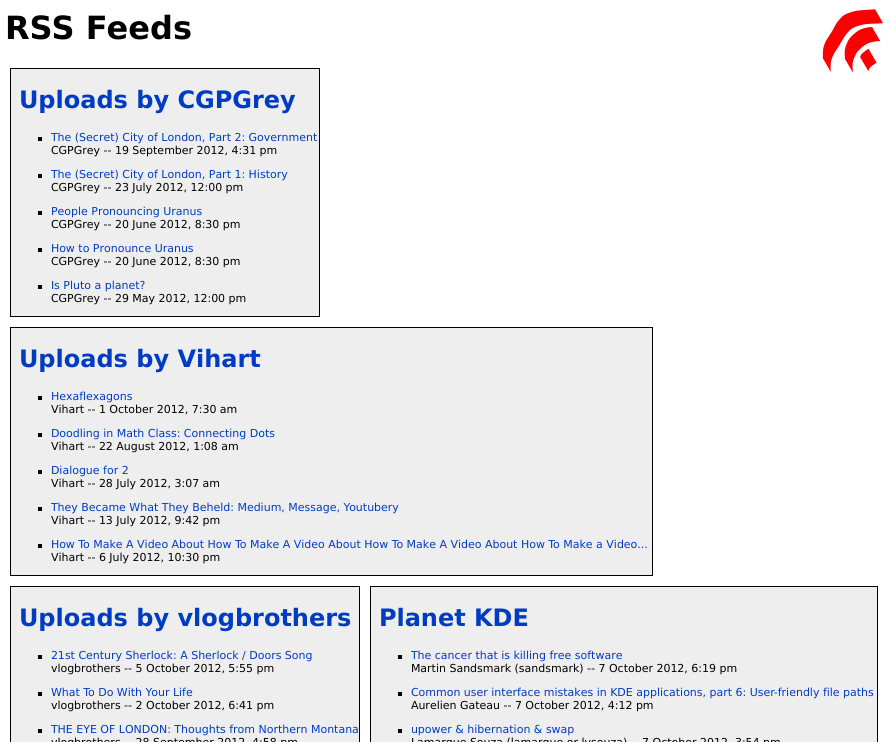
Screenshot of webapp Kadaka is a simple rss reader showing the five newest items from various rss feeds. Has special support for youtube channels.
I have created a boring homepage for it on http://sune.vuorela.dk/kadaka and I have a screenshot here:
Screenshot of kadaka Have fun with those two apps. Patches always welcome. Some of you might wonder where does he get those crazy names from . Well. One of them I found on a map. Thats actually a way I name quite many of my projects. Even those that don t even leave my harddrive. And the other one actually also is on a map, but I saw it on a frequently used bus in Tallin, Estonia. And. I am considering naming my next fancy projects after some of the cool words found on the join the game member page. If you want to be part of that, feel free to Join the game!

Matthew Garrett: Handling UEFI Secure Boot in smaller distributions

The plan for supporting UEFI Secure Boot in Fedora is still pretty much as originally planned, but it's dependent upon building a binary which has the Fedora key embedded, and then getting that binary signed by Microsoft. Easy enough for us to do, but not necessarily practical for smaller distributions. There's a few possible solutions for them.


I've taken Suse's code for key management and merged it into my own shim tree with a few changes. The significant difference is a second stage bootloader signed with an untrusted key will cause a UI to appear, rather than simply refusing to boot. This will permit the user to then navigate the available filesystems, choose a key and indicate that they want to enrol it. From then on, the bootloader will trust binaries signed with that key.

Distributions are then able to take an existing signed copy of shim and put it on their install media, along with a file containing their key. If a user attempts to boot then the boot will fail because the second stage bootloader isn't signed with a trusted key, but the user can then use the navigator and select the distribution's key file. After providing confirmation and rebooting, the second stage bootloader's signature will now be recognised and the installer will boot.

This has the advantage over the first two options that the UI is consistent, making it easier to document the install process. The primary disadvantage is that the distribution won't be able to rebuild shim and will have to ship a pre-compiled binary. This may well be unacceptable to distributions like Debian, but should still provide a viable approach for other distributions who are either unwilling or unable to deal with Microsoft themselves.

comment count unavailable comments

Dominique Dumont: Dpkg source editor/checker is going native

Hello As Config::Model was becoming too big with too many dependencies, I ve moved all Debian stuff from Config::Model repository into a separate Debian repository. If you install only libconfig-model-perl 2.026-1 (from experimental), the command cme check dpkg will not work. You must also install libconfig-model-dpkg-perl to get it back. libconfig-model-dpkg-perl is currently in experimental. libconfig-model-dpkg-perl repository is hosted on Alioth in debian perl-packaging team and is a Debian native package. Nevertheless, it will be uploaded to CPAN. (just like dh-make-perl).
All people involved in packaging are welcome to hack it or suggest improvements I ll upload both packages into unstable once the dust settles. All the best
Tagged: config-model, debian, dpkg, Perl

6 October 2012

Matthew Garrett: The importance of trustworthy power structures

Direct harassment and overt sexism are certainly a significant part of why the gender ratios in the Linux community[1] are so skewed, but they're not the whole story. Part of feeling comfortable with a community is the knowledge that those in positions of power can be relied upon to engage in appropriate action when undesirable situations arise - no matter how compelling your code of conduct, no matter how detailed your diversity policy, if someone contravenes them and nothing happens, those documents are worthless and your community is unwelcoming. You can't rely on enforcement unless the community can trust its leadership.

Setting a good example in terms of behaviour is obviously vital, but it's not sufficient. Leaders who engage in sexist behaviour or who harass community members are clearly untrustworthy and undermine any attempts the rest of the community may be making. Failing to step in when they see examples of unacceptable behaviour is as bad. But less obvious is that it's possible to destroy that community trust without clearly contravening those community standards.

An example of this is Todd Akin, a candidate for the upcoming US Senate elections. In August he justified his support for making abortion illegal even in cases of rape, on the basis that women can't become pregnant through being victims of "legitimate rape". Of course, this had little to do with his fiscal or wider social policies, positions that are more directly relevant to most of his potential constituents, and in an election year that's primarily about the economy and healthcare it might be expected that a single issue would have little effect on the election standings. Instead, there was a huge uproar and a previously safe victory has now turned into a real chance of a loss.

Why? A significant part of it is because many people now have difficulty believing that they can trust him to represent them. If he understands women so little that he's willing to make entirely spurious justifications for his positions, how could any woman trust him to consider any other problems they may face? If he's willing to use fake science to back himself up, how could anyone trust him to consider any issue involving science? Through a single statement to a journalist he demonstrated to many that he was unsuited to be their representative in government. Many people who would otherwise have voted for him simply don't feel that they can rely on him to be there for them. Whether he wins his election or not, that distrust is going to remain and it's going to compromise his ability to work with his constituents.

It's the same in technical communities. If a member of a project's technical leadership frequently and loudly expresses their disdain for Python coders, anyone advocating for increased use of Python in that project is unlikely to feel that they can get unbiased opinions from that leader. If the project as a whole is uninterested in adopting Python then that's probably for the best, but if the rest of the project is open to using Python then there's a problem. People working with Python are less likely to join the project, and perhaps the project will lose out as a result.

But it's worth remembering that technical communities are still communities. If a member of a project's technical leadership vociferously argues that slavery benefited minority groups in the long run, members of those minority groups are going to feel that they're not going to be well represented by that leader. If they blog about how homosexuality is a lifestyle choice then homosexuals are unlikely to flock to the project. Likewise, if they downplay the prevalence or impact of rape, women are going to feel marginalised and find something better to do with their time.

It's impossible to separate these things. No matter how technically competent a community leader is, no matter how much code review they perform or how much mentorship they provide, if they're expressing unacceptable social opinions then they're diminishing the community. People I know and respect have left technical communities simply because people in positions of responsibility have engaged in this kind of behaviour without it causing them any problems.

We shouldn't be willing to give people a pass simply because they aren't actually groping anyone or because they're not members of the KKK. Those who drive people away from the community on the basis of race, gender or sexual orientation deserve vocal condemnation, and if they're unwilling to change their behaviour then the community should instead act to drive them away.

We're pretty bad at that in the Linux world at the moment. Too many people have behaved in this way and are left with positions of power or responsibility. There's no easy solution to the problem, but the Ada Initiative is continuing to work to improve awareness and work with communities to reduce the alienation that results from this kind of behaviour. If you want this to be anything other than a straight white male dominated community, you should give them money.

[1] (and computing in general, though to a lesser extent)

comment count unavailable comments

Lars Wirzenius: Obnam 1.2 (backup software)

I've just made release 1.2 of Obnam, my backup program. The NEWS file entry: Bug fixes: This release has been uploaded to my own apt repository on code.liw.fi, for squeeze and unstable. Due to the Debian freeze, I am not uploading this to Debian at this time, though some changes may eventually be uploaded there.

Christian Perrier: [life] Running update

It's been some time since I didn't write in this blog about my running activities. So let's make an update for my international friends. If you don't care about running, you can move to the next post in your feed reader..:-) After a quite busy running activity during DebConf 12 in Nicaragua, as well as during the touristic trip we did afterwards, I went back to my "regular" schedule. Main objectives in September-December are roughly the following: During August, I broke my monthly distance record by running nearly 300km in one month, even achieving 100km in only 5 days, around 24th. That was one of my goals: improve my overall resistance to run repetitions, which is one of the keys for ultra-running. These were achieved with many runs to/back work, with up to 13km in the morning and the same in the evening. Yes, running 26km at about 11km/h (and with some ups and downs in the woods to make it even worse) on a day where one has a normal work activity is quite a challenge. September has been more focused on marathon preparation. This time, no complicated plan with interval running as the month was also a very busy work month, where fitting training sessions during the day would be hard. So, I made an easy plan : run a half-marathon every Sunday and run part of my work-home commute every day (So, 3km run to the train station, 30mn train ride, then 4km run to my work place, then shower....and the same back after work). Out of the 5 half-marathons I ran during these 5 Sundays, two of them were official ones. On the first one, I finally managed to break my personal best on half, with 1h37'14". Only a 14 seconds improvement, but that one is certainly one of my best among personal bests....even better than 3h38'45" on marathon.. All other half-marathons were run at marathon speed, so targeting 5'06"/km, which will be my planned pace on October 21st. The one I ran on Sept. 16th, which was the other official race I ran was finally done quite significantly faster than this. First of all, because I had hard times to run "only" at 5'06"/km because of other runners emulation. And also, because I ran the last 3 kilometers up to nearly 14km/h (so, down to 4'15"/km), just for fun, because I could do it..:-) With all this preparation, I think that I now manage to very well manage my marathon speed. I'll probably do a final test tomorrow by trying to keep running at this speed for 3 rounds of my favourite "Maurepas Marathon" circuit, which is just exactly 1/4 of a marathon. More "funnily", I also did something I never did before during this really crazy month : simply said, I came back from work by running. All the way long. Through woods, forests, along some lakes and finally in the country. 42 kilometers (yes, a marathon). After a work day. Starting at 5:45pm and arriving home after 4h50 minutes. With 2 hours of heavy rain. With 2.5 hours running in the dark (with my headlamp of course). All alone. That was a crazy bet to do....but really great fun achieving this : the GPS trace is here. Really something I have to do again..:-) So, well, now I'm more or less prepared and having fun is just a matter for time..:-). I'll keep you guys posted with those and, guess what? I'm already picking my target races for next year..:-)

5 October 2012

Maximilian Attems: New klibc release 2.0.2

The new klibc features fixes for latest 3.6 Linux, dash sync and arm fixes. For details see the longer story on: klibc 2.0.2 release announcement or klibc git repository.

Keith Packard: fd-passing

FD passing for DRI.Next Using the DMA-BUF interfaces to pass DRI objects between the client and server, as discussed in my previous blog posting on DRI-Next, requires that we successfully pass file descriptors over the X protocol socket. Rumor has it that this has been tried and found to be difficult, and so I decided to do a bit of experimentation to see how this could be made to work within the existing X implementation. (All of the examples shown here are licensed under the GPL, version 2 and are available from git://keithp.com/git/fdpassing) Basics of FD passing The kernel internals that support FD passing are actually quite simple POSIX already require that two processes be able to share the same underlying reference to a file because of the semantics of the fork(2) call. Adding some ability to share arbitrary file descriptors between two processes then is far more about how you ask the kernel than the actual file descriptor sharing operation. In Linux, file descriptors can be passed through local network sockets. The sender constructs a mystic-looking sendmsg(2) call, placing the file descriptor in the control field of that operation. The kernel pulls the file descriptor out of the control field, allocates a file descriptor in the target process which references the same file object and then sticks the file descriptor in a queue for the receiving process to fetch. The receiver then constructs a matching call to recvmsg that provides a place for the kernel to stick the new file descriptor. A helper API for testing I first write a stand-alone program that created a socketpair, forked and then passed an fd from the parent to the child. Once that was working, I decided that some short helper functions would make further testing a whole lot easier. Here s a function that writes some data and an optional file descriptor:
ssize_t
sock_fd_write(int sock, void *buf, ssize_t buflen, int fd)
 
    ssize_t     size;
    struct msghdr   msg;
    struct iovec    iov;
    union  
        struct cmsghdr  cmsghdr;
        char        control[CMSG_SPACE(sizeof (int))];
      cmsgu;
    struct cmsghdr  *cmsg;
    iov.iov_base = buf;
    iov.iov_len = buflen;
    msg.msg_name = NULL;
    msg.msg_namelen = 0;
    msg.msg_iov = &iov;
    msg.msg_iovlen = 1;
    if (fd != -1)  
        msg.msg_control = cmsgu.control;
        msg.msg_controllen = sizeof(cmsgu.control);
        cmsg = CMSG_FIRSTHDR(&msg);
        cmsg->cmsg_len = CMSG_LEN(sizeof (int));
        cmsg->cmsg_level = SOL_SOCKET;
        cmsg->cmsg_type = SCM_RIGHTS;
        printf ("passing fd %d\n", fd);
        *((int *) CMSG_DATA(cmsg)) = fd;
      else  
        msg.msg_control = NULL;
        msg.msg_controllen = 0;
        printf ("not passing fd\n");
     
    size = sendmsg(sock, &msg, 0);
    if (size < 0)
        perror ("sendmsg");
    return size;
 
And here s the matching receiver function:
ssize_t
sock_fd_read(int sock, void *buf, ssize_t bufsize, int *fd)
 
    ssize_t     size;
    if (fd)  
        struct msghdr   msg;
        struct iovec    iov;
        union  
            struct cmsghdr  cmsghdr;
            char        control[CMSG_SPACE(sizeof (int))];
          cmsgu;
        struct cmsghdr  *cmsg;
        iov.iov_base = buf;
        iov.iov_len = bufsize;
        msg.msg_name = NULL;
        msg.msg_namelen = 0;
        msg.msg_iov = &iov;
        msg.msg_iovlen = 1;
        msg.msg_control = cmsgu.control;
        msg.msg_controllen = sizeof(cmsgu.control);
        size = recvmsg (sock, &msg, 0);
        if (size < 0)  
            perror ("recvmsg");
            exit(1);
         
        cmsg = CMSG_FIRSTHDR(&msg);
        if (cmsg && cmsg->cmsg_len == CMSG_LEN(sizeof(int)))  
            if (cmsg->cmsg_level != SOL_SOCKET)  
                fprintf (stderr, "invalid cmsg_level %d\n",
                     cmsg->cmsg_level);
                exit(1);
             
            if (cmsg->cmsg_type != SCM_RIGHTS)  
                fprintf (stderr, "invalid cmsg_type %d\n",
                     cmsg->cmsg_type);
                exit(1);
             
            *fd = *((int *) CMSG_DATA(cmsg));
            printf ("received fd %d\n", *fd);
          else
            *fd = -1;
      else  
        size = read (sock, buf, bufsize);
        if (size < 0)  
            perror("read");
            exit(1);
         
     
    return size;
 
With these two functions, I rewrote the simple example as follows:
void
child(int sock)
 
    int fd;
    char    buf[16];
    ssize_t size;
    sleep(1);
    for (;;)  
        size = sock_fd_read(sock, buf, sizeof(buf), &fd);
        if (size <= 0)
            break;
        printf ("read %d\n", size);
        if (fd != -1)  
            write(fd, "hello, world\n", 13);
            close(fd);


void
parent(int sock)
 
    ssize_t size;
    int i;
    int fd;
    fd = 1;
    size = sock_fd_write(sock, "1", 1, 1);
    printf ("wrote %d\n", size);
 
int
main(int argc, char **argv)
 
    int sv[2];
    int pid;
    if (socketpair(AF_LOCAL, SOCK_STREAM, 0, sv) < 0)  
        perror("socketpair");
        exit(1);
     
    switch ((pid = fork()))  
    case 0:
        close(sv[0]);
        child(sv[1]);
        break;
    case -1:
        perror("fork");
        exit(1);
    default:
        close(sv[1]);
        parent(sv[0]);
        break;
     
    return 0;
 
Experimenting with multiple writes I wanted to know what would happen if multiple writes were made, some with file descriptors and some without. So I changed the simple example parent function to look like:
void
parent(int sock)
 
    ssize_t size;
    int i;
    int fd;
    fd = 1;
    size = sock_fd_write(sock, "1", 1, -1);
    printf ("wrote %d without fd\n", size);
    size = sock_fd_write(sock, "1", 1, 1);
    printf ("wrote %d with fd\n", size);
    size = sock_fd_write(sock, "1", 1, -1);
    printf ("wrote %d without fd\n", size);
 
When run, this demonstrates that the reader gets two bytes in the first read along with a file descriptor followed by one byte in a second read, without a file descriptor. This demonstrates that a file descriptor message forms a barrier within the socket; multiple messages will be merged together, but not past a message containing a file descriptor. Reading without accepting a file descriptor What happens when the reader isn t expecting a file descriptor? Does it just get lost? Does the reader not get the message until it asks for the file descriptor? What about the boundary issue described above? Here s my test case:
void
child(int sock)
 
    int fd;
    char    buf[16];
    ssize_t size;
    sleep(1);
    size = sock_fd_read(sock, buf, sizeof(buf), NULL);
    if (size <= 0)
        return;
    printf ("read %d\n", size);
    size = sock_fd_read(sock, buf, sizeof(buf), &fd);
    if (size <= 0)
        return;
    printf ("read %d\n", size);
    if (fd != -1)  
        write(fd, "hello, world\n", 13);
        close(fd);
     
 
void
parent(int sock)
 
    ssize_t size;
    int i;
    int fd;
    fd = 1;
    size = sock_fd_write(sock, "1", 1, 1);
    printf ("wrote %d without fd\n", size);
    size = sock_fd_write(sock, "1", 1, 2);
    printf ("wrote %d with fd\n", size);
 
This shows that the first passed file descriptor is picked up by the first sockfdread call, but the file descriptor is closed. The second file descriptor passed is picked up by the second sockfdread call. Zero-length writes Can a file descriptor be passed without sending any data?
void
parent(int sock)
 
    ssize_t size;
    int i;
    int fd;
    fd = 1;
    size = sock_fd_write(sock, "1", 1, -1);
    printf ("wrote %d without fd\n", size);
    size = sock_fd_write(sock, NULL, 0, 1);
    printf ("wrote %d with fd\n", size);
    size = sock_fd_write(sock, "1", 1, -1);
    printf ("wrote %d without fd\n", size);
 
And the answer is clearly no the file descriptor is not passed when no data are included in the write. A summary of results
  1. read and recvmsg don t merge data across a file descriptor message boundary.
  2. failing to accept an fd in the receiver results in the fd being closed by the kernel.
  3. a file descriptor must be accompanied by some data.
Make X pass file descriptors I d like to get X to pass a file descriptor without completely rewriting the internals of both the library and the X server. Ideally, without making any changes to the existing code paths for regular request processing at all. On the sending side, this seems pretty straightforward we just need to get the X connection file descriptor and call sendmsg directly, passing the desired file descriptor along. In XCB, this could be done by using the xcbtakesocket interface to temporarily hijack the protocol as Xlib does. It s the receiving side where things are messier. Because a bare read will discard any delivered file descriptor, we must make sure to use recvmsg whenever we want to actually capture the file descriptor. Kludge X server fd receiving Because a passed fd creates a barrier in the bytestream, when the X server reads requests from a client, the read will stop sending data after the message with the file descriptor is consumed. Of course, this process consumes the passed file descriptor, and if that call isn t made with recvmsg set up to receive it, the fd will be lost. As a simple kludge, if we pass a meaningless fd with the X request and then the real fd with a following XNoOperation request, the existing request reading code will get the request, discard the meaningless fd and then stop reading at that point due to the barrier. Once into the request processing code, recvmsg can be called to get the real file descriptor and the associated XNoOperation request. I wrote a test for this that demonstrates how this works:
static void
child(int sock)
 
    uint8_t xreq[1024];
    uint8_t xnop[4];
    uint8_t req;
    int i, reqlen;
    ssize_t size, fdsize;
    int fd = -1, *fdp;
    int j;
    sleep (1);
    for (j = 0;; j++)  
        size = sock_fd_read(sock, xreq, sizeof (xreq), NULL);
        printf ("got %d\n", size);
        if (size == 0)
            break;
        i = 0;
        while (i < size)  
            req = xreq[i];
            reqlen = xreq[i+1];
            i += reqlen;
            switch (req)  
            case 0:
                break;
            case 1:
                if (i != size)  
                    fprintf (stderr, "Got fd req, but not at end of input %d < %d\n",
                         i, size);
                 
                fdsize = sock_fd_read(sock, xnop, sizeof (xnop), &fd);
                if (fd == -1)  
                    fprintf (stderr, "no fd received\n");
                  else  
                    FILE    *f = fdopen (fd, "w");
                    fprintf(f, "hello %d\n", j);
                    fflush(f);
                    fclose(f);
                    close(fd);
                    fd = -1;
                 
                break;
            case 2:
                fprintf (stderr, "Unexpected FD passing req\n");
                break;


int
tmp_file(int j)  
    char    name[64];
    sprintf (name, "tmp-file-%d", j);
    return creat(name, 0666);
 
static void
parent(int sock)
 
    uint8_t xreq[32];
    uint8_t xnop[4];
    int i, j;
    int fd;
    for (j = 0; j < 4; j++)  
        /* Write a bunch of regular requests */
        for (i = 0; i < 8; i++)  
            xreq[0] = 0;
            xreq[1] = sizeof (xreq);
            sock_fd_write(sock, xreq, sizeof (xreq), -1);
         
        /* Write our 'pass an fd' request with a 'useless' FD to block the receiver */
        xreq[0] = 1;
        xreq[1] = sizeof(xreq);
        sock_fd_write(sock, xreq, sizeof (xreq), 1);
        /* Pass an fd */
        xnop[0] = 2;
        xnop[1] = sizeof (xnop);
        fd = tmp_file(j);
        sock_fd_write(sock, xnop, sizeof (xnop), fd);
        close(fd);
     
 
Fixing XCB to receive file descriptors Multiple threads may be trying to get replies and events back from the X server at the same time, which means the kludge of having the real fd follow the message will likely lead to the wrong thread getting the file descriptor. Instead, I suspect the best plan will be to fix XCB to internally capture passed file descriptors and save them with the associated reply. Because the file descriptor message will form a barrier in the read stream, xcb can associate any received file descriptor with the last reply in the read data. The X server would then send the reply with an explicit sendmsg call to pass both reply and file descriptor together. Next steps The next thing to do is code up a simple fd passing extension and try to get it working, passing descriptors back and forth to the X server. Once that works, design of the rest of the DRM-Next extension should be pretty straightforward.

Mart&iacute;n Ferrari: KGB 1.16 is out!

It was a surprisingly busy week. The commit notification service CIA was shut down about a week ago, so I spammedsent some messages to announce that KGB could be used as a replacement, and Don Armstrong wrote a great tutorial on how to set it up. As a result, many people came to us to use our bots, or to set-up their own instances. Since then, 14 Debian sub-projects started using our bots, and we know of at least two other bots being run independently. For a small project that was mainly developed and maintained for our own use, this was quite some unexpected popularity! With bug reports and feature requests starting to flow in, Damyan Ivanov (who's basically the one doing most of the work these days) sat down and produced a new release. So, I present you, KGB 1.16! What's new Bug fixes Coming up soon Tags: Planet Debian, KGB

3 October 2012

Alberto Garc a: IndustryPack, QEMU and LinuxCon

IndustryPack drivers for Linux In the past months we have been working at Igalia to give Linux support to IndustryPack devices. IndustryPack modules are small boards ( mezzanine ) that are attached to a carrier board, which serves as a bridge between them and the host bus (PCI, VME, ). We wrote the drivers for the TEWS TPCI200 PCI carrier and the GE IP-OCTAL-232 module.
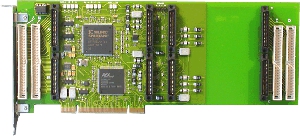
TEWS TPCI200
GE IP-OCTAL-232
My mate Samuel was the lead developer of the kernel drivers. He published some details about this work in his blog some time ago. The drivers are available in latest Linux release (3.6 as of this writing) but if you want the bleeding-edge version you can get it from here (make sure to use the staging-next branch). IndustryPack emulation for QEMU Along with Samuel s work on the kernel driver, I have been working to add emulation of the aformentioned IndustryPack devices to QEMU. The work consists on three parts: I decided to split the emulation like this to be as close as possible to how the hardware works and to make it easier to reuse the code to implement other IndustryPack devices. The emulation is functional and can be used with the existing Linux driver. Just make sure to enable CONFIG_IPACK_BUS, CONFIG_BOARD_TPCI200 and CONFIG_SERIAL_IPOCTAL in the kernel configuration. I submitted the code to QEMU, but it hasn t been integrated yet, so if you want to test it you ll need to patch it yourself: get the QEMU source code and apply the TPCI200 patch and the IP-Octal 232 patch. Those patches have been tested with QEMU 1.2.0. And here s how you run QEMU with support for these devices:
$ qemu -device tpci200 -device ipoctal
The IP-Octal board implements eight RS-232 serial ports. Each one of those can be redirected to a character device in the host using the functionality provided by QEMU. The serial0 to serial7 parameters can be used to specify each one of the redirections. Example:
$ qemu -device tpci200 -device ipoctal,serial0=pty
With this, the first serial port of the IP-Octal board ( /dev/ipoctal.0.0.0 on the guest) will be redirected to a newly-allocated pty on the host. LinuxCon Europe Having virtual hardware allows us to test and debug the Linux driver more easily. In November I ll be in Barcelona with the rest of the Igalia OS team for LinuxCon Europe and the KVM Forum. I will be talking about how to use QEMU to improve the robustness of device drivers and speed up their development.. Some other Igalians will also be there, including Juan Su rez who will be talking about the Grilo multimedia framework. See you in Barcelona!

Stefano Zacchiroli: put some Debian salt in the Ubuntu charity marathon

Fellow geeks of the Canonical community team will be doing something pretty weird this week. They're fund-raising for charity, for causes ranging from environment to autism, from homeless support to kids education, from poverty fight to water supplies. But that's not weird. What's weird is that the fund-raising will culminate in a 24-hour work marathon stream live, which will kick off tomorrow (Thursday) at 10:00 UTC. As I like charity, and as I like contributing to Free Software, I gladly accepted to rely here a challenge to the Debian community by one of the marathon "horsemen", Michael Hall: Raising the stakes, Nick Skaggs has decided to propose a similar challenge: Wanna take the challenge? And how about the other 4 horsemen? No challenges to the Debian community? Feel free to leave a comment and I'll raise the stakes even more, updating the list above. Update 4/10/2012, 13:35 +0200: Daniel Holbach added his own challenge to the Debian community:

Petter Reinholdtsen: Why is your local library collecting the "wrong" computer books?

I just read the blog post from Tim Retout about the computer science book collection available in his local library, and just wanted to share my comment on his theory about computer books becoming obsolete so soon. That is part of the reason why the selection is so sad in almost any local library (it is in mine too), but I believe the major contributing factor is that the people buying books to the library have no way to know a good and future computer classic from trash. And they need to know which one will become a classic in the future, as they would normally buy one of the recently published books. During my university years, I worked for a while at the university library, and even there the person in charge of buying computer related books (and in fact any natural science related book), did not know enough about computers to make a good educated guess. Once, just before Christmas, they had some leftover money on the book budget and I was asked if I could pick out a lot of computer books in the university book store, for the library to buy for their collection. I had a great time picking all the books I dreamt of buying and reading, and the books I knew were classics (like most of the Stevens collection). I picked several of the generic O'Reilly books (ie documenting protocols, formats and systems, not specific versions of products) and stayed away from the 'teach yourself X in N days' class. I had a great time, and probably picked out more than a hundred books for the library that evening. The sad fact is that there is no way a overworked librarian is going to know that for example The Practice of Programming is a must-have in any computer library, and they will most of the time end up picking the wrong books to buy. Perhaps you can help your local library make better choices by giving the suggestions for books to get? I know they would love to hear from you, even if their budget might block them from getting your favourite book right away.

Kumar Appaiah: A backup workflow with bup

It's important to back things up. You should also make your life easier by using some good software. I use obnam for some backups, but I wanted to try out bup for a new backup workflow I needed. I will describe the workflow here.The situation: I have a laptop with things to be backed up. I also have a Raspberry Pi which I use as a network attached storage (it has a 1 TB external drive attached to it) and runs Raspbian Wheezy on it. Naturally, you can do this on any NAS running some GNU/Linux variant. In addition, I also have an external portable USB hard disk where another backup copy will be stored. How do I automate this?Here is how I went about this process. First, for the Raspberry Pi:
  1. First, identify the directory or directories to be backed up. To keep this simple, the directory I am backing up is /home/kumar/Work.
  2. On the Raspberry Pi, install bup. If you want to build it from the git clone, you would need python-dev, and pandoc for the documentation.
    sudo aptitude install pandoc python-dev
    git clone git://github.com/apenwarr/bup.git
    cd bup;make;sudo make install
    
  3. Initialize the backup directory on the Raspberry Pi:
    BUP_DIR=/home/kumar/BACKUPS bup init
    BACKUPS is the place where bup is asked to store the backups (much like it's analogue of .git). You can store all your backups within this directory, and you can still classify backup sets within this directory with different names (much like git branches).
  4. On the local machine, initialize the backup directory.
    bup index -uv /home/kumar/Work
  5. Back it up. This will take time the first time, if the Work directory has several contents within it.
    bup save -r kumar@<raspberry_pi_ip_address>:BACKUPS -n workbackup /home/kumar/Work
    
    workbackup is the name of the backup set. This can be paperbackup or databackup or notesbackup so that several classes can be backed up within the BACKUPS directory.
  6. Now, you have backed things up. Make changes in the Work directory. For instance, add/edit/remove/move some files.
  7. Rerun the index and save commands from steps 4 and 5 above. Enjoy the speedup and ability to rewind to the previous state.
  8. Test restoration of ONE directory of backup (just to save time) on Pi itself directly on the Pi:
    bup -d /home/kumar/BACKUPS/ restore -C /tmp/ /workbackup/latest/home/kumar/Work/offset-coupling-params
    
    Then scp it back if you need it.
  9. Alternative: Use fuse. On the Pi:
    sudo aptitude install python-fuse
    sudo adduser kumar fuse
    mkdir Mount
    bup -d /home/kumar/BACKUPS fuse Mount
    Then cd into Mount and cp/scp the correct files wherever.
    fusermount -u Mount
    
  10. Once happy, write the bup index/bup save commands into a script and run it periodically to back up (check this at the end of the post). Have fun.
Next, to prepare the external hard disk, I went with the old-style autofs automounting solution:
  1. To automount the disk, in /etc/auto.master, add
    /auto			/etc/auto.misc	--timeout=60
    
  2. In /etc/auto.misc add:
    backupdrive	-fstype=btrfs	:UUID="7927a7ab-8c3f-4198-bd73-d3cc519a9ac3"
    
    fstype may need changing for your file system, and UUID can be found using blkid on the exact partition of the hard disk you wish to back up to.
  3. Initialize the backup directory:
    sudo mkdir /auto/backupdrive/BACKUPS
    sudo chown kumar.kumar /auto/backupdrive/BACKUPS
    bup -d /auto/backupdrive/BACKUPS/ init
    
  4. Index and back up:
    bup -d /auto/backupdrive/BACKUPS/ index -uv /home/kumar/Work
    bup -d /auto/backupdrive/BACKUPS/ save -n workbackup /home/kumar/Work
    
  5. Make changes in the Work directory. Add/edit/remove/move files.
  6. Rerun index and save commands from step 5. Enjoy the speed.
  7. Test restoration of ONE directory of backup from removable disk:
    bup -d /auto/backupdrive/BACKUPS/ restore -C /tmp/ /workbackup/latest/home/kumar/Work/offset-coupling-params
    
  8. Once happy, write the bup index/bup save commands into a script and run it periodically to back up. Have fun.
Finally, a quick script to automate all of the above.
#!/bin/sh
bup index -u /home/kumar/Work
bup save -r kumar@<raspberry_pi_ip_address>:BACKUPS -n workbackup /home/kumar/Work
if ls /auto/backupdrive/ 2> /dev/null;then
    echo Backing up to the removable disk...
    bup -d /auto/backupdrive/BACKUPS/ index -u /home/kumar/Work
    bup -d /auto/backupdrive/BACKUPS/ save -n workbackup /home/kumar/Work
    echo Backed up to the removable disk! Yay!
else
    echo WARNING: Not backing up to the removable disk
fi
What this script does it, it backs up to the NAS, and then checks if the external disk is connected. If the disk is mounted, then it backs up to that disk as well. It might be a good idea to cron or anacron this script, or have someone remind you to run this periodically. The only limitation I have is that you can't use bup restore to restore from a remote repository yet, but that isn't a huge issue for me now. In addition, metadata is not stored by the bup save/restore commands. You would have to use split and join with tar to get that. However, bup is fast moving, so I'd expect these features soon. Till then, this workflow works all right for data only backups.Although this is just a mental dump of the procedure I made for myself, suggestions for improvement are welcome. Thanks.

2 October 2012

Andrea Veri: An interview with Allan Day

A few days ago I had the great pleasure to interview Allan Day, GNOME designer and enthusiastic contributor. Me: Hello Allan, mind presenting yourself? Allan: I m a designer working on the GNOME Project. I ve been involved for quite a few years now. Last year I was lucky to be hired by Red Hat to work in their Desktop Team. Me: Can you tell us something more about GNOME 4? Can we alias it GNOME OS? Allan: GNOME 4 isn t something that is being seriously considered right now, at least as far as I m aware. Those of us in the GNOME Project are thinking about the future though, and have been setting some big goals for the next few years. Who knows, maybe those things will lead to a big new version? It s probably too soon to tell though. Me: Which new features will be introduced in the incoming GNOME 3.6, and what about GNOME 3.8? Allan: 3.6 is already out, so you can read the release notes if you want to find out about it. I was really happy with it, and the last release had quite a lot of new features. My personal favourites where the input sources work, the Lock Screen and the work we need on notifications and the Message Tray. Oh, and I m really pleased with the new Clocks application that we released a preview of. Members of the community are still proposing features for 3.8, so it s a little early to say what we will be working on for the next six months. I think I d be happy if we can continue to polish the core user experience, and hopefully get some more new applications off the ground. Me: GNOME Fallback is due to be completely dropped, are you in favor of that choice and why? Allan: I think that s mostly a technical discussion, and I m not a developer. Also, GNOME needs to have an open discussion about that question as a community which is something we might be doing at this year s Boston
Summit. What I would say is that it is important for us to deliver high quality user experiences, so if fallback mode isn t good enough, or if it is holding back the primary GNOME 3 UX, then we obviously need to think about what needs to happen. Me: Ubuntu has recently released the first two Alphas of the Ubuntu GNOME Remix, do you think this will strengthen the cooperation between GNOME and Canonical as in the past? Allan: As far as I understand it, the GNOME Remix is a community effort, and isn t coming from Canonical itself. That said, we always want to see more involvement in GNOME by Canonical and Ubuntu. Me: Do you see anything in the current GNOME 3 that would require an improvement? and can you add a few words about the brand new login screen recently introduced? Allan: GNOME 3 is getting better all the time, and I m particularly pleased with the latest version. That said, there is plenty of work still to do. I think the big area for us right now is to filling the missing blanks in our application story, so we have a suite of consistent core applications. That will enable people to access content more easily, and will serve as a springboard for other new GNOME applications. What to say about the Lock Screen?! Well, it was originally conceived as something that is like a screensaver, but is really really useful (rather than just looking pretty). We wanted something that looks cool when the machine is locked, but we also wanted to add plenty of features on top, like having media playback controls and built-in notifications. The idea is to make some things possible without having to enter a password, like pausing your music or checking to see if you have received any emails. Me: Many have argued new contributors most of the times aren t redirected correctly to their area of interest, thus they lose interest in contributing and leave. Do you feel anything could be improved in how GNOME welcomes new contributors? Allan: That s a good observation. I agree that one of the hardest things about contributing to open source projects is finding the right place to start. In GNOME we are working to help with this, such as through new mentoring schemes, but there is certainly more that we could do. One thing would be to run more online events, like bug days. Another thing is advertising good tasks for newcomers; we do some of that, but we could be better at it. Me: Anything else you would like to add? Allan: Just that anyone is always welcome in GNOME! That s what we re about really creating opportunities for people, having fun and making great technologies.

Andrea Veri: An interview with Allan Day

A few days ago I had the great pleasure to interview Allan Day, GNOME designer and enthusiastic contributor. Me: Hello Allan, mind presenting yourself? Allan: I m a designer working on the GNOME Project. I ve been involved for quite a few years now. Last year I was lucky to be hired by Red Hat to work in their Desktop Team. Me: Can you tell us something more about GNOME 4? Can we alias it GNOME OS? Allan: GNOME 4 isn t something that is being seriously considered right now, at least as far as I m aware. Those of us in the GNOME Project are thinking about the future though, and have been setting some big goals for the next few years. Who knows, maybe those things will lead to a big new version? It s probably too soon to tell though. Me: Which new features will be introduced in the incoming GNOME 3.6, and what about GNOME 3.8? Allan: 3.6 is already out, so you can read the release notes if you want to find out about it. I was really happy with it, and the last release had quite a lot of new features. My personal favourites where the input sources work, the Lock Screen and the work we need on notifications and the Message Tray. Oh, and I m really pleased with the new Clocks application that we released a preview of. Members of the community are still proposing features for 3.8, so it s a little early to say what we will be working on for the next six months. I think I d be happy if we can continue to polish the core user experience, and hopefully get some more new applications off the ground. Me: GNOME Fallback is due to be completely dropped, are you in favor of that choice and why? Allan: I think that s mostly a technical discussion, and I m not a developer. Also, GNOME needs to have an open discussion about that question as a community which is something we might be doing at this year s Boston

Summit. What I would say is that it is important for us to deliver high quality user experiences, so if fallback mode isn t good enough, or if it is holding back the primary GNOME 3 UX, then we obviously need to think about what needs to happen. Me: Ubuntu has recently released the first two Alphas of the Ubuntu GNOME Remix, do you think this will strengthen the cooperation between GNOME and Canonical as in the past? Allan: As far as I understand it, the GNOME Remix is a community effort, and isn t coming from Canonical itself. That said, we always want to see more involvement in GNOME by Canonical and Ubuntu. Me: Do you see anything in the current GNOME 3 that would require an improvement? and can you add a few words about the brand new login screen recently introduced? Allan: GNOME 3 is getting better all the time, and I m particularly pleased with the latest version. That said, there is plenty of work still to do. I think the big area for us right now is to filling the missing blanks in our application story, so we have a suite of consistent core applications. That will enable people to access content more easily, and will serve as a springboard for other new GNOME applications. What to say about the Lock Screen?! Well, it was originally conceived as something that is like a screensaver, but is really really useful (rather than just looking pretty). We wanted something that looks cool when the machine is locked, but we also wanted to add plenty of features on top, like having media playback controls and built-in notifications. The idea is to make some things possible without having to enter a password, like pausing your music or checking to see if you have received any emails. Me: Many have argued new contributors most of the times aren t redirected correctly to their area of interest, thus they lose interest in contributing and leave. Do you feel anything could be improved in how GNOME welcomes new contributors? Allan: That s a good observation. I agree that one of the hardest things about contributing to open source projects is finding the right place to start. In GNOME we are working to help with this, such as through new mentoring schemes, but there is certainly more that we could do. One thing would be to run more online events, like bug days. Another thing is advertising good tasks for newcomers; we do some of that, but we could be better at it. Me: Anything else you would like to add? Allan: Just that anyone is always welcome in GNOME! That s what we re about really creating opportunities for people, having fun and making great technologies.

Next.

Previous.