Search Results: "he"

1 March 2017

Brett Parker: Ooooooh! Shiny!

Yay! So, it's a year and a bit on from the last post (eeep!), and we get the news of the Psion Gemini - I wants one, that looks nice and shiny and just the right size to not be inconvenient to lug around all the time, and far better for ssh usage than the onscreen keyboard on my phone!

Junichi Uekawa: I was wondering why my Termux is so slow.

I was wondering why my Termux is so slow. ARM might be slow but not this slow. Maybe I have too high expectations on interactivity of a local development environment.

Paul Wise: FLOSS Activities February 2017

Changes

Issues

Review

Administration
  • Debian: do the samhain dance, ask for new local contacts at one site, ask local admins to reset one machine, powercycle 2 dead machines, redirect 1 user to the support channels, redirect 1 user to a service admin, redirect 1 spam reporter to the right mechanisms, investigate mail logs for a missing bug report, ping bugs-search.d.o service admin about moving off glinka and remove data, poke cdimage-search.d.o service admin about moving off glinka, update a cron job on denis.d.o for the rename of letsencrypt.sh to dehydrated, debug planet.d.o issue and remove stray cron job lock file, check if ftp is used on a couple of security.d.o mirrors, discuss storage upgrade for LeaseWeb for snapshot.d.o/deriv.d.n/etc, investigate SSD SMART error and ignore the unknown attribute, ask 9 users to restart their processes, investigate apt-get update failure in nagios, swapoff/swapon a swap file to drain it, restart/disable some failed services, help restore the backup server, debug stretch /dev/log issue,
  • Debian QA: deploy merged PTS/tracker patches,
  • Debian wiki: answer 1 IP-blocked VPN user, pinged 1 user on IRC about their bouncing mail, disabled 4 accounts due to bouncing mail, redirect 1 person to documentation/lists, whitelist 5 email addresses, forward 1 password reset token, killed 1 spammer account, reverted 1 spammer edit,
  • Debian mentors: security upgrades, check which email a user signed up with
  • Openmoko: security upgrades, daemon restarts, reboot

Debian derivatives
  • Turned off the census cron job because it ran out of disk space
  • Update Armbian sources.list
  • Ping siduction folks about updating their sources.list
  • Start a discussion about DebConf17
  • Notify the derivatives based on jessie or older that stretch is frozen
  • Invite Rebellin Linux (again)

Sponsors The libesedb Debian backport was sponsored by my employer. All other work was done on a volunteer basis.

Thorsten Glaser: New GitHub Terms of Service r e q u i r e removing many Open Source works from it

Please use the correct (perma)link to bookmark this article, not the page listing all wlog entries of the last decade. Thank you.</update> Some updates inline and at the bottom. The new Terms of Service of GitHub became effective today, which is quite problematic there was a review phase, but my reviews pointing out the problems were not answered, and, while the language is somewhat changed from the draft, they became effective immediately. Now, the new ToS are not so bad that one immediately must stop using their service for disagreement, but it s important that certain content may no longer legally be pushed to GitHub. I ll try to explain which is affected, and why. I m mostly working my way backwards through section D, as that s where the problems I identified lie, and because this is from easier to harder. Note that using a private repository does not help, as the same terms apply. Anything requiring attribution (e.g. CC-BY, but also BSD, ) Section D.7 requires the person uploading content to waive any and all attribution rights. Ostensibly to allow basic functions like search to work , which I can even believe, but, for a work the uploader did not create completely by themselves, they can t grant this licence. The CC licences are notably bad because they don t permit sublicencing, but even so, anything requiring attribution can, in almost all cases, not written or otherwise, created or uploaded by our Users . This is fact, and the exceptions are few. Anything putting conditions on the right to use, display and perform the work and, worse, reproduce (all Copyleft) Section D.5 requires the uploader to grant all other GitHub users Note that section D.4 is similar, but granting the licence to GitHub (and their successors); while this is worded much more friendly than in the draft, this fact only makes it harder to see if it affects works in a similar way. But that doesn t matter since D.5 is clear enough. (This doesn t mean it s not a problem, just that I don t want to go there and analyse D.4 as D.5 points out the same problems but is easier.) This means that any and all content under copyleft licences is also no longer welcome on GitHub. Anything requiring integrity of the author s source (e.g. LPPL) Some licences are famous for requiring people to keep the original intact while permitting patches to be piled on top; this is actually permissible for Open Source, even though annoying, and the most common LaTeX licence is rather close to that. Section D.3 says any (partial) content can be removed though keeping a PKZIP archive of the original is a likely workaround. Affected licences Anything copyleft (GPL, AGPL, LGPL, CC-*-SA) or requiring attribution (CC-BY-*, but also 4-clause BSD, Apache 2 with NOTICE text file, ) are affected. BSD-style licences without advertising clause (MIT/Expat, MirOS, etc.) are probably not affected if GitHub doesn t go too far and dissociates excerpts from their context and legal info, but then nobody would be able to distribute it, so that d be useless. But what if I just fork something under such a licence? Only continuing to use GitHub constitutes accepting the new terms. This means that repositories from people who last used GitHub before March 2017 are excluded. Even then, the new terms likely only apply to content uploaded in March 2017 or later (note that git commit dates are unreliable, you have to actually check whether the contribution dates March 2017 or later). And then, most people are likely unaware of the new terms. If they upload content they themselves don t have the appropriate rights (waivers to attribution and copyleft/share-alike clauses), it s plain illegal and also makes your upload of them or a derivate thereof no more legal. Granted, people who, in full knowledge of the new ToS, share any User-Generated Content with GitHub on or after 1 March, 2017, and actually have the appropriate rights to do that, can do that; and if you encounter such a repository, you can fork, modify and upload that iff you also waive attribution and copyleft/share-alike rights for your portion of the upload. But especially in the beginning these will be few and far between (even more so taking into account that GitHub is, legally spoken, a mess, and they don t even care about hosting only OSS / Free works). Conclusion (Fazit) I ll be starting to remove any such content of mine, such as the source code mirrors of jupp, which is under the GNU GPLv1, now and will be requesting people who forked such repositories on GitHub to also remove them. This is not something I like to do but something I am required to do in order to comply with the licence granted to me by my upstream. Anything you ve found contributed by me in the meantime is up for review; ping me if I forgot something. (mksh is likely safe, even if I hereby remind you that the attribution requirement of the BSD-style licences still applies outside of GitHub.) (Pet peeve: why can t I adopt a licence with British spelling? They seem to require oversea barbarian spelling.) The others Atlassian Bitbucket has similar terms (even worse actually; I looked at them to see whether I could mirror mksh there, and turns out, I can t if I don t want to lose most of what few rights I retain when publishing under a permissive licence). Gitlab seems to not have such, but requires you to indemnify them YMMV. I think I ll self-host the removed content. And now? I m in contact with someone from GitHub Legal (not explicitly in the official capacity though) and will try to explain the sheer magnitude of the problem and ways to solve this (leaving the technical issues to technical solutions and requiring legal solutions only where strictly necessary), but for now, the ToS are enacted (another point of my criticism of this move) and thus, the aforementioned works must go off GitHub right now. That s not to say they may not come back later once this all has been addressed, if it will be addressed to allow that. The new ToS do have some good; for example, the old ToS said you allow every GitHub user to fork your repositories without ever specifying what that means. It s just that the people over at GitHub need to understand that, both legally and technically , any and all OSS licences grant enough to run a hosting platform already , and separate explicit grants are only needed if a repository contains content not under an OSI/OKFN/Copyfree/FSF/DFSG-free licence. I have been told that these are important issues and been thanked for my feedback; we ll see what comes from this. maybe with a little more effort on the coders side All licences on one of those lists or conformant to the DFSG, OSD or OKD should do . e.g. when displaying search results, add a note this is an excerpt, click HERE to get to the original work in its context, with licence and attribution where HERE is a backlink to the file in the repository It is understood those organisations never un-approve any licence that rightfully conforms to those definitions (also in cases like a grant saying just use any OSS licence which is occasionally used) Update: In the meantime, joeyh has written not one but two insightful articles (although I disagree in some details; the new licence is only to GitHub users (D.5) and GitHub (D.4) and only within their system, so, while uploaders would violate the ToS (they cannot grant the licence) and (probably) the upstream-granted copyleft licence, this would not mean that everyone else wasn t bound by the copyleft licence in, well, enough cases to count (yes it s possible to construct situations in which this hurts the copyleft fraction, but no, they re nowhere near 100%).

28 February 2017

Chris Lamb: Free software activities in February 2017

Here is my monthly update covering what I have been doing in the free software world (previous month):
Reproducible builds

Whilst anyone can inspect the source code of free software for malicious flaws, most software is distributed pre-compiled to end users. The motivation behind the Reproducible Builds effort is to permit verification that no flaws have been introduced either maliciously or accidentally during this compilation process by promising identical results are always generated from a given source, thus allowing multiple third-parties to come to a consensus on whether a build was compromised. (I have been awarded a grant from the Core Infrastructure Initiative to fund my work in this area.) This month I:
I also made the following changes to our tooling:
diffoscope

diffoscope is our in-depth and content-aware diff utility that can locate and diagnose reproducibility issues.

  • New features:
    • Add a machine-readable JSON output format. (Closes: #850791).
    • Add an --exclude option. (Closes: #854783).
    • Show results from debugging packages last. (Closes: #820427).
    • Extract archive members using an auto-incrementing integer avoiding the need to sanitise filenames. (Closes: #854723).
    • Apply --max-report-size to --text output. (Closes: #851147).
    • Specify <html lang="en"> in the HTML output. (re. #849411).
  • Bug fixes:
    • Fix errors when comparing directories with non-directories. (Closes: #835641).
    • Device and RPM fallback comparisons require xxd. (Closes: #854593).
    • Fix tests that call xxd on Debian Jessie due to change of output format. (Closes: #855239).
    • Add missing Recommends for comparators. (Closes: #854655).
    • Importing submodules (ie. parent.child) will attempt to import parent. (Closes: #854670).
    • Correct logic of module_exists ensuring we correctly skip the debian.deb822 tests when python3-debian is not installed. (Closes: #854745).
    • Clean all temporary files in the signal handler thread instead of attempting to pass the exception back to the main thread. (Closes: #852013).
    • Fix behaviour of setting report maximums to zero (ie. no limit).
  • Optimisations:
    • Don't uselessly run xxd(1) on non-directories.
    • No need to track libarchive directory locations.
    • Optimise create_limited_print_func.
  • Tests:
    • When comparing two empty directories, ensure that the mtime of the directory is consistent to avoid non-deterministic failures.
    • Ensure we can at least import the "deb_fallback" and "rpm_fallback" modules.
    • Add test for symlink differing in destination.
    • Add tests for --progress, --status-fd and profiling output options as well as the Deb Changes,Buildinfo,Dsc and RPM fallback comparisons.
    • Add get_data and @skip_unless_module_exists test helpers.
    • Mark impossible-to-reach code to improve test coverage.

buildinfo.debian.net

buildinfo.debian.net is my experiment into how to process, store and distribute .buildinfo files after the Debian archive software has processed them.

  • Drop raw_text fields now as we've moved these to Amazon S3.
  • Drop storage of Installed-Build-Depends and subsequently-orphaned Binary package instances to recover diskspace.

strip-nondeterminism

strip-nondeterminism is our tool to remove specific non-deterministic results from a completed build.

  • Print log entry when fixing a file. (Closes: #777239).
  • Run our entire testsuite in autopkgtests, not just the first test. (Closes: #852517).
  • Don't test for stat(2)'s blksize and block attributes. (Closes: #854937).
  • Use error() from Dh_Lib.pm over "manual" die().


Debian
Debian LTS

This month I have been paid to work 13 hours on Debian Long Term Support (LTS). In that time I did the following:
  • "Frontdesk" duties, triaging CVEs, etc.
  • Issued DLA 817-1 for libphp-phpmailer, correcting a local file disclosure vulnerability where insufficient parsing of HTML messages could potentially be used by attacker to read a local file.
  • Issued DLA 826-1 for wireshark which fixes a denial of service vulnerability in wireshark, where a malformed NATO Ground Moving Target Indicator Format ("STANAG 4607") capture file could cause a memory exhausion/infinite loop.

Uploads
  • python-django (1:1.11~beta1-1) New upstream beta release.
  • redis (3:3.2.8-1) New upstream release.
  • gunicorn (19.6.0-11) Use $ misc:Pre-Depends to populate Pre-Depends for dpkg-maintscript-helper.
  • dh-virtualenv (1.0-1~bpo8+1) Upload to jessie-backports.

I sponsored the following uploads: I also performed the following QA uploads:
  • dh-kpatches (0.99.36+nmu4) Make kernel kernel builds reproducible.
Finally, I made the following non-maintainer uploads:
  • cpio (2.12+dfsg-3) Remove rmt.8.gz to prevent a piuparts error.
  • dot-forward (1:0.71-2.2) Correct a FTBFS; we don't install anything to /usr/sbin, so use GNU Make's $(wildcard ..) over the shell's own * expansion.


FTP Team

As a Debian FTP assistant I ACCEPTed 116 packages: autobahn-cpp, automat, bglibs, bitlbee, bmusb, bullet, case, certspotter, checkit-tiff, dash-el, dash-functional-el, debian-reference, el-x, elisp-bug-hunter, emacs-git-messenger, emacs-which-key, examl, genwqe-user, giac, golang-github-cloudflare-cfssl, golang-github-docker-goamz, golang-github-docker-libnetwork, golang-github-go-openapi-spec, golang-github-google-certificate-transparency, golang-github-karlseguin-ccache, golang-github-karlseguin-expect, golang-github-nebulouslabs-bolt, gpiozero, gsequencer, jel, libconfig-mvp-slicer-perl, libcrush, libdist-zilla-config-slicer-perl, libdist-zilla-role-pluginbundle-pluginremover-perl, libevent, libfunction-parameters-perl, libopenshot, libpod-weaver-section-generatesection-perl, libpodofo, libprelude, libprotocol-http2-perl, libscout, libsmali-1-java, libtest-abortable-perl, linux, linux-grsec, linux-signed, lockdown, lrslib, lua-curses, lua-torch-cutorch, mariadb-10.1, mini-buildd, mkchromecast, mocker-el, node-arr-exclude, node-brorand, node-buffer-xor, node-caller, node-duplexer3, node-ieee754, node-is-finite, node-lowercase-keys, node-minimalistic-assert, node-os-browserify, node-p-finally, node-parse-ms, node-plur, node-prepend-http, node-safe-buffer, node-text-table, node-time-zone, node-tty-browserify, node-widest-line, npd6, openoverlayrouter, pandoc-citeproc-preamble, pydenticon, pyicloud, pyroute2, pytest-qt, pytest-xvfb, python-biomaj3, python-canonicaljson, python-cgcloud, python-gffutils, python-h5netcdf, python-imageio, python-kaptan, python-libtmux, python-pybedtools, python-pyflow, python-scrapy, python-scrapy-djangoitem, python-signedjson, python-unpaddedbase64, python-xarray, qcumber, r-cran-urltools, radiant, repo, rmlint, ruby-googleauth, ruby-os, shutilwhich, sia, six, slimit, sphinx-celery, subuser, swarmkit, tmuxp, tpm2-tools, vine, wala & x265. I additionally filed 8 RC bugs against packages that had incomplete debian/copyright files against: checkit-tiff, dash-el, dash-functional-el, libcrush, libopenshot, mkchromecast, pytest-qt & x265.

Reproducible builds folks: Reproducible Builds: week 96 in Stretch cycle

Here's what happened in the Reproducible Builds effort between Sunday February 19 and Saturday February 25 2017: Reproducible work in other projects Upcoming Events Introduction to Reproducible Builds will be presented by Vagrant Cascadian at Scale15x in Pasadena, California, March 5th. On March 23rd Holger Levsen will give a talk at the German Unix User Group's "Fr hjahrsfachgespr ch" about Reproducible Builds everywhere. Verifying Software Freedom with Reproducible Builds will be presented by Vagrant Cascadian at Libreplanet2017 in Boston, March 25th-26th. Packages reviewed and fixed, and bugs filed Chris Lamb: Reviews of unreproducible packages 9 package reviews have been added, 3 have been updated and 1 has been removed in this week, adding to our knowledge about identified issues. Weekly QA work During our reproducibility testing, the following FTBFS bugs have been detected and reported by: diffoscope development diffoscope is our in-depth and content-aware diff utility that can locate and diagnose reproducibility issues. buildinfo.debian.net development buildinfo.debian.net is our experiment into how to process, store and distribute .buildinfo files after the Debian archive software has processed them. Website development tests.reproducible-builds.org Misc. This week's edition was written by Chris Lamb, Ed Maste & Levsen and reviewed by a bunch of Reproducible Builds folks on IRC & the mailing lists.

Kees Cook: security things in Linux v4.10

Previously: v4.9. Here s a quick summary of some of the interesting security things in last week s v4.10 release of the Linux kernel: PAN emulation on arm64 Catalin Marinas introduced ARM64_SW_TTBR0_PAN, which is functionally the arm64 equivalent of arm s CONFIG_CPU_SW_DOMAIN_PAN. While Privileged eXecute Never (PXN) has been available in ARM hardware for a while now, Privileged Access Never (PAN) will only be available in hardware once vendors start manufacturing ARMv8.1 or later CPUs. Right now, everything is still ARMv8.0, which left a bit of a gap in security flaw mitigations on ARM since CONFIG_CPU_SW_DOMAIN_PAN can only provide PAN coverage on ARMv7 systems, but nothing existed on ARMv8.0. This solves that problem and closes a common exploitation method for arm64 systems. thread_info relocation on arm64 As done earlier for x86, Mark Rutland has moved thread_info off the kernel stack on arm64. With thread_info no longer on the stack, it s more difficult for attackers to find it, which makes it harder to subvert the very sensitive addr_limit field. linked list hardening
I added CONFIG_BUG_ON_DATA_CORRUPTION to restore the original CONFIG_DEBUG_LIST behavior that existed prior to v2.6.27 (9 years ago): if list metadata corruption is detected, the kernel refuses to perform the operation, rather than just WARNing and continuing with the corrupted operation anyway. Since linked list corruption (usually via heap overflows) are a common method for attackers to gain a write-what-where primitive, it s important to stop the list add/del operation if the metadata is obviously corrupted. seeding kernel RNG from UEFI A problem for many architectures is finding a viable source of early boot entropy to initialize the kernel Random Number Generator. For x86, this is mainly solved with the RDRAND instruction. On ARM, however, the solutions continue to be very vendor-specific. As it turns out, UEFI is supposed to hide various vendor-specific things behind a common set of APIs. The EFI_RNG_PROTOCOL call is designed to provide entropy, but it can t be called when the kernel is running. To get entropy into the kernel, Ard Biesheuvel created a UEFI config table (LINUX_EFI_RANDOM_SEED_TABLE_GUID) that is populated during the UEFI boot stub and fed into the kernel entropy pool during early boot. arm64 W^X detection As done earlier for x86, Laura Abbott implemented CONFIG_DEBUG_WX on arm64. Now any dangerous arm64 kernel memory protections will be loudly reported at boot time. 64-bit get_user() zeroing fix on arm
While the fix itself is pretty minor, I like that this bug was found through a combined improvement to the usercopy test code in lib/test_user_copy.c. Hoeun Ryu added zeroing-on-failure testing, and I expanded the get_user()/put_user() tests to include all sizes. Neither improvement alone would have found the ARM bug, but together they uncovered a typo in a corner case. no-new-privs visible in /proc/$pid/status
This is a tiny change, but I like being able to introspect processes externally. Prior to this, I wasn t able to trivially answer the question is that process setting the no-new-privs flag? To address this, I exposed the flag in /proc/$pid/status, as NoNewPrivs. That s all for now! Please let me know if you saw anything else you think needs to be called out. :) I m already excited about the v4.11 merge window opening

2017, Kees Cook. This work is licensed under a Creative Commons Attribution-ShareAlike 3.0 License.
Creative Commons License

Gunnar Wolf: Much belated book presentation, this Saturday

Once again, I'm making an announcement mainly for my local circle of friends and (gasp!) followers. For those of you over 100Km away from Mexico City, please disregard this message. Back in July 2015, and after two years of hard work, my university finished the publishing step of my second book. This is a textbook for the subject I teach at Computer Engineering: Operating Systems Fundamentals. The book is, from its inception, fully available online under a permissive (CC-BY) license. One of the books aimed contributions is to present a text natively written in Spanish. Besides, our goal (I coordinated a team of authors, working with two colleagues from Rosario, Argentina, and one from Cauca, Colombia) was to provide a book students can easily and legally share with no legal issues. I have got many good reviews so far, and after teaching based on it for four years (while working on it and after its publication), I can attest the material is light enough to fit in a Bachelors level degree, while it's deep enough to make our students sweat healthily ;-) Anyway: I have been scheduled to present the book at my university's main book show, 38 Feria Internacional del Libro del Palacio de Miner a this Saturday, 2017.03.04 16:00; Sal n Manuel Tols . What's even better: This time, I won't be preparing a speech! The book will be presented by my two very good friends, Jos Mar a Serralde and Rolando Cedillo. Both of them are clever, witty, fun, and a real honor to work with. Of course, having them present our book is more than a double honor. So, everybody who can make it: FIL Miner a is always great and fun. Come share the love! Come have a book! Or, at least, have a good time and a nice chat with us!

Urvika Gola: Outreachy- Week 8 & 9 Progress

Working with 9-Patch Images, Adapter Classes, Layouts in Android. Before starting this new task I never wondered .. How does that bubble around our chat messages wraps around the width of the text written by us?? . The image being used as the background of our messages are called 9-Patch images. They stretch themselves according to the text length and font size! Android will automatically resize to accommodate the contents , like

ninepatch_examples-1

Source- developer.android.com

How great it would be if the clothes we wear could also work the same way.
Fit according to the body-size. I could then still wear my childhood cute nostalgic dresses..
Below, are the 9-Patch image I edited. There are two set of bubble images which are different for incoming and outgoing SIP messages. bubble_incoming-9 bubble1-9 These images have to be designed a certain way and should be stored as the smallest size and leave 1px to all sides. Details are clearly explained in Android Documentation https://developer.android.com/guide/topics/graphics/2d-graphics.html#nine-patch Then, save the image by concatenating .9 between the file name and extension. For example if your image name is bubble.png. Rename it to bubble.9.png They should be stored like any other image file in res/drawable folder. Using 9-patch images these problems are taken care of
  1. The image proportions are set according to different screen sizes automatically.
    You don t have to create multiple PNGs of different pixels for multiple screen sizes.
  2. The image resizes itself accroding to the Text size set in the user s phone.
I had to modify the existing Lumicall SIP Message screen which had simple ListView as the chat message holder and replace it with 9-patch bubble images to make it more interactive
Voila! What a simple way to provide a simple yet valuable usability feature.

Elizabeth Ferdman: 12 Week Progress Update for PGP Clean Room

I worked on creating the whiptail and corresponding gpg scripts for 4 options for primary and/or secondary/subkey generation. 1) A Quick Generate Primary and Secondary Key task that only asks the user for the UID and password and creates an rsa4096 primary key, an rsa2048 secondary key and an rsa2048 laptop signing subkey. 2) A Custom Generate Primary and Secondary Key task that gives the user more flexibility in algo, usage and expiry, but still adheres to PGP best practices. For the primary key, the user chooses between rsa4096 key or an ECC curve, sign/cert or cert only for usage, and the expiry. For the secondary encryption key, the user also chooses between RSA and ECC, but can choose a key length between 2048 and 4096, and the expiry. 3) Generate Primary Key Only: Same as the primary key generation for #2 4) Generate a Custom Subkey: The user gets to choose between rsa<2048-4096>, dsa<2048-3072>, elg<2048-4096>, and an ECC curve, and choose the usage and expiry. The tricky part was making sure that the usage matched the algorithm. For example, DSA is only capable of sign and auth, while RSA can do sign, auth, and encrypt. ECC curves are capable of all usages, however, encrypt cannot overlap with sign/auth for any curve, even though the name of the curve is the same. So I used radio and checkboxes to make it as easy as possible for the user. These options follow the best practices outlined at riseup and Debian Wiki pages, such as:

27 February 2017

Joey Hess: making git-annex secure in the face of SHA1 collisions

git-annex has never used SHA1 by default. But, there are concerns about SHA1 collisions being used to exploit git repositories in various ways. Since git-annex builds on top of git, it inherits its foundational SHA1 weaknesses. Or does it? Interestingly, when I dug into the details, I found a way to make git-annex repositories secure from SHA1 collision attacks, as long as signed commits are used (and verified). When git commits are signed (and verified), SHA1 collisions in commits are not a problem. And there seems to be no way to generate usefully colliding git tree objects (unless they contain really ugly binary filenames). That leaves blob objects, and when using git-annex, those are git-annex key names, which can be secured from being a vector for SHA1 collision attacks. This needed some work on git-annex, which is now done, so look for a release in the next day or two that hardens it against SHA1 collision attacks. For details about how to use it, and more about why it avoids git's SHA1 weaknesses, see https://git-annex.branchable.com/tips/using_signed_git_commits/. My advice is, if you are using a git repository to publish or collaborate on binary files, in which it's easy to hide SHA1 collisions, you should switch to using git-annex and signed commits. PS: Of course, verifying gpg signatures on signed commits adds some complexity and won't always be done. It turns out that the current SHA1 known-prefix collision attack cannot be usefully used to generate colliding commit objects, although a future common-prefix collision attack might. So, even if users don't verify signed commits, I believe that repositories using git-annex for binary files will be as secure as git repositories containing binary files used to be. How-ever secure that might be..

Matthew Garrett: The Fantasyland Code of Professionalism is an abuser's fantasy

The Fantasyland Institute of Learning is the organisation behind Lambdaconf, a functional programming conference perhaps best known for standing behind a racist they had invited as a speaker. The fallout of that has resulted in them trying to band together events in order to reduce disruption caused by sponsors or speakers declining to be associated with conferences that think inviting racists is more important than the comfort of non-racists, which is weird in all sorts of ways but not what I'm talking about here because they've also written a "Code of Professionalism" which is like a Code of Conduct except it protects abusers rather than minorities and no really it is genuinely as bad as it sounds.

The first thing you need to know is that the document uses its own jargon. Important here are the concepts of active and inactive participation - active participation is anything that you do within the community covered by a specific instance of the Code, inactive participation is anything that happens anywhere ever (ie, active participation is a subset of inactive participation). The restrictions based around active participation are broadly those that you'd expect in a very weak code of conduct - it's basically "Don't be mean", but with some quirks. The most significant is that there's a "Don't moralise" provision, which as written means saying "I think people who support slavery are bad" in a community setting is a violation of the code, but the description of discrimination means saying "I volunteer to mentor anybody from a minority background" could also result in any community member not from a minority background complaining that you've discriminated against them. It's just not very good.

Inactive participation is where things go badly wrong. If you engage in community or professional sabotage, or if you shame a member based on their behaviour inside the community, that's a violation. Community sabotage isn't defined and so basically allows a community to throw out whoever they want to. Professional sabotage means doing anything that can hurt a member's professional career. Shaming is saying anything negative about a member to a non-member if that information was obtained from within the community.

So, what does that mean? Here are some things that you are forbidden from doing:
Now, clearly, some of these are unintentional - I don't think the authors of this policy would want to defend the idea that you can't report something to the police, and I'm sure they'd be willing to modify the document to permit this. But it's indicative of the mindset behind it. This policy has been written to protect people who are accused of doing something bad, not to protect people who have something bad done to them.

There are other examples of this. For instance, violations are not publicised unless the verdict is that they deserve banishment. If a member harasses another member but is merely given a warning, the victim is still not permitted to tell anyone else that this happened. The perpetrator is then free to repeat their behaviour in other communities, and the victim has to choose between either staying silent or warning them and risk being banished from the community for shaming.

If you're an abuser then this is perfect. You're in a position where your victims have to choose between their career (which will be harmed if they're unable to function in the community) and preventing the same thing from happening to others. Many will choose the former, which gives you far more freedom to continue abusing others. Which means that communities adopting the Fantasyland code will be more attractive to abusers, and become disproportionately populated by them.

I don't believe this is the intent, but it's an inevitable consequence of the priorities inherent in this code. No matter how many corner cases are cleaned up, if a code prevents you from saying bad things about people or communities it prevents people from being able to make informed choices about whether that community and its members are people they wish to associate with. When there are greater consequences to saying someone's racist than them being racist, you're fucking up badly.

comment count unavailable comments

Steinar H. Gunderson: 10-bit H.264 tests

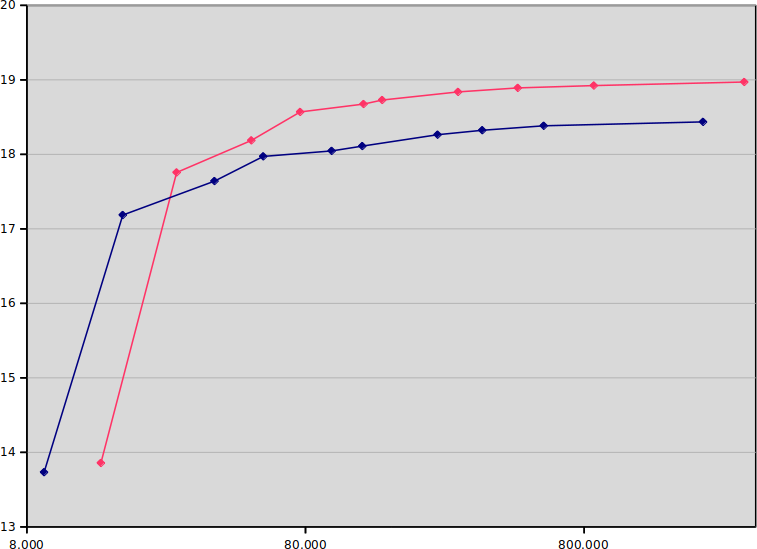
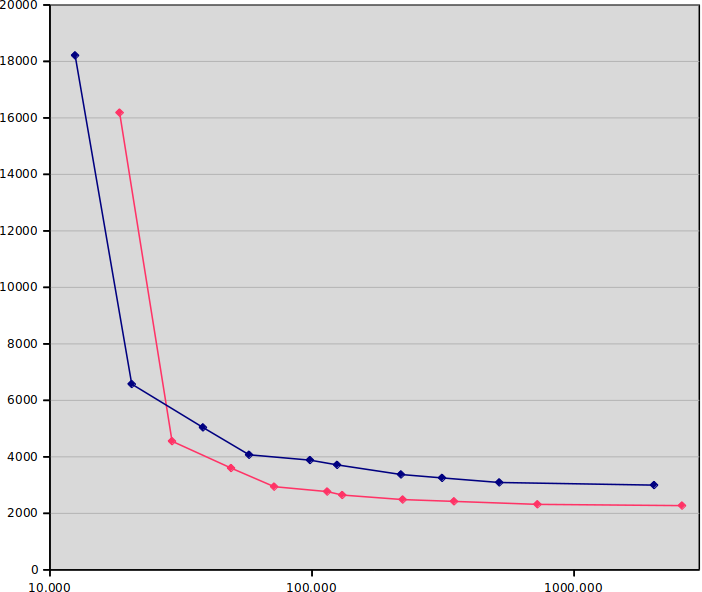
Following the post about 10-bit Y'CbCr earlier this week, I thought I'd make an actual test of 10-bit H.264 compression for live streaming. The basic question is; sure, it's better-per-bit, but it's also slower, so it is better-per-MHz? This is largely inspired by Ronald Bultje's post about streaming performance, where he largely showed that HEVC is currently useless for live streaming from software; unless you can encode at x264's veryslow preset (which, at 720p60, means basically rather simple content and 20 cores or so), the best x265 presets you can afford will give you worse quality than the best x264 presets you can afford. My results will maybe not be as scientific, but hopefully still enlightening. I used the same test clip as Ronald, namely a two-minute clip of Tears of Steel. Note that this is an 8-bit input, so we're not testing the effects of 10-bit input; it's just testing the increased internal precision in the codec. Since my focus is practical streaming, I ran the last version of x264 at four threads (a typical desktop machine), using one-pass encoding at 4000 kbit/sec. Nageru's speed control has 26 presets to choose from, which gives pretty smooth steps between neighboring ones, but I've been sticking to the ten standard x264 presets (ultrafast, superfast, veryfast, faster, fast, medium, slow, slower, veryslow, placebo). Here's the graph: The x-axis is seconds used for the encode (note the logarithmic scale; placebo takes 200 250 times as long as ultrafast). The y-axis is SSIM dB, so up and to the left is better. The blue line is 8-bit, and the red line is 10-bit. (I ran most encodes five times and averaged the results, but it doesn't really matter, due to the logarithmic scale.) The results are actually much stronger than I assumed; if you run on (8-bit) ultrafast or superfast, you should stay with 8-bit, but from there on, 10-bit is on the Pareto frontier. Actually, 10-bit veryfast (18.187 dB) is better than 8-bit medium (18.111 dB), while being four times as fast! But not all of us have a relation to dB quality, so I chose to also do a test that maybe is a bit more intuitive, centered around bitrate needed for constant quality. I locked quality to 18 dBm, ie., for each preset, I adjusted the bitrate until the SSIM showed 18.000 dB plus/minus 0.001 dB. (Note that this means faster presets get less of a speed advantage, because they need higher bitrate, which means more time spent entropy coding.) Then I measured the encoding time (again five times) and graphed the results: x-axis is again seconds, and y-axis is bitrate needed in kbit/sec, so lower and to the left is better. Blue is again 8-bit and red is again 10-bit. If the previous graph was enough to make me intrigued, this is enough to make me excited. In general, 10-bit gives 20-30% lower bitrate for the same quality and CPU usage! (Compare this with the supposed up to 50% benefits of HEVC over H.264, given infinite CPU usage.) The most dramatic example is when comparing the medium presets directly, where 10-bit runs at 2648 kbit/sec versus 3715 kbit/sec (29% lower bitrate!) and is only 5% slower. As one progresses towards the slower presets, the gap is somewhat narrowed (placebo is 27% slower and only 24% lower bitrate), but in the realistic middle range, the difference is quite marked. If you run 3 Mbit/sec at 10-bit, you get the quality of 4 Mbit/sec at 8-bit. So is 10-bit H.264 a no-brainer? Unfortunately, no; the client hardware support is nearly nil. Not even Skylake, which can do 10-bit HEVC encoding in hardware (and 10-bit VP9 decoding), can do 10-bit H.264 decoding in hardware. Worse still, mobile chipsets generally don't support it. There are rumors that iPhone 6s supports it, but these are unconfirmed; some Android chips support it, but most don't. I guess this explains a lot of the limited uptake; since it's in some ways a new codec, implementers are more keen to get the full benefits of HEVC instead (even though the licensing situation is really icky). The only ones I know that have really picked it up as a distribution format is the anime scene, and they're feeling quite specific pains due to unique content (large gradients giving pronounced banding in undithered 8-bit). So, 10-bit H.264: It's awesome, but you can't have it. Sorry :-)
25 February 2017

Jonas Meurer: debian lts report 2017.02

Debian LTS report for February 2017 February 2017 was my sixth month as a Debian LTS team member. I was allocated 5 hours and had 9,75 hours left over from January 2017. This makes a total of 14,75 hours. I spent all of them doing the following:

Stefano Zacchiroli: Software Freedom Conservancy matching

become a Conservancy supporter by February 28th and have your donation matched Non-profits that provide project support have proven themselves to be necessary for the success and advancement of individual projects and Free Software as a whole. The Free Software Foundation (founded in 1985) serves as a home to GNU projects and a canonical list of Free Software licenses. The Open Source Initiative came about in 1998, maintaining the Open Source Definition, based on the Debian Free Software Guidelines, with affiliate members including Debian, Mozilla, and the Wikimedia Foundation. Software in the Public Interest (SPI) was created in the late 90s largely to act as a fiscal sponsor for projects like Debian, enabling it to do things like accept donations and handle other financial transactions. More recently (2006), the Software Freedom Conservancy was formed. Among other activities like serving as a fiscal sponsor, infrastructure provider, and support organization for a number of free software projects including Git, Outreachy, and the Debian Copyright Aggregation Project they protect user freedom via copyleft compliance and GPL enforcement work. Without a willingness to act when licenses are violated, copyleft has no power. Through communication, collaboration, and only as last resort litigation, the Conservancy helps everyone who uses a freedom respecting license. The Conservancy has been aggressively fundraising in order to not just continue its current operations, but expand their work, staff, and efforts. They recently launched a donation matching campaign thanks to the generosity and dedication of an anonymous donor. Everyone who joins the Conservancy as a annual Supporter by February 28th will have their donation matched. A number of us are already supporters, and hope you will join us in supporting the world of an organization that supports us.

Martin Pitt: systemd 233 about to be released, please help testing

systemd 233 is scheduled to be released next week, and there is only a handful of small issues left. As usual there are tons of improvements and fixes, but the most intrusive one probably is another attempt to move from legacy cgroup v1 to a hybrid setup where the new unified (cgroup v2) hierarchy is mounted at /sys/fs/cgroup/unified/ and the legacy one stays at /sys/fs/cgroup/ as usual. This should provide an easier path for software like Docker or LXC to migrate to the unified hiearchy, but even that hybrid mode broke some bits. While systemd 233 will not make it into Debian stretch or Ubuntu zesty, as both are in feature freeze, it will soon be available in Debian experimental, and in the next Ubuntu release after 17.04 gets released. Thus now is another good time to give this some thorough testing! To help with this, please give the PPA with builds from upstream master a spin. In addition to the usual packages for Ubuntu 16.10 I also uploaded a build for Ubuntu zesty, and a build for Debian stretch (aka testing) which also works on Debian sid. You can use that URL as an apt source:
deb [trusted=yes] https://people.debian.org/~mpitt/tmp/systemd-master-20170225/ /
These packages pass our autopkgtests and I tested them manually too. LXC and LXD work fine, docker.io/runc needs a fix which I uploaded to Ubuntu zesty. (It s not yet available in Debian, sorry.) Please file reports about regressions on GitHub, but please also le me know about successes on my Google+ page so that we can get some idea about how many people tested this. Thank you, and happy booting!

24 February 2017

Gunnar Wolf: Started getting ads for ransomware. Coincidence?

Very strange. Verrrry strange. Yesterday I wrote a blog post on spam stuff that has been hitting my mailbox. Nothing too deep, just me scratching my head. Coincidentally (I guess/hope), I have been getting messages via my Bitlbee to one of my Jabber accounts, offering me ransomware services. I am reproducing it here, omitting of course everything I can recognize as their brand names related URLs (as I'm not going to promote the 3vi1-doers). I'm reproducing this whole as I'm sure the information will be interesting for some.
*BRAND* Ransomware - The Most Advanced and Customisable you've Ever Seen
Conquer your Independence with *BRAND* Ransomware Full Lifetime License!
* UNIQUE FEATURES
* NO DEPENDENCIES (.net or whatever)!!!
* Edit file Icon and UAC - Works on All Windows Versions
* Set Folders and Extensions to Encrypt, Deadline and Russian Roulette
* Edit the Text, speak with voice (multilang) and Colors for Ransom Window
* Enable/disable USB infect, network spread & file melt
* Set Process Name, sleep time, update ransom amount, Give mercy button
* Full-featured headquarter (for Windows) with unlimited builds, PDF reports, charts and maps, totally autonomous operation
* PHP Bridges instead of expensive C&C servers!
* Automatic Bitcoin payment detection (impossible to bypass/crack - we challege who says the contrary to prove what they say!)
* Totally/Mathematically IMPOSSIBLE to DECRYPT! Period.
* Award-Winning Five-Stars support and constant updates!
* We Have lot vouchs in *BRAND* Market, can check!
Watch the promo video: *URL*
Screenshots: *URL*
Website: *URL*
Price: $389
Promo: just $309 - 20% OFF! until 25th Feb 2017
Jabber: *JID*
I think I can comment on this with my students. Hopefully, this is interesting to others.
Now... I had never received Jabber-spam before. This message has been sent to me 14 times in the last 24 hours (all from different JIDs, all unknown to me). I hope this does not last forever :-/ Otherwise, I will have to learn more on how to configure Bitlbee to ignore contacts not known to me. Grrr...

Jonathan Dowland: OpenShift Java S2I

One of the products I have done some work on at Red Hat has recently been released to customers and there have been a few things written about it:

Ritesh Raj Sarraf: Shivratri

,

Categories:

Keywords:

Like:

Sven Hoexter: Tcl and https - back to TclCurl

Must be the irony of life that I was about to give up the TclCurl Debian package some time ago, and now I'm using it again for some very old and horrible web scraping code. The world moved on to https but the Tcl http package only supports unencrypted http. You can combine it with the tls package as explained in the Wiki, but that seems to be overly complicated compared to just loading the TclCurl binding and moving on with something like this:
package require TclCurl
# download to a variable
curl::transfer -url https://sven.stormbind.net -bodyvar page
# or store it in a file
curl::transfer -url https://sven.stormbind.net -file page.html
Now the remaining problem is that the code is unmaintained upstream and there is one codebase on bitbucket and one on github. While I fed patches to the bitbucket repo and thus based the Debian package on that repo, the github repo diverted in a different direction.

Next.

Previous.