Search Results: "ana"

9 May 2009

Andrew Pollock: [life] A few days in British Columbia

We got back from our brief visit to Canada last night. We had a great time, Vancouver and Victoria were both very nice. YVR (Vancouver Airport) This airport has to win the award for nicest airport I've seen. Clearly they pulled out all the stops in preparation for the Winter Olympics next year. The airport is very bright, airy and open. Before you even hit the immigration line, you pass through a couple of water features, some indigenous art, all of that jazz. Immigration is done in the open in a huge hall, instead of in the dark bowels of the airport, which was a pleasant change from the usual US airport immigration experience. (That said, Houston airport had a pretty nice immigration experience). Oh, and it was blanketed with free WiFi, which was a nice touch. Ferry to Victoria The brief geography lesson I got was that Victoria is on Vancouver Island, and Vancouver (the city) is not on Vancouver (the island). Go figure. Getting to Victoria from the airport via BC Ferries was a very seamless experience. You board a bus from the side of the airport terminal, and it drives to Tsawwassen, drives onto the ferry, and then you get off the bus and go sit on one of the passenger levels of the ferry. BC Ferries BC Ferries deserves special mention. The ferry itself is huge - 7 decks (three of them for vehicles). It's a veritable shopping mall on water. It's got some stores, buffets, exclusive $10 entry lounges, video arcades, cellular payphones, the works. The trip to Victoria The ferry ride took about 1.5 hours, and was very scenic. We passed by a few smaller islands, and I had an instant flashback to the TV show The Beachcombers that I used to watch as a kid, particularly the opening sequence. Victoria Victoria is a beautiful city. It's the capital of the province of British Columbia, and I likened it to Canberra in a lot of ways. It had more modern conveniences than a town with a population of its size would otherwise normally have. It was a government and university town. Nice houses, very green in general, and being an island, there was water everywhere. It seemed to have lots of bays, and harbours and rivers. It was very nice. Flight back to Vancouver We took a Harbour Air seaplane back to Vancouver on Sunday afternoon. That was fun. I've never been on a seaplane before. It took about 35 minutes. Vancouver First order of business in Vancouver was the purpose of the whole trip: renewing our visas. That went fine, I'll write a separate post about the process. Afterwards, we bought tickets for the Big Bus, and toured the city for the remainder of Monday and Tuesday. Drive to Whistler For Wednesday and Thursday, we hired a car, and went a bit further afield. On Wednesday, we drove up to Whistler to check it out. The drive up took about 5 hours, because we stopped at every scenic spot we came by. Waterfalls abounded. There was a lot of work being done on the roads between Vancouver and Whistler, upgrading them for the Olympics. Whistler itself was pretty spectacular. Some crazy looking ski runs. The village looked like Squaw Village on steroids. The drive back only took about 2 hours. Cleveland Dam, Lynn Canyon suspension bridge For the last day, we drove to Cleveland Dam, where there was a salmon hatchery, and checked out the dam, hatchery and surrounding area. It was lovely and green. After that, we drove to Lynn Canyon to check out the suspension bridge there (unlike the Capilano Suspension Bridge, which costs $26 a pop, the Lynn Canyon one is free). That was all we had time for really. The weather wasn't fantastic during our stay, but it didn't really prevent us from doing anything either. I'd have liked to have checked out Stanley Park if we had more time, and Sarah wanted to go to Grouse Mountain. We had a near-100% success rate at being picked as Australians, unlike when we're in the US, where more often than not, people ask us if we're British. Apparently this is mainly attributed to the fact that Australians run all of the ski lifts at Whistler. We certainly heard a lot of Australian accents while we were getting around. I'd also never seen such a saturation of Starbucks before. In Vancouver, there were literally Starbucks across the road from Starbucks, and around the corner from another one. Whistler village had two. The Canadian accent is cute. They really do tack "eh?" on the end of everything, although it's phonetically more like "ay?". "House" and "about" are also pronounced distinctively differently. Overall, Vancouver wasn't what I'd call bursting at the seams with tourist attractions, but seemed like a nice city. It was fairly flat. The beggars were well dressed. Everyone was very friendly. A lot of the taxis were Priuses. It seemed pretty clean. I could handle living there. Not sure how bad it gets in winter.

8 May 2009

Christoph Haas: Thanks for the great time, KDE

After years of being a dedicated KDE user it seems like it s finally time for me to go back to Gnome. I once tried KDE 4.x from the Debian experimental branch knowing that it s probably unstable and will require a lot of patience. But I was willing to report bugs and dive into new things. It didn t take long though to find out that graphics were extraordinarily slow with the new desktop effects . The worst was resizing a konsole (KDE terminal window). It took 25 seconds until the window was resized and redrawn! On the interweb I found KDE developers rant about NVidia who didn t support some special extension they needed. They suggested to get an ATI card instead. (No, thanks, I was struggling with the crappy radeon and fglrx drivers on my new work laptop and am sick of ATI for Xorg.) Or I could use a bare XTerm instead. Yeah, right. So I couldn t use the desktop effects. After all I used the non-free NVidia driver for years and it never let me down. I don t mind doing without eye candy. But the desktop effects were about the only serious way to switch between virtual desktops. Point the mouse into a corner or edge of the screen and get a zoom-out bird s view of the virtual desktops. Nice but quickly annoying. Besides you had to push the mouse pointer a few pixels into the edge (it s not sufficient to just hit the edge) which means that after 10 desktop switches I had to lift the mouse and set it back on the mousepad. Another annoying issue is that up to now I can t assign functionality to every key on my keyboard any more. I had a neat trick by having 3 3=9 virtual desktops and use my numpad keys 1 to 9 to page through them. 0 on the numpad opened a new shell window. + on the numpad maximized a window. But now I couldn t assign any of those numpad keys. I pressed the 1 but KDE didn t detect Numpad_1 but just 1 . Guess how useful it is to not be able to type the 1 any more. There is a low-priority bug report for KDE from users who want this fixed but it will likely not happen any time soon. So the only way to switch desktops was to poke on the tiny pager widget in my panel. Yuk. Not to mention that I couldn t put icons on the desktop any longer. There was just a sissy widget that I could use for that purpose but it didn t work like a conqueror or dolphin at all. It was pretty amusing when in KDE 4.2 there was suddenly a feature to re-enable the old behavior. Let me guess, KDE developers - I wasn t the only user you couldn t persuade of the new paradigm? Next evil thing was performance. KDE 4 takes ages to load. Simple window managers get me started within seconds. Even Gnome. But KDE takes 30 seconds until it s loaded plus some disk grinding in the background. And memory usage wasn t nice either. And what finally made me mad was stabilty - or rather lack thereof. Everytime the screen saver ran my kbluetooth module crashed. kmail crashed even more frequently than before. (I loved kmail for it s great customizability and feature set.) plasma (the actual window manager) died at least twice a day. Suddenly the panels were looking ugly or crashing. As a Debian developer I have to follow the unstable branch on my workstation. And there is no distinction between KDE 3 and KDE 4 any more so a dist-uprade inevitably gets all of my applications upgraded to KDE 4 (plus an hour of manual engineering in aptitude because half of my applications weren t upgraded automatically due to different application names and I had a mixed environment). So there I was with KDE 4.2. I really worked with it for a month. I tried hard to get acquainted to its bloatedness and instability. It s really a nice technological preview of what might be possible in the future. Everything is really automatic. Mounting external media. New ways to find programs (although I m not happy with the new K start menu). Funny effects and nice eye candy. But it s far from the rock solid desktop environment that I was used from KDE 3.5.8. So there I am on Gnome now. I was switching back and forth. One day working on KDE 4.2 and the other day using Gnome 2.26. And although it makes me feel sad I think it s finally time to say goodbye to KDE 4. I have invested a good amount of time and energy into it - even just from a user perspective. But it s not ready. And I finally need to get some work done. A number of projects suffered from my playfulness (my ispmail tutorial, screenshots.debian.net, debexpo, my kids) and it s time to get back to work. And Gnome was pretty surprising. With compiz I have the KDE desktop effects working (here they really do) and they are all customizable. I can assign keys properly again (even the numpad). Everything is pretty fast and stable. I have replaced kmail and its buggy shared calendar feature by Icedove (aka Thunderbird) with the Lightning plugin. Worked from the first minute and hasn t crashed in a week (just have to remember next time to install libstdc++5 to be able to use Lightning). With enigmail I finally have a proper simple working PGP key management that doesn t die and is buggy like hell like in kgpg. And there s the nice Nostalgy add-on that allows me to file emails into IMAP folder quickly again - a feature that just kmail seemed to support so far. Oh, and I see new mail instantly because Icedove supports the IDLE command while kmail has never learned that neat little trick. The Gnome file manager isn t really great for my taste but it s doing its job (dolphin is just much nicer). It s not as nice as KDE but I had to learn that working and stable weighs more than nice. The hard way. And many things I liked about KDE 4 (like starting a new program with Alt-F2 and having a smart application finder and simple calculator in one) are built into Gnome, too. So why bother. Thanks, KDE, for the years of fun and service. I ll surely miss you. Get back to me should you grow up one day.

Antti-Juhani Kaijanaho: Star Trek

It is curious to see that the eleventh movie in a series is the first to bear the series name with no adornment. It is apt, however: Star Trek is a clear attempt at rebooting the universe and basically forgetting most of the decades-heavy baggage. It seems to me that the reboot was fairly well done, too. The movie opens with the birth of James Tiberius Kirk, and follows his development into the Captain of the Enterprise. Along the way, we also see the growth of Spock from adolescence into Kirk s trusted sidekick and also into well. Despite the fact that the action plot macguffins are time travel and planet-killer weaponry, it is mainly a story of personal vengeance, personal tragedy, and personal growth. Curiously enough, although Kirk gets a lot of screen time, it is really the personal story of Spock. Besides Kirk and Spock, we also get to meet reimagined versions of Uhura (I like!), McCoy, Sulu, Chekov and Scott. And Christopher Pike, the first Captain of the Enterprise. The appearance of Leonard Nimoy as the pre-reboot Spock merits a special mention and a special thanks. I overheard someone say in the theatre, after the movie ended, that the movie was a ripoff and had nothing to do with anything that had gone before. I respectfully disagree. The old Star Trek continuum had been weighed down by all the history into being a 600-pound elderly man who is unable to leave the couch on his own. This movie provided a clearn reboot, ripping out most of the baggage, retaining the essence of classic Star Trek and giving a healthy, new platform for good new stories. One just hopes Paramount is wise enough not to foul it up again. It was worth it, I thought.

Eddy Petrișor: I bought a folding bicycle

For some time I've been pondering about buying a bicycle since it seems my weight has been increasing lately up to about 90 kg, which, for my height and age, is about 20 kilograms too much.

But since I am living in a rented apartment, storing the bicycle was a problem, until I realized I could buy a folding bicycle. When that idea hit me, I literally couldn't sleep until about 6 am and I searched the internet about the options, issues to expect, things to check.

In the end I found a Dahon Mu P8 bicycle someone was selling on a bidding site and, after seeing it I concluded that was in mint shape, so there was no reason not to buy it since the price was half of a new one, while this one was only a year old.

I bought the bike yesterday and rode it to work from the place where I met the person who sold it to me and it was quite an enjoyable experience. I still have to do some minor adjustments (saddle is a little bit loose and folding could be better if the handle bar was in another position) before I can ride it regularly to work, but that's just, well, a minor problem :-P.


Now I have a way to do regular exercise without feeling is a drag, so I expect to lose some weight soon after I start riding it to work regularly :-) . Maybe I'll manage to lose about 5 kilos until DebConf, which would be great.

7 May 2009

Jaldhar Vyas: Shaka, When the Firewall Fell

Debra and Ian at Tanagra. The Source. The Source at Yahoo. Jaldhar and the Source at Tanagra. Torvalds under two moons, his sky is grey. Git, his arms wide. Jaldhar of Tanagra, Git of Torvalds, at Lungha. Jaldhar and Git in court. The court of silence. Jaldhar, his eyes closed. #debian-devel, its arms wide, its thighs fat. Jaldhar, his eyes open! The Source in Git, its sails unfurled. Update: From Barak A. Pearlmutter who doesn't have a blog.
JOIN US, AS GNULIB HAS.
THERE IS NOTHING TO FEAR.
SUSPEND YOUR DOUBTS.
SUBMIT TO THE GIT.OR.CZ SUPERIORITY.
YOUR REPOSITORY WILL BE CONVERTED.
COMPLEXITY IS BLISS.
ALL CODE WILL BE REPLICATED.
ALL BRANCHES SERVE THE CONSENSUALITY.
YOUR INDIVIDUALITY WILL BE A
TREASURED ASSET OF THE GITHUB.

6 May 2009

Biella Coleman: The Year s Work in Lebowski Studies

Our beloved dude is now the subject/object of academic study. I hope the essays are playful or else they just won t cut it.

5 May 2009

Jan Hauke Rahm: Avelsieve 1.9.8

Today the SquirrelMail plugin avelsieve happened to be released with version 1.9.8. Thanks and kudos to Alexandros who after so long time still was in the mood to put things together. The new features promise to be amazing: a new user interface, much code rewriting, and an entirely new SPAM handling. Unfortunately after installing it my SquirrelMail installation went badly down somehow. While everything alse is delivered properly by apache2, SquirrelMail now runs into one timeout after another. I need to figure out what s actually going on there. The error.log is quiet so far Anyways, for all you people who are looking forward to see this new fancy and shiny version in sid, I have to ask for patience. I think the package is ready but before testing no uploading! Until then you can (if you re brave) test the package by installing it from http://downloads.jhr-online.de/avelsieve_1.9.8-1_all.deb And all you others just have a look at the changelog that s probably (hopefully) hitting sid in a few days:
  * New upstream release
     + A large part of the code has been rewritten.
     + A new-style SPAM rule has been implemented.
     + A new, global Whitelist rule has been implemented, for
       the SPAM rules to take advantage of.
     + New, "Custom Sieve Code" rule has been implemented; this allows users
       to enter directly Sieve code snippets as a rule. (experimental)
     + Miscellaneous code movement and restructuring.
     + UI: The "Add New Rule" buttons are now links, and are displayed
       both at the top and at the bottom of the rule table.
     + UI: Major rework in the UI of both the Rules Table and the Add New
       Rule / Edit Rule pages.
     + UI: If a vacation rule is active, then display a notice in the
       rules table page and upon logging in to Squirrelmail, that reminds
       the user.
     + UI: Vacation options have been aligned properly; text has been
       changed accordingly.
     + Sieve: Vacation Subject is now supported.
     + New functionality: "Insert New Rule Here"
     + New functionality: "Move Rule to Position" (requires Javascript)
     + Avelsieve now highly recommends the use of javascript_libs plugin
       for some visual effects / UI improvements.
     + UI: Added new icons and used different ones, to improve usability.
       Icons are provided by Mark James' famfamfam.com.
     + UI: Added new icon "theme" based also on famfamfam.com. This theme
       is the default from now on.
     + UI: Removed unnecessary text / clutter from rules table page.
     + UI: The notify action options have been aligned in a table.
     + Added an LDAP Sieve storage backend, compatible with Sun Messaging
       Server's Sieve features.
     + The DO_Sieve_* backends should have a separate retrieve() method
       for retrieving the raw Sieve script. Currently, only the Managesieve
       backend has it.

Michal Čihař: Going native IPv6

I finally managed to ask my hosting provider for a IPv6 addresses and it went surprisingly smoothly. So since today, all what is running on my server (for example Wammu website or phpMyAdmin wiki and demo) should be accessible natively over IPv6. And thanks to Sixxs guys for providing tunnel which I've been using up to now.

Bastian Venthur: LinuxTag 2009

Nion just reminded me of this year s LinuxTag. Although I certainly won t have the time to help at the booth every day as in the last years, I hope I can manage to work there at least for one or two days. If you want to help at our booth (you don t have to be a Debian Developer), join us! It s fun and a great way to get in touch with other like minded people and your help is really appreciated.

Andrew Pollock: [tech] Analog cable's days numbered?

Apparently Comcast is planning on axing its analog cables at some undetermined point in the future. That will make my MythTV setup more complicated, and no doubt require a more expensive cable plan and yet more equipment. My setup is already a tad ridiculous.

4 May 2009

Manoj Srivastava: Manoj: Reflections on streetcars

Recently, I have made fairly major changes to kernel-package, and there were some reports that I had managed to mess up cross compilation. And, not having a cross-compilation tool chain handy, I had to depend on the kindness of strangers to address that issue. And, given that I am much less personable than Ms Vivien Leigh, this is not something I particularly look forward to repeating. At the onset, building a cross compiling tool chain seems a daunting task. This is not an activity one does frequently, and so one may be pardoned for being non-plussed by this. However, I have done this before, the most recent effort being creating one to compile rockbox binaries, so I had some idea where to start. Of course, since it is usually years between attempts to create cross-compiling tool chains, I generally forget how it is all done, and have to go hunting for details. Thank god for google. Well, I am not the only one in the same pickle, apparently, for there are gobs of articles and HOWTOs out there, including some pretty comprehensive (and intimidating) general tool sets to designed to create cross compilers in the most generic fashion possible. Using them was not really an option, since I would forget how to drive them in a few months, and have a miniature version of the current problem again. Also, you know, I don t feel comfortable using scripts that are too complex for me to understand I mean, without understanding, how can there be trust? Also, this time around, I could not decide whether to cross compile for arm-elf, as I did the last time, or for the newfangled armel target. A need for quickly changing the target for the cross compiler build mechanism would be nice. Manually building the tool chain makes a wrong decision here expensive, and I hate that. I am also getting fed up with having to root around on the internet every time I wanted to build a cross compiler. I came across a script by Uwe Hermann, which started me down the path of creating a script, with a help option, to store the instructions, without trying to be too general and thus getting overly complex. However, Uwe s script hard coded too many things like version numbers and upstream source locations, and I know I would rapidly find updating the script irritating. Using Debian source packages would fix both of these issues. I also wanted to use Debian sources as far as I could, to ensure that my cross compiler was as compatible as I could make it, though I did want to use newlib (I don t know why, except that I can, and the docs sound cool). And of course the script should have a help option and do proper command line parsing, so that editing the script would be unnecessary. Anyway, all this effort culminated in the following script: build cross toolchain, surprisingly compact. So I am now all set to try and cross compile a kernel the next time a kernel-package bug comes around. I thought that I would share this with the lazy web, while I was at it. Enjoy. The next thing, of course, is to get my script to create a qemu base image every week so I can move from user mode Linux to the much more nifty kvm, which is what all the cool kids use. And then I can even create an arm virtual machine to test my kernels with, something that user mode linux can t easily do.

2 May 2009

Antti-Juhani Kaijanaho: dpkg tip

If your dpkg runs seem to take a long time in the reading database step, try this: Step One: Clear the available file dpkg --clear-avail Step Two: Forget old unavailable packages dpkg --forget-old-unavail Step Three: If you use grep-available or other tools that rely on a useful available file, update the available file using sync-available (in the dctrl-tools package). The few times I ve tried it (all situations where the reading database step seemed to take ages), it has always sped the process up dramatically. There probably are situations where it won t make much difference, but I haven t run into them.

1 May 2009

Simon McVittie: Implementing D-Bus clients with telepathy-glib (and telepathy-qt4)

(The much-delayed part 2 in an ongoing series: shiny things in telepathy-glib) Over a year ago I explained my first major round of work on telepathy-glib, with which it could be used to implement D-Bus services. I started to write this post shortly after, but then got distracted by a bee or something; recent discussion about having a D-Bus binding in GLib has finally prompted me to finish it. The second major round of work on telepathy-glib dealt with implementing client code, and went sufficiently well that telepathy-qt4 (currently under development) uses essentially the same model. Again, while telepathy-glib is intended for Telepathy implementors, I think TpProxy's ideas are generically useful, particularly for "large" D-Bus APIs.
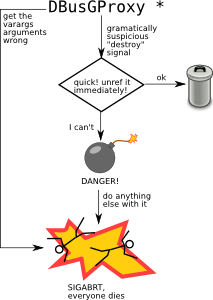
Some background: dbus-glib and libtelepathy
GObject-CRITICAL: Assertion failed: proxy->convenient
The life-cycle of a DBusGProxy (PD clipart credit: karderio and Andy)
The API provided by dbus-glib for client code is, er, rather less than ideal. The basic object is DBusGProxy, which has a few problems. There's one per interface, rather than one per object; this leads to a maze of twisty GObjects, all suspiciously similar. Our old client library, libtelepathy, got round this by subclassing DBusGProxy to make helper objects called TpChan, TpConn etc., which were simultaneously the proxy for the "main" interface (Channel, Connection etc.), and a factory for proxies for the other interfaces (like Channel.Type.Text and Channel.Interface.Password). This still wasn't ideal, but it was a start. If you use a DBusGProxy in any way after it has emitted the destroy signal, this is considered to be invalid use of the API, and dbus-glib asserts all over the place. We'd rather it didn't do that - remote objects becoming invalid is a fact of life, and if you don't immediately discard all your references to those objects, remote operations on them should just give you a runtime error. You have to be prepared to handle such runtime errors already, because any IPC call can fail at any time. The main API for calling methods uses varargs and is rather subtle. Notably, the calling convention for variant parameters (of D-Bus signature 'v') is not consistent with the calling convention for any other container. For any other container, for instance a GPtrArray *, you pass in a GPtrArray ** pointing to a GPtrArray * variable containing NULL; on success, a pointer to a new GPtrArray is written into that variable. For variant parameters, though, you must pass in a GValue * pointing to a zero-filled GValue, and the result will be written into that GValue. dbus-binding-tool generates thin wrappers around this method-calling API which provide type-safety, although they can't directly specify a non-default timeout. As for signals, before binding to a signal, you have to tell dbus-glib about its signature. This tells dbus-glib how it should push the signal arguments onto the C stack (in GObject terminology: how it should marshal them), to match the signature of the signal-handler function. The documentation claims that this isn't necessary for objects supporting the Introspect method, but that's untrue - on the other hand, if the documented behaviour actually happened, I would consider this to be a critical bug in dbus-glib, since it would enable remote objects to crash dbus-glib clients (by causing signal arguments to be pushed onto the stack in a way that does not match the signature of the signal handler). Of course, the signal-adding function takes varargs, and has to be called exactly once per signal per object. If you don't, dbus-glib asserts when you connect to the signal; if you call it twice, dbus-glib asserts anyway.

TpProxy TpProxy is a GObject subclass vaguely inspired by Python's dbus.proxy.ProxyObject. It isn't a subclass of DBusGProxy, which lets us encapsulate dbus-glib almost completely - in fact, all the references to DBusGProxy are in a separate header, proxy-subclass.h, only used by subclasses of TpProxy (as opposed to normal library API users). TpProxy instances are per-remote-object (per-object-path) like in dbus-python, rather than per-interface like in dbus-glib or QtDBus. As explained below, I believe that this is the most natural object mapping for D-Bus interfaces; in practice it tends to lead to clearer code for us, since one remote object often maps nicely to one UI element (of course, if your objects only have one interface, this approach is no better or worse than dbus-glib's). TpProxy provides support for the following common D-Bus things:
  • Calling methods
  • Connecting to signals
  • Objects becoming invalid
  • Objects with optional interfaces
  • Extensibility
It doesn't currently provide any particular help with Properties - the Properties interface is just another interface as far as we're concerned. We find that, in practice, that's not a problem (even though we use D-Bus properties extensively). In telepathy-qt4 we basically reinvented TpProxy in C++, as Tp::DBusProxy. I've put in some comments below illustrating how the general ideas we used in TpProxy translate into a different object mapping.

Calling methods Method calls on TpProxy are done through auto-generated wrapper functions, much like DBusGProxy. These look something like this:
typedef void (*tp_cli_channel_callback_for_close) (TpChannel *proxy,
    /* any 'out' arguments would go here - Close() doesn't have any */
    const GError *error, gpointer user_data,
    GObject *weak_object);
TpProxyPendingCall *tp_cli_channel_call_close (TpChannel *proxy,
    gint timeout_ms,
    /* any 'in' arguments would go here - Close() doesn't have any */
    tp_cli_channel_callback_for_close callback,
    gpointer user_data,
    GDestroyNotify destroy,
    GObject *weak_object);
Methods for some interfaces, like DBus.Properties, are available on TpProxy itself; others, like Telepathy's Channel.anything, are only available on a particular subclass, like TpChannel. Things to note here:
  • It's an asynchronous call with a callback. General design principle: "this is IPC, get over it". We don't try to hide the fact that IPC is taking place by doing pseudo-blocking calls.
  • The timeout is explicit (although you can always pass -1 to let libdbus pick a "reasonable" default for you). This is because the remote service might not respond, and API users should be at least vaguely aware of this: "this is IPC, get over it".
  • The callback isn't a GCallback; it has an explicit signature, for some semblance of type-safety (it's not much, but it's better than nothing).
  • The callback takes a GError, because any IPC call can fail for any reason.
  • A TpProxyPendingCall * is returned. This is a pointer to an object that only exists until just after the callback is called (so you can ignore it if you don't want it), with a method you can call to cancel the method call (with hindsight this is not ideal, and if I was writing this API now, I'd use gio's GCancellable). "Cancel" is perhaps slightly misleading: the method call still takes place (it was already in libdbus's outgoing queue) but the result gets ignored and the callback isn't called. This is mostly so you an object can forget all the calls it was busy making at the time that the results become irrelevant (e.g. the object is destroyed).
  • There is an extra weak_object argument, which is weakly referenced and is passed to the callback: in practice, most users of telepathy-glib use this as well as or instead of user_data. If the weak_object runs out of references, the callback is automatically cancelled, which means that in practice, explicit cancellation is almost never needed.
  • The generated code has as its first argument a suitable subclass of TpProxy, in this case TpChannel (we tell the code generator about subclasses).
  • You can't see it in the API, but the TpProxy gains an extra ref while a method call is in progress, so you never have to worry about what happens if the proxy gets unreffed during a method call.
  • There's an explicit destructor for the user_data, which is called even if you "cancel" the method call.
In telepathy-qt4, these methods are on small generated helper classes similar to dbus-python's dbus.Interface, one per interface (we provide accessors for them on the non-generated DBusProxy subclass). Instead of using callbacks, we return a temporary QObject per call, which emits a Qt signal on success or failure (that's how all async calls in QtDBus work).

Connecting to signals Similarly, signals have some generated functions:
typedef void (*tp_cli_channel_signal_callback_closed) (TpChannel *proxy,
    /* any arguments would go here - Closed doesn't have any */
    gpointer user_data, GObject *weak_object);
TpProxySignalConnection *tp_cli_channel_connect_to_closed (TpChannel *proxy,
    tp_cli_channel_signal_callback_closed callback,
    gpointer user_data,
    GDestroyNotify destroy,
    GObject *weak_object,
    GError **error);
API notes for these:
  • The callback doesn't take a GError any more, because signals can't fail; the weak_object and the user_data are the same as for method calls
  • This isn't actually a GObject signal at all: those aren't particularly typesafe, and lack namespacing. This might not be very binding-friendly, we haven't tried doing that yet... it might be worth introducing a signal with details, like in dbus-glib, for which these functions are "C bindings".
  • The returned TpProxySignalConnection lets you disconnect from the signal, just like the TpProxyPendingCall above; it can safely be ignored
  • Similarly, if the weak_object dies, then the signal automatically disconnects
  • It is possible for connecting to a signal to fail: this happens if the proxy doesn't actually have the requested interface. If this happens, it's graceful, not a crash. In practice, the flow of code is almost always such that error can safely be NULL because the interfaces are already known.
In telepathy-qt4 the per-interface generated helper classes emit Qt signals. In many cases, we end up proxying these signals by responding to them in the hand-written Tp::DBusProxy subclass by emitting a different signal, in order to give them a nicer representation.

Becoming invalid This is IPC, and any error can happen to you at any time. We found that it was useful to have a general concept of "this object is no longer useful", so we introduced the concept of an object becoming invalidated. The invalidation reason is stored on the object as a GError. If this GError is NULL (as it is initially), then the object is still expected to be valid; if it's non-NULL, the remote object has vanished and the local proxy no longer works. There are several ways a TpProxy can become invalid:
  • its bus name falls off the bus (the process exited or crashed)
  • application-specific reasons (usually triggered by a D-Bus signal in a subclass, like the Telepathy Channel's Closed signal)
  • the GObject gets disposed
Method calls on an invalidated object always fail, with the invalidation reason as the error. This means that calling a method on a TpProxy should never crash your process. The method's callback has to be prepared to handle an error in any case, because this is Sparta^WIPC, so there's no loss in giving it another error. Connecting to signals on an invalidated object always fails, and any existing signal connections are disconnected when it becomes invalidated. This means that if a new remote object appears, and it happens to have the same object path, bus name etc. as the old one, you won't get its signals. A TpProxy can either be bound to a unique bus name or a well-known bus name. In the equivalent code in telepathy-qt4, we call this "stateful" or "stateless" - these names don't capture the intention perfectly, but they're the best we could come up with. A proxy for a stateful API like Telepathy's Channel should always bind to a unique name - when the unique name falls off the bus, the TpProxy becomes invalidated automatically, representing the fact that the Channel you had no longer exists, and nothing can be a perfect replacement for it (the VoIP call has already been terminated, you've already left the chatroom, or whatever - if you make another Channel, that's e.g. a distinct VoIP call). A proxy for a stateless API like Telepathy's ConnectionManager, where an exiting process can disappear, be service-activated again, and still have exactly the same API, should bind to the well-known name. Proxies for well-known names aren't invalidated when the process exits. Qt doesn't have a natural equivalent for GError, so the invalidation reasons in telepathy-qt4 are just a pair of strings, the namespaced name and the message - basically a libdbus DBusError. The principle is the same, though.

Optional interfaces As mentioned above, TpProxy instances are per-remote-object (per-object-path) like in dbus-python, rather than per-interface like in dbus-glib or QtDBus. I believe that this is the most natural object mapping for the D-Bus object model, because the D-Bus interfaces on a remote object can behave like any of these:
  • classes and subclasses (Telepathy.Channel.Type.Text is a Telepathy.Channel)
  • shared interfaces (some Telepathy.Channel objects, of many Types, implement Telepathy.Channel.Interface.Group; any D-Bus object can implement DBus.Properties)
  • optional features (some Telepathy.Channel.Type.Text objects implement Telepathy.Channel.Interface.ChatStates, some do not)
  • discoverable extensions (some Telepathy.Channel.Type.Text objects implement Telepathy.Channel.Interface.Messages, which is more or less Text 2.0)
The way in which interfaces are discovered is also variable. The "classic" D-Bus way to discover interfaces would be to call Introspect. Telepathy services still support that style of introspection, but we don't use it for anything beyond d-feet:
  • Introspect returns a blob of XML, which you have to parse into something useful; if it was in a D-Bus data structure, you'd already have some sensible data structure.
  • Finding out more information about the supported interfaces than their names isn't very useful: in a static language like C you already need to know the methods, signals, properties and their signatures in order to write and compile your code, and in a dynamic language like Python consumers of Introspect end up being remotely crashable by services with unexpected method signatures (this is one of dbus-python's big mistakes in my opinion).
  • If a method that you want to call turns out to be missing, the worst that can happen (in a competently written service) is that it fails with a D-Bus error - and you have to handle D-Bus errors anyway, because this is IPC and anything could fail.
  • Static bindings like dbus-glib have poor support for removing interfaces for which C code exists at runtime, whereas Telepathy needs features like an IM connection that might or might not support avatars (we don't get to find out until we've successfully connected to the server).
Instead, our older interfaces have a method on the "base class" (Channel, Connection etc.) called GetInterfaces, which just returns an array of strings. Newer interfaces (like Account), and older interfaces that have been ported (like Channel), have a property called Interfaces which is, again, an array of strings - this lets us combine the download of the interfaces list with downloading other basic information in a GetAll call. To cater for all these ways to use interfaces, the TpProxy base class has very basic support for interface discovery - you can ask it whether it supports an interface, and you can tell it that it does, in fact, support an interface. Asking which interfaces are supported is directly useful for library users; it's also used as a check by the generated method-call and signal-connection stubs, which return a canned error (Telepathy.Error.NotImplemented in Telepathy's case) if the object isn't known to have the interface. Telling TpProxy that it does support an interface is intended for use by subclasses, and might have been protected if we were writing C++: what happens in practice is that a concrete subclass like TpChannel knows how to discover the fully supported interfaces for this particular object, does so, and calls methods on the TpProxy to tell it which interfaces can work.

Extensibility The API stubs used by TpProxy to call methods and bind to signals are generated from XML documents containing an augmented form of D-Bus introspection data. These XML documents contain various Telepathy-specific extensions, but none of the extensions are language-specific - telepathy-glib, telepathy-python and telepathy-qt4 all operate from exactly the same XML specification. telepathy-qt4's different object-mapping did require us to tighten up some rules that were previously only conventions, but even so, the format is the same. I think this is vitally important - it just doesn't scale to have one set of language-specific annotations in a D-Bus API for each language that will have bindings. One thing that we make heavy use of is what I call "Ugly_Case", which is camel-case with underscores at word boundaries. This gives us a simple, unambiguous and foolproof rule to use in code generators whenever we generate any of the popular conventions for identifiers:
  • CamelCase: delete underscores
  • javaCamelCase: force everything before the first underscore to lower case, then delete underscores
  • lower_case: force everything to lower case, retain underscores
  • UPPER_CASE: force everything to upper case, retain underscores
dbus-glib, by contrast, applies a complex and subtly buggy algorithm to the CamelCase D-Bus names, which results in our SendDTMF method being mapped into GLib as send_dt_mf, and requires that telepathy-glib's Python reimplementation of dbus-binding-tool uses a bug-for-bug compatible implementation (we ended up reimplementing dbus-binding-tool in order to generate the TpProxy-based bindings). Our code generation tools are still rather ad-hoc, because so is our spec format, but for draft interfaces it's possible to copy them into individual projects and use them to generate additional methods for TpProxy or any subclass. This is how we implement unfinished APIs like geolocation in Empathy, for instance. The Interfaces or GetInterfaces hook described above is entirely usable for these extension interfaces, and in fact that's how they're set up. In telepathy-qt4, the generated method stubs are genuine C++ methods, so we can't just append methods to an existing class: this is why we have one helper class per interface, so individual clients can generate a helper class for their particular version of an unfinished API, and instantiate an object of this class attached to a particular Tp::DBusProxy. When an interface becomes stable, it can be added to the set of interfaces for which code is generated in telepathy-glib or telepathy-qt4, at which point any client or service that was already using the final draft of that interface can easily be ported to the library version using sed (the API remains the same).

Becoming ready The concept of being "ready" does not directly exist in TpProxy, but is implemented in TpChannel, TpConnection and TpConnectionManager. The idea is that a freshly created proxy object isn't really fully usable yet - you have to connect to basic signals and recover the initial state of the remote object, as well as checking which extension interfaces are supported. In many well-designed D-Bus APIs you can do this initial setup with a few signal connections and a DBus.Properties.GetAll call. After doing that initial setup (which has to be done asynchronously, because it's IPC), the TpProxy subclass has a local cache of the remote object's state (not necessarily in the same format as the representation on the bus), which can be accessed synchronously at any time, and will be updated in response to change-notification signals. TpChannel and subclasses like it have explicit support for checking for readiness, and having a callback called when the object is ready or invalidated (whichever happens first). The "ready" property also supports the GObject notify signal. telepathy-qt4 took this concept and ran with it - there is library support for objects that can become ready, including a mixin. If I had as much time to work on telepathy-glib as I wish I had, this would be one of the first telepathy-qt4 features to be added to telepathy-glib.

Features becoming ready Going beyond that, in an extensible framework like Telepathy it's probable that not every client understands (or wants to understand) every feature of every object, so it's highly inefficient for every proxy object to subscribe to all the change notification signals and cache all the remote state on the off-chance that the library user wants them. In the API for TpContact (which is not actually a TpProxy for various reasons) we introduced the concept of optional features; telepathy-qt4 extended this idea throughout the library. The idea is that each library user knows which of the optional features are "interesting" to it, and makes a single asynchronous call (which expands into a series of D-Bus calls inside the library) to download the state for core functionality plus all of the selected features, and subscribe to change notification for all of those. This is another telepathy-qt4 thing that telepathy-glib still needs to catch up with; until someone works out how to make the clone() syscall apply to programmers, I fear all libraries are doomed to lag behind how their designers want them to look :-) (license: CC-BY-3.0 / LGPL-2.1+)

Lior Kaplan: OpenOffice.org 3.1 New Features


Openoffice.org 3.1 release was postponed to may 7th. Meanwhile, you can check the new features list (some features already covered by oooninja). I already blogged about the RTL issues fix in 3.1, but the next thing I m waiting for the most are the calc performance improvements. I m also looking forward for future changes related to this issue (see OpenOffice.org performance improvements at oooninja). Posted in Openoffice.org Tagged: openoffice

Lucas Nussbaum: Simple CMS for a simple website ?

Dear readers, I m looking for a simple CMS, that would be usable by a non-programmer to write a simple website with less than 10 pages, not updated too frequently. Requirements:

- maintained/supported, but won t force me to upgrade for security reasons every month
- good wysiwyg editor (including positioning of images). Wiki-like markup is not an option.
- easy to learn, easy to use.
- doesn t look like a CMS or a blog for the visitors.
- usable by a non-programmer. Please suggest something that your parents would be able to use :-) Bonus points if:
- documentation available in french
- available as a Debian package
- doesn t expose many complex about publication workflow, user management, etc So, suggestions ?

Russ Allbery: Dreamwidth

For those who haven't heard, Dreamwidth is a new journal hosting site using the LiveJournal code base (with improvements) but a different business model and general attitude towards their community. They're trying to be much more transparent and open about everything they're doing, they're trying to run the business so that it's focused on building a community than making a profit, and they're trying to do much better at being an active open source project than LiveJournal has managed. They also run all of their servers on Ubuntu, so they feel like part of the broader Debian community. I haven't had a lot of time to help, but I think their ideals look great and I really would like to see them succeed. Dreamwidth just launched open beta, which means you can purchase a paid account but they're using an invite code model for free accounts. Since they just launched, I have invite codes. I think one of the things that will make Dreamwidth successful is to have a broad-based community, and I'd also like to see Debian and Ubuntu folks involved in their community, in a position to help with improvements to infrastructure packages they use, and help with the open source development of the underlying code base. I've therefore got a few invite codes reserved for Debian and Ubuntu folks on basically a first-come, first-served basis. If you're active in Debian or Ubuntu, want to try Dreamwidth, and think there's a chance you'd actively use it, send me e-mail and I'll send you an invite. For more information about Dreamwidth, see their wiki.

30 April 2009

Biella Coleman: On Chasing Plastic

Anyone who knew me prior to 2000, knew me as a fanatic Ultimate Frisbee player. I was (mostly) all about chasing a plastic disc on lush green fields. Ultimate Frisbee, which took my attention and soul my first year of college, commanded my attention, time, and body for years. The New York Times just ran a nice short piece piece about Ultimate Frisbee, which apparently has skyrocketed in popularity since 2003. One section of the article caught my attention:
It may be a non-contact sport according to its rules, but Ultimate is hardly free of injuries. The quick cutting and sprinting have made anterior cruciate ligament tears among women players especially common. JOY CHEN, a 33-year-old software developer in Alameda, Calif., considers herself lucky that herniated disks, a rotator cuff tear and ankle sprains have been the extent of her Ultimate injuries. We hit each other and the ground pretty hard, said Ms. Chen, who discovered Ultimate in college after years as a soccer and tennis player. She played with Stanford University s Superfly, which went on a three-year run as undefeated women s national collegiate champions.
Injury goes with the sport as hand and glove and young players tend to wear these injuries as a badge of pride. As much as I adore the sport and there are days I get pretty bummed that I no longer play I think that the UPA and older players should seriously skool the younger generation on the danger of injuries. It is an extreme sport that requires extreme care. Tournaments are usually composed of 4-7 games over the course of 2 days. If that is not demanding enough, the body gets pretty intimate with the the ground while laying out and then there are there all those sprained ankles and broken bones and ligaments from collisions. Today I suffer from bouts of knarly neck pain, for example, which is due in part from playing without taking proper precautions. One of my best friends, who was a stellar player in college, also suffers from pretty devastating back pain. It is an extreme sport that requires extreme care. I say toss out the pride in pain/injuries and in place, instill a healthy sense of fear of the injuries so that people get proper long term and sustained care for their injuries so that they can keep on playing the world s best sport. PS For those that don t know, UF also revolves around an ethical philosophy Spirit of the Game, which unfortunately the article makes no mention of, despite its centrality to the sport.

29 April 2009

Clint Adams: Here she comes, big as life

What seems like eons ago, I ordered one of those SheevaPlug Development Kits. After about six weeks, they got around to shipping it, and then, yesterday, after I assume a tortoise had piloted it across the country on broken tricycle, it was finally delivered to me. I booted it up, observed that there was some kind of Ubuntu thing on it, and set myself to correct that problem. Within an hour I had managed to lock myself out. Here is something I should have read beforehand. Thanks to Martin Michlmayr, it is now running Debian and allowing me to log in. Here are some steps to follow if you would like to boot Debian off of a USB stick plugged into your Sheevaplug: That should be all there is to it. Next I'm wondering if SDIO wireless cards work.

Florian Ragwitz: Running tests that require an X server

Lots of CPAN distributions require some kind of graphical environment. Some of them even pop up windows, which not only very annoying, but also sometimes fails if you're using a tiled window manager. To test such distributions on a machine where no graphical environment is available or on your desktop while you're working and don't want to get annoyed to death you can use a fake X server, like Xvfb. The easiest way to do that is to run
$ xvfb-run -a make test
instead of a plain make test. That'll automatically create a fake xserver, set up DISPLAY and run make test in that environment. That works well for manually installing modules. When installing using CPAN.pm you can make things easier by writing a distropref. First, tell cpan where your distroprefs are. I use ~/.cpan/prefs:
$ cpan
cpan[1]> o conf init prefs_dir
[...]
<prefs_dir>
Directory where to store default options/environment/dialogs for
building modules that need some customization? [] /home/rafl/.cpan/prefs
cpan[3]> o conf commit
commit: wrote '/home/rafl/.cpan/CPAN/MyConfig.pm'
Now write a distropref for the modules that need an X server and put it into your prefs dir as X11.yml
---
match:
  distribution:  
    /(?x:Wx
       Gtk2
       Gnome2
       ... other modules requiring an X server
    )-\d 
test:
  commandline: "xvfb-run -a make test"
Now the tests for Wx, Gtk2, Gnome2 and all other distributions you list in that regex will be executed with a fake X server. I have yet to figure out how to write a distropref that just prepends to the test commandline instead of replacing it so I won't need to have another pref for all modules using Module::Build.

Antti-Juhani Kaijanaho: Initramfs problems with the new kernel-package, and a solution

I ve been using Manoj s new kernel-package for some weeks now, and used it to compile two kernels (a reconfigured 2.6.29.1 and the new 2.6.29.2). Both times I ve had trouble with initrd. As the documentation says, kernel-package kernel packages no longer do their own initramfs generation. One must copy the example scripts at /usr/share/doc/kernel-package/examples/etc.kernel/postinst.d/initramfs and /usr/share/doc/kernel-package/examples/etc.kernel/postrm.d/initramfs to the appropriate subdirectories of /etc/kernel/. However, this is not enough. My /etc/kernel-img.conf file had the usual posthook and prehook lines calling update-grub. Unfortunately, those hooks are called before the postinst.d hooks, and so update-grub never saw my initramfs images. Fix? I removed those lines from /etc/kernel-img.conf and created a very simple postinst.d and postrm.d script:
#!/bin/sh
update-grub
I call the script zzz-grub-local, to ensure that it runs last.

Next.

Previous.

