Search Results: "sto"

11 January 2012

Jon Dowland: Robert Smith in for John Peel

On 21st October 2004, Robert Smith of the Cure sat in for John Peel whilst he was on holiday and presented his show. This was part of a sequence of people covering for Peel. Off the top of my head Siouxie of the Banshees sat in on another night, but I forget who else. Anyway, sadly, John died a few days later on the 25th. Before John's death, in response to his pre-recorded show being butchered by the BBC, Smith posted an angry message on the Cure's website, which included the tracklisting as he had originally prepared. After John's death was announced, Smith deleted the post from his site, no doubt out of respect for Peel and to avoid any mis-interpretation. I recorded the show onto minidisc when it was broadcast and discovered a lot of music that I loved and hadn't heard of before. I've just stumbled across a copy of Smith's post, including the tracklist, so for historical interest's sake, here it is (with only light typographical editing). If anyone cares enough, I could have a look for that minidisc

10 January 2012

Andrew Pollock: [life] Breaking and entering, with permission

I had a bit of an adventure yesterday, which would have taken some explaining if the police had gotten involved. It went a little something like this... My friend and former co-worker Sara was in the US Virgin Islands for the holidays. Her boyfriend, Karl, flew there separately for the tail end of her time there. Yesterday, I received a phone call from Sara, saying that Karl had managed to fly out to the Virgin Islands without his passport. Apparently you can get there without one, but to get back into the mainland US, you need one. She wanted to know if I could get one of my lock-picking co-workers to break into their apartment and retrieve Karl's passport and mail it them. Karl was supposed to fly out the next day. Attempts by Sara to contact her landlord had failed, so they didn't have many other options (apart from mailing me a key, which would have cost them another day). I asked one of my co-workers, Jason, who I knew was into lock picking, if he was up for it, and he offered to put me in touch with another guy who had dominated the recent lock picking night that he'd run. So now I'm talking to David, who's on board with the mission, but doesn't have his lock picking gear on him. No problem, Jason says he'll lend me his, which was at work with him. So we have a plan. Our friends Ian and Melinda are currently in Australia. They've lent us their car because it's leased, and they have some minimum mileage they're supposed to do and they're under it, so I've been driving to work in their car some days. As it happens, I drove to work in it yesterday. So now David and I set out in a car that neither of us own, with a lock picking set that belongs to another person, to break into an apartment of someone who's in the Virgin Islands. What could possibly go wrong? I'm told that it's not illegal to own a lock picking set, but if you're caught with one on your person and you're not a locksmith, you can get into all sorts of trouble. On top of that I'd have a hard time explaining the car I'm driving. We get to Sara and Karl's condo complex. It has a common gate that visitors would normal get buzzed through. Turns out it's not that hard to climb over. It's got some benign-looking spiky things on top, but I could get a leg over from the left hand side of the gate and jump over without impaling myself. Then I let David in and we proceeded upstairs to Sara and Karl's apartment door, where David set to work. Sara said that just the dead bolt was locked. David started at it with Jason's tools, trying to be as discreet as possible. It was about 3:30pm and there was no one around, but we could hear some noises from the neighbouring apartment (the two front doors were right next to each other). After what felt like about half an hour without success (the last pin of the lock was particularly tricky apparently) David was having to resort to more noisy techniques with the lock, so I decided to take the up-front approach and just inform the next door neighbour what we were doing in case he/she (I think it was a she) decided to call the cops on us. I told her through the door why we were there and what we were doing. She didn't seem to care too much. David then proceeded to start "raking" the lock, essentially brute forcing the pins with a lot of jiggling, and finally managed to pick it and we were in. I quickly found Karl's passport where it was suspected to be, and then we pondered how we were going to lock the door again. We could have just locked the door knob instead of the deadbolt and closed the door behind us, but we weren't sure if Sara and Karl had a key to the doorknob (Sara said they always just locked the deadbolt). Sara was fine with leaving the door unlocked until they got home, but weren't so keen on leaving our fingerprints all over the place and then leaving the door unlocked. David tried to re-pick the deadbolt so that he could lock it via the same means as opened it, and I scouted around for a key. I managed to find a key that locked both the deadbolt and the doorknob, so I took that with us and locked up their apartment. In David's defense, the deadbolt was a bit stiff to lock even with the key. I dropped David back at work, collected my stuff (it was now about 4:30pm) and headed to the UPS Store to ship Karl's passport to him as fast as humanly possible. I just made the 5pm pick up. Today I received an SMS from Sara informing me that they had received the passport. I was very impressed with how fast it got to them. So that was all a bit of an adventure. I'm not sure how much longer Karl is going to have to stay in the Virgin Islands as a result. I'm going to suggest that Sara and Karl leave a spare key with someone in future.

9 January 2012

Eddy Petrișor: Another Windows tip - How to store cvspass login for CVSNT

Since I am currently working on a Windows machine at work I am looking for ways to make this thing work in a sane way. The latest insane thing is the fact that I wasn't able to log on a CVS server at work from WinCVS (which uses CVSNT) with my regular credentials, while the cached password in Cygwin did work with the Cygwin CVS.

So the obvious fix was to copy the .cvspass file from cygwin to whereever CVSNT kept its cvspass file. Well, it isn't that easy, since CVSNT keeps such passwords in the Windows registry. But since I had no previous logins with CVSNT, I didn't knew what to put in the registry.

I found really easily that the key is under HKEY_CURRENT_USER\Software\cvsnt\cvspass, but how do I save it? Looking at the line in my cygwin .cvspass I saw the line had the format:

/1 :pserver:username@our.cvs.server.net:/u S()meh4s'h00

I finally found out that I have to create a string value with the name ":pserver:username@our.cvs.server.net:/u" and the value data that hash "S()meh4s'h00" and plainly ignore the first field.


Stay tuned. The next article will be about what's common between Windows 7 and GNOME 3 / gnome-shell, since I upgraded my home laptop to wheezy (I really wanted to use pitivi 0.15), and my desktop at work to Windows 7.

Blars Blarson: makers

Makers by Cory Doctorow (and Chiriaco Summit again) OpenStreetmap Link Tonight I'm staying at the free camping area behind the General Patton Museum at Chiriaco Summit. Not a lot has changed since the last time I stayed here. There is one other RV here as well. The picture is taken from the tank garden, with my RV in the free camping area behind. Makers is a SF novel set in the fairly near future. It is available in ebook form free from the author's web site or if you prefer you can buy the paper edition from a bookstore. I found the first portion one of the most believable near-future with a significant change I have read. (The boogie-woogie Elmo dolls that run Linux and didn't sell were a cute touch.) While the technology involved might seem the same as the typical techno-babble seen in mass-market SF to someone not in the computer industry, it is actually plausible and the details are correct. The later parts of the novel are less believable, but still internally consistent. Overall, I found this a good but not great read.

8 January 2012

Russell Coker: My First Cruise

A few weeks ago I went on my first cruise, from Sydney to Melbourne on the Dawn Princess. VacationsToGo.com (a discount cruise/resort web site) has a review of the Dawn Princess [1], they give it 4 stars out of a possible 6. The 6 star ships seem to have discount rates in excess of $500 per day per person, much more than I would pay. The per-person rate is based on two people sharing a cabin, it seems that most cabins can be configured as a double bed or twin singles. If there is only one person in a cabin then they pay almost double the normal rate. It seems that most cruise ships have some support for cabins with more than two people (at a discount rate), but the cabins which support that apparently sell out early and don t seem to be available when booking a cheap last-minute deal over the Internet. So if you want a cheap cruise then you need to have an even number of people in your party. The cruise I took was two nights and cost $238 per person, it was advertised at something like $220 but then there are extra fees when you book (which seems to be the standard practice). The Value of Cruises To book a hotel room that is reasonably comfortable (4 star) in Melbourne or Sydney you need to spend more than $100 per night for a two person room if using Wotif.com. The list price of a 4 star hotel room for two people in a central city area can be well over $300 per night. So the cost for a cruise is in the range of city hotel prices. The Main Dining Room (MDR) has a quality of food and service that compares well with city restaurants. The food and service in the Dawn Princess MDR wasn t quite as good as Walter s Wine Bar (one of my favorite restaurants). But Walter s costs about $90 for a four course meal. The Dawn Princess MDR has a standard 5 course meal (with a small number of options for each course) and for no extra charge you can order extra serves. When you make it a 7 course meal the value increases. I really doubt that I could find any restaurant in Melbourne or Sydney that would serve a comparable meal for $119. You could consider a cruise to be either paying for accommodation and getting everything else for free or to be paying for fine dining in the evening and getting everything else for free. Getting both for the price of one (along with entertainment etc) is a great deal! I can recommend a cruise as a good holiday which is rather cheap if you do it right. That is if you want to spend lots of time swimming and eating quality food. How Cruise Companies Make Money There are economies of scale in running a restaurant, so having the MDR packed every night makes it a much more economic operation than a typical restaurant which has quiet nights. But the expenses in providing the services (which involves a crew that is usually almost half the number of passengers) are considerable. Paying $119 per night might cover half the wages of an average crew member but not much more. The casino is one way that the cruise companies make money. I can understand that someone taking a luxury vacation might feel inclined to play blackjack or something else that seems sophisticated. But playing poker machines on a cruise ship is rather sad not that I m complaining, I m happy for other people to subsidise my holidays! Alcohol is rather expensive on board. Some cruise companies allow each passenger to take one bottle of wine and some passengers try to smuggle liquor on board. On the forums some passengers report that they budget to spend $1000 per week on alcohol! If I wanted a holiday that involved drinking that much I d book a hotel at the beach, mix up a thermos full of a good cocktail in my hotel room, and then take my own deck-chair to the beach. It seems that the cruise companies specialise in extracting extra money from passengers (I don t think that my experience with the Dawn Princess is unusual in any way). Possibly the people who pay $1000 per night or more for a cruise don t get the nickel-and-dime treatment, but for affordable cruises I think it s standard. You have to be in the habit of asking the price whenever something is offered and be aware of social pressure to spend money. When I boarded the Dawn Princess there was a queue, which I joined as everyone did. It turned out that the queue was to get a lanyard for holding the key-card (which opens the cabin door and is used for payment). After giving me the lanyard they then told me that it cost $7.95 so I gave it back. Next time I ll take a lanyard from some computer conference and use it to hold the key-card, it s handy to have a lanyard but I don t want to pay $7.95. Finally some things are free at some times but not at others, fruit juice is free at the breakfast buffet but expensive at the lunch buffet. Coffee at the MDR is expensive but it was being served for free at a cafe on deck. How to have a Cheap Cruise VacationsToGo.com is the best discount cruise site I ve found so far [2]. Unfortunately they don t support searching on price, average daily price, or on a customised number of days (I can search for 7 days but not 7 or less). For one of the cheaper vessels it seems that anything less than $120 per night is a good deal and there are occasional deals as low as $70 per night. Princess cruises allows each passenger to bring one bottle of wine on board. If you drink that in your cabin (to avoid corkage fees) then that can save some money on drinks. RumRunnerFlasks.com sells plastic vessels for smuggling liquor on board cruise ships [3]. I wouldn t use one myself but many travelers recommend them highly. Chocolate and other snack foods are quite expensive on board and there are no restrictions on bringing your own, so the cheap options are to bring your own snack food or to snack from the buffet (which is usually open 24*7). Non-alcoholic drinks can be expensive but you can bring your own and use the fridge in your cabin to store it, but you have to bring cans or pressurised bottles so it doesn t look like you are smuggling liquor on board. Generally try not to pay for anything on board, there s enough free stuff if you make good choices. Princess offers free on-board credit (money for buying various stuff on-board) for any cruise that you book while on a cruise. The OBC starts at $25 per person and goes as high as $150 per person depending on how expensive the cruise is. Generally booking cruises while on-board is a bad idea as you can t do Internet searches. But as Princess apparently doesn t allow people outside the US to book through a travel agent and as they only require a refundable deposit that is not specific to any particular cruise there seems no down-side. In retrospect I should have given them a $200 on the off chance that I ll book another cruise with them some time in the next four years. Princess provide a book of discount vouchers in every cabin, mostly this is a guide to what is most profitable for them and thus what you should avoid if you want a cheap holiday. But there are some things that could be useful such as a free thermos cup with any cup of coffee if you buy coffee then you might as well get the free cup. Also they have some free contests that might be worth entering. Entertainment It s standard practice to have theatrical shows on board, some sort of musical is standard and common options include a magic show and comedy (it really depends on which cruise you take). On the Dawn Princess the second seating for dinner started at 8PM (the time apparently varies depending on the cruise schedule) which was the same time as the first show of the evening. I get the impression that this sort of schedule is common so if you want to see two shows in one night then you need to have the early seating for dinner. The cruise that I took lasted two nights and had two shows (a singing/dancing show and a magic show), so it was possible to have the late seating for dinner and still see all the main entertainment unless you wanted to see one show twice. From reading the CruiseCritic.com forum [4] I get the impression that the first seating for dinner is the most popular. On some cruises it s easy to switch from first to second seating but not always possible to switch from second to first. Therefore the best strategy seems to be to book the first seating. Things to do Before Booking a Cruise Read the CruiseCritic.com forum for information about almost everything. Compare prices for a wide variety of cruises to get a feel for what the best deals are. While $100 per night is a great deal for the type of cruise that interests me and is in my region it may not be a good match for the cruises that interest you. Read overview summaries of cruise lines that operate in your area. Some cruise lines cater for particular age groups and interests and are thus unappealing to some people EG anyone who doesn t have children probably won t be interested in Disney cruises. Read reviews of the ships, there is usually a great variation between different ships run by one line. One factor is when the ships have been upgraded with recently developed luxury features. Determine what things need to be booked in advance. Some entertainment options on board support a limited number of people and get booked out early. For example if you want to use the VR golf simulator on the Dawn Princess you should probably check in early and make a reservation as soon as you are on board. The forums are good for determining what needs to be booked early. Also see my post about booking a cruise and some general discussion of cruise related things [5]. Related posts:
  1. Cruises It seems that in theory cruises can make for quite...
  2. Combat Wasps One of the many interesting ideas in Peter F. Hamilton s...
  3. Victoria Hotel Melbourne I have just stayed at the Victoria Hotel Melbourne. I...

7 January 2012

Jon Dowland: Flow My Tears, the Policeman Said

The Philip K. Dick Collection The Philip K. Dick Collection
I've just finished reading "Flow My Tears, the Policeman Said" by Philip K Dick, one of 13 novels collected in the Library of America's wonderful "The Philip K. Dick Collection" boxed set. This story has never jumped out at me as one to read with any particular urgency, despite the title being a reference to a composition by my namesake. I was reminded about it whilst listening to one of BBC Radio 4's "Great Lives" broadcasts, where Michael Sheen read a passage from the book. As an aside, the "Great Lives" series is a really interesting listen: I particularly enjoyed their episode on Ludwig Wittgenstein. You can get the whole series in podcast form. Back to the book. It features Dick's trademark theme of fractured realities, perhaps more so than in many of his more well-known works such as Ubik or A Scanner Darkly. It also has much better characterisation than I expect from his writing. His female characters remain as always sinister, threatening, mischevious, but they are at least fleshed out. There is a lot more of an exploration of the human condition than usual. Dick wrote that the novel begun as an attempt to explore different varieties of love. I enjoyed the mystery of the weird goings-on whilst they were mysterious, but I felt mildly let down when the explanation was eventually proffered.

Craig Small: rpath bites me again

Debian OpenLogo

Image via Wikipedia

It s funny, in bad way, when certain sorts of bugs come back to bite you. People may remember the fun debian had with rpath issues around in the late 90s where some binaries wanted to set the path of where their libraries were located. After much contraversy the consensus was at least in Debian (with some specific exceptions) RPATH is bad and don t use it. I lived through that fun and remember hacking libtool or autoconf or some such file. The horror of those times came back to haunt me today while working on procps 3.3.2 packages. lintian was suddenly complaining that binary-or-shlib-defines-rpath for all my binaries. I ve not seen rpath set for many years and as I m also part of the upstream and never saw it set there it took me a while to work out what was going on. Certainly, my binaries were setting the RPATH, it wasn t lintian getting the wrong idea. You can see this with objdump myfile grep RPATH. If you get a hit, you got RPATH set, an empty result means no RPATH. libtool was definitely setting the rpath, with
cc -Iproc -g -O2 -o \$progdir/\$file pmap.o  ./proc/.libs/libprocps.so \
 -Wl,-rpath -Wl,/home/csmall/debian/procps/procps/proc/.libs \
 -Wl,-rpath -Wl,//usr/lib/x86_64-linux-gnu
That s not one rpath setting but two, for double insult. Configure flags such as disable-rpath wouldn t work. I flicked back to a pure upstream archive and there was no rpath there in either the compile flags or objdump. There was obviously some sort of side-effect going on. The problem, after much testing, was in the debian/rules file:
        ./configure \
          --build=$(DEB_BUILD_GNU_TYPE) \
          --enable-watch8bit --enable-w-from \
          --prefix=/ \
          --mandir=\$$ prefix /usr/share/man  \
          --libdir=\$$ prefix /usr/lib/$(DEB_HOST_MULTIARCH)
The problem is above, and all it was was a / . libtool does some checking to see if the library directory exists and if it doesn t silently turns on rpath. It s not smart enough to know that //usr/lib/x86_64-linux-gnu is the same as /usr/lib/x86_64-linux-gnu and so it enables rpath. Removing the slash before the usr fixed the problem. I d say this is bad behavour on libtools part. It should know that / is // or all the other alternative ways of specifying paths. Hopefully this post will stop someone else wasting their time like I did.

6 January 2012

Mark Brown: regmap updates in 3.2

Version 3.1 of the Linux kernel was the first release to include regmap support and only included a bare minimum of features in order to ease review so version 3.2 has been a pretty big one for regmap development with some pretty major features being built on top of the core code.

Steve Kemp: Tonight I've mostly been using Sinatra

This evening I've mostly been using Sinatra to build a little file storage service which uses a REST API. That means I can upload a file:
skx@birthday:~/hg/sinatra$ curl -X PUT -F file=@/etc/fstab http://localhost:4567/
 "id":"dbd1bdc11b5a1a8e80588a135648b4c2edffb49a","path":"/" 
Download that same file:
skx@birthday:~/hg/sinatra$ curl -X GET -F id=dbd1bdc11b5a1a8e80588a135648b4c2edffb49a  \
   http://localhost:4567/
# /etc/fstab: static file system information.
..
/dev/cdrom        /media/cdrom0   udf,iso9660 user,noauto     0       0
Get an index of files:
skx@birthday:~/hg/sinatra$ curl http://localhost:4567/
[ "id":"dbd1bdc11b5a1a8e80588a135648b4c2edffb49a","type":"file" ]
And finally we can delete a file:
skx@birthday:~/hg/sinatra$ curl -X DELETE -F "id=dbd1bdc11b5a1a8e80588a135648b4c2edffb49a" \
  http://localhost:4567/
Removed
We can also upload to different paths so we can replicate a file-system if we wanted to. (I added in "type" to hold either "file" or "directory", though I guess if we were to code up a FUSE client we'd want to store things like ctime, UID, GID, etc. THe list operation will show both files and sub-directories) The code was trivial once I got the hang of Sinatra, and I'm pretty pleased with it so far. I don't yet need to use it for anything, but I'm thinking of unifying the way that I store images on a couple of sites - and fetching them via JSON and Javascript might be an option this was an experiment in that direction. (Though I'd probably want to hook in rsync so we replicated the eventual upload location for safety.) In other news I've been all organized and upgraded the kernel on my guest:
steve@steve:~$ uptime
 22:00:28 up  4:18,  1 user,  load average: 0.14, 0.05, 0.05
steve@steve:~$ uname -r
3.2.0-kvm-hosting.org-i386-20120106
So for once I'm up to date with a cutting edge kernel. Happy times. ObQuote: "How you expect to run with the wolves come night when you spend all day sparring with the puppies? " - The Wire (Omar)

Mirco Bauer: Smuxi 0.8.9 "One Giant Leap" Release

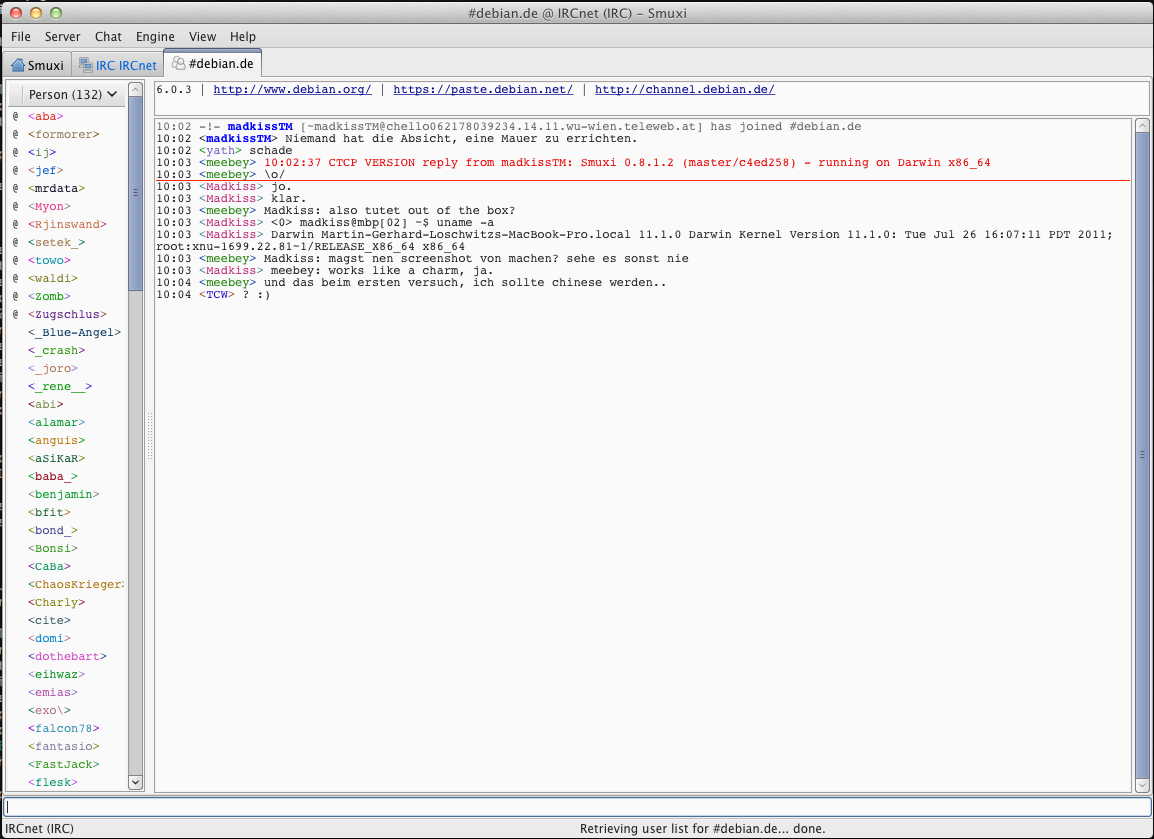
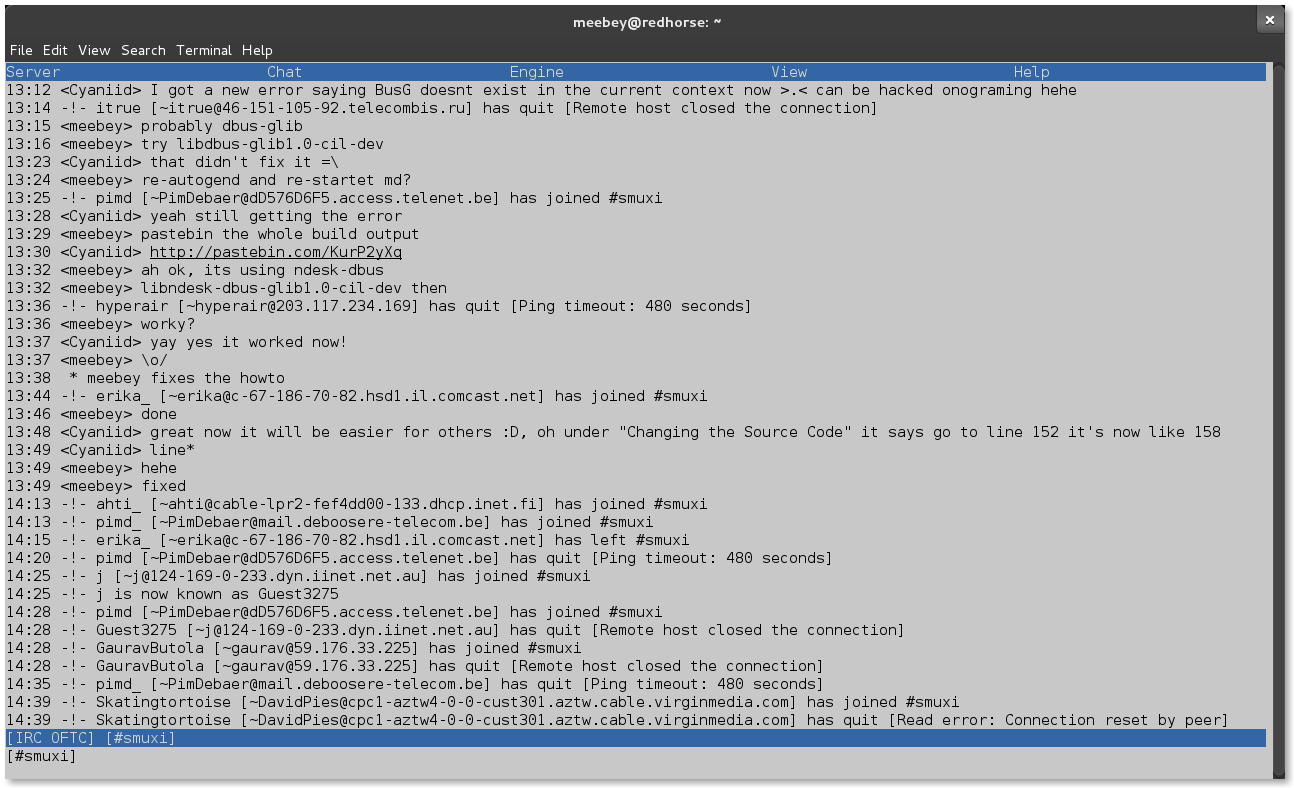
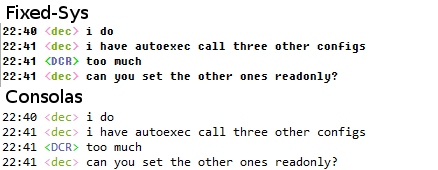
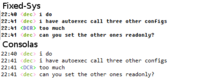
Just in time for 2012 I am very pleased to announce Smuxi 0.8.9 codenamed "One Giant Leap". During the development 56 bug reports and 33 feature requests in 593 commits were worked on making this release a major milestone of the Smuxi project. At the Chaos Communication Congress (28C3) in Berlin I was doing the final development sprint to get 0.8.9 done, which was a very intensive and refreshing experience. Here are the highlights of this release: Development Builds / Rolling Releases After the 0.8 release it became clear that a continious and short development -> test cycle is important to keep the project going quickly. At some point I have received requests if the project is dead while it was more active than ever. The lack of new releases (for about 15 months) lead to this wrong impression. Thus Smuxi can be obtained from development builds now. This includes daily builds for Debian (Squeeze, Wheezy, Sid), Ubuntu (Lucid, Maverick, Natty, Oneiric, Precise) and Windows. Thanks goes to Hannes Tismer for providing the Windows autobuilder and to Canonical for the PPA autobuilder. We invite everyone to use these daily builds to keep track of the latest development of Smuxi. Issues and regressions are fixed in a very short period (usually the same day). Thanks to our users who ran development builds and reported issues which led to many bug fixes prior to this release. On the other hand one of my New Year's resolutions are to "release early, release often" So there should be no nerd left behind... Screenshot of Smuxi 0.8.9 on Mac OS X Mac OS X support With the help of Steven McGrath (Steve[cug]) who created the initial Mac OS X installer for Smuxi we now have official support for Mac OS X. The download page contains the instructions how to obtain and install Smuxi on Mac OS X. This makes the 4th platform where Smuxi can be used on besides Windows, Linux and *BSD. For now Smuxi 0.8.9 doesn't feel as native as it could as it relies on the GTK+ port. We are looking into enhancing the experience though, just stay tuned. Chat History on Disk (Beta) The most exciting feature in this release I think are the "persistent message buffers". With this feature I could solve one of the biggest drawbacks IRC ever had: IRC does not retain any messages you have sent or received. All messages are only relayed to all users. The issue is that if you close your IRC client or even just leave a channel, all your received messages are gone. One workaround in most clients was to create text log files which then contains the chat history, but it is annoying and not user-friendly to open some text file somewhere from your disk to read the history outside of your IRC client. Now with Smuxi 0.8.9 you no longer have this issue, all chat history gets automatically written and read to a message database when you start Smuxi, join channels or open queries! As this feature is not fully stable yet it is not enabled by default. If you want to try it go to: File -> Preferences -> Interface and change "Persistency Type" from "Volatile" to "Persistent", hit OK and restart Smuxi. Now all messages are saved into the database and will automatically be shown. Click here for a screencast of this feature Jabber / XMPP Support (Beta) You probably have friends not on IRC and Twitter, say on Jabber, gTalk or Facebook? This is where the new XMPP engine of Smuxi comes into play. You can send and receive messages to/from them now! The implementation is far from complete, though. It has no buddy list for example and needs only to be treated as a technical preview of what will be coming in future Smuxi releases. Click here for a screencast of this feature Screenshot of Smuxi's Text Interface Text Interface (Alpha) This is the first release that contains a text frontend based on the STFL library. STFL is a library that uses ncurses to draw text based user interface using a markup language (like Glade for GTK+). This frontend is in early alpha state and lacks a lot of interface features and likes to crash. It is still included to attract potential developers who want to enhance this frontend. The frontend can be enabled by passing --enable-frontend-stfl to the configure script and then by executing smuxi-frontend-stfl. NetworkManager Support Everyone with a laptop knows how annoying it can be to suspend and resume when network based applications suddenly go crazy because they have lost the connection and either spew errors or take forever to get back in shape. Smuxi will now detect the network state right away with the help of the new Network Manager support. It automatically reconnects when needed right away for you. Next Generation Internet Support You can now connect to IRC servers using the IPv6 protocol Enhanced Find Group Chat Support Users had real issues to find out how to search for channels, thus Bianca Mix added a neat feature. The /list command will now simply open the Find Group Chat dialog for you. This way everyone used to IRC will find it in no time. Searching for channels on freenode wasn't working correctly, this is now fixed. Smuxi also supports the SAFELIST feature of the IRC protocol now which allows to retrieve a full channel list and do client side search which makes consecutive searches much faster. Enhanced Windows Experience For a long time you could not use Smuxi with the latest GTK# version of 2.12.10 on Windows. The issue was that Smuxi relied on SVG support which 2.12.10 no longer had. Smuxi is no longer using SVG instead it uses pre-scaled PNG images thus it works just fine with GTK# 2.12.10 on Windows now. At the same time the issue that the maximized state of the main window was left when restoring from task bar is fixed with GTK# 2.12.10. Screenshot of Fixed-Sys vs Consolas font Smuxi used by default the FixedSys font on Windows to give it the typical IRC look most people are used to. Since Windows Vista there is a better console-like font available called Consolas. Smuxi will now use the Consolas font instead on Windows Vista or later. Another important enhancement is that Smuxi no longer has issues with multiple GTK+ installs on the same computer, which was getting more common with more popular ported GTK+ applications such as GIMP or Pidgin. SSL for IRC fixed IRC with SSL was only working with the default port of 6697. Thanks to Jo Shields now any port can be used with SSL. Crash Related Issues Desktop notifications could crash Smuxi in case of errors related to the notification system or an absent notification daemon. There was a chance that the crash dialog simply disappeared which made reporting bugs more difficult no longer happens. Rapid use of ctrl+w, /window close (Jimmie Elvenmark) and opening the Find Group Chat dialog on the Smuxi tab do no longer crash. Also number-only network names, /network switch freenode and GTK+ install without SVG support no longer lead into a crash. Enhanced Notice Handling Notices will no longer open query tabs for you instead it will show them on tabs you share with the person who sent it with the server tab as fallback. This also avoids ChanServ, NickServ and spammy IRCop tabs. Twitter fixes Twitter made some changes to their API which broke the Twitter support of Smuxi 0.8. This was taken care of and also a few other issues were solved allowing Smuxi 0.8.9 to work smoothly with Twitter again. Extended Keybindings Smuxi allows now to use the ctrl+tab / ctrl+shift+tab and ctrl+n / ctrl+p keys to switch tabs. The keybindings still work even with a hidden menu bar now. Smuxi Server specific highlights More interactive and much faster synchronization When connecting to a smuxi-server you had to wait till Smuxi finished the synchronization before you could use the interface. Also you could not tell how far the synchronization was and just had to wait till it was completed. With Smuxi 0.8.9 the connect just takes a few seconds and all chats are synchronized in the background with a progress bar so you can use the interface from the first moment on and know how far it is. The speed how much it takes to synchronize all chats also reduced drastictly by 400%! Click here for a screencast of this feature More background communication When using a smuxi-server the interface sometimes had load times like when opening the preferences or when using the nickname completion (Andrew Kannan). These operations are done in the background and no longer blocks the interface. Also when the communication is lost to the smuxi-server the frontend will now automatically reconnect to it in the background. Low Bandwidth Mode When it comes to mobile internet connectivity such as UMTS/HSDPA, Edge and GRPS it can be a real pain to connect to the smuxi-server as it has to transfer all the messages over that. If you just want to ask someone you know then you don't need any old messages to do that. With the "Low Bandwidth Mode" you can now connect to the smuxi-server without loading old messages which makes the connect very quick. You find this option in the engine connect dialog. Stable Protocol Initially I didn't plan to make the protocol of Smuxi stable before the 0.9 release, but as it turned out the 0.8 protocol was good enough to still use it and for that reason Smuxi 0.8.9 is still compatible with 0.8. The 0.8 protocol will see no breakages, instead the next protocol will be on-top or opt-in of the current one. This means future Smuxi versions stay compatible with it. Shutdown Command You can now shutdown the smuxi-server if you like using the /shutdown command. It it safe to use the command, it will do a clean shutdown sequence for you. For example it makes sure all messages are written to disk in the case of enabled persistent message buffers. If you have your smuxi-server daemon monitored (e.g. with runit) it can also automatically be restarted and upgraded this way. Built-in SSH Keyfile Support It is no longer needed to fiddle with the .ssh/config file or pagent to get SSH key authorization working. You can now simply tell Smuxi which SSH keyfile you want to use to connect to your smuxi-server. Updated Translations
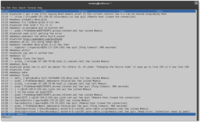
  • Catalan (Siegfried-Angel Gevatter Pujals)
  • Danish (Joe Hansen)
  • Finnish (Kalle Kaitala)
  • French (Cl ment Bourgeois)
  • German (Bianca Mix)
  • Italian (Vincenzo Campanella)
  • Portuguese (Americo Monteiro)
  • Spanish (Castilian) (Ricardo A. Hermosilla Carrillo)
New Translations
  • Chinese Simp (Dean Lee)
  • Slovak (Tom Vadina)
  • Swedish (Jimmie Elvenmark)
  • partially Russian (Aleksandr P)
  • partially Turkish (Umut Albayrak)
  • partially Urdu (makki)
Contributors Contributors to this release are the following people:
  • Mirco Bauer (497 commits)
  • Tuukka Hastrup (10 commits)
  • Bianca Mix (10 commits, translations)
  • Cl ment Bourgeois (8 commits, translations)
  • Andrius Bentkus (5 commits)
  • Carlos Mart n Nieto (3 commits)
  • Jimmie Elvenmark (3 commits, translations)
  • Hannes Tismer (1 commit)
  • Jonathan Pryor (1 commit)
  • Jo Shields (1 commit)
  • Siegfried-Angel Gevatter Pujals (translations)
  • Dean Lee (translations)
  • Aleksandr P (translations)
  • Americo Monteiro (translations)
  • Andrew Kannan (translations)
  • Joe Hansen (translations)
  • Kalle Kaitala (translations)
  • makki (translations)
  • Ricardo A. Hermosilla Carrillo (translations)
  • Tom Vadina (translations)
  • Umut Albayrak (translations)
  • Vincenzo Campanella (translations)
Thank you very much for your contributions to Smuxi! After reading this whole pile of text, head over here and grab this smexy stuff!
Posted Sun Jan 1 22:58:29 2012

Michal Čihař: Adding API to Django application

One of Django applications I maintain is our internal tool used at SUSE used for managing incoming L3 requests. Recently request to add some API arose (read only for now). Looking at available solutions, I came to conclusion that django-piston should be the best choice for me. Adding simple model based API with it is indeed quite simple, all basic information you need is written in getting started part of their documentation. On the other side, things can never go without problems, so I was hit by well known bug. Fortunately fix exists, though it is not yet merged upstream. While digging so deep into problem anyway, I've submitted a request to include this patch in devel:languages:python OBS repo.

Filed under: Django English Suse 4 comments Flattr this!

Robert Collins: Public service announcement: signals implies reentrant code even in Python

This is a tiny PSA prompted by my digging into a deadlock condition in the Launchpad application servers. We were observing a small number of servers stopping cold when we did log rotation, with no particularly rhyme or reason. tl;dr: do not call any non-reentrant code from a Python signal handler. This includes the signal handler itself, queueing tools, multiprocessing, anything with locks (including RLock). Tracking this down I found we were using an RLock from within the signal handler (via a library ) so I filed a bug upstream: http://bugs.python.org/issue13697 Some quick background: when a signal is received by Python, the VM sets a status flag saying that signal X has been received and returns. The next chance that thread 0 gets to run bytecode, (and its always thread 0) the signal handler in Python itself runs. For builtin handlers this is pretty safe e.g. for SIGINT a KeyboardInterrupt is raised. For custom signal handlers, the current frame is pushed and a new stack frame created, which is used to execute the signal handler. Now this means that the previous frame has been interrupted without regard for your code: it might be part way through evaluating a multi-condition if statement, or between receiving the result of a function and storing it in a variable. Its just suspended. If the code you call somehow ends up calling that suspended function (or other methods on the same object, or variations on this theme), there is no guarantee about the state of the object; it becomes very hard to reason about. Consider, for instance, a writelines() call, which you might think is safe. If the internal implementation is for line in lines: foo.write(line) , then a signal handler which also calls writelines, could have what it outputs appear between any two of the lines in writelines. True reentrancy is a step up from multithreading in terms of nastiness, primarily because guarding against it is very hard: a non-reentrant lock around the area needing guarding will force either a deadlock, or an exception from your reentered code; a reentrant lock around it will provide no protection. Both of these things apply because the reentering occurs within the same thread kindof like a generator but without any control or influence on what happens. Safe things to do are: In Launchpad s case, we will be setting a flag variable unconditionally from the signal handler, and the next log write that occurs will lock out other writers, consult the flag, and if needed do a rotation, resetting the flag. Writes after the rotation signal, which don t see the new flag, would be ok. This is the only possible race, if a write to the variable isn t seen by an in-progress or other-thread log write. That is all.

5 January 2012

Russell Coker: DRBD Benchmarking

I ve got some performance problems with a mail server that s using DRBD so I ve done some benchmark tests to try and improve things. I used Postal for testing delivery to an LMTP server [1]. The version of Postal I released a few days ago had a bug that made LMTP not work, I ll release a new version to fix that next time I work on Postal or when someone sends me a request for LMTP support (so far no-one has asked for LMTP support so I presume that most users don t mind that it s not yet working). The local spool on my test server is managed by Dovecot, the Dovecot delivery agent stores the mail and the Dovecot POP and IMAP servers provide user access. For delivery I m using the LMTP server I wrote which has been almost ready for GPL release for a couple of years. All I need to write is a command-line parser to support delivery options for different local delivery agents. Currently my LMTP server is hard-coded to run /usr/lib/dovecot/deliver and has it s parameters hard-coded too. As an aside if someone would like to contribute some GPL C/C++ code to convert a string like /usr/lib/dovecot/deliver -e -f %from% -d %to% -n into something that will populate an argv array for execvp() then that would be really appreciated. Authentication is to a MySQL server running on a fast P4 system. The MySQL server was never at any fraction of it s CPU or disk IO capacity so using a different authentication system probably wouldn t have given different results. I used MySQL because it s what I m using in production. Apart from my LMTP server and the new version of Postal all software involved in the testing is from Debian/Squeeze. The Tests All tests were done on a 20G IDE disk. I started testing with a Pentium-4 1.5GHz system with 768M of RAM but then moved to a Pentium-4 2.8GHz system with 1G of RAM when I found CPU time to be a bottleneck with barrier=0. All test results are for the average number of messages delivered per minute for a 19 minute test run where the first minute s results are discarded. The delivery process used 12 threads to deliver mail.
P4-1.5 p4-2.8
Default Ext4 1468 1663
Ext4 max_batch_time=30000 1385 1656
Ext4 barrier=0 1997 2875
Ext4 on DRBD no secondary 1810 2409
When doing the above tests the 1.5GHz system was using 100% CPU time when the filesystem was mounted with barrier=0, about half of that was for system (although I didn t make notes at the time). So the testing on the 1.5GHz system showed that increasing the Ext4 max_batch_time number doesn t give a benefit for a single disk, that mounting with barrier=0 gives a significant performance benefit, and that using DRBD in disconnected mode gives a good performance benefit through forcing barrier=0. As an aside I wonder why they didn t support barriers on DRBD given all the other features that they have for preserving data integrity. The tests with the 2.8GHz system demonstrate the performance benefits of having adequate CPU power, as an aside I hope that Ext4 is optimised for multi-core CPUs because if a 20G IDE disk needs a 2.8GHz P4 then modern RAID arrays probably require more CPU power than a single core can provide. It s also interesting to note that a degraded DRBD device (where the secondary has never been enabled) only gives 84% of the performance of /dev/sda4 when mounted with barrier=0.
p4-2.8
Default Ext4 1663
Ext4 max_batch_time=30000 1656
Ext4 min_batch_time=15000,max_batch_time=30000 1626
Ext4 max_batch_time=0 1625
Ext4 barrier=0 2875
Ext4 on DRBD no secondary 2409
Ext4 on DRBD connected C 1575
Ext4 on DRBD connected B 1428
Ext4 on DRBD connected A 1284
Of all the options for batch times that I tried it seemed that every change decreased the performance slightly but as the greatest decrease in performance was only slightly more than 2% it doesn t matter much. One thing that really surprised me was the test results from different replication protocols. The DRBD replication protocols are documented here [2]. Protocol C is fully synchronous a write request doesn t complete until the remote node has it on disk. Protocol B is memory synchronous, the write is complete when it s on a local disk and in RAM on the other node. Protocol A is fully asynchronous, a write is complete when it s on a local disk. I had expected protocol A to give the best performance as it has lower latency for critical write operations and for protocol C to be the worst. My theory is that DRBD has a performance bug for the protocols that the developers don t recommend. One other thing I can t explain is that according to iostat the data partition on the secondary DRBD node had almost 1% more sectors written than the primary and the number of writes was more than 1% greater on the secondary. I had hoped that with protocol A the writes would be combined on the secondary node to give a lower disk IO load. I filed Debian bug report #654206 about the kernel not exposing the correct value for max_batch_time. The fact that no-one else has reported that bug (which is in kernels from at least 2.6.32 to 3.1.0) is an indication that not many people have found it useful. Conclusions When using DRBD use protocol C as it gives better integrity and better performance. Significant CPU power is apparently required for modern filesystems. The fact that a Maxtor 20G 7200rpm IDE disk [3] can t be driven at full speed by a 1.5GHz P4 was a surprise to me. DRBD significantly reduces performance when compared to a plain disk mounted with barrier=0 (for a fair comparison). The best that DRBD could do in my tests was 55% of native performance when connected and 84% of native performance when disconnected. When comparing a cluster of cheap machines running DRBD on RAID-1 arrays to a single system running RAID-6 with redundant PSUs etc the performance loss from DRBD is a serious problem that can push the economic benefit back towards the single system. Next I will benchmark DRBD on RAID-1 and test the performance hit of using bitmaps with Linux software RAID-1. If anyone knows how to make a HTML table look good then please let me know. It seems that the new blog theme that I m using prevents borders. Update: I mentioned my Debian bug report about the mount option and the fact that it s all on Debian/Squeeze. Related posts:
  1. I need an LMTP server I am working on a system where a front-end mail...
  2. Some Notes on DRBD DRBD is a system for replicating a block device across...
  3. paper about ZCAV This paper by Rodney Van Meter about ZCAV (Zoned Constant...

4 January 2012

Jon Dowland: Ready Player One

I recently completed "Ready Player One", Ernest Cline's debut novel. It's a Sci-Fi fan-service novel that explores a dystopian future (yes, another one) where the majority of the populace hide inside a VR environment to escape their "real" lives. The sole-genius who authored the VR software hid a series of easter eggs inside, in the form of challenges relating to pop-culture and video game trivia circa the 80s. He constructs his will such that whoever first completes the challenges inherits the mega-bucks company who control the VR simulation. Mike Hoye has an excellent summary:
Ready Player One is a nerdculture bender of a book, about as hard to hate while you re in the middle of it as it is to love in hindsight; it s young adult literature for people who were born in the late seventies and haven t really grown up yet. Of which I am apparently one, it has become clear, but you re still left with the sense that you re reading a Cory Doctorow book whose discerning virtue is that the lead isn t a thinly-veiled Cory Doctorow. Which is a huge, huge improvement, make no mistake, but it s stills relentless, pandering fanservice.
(Whilst you are over on Mike's website you should really read this excellent piece on libraries and publishers.) Despite the points above, I enjoyed the book. My biggest complaint was that the ending was quite abrupt. Quite often when I read a story which is essentially about a journey, I am disappointed if the story ends when the journey does. I hope I am not spoiling too much here by revealing that someone eventually solves the riddles and inherits essentially the earth. But what do they do with it? What impact do they make on the miserable world, described only briefly in sparse passages dotted around the bulk of the text detailing the VR one? During the book, the characters opine on what to do with the fortune, but we never see that come to fruition. Perhaps in a sequel.

Russell Coker: Autism and a Child Beauty Contest

Fenella Wagener wrote an article for the Herald Sun about an Autistic girl who won the best personality award from the controversial new Australian children s beauty pageant [1]. The girl s mother is complaining that an Autistic girl shouldn t win a prize for personality and is critizing the pageant organisers. A beauty contest involves queuing, being quiet, appearing on stage, wearing cosmetics and unusual/uncomfortable clothes. It probably also involves having someone else assist with dressing and applying cosmetics (being touched by another person). These are all things which tend to be difficult or impossible for Autistic kids. So any girl who can get on stage wearing make-up can probably do whatever is required to avoid being obviously excluded from a personality prize. As any such prize has to be largely subjective I don t think it would ever be possible to prove that someone was the correct choice for the winner, it would merely be possible to prove that some candidates excluded themselves. But whether the girl deserved to win isn t the real issue here. I think that beauty pageants should be restricted to adults, merely entering a child in such a contest is bad enough, but making nasty public statements about a child is horrible. If other children made a Facebook page claiming that the girl in question didn t deserve to win a best personality prize it would probably be reported as cyber-bullying. I don t think that publishing the name or photo of the girl in question is in the public interest either. Many news sites that have picked up the story have shown the same lack of journalistic ethics so now the girl has some high traffic sites with her name linked to this story, it seems unlikely that anything good she might do in the near future will get a higher ranking for her name in search engines. So any time she searches for her name on Google (which most people do regularly) she will be reminded that her mother thinks she has some sort of defective personality because she is Autistic. High school is generally bad for almost everyone on the Autism Spectrum. Presumably any parent who would abuse their child by allowing such an article to be published would also send them to a regular school (as opposed to Home Schooling which is probably the only good option for Autistic kids in Australia). I m sure that the standard practice at every high school nowadays is that the kids all use Google to discover things to tease each other about. So in a few years the Herald Sun article will probably be the basis of a high school bullying campaign. The girl in question is only 9, so she s got another 6 or 7 years before she can legally leave her mother. In Australia 16 is the minimum legal age to live without parents and the police won t forcibly return runaway children who are almost 16. The Journalistic Code of Ethics Here is a link to the Australian Media Alliance code of Journalistic Ethics [2]. Section 8 includes Never exploit a person s vulnerability or ignorance of media practice . I think that publishing the name and photograph of a 9yo girl in a way that is likely to lead to bullying in a few years is a clear example of exploiting a vulnerable person. The code of ethics has a guidance clause which says Only substantial advancement of the public interest or risk of substantial harm to people allows any standard to be overridden . Even if it was a proven fact that a beauty pageant was issuing awards to unqualified children there would not be any substantial advancement of the public interest in publishing that. Beauty Contests are Evil The Australian has an article about the same beauty contest by Caroline Overington which quotes adolescent and child psychotherapist Collett Smart calling for government intervention [3]. Catherine Manning has written a good article explaining some of the reasons for opposing child beauty pageants [4]. The American Psychological Association has published a report on the Sexualization of Girls [5], they have lots of references to psychological research which gives a variety of reasons for opposing child beauty contests. IMHO each of the reasons alone should be sufficient to convince people that child beauty pageants are bad. Finally the pictures of contestants who are less than 10yo but made up to look like they are 20+ are rather disturbing. Related posts:
  1. Child Abuse and Censorship In Australia we are currently in the middle of a...
  2. Autism Awareness and the Free Software Community It s Autism Awareness Month April is Autism Awareness month, there...
  3. Autism, Food, etc James Purser wrote Stop Using Autism to Push Your Own...

Kartik Mistry: Wikipedia takes Ahmedabad

* This post is almost translation of my this post on Gujarati blog (with some corrections and additions etc). If you re not interested in Wikipedia, move on. So, as I mentioned here and here, Wikipedians in Ahmedabad planned event: Wikipedia Takes Ahmedabad. We gathered at Gandhi Ashram. Met Noopur again and some volunteers were already there at 8 AM. I never been to Ashram since long time. This place has something, you know it, folks! People started coming around 8.30 and we quickly divided them based upon their interests on 4 routes we already decided. Most of people went to old city s route 1 and our route 2 had odd 6 (and 2 coordinaters) people only. Good. Less is always good. Noopur and Anirudh gave introduction to wikipedia, creative commons license and some basic rules and todo. We then left for Swaminarayan Temple at Sahibaug. We asked for permission to take photographs and we got it after meeting main swamiji there along with nice sweets and he promised to send professional picture for wikipedia to use. We then left for Delhi Darwaja. Ahmedabad has numbers of old fort gates. We covered some of them and moved to Kalupur Railway Station. Palak and Chirag were caught by traffic police and we should take care of following rules from next time. Point noted for next photowalk. We then left for Zulta Minar. This is well known for its carving and some myths associated with it. We discussed some points regarding uploading pictures, categories and left for Raipur Darwaja. This place is famous for Bhajiyas. We didn t taste it but had again fun taking pictures, talking to police and had smile before we leave for home. Only bad thing I ve got in this walk is that due to some or other reason my phone s touch screen seems stopped working :( That s another topic, but I couldn t call Noopur/Anirudh for lunch etc due to that :) You can view all uploaded pictures at: Categories: Ahmedabad 1 Most of Ahmedabad is covered due to event. Time to write articles?

Matthew Garrett: Android, GPL violations and Google

A bit over a year ago, I wrote about how an incredible number of Android tablets on the market were in violation of the terms of the GPL. I've had rather a lot else to do since then so it's now awfully out of date - but taking a quick browse through the current stack of cheaper devices indicates that things aren't all that much better. We've got source code for some chipsets that were missing it before, but to compensate we've got a whole bunch of new hardware that's entirely lacking. It's all pretty poor, really.

At the time, I wrote the following:

"(Side note: People sometimes ask why Google aren't doing more to prevent infringing devices. For the vast majority of these cases, Google's sole contribution has been to put Android source code on a public website. Red Hat own more of the infringing code than Google do. There's no real reason why Google should be the ones taking the lead role here, and there's fairly sound business reasons why it's not in their interest to do so)"

Factually speaking, nothing's changed. Each of these devices contains code owned by Google, and Google could absolutely take legal action against the vendors. Equally, so could Red Hat, Intel, Nokia and dozens of other companies who hold copyright on portions of the code carried on these devices, and so could thousands of individuals around the world. Nobody's obliged to enforce their copyrights, and in the absence of anyone else doing so it's unreasonable to insist that Google should do it.

However.

Google gives Android away. This seems like an odd thing for them to do, given that it's a significant engineering effort and costs a lot of money to produce. But remember what Android brings to Google - it's a platform with a well-integrated mechanism for distributing advertising to users. Scanning the market shows a huge number of ad-supported apps, and Google's getting money for every single one of those that gets shown. The more Android devices, the bigger the market for apps - and the wider their advertising reach.

In other words: unscrupulous hardware vendors save money by ignoring their GPL obligations. This lets them appeal on price, increasing the number of Android devices in use and increasing Google's profits. Google makes money off other people's violation of the GPL.

Could Google do anything to stop this? Yes. They could sue for copyright infringement, but that kind of thing's time consuming and awkward and any argument about the GPL always seems to end up as a big argument involving conspiracy theories. Instead, Google could attach some extra conditions to the Android trademark. Requiring that the trademark only be attached to GPL-compliant products ought to allow Google to take advantage of the existing well-tested mechanisms for seizing counterfeit goods, providing a direct economic incentive for companies to come into compliance. For added marks, they could restrict the adwords code to devices that use the trademark - if the vendor removes the trademark, applications depending on the adwords functionality would refuse to run and Google wouldn't make money off the infringing hardware.

Or, of course, they could just carry on making extra money as a result of vendors denying users the freedoms granted by the copyright holders. Although that sounds kind of evil to me.

Edit: You probably also want to read the followup post here.

comment count unavailable comments

3 January 2012

Julien Danjou: Google Calendar notifications using pynotify

I use Google Calendar to manage my calendars, and I really missed something to warn me whenever I have an appointment with an alert set. So here is an example of a Python program to do such a thing. It is written using the Google Data APIs Python client library and pynotify. I'll detail the code here, so you can build your own and adapt it to your needs. First, we need to import GTK+ and pynotify, and initialize it.
import gtk
import pynotify
pynotify.init(sys.argv[0])
Then, we need to import gdata Calendar API and connect to the calendar. I'll use the simple email/password way to login, which is clearly not the best, but it's also the simplest. Feel free to use OAuth 2.0. :-)
calendar_service = gdata.calendar.service.CalendarService()
calendar_service.email = 'mygooglelogin'
calendar_service.password = 'mygooglepassword'
calendar_service.ProgrammaticLogin()
Now we're ready to request stuff and notify! First, request the events from the default calendar.
feed = calendar_service.GetCalendarEventFeed()
Now we can iterate over feed and do various checks.
for event in feed.entry:
    # If the event status is not confirmed, go to the next event.
    if event.event_status.value != "CONFIRMED":
        continue
    # Now iterate over all the event dates (usually it has one)
    for when in event.when:
        # Parse start and end time
        try:
            start_time = datetime.datetime.strptime(when.start_time.split(".")[0], "%Y-%m-%dT%H:%M:%S")
            end_time = datetime.datetime.strptime(when.end_time.split(".")[0], "%Y-%m-%dT%H:%M:%S")
        except ValueError:
            # ValueError happens on parsing error. Parsing errors
            # usually happen for "all day" events since they have
            # not time, but we do not care about this events.
            continue
        now = datetime.datetime.now()
        # Check that the event hasn't already ended
        if end_time > now:
            # Check each alert
            for reminder in when.reminder:
                # We handle only reminders with method "alert"
                # and whose start time minus the reminder delay has passed
                if reminder.method == "alert" \
                        and start_time - datetime.timedelta(0, 60 * int(reminder.minutes)) < now:
                    # Build the notification
                    notification = pynotify.Notification(summary=event.title.text,
                                                         message=event.content.text)
                    # Set an icon from the GTK+ stock icons
                    notification.set_icon_from_pixbuf(gtk.Label().render_icon(gtk.STOCK_DIALOG_INFO,
                                                                              gtk.ICON_SIZE_LARGE_TOOLBAR))
                    notification.set_timeout(0)
                    # Show the notification
                    notification.show()
Running this program, you should see a notification if an appointment has an alert to be raised at that time. This should be enough to start to build something. If you don't want to program this into Python, you might want to take a look at gcalcli.

Russell Coker: Standardising Android

Don Marti wrote an amusing post about the lack of standards for Android phones and the fact that the iPhone has a better accessory market as a result [1]. I d like to see some Android phones get standardised in a similar manner to the PC. The big thing about the IBM PC compatible market was that they all booted the same way, ran the same OS and applications, had the same expansion options, connectors, etc. The early PCs sucked in many ways (there were many other desktop computers in the 80 s that were better in various ways) but the larger market made the PC win. The PC even killed the Mac! This is something we should remember now when discussing the iPhone. I d like to see different Android phones that can run the same OS with the same boot loader. Having HTC, LG, Samsung, and others all sell phones that can run the same version of CyanogenMod and have the same recovery options if a mistake is made when loading CyanogenMod shouldn t be any more difficult than having IBM, Compaq, HP, DEC, Dell, and others selling PCs that run the same versions of all the OSs of the day and had the same recovery options. Then there should be options for common case sizes. From casual browsing in phone stores it seems that most phones on sale in Australia are of a tablet form without a hardware keyboard, they have a USB/charger socket, an audio socket, and hardware buttons for power, volume up/down, and home with the settings and back buttons being through the touch-screen on the Galaxy S but hardware in most others. A hardware button to take a picture is available in some phones. The variation in phone case design doesn t seem to be that great and there seems to be a good possibility for a few standards for common formats, EG large tablet, small tablet, and large tablet with hardware keyboard. The phone manufacturers are currently competing on stupid things like how thin a phone can be while ignoring real concerns of users such as having a phone that can last for 24 hours without being charged! But they could just as easily compete on ways of filling a standard case size, with options for screen resolution, camera capabilities, CPU, GPU, RAM, storage, etc. There could also be ways of making a standard case with several options, EG having an option for a camera that extends from the back of the case for a longer focal length such an option wouldn t require much design work for a second version of anything that might connect to the phone. Also standards would need to apply for a reasonable period of time. One advantage that Apple has is that it has only released a few versions of the iPhone and each has been on sale for a reasonable amount of time (3 different sizes of case in 4 years). Some of the Android phones seem to only be on sale in mass quantities for a few months before being outdated, at which time many of the stores will stop getting stock of matching accessories. Finally I d be a lot happier if there was good support for running multiple Android phones with the same configuration. Then I could buy a cheap waterproof phone for use at the beach and synchronise all the configuration before leaving home. This is a feature that would be good for manufacturers as it would drive the average rate of phone ownership to something greater than 1 phone per person.

2 January 2012

Gunnar Wolf: Happy Public Domain day, even for the inhabitants of the longest-copyright-term country

Happy Public Domain day, even for the inhabitants of the longest-copyright-term country
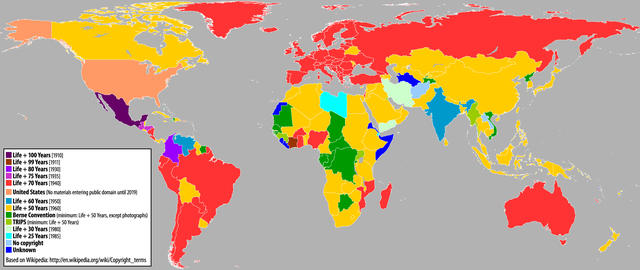
Every year, on January 1st, new material ceases to be protected by copyright and enters the public domain. This means, every year, more knowledge, literature, paintings, music, movies and a long etcetera becomes collective property, instead of being artificially held by the current holders of their rights. As this image shows (source: http://publicdomainday.org/node/39 ), I have the honor(?) to live in the country with the longest copyright protection term in the world. Copyright in Mexico does not only last for 100 years It lasts for the natural life of the author plus 100 years. This means that the popular corridos that tell the stories of the 1910 revolution are still not in the public domain. La sucesi n presidencial, the book which Francisco I. Madero wrote to justify that a peaceful political change was needed for the 1910 elections, will not enter the public domain until 2014 (president Madero was killed during 1913). Does it make any sense to kidnap cultural, political or artistic works for over a century? Not only that: Material that is legally sold as public domain in other countries is illegal in ours. Take as an example the recordings of Enrico Carusso, the great Italian tenor who died in 1921. Over 15 years ago, I bought a couple of CDs with his recordings (even if the sources were quite low-quality, as they had been copied over from wax cylinders to magnetic tapes to optical media). I bought them surprisingly cheap, as they were genuine public domain. But they are still protected in my country. That means, I ilegally have some stolen(!) works of art which I lawfully bought outside my country. Copyright law needs to be revised to match reality. Technological advances have strongly changed reality since 1717's promulgation of the first copyright laws. The solution is not to extend the terms, but to rethink the whole process. (yes, this rant was mainly made as an excuse for me to copy this image and put it in a location I can easily refer to later. But I hope it is interesting to you!)

Next.

Previous.