Search Results: "ina"

28 February 2013

Keith Packard: x-on-resize

x-on-resize: a simple display configuration daemon I like things to be automated as much as possible, and having abandoned Gnome to their own fate and switched to xfce, I missed the automatic display reconfiguration stuff. I decided to write something as simple as possible that did just what I needed. I did this a few months ago, and when Carl Worth asked what I was using, I decided to pack it up and make it available. Automatic configuration with a shell script I ve had a shell script around that I used to bind to a key press which I d hit when I plugged or unplugged a monitor. So, all I really need to do is get this script run when something happens. The missing tool here was something to wait for a change to happen and automatically invoke the script I d already written. Resize vs Configure The first version of x-on-resize just listened for ConfigureNotify events on the root window. These get sent every time anything happens with the screen configuration, from hot-plug to notification when someone runs xrandr. That was as simple as possible; the application was a few lines of code to select for ConfigureNotify events, and invoke a program provided on the command line. However, it was a bit too simple as it would also respond to manual invocations of xrandr and call the script then as well. So, as long as I was content to accept whatever the script did, things were fine. And, with a laptop that had a DisplayPort connector for my external desktop monitor, and a separate VGA connector for projectors at conferences, the script always did something useful. Then I got this silly laptop that has only DisplayPort, and for which a dongle is required to get to VGA for projectors. I probably could write something fancy to figure out the difference between a desktop DisplayPort monitor and DisplayPort to VGA dongle, but I decided that solving the simpler problem of only invoking the script on actual hotplug events would be better. So, I left the current invoke-on-resize behavior intact and added new code that watched the list of available outputs and invoked a new config script when that set changed. The final program, x-on-resize, is available via git at
git://people.freedesktop.org/~keithp/x-on-resize
I even wrote a manual page. Enjoy!

Erich Schubert: ELKI data mining in 2013

ELKI, the data mining framework I use for all my research, is coming along nicely, and will see continued progress in 2013. The next release is scheduled for SIGMOD 2013, where we will be presenting the novel 3D parallel coordinates visualization we recently developed. This release will bear the version number 0.6.0.
Version 0.5.5 of ELKI is in Debian unstable since december (Version 0.5.0 will be in the next stable release) and Ubuntu raring. The packaged installation can share the dependencies with other Debian packages, so they are smaller than the download from the ELKI web site.
If you are developing cluster analysis or outlier detection algorithm, I would love to see them contributed to ELKI. If I get a clean and well-integrated code by mid june, your algorithm could be included in the next release, too. Publishing your algorithms in source code in a larger framework such as ELKI will often give you more citations. Because it is easier to compare with your algorithm then and to try it on new problems. And, well, citations counts are a measure that administration loves to judge researchers ...
So what else is happening with ELKI:
  • The new book "Outlier Analysis" by C. C. Aggarwal mentions ELKI for visual evaluation of outlier results as well as in the "Resources for the Practioner" section and cites around 10 publications closely related to ELKI.
  • Some classes for color feature extraction of ELKI have been contributed to jFeatureLib, a Java library for feature detection in image data.
  • I'd love to participate in the Google Summer of Code, but I need a contact at Google to "vouch" for the project, otherwise it is hard to get in. I've been sending a couple of emails, but so far have not heard back much yet.
  • As the performance of SVG/Batik is not too good, I'd like to see more OpenGL based visualizations. This could also lead to an Android based version for use on tablets.
  • As I'm not an UI guy, I would love to have someone make a fancier UI that still exposes all the rich functions we have. The current UI is essentially an automatically generated command line builder - which is nice, as new functionality shows up without the need to modify UI code. It's good for experienced users like me, but hard for beginners to get started.
  • I'd love to see integration of ELKI with e.g. OpenRefine / Google Refine to make it easier to do appropriate data cleaning and preprocessing
  • There is work underway for a distributed version running on Hadoop/YARN.

Dirk Eddelbuettel: inline 0.3.11

A maintenance release of inline is now on CRAN, and is being uploaded to Debian. The release fixes two minor bugs kindly reported by users. As the two previous releases appear to not have been announced here, their NEWS entries are included as well.
Changes in inline version 0.3.11 (2013-02-26)
  • Fix bug in cfunction for .C convention with raw vectors.
  • Correct cfunction to use .Platform$dynlib.ext as the file extension for the library file (unless on Windows).
  • Allow rcpp wrapper to pass another plugin (as eg RcppArmadillo)
Changes in inline version 0.3.10 (2012-10-03)
  • getDynLib() error message corrected as suggested by Yasir Suhail
  • Added rcpp() wrapper for cxxfunction() which sets plugin="Rcpp"
  • Converted NEWS to NEWS.Rd
  • New maintainer, after having coordinated releases (along with Romain) since 0.3.5 in June 2010
Changes in inline version 0.3.9 (2012-10-02)
  • Uncoordinating hijacking of package by CRAN maintainers with a single word change in cfunction.R to prevent an error under an unreleased version of R
Courtesy of CRANberries, there is also a diffstat report for the most recent release. A few more details are available at the R-Forge page.

27 February 2013

Sylvain Le Gall: planet.ocaml.org spring cleaning

Hi planet.ocaml.org. Just a quick post to thanks Marek Kubica for his help on the planet.ocaml.org spring cleaning. Here are the feeds that have been removed: http://redlizards.com/blog/feed/?tag=ocaml http://blog.mestan.fr/feed/?cat=16 http://www.sairyx.org/tag/ocaml/feed/ http://blog.dbpatterson.com/rss http://www.nicollet.net/toroidal/ocaml/feed/ http://ocamlhackers.ning.com/profiles/blog/feed?tag=ocaml&xn_auth=no http://eigenclass.org/R2/feeds/rss2/all http://procrastiblog.com/category/ocaml/feed http://savonet.sourceforge.net/liquidsoap.rss Here is the feed that have been added: http://newblog.0branch.com/rss.xml Here are the feeds that have been updated: https://ocaml.janestreet.com/?q=rss.xml http://scattered-thoughts.net/atom.xml http://www.rktmb.org/feed/tag/ocaml/atom http://nleyten.com/feed/tag/ocaml/atom http://www.mega-nerd.com/erikd/Blog/index.rss20 http://y-node.com/blog/feeds/latest/ If you want that we had back your blog, please follow the howto add your feed to planet. We didn't have removed feed on purpose, this was just a way to get rid of a lot of 404, And don't forget, planet.ocamlcore.org is now served by planet.ocaml.org! Update your feed reader.

Matthew Garrett: Supporting third-party keys in a Secure Boot world

It's fairly straightforward to boot a UEFI Secure Boot system using something like Shim or the Linux Foundation's loader, and for distributions using either the LF loader or the generic version of Shim that's pretty much all you need to care about. The physically-present end user has had to explicitly install new keys or hashes, and that means that you no longer need to care about Microsoft's security policies or (assuming there's no exploitable flaws in the bootloader itself) fear any kind of revocation.

But what about if you're a distribution that cares about booting without the user having to install keys? There's several reasons to want that (convenience for naive users, ability to netboot, that kind of thing), but it has the downside that your system can now be used as an attack vector against other operating systems. Do you care about that? It depends how you weigh the risks. First, someone would have to use your system to attack another. Second, Microsoft would have to care enough to revoke your signature. The first hasn't happened yet, so we have no real idea how likely the second is. However, it doesn't seem awfully unlikely that Microsoft would be willing to revoke a distribution signature if that distribution were being used to attack Windows.

How do you avoid that scenario? There's various bits of security work you need to do, but one of them is to require that all your kernel modules be signed. That's easy for the modules in the distribution, since you just sign them all before shipping them. But how about third party modules? There's three main options here:

  1. Don't support third party modules on Secure Boot systems
  2. Have the distribution sign the modules
  3. Have the vendor sign the modules

The first option is easy, but not likely to please users. Or hardware vendors. Not ideal.

The second option is irritating for a bunch of reasons, and a pretty significant one is license-related. If you sign a module, does that mean you're endorsing it in some way? Does signing the nvidia driver mean that you think there's no license concerns? Even ignoring that, how do you decide whose drivers to sign? We can probably assume that companies like AMD and nvidia are fairly reputable, but how about Honest John's Driver Emporium? Verifying someone's identity is astonishingly expensive to do a good job of yourself, and not hugely cheaper if you farm it out to a third party. It's also irritating for the driver vendor, who needs a separate signature for every distribution they support. So, while possible, this isn't an attractive solution.

The third option pushes the responsibility out to other people, and it's always nice to get other people to do work instead of you. The problem then is deciding whose keys you trust. You can push that off to the user, but it's not the friendliest solution. The alternative is to trust any keys that are signed with a trusted key. But what is a trusted key? Having the distribution sign keys just pushes us back to option (2) - you need to verify everyone's identity, and they need a separate signing key for every distribution they support. In an ideal world, there'd be a key that we already trust and which is owned by someone willing to sign things with it.

The good news is that such a key exists. The bad news is that it's owned by Microsoft.

The recent discussion on LKML was about a patchset that allowed the kernel to install new keys if they were inside a PE/COFF binary signed by a trusted key. It's worth emphasising that this patchset doesn't change the set of keys that the kernel trusts - the kernel trusts keys that are installed in your system firmware, so if your system firmware trusts the Microsoft key then your kernel already trusts the Microsoft key. The reasoning here is pretty straightforward. If your firmware trusts things signed by Microsoft, and if a bad person can get things signed by Microsoft, the bad person can already give you a package containing a backdoored bootloader. Letting them sign kernel modules doesn't alter the power they already have over your system. Microsoft will sign PE/COFF binaries, so a vendor would just have to sign up with Microsoft, pay $99 to Symantec to get their ID verified, wrap their key in a PE/COFF binary and then get it signed by Microsoft. The kernel would see that this object was signed by a trusted key and extract and install the key.

Linus is, to put it mildly, unenthusiastic about this idea. It adds some extra complexity to the kernel in the form of a binary parser that would only be used to load keys from userspace, and the kernel already has an interface for that in the form of X509 certificates. The problem we have is that Microsoft won't sign X509 certificates, and there's no way to turn a PE/COFF signature into an X509 signature. Someone would have to re-sign the keys, which starts getting us back to option (2). One way around this would be to have an automated service that accepts PE/COFF objects, verifies that they're signed by Microsoft, extracts the key, re-signs it with a new private key and spits out an X509 certificate. That avoids having to add any new code to the kernel, but it means that there would have to be someone to run that service and it means that their public key would have to be trusted by the kernel by default.

Who would that third party be? The logical choice might be the Linux Foundation, but since we have members of the Linux Foundation Technical Advisory Board saying that they think module signing is unnecessary and that there's no real risk of revocation, it doesn't seem likely that they'll be enthusiastic. A distribution could do it, but there'd be arguments about putting one distribution in a more privileged position than others. So far, nobody's stood up to do this.

A possible outcome is that the distributions who care about signed modules will all just carry this patchset anyway, and the ones who don't won't. That's probably going to be interpreted by many as giving too much responsibility to Microsoft, but it's worth emphasising that these patches change nothing in that respect - if your firmware trusts Microsoft, you already trust Microsoft. If your firmware doesn't trust Microsoft, these patches will not cause your kernel to trust Microsoft. If you've set up your own chain of trust instead, anything signed by Microsoft will be rejected.

What's next? It wouldn't surprise me too much if nothing happens until someone demonstrates how to use a signed Linux system to attack Windows. Microsoft's response to that will probably determine whether anyone ends up caring.

comment count unavailable comments

Jan Wagner: Chemnitzer Linux-Tage 2013?

Also this year I registered a booth in the name of the Debian Project at Chemnitzer Linux-Tage. Unfortunalety this is the second time in the row, that we seem to be short of manpower while preparing the booth. Actually just one person was able to commit his available time. A general offer was announced by 3 people (including me). This makes me a little sad, cause CLT is a very community driven event which is really nice organized. I always liked to chat and discuss with very interesting people from other projects and visitors. As the CLT runs a 6 track lecture program with commonly very good lectures, it is not possible to get the booth running into good shape with such a small amount of volunteers. If you feel you are interested into visiting the Chemnitzer Linux-Tage and want to make our booth a success like last years for the Debian Project, please have a look into my announcment and our coordination wiki. So please ... let come more brave people into our band wagon! Don't wait to long! Registration period for (possibly sponsored) Booth tickets (read here) ends on 4th March, many thanks!

26 February 2013

Ian Campbell: LinaroConnect 2013, Talks and Demos

My colleague Stefano Stabellini and I are in the process of putting the finishing touches to our presentation which we are giving at Linaro Connect next week in Hong Kong. If you are there come and see Introducing XEN on ARM on Monday at 1100, we'll be running through some of the basics of Xen as well as the specifics of how this translates into use on the ARM virtualised platform and talking about our status and roadmap going forward. As well as that we will also be demoing Xen on ARM, both on v7 hardware platforms and on v8 software models, at Demo Friday. I've been mostly working on the 64-bit port recently and the initial set of 45(!) patches was committed at the end of last week --- just in time! The other main Xen on ARM event at this years Connect is a keynote on the Tuesday morning given by Lars Kurth (Xen.org Community Manager) and Mark Heath (XenServer VP of Engineering, and also my boss). Other than that my schedule seems to be running over with other interesting sounding talks and there are certainly going to be plenty of people to catch up with, but hopefully I'll have enough time to put the finishing touches onto ARMv8 64-bit guest support in the hackrooms like I'm planning... Looking forward to seeing some of you there!

Ingo Juergensmann: Xen problems with VMs on 2.6.32-5-xen-amd64?

On Saturday there were some updates for Squeeze/Stable, for example a new/updated version of Xen hypervisor and kernels were downloaded and installed:
gate:~# dir /var/cache/apt/archives/
base-files_6.0squeeze7_amd64.deb                 libxenstore3.0_4.0.1-5.6_amd64.deb
bind9-host_1%3a9.7.3.dfsg-1~squeeze9_amd64.deb   linux-base_2.6.32-48_all.deb
dbus_1.2.24-4+squeeze2_amd64.deb                 linux-image-2.6.32-5-amd64_2.6.32-48_amd64.deb
dbus-x11_1.2.24-4+squeeze2_amd64.deb             linux-image-2.6.32-5-xen-amd64_2.6.32-48_amd64.deb
firmware-linux-free_2.6.32-48_all.deb            lock
gzip_1.3.12-9+squeeze1_amd64.deb                 openssh-client_1%3a5.5p1-6+squeeze3_amd64.deb
host_1%3a9.7.3.dfsg-1~squeeze9_all.deb           openssh-server_1%3a5.5p1-6+squeeze3_amd64.deb
libbind9-60_1%3a9.7.3.dfsg-1~squeeze9_amd64.deb  openssl_0.9.8o-4squeeze14_amd64.deb
libcups2_1.4.4-7+squeeze3_amd64.deb              partial
libdbus-1-3_1.2.24-4+squeeze2_amd64.deb          perl_5.10.1-17squeeze5_amd64.deb
libdbus-glib-1-2_0.88-2.1+squeeze1_amd64.deb     perl-base_5.10.1-17squeeze5_amd64.deb
libdns69_1%3a9.7.3.dfsg-1~squeeze9_amd64.deb     perl-modules_5.10.1-17squeeze5_all.deb
libisc62_1%3a9.7.3.dfsg-1~squeeze9_amd64.deb     ssh_1%3a5.5p1-6+squeeze3_all.deb
libisccc60_1%3a9.7.3.dfsg-1~squeeze9_amd64.deb   tzdata_2012g-0squeeze1_all.deb
libisccfg62_1%3a9.7.3.dfsg-1~squeeze9_amd64.deb  xen-hypervisor-4.0-amd64_4.0.1-5.6_amd64.deb
libldap-2.4-2_2.4.23-7.3_amd64.deb               xen-linux-system-2.6.32-5-xen-amd64_2.6.32-48_amd64.deb
liblwres60_1%3a9.7.3.dfsg-1~squeeze9_amd64.deb   xenstore-utils_4.0.1-5.6_amd64.deb
libperl5.10_5.10.1-17squeeze5_amd64.deb          xen-utils-4.0_4.0.1-5.6_amd64.deb
libssl0.9.8_0.9.8o-4squeeze14_amd64.deb
Unfortunately this update appears to be problematic on my Xen hosting server. This night it happened the second time that some of the virtual network interfaces disappeared or turned out to be non-working. For example I have two VMs: one running the webserver and one running the databases. Between these two VMs there's a bridge on the dom0 and both VMs have a VIF to that (internal) bridge. What happens is that this bridge becomes inaccessible from within the webserver VM. Sadly there's not much to see in the log files. I just spotted this on dom0:
Feb 26 01:01:29 gate kernel: [12697.907512] vif3.1: Frag is bigger than frame.
Feb 26 01:01:29 gate kernel: [12697.907550] vif3.1: fatal error; disabling device
Feb 26 01:01:29 gate kernel: [12697.919921] xenbr1: port 3(vif3.1) entering disabled state
Feb 26 01:22:00 gate kernel: [13928.644888] vif2.1: Frag is bigger than frame.
Feb 26 01:22:00 gate kernel: [13928.644920] vif2.1: fatal error; disabling device
Feb 26 01:22:00 gate kernel: [13928.663571] xenbr1: port 2(vif2.1) entering disabled state
Feb 26 01:40:44 gate kernel: [15052.629280] vif7.1: Frag is bigger than frame.
Feb 26 01:40:44 gate kernel: [15052.629314] vif7.1: fatal error; disabling device
Feb 26 01:40:44 gate kernel: [15052.641725] xenbr1: port 6(vif7.1) entering disabled state
This corresponds to the number of VMs having lost their internal connection to the bridge. On the webserver VM I see this output:
Feb 26 01:59:01 vserv1 kernel: [16113.539767] IPv6: sending pkt_too_big to self
Feb 26 01:59:01 vserv1 kernel: [16113.539794] IPv6: sending pkt_too_big to self
Feb 26 02:30:54 vserv1 kernel: [18026.407517] IPv6: sending pkt_too_big to self
Feb 26 02:30:54 vserv1 kernel: [18026.407546] IPv6: sending pkt_too_big to self
Feb 26 02:30:54 vserv1 kernel: [18026.434761] IPv6: sending pkt_too_big to self
Feb 26 02:30:54 vserv1 kernel: [18026.434787] IPv6: sending pkt_too_big to self
Feb 26 03:39:16 vserv1 kernel: [22128.768214] IPv6: sending pkt_too_big to self
Feb 26 03:39:16 vserv1 kernel: [22128.768240] IPv6: sending pkt_too_big to self
Feb 26 04:39:51 vserv1 kernel: [25764.250170] IPv6: sending pkt_too_big to self
Feb 26 04:39:51 vserv1 kernel: [25764.250196] IPv6: sending pkt_too_big to self
Rebooting the VMs will result in a non-working VM as it will get paused on creation and Xen scripts complain about not working hotplug scripts and Xen logs shows this:
[2013-02-25 13:06:34 5470] DEBUG (XendDomainInfo:101)
XendDomainInfo.create(['vm', ['name', 'vserv1'], ['memory', '2048'],
['on_poweroff', 'destroy'], ['on_reboot', 'restart'], ['on_crash',
'restart'], ['on_xend_start', 'ignore'], ['on_xend_stop', 'ignore'],
['vcpus', '2'], ['oos', 1], ['bootloader', '/usr/lib/xen-4.0/bin/pygrub'],
['bootloader_args', ''], ['image', ['linux', ['root', '/dev/xvdb '],
['videoram', 4], ['tsc_mode', 0], ['nomigrate', 0]]], ['s3_integrity', 1],
['device', ['vbd', ['uname', 'phy:/dev/lv/vserv1-boot'], ['dev', 'xvda'],
['mode', 'w']]], ['device', ['vbd', ['uname', 'phy:/dev/lv/vserv1-disk'],
['dev', 'xvdb'], ['mode', 'w']]], ['device', ['vbd', ['uname',
'phy:/dev/lv/vserv1-swap'], ['dev', 'xvdc'], ['mode', 'w']]], ['device',
['vbd', ['uname', 'phy:/dev/lv/vserv1mirror'], ['dev', 'xvdd'], ['mode',
'w']]]])
[2013-02-25 13:06:34 5470] DEBUG (XendDomainInfo:2508)
XendDomainInfo.constructDomain
[2013-02-25 13:06:34 5470] DEBUG (balloon:220) Balloon: 2100000 KiB free;
need 16384; done.
[2013-02-25 13:06:34 5470] DEBUG (XendDomain:464) Adding Domain: 39
[2013-02-25 13:06:34 5470] DEBUG (XendDomainInfo:2818)
XendDomainInfo.initDomain: 39 256
[2013-02-25 13:06:34 5781] DEBUG (XendBootloader:113) Launching bootloader
as ['/usr/lib/xen-4.0/bin/pygrub', '--args=root=/dev/xvdb  ',
'--output=/var/run/xend/boot/xenbl.6040', '/dev/lv/vserv1-boot'].
[2013-02-25 13:06:39 5470] DEBUG (XendDomainInfo:2845)
_initDomain:shadow_memory=0x0, memory_static_max=0x80000000,
memory_static_min=0x0.
[2013-02-25 13:06:39 5470] INFO (image:182) buildDomain os=linux dom=39
vcpus=2
[2013-02-25 13:06:39 5470] DEBUG (image:721) domid	    = 39
[2013-02-25 13:06:39 5470] DEBUG (image:722) memsize	    = 2048
[2013-02-25 13:06:39 5470] DEBUG (image:723) image	    =
/var/run/xend/boot/boot_kernel.xj7W_t
[2013-02-25 13:06:39 5470] DEBUG (image:724) store_evtchn   = 1
[2013-02-25 13:06:39 5470] DEBUG (image:725) console_evtchn = 2
[2013-02-25 13:06:39 5470] DEBUG (image:726) cmdline	    =
root=UUID=ed71a39f-fd2e-4035-8557-493686baa151 ro root=/dev/xvdb
[2013-02-25 13:06:39 5470] DEBUG (image:727) ramdisk	    =
/var/run/xend/boot/boot_ramdisk.QavuAo
[2013-02-25 13:06:39 5470] DEBUG (image:728) vcpus	    = 2
[2013-02-25 13:06:39 5470] DEBUG (image:729) features	    =
[2013-02-25 13:06:39 5470] DEBUG (image:730) flags	    = 0
[2013-02-25 13:06:39 5470] DEBUG (image:731) superpages     = 0
[2013-02-25 13:06:40 5470] INFO (XendDomainInfo:2367) createDevice: vbd :
 'uuid': '04d99772-cf27-aecf-2d1b-c73eaf657410', 'bootable': 1, 'driver':
'paravirtualised', 'dev': 'xvda', 'uname': 'phy:/dev/lv/vserv1-boot',
'mode': 'w' 
[2013-02-25 13:06:40 5470] DEBUG (DevController:95) DevController: writing
 'virtual-device': '51712', 'device-type': 'disk', 'protocol':
'x86_64-abi', 'backend-id': '0', 'state': '1', 'backend':
'/local/domain/0/backend/vbd/39/51712'  to
/local/domain/39/device/vbd/51712.
[2013-02-25 13:06:40 5470] DEBUG (DevController:97) DevController: writing
 'domain': 'vserv1', 'frontend': '/local/domain/39/device/vbd/51712',
'uuid': '04d99772-cf27-aecf-2d1b-c73eaf657410', 'bootable': '1', 'dev':
'xvda', 'state': '1', 'params': '/dev/lv/vserv1-boot', 'mode': 'w',
'online': '1', 'frontend-id': '39', 'type': 'phy'  to
/local/domain/0/backend/vbd/39/51712.
[2013-02-25 13:06:40 5470] INFO (XendDomainInfo:2367) createDevice: vbd :
 'uuid': 'e46cb89f-3e54-41d2-53bd-759ed6c690d2', 'bootable': 0, 'driver':
'paravirtualised', 'dev': 'xvdb', 'uname': 'phy:/dev/lv/vserv1-disk',
'mode': 'w' 
[2013-02-25 13:06:40 5470] DEBUG (DevController:95) DevController: writing
 'virtual-device': '51728', 'device-type': 'disk', 'protocol':
'x86_64-abi', 'backend-id': '0', 'state': '1', 'backend':
'/local/domain/0/backend/vbd/39/51728'  to
/local/domain/39/device/vbd/51728.
[2013-02-25 13:06:40 5470] DEBUG (DevController:97) DevController: writing
 'domain': 'vserv1', 'frontend': '/local/domain/39/device/vbd/51728',
'uuid': 'e46cb89f-3e54-41d2-53bd-759ed6c690d2', 'bootable': '0', 'dev':
'xvdb', 'state': '1', 'params': '/dev/lv/vserv1-disk', 'mode': 'w',
'online': '1', 'frontend-id': '39', 'type': 'phy'  to
/local/domain/0/backend/vbd/39/51728.
[2013-02-25 13:06:40 5470] INFO (XendDomainInfo:2367) createDevice: vbd :
 'uuid': 'e2d61860-7448-1843-3935-6b63c5d2878e', 'bootable': 0, 'driver':
'paravirtualised', 'dev': 'xvdc', 'uname': 'phy:/dev/lv/vserv1-swap',
'mode': 'w' 
[2013-02-25 13:06:40 5470] DEBUG (DevController:95) DevController: writing
 'virtual-device': '51744', 'device-type': 'disk', 'protocol':
'x86_64-abi', 'backend-id': '0', 'state': '1', 'backend':
'/local/domain/0/backend/vbd/39/51744'  to
/local/domain/39/device/vbd/51744.
[2013-02-25 13:06:40 5470] DEBUG (DevController:97) DevController: writing
 'domain': 'vserv1', 'frontend': '/local/domain/39/device/vbd/51744',
'uuid': 'e2d61860-7448-1843-3935-6b63c5d2878e', 'bootable': '0', 'dev':
'xvdc', 'state': '1', 'params': '/dev/lv/vserv1-swap', 'mode': 'w',
'online': '1', 'frontend-id': '39', 'type': 'phy'  to
/local/domain/0/backend/vbd/39/51744.
[2013-02-25 13:06:40 5470] INFO (XendDomainInfo:2367) createDevice: vbd :
 'uuid': 'd314a46e-1ce9-0e8d-b009-3f08e29735f5', 'bootable': 0, 'driver':
'paravirtualised', 'dev': 'xvdd', 'uname': 'phy:/dev/lv/vserv1mirror',
'mode': 'w' 
[2013-02-25 13:06:40 5470] DEBUG (DevController:95) DevController: writing
 'virtual-device': '51760', 'device-type': 'disk', 'protocol':
'x86_64-abi', 'backend-id': '0', 'state': '1', 'backend':
'/local/domain/0/backend/vbd/39/51760'  to
/local/domain/39/device/vbd/51760.
[2013-02-25 13:06:40 5470] DEBUG (DevController:97) DevController: writing
 'domain': 'vserv1', 'frontend': '/local/domain/39/device/vbd/51760',
'uuid': 'd314a46e-1ce9-0e8d-b009-3f08e29735f5', 'bootable': '0', 'dev':
'xvdd', 'state': '1', 'params': '/dev/lv/vserv1mirror', 'mode': 'w',
'online': '1', 'frontend-id': '39', 'type': 'phy'  to
/local/domain/0/backend/vbd/39/51760.
[2013-02-25 13:06:40 5470] DEBUG (XendDomainInfo:3400) Storing VM details:
 'on_xend_stop': 'ignore', 'shadow_memory': '0', 'uuid':
'04541225-6d3c-3cae-a4c4-0b6d4ccfac7a', 'on_reboot': 'restart',
'start_time': '1361794000.37', 'on_poweroff': 'destroy', 'bootloader_args':
'', 'on_xend_start': 'ignore', 'on_crash': 'restart', 'xend/restart_count':
'0', 'vcpus': '2', 'vcpu_avail': '3', 'bootloader':
'/usr/lib/xen-4.0/bin/pygrub', 'image': "(linux (kernel ) (args
'root=/dev/xvdb  ') (superpages 0) (tsc_mode 0) (videoram 4) (pci ())
(nomigrate 0) (notes (HV_START_LOW 18446603336221196288) (FEATURES
'!writable_page_tables pae_pgdir_above_4gb') (VIRT_BASE
18446744071562067968) (GUEST_VERSION 2.6) (PADDR_OFFSET 0) (GUEST_OS linux)
(HYPERCALL_PAGE 18446744071578882048) (LOADER generic) (SUSPEND_CANCEL 1)
(PAE_MODE yes) (ENTRY 18446744071584289280) (XEN_VERSION xen-3.0)))",
'name': 'vserv1' 
[2013-02-25 13:06:40 5470] DEBUG (XendDomainInfo:1804) Storing domain
details:  'console/ring-ref': '2143834', 'image/entry':
'18446744071584289280', 'console/port': '2', 'store/ring-ref': '2143835',
'image/loader': 'generic', 'vm':
'/vm/04541225-6d3c-3cae-a4c4-0b6d4ccfac7a',
'control/platform-feature-multiprocessor-suspend': '1',
'image/hv-start-low': '18446603336221196288', 'image/guest-os': 'linux',
'cpu/1/availability': 'online', 'image/virt-base': '18446744071562067968',
'memory/target': '2097152', 'image/guest-version': '2.6', 'image/pae-mode':
'yes', 'description': '', 'console/limit': '1048576', 'image/paddr-offset':
'0', 'image/hypercall-page': '18446744071578882048',
'image/suspend-cancel': '1', 'cpu/0/availability': 'online',
'image/features/pae-pgdir-above-4gb': '1',
'image/features/writable-page-tables': '0', 'console/type': 'xenconsoled',
'name': 'vserv1', 'domid': '39', 'image/xen-version': 'xen-3.0',
'store/port': '1' 
[2013-02-25 13:06:40 5470] DEBUG (DevController:95) DevController: writing
 'protocol': 'x86_64-abi', 'state': '1', 'backend-id': '0', 'backend':
'/local/domain/0/backend/console/39/0'  to
/local/domain/39/device/console/0.
[2013-02-25 13:06:40 5470] DEBUG (DevController:97) DevController: writing
 'domain': 'vserv1', 'frontend': '/local/domain/39/device/console/0',
'uuid': 'c8819aed-c78f-02b8-0ef7-1600abd15add', 'frontend-id': '39',
'state': '1', 'location': '2', 'online': '1', 'protocol': 'vt100'  to
/local/domain/0/backend/console/39/0.
[2013-02-25 13:06:40 5470] DEBUG (XendDomainInfo:1891)
XendDomainInfo.handleShutdownWatch
[2013-02-25 13:06:40 5470] DEBUG (DevController:139) Waiting for devices
vif2.
[2013-02-25 13:06:40 5470] DEBUG (DevController:139) Waiting for devices
vif.
[2013-02-25 13:06:40 5470] DEBUG (DevController:139) Waiting for devices
vscsi.
[2013-02-25 13:06:40 5470] DEBUG (DevController:139) Waiting for devices
vbd.
[2013-02-25 13:06:40 5470] DEBUG (DevController:144) Waiting for 51712.
[2013-02-25 13:06:40 5470] DEBUG (DevController:628) hotplugStatusCallback
/local/domain/0/backend/vbd/39/51712/hotplug-status.
From my point of view, either Xen hypervisor or the kernel seems to be broken, but it's hard to tell for me. Maybe it would be easier to update the system from Squeeze to Wheezy and get rid off this problem that way? On the other hand this would solve the problem. Are there any other people experiencing problems with that latest update of Xen and kernel? UPDATE: Bug #701744 filed. UPDATE 2: Downgrading kernel and hypervisor on dom0 to the following packages from snapshot.debian.org seems to have solved that problem.
  • xen-hypervisor-4.0-amd64_4.0.1-5.4_amd64.deb
  • linux-image-2.6.32-5-xen-amd64_2.6.32-46_amd64.deb
Note that I haven't tested yet with the newest kernel update from DSA-2632-1. UPDATE 3: After running with older versions of hypervisor and kernel I now have upgraded the hypervisor to xen-hypervisor-4.0-amd64_4.0.1-5.6_amd64.deb and rebooted. Let's see whether it's running stable or not. If not it's the hypervisor, if yes, it's the kernel. UPDATE 4: apparently it's the kernel which is buggy. And the kernel from DSA-2632-1 is affected as well. So, the current workaround is to downgrad to linux-image-2.6.32-5-xen-amd64_2.6.32-46_amd64.deb.
Kategorie:

25 February 2013

Russ Allbery: Review: The Hare with Amber Eyes

Review: The Hare with Amber Eyes, by Edmund de Waal
Publisher: Farrar, Straus and Giroux
Copyright: 2010
ISBN: 0-374-10597-9
Format: Kindle
Pages: 351
A netsuke ( ) is a miniature sculpture, often made from ivory or boxwood, generally rounded and no larger than a matchbox. They were a part of Japanese clothing starting from the 17th century: traditional garments had no pockets, but people needed a way to carry small objects around with them, so they wore pouches or small boxes attached to a cord. The cord could then be passed under the sash of the garment and be held in place there by a netsuke attached to the end of the cord, since the netsuke was too large to slip under the sash. The hare with amber eyes is one of 264 netsuke. It, and all the rest, belonged to Edmund de Waal's uncle Iggie. They sat in a vitrine in his home in Japan, where de Waal went for a two-year scholarship and was working on a book on japonisme: the passionate and creative Western misunderstanding of Japan. When Iggie later died in 1991, de Waal inherited the collection. This book is his attempt to tell their history. The Hare with Amber Eyes falls into the genre of family memoir or biography, but it's one told from an unusual angle. Edmund de Waal is a potter by profession: an artist who creates physical objects that then pass from his studio out into the world. The physicality of the netsuke their occupation of time and space and their passsage through the world fascinates him, and he tries to express that fascination to the reader and uses it as a focal point for the memoir. He tells, here, the story of his own family, but he does so via the netsuke, following them from their purchase in Paris in 1871 through one branch of the family and then another until they reach Iggie and, finally, him. Along the way, he tries to put them into context. At first, the context is primarily artistic, and the early parts of this book are something of a tour of late 19th century artistic culture in Paris. But, as the story continues, the connection becomes more emotional and the context becomes more complicated. Anyone who is a fan of the TV program Antiques Roadshow or any similar effort to trace the history of specific objects will see the immediate appeal in this presentation. Antiques are fascinating in their mute path through lives and history; attempting to reconstruct the rooms they've sat in and the conversations they've witnessed is something I've always found intriguing. But it's also very difficult to do. Most of our objects, and most owners of objects, simply don't have that sort of documentation. I was wondering, at the start of this book, how de Waal was going to manage to construct his history. The answer is that his family is, or at least was, famous enough to have letters, papers, and history in libraries throughout Europe. That's what makes the parts of the book before Iggie's living memory possible. It's a bit disappointing, if unsurprising; de Waal doesn't have any special technique to find hidden history, and most objects could never have this sort of history written about them. The first owner of the netsuke in his family is Charles Ephrussi, a critic, historian, and art historian who was a patron of the Impressionists and who was important enough in Parisian art culture that he is the inspiration of a character in Marcel Proust's Remembrance of Things Past. This means that quite a lot of this book is about people who moved through social circles and lived in ways that I find quite foreign, which made it hard to invest too much in the first part of the book. The Ephrussi family was originally from Odessa and made a fortune as grain merchants some time prior to the start of the history, and by the time de Waal opens their story, they have vast inherited wealth. There is no sign in the book that Charles needs to work in any way. The first part of the book paints a picture of the culture of art patronage partly via descriptions of Charles's rooms and personal collection, to which the netsuke were added during the surge in interest in Japanese art in Europe produced by the opening of Japan during the Meiji period. It's interesting, but for me in a distant and intellectual way. (People with a deeper interest in Impressionist art or other late 19th century art may have a different reaction.) De Waal writes at length at the start of this book about avoiding sentimentality and trying to take an honest and immersive look at the history of the netsuke. The emotional intensity that he brings to this goal seemed a bit odd, since little in the early part of the book seems to tempt towards sentimentality. But then the Dreyfus Affair enters Charles's story, followed by his gift of the vitrine and the netsuke to a cousin in Austria as a marriage gift, and I started to realize the implications of following a possession of a prominent Jewish family in Europe during the first half of the twentieth century. This is the sort of non-fiction book that you can spoil, so I won't give a detailed description of the rest of the book. But there is a specific event in the history of the netsuke that de Waal tells that would be the story most people would start with, and I now understand the sentimentality that de Waal was trying to avoid. It's a great story, but one of the things I like about this book is that de Waal puts it into a broader context and complicates the story. He includes the long periods of time when the netsuke were mostly ignored, he ties them into the history of western obsession with (and exploitation of) Japanese art, and he shows how the sturdy nature of the netsuke, meant for physical handling rather than display, led to them creating the emotional connection that made them important to the family. It's a book that deals with anti-Semitism with accuracy and specifics without being either lurid or overwhelming. It's a book that traces a line through one of the most overwritten and well-trod areas of history and manages to stay on its own path. It's a book that made me angry, and made me cry, and then made me step back and think about those emotions in a broader context and think about the benefits of leaving those emotions behind. I've never read a book quite like this before. It's slow in places (particularly if one is not very interested in art history), utterly compelling in others, and carefully avoids any simple themes or grand stories. It's entangled with some of the darkest events of recent history, but de Waal stays tightly focused on the family through the lens of the netsuke, which is valuable for keeping the story from drifting into well-worn and less unique material. I was not as completely taken by this book as the review that got me to buy it (it's an excellent review, better than this one). But I'm glad that I read it, and I feel like I now know more about the world. Rating: 7 out of 10

23 February 2013

Daniel Pocock: Checking authors.txt before migrating to github

Ensuring that contributors are correctly recognised for their work is a cornerstone of the free and open source software community. Here I present a convenient script to help. When projects migrate to git (and usually Github these days), there is usually quite a lot of enthusiasm to get up and running and the authors.txt file is not looked at closely, or not at all. Github does a great job of summarising the free software contributions of each member. To do this, it needs to cross-reference their commits with their email addresses. This possibility is not unique to Github though: as git is a distributed version control system, it is quite possible that other services will seek to mirror and report on code contributions in the future. authors.txt can be tedious For a large project with a long history, there may be more than 100 committers, many of them designated by SVN user IDs that are unique to the project and not easily mapped to the user email address. If the project is hosted on Google Code SVN, then Google often makes dummy gmail.com accounts for the committers - and many people don't even use those accounts for anything else, not even as an email account. Including these accounts in a git repository is a bad idea if it is not the person's preferred email address. If they don't have that address associated with their Github account, then their commits won't be easily attributed to them at all. Often, building an accurate authors.txt can be tedious, but here are some steps to simplify it:
  • Use a script like svn-authors-extract to quickly build a template file by scanning the SVN repository.
  • Scan email list history - if necessary, download the email archive as a mailbox, and use regular expressions to extract all email addresses
  • Find out if the SVN server keeps a list of email addresses with the SVN user IDs somewhere
  • Use searches in Google, LinkedIn and various other places to try and find out where the person is now
  • Finally, use the script below to test the results
Testing the results against Github automatically How do you know which email addresses are already matched to a Github account and which need further research? I've written a convenient script to help It creates a dummy repository with one commit per committer. Upload this dummy repository as a new project on Github, view the commit log page, and all the matched user IDs will be highlighted, so the missing ones will stand out and you can quickly focus your search for missing email addresses. I've tested this with the authors.txt file I'm building for the Sipdroid/Lumicall projects. This project comes from Google Code SVN and almost all the identities are obscured by gmail.com addresses that may or may not be the real/preferred email addresses. I created a dummy project on Github called sipdroid-users and pushed the dummy commits there so I can see how many of the contributors are correctly mapped to a Github account. A full copy of the script is below, you can also find it in the sync2git repository:
#!/bin/bash
set -e
if [ $# -lt 2 ];
then
  echo "$0 <authors file> <dest repo for push>"
  exit 1
fi
AUTHORS_FILE=" pwd /$1"
DEST_REPO="$2"
if [ ! -e "$ AUTHORS_FILE " ];
then
  echo "can't find $ AUTHORS_FILE , aborting"
  exit 1
fi
TMP_REPO= mktemp -d 
TARGET_FILE="testing.txt"
cd "$ TMP_REPO "
git init .
cat "$ AUTHORS_FILE "   while read ;
do
  full_info= echo "$ REPLY "   cut -f2 -d'='   cut -b2- 
  an=" echo "$ full_info "   sed -e "s/ <.*\$//\" "
  am=" echo "$ full_info "   sed -e "s/^.*</</\" "
  cn="$an"
  cm="$am"
  echo "$REPLY" >> "$ TARGET_FILE "
  git add "$ TARGET_FILE "
  export GIT_AUTHOR_NAME="$an"
  export GIT_AUTHOR_EMAIL="$am"
  export GIT_COMMITTER_NAME="$cn"
  export GIT_COMMITTER_EMAIL="$cm"
  git commit -m "Test adding $ REPLY "
done
git remote add origin "$ DEST_REPO "
git push -u origin master

Robert Collins: Simpler is better a single event type for StreamResult

StreamResult, covered in my last few blog posts, has panned out pretty well. Until that is, that I sat down to do a serialised version of it. It became fairly clear that the wire protocol can be very simple just one event type that has a bunch of optional fields test ids, routing code, file data, mime-type etc. It is up to the recipient at the far end of a stream to derive semantic meaning, which means that encoding a lot of rules (such as a data packet can have either a test status or file data) into the wire protocol isn t called for. If the wire protocol doesn t have those rules, Python parsers that convert a bytestream into StreamResult API calls will have to manually split packets that have both status() and file() data in them this means it would be impossible to create many legitimate bytestreams via the normal StreamResult API. That seems to be an unnecessary restriction, and thinking about it, having a very simple here is an event about a test run API that carries any information we have and maps down a very simple wire protocol should be about as easy to work with as the current file or status API. Most combinations of file+status parameters is trivially interpretable, but there is one that had no prior definition a test_status with no test id specified. Files with no testid are easily considered as global scope for their source, so perhaps test_status should be treated the same way? [Feedback in comments or email please]. For now I m going to leave the meaning undefined and unconstrained. So I m preparing a change to my patchset for StreamResult to: This will make the API trivially serialisable (both to JSON or protobufs or whatever, or to the custom binary format I m considering for subunit), and equally trivially parsable, which I think is a good thing.

Russ Allbery: Surfacing

(Wasn't that the subject of the last journal post I made? Oh, no, it was just similar.) Hi. Sorry that I've been a bad correspondant! I owe lots of people mail and I'm rather behind in various things. Over the past couple of weeks, I've dealt with a couple of ant invasions, a compromised credit card number, and then a respiratory infection that completely knocked me on my ass. I'm still only back up to about 80%, although I did manage to do a complete day of work today for the first time in over a week. More normal posting and communication should hopefully resume shortly. The System of the World is a very long book, and is not, so far, all that horribly interesting, but I'm going to finally finish this series if it kills me, and illness thankfully let me get a solid start on it. Finally finishing Stephenson's Baroque Cycle so that I can stop thinking about it was one of my reading goals for the year. (I would have considered just not finishing the series, but it won an award, and I have a thing about eventually reading all the winners of certain awards so that I can judge them fairly.)

22 February 2013

Hideki Yamane: Postgresql + GPU / SELinux approach

I've participated an event (18th, Feb), Kohei Kaigai from NEC talked about 3 topics.


  • Places to Visit in Europe
  • PG-Strom: GPU Accelerated AsynchronousSuper-Parallel Query
  • Row-Level Security: DB Security, prevent information leak

I've interested in PG-Strom, it can accelerated query 8 times with $100 GPU card, for more detail, see above link.

This event was hosted in Red Hat office at Yebisu( ), Tokyo. Thanks to Ryo Fujita from Red Hat for his coordination.


Gunnar Wolf: So ZTE it is

Some weeks ago I posted about the long-expected demise of my old phone. And even given I don't usually don't pay much attention to phones (and could care less about the smartphone fad), I asked for a recommendation here on what to change to. The only thing that made me look for something other than a ~US$15 phone is that I enjoy having a GPS-enabled device. So, with that in mind, I went to my carrier's offices, with a top budget of MX$2,000 (~US$150), and asked for help. After being a Telcel subscriber for ~10 years (and ~6 with the same device), even though I use prepaid cards only (and seldom pay over MX$100 a month), I expected some advice. So, when the employee told me to go to the phone exhibit they have and pick my favorite, I declined, by telling I just want the cheapest unit with a GPS. He almost immediately offered me the ZTE V791, an Android 2.3-based unit, for MX$990 (~US$75), just around half of what I expected to pay. So I got two - One for myself, one for Regina, as her previous "nice" phone died under the Bosnian rain and had one of the sturdy, reliable but utterly boring US$15 phones for over a year ;-) As a new Mexican resident, she can surely use a GPS as well! (and some other tools in it). So, two nice phones, and still (squarely!) in my projected budget! I *did* give some thought to the comments posted in my original post, but given I don't want to bite in to the tendency too much, I let price determine what we get. And after all, I do not plan to ever enable data over the phone network (if at all, I use it on wifi). A recommendation for people with similar profiles/interest than me: Maps with me allows for downloading OpenStreetMap data on a country basis (so I get all of Mexico with me). I also got Vespucci OSM Editor, to be able to do OpenStreetMap updates from the phone, but given it has some stability issues I have not used it much (and it's understandably not so disconnected-mode-friendly) Not much more to add to this. I am writing this prompted by Russell's "iPhone vs. Android" post. My point after getting these two cheap phones? Having a wide range of devices under this same OS (even if it still has long ways to go freedom-wise) makes it a choice for people like me, who don't want to save money for a couple of months in order to get the newest gadget. I hope this phone lasts with me several years as well, without changing my usage pattern!

Francois Marier: Doing a fresh Debian/Ubuntu install without having to reconfigure everything

Taking advantage of a new hard drive, I decided to reinstall my Ubuntu (Precise 12.04.2) laptop from scratch so that I could easily enable full-disk encryption (a requirement for Mozilla work laptops). Reinstalling and reconfiguring everything takes a bit of time though, so here's the procedure I followed to keep the configuration to a minimum.

Install Ubuntu/Debian on the new drive While full-disk encryption is built into the graphical installer as of Ubuntu 12.10, it's only available through the alternate install CD in 12.04 and earlier. Using that CD, install Ubuntu on the new drive, making sure you select the "Encrypted LVM" option when you get to the partitioning step. (The procedure is the same if you use a Debian CD.) To make things easy, the first user you create should match exactly the one from your previous installation.

Copy your home directory Once the OS is installed on the new drive, plug the old one back in (in an external enclosure if you need to) and mount its root partition as a read-only drive on /mnt. Then log in as root (not just using sudo, actually login using the root user) and copy your home directory on the new drive:
rm -rf /home/*
cp -a /mnt/home/* /home/
Then you should be able to log in as your regular user.

Reinstall all packages The next step is to reinstall all of the packages you had installed on the old OS. But first of all, let's avoid having to answer all of the debconf questions we've already answered in the past:
rm -rf /var/cache/debconf
cp -a /mnt/var/cache/debconf /var/cache/
and set the debconf priority to the one you usually use (medium in my case):
dpkg-reconfigure debconf
Next, make sure you have access to all of the necessary repositories:
cp -a /mnt/etc/apt/sources.list /etc/apt/
cp -a /mnt/etc/apt/sources.list.d/* /etc/apt/sources.list.d/
apt-get update

Getting and setting the list of installed packages To get a list of the packages that were installed on the old drive, use dpkg on the old install:
mount -o remount,rw /mnt
chroot /mnt
dpkg --get-selections > /packages
exit
mount -o remount,ro -r /mnt
Use that list on the new install to reinstall everything:
dpkg --set-selections < /mnt/packages
apt-get dselect-upgrade

Selectively copy configuration files over Finally, once all packages are installed, you can selectively copy the config files from the old drive (in /mnt/etc) to the new (/etc/). In particular, make sure you include these ones:
cp -a /mnt/etc/alternatives/ /mnt/etc/default/ /etc/
(I chose not to just overwrite all config files with the old ones because I wanted to get rid of any cruft that had accumulated there and suspected that there might be some slight differences due to the fresh install of the distro.)

Reboot Once that's done, you should really give that box a restart to ensure that all service are using the right config files, but otherwise, that's it. Your personal data and config are back, all of your packages are installed and configured the way they were, and everything is fully encrypted!

Russell Coker: iPhone vs Android

A friend who s a long-time iPhone user just asked for my advice about whether to get a Samsung Galaxy S3, a Samsung Galaxy Note 2, or a iPhone 5. Advantages for Android I think that liberty should be the first consideration, I ve previously written about how Android phones won t necessarily give you as much freedom as you desire if you buy on the basis of price and features [1]. But even the least free Android options are way better than the iOS (iPhone and iPad) environment. This isn t necessarily a big deal for my friend, like most of the population he usually just wants things to work being able to hack them isn t such an issue. However unlike most of the population he does make a reasonable portion of his income from software development and it could be that he will have a contract for developing an app on a mobile device in which case the freedom to tinker on Android will help him. He could use an iPhone for his personal use and develop on an Android platform for his clients, but generally it s more efficient if your personal use of technology is similar to that of your clients. The Nexus devices are very good for liberty and they also have nice hardware at a low price, I ve just got a Nexus 4 for my wife and it s very nice. The next issue is that of hardware standards, I ve previously written about the potential for developing a standard form factor for Android phones [2] although this doesn t seem likely to be implemented in the near future. The wide range of Android hardware means that the range of cases etc on the market is rather small. But the advantage of the wide range is that with an Android phone you can have a device that s bigger, smaller, cheaper, cuter, or faster than an iPhone. There are Android devices which have a higher resolution, more RAM, more storage (if you include SD storage), or has other benefits over an iPhone. For whatever reasonable range of specs appeal to you you can probably find a device to match. I ve previously written about the way the ideal size for devices depends on your hand size and your preferred manner of gripping the device [3], so the lack of size range in Apple devices is not just a limitation on personal choice but also a failure to properly support people with different size hands. Depending on the preferred manner of gripping a phone the iPhone 5 is either too big for an average woman or too small for a tall man. The Google Play store apparently has more applications than the iPhone/iPad App Market. This difference can be expected to increase now that the Samsung Galaxy S3 is outselling the iPhone 5. Comparing the number of unit sales of the iPhone vs Android phones is no longer interesting, comparing Samsung to Apple is the interesting thing. Advantages for the iPhone By all accounts it s quite an easy process to backup and restore all iPhone settings. You can expect that after losing an iPhone you can just connect the new one to your PC and have it work in exactly the same way after all the data is transferred. Trying to do such things on Android is merely difficult if you have root access to your phone and the source and destination phones are of exactly the same make and model. But if you have different versions of the phone or if you don t have root access then it may be impossible. I welcome comments from anyone who knows of good solutions to this problem. The iPhone achieved a reasonable share of the smart-phone market before Android really started going well so there are a lot of people who are used to the iPhone. Simply by being unfamiliar Android will be a more difficult option for people who have used the iPhone such as my friend. But it is possible to learn other systems. Generally I think that this may be a big issue for people who use Macs for all their other computing. But if the only Apple product you use is an iPhone then switching to Android shouldn t be a big deal. Update: One feature of the iPhone that is very important to my friend is the ability to add arbitrary tags in the contacts. In addition to name, address, phone number, etc he wants to add arbitrary notes related to his business. While he could put that sort of thing into the Notes field in Android he would rather have several fields with his own names. Android 4.1.x definitely doesn t have this and I can t test Android 4.2.x at this time. Is there any way of doing such things on Android? Conclusion It seems to me that Android devices are better in every way apart from backup, restore, and general management. If I was about to buy 100 phones then I d probably consider the iPhone (not necessarily buy but definitely consider). But for a single user I definitely recommend Android devices. The Android devices which seem good at the moment are the Galaxy S3 (which I m using now), the Nexus 4 (which is really good apart from being unable to change the battery or add more storage), and the Galaxy Note 2 (which is about the biggest phone available). One of the things that my friend wants to do is to use a phone instead of a tablet or laptop. I think that the Galaxy Note 2 is the only option for him.

21 February 2013

Biella Coleman: Coding Freedom: The Ethics and Aesthetics of Hacking

Although the book has been out for a number of months, available for purchase and download, Coding Freedom finally has a dedicated home on the Interwebz. Based on my graduate research in anthropology and my dissertation, the book takes an up front and close look at various personal, affective, ethical and political dimensions of free software development. While the book is not on Debian per se, there is one chapter dedicated to the project and a whole lot of Debian developers were interviewed for the book. You can read some reviews and if you like what you see, take a dip.

Joey Hess: Kickstarter rewards wrap-up

I finished delivering all my Kickstarter rewards at the end of the year. This is an overview of how that went, both financially and in general.
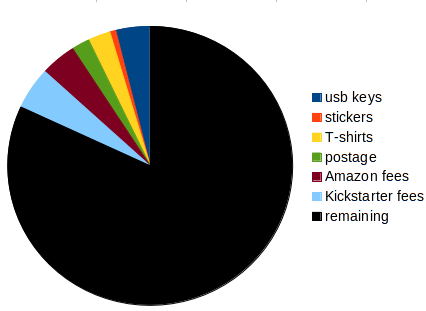
my Kickstarter pie (not including taxes)
While the Kickstarter was under way, several friends warned me that I might end up spending a lot of the money for rewards, or even shipping, and come out a loser. It's happened to some people, but I avoided it. Most of the pie went to its intended purpose.
USB key arrives in Amsterdam
I kept shipping cost low by shipping everything by US postal service, including Air Mail for international shipping. This was particularly important for the stickers (which cost $1.05 to ship internationally). But I also shipped USB keys in regular mail envelopes, protected by bubble wrap, which worked very well and avoided the bother of shipping packages. The USPS will be annoyed at you for a rigid letter and add a non-machinable surcharge, but it's still a nice savings.
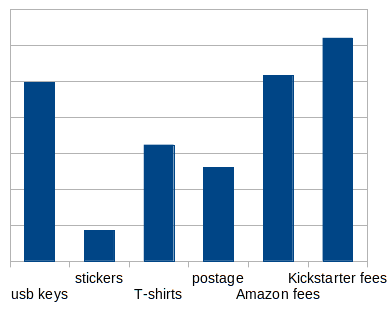
expenses
I spent more on rewards than on transaction fees, but the fees are still pretty large. Being dinged a second time by Amazon is the worst part. I have not been able to work out exactly what formula Kickstarter uses to determine its fee per pledge. It does not seem to be a simple percentage of the pledge. For example, they seem to have charged $0.25 per $10 pledge, but $25 for a $500 pledge. I wanted to solve this, but I'd have to match up all the pledges and fees manually to do it.
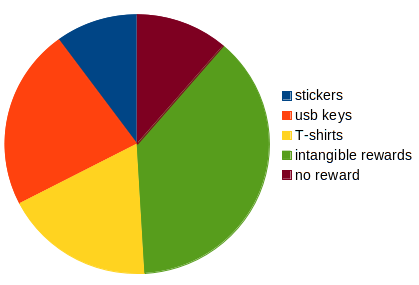
gross income by reward type
This chart is slightly innacurrate, because it puts any money pledged, beyond the amount needed to get a reward, into the "intangibles" category, despite the reward being probably responsible for that money being pledged. (The intangibles also includes people who did not ask for a reward, and several categories of rewards not involving shipping matter around.) But, the surprise for me is how large a peice the T-shirts are responsible for. It was my least favorite reward, and a low volume one, but I made out pretty well on it. However, I'd still try to avoid putting T-shirts on Kickstarter again. It's hard to do a good design (I didn't, really); they're expensive, and were by far the most annoying thing to ship. Also, I was not happy with the countries Cafe Press sourced their shirts from; I've been to Honduras and talked with people who have relatives in las machinas.
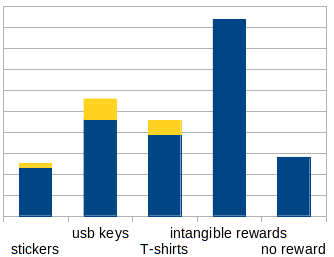
gross and net income by reward type (excluding shipping)
In contrast, the stickers had an amazing margin; they're so inexpensive to print that I printed up two kinds and included multiple with every other reward I mailed. I still have hundreds left over, too.. All the online print shops I tried have very annoying interfaces to upload artwork though. I had to do quite a bit of math to render TIFF files with appropriate DPI and margins. The USB keys were my favorite reward. I got them from USB Memory Direct, who gave me quite a nice deal. I was very happy that I was able to send them a SVG file of my artwork, so I didn't need to worry about lacking resolution for the laser engraving. And it came out looking great. The best part was when their sales guy Mike actually did a minor alteration of the artwork, to better fit on the key, when I, being overloaded with Kickstarter stuff asked him too. A bit above and beyond. There was an issue with their Chinese manufacturer's quality control of the 16 gb drives, but they were willing to send me replacement for all the ones I found problems with.
All told I spent probably 3 full days stuffing and shipping envelopes, and probably spent a week working on Kickstarter reward fullfillment. As work-related overhead goes, that's not bad. Maybe someone considering a Kickstarter will find this information useful somehow. Oh well, back to work. :)

20 February 2013

Daniel Pocock: Automatically mirroring SVN repositories to git and github

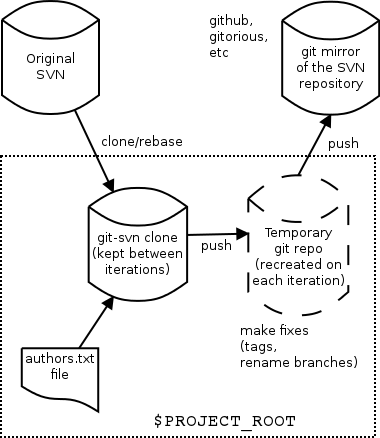
Updated 21 February 2013: the scripts below have now been adapted to run conveniently from cron and mirror multiple repositories. You can find full scripts and documentation on github There are a number of scripts around, including an earlier blog post of my own, for making a once-off conversion of an SVN repository to a Git repository. However, what if the project team is not yet ready for a full move to git? You may want to start benefiting from git (e.g. using the project as a submodule of another git project, or using Travis-CI.org for automated builds) while development officially continues to take place in SVN. If you don't need to make commits into git just now, you can set up a mirror and refresh it periodically from SVN. This process can be used with various SVN repositories, including Sourceforge and Google Code SVN repositories. Process overview
  • An authors.txt file is created manually before the first run.
  • A git-svn clone of the SVN repository is created. This clone needs to be retained between replication runs.
  • On each run, a temporary git repository is created. The svn-clone is rebased and pushed to the fresh git repository.
  • Fixes (e.g. branch renames and tagging) are made in the temporary git repository.
  • The final results are then pushed from the temporary repository to the real git mirror that is being maintained.
  • Finally, the temporary git repository is deleted, but the svn-clone is kept.
Here is a diagram of the workflow: Config file Here is a sample config file for the script, it mirrors the rather complicated reSIProcate repository with 10,000 commits:
PROJECT_ROOT=/home/daniel/svn-mirror/resiprocate
AUTHORS_FILE=$ PROJECT_ROOT /authors.txt
SVN_REPO=https://svn.resiprocate.org/rep/resiprocate
SVN_LAYOUT="--trunk=main --branches=branches --tags=tags"
GIT_REPO=git@github.com:resiprocate/resiprocate.git
Of particular note here:
  • The $PROJECT_ROOT is where the svn-clone and the temporary repositories will be created
  • $GIT_REPO is the final destination repository. For testing, it could just be a local directory initialised with git init --bare .
  • In this repository, our trunk is actually called main, hence we have the layout argument --trunk=main. Many projects would just use --trunk=trunk
The script The script itself is below. I'd suggest running it manually a few times first and observing how it behaves, disk space requirements, etc.
#!/bin/bash
set -e
if [ ! $# -eq 1 ];
then
  echo "Usage:"
  echo "$0 <config-file>"
  exit 1
fi
CONFIG_FILE="$1"
. "$ CONFIG_FILE "   exit 1
SVN_CLONE="$ PROJECT_ROOT /svn-clone"
GIT_BARE="$ PROJECT_ROOT /git-bare-tmp"
if [ ! -d "$ PROJECT_ROOT " ];
then
  mkdir -p "$ PROJECT_ROOT "
fi
cd "$ PROJECT_ROOT "
if [ ! -d "$ SVN_CLONE " ];
then
  git svn clone \
    "$ SVN_REPO " \
    -A "$ AUTHORS_FILE " \
    $ SVN_LAYOUT  \
    "$ SVN_CLONE "
  cd "$ SVN_CLONE "
else
  cd "$ SVN_CLONE "
  git remote rm bare   echo "failed to delete remote:bare, proceeding anyway"
  git svn rebase \
    --fetch-all \
    -A "$ AUTHORS_FILE "
fi
git remote add bare "$ GIT_BARE "
git config remote.bare.push 'refs/remotes/*:refs/heads/*'
if [ -d "$ GIT_BARE " ];
then
  rm -rf "$ GIT_BARE "
fi
mkdir -p "$ GIT_BARE "
cd "$ GIT_BARE "
git init --bare .
git symbolic-ref HEAD refs/heads/trunk
cd "$ SVN_CLONE "
git push bare
cd "$ GIT_BARE "
git branch -m trunk master
git for-each-ref --format='%(refname)' refs/heads/tags   \
   cut -d / -f 4   \
   while read ref;
   do
      git tag "$ref" "refs/heads/tags/$ref"
      git branch -D "tags/$ref"
   done
git remote add origin "$ GIT_REPO "
git config branch.master.remote origin
git config branch.master.merge refs/heads/master
git push --tags origin master
git push --all
rm -rf "$ GIT_BARE "
</config-file>
AttachmentSize
svn-mirror.png32.65 KB

Daniel Pocock: Automatically mirroring SVN repositories to git and github

Updated 21 February 2013: the scripts below have now been adapted to run conveniently from cron and mirror multiple repositories. You can find full scripts and documentation on github There are a number of scripts around, including an earlier blog post of my own, for making a once-off conversion of an SVN repository to a Git repository. However, what if the project team is not yet ready for a full move to git? You may want to start benefiting from git (e.g. using the project as a submodule of another git project, or using Travis-CI.org for automated builds) while development officially continues to take place in SVN. If you don't need to make commits into git just now, you can set up a mirror and refresh it periodically from SVN. This process can be used with various SVN repositories, including Sourceforge and Google Code SVN repositories. Process overview
  • An authors.txt file is created manually before the first run - see my other blog entry for convenient scripts to help generate authors.txt
  • A git-svn clone of the SVN repository is created. This clone needs to be retained between replication runs.
  • On each run, a temporary git repository is created. The svn-clone is rebased and pushed to the fresh git repository.
  • Fixes (e.g. branch renames and tagging) are made in the temporary git repository.
  • The final results are then pushed from the temporary repository to the real git mirror that is being maintained.
  • Finally, the temporary git repository is deleted, but the svn-clone is kept.
Here is a diagram of the workflow: Config file Here is a sample config file for the script, it mirrors the rather complicated reSIProcate repository with 10,000 commits:
PROJECT_ROOT=/home/daniel/svn-mirror/resiprocate
AUTHORS_FILE=$ PROJECT_ROOT /authors.txt
SVN_REPO=https://svn.resiprocate.org/rep/resiprocate
SVN_LAYOUT="--trunk=main --branches=branches --tags=tags"
GIT_REPO=git@github.com:resiprocate/resiprocate.git
Of particular note here:
  • The $PROJECT_ROOT is where the svn-clone and the temporary repositories will be created
  • $GIT_REPO is the final destination repository. For testing, it could just be a local directory initialised with git init --bare .
  • In this repository, our trunk is actually called main, hence we have the layout argument --trunk=main. Many projects would just use --trunk=trunk
The script The script itself is below. I'd suggest running it manually a few times first and observing how it behaves, disk space requirements, etc.
#!/bin/bash
set -e
if [ ! $# -eq 1 ];
then
  echo "Usage:"
  echo "$0 <config-file>"
  exit 1
fi
CONFIG_FILE="$1"
. "$ CONFIG_FILE "   exit 1
SVN_CLONE="$ PROJECT_ROOT /svn-clone"
GIT_BARE="$ PROJECT_ROOT /git-bare-tmp"
if [ ! -d "$ PROJECT_ROOT " ];
then
  mkdir -p "$ PROJECT_ROOT "
fi
cd "$ PROJECT_ROOT "
if [ ! -d "$ SVN_CLONE " ];
then
  git svn clone \
    "$ SVN_REPO " \
    -A "$ AUTHORS_FILE " \
    $ SVN_LAYOUT  \
    "$ SVN_CLONE "
  cd "$ SVN_CLONE "
else
  cd "$ SVN_CLONE "
  git remote rm bare   echo "failed to delete remote:bare, proceeding anyway"
  git svn rebase \
    --fetch-all \
    -A "$ AUTHORS_FILE "
fi
git remote add bare "$ GIT_BARE "
git config remote.bare.push 'refs/remotes/*:refs/heads/*'
if [ -d "$ GIT_BARE " ];
then
  rm -rf "$ GIT_BARE "
fi
mkdir -p "$ GIT_BARE "
cd "$ GIT_BARE "
git init --bare .
git symbolic-ref HEAD refs/heads/trunk
cd "$ SVN_CLONE "
git push bare
cd "$ GIT_BARE "
git branch -m trunk master
git for-each-ref --format='%(refname)' refs/heads/tags   \
   cut -d / -f 4   \
   while read ref;
   do
      git tag "$ref" "refs/heads/tags/$ref"
      git branch -D "tags/$ref"
   done
git remote add origin "$ GIT_REPO "
git config branch.master.remote origin
git config branch.master.merge refs/heads/master
git push --tags origin master
git push --all
rm -rf "$ GIT_BARE "
</config-file>
AttachmentSize
svn-mirror.png32.65 KB

Next.

Previous.