Search Results: "ron"

4 May 2010

Alastair McKinstry: EGU 2010 - Monday

I'm at the European Geosciences Union (EGU) General Assembly, 2010, the biggest gethering of European geoscientists, in Vienna, May 2-7. This is my first time here and its huge: over 9000 participants. Merely finding the talks and posters is a challenge (they supply a USB stick with the abstracts and agendas as they can't print them all! The first day I spent mostly at the exoplanet stream (and putting up my own poster). Some neat stuff on show: summaries by Borucki on Keplers findings (on the Hot Jupiters they found :" these things glow like a blast furnace; forget life"). He points out that when they look for Earth sized planets, radial velocity confirmation would take 1000s of hours on 10M telescopes - so it won't happen. hmm. Steve Unwin on SIM: neat astrometric mission for planet hunting and galaxy measurement. A targeted mission list, unlike the Gaia survey; to fly in 2016 if the Decadal survey says yes. 20% of time available under the general observer program, so get proposals ready ? Nestest poster idea: Anomalous night-time temps on Mars, Gonzales et al.. Finding hot spots on Arsia Mons, a volcano. Explained by air rising from 100km long lava tubes. We've seen pit entrances to caves on Mars with HiRISE, etc. here they model heat output from a pit entrace/exit and imply 100km caves. Oh to go exploring... Tinetti points out that we lack proper spectra, both experimental and theoretical, for high temperature and pressure gases such as methane, etc. Hmm, I know a group in Galway that might be able to help ... Helmut Lammer raised an interesting point at the poster session, that many groups ignore the stellar wind when looking at H2 atmospheres around exoplanets. Theis grossly inflates the apparent H2 atmosphere. Without taking this into acount it would be easy to mistake H2 detections with a Neptune-like atmosphere. He points to a 1.7M UV telescope that the Russians are planning to launch that would help do UV measurements when Hubble is gone. Lena Noack gave a talk on convection in tidally-locked planets (with related poster Low-lid formation on Super-Earths and implications for the habitability of Super-Earths and Sub-Earths). They argue that no covection can be expected in the mantle, and hence no geodynamo or magnetosphere. This could be a problem for holding an atmosphere. Time to check for planetary magnetic fields. Break out the polarimeter ? Oh, and it seems that That Damned Volcano is closing Irish airspace on Tuesday. Might be an idea to go to the meeting about it. Hope it clears by Friday ... Tags ,

3 May 2010

Matthew Garrett: PCI power management problems

I've previously written about some of the implementation details of runtime PCI power management. One of the key aspects for PCI devices is that the PME line on the device be able to generate a wakeup event. Unfortunately, it turns out that since Windows makes no use of this functionality at present, some vendors have started failing to wire this up. This is problematic because the device itself still announces PME support and will even raise a PME signal when it gets woken up - but it's pretty much screaming as hard as it can and nobody's listening because somebody's replaced the air with cheese.

Bother, etc.

The obvious question is what to do next. We could poll all the PCI devices every second or so to see if there's a PME status register that's been set. This would be reasonably cheap (we're going to wake up at least once a second on x86 anyway, so it makes no real difference to power consumption) but would introduce obvious latency in the wakeup path. This would be fine for certain types of situation (you're probably not going to be too sad if your SD reader takes a second longer to notice a card insertion) but not others (if an sdio wireless card generates a wakeup interrupt then we really ought to do something about it in a more sensible timeframe). A second is to force users to pass a boottime argument to enable this at all. That kind of sucks.

The third possibility is limited to a subset of hardware, but does allow the introduction of some kind of elegance into what would otherwise be one of those nightmarish scenarios that makes me consider taking up farming instead. If we can trigger a PME ourselves then we can test whether the line is connected. This doesn't appear to be possible on SDHCI but the spec for firewire makes it look like we can do it there - one of the interrupt sources is the port enable/disable register, and we can hit toggle that ourselves. I haven't actually tested this yet, but if it works that would let us make this determination.

It's depressing that doing anything interesting with power management is still heavily determined by what Microsoft have bothered to implement - to the extent that on some machines (hello, Thinkpads) there are no GPE methods at all for PME signals and you don't get runtime power management at all. The only thing that saves us is that (a) it's pretty hard to be able to screw up stuff that's already all glued into one chip package, so integrated stuff like USB should be fine anyway, and (b) PCIe does this as part of the normal traffic stream so there's no way to get that wrong. Unless you're still missing the GPE methods for the signals (hello, Thinkpads) in which case you get nothing unless the native PCIe signalling works. I suspect that we can always force that, so there's some hope yet.

In summary, then: dispassionate.

Russell Coker: Flash, Apple, and Linux

Steve Jobs has published an interesting article about Flash [1]. He criticises Flash for being proprietary, this seems a little hypocritical coming from Apple (who s the only competitor for Microsoft in terms of being the most proprietary computer company) but is in fact correct. Steve advocates HTML5 which is a better technical solution to a lot of the things that Flash does. He claims that Apple users aren t missing out on much, but I think that sites such as Physics Games [2] demonstrate the benefits of Flash. I think that Apple s attack on Flash is generally a good thing. HTML5 web sites will work everywhere which will be a good incentive for web designers to fix their sites. I also think that we want to deprecate it, but as it s unfortunately popular it s useful to have tools such as GNASH to use Flash based web sites with free software. Microsoft has belatedly tried to compete with flash, but it s Silverlight system and the free but patent encumbered Linux equivalent Moonlight have very little content to play and will probably disappear soon. As an aside the relentless determination of GNOME people to force the MONO project (including Moonlight) on it s users convinced me to remove GNOME from all systems that I run. OS News has a good analysis of the MPEG-LA patents [3] which are designed to prevent anyone making any commercial use of H.264 which includes putting such videos on sites that contain Google advertising! These patent terms are so horrible that they want to control video streams that were ever encoded with them, so you can t even transcode a H.264 stream to an open format without potentially having the scum at MPEG-LA going after you. This is worth noting when examining Apple s actions, they support MPEG patents and therefore seem happy to do anything that reduces the freedom of their customers. Apple s 1984 commercial has been proven to be a lie, it s Apple that wants to control our freedom. Charles Stross makes some good points about the issues related to Apple and Flash [4]. He believes that it s all part of an Apple push to cloud computing and that Apple wants to own all our data at the back-end while providing a relatively reliable front-end (IE without all the anti-virus nonsense that is needed on the MS-Windows platform. Cloud computing is a good thing and I can t wait for the Linux support for it to improve, I support a number of relatives who run Linux and it would be a lot easier for me if they could have the primary storage for everything be on the cloud so that I can do central backups of user data and they can use their own data while visiting each other. I think that a network filesystem that is similar in concept to offline-IMAP would be a really good thing, I know that there are some filesystems such as AFS and CODA that are designed for wide area network use with client-side caching but as far as I am aware they aren t designed for the type of operation that offline/caching IMAP supports. Matt Brubeck has given a good status report of the work porting Firefox to Android [5]. He notes that the next version of Fennec (mobile Firefox) will have Electrolysis the Firefox one process per tab feature that was first implemented in Google Chrome [6]. I think that the development of Fennec and the one process per tab feature are both great developments. Matt also says One of my personal goals is to make Firefox compatible with more mobile sites, and to give web developers the tools and information they need to make their sites work great in mobile Firefox. I ll write much more about this in future articles , that sounds great, I look forward to the results of his coding and to reading his blog posts about it!

2 May 2010

Dominique Dumont: Improve config file upgrades Ep 01

Hello The GSoC project Krzysztof and I are working aims to facilitate configuration upgrade during package upgrades. Most of the cases, this upgrade should not require any input from the user, even if the user had previously customized his configuration file. Currently configuration upgrade may ask questions to the user which may be hard to answer for most non-technical users. For more details see PackageConfigUpgrade on Debian wiki. (If you are not familiar with upgrade issues, you might want to read this page.) At the 2 extremes of upgrade tools, we have: Each tool has its own advantages and drawbacks. On the plus side of diff3 tools : On the other hand, here are the issues with diff3 based tools: For more details on diff3 issues, see Benjamin Pierce s paper (thanks to David Lutterkort from Augeas for the info) On the other end of the spectrum, Config::Model pros are: But, Config::Model main problem is: diff3 tools is lackluster for users. While Config::Model puts too much strain on packagers because it requires configuration models where all parameters are defined and declared in the model. For fast evolving projects, this can be a huge recurrent task (been there, done that for Xorg) . (Well, this recurrent task is a problem until doc, implementation and config model can be extracted from a single meta-description But I digress, this may be a project for GSoC 2011 :-p ) So, this GSoC project (for 2010) aims to find a compromise between these 2 extreme cases. On Config::Model, I ve always had a drawer statement whenever I was asked why Config::Model does not handle unknown parameter:
a configuration file cannot be validated if an unknown parameter can t be distinguished from a user typo.
This stance is fine for casual user interaction on a stable system: an unknown parameter is most likely an error. And the user must be warned of his error as soon as possible. For a stable distro release, packagers should have the time to provide complete models, so basing upgrade on complete models should be possible (famous last words ?). On the other hand, a lot of configuration upgrades will be done on unstable systems where software evolve quite fast, where models will likely fall behind software evolutions. Another shorcoming of my drawer statement is that it assumes user interaction where erroneous input is more likely. In case of configuration upgrades, there should be no user interaction. And we can assume that the config file to be upgraded was used (and thus validated) by the old version of the software. So unknown parameters should be tolerated and managed as best as possible. Now, the big question is: how ? In all attempts I ve seen in managing upgrades that goes beyond diff3 tools, the configuration is stored as structured data. Sometimes this structure can be infered from the configuration file syntax (shell vars, INI files, YAML, XML), sometimes not (sshd config file). In the latter case, some structural knowledge must be built in the upgrade tool. Currently, Config::Model is designed to bring a complete description of the structure and semantics of a configuration file. This is perceived as bringing too much structural and semantic knowledge ( too semantic ). So the maintenance cost is perceived as too important. That may be right or wrong, but that does not matter. Perception is more important here. So, let s figure out a way to reduce the amount of work required to perform upgrades (you may want to read a little bit more on configuration model creation before going on ) One possibility would be to support configuration models that allow unknown leaves in nodes. Such a model would provide a kind of fallback leaf description. Something like: this parameter is unknown, let s assume it s a simple string value . Let s consider sshd_config example to see how such a behavior would pan out for some upgrade scenarios. sshd model is made of 2 main classes:
- Sshd
- SshdMatchElement The second one contains all parameters allowed in a Match class (in fact, Match parameter is the only one in sshd that defines a new hierarchical level. All other parameters are simple leaves). Now let s consider typical upgrade scenarios from old version (with old models) to a more modern version. Let s assume that the model is lagging behind and the model does not follow sshd evolutions. So Config::Model will face 3 upgrade cases (extracted from sshd config history):
  1. Unexpected parameter that are actually simple leaf parameters. E.g. introduction of ClientAliveInterval.
  2. Obsolete parameters that should be migrated. E.g KeepAlive is renamed into TCPKeepAlive
  3. New structural parameters (introduction of Match element)
So what would happen with a model allowing unknown parameters but lacking specific instructions for these upgrades:
  1. ClientAliveInterval value would be kept. :-)
  2. KeepAlive would be kept as is.TCPKeepAlive would also be kept. No migration is performed, but the configuration would be good. As long as sshd supports the old parameter, we re good. :-/
  3. Without knowledge of the structure brought by Match parameters, Config::Model would consider that parameter in Match block would duplicate parameters in the main block and remove the duplicate. User data may be lost. :-(
So, there s not silver bullet. Let s resume what we ve learnt: Next step is to figure out what would happen if the same strategy is applied to other types of configuration files. But that will be for another blog. All the best

Julien Blache: forked-daapd: now with AirTunes v2 streaming

I ve been working on this for a few months now; it s taken quite some time because I wanted to do it right and deliver something better than what already existed in the OpenSource world as far as that particular technology was (not) concerned. So here it is:

AirTunes v2 UDP streaming forked-daapd can now do streaming to multiple AirTunes devices (as well as the local soundcard) and can be controlled from Remote (and, ideally, from anything that speaks DACP). I m releasing this early while the paint is still wet and not everything works on the DACP-side of things. Case in point, while playing a song or an album is supported, playing a playlist isn t. There s some work needed on this particular feature, and it ll get there eventually. There have been a couple of other changes in the codebase in recent weeks too; details after the jump. Implementing AirTunes v2 has been quite fun and, in addition to releasing the forked-daapd code today, I ve also taken the time to write down my findings about the protocol so others can experiment with it. This documentation is by no means exhaustive nor complete as far as the protocol goes; if you find out anything I haven t, let me know so I can update this document. Let s review the recent changes in the forked-daapd codebase over the past few weeks. AirTunes v2 You can now use Remote from your iSomething together with your AirTunes devices and forked-daapd to listen to your library. As mentioned above, playing a playlist is not supported; I have a few things to sort out before this can work and I suspect this will bring changes not only to the DACP interface but also to other parts of the code. So, stay tuned. forked-daapd supports synchronized playback to multiple AirTunes devices together with the local soundcard if so desired. You can expect the AirTunes devices to be in sync with each other, but the soundcard will usually run in circles around them. It looks like AirTunes plays sound a bit slower than 44.1 kHz; not a big deal, though, as AirTunes will catch up periodically and the desync, while it can be noticeable, isn t big (ie we re not talking seconds, not even one full second). Make sure your network can handle the load, as streaming to a single AirTunes device requires in excess of 1.6 Mbps (1.8 Mbps is actually closer to the real thing). Local audio output is supported via ALSA and OSS4, although note that the OSS4 code hasn t been very well tested. I intend to test and debug it fully at a later date, but feel free to beat me to it and send patches. Also note that, while there is code for FreeBSD in the player/streaming part of forked-daapd, it doesn t work well at all. The streaming code needs a timer with a higher resolution than kqueue/kevent has to offer, and I haven t found anything as capable as timerfd. So it s there, but it s broken. Read on about FreeBSD support. Metadata scanning Several fixes and enhancements have been made to the filescanner so it picks more and better metadata. Format-specific tagnames have been added to work around ffmpeg s limitations. Using a recent enough ffmpeg version (anything after mid-december 2009) will work best, especially for MP3 files. SQLite concurrency fixes The database code has been reworked to handle concurrency on the database. Issues with locked tables (or the whole database) were noticed pretty easily with big libraries when accessing forked-daapd during the library update after startup. On uniprocessor machines, this was even easier to hit. This, however, comes with new requirements for SQLite3: you ll now need SQLite3 v3.5.0 at least and it must be built with the unlock notify API enabled. Not all distributions ship SQLite3 with the unlock notify API enabled, so you may need to do a rebuild. Debian, for instance, doesn t; this is #579266. A word about FreeBSD support I m giving up on FreeBSD support. The streaming code doesn t work on FreeBSD due to timer issues, and I don t intend to fix it. I also don t intend to invest much time in porting future features to FreeBSD; if I can make it work, then fine, otherwise, too bad. Someone needs to step up if there s interest in having forked-daapd work on FreeBSD.

Russell Coker: Lexmark Supposedly Supports Linux

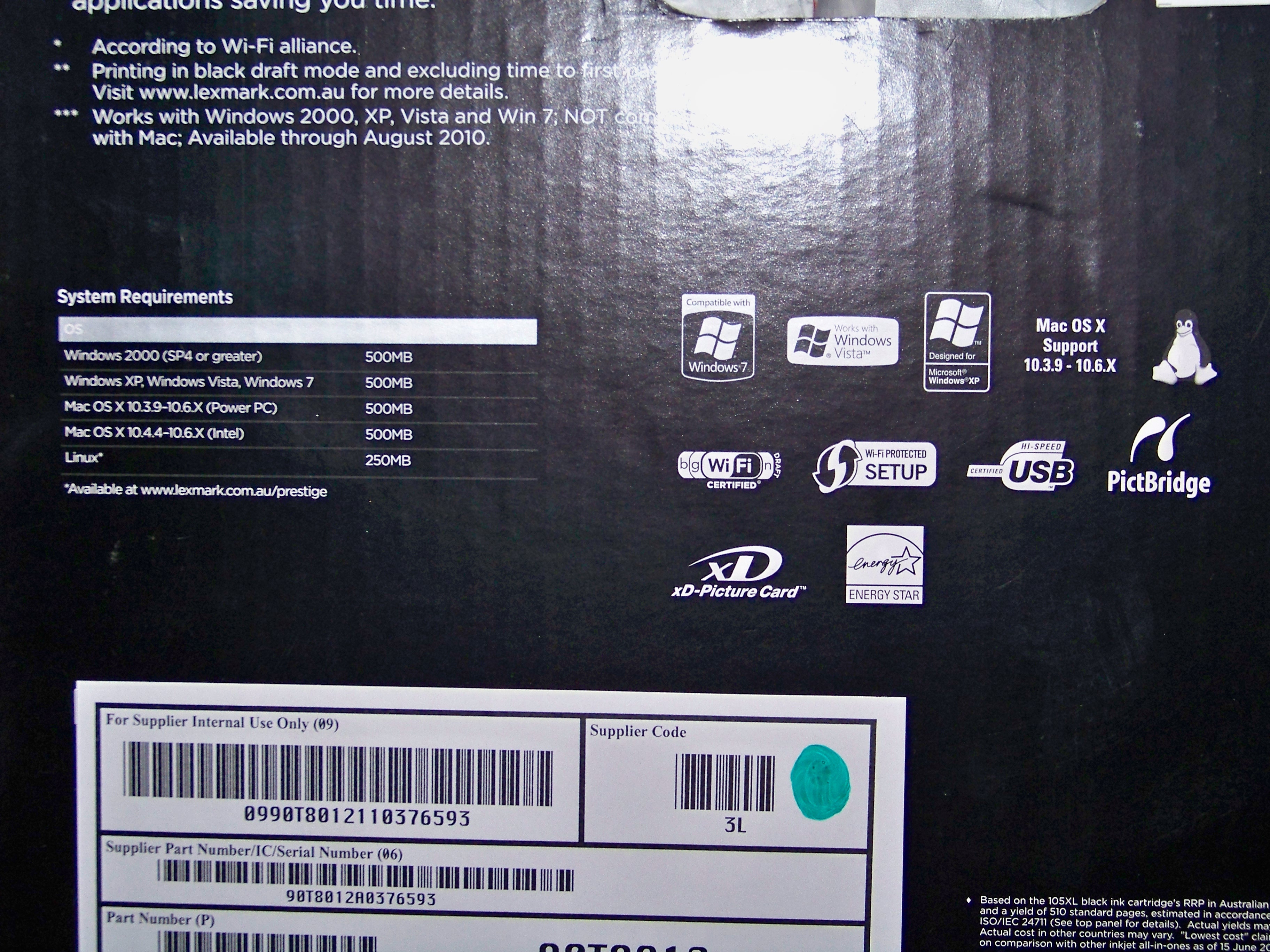
I wanted to get a Lexmark Prestige Pro805 printer to work under Linux, due to bad drivers from Lexmark and no driver support in Debian/Unstable I ve given up and advised the people who purchased it to return it for a refund. I recommend that Lexmark not be considered when purchasing a printer for use with Linux. The box advertises the URL http://www.lexmark.com.au/prestige for downloading Linux drivers. The driver file is named lexmark-inkjet-09-driver-1.5-1.i386_ts.deb.sh.tar.gz which makes anyone expect a tar.gz archive of a shell archive of a Debian package. But that s not what it is at all, in Lexmark-land deb is not the file name extension for a Debian package, but just a random bit of text to identify a file that is somewhat related to Debian, the fact that the Linux driver for Ubuntu/Debian Package Manager based distros doesn t use the string ubu in it s name is something that would lead a typical Linux user to believe that deb means a Debian package. Similarly the file named lexmark-inkjet-09-driver-1.5-1.i386_ts.rpm.sh.tar.gz and described as Linux driver for RedHat Package Manager based distros is not actually an RPM package or inherently for RPM based distros, it s just a shar archive that is built and tested for some unspecified version of some Red Hat distribution (RHEL? Fedora? SUSE?). Now when I execute lexmark-inkjet-09-driver-1.5-1.i386_ts.deb.sh on an AMD64 version of Linux it opens an X11 window, prompts for the root password, and then fails because an i386 Debian package that it somehow built couldn t be installed. When I ran the shar archive with the options --noexec --keep and examined the files it contained it has a few AMD64 executables so obviously the software they used to create the installer has some support for AMD64 but they just decided not to use it. It seems that the only way to buy an i386 system nowadays is to buy an embedded system or a NetBook, all Desktops, laptops, and servers run the AMD64 architecture, as most people do a Linux install that matches the full capabilities of their system (IE running AMD64 software on an AMD64 CPU) that means most systems sold in the last few years can t be used with a new Lexmark printer without an unreasonable amount of work. Sure it is possible to setup a chroot environment or KVM virtual machine for running printer drivers, but I don t really want to do that and a significant portion of the potential customers don t have the skill needed to do so. While technically their claims about having Linux driver support are correct (they support some distributions of Linux on i386), the majority of new systems won t work with it unless someone who has good skills spends some time and effort on it. Probably the majority of Linux Desktop and server systems that are in use today use AMD64 and are run by people who don t know how to setup a chroot so therefore for most real installations it s not supported. Even for i386 systems installation is unlikely to be trouble-free, when they support RPM based distributions (without identifying which of the many wildly different RPM systems they tested on) and Debian (without mentioning a version number) it seems that the incidence of people running a distribution that is supported is going to be quite low. Lexmark uses the Linux logo to claim compatibility Based on this experience I am not inclined to trust Lexmark in future, I will not trust any future claims of Linux support that they may make. The above picture of the Lexmark box shows Tux (the Linux logo), it doesn t mean support out of the box as you would hope, but instead means support for old systems with some effort.

30 April 2010

Biella Coleman: Baby Panda wants YOU to submit to DEBCONF


bad mood destroyer, originally uploaded by the biella.
People s the deadline is fast approaching. Don t worry though, the best ideas come under deadlines and your proposal need not be lengthy. So get those typing hands out and submit a proposal (a few sentences suffices) for a presentation! The annual Debian conference is being held in NYC this year. First time
setting foot in the imperial empire. Are you doing something related to
free software that might be interesting to share, show off or talk about
at Debconf? I bet you are! We are looking for art installations,
performances, movie screenings, maybe you are wanting to host a
roundtable/panel discussion, coordinate a workshop (you dont have to
know the subject deeply to do this!). I know the deadline is soon, but don t let that scare you. The
submission requirement bar is very low, and we are flexible! here is the submission information: [1] ********************* Calling all potential contributors to DebConf10! One more week until
the final submission deadline! The DebConf team is excited to announce that we are now accepting
proposals for contributions to this year s Debian conference! We
invite you to submit proposals for how you would contribute until the
deadline: soon There are many ways you can contribute, you could present a technical
paper, host a panel discussion, put on a tutorial, do a performance,
an art installation, a debate, host a meeting (BoFS, or Birds of a
Feather Session), or other possibilities that you devise. This year we
are also accepting proposals for tracks=E2=80=94a thematic grouping around a
particular subject, and people to coordinate those tracks. If you are
looking for ideas of things that you could contribute, or have ideas
for things that you would like to see happen at DebConf, have a look
at the Contribution Brainstorm[0] page. DebConf talks will be broadcast live on the Internet where possible,
unless otherwise requested. Videos of the talks will be published on
the web along with the presentation slides and papers. =3D=3D Step 1. Submit Proposal =3D=3D Proposals should provide an overview of your proposed contribution,
similar to an abstract, and be no more than 600 words. Since
contributions can cover a range of issues, please describe what your
proposal covers, be it political (Free Software, law, advocacy,
access, etc.), technical (d-i, OpenPGP, etc.), social (Debian
structures and groups). It s okay to hit all three of these. Your
proposal should also include some information on why you re qualified
to present, or coordinate this topic. For example, you can include
links to posts you have made to Debian mailing lists or other material
that indicates your qualifications. Proposals and their abstracts will
be accepted until May 1st, 2010, 23h59 UTC. To submit your proposal, go to Penta[1] and register as an
attendee. Once you are registered, there is a Submit a proposal
link. You will see your proposal on the site. You can choose between
different presentation types. If you are unsure what type you should
use, please read our glossary of definitions[2]. If it s not there for
some reason, or you have questions, please contact us immediately at
mailto:talks@debconf.org. =3D=3D Step 2. Committee Review =3D=3D The review committee for this year will make its decision by May 1st,
2010. All correspondence will be done by email. =3D=3D Step 3. Paper Submission =3D=3D Like last year, we are asking for papers to be submitted along with
the presentations. A full paper is optional, however we strongly
encourage you to submit one if possible as we intend to provide
written information along with transcripts of the sessions for later
viewing. Having written papers in advance will allow us to get
translations done to help non-native-English speakers feel more
comfortable with the topics presented. Papers are due by July 1st,
2010, and should cover the topic in reasonable depth (3 pages A4 text,
plus pictures and diagrams). We will use LaTeX to typeset the
proceedings. Please submit your paper formatted in LaTeX. Should you
be unfamiliar with LaTeX earlier submission in plain text is also
fine. =3D=3D Step 4. Live Presentation =3D=3D Longer presentations may have a break in the middle and should include
workshop items that directly involve the participants. If using slides
or any other presentation, please consider that your audience will
consist of people who use free software, and your choice of
application to prepare and display the slides should reflect this if
at all possible. =3D=3D Fine Print Publication Rights =3D=3D DebConf requires non-exclusive publication rights to papers,
presentations, and any additional handouts or audio/visual materials
used in conjunction with the presentation. The authors have the
freedom to pick a DFSG-free license for the papers themselves and
retain all copyrights. The presentations will be recorded, and may be
broadcast over the Internet. Any copies of the presentation will be
made available =3D=3D Failure to Submit =3D=3D In the event that a deadline is missed we reserve the right to revoke
any offer to present. =3D=3D About DebConf =3D=3D The annual DebConf conference is a technical and social forum for
Debian developers, sponsors, affiliates, and friends. It allows
various groups within Debian a chance to come together, network, and
share their work. Until we see you in the big city,
DebConf Talks Team [1] introduction written by Micah Anderson

Asheesh Laroia: Mailing lists can wait

Most of my email comes to me via mailing lists. When someone asks a question or starts a discussion, I used to jump at the chance to be the first to reply with an answer. I don't want to unsubscribe; often, I know something that can move the conversation forward or help someone out. But I'm trying to allocate more time for myself away from computing these days. So now I let these discussions mature a little before I see them. All mailing list messages are delivered to a folder called OneDayDelayed. Every night, my server moves those messages to my INBOX. If someone else has already contributed what I would have, perfect! If not, I still have a chance to participate. Sometimes, if I have a long backlog of email, I disable that cron job, sometimes for up to two weeks. Being able to turn the cron job on and off really helps; when I have time to deal with mailing lists, I do. Otherwise, I know the messages will be there when I do have time. Since this OneDayDelayed change, I've gained have a sense of calmness and distance from them. I like that. (Note that if you add me to the CC: line of a mailing list thread, I will see your message immediately, for better or for worse.)

Russell Coker: Link Within

Good Things about LinkWithin For the last 10 weeks I ve been using the LinkWithin.com service to show links to other blog posts at the end of each post (the links are only shown to visitors of my blog not in the RSS feed, so people who read my posts through RSS syndication will miss this). The service shows excerpts of pictures from my blog at the bottom of each post to entice readers into reading other posts. When you click on a LinkWithin icon on my blog you visit a LinkWithin page that redirects you back to my page, so people who use that show up as new visitors being referred by LinkWithin. Currently this month LinkWithin is the fourth highest referrer to my blog, below Google, Reddit, and WebWombat.com.au so it is clearly doing some good in enticing people to read other posts that they might not otherwise read! Bad Things about LinkWithin The first problem with LinkWithin is that the Wordpress plugin was written by people who don t know much about Wordpress. Unlike every other plugin I use it doesn t support configuration options for the user in the database but instead has it hard coded in the PHP code! When you download a plugin from their web site it creates a custom zip that includes the PHP code automatically generated just for you! I have some friends using the same web server as me for running blogs, and I have to tell them you can install any plugin apart from LinkWithin it works for no-one but me . The next problem is that LinkWithin advertises that it will display related posts, it seems to be doing a poor job of that on my blog although admittedly only a minority of my blog posts have pictures so this limits what it has to work with. This has however inspired me to use more pictures in my posts. Another problem is that it produces web pages that are not valid XHTML, the following patch fixes this. --- /tmp/linkwithin.php 2010-02-22 02:09:47.000000000 +0000
+++ ./wp-content/plugins/linkwithin/linkwithin.php 2010-02-22 02:17:29.000000000 +0000
@@ -15,7 +15,7 @@
global $post, $wp_query, $linkwithin_code_start, $linkwithin_code_end; $permalink = get_permalink($post->ID);
- $content .= '<div class="linkwithin_hook" id="'.$permalink.'"></div>';
+ $content .= '<div class="linkwithin_hook" id="'.str_replace('/','-',$permalink).'"></div>';
$content = linkwithin_add_code($content);

return $content;
@@ -26,13 +26,13 @@
global $post, $wp_query, $linkwithin_code_start, $linkwithin_code_end; if ($wp_query->current_post + 1 == $wp_query->post_count)
- $embed_code = '<script>
+ $embed_code = '<script type="text/javascript">
<!-- //LinkWithinCodeStart
var linkwithin_site_id = 151382;
var linkwithin_div_class = "linkwithin_hook";
//LinkWithinCodeEnd -->
</script>
-<script src="http://www.linkwithin.com/widget.js"></script>
+<script src="http://www.linkwithin.com/widget.js" type="text/javascript"></script>
<a href="http://www.linkwithin.com/"><img src="http://www.linkwithin.com/pixel.png" alt="Related Posts with Thumbnails" style="border: 0" /></a>';
$content .= $embed_code;
Finally LinkWithin shows up badly on the FireBug analysis (see my previous post about using Firebug to speed up my blog) [1] see the below picture for details. As an aside, given that Google recommend Firebug it is rather ironic that Google Adsense related URLs cover the majority of the Firebug issues that are not caused by LinkWithin. demonstration of how Linkwithin lowers my page speed What Next? I ve sent email to the LinkWithin people about all these issues other than the FireBug problem reports, given that they haven t responded to some suggestions for over 10 weeks it seems hardly worth my effort in informing them of other issues. I m thinking of trying OutBrain.com again. 18 monthe ago I tried OutBrain but never got it working due to technical issues and then forgot about it. It has some similar features and may work better at least it has tech support people who respond to queries!

Matt Brubeck: Fennec on Android: user feedback and next steps

Last month I joined Mozilla as a UI engineer on the Fennec (Mobile Firefox) project. Firefox is already available for Nokia's Maemo platform, and now a group of Mozilla programmers are porting it to Google's Android OS. This Tuesday they made an early preview build available for public feedback. Until now, the only people working on Firefox for Android were platform developers getting the back-end code to build and run. This week was the first time most other people including me got to try it out. We front-end developers and designers are now starting to adapt the user interface to Android. (The preview build used the look and feel of Firefox for Maemo, designed for rather different hardware and software.) Because we are an open source project, we like to share our work and hear your feedback even at this early stage of development. While I wasn't directly involved in the Android development effort, I spent some of my spare time this week talking to users via Twitter and our Android feedback group. Here's what I heard, in rough order of importance to users, plus some information on our future plans.1 We don't have a regular schedule yet for releasing new builds on Android. Once we get the code merged and automated build servers configured, we'll publish nightly builds of Firefox for Android alongside our Maemo and desktop nightlies. Later this year we will have alpha and beta versions, and hopefully a stable release. Until then, you can follow @MozMobile or Vlad (@vvuk) to hear about any new previews.

  1. Please remember I am still new to the project, and cannot speak for the whole team. This is a personal blog, not a Firefox roadmap!

Russell Coker: CPL Still Sucks

I previously described my experience with Computers and Parts Land (CPL) [1] who gave me a product that didn t do what I wanted (because they thought that they knew better than me) and then gave me attitude when I returned it. As it s almost a year since that incident I had to buy something else from them to use the credit note as I decided that it s not worth making a Trade Practices Act (TPA) [2] issue out of it. Thanks Tim for the suggestion though. Firstly I went to their new store that is advertised on their web site. The people at the new store refused to honor the credit note (they probably hoped that I would just let it go and give them an extra $60 in profit). Claiming that I need to take a credit note back to the store it came from is bogus. Anyway I went back to the original store and bought a new 1.5TB SATA hard drive which seems to work well enough. The service was really slow, I was the only customer in the store and there were several employees not doing much but it still took them ages to print a receipt and give me the hard drive. It will be the last CPL purchase I ever make. In the unlikely situation that there is ever any new gear that is only sold by CPL then I will wait a year and buy it on ebay. It would be good if someone started working as a TPA complainant. They would take donations from dis-satisfied customers who want to pay for an investigation of a shonky company (I d pay $10 for an investigation of CPL). When enough donations were collected they would buy some stuff and make a video of every interaction with the employees and then launch a private legal action under the TPA if they do anything wrong. The TPA complainant would get to keep everything that they buy, any excess donation money after proving the case, and any money offered by the company to settle law suits. While it s not a good use of my time and money to go after CPL directly it would be good to give some money to someone who would then see them dealt with properly.

Andrew Pollock: [tech] How to set up my Mustek 1200 UB Plus scanner under Linux

One for the note-to-self file... Strangely, it's labeled as a "Mustek 1200 UB Plus" on the unit itself, but lsusb says it's a "Ultima Electronics Corp. Artec Ultima 2000 (GT6801 based)/Lifetec LT9385/ScanMagic 1200 UB Plus Scanner" apt-get install xsane sane-utils http://www.meier-geinitz.de/sane/gt68xx-backend/ says I should be downloading sbfw.usb, which needs to go into /usr/share/sane/gt68xx Uncomment override "mustek-scanexpress-1200-ub-plus" in /etc/sane.d/gt68xx.conf adduser apollock scanner newgrp scanner scanimage -L should now report something like "device gt68xx:libusb:001:002' is a Mustek ScanExpress 1200 UB Plus flatbed scanner"

29 April 2010

Sylvestre Ledru: Google Summer of code at Scilab

First, a quick news. Scilab 5.2.2 has been released a few days and he now available in the Debian archive (Debian Unstable for now).
It is mostly a performance improvements and bug fixes release. See the changelog. Second, for a second year, Scilab is part of the Google Summer of Code v2010. I am admin (and also mentor) this year again.
Google just released the list of accepted students. We have 9 students (against 7 last year). 2 are working on experimental projects, the other should have a finished result by the end of the GSoC. Extends Scilab UI Control - Han Dong
Extension of Scilab User Interface construction (uicontrol) by providing more elements (tree, image display, etc). Simulink import in Xcos - Jerzy Zagorski
Importation of most of the Simulink schemas from Xcos. Cumulative distribution function improvements - Michael Zhang
Improvement and extension of the current cumulative distribution functions (CFD) into Scilab. Metanet and Boost.graph - Bal a Rai evi
Extension of the Metanet capabilities in term of graphs by Boost.graph SOAP Client/server - Artem Glebov
Making available from Scilab both SOAP client and server capabilities as an ATOMS module. Database module + fuzzySQL - Igor Gridchyn
Allow to access to most databases systems from Scilab. Based on this work, the FuzzySQL will be introduced, a SQL extension to allow flexible conditions in queries. Python import - Baozeng Ding
Introduction of a mechanism to load and use Python code (objects in particular) from Scilab. Experimental projects:
Use Eigen into Scilab - Joseph Fahnbulleh
Base some components of the Scilab core code on the Eigen library which is a state-of-the-art C++ linear algebra library. This work will be a joint mentoring between Ga l Guennebaud from the Eigen team and Scilab R & D team. Hybrid Automata module - Ievgen Ivanov
Provide a convenient environment for direct modeling of hybrid automata in Scilab/Xcos.

28 April 2010

Petter Reinholdtsen: Thoughts on roaming laptop setup for Debian Edu

For some years now, I have wondered how we should handle laptops in Debian Edu. The Debian Edu infrastructure is mostly designed to handle stationary computers, and less suited for computers that come and go. Now I finally believe I have an sensible idea on how to adjust Debian Edu for laptops, by introducing a new profile for them, for example called Roaming Workstations. Here are my thought on this. The setup would consist of the following: I believe all the pieces to implement this are in Debian/testing at the moment. If we work quickly, we should be able to get this ready in time for the Squeeze release to freeze. Some of the pieces need tweaking, like libpam-ccreds should get support for pam-auth-update (#566718) and nslcd (or perhaps debian-edu-config) should get some integration code to stop its daemon when the LDAP server is unavailable to avoid long timeouts when disconnected from the net. If we get Kerberos enabled, we need to make sure we avoid long timeouts there too. If you want to help out with implementing this for Debian Edu, please contact us on debian-edu@lists.debian.org.

Andrew Pollock: [life] 17 days

Getting close now. Sarah had another ultrasound yesterday, just to check things. Unfortunately I couldn't be there due to a self-inflicted scheduling screw up. Apparently you could see hair on the ultrasound, so I'm a bit bummed to have missed it. The baby has "dropped", so that's good. Her head's still down, and she's swallowing, so that's all good too. Weight-wise she's now in the 38th percentile. We're booked in for a C-section on the 14th, unless she comes of her own free will between now and then (which is what we'd prefer), in which case our OB will allow an attempt at a VBAC. Our OB is reluctant to allow the pregnancy to go past 39 weeks, given prior history and Sarah's heart, and they don't induce for VBACs, so it's going to require some planetary alignment to avoid a C-section. The whole heart thing still being an issue was only a fairly recent discovery for us. Sarah's cardiac surgeon had told us we could go forth and have as many kids as we wanted, but it turns out the fine print in that statement is that while the previous aneurysm has been repaired, she has an undiagnosed connective tissue disorder, so there's no telling what might happen with the rest of her aorta in the future. So her OB is just doing what a good high-risk OB should do, and being extra paranoid, on two fronts. So we've got a couple of weeks to try and convince our daughter to come more than a week and 2 days early. I don't think we have statistics on our side, unfortunately (although I had a surprisingly hard time finding concrete statistics on delivery dates relative to due dates for first-time deliveries versus subsequent deliveries).

Andrew Pollock: [life/americania] TransLink to become Clipper

No sooner do I discover it, and TransLink up and renames itself to Clipper. I wonder how much that exercise is going to cost? I'm also curious as to what they're going to do in terms of a new domain name. Ah, marketing:
Why is the name being changed? Now that the system is fully operational on five transit agencies - Muni, BART, AC Transit, Caltrain and Golden Gate Transit and Ferry - it is available to the majority of Bay Area transit riders. Giving the system a new name and logo helps make it more appealing to potential customers and also takes away any confusion with other local programs such as FasTrak, Fast Pass, as well as several other transportation programs around the world that are also named TransLink.
With Bay Area public transportation being woefully inadequate, I have to wonder if much of any adoption problems (which is what I presume they're trying to solve with this rebranding) are more a function of overall patronage?

27 April 2010

Matthew Garrett: Radeon reclocking

Alex released another set of Radeon power management patches over the weekend, and I've been adding my own code on top of that (Alex's patches go on top of drm-next, mine go on top of there). I've left it stress-testing for a couple of hours without it falling over, which tells me that it's stable enough that I can feel smug. This is a pleasing counterpoint to the previous experiences I've been having, which have been rife with a heady mixture of chip lockups or kernel deadlocks. It turns out that gpus are hard.

There's a few things you need to know about gpus. The first is that if they're discrete devices they typically have their own memory controller and video memory. The second is that there's an impressive number of ways that you can end up touching that memory. The third is that they tend to get upset if something tries to touch that memory and the memory controller is in the middle of reclocking at the time.

The first and most obvious use of video memory is by the gpu itself. Accelerated operations on radeon are carried out by sending a command packet to the command processor. This is achieved by sharing a ring buffer between the cpu and the gpu, with the gpu reading packets out of that ring buffer and performing the operations contained within them. Many of these operations will touch video memory (that being the nature of most things you want a gpu to do), and if that happens bad things occur. Like the card locking up and potentially taking your PCI bus with it.

So, obviously, we don't want that to happen. The first thing we do is take a mutex that blocks any further accelerated operations from being submitted by userspace. Then we wait until we get an interrupt from the gpu telling us that the display engine has gone idle. The problem here is that we don't have a terribly good idea of how many more operations there are to complete and we don't know how long each of those operations is going to take, but this is less bad than some of the alternatives[1]. Jerome Glisse has some ideas on how to improve this to require less waiting, but the effects should still be pretty much invisible to the average user.

So we've stopped the command processor touching ram. Everything's good, right?

Well, not really. The obvious problem is that users typically want to display something, so there's a separate chunk of chip that's repeatedly copying video memory over to your monitor. That's got to go too. Thankfully, there's a convenient bit in the crtc registers that lets us turn that off, but the pretty unsurprising downside is that your screen goes blank while that's happening. So we don't want to do that. Instead, we try to perform the reclock while there's nothing being displayed on the screen - that is, while we're in the screen region where a crt's electron gun would be scanning back from the bottom of the screen to the top. It turns out that rather a lot of display assumptions depend on this happening even if there's no crt, no electron gun and no thick sheet of glass with a decent approximation of vacuum behind it, so we get to do this even if we're displaying to an LVDS. And we have about 400-500 microseconds to do it - an almost generous amount of time.

So we ask the hardware to generate an interrupt when we enter vblank and then we reclock. Except the hardware has an irritating habit of lying - sometimes we get the interrupt a line or two before vblank, sometimes we get it after we've already gone out the other side. Vexing, and not entirely solved yet - so sometimes you'll still get a single blank frame during reclock. But there are plans, and they'll probably even work.

At this point the acceleration hardware isn't touching the memory and the scanout hardware isn't touching the memory. Except it still crashes under some workloads. This one took me longer to track down, but the answer turned out to be pretty straightforward. Not all operations are accelerated. When they're not accelerated they have to be done in software. That means that the CPU has to write to the video memory itself. I'm sure you can see where this is going. This was fixed without too much trouble once I'd finished picking through the driver to work out every location where objects might be mapped into the CPU's address space, at which point it's a simple matter of unmapping them and blocking the fault handler from remapping them until the reclock is finished. Linux, thankfully, has lots of synchronisation primitives. And now everything works.

Except when it doesn't. This took a final period of head scratching, followed by the discovery that ttm (the memory allocator used by radeon) has a background thread that would occasionally fire to clean up objects. And by clean up objects, I mean change their mapping - which means updating their status in the gart, which means touching video memory. So, let's block that. And that tripped me off to the fact that even if it couldn't submit new commands, the CPU could still create or destroy objects - with the same consequences.

So, once all of these are blocked, video memory is quiescent and we can do what we want. And we do, at least once I'd sorted out the bits where I was taking locks in the wrong order and deadlocking. Depending on the powerplay tables available on your card we'll chose different rates and so your power savings will vary heavily depending on the values that your vendor provided, but the card I'm testing on sees a handy 30W drop at idle. Right now we're only changing clocks and not dropping voltage so there's potentially a little more to come.

While getting this stable was pretty miserable, the documented entry points for clock changing made a lot of this easier than it would otherwise have been. It's also probably worth noting that Intel's clock configuration registers are entirely missing from any public documentation and the dirver Intel submitted to make them work in their latest chips appeared to have been deliberately obfuscated, so thanks to AMD for making all of this possible.

[1] It's possible to insert various command packets that either indicate when they've passed or stall until a register value gets updated, but these either cause awkward problems with the cp locking or mean that the gui idle functionality never goes idle, so they're not ideal either.

Ingo Juergensmann: Johan Schl ter: "Child pornography is great"

For many activists in net-politics it is apparent that the fight against child pornography is just an excuse for establishing a EU-wide content filtering infrastructure. This infrastructure for content filtering can be used to filter other content than child pornography as well. For example politicians in Germany already requested blocking gambling sites, Nazi sites, left extremistic political sites and others, when we had that kind of discussion last year over here. The proposal of a law putting up stop pages in front of child pronography sites by former minister for family Ursula "Zensursula" von der Leyen passed the parliament, but shortly after last years parliament elecetion all political parties didn't want that law anymore.
EU commissioner Cecilia "Censilia" Malmstr m introduced a similar proposal for a EU-wide blocking iinitiative a short while ago, as you might now. Christian Engstr m, member of the EU parliament of the swedish Pirate Party, wrote today on his blog that content right industry welcomes child pornography as a way to introduce content filter and blocking infrastructure:

Child pornography is great, the speaker at the podium declared enthusiastically. It is great because politicians understand child pornography. By playing that card, we can get them to act, and start blocking sites. And once they have done that, we can get them to start blocking file sharing sites .

The venue was a seminar organized by the American Chamber of Commerce in Stockholm on May 27, 2007, under the title Sweden A Safe Haven for Pirates? . The speaker was Johan Schl ter from the Danish Anti-Piracy Group, a lobby organization for the music and film industry associations, like IFPI and others.

[...]

Start with child porn, which everybody agrees is revolting, and find some politicians who want to appear like they are doing something. Never mind that the blocking as such is ridiculously easy to circumvent in less than 10 seconds. The purpose at this stage is only to get the politicians and the general public to accept the principle that censorship in the form of filters is okay. Once that principle has been established, it is easy to extend it to other areas, such as illegal file sharing. And once censorship of the Internet has been accepted in principle, they can start looking at ways to make it more technically difficult to circumvent.


If you already have not, then please act now and contact your local EU representive and kindly ask to refuse this directive of Malmstr m and enlighten them by supplying arguments such those MOGIS (MissbrauchsOpfer Gegen InternetSperren, abuse survivors against internet blocking) put up on their webpage (English and other languages).

The abuse of childs and the documentation of such abuse (child pornography is a bad term anyway) needs to be stopped! But access blocking is the wrong direction. Better take care of a more effective criminal prosecution. Documentation of child abuse needs to get removed from the web and the producers needs to get arrested.

So, please act now!

P.S.: there's a nice video on http://cleanternet.org/

26 April 2010

Jan Hauke Rahm: Talking about Free Software

When I first started using Free Software yes, that s quite some time ago I found it the right thing to do. It felt like I was first time ever really controlling what my computer does. Took just a bit of time to notice I really never knew anything about it. Well, almost at least. Then when I started contributing to Free Software this obviously changed. One of the freedoms is to learn from the code you re running. And I did it by reading, contributing, doing nonsense with it, reimplementing it you know the deal. Starting to work on Debian was something that just evolved out of it. Doing so gave me the opportunity to give back. I never achieved that actually, though. At least I don t consider my contributions even remotely sufficient to make up for the great deal of software that I use sometimes without noticing it. Still there s lots of stuff that I don t have a clue of and I rely on other developers to do their (volunteer) job. Otherwise my knowledge wouldn t help much. I could never continue kernel development if those kernel hackers all stepped back for instance. I guess, it s getting more and more difficult the closer the piece of code is to hardware. Another thought I had was about Free Software in general. It s more than just the code (although it might be the most important part), it s also a concept that needs to be communicated. Firefox on Windows shows how Free Software can have a big market share in an otherwise closed source environment. Yet I m not sure all users know about it being open source and what that means (hear them talk about Freeware instead). And who is dealing with this conceptual stuff? I decided to do something about all that. Now I don t really have money but a bit I thought I could share. And I could set yet another sign by publicly talking about it, or casually mentioning that I consider Free Software and Linux a good thing. So you will see a mail signature now below all my mails. I always wondered what one might gain with such and now I found a reason to include one. It reads:
Debian Developer                                 www.debian.org
Member of the Linux Foundation                    www.linux.com
Fellow of the Free Software Foundation Europe      www.fsfe.org

Next.

Previous.