Search Results: "ina"

26 March 2013

Michal Čihař: Updated photo gallery

Finally, I've found some time to go through last year photos and make a good selection for my photo gallery. While doing that, I've also adjusted the structure a bit, while putting together things which I think deserve own gallery. The biggest change is that there is now separate gallery for Czech-Saxon Switzerland. Lot of new photos were uploaded to Dolomiti album or for Slovakia.

Filed under: English Photography 0 comments Flattr this!

25 March 2013

Russ Allbery: kadmin-remctl 3.3

kadmin-remctl is a remctl wrapper around the kadmin protocol that we use at Stanford to provide an easier API to Kerberos administration (for Java applications in particular, but also somewhat for humans) and to use a finer-grained ACL than Kerberos kadmin provides. This package is still kind of a mess, with some Stanford-specific bits and a whole lot of messy Perl code, but we had some serious bugs that I needed to deal with. So this is mostly a bug-fix release without the much-delayed cleanup. (More on that in a moment.) The primary problem this release addresses is a very annoying network problem that we've been having at Stanford. Some interaction between our new OpenFlow fabric and our current firewalls causes some number of TCP connections to just be dropped under heavy load. Since we do a lot of kadmin queries (although we're working on various caching strategies to cut down on that), kadmin sees this a lot, which results in failures that cause user-noticable problems in various applications. After some experimentation, though, we found that most of the failures were on the original connection, so catching connection failure and retrying works around most of the problem (at the cost of a delay). That was only the beginning of the odyssey, however. When I added the retry code, I found that we were improperly configuring Heimdal::Kadm5 to actually throw exceptions. And then, even after fixing that, I found that error messages were still printed to standard error. It turns out that the underlying Heimdal libraries print warnings to standard error by default unless the application directs the log messages somewhere else, and Heimdal::Kadm5 doesn't have a look available to do that. So I ended up adding a bunch of ugly code to close standard error while doing the initial connection. This release also cleans up a bunch of the error handling, including going back to the behavior that the code always should have had: check_passwd returns a non-zero status if the password is rejected. I lost an argument with a co-worker about that years ago, but they've since left and I still think that's the right thing to do. The new code also uses IPC::Run to run commands, which makes for much shorter and saner code, and improves error reporting when trying to change the password of a disabled account with Heimdal's kpasswd. It also strips whitespace from the username in passwd_change. At some point, I'm going to rewrite this software completely, but what that really needs is a much saner underlying Kerberos module. One of the problems with all existing Kerberos Perl modules is that they all use various hacks to try to build with different Kerberos libraries within the ExtUtils::MakeMaker framework, which is totally inadequate. (That's also why there aren't any Perl modules linked with the server version of the kadmin libraries, so they're all painfully slow and require a keytab even when running directly on the KDC.) I think the answer is a brand new Perl module that incorporates my portability layer on top of Kerberos libraries and a configure script that does proper probing for Kerberos library functionality, and then integrates that Autoconf probing into a Module::Build infrastructure. There are some bits on CPAN that one could start with, but not all the proper glue, so this is a bit of a project. I also have to figure out how to link different extensions in the project with different libraries, since having separate distributions for the server and client kadmin modules (which share 95% of their code) is dumb, but they have to be separately linked with the appropriate library. Sometime, when I have some time, I'll do that, and then rebuild a remctl interface on top of that infrastructure with a much better protocol. In the meantime, you can get the latest version of kadmin-remctl from the kadmin-remctl distribution page.

24 March 2013

Petter Reinholdtsen: Typesetting a short story using docbook for PDF, HTML and EPUB

A few days ago, during a discussion in EFN about interesting books to read about copyright and the data retention directive, a suggestion to read the 1968 short story Kod mus by Tore ge Bringsv rd came up. The text was only available in old paper books, and thus not easily available for current and future generations. Some of the people participating in the discussion contacted the author, and reported back 2013-03-19 that the author was OK with releasing the short story using a Creative Commons license. The text was quickly scanned and OCR-ed, and we were ready to start on the editing and typesetting. As I already had some experience formatting text in my project to provide a Norwegian version of the Free Culture book by Lawrence Lessig, I chipped in and set up a DocBook processing framework to generate PDF, HTML and EPUB version of the short story. The tools to transform DocBook to different formats are already in my Linux distribution of choice, Debian, so all I had to do was to use the dblatex, dbtoepub and xmlto tools to do the conversion. After a few days, we decided to replace dblatex with xsltproc/fop (aka docbook-xsl), to get the copyright information to show up in the PDF and to get a nicer <variablelist> typesetting, but that is just a minor technical detail. There were a few challenges, of course. We want to typeset the short story to look like the original, and that require fairly good control over the layout. The original short story have three parts/scenes separated by a single horizontally centred star (*), and the paragraphs do not contain only flowing text, but dialogs and text that started on a new line in the middle of the paragraph. I initially solved the first challenge by using a paragraph with a single star in it, ie <para>*</para>, but it made sure a placeholder indicated where the scene shifted. This did not look too good without the centring. The next approach was to create a new preprocessor directive <?newscene?>, mapping to "<hr/>" for HTML and "<fo:block text-align="center"><fo:leader leader-pattern="rule" rule-thickness="0.5pt"/></fo:block>" for FO/PDF output (did not try to implement this in dblatex, as we had switched at this time). The HTML XSL file looked like this:
<?xml version='1.0'?> 
<xsl:stylesheet xmlns:xsl="http://www.w3.org/1999/XSL/Transform" version='1.0'>
  <xsl:template match="processing-instruction('newscene')">
    <hr/>
  </xsl:template>
</xsl:stylesheet> 
And the FO/PDF XSL file looked like this:
<?xml version='1.0'?> 
<xsl:stylesheet xmlns:xsl="http://www.w3.org/1999/XSL/Transform" version='1.0'>
  <xsl:template match="processing-instruction('newscene')">
    <fo:block text-align="center">
      <fo:leader leader-pattern="rule" rule-thickness="0.5pt"/>
    </fo:block>
  </xsl:template>
</xsl:stylesheet> 
Finally, I came across the <bridgehead> tag, which seem to be a good fit for the task at hand, and I replaced <?newscene?> with <bridgehead>*</bridgehead>. It isn't centred, but we can fix it with some XSL rule if the current visual layout isn't enough. I did not find a good DocBook compliant way to solve the linebreak/paragraph challenge, so I ended up creating a new processor directive <?linebreak?>, mapping to <br/> in HTML, and <fo:block/> in FO/PDF. I suspect there are better ways to do this, and welcome ideas and patches on github. The HTML XSL file now look like this:
<?xml version='1.0'?> 
<xsl:stylesheet xmlns:xsl="http://www.w3.org/1999/XSL/Transform" version='1.0'>
  <xsl:template match="processing-instruction('linebreak)">
    <br/>
  </xsl:template>
</xsl:stylesheet> 
And the FO/PDF XSL file looked like this:
<?xml version='1.0'?> 
<xsl:stylesheet xmlns:xsl="http://www.w3.org/1999/XSL/Transform" version='1.0'
  xmlns:fo="http://www.w3.org/1999/XSL/Format">
  <xsl:template match="processing-instruction('linebreak)">
    <fo:block/>
  </xsl:template>
</xsl:stylesheet> 
One unsolved challenge is our wish to expose different ISBN numbers per publication format, while keeping all of them in some conditional structure in the DocBook source. No idea how to do this, so we ended up listing all the ISBN numbers next to their format in the colophon page. If you want to check out the finished result, check out the source repository at github (future/new/official repository). We expect it to be ready and announced in a few days.

Ben Armstrong: Debugging the installer on Debian Live

I ve been using this process for debugging the installer while launched from a Debian Live desktop. Having a full live environment at your disposal during install is a boon to debugging because you don t have to work within the constraints normally imposed upon you by the limited debian-installer environment. Caveat: running debian-installer from the debian-installer-launcher still has one or two unresolved issues, so unless you re specifically working on live integration issues like I am, compare with a conventional d-i image install to gain the added confidence the install is the same in both environments. There are no longer active maintainers working on debian-installer-launcher and live-installer, and I think it s really important for wheezy to release with solid support for live installs, so I ve been using this setup to try to solve #702335. So far, progress is slow because I m new to this. If anyone is interested in collaborating in this work, give me a shout. I am SynrG @ irc.oftc.net and can be found on #debian-live and #debian-boot if you would like to drop in. Overview:

  1. Use images/lxde-desktop config from live-images.git and build your own image with live-build >=3.0.1-1. Just add -b hdd in auto/config before starting your build, as having a read/writable image is handy for this exercise.
  2. Boot the live medium. You may prefer to do this in a VM for convenience, having prepared a blank virtual disk image as your target in advance.
  3. Make any small changes you want to the installer before launching it. A quick hack I ve used is to sudo vi /usr/sbin/debian-installer-launcher and near the end on the line after prepare right before run , open a new line and add bash so an interactive shell will be opened after the installer is extracted but before it is launched. For larger changes (e.g. inclusion of updated udebs, etc.) add them to your live image configuration before building as described in live-manual.
  4. Open two root terminals and do debian-installer-launcher -t debug in one and tail -f /lib/live/installer/var/log/syslog in the other. If you ve added the hack from step 3, don t forget to exit the interactive shell after making changes. Now you can watch debug output as you go through the steps of the installer. If you like, you may append additional boot prompt parameters (e.g. preseeds) to the debian-installer-launcher command.
  5. During the install, you may modify other parts of the unpacked installer under /lib/live/installer (e.g. to add set -x to some scripts) prior to executing steps that would call them.

Steve Kemp: Want to fight about it?

So via hackernews I recently learned about fight code, and my efforts have been fun. Currently my little robot is ranked ~400, but it seems to jump around a fair bit. Otherwise I've done little coding recently: I'm pondering libpcap a little, for work purposes. There is a plan to write a deamon which will count incoming SYN packets, per-IP, and drop access to clients that make "too many" requests "too quickly". This plan is a simple anti-DoS tool which might or might not work in the real world. We do have a couple of clients that seem to be DoS magnets and this is better than using grep + sort against apache access logs. For cases where a small number of source IPs make many-many requests it will help. For the class of attacks where a huge botnet has members making only a couple of requests each it won't do anything useful. We'll see how it turns out.

23 March 2013

Masayuki Hatta: 2nd Denousen: Abe vs. Shueso

The 2nd Shogi Denousen has began. This is the first cut-throat match between top-notch professional Shogi players(yes, there are such people) and the best crop of computer Shogi engines, 5 on 5. Shogi is a distant cousin of Chess. Unlike Chess, you may re-use captured pieces anywhere on the board anytime. It brings quite lot of additional complexities, and even after the defeat of Garry Kasparov in 1997, many considered that (at least top-level) human Shogi players have a great lead on computer Shogi engines. The situation had changed dramatically when a newcomer Shogi engine called Bonanza, developed by a Japanese chemist Kunihito Hoki, won the 16th World Computer Shogi Championship. Bonanza appeared totally out of the blue Hoki incorporated some new ideas developed in the field of computer Chess, and Bonanza beated existing engines with no mercy. Bonanza could even corner some professional Shogi players in 2007. Later Hoki released(but not strictly open-source) the source code of Bonanza, and the standard of computer Shogi has risen considerably since then. Finally, in the 1st Denousen last year, Kunio Yonenaga, long retired but possibly one of the greatest Shogi players in the history, was defeated by Bonkras, a clustered version of Bonanza developed by Eiki Itoh of Fujitsu. The first match of Denousen this year was held yesterday between Kouru Abe, an 18-year old prodigy from Aomori, and Shueso, which finished in 5th at the 22nd World Computer Shogi Championship. I hoped a close game, but Abe could beat Shueso quite easily. Shueso somehow could not bring its ability into full play, to my great disappointment. Next weekend(Mar. 30), we will see the second match between Shinichi Sato, another young pro, and Ponanza, developed based on Bonanza by Issei Yamamoto of The University of Tokyo. BTW, Debian already has the package of GPS Shogi, which won the 22nd World Computer Shogi Championship and considered by many the strongest Shogi engine available now (there is also gnushogi in Debian, but gnushogi is quite weak). You may have fun with
    $ xshogi -fsp gpsshogi
Unfortunately, we don t have good modern GUI for Shogi yet

Dirk Eddelbuettel: Rcpp 0.10.3

A new relase 0.10.3 of Rcpp is now on CRAN and in Debian. This is the fourth release in the 0.10.* series, and further extends and solidifies the excellent Rcpp attributes. A few other bugs were fixed as well, and support for wide character strings has been added. We once again tested this fairly rigorously by checking against 86 of the 100 CRAN packages depending on Rcpp. All of these passed. So we do not expect any issues with dependent packages, but one never knows. The complete NEWS entry for 0.10.3 is below; more details are in the ChangeLog file in the package and on the Rcpp Changelog page.
Changes in Rcpp version 0.10.3 (2013-03-23)
  • Changes in R code:
    • Prevent build failures on Windowsn when Rcpp is installed in a library path with spaces (transform paths in the same manner that R does before passing them to the build system).
  • Changes in Rcpp attributes:
    • Rcpp modules can now be used with sourceCpp
    • Standalone roxygen chunks (e.g. to document a class) are now transposed into RcppExports.R
    • Added Rcpp::plugins attribute for binding directly to inline plugins. Plugins can be registered using the new registerPlugin function.
    • Added built-in cpp11 plugin for specifying the use of C++11 in a translation unit
    • Merge existing values of build related environment variables for sourceCpp
    • Add global package include file to RcppExports.cpp if it exists
    • Stop with an error if the file name passed to sourceCpp has spaces in it
    • Return invisibly from void functions
    • Ensure that line comments invalidate block comments when parsing for attributes
    • Eliminated spurious empty hello world function definition in Rcpp.package.skeleton
  • Changes in Rcpp API:
    • The very central use of R API R_PreserveObject and R_ReleaseObject has been replaced by a new system based on the functions Rcpp_PreserveObject, Rcpp_ReleaseObject and Rcpp_ReplaceObject which shows better performance and is implemented using a generic vector treated as a stack instead of a pairlist in the R implementation. However, as this preserve / release code is still a little rough at the edges, a new #define is used (in config.h) to disable it for now.
    • Platform-dependent code in Timer.cpp now recognises a few more BSD variants thanks to contributed defined() test suggestions
    • Support for wide character strings has been added throughout the API. In particular String, CharacterVector, wrap and as are aware of wide character strings
Thanks to CRANberries, you can also look at a diff to the previous release 0.10.2. As always, even fuller details are on the Rcpp Changelog page and the Rcpp page which also leads to the downloads, the browseable doxygen docs and zip files of doxygen output for the standard formats. A local directory has source and documentation too. Questions, comments etc should go to the rcpp-devel mailing list off the R-Forge page

22 March 2013

Matthew Palmer: Managing your Databases

The Standalone Sysadmin asks, How do you manage database server instances? :
Do you have one (or a few) centralized database servers, either standalone or clustered, or do you spread the load like we are currently?
His argument for centralisation is one of easing the management burden of configuration and backups, whereas the distributed approach eliminates a central point of failure and performance degradation. I go for distributed, all the way. For a start, we run so many databases for so many customers that there s no way on earth we could stand up a small number of database servers and handle all the load (hell, we ve got single customers who consume a cluster of machines with 384GB of RAM and all the SSDs you can eat). Security and permissions is a whole other kettle of fish; the contortions we d have to do to allow customers the level of management they need with a centralised database system would be immense. Then there s the need of some customers for MySQL, some for PgSQL, different performance tuning for different workloads nope, centralised DBs don t work for us. Given this, we ve bitten the bullet and solved pretty much all of the management problems. Installation and configuration is all handled via Puppet, and backups are trivial the same system that installs the DB server itself also drops a hook script that the backup agent uses to know that it has to dump a database server. Monitoring that this backup is taking place successfully is also automatically provisioned, so we know that we re not missing anything. Ultimately, this same approach applies to practically anything that you re tossing up between centralised and distributed. At scale, you can never rely on centralisation, so you may as well bite the bullet and learn how to do it distributed pretty much from the start. That saves some serious system shock when you discover what your hardware vendor wants for the next step up in big iron hardware

21 March 2013

Paul Tagliamonte: Hy: The joke just got pretty serious

(btw, the source is on github) During the sprints at PyCon in a spare moment after some awesome OpenGov hacking, I ended up doing the unthinkable: rpython support in Hy. Yes. That s right. Lisp > Python > C > x86 instructions. The thanks here goes to Romain Guillebert - who is a really funny rpythonista and took the time to sit down and help me with this frankly insane idea. It works, though. I filed a bug on shipping rpython bits from PyPy s Debian package (hi, tumbleweed!), which should make building this a skitch easier. Finally, and unrelatedly, I also just got a .hy > .pyc compiler working (huzzah!) which means no one will ever know we wrote anything in Lisp, ever. As always, play with the REPL, star the code or have a laugh with it. Let me know what you hack up! I ll post the lightning talk I gave after it s posted :)

Eddy Petri&#537;or: Finally the XDG fixes are in appdirs

Just a few hours ago my XDG fixes landed in the master branch of ActiveState appdirs.

https://github.com/ActiveState/appdirs/pull/17

They will be part of version 1.3.0, but the maintainers want first to create some tests, since the test frame was just rewritten recently.

Jonas Smedegaard: FreedomBox - scratching someone elses itch

Today Sunday November 11th I give a talk at FSCONS in Gothenburg about FreedomBox. FSCONS is an annual scandinavian hacker conference, with a very friendly attitude and atmosphere. The FreedomBox is a project to help non-geeks care about their personal privacy when online, same ways as geeks have practiced for more than a decade. The project is exciting in that is frames a common dream among lots of hackers and therefore sparks new innovation and renewed commitment. The goal is frustrating to tackle, because us hackers most often solve problems close to ourselves (a.k.a. is driven by "an itch to scratch"), and only very few of us are interface designers, which are crucially needed to make things usable for non-geeks. Slides and sources for them.

Daniel Pocock: Migrating to Xen Cloud Platform (XCP Xen-API) on Debian wheezy

I recently decided to upgrade my server and host it in a new location (turns out that leaving the UK hosting was a smart move too, as new UK laws to rein in the press are more likely to punish and censor private web sites and bloggers) As part of the upgrade, starting off with Debian 7 (wheezy) seemed to make a lot of sense. I've been using Xen as a standard server virtualization platform since Debian 5 (lenny), and upgrading through Debian 6 (squeeze) without any major problems. I had been managing it with the traditional xm toolstack without any major concerns. Wheezy benefits from supporting Xen Cloud Platform with a standard set of packages, and it has been promoted heavily as a key technology in wheezy. XCP appealed to me for various reasons: The gotchas Reading through that list, it seems like there is no reason not to use XCP. In fact, there are major differences between the way xl/xm tools manage a host and the way XCP manages a host. While xl/xm offer the flexibility to manually configure networking and storage any way you like, XCP is more like a cookie-cutter virtualization system. It needs to be: without having low level control over networking and storage on the physical host, it could not offer things like hot-migration. Some people might get a shock, however, when moving to such a locked-down platform, as it takes away some of the things you would normally control manually on a Debian server:
  • XCP takes over networking. Your /etc/network/interfaces file must be almost empty - you can still set up firewall rules from a separate script, but don't plan on having any customised IP address configuration or routing.
  • XCP still has some bugs, such as requiring a quick config hack to use any subnet size other than /24, or another hack to make HVM networking function for any non-Linux VM. Hopefully these will be fixed before the official wheezy release.
  • XCP management tools don't support IPv6 - although this doesn't prevent using IPv6 in a VM. If you were planning to use dom0 as an IPv6 gateway for the domUs, it won't work: however, you can set up a domU bridged to the physical ethernet so it can act as an IPv6 gateway for the other VMs.
  • XCP takes over your storage and creates it's own PV, VG and LVs. This can inadvertently lead to the creation of a nested volume group if you are not aware of the exact way this works.
Making it work Despite these gotchas, I have managed to get it working, doing all the things that were possible on regular Xen + Debian squeeze. I would suggest that anybody attempting this read through all the bugs of severity important or serious and the updated README.Debian file (patch in bug 702337) to get off to a quick start without repeating some of the problems faced by early adopters like myself.

Martin Pitt: python-dbusmock 0.6 released

I just pushed out a new python-dbusmock release 0.6. Calling a method on the mock now emits a MethodCalled signal on the org.freedesktop.DBus.Mock interface. In some cases this is easier to track than parsing the mock s log or using GetMethodCalls. Thanks to Lars Uebernickel for this. DBusMockObject.AddTemplate() and DBusTestCase.spawn_server_template() can now load local templates from your own project by specifying a path to a *.py file as template name. Thanks to Lucas De Marchi for this feature. I also wrote a quite comprehensive template for systemd s logind. It stubs out the power management functionality as well as user/seat/session objects, and is convincing enough for loginctl. Some bits like AttachDevice is missing, as this sounds unlikely to be required for D-BUS mock tests, but please let me know if you need anything else. The mock processes now terminate automatically if their connected D-BUS goes down, as advertised in the documentation. You can get the new tarball from Launchpad, and I uploaded it to Debian experimental now. Enjoy!

20 March 2013

Masayuki Hatta: Recipe for Debian Haskell packaging

The following is what I usually do when I want to debianize a Haskell stuff from Hackage. This is a personal recipe, by no means official procedure or such. I may be wrong, badly at that.
  1. Check pkg-haskell repository whether your intended package already exists or not. Somebody might work on it already.
  2. Find the webpage of your intended package at HackageDB, then download Cabal source package . Untar it. The tarball filename should be changed to fit the Debian source package convention. For example, if the original name is something like foobar-1.0.tar.gz, then it should be haskell-foobar_1.0.orig.tar.gz.
  3. File ITP. reportbug is your friend.
  4. Run cabal-debian in untared dir:
     $ cabal-debian --debianize --quilt
    
    We do have the upstream tarball, so use quilt. See http://wiki.debian.org/UsingQuilt. It might give you warnings about changelog. debian/changelog doesn t exist yet, so ignore it.
  5. Now read http://wiki.debian.org/Haskell/CollabMaint/Processes and http://wiki.debian.org/Haskell/CollabMaint/PackageTemplate carefully. Then do things as they say. These two are short, but well-written instructions. Edit the generated debian/control appropriately. Do not forget to make your debian/copyright machine-friendly. See http://www.debian.org/doc/packaging-manuals/copyright-format/1.0/.
  6. Test whether your package is flawless and really buildable. Do lintian. Use pbuilder.
     $ lintian haskell-foobar_1.0-1_amd64.changes
     # pbuilder --build haskell-foobar_1.0-1.dsc
    
  7. Read http://wiki.debian.org/Haskell/CollabMaint/DarcsBasic. Darcs is quite easy to use, and you don t have to be the master of Darcs to merely debianize things anyway. Basically, what I usually do is
     $ darcs record -a; darcs push --repo=debian
    
    Darcs is well-suited to Haskell-related development, but seems you can use Git, too.
  8. Change debian/changelog. UNRELEASED in the first line should be unstable or experimental . Do not forget to close ITP.
  9. Finally, do
     $ debuild -tc; debcommit -r; debrelease; darcs push --repo=debian
    
    That s all folks!

Evgeni Golov: QiFi the pure JS WiFi QR Code Generator

Some time ago, the QR Code Generator WiFi Access made quite some noise on the mighty Internet. Sure, it is cool to be able to share your WiFi-access with someone by just showing him a QR code he can scan on his phone and the phone will auto-connect to the WiFi. But I get a strange feeling telling someone I do not know my WiFi credentials. No, I do not mean my guests, I know them. I mean that shiny web-service that will generate a QR code for me. The geek in you will now say: So? Open up a terminal, install qrencode, pipe it the string WIFI:S:<SSID>;T:<WPA WEP >;P:<password>;; and you got our QR code . Yeah, that works. But was it one or two semicolons at the end? And was it really just WPA even if my WiFi uses WPA2? Oh and how do I encode that umlaut again? I do not want to remember this. Thus, without too much rumble, may I present you: QiFi the pure JS WiFi QR Code Generator. QiFi is a QR code generator for WiFi access in pure JavaScript. It will generate the QR code on your machine, in your browser, not leaking your precious credentials to anyone (but your guests). Don t trust me? Read the code. Fork the code. Host the code yourself. I hope you will find QiFi at least slightly useful ;-)

18 March 2013

Richard Hartmann: Bee happy

Finally.. My bee box has arrived. Initially I had planned to build it myself, but with current time constraints and in light of the fact that the commercial variant is built in a sheltered workshop, I decided to go for a pre-built one. The bee box is designed to give bees a natural habitat and allow them to get through the winter without the need for artificial sugar. Harvest is limited to about 15 kg in a good year as opposed to up to 50 kg in commercial beehives, but this method of beekeeping is less stressful for the bees. The trick is that there are two sections in every bee box; starting in the second year, you open the second section as soon as the bees have started to run out of space. As that's done relatively late in May, the bees will mainly build honey-only non-larvae honeycombs. During harvest, you remove only those secondary honeycombs; as a result, the bees will not need to defend their larvae and thus be a lot more relaxed. As those bees are under supervision of a human with access to oxalic acid, it's trivial to protect those bees against infestations by varroa destructor and to keep them safe form mice during winter. Bees are incredibly important for nature's cycle, so this is a hobby with a lot of positive impact on your local flora, and subsequently fauna. And hey.. free honey!

Daniel Pocock: Switzerland Glacier Express

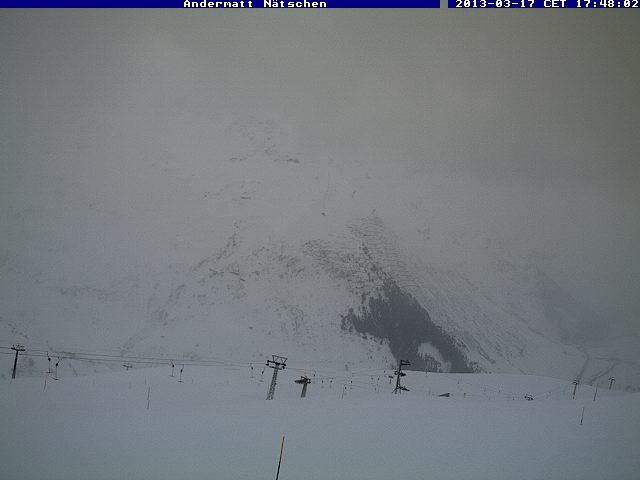
With many people coming to visit this year, both for DebConf13 and holidays, I'm going to start sharing some Swiss travel tips here in the blog. One of Switzerland's most popular tourist promotions is the Glacier Express railway. Here are the facts and a cool video. Avoid tickets/itineraries with fixed dates for visiting the mountains. The full Glacier Express journey is about 6 hours, and if it is cloudy or foggy, it is 6 hours in a train just like any other train. Some days really are cloudy and you won't see a single mountain. Try and make sure you have several flexible days in Switzerland so you can go up the mountains when the weather is optimal. Check the weather using the live webcam service Below is a typical webcam image for a bad day (I was up there Saturday skiing and it was perfect, Sunday was every tourist's nightmare). Compare this picture with the video further down: You can find a live feed like this for most Swiss mountain destinations with a web search Regular passenger trains run on the same route You don't need to buy an expensive Glacier Express' ticket. A regular passenger train does the same route every hour. No fixed reservation is necessary either and you can hop off and back on again along the way at many little stops. Oberalp Pass, at 2000 meters, is a good place to stop and hike (up to the peaks if you are keen, down to Andermatt if you want an easy walk with breathtaking views) What's more, the expensive trains are fully sealed and you can't open the windows. The regular trains do let you open the windows, so you can fully immerse yourself in the experience like this riding down from Natschen to Andermatt (1,500m): <video controls="" height="340" poster="http://danielpocock.com/sites/danielpocock.com/files/train-poster.png" width="560">
<source src="http://danielpocock.com/sites/danielpocock.com/files/DSC_1776.mp4" type="video/mp4"></source>
<source src="http://danielpocock.com/sites/danielpocock.com/files/DSC_1776.webm" type="video/webm"></source>
</video> To plan an itinerary, you can check Swiss train timetables at the official web site http://www.sbb.ch/en

Gerfried Fuchs: Backports Integrated Into The Main Archive

Dear users and supporters of the backports service! The Backports Team is pleased to announce the next important step on getting backports more integrated. People who are reading debian-infrastructure-announce will have seen that there was an archive maintenance last weekend: starting with wheezy-backports the packages will be accessible from the regular pool instead of a separate one, and all backports uploads will be processed through the regular upload queue (including those for squeeze-backports and squeeze-backports-sloppy). For Users What exactly does that mean for you? For users of wheezy, the sources.list entry will be different, a simple substitute of squeeze for wheezy won't work. The new format is:
deb http://ftp.debian.org/debian/ wheezy-backports main
So it is debian instead of debian-backports, and offered through the regular mirror network. Feel invited to check your regular mirror if it carries backports and pull from there. For Contributers What does it mean for contributing developers? Uploads for backports are no longer to be pushed to backports-master but to ftp.upload.debian.org, like any other regular package. Also, given that the packages are served from the same archive install there is no need to include the original tarball in the upload any longer because the archive knows it (Squeeze and beyond). Also, given that the upload goes to the same upload queue, there is only one keyring used anymore, so no more pain with expired or replaced keys. We though still keep the rule of adding your UID to an ACL list (this also includes DM additions). This is mostly only to give us the chance to remind you that uploads to backports are directly available for installation onto stable systems and you thus should take special care there. We carefully tried to take over the old ACLs, in case you can't upload anymore, please tell us so we can look into the issue. I've mentioned wheezy-backports (and squeeze-backports-sloppy) a few times here already, and you might wonder when it will be available. Technically, it is available from now on. Practically, while you could already upload to it, the set up of the buildd network is more painful than expected, so please allow the Buildd Team some days for setting them up. The upload rules for wheezy-backports are the same: packages that are in the next suite are accepted. Given that Jessie isn't created yet, we want you to think about whether the package you want to upload will go into Jessie final, and that you are taking a closer look once Jessie is created and the package entered there about the upgradeability. For the time until the suite is available, you can see this as relaxed upload rule. The same goes for squeeze-backports-sloppy: packages from two suites after Squeeze are acceptable, which turns it into the same relaxed rule as wheezy-backports above. Please also keep in mind that uploads to squeeze-backports-sloppy usually should be accompanied by uploads to wheezy-backports so people are able to upgrade from squeeze-backports-sloppy to wheezy with wheezy-backports. Thanks Finally, we want to thank the FTP-Master Team for their fine work on making this happen. The documentation on backports-master has been updated, and in case of any doubt or question, feel free to ask them on either the debian-backports mailinglist, or in case of sensitive topics ask us directly. Enjoy!
Rhonda for the Backports Team

/debian permanent link Comments: 1 Flattr this

Michal &#268;iha&#345;: phpMyAdmin translations status

Next round of phpMyAdmin 4.0 translation status report is coming. So let's look at which translations are at 100% right now: Almost complete: As you can see, there is still lot of languages missing, this might be your opportunity to contribute to phpMyAdmin. Also you are welcome to translate phpMyAdmin 4.0 using translation server. If your language is already fully translated and you want to help as well, you can translate our documentation as well.

Filed under: English Phpmyadmin 0 comments Flattr this!

Benjamin Mako Hill: SCARF ACE

Imako_scarf Although I don t mean to brag I have a really great scarf-hood-combination garment. I was wearing said awesome scarf in a rather cold apartment during my remote participation in the Learning Creative Learning class. I would like to think that I said some interesting and insightful things. But if I didn t, I m glad to hear my scarf which now has its very own sub-reddit was able to impress and entertain.

Next.

Previous.