A pure maintenance release of the random package for truly (hardware-based) random numbers as provided by random.org is now on CRAN. As requested by CRAN, we made running tests optional. Not running tests is clearly one way of not getting (spurious, networking-related) failures ...
Courtesy of CRANberries comes a diffstat report for this release. Current and previous releases are available here as well as on CRAN.
I am in the process of trying to fix
CVE-2017-533[4567]
for jessie and have created a preliminary candidate for uploading to
stable. Source (and amd64 binaries for the trusting) is available
here and
also on the
gnutls28_jessie
branch
in GIT.
I would appreciate testing and feedback to gnutls28 at
packages.debian.org. Thanks!
My most loathed feature of Go is the mandatory use of GOPATH:
I do not want to put my own code next to its
dependencies. Hopefully, this issue is slowly starting to
be accepted by the main authors. In the meantime, you can
workaround this problem with more opinionated tools (like gb) or
by crafting your own Makefile.
For the later, you can have a look at Filippo Valsorda s example
or my own take which I describe in more details here. This is not
meant to be an universal Makefile but a relatively short one with
some batteries included. It comes with a simple Hello World! application.
Project structure
For a standalone project, vendoring is a must-have1 as
you cannot rely on your dependencies to not
introduce backward-incompatible changes. Some packages are
using versioned URLs but most of them aren t. There is
currently no standard tool to handle vendoring. My personal take
is to vendor all dependencies with Glide.
It is a good practice to split an application into different packages
while the main one stay fairly small. In the hellogopher example,
the CLI is handled in the cmd package while the application logic
for printing greetings is in the hello package:
.
  cmd/
    hello.go
    root.go
    version.go
  glide.lock (generated)
  glide.yaml
  vendor/ (dependencies will go there)
  hello/
    root.go
    root_test.go
  main.go
  Makefile
  README.md
Down the rabbit hole
Let s take a look at the various features of the Makefile.
GOPATH handling
Since all dependencies are vendored, only our own project needs to be
in the GOPATH:
The base import path is hellogopher, not
github.com/vincentbernat/hellogopher: this shortens imports and
makes them easily distinguishable from imports of dependency
packages. However, your application won t be go get-able. This is a
personal choice and can be adjusted with the $(PACKAGE) variable.
We just create a symlink from .gopath/src/hellogopher to our root
directory. The GOPATH environment variable is automatically exported
to the shell commands of the recipes. Any tool should work fine after
changing the current directory to $(BASE). For example, this
snippet builds the executable:
Vendoring dependenciesGlide is a bit like Ruby s Bundler. In glide.yaml, you specify
what packages you need and the constraints you want on
them. Glide computes a glide.lock file containing the exact
versions for each dependencies (including recursive dependencies) and
download them in the vendor/ folder. I choose to check into the VCS
both glide.yaml and glide.lock files. It s also possible to only
check in the first one or to also check in the vendor/ directory. A
work-in-progress is currently ongoing to provide
a standard dependency management tool with a similar workflow.
We define two rules2:
We use a variable to invoke glide. This enables a user to easily
override it (for example, with make GLIDE=$GOPATH/bin/glide).
Using third-party tools
Most projects need some third-party tools. We can either expect
them to be already installed or compile them in our private
GOPATH. For example, here is the lint rule:
BIN=$(GOPATH)/bin
GOLINT=$(BIN)/golint
$(BIN)/golint:$(BASE)#
go get github.com/golang/lint/golint
.PHONY:lintlint:vendor$(BASE)$(GOLINT)#
@cd $(BASE)&&ret=0&&for pkg in $(PKGS);do\test -z "$$($(GOLINT)$$pkg tee /dev/stderr)"ret=1;\done;exit$$ret
As for glide, we let the user a chance to override which golint
executable to use. By default, it uses a private copy. But a user can
use its own copy with make GOLINT=/usr/bin/golint.
In , we have the recipe to build the private copy. We simply issue
go get3 to download and build golint. In , the lint rule
executes golint on each package contained in the $(PKGS)
variable. We ll explain this variable in the next section.
Working with non-vendored packages only
Some commands need to be provided with a list of packages. Because we
use a vendor/ directory, the shortcut ./... is not what we expect
as we don t want to run tests on our
dependencies4. Therefore, we compose a list of packages
we care about:
If the user has provided the $(PKG) variable, we use it. For
example, if they want to lint only the cmd package, they
can invoke make lint PKG=hellogopher/cmd which is more intuitive
than specifying PKGS.
Otherwise, we just execute go list ./... but we remove anything from
the vendor directory.
make test TIMEOUT=10 runs all tests with a timeout of 10 seconds;
make test PKG=hellogopher/cmd only runs tests for the cmd package;
make test ARGS="-v -short" runs tests with the specified arguments;
make test-race runs tests with race detector enabled.
Tests coveragego test includes a test coverage tool. Unfortunately, it only
handles one package at a time and you have to explicitely list
the packages to be instrumented, otherwise the instrumentation is
limited to the currently tested package. If you provide too many
packages, the compilation time will skyrocket. Moreover, if you want
an output compatible with Jenkins, you ll need some additional tools.
First, we define some variables to let the user override them. We also
require the following tools (in ):
gocovmerge merges profiles from different runs into a single one;
gocov-xml converts a coverage profile to the Cobertura format;
gocov is needed to convert a coverage profile to a format handled
by gocov-xml.
The rules to build those tools are similar to the rule for golint
described a few sections ago.
In , for each package to test, we run go test with the
-coverprofile argument. We also explicitely provide the list of
packages to instrument to -coverpkg by using go list to get a list
of dependencies for the tested package and keeping only our owns.
Final result
While the main goal of using a Makefile was to work around GOPATH,
it s also a good place to hide the complexity of some operations,
notably around test coverage.
The excerpts provided in this post are a bit simplified. Have a look
at the final result for more perks!
In Go, vendoring is about both bundling and
dependency management. As the Go ecosystem matures, the
bundling part (fixed snapshots of dependencies) may become
optional but the vendor/ directory may stay for dependency
management (retrieval of the latest versions of dependencies
matching a set of constraints).
If you don t want to automatically update glide.lock when a
change is detected in glide.yaml, rename the target to
deps-update and make it a phony target.
There is some irony for bad mouthing go get and then
immediately use it because it is convenient.
I think ./... should not include the vendor/
directory by default. Dependencies should be trusted to have run
their own tests in the environment they expect them to
succeed. Unfortunately, this is unlikely to change.
Here is how I managed to extend my
OpenVPN setup on my Linode VPS
to include IPv6 traffic.
This ensures that clients can route all of their traffic through the VPN and
avoid leaking IPv6 traffic, for example. It also enables clients on
IPv4-only networks to receive a routable IPv6 address and connect to
IPv6-only servers (i.e. running your own IPv6 broker).
Request an additional IPv6 block
The first thing you need to do is get a new IPv6 address block (or "pool" as
Linode calls it) from which you can allocate a single address to each VPN
client that connects to the server.
If you are using a
Linode VPS,
there are
instructions on how to request a new IPv6 pool.
Note that you need to get an address block between /64 and /112. A
/116 like Linode offers won't work in OpenVPN. Thankfully, Linode
is happy to allocate you an extra /64 for free.
Setup the new IPv6 address
If your server only has an single IPv4 address and a single IPv6 address,
then a simple DHCP-backed network configuration will work fine.
To add the second IPv6 block on the other hand, I had to change my network
configuration (/etc/network/interfaces) to this:
where 2600:3c01::xxxx:xxxx:xxxx:939f/64 (bound to eth0) is your main
IPv6 address and
2600:3c01:xxxx:xxxx::/64 (bound to tun0) is the new block you
requested.
Once you've setup the new IPv6 block, test it from another IPv6-enabled host
using:
ping6 2600:3c01:xxxx:xxxx::1
OpenVPN configuration
The only thing I had to change in my
OpenVPN configuration
(/etc/openvpn/server.conf) was to change:
to bind to the right V6 address and to tell clients to tunnel all V6 Internet
traffic through the VPN.
In addition to updating the OpenVPN config, you will need to add the
following line to /etc/sysctl.d/openvpn.conf:
net.ipv6.conf.all.forwarding=1
and the following to your firewall (e.g. /etc/network/ip6tables.up.rules):
# openvpn
-A INPUT -p udp --dport 1194 -j ACCEPT
-A FORWARD -m state --state NEW -i tun0 -o eth0 -s 2600:3c01:xxxx:xxxx::/64 -j ACCEPT
-A FORWARD -m state --state NEW -i eth0 -o tun0 -d 2600:3c01:xxxx:xxxx::/64 -j ACCEPT
-A FORWARD -m state --state ESTABLISHED,RELATED -j ACCEPT
Testing the connection
Now connect to the VPN using your desktop client and check that the default
IPv6 route is set correctly using ip -6 route.
Then you can ping the server's new IP address:
ping6 2600:3c01:xxxx:xxxx::1
and from the server, you can ping the client's IP (which you can see in the
network settings):
ping6 2600:3c01:xxxx:xxxx::1002
Once both ends of the tunnel can talk to each other, you can try pinging an
IPv6-only server from your client:
ping6 ipv6.google.com
and then pinging your client from an IPv6-enabled host somewhere:
ping6 2600:3c01:xxxx:xxxx::1002
If that works, other onlinetests should also work.
Better late than never, we'd like to welcome our three Outreachy interns
for this round, lasting from the 6th of December 2016 to the 6th of March 2017.
Elizabeth Ferdman
is working in the
Clean Room for PGP and X.509 (PKI) Key Management.
Maria Glukhova
is working in
Reproducible builds for Debian and free software.
Urvika Gola
is working in
improving voice, video and chat communication with free software.
From the official website: Outreachy
helps people from groups underrepresented in free and open source software
get involved. We provide a supportive community for beginning to contribute
any time throughout the year and offer focused internship opportunities
twice a year with a number of free software organizations.
The Outreachy program is possible in Debian thanks
to the effort of Debian developers and contributors that dedicate
part of their free time to mentor students and outreach tasks, and
the help of the Software Freedom Conservancy,
who provides administrative support for Outreachy,
as well as the continued support of Debian's donors, who provide funding
for the internships.
Debian will also participate in the next round for Outreachy, during
the summer of 2017. More details will follow in the next weeks.
Join us and help extend Debian! You can follow the work of the Outreachy
interns reading their blogs (they are syndicated in Planet Debian),
and chat with us in the #debian-outreach IRC channel and mailing list.
Congratulations, Elizabeth, Maria and Urvika!
Google Flights Fees tracking between PNQ and YUL and back, economy fares.
Couple of weeks ago, either on some mailing list, on IRC or somewhere else, somebody mentioned that people always put higher amount of airline expenditure for self when asking for sponsorship.
Now last year, between sending the application and getting the approval for sponsorship, there was 3 months of difference between the two. Now if you put up an application for sponsorship like I did last year, I had added 10% to the cost of flight tickets of the cheapest prevailing prices at that point in time on skyscanner or any of the meta-search-engines were showing me at that point in time.
I was sceptical whether the amount that I had put for the to and fro tickets would be enough or not. Strangely, I was lucky enough to get my ticket around the new estimated price. I would have to mention though that there were only 2 tickets left at the new price and if I had waited just a few hours more, those tickets would have gone too and all other tickets were around 25% more than before. The only reasons I could fathom are
a. Luck, pure and simple.
b. Going at the end of the tourism season This was evident as I was able to book my extended stay at any hostel just 2 days before my stay at UCT (University of Cape Town) was over. Was corroborated by hostel staff, shop-owners as well as whatever info. I found on the web before and during my stay in SA.
c. South Africa being more lenient than probably Canada is giving and processing visas.
While looking at the third point, thought I better check world tourism rankings and saw the Wikipedia page for it. Interestingly, South Africa seems to have a slight edge over Canada when it comes to statistics and hence strengthens my assumptions that probably more people apply for SA than Canada as they know the possibility of more people making through visa processing. It would stand to be logical that more people would apply for a tourist or similar short-term resident visas if they know they have a good chance going through.
While researching on the topic I also came across/ hunted to find the hardest places to get a Visa for and was surprised to find India being lasted therein.Coincidentally, that site also has a UK domain.It does burst the bubble in Incredible India a little bit.
As a newbie who had no clue I knew I was probably a victim of Information Asymmetry where the airlines have much more information about travel trends, ongoing trends at Airports, Politics and Economics of Countries, Price of Crude Oil, Profit, Competition and probably many more factors that I haven t taken into account which decide fares.
While researching on the topic, one of the interesting finds I had while trying to figure the above is that Airlines didn t pass on fuel savings to their customers. Now I don t know whether this was the same around the world or was this only in UK. I am shocked that British (and by definition EU, as UK was part of EU at that time) travellers or consumer groups didn t file a suit in the court of law as reading the above smells of anticompetitive behaviour. The most shocking statement was this
Average fares to Spain rose by 10 per cent over the same period. Telegraph, UK.
In order to lessen this information asymmetry a bit, I used google flights and its data of the past 2 months to see how the fares have been changing to have some insight of where the fares might end up. I know google is hated by one and all, but in this instance I couldn t find any comparable site which does this kind of thing.
As can be seen in the graph, the tickets had started relatively cheap from around INR 65k ish to around 80k ish at this point in time. That is a jump of around 30% in the last couple of months. All of these flights have a layover somewhere in Europe and taking a second flight from there to Canada.
The one which didn t show much of action is the direct plan between BOM YUL and back but then this seems to be a premium service . Taking a direct flight from BOM YUL is north of INR 90k/- which doesn t make much sense unless one is fond of spending 13+ hours in flight. Definitely not my cup of tea.
With layovers it makes the experience a bit more bearable.
While the real action is probably 3 or bit more months away, its interesting to see how things are panning out at least on airline price tickets and the dynamics involved therein.
Even with all the above attempts at finding the answer, I m no closer to figuring out to estimate airline ticket prices when window is largish 3 months in making. Any ideas anybody?
If the previous jump is any indication, then 10-15% escalation bit might not hack this time around. Any strategies that people could advise while trying to put a ball-park figure. Filed under: Miscellenous Tagged: #air-travel, #Airfares, #Competition, #Price Estimation, #Sponsorship
A new minor version 0.2.1, of RcppCCTZ is now on CRAN. It corrects a possible shortcoming and rounding in the conversion from internal representation (in C++11 using int64_t) to the two double values for seconds and nanoseconds handed to R. Two other minor changes are also summarized below.
RcppCCTZ uses Rcpp to bring CCTZ to R. CCTZ is a C++ library for translating between absolute and civil times using the rules of a time zone. In fact, it is two libraries. One for dealing with civil time: human-readable dates and times, and one for converting between between absolute and civil times via time zones. The RcppCCTZ page has a few usage examples and details.
The changes in this version are summarized here:
Changes in version 0.2.1 (2017-02-04)
Conversion from timepoint to two double values now rounds correctly (#14 closing #12, with thanks to Leonardo)
The Description was expanded to stress the need for a modern C++11 compiler; g++-4.8 (as on 'trusty' eg in Travis CI) works
A new version of the nanotime package for working with nanosecond timestamps is now on CRAN.
nanotime uses the RcppCCTZ package for (efficient) high(er) resolution time parsing and formatting, and the bit64 package for the actual integer64 arithmetic.
This release adds an improved default display format always showing nine digits of fractional seconds. It also changes the print() method to call format() first, and we started to provide some better default Ops methods. These fixes were suggested by Matt Dowle. We also corrected a small issue which could lead to precision loss in formatting as pointed out by Leonardo Silvestri.
Changes in version 0.1.1 (2017-02-04)
The default display format now always shows nine digits (#10 closing #9)
The default print method was updated to use formated output, and a new new converter as.integer64 was added
Several 'Ops' method are now explicitly defined allowing casting of results (rather than falling back on bit64 behaviour)
The format routine is now more careful about not loosing precision (#13 closing #12)
Welcome to gambaru.de. Here is my monthly report that covers what I have been doing for Debian. If you re interested in Java, Games and LTS topics, this might be interesting for you.
Debian Games
In January 2017 we had the last chance to get new upstream releases into the next stable release of Debian 9 aka Stretch. Hence I packaged new versions of pygame-sdl2, renpy, fife, unknown-horizons, redeclipse and redeclipse-data and also backported Red Eclipse to Jessie.
I uploaded fifechan to unstable and applied an upstream patch to fix a segmentation fault (#852247) in Unknown Horizons.
Package cleanups and improvements: freeorion (#843538), I enabled support for mips64el again; I tidied up gtkatlantic, powermanga, lincity-ng, opencity and tecnoballz; I applied a patch from Reiner Herrmann to make the build of netpanzer reproducible (#827150); In spring I changed the build-dependency of asciidoc to asciidoc-base (#850387) although it turned out later that this wasn t strictly needed. I also removed ConvertUTF8 related code from spring because it might be non-free. I don t think this is necessarily true but I didn t want to argue with Lintian in this case.
I sponsored a new upstream release of pentobi for Juhani Numminen.
I backported minetest 0.4.5 to jessie-backports and fixed #851114, which I think was not really an issue since we already provide the font sources in Debian and Minetest depends on the respective package.
I triaged RC bug #847812 in pysolfc, provided a patch and reassigned the issue to src:pillow. Apparently this affected a lot more 32 bit applications written in Python.
Debian Java
For Debian Java the situation was very similar but I didn t want to break too many reverse-dependencies right before the freeze. So I chose rather harmless packages and updated objenesis, syncany and jackson-dataformat-xml. At first I couldn t build objenesis 2.5 from source but after some consultation on the debian-java list, it became clear that the test failure was probably an upstream bug. Henri Tremblay kindly issued a new release of Objenesis which addressed the build failure.
I prepared security updates for groovy and groovy2 in Jessie. (#853233, #853235)
Debian LTS
This was my eleventh month as a paid contributor and I have been paid to work 12,75 hours on Debian LTS, a project started by Rapha l Hertzog. In that time I did the following:
From 16. January until 22. January I was in charge of our LTS frontdesk. I triaged security issues in imagemagick, wordpress, hesiod, opus, mysql-5.5, netbeans, groovy and zoneminder.
DLA-779-1. Issued a security update for Tomcat 7 fixing 1 CVE and a regression when running Tomcat with SecurityManager enabled.
DLA-761-2. Issued a regression update for python-bottle. (Debian bug #850176).
DLA-781-1 and DLA-781-2. Issued a security update for Asterisk fixing 2 CVE after I had prepared the package last month. Later Brad Barnett discovered a regression when using SIP communication and provided assistance with debugging the issue. I corrected this one in DLA-781-2.
DLA-792-1. Issued a security update for libphp-swiftmailer fixing 1 CVE.
DLA-793-1. Issued a security update for opus fixing 1 CVE.
DLA-794-1. Issued a security update for groovy fixing 1 CVE.
DLA-797-1. Issued a security update for mysql-5.5 fixing 10 CVE. The update was prepared by Lars Tangvald.
DLA-813-1. Issued a security update for wordpress fixing 9 CVE.
Misc
In xarchiver (#850103) I added binutils to the list of suggested packages, in iftop (#850040) I applied a patch from Brian Russell and I packaged a new upstream release of mediathekview, a Java application to watch and download broadcasts from German television stations. I had to make some major packaging changes because the build system switched from Ant to Gradle but there were fewer issues than expected.
Whilst I am an avid podcast listener, this was actually my first appearance on one. It was an curious and somewhat disconcerting feeling to be "just" talking to Adam and Jerod in the moment yet knowing all the time that anything and everything I said would be distributed more widely in the future.
It has been a quiet start to the year due to work keeping me very busy. Most of my spare time (when not sitting shattered on the sofa) was spent resurrecting my old website from backups. My son had plenty of visitors coming to visit as well, which prompted me to restart work on my model railway in the basement. Last year I received a whole heap of track, and also a tunnel formation from a friend at work. I managed to finish the supporting structure for the tunnel, and connect one end of it to the existing track layout. The next step (which will be a bit harder) is to connect the other end of the tunnel into the existing layout. The basement is one of the favourite things for me to keep my son and his friends occupied when there is a visit. The railway and music studio are very popular with the little guests.
Debian
Packaged latest Gramps 4.2.5 release for Debian so that it will be part of the Stretch release.
Package latest abcmidi release so it too would be part of Stretch. The upstream author had changed his website, so it took a while to locate a tarball.
Tested my latest patches to convert Cree.py to Qt5, but found another Qt4 Qt5 change to take into account (SIGNAL function). I ran out of time to fully investigate that one, before Creepy was booted out of testing again. I am seriously considering the removal of Cree.py from Debian, as the upstream maintainer does not seem very active any more, and I am a little tired of being upstream for a project that I don t actually use myself. It was only because it was a reverse dependency of osm-gps-map that I originally got involved.
Started preparing a Gramps 5.2.5 backport for Jessie, but found that the tests I enabled in unstable were failing in the Jessie build. I need to investigate this further.
Ubuntu
Announced the Ubuntu Studio 16.02.2 point release date on the Ubuntu Studio mailing lists asking for testers. The date subsequently got put back to February the 9th.
Upgraded my Ubuntu Studio machine from Wily to Xenial.
Other
Resurrected my old Drupal Gammon One Name Study website. I used Drupal VM to get the site going again, before transferring it to the new webhost. It was originally a Drupal 7 site, and I did not have the required versions of Ansible & Vagrant on my Ubuntu Xenial machine, so the process was quite involved. I will blog about that separately, as it may be a useful lesson for others. As part of that, I started on a backport of vagrant, but found a bug which I need to follow up on.
Also managed to extract my old WordPress blog posts from the same machine that had the failed Drupal instance, and import them into this blog. I also learnt some stuff in that process that I will blog about at some point.
Plan status from last month & update for next month
Debian
Before the 5th February 2017 Debian Stretch hard freeze I hope to:
Keep an eye on the Release Critical bugs list, and see if I can help fix any.
Generally:
Finish the Gramps 5.2.5 backport for Jessie.
Package all the latest upstream versions of my Debian packages, and upload them to Experimental to keep them out of the way of the Stretch release.
Begin working again on all the new stuff I want packaged in Debian.
Ubuntu
Finish the ubuntustudio-lightdm-theme, ubuntustudio-default-settings transition including an update to the ubuntustudio-meta packages. Still to do (actually started today)
Reapply to become a Contributing Developer. Still to do
Start working on an Ubuntu Studio package tracker website so that we can keep an eye on the status of the packages we are interested in. Started
Start testing & bug triaging Ubuntu Studio packages. Still to do
Test Len s work on ubuntustudio-controls Still to do
Other
Try and resurrect my old Gammon one-name study Drupal website from a backup and push it to the new GoONS Website project. Done
Give JMRI a good try out and look at what it would take to package it. In progress
Also look at OpenPLC for simulating the relay logic of real railway interlockings (i.e. a little bit of the day job at home involving free software fun!).
FTP assistant
This month I only marked 146 packages for accept and rejected 25 packages. I only sent 3 emails to maintainers asking questions.
Nevertheless I could pass a big mark. All in all I accepted more than 10000 packages now!
Debian LTS
This was my thirty-first month that I did some work for the Debian LTS initiative, started by Raphael Hertzog at Freexian.
This month my all in all workload has been 12.75h. During that time I did uploads of
[DLA 805-1] bind9 security update for three CVEs
[DLA 806-1] zoneminder security update for one CVE
Unfortunately the upload of jasper had to be postponed, as there is no upstream fix for most of the open CVEs yet.
I also suggested to mark th slum-llnl CVE as , as the patch would be too invasive. Further I did another week of frontdesk work.
Last but not least I took care of about 140 items of the TODO list[1]. Ok, it was not that much work, but the enormous number is impressing :-). I also had a look at [2] and filed bugs against two packages. Within hours the maintainers responded to that bugs, clarified everything to mark the CVEs as not-affected and nobody has to care about them anymore. This is a good example of how the knowledge of the maintainer can help the security teams! So, if you have some time left, have a look at [3] and take care of something.
[1] https://security-tracker.debian.org/tracker/status/todo
[2] https://security-tracker.debian.org/tracker/status/unreported
[3] https://security-tracker.debian.org/tracker
Other stuff
This month I sponsored a new round of sidedoor and printrun. After advocating Dara Adib to become Debian Maintainer, I hope my activities as sponsor can be reduced again :-).
Further I uploaded another version of setserial, but as you can see in #850762 it does not seem to satisfy everybody. I also uploaded new upstream versions of duktape and pipexec.
As I didn t do any DOPOM in December I adopted two packages in January: pescetti and salliere. I dedicate those uploads to my aunt Birgit, who was a passionate bridge player. You will never be forgotten.
The soft freeze has been on going for almost a month now and the full stretch freeze will start tomorrow night (UTC). It has definitely been visible in the number of unblock requests that we have received so far. Fortunately, we are no where near the rate of the jessie freeze. At the moment, all unblock requests are waiting for the submitter (either for a clarification or an upload).
Looking at stretch at a glance (items are in no particular order):
Secure boot support is progressing too slowly.
The openssl transition is still on-going and badly needs closure.
Secure boot support
Currently, we are blocked on two items:
We do not have signing done yet for the boot packages (not even manual signing).
Our shim is not yet signed, so no hardware would be trusting our boot chain out of the box.
After they are done, we are missing a handful of uploads to provide a signed bootloader etc. plus d-i and some infrastructure bits need to be updated. At the moment, we are waiting for a handful of key people/organisations to move on their part. As such, there is not a lot you can do to assist here (unless you are already involved in the work).
On the flip side, if both of these items are resolved soon, there is a good chance that we can support secure boot in stretch.See bug#820036 and blockers for more information on the remaining items.
Where can you help with the release?
At the moment, the best you can do is to:
Test (packages, upgrades, etc.) and report bugs
File bugs against release-notes for issues that should be documented
Fix RC bugs (please see the next section)
Release Critical Bug report
The UDD bugs interface currently knows about the following release critical bugs:
Affecting stretch: 294 (key packages: 158)
That s the number we need to get down to zero before the release. They can be split in two big categories:
Affecting stretch and unstable: 232 (key packages: 134)
Those need someone to find a fix, or to finish the work to upload a fix to unstable:
30 bugs are tagged patch . (key packages: 21)
Please help by reviewing the patches, and (if you are a DD) by uploading them.
17 bugs are marked as done, but still affect unstable. (key packages: 5)
This can happen due to missing builds on some architectures, for example. Help investigate!
185 bugs are neither tagged patch, nor marked done. (key packages: 108)
Help make a first step towards resolution!
Affecting stretch only: 62 (key packages: 24)
Those are already fixed in unstable, but the fix still needs to migrate to stretch. You can help by submitting unblock requests for fixed packages, by investigating why packages do not migrate, or by reviewing submitted unblock requests.
36 bugs are in packages that are unblocked by the release team. (key packages: 14)
26 bugs are in packages that are not unblocked. (key packages: 10)
So last weekend I attended Devconf.cz in Brno and together with Dennis Gilmore gave a talk about Reproducible Builds and Fedora (Slides) which was fun and - I think - pretty well received.
Then on the following Tuesday, so three days ago, after using Debian as the primary OS on my primary computer for more than two decades, I finally made the long anticipated switch and I must say, so far I'm really happy with my new environment, even though I'm not yet again using a tiled window manager (but instead Xfce), cannot yet do all the things I could do before and even have to reconfigure a VM twice and restart another to get back wireless network after suspend and resume
So what have I done? Nothing too dramatic: I've switched to Qubes OS and now I'm running Debian jessie and stretch and Fedora and Whonix on my primary computer, just not as my primary OS
IOW: hardware is basically software and while I want the red pill, who knows what's really inside the box?
If you have no idea what I'm talking about, this intro about Qubes OS might be helpful. Or you dive directly into this six year old post, where Joanna Rutkowska described how she partitioned her digital life using Qubes.
I'm not sure where this journey will lead me to, but I'm confident this is the right direction. And in case you wondered, I'll keep working on Debian, as far as I know now
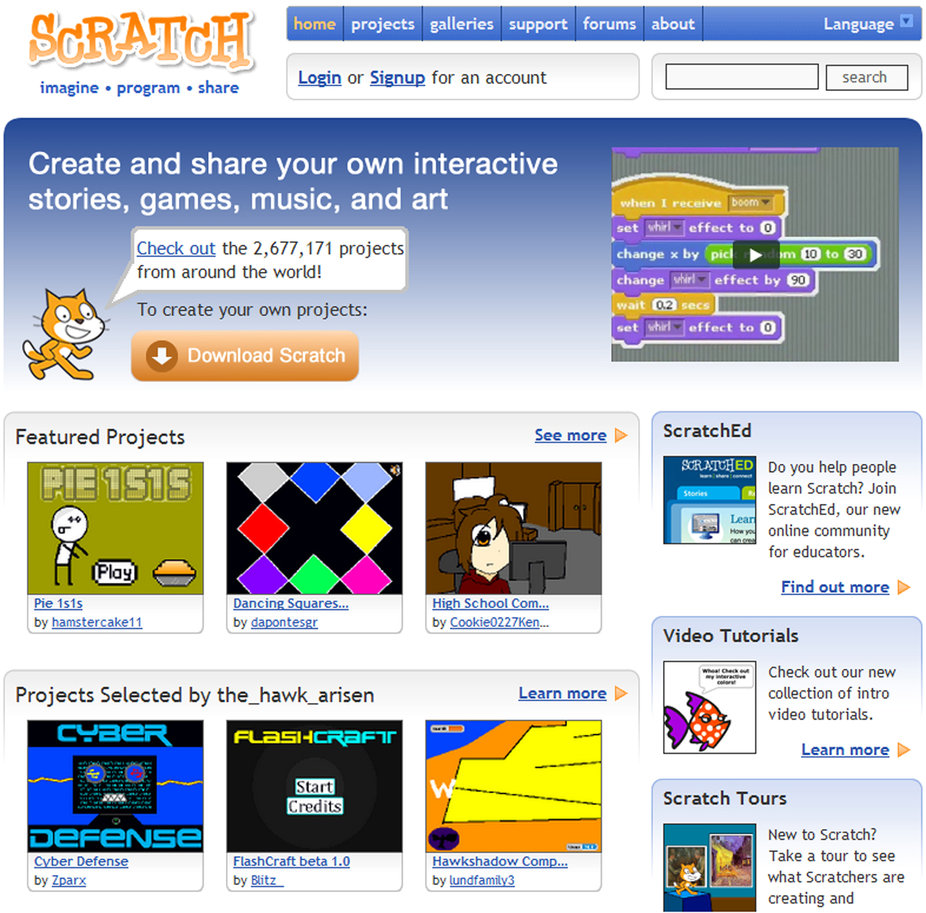
Scratch is a block-based programming language created by the Lifelong Kindergarten Group (LLK) at the MIT Media Lab. Scratch gives kids the power to use programming to create their own interactive animations and computer games. Since 2007, the online community that allows Scratch programmers to share, remix, and socialize around their projects has drawn more than 16 million users who have shared nearly 20 million projects and more than 100 million comments. It is one of the most popular ways for kids to learn programming and among the larger online communities for kids in general.
Front page of the Scratch online community (https://scratch.mit.edu) during the period covered by the dataset.
Since 2010, I havepublishedaseriesofpapers using quantitative data collected from the database behind the Scratch online community. As the source of data for many of my first quantitative and data scientific papers, it s not a major exaggeration to say that I have built my academic career on the dataset.
I was able to do this work because I happened to be doing my masters in a research group that shared a physical space ( The Cube ) with LLK and because I was friends with Andr s Monroy-Hern ndez, who started in my masters cohort at the Media Lab. A year or so after we met, Andr s conceived of the Scratch online community and created the first version for his masters thesis project. Because I was at MIT and because I knew the right people, I was able to get added to the IRB protocols and jump through the hoops necessary to get access to the database.
Over the years, Andr s and I have heard over and over, in conversation and in reviews of our papers, that we were privileged to have access to such a rich dataset. More than three years ago, Andr s and I began trying to figure out how we might broaden this access. Andr s had the idea of taking advantage of the launch of Scratch 2.0 in 2013 to focus on trying to release the first five years of Scratch 1.x online community data (March 2007 through March 2012) most of the period that the codebase he had written ran the site.
After more work than I have put into any single research paper or project, Andr s and I have published a data descriptor in Nature s new journal Scientific Data. This means that the data is now accessible to other researchers. The data includes five years of detailed longitudinal data organized in 32 tables with information drawn from more than 1 million Scratch users, nearly 2 million Scratch projects, more than 10 million comments, more than 30 million visits to Scratch projects, and much more. The dataset includes metadata on user behavior as well the full source code for every project. Alongside the data is the source code for all of the software that ran the website and that users used to create the projects as well as the code used to produce the dataset we ve released.
Releasing the dataset was a complicated process. First, we had navigate important ethical concerns about the the impact that a release of any data might have on Scratch s users. Toward that end, we worked closely with the Scratch team and the the ethics board at MIT to design a protocol for the release that balanced these risks with the benefit of a release. The most important features of our approach in this regard is that the dataset we re releasing is limited to only public data. Although the data is public, we understand that computational access to data is different in important ways to access via a browser or API. As a result, we re requiring anybody interested in the data to tell us who they are and agree to a detailed usage agreement. The Scratch team will vet these applicants. Although we re worried that this creates a barrier to access, we think this approach strikes a reasonable balance.
Beyond the the social and ethical issues, creating the dataset was an enormous task. Andr s and I spent Sunday afternoons over much of the last three years going column-by-column through the MySQL database that ran Scratch. We looked through the source code and the version control system to figure out how the data was created. We spent an enormous amount of time trying to figure out which columns and rows were public. Most of our work went into creating detailed codebooks and documentation that we hope makes the process of using this data much easier for others (the data descriptor is just a brief overview of what s available). Serializing some of the larger tables took days of computer time.
In this process, we had a huge amount of help from many others including an enormous amount of time and support from Mitch Resnick, Natalie Rusk, Sayamindu Dasgupta, and Benjamin Berg at MIT as well as from many other on the Scratch Team. We also had an enormous amount of feedback from a group of a couple dozen researchers who tested the release as well as others who helped us work through through the technical, social, and ethical challenges. The National Science Foundation funded both my work on the project and the creation of Scratch itself.
Because access to data has been limited, there has been less research on Scratch than the importance of the system warrants. We hope our work will change this. We can imagine studies using the dataset by scholars in communication, computer science, education, sociology, network science, and beyond. We re hoping that by opening up this dataset to others, scholars with different interests, different questions, and in different fields can benefit in the way that Andr s and I have. I suspect that there are other careers waiting to be made with this dataset and I m excited by the prospect of watching those careers develop.
You can find out more about the dataset, and how to apply for access, by reading the data descriptor on Nature s website.
Yes, You Should Not discard cached ssh host keys without looking. An unexpected change of an ssh host key is always a
reason to step back from the keyboard and think. However, there are situations when you know that a
systems ssh host key has changed, for example when the system reachable under this host name has been redeployed,
which happens
increasingly often proportionally to the devopsness of your environment, or for example in test environments.
Later versions of ssh offer you the ssh-keygen -R command line to paste from the error message, so that you can abort
the connection attempt, paste the command and reconnect again. This will still ask for confirmation of the new host key
though.
Almost every sysadmin has an alias or wrapper to make handling of this situation easier. Solutions range from using
StrictHostKeyChecking no and/or UserKnownHostsFile /dev/null , turning off this layer of
securit altogether either globally or usually too broadly, to more-or-less sophisticated solutions that involve turning
off know-host file hashing, parsing client output and/or grep-sed-awk magic. grml even comes with an insecssh script
that is rather neat and that I used until I developed my own.
Later ssh versions (not including the 6.7 in Debian jessie, but the 7.4 in debian sid) do offer a -G command line
option which will give access to configuration options after the complete client configurtion was processed. This will
allow you to neatly get access to the actual hostname the ssh client will connect to. This can, in turn be used to
obtain the IP address so that all traces of the host and its IP addresses can be removed from the known_hosts file
before the actual connection is done.
The following script is the insecssh that I currently use. It only uses documented interfaces to the ssh client which
I consider rather neat.
Ugliness results from the necessity of following CNAMEs manually since there is - to my knowlegde (educate me!) - no
command line utility that has the output simplicity and selection powers of dig which can automatically follow CNAMEs
without relying on the recursor having the CNAME cached or not.
Use this script if you know that a host has changed its host key. It will first zap all knowledge of the previous
host key from known_hosts and then invoke the ssh client with the given arguments from its command line, with options
added so that you ll see the new host key in random art and that you don t need to manually confirm the new
host key.
From time to time I've to use chromium for creepy stuff like
lifesize video conferencing with document sharing. The document sharing
requires a chromium extension. Suddenly that stopped working today
and I could not reinstall the extension. After trying a lot of
stuff I had a look at the debian changelog and found out about:
A major new update of the RPushbullet package is now on CRAN. RPushbullet interfacing the neat Pushbullet service for inter-device messaging, communication, and more. It lets you easily send alerts like the one to the to your browser, phone, tablet, ... -- or all at once.
This release owes a lot to Seth Wenchel who was instrumental in driving several key refactorings. We now use the curl package instead of relying on system() calls to the binary. We also switched from RJSONIO to jsonlite. A new helper function to create the required resourcefile was added, and several other changes were made as detailed below in the extract from the NEWS.Rd file.
Changes in version 0.3.0 (2017-02-03)
The curl binary use was replaced by use of the curl package; several new helper functions added (PRs #30, #36 by Seth closing #29)
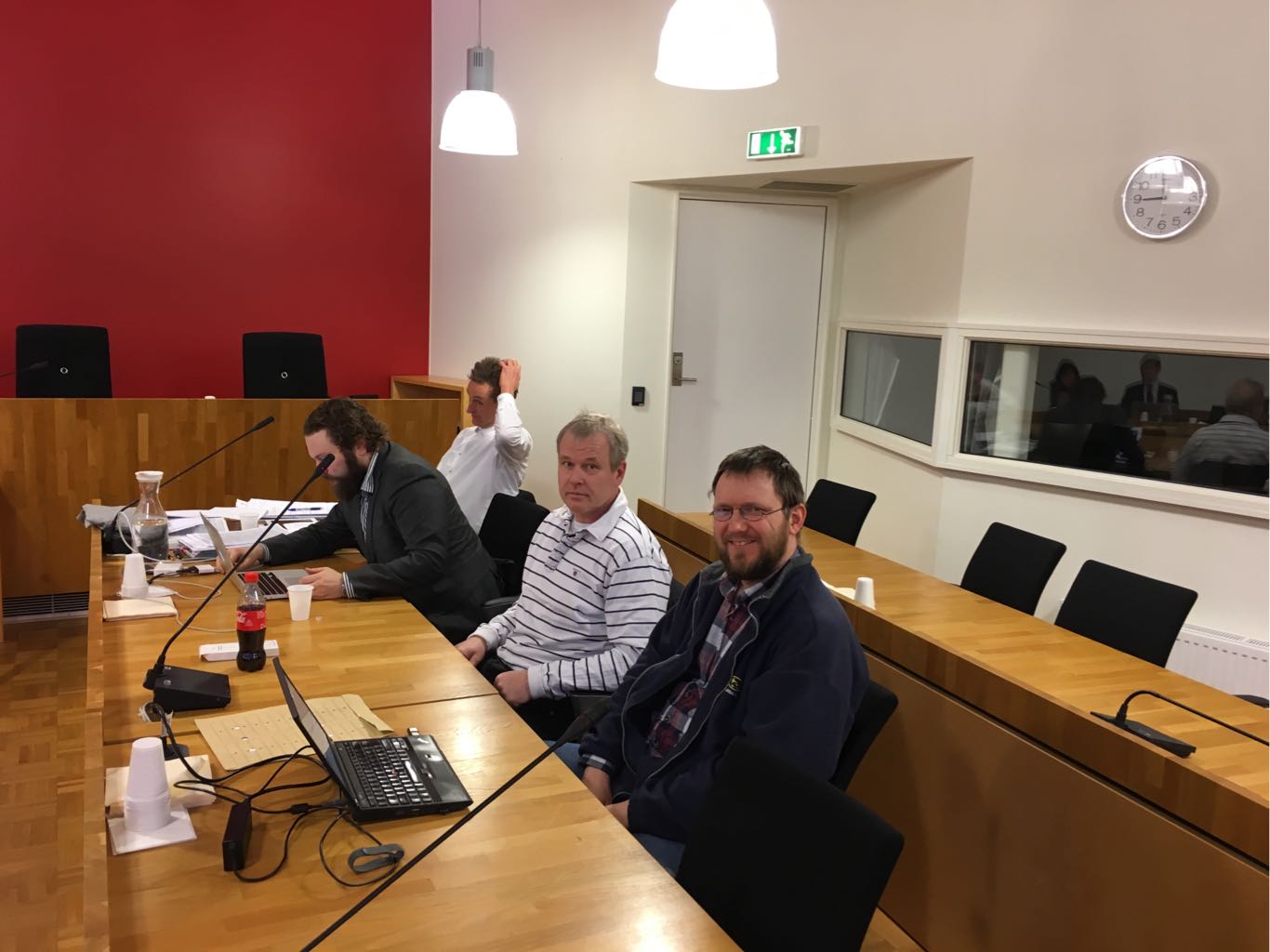
On Wednesday, I spent the entire day in court in Follo Tingrett
representing the member association
NUUG, alongside the member
association EFN and the DNS registrar
IMC, challenging the seizure of the DNS name popcorn-time.no. It
was interesting to sit in a court of law for the first time in my
life. Our team can be seen in the picture above: attorney Ola
Tellesb , EFN board member Tom Fredrik Blenning, IMC CEO Morten Emil
Eriksen and NUUG board member Petter Reinholdtsen.
The
case at hand is that the Norwegian National Authority for
Investigation and Prosecution of Economic and Environmental Crime (aka
kokrim) decided on their own, to seize a DNS domain early last
year, without following
the
official policy of the Norwegian DNS authority which require a
court decision. The web site in question was a site covering Popcorn
Time. And Popcorn Time is the name of a technology with both legal
and illegal applications. Popcorn Time is a client combining
searching a Bittorrent directory available on the Internet with
downloading/distribute content via Bittorrent and playing the
downloaded content on screen. It can be used illegally if it is used
to distribute content against the will of the right holder, but it can
also be used legally to play a lot of content, for example the
millions of movies
available from the
Internet Archive or the collection
available from Vodo. We created
a
video demonstrating legally use of Popcorn Time and played it in
Court. It can of course be downloaded using Bittorrent.
I did not quite know what to expect from a day in court. The
government held on to their version of the story and we held on to
ours, and I hope the judge is able to make sense of it all. We will
know in two weeks time. Unfortunately I do not have high hopes, as
the Government have the upper hand here with more knowledge about the
case, better training in handling criminal law and in general higher
standing in the courts than fairly unknown DNS registrar and member
associations. It is expensive to be right also in Norway. So far the
case have cost more than NOK 70 000,-. To help fund the case, NUUG
and EFN have asked for donations, and managed to collect around NOK 25
000,- so far. Given the presentation from the Government, I expect
the government to appeal if the case go our way. And if the case do
not go our way, I hope we have enough funding to appeal.
From the other side came two people from kokrim. On the benches,
appearing to be part of the group from the government were two people
from the Simonsen Vogt Wiik lawyer office, and three others I am not
quite sure who was. kokrim had proposed to present two witnesses
from The Motion Picture Association, but this was rejected because
they did not speak Norwegian and it was a bit late to bring in a
translator, but perhaps the two from MPA were present anyway. All
seven appeared to know each other. Good to see the case is take
seriously.
If you, like me, believe the courts should be involved before a DNS
domain is hijacked by the government, or you believe the Popcorn Time
technology have a lot of useful and legal applications, I suggest you
too donate to
the NUUG defense fund. Both Bitcoin and bank transfer are
available. If NUUG get more than we need for the legal action (very
unlikely), the rest will be spend promoting free software, open
standards and unix-like operating systems in Norway, so no matter what
happens the money will be put to good use.
If you want to lean more about the case, I recommend you check out
the blog
posts from NUUG covering the case. They cover the legal arguments
on both sides.
I am boarding my flight to Brussels to attend FOSDEM.
The Desktops DevRoom will be a blast again this year. While I have been in charge of it for 6? years already, the last two (since my twins) were born I had organized remotely and local duties were carried on by the Desktops DevRoom team (thank you Christophe Fergeau, Philippe Caseiro and others!).
I am anxious at meeting old friends again. I will be at the beer event today.
Video streaming will be available thanks to the Video Team. If you want to help, please contact us in the desktops-devroom@lists.fosdem.org mailing list, or directly at the devroom.
Also, this year will be the first for me using the job corner to recruit: my company (everis) is recruiting globally for many open positions. Drop us a mail at fosdem@everis.com with your CV, desired position and location (we have direct presence in 13 countries and indirect in 40 countries) and I will make sure it reaches the right inbox.
 A pure maintenance release of the random package for truly (hardware-based) random numbers as provided by random.org is now on CRAN. As requested by CRAN, we made running tests optional. Not running tests is clearly one way of not getting (spurious, networking-related) failures ...
Courtesy of CRANberries comes a diffstat report for this release. Current and previous releases are available here as well as on CRAN.
 My most loathed feature of
 Here is how I managed to extend my
 Better late than never, we'd like to welcome our three Outreachy interns
for this round, lasting from the 6th of December 2016 to the 6th of March 2017.


 Welcome to gambaru.de. Here is my monthly report that covers what I have been doing for Debian. If you re interested in Java, Games and LTS topics, this might be interesting for you.
Debian Games
 I recently
 It has been a quiet start to the year due to work keeping me very busy. Most of my spare time (when not sitting shattered on the sofa) was spent resurrecting my old website from backups. My son had plenty of visitors coming to visit as well, which prompted me to restart work on my model railway in the basement. Last year I received a whole heap of track, and also a tunnel formation from a friend at work. I managed to finish the supporting structure for the tunnel, and connect one end of it to the existing track layout. The next step (which will be a bit harder) is to connect the other end of the tunnel into the existing layout. The basement is one of the favourite things for me to keep my son and his friends occupied when there is a visit. The railway and music studio are very popular with the little guests.
Debian


 So last weekend I attended
 IOW: hardware is basically software and while I want the red pill, who knows what's really inside the box?
If you have no idea what I'm talking about,

 Scratch is a
 Yes, You Should Not discard cached ssh host keys without looking. An unexpected change of an ssh host key is always a
reason to step back from the keyboard and think. However, there are situations when you know that a
systems ssh host key has changed, for example when the system reachable under this host name has been redeployed,
which happens
increasingly often proportionally to the devopsness of your environment, or for example in test environments.
Later versions of ssh offer you the ssh-keygen -R command line to paste from the error message, so that you can abort
the connection attempt, paste the command and reconnect again. This will still ask for confirmation of the new host key
though.
Almost every sysadmin has an alias or wrapper to make handling of this situation easier. Solutions range from using
StrictHostKeyChecking no and/or UserKnownHostsFile /dev/null , turning off this layer of
securit altogether either globally or usually too broadly, to more-or-less sophisticated solutions that involve turning
off know-host file hashing, parsing client output and/or grep-sed-awk magic. grml even comes with an insecssh script
that is rather neat and that I used until I developed my own.
Later ssh versions (not including the 6.7 in Debian jessie, but the 7.4 in debian sid) do offer a -G command line
option which will give access to configuration options after the complete client configurtion was processed. This will
allow you to neatly get access to the actual hostname the ssh client will connect to. This can, in turn be used to
obtain the IP address so that all traces of the host and its IP addresses can be removed from the known_hosts file
before the actual connection is done.
The following script is the insecssh that I currently use. It only uses documented interfaces to the ssh client which
I consider rather neat.
 A major new update of the
 On Wednesday, I spent the entire day in court in Follo Tingrett
representing
 I am boarding my flight to Brussels to attend