Search Results: "nic"

28 July 2010

Aigars Mahinovs: Debconf 10 arrival and first days

I had planned long for this Debconf and with the experience from the previous times I did all I could to reach one goal minimise stress. I think I got it right this time. First of all I got my company (Accenture) pay for the whole thing, so I did not have to worry about sponsorship queue (but instead I must gather and deliver them back some knowledge gained from the conference should be easy). I also managed to get a direct flight there is a weekly flight Tashkent-Riga-New York on Sundays and I got a ticket for that both ways. This took many hours off the travel time and reduced the stress a ton. Then I also did all the prudent travelling things: mostly reading the New York page on Wikitravel. This told me (among other things) what metro line to take to get the best view of the city. And for luggage I took a backpack (for the laptop and walking around) and a roller (for the clothes). I learned a lot from the Up in the air movie, it really teaches one how to take stress out of travel. This went very well in the beginning I took a bus to the airport early, checked in, breezed trough security and then waited and waited. The boarding only started half an hour after we were scheduled to depart. But I can not complain, because the flight attendant called my name (among a few others) just before boarding and changed my ticket I was bumped up to business class :) . It has been many years since I ve flown a regular (non-budget) airline and now first time ever in the business class! We got regular class meals, but at least we got to sit in the big chairs with lots of leg room. It was great! I bought a paper book (from Charles Stross) to read during the flight, because that is the only thing you can do during take-off and landing and I had some stuff to listen to in my iPhone. I tried sleeping and I think I managed to kill a couple hours that way too. It sure helped combat jet lag later on. When I arrived, I had my immigration and customs forms filled out. Latvia is on the USA Visa Waiver program, so I just had to fill out a form online prior to the trip to get a permission to enter USA. I only had one printout of the Waiver confirmation page and my airline took that before giving me a boarding pass, so I had no paper copy to give to the guy at the USA border, but he did not even ask for it he only took the two forms I filled out, scanned my passport, took my fingerprints (all fingers) and a photo. Then he gave me back the customs for (stamped) and I could go get my luggage. After that it was just a matter of walking trough customs and giving the customs official the pre-filled and stamped customs form. I was not stopped further. The AirTrain was a bit confusing you just get on the AirTrain and go where you need to go, you actually pay at the place where AirTrain connects to metro, so when you are coming from the airport you are actually paying ($5) when you are exiting the AirTrain system. There are plenty of AirTrain people that will give you an AirTrain ticked for $5 cash right there or you can use a machine to get it (where you can also pay with a card). The machines also take AmEx, but you must know the PIN code, if your don t know the PIN of you AmEx card (like I don t know the PIN of my corporate AmEx) you can only buy MetroCards at news stands, but there you will not find the unlimited ride tickets only 5 or 10 ride tickets are available. Next I screwed up a bit and thus got a bit lost in the New York metro system. The Wikitravel recommends to take the AirTrain to Jamaica station and from there take J or Z line into the city for the best views. I went to Jamaica and got into the first metro train that came on to the platform. Unfortunately, that was the E line train and it does not cross with J or Z lines after that, so I was stuck. To complicate the situation E line is under repair, so after a few stops the trains diverted to the F line and I had to scramble to figure out where to get out to get to the 1 line where Columbia University is. I ended up spending more than an hour in the metro, but I got there in the end. So I emerge from the 116th street metro station directly in front of the campus entrance gate and it starts raining. A thunderstorm swept across New York as soon as I stepped outside the metro station, so I took shelter a the side of the building. It kept raining. After a few minutes decided that I don t want to wait any more, so I put all my electronics into my backpack and went towards the dorm where my room was. The rain was warm, people around me were playing and running around in the wet grass, it was fun. The guard showed me where to go to check in. It was really simple sign here, here is you magnetic stripe key, have fun. And the room was just as spartan bed, desk, chair, closet, bathroom and a large fan under the window. The first night I did not know that I could actually turn that fan down, so I slept to the sound of full fan blasting, much like on the airplane. The dorm looks ancient it looks like it was build in the 60s and never changed since then. I mean, I ve lived in worse places, but people would at least change wall sockets or faucets or ceiling paint every other decade or so. The newest things here were the magnetic locks on the doors and a TV and a mini fridge in the hallway. After dropping my things I went off to the Mudd building across the campus to check in with people in the hacklab. It was just starting to take shape, but many great and familiar people were already there. It was like walking into a family home same warm welcome smiles and that great feel of belonging to the group. After I quick chat I went off downtown. The plan was that I left my old Canon 400D camera back at home and that I would buy a new Canon 550D here in New York on arrival. Unfortunately I underestimated the travel time on subway and by the time I got back downtown most shops where already closed. I got to checking out a Best Buy and was told there that they don t have 550D in stock. Next morning I went for a full scale search B&H Photo Video store, J&R Express, another BestBuy none of them had the Canon 550D (aka T2i) in stock in a body-only configuration. BestBuy had a few sets with the kit lens, but I did not want paying 100$ extra for something I already have. The last option was Adorama and I got lucky I nabbed the last 550D they had and it was body-only. Now I was back, with a camera in my hands and the Debconf10 could really begin!

Gunnar Wolf: Running around

If Tim can report his movements around New York, so can I! ;-) Sadly, due to Nokia deprecating my still-quite-new N95 phone by not allowing me to use their service anymore, I won't be able to share my routes with you But anyway This morning I decided to take a quick run to start off the day on Riverside Park (the park where we had dinner yesterday). I went South for about 3Km and headed back (for, you guessed right, a grand total of 6Km), and decided that 45 minutes of exercising are enough to declare my day started - As I started at ~8:15, it was getting warm (specially when running under the sun). I am quite heath-intolerant; it's not unpleasant at all, but I will try to run earlier on future days. Riverside is a long and narrow park. I ran Southwards by the lower trail, in the park itself, but ran Northwards by the upper trail, in the wide sidewalk between the street and the park. The way South was also way flatter, while the way back goes up and down repeatedly. I don't think I will run on a daily basis, but that will be determined by my mood when I open my eyes in the morning ;-) Anyway, riverside is a very nice run, and I expect to head North. I still am not back to running ~10Km, so I won't do the Central Park trail Tim did - But I'll surely go run there as well a bit. And rent a bike one of this days for a ~2hr morning ride, of course!

27 July 2010

Petter Reinholdtsen: First Debian Edu test release (alpha0) based on Squeeze is released

I just posted this announcement culminating several months of work with the next Debian Edu release. Not nearly done, but one major step completed.
This is the first test release based on Squeeze. The focus of this release is to test the user application selection. To have a look, install the standalone profile and let the developers know if the set of installed packages i.e. applications should be modified. If some user application is missing, or if there are some applications that no longer make sense to be included in Debian Edu, please let us know. Also, if a useful application is missing the translation for your language of choice, please let us know too. In addition, feedback and help to polish the desktop (menus, artwork, starters, etc.) is appreciated. We would like to ship a nice and handy KDE4 desktop targeted for schools out of the box. The other profiles should be installable, but there is a lot more work left to be done before they are ready, so do not expect to much. Changes compared to the lenny based version
  • Everything from Debian Squeeze
    • Desktop environment KDE 4.4 => the new KDE desktop in combination with some new artwork
    • Web browser Iceweasel 3.5
    • OpenOffice.org 3.2
    • Educational toolbox GCompris 9.3
    • Music creator Rosegarden 10.04.2
    • Image editor Gimp 2.6.10
    • Virtual universe Celestia 1.6.0
    • Virtual stargazer Stellarium 0.10.4
    • 3D modeler Blender 2.49.2 (new application)
    • Video editor Kdenlive 0.7.7 (new application)
  • Now using Kerberos for password checking (migration not finished). Enabled for:
    • PAM
    • LDAP
    • IMAP
    • SMTP (sender verification)
  • New experimental roaming workstation profile for laptops.
  • Show welcome page to users when they first log in. The URL is fetched from LDAP.
  • New LXDE desktop option, in addition to KDE (default) and Gnome.
  • General cleanup (not finished)
The following features are not working as they should
  • No web based administration tool for creating users and groups. The scripts ldap-createuser-krb and ldap-add-user-to-group can be used for testing.
  • DVD installs are missing debian-installer images for the PXE boot, and do not set up the PXE menu on eth0 because of this. LTSP clients should still boot from eth1 on thin client servers.
  • The restructured KDE menu is not implemented.
  • The LDAP server setup need to be reviewed for security.
  • The LDAP directory structure need to be reworked.
  • Different sets of packages are installed when using the DVD and the netinst CD. More packages are installed using the netinst CD.
  • The jackd package fail to install. This is believed to be caused by some ongoing transition, and hopefully should be solved soon. The jackd1 package can be installed manually for those that need it.
  • Some packages lack translations. See http://wiki.debian.org/DebianEdu/Status/Squeeze for updated status, and help out with translations.
To download this multiarch netinstall release you can use To download this multiarch dvd release you can use There is no source DVD available yet. It will be prepared when we get closer to the final release. The MD5SUM of these images are
  • 3dbf45d59f42a53518b6e3c9ec3b5eb6 debian-edu-6.0.0+edua0-CD.iso
  • 22f2cbfce281d1c6e478be452638675d debian-edu-6.0.0+edua0-DVD.iso
The SHA1SUM of these images are
  • c53d1b69b40cf37cd27aefaf33f6f6a3821bedf0 debian-edu-6.0.0+edua0-CD.iso
  • 2ec29d7db676d59d32197b05c277ffe16348376c debian-edu-6.0.0+edua0-DVD.iso
How to report bugs: http://wiki.debian.org/DebianEdu/HowTo/ReportBugsInBugzilla Please direct replies to debian-edu@lists.debian.org

Daniel Baumann: The World's most powerful Wireless Network Card

About two weeks ago I got a Wifly-City G2000, the world's most powerful 802.11bg wireless network card. It features 2000mW which is 10 times more than the legally allowed limit of 200mW in Switzerland (or 2 times more than the allowed 1000mW in the USA, 5 times more than the allowed 400mW in Brazil, or 20 times more than the allowed 100mW in the EU). Contents The adapter is sold as a set named Wifly-City AVATAR-4PA with some accessories.
click on the images for full resolution The box prominelty lists Linux compatibility and contains the following part: The adapter has a Realtek 8187L chipset. This is particulary nice since there is no firmware needed for this chipset (therefore no questinable binary-only firmware blob). Also, it works out of the box with any Linux as of kernel version 2.6.30 and newer. I tested it on lenny with kernel backports, vanilla squeeze and vanilla sid. In all of these setups, it works out of the box without any configuration whatsoever - just plug it in and it works. I know that this is how it is supposed to be but still, I am always surprised again when things just work. For those who care, this is the output of dmesg when plugging in the card...
[...]
usb 1-1: new high speed USB device using ehci_hcd and address 6
usb 1-1: New USB device found, idVendor=0bda, idProduct=8187
usb 1-1: New USB device strings: Mfr=1, Product=2, SerialNumber=3
usb 1-1: Product: RTL8187_Wireless_LAN_Adapter
usb 1-1: Manufacturer: Manufacturer_Realtek_RTL8187_
usb 1-1: SerialNumber: xxxxxxxxxxxx
usb 1-1: configuration #1 chosen from 1 choice
phy1: Selected rate control algorithm 'minstrel'
phy1: hwaddr xx:xx:xx:xx:xx:xx, RTL8187vB (default) V1 + rtl8225z2, rfkill mask 2
rtl8187: Customer ID is 0xFF
Registered led device: rtl8187-phy1::tx
Registered led device: rtl8187-phy1::rx
rtl8187: wireless switch is on
usbcore: registered new interface driver rtl8187
ADDRCONF(NETDEV_UP): wlan1: link is not ready
wlan1: direct probe to AP xx:xx:xx:xx:xx:xx (try 1)
wlan1: direct probe responded
wlan1: authenticate with AP xx:xx:xx:xx:xx:xx (try 1)
wlan1: authenticated
wlan1: associate with AP xx:xx:xx:xx:xx:xx (try 1)
wlan1: RX AssocResp from xx:xx:xx:xx:xx:xx (capab=0x411 status=0 aid=5)
wlan1: associated
ADDRCONF(NETDEV_CHANGE): wlan1: link becomes ready
wlan1: no IPv6 routers present
[...]
...and this is the output of lsusb:
Bus 001 Device 006: ID 0bda:8187 Realtek Semiconductor Corp. RTL8187 Wireless Adapter
Special Offer I have played with the card for some time now and am really pleased with it. It works nicely with all the standard tools (aircrack-ng, kismet, etc.). The only bummer is that the card is quite expensive. Fortunately, we could arrange a good deal for Free Software people where the store selling it does not make any money on it: instead of 89 USD you can get it for 68 USD (including everything). If you are interested in getting one and you are comming to DebConf 10 in New York between 2010-07-25 and 2010-08-08, you can write an email to Ralph Amissah or speak to Ralph personally during the event. 1 I have no idea why they are shipping with a Y cable because the adapter does not need one. However, it does not disturb and in case I ever need an Y cable, I now have one :)

26 July 2010

Tim Retout: Arriving at DebCamp

Yesterday my brother and I checked out of the youth hostel - it was a nice place, but I think it would have been better if we'd had the time to focus on the youth hostelling experience. As it was, I felt like we were just interlopers peeking into a world where we didn't belong. We headed across Central Park and visited the Met, which is huge - and noted with some satisfaction all the things that came from England. When we left, it was raining, and we walked down Fifth Avenue in the downpour. After so much heat, it was a great relief - but it'll probably be straight sunshine for a few days now. After a visit to a Barnes & Noble (which was a novelty, since I don't think they have a UK presence - I bought a book on JQuery), we went up the Empire State Building on a whim. Quite a view, and a cheesy but informative audio guide. Then after fetching our luggage back from the youth hostel, we went our separate ways to our respective accommodation. For me, this meant finding Columbia University. I don't have a great track record with the whole "taking a note of where I'm meant to turn up" thing, and this time saw me wandering around the campus asking directions of people who couldn't understand me. For anyone else with the same habits: you want to find the corner of Broadway and 114th St. (you might get off the #1 subway at Broadway and 116th and walk south), and then proceed down 114th and through the first set of gates on the left. There's a green sign on the gates saying something about "Tech Campus". The Carman building is the first entrance immediately on the left after that. Alternatively you could go through the main campus entrance on Broadway opposite 115th St, and follow the path round the large building on your right until you get to just before the gates. So then stumbling into all the DebConf people, we went for dinner at a local restaurant; and later out to a bar. Now I need to haul my ass outta bed (it's almost 12pm local time) and find the hacklab, or maybe breakfast.

Wouter Verhelst: Maintainer stupidity

As a buildd admin, you get to see the myriad of ways in which packages can fail to build. Sometimes this is due to interesting technical reasons about the architecture in question; sometimes... not so much.
cc1: unknown option: -mmmx
For reference, I maintain powerpc and m68k buildd hosts.
configure: error: pkg-config: command not found
Checking build-dependencies is hard. Right?
ccache: failed to create /home/buildd/.ccache (No such file or directory)
No, I don't manually install ccache inside the buildd chroot, which must mean some build-dependency pulled it in. Why one would want to do that, I dunno it's not like a build that takes longer would produce a different package, so it clearly is not required for the build. (BTW, the invalidity of $HOME is on purpose -- packages are not allowed to write outside their build directory during builds, which includes home directories) ... and more. Sometimes, I wonder how people get the right to upload. But, well.

25 July 2010

Raphaël Hertzog: Ubuntu default bookmarks pointing to Debian

Just noticed that the default bookmarks in Ubuntu include one entry pointing back to Debian. It even says that Ubuntu is based on Debian. It s a small thing but it made my day. It s nice to see this kind of acknowledgement. Click on the screenshot to see the picture in full size (and yes, most favicons suck with a dark background). For those wondering, the screenshot is taken on a default install of Ubuntu 10.04 Netbook Edition. Flattr this Share/Bookmark 3 comments Support my work

Russell Coker: Links July 2010

David Byrne gave an interesting TED talk about how changes to architecture drove changes to musical styles [1]. I think he does stretch the point a little. To a certain extent people develop the most complex instruments and the largest music halls that can be supported by the level of technology in their society people with a hunter-gatherer civilisation play drums because they can build them and can carry them. The NY Times has an interesting article about paternity leave in Sweden [2]. The Swedish government pays for a total of 13 months leave that can be split between parents for every child. Of those 13 months 2 months can only be taken by the father and that is likely to increase to a minimum of 4 months of paternity leave after the next election. Dan Meyer gave an interesting TEDX talk about how the current math curriculum in the US (as well as Australia and lots of other countries that do the same thing) is totally wrong [3]. His main point is that maths problems should be based on real-world use cases where not all needed data is immediately available and there is also useless data that must be discarded. He believes that the most important thing is developing mathematical problem solving skills basically the things that I did for fun when I was in primary school are skills that need to be taught to high-school students The Atlantic magazine has an amusing article by Daniel Byman and Christine Fair about the incompetent Islamic terrorists [4]. In Afghanistan half the suicide bombers kill only themselves and the US government has a lot of evidence of Taliban soldiers practicing bestiality and collecting porn. Islamic extremist groups are staffed by people who are bad soldiers and bad Muslims. Jon Masters wrote an interesting post titled What Would Jesus Buy about ethical purchasing decisions [5]. Jon references The Church of Stop Shopping which isn t a real religious organisation but a street theatre activist group. ZeroHedga has an insightful article comparing corporations and the US government to street gangs [6]. The conclusion is that when gangs take over a neighbourhood everyone has to join a gang for their own protection. Hillel Cooperman gave an interesting TED talk about being obsessed with Lego [7]. He compares Lego fans to Furries and makes a good case for this comparison. Marian Bantjes gave an interesting TED talk about her graphic art / graphic design work [8]. I ve never seen anything quite like this. Business Insider has an interesting article about oil cleanup, it seems that most people who worked on the Exxon Valdez disaster are now dead [9], s opposed to most people who worked in almost every other occupation at that time who are either still working or enjoying their retirement. The current gulf disaster is bigger, will require more workers for the cleanup, and can be expected to have a higher death toll. Some people claim that measures to reduce oil efficiency will impact the economy, how will millions of people who are chronically ill for the rest of their lives impact the economy? The NY Times has an interesting article on circle lenses [10], contact lenses designed to make the eyes look larger. It s illegal to sell contact lenses in the US without a prescription, but the latest trend is for women to buy them online in a variety of colors. The FDA should probably approve them, it would be better to have the quality controls you expect from a medical supply company instead of having people rely on Malaysian mail-order companies for the safety of their eyes. Don Marti has written an interesting article about the economic decline in the US, he suggests making pension funds invest in local jobs [11]. Companies are supposed to act on behalf of their stock-holders, but US companies often have the majority of their stock owned by the pension funds of workers but they act on behalf of a small number of rich people who own a minority of the stock. Don s article was inspired by Andy Grove s article in Bloomberg about the stagnation in technological development that has been caused by off-shoring the manufacturing [12]. Neil Brown has completed a test release of a new Linux software RAID feature for arrays with multiple redundancy that have bad sectors [13]. When a disk gets a bad sector the current behavior is to kick it out of the array, if you have two such errors on a 3 disk RAID-1 or a RAID-6 array then you lose all redundancy and are at risk of catastrophic failure even though in most cases both disks will still mostly work. With this patch some regions of the disk may be excluded but it can provide redundancy for other stripes. Thanks Neil for your great work here, and all your previous work over the last 10+ years! The RSPCA has a new campaign titled Close the Puppy Factories [14]. Dogs are kept in very poor conditions and forced to churn out puppies for their entire lives to supply pet stores. The RSPCA recommends that people buy puppies from registered dog breeders (not registered dog breeding companies ) and ask to see the dog s parents. They also recommend not buying from classified adverts or pet stores. Animal shelters have to euthenise huge numbers of unwanted animals, you can buy a pet dog or cat from an animal shelter for a small fee that covers the expenses related to housing and spaying it and save that animal from being euthenised! Maureen Dowd criticises the Catholic Church properly in an article for the New York Times [15]. The Catholic Church officially regards ordaining a woman and raping a child to be equally bad offenses. Frank Rich wrote an interesting column for the New York Times about Mel Gibson [16]. He describes the destruction of Mel Gibson s reputation as a symptom of changes in the culture in the US and also links it to the fall of Ted Haggard (who supported Gibson s most notorious movie The Passion of the Christ).

Steve Kemp: My router serves Debian installer via gPXE

My Linksys router now serves the LAN with netboot images, allowing the simple installation of Debian GNU/Linux. I updated /etc/dnsmasq.conf on the router itself to read:
# gPXE sends a 175 option.
dhcp-match=gpxe,175
# serve the "undionly.kpxe" file by default.
dhcp-boot=net:#gpxe,undionly.kpxe
# which will then pull the config via HTTP
dhcp-boot=http://static.steve.org.uk/netboot/gpxe.cfg
Then placed /tftproot/undionly.kpxe in place on the router. This combination of files causes: I have only one problem - it seems that adding the expected entry to boot locally fails:
MENU TITLE Netboot
LABEL Local.Disk
   bootlocal 0
Update: After a fresh sleep and more trial and error I discovered this works:
LABEL Local.Boot
   KERNEL local/chain.c32
   APPEND -
It gives a temporary warning about invalid sector number - but actually does boot locally by default, on both my EEEPC and my desktop machine. If you want to snarf my netboot environment you are welcome to mirror : Why did I do this in the first place? I wanted to install Squeeze upon my EEEPC (now done.) ObQuote: Nice Cross. How'd you get the blood off? - Dead Like Me

24 July 2010

Andrew Pollock: [geek] Cleaning up from 20 years ago

I'm a terrible hoarder. I hang onto old stuff because I think it might be fun to have a look at again later, when I've got nothing to do. The problem is, I never have nothing to do, or when I do, I never think to go through the stuff I've hoarded. As time goes by, the technology becomes more and more obsolete to the point where it becomes impractical to look at it. Today's example: the 3.5" floppy disk. I've got a disk holder thingy with floppies in it dating back to the mid-nineties and earlier. Stuff from high school, which I thought might be a good for a giggle to look at again some time. In the spirit of recording stuff before I throw it out, I present the floppy disks I'm immediately tossing out.
MS-DOS 6.2 and 6.22
Ah the DOS days. I remember excitedly looking forward to new versions of MS-DOS to see what new features they brought. I remember DOS 5.0 being the revolutionary one. The dir command grew a ton of options.
XTreeGold
More from the DOS days, when file management was such a pain in the arse that there was a business model to do it better. ytree seems like a fairly good looking clone of it for Linux.
WinZip for Windows 95, Windows NT and Windows 3.1
Ha. I actually paid money for an official WinZip floppy disk.
Nissan Maxima Electronic Brochure
I'm amazed this fit on a floppy disk
Turbo Pascal 6.0
Excluding GW-BASIC, this was the first "real" language I dabbled in. I learned it in Information Processing & Technology in grades 11 and 12. I never got into the OO stuff that version 6.0 was particularly geared towards.
Where in the World is Carmen Sandiego?
Awesome educational game. I was first introduced to this on the Apple ][, and loved it. This deserves being resurrected for a console.
Captain Comic II
Good sequel to the original, but I never found a version that worked properly (I could never convince it to let me finish it)
HDM IV
Ah, Hard Disk Menu. A necessity from the DOS days when booting up to a C:\> prompt just really didn't cut it. I used to love customising this thing.
ARJ, LHA, PK-ZIP
Of course, you needed a bazillion different decompression programs back in the days of file trading. I guess things haven't changed much with Linux. There's gzip, bzip2, 7zip, etc.
Zeliard
I wasted so many hours playing this. The ending was so hard.
MicroSQL
This was some locally produced software from Brisbane, written in Turbo Pascal (I think). It was a good introduction to SQL, I used it in high school and my first stab at University.
DOOM and DOOM II
Classics. I don't seem to have media for it any more, but I also enjoyed playing Heretic and Hexen. Oooh, Hexen has been ported to Linux? Must check that out...
SimCity 2000
I wasn't a big fan of this game, but I liked the isometric view that 2000 had, compared to the previous version.

Dirk Eddelbuettel: useR 2010 at NIST in Gaithersburg

This past week, the annual R user conference useR! 2010 took place at the National Institute of Standards and Technology (NIST) in Gaithersburg, MD (which is a tad northwest of Washington, DC). Kate Mullen and her team of local organizers did a truly tremendous job in putting together a very smooth conference attended by almost 500 people. It is always nice to meet so many other R contributors and users in person. And needless to say it's also just plain fun to hang out with these folks. As at the preceding useR! 2008 in Dortmund and useR! 2009 in Rennes, I presented a three-hour tutorial on high-performance computing with R. This covers scripting/automation, profiling, vectorisation, interfacing compiled code, parallel computing and large-memory approaches. The slides, as well as a condensed 2-up version, are now on my presentations page. On Wednesday, Romain and I had a chance to talk about recent work on Rcpp, our R and C++ integration. Thursday, we followed up with a presentation on RProtoBuf -- a project integrating Google's Protocol Buffers with R which much to our delight already seems to be in use at Google itself! It was quite fun to do these two talks jointly with Romain. But my other coauthor Khanh had to be at a conference related to his actual PhD work. So on Friday it was just me to give a presentation about RQuantLib which brings QuantLib to R. Slides from all these talks have now been added to my presentations page. I will also upload them via the conference form so that they can be part of the conference's collection of presentations which should be forthcoming.

23 July 2010

Matthew Garrett: Meego kernel watch

sgx535 drivers in today's Meego kernel tree: 3 (GMA600, CE4100, N900)
sgx535 drivers submitted upstream: 1 (Tungsten GMA500 driver, submitted March 2009, rejected due to significant chunks of functionality there purely to support closed userspace)

To be fair, the rest of the Moorestown support code seems to be shaping up fairly nicely. But the lack of a coherent story about what graphics support is going to look like isn't hugely reassuring.

Update:

The Meego kernel tree isn't really a fair comparison here - I should be talking about the Intel MID tree. That's only got the GMA600 and CE4100 drivers at the moment, and I'm told that there's consolidation work going on there.

22 July 2010

Steve Kemp: My Linksys router now runs Linux and almost provides PXE.

I've been interesting in running Linux upon my router for a long time, but I never had a really compelling reason to do so. The potential for brickage was always too high to make me want to experiment for the sake of it. However last night I installed Gargoyle upon my Linksys WRT53GL. Although I have no single compelling reason to do so there were a few things on my mind which made me risk it:
Syslog
I thought it would be nice to log things to my desktop machine.
QoS
I often run rsync to mirror my photographs, videos, and files, to off-site locations. These are then replicated via chironfs. Being able to use QoS to prioritise SSH traffic, which is the transport I use for rsync, means I don't suffer from laggy connections.
Graphing & Statistics
Having statistics and traffic information is interesting.
Since I've only just installed it I've not had too much opportunity to experiment with it - and my initial forays were not so productive. For example "opkg install tcpdump" failed as the root filesystem wasn't big enough. However which was to update the router to function as PXE server. I installed the tftpd server:
opkg install tftpd-hpa
Then I added this to /etc/dnsmasq.conf:
dhcp-boot=pxelinux.0,router.my.flat,192.168.1.1
Only after I'd done this did I realise two things: Tomorrow, (after visiting the dentist. Uggh) I will experiment with this further. Right now it looks like I have two options: Either way I have to store the files upon another host, due to the constrained space on the router's filsystem. So the question becomes "Which service should I run externally: TFPTD or NFS?". Running TFTPD, upon my desktop, seems smaller, less of a security risk, and neater. Running TFTPD also avoids issues if I reboot both the router and my desktop at the same time as a stalling NFS mount could prevent a timely router-boot. ObQuote: Looking for a secret door. Places like this always have a secret door.

- St Trinian's 2: The Legend of Fritton's Gold

Stefano Zacchiroli: debian podcast planning

This Week In Debian I've been contacted by Jonathan Nadeau of Frostbite Systems, a company selling computer hardware with pre-installed GNU/Linux distros, including Debian (of course!). (Usual disclaimer applies: I haven't tried their products, I've just skimmed through their website ...) Both for promotion and as a service to the communities, Jonathan has started various podcasts, such as This Week in Fedora. Jonathan has contacted me to check whether Debian is interested in having a This Week in Debian podcast, which will be discussing weekly Debian-related topics, interviewing at each episode someone from the community. So, folks, are you interested in seeing that happen?
Personally I like the idea, as I'm myself an eager podcast listener and I've always missed something Debian-specific. To make it a reality however we need to plan and record some episode in advance, to ensure the podcast will have enough "buffer" to start. That's why I've created the ThisWeekInDebian wiki page, where interested people should drop a line, proposing a topic and volunteering to speak about it. Any Debian-related topic is a good candidate: a team, an initiative, a general discussion about a relevant project aspect, etc. You don't even need any particular upfront preparation, as it'll be interview-like. So, what are you waiting for? Drop a line to the wiki page. Jonathan will attend DebConf10 so, in case you are attending, that can be a nice occasion to record some episode in person (otherwise recordings usually happen over the net).

John Goerzen: Once, We Were Makers

I saw an article on Wired today: The Lost Tribes of RadioShack. It is well worth the read even if you re not into electronics. A key quote:
[H]is shop is a lone outpost; in a single generation, the American who built, repaired, and tinkered with technology has evolved into an entirely new species: the American who prefers to slip that technology out of his pocket and show off its killer apps. Once, we were makers. Now most of us are users.
I remember as a kid eagerly awaiting each year s new RadioShack catalog. I d read them pretty much cover to cover for fun. And who wouldn t? The catalogs had fun things like radios, telephone gadgets, calculators, tape recorders, electronic lab kits , books, components, LEDs I loved the catalogs and loved the store. My parents bought me a electronic kit (if memory serves 20 years later, it s the deluxe 160-project electronic kit from page 156 of the 1988 catalog, though it may have been purchased a different year). I had endless fun with that thing. It had resistors, diode, capacitors, oscillator, speaker, LED, relay, etc plenty to make a bunch of kid-friendly projects. Just looking at the catalog makes me excited even today. On the next page from the kit I had is a $5 crystal radio kit which needs no power source Solderless. With earphone, instructions, theory. On page 28 there was a revolving red light, and some microcassette recorders on p. 36 (I had one of those for awhile). I had enthusiasm for building and figuring out things for a long time. My dad let me take apart an old lawn mower for fun once I m sure he knew ahead of time it would never be back together. One of his friends from work built homemade contraptions out of things like an old vacuum cleaner (attach a cardboard tube to the exhaust and you get a great tennis ball shooter). And there was always all sorts of fun junk to discover up in the barn. I eventually shifted to a different sort of making things : programming. It has kept me busy for quite a number of years. But the Wired article has a point. RadioShack is struggling. Many people have no interest in making or fixing things anymore. The best-selling smartphone in the world comes sealed in a metal case where not even the battery can be replaced, the software is dictated by a company in California, and good luck trying to program for it without signing your life away first. A far cry from the first computer I used, a TRS-80 Color Computer II, bought, yes, at RadioShack. Turn it on, and in a few seconds you get a BASIC prompt. Can t really use it without programming. Being able to read its manual was an early motivation for me to work at learning to read. It is sad that so many devices can t be worked on anymore, and that so many people don t care. It is difficult for me to give Jacob (and later, Oliver) the sort of experience I had as a child. Companies would love to sell us $50 DVD sets, $300 educational game systems, $40 educational games, and any number of $30 plastic toys (some of which we have and the boys enjoy). I d rather give him a $10 bag of resistors, capacitors, wire, battery holders, LEDs, and a book, and see what he can come up with (when he s a bit older, of course). And, in fact, he and I built his first computer together. We installed the ultimate in operating systems for tinkering: Linux. This all brings me back to RadioShack. I ve been working on ham radio lately, with an eye to that being a project for Jacob (age 3.5), Oliver (just turned 1), and me to enjoy in the future. I needed some cable, and had been told by many people to visit the RadioShack in Derby, KS. It s like the one mentioned in the Wired article: huge, selling everything from washing machines to bulk cable, except this one specializes in amateur radio. I asked Jacob if he would like to come with me to a radio store. Dad, I would LOVE that! He brought his little semi-broken walkie-talkies with him to use during the hour drive there. At one point, he was concerned that a radio store is like a library and he might have to leave them on a shelf. I assured him he could keep them. We got to the RadioShack and he loved it. He couldn t even really contain his excitement. He ran back and forth along the bright green stripe running down the middle of the carpet. He excitedly watched them measure out 60ft of RG-8 coax for me. He pushed buttons on the demo clothes dryer, looked at all the antennas, and just had a great time. And he s been interested in my radio, too. When I was talking to somebody on it the other day, he said, I think he is at the radio store. He is having fun there. Right now, everybody I talk to on the radio is at the radio store to him. Jacob loves the fact that the backlight on my FT-857D can change colors, and often comes into the office just so I can put it into setup mode and let him spin the big wheel to change the colors. He enjoys opening boxes of components, and came out to help (and run around) while I suspended a dipole from some trees last Friday. I had told Jacob when we got to the store that This radio store is called RadioShack. He obviously took that to heart, because now if he hears me talking about a radio store , he will say, Dad, actually it is radio SHACK. So I say thank you to the Derby RadioShack for keeping the magic of making things with your dad alive for another generation.

21 July 2010

Maximilian Attems: Solid bases in Theoretical Physics

Landau, L. D.; Lifshitz, E. M. (1976). Course of Theoretical Physics is still the most interesting and solid base that is to be considered as a reference and inspiration in Theoretical Physics. The reference for "Classical Electrodynamics" is the book by J.D. Jackson. "Advanced Quantum Mechanics" by J.J. Sakurai is a popular student choice. Compendium of Relations contains various formulas and relations of the Standard Model. The Lecture Notes on General Relativity by S. Carroll are a solid introduction for an initiate relativist. "Quantum Field Theory in a Nutshell" by A. Zee is amazing. Quantum electrodynamics can be explored in the books by "The Quantum Theory of Fields" by S. Weinberg or "Quantum field theory" by L.H. Ryder or Quantum Chromodynamics in M.E. Peskin & D.V. Schroeder "An Introduction to Quantum Field Theory". The lecture notes on Quantum Chromodynamics (QCD) might be interesting for people diving into the particle physics standard model. "Finite-temperature field theory: Principles and Application" discusses systems in equilibrium but at finite temperatures and chemical potentials and thus connects to cosmology of the early universe. The field of Statistical Field Theory has the classic "Quantum Many-Particle Systems" by J.W. Negele and H. Orland or the more recent "Quantum Field Theory of Many-Body Systems" by X-G. Wen or "Ultracold Quantum Fields" by H.T.C Stoof, D.B.M. Dickerscheid, K. Gubbels. String Theory is so diverse that you'll find lots of different approaches, recommendations are Graduate Course in String Theory by A. Uranga, Applied Conformal Field Theory by P. Ginsparg, Lectures on String Theory by D. Tong or more introductory the book "A First Course in String Theory " by B. Zwiebach or the dense "Superstring Theory" by M. Green, J. Schwarz and E. Witten, "String Theory" by J. Polchinski. "Quantum Field Theory of Point Particles and Strings" by B. Hatfield assumes no previous stringy background and is known for excellent explanation of the path integral formalism. M. Nakahara wrote the wonderfull bridge to maths: "Geometry, Topology and Physics". So please when looking for "references" in theoretical physics venture on solid grounds and don't get distracted by sketchy notes. Update: Peter West pointed out that the The Feynman Lectures on Physics are missing as a timeless reference.

20 July 2010

Francois Marier: Cherry-picking a range of git commits

The cherry-pick command in git allows you to copy commits from one branch to another, one commit at a time. In order to copy more than one commit at once, you need a different approach.

Cherry-picking a single commitSay we have the following repository composed of three branches (master, feature1 and stable):

$ git tree --all
* d9484311 (HEAD, master) Delete test file
* 4d4a0da8 Add a test file
* 5753515c (stable) Add a license
* 4b95278e Add readme file
/
* a37658bd (feature1) Add fourth file
* a7785c10 Add lines to 3rd file
* 7f545188 Add third file
* 2bca593b Add line to second file
* 0c13e436 Add second file
/
* d3199755 Add a line
* b58d925c Initial commit

The "git tree" command is an alias I defined in my ~/.gitconfig:

[alias]
tree = log --oneline --decorate --graph

To copy the license file (commit 5753515c) to the master branch then we simply need to run:

$ git checkout master
$ git cherry-pick 5753515c
Finished one cherry-pick.
[master 08ff7d4] Add a license
1 files changed, 676 insertions(+), 0 deletions(-)
create mode 100644 COPYING

and the repository now looks like this:

$ git tree --all
* 08ff7d4a4 (HEAD, master) Add a license
* d94843113 Delete test file
* 4d4a0da88 Add a test file
* 5753515c (stable) Add a license
* 4b95278e Add readme file
/
* a37658bd (feature1) Add fourth file
* a7785c10 Add lines to 3rd file
* 7f545188 Add third file
* 2bca593b Add line to second file
* 0c13e436 Add second file
/
* d3199755 Add a line
* b58d925c Initial commit

Cherry-picking a range of commits
In order to only take the third file (commits a7785c10 and 7f545188) from the feature1 branch and add it to the stable branch, I could cherry-pick each commit separately, but there is a faster way if you need to cherry-pick a large range of commits.

First of all, let's create a new branch which ends on the last commit we want to cherry-pick:

$ git branch tempbranch a7785c10
$ git tree --all
* 08ff7d4a (HEAD, master) Add a license
* d9484311 Delete test file
* 4d4a0da8 Add a test file
* 5753515c (stable) Add a license
* 4b95278e Add readme file
/
* a37658bd (feature1) Add fourth file
* a7785c10 (tempbranch) Add lines to 3rd file
* 7f545188 Add third file
* 2bca593b Add line to second file
* 0c13e436 Add second file
/
* d3199755 Add a line
* b58d925c Initial commit

Now we'll rebase that temporary branch on top of the stable branch:

$ git rebase --onto stable 7f545188^ tempbranch
First, rewinding head to replay your work on top of it...
Applying: Add third file
Applying: Add lines to 3rd file
$ git tree --all
* ec488677 (HEAD, tempbranch) Add lines to 3rd file
* a85e5281 Add third file
* 5753515c (stable) Add a license
* 4b95278e Add readme file
* 08ff7d4a (master) Add a license
* d9484311 Delete test file
* 4d4a0da8 Add a test file
/
* a37658bd (feature1) Add fourth file
* a7785c10 Add lines to 3rd file
* 7f545188 Add third file
* 2bca593b Add line to second file
* 0c13e436 Add second file
/
* d3199755 Add a line
* b58d925c Initial commit

All that's left to do is to make stable point to the top commit of tempbranch and delete the old branch:

$ git checkout stable
Switched to branch 'stable'
$ git reset --hard tempbranch
HEAD is now at ec48867 Add lines to 3rd file
$ git tree --all
* ec488677 (HEAD, tempbranch, stable) Add lines to 3rd file
* a85e5281 Add third file
* 5753515c Add a license
* 4b95278e Add readme file
* 08ff7d4a (master) Add a license
* d9484311 Delete test file
* 4d4a0da8 Add a test file
/
* a37658bd (feature1) Add fourth file
* a7785c10 Add lines to 3rd file
* 7f545188 Add third file
* 2bca593b Add line to second file
* 0c13e436 Add second file
/
* d3199755 Add a line
* b58d925c Initial commit
$ git branch -d tempbranch
Deleted branch tempbranch (was ec48867).

It would be nice to be able to do it without having to use a temporary branch, but it still beats cherry-picking everything manually.

Another approachAnother way to achieve this is to use the format-patch command to output patches for the commits you are interested in copying to another branch and then using the am command to apply them all to the target branch:

$ git format-patch 7f545188^..a7785c10
0001-Add-third-file.patch
0002-Add-lines-to-3rd-file.patch
$ git am *.patch

Update: looking forward to git 1.7.2According to a few people who were nice to point this out in a comment, version 1.7.2 of git, which is going to be released soon, will have support for this in cherry-pick:

git cherry-pick 7f545188^..a7785c10

Ondřej Čertík: Theoretical Physics Reference Book

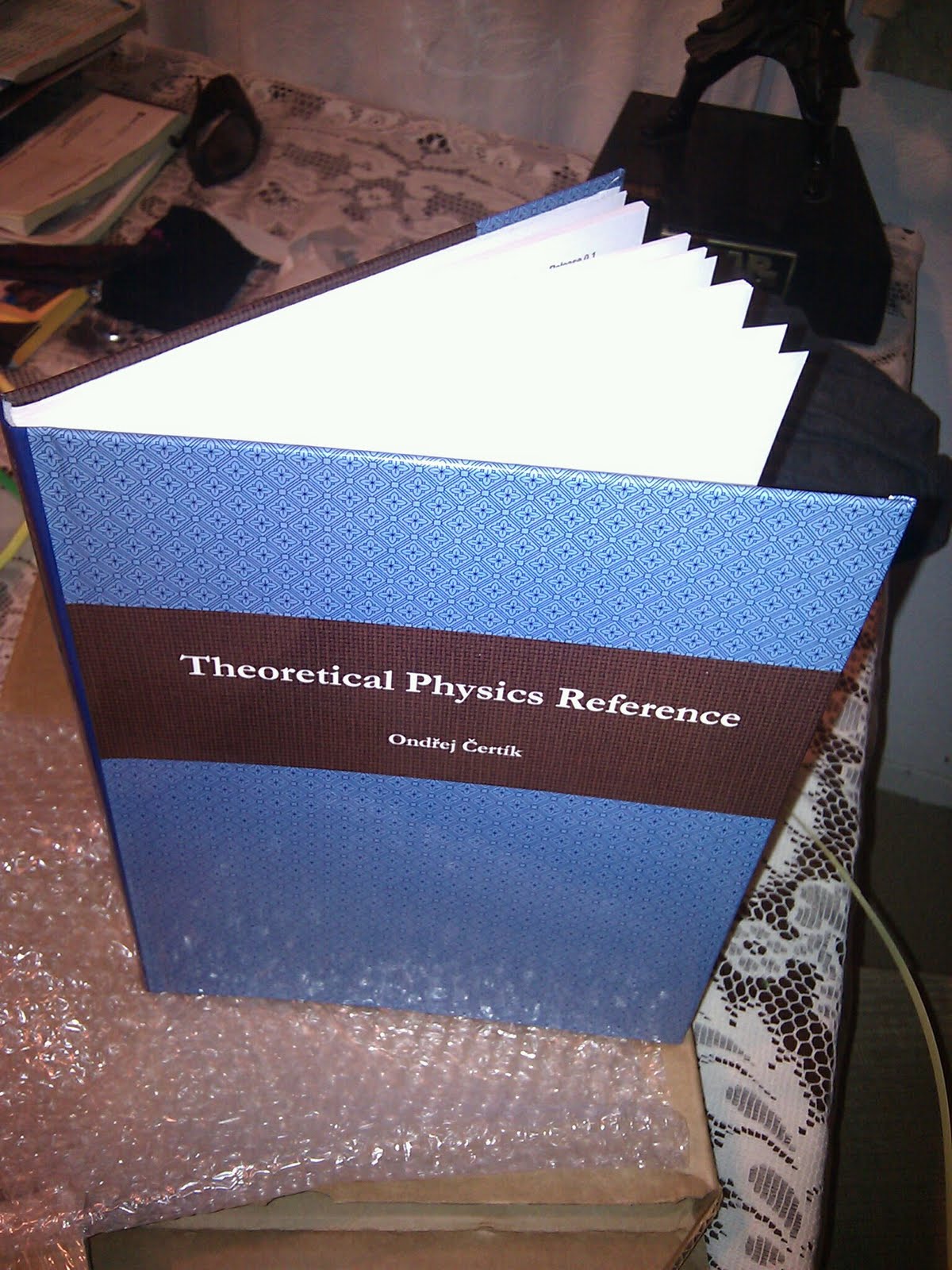
Today I fulfilled my old dream --- I just created my first book! Here is how it looks like:

More images
here.

Here is the source code of the book: http://github.com/certik/theoretical-physics, the repository contains a branch 'master' with the code and 'gh-pages' with the generated html pages, that are hosted at github, at the url theoretical-physics.net.

Then I published the book at Lulu: http://www.lulu.com/product/hardcover/theoretical-physics-reference/11612144, I wanted a hardcover book, so I setup a project at Lulu, used some Lulu templates for the cover and that was it. Lulu's price for the book is $19.20 (166 black & white pages, hardcover), then I can set my own price and the rest of the money probably goes to me. I set the price to $20, because Lulu has free shipping for orders $20 or more. You can also download the pdf (for free) at the above link (or just use my git repository). So far this didn't cost me anything.

I have then ordered the book myself (just like anybody else would, at the above address) and it arrived today. It's a regular hardcover book. Beautiful, you can browse the pictures above. It smells deliciously (that you have to believe me). And all that it cost me was $19.20.

As for the contents itself, you can browse it online at theoretical-physics.net, essentially it's most of my physics notes, that I collected over the years. I'd like to treat books like software --- release early release often. This is my first release and I would call it beta. The main purpose of it was to see if everything goes through, how long it takes (the date inside the book is July 4, 2010, I created and ordered it on July 5, got the physical book on July 19) and what the quality is (excellent). I also wanted to see how the pages correspond to the pdf (you can see for yourself on the photos, click on the picasa link above).

Now I need to improve the first pages a bit, as well as the last pages, improve the index, write some foreword and so on. I also need to think how to better organize the contents itself and generally improve it. I also need to figure out some versioning scheme, so far this is version 0.1. I think I'll do edition 1, edition 2, edition 3, and so on. And whenever I feel that I have added enough new content, I'll just publish it as a new edition. So if you want to buy it, I suggest to wait for my 1.0 version, that will have the mentioned improvements.

It'd be also cool to have all the editions online somehow and create nice webpages for it (currently theoretical-physics.net points directly to the book html itself).

So far the book is just text. I still need to figure out how to handle pictures and also whether or not to use program examples (in Python, using sympy, scipy, etc.). So far I am inclining not to put there any program codes, as then I don't need to maintain them.

Overall I am very pleased with the quality, up to some minor issues that I mentioned above, everything else end up just fine. I think we have come a long way from the discovery of the printing press. Anybody can now create a book for free, and if you want to hold the hardcopy in your hands, it costs around $20. You don't need to order certain amounts of books, nor partner with some publisher etc. I think that's just awesome.

Russell Coker: Digital Video Cameras

I ve just done some quick research on Digital Video Cameras for some relatives. It seems to me that the main feature that is necessary is Full HD (1920*1080) resolution as everyone seems to be getting 1920*1080 resolution monitors (getting smaller doesn t save enough money to be worth-while). Resolutions higher than 1920*1080 will probably available in affordable monitors in the next few years, so the ability of programs like mplayer to zoom videos will probably be required even for Full HD video soon. Saving maybe $300 on a video camera while getting a lower resolution doesn t seem like a good idea. The next feature is optical zoom, most cameras are advertised with features such as advanced zoom to try and trick customers, cameras which advertise 60* or better zoom often turn out to only have 20* zoom. I think that about 20* optical zoom should be considered the minimum, not that there is anything special about 20* zoom, it s just that there is a good range of cameras with better zoom capacity. Image stabilisation is a required feature, no-one can keep their hand perfectly steady and the typically a DVC only gets hand-held use most people who own them don t even own a tripod! Digital image stabilisation is apparently not nearly as good as optical image stabilisation, and image stabilisation that involves moving the CCD is apparently somewhere in between. Finally it s good to have the ability to take quality photos as few people will want to carry a Digital Camera and a Digital Video Camera. I did a search for DVCs on the web site of Ted s Camera store (a chain of camera stores in Australia that generally provide good service at a competitive price but not the cheapest price). The best of the Ted s options seems to be the Panasonic SD60 HD Video [1] which does 25* optical zoom, 1920*1080i video, 5 megapixel still photography, and optical image stabilisation it costs $750 from Ted s. The next best option seems to be the Sony Handycam HDR-CX110 HD [2] which does 25* optical zoom, 1920*1080i video, 3.1 megapixel 2048*1536 still photography, and digital image stabilisation. The Panasonic seems to be a better option due to having optical image stabilisation and a higher resolution for still photographs. It is also $750 from Ted s. Now there s the issue of how well the cameras work on Linux. A quick Google search indicated that the Sony cameras present themselves as USB card readers and can be mounted on a Linux system, I couldn t discover anything about the Panasonic. If I was going to buy one I would take my Netbook to the store and do a quick test. I don t have enough information to recommend either of those cameras, they may have some awful defects that are only apparent when you use them. But in terms of features they seem pretty good. The Panasonic SD60 HD Video should be a good benchmark when comparing cameras in the store. If nothing else the camera store staff seem to not be very helpful if asked generic questions such as which camera is best , but if asked questions such as how is this other camera better than the one I m looking at they can usually give good answers. If anyone has any other advice for purchasing a DVC then please let me know. Either generic advice or specific examples of Linux-friendly DVCs that have been purchased recently.

19 July 2010

Christian Perrier: Taking care of my pet geneweb package

This week-end, I didn't work a lot on Debian stuff (mostly running and gardeing...) but still managed to finally take care of my pet package, the one I maintain since 2001, namely geneweb. The package suffered from a very longstanding RC bug that made it unusable on amd64 machines. I had to call for help Ocaml gurus and R mi Vanicat kindly provided a working patch. So, now, geneweb can be released and I won't have to ask for my pet package to be removed from testing. I even switched it to dh7 and "minimal" debian/rules file (something I planned to do at DC10 but finally turned out to be easy to do. That will be my last week-end of activity in Debian until DebConf10 as I'll be away for the upcoming week-end. So, for those of you who attend DC10, see you in NYC. I'll arrive on Wed 28th evening for part of Debcamp and I'll have the great pleasure to introduce my son Jean-Baptiste to the Debian world.

Next.

Previous.