Search Results: "ina"

3 April 2013

Daniel Pocock: The multiple repository conundrum in Linux packaging

I'm involved with a number of free software projects as both a developer and as the maintainer of packages for various distributions such as Debian (which also feeds packages to Ubuntu) and OpenCSW. I regularly come across the following situations:
  • Developers of great software who would like to see it packaged, distributed and promoted conveniently through platforms like Debian
  • Users of Linux distributions who are keen to use free software if it is presented in a convenient and accessible manner they are familiar with.
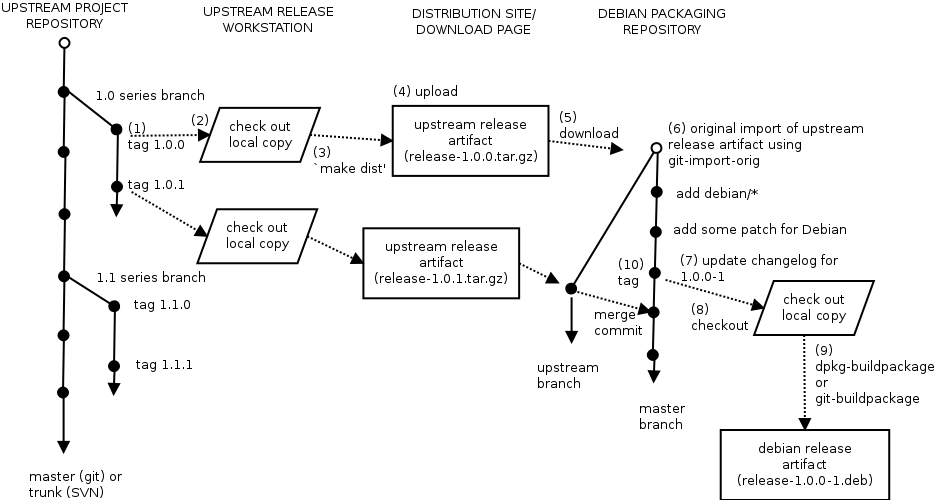
Sadly, despite everybody having the best intentions, there is sometimes a chasm separating these two groups of people. Upstream developers are often busy developing new features and don't have time to work on the intricacies of packaging. I hope that by sharing a few of my own experiences I can help more developers get their software packaged more easily. Fortunately, a number of great tools like git-buildpackage have emerged for streamlining the packaging process, but this has also created more confusion for developers who have their own git repositories and don't quite understand how the Debian git repository and patching process relates to their own repository. The autotools world Here, I focus on autotools based software, because this type of software has it's own peculiar issues when packaging. In particular, these issues appear when using a version control system to track upstream releases. Some of the concepts can be applied to the study of regular Makefile or cmake projects as well. Here is a diagram giving an overview: Let's work through each of the steps in the diagram: The upstream release
  1. The developer/release manager updates the version number in
    configure.ac
    (sometimes called configure.in) and tags the code. (Usually this tag is on a dedicated release branch.)
  2. The developer checks out a copy of the code from the tag into a fresh working directory
  3. The developer runs the autoreconf/automake tools, usually from a bootstrap script. These tools create a number of new files that don't exist in the project repository. Finally, the developer runs
    make dist
    , which puts all the files,
    including the generated files, into a distribution tarball. It is worth emphasizing this point: the tarball is not just an archive of the files from the repository/tag, it also contains a number of
    files generated by autotools.
  4. The developer uploads the tarball to a web site such as the Sourceforge download page. Usually a release announcement is made now containing checksums for the tarball.
At this point, the upstream developer's work is done and packaging teams from various projects such as Debian will take over. Sometimes, the upstream developer is also building the packages and continues
onto the next steps himself: Packaging
  1. The package is downloaded by the package maintainer
  2. If it is the first download, the maintainer creates a new git repository. If it has been packaged before, he clones the repository. The important point here is that this is not the upstream repository, it is an independent repository for Debian packaging. The maintainer uses the git-import-orig tool to import the upstream tarball into the packaging repository. The git-import-orig tool captures an exact snapshot of the upstream release tarball contents in a branch called upstream. One point where the Debian repository differs fundamentally from the upstream repository is that all files from the tarball will be tracked in the Debian git repository, even those automatically generated files that were created by autotools and don't exist in the upstream repository.
  3. The maintainer creates or updates the various artifacts for packaging. These files are kept on the master branch, and the tarball contents from the upstream branch are merged into master to create packages.
  4. When the maintainer feels the code is ready, he will check out a clean copy of the repository to build the package from.
  5. The maintainer executes a tool such as git-buildpackage or regular dpkg-buildpackage, which creates the *.deb files.
  6. The files are checked with a tool like lintian and some manual testing/installation. If all is OK, a tag is made in the packaging repository, with a suffix appended to the upstream version number to indicate which iteration of the package it applies to.
AttachmentSize
release-packaging-workflow.dia3.97 KB

2 April 2013

Jon Dowland: GSettings

With GNOME 3, if you want to override a setting with a new site default, assuming your app has been updated to use the new gsettings API and doesn't still use the old gconf one, the best guide on what to do is still Ross Burton's blog post from two years ago, although you can find most of what you need to know buried deep in the GSettings C API specification, which is not the first place I would have looked (lesson learned!) Note: In this context I'm in the role of systems administrator, rather than distributor/vendor or software author. Whereas you are generally advised to use gsettings itself and not poke at the backend (dconf for Linux), the documentation seems to point sysadmins towards dconf hackery rather than gsettings. However gsettings worked for me, and I got nowhere with dconf direct. Some caveats worth knowing about: Today I had to create 40 guest accounts on our 70-seat Linux cluster, including randomly generate passwords, set up persistent storage on our NFS server, etc.; quickly. As a nice-to-have I also wanted to add some application icons to the GNOME 3 "Favourite Apps" menu for the guests. Would you like to guess which of those jobs was the easier of the two?

Wouter Verhelst: Switching away from mutt

After having used mutt for about a decade, I decided it's time I move away from it, for various reasons that I won't go into here. I've been evaluating thunderbird^Wicedove now for a few weeks, but I can already see I won't keep using it forever, because I find too many issues with it:
  1. I can't tell the thing that I never ever ever want to write HTML-formatted emails. While there is an option "Compose messages in HTML format" in the "Account settings" dialog, that only seems to impact the behaviour of the client upon "new mail", not its reply behaviour, forcing me to go to Options->Format and switch it off.
  2. To make matters worse, the HTML editor and the plain-text editor are not the same dialog. That means it is not possible to switch on HTML formatting if it wasn't on originally (not a problem for me, but I can imagine it being a problem for others), but also that the fugly quoting style (vertical line next to the text) of the HTML editor is not removed when you switch from HTML to plain-text. Further on, it has issues when you want to remove white space, where it will remove entire quoting levels rather than just an empty line. This is horrible, horrible behaviour.
  3. While there is support for multiple email addresses connected to the same IMAP account, it does appear that there is no support for automatically choosing the right email address based on user-defined rules, such as "which mail folder are we currently in". Having to remember that I need to select the right mail address is tiresome and error-prone; e.g., when I'm in a Debian-related mail folder, I want my mail client to use my Debian mail address automatically. It appears the only way in which icedove can automatically select sender addresses is by checking the recipient list in the To: and Cc: headers for any of its configured mail addresses, and using that to decide what to put in the from: header.
Any one of the above would eventually be enough for me to grow tired of icedove and switch to something else; but the three combined mean that I'll be looking for something else fairly soon. Suggestions are, of course, welcome.

Jonathan McDowell: Building a new house server

I've moved (only a couple of blocks from where I was before), and as the new place has Webpass I've reluctantly given up my Sonic.net connection, along with its static IPv4 address and ISP IPv6 tunnel. Hard to resist a 200Mb/s ethernet connection for the same price I was paying for 18Mb/s ADSL2 though. However that leaves my DGN3500 router somewhat inappropriate for providing my net connection. Freed from the need for an ADSL/cable router I decided it was time to build an all in one house server (I'm a believer in as few always on boxes as possible). I already had a nettop acting as a media box, but wanted to build something that would handle: Probably in that order if it turns out I'm asking too much. The intention is the box is the only one that always needs to be on, so I wanted it to be low power consumption. I also wanted the option of hooking it up to the TV if it turned out to have enough grunt, so the case needed to be something suitable for the living room. I like Intel's approach to graphics drivers, in particular the existence of Free video acceleration support, so I went with an Intel Core i3-3220T as the processor. It's a 35W Ivybridge processor with HD 2500 graphics, plus I got it for a decent price. For the case I chose a CFI A2059. There's a local supplier I was able to pick it up from, it has a couple of large fans which helps keeps the noise down while keeping things cool and as I was aiming for backup / file sharing being more important than a media box the 2 hot swap bays tipped the balance away from an AV style case. The small case limits the motherboard options. I wanted twin GigE ports so the external was entirely separate from the internal (my switch does VLANs so I could have made do with a single port, but with a 200Mb/s connection I didn't really want to share the port). The Gigabyte GA-H77N-WIFI seemed to fit the bill, with the added advantage of a built in WiFi card (an Intel 2230 in a mini PCI-E slot) which leaves the PCI-E slot free for either a TV tuner or a second WiFi card to cover 5GHz. I maxed out the board with 2 8G G.SKILL DDR3-1600 DIMMs. I normally go Crucial because I've found them reliable, but these were slightly cheaper and available from the same place as the motherboard. Finally I added a Seagate ST4000DM000 for storage. It actually came from a Backup Plus that Costco were selling for about $20 less than the bare drive sells for. The plan is to add at least another 1T drive to RAID1 the most important bits (or possibly a 2T - it depends which of my existing drives I can tidy stuff off most easily). Of course it's running Debian and I took the opportunity to try out the RC1 Wheezy image. For extra giggles I did an EFI install; this all worked fine except I didn't end up with grub-efi installed at the end, instead I had grub-pc. I booted with legacy BIOS enabled and followed Tanguy's switch to UEFI boot instructions. Further notes on software setup to follow...

Russ Allbery: Review: An Election

Review: An Election, by John Scalzi
Publisher: Subterranean
Copyright: 2010
Printing: 2012
ISBN: 1-59606-496-X
Format: Kindle
Pages: 24
This is another story from the Subterranean Scalzi Super Bundle that probably doesn't justify a full review, particularly since this time it's a short story and not even a novelette, but as with the others it's been independently published on the Kindle (and is still available that way for 99 cents). So by my obsessive internal consistency that matters only to me, it gets a full review anyway. I was mildly surprised to find that this was actually my second reading, and now vaguely remember that Subterranean had actually sponsored the story's appearance on Scalzi's blog as an advertising experiment. So I originally read the story from Scalzi's blog, and if you don't really want to pay money for it, you still can as well. Along with a couple of ads that appear to have bit-rotted. The chief feature of An Election is the background: a world in which aliens and humans are intermingled in a political district, going about their lives against a background of rather extreme multispecies diversity. The protagonist, David, decides to run for the upcoming city council special election, despite living in a district that's minority-human and that hasn't seen a human councilor in forty-four years. (David also happens to be a gay man, which goes entirely unremarked in the story and is, in fact, entirely unremarkable given the excitingly diverse characteristics of his alien neighbors. I thought that was a nice touch.) He of course appears to stand no chance, particularly when one of the city bosses decides to run as well, but ends up with a campaign advisor almost by accident and determinedly attempts to connect with his neighbors and earn their votes. This felt quite typical to me of Scalzi's humor writing. The protagonist is a good-hearted person who gets in rather over his head but is still determined to do the right thing, while not taking anything too seriously. The background humor is never particularly threatening and tends towards slapstick and banter. I found it similar in tone to most of Agent to the Stars, although of course much shorter. As usual, Scalzi's grasp of conversational banter is probably the strongest part of the story; the dynamic between David, his husband James, and his campaign advisor brought several chuckles for me. This is slight but enjoyable. I wouldn't go out of my way to read it, but it's a good story to toss into a bundle of other work, and I remember it holding my interest when reading it on-line. (Which is rare; usually I fail to finish any fiction I try to read in a browser unless it's extremely short.) Rating: 6 out of 10

1 April 2013

Andrew Pollock: [life/repatexpat] Day #1 of repatriation

Well, we're back in Brisbane, for good. Now starts the long and involved process of bootstrapping a new life for myself. Fortunately it's slightly more familiar territory than starting up in the US was. The tenants in my Hawthorne apartment have agreed to terminate their lease early, and I should get the keys tomorrow. The lease on my Woolloongabba apartment ends on Friday I think, and all of our stuff is scheduled to be delivered there next Monday. My primary goal is to get my apartment habitable for Zoe and I as soon as possible. That means beds and a fridge, and Zoe's going to need some way of being kept entertained while I'm running around like a chook with its head cut off, which is most likely going to mean a TV and a DVD player. This week is going to be spent doing a lot of running around. I need to get a car, get a Queensland driver's licence, get the electricity on, get the ADSL on, buy appliances, furnish Zoe's room, furnish my room, heck, furnish the whole apartment, really. It's going to be very full on busy. I don't want to race out and buy anything today, even though the shops seem to be open, because I want to measure up my apartment first. The day's sole purchase was an electric screwdriver from Bunnings. There will be much Ikea assembly in my future.

Russ Allbery: Review: Echo

Review: Echo, by Jack McDevitt
Series: Alex Benedict #5
Publisher: Ace
Copyright: November 2010
Printing: November 2011
ISBN: 1-937007-00-6
Format: Mass market
Pages: 367
This is the fifth book in the ongoing Alex Benedict series, but reading the previous volumes is generally optional. While there are references to earlier events (and indeed I resorted to Wikipedia at one point to refresh my memory of the plot of the the first book in the series), they aren't critical to the plot. They mostly are background for the reactions of other characters to Benedict and his firm. Echo opens with the now-familiar prologue, giving us a fleeting and limited glimpse into the mystery that Benedict and Chase Kolpath will be pursuing for the rest of the book. This time, it features the explorer Somerest Tuttle, who has spent most of his life looking for intelligent alien life. (In the far future setting of these books, humanity has spread through a large region of the galaxy but has only encountered one other alien race.) In the twilight of his career and life, a friend who works as a tour guide for astronomical tours comes to him with a story about something she saw. What, we don't know, and won't for most of the book. But, whatever it is, Tuttle never goes public with it, which is directly contrary to what everyone would expect him to do with any news about alien life. Benedict and Kolpath get involved some years later, after Tuttle's death, when a stone slab with unknown markings that was part of his estate shows up on the future equivalent of Craigslist, free to the first person who will haul it away. Benedict finds that interesting enough to go pick up, but then is really hooked when someone else goes to considerable lengths to try to make the slab disappear before anyone can get a good look at it. This, slowly, leads into poking around Tuttle's life and connections, the star tour industry, and the possible origins of the slab. If you've read any of the previous books in this series, Echo is more of the same, and I mean that in a good way. I think McDevitt is at his best when writing this sort of cross between scientific puzzle, mystery, and non-military adventure, full of people who care deeply about knowing and understanding things and don't like to be thwarted in their efforts. There is McDevitt's trademark halting and red-herring-ridden investigation that succeeds in being engrossing and compelling, plenty of opportunities to guess what's really going on (a bit easier this book than in some others), and a bit of action that I thought was better-handled than the somewhat strained action scenes of The Devil's Eye. The book moves right along, despite multiple reversals in the progress of the investigation, and the final revelation does indeed justify the strange behavior of the various people Benedict encounters. As with McDevitt in general and this series in particular, there is one caveat: the astronomical details are often interesting, but the world building in general is not terribly believable. Despite supposedly taking place millennia into the future, the society is a straight transplant (projection would imply more change than exists) of middle-class American culture, with bonus air cars, space ships, and slightly better computers. Similarly, alien ecologies suffer from severe Star Trek problems: all the planets feel like copies of Earth with a few minor tweaks. This just goes with the territory, and if you're up to the fifth book of the series, you've probably gotten used to it, but the unrealistic lack of divergence is actually used as a plot point here. That strained my suspension of disbelief a bit. That said, this sort of extremely familiar social context does give the books an oddly calm, comfortable feeling. It's tempting to describe McDevitt as cozy science fiction. There's a bit of danger, a bit of suspense, but one is fairly certain that everything will work out in the end and the reader will leave the book knowing the solutions to most of the mysteries raised without having to work very hard at understanding the society or the puzzle. If that's what you're in the mood for (and I was when I read Echo), McDevitt delivers reliably. If you like the Alex Benedict series in general, recommended, as this is an excellent example of the type. Rating: 8 out of 10

Francois Marier: Poor man's RAID1 between an SSD and a hard drive

After moving from a hard drive to an SSD on my work laptop, I decided to keep the hard drive spinning and use it as a backup for the SSD. With the following setup, I can pull the SSD out of my laptop and it should still boot up normally with all of my data on the hard drive.

Manually setting up an encrypted root partition Before setting up the synchronization between the two drives, I had to replicate the partition setup. I used fdisk, cfdisk and gparted to create the following partitions:
   Device Boot      Start         End      Blocks   Id  System
/dev/sdb1   *        2048      499711      248832   83  Linux
/dev/sdb2          501760   500117503   249807872    5  Extended
/dev/sdb5          503808   500117503   249806848   83  Linux
and then loosely followed these instructions to create an encrypted root partition on /dev/sdb5:
$ cryptsetup luksFormat /dev/sdb5
$ cryptsetup luksOpen /dev/sdb5 sdb5_crypt
$ pvcreate /dev/mapper/sdb5_crypt
$ vgcreate akranes2 /dev/mapper/sdb5_crypt
$ vgchange -a y akranes2
$ lvcreate -L247329718272B -nroot akranes2
$ lvcreate -L8468299776B -nswap_1 akranes2
$ mkfs.ext4 /dev/akranes2/root
Finally, I added the new encrypted partition to the list of drives to bring up at boot time by looking up its UUID:
$ cryptsetup luksUUID sdb5_crypt
and creating a new entry for it in /etc/crypttab.

Copying the boot partition Setting up the boot partition was much easier because it's not encrypted. All that was needed was to format it and then copy the files over:
$ mkfs.ext2 /dev/sdb1
$ mount /dev/sdb1 /mnt/boot
$ cp -a /boot/* /mnt/boot/
The only other thing to remember is to install grub on the boot loader of that drive. On modern Debian systems, that's usually just a matter of running dpkg-reconfigure grub-pc and adding the second drive (/dev/sdb in my case) to the list of drives to install grub on.

Sync scripts To keep the contents of the SSD and the hard drive in sync, I set up a regular rsync of the root and boot partitions using the following mount points (as defined in /etc/fstab):
/dev/mapper/akranes-root /           ext4    noatime,discard,errors=remount-ro 0       1
/dev/mapper/akranes2-root /mnt/root  ext4    noatime,errors=remount-ro         0       2
UUID=0b9109d0-... /boot              ext2    defaults                          0       2
UUID=6e6f05fb-... /mnt/boot          ext2    defaults                          0       2
I use this script (/usr/local/sbin/ssd_boot_backup) for syncing the boot partition:
#!/bin/sh
if [ ! -e /mnt/boot/hdd.mounted ] ; then
    echo "The rotating hard drive is not mounted in /mnt/boot."
    exit 1
fi
if [ ! -e /boot/ssd.mounted ] ; then
    echo "The ssd is not the boot partition"
    exit 1
fi
nice ionice -c3 rsync -aHx --delete --exclude=/ssd.mounted --exclude=/lost+found/* /boot/* /mnt/boot/
and a similar one (/usr/local/sbin/ssd_root_backup) for the root partition:
#!/bin/sh
if [ ! -e /mnt/root/hdd.mounted ] ; then
    echo "The rotating hard drive is not mounted in /mnt/root."
    exit 1
fi
if [ ! -e /ssd.mounted ] ; then
    echo "The ssd is not the root partition"
    exit 1
fi
nice ionice -c3 rsync -aHx --delete --exclude=/dev/* --exclude=/proc/* --exclude=/sys/* --exclude=/tmp/* --exclude=/boot/* --exclude=/mnt/* --exclude=/lost+found/* --exclude=/media/* --exclude=/var/tmp/* --exclude=/ssd.mounted --exclude=/var/lib/lightdm/.gvfs --exclude=/home/francois/.gvfs /* /mnt/root/
To ensure that each drive is properly mounted before the scripts run, I created empty ssd.mounted files in the root directory of each of the partitions on the SSD, and empty hdd.mounted files in the root directory of the hard drive partitions.

Cron jobs The sync scripts are run every couple of hours through this crontab:
10 */4 * * *                root    /usr/local/sbin/ssd_boot_backup
20 0,4,8,12,16,20 * * *     root    /usr/local/sbin/ssd_root_backup
20 2,6,10,14,18,22 * * *    root    /usr/bin/on_ac_power && /usr/local/sbin/ssd_root_backup
which includes a reduced frequency while running on battery to avoid spinning the hard drive up too much.

31 March 2013

Enrico Zini: A proposal to solve gender imbalance in Debian

A proposal to solve gender imbalance in Debian We've done all we can so far: Debian Women, the Diversity Statement, the anti-harassment contact, gender neutral language, lots of education all round, but we still suffer from a strong gender imbalance in Debian. I think that the reason is that the majority group of cisgender men in the project, although they don't actively work /against/ the rest, still have /no incentive/ to be inclusive, and generally do not understand what bearing a female name online is like. I think it is about time we addressed that, and after a lot of thinking and discussing with many other concerned debianers, I think I have just the right proposal, which is twofold. The first part is this: since the goal is to have an equal gender perception in Debian, we can just decide to only approve one obviously-male-named DD for every obviously-female-named one. That's right: no new obviously-male-named DD unless an obviously-female-named DD has just been approved. It may sound like affirmative action gone wild, but please stop a moment to think about it: this would create precisely the right incentive for the currently dominant group of developers to be inclusive! People shouldn't just assume they can get a Debian account regardless of what happens around them. We already ask NM candidates to fix RC bugs and, well, gender imbalance should be treated as an RC bug, and everyone should feel compelled to join the effort to fix it! Now, of course since there currently are many male names in NM but not a single female name, it would not be reasonable to just stop the flow of new developers into the project: that would just have the effect to make us starve on personpower. So here is the second part of the proposal: the one-female-name-one-male-name policy will not be enforced for, say, a year. But during this year, everyone currently in NM or joining NM will be asked to adopt a female identity. Crazy? No, genius! It's about time people understood what it means to get advances in private every time they make a public contribution! What better way than just trying it out for themselves? On top of that, as more and more female names appear in Debian changelogs, fake or not, people will finally start to understand that it does not matter what name is used to sign the contribution, but the contribution itself. I don't know if this will give us a community where people realise female or male contributions are equally valuable, which is what I hope, or a community where people will think that everyone is a cisgender man even if they have female names. In the end, really, it does not matter. Either way, we finally get to have a community where everyone is /guaranteed/ to be treated the same. But gender imbalance isn't the only imbalance we have in Debian. People accrue a reputation over time, good or bad, and this reputation tends to stick on you for years, regardless of how you may change, for better or for worse. When we evaluate the merit a contribution, we should not be biased by the reputation of the contributor! How can new contributors be taken seriously otherwise? I believe we are loosing lots of fresh, good ideas this way. And how much damage could be wrecked on the project by a well-respected contributor, like a Debian Account Manager, who is having a funny day? I think we can address this just as I propose to address gender imbalance: let's swap identities from time to time, like it usually happens with nametags at the end of Debconfs. Let's see gregoa upload a patched versions of python3.2, and enrico upload a new upstream version of eglibc! See if we won't finally have some peer review at last! Reputation and real identities have many merits, but we have come to rely too much on them, and it is hurting us. It is time we did something about it, before it is too late!

Nathan Handler: Debian Mobile

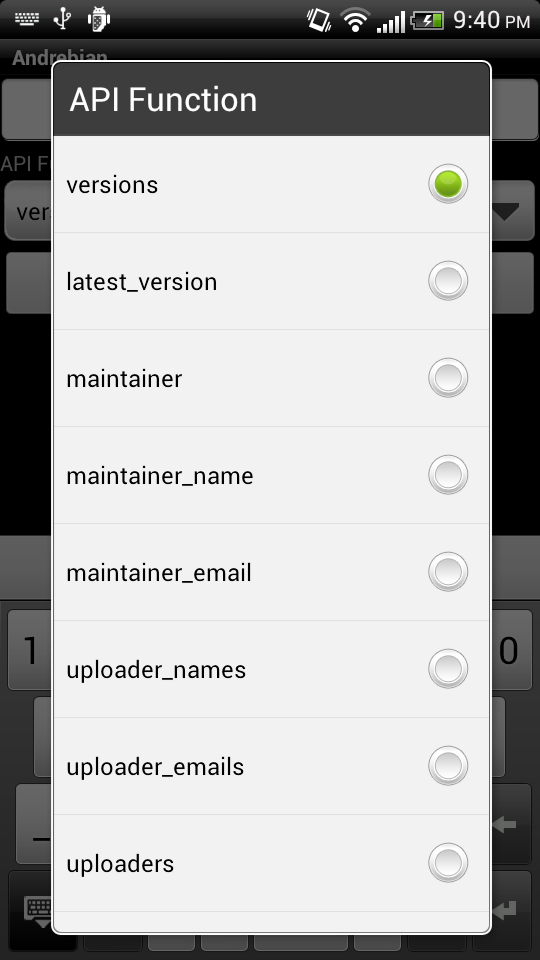
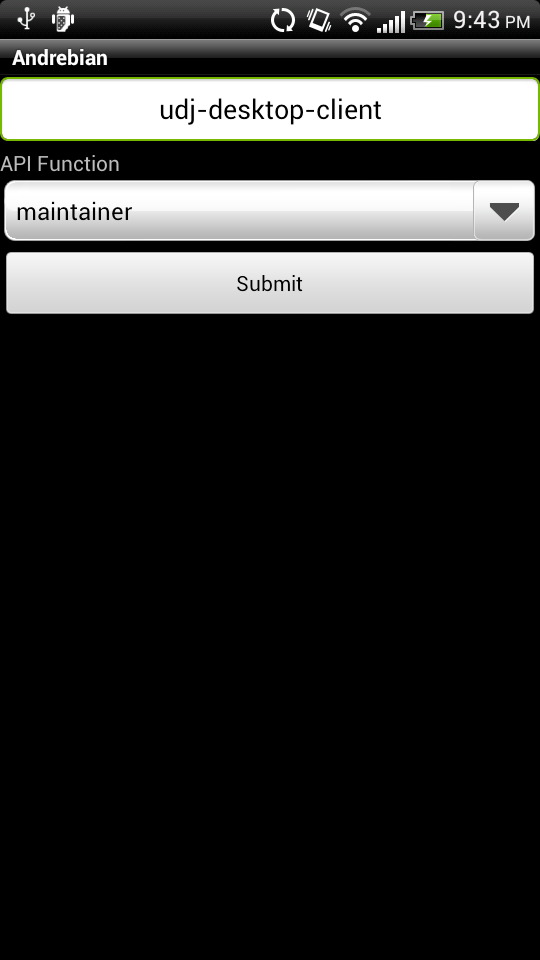
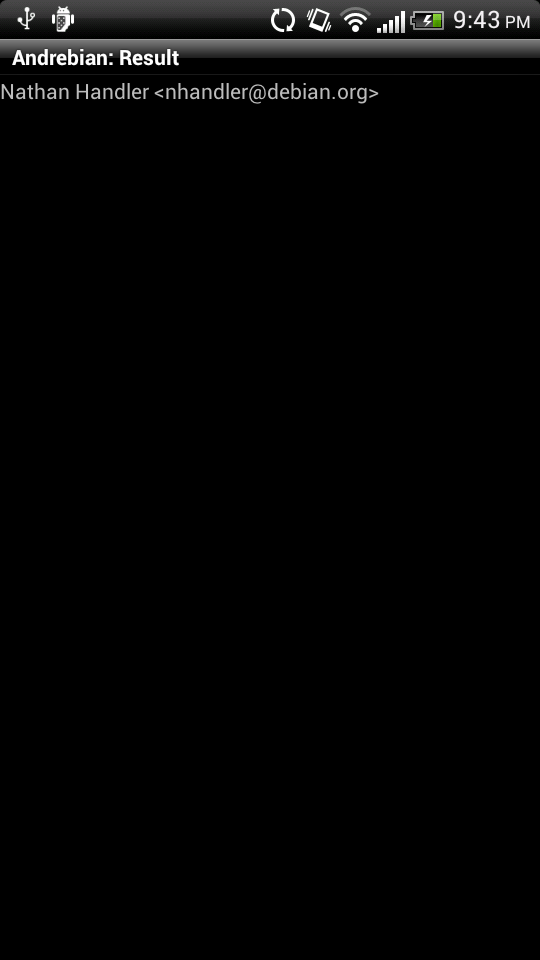
For one of my classes, the final project is to work on a personal project for four weeks. Since I have never done mobile programming before, I decided I would use this project as a chance to teach myself the basics of Android development. Paul Tagliamonte recently blogged about a Google Summer of Code project idea for a Debian Android application. It was this post that motivated me to create a Debian Android application for my final project. We are only in the middle of week one, but my plan is to have at least a basic BTS and PTS interface done by the end of the project. Then, depending on a few things, I hope to turn it into a Google Summer of Code project or simply continue developing it on my own. As I mentioned, I am only a few days into the project. One of the first hurdles I encountered was interacting with the SOAP interfaces available for the PTS and BTS. There are a few examples available on the wiki, but there are not any for Java. A Google search also failed to return any clear and simple results. As a result, I decided I would create a Python script that would accept requests from the Java Android application via a REST API and pass them on to the SOAP API before returning the result as JSON. Before I could finish writing the script, Paul mentioned that he had already written a similar program a few months ago. I immediately stopped working on my script and began preparing a patch for Paul's program to add support for some missing PTS SOAP functions as well as the entire BTS. After a few hours, I had the ability to query the PTS and BTS via a REST API from Java. While I normally prefer to use VIM for my programming, I decided to follow Google's recommendation and use Eclipse. I was able to follow their guide to get the SDK setup and a simple demo application running. One of the few hurdles I encountered was when I wanted to make web requests. Due to the ability for such requests to stall, you are required to perform them in a separate thread. This only becomes aparant when you try to test your application on an actual device; the emulator will happily run the process in the main thread. Regardless, I was eventually able to modify the demo application to allow me to make requests to my Python REST server and then parse and display the result. Here are some screenshots of the application running. Main Screen API Functions Information Entered Result If you have any feature suggestions, questions, or comments, feel free to send me an email (nhandler@debian.org). The source code for the Android application is currently not available, but I plan to put it up in a git repository sometime in the near future. The source code for the Python script that provides a REST API to access the PTS and BTS SOAP interface is available on GitHub.

30 March 2013

Steve McIntyre: Scanning for assembly code in Free Software packages

In the Linaro Enterprise Group, my task for the last several weeks was to work through a huge number of packages looking for assembly code. Why? So that we could identify code that would need porting to work well on AArch64, the new 64-bit execution state coming to the ARM world Real Soon Now. Working with some Ubuntu and Fedora developers, we generated a list of packages included in each distribution that seemed to contain assembly code of some sort. Then I worked through that list, checking to see:
  1. if there was actually any assembly there;
  2. if so, what it was for, and
  3. whether it was actually used
I've written a full report about what I found in the scan, and I'll be writing some more articles based on it shortly.

29 March 2013

Dirk Eddelbuettel: R / Finance 2013 Open for Registration

The annoucement below just went to the R-SIG-Finance list. More information is as usual at the R / Finance page:
Now open for registrations: R / Finance 2013: Applied Finance with R
May 17 and 18, 2013
Chicago, IL, USA
The registration for R/Finance 2013 -- which will take place May 17 and 18 in Chicago -- is NOW OPEN! Building on the success of the previous conferences in 2009, 2010, 2011 and 2012, we expect more than 250 attendees from around the world. R users from industry, academia, and government will joining 30+ presenters covering all areas of finance with R. We are very excited about the four keynotes by Sanjiv Das, Attilio Meucci, Ryan Sheftel and Ruey Tsay. The main agenda (currently) includes seventeen full presentations and fifteen shorter "lightning talks". We are also excited to offer five optional pre-conference seminars on Friday morning. To celebrate the fifth year of the conference in style, the dinner will be held at The Terrace of the Trump Hotel. Overlooking the Chicago river and skyline, it is a perfect venue to continue conversations while dining and drinking. More details of the agenda are available at:
http://www.RinFinance.com/agenda/
Registration information is available at
http://www.RinFinance.com/register/
and can also be directly accessed by going to
http://www.regonline.com/RFinance2013
We would to thank our 2013 Sponsors for the continued support enabling us to host such an exciting conference:
International Center for Futures and Derivatives at UIC Revolution Analytics
MS-Computational Finance at University of Washington Google
lemnica
OpenGamma
OneMarketData
RStudio
On behalf of the committee and sponsors, we look forward to seeing you in Chicago!
Gib Bassett, Peter Carl, Dirk Eddelbuettel, Brian Peterson,
Dale Rosenthal, Jeffrey Ryan, Joshua Ulrich
See you in Chicago in May!!

28 March 2013

Eddy Petrișor: The sorry state of the Android universe


Update: Corrected the code name for 4.2.2 is Jelly Bean, not Ice Cream Sandwich as I initially stated. I also described in the comments why the calendar application is also crap.

I recently bought a phone based on the Android platform (version 4.2.2 aka Jelly Bean). Before the purchase I had the wrong idea that this platform - Android - is the best thing since sliced bread. Let me tell you, that idea is so wrong, it's a shame anybody thinks or has ever thought that.

My previous phone was a Nokia E71 and with its stock set of applications and in spite of its old and rusty Symbian OS, I still have a hard time to even match the basic functionalities on the Android phone even using the most praised apps from the Play Store.

The dialer is crap, there is no decent speed dialer, the focus is on the apps instead of the phone functionality, the homescreen-type-to-search-in-contacts functionality of E71 is probably impossible due to the retarded decision to forget you're using a phone, notifications, even important ones, are hidden, to the point that the ones needing attention can be missed (e.g. entering the PIN/confirmation for Bluetooth pairing must be searched for in the notification area), when looking in the agenda there is no straight one step to edit a contact, you must jump to another application and do the edit there, treating SMS conversations as one to one instant messages works until you want to reply to multiple people at once.

Volume for ringing, SMS notification and the headset are controlled all together, so if during the last conversation you turned down the volume because it was too loud, you can miss a call because our will ring at a lower volume.

And these are only broken things in the basic functionality (for a post 2008 cell phone).

Android phones are smart phones, so more advanced features are required: playing audio and video files, GPS related applications, podcasting support, email handling and web browsing are among the features that can be expected on such a phone.

Only web related functionality and simple media playing are at a reasonable level compared with my old E71, maybe due to Google being web oriented and the new phones having better screens than the old Nokia.

But I am an avid podcast listener, so I've been searching for an application that can match Nokia's Podcasts stock application, and I've come to the conclusion Android users which love podcasts either have to wait for Nokia to develop on Android (which seems unlikely) or find one or two talented developers to create a decent application.

I don't understand how can such an application not have a playlist with the downloaded episodes, not have download all new episodes or mark all/selected as listened. I have found applications that have at least one of these issues and have an average of over 4 out of 5 stars in Google Play. Poor users!

In the light of these issues, I'm having so much difficulty coming up with an excuse for Nokia losing its position as a market leader, but our seems technical superiority is not necessary or enough to dominate the mobile phone market. Sadly, that says a lot about our species, and the words aren't nice.

Michal Čihař: phpMyAdmin translations status

Next round of phpMyAdmin 4.0 translation status report is coming. So let's look at which translations are at 100% right now (new ones are bold): Almost complete: As you can see, there is still lot of languages missing, this might be your opportunity to contribute to phpMyAdmin. Also you are welcome to translate phpMyAdmin 4.0 using translation server. If your language is already fully translated and you want to help as well, you can translate our documentation as well.

Filed under: English Phpmyadmin 2 comments Flattr this!

Russ Allbery: wallet 1.0

Finally. The wallet is a system management tool for storing and retrieving secure data. I originally wrote it as part of our Kerberos v5 migration project to replace the old Kerberos v4 system we had for distributing srvtabs. It's still mostly used at Stanford for distributing keytabs, but it's extensible and supports storing arbitrary secure data. We also use it internally for storing database passwords, SSL private keys, and anything else that needs to be kept secure and retrieved later. It supports a rich ACL mechanism and namespace enforcement and is built on top of remctl for security and confidentiality. I did a bunch of development on it originally in 2006 and 2007, but then it solved our immediate problems and I didn't have much time to work on it. I used pre-1.0 versions because there was so much more on it that I wanted to do. But we've been running it in production for years, and while there's still tons more work that needs to be done, it really deserves a 1.0 version. Jon Robertson converted the database backend to DBIx::Class (which added PostreSQL support) and implemented schema upgrading, which were two of the major things that were keeping me from putting a 1.0 version on it. So it's time. Other new features since the previous release include a change to the default ACLs so that owners of objects can destroy them by default, a new ldap-attr ACL type that checks whether the caller has a particular attribute set in LDAP (which will let us use our entitlement system to control access), and support for storing and managing key rotation for WebAuth keyrings. There's also a new acl check command to determine whether an ACL exists and a new comment field and command to store an arbitrary comment about an object. Our local naming policy has also gotten much more complex, so I turned it into a module to provide an example to others of how to implement some reasonably detailed namespace and object autocreation controls. You can get the latest version from the wallet distribution page. I'm going to upgrade Debian packages to experimental or unstable (depending on the freeze status) as soon as I get a chance to write a bit more documentation and hopefully figure out debconf integration with the database setup support inside Debian for the server piece.

27 March 2013

Bits from Debian: Debian Project Leader elections 2013: interview with Moray Allan

We have asked Moray Allan, one of the three candidates for DPL elections 2013, to tell our readers about himself and his ideas for the Debian Project. You can also read the interviews to the other two candidates: Lucas Nussbaum and Gergely Nagy.
Please tell us a little about yourself. I'm Moray Allan, from Edinburgh in Scotland. I'm 32. After working in academic research for a few years, I'm now working freelance on a wide mixture of topics, with recent projects in Indonesia, Romania and Kuwait. When I'm not working, I'm likely to be found walking through a city or the countryside, or otherwise relaxing at home reading a novel in French or Spanish. What do you do in Debian and how did you started contributing? In recent years, most of my Debian time was taken up organising the annual Debian conferences. But I still have a load of packages, mostly connected to an upstream Linux-on-handheld-computers project I was working on before I joined Debian to create packages for it. Why did you decide to run as DPL? I've been involved in Debian for about 10 years now, including working for the last few years in DebConf in a way similar to how the DPL acts within overall Debian. Previously I'd ruled out running due to lack of time, but currently I'm in a more flexible work situation. It seems the right time to put myself forward, and see if the ideas in my platform interest project members. Three keywords to summarise your platform. Transparency, communication, openness. (Three ways I'd like us to think about teams in Debian.) What are the biggest challenges that you envision for Debian in the future? I think the biggest challenges are for free software in general.
End-users are moving to more closed hardware -- will our software be able to run on the phones and tablets people are shifting towards? At the same time, end-users and server users are moving to "the cloud", and often depending more heavily on non-free infrastructure outside their own control. What are, in your opinion, the areas of the project more in need of technical and/or social improvements? In my platform I give a few ideas about teams and delegations, coordination and mediation, and both internal and external communication, including more organised fundraising. These are areas where I think relatively simple changes can give big benefits. Why should people vote for you? I have proven leadership experience within Debian, as I've been working on coordination and mediation tasks for some years already. At the same time, I do regular packaging work, and work in other parts of Debian like the press and publicity teams, so I'm in touch with the experience of normal Debian contributors. People should vote for me if they support my platform, which is about coordination-level changes that I would have no mandate or authority to push through unless I am elected. Name three tools you couldn't stay without. APT, emacs, ssh. What keep you motivated to work in Debian? I've used Debian on all my computers for a long time, and by now working on the distribution myself feels a natural part of that.
Fortunately I'm constantly positively surprised by Debian and by the Debian community. Are there any other fields where you call yourself a geek, besides computers? Certainly history (such as the eastern Mediterranean region in late antiquity), languages (including dead ones) and music (especially Josquin to Monteverdi).

Bits from Debian: Debian Project Leader elections 2013: interview with Lucas Nussbaum

We have asked Lucas Nussbaum, one of the three candidates for DPL elections 2013, to tell our readers about himself and his ideas for the Debian Project. You can also read the interviews to the other two candidates: Gergely Nagy and Moray Allan.
Please tell us a little about yourself. Hi! I'm a 31 years old french computer geek. In my day job, I'm an assistant professor (Ma tre de Conf rences) of Computer Science at Universit de Lorraine. What do you do in Debian and how did you started contributing? Like many, I started contributing to Debian by creating and maintaining packages for my own software, in the Ruby team. Then, I discovered that, even if it's not so obvious from the outside, there are a lot of areas in Debian that could use more contributors. So I just started to contribute to more and more things. There's a list of things I did in Debian in my platform. What I have been doing recently is: Why did you decide to run as DPL? Two main reasons: Three keywords to summarise your platform. (re-)make Debian the center of the Free Software ecosystem; foster innovation inside Debian; reduce barriers to contributions What are the biggest challenges that you envision for Debian in the future? I often have the impression that the project is losing momentum, positive energy, and slowing down. It feels like we are living on the benefits of the past. A lot of very cool things happen in the Debian ecosystem, but very often outside the Debian project (in derivative distributions). Debian should aim at reinforcing its position in the center of the Free Software ecosystem: it should be the main active intermediary between upstream projects and final users. To achieve that, we need to reinforce the visibility and the impact of Debian. This is extremely important because the values we fight for as a project are often neglected by our derivatives. What are, in your opinion, the areas of the project more in need of technical and/or social improvements? Fostering innovation inside Debian: we should be more welcoming towards innovation and experiments inside the project. Often, we merely tolerate them, and bureaucracy makes them hard and slow to conduct. As a result, people tends to innovate outside the Debian project. Making it easier to contribute to Debian: we compete with more and more projects to attract contributors. While we are already quite good at welcoming new contributors with good documentation and mentoring (much better than people usually think), there's still a lot of room for improvement. Why should people vote for you? A great thing in Debian's voting system is that you don't vote "for" or "against" a specific candidate. Instead, due to our use of the Condorcet method, you rank candidates (and also indicate those who you consider suitable for the role by ranking a virtual "None of the above" candidate). Why am I a good candidate? My previous contributions to Debian show that I have a pretty good understanding of the inner workings of the project, and that I have a track record of managing projects successfully inside Debian. I think that those are two required qualities for a DPL. Name three tools you couldn't stay without. vim, mutt, ssh. What keep you motivated to work in Debian? Debian is a fantastic project from a technical point of view (focus on technical excellence, lots of interesting challenges), but also from a social point of view: the Debian community is a great community where I have lots of good friends. Also, what's great when you contribute to Debian is that your work has a real impact, and that you see people using stuff you worked on everywhere. Are there any other fields where you call yourself a geek, besides computers? I'm not sure this really qualifies as "besides computers", but I've gotten very interested in the OpenStreetMap project lately. I very much enjoy exploring unmapped areas on a mountain bike. It feels like being Christopher Columbus or Marco Polo, but 20 minutes from home. ;) The OpenStreetMap and Debian projects also share many values, such as a great attention to quality and details.

Benjamin Mako Hill: The Institute for Cultural Diplomacy and Wikipedia

A month ago, Mark Donfried from the Institute for Cultural Diplomacy (ICD) an organization dedicated to promoting open dialogue sent me this letter threatening me with legal action because of contributions I ve made to Wikipedia. Yesterday, he sent me this followup threat. According to the letters, Donfried has threatened me with legal action because I participated in a discussion on Wikipedia that resulted in his organization s article being deleted. It is not anything I wrote in any Wikipedia article that made Donfried so upset although Donfried is also unhappy about at least one off-hand comment I made during the deletion discussion on a now-deleted Wikipedia process page. Donfried is unhappy that my actions, in small part, have resulted in his organization not having an article in Wikipedia. He is able to threaten me personally because unlike many people I edit Wikipedia using my real, full, name. Donfried s letter is the latest step in a saga that has been ongoing since last June. It has been a frustrating learning experience for me that has made me worried about Wikipedia, its processes, and its future. In Wikipedia, debates can be won by stamina. If you care more and argue longer, you will tend to get your way. The result, very often, is that individuals and organizations with a very strong interest in having Wikipedia say a particular thing tend to win out over other editors who just want the encyclopedia to be solid, neutral, and reliable. These less-committed editors simply have less at stake and their attention is more distributed. The ICD is a non-profit organization based in Berlin. According to its own website, a large part of the organization s activities are based around arranging conferences. Its goals peace, cultural interchange, human rights are admirable and close to my heart. Its advisors and affiliates are impressive. I had never heard of the ICD before their founder, Mark Donfried, emailed me in April 2012 asking me to give a keynote address at their conference on The 2012 International Symposium on Cultural Diplomacy & Human Rights. I replied, interested, but puzzled because my own research seems very far afield of both cultural diplomacy (which I had never heard of) and human rights. I replied saying:
What would you like me to talk about I ask because I don t consider myself an expert in (or even particularly knowledgeable about) cultural diplomacy. Did someone else refer you to me?
Donfried replied with a long message seemingly copy and pasted thanking me for considering attending and asking me for details of my talk. I replied again repeating text from my previous email and asking why he was interested in me. Donfried suggested a phone call to talk about details. But by this point, I had looked around the web for information about the ICD and had decided to decline the invitation. Among things I found was a blog post by my friend James Grimmelmann that suggests that, at least in his case, the ICD had a history of sending unsolicited email and an apparently inability to take folks off their email lists even after repeated requests. I also read the Wikipedia article about the ICD. Although the Wikipedia article was long and detailed, it sent off some internal Wikipedian-alarm-bells for me. The page read, to me, like an advertisement or something written by the organization being described; it simply did not read to me like an encyclopedia article written by a neutral third-party. I looked through the history of the article and found that the article had been created by a user called Icd_berlin who had made no other substantive edits to the encyclopedia. Upon further examination, I found that almost all other significant content contributions were from a series of anonymous editors with IP addresses associated with Berlin. I also found that a couple edits had removed criticism when it had been added to the article. The criticism was removed by an anonymous editor from Berlin. Criticisms on the article included links to a website called Inside the ICD which was a website that mostly consisted of comments by anonymous people claiming to be former interns of the ICD complaining about the working conditions at the organization. There were also many very positive descriptions of work at the ICD. A wide array of pseudonymous users on the site accused the negative commenters of being liars and detractors and the positive commenters of being ICD insiders. I also found that there had been evidence on Wikipedia also removed without discussion by an anonymous IP from Berlin of an effort launched by the youth wing of ver.di one of the largest trade unions in Germany to campaign for good internships at the ICD. Although details of the original campaign have been removed from ver.di s website, the campaigned ended after coming to an agreement with the ICD that made explicit a set of expectations and created an Intern Council. Although the article about ICD on Wikipedia had many citations, many were to the ICD s own website. Most of the rest were to articles that only tangentially mentioned the ICD. Many were about people with ICD connections but did not mention the ICD at all. As Wikipedia editor, I was worried that Wikipedia s policies on conflict of interest, advertising, neutrality, and notability were not being served by the article in its state. But as someone with no real experience or knowledge of the ICD, I wasn t sure what to do. I posted a request for help on Wikipedia asking for others to get involved and offer their opinions. It turns out, there were several editors who had tried to improve the article in the past and had been met by pro-ICD editors reverting their changes. Eventually, those editors lost patience or simply moved on to other topics. By raising the issue again, I kicked off a round of discussion about the article. At the termination of that discussion, the article was proposed for deletion under Wikipedia s Articles for Deletion policy. A new Wikipedia editor began working enthusiastically to keep the article by adding links and by arguing that the article should stay. The new user edited the Wikipedia article about me to accuse me of slander and defamation although they removed that claim after I tried to explain that I was only trying to help. I spent quite a bit of time trying to rewrite and improve the article during the deletion discussion and I went link by link through the many dozens of citations. During the deletion discussion, Mark Donfried contacted me over email and explained that his representatives had told him that I was working against the ICD in Wikipedia. He suggested that we meet. We had a tentative plan to meet in Berlin on an afternoon last July but, in the end, I was too busy trying to submit my thesis proposal and neither of us followed up to confirm a particular time within the time window we had set. I have still never met him. My feeling, toward the end of the deletion discussion on Wikipedia, was mostly exasperation. Somewhat reluctantly, I voted to delete the article saying:
Delete This AFD is a complete mess for all the reasons that the article itself is. Basically: there are a small number of people who seem to have a very strong interest in the Institute for Cultural Diplomacy having an article in Wikipedia and, from what I can tell, very little else. Hessin fahem, like all the major contributors to the page, joined Wikipedia in order to participate in this issue. This article has serious problems. I have posted a detailed list of my problems on the article talk page: primary sources, conflict of interest for nearly all substantive contributions and reading like an advert are the biggest issues. My efforts to list these problems were reverted without discussion by an anonymous editor from Berlin. I have seen no evidence that the Institute for Cultural Diplomacy satisfies WP:ORG but I agree that it is possible that it does. I strongly agree with Arxiloxos that articles should always be fixed, and not deleted, if they are fixable. But I also know that Wikipedia does not deserve this article, that I don t know to fix it, and that despite my efforts to address these issues (and I ll keep trying), the old patterns of editing have continued and the article is only getting worse. This ICD seems almost entirely based around a model that involves organizing conferences and then calling and emailing to recruit speakers and attendees. A large number of people will visit this Wikipedia article to find out more about the organization before deciding to pay for a conference or to join to do an internship. What Wikipedia shows to them reads like an advert, links almost exclusively to of pages on the organizations websites and seems very likely to have been written by the organization itself. We are doing an enormous disservice to our readers by keeping this page in its current form. If somebody wants to make a serious effort to improve the article, I will help and will happily reconsider my !vote. But after quite a bit of time trying to raise interest and to get this fixed, I m skeptical this can be addressed and my decision reflects this fact. mako 05:18, 12 June 2012 (UTC)
I concluded that although the organization might be notable according to Wikipedia s policies and although the Wikipedia article about it might be fixable, the pattern of editing gave me no faith that it could be fixed until something changed. When the article was deleted, things became quiet. Several months later a new article was created again, by an anonymous user with no other edit history. Although people tend to look closely at previously deleted new pages, this page was created under a different name: The Institute of Cultural Diplomacy and was not noticed. Deleted Wikipedia articles are only supposed to be recreated after they go through a process called deletion review. Because the article was recreated out of this process, I nominated it for what is called speedy deletion under a policy specifically dealing with recreated articles. It was deleted again. Once again, things were quiet. In January, it seems, the Inside the ICD website was threatened with a lawsuit by the ICD and the maintainers of the site took it down with the following message:
Apparently, the ICD is considering filing a lawsuit against this blog and it will now be taken down. We completely forgot about this blog. Let s hope no one is being sued. Farewell.
On February 25, the Wikipedia article on ICD was recreated once again out of process and by a user with almost no previous edit history. The next day, I received an email from Mark Donfried. In the message, Donfried said:
Please note that the ICD is completely in favor of fostering open dialogue and discussions, even critical ones, however some of your activities are raising serious questions about the motives behind your actions and some even seem to be motives of sabotage, since they resulted in ICD not having any Wikipedia page at all. We are deeply concerned regarding these actions of yours, which are causing us considerable damages. As the person who initiated these actions with Wikipedia and member of the board of Wikipedia [1], we would therefore request your answer regarding our questions below within the next 10 days (by March 6th). If we do not receive your response we will unfortunately have to consider taking further legal actions with these regards against you and other anonymous editors.
I responded to Donfried to say that I did not think it was prudent to speak with him while he was threatening me. Meanwhile, other Wikipedia editors nominated the ICD article for deletion once again and unanimously decided to delete it. And although I did not participate in the discussion, Donfried emailed again with more threats of legal action hours after the ICD article was deleted:
[A]s the case of the ICD and its presentation on the Wikipedia has seriously worsened in recent days, we see no alternative but to forward this case (including all relevant visible and anonymous contributors) to our legal representatives in both USA and Europe/Germany as well as to the authorities and other corresponded organizations in order to find a remedy to this case.
Donfried has made it very clear that his organization really wants a Wikipedia article and that they believe they are being damaged without one. But the fact that he wants one doesn t mean that Wikipedia s policies mean he should have one. Anonymous editors in Berlin and in unknown locations have made it clear that they really want a Wikipedia article about the ICD that does not include criticism. Not only do Wikipedia s policies and principles not guarantee them this, Wikipedia might be hurt as a project when this happens. The ICD claims to want to foster open dialogue and criticism. I think they sound like a pretty nice group working toward issues I care about personally. I wish them success. But there seems to be a disconnect between their goals and the actions of both their leader and proponents. Because I used my real name and was skeptical about the organization on discussion pages on Wikipedia, I was tracked down and threatened. Donfried insinuated that I was motivated to sabotage his organization and threatened legal action if I do not answer his questions. The timing of his first letter the day after the ICD page was recreated means that I was unwilling to act on my commitment to Wikipedia and its policies. I have no problem with the ICD and I deeply regret being dragged into this whole mess simply because I wanted to improve Wikipedia. That said, Donfried s threat has scared me off from attempts to improve the ICD articles. I suspect I will not edit ICD pages in Wikipedia in the future. The saddest part for me is that I recognize that what is in effect bullying is working. There are currently Wikipedia articles about the ICD in many languages. For several years, ICD has had an article on English Wikipedia. For almost all of that period, that article has consisted entirely of universally positive text, without criticism, and has been written almost entirely by anonymous editors who have only contributed to articles related to the ICD. In terms of the ICD and its article on Wikipedia, I still have hope. I encourage Donfried and his representatives to create accounts on Wikipedia with their full names just like I have. I encourage them to engage in open dialogue in public on the wiki. I encourage them go through deletion review, make any conflicts of interest they have unambiguously clear, and to work with demonstrably non-conflicted editors on Wikipedia to establish notability under Wikipedia s policies. The result still can be an awesome, neutral, article about their organization. I have offered both advice on how to do this and help in that process in the past. I have faith this can happen and I will be thrilled when it does. But the general case still worries me deeply. If I can be scared off by threats like these, anybody can. After all, I have friends at the Wikimedia Foundation, a position at Harvard Law School, and am close friends with many of the world s greatest lawyer-experts on both wikis and cyberlaw. And even I am intimidated into not improving the encyclopedia. I am concerned by what I believe is the more common case where those with skin in the game will fight harder and longer than a random Wikipedian. The fact that it s usually not me on the end of the threat gives me lots of reasons to worry about Wikipedia at a time when its importance and readership continues to grow as its editor-base remains stagnant.
[1] It s a minor mistake but worth pointing out that I am not on the board of Wikipedia ; I am on its advisory board which carries no power or responsbility within the organization. Sometimes, the foundation asks for my advice and I happily give it.

Raphael Geissert: A bashism a week: substrings (dynamic offset and/or length)

Last week I talked about the substring expansion bashism and left writing a portable replacement of dynamic offset and/or length substring expansion as an exercise for the readers.

The following was part of the original blog post, but it was too long to have everything in one blog post. So here is one way to portably replace said code.

Let's consider that you have the file name foo_1.23-1.dsc of a given Debian source package; you could easily find its location under the pool/ directory with the following non-portable code:
file=foo_1.23-1.dsc
echo $ file:0:1 /$ file%%_* /$file

Which can be re-written with the following, portable, code:
file=foo_1.23-1.dsc
echo $ file%$ file#? /$ file%%_* /$file

Now, in the Debian archive source packages with names with the lib prefix are further split, so the code would need to take that into consideration if file is libbar_3.2-1.dsc.

Here's a non-portable way to do it:
file=libbar_3.2-1.dsc
if [ lib = "$ file:0:3 " ]; then
length=4
else
length=1
fi

# Note the use of a dynamic length:
echo $ file:0:$length /$ file%%_* /$file

While here's one portable way to do it:
file=libbar_3.2-1.dsc
case "$file" in
lib*)
length=4
;;
*)
length=1
;;
esac

length_pattern=
while [ 0 -lt $length ]; do
length_pattern="$ length_pattern ?"
length=$(($length-1))
done

echo $ file%$ file#$length_pattern /$ file%%_* /$file

The idea is to compute the number of interrogation marks needed and use them where needed. Here are two functions that can replace substring expansion as long as values are not negative (which are also supported by bash.)

genpattern()  
local pat=
local i="$ 1:-0 "

while [ 0 -lt $i ]; do
pat="$ pat ?"
i=$(($i-1))
done
printf %s "$pat"


substr()
local str="$ 1:- "
local offset="$ 2:-0 "
local length="$ 3:-0 "

if [ 0 -lt $offset ]; then
str="$ str#$(genpattern $offset) "
length="$(($ #str - $length))"
fi

printf %s "$ str%$ str#$(genpattern $length) "


Note that it uses local variables to avoid polluting global variables. Local variables are not required by POSIX:2001.

Enough about substrings!

Remember, if you rely on non-standard behaviour or feature make sure you document it and, if feasible, check for it at run-time.

Matthew Garrett: Secure Boot and Restricted Boot.

I gave a presentation at Libreplanet this weekend on the topic of Secure Boot and Restricted Boot. There's a copy of the video here - it should be up on the conference site at some point. It turned out to be excellent timing, in that a group in Spain filed a complaint with the European Commission this morning arguing that Microsoft's imposition of Secure Boot on the x86 client PC market is anticompetitive. I suspect that this is unlikely to succeed (the Commission has already stated that the current implementation appears to conform to EU law), and I fear that it's going to make it harder to fight the real battle we face.

Secure Boot means different things to different people. I think the FSF's definition is a useful one - Secure Boot is any boot validation scheme in which ultimate control is in the hands of the owner of the device, while Restricted Boot is any boot validation scheme in which ultimate control is in the hands of a third party. What Microsoft require for x86 Windows 8 devices falls into the category of Secure Boot - assuming that OEMs conform to Microsoft's requirements, the user must be able to both disable Secure Boot entirely and also leave Secure Boot enabled, but with their own choice of trusted keys and binaries. If the FSF set up a signing service to sign operating systems that met all of their criteria for freeness, Microsoft's requirements would permit an end user to configure their system such that it refused to run non-free software. My system is configured to trust things shipped by Fedora or built locally by me, a decision that I can make because Microsoft require that OEMs support it. Any system that meets Microsoft's requirements is a system that respects the freedom of the computer owner to choose how restrictive their computer's boot policy is.

This isn't to say that it's ideal. The lack of any common UI or key format between hardware vendors makes it difficult for OS vendors to document the steps users must take to assert this freedom. The presence of Microsoft as the only widely trusted key authority leaves people justifiably concerned as to whether Microsoft will be equally aggressive in blacklisting its own products as it will be in blacklisting third party ones. Implementation flaws in a (very) small number of systems have resulted in correctly signed operating systems failing to boot, requiring users to update their firmware before being able to install anything but Windows.

But concentrating on these problems misses the wider point. The x86 market remains one where users are able to run whatever they want, but the x86 market is shrinking. Users are purchasing tablets and other ARM-based ultraportables. Some users are using phones as their primary computing device. In contrast to the x86 market, Microsoft's policies for the ARM market restrict user freedom. Windows Phone and Windows RT devices are required to boot only signed binaries, with no option for the end user to disable the signature validation or install their own keys. While the underlying technology is identical, this differing set of default policies means that Microsoft's ARM implementation is better described as Restricted Boot. The hardware vendors and Microsoft define which software will run on these systems. The owner gets no say.

And, unfortunately, Microsoft aren't alone. Apple, the single biggest vendor in this market, implement effectively identical restrictions. Some Android vendors provide unlockable bootloaders, but others (either through personal preference or at the behest of phone carriers) lock down their platforms. A naive user is likely to end up purchasing a device that will, in the absence of exploited security flaws, refuse to run if any system components are modified. Even in cases where the underlying components are built using free software, there's no guarantee that the user will have the ability to assert any of those freedoms.

Why does this matter? Some of these platforms (notably Windows RT and iOS, but also some Android-based devices) will even refuse to run unsigned applications. Users are unable to write their own software and distribute it to others without agreeing to often onerous restrictions. Users with the misfortune of living in the wrong country may be forbidden from even that opportunity. The vendor may choose to block applications that compete with their own, reducing innovation. The ability to explore and tinker with the components of the system is restricted, making it harder for users to learn how modern operating systems work. If I own a perfectly functional phone that no longer receives vendor updates, I don't even have the option of paying a third party to ensure that I can't be compromised by a malicious website and risk the loss of passwords or financial details. The user is directly harmed by these restrictions.

I won't argue that there are no benefits to curated software ecosystems. I won't even argue against devices shipping with a locked down policy by default. I will strongly argue that the owner of a device should not only have the freedom to choose whether they wish to remain within those locked-down boundaries, but should also have the freedom to impose their own boundaries. There should be no forced choice between freedom and security.

Those who argue against Secure Boot risk depriving us of the freedom to make a personal decision as to who we trust. Those who argue against Secure Boot while ignoring Restricted Boot risk depriving us of even more. The traditional PC market is decreasing in importance. Unless we do anything about it, free software will be limited to a niche group of enthusiasts who've carefully chosen from a small set of devices that respect user freedom. We should have been campaigning against Restricted Boot 10 years ago. Don't delay it even further by fighting against implementations that already respect user freedom.

comment count unavailable comments

Next.

Previous.