Search Results: "sto"

20 February 2012

Gunnar Wolf: Left Google Reader for rssLounge

Ben mentions he left Google Reader and went back to Liferea, but mentions a series of bugs that keep him from being happy. After pondering it a bit, a couple of months ago I also left Google Reader, but I turned to a free webapp: rssLounge aggregator. Although it does not fully cover Ben's wishlist (I'll get to it now), I am happy using it as it covers my main need: Being able to read my stuff from just about everywhere, without installing even a ssh client (that would make public Windows machines a liability for me, as they could sniff my keystrokes while authenticating to my ssh server). So, for me, a webapp is basically a must. Well, as for Ben's list:
  1. MAY be a desktop or web application.
    Check. Well, I don't know what would fail this :)
  2. If it's a web application, it MUST be reasonably secure, e.g. it must not be written in PHP.
    Fail. It's PHP. And that's my main reason for not uploading it to Debian I use and enjoy this app every day, but it has some bugs I don't really feel like looking into. And yes, maintaining PHP code is ugly.
  3. If it's a web application, it MUST allow for multiple independent users on the same server.
    Don't really remember, I set it up just for myself. But in any case, you could install a different instance per user?
  4. If it's a desktop application, it MUST embed a browser engine (presumably Gecko or WebKit) so I can follow links without having to switch windows.
    N/A
  5. MUST support organisation of feeds by folders or tags, including combined item lists.
    Pass.
  6. MUST keep track of which items have been read.
    Pass.
  7. MUST support a global 'unread items' list. SHOULD only remove items from this list when I refresh it, not as soon as I move away from an item.
    Pass. In fact, given that storage is cheap, I have set it to never expire old entries. I don't know if it will ever be useful, but as long as it does not hurt me...
  8. SHOULD support a three-pane (folder/list/item) view or something similar. Google Reader's list view with expanding items is perhaps even better, though it means links must be opened in a separate tab.
    It's more like Google Reader's
  9. SHOULD support folder and item navigation by keyboard.
    Pass.
  10. SHOULD have some way to flag/bookmark items for later attention.
    Pass.
  11. If it's a desktop application, it SHOULD have some sort of download manager to support podcasts.
    N/A
So, Ben, with only one (big) fail, it might be a good candidate for you. PS- And hard as it might seem, I am leading an almost-Google-free life now! :) But don't let them hear this, as we want them to keep sponsoring Summer of Code and DebConf.

Ben Hutchings: Feed reading

I switched from Google Reader to Liferea a while back. I was mostly happy with the functionality of Reader but I don't really want my reading history to be recorded or my feed list to be vulnerable to the whim of Google's inscrutable abuse department. I'm still using Liferea but unfortunately it has a lot of problems. Yes I do have bug numbers: So, I'm looking for an alternative again. My requirements are:
  1. MAY be a desktop or web application.
  2. If it's a web application, it MUST be reasonably secure, e.g. it must not be written in PHP.
  3. If it's a web application, it MUST allow for multiple independent users on the same server.
  4. If it's a desktop application, it MUST embed a browser engine (presumably Gecko or WebKit) so I can follow links without having to switch windows.
  5. MUST support organisation of feeds by folders or tags, including combined item lists.
  6. MUST keep track of which items have been read.
  7. MUST support a global 'unread items' list. SHOULD only remove items from this list when I refresh it, not as soon as I move away from an item.
  8. SHOULD support a three-pane (folder/list/item) view or something similar. Google Reader's list view with expanding items is perhaps even better, though it means links must be opened in a separate tab.
  9. SHOULD support folder and item navigation by keyboard.
  10. SHOULD have some way to flag/bookmark items for later attention.
  11. If it's a desktop application, it SHOULD have some sort of download manager to support podcasts.

19 February 2012

Richard Hartmann: RAID sucks

Intro RAID sucks, and so do all other Free alternatives in the Linux world. Having been in exactly the same situation several times in the past, I have been following Russell Coker's posts regarding data integrity with interest. FWIW, the correct answer to "BTRFS (sic) and Xen" is: subvolumes. Now that Fedora has, once again, decided to postpone their switch to Btrfs as default file system, I decided to write up my own take on this topic. Any and all my considerations are made under the assumption that important data is backed up while semi-important data is at least living on two different machines. Beware, this is a long post, but I do like to think it's well worth reading. RAID Disk failures Let's recap the current situation for "traditional" file systems like xfs, ext 2..4 , etc. In case you need to freshen up on the technical details go here. Silent corruption All the RAID levels with redundancy are fine and dandy if you lose a whole disk and put in a new one. Of course, that does not help you the tiniest bit once you get read errors. Controllers which manage RAID 1 or 10 may or may not compare the data while it's being read and may or may not tell you about discrepancies. They can then toss a coin and give you either result. There is no way to determine which is correct. RAID 2, 3, 4, 5, and 6 could, in theory, verify the data as it's being read, but that would limit your read rate to that of a single disk so no one does that. We actually had a massive web presence fail over night, once. No one knew what the cause was as there hadn't been any kind of access logged. As that particular deployment is done directly from a VCS, we simply ran a diff and found one change. We traced the failure down to a syntax error; a one character change made everything fail. Looking at the ASCII table, it was clear that one single bit had flipped. This sucked. A lot. Mitigation So you end up scrubbing your RAID sets on a weekly basis, recovering from silent corruption with the help of your RAID 6's two parity stripes. And even though you schedule the scrubbings with the least priority, you still take a performance hit when randomly seeking a lot. ZFS Some smart people at Sun set out to fix these problems and more, and fix it they did. The "Z" in ZFS is meant to imply that this is the last file system you will ever need and if not for its license, this might have worked. Of course, "last" and "forever" mean "not now" and "10 years" respectively, in computer terms. The limits within ZFS have been chosen so that the entropy needed to create a disk able to max out a ZFS volume would, literally, require our oceans to boil. Let's just say that you won't encounter these limits any time soon. While that is a nice thing to know, it does not say anything about data integrity. There are several mechanisms ensuring data integrity built in ZFS, the most fundamental being extensive checksumming. Checksums are vastly superior to live comparisions which RAID would have to perform as it does not need to sacrifice any significant i/o reading checksum data. With HDD access, you are i/o-bound, and not CPU-bound, anyway, so performing the checksum calculations is laughably cheap when factoring in the added safety. Everything, be data, metadata, inodes, you name it, is checksummed. Every read operation must go through the checksumming functions, ensuring that all data which reaches your user space is correct. If ZFS can't verify the checksum, it will not deliver any data at all, ensuring noticeable, as opposed to silent, corruption. So how does ZFS recover when the checksum does not match the data? copies= 1..3 The easy way is to store several copies of your data within your volume. Mount a ZFS volume or subvolume with copies=2 or 3 and all data that is being written from then on will be copied twice or three times. Trivial in principle, but powerful when built into a file system. RAIDz 1..3 This is where things start to get interesting. RAIDz1, 2, and 3 will allow you to lose 1, 2, or 3 disks respectively while still retaining your data; at the obvious expense of the storage capacity of as many disks. Basically, RAIDz2 is ZFS' variant of RAID 6, but it's so much better than mere RAID 6. Moo! RAIDz will not assign fixed slices and fill them up like RAID does. It will look at the current write speeds and use appropriate slice sizes dynamically. As a direct result, data which has been written at roughly the same time will always be near other data written at the same time. This is very nice for functionality like snapshots, writeable subvolumes and other things and is called COW, ZFS' variant of super cow powers. This also enables ZFS to write data, read it back and verify the checksum and only then point to the new data. Atomic commits done right. Keep rollin' As ZFS has to keep track of what data is still in use in which volumes and subvolumes anyway, it knows which regions are free to be reclaimed. Instead of filling up random places, ZFS will roll over your disks, overwriting unused data on the fly. This bears repeating: Contrary to RAID 5 and 6, ZFS will never need to read old data in order to write new data. Write performance galore and anyone still stuck on RAID 10 can finally enjoy the increased data security. Btrfs To be completely honest, I do not know Btrfs as well as I know ZFS. If I get anything wrong, correct me. If I offend anyone with my outsider's interpretation, that is not my intention. Btrfs has been initiated by Oracle way before it ever even thought about buying Sun or history might have run a different course, for worse or a lot worse. The closing of Java, Solaris, ZFS, Hudson, OpenOffice (since then "gifted" aka thrown away), and others makes me think the latter. As there are few technological developments which caused me as much stress, overtime and pain as OCFS2, I am naturally wary of file systems sponsored by Oracle and their data focus integrity/availability. The fact that there's still no way to fsck a Btrfs volume could be birthing pain or yet another facet of Oracle's stance on this topic, I honestly don't know. Either way, it's a good idea to be wary for now. I can't say too much on Btrfs' technical underpinnings, but I know it uses COW and that it has its own variant of RAID. Toss in snapshots (writeable?), subvolumes and integrated block device management, and you have the building blocks of a decent file system. Still, Btrfs is not ready for prime time. Btrfs has been "one or two years in the future" for a few years now so I will not be holding my breath. And once the first distributions are starting to use Btrfs by default, people will lose data. A year or three after that, I will feel comfortable to use it myself and in production. Commercial solutions You can either hand a lot of money to proprietary vendors who will not tell you a thing about how things work internally (and no way to fix things directly) or you can buy solutions that employ ZFS in the back-end. I prefer my storage hardware to be relatively dumb while keeping the intelligent bits where I can see and poke them so this is not really part of these considerations. So what can you do? Test your disks before deploying them Easy, but vitally important:
disk=/dev/foo
smartctl -a $disk
smartctl -t long $disk
badblocks -swo $vendor_$model_$serial_$timestamp.badblocks.swo $disk
smartctl -a $disk

If you are lazy, get a copy of disktest, a tool I wrote to do exactly this. It should wait for the long self-test to finish, can not read out all vendor names, and does not have a way to document who ran the test, but it's a start. Patches and feedback are, obviously, welcome. And yes, I will package this soonish. Using your disks This list is surprisingly short. You can use And that's it. At work, I prefer small RAID 6 volume sets. It sucks, but there is nothing better. For personal use, I have a machine with a FUSE-based RAIDz2 mounted with copies=2. Three disks can fail and my data is still secure. While this setup is slow as molasses due to FUSE, speed is not a consideration for me here; data safety is. A migration to Debian/kFreeBSD in the medium term is still likely. If you have things to add or disagree with me, I would love to hear from you. Update: Jan Christian Kaessens pointed out that, contrary to my experience, zfsonlinux did not bring down his sytem in flames. As zfsonlinux is a kernel module, potential performance is a lot better. Also, it supports ZFS Pool Version 28 as opposed to FUSE-ZFS' 23. While the really nice features are in v 29 and 30 (which are closed thanks to Oracle) v 28 still has some nice changes.

18 February 2012

Biella Coleman: Montreal, first impressions

frozenlights When I told people of my plans to move to Montreal, it usually prompted one of two reactions: one was some version of joyful envy, many people exclaiming breathlessly Montreal is one of my favorite cities, one person once even clutching my arm and told me as he looked me straight in the eye: you are so lucky, there is no city quite like Montreal in North America. The second reaction came off as a thinly veiled mixture of disdain and disbelief usually peppered with many reallys: oh wow, really, really you would really leave NYC? I am pretty certain they really were thinking something along the lines of what a fool, how dare she leave a great job, a great university, a world class city (the only city to live) for some Canadian mid-sized city, which is like tundra for a good chunk of the year? The decision to move weighed heavily on me, if for no other reason I had a choice to stay or to go and I honestly have not had a choice, a decision to make about where to go since I got accepted to graduate school (and even then the choice was more obvious than this one). So over a month into my move what is my verdict? In a word, win. I don t miss NYC at all though I get why some people cannot leave the place and know that despite some oddities and difficulties of living in Montreal, it fits my tastes and needs much better than NYC which dwarfed me in so many ways. I never felt I could enjoy it, I grew tired of the cramped living quarters, the noise ate at my soul, and I simply felt more overwhelmed by the fact that I could not even get a handle on the neighborhoods in my vicinity, much less all the other hoods in the area. Instead of dogging NYC anymore, I think I will spend a little time on first impressions, as they will soon be lost to the familiarity borne with time and experience. In essence Montreal is chock full of life but rather intimate, a quirky city with lots of charm but some grit and lacking the way over designed and done feel of cities like Portland. Here are some of quirks: 1. The Hawt Metro: I fell in love with the Metro when I first rode it a few years ago. I just love the powder blue color of the cars and the super sweet 1960s aesthetic of many stations. Even better and unlike NYC, they are just clean and quiet. The downside? The temperatures approximates a sauna during the winter and while you would think this is a good thing, when you are layered with the clothing necessary to survive outside (re: long underwear along with Canada-coat, gloves, hat, and scarf), it is hooooooot down there and you feel like you need to pass out. 2. Spend money, get free stuff: In many establishments you get free stuff (like blueberries or some like sports bar) when you spend over a certain amount of money, like 70 bucks. Quirky local tradition. 3. The culture of negotiation and the kick ass standard lease: Housing is amazing here. There is plenty of it, there are many different styles, and it is rather fun exploring all the different hoods that make up the city. Problem is too that lots of apartments have weird problems and issues and I had to steer clear of anything that could even possibly have mold. I spent weeks day in day out looking for a place, desperate to move out of my corporate apartment very nicely provided by the university but still not my ideal living situation. Finally found a place that fit all my needs in the perfect location and I took it to only find out that places are priced to negotiate and I was faced with the decision to negotiate or not. Sort of did, was not thrilled about it (thinking that I might lose the place) but it sort of worked and I scored the place. If price is up to haggling, the lease on the other hand, is standard (you can buy one at your local bodega ). It is the law to use it and it is like a no nonsense, straightforward lease, which is very protective of renters. 4. Montreal is known for its exceptional food but you know Poutine is just plain gross: Food here is good and I can tell that I will get a handle of restaurants in a way that felt impossible in NYC. The gluten free religion seems to be spreading, thankfully. There are many little Fruiterias! to get your fruits veggies which I am still exploring and right around my house is a crazy supermarket that is so cheap, which is weird because consumer goods generally ain t cheap in Montreal like they are in the states but this place is a gem and everyone agrees (and almost impossible to notice from the street!). Now Poutine is disgusting. Ok it did not help that the first night I went out to eat it, I was still under the clutches of Noro virus, and I think it re-activated the nausea that had been zapped by some strong medicine and the hospital, the day before, which brings me to the next point, the health care system. 5. Healthcare, I had to use it way too early: So last week I came down with the Noro virus and you usually wait it out as it runs through you quickly but I was dehydrated before I even started to vomit to for 8 hours straight, at which point severely tired and so nauseous (I was yelling to make it stop), I went to the hospital. Now I had talked to lot of people about the healthcare system in Montreal as it seems good, really great but a bit over taxed, especially compared to where I had lived in Edmonton where it was like a magic fairy tale dream. I had heard of two things: the care is excellent but the facilities are shocking and the wait times unless dire can be atrociously long. So facilities, yea they are kinda shocking, somewhat shabby but who cares, so long as the care is good, no? Packaging is irrelevant so long as the goods are derived. Before going I was scared of the long wait times (and also the taxi took me by mistake to Montreal General Hospital was looked too much like a HUGE version of the creepy buildings in The Shining for me, and I was supposed to go to Jewish General so left for there). The wait time: nearly none, somewhat as shocking as the facilities first looked to me. I think it was a combination of the time I arrived, with the fact that my lounge was parched and yellowish-gross (sorry, it was gross), indicating I was dehydrated, oh and I was crying bit hysterically, for despite my high threshold for pain, nausea terrorizes me. I was covered by insurance and since I did not yet have my McGill health cards (it takes three months to qualify for the local stuff), I did pay and the price was laughably cheap compared to what I would pay in NYC for the same treatment. 6. Now for my favorite, snow so nice, ice oh Christ: Well this winter has been, by all accounts, weak and warm, the spirit of winter barely making its way from the underworld to the outerworld. But even though it is has been more idle than full throttle, I still got a pretty accurate taste of what winter is like, with a few days of 20- c temps, and having to walk a number of times on a layer of frozen ice that makes it feel like a very dangerous mini-ice age in the making. IMAG0028-1 I do rather love the quiet snow falling and just love love sprinting through the snow with my dog, Roscoe, who has taken a liking for prancing in the white stuff and looks awful cute with his winter man s ice beard. After a sizable snowfall, it is clear they city does not toy with the snow removal although the sidewalk snow plows do look somewhat like very large and dangerous but kinda cute toys. But let s be frank, winters are hard, so hard that I think I would go mad if I had to stay through the entire thing, being born and raised in the tropics So the fact that I am writing this from the southern hemisphere in the height of summer gives me the assurance I can handle the rest of the snow, ice, ice and snow upon my return.

Dirk Eddelbuettel: Using Rcout with Rcpp / RcppArmadillo to coordinate output with R

The new RcppArmadillo release 0.2.35 now supports the Rcpp::Rcout output stream device. Based on a contributed Rcpp patch by Jelper Ypma, the Rcpp::Rcout output stream gets redirected to R's buffered output. In other words, R's own output and that eminating from C++ code using Rcpp::Rcout are now both in sync. This avoids a stern warning from Section 5.6 in the Writing R Extensions manual:
Using C++ iostreams, as in this example, is best avoided. There is no guarantee that the output will appear in the R console, and indeed it will not on the R for Windows console. Use R code or the C entry points (*note Printing) for all I/O if at all possible.
and does in fact provide exactly what is recommended: the same entry points R itself uses. Below is a sample program, once again using the wonderful inline package to compile, load and link C++ code into R from a simple text variable submitted to the cxxfunction. What is shown in R code to load the package, the definition of the C++ code as assigned to a variable src and the creation of the dynamically-loadaded R function called fun which contains the code from we compiled, link and load via a single call to cxxfunction() given src.
library
library(inline)
src <- '
  Rcpp::Rcout << "Armadillo version: " << arma::arma_version::as_string() << std::endl;
  // directly specify the matrix size (elements are uninitialised)
  arma::mat A(2,3);
  // .n_rows = number of rows    (read only)
  // .n_cols = number of columns (read only)
  Rcpp::Rcout << "A.n_rows = " << A.n_rows << std::endl;
  Rcpp::Rcout << "A.n_cols = " << A.n_cols << std::endl;
  // directly access an element (indexing starts at 0)
  A(1,2) = 456.0;
  A.print("A:");
  // scalars are treated as a 1x1 matrix,
  // hence the code below will set A to have a size of 1x1
  A = 5.0;
  A.print("A:");
  // if you want a matrix with all elements set to a particular value
  // the .fill() member function can be used
  A.set_size(3,3);
  A.fill(5.0);
  A.print("A:");
  arma::mat B;
  // endr indicates "end of row"
  B << 0.555950 << 0.274690 << 0.540605 << 0.798938 << arma::endr
    << 0.108929 << 0.830123 << 0.891726 << 0.895283 << arma::endr
    << 0.948014 << 0.973234 << 0.216504 << 0.883152 << arma::endr
    << 0.023787 << 0.675382 << 0.231751 << 0.450332 << arma::endr;
  // print to the cout stream
  // with an optional string before the contents of the matrix
  B.print("B:");
  // the << operator can also be used to print the matrix
  // to an arbitrary stream (cout in this case)
  Rcpp::Rcout << "B:" << std::endl << B << std::endl;
  // save to disk
  B.save("B.txt", arma::raw_ascii);
  // load from disk
  arma::mat C;
  C.load("B.txt");
  C += 2.0 * B;
  C.print("C:");
  // submatrix types:
  //
  // .submat(first_row, first_column, last_row, last_column)
  // .row(row_number)
  // .col(column_number)
  // .cols(first_column, last_column)
  // .rows(first_row, last_row)
  Rcpp::Rcout << "C.submat(0,0,3,1) =" << std::endl;
  Rcpp::Rcout << C.submat(0,0,3,1) << std::endl;
  // generate the identity matrix
  arma::mat D = arma::eye<arma::mat>(4,4);
  D.submat(0,0,3,1) = C.cols(1,2);
  D.print("D:");
  // transpose
  Rcpp::Rcout << "trans(B) =" << std::endl;
  Rcpp::Rcout << trans(B) << std::endl;
  // maximum from each column (traverse along rows)
  Rcpp::Rcout << "max(B) =" << std::endl;
  Rcpp::Rcout << max(B) << std::endl;
  // maximum from each row (traverse along columns)
  Rcpp::Rcout << "max(B,1) =" << std::endl;
  Rcpp::Rcout << max(B,1) << std::endl;
  // maximum value in B
  Rcpp::Rcout << "max(max(B)) = " << max(max(B)) << std::endl;
  // sum of each column (traverse along rows)
  Rcpp::Rcout << "sum(B) =" << std::endl;
  Rcpp::Rcout << sum(B) << std::endl;
  // sum of each row (traverse along columns)
  Rcpp::Rcout << "sum(B,1) =" << std::endl;
  Rcpp::Rcout << sum(B,1) << std::endl;
  // sum of all elements
  Rcpp::Rcout << "sum(sum(B)) = " << sum(sum(B)) << std::endl;
  Rcpp::Rcout << "accu(B)     = " << accu(B) << std::endl;
  // trace = sum along diagonal
  Rcpp::Rcout << "trace(B)    = " << trace(B) << std::endl;
  Rcpp::Rcout << std::endl;
'
fun <- cxxfunction(signature(), body=src, plugin="RcppArmadillo")
setwd("/tmp")                           # adjust on other OSs
fun()                                   # output to stdout
sink("rcpparma.log.txt")                # start 'sink' to output to file
fun()                                   # no output to screen
sink()                                  # stop 'sink'
We then switch to a temporary directory (as the example code, taken from one of the two examples in Conrad's Armadillo sources, creates a temporary file) and run the new function. To demontrate how it does in fact now mesh perfectly with R, we create an output 'sink' (which catches all output) and re-run. This simple example demonstrated how we can use the new Rcout output stream from Rcpp to have dynamically-loaded C++ code cooperate more cleanly with the (buffered) R output. It also demontrated some of the nice features in Armadillo which we bring to R via RcppArmadillo.

Andrea Veri: Nagios XMPP Notifications for GTalk

While improving GNOME s servers Nagios Notifications, I ended up working on a nice way to notify the relevant folks through GTalk in case something could go wrong on any of the hosted services. Looking around on the web, I found Seth Vidal s script, modified it to suit my needs and made it working with GTalk, here s the result:
#!/usr/bin/python -tt
import warnings
warnings.simplefilter("ignore")
import xmpp
from xmpp.protocol import Message
from optparse import OptionParser
import ConfigParser
import sys
import os
parser = OptionParser()
opts, args = parser.parse_args()
if len(args) < 1:
    print "xmppsend message [to whom, multiple args]"
    sys.exit(1)
msg = args[0]
msg = msg.replace('\\n', '\n')
# Connect to the server
c  =  xmpp.Client('gmail.com')
c.connect( ( 'talk.google.com', 5223 ) )
# Authenticate to the server
jid  =  xmpp.protocol.JID( 'example@gmail.com' )
c.auth( jid.getNode( ), 'yourgmailpassword' )
if len(args) < 2:
    r = c.getRoster()
    for user in r.keys():
        if user == username:
            continue
        c.send(Message(user, '%s' % msg))
else:
    for user in args[1:]:
        c.send(Message(user, '%s' % msg))
I, then, added the command definitions on the relevant Nagios configuration file:
define command 
        command_name    host-notify-by-xmpp
        command_line    /home/user/bin/xmppsend "Host '$HOSTALIAS$' is $HOSTSTATE$ - Info : $HOSTOUTPUT$" $CONTACTPAGER$
         
define command 
        command_name    notify-by-xmpp
        command_line    /home/user/bin/xmppsend "$NOTIFICATIONTYPE$ $HOSTNAME$ $SERVICEDESC$ $SERVICESTATE$ $SERVICEOUTPUT$ $LONGDATETIME$" $CONTACTPAGER$
         
And in the end on contacts.cfg:
define contact  
        contact_name    admin
        use             generic-contact
        alias           Full Name
        email           example@gmail.com
        pager           example@gmail.com
        service_notification_commands   notify-by-xmpp
        host_notification_commands      host-notify-by-xmpp
 
When done just reload the configuration files with:
sudo /etc/init.d/nagios3 reload
Enjoy your new XMPP Nagios notifications! Update: if you don t want the script to store your username or password, you can use the following modified script together with a nice config file like this one:
[xmpp_nagios]
username=example@gmail.com
password=yourgmailpassword
Then you can invoke xmppsend this way:
xmppsend -a config.ini

Neil Williams: Introducing ladder

We needed a new package at work and once I'd written it, I realised that it could well be useful for others, so I did the ITP and the package is now in Debian unstable.

Ladder - Stepwise repository upgrade tool

Ladder creates a local repository of packages required
to upgrade a tarball of a chroot to a new milestone or
software release.
.
The repository can be signed and includes all specified
target packages and dependencies. The repository can then
be distributed and used to upgrade multiple devices in
sequence without needing network access.


The only dependencies are some simple perl modules, reprepro for the repository, apt and gnupg for the signing. None of those need to be particularly recent versions, so once ladder has had a little time in testing, I will be doing a backport to Squeeze. Lenny is a little less likely but eminently possible if someone specifically asks for it. Not that it particularly needs a backport mind, if you want to run ladder on some other Debian-based system, it's simply a case of installing the version in unstable. reprepro was in Lenny at a suitable version for what ladder requires, so any system remotely recent should be able to run ladder without changes.

Normally, whenever you need to upgrade a device, you need to get that device onto a network, get access over the serial port or some form of pre-configured network connection, run the commands and clean up afterwards. OK, now do that again... oh and here are another 40 or 100 devices which all need precisely the same thing done and they all have to be shipped to paying customers today. What does any geek do? Script it.

Ladder is part of that process. There would need to be some scripting / programming support on the devices concerned but ladder makes it easier to put that support in place at the design stage and then automate the actual update without the device needing to get onto a network and, potentially, allowing you to decide how to offer the upgrade (automatic, user involvement, engineers only etc.) Once that is implemented, the device is simply pointed at a locally mounted filesystem which contains the ladder step for the migration. Each step is a SecureApt signed repository which is available at a deterministic location which can be easily scripted and which contains only the packages necessary (with dependencies) to upgrade any device installed at Milestone A to Milestone B. Nice and small, only the stuff you need, whatever architecture you like and if you need to migrate from Milestone A to Milestone D, then you create a few steps on the ladder and automate the migration from A to B to C to D. All you need is enough space on whatever local media you need to use to plug into the devices. Then copy the media enough times, start the interface on each device and do something useful whilst the upgrade happens. Then, when the next lot need to be upgraded, you already have the media... Oh and ladder does not need to run on the same architecture as the devices - all package handling is entirely architecture-neutral. So create the ladder steps and media on your fast x86 machines and then let the slower SSD devices take their own sweet time via automation. Simple - maybe, hopefully.

I'm expressly talking about devices here because this is where the original requirement arose - embedded devices which don't have direct / automatic / accessible network ports or even a working network configuration preset. These aren't new images to flash onto the device either, these are apt repositories, so only the stuff which needs to be changed is changed which saves a lot of time writing to slow SSD storage.

If the mechanism sounds familiar, yes, it's using the same principles as xapt, multistrap and emdebian-grip but I thought it could be useful, so I generalised the interface (a bit) and uploaded.

Let me know via the BTS if you need tweaks to the support. Ladder isn't particularly about getting desktop machines from Debian Potato to Debian Wheezy because you need to identify a target package to be the top point of the dependency chain which gets into the step repository and all devices should start with the same packages at the same versions. Normally, the kind of devices I use at work have a single top level application which is the sole user interface and which directly or indirectly depends on all the other software required for that device. Whilst the target package value could take a few carefully selected packages instead of just one and there is support for an extra packages field, it's not intended / expected to be useful for desktops. This is for use with multiple devices which all have the same package selection, are at the same milestone at the start and which all need to migrate smoothly to whatever milestone is intended - one step at a time. Ladder could be used to migrate between Debian releases and I've included example config files to support that, but the principle usage is with internal / proprietary repositories based on a common Debian stable platform where the user interface software is managed via identifiable milestones and where users have no direct control over installing packages. It's a production / manufacturing support tool more than a user / admin support tool. If you want to manage servers and desktops which allow users to install (or request to be installed) arbitrary packages, there are plenty of tools which already support this and are used by DSA in Debian for exactly these tasks. Ladder is not puppet but Linp didn't sound like a good name...

Ladder step repositories only include the binary packages, not sources - so if the migration is not going to be done in-house and you're expecting to distribute these steps to users somehow, ensure that the original source repository is available online for the Debian / free software packages concerned. If you can't do that (because the source is proprietary), you possibly shouldn't be distributing the binaries as a user update mechanism in the first place because each step will include packages from the core Debian system which need to have the sources available when distributed.

Inevitably, the ladder source package already contains two POT files for translations of the runtime messages and the POD based manpage. I expect to need to expand / clarify the manpage in due course, so don't rush to translate it yet as it's likely to change.

Mike Hommey: How to waste a lot of space without knowing

const char *foo = "foo";
This was recently mentioned on bugzilla, and the problem is usually underestimated, so I thought I would give some details about what is wrong with the code above. The first common mistake here is to believe foo is a constant. It is a pointer to a constant. In practical ELF terms, this means the pointer lives in the .data section, and the string constant in .rodata. The following code defines a constant pointer to a constant:
const char * const foo = "foo";
The above code will put both the pointer and the string constant in .rodata. But keeping a constant pointer to a constant string is pointless. In the above examples, the string itself is 4 bytes (3 characters and a zero termination). On 32-bits architectures, a pointer is 4 bytes, so storing the pointer and the string takes 8 bytes. A 100% overhead. On 64-bits architectures, a pointer is 8 bytes, putting the total weight at 12 bytes, a 200% overhead. The overhead is always the same size, though, so the longer the string, the smaller the overhead, relatively to the string size. But there is another, not well known, hidden overhead: relocations. When loading a library in memory, its base address varies depending on how many other libraries were loaded beforehand, or depending on the use of address space layout randomization (ASLR). This also applies to programs built as position independent executables (PIE). For pointers embedded in the library or program image to point to the appropriate place, they need to be adjusted to the base address where the program or library is loaded. This process is called relocation. The relocation process requires information which is stored in .rel.* or .rela.* ELF sections. Each pointer needs one relocation. The relocation overhead varies depending on the relocation type and the architecture. REL relocations use 2 words, and RELA relocations use 3 words, where a word is 4 bytes on 32-bits architectures and 8 bytes on 64-bits architectures. On x86 and ARM, to mention the most popular 32-bits architectures nowadays, REL relocations are used, which makes a relocation weigh 8 bytes. This puts the pointer overhead for our example string to 12 bytes, or 300% of the string size. On x86-64, RELA relocations are used, making a relocation weigh 24 bytes! This puts the pointer overhead for our example string to 32 bytes, or 800% of the string size! Another hidden cost of using a pointer to a constant is that every time it is used in the code, there will be pointer dereference. A function as simple as
int bar() return foo;
weighs one instruction more when foo is defined const char *. On x86, that instruction weighs 2 bytes. On x86-64, 3 bytes. On ARM, 4 bytes (or 2 in Thumb). That weight can vary depending on the additional instructions required, but you get the idea: using a pointer to a constant also adds overhead to the code, both in time and space. Also, if the string is defined as a constant instead of being used as a literal in the code, chances are it s used several times, multiplying the number of such instructions. Update: Note that in the case of const char * const, the compiler will optimize these instruction and avoid reading the pointer, since it s never going to change. The symbol for foo is also exported, making it available from other libraries or programs, which might not be required, but also adds its own overhead: an entry in the symbols table (5 words), an entry in the string table for the symbol name (strlen("foo") + 1) and an entry in the symbols hash chain table (4 bytes if only one type of hash table (sysv or GNU) is present, 8 if both are present), and possibly an entry in the symbols hash bucket table, depending on the other exported symbols (4 or 8 bytes, as chain table). It can also affect the size of the bloom filter table in the GNU symbol hash table. So here we are, with a seemingly tiny 3 character string possibly taking 64 bytes or more! Now imagine what happens when you have an array of such tiny strings. This also doesn t only apply to strings, it applies to any kind of global pointer to constants. In conclusion, using a definition like
const char *foo = "foo";
is almost never what you want. Instead, you want to use one of the following forms:

17 February 2012

Joey Hess: addicted to $

One of the weird historical accidents of programming languages is that so many of them use $ for important things. The reason is just that out of the available punctuation, nearly all of it has a mathmatical or other predefined use that makes sense to retain in a programming language context, while $ (and also @ and #) do not. Still, $ annoys me, it's so asymetric that we use it all over our code, and never a or to be seen. The one language that manages to use $ nicely, IMHO, is Haskell. Recently I noticed that it has an actual visual mnemonic in its use of $. And it's used for something I've not seen in other languages. The visual mnemonic of $ is that it looks like an opening parenthesis, with the related closing parenthesis on a line below it.
(something (that
    (lisp folks
        (are (very (familiar with)))
    )
))
And this is also the problem that $ solves:
something $ that $
    haskell folks $
        are $ very $ familiar with
This is a trivial feature.. but oh so useful. The implementation in Haskell of $ is simply:
f $ x = f x
infixr 0 $
Just function application, but at a different precedence than usual. I am now very addicted to my $. Out of 15 thousand lines of code, only 87 contain )), while 10% use $.

Dirk Eddelbuettel: Rcpp 0.9.10

A new release 0.9.10 of Rcpp is now on CRAN and in Debian. This is mostly internal release with a little bit of code reorgination (some of which will be used by a forthcoming RcppArmadillo release), some changes to make R CMD check happy, and one or two new features. The complete NEWS entry for 0.9.10 is below; more details are in the ChangeLog file in the package and on the Rcpp Changelog page.
0.9.10  2012-02-16
    o   Rearrange headers so that Rcpp::Rcout can be used by RcppArmadillo et al
    o   New Rcpp sugar function mapply (for limited to two or three input vectors)
    o   Added custom version of the Rcpp sugar diff function for numeric vectors
        skipping unncesserry checks for NA
    o   Some internal code changes to reflect changes and stricter requirements
        in R CMD check in the current R-devel versions
    
    o   Corrected fixed-value initialization for IntegerVector (with thanks to
        Gregor Kastner for spotting this)
    o   New Rcpp-FAQ entry on simple way to a set compiler option for cxxfunction
Thanks to CRANberries, you can also look at a diff to the previous release 0.9.9. As always, even fuller details are on the Rcpp Changelog page and the Rcpp page which also leads to the downloads, the browseable doxygen docs and zip files of doxygen output for the standard formats. A local directory has source and documentation too. Questions, comments etc should go to the rcpp-devel mailing list off the R-Forge page

16 February 2012

C.J. Adams-Collier: NIST::NVD CWE development follow along

I m in the process of getting the tests passing for the 0.03 release of NIST::NVD::Store::SQLite3 wherein our hero imports the CWE data and cross-indexes it with CVEs and CPEs. Follow along and suggest some patches. I m developing on Debian Wheezy, but I would very much like input from devs on other platforms. http://git.colliertech.org/?p=NIST-NVD-Store-SQLite3.git;a=summary

cjac@foxtrot:/tmp$ time git clone http://git.colliertech.org/git/NIST-NVD-Store-SQLite3.git
Cloning into 'NIST-NVD-Store-SQLite3'...
real	0m32.757s
user	0m0.200s
sys	0m0.088s
cjac@foxtrot:/tmp$ ls NIST-NVD-Store-SQLite3/t/data/
cwec_v2.1.xml  nvdcve-2.0-test.xml
Publish your patches and I ll fetch them, or you can submit them in udiff format and I ll review/apply. Thanks for playing along! [edit 20120216T1456 -0800]
Seems I need to update the NIST::NVD package as well.
cjac@foxtrot:/usr/src/git/f5/NIST-NVD-Store-SQLite3$ rm t/data/*.db *.db ; perl Makefile.PL ; make ; time perl -Iblib/lib /usr/src/git/f5/NIST-NVD-Store-SQLite3/blib/script/convert-nvdcve --nvd /usr/src/git/f5/NIST-NVD-Store-SQLite3/t/data/nvdcve-2.0-test.xml --cwe /usr/src/git/f5/NIST-NVD-Store-SQLite3/t/data/cwec_v2.1.xml --store SQLite3
rm: cannot remove  t/data/*.db': No such file or directory
Writing Makefile for NIST::NVD::Store::SQLite3
Writing MYMETA.yml and MYMETA.json
Skip blib/lib/NIST/NVD/Store/SQLite3.pm (unchanged)
cp bin/convert-nvdcve blib/script/convert-nvdcve
/usr/bin/perl -MExtUtils::MY -e 'MY->fixin(shift)' -- blib/script/convert-nvdcve
Manifying blib/man3/NIST::NVD::Store::SQLite3.3pm
using store [SQLite3]
reading NVDs from file: /usr/src/git/f5/NIST-NVD-Store-SQLite3/t/data/nvdcve-2.0-test.xml.......................................................................read 68 entries
Processing CWE file...vvvvvvvvvvvvvvvvvvvvvvvvvvvcccccccccccccccccccccccccccccccccccccccccccccccccccccccccccccccccccccccccccccccccccccccccccccccccccccccccccccccccccccccccccccccccccccccccccccccccccccccccccccwwwwwwwwwwwwwwwwwwwwwwwwwwwwwwwwwwwwwwwwwwwwwwwwwwwwwwwwwwwwwwwwwwwwwwwwwwwwwwwwwwwwwwwwwwwwwwwwwwwwwwwwwwwwwwwwwwwwwwwwwwwwwwwwwwwwwwwwwwwwwwwwwwwwwwwwwwwwwwwwwwwwwwwwwwwwwwwwwwwwwwwwwwwwwwwwwwwwwwwwwwwwwwwwwwwwwwwwwwwwwwwwwwwwwwwwwwwwwwwwwwwwwwwwwwwwwwwwwwwwwwwwwwwwwwwwwwwwwwwwwwwwwwwwwwwwwwwwwwwwwwwwwwwwwwwwwwwwwwwwwwwwwwwwwwwwwwwwwwwwwwwwwwwwwwwwwwwwwwwwwwwwwwwwwwwwwwwwwwwwwwwwwwwwwwwwwwwwwwwwwwwwwwwwwwwwwwwwwwwwwwwwwwwwwwwwwwwwwwwwwwwwwwwwwwwwwwwwwwwwwwwwwwwwwwwwwwwwwwwwwwwwwwwwwwwwwwwwwwwwwwwwwwwwwwwwwwwwwwwwwwwwwwwwwwwwwwwwwwwwwwwwwwwwwwwwwwwwwwwwwwwwwwwwwwwwwwwwwwwwwwwwwwwwwwwwwwwwwwwwwwwwwwwwwwwwwwwwwwwwwwwwwwwwwwwwwwwwwwwwwwwwwwwwwwwwwwwwwwwwwwwwwwwwwwwwwwwwwwwwwwwwwwwwwwwwweeeeeeeeeDone.
Writing CPE URNs to disk...Done.
Writing NVD entries to disk....................................................................... Done.
Writing CPE index to disk...Done.
Writing CWE index to disk...Can't locate object method "put_idx_cwe" via package "NIST::NVD::Update" at /usr/src/git/f5/NIST-NVD-Store-SQLite3/blib/script/convert-nvdcve line 77.
real	0m13.072s
user	0m12.421s
sys	0m0.044s
$ time git clone http://git.colliertech.org/git/NIST-NVD.git
Cloning into 'NIST-NVD'...
real	0m2.921s
user	0m0.016s
sys	0m0.024s
[edit 20120216T16:28 -0800]
cjac@foxtrot:/usr/src/git/f5/NIST-NVD$ git log   head -5
commit 82c72a79ee810c2b5c269a15dca5151ad67059f9
Author: C.J. Adams-Collier <cjac>
Date:   Thu Feb 16 16:25:53 2012 -0800
    added put_idx_cwe to NIST::NVD::Update
[edit 20120216T1635 -0800]
cjac@foxtrot:/usr/src/git/f5/NIST-NVD-Store-SQLite3$ rm t/data/*.db *.db ; perl Makefile.PL ; make ; time perl -Iblib/lib /usr/src/git/f5/NIST-NVD-Store-SQLite3/blib/script/convert-nvdcve --nvd /usr/src/git/f5/NIST-NVD-Store-SQLite3/t/data/nvdcve-2.0-test.xml --cwe /usr/src/git/f5/NIST-NVD-Store-SQLite3/t/data/cwec_v2.1.xml --store SQLite3
rm: cannot remove  t/data/*.db': No such file or directory
Writing Makefile for NIST::NVD::Store::SQLite3
Writing MYMETA.yml and MYMETA.json
Skip blib/lib/NIST/NVD/Store/SQLite3.pm (unchanged)
cp bin/convert-nvdcve blib/script/convert-nvdcve
/usr/bin/perl -MExtUtils::MY -e 'MY->fixin(shift)' -- blib/script/convert-nvdcve
Manifying blib/man3/NIST::NVD::Store::SQLite3.3pm
using store [SQLite3]
reading NVDs from file: /usr/src/git/f5/NIST-NVD-Store-SQLite3/t/data/nvdcve-2.0-test.xml.......................................................................read 68 entries
Processing CWE file...vvvvvvvvvvvvvvvvvvvvvvvvvvvcccccccccccccccccccccccccccccccccccccccccccccccccccccccccccccccccccccccccccccccccccccccccccccccccccccccccccccccccccccccccccccccccccccccccccccccccccccccccccccwwwwwwwwwwwwwwwwwwwwwwwwwwwwwwwwwwwwwwwwwwwwwwwwwwwwwwwwwwwwwwwwwwwwwwwwwwwwwwwwwwwwwwwwwwwwwwwwwwwwwwwwwwwwwwwwwwwwwwwwwwwwwwwwwwwwwwwwwwwwwwwwwwwwwwwwwwwwwwwwwwwwwwwwwwwwwwwwwwwwwwwwwwwwwwwwwwwwwwwwwwwwwwwwwwwwwwwwwwwwwwwwwwwwwwwwwwwwwwwwwwwwwwwwwwwwwwwwwwwwwwwwwwwwwwwwwwwwwwwwwwwwwwwwwwwwwwwwwwwwwwwwwwwwwwwwwwwwwwwwwwwwwwwwwwwwwwwwwwwwwwwwwwwwwwwwwwwwwwwwwwwwwwwwwwwwwwwwwwwwwwwwwwwwwwwwwwwwwwwwwwwwwwwwwwwwwwwwwwwwwwwwwwwwwwwwwwwwwwwwwwwwwwwwwwwwwwwwwwwwwwwwwwwwwwwwwwwwwwwwwwwwwwwwwwwwwwwwwwwwwwwwwwwwwwwwwwwwwwwwwwwwwwwwwwwwwwwwwwwwwwwwwwwwwwwwwwwwwwwwwwwwwwwwwwwwwwwwwwwwwwwwwwwwwwwwwwwwwwwwwwwwwwwwwwwwwwwwwwwwwwwwwwwwwwwwwwwwwwwwwwwwwwwwwwwwwwwwwwwwwwwwwwwwwwwwwwwwwwwwwwwwwwwwwwwwweeeeeeeeeDone.
Writing CPE URNs to disk...Done.
Writing NVD entries to disk....................................................................... Done.
Writing CPE index to disk...Done.
Writing CWE index to disk...Done.
real	0m13.968s
user	0m13.225s
sys	0m0.064s
Alright. before going to bed, I made those w characters above mean something. Same with some of the v characters above. [edit 20120217T10:50 -0800] Now processing the Categories from the CWE files. At this point we have parsed the Description elements. Next up are: [edit 20120217T11:35 -0800]
  1. Likelihood_of_Exploit
  2. Time_of_Introduction
  3. Affected_Resources
  4. Applicable_Platforms
cjac@foxtrot:/usr/src/git/f5/NIST-NVD-Store-SQLite3$ rm t/data/*.db *.db ; perl Makefile.PL ; make ; time perl -Iblib/lib /usr/src/git/f5/NIST-NVD-Store-SQLite3/blib/script/convert-nvdcve --nvd /usr/src/git/f5/NIST-NVD-Store-SQLite3/t/data/nvdcve-2.0-test.xml --cwe /usr/src/git/f5/NIST-NVD-Store-SQLite3/t/data/cwec_v2.1.xml --store SQLite3
rm: cannot remove  t/data/*.db': No such file or directory
Writing Makefile for NIST::NVD::Store::SQLite3
Writing MYMETA.yml and MYMETA.json
Skip blib/lib/NIST/NVD/Store/SQLite3.pm (unchanged)
cp bin/convert-nvdcve blib/script/convert-nvdcve
/usr/bin/perl -MExtUtils::MY -e 'MY->fixin(shift)' -- blib/script/convert-nvdcve
Manifying blib/man3/NIST::NVD::Store::SQLite3.3pm
using store [SQLite3]
reading NVDs from file: /usr/src/git/f5/NIST-NVD-Store-SQLite3/t/data/nvdcve-2.0-test.xml.......................................................................Done.
read 68 nvd entries
Processing CWE file...vvvvvvvvvvvvvvvvvvvvvvvvvvvvDDDcvDDDcvDDDcvDDDcvDDDcvDDDcvDDDcvDDDcvDDDcvDDDcvDDDcvDDDcvDDDcvDDDcvDDDcvDDDDDcvDDDcvDDDcvDDDDDcvDDDcvDDDcvDDDcvDDDcvDDDcvDDDcvDDDcvDDDcvDDDcvDDDcvDDDcvDDDDDcvDDDcvDDDcvDDDcvDDDcvDDDcvDDDDDcvDDDDDcvDDDcvDDDcvDDDcvDDDcvDDDcvDDDcvDDDcvDDDcvDDDcvDDDcvDDDcvDDDcvDDDcvDDDcvDDDcvDDDDDcvDDDcvDDDcvDDDDDcvDDDcvDDDcvDDDcvDDDcvDDDcvDDDcvDDDcvDDDcvDDDcvDDDcvDDDcvDDDcvDDDcvDDDcvDDDcvDDDcvDDDcvDDDcvDDDcvDDDcvDDDcvDDDcvDDDcvDDDcvDDDcvDDDcvDDDcvDDDcvDDDcvDDDcvDDDcvDDDcvDDDcvDDDcvDDDcvDDDcvDDDcvDDDcvDDDcvDDDcvDDDcvDDDcvDDDcvDDDcvDDDcvDDDcvDDDcvDDDcvDDDDDcvDDDcvDDDcvDDDcvDDDcvDDDcvDDDcvDDDcvDDDcvDDDcvDDDcvDDDcvDDDcvDDDcvDDDcvDDDDDcvDDDcvDDDcvDDDcvDDDcvDDDcvDDDcvDDDcvDDDcvDDDcvDDDcvDDDcvDDDcvDDDcvDDDcvDDDcvDDDcvDDDcvDDDcvDDDcvDDDcvDDDcvDDDcvDDDcvDDDcvDDDcvDDDcvDDDcvDDDcvDDDcvDDDcvDDDcvDDDcvDDDcvDDDcvDDDcvDDDcwwwwwwwwwwwwwwwwwwwwwwwwwwwwwwwwwwwwwwwwwwwwwwwwwwwwwwwwwwwwwwwwwwwwwwwwwwwwwwwwwwwwwwwwwwwwwwwwwwwwwwwwwwwwwwwwwwwwwwwwwwwwwwwwwwwwwwwwwwwwwwwwwwwwwwwwwwwwwwwwwwwwwwwwwwwwwwwwwwwwwwwwwwwwwwwwwwwwwwwwwwwwwwwwwwwwwwwwwwwwwwwwwwwwwwwwwwwwwwwwwwwwwwwwwwwwwwwwwwwwwwwwwwwwwwwwwwwwwwwwwwwwwwwwwwwwwwwwwwwwwwwwwwwwwwwwwwwwwwwwwwwwwwwwwwwwwwwwwwwwwwwwwwwwwwwwwwwwwwwwwwwwwwwwwwwwwwwwwwwwwwwwwwwwwwwwwwwwwwwwwwwwwwwwwwwwwwwwwwwwwwwwwwwwwwwwwwwwwwwwwwwwwwwwwwwwwwwwwwwwwwwwwwwwwwwwwwwwwwwwwwwwwwwwwwwwwwwwwwwwwwwwwwwwwwwwwwwwwwwwwwwwwwwwwwwwwwwwwwwwwwwwwwwwwwwwwwwwwwwwwwwwwwwwwwwwwwwwwwwwwwwwwwwwwwwwwwwwwwwwwwwwwwwwwwwwwwwwwwwwwwwwwwwwwwwwwwwwwwwwwwwwwwwwwwwwwwwwwwwwwwwwwwwwwwwwwwwwwwwwwwwwwwwwwwwwweeeeeeeeeDone.
read 27 cwe Views
read 1 cwe Categories
read 693 cwe Weaknesses
read 1 cwe Compound Elements
Writing CPE URNs to disk...Done.
Writing NVD entries to disk....................................................................... Done.
Writing CPE index to disk...Done.
Writing CWE index to disk...Done.
real	0m14.306s
user	0m13.501s
sys	0m0.072s
[edit 20120217T1333 -0800] Alright, I ve got enough of the CWE processing done that I feel comfortable releasing this stuff. Let s make sure that the data got all the way down into the database. I ll write some tests in t/cwe.t to exercise the CRUD [edit 20120217T1345 -0800] Tests are in place and failing (this is good, by the way). Now to turn the tests green.
cjac@foxtrot:/usr/src/git/f5/NIST-NVD-Store-SQLite3$ pushd ../NIST-NVD ; perl Makefile.PL ; make ; popd ; rm t/data/*.db *.db ; perl Makefile.PL ; make ; time prove -v -I../NIST-NVD/blib/lib -Iblib/lib t/cwe.t
/usr/src/git/f5/NIST-NVD /usr/src/git/f5/NIST-NVD-Store-SQLite3 /usr/src/git/f5/NIST-NVD-Store-SQLite3 /usr/src/git/f5/NIST-NVD /usr/src/git/f5/NIST-NVD /usr/src/git/f5/NIST-NVD-Store-SQLite3 /usr/src/svn/f5/axiom/branches/cjac/F5-Discovery
Writing Makefile for NIST::NVD
Writing MYMETA.yml and MYMETA.json
Skip blib/lib/NIST/NVD/Store/Base.pm (unchanged)
Skip blib/lib/NIST/NVD.pm (unchanged)
Skip blib/lib/NIST/NVD/Query.pm (unchanged)
Skip blib/lib/NIST/NVD/Update.pm (unchanged)
Skip blib/lib/NIST/NVD/Store/DB_File.pm (unchanged)
cp bin/convert-nvdcve blib/script/convert-nvdcve
/usr/bin/perl -MExtUtils::MY -e 'MY->fixin(shift)' -- blib/script/convert-nvdcve
Manifying blib/man3/NIST::NVD::Store::Base.3pm
Manifying blib/man3/NIST::NVD.3pm
Manifying blib/man3/NIST::NVD::Query.3pm
Manifying blib/man3/NIST::NVD::Update.3pm
Manifying blib/man3/NIST::NVD::Store::DB_File.3pm
/usr/src/git/f5/NIST-NVD-Store-SQLite3 /usr/src/git/f5/NIST-NVD-Store-SQLite3 /usr/src/git/f5/NIST-NVD /usr/src/git/f5/NIST-NVD /usr/src/git/f5/NIST-NVD-Store-SQLite3 /usr/src/svn/f5/axiom/branches/cjac/F5-Discovery
rm: cannot remove  t/data/*.db': No such file or directory
Writing Makefile for NIST::NVD::Store::SQLite3
Writing MYMETA.yml and MYMETA.json
Skip blib/lib/NIST/NVD/Store/SQLite3.pm (unchanged)
cp bin/convert-nvdcve blib/script/convert-nvdcve
/usr/bin/perl -MExtUtils::MY -e 'MY->fixin(shift)' -- blib/script/convert-nvdcve
Manifying blib/man3/NIST::NVD::Store::SQLite3.3pm
t/cwe.t ..
1..10
ok 1 - use NIST::NVD::Query;
ok 2 - no error
ok 3 - constructor returned an object of correct class
not ok 4 - cve_for_cpe returned ARRAY ref
#   Failed test 'cve_for_cpe returned ARRAY ref'
#   at t/cwe.t line 36.
#          got: ''
#     expected: 'ARRAY'
not ok 5 - cwe_for_cpe returned ARRAY ref
#   Failed test 'cwe_for_cpe returned ARRAY ref'
#   at t/cwe.t line 37.
#          got: ''
#     expected: 'ARRAY'
Can't use an undefined value as an ARRAY reference at t/cwe.t line 39.
# Looks like you planned 10 tests but ran 5.
# Looks like you failed 2 tests of 5 run.
# Looks like your test exited with 2 just after 5.
Dubious, test returned 2 (wstat 512, 0x200)
Failed 7/10 subtests 
Test Summary Report
-------------------
t/cwe.t (Wstat: 512 Tests: 5 Failed: 2)
  Failed tests:  4-5
  Non-zero exit status: 2
  Parse errors: Bad plan.  You planned 10 tests but ran 5.
Files=1, Tests=5,  1 wallclock secs ( 0.02 usr  0.00 sys +  0.07 cusr  0.01 csys =  0.10 CPU)
Result: FAIL
real	0m0.442s
user	0m0.144s
sys	0m0.028s
[edit 20120220T1311 -0800] CWE load is passing. It takes 13 seconds to process all CWEs in cwec_v2.1.xml and some recent CVEs from the 13th of December of 2011. It seems I ve broken t/query.t, though. When it s green I ll push a new release. Everything is in master. Check it out if you like pain.
cjac@foxtrot:/usr/src/git/f5/NIST-NVD-Store-SQLite3$ rm t/data/*.db ; pushd ../NIST-NVD/ ; perl Makefile.PL ; make ; popd ; perl -I../NIST-NVD/blib/lib Makefile.PL ; make ; PERL5LIB=../NIST-NVD/blib/lib:blib/lib prove -I../NIST-NVD/blib/lib -bv t/01-load-nvdcve.t
/usr/src/git/f5/NIST-NVD /usr/src/git/f5/NIST-NVD-Store-SQLite3
Writing Makefile for NIST::NVD
Writing MYMETA.yml and MYMETA.json
Skip blib/lib/NIST/NVD/Store/Base.pm (unchanged)
Skip blib/lib/NIST/NVD.pm (unchanged)
Skip blib/lib/NIST/NVD/Query.pm (unchanged)
Skip blib/lib/NIST/NVD/Update.pm (unchanged)
Skip blib/lib/NIST/NVD/Store/DB_File.pm (unchanged)
cp bin/convert-nvdcve blib/script/convert-nvdcve
/usr/bin/perl -MExtUtils::MY -e 'MY->fixin(shift)' -- blib/script/convert-nvdcve
Manifying blib/man3/NIST::NVD::Store::Base.3pm
Manifying blib/man3/NIST::NVD.3pm
Manifying blib/man3/NIST::NVD::Query.3pm
Manifying blib/man3/NIST::NVD::Update.3pm
Manifying blib/man3/NIST::NVD::Store::DB_File.3pm
/usr/src/git/f5/NIST-NVD-Store-SQLite3
Writing Makefile for NIST::NVD::Store::SQLite3
Writing MYMETA.yml and MYMETA.json
Skip blib/lib/NIST/NVD/Store/SQLite3.pm (unchanged)
cp bin/convert-nvdcve blib/script/convert-nvdcve
/usr/bin/perl -MExtUtils::MY -e 'MY->fixin(shift)' -- blib/script/convert-nvdcve
Manifying blib/man3/NIST::NVD::Store::SQLite3.3pm
t/01-load-nvdcve.t ..
1..20
ok 1 - $dist_dir is a directory
ok 2 - $test_dir is a directory
ok 3 - $data_dir is a directory
ok 4 - $convert_script is a file
ok 5 - $nvd_source_file is a file
ok 6 - $db_file does not yet exist
# running /usr/src/git/f5/NIST-NVD-Store-SQLite3/blib/script/convert-nvdcve --nvd /usr/src/git/f5/NIST-NVD-Store-SQLite3/t/data/nvdcve-2.0-test.xml --cwe /usr/src/git/f5/NIST-NVD-Store-SQLite3/t/data/cwec_v2.1.xml --store SQLite3 2>&1
ok 7 - took less than 15 seconds to load CWE data: 13
ok 8 - conversion script returned cleanly
ok 9 - database file exists
ok 10 - database file not empty
ok 11 - database file readable
ok 12 - database file writeable
ok 13 - database file not executable
ok 14 - file is correct type: [application/octet-stream]
ok 15 - $mtime is close
ok 16 - opened database file for reading
ok 17 - file contents indicate correct type: [application/octet-stream]
ok 18 - file contents indicate correct type: [application/octet-stream]
ok 19 - file contents indicate correct type: [SQLite 3.x database]
ok 20 - constructor returned an object of correct class
ok
All tests successful.
Files=1, Tests=20, 13 wallclock secs ( 0.02 usr  0.02 sys + 12.78 cusr  0.07 csys = 12.89 CPU)
Result: PASS
[edit 20120220T2220 -0800]
Okay, it s published. I ll need to factor the changes in to the DB_File storage engine as well.

Eddy Petri&#537;or: HOWTO: Git - reauthor/fix author and committer email and author name after a git cvsimport

You might find yourself at some moment when your git repository imported from CVS does not contain all the correct names and email addresses of the commits which were once in CVS but are now part of your project history in your git repo. Or you might do a cvsimport which missed a few authors.

Let's suppose you first import the cvs repo into git, but then you realise you missed some authors.

Before being able to do a git cvsimport, you need a checkout of the module or cvs subdir that you want to turn into its own git repo.

For ease of use I defined CVSCMD as
cvs -z9 -d :pserver:my_cvs_id@cvs.server.com:/root_dir
You will need to replace the items written in italics according to you situation, more exactly, you need to define 'my_cvs_id', 'cvs.server.com' and 'root_dir'. If your acces method to the server is not pserver, you should change that accordingly. This information should be available from your project admin or pages.


Check out the desired module or even subdir of a module

$CVSCMD checkout -d localdirname MODULE/path/to/subdir

git cvsimport -A ../authors -m -z 600 -C ../new-git-repo -R

How to find out the commits which do need rewriting

The way to limit yourself only to the commits that had no cvs-git author and commit information on git-cvsimport time is to use a filter like this:
git log -E --author='^[^@]*$' --pretty=format:%h
This tells git log to print only the abbreviated hashes (%h) for the commits that have NO '@' sign in the 'Author:', which happens if no cvs user id to git author and email was provided in the authors file and git cvsimport time.

We will use this command's output to tell later git filter-branch which commits need rewriting. *

But before that...

How do we find if our authors file is complete?

For this task we'll use a slighly modified form of the previous command and some shell script magic.
git log -E --author='^[^@]*$' --pretty=format:%an sort -u > all-leftout-cvs-authors
And now in all-leftout-cvs-authors we'll have a sorted list of all cvs id's which were not handled in the original git-cvsimport. In my case there are only 19 such ids:
$ wc -l all-leftout-cvs-authors
19 all-leftout-cvs-authors

Nice, that will be easy to fix. Now edit your all-leftout-cvs-authors file to add the relevant information in a format similar to this:
john = John van Code <john@code.temple.tld>
jimmy = Jimmy O'Document <jimmy@documenting.com>
In case you can't make a complete cvs-user-to-name-and-email map, you might want to use stubs of the following form in order to be able to easily identify later such commits, if you prefer (or you could let them unaltered at al ;-):
cvsid=cvsid <cvsid@cvs.server.com>

How to actually do the filtering to fix history (using git-filter-branch and a script)

After this is done, we'll need just one more piece, the command to do the altering itself which reads as follow (note that my final authors file is called new-authors and that I placed this in a script in order to be able to easily run it without trying to escape all spaces and such madness):

[ "$authors_file" ]   export authors_file=$HOME/new-authors

#git filter-branch -f --remap-cvs --env-filter '
git filter-branch -f --env-filter '

get_name ()
grep "^$1=" "$authors_file" sed "s/^.*=\(.*\)\ .*$/\1/"


get_email ()
grep "^$1=" "$authors_file" sed "s/^.*\ <\(.*\)>$/\1/"


if grep -q "^$GIT_COMMITTER_NAME" "$authors_file" ; then
GIT_AUTHOR_NAME=$(get_name "$GIT_COMMITTER_NAME") &&
GIT_AUTHOR_EMAIL=$(get_email "$GIT_COMMITTER_NAME") &&
GIT_COMMITTER_NAME="$GIT_AUTHOR_NAME" &&
GIT_COMMITTER_EMAIL="$GIT_AUTHOR_EMAIL" &&
export GIT_AUTHOR_NAME GIT_AUTHOR_EMAIL &&
export GIT_COMMITTER_NAME GIT_COMMITTER_EMAIL
fi
' -- --all
You might wonder what's up with the commented git filter-branch line with the --remap-cvs option. This script will NOT work for you as long as you have the stock git-filter-branch script and keep the option --remap-cvs while not patching your git-filter-branch script (/usr/lib/git-core/git-filter-branch), but that option will provide a file with the mappings from the old to the new commit ids. If you want that function, too, you'll want to apply this patch to git-filter-branch:

diff --git a/git-filter-branch b/git-filter-branch
old mode 100644
new mode 100755
index ae602e3..d1f7ef6
--- a/git-filter-branch
+++ b/git-filter-branch
@@ -149,6 +149,11 @@ do
prune_empty=t
continue
;;
+ --remap-cvs)
+ shift
+ remap_cvs=t
+ continue
+ ;;
-*)
;;
*)
@@ -368,6 +373,33 @@ while read commit parents; do
die "could not write rewritten commit"
done <../revs

+# Rewrite the cvs-revisions file, if requested and the file exists
+
+ORIG_CVS_REVS_FILE="$ GIT_DIR /cvs-revisions"
+if [ -f "$ORIG_CVS_REVS_FILE" ]; then
+ if [ "$remap_cvs" ]; then
+ printf "CVS remapping requested\n"
+
+ CVS_REVS_FILE="$tempdir/cvs-revisions"
+ cp "$ORIG_CVS_REVS_FILE" "$CVS_REVS_FILE"
+ printf "\nFound $ORIG_CVS_REVS_FILE; will copy and alter it as $CVS_REVS_FILE\n"
+ cvs_remap__commit_count=0
+ newcommits="$(ls ../map/ wc -l)"
+ for commit in ../map/* ; do
+ cvs_remap__commit_count=$(($cvs_remap__commit_count+1))
+ printf "\rRemap CVS commit $commit ($cvs_remap__commit_count/$newcommits)"
+
+ oldsha1="$(basename $commit)"
+ read newsha1 < $commit
+ sed -i "s@$oldsha1\$@$newsha1@" "$CVS_REVS_FILE"
+ done
+ else
+ warn "\nNo CVS remapping requested, but cvs-revisions file found. All CVS mappings will be lost.\n"
+ fi
+elif [ "$remap_cvs" ]; then
+ warn "\nWARNING: CVS remap was ignored, since no original cvs-revisions file was found\n"
+fi
+
# If we are filtering for paths, as in the case of a subdirectory
# filter, it is possible that a specified head is not in the set of
# rewritten commits, because it was pruned by the revision walker.
@@ -491,6 +523,11 @@ if [ "$filter_tag_name" ]; then
done
fi

+if [ "$remap_cvs" -a -f "$CVS_REVS_FILE" ]; then
+ mv "$ORIG_CVS_REVS_FILE" "$ORIG_CVS_REVS_FILE.original"
+ cp "$CVS_REVS_FILE" "$ORIG_CVS_REVS_FILE"
+fi
+
cd ../..
rm -rf "$tempdir"


Then, after running this script, let's call it filter, you should have a brand new git repo with the appropriate authors and their emails set.


P.S.: I have started writing this post some time ago but stopped just before the last part, the one with the filter script. I realise I might be missing something in the explanation, but if you have problems, please comment so I can help you fixing them.

P.P.S.: * I realised in the filter script at some point I wanted to do something like:
for R in $(git log -E --author='^[^@]*$' --pretty=format:%H   head -n 2) ; do
[the same git filter branch command above but ending in ...]
' $R
done
But I think I remember that $R didn't work on the whole history, but only on that revision, or some other weird of that sort. I know I ended up not filtering explicitly those revisions, but the entire history. I hope this helps.

15 February 2012

Kees Cook: discard, hole-punching, and TRIM

Under Linux, there are a number of related features around marking areas of a file, filesystem, or block device as no longer allocated . In the standard view, here s what happens if you fill a file to 500M and then truncate it to 100M, using the truncate syscall:
  1. create the empty file, filesystem allocates an inode, writes accounting details to block device.
  2. write data to file, filesystem allocates and fills data blocks, writes blocks to block device.
  3. truncate the file to a smaller size, filesystem updates accounting details and releases blocks, writes accounting details to block device.
The important thing to note here is that in step 3 the block device has no idea about the released data blocks. The original contents of the file are actually still on the device. (And to a certain extent is why programs like shred exist.) While the recoverability of such released data is a whole other issue, the main problem about this lack of information for the block device is that some devices (like SSDs) could use this information to their benefit to help with extending their life, etc. To support this, the TRIM set of commands were created so that a block device could be informed when blocks were released. Under Linux, this is handled by the block device driver, and what the filesystem can pass down is discard intent, which is translated into the needed TRIM commands. So now, when discard notification is enabled for a filesystem (e.g. mount option discard for ext4), the earlier example looks like this:
  1. create the empty file, filesystem allocates an inode, writes accounting details to block device.
  2. write data to file, filesystem allocates and fills data blocks, writes blocks to block device.
  3. truncate the file to a smaller size, filesystem updates accounting details and releases blocks, writes accounting details and sends discard intent to block device.
While SSDs can use discard to do fancy SSD things, there s another great use for discard, which is to restore sparseness to files. Normally, if you create a sparse file (open, seek to size, close), there was no way, after writing data to this file, to punch a hole back into it. The best that could be done was to just write zeros over the area, but that took up filesystem space. So, the ability to punch holes in files was added via the FALLOC_FL_PUNCH_HOLE option of fallocate. And when discard was enabled for a filesystem, these punched holes would get passed down to the block device as well. Take, for example, a qemu/KVM VM running on a disk image that was built from a sparse file. While inside the VM instance, the disk appears to be 10G. Externally, it might only have actually allocated 600M, since those are the only blocks that had been allocated so far. In the instance, if you wrote 8G worth of temporary data, and then deleted it, the underlying sparse file would have ballooned by 8G and stayed ballooned. With discard and hole punching, it s now possible for the filesystem in the VM to issue discards to the block driver, and then qemu could issue hole-punching requests to the sparse file backing the image, and all of that 8G would get freed again. The only down side is that each layer needs to correctly translate the requests into what the next layer needs. With Linux 3.1, dm-crypt supports passing discards from the filesystem above down to the block device under it (though this has cryptographic risks, so it is disabled by default). With Linux 3.2, the loopback block driver supports receiving discards and passing them down as hole-punches. That means that a stack like this works now: ext4, on dm-crypt, on loopback of a sparse file, on ext4, on SSD. If a file is deleted at the top, it ll pass all the way down, discarding allocated blocks all the way to the SSD: Set up a sparse backing file, loopback mount it, and create a dm-crypt device (with allow_discards ) on it:
# cd /root
# truncate -s10G test.block
# ls -lk test.block
-rw-r--r-- 1 root root 10485760 Feb 15 12:36 test.block
# du -sk test.block
0       test.block
# DEV=$(losetup -f --show /root/test.block)
# echo $DEV
/dev/loop0
# SIZE=$(blockdev --getsz $DEV)
# echo $SIZE
20971520
# KEY=$(echo -n "my secret passphrase"   sha256sum   awk ' print $1 ')
# echo $KEY
a7e845b0854294da9aa743b807cb67b19647c1195ea8120369f3d12c70468f29
# dmsetup create testenc --table "0 $SIZE crypt aes-cbc-essiv:sha256 $KEY 0 $DEV 0 1 allow_discards"
Now build an ext4 filesystem on it. This enables discard during mkfs, and disables lazy initialization so we can see the final size of the used space on the backing file without waiting for the background initialization at mount-time to finish, and mount it with the discard option:
# mkfs.ext4 -E discard,lazy_itable_init=0,lazy_journal_init=0 /dev/mapper/testenc
mke2fs 1.42-WIP (16-Oct-2011)
Discarding device blocks: done
Filesystem label=
OS type: Linux
Block size=4096 (log=2)
Fragment size=4096 (log=2)
Stride=0 blocks, Stripe width=0 blocks
655360 inodes, 2621440 blocks
131072 blocks (5.00%) reserved for the super user
First data block=0
Maximum filesystem blocks=2684354560
80 block groups
32768 blocks per group, 32768 fragments per group
8192 inodes per group
Superblock backups stored on blocks:
        32768, 98304, 163840, 229376, 294912, 819200, 884736, 1605632
Allocating group tables: done
Writing inode tables: done
Creating journal (32768 blocks): done
Writing superblocks and filesystem accounting information: done 
# mount -o discard /dev/mapper/testenc /mnt
# sync; du -sk test.block
297708  test.block
Now, we create a 200M file, examine the backing file allocation, remove it, and compare the results:
# dd if=/dev/zero of=/mnt/blob bs=1M count=200
200+0 records in
200+0 records out
209715200 bytes (210 MB) copied, 9.92789 s, 21.1 MB/s
# sync; du -sk test.block
502524  test.block
# rm /mnt/blob
# sync; du -sk test.block
297720  test.block
Nearly all the space was reclaimed after the file was deleted. Yay! Note that the Linux tmpfs filesystem does not yet support hole punching, so the exampe above wouldn t work if you tried it in a tmpfs-backed filesystem (e.g. /tmp on many systems).

2012, Kees Cook. This work is licensed under a Creative Commons Attribution-ShareAlike 3.0 License.
Creative Commons License

Russell Coker: Links February 2012

Sociological Images has an interesting article about the attempts to apply the word Camping to OWS and framing the issues [1]. Lester Macgurdy wrote an insightful article about the snake , a new technique for OWS protesters to beat riot police [2]. Ron Barassi suggests that Australia Day be celebrated on the 27th of May to commemorate the day in 1967 when the Australian constitution was amended to not be racist [3]. The current Australia Day is often referred to as Invasion Day . IMHO Ron deserves another Best and Fairest award. Stefon Harris gave an entertaining TED talk about improv Jazz music titled There Are No Mistakes on the Bandstand [4]. It seems that his concepts can apply to some extent to many collaborative projects. John Robb wrote an interesting article about the future of drone (UAV) warfare [5]. He suggests that having one person control each drone is a temporary thing and that the future is to have a cloud of cheap autonomous drones taking strategic control from one person. His comparison of Starcraft players to future drone fighters is interesting. The OWS movement is branching out into other related areas, OccupyYourHomes.org is one of the latest ones [6]. When banks try to forclose on homes without good cause the OWS people are protesting. Cory Doctorow wrote an important article for The Guardian about corporations using the Youtube ContentID system to pirate works that other people have uploaded [7]. Matt Taibbi s description of Goldman Sachs as a great vampire squid wrapped around the face of humanity, relentlessly jamming its blood funnel into anything that smells like money will never die [8]. It has spawned many other creative descriptions of the evil and greed of Goldman Sachs and even Lloyd Blankfein of Goldman Sachs describes his company as having burned down the Reichstag, shot the Archduke Ferdinand and fired on Fort Sumter he was trying to use satire, but I don t think that Goldman Sachs people would act differently to Fritz Thyssen. Keith Packard wrote an interesting article about the Calypso CalDAV system which he uses with Android [9]. He makes lots of good points about how to improve calendaring and contacts on Android, unfortunately I lack time to fiddle with such things at the moment so I ll stick with Google in spite of the risks. Asheesh Laroia wrote a great article about the problems with short (32bit) GPG keys [10]. It seems that creating keys with matching ID numbers isn t particularly difficult and that GPG doesn t handle them as well as we would like giving the possibility of at best annoying DoS attacks and at worse security problems due to using the wrong key. Sociological Images has an interesting article about when game show audiences are trustworthy [11]. It seems that French people don t want an undeserving person to win so they will intentionally advocate the wrong answer if the contestant should know it. Paul Wayper gave a great lecture titled SE Linux for Everyone [12]. He covers the basics of SE Linux in a user-friendly way and explains some simple solutions to common problems which don t involve compromising system security. Paul Tassi wrote an insightful article for Forbes about piracy [13]. His conclusion is that the media companies should make it cheaper and easier to be a customer and not spend insane amounts of money on low quality products. The Reid Report has an interesting article about Ron Paul s racism [14]. Ron Paul is generally well regarded outside the US because he wants the US government to stop meddling in the affairs of other countries, but while he s less bad than other US politicians in terms of foreign policy that doesn t make him a good person. Anonymous hacked some mailboxes belonging to a neo-Nazi group and found links to Ron Paul [15]. I ve always been suspicious of the way Ron Paul wanted to avoid anti-racism legislation on supposed Libertarian principles. The Reid Report has an interesting summary of Ron Paul news plus some criticism of Glenn Greenwald and others who associate with him [16]. Related posts:
  1. Links February 2011 Australia s Department of Finance has mandated that the MS-Office document...
  2. Links January 2012 Cops in Tennessee routinely steal cash from citizens [1]. They...
  3. Links February 2009 Michael Anissimov writes about the theft of computers from the...

MJ Ray: Food Co-ops in Bristol

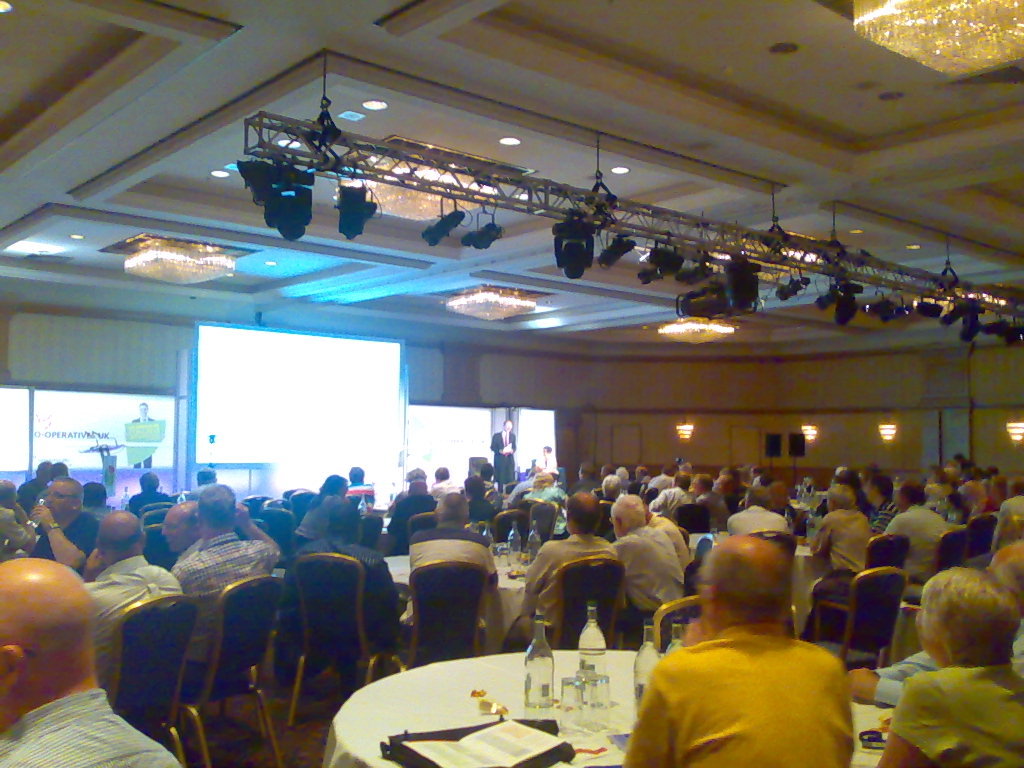
A previous conferenceLast week I went along to the food co-ops networking event at the Southville Centre in Bristol. It was a useful event and very inspiring and informative to meet people from so many other co-ops, as well as attend some useful workshops: the two I went to were Good meetings and communication and Starting and developing a food co-op, while there were also ones on funding and Simply Legal available. There was some time for networking, as well as a relaxed end to the day which let me catch up with a few more people. I would have preferred a little more time for the workshops and a little less on case studies (every food co-op is different and I don t think any of the featured ones were quite what I was looking for), but that s a very minor thing and didn t really reduce the usefulness of the whole day. Our co-op is a tech worker co-op and not a food co-op, so I didn t know that much about how to start one before the event. Now I ve got a much better idea of what I need to do when I eventually move back out to what may be a co-op desert in King s Lynn. Are you a member of a food co-op or buying group? If so, what would you say about it? Were you involved in its start-up?

14 February 2012

Martin-&#201;ric Racine: Adopted: ispell-et, myspell-lv, rus-ispell.

Over recent months, I have been pondering the relevance of my Free Software involvement a lot: More than anything, it constantly feels more and more like several important distributions and projects are moving in directions that break with the old ways far too radically, by breaking software usability rules such as "least surprise", "works out of the box", and "if it ain't broken, don't fix it" either to try new approaches to addressing existing needs or simply for change's sake. Another aspect lies in my usual motivation for packaging or adopting software: because I need it and nobody else bothered doing it. Further reflection made me ponder what, correspondingly, are my usual reasons for dropping software: because what exists already works and because everybody and their grand-mother already invented a million of ways to handle the same issue. Which brings us to today's news. What prompted me to hand the dictionary packages I maintained over to someone else was a combination of "no longer need it" and "it already works fine as it is." For instance, the Estonian dictionaries haven't seen any upstream release since the initial one in 2003. While I still use Estonian daily in my online communications, the last 9 years have mostly been spent making minor changes to the dependencies and maintainer scripts, just to keep the package compliant with current Debian packaging policies and with ongoing improvements to the dictionary-common maintainer tools. This is not the sort of work that requires any knowledge of the Estonian language, so I felt that having dictionary-common developers handle those technical transitions in a clean and across-the-board way for as many dictionary packages as possible would be more productive than me trying to keep track of those changes by myself. A similar case applies to the Latvian dictionaries. While there have been occasional upstream releases, some of which required patching the source code, maintaining the package has mostly been about tracking Debian policy changes and dictionary-common functional changes. Additionally, my interest for learning Latvian has dramatically dropped over the years, so I no longer saw any point in remaining involved in maintaining the package. Ditto for the Russian dictionaries: occasional upstream releases, occasional patches, regular packaging upgrades to keep up with the Debian policy and with dictionary-common functionality, but no longer much of anything than a passive interest in practicing my Russian. One of the developers behind dictionary-common, Agustin Martin Domingo, frequently helped me make sense of the changes I needed to track in the past, so he gladly accepted taking over the technical maintenance of all 3 packages. The Estonian dictionaries, while extremely skim in the breadth of vocabulary they cover, remain useful, but are essentially deprecated, as the upstream author is working on a spell checking engine similar to what Voikko does for Finnish, which is why maintaining them will be a rather easy task for Agustin. Meanwhile, Aigars Mahinovs passively remains on board for the Latvian dictionaries, while the Russian dictionaries have been adopted by Mikhail Gusarov, in both cases with Agustin assisting on technical matters. Basically, I feel that passing the maintenance over to people whose motivation remains high is a better way to guarantee those packages' future than leaving them in my unmotivated hands and I'm glad that I found someone to keep on packaging them. PS: happy Valentine's day to everyone!

13 February 2012

Siegfried Gevatter: eSpeak GUI 0.4 is out!

A few of you may remember espeak-gui, a graphical user interface for eSpeak I did release two years ago. While I haven t been dedicating much time to it, it s still alive and I m happy to announce its fourth release! This new release introduced automatic language guessing, a feature I ve wanted for a while, as well as spell checking (contributed by Joe Burmeister). Version 0.3, released a year ago and which I didn t announce here, did also introduce Undo/Redo, pausing, file history logging, a bunch of translations and some voice options. It s sister project, python-espeak, did also get some bug fixes since its first release. As usual, packages for both espeak-gui and python-espeak are available in my PPA, and since last month in Debian unstable. Make sure you also install libtextcat0 (version 2.2-8 or newer) to get the language identification support. Related posts:
  1. espeak-gui 0.2 Yesterday I did a first release of espeak-gui, so while...
  2. Introducing espeak-gui I m joining the hype of presenting little new projects there...
  3. Here is Zeitgeist 0.2.1! One month after the first Zeitgeist release (0.2), here is...
flattr this!

12 February 2012

Matthew Garrett: Some things you may have heard about Secure Boot which aren't entirely true

Talking about Secure Boot again, I'm afraid. One of the things that's made discussion of this difficult is that, while the specification isn't overly complicated, some of the outcomes aren't obvious at all until you spend a long time thinking about it. So here's some clarification on a few points.
Secure Boot provides no additional securityUntrue. Attacks against the pre-boot environment are real and increasingly common - this is a recent proof of concept, and this has been seen in the wild. Once something has got into the MBR, all bets are off. It can modify your bootloader or kernel, inserting its own code to return valid results whenever any kind of malware checker scans for it. The only way to reliably identify it is to either move the disk to another system or to cold boot off verified media. By restricting pre-OS code to something that's been signed, Secure Boot does provide enhanced security.
Secure Boot is just another name for Trusted BootUntrue. Trusted Boot requires the ability to measure the entire boot process, which gives the OS the ability to figure out everything that's been run before OS startup. The root of trust is in the hardware and a TPM is required. Secure Boot is simply a way to limit the applications that are run before the OS. Once booted, there is no way for the OS to identify what was previously booted, or even if the system was booted securely.
Microsoft are just requiring that vendors implement the specificationUntrue. Quoting from the Windows 8 Hardware Certification Requirements:

MANDATORY: No in-line mechanism is provided whereby a user can bypass Secure Boot failures and boot anyway Signature verification override during boot when Secure Boot is enabled is not allowed. A physically present user override is not permitted for UEFI images that fail signature verification during boot. If a user wants to boot an image that does not pass signature verification, they must explicitly disable Secure Boot on the target system.

Section 27.7.3.3 of version 2.3.1A of the UEFI spec explicitly permits implementations to provide a physically present user override. Whether this is a good thing or not is obviously open to argument, but the fact remains that Microsoft forbid behaviour that the specification permits.
Secure Boot can be used to implement DRMUntrue. The argument here is that Secure Boot can be used to restrict the software that a machine can run, and so can limit a system to running code that implements effective copy protection mechanisms. This isn't the case. For that to be true, there would need to be a mechanism for the OS to identify which code had been run in the pre-OS environment. There isn't. The only communication channel between the firmware and the OS is via a single UEFI variable called "SecureBoot", which may be either "1" or "0". Additionally, the firmware may provide a table to the OS containing a list of UEFI executables that failed to authenticate. It is not required to provide any information about the executables that authenticated correctly.

In both these cases, the OS is required to trust the firmware. If the firmware has been compromised in any way (such as the user turning off Secure Boot), the data provided by the firmware can be trivially modified and the OS told that everything is fine. As long as machines exist where users are permitted to disable Secure Boot, Secure Boot is not any kind of DRM scheme.
Secure Boot provides physical securityUntrue. Secure Boot does not in any way claim to improve security against attackers who have physical access, for the same reasons as the DRM case. The OS has no way to determine that the firmware's behaviour has been modified. A physically-present attacker can simply disable Secure Boot and install a piece of malware that lies to the OS about platform security. The "Evil Maid" attack still exists.
Secure Boot only defines the interaction between the firmware and the bootloader. It doesn't specify any higher policyMisleading. It's true that Secure Boot only specifies the authentication of pre-OS code. However, if you implement Secure Boot it's because you want to ensure that only authenticated code has run before your OS. If there is any way for unauthenticated code to touch the hardware before your OS starts, you can't ensure that. If an authenticated Linux kernel is booted and then loads an unsigned driver, that unsigned driver can fabricate a fake UEFI environment and then launch Windows from it. Windows would falsely believe that it has booted securely. If that authenticated Linux kernel were widely distributed, attackers could use it as an attack vector for Windows. The logical response from Microsoft would be to blacklist that kernel.

The inevitable outcome of implementing Secure Boot is that every component that can touch hardware must be signed. Anyone who implements Secure Boot without requiring that is adding no additional security whatsoever.
Only machines that want to boot Windows need to carry Microsoft's keysAgain, misleading. Microsoft only require one signing key to be installed, and the Windows bootloader will be signed with a key that chains back to this one. However, the bootloader is not the only component that must be signed. Any drivers that are carried on ROMs on plug-in cards must also be signed. One approach here would have been for all hardware vendors to have their own keys. This would have been unscalable - any shipped machine would have to carry keys for every vendor who produces PCI cards. If a machine carried an nvidia key but not an AMD one, swapping a geforce for a radeon would have resulted in the firmware graphics driver failing to load. Instead, Microsoft are providing a signing service. Vendors will be able to sign up for WHQL membership and have their UEFI drivers signed by Microsoft.

This leads to the problem. The Authenticode format used for signing UEFI objects only allows for a single signature. If a driver is signed by Microsoft, it can't be signed by anybody else. Therefore, if a system vendor wants to support off-the-shelf PCI devices with Microsoft-signed drivers, the system must carry Microsoft's key. If the same key is used as the root of trust for the driver signing and for the bootloader signing, that also means that the system will boot Windows.
This is only a problem for clients, not serversNot strictly true. While Microsoft's current requirements don't mandate the presence of Secure Boot on server hardware, if present it must be enabled and locked down as it is for clients. It's not valid for servers to ship with disabled Secure Boot support, or for it to be shipped in a mode allowing users to make automated policy modifications at OS install time.
Secure Boot is required by NISTThis is one that I've heard from multiple people working on Secure Boot. It's amazingly untrue. The document they're referring to is NIST SP800-147, which is a document that describes guidelines for firmware security - that is, what has to be done to ensure that the firmware itself is secure. This includes making sure that the OS can't overwrite the firmware and that firmware updates must be signed. It says absolutely nothing about the firmware only running signed software. Secure Boot depends upon the firmware being trusted, so these guidelines are effectively a required part of Secure Boot. But Secure Boot is not within the scope of SP800-147 at all.
It's easy for Linux to implement Secure BootMisleading. From a technical perspective, sure. From a practical perspective, not at all. I wrote about the details here.
It's only a problem for hobbyist Linux, not the real Linux marketUntrue. It's unclear whether even the significant Linux vendors can implement Secure Boot in a way that meets the needs of their customers and still allows them to boot on commodity hardware. A naive implementation removes many of the benefits of Linux for enterprise customers, such as the ability to use local modifications to micro-optimise systems for specific workloads. One of the key selling points of Linux is the ability to make use of local expertise when adapting the product for your needs. Secure Boot makes that more difficult.

ConclusionMuch reporting on the issues surrounding Secure Boot so far has been inaccurate, leading to misunderstandings about the (genuine) benefits and the (genuine) drawbacks. Any useful discussion must be based around an accurate understanding of the specification rather than statements from analysts with no real understanding of the Linux market or security.

comment count unavailable comments

Gregor Herrmann: RC bugs 2012/05-06

I was at FOSDEM over the last weekend, so here's my report for two weeks now:

Jose Luis Rivas Contreras: Express Sessions with connect-redis + Socket.IO in CoffeeScript

If you are working with Socket.IO and Express Framework while developing your applications you must know they work together so Socket.IO will listen on the same port that your HTTP/S server and will serve the requests by that way, but Socket.IO doesn t works on the same paradigm where you pass a middleware to the route and you could get authentication on this manner. Instead, you must configure Socket.IO with a global authorization method or a handshake authorization manner. Since in my applications I serve cookies already where I save session info and this is already stored in Redis with help of the module connect-redis then I should be able to get this info onto Socket.IO authorization method and with this allow only to authorized users to get info from my websockets. I found how to do it with the default session-store in-memory from Express, and adapted that so it could work with Redis. Here s the snippet: <script src="https://gist.github.com/1805743.js"> </script><noscript>You don t have JavaScript enabled, check it out at gist.github.com </noscript> Hope anyone can found it useful!

Next.

Previous.