Search Results: "ms"

27 March 2014

Diego Escalante Urrelo: Setting up Apache + PHP + MySQL on OSX with Homebrew

Recently I ve been doing some hacking for Chamilo LMS, a Free Software E-Learning system. For various reasons I had to do this on OSX, which meant setting up a web development environment. This lead me to MAMP, an OSX bundle with Apache + MySQL + PHP. However MAMP had many weird quirks that forced me to maintain a local set of patches just to get things working. I finally had the time to look into a saner option, take some notes in the process, and write a blog post.
Important advice. This post enables it.

Important life advice. This post enables it.

A popular alternative was using OSX s installed Apache with a newer PHP version from Homebrew. This sounded dangerous because you can t just apt-get install --reinstall apache if you break something. I preferred a pure Homebrew installation also because: I couldn t find a simple and straightforward resource for this specific setup, so I present you with my tutorial/recipe to get Apache + MySQL + PHP, via Homebrew, running on OSX. I took these notes on OSX 10.7.5 while building Apache/2.2.26 (Unix) with PHP 5.5.10 and MySQL 5.6.16. #1- A healthy Homebrew install First of all you need to install Homebrew. Head over to Homebrew s homepage for instructions. Even if you already have it, I recommend a health check and an update+upgrade: $ brew doctor
$ brew update && brew upgrade
Pay attention to whatever that says and follow the instructions if there s any. You also want to add Homebrew binary paths to your $PATH, even if the directories don t exist yet. Add this to .bash_profile or whatever your shell uses:
PATH=/usr/local/opt/php55/bin/:/usr/local/sbin:/usr/local/bin:$PATH #2- PHP and all its additional recipes The PHP recipes are maintained in a different repo, but don t worry, this is not a duct taped chaos, it s properly maintained: $ brew tap jgonzales/php
$ brew install php55 --with-intl
You might want to add --with-pgsql if you want to work with PostgreSQL. MySQL, Apache and CLI support is built by default. After the installation there are two quick things to do. First, timezone configuration:
(editing /usr/local/etc/php/5.5/php.ini)
date.timezone = America/Lima (or whatever works for you)
And second, PEAR permissions:
$ chmod -R ug+w /usr/local/Cellar/php55/5.5.10/lib/php #3- Setting up boring MySQL Now let s brew MySQL:
$ brew install mysql With that done, go ahead and start the server so we can initialize the basic tables, and secure the installation defaults:
$ unset TMPDIR
$ mysql_install_db --verbose --user= whoami --basedir="$(brew --prefix mysql)" --datadir=/usr/local/var/mysql --tmpdir=/tmp
$ mysql.server start
$ mysql_secure_installation

Remember: You shouldn t use sudo, so be careful with your muscle memory!
Clint Eastwood... Yeah.

Mr. Eastwood acknowledges the warning.

#4- Brewing Apache (httpd) And finally, it s time to brew Apache. You can do so with:
$ brew install httpd When that s done burning your lap, you can start configuring Apache. I chose to keep httpd.conf as pristine as possible and do everything in a VirtualHost. Remember you need to run this on something other than port 80 because you won t run httpd as root: Note that I m enabling virtual hosts and using my own paths. If you want to configure Apache differently, you probably know what you are doing. So, get off my lawn you damn kid. #5- Brownie points: PHPMyAdmin In my virtual hosts configuration I included some lines for PHPMyAdmin. That s because I m old school and I love PHPMyAdmin. You can follow into my wrinkled foot steps with:
$ brew install phpmyadmin #6- Profit You can check everything is fine by creating an index.php with a call to phpinfo() inside your configured root from httpd-vhosts.conf. Make sure OSX s Apache is not running and start (or restart) the servers:
$ apachectl start/stop/graceful(restart)
$ mysql.server start/stop/restart
Now open go to http://localhost:8000/ and http://localhost:8000/phpmyadmin. Enjoy your success. Maybe do a victory dance:
This might seem like a lot of work, but it s fairly quick with this cheat sheet. It s also very safe and easy to keep updated with brew update && upgrade. A final note: All the suggestions and instructions that are printed after installing each package can be read again with brew info <recipe>. No need to write them down. Happy hacking!

Andrew Pollock: [life] Day 58: Playgroup, rain and errands

My yoga teacher was out sick this morning. I had grand plans of instead biking to the pool and going for a swim, but when my alarm went off, and the weather outside was grey and miserable, having an extra half an hour lie in seemed more attractive. I think I made the right choice, because I felt like a million bucks today. I did all of the preparation to bake a batch of carrot and kale muffins before Zoe arrived, and we baked a batch as soon as she arrived and had them out of the oven in time to drive to Playgroup. I was expecting a larger crowd today on account of the wet weather, but it turned out quite the opposite. That said, Zoe still had a good time. There's really no other kids her age though, so it's still winding up as a "play with Dad in a different environment". My ABN came through yesterday, so after Playgroup we walked to the bank to give it to them and sort out a business credit card. Zoe was super well behaved while I did that, so we grabbed a fresh hot cross bun from Brumby's across the street afterwards. I needed some more stamps, so I figured we could just walk down to the post office down the other end of Oxford Street while we were there. That was slow going, but Zoe was enjoying walking with her umbrella in the rain. We got to the post office, and I discovered that postage is going up to 70 cents next week, and they couldn't sell be 70 cent stamps yet, and buying 60 cent stamps would be pointless after Monday, so I left empty handed. Zoe was eyeing off the umbrellas they had for sale in the post office. No sooner had we walked out of the post office and Zoe managed to walk all over her umbrella and totally destroy it. If I hadn't seen it happen, I'd have said she did it deliberately to get a new umbrella, but it really was an accident, so we had to turn around and buy one of the umbrellas from the post office. We made our way back down Oxford Street, and stopped in the boutique toy shop there. Zoe was particularly enthralled by the musical jewelery boxes, and really wanted one. I negotiated with her for it to be a birthday present, and got it gift wrapped. She seemed fine with the idea of not being able to have it until her birthday. We then made our way back to the car and drove home for a rather late lunch. I'm glad Zoe had the hot cross bun after the bank to keep her going, as she didn't seem to mind the late lunch at all. I made fritters with some left over corned beef, and then after we'd had lunch I thought we might as well get out of the house. Zoe's Kindergarten has a working bee on Saturday (I'm expecting it'll get canceled due to the wet weather, though). Incidentally, I have no idea where the "bee" in "working bee" comes from. Megan's Dad is Welsh, and I was lost for words when it came to explaining what a working bee was. Anyway, I wanted to get some gardening gloves, so we went to Bunnings. I managed to find some cute little kids ones as well, so Zoe can help. After Bunnings, we went to the pet shop to get some more cat litter. The pet shop seems to be a great source of entertainment for Zoe. She absolutely loved playing around with the hutches they had on display, and checking out all the fish, and the aquarium accessories. We eventually made it out of the pet shop, and we went around to the adjacent shopping mall in search of some craft supplies at some of the cheap shops there. It turns out the cheap shops are also a great source of entertainment. By the time we were done there, it was time to get home so Sarah could pick Zoe up, so we headed home. There was enough time for Zoe to watch a little bit of TV before Sarah arrived. So despite the weather, and no real plan for the day, we managed to completely fill the day, and Zoe had a great time. She seemed no worse for wear for powering through without a nap. There was a few small tantrums at Bunnings, but that mostly revolved around her tipping over her miniature shopping trolley.

26 March 2014

Russell Coker: The Aspie Accent

I am often asked about my accent . The most common guess is that it s a British accent, while I lived in London for about a year I don t think that my accent changed much during that time (people have commented on the way I speak since I was in primary school). Also there isn t a British accent anyway, the Wikipedia page of Regional Accents of English has the first three sections devoted to accents in the island of Britain (and Northern Ireland is part of the United Kingdom which people often mean when they sat Britain ). The Received Pronounciation is the main BBC accent and the accent that is most associated with Britain/England/the UK (which are three different things even though most people don t know it) and I don t think that I sound like that at all. I ve had various other guesses, the Netherlands (where I lived for a few years but mostly spoke to other foreigners), New Zealand (which I ve visited a couple of times for conferences), Denmark (the closest I got was attending a conference in Sweden), and probably others I can t remember. If I actually had developed an accent from another country then it would probably be from the US. The amount of time I ve spent watching Hollywood movies and watching US TV shows greatly exceeds the amount of time I ve spent listening to people from all other countries. The fact that among all the people who wanted to try and guess where my accent supposedly originated none have ever included the US seems like strong evidence to suggest that I don t have any sort of accent that really derives from another country. Also I have never had someone mistake me for being a resident of their own country based on accent which seems like clear evidence that all claims about me having a foreign accent are bogus. Autism forums such as WrongPlanet.net [1] always turn up plenty of results for a search on accent . In such discussions it seems that a British accent is most common mistake and there are often theories raised about why that is often related to speaking in a formal or precise way or by using a large vocabulary. Also in such discussions the list of countries that people supposedly have accents from is very inclusive, it seems that any country that the listener has heard of but doesn t know that well is a good candidate. The fact that Aspies from outside the US are rarely regarded as having an American accent could be due to the fact that Hollywood has made most of the world population aware of what most American accents sound like. Also if I really had some sort of accent from another country then probably someone would comment on that when I m outside Australia. When I m travelling people tend to recognise my accent as Australian, while it doesn t please me when someone thinks that I sound like Crocodile Dundee (as happened in the Netherlands) it might not be entirely inaccurate. This is Annoying The way the issue of accent is raised is generally in the form of people asking where I m from, it seems to imply that they don t think I belong in Australia because of the way I speak. It s particularly annoying when people seem unable to realise that they are being obnoxious after the first wrong guess. When I reply no to the first are you from $COUNTRY question and don t offer any further commentary it s not an invitation to play 20 questions regarding where I m supposedly from, it s actually an indication that I m not interested in a conversation on that topic. A Social Skills 101 course would include teaching people that when someone uses one-word answers to your questions it usually means that they either don t like your questions or don t want to talk to you. Social Skills vs Status The combination of persistence and misreading a social situation which are involved when someone interrogates me about my supposed accent are both parts of the diagnostic criteria for Autism. But I generally don t get questions about my accent in situations where there are many Aspies (IE anything related to the Free Software community). I think that this is because my interactions with people in the Free Software community are based around work (with HR rules against being a jerk) and community events where no-one would doubt that I belong. I mostly get questions about my accent from random middle-class white people who feel entitled to query other people about their status who I meet in situations where there is nothing restraining them from being a jerk. For example random people I meet on public transport.

Steve Kemp: A diversion on off-site storage

Yesterday I took a diversion from thinking about my upcoming cache project, largely because I took some pictures inside my house, and realized my offsite backup was getting full. I have three levels of backups: Unfortunately my rsync-based personal server is getting a little too full, and will certainly be full by next year. S3 is pricy, and I don't trust the "unlimited" storage people (backblaze,etc) to be sustainable and reliable long-term. The pricing on Google-drive seems appealing, but I guess I'm loathe to share more data with Google. Perhaps I could dedicated a single "backup.account@gmail.com" login to that, separate from all-else. So the diversion came along when I looked for Amazon S3-comptible, self-hosted, servers. There are a few, most of them are PHP-based, or similarly icky. So far cloudfoundry's vlob looks the most interesting, but the main project seems stalled/dead. Sadly using s3cmd to upload files failed, but certainly the curl based API works as expected. I looked at Gluster, CEPH, and similar, but didn't yet come up with a decent plan for handling offsite storage, but I know I have only six months or so before the need becomes pressing. I imagine the plan has to be using N-small servers with local storage, rather than 1-Large server, purely because pricing is going to be better that way. Decisions decisions.

Andrew Pollock: [life] Day 57: UnderWater World (now known as Sea Life: Mooloolaba)

My late biological maternal grandmother ("Nana"), remarried late in her life to a long-time friend named Bryce. I was probably an early teenager. He was a nice guy, and I kept in loose contact with him after my Nana passed away. After my Nana passed away, he moved out of the retirement home he'd been living in with my Nana, and in with one of his sons. Sometime before I moved back to Australia, in ailing physical health, he moved from his son's place into Masonic Care's aged-care hostel in Sandgate. He turned 90 last year. Mentally, he's doing pretty good. Physically, he's very wobbly on his legs. He's had a few falls, which was the main catalyst for moving from his son's place to the aged-care hostel. Other than that, he's in pretty good physical health though. I remember the first time I visited him in the hostel. After I left, I wept uncontrollably. Here was a man who was literally just waiting out the rest of his life in a small cupboard of a room. I was appalled at how small the room was, and the fact that he was just sitting around waiting to die really upset me. I've visited him a few times since I've been back. I've taken him over to my parent's place when I've taken Zoe to visit them, just so he gets out. I should say that I'm sure his own family do spend some time with him, so it's not like he's spending all his time rotting in this place, but probably still a fair chunk of it. Growing old sucks. Yesterday, when the weather forecast for today was looking like it was going to be pretty wet and miserable, I decided I'd use the day to take Zoe to Underwater World (which I've since learned has rebranded it self as "Sea Life: Mooloolaba". I had the presence of mind to call up Bryce yesterday to see if he'd like to join us today. We had to pass in his general direction to get up there, so it wasn't particularly out of my way. He informed me that he was now in a wheelchair, which I thought was fine for this excursion. So this morning, after we got ourselves going, we stopped at Sandgate to pick up Bryce, and made it to Underwater World by about 10am. I was a bit leery of the drive, because from home, it was another 30 minutes on top of the drive to Wet and Wild, and 15 minutes on top of the drive to Sea World, so I wasn't sure how Zoe would take that length car trip. It turned out that she took it pretty well. She started getting a bit restless in the last 30 minutes, but it was manageable. I was a little apprehensive about how wrangling Zoe and looking after a frail 90 year old in a wheelchair was going to work out. It turned out it worked out just fine. I could leave Bryce wherever he was, if I had to chase after Zoe, and Zoe quite liked helping push the wheelchair around. Towards the end of the day, when she got tired, I could just pop her in Bryce's lap, and push the pair of them around. It was a really good outing. I have only vague memories of visiting the place in my childhood, and it's become significantly better since then. Zoe really enjoyed going through the glass tunnels under the main ocean exhibit. We did several laps of that. We were fortunate enough to catch the sting ray feeding almost immediately upon arrival, and we also saw the seal show and made the otter feeding. The place was more focused on salt water aquatic life, hence the name, but there was also some freshwater exhibits. I never thought that much of the Monterey Aquarium, much preferring the California Academy of Science's aquariums, especially in terms of drive time accessibility. If you ignore the freshwater/salt water diversity, I think Sea Life is even better than the California Academy of Sciences. We left at about 2pm, and after a lot of hunting around, tracked down the photo they took when we entered, and then drove home closer to 3pm. To my surprise, Zoe didn't fall asleep immediately, but she did fall asleep on the way back to Bryce's place. She woke up to say goodbye to him, and then we drove home, stopping off in the Valley to check my post office box along the way, and arrived back home about 15 minutes before Sarah arrived to pick her up. It ended up being a very full day. Bryce really enjoyed himself, and I felt really happy that I was able to relatively easily brighten up his day. I've resolved to try another such outing again, I just need to figure out what to do. I thought I'd try for a 10km run, but it started to rain at the 4km mark. I was also not feeling particularly confident about lasting the distance, so I decided to just turn it into a 5km run instead.

Neil Williams: LAVA packages for Debian

Packaging LAVA for Debian unstable with notes on other distributions I ve been building packages for LAVA on Debian unstable for several months now and I ve been running LAVA jobs on the laptop and on devices in my home lab and on an ARMv7 arndale too. Current LAVA installations use lava-deployment-tool which has only supported Ubuntu 12.04 LTS Precise Pangolin. There has been a desire in LAVA to move away from a virtual environment, to put configuration files in FHS compliant paths, to use standard distribution packages for dependencies and so to make LAVA available on more platforms than just precise. Packaging opens the door to installing LAVA on Debian, Ubuntu, Fedora and any other recent distribution. Despite LAVA currently being reliant on 12.04 Precise, some of the python dependencies of LAVA have been able to move forward using the virtual environment provided by builtout and pypi. This means that LAVA, as packaged, requires a newer base OS suite than precise for Ubuntu, the minimal base is Saucy Salamander 13.10 and for Debian it would be Jessie (testing) although there is currently a transition ongoing in Debian which means that uwsgi is not in testing and Debian unstable would be needed instead. The work to migrate configuration snippets out of deployment-tool and to ensure that the tarball built using setuptools contains all of the necessary files for the package has already been done. The packaging itself is clean and most of the work is done upstream. There is, as ever, more to do but the packages work smoothly for single install LAVA servers where the dispatcher is on the same machine as the django web frontend. The packages have also migrated to Django1.6, something which is proving difficult with the deployment-tool as it has not kept pace with the changes outside the virtual environment, even if other parts of LAVA have. LAVA will be switching to packages for installation instead of deployment-tool and this will mean changes to how LAVA works outside the Cambridge lab. When the time comes to swich to packaging, the plan is to update deployment-tool so that it no longer updates /srv/lava/ but instead migrates the instance to packages. Main changes
  1. Configuration files move into /etc/
    • Device configuration files /etc/lava-dispatcher/devices/
    • Instance configuration files/etc/lava-server/
  2. Log files move into /var/log/
    • Adding logrotate support no more multi-Gb log files in /srv/lava/
  3. Commitment to keeping the upstream code up to date with dependencies
  4. Support for migrating existing instances, using South.
  5. Packaging helpers
    • add devices over SSH instead of via a combination of web frontend and SSH.
    • Developer builds with easily identifiable version strings, built as packages direct from your git tree.
  6. New frontend
    • Although django1.6 does not change the design of the web frontend at all, LAVA will take the opportunity to apply a bootstrap frontend which has greater support for browsers on a variety of devices, including mobile. This also helps identify a packaged LAVA from a deployment LAVA.
  7. Documentation and regular updates
The Plan LAVA has made regular releases based on a monthly cycle and these will be provided as source tarballs at http://www.linaro.org/downloads/ for distributions to download. The
official monthly release and any intervening updates will be made available for distributions to use for their own packaging. Additionally, Debian packages will be regularly built for use within LAVA and these will be available for those who choose to migrate from Ubuntu Precise to Debian Jessie. LAVA will assist maintainers who want to package LAVA for their distributions and we welcome patches from such maintainers. This can include changes to the developer build support script to automate the process of supporting development outside LAVA. Initially, LAVA will migrate to packaging internally, to prove the process and to smooth out the migration. Other LAVA instances are welcome to follow this migration or wait until the problems have been ironed out. The Issues Build Dependencies For Debian unstable, the list of packages which must be installed on your Debian system to be able to build packages from the lava-server and lava-dispatcher source code trees are:
debhelper (>= 8.0.0) python   python-all   python-dev   python-all-dev 
python-sphinx (>= 1.0.7+dfsg)   python3-sphinx python-mocker 
python-setuptools python-versiontools
(python-versiontools may disappear before the packages are finalised) In addition, to be able to install lava-server, these packages need to be built from tarballs released by Linaro (the list may shorten as changes upstream are applied)
linaro-django-pagination, 
python-django-restricted-resource (>= 0.2.7), 
lava-tool (>= 0.2), lava-utils-interface (>= 1.0), 
linaro-django-xmlrpc (>= 0.4),
python-versiontools (>= 1.8),
python-longerusername,
linaro-dashboard-bundle (>= 1.10.2), 
lava-dispatcher (>= 0.33.3)
lava-coordinator, lava-server-doc
The list for lava-dispatcher is currently:
python-json-schema-validator, lava-tool (>= 0.4), 
lava-utils-interface, linaro-dashboard-bundle (>= 1.10.2), 
The packages available from my experimental repository are using a new packaging branch of lava-server and lava-dispatcher where we are also migrating the CSS to Bootstrap CSS. Installing LAVA on Debian unstable
$ sudo apt-get install emdebian-archive-keyring
Add the link to my experimental repository (amd64, i386, armhf & arm64) to your apt sources, e.g. by creating a file /etc/apt/sources.list.d/lava.list containing:

deb http://people.linaro.org/~neil.williams/lava sid main
Update with the new key

$ sudo apt-get update
It is always best to install postgresql first:

$ sudo apt-get install postgresql
There are then three options for the packages to install (Please be careful with remote worker setup, it is not suitable for important installations at this time.):
  1. Single instance, server and dispatcher with recommended tools
    apt-get install lava
    Installs linaro-image-tools and guestfs tools.
  2. Single instance, server and dispatcher
    apt-get install lava-server
    Installs enough to run LAVA on a single machine, running jobs on boards on the same LAN.
  3. Experimental remote worker support
    apt-get install lava-worker
    Needs a normal lava-server installation to act as the master scheduler but is aimed at supporting a dispatcher and boards which are remote from that master.
The packages do not assume that your apache2.4 setup is identical to that used in other LAVA installations, so the LAVA apache config is installed to /etc/apache2/sites-available/ but is not enabled by default. If you choose to use the packaged apache config, you can simply run:

$ sudo a2ensite lava-server
$ sudo apache2ctl restart
(If this is a fresh apache install, use a2dissite to disable to default configuration before restarting.) Information on creating a superuser, adding devices and administering your LAVA install is provided in the README.Debian file in lava-server:

$ zless /usr/share/doc/lava-server/README.Debian.gz
Provisos and limitations Please be aware that packaged LAVA is still a work-in-progress but do let us know if there are problems. Now is the time to iron out install bugs and other issues as well as to prepare LAVA packages for other distributions. It will be a little while before the packages are ready for upload to Debian I ve got to arrange the download location and upload the dependencies first and some of that work will wait until more work has gone in upstream to consolidate some of the current dependencies.

Wouter Verhelst: LDAP and Kerberos authentication

Kerberos is a great protocol for single sign-on authentication. It's supported by many protocols, allowing you to not have to enter a password to each and every one of them; instead, the protocols behind the scenes (not "just" Kerberos, but also the things that embed tickets, such as GSSAPI, or the things that embed GSSAPI, such as SASL or SPNEGO) use your ticket-granting-ticket to ask for security credentials for the service you're trying to use, magic happens, and you're authenticated. I blogged about kerberos before (even if it was ages ago); since then, I've not only used it on my own systems, but also on the systems of various customers. One thing I've learned in that time, however, is that most web application developers have a bad case of NIHilism when it comes to authentication. Most webservers that I've seen have a wide range of methods to do authentication in the webserver through various means, including things like certificate-based authentication, one-time password modules, and, yes, kerberos. Yet almost no webapp out there will look at the magic variables that those webservers set to explain we're authenticated, instead reinventing the wheel through webforms and other various stupid means. Sigh. So, that means, no kerberos authentication for webapps. Worse, if the application has no way to pass on authentication to something external, that means users will now have to learn another password: one for Kerberos, one for the webapp. And, probably, one for this other webapp, too -- because once you add one webapp, people expect you to add more of them. Well, mostly. In some cases, webapps do have ways to externalize authentication. In most cases this means "store passwords in a database", or "try authenticating against this other service here". When "this other service here" is an IMAP server, then all you need to do is make sure cleartext authentication on the IMAP server eventually ends up trying to authenticate against the Kerberos server, and you're all set. When "this other service here" is an LDAP server, however, you're out of luck. Right? It turns out that no, you're not. I recently learned that OpenLDAP can, in fact, check "simple" bind requests by checking some other service, and that this other service can be a Kerberos realm. Doing so is called "Pass-through authentication" in the OpenLDAP documentation, and this is how you do it:

mech_list: plain
pwcheck_method: saslauthd

This directs the SASL libraries, loaded by slapd, to talk to saslauthd when trying to authenticate some SASL things - Make sure slapd has the correct permissions to access the saslauthd unix domain socket. On Debian, that means you need to add the "openldap" user to the "sasl" group:
 adduser openldap sasl 
(obviously that won't be active until the next slapd restart) And that's it; if you now try a simple bind against the LDAP directory, and enter your Kerberos password, you should be in. If it doesn't work, try running "testsaslauthd"; if that works, it means the error is in your slapd configuration. If it doesn't, then the problem is in saslauthd. Some notes: Oh, and if you're a webapp developer: please please please make it easy for me to use an external authentication mechanism. This isn't hard; all you need is a separate page that will read the magic variables (probably REMOTE_USER if you're using apache), set a session variable or whatever, and then redirect to your normal "we've just logged in" page. ikiwiki gets this right; you can too! (for added bonus points, have some way to declare a mapping from REMOTE_USER values to internal, readable, usernames, but it's not too crucial)

Mario Lang: Accessible DNS hosting with LuaDNS

I used to host my internet infrastructure at Hurricane Electric. It all started in october 1998 with POP3/SMTP, HTTP and DNS. In the coming years, I began to host all services except DNS on my own. But I kept using he.net for its DNS management interface. It was dead simple, and therefore accessible. All they had was a basic textarea with BIND alike configuration in it. I could log in to their admin interface and change my DNS records as desired. A few years ago, they auto-upgraded my account to their new shiny DNS panel, which, surprise surprise, is no longer accessible with a simple text browser. After a bit of bitching with support, they ended up downgrading my account back to the old functionality, so I was happy again. However, as you might guess, last time I needed to change a DNS record, I found that the DNS panel has been ugpraded yet again and is again no longer accessible to me. So it was time to leave the sinking ship. But I needed to find an accessible DNS hosting service. Not an easy task, given that everyone seems to do more or less the same thing these days.

Git to the rescue! After a bit of web searching it became apparent that most offers these days are not what I want. I want a simple interface without any danger of accessibility issues. In most cases, you can not test the DNS management interface before signup. After a few dead ends, I took a step back and said to myself: "So, what is it that I am actually looking for? If this were a wishlist item, how would I like my workflow to be?" And the answer came immediately: "I want my zonefiles in a git repo!" So I decided to turn my search upside down and search exactly for that. And guess what, I found exactly what I was looking for: LuaDNS. LuaDNS has 5 nameservers in Europe, Asia and North America. As the name implies, it offers a way to write your zone files with Lua. This can be quite helpful for programmatically generating zones. However, it also supports BIND alike zone files, which is what I use. The idea is simple: You create a Git repository on GitHub or BitBucket and let LuaDNS know where it is. A web hook can be setup to automatically trigger zone rebuilds once you push to your repository. So all my accessibility problems around DNS hosting are suddenly completely gone. Once I edited/commited my zone files and pushed to my repository, LuaDNS will automatically pull from the repository and update my zones.
  • I can edit my zones with my editor of choice without having to go through the web.
  • I have history for my DNS changes.
  • I can revert changes easily.
  • Changes can have descriptive commit log entries.
  • All the usual advantages of Git.
And I will never have to fight with an inaccessible web interface again. That said, LuaDNS has a web interface for administering account settings. It works very nice with Lynx. I hope they keep it that way.
Current LuaDNS limitations There are two things I don't particularily like about LuaDNS currently:
  • There are currently no AAAA records for their DNS servers. This is apparently being worked on and is supposed to be fixed somewhere around april 2014. Note that AAAA records are perfectly supported by LuaDNS zone files, it is just that none of the DNS servers they provide to you offers any AAAA records yet. So IPv6-only hosts might have trouble to reach your site if they don't use an IPv4 enabled recursor (a rather rare setup I guess).
  • Due to the way BIND alike zone files work in LuaDNS (SOA records are autogenerated), you can currently not sign your zones. I've been told DNSSEC is on the list of things to work on at LuaDNS, so I am looking forward to see what they will implement.
The team is friendly and was very fast to react on a question via email. Looks good, I'll stay. Now that I think of it, this article might be considered an answer to Steve Kemps question what would you pay for: I'd pay for a VCS based DNS hosting solution that allows me to use DNSSEC, if its web interface were kept clean and simple and therefore accessible. However, I don't mind a free account for low volume usage at all. Especially if that makes it easy to test the service and make sure it works as expected.

Russ Allbery: krb5-strength 3.0

krb5-strength is the password strength checking code that we use at Stanford for our primary Kerberos realm. We've had quite a lot of difficulty deciding exactly what password strength checking we want to do and how we want to handle password history. The good part is that this is to the advantage of everyone else, since now more flexible password strength checking code is available. The major change in this release is the addition of a password history implementation for Heimdal. Implemented as an external password quality check program, it can stack with other password quality check programs, such as the one included in this distribution. Previous passwords are hashed with PBKDF2 with SHA-2. Note that this has somewhat extensive Perl module dependencies, since it was originally written as a separate project. Also in this release is yet another password dictionary type: SQLite. This is probably a bit slower than straight lookups in CDB, and it's definitely less space-efficient since it stores each word both forward and reversed, but it can reject any password that is within edit distance one of a dictionary word. (Edit distance one means that the word can be formed from the password by adding, removing, or changing a single character.) The cdbmake-wordlist utility has been renamed to krb5-strength-wordlist and can now generate the SQLite dictionary as well as the CDB dictionary. Finally, another configuration option has been added: minimum_different. If set, passwords must contain at least this many different characters. This can be used to reject passwords that are long strings of the same character or short repeating patterns, which are otherwise difficult to detect with a straight dictionary-driven approach. You can get the latest release from the krb5-strength distribution page.

Russ Allbery: rra-c-util 5.4

Further improvements to the shared infrastructure I use for my various packages. This release adds new Autoconf macros for detecting SQLite. These use the same strategy that I used for libevent, and which I'm slowly adopting for all libraries that support pkg-config. pkg-config is tried first if available, and unless the Autoconf flags to point to particular install paths for the library are given. Autoconf then falls back on manual probing. Also in this release are all the changes to the Perl support modules for test programs and the various generic Perl tests to implement the change that I started in the last Term::ANSIColor release: using the Lancaster Consensus environment variables to control whether tests run when they don't directly test package functionality, and skipping a lot more tests for the average end user who doesn't really care if, say, the POD syntax is correct or all the supporting Perl scripts past strictness checks. You can get the latest release from the rra-c-util distribution page.

Clint Adams: Belinda Carlisle (@belindaofficial) retweeted one of your Tweets!

Now that ZOMG has support for Opus, I find myself wondering how one does the equivalent of vorbisgain, preferably without floating-point.

Dirk Eddelbuettel: RProtoBuf 0.4.1

A new bug-fix release release 0.4.1 of RProtoBuf, is now on CRAN. RProtoBuf provides GNU R bindings for the Google Protocol Buffers ("Protobuf") data encoding library used and released by Google, and deployed as a language and operating-system agnostic protocol by numerous projects. Murray once more shouldered most of the actual burden and fixed a number of issues detailed below.

Changes in RProtoBuf version 0.4.1 (2014-03-25)
  • Document and add a test for the deprecated group functionality.
  • Add a CITATION file pointing to our arXiv.org preprint.
  • Fix a bug in the show method for EnumDescriptor types.
  • Import all top-level enums from imported .proto files.
  • Removed duplicate enum value type from the unit tests that caused problems with the most recent libprotobuf-2.5. (without option allow_alias).
CRANberries also provides a diff to the previous release. More information is at the RProtoBuf page which has a draft package vignette, a 'quick' overview vignette and a unit test summary vignette. Questions, comments etc should go to the rprotobuf mailing list off the RProtoBuf page at R-Forge.

This post by Dirk Eddelbuettel originated on his Thinking inside the box blog. Please report excessive re-aggregation in third-party for-profit settings.

25 March 2014

Richard Hartmann: Train them to submit

And today from our ever-growing collection of what the fuck is wrong with you people?!... This is wrong on so many levels, I can't even begin to describe it. Sadly, it seems that this will get funded. And if it does not, technology will only become cheaper over time...

Petter Reinholdtsen: Public Trusted Timestamping services for everyone

Did you ever need to store logs or other files in a way that would allow it to be used as evidence in court, and needed a way to demonstrate without reasonable doubt that the file had not been changed since it was created? Or, did you ever need to document that a given document was received at some point in time, like some archived document or the answer to an exam, and not changed after it was received? The problem in these settings is to remove the need to trust yourself and your computers, while still being able to prove that a file is the same as it was at some given time in the past. A solution to these problems is to have a trusted third party "stamp" the document and verify that at some given time the document looked a given way. Such notarius service have been around for thousands of years, and its digital equivalent is called a trusted timestamping service. The Internet Engineering Task Force standardised how such service could work a few years ago as RFC 3161. The mechanism is simple. Create a hash of the file in question, send it to a trusted third party which add a time stamp to the hash and sign the result with its private key, and send back the signed hash + timestamp. Both email, FTP and HTTP can be used to request such signature, depending on what is provided by the service used. Anyone with the document and the signature can then verify that the document matches the signature by creating their own hash and checking the signature using the trusted third party public key. There are several commercial services around providing such timestamping. A quick search for "rfc 3161 service" pointed me to at least DigiStamp, Quo Vadis, Global Sign and Global Trust Finder. The system work as long as the private key of the trusted third party is not compromised. But as far as I can tell, there are very few public trusted timestamp services available for everyone. I've been looking for one for a while now. But yesterday I found one over at Deutches Forschungsnetz mentioned in a blog by David M ller. I then found a good recipe on how to use the service over at the University of Greifswald. The OpenSSL library contain both server and tools to use and set up your own signing service. See the ts(1SSL), tsget(1SSL) manual pages for more details. The following shell script demonstrate how to extract a signed timestamp for any file on the disk in a Debian environment:
#!/bin/sh
set -e
url="http://zeitstempel.dfn.de"
caurl="https://pki.pca.dfn.de/global-services-ca/pub/cacert/chain.txt"
reqfile=$(mktemp -t tmp.XXXXXXXXXX.tsq)
resfile=$(mktemp -t tmp.XXXXXXXXXX.tsr)
cafile=chain.txt
if [ ! -f $cafile ] ; then
    wget -O $cafile "$caurl"
fi
openssl ts -query -data "$1" -cert   tee "$reqfile" \
      /usr/lib/ssl/misc/tsget -h "$url" -o "$resfile"
openssl ts -reply -in "$resfile" -text 1>&2
openssl ts -verify -data "$1" -in "$resfile" -CAfile "$cafile" 1>&2
base64 < "$resfile"
rm "$reqfile" "$resfile"
The argument to the script is the file to timestamp, and the output is a base64 encoded version of the signature to STDOUT and details about the signature to STDERR. Note that due to a bug in the tsget script, you might need to modify the included script and remove the last line. Or just write your own HTTP uploader using curl. :) Now you too can prove and verify that files have not been changed. But the Internet need more public trusted timestamp services. Perhaps something for Uninett or my work place the University of Oslo to set up?

Russell Coker: Nexus5 Armourdillo Hybrid Case

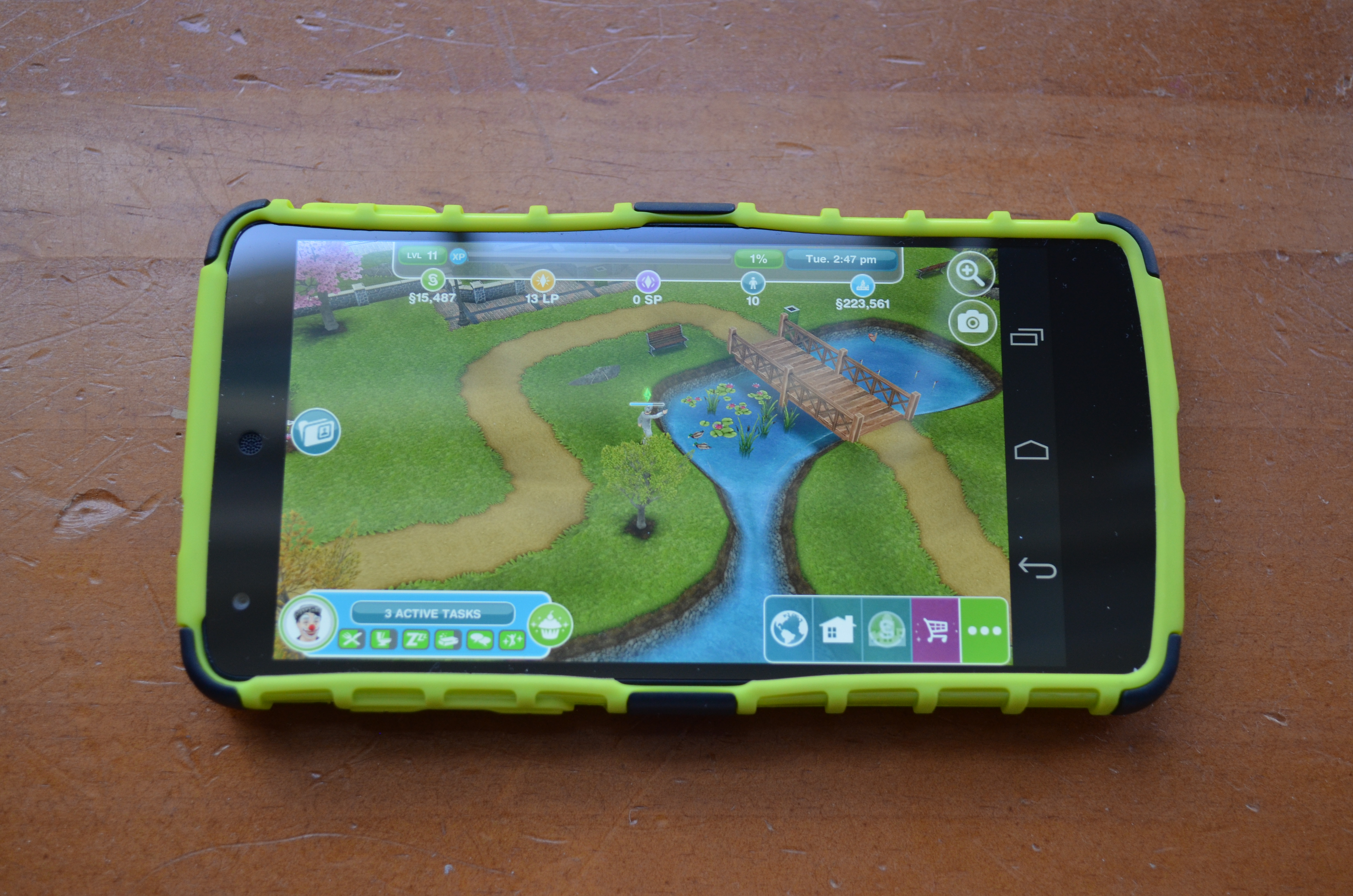
back of case showing both layersfront of casecase standshowing the mirror surface of the Nexus 5 I ve just been given an Armourdillo Hybrid case for the Nexus 5 [1] to review. The above pictures show the back of the case, the front of the case, the stand, and the front of the case with the screen blank. When I first photographed the case the camera focused on a reflection of the window, I include that picture for amusement and to demonstrate how reflective the phone screen is. This case is very hard, the green plastic is the soft inner layer which is still harder than the plastic in a typical gel case . The black part is polycarbonate which is very hard and also a little slippery. The case is designed with lots of bumps for grip (a little like the sole of a running shoe) so it s not likely to slip out of your hand. But the polycarbonate slides easily on plastic surfaces such as the dash of a car. It s fortunate that modern cars have lots of cup holders that can be used for holding a phone. I haven t dropped the phone since getting the new case, but I expect that the combination of a hard outer shell and a slightly softer inner shell (to cushion the impact) will protect it well. All the edges of the case extend above the screen so dropping the phone face down on a hard flat surface shouldn t cause any damage. The black part has a stand for propping the phone on it s side to watch a movie. The stand is very solid and is in the ideal position for use on soft surfaces such as a doona or pillow for watching TV in bed. Appearance This case is mostly designed to protect the phone and the bumps that are used for grip detract from the appearance IMHO. I think that the Ringke Fusion case for my Nexus 4 [2] looks much better, it s a trade-off between appearance and functionality. My main criteria for this case were good protection (better than a gel case) and small size (not one of the heavy waterproof cases). It was a bonus to get a green case for the Enlightened team in Ingress. NB Armourdillo also offers a blue case for the Resistance team in Ingress as well as other colors. MobileZap also have a number of other cases for the Nexus 5 [3].

Andrew Pollock: [life] Day 56, Kindergarten, rain, taxes

There was quite the torrential downpour overnight. It woke me up, and it woke Zoe up too, and at about 1:45am she ended up in bed with me. I think she managed to invent a new baby sleep position, where she was on my pillow, perpendicular to me along the bed head, and had somehow ejected the pillow that was on her side of the bed. We got up, with a slow start, and the weather was still looking a bit dicey, so Zoe wanted to go to Kindergarten by car. That actually meant we were the first ones there, because I'd been working to a timetable of leaving home by bike. One of the chickens was starting to hatch (and subsequently hatched around noon) so that was exciting. Funnily enough, Zoe had spent all morning telling me how she didn't want to go to Kindergarten, but by the time we got there, she didn't seem to mind being there all that much. After I got home from Kindergarten, I biked down to Bulimba to go to the bank to finalise opening my business bank accounts. I've since discovered that one can't do much without an ABN, I can't even get a cheque book, so I've sicked my accountant on that one for me. I got stuck into my US taxes some more today, and made a very satisfactory amount of progress on them. I think I should be able to finish them off in the next session I get to work on them. I felt like getting out of the house after that. It was looking quite like rain again, making picking up Zoe by bike out, so I ran a few errands in the car before getting to Kindergarten quite early. Zoe was fast asleep, but I let her have a long, slow wake up, and that made our departure much easier. She got to have a little hold of one of the baby chicks before we left. Today I learned that baby chicks smell absolutely divine. We got home, and Zoe did some self-directed craft for a bit, and then wanted to play hide and seek, so we did that and finally got around to looking at all of the Woolworths DreamWorks Heroes cards she's been collecting. I was disappointed to discover there's only a single card per pack, so that's going to mean I have to spend at least $840 on groceries, excluding duplicates, before we get all of them. I'm glad the checkout operators aren't sticking to the rules and are handing them out a little more generously than that. After that, we did a bit more rough and tumble play, and then it was time to start making dinner, so Zoe watched a DVD. We got dinner out of the way relatively early, so I practiced plaiting her hair (I've surprised myself with the half-decent job I can do) and then did bath time and bed time. Bed time was a little protracted (she didn't like her bedroom and wanted to sleep in my bed) but otherwise seems to have gone smoothly.

Sylvain Le Gall: Release of OASIS 0.4.3

I am happy to announce the release of OASIS v0.4.3. Logo OASIS small OASIS is a tool to help OCaml developers to integrate configure, build and install systems in their projects. It should help to create standard entry points in the source code build system, allowing external tools to analyse projects easily. This tool is freely inspired by Cabal which is the same kind of tool for Haskell. You can find the new release here and the changelog here. More information about OASIS in general on the OASIS website. Here is a quick summary of the important changes: Features: This new version closes 4 bugs, mostly related to parsing of _oasis. It also includes a lot of refactoring to improve the overall quality of OASIS code base. The big project for the next release will be to setup a Windows host for regular build and test on this platform. I plan to use WODI for this setup. I would like to thanks again the contributor for this release: David Allsopp, Martin Keegan and Jacques-Pascal Deplaix. Their help is greatly appreciated.

24 March 2014

Andrew Shadura: Tired of autotools? Try this: mk-configure

mk-configure is a project which tries to be autotools done right. Instead of supporting an exceedingly large number of platforms, modern and ancient, at costs of generated unreadable multi-kilobyte shell scripts, mk-configure aims at better support of less platforms, but those which are really in use today. One of the main differences of this project is that it avoids code generation as much as possible. The author of mk-configure, Aleksey Cheusov, a NetBSD hacker from Belarus, uses NetBSD make (bmake) and shell script snippets instead of monstrous libraries written in m4 interleaved with shell scripts. As the result, there s no need in a separate step of package configuration or bootstrapping the configure script, everything is done by just running bmake, or a convenience wrapper for it, mkcmake, which prepends a proper library path to bmake arguments, so you don t have to specify it yourself. Today, mk-configure is already powerful enough to be able replace autotools for most of the projects, and what is missing from it can be easily done by hacking the Makefile, which would otherwise be quite simple. Try it for your project, you may really like it. I already did. And report bugs.

Michael Prokop: Building Debian+Ubuntu packages on EC2

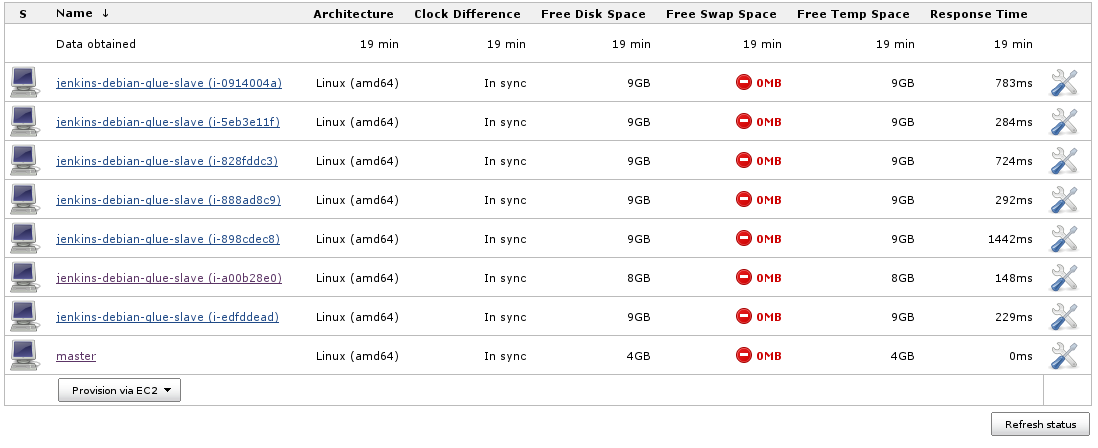
In a project I recently worked on we wanted to provide a jenkins-debian-glue based setup on Amazon s EC2 for building Debian and Ubuntu packages. The idea is to keep a not-so-strong powered Jenkins master up and running 24 7, while stronger machines serving as Jenkins slaves should be launched only as needed. The project setup in question is fully open sourced (more on that in a separate blog post), hereby I am documenting the EC2 setup in usage. Jenkins master vs. slave Debian source packages are generated on Jenkins master where a checkout of the Git repository resides. The Jenkins slaves do the actual workload by building the binary packages and executing piuparts (.deb package installation, upgrading, and removal testing tool) on the resulting binary packages. The Debian packages (source+binaries) are then provided back to Jenkins master and put into a reprepro powered Debian repository for public usage. Preparation The starting point was one of the official Debian AMIs (x86_64, paravirtual on EBS). We automatically deployed jenkins-debian-glue on the system which is used as Jenkins master (we chose a m1.small instance for our needs). We started another instance, slightly adjusted it to already include jenkins-debian-glue related stuff out-of-the-box (more details in section Reduce build time below) and created an AMI out of it. This new AMI ID can be configured for usage inside Jenkins by using the Amazon EC2 Plugin (see screenshot below). IAM policy Before configuring EC2 in Jenkins though start by adding a new user (or group) in AWS s IAM (Identity and Access Management) with a custom policy. This ensures that your EC2 user in Jenkins doesn t have more permissions than really needed. The following policy should give you a starting point (we restrict the account to allow actions only in the EC2 region eu-west-1, YMMV):
 
  "Version": "2012-10-17",
  "Statement": [
     
      "Action": [
        "ec2:CreateTags",
        "ec2:DescribeInstances",
        "ec2:DescribeImages",
        "ec2:DescribeKeyPairs",
        "ec2:GetConsoleOutput",
        "ec2:RunInstances",
        "ec2:StartInstances",
        "ec2:StopInstances",
        "ec2:TerminateInstances"
      ],
      "Effect": "Allow",
      "Resource": "*",
            "Condition":  
                "StringEquals":  
                    "ec2:Region": "eu-west-1"


  ]
 
Jenkins configuration Configure EC2 access with Access Key ID , Secret Access Key , Region and EC2 Key Pair s Private Key (for SSH login) inside Jenkins in the Cloud section on $YOUR_JENKINS_SERVER/configure. Finally add an AMI in the AMIs Amazon EC2 configuration section (adjust security-group as needed, SSH access is enough): As you can see the configuration also includes a launch script. This script ensures that slaves are set up as needed (provide all the packages and scripts that are required for building) and always get the latest configuration and scripts before starting to serve as Jenkins slave. Now your setup should be ready for launching Jenkins slaves as needed: NOTE: you can use the Instance Cap configuration inside the advanced Amazon EC2 Jenkins configuration section to place an upward limit to the number of EC2 instances that Jenkins may launch. This can be useful for avoiding surprises in your AWS invoices. :) Notice though that the cap numbers are calculated for all your running EC2 instances, so be aware if you have further machines running under your account, you might want to e.g. further restrict your IAM policy then. Reduce build time Using a plain Debian AMI and automatically installing jenkins-debian-glue and further jenkins-debian-glue-buildenv* packages on each slave startup would work but it takes time. That s why we created our own AMI which is nothing else than an official Debian AMI with the bootstrap.sh script (which is referred to in the screenshot above) already executed. All the necessary packages are pre-installed and also all the cowbuilder environments are already present then. From time to time we start the instance again to apply (security) updates and execute the bootstrap script with its &dash&dashupdate option to also have all the cowbuilder systems up2date. Creating a new AMI is a no-brainer and we can then use the up2date system for our Jenkins slaves, if something should break for whatever reason we can still fall back to an older known-to-be-good AMI. Final words How to set up your Jenkins jobs for optimal master/slave usage, multi-distribution support (Debian/Ubuntu) and further details about this setup are part of another blog post. Thanks to Andreas Granig, Victor Seva and Bernhard Miklautz for reading drafts of this.
Steve Kemp: So I failed at writing some clustered code in Perl

Until this time next month I'll be posting code-based discussions only. Recently I've been wanting to explore creating clustered services, because clusters are definitely things I use professionally. My initial attempt was to write an auto-clustering version of memcached, because that's a useful tool. Writing the core of the service took an hour or so: At the point I was done the following code worked:
use KeyVal;
# Create an object, and set some values
my $obj = KeyVal->new( logfile => "/tmp/foo.log" );
$obj->incr( "steve" );
print $obj->get( "steve" ) # prints 2.
# Now replay the append-only log
my $replay = KeyVal->new( logfile => "/tmp/foo.log" );
$replay->replay();
print $replay->get( "steve" ) # prints 2.
In the first case we used the primitives to increment a value twice, and then fetch it. In the second case we used the logfile the first object created to replay all prior transactions, then output the value. Neat. The next step was to make it work over a network. Trivial. Finally I wanted to autodetect peers, and deploy replication. Each host would send out regular messages along the lines of "Do you have updates made since $time?". Any that did would replay the logfile from the given unixtime offset. However here I ran into problems. Peer discovery was supposed to be basic, and I figured I'd write something that did leader election by magic. Unfortunately Perls threading code is .. unpleasant: This failed. Majorly. Because you cannot launch the implementation of a class-method as a thread. Equally you cannot make a variable which is "complex" shared across threads. I wrote some demo code which works without packages and a shared singleton: The Ruby version, by contrast, is much more OO and neater. Meh. I've now shelved the project. My next, big, task was to make the network service utterly memcached compatible. That would have been fiddly, but not impossible. Right now I just use a simple line-based network protocol. I suspect I could have got what I wanted using EventMachine, or similar, but that's a path I've not yet explored, and I'm happy enough with that decision.

Next.

Previous.