Search Results: "ina"

10 April 2013

Julian Andres Klode: apt-show-versions rewrite in C++ (more than 10 times faster)

The script apt-show-versions is developed by another Debian Developer called Christoph Martin in Perl. Recently, it turned out that apt-show-versions is too slow for some users; so I decided to rewrite his program using APT s C++ API. I expect this to be part of a future APT release, rendering the original apt-show-versions obsolete. The rewrite is sadly not 100% backwards compatible to the original version; as some option names had to be renamed due to our command-line parser not supporting option names like -nh, and some other options were dropped because they are hard to support (like status-file and lists-dir) with our command-line parsing. I also decided not to keep the the -p and -r options, but use the standard APT command-line conventions insteads. For now, it also cannot show you the distribution names you have specified in your sources.list file, but will always display codenames instead; if available. I hope to fix this in Jessie by extending APT s cache format a bit. On the performance side, this program now takes about 0.09s compared to the 1.40 seconds needed by apt-show-versions. The times are taken with all data in caches. The current version can be found in a git repository, a link to gitweb is: http://anonscm.debian.org/gitweb/?p=users/jak/apt-show-versions.git
Please also note that support for allversions is not 100% implemented yet, but it should work for most uses. Now, go testing and report back!
Filed under: Debian

Paul Wise: Inadequate software

Just 168 of the 4961 packages (3%) I have installed are inadequate. Unfortunately those packages collectively have 3440 inadequacies. How much of the software on your system has these inadequacies? You can find out today by installing Jakub Wilk's software, which is appropriately named adequate. It is now available in Debian unstable. I recommend enabling the apt hook which notifies you when software you are installing is inadequate. Other ways of being notified when you are installing inadequate software include apt-listbugs and debsecan. If you are interested in software quality, Debian's QA activities wiki page provides a good overview of the quality assurance activities that are being worked on within the context of Debian. If you want to provide better quality software for Debian, please keep an eye on the PTS pages for software you maintain. You can also run various automated checks on your software before you make new releases or upload them to the Debian archive. More people are needed to improve and expand upon Debian's existing quality assurance activities and infrastructure. Come join us today!

Andrew Pollock: [life/repatexpat] Day #10 of repatriation -- got wheels

Finally, finally, I've got a car. I had this grand plan of using a friend of a friend who was a car buyer to source me a car and have it ready for me at the airport when I arrived. That didn't work out so well, so I resorted to carsales.com.au and found something very quickly. I could have bought it last Friday, if I'd wanted to forego the RACQ inspection, but I hate used cars at the best of times, and so I want to do what I can do avoid buying a lemon, so I had to wait until Monday for the inspection. I got the report in the early afternoon on Monday, and the only thing it highlighted was a bit of oil on the front differential housing. I contacted the dealer and he said he'd get it looked at. I got an SMS from him on Tuesday morning saying the car would be ready after 3pm, but by the time I could arrange with Kristy for a ride, we just missed the bank, so I couldn't get the bank cheque to pay for it, so we rescheduled for this morning. The shipping container was delivered to Sarah's place on Monday, and there's been a steady stream of boxes arriving at my place. It was good to be able to transport some of those myself today, and there'll be more to move tomorrow. I need to sort out storage options, because one thing I don't want is for there to be too much clutter in my home. I think there'll be another trip to IKEA in my near future. At least I can do that all on my own now. It's so great to have independent mobility again.

9 April 2013

Bits from Debian: Call for participants in Debian for the Google Summer of Code

The Google Summer of Code is a program that allows post-secondary students aged 18 and older to earn a stipend writing code for Free and Open Source Software projects during the summer. For the eighth time, Debian has just been accepted as a mentoring organization for this year's program. If you're an eligible student, now is the time to take a look at our project ideas list, engage with the mentors for the projects you find interesting, and start working on your application!
Please read the FAQ and the Program Timeline on Google's website. If you are interested, we encourage you to come and chat with us on irc (#debian-soc on irc.oftc.net), or to send an email to the SoC coordination mailing-list. Most of the GSoC related information in Debian can be found on our wiki pages, but feel free to ask us directly on irc or via email. We're looking forward to work with amazing students again this summer!

Wouter Verhelst: Dear HP,

I bought a ScanJet N6350 a few years back, in the belief that it would work. After all, you write free Linux drivers for all your printers, and when those printers are multifunctional printers with scanners, you do make sure the scanner bits of those printers work too. So it shouldn't be too hard to write a Linux driver for that scanner too, right? Apparently it is. For some reason that I can't imagine, you decided that my money is worth more than my stress levels. Dear HP, you suck. I fail to understand how the basic loss of functionality after a failed scan managed to get through your testing. I fail to understand why you think Linux users should be able to print, but not scan. And I especially fail to understand why I should waste my time with such an expensive device that can't even perform its basic functionality with more than 10% success rate.

Russ Allbery: Review: Judge Sn Goes Golfing

Review: Judge Sn Goes Golfing, by John Scalzi
Artist: Gahan Wilson
Publisher: Subterranean
Copyright: 2009
Printing: 2012
ISBN: 1-59606-479-X
Format: Kindle
Pages: 32
As you may have guessed, this is yet another short story by Scalzi that was rolled into the Subterranean Scalzi Super Bundle. This one is a bit longer than the ones I've previously reviewed, and is also illustrationed. Unlike some of the others, it's not available on-line for free... as a written work at least. There's an abridged audio version available for free from Subterranean Press's web site, though. Like the other stories I've reviewed so far, it's humor, but I think it's a bit more successful and substantial than the previous short stories. Judge Bufan Nigun Sn is an extremely foul-tempered alien judge who loves to golf, despite being terrible at it. He's a sort of circuit court judge for a larger galactic civilization, of which Earth is now part. (There's a smattering of background world-building, but it's not the core of the story.) Golf is his passion, in several senses of the word: his habit of getting into nasty fights with his fellow players and otherwise making public and occasionally injurious scenes has gotten him banned from every course in the Washington DC area, both public and private. Except, that is, for Dulles Woods, a dire, badly-maintained course designed via nepotism and theft whose business model is primarily based on letting the people banned from every other course golf there. And charging them extra to let caddies accompany them. The plot of this story is about a particular game of golf, dramatically foreshadowed by the opening sentence. But the story is really about Judge Sn's relationship to golfing and to the notorious Dulles Woods. It's one of the better jobs I've seen of writing a thoroughly unlikable person into a gloriously foul-tempered charm. It's also a story about a golf course and golfer who thoroughly deserve each other, and about how it feels to suddenly have something go right after grinding out hours and hours of work on a hobby that is supposed to be fun but manages to fall into some horribly compelling middle ground between enjoyment and rage-inducing frustration. Speaking as someone who is known to grind out video game completions while swearing at the television, I can sympathize. I got thoroughly hooked by Scalzi's descriptions of Judge Sn's mental state and enjoyed this story far more than I expected to. Sadly, when the plot does finally arrive, I thought it was a letdown. Scalzi throws in a highly improbable coincidence to create action, and while that's a legitimate plot technique (particularly in humor), it works best when the author goes back afterwards and fills in the back story of the coincidence. Pratchett does this extremely well. Scalzi, alas, doesn't really bother, and while suspension of disbelief isn't as relevant for this sort of story, I thought it was a missed opportunity. The ending seemed to be missing some sort of punch or background twist. That said, I really liked the character study and I think the story is well worth the 99 cents it's still selling for on the Kindle (and quite possibly other platforms; I haven't checked). If buying short stories on the Kindle is something you want to do, I recommend this one to your attention. Rating: 7 out of 10

8 April 2013

Matthias Klumpp: Tanglu status report

Hello everyone! I am very excited to report about the awesome progress we made with Tanglu, the new Debian-based Linux-Distribution. :) First of all, some off-topic info: I don t feel comfortable with posting too much Tanglu stuff to Planet-KDE, as this is often not KDE-related. So, in future Planet-KDE won t get Tanglu information, unless it is KDE-related ;-) You might want to take a look at Planet-Tanglu for (much) more information. So, what happened during the last weeks? Because I haven t had lectures, I nearly worked full-time on Tanglu, setting up most of the infrastructure we need. (this will change with the next week, where I have lectures again, and I also have work to do on other projects, not just Tanglu ^^) Also, we already have an awesome community of translators, designers and developers. Thanks to them, the Tanglu-Website is now translated to 6 languages, more are in the pipeline and will be merged later. Also, a new website based on the Django framework is in progress. The Logo-Contest We ve run a logo-contest, to find a new and official Tanglu logo, as the previous logo draft was too close to the Debian logo (I asked the trademark people at Debian). More than 30 valid votes (you had to be subscribed to a Tanglu Mailinglist) were received for 7 logo proposals, and we now have a final logo: Tanglu Logo (Text) I like it very much :) Fun with dak I decided to use dak, the Debian Archive Kit, to handle the Tanglu archive. Choosing dak over smaller and easy-to-use solutions had multiple reasons, the main reason is that dak is way more flexible than the smaller solution (like reprepro or min-dak) and able to handle the large archive of Tanglu. Also, dak is lightning fast. And I would have been involved with dak sooner or later anyway, because I will implement the DEP-11 extension to the Debian Archive later (making the archive application-friendly). duckWorking with dak is not exactly fun. The documentation is not that awesome, and dak contains many hardcoded stuff for Debian, e.g. it often expects the unstable suite to be present. Also, running dak on Debian Wheezy turned out to be a problem, as the Python module apt_pkg changed the API and dak naturally had problems with that. But with the great help of some Debian ftpmasters (many thanks to that!), dak is now working for Tanglu, managing the whole archive. There are still some quirks which need to be fixed, but the archive is in an usable state, accepting and integrating packages. The work on dak is also great for Debian: I resolved many issues with non-Debian dak installations, and made many parts of dak Wheezy-proof. Also, I added a few functions which might also be useful for Debian itself. All patches have of course been submitted to upstream-dak. ;-) Wanna-build and buildds GearThis is also nearly finished :) Wanna-build, the software which manages all buildds for an archive, is a bit complicated to use. I still have some issues with it, but it does it s job so far. (need to talk to the Debian wanna-build admins for help, e.g. wanna-build seems to be unable to handle arch:all-only packages, also, build logs are only submitted in parts) The status of Tanglu builds can be viewed at the provisoric Buildd-Status pages. Setting up a working buildd is also a tricky thing, it involves patching sbuild to escape bug #696841 and applying various workarounds to make the buildd work and upload packages correctly. I will write instructions how to set-up and maintain a buildd soon. At time, we have only one i386 buildd up and running, but more servers (in numbers: 3) are prepared and need to be turned into buildds. After working on Wanna-build and dak, I fully understand why Canonical developed Launchpad and it s Soyuz module for Ubuntu. But I think we might be able to achieve something similar, using just the tools Debian already uses (maybe a little less confortable than LP, but setting up an own LP instance would have been much more trouble). Debian archive import The import of packages from the Debian archive has finished. Importing the archive resulted in many issues and some odd findings (I didn t know that there are packages in the archive which didn t receive an upload since 2004!), but it has finally finished, and the archive is in a consistent state at time. To have a continuous package import from Debian while a distribution is in development, we need some changes to wanna-build, which will hopefully be possible. Online package search The Online-Package-Search is (after resolving many issues, who expected that? :P ) up and running. You can search for any package there. Some issues are remaining, e.g. the file-contents-listing doesn t work, and changelog support is broken, but the basic functionality is there. Tanglu Bugtracker We now also have a bugtracker which is based on the Trac software. The Tanglu-Bugtracker is automatically synced with the Tanglu archive, meaning that you find all packages in Trac to report bugs against them. The dak will automatically update new packages every day. Trac still needs a few confort-adjustments, e.g. submitting replies via email or tracking package versions. Tanglu base system tanglu-platform-smallThe Tanglu metapackages have been published in a first alpha version. We will support GNOME-3 and KDE4, as long as this is possible (= enough people working on the packaging). The Tanglu packages will also depend on systemd, which we will need in GNOME anyway, and which also allows some great new features in KDE. Side-effect of using systemd is at least for the start that Tanglu boots a bit slow, because we haven t done any systemd adjustments, and because systemd is very old. We will have to wait for the systemd and udev maintainers to merge the packages and release a new version first, before this will improve. (I don t want to do this downstream in Tanglu, because I don t know the plans for that at Debian (I only know the information Tollef Fog Heen & Co. provided at FOSDEM)) The community The community really surprised me! We got an incredible amount of great feedback on Tanglu, and most of the people liked the idea of Tanglu. I think we are one of the less-flamed new distributions ever started ;-) . Also, without the very active community, kickstarting Tanglu would not have been possible. My guess was that we might be able to have something running next year. Now, with the community help, I see a chance for a release in October :) The only thing people complained about was the name of the distribution. And to be really honest, I am not too happy with the name. But finding a name was an incredibe difficult process (finding something all parties liked), and Tanglu was a good compromise. Tanglu has absolutely no meaning, it was taken because it sounded interesting. The name was created by combining the Brazilian Tangerine (Clementine) and the German Iglu (igloo). I also dont think the name matters that much, and I am more interested in the system itself than the name of it. Also, companies produce a lot of incredibly weird names, Tanglu is relatively harmless compared to that ;-) . In general, thanks to everyone participating in Tanglu! You are driving the project forward! The first (planned) release I hereby announce the name of the first Tanglu release, 1.1 Aequorea Victoria . It is Daniel s fault that Tanglu releases will be named after jellyfishes, you can ask him why if you want ;-) I picked Aequorea, because this kind of jellyfish was particularly important for research in molecular biology. The GFP protein, a green fluorescent protein (=GFP), caused a small revolution in science and resulted in a Nobel Prize in 2008 for the researchers involved in GFP research (for the interested people: You can tag proteins with GFP and determine their position using light microscopy. GFP also made many other fancy new lab methods possible). Because Tanglu itself is more or less experimental at time, I found the connection to research just right for the very first release. We don t have a time yet when this version will be officially released, but I expect it to be in October, if the development speed increases a little and more developers get interested and work on it. Project Policy We will need to formalize the Tanglu project policy soon, both the technical and the social policies. In general, regarding free software and technical aspects, we strictly adhere to the Dbian Free Software Guidelines, the Debian Social Contract and the Debian Policy. Some extra stuff will be written later, please be patient! Tanglu OIN membership I was approached by the Open Invention Network, to join it as member. In general, I don t have objections to do that, because it will benefit Tanglu. However, the OIN has a very tolerant public stance on software patents, which I don t like that much. Debian did not join the OIN for this reason. For Tanglu, I think we could still join the OIN without someone thinking that we support the stance on software patents. Joining would simply be pragmatic: We support the OIN as a way to protect the Linux ecosystem from software patents, even if we don t like the stance on software patents and see it differently. Because this affects the whole Tanglu project, I don t want to decide this alone, but get some feedback from the Tanglu community before making a decision. Can I install Tanglu now? Yes and no. We don t provide installation images yet, so trying Tanglu is a difficult task (you need to install Debian and then upgrade it to Tanglu) if you want to experiment with it, I recomment trying Tanglu in a VM. I want to help! Great, then please catch one of us on IRC or subscribe to the mailinglists. The best thing is not to ask for work, but suggest something you want to do, others will then tell you if that is possible and maybe help with the task. Packages can for now only be uploaded by Debian Developers, Ubuntu Developers or Debian Maintainers who contacted me directly and whose keys have been verified. This will be changed later, but at the current state of the Tanglu archive (= less safety checks for packages), I only want people to upload stuff who definitely have the knowledge to create sane packages (you can also proove that otherwise, of course). We will later establish a new-member process. If you want to provide a Tanglu archive mirror, we would be very happy, so that the main server doesn t have to carry all the load. If you have experience in creating Linux Live-CDs or have worked with the Ubiquity installer, helping with these parts would be awesome! Unfortunately, we cannot reuse parts of Linux Mint Debian, because many of their packages don t build from source and are repackaged binaries, which is a no-go for the Tanglu main archive. Sneak peek And here is a screenshot of the very first Tanglu installation (currently more Debian than Tanglu):



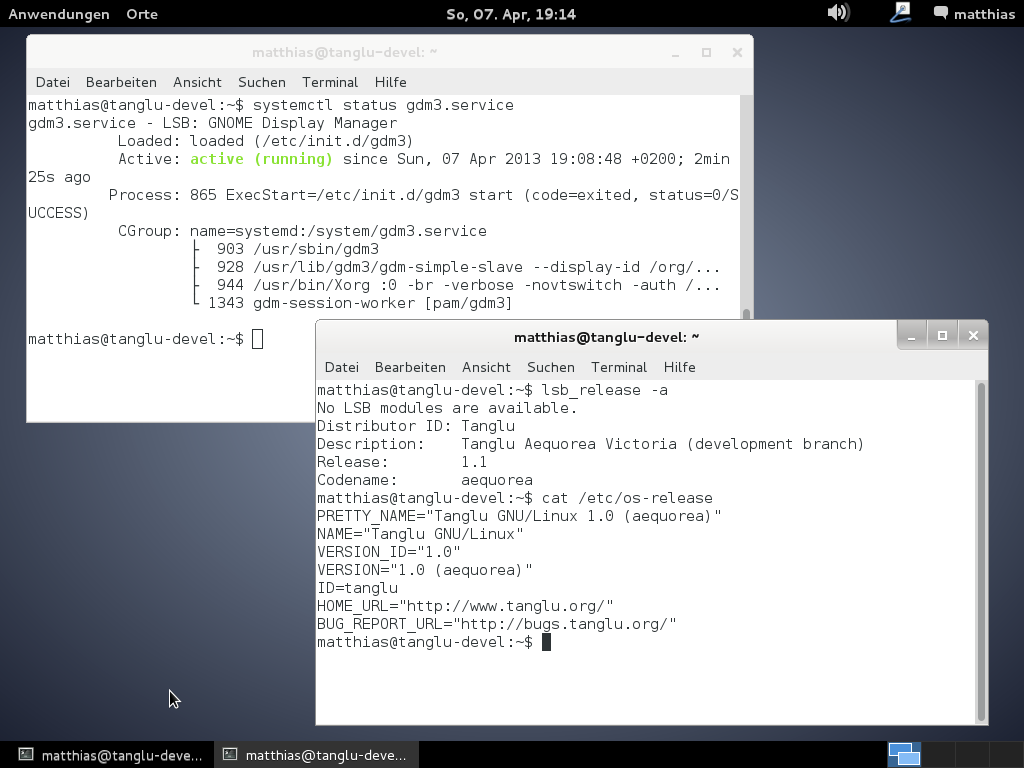
tanglu_sneak-peek_screenshot Something else I am involved in Debian for a very long time now, first as Debian Maintainer and then as Debian Developer and I never thought much about the work the Debian system administrators do. I didn t know how dak worked or how Wanna-build handles the buildds and what exactly the ftpmasters have to do. By not knowing, I mean I knew the very basic theory and what these people do. But this is something different than experiencing how much work setting up and maintaining the infrastructure is and what an awesome job the people do for Debian, keeping it all up and running and secure! Kudos for that, to all people maintaining Debian infrastructure! You rock! (And I will never ever complain about slow buildds or packages which stay in NEW for too long ;-) )

Bits from Debian: Debian joins Free & Open Source Software Outreach Program for Women

The GNOME Foundation started the Free & Open Source Software Outreach Program for Women, OPW, in 2010. In the January-April 2013 round, many other FOSS organizations joined the program. We are happy to announce that Debian will also join in the next round from June-September and we'll offer one internship. You can find more details about Debian's participation in the program at Debian OPW page. Call for mentors and projects OPW allows applicants to work on any kind of project, including coding, design, marketing, web development... The Debian Google Summer of Code projects will be offered also as possible projects for OPW, but GSoC only allows coding projects. If you have any idea of a non-coding project and you want to mentor it, please contact us in the soc-coordination mailing list adding [OPW] in subject. OPW works in the same way as GSoC except Google doesn't play a part here. The same advice that is provided for GSoC mentors works for OPW mentors. Call for participants The main goal of this program is to increase the number of women in FOSS, so all women who are not yet a Debian Developer or a Debian Maintainer are encouraged to apply. There are no age restrictions and applicants don't need to be a student. If you want to apply, you must follow three steps:
  1. Choose a project from this list. There are two lists, one for GSoC and another with non-coding tasks that can be only offered by the OPW. Those lists may change and add or remove more projects in the next few weeks.
  2. Make a small contribution to Debian. Projects will add a task the applicant must complete as part of the pre-selection process. If no task is provided, you are welcome to ask the mentors of the project. You can also make a different extra task of the one listed to show your skills and interest.
  3. Create a page in the Debian wiki with your application. You can do so under pseudonym, but in that case, please give us information about yourself privately by email to the coordinators listed in the Debian OPW page!

7 April 2013

Bits from Debian: DebConf14 to be held in Portland, Oregon, USA

We are pleased to announce the 15th annual Debian Conference (DebConf14) is to be held in Portland, Oregon, USA in August 2014, with specific dates yet to be announced. Portland is an open source hotspot in the Pacific Northwest of the US. It is a technologically savvy community, home to Intel and the adopted home of Linus Torvalds. The city plays host to many Free Software conferences including OSCON, and is where Linux Plumbers originated. The local team has been involved in mulitple DebConfs in the past, and is excited to bring their experience and ideas to fruition in a city well-positioned to host such a prestigious event.

Olivier Berger: Migrating picture tags from KPhotoAlbum to digiKam (or others) through IPTC

I've occasionally used KPhotoAlbum for a few years and eventually added many tags to the pictures. But I've decided I wanted to try other tools, and digiKam seems to be the best option from the many reviews I've read. Still, there's apparently no automatic feature to import into digiKam the tags set in KPhotoAlbum. Fortunately, some smart people have implemented Perl tools allowing to overcome this issue. The process involves modifying the pictures to save the tags inside the files, using the IPTC standard. Then, digiKam will be able to load the tags from the modified files. Here's a copy of the (translated) kphotoalbum2iptc.pl script (the original as in french) I copied from this blog post (in french too). I've been able to generate .deb packages for the required 2 perl libs dependencies using the method described in the referenced post , with : dh-make-perl --build --cpan Image::Kimdaba and dh-make-perl --build --cpan Image::IPTCInfo

Thanks to Pierre Doucet and Bruno Adele for sharing this. Hope this helps.

Andrew Pollock: [life/repatexpat] Getting online

I'd decided ahead of time that I wanted to use Internode as my ISP, and had ordered a Naked DSL service from them and also decided to bundle my mobile phone with them as well. For reasons that only made sense to me 7 years ago, I've been paying Telstra to keep my mobile number going, but I've long since lost the SIM. My current phone has a micro-SIM anyway, so I needed a replacement SIM. My grand plan had been to order the SIM, order the number port from Telstra to Internode, and then, well, profit from the moment I stuck the SIM in my phone. Unfortunately the port didn't go through as planned, and I was left incommunicado for the better part of two and a half days. I felt like I had my hands tied behind my back not having a mobile data service. It was also mildly annoying not being able to call people or be contactable, given the amount of running around I was doing. But it got resolved and is fast becoming a distant memory. The DSL service required a Telstra technician to come out (I'm not actually sure why) and that was scheduled for Thursday. I happened to catch him while he was at my building's MDF, and had a bit of a chat with him. He was a Scotsman, and I didn't get all the details, but he was going on about how he was only there to operate on the exchange side of the MDF, and I'd have to get someone else to jumper it up to my apartment. This wasn't what I expected from an installation service, but sure enough when I finally got around to plugging the ADSL modem in on Saturday morning, there was no line sync to be had. A call to Internode confirmed that he'd only jumpered it up to exchange side of the MDF. What was even more annoying was I'm pretty sure I saw him yanking out jumper wires from the MDF when he was working on it. Jumper wires that connected the exchange side of the MDF to my apartment. I was not thrilled with the idea of waiting (and paying) for a cabling contractor to come out and hook up a couple of bits of jumper wire, so I put out a call on Facebook for a Krone tool and a tone generator, and Brent was able to come through for me. He dropped the gear around while I was out shopping with Kristy, and when we got back, I located the pair for my unit, and rejumpered the existing jumper wire that I'm pretty sure the Telstra technician had disconnected. Lo and behold, my ADSL started working. I felt pretty proud of myself. It's fun operating at Layer 1 every now and then. The FRITZ!Box Fon WLAN 7270 is quite the beast of a box. Not only is it an ADSL modem, it's a wireless router, DECT base station, VoIP thingy and an answering machine! I've managed to connect my Engin account up to it, so once I get a DECT handset, I'll be able to make VoIP calls through it. I don't need to run Asterisk any more.

6 April 2013

Chris Lamb: Thames Turbo Sprint Triathlon 2013 Race 1

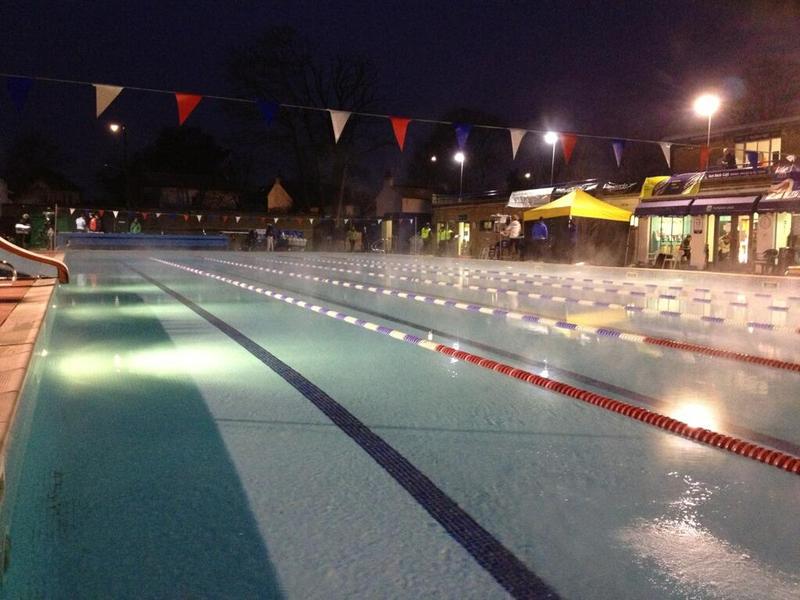
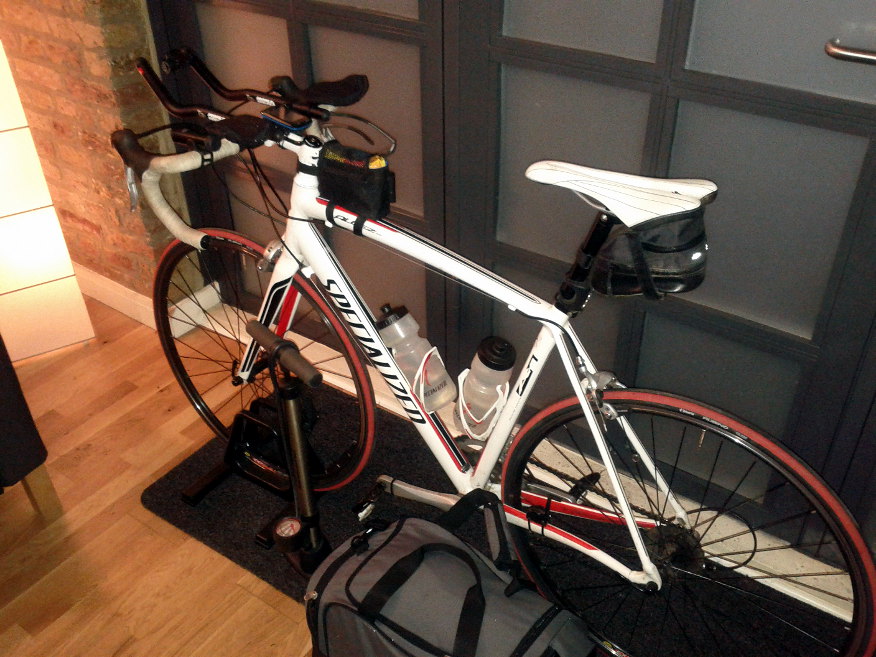
/wp-content/2013/hampton_wick_pool.jpg /wp-content/2013/bike_tt_01.jpg On Monday I took part in my first triathlon, a "sprint" distance race organised by Thames Turbo Triathlon Club.
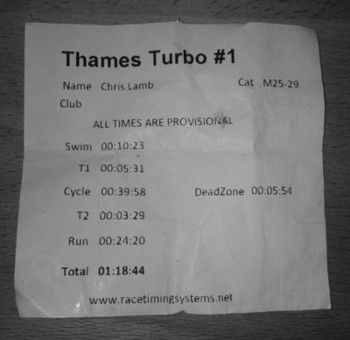
Swim
Distance
428m (+ pool exit chute)
Time
10:23 (2:26/100m)
I was glad to be given a low race number as it would reduce the time standing around 0 C in swimming gear. The 28 C heated pool was a welcome relief and I was quickly on my way, although perhaps overcooking it in the first half. Overall, I was quite pleased with my swim time as I had cut it by well over 50% during March; there are perhaps 1-2 minutes of fairly easy gains still to be made as well.
T1 (time: 5:32) Due to the cold temperature and forecast for snow, the race director insisted that competitors added extra layers covering their arms and torso on the bike. An additional "free" 5 minutes was also granted for T1 in order that clothing was not skipped in expense of time. I eventually wore a long-sleeve base layer, tights, a short-sleeved jersey, arm warmers and two pairs of gloves.
Bike
Distance
13.8 miles (+ mounting/demounting chutes)
Time
39:59 (19.5 mph)
I overtook 10-15 riders in the first half of the bike leg, a couple of them even seeking me out to later to congratulate me on looking so fast. I was thus more than a little disappointed when I discovered my final bike split as I was hoping for at least a sub-39 minute time. Analysing my GPS later I can see my average speed was over 1.5mph slower in the second half, yet I cannot recall being limited by fatigue or headwind in the last 6 miles. I was either overly reliant on other riders to "reel in" during the first half (but had run out of people to catch in the latter stage) or I simply was not giving 100%.
T2 (time: 3:30) Leaving T2 I failed to start both my GPS and stopwatch correctly so I do not have splits of my time. I also did not pick up my running gloves resulting in distractingly cold hands in Bushy Park.
Run
Distance
5k
Time
24:21 (4:52/km)
Throughout the first kilometer my legs were extremely sluggish and I simply could not get them to do what I wanted - typical triathlon "brick legs". I did not know it at the time but I was also running up a slight but extended incline. I struggled to get to the 1k marker and briefly stopped to mentally regroup. I joined another runner a few moments later and we ran the rest of the 5k at a fairly easy pace. It's clear that the lack of serious brick workouts compromised my run time, as well as my inability to dial down the pace once it was clearly too optimistic. Knowing the elevation profile of the run should have adjusted my expectations too, leading to a better overall time.
Overall
Total time
1:18:44
Position
127/261
Position male
109/202
Position 25-29 male
16/25
Despite finishing just to the left of the overall bell curve, it is difficult avoid feeling disappointed with my time as it was hindered by well-documented and avoidable errors. The sub-optimal pacing throughout meant I still had something left "in the tank" at the end, adding to a general feeling of under-achieving on the way home. Preperation was also less than ideal - two days before the race I had twinged my back in a 70-mile reconnaissance ride (!) by overusing my clip-on bars although this only affected me mentally in the race. I additionally ate too much before and during the race in retrospect. Nevertheless, there must be some value in learning these lessons first-hand and and early on. /wp-content/2013/tt_1_times.jpg (Full results)

Daniel Pocock: Switzerland Rigi-Bahn railway, Swiss rail travel

With DebConf13 registrations opening very soon, it's about time to share some more about Swiss travel. For all those who enjoyed the Glacier Express video, now there is another. This is the Rigi Bahn rack railway which goes from Vitznau up to the top of Mount Rigi (often just referred to as Rigi). At the top, it meets another train which goes to the junction of main railway lines at Arth-Goldau, and a cable car to Weggis The video starts at the station in Vitznau (beside the ferry terminal) and rises up rapidly in a breathtaking ride to the snowy peak at approximately 2,000 meters. There are spectacular views of mountains to the south across the lake, and look out for the wild animals on the way. You need at least a 2Mbit connection to stream this video: <video controls="" height="340" poster="http://danielpocock.com/sites/danielpocock.com/files/rigi-poster.jpg" width="560">
<source src="http://video.danielpocock.com/DSC_1789.mp4" type="video/mp4"></source>
<source src="http://video.danielpocock.com/DSC_1789.webm" type="video/webm"></source>
</video> and here are download links for those who prefer to download now and watch later (about 250MB): Swiss railway tickets When looking at the price of rail passes, keep in mind the maximum price paid by a Swiss resident is never more than 8 CHF per day, because that is the cost of the unlimited annual ticket that many people have. People who don't have the unlimited pass have what is called a half price card' which costs 150 CHF per year and allows them to buy any ticket at half the advertised price. This means that only the tourists pay the full advertised price, which is usually quite exorbitant. It is an extremely effective system of discrimination. A touist pays 8 CHF just for a 1 day pass for the center of a city like Zurich. Switzerland does offer some short term unlimited passes that provide some discounts to visitors, it is necessary to think carefully about how many days you want to use to get the optimal package:
  • Swiss Travel System web site offers the passes for all of Switzerland. Visitors can buy a multi-day unlimited pass, and also get several days of half-price travel as well. For 5 days unlimited travel within 1 month, the cost is 364 CHF, includes half price travel for all other days in the month. Shorter and longer periods available.
  • The Tell Pass, named after William Tell is significantly cheaper, offering unlimited travel just within the central mountain area. The Tell Pass includes use of the Rigi Bahn train shown in this blog, and is valid for travel to Andrematt, where you have to buy an extra ticket to ride on the Glacier Express train from the other blog. That is not so bad though, because you can buy a one-way ticket from Andermatt up to Natschen and then walk back down. The region covered by the Tell Pass is really quite big, centered around Luzern, it goes all the way west to Interlaken and south-east to Andermatt in the high mountains. Tell Pass costs 246 CHF for 15 days half-price travel including 5 days unlimited travel. Shorter periods available too.
  • More regional passes like the Tell Pass are available for people who want to spend less money by just visiting one area of Switzerland.
  • The SBB.ch web site has all the timetables for the trains, ferries, Postbuses and other services.

Andrew Pollock: [life/repatexpat] Day #6 of repatriation -- the crash continues

I was really not doing well by yesterday, I had developed quite the runny nose. I've discovered that it's neigh on impossible (from my sample set of two pharmacies) to get pseudoephedrine over the counter in this country. In the US, you have to provide ID and they report all purchases to the government and if you start buying too much, they come and kick down the door of your meth lab. Here, you seem to need a prescription. One pharmacy told me that 1 in 10 pharmacies will sell it over the counter. I ended up with the Australian equivalent of Afrin, which I don't particularly like, but it at least dried up my nose. Discussions on Facebook suggest that I may have been dealing with second-rate pharmacies, and the "big ones" would be more useful. I was also advised to try begging and pleading for Claritin-D. The damn meth labs have ruined it for everybody. It's too bad they can't come up with an additive that is safe to ingest, but would fuck up the meth cooking process. Not content with only two marathon shopping days, Kristy came back for a third day of driving me all around town, as my quest for a sofa bed and a dining table continued. It turns out that one does not simply walk into a furniture store and walk out with a sofa bed (or a dining table, for that matter). These things all seem to be on boats from China, or at best interstate warehouses, and most places can sell you something they know is in transit at best, but they're loathe to sell floor stock (for obvious reasons), and they seem to not have anything in a Brisbane warehouse (plenty of stuff was in Sydney or Melbourne and they'd ship it up). Plushhad a chaise sofa bed that had a nice sprung mattress, and was due in late this month or early next, and they would lend me something in the meantime, so they got my business. I look forward to having something to sit on. We then had an epic time at Bunnings getting all sorts of random household stuff, with the obligatory sausage sizzle before and after. Oh, how I have missed proper sausages! It turns out I'm looking for something that doesn't seem to exist over here, Rubbermaid don't seem to make the plastic "shed" cupboards in Australia, so I'll have to look elsewhere (Clark Rubber seems to make something approximately like what I'm looking for). Then I picked up some towels from Westfield Chermside and resumed the search for a dining table. I was really liking the idea of at least one bench seat, and we finally found a matching table, a bench seat, some shelving and a coffee table that would work as an entertainment unit, at OZ Design Furniture. They had a 20% off sale that made it all fairly reasonable. The entertainment unit was available immediately, and the rest of the stuff should be delivered in a couple of weeks. That just leaves finding some dining chairs that will go with it. OZ Design Furniture had the most unusual delivery charging system. They charge by the flight of stairs. Living on the 2nd floor does have its disadvantages. At least I won't be moving out of here any time soon. By the end of the day, I was totally done, but very happy to have finally sorted out the elusive remaining bits of furniture. I had my first night sleeping in my new home.

5 April 2013

Matthew Garrett: Update on leaked UEFI signing keys - probably no significant risk

According to the update here, the signing keys are supposed to be replaced by the hardware vendor. If vendors do that, this ends up being uninteresting from a security perspective - you could generate a signed image, but nothing would trust it. It should be easy enough to verify, though. Just download a firmware image from someone using AMI firmware, pull apart the capsule file, decompress everything and check whether the leaked public key is present in the binaries.

The real risk here is that even if most vendors have replaced that key, some may not have done. There's certainly an argument that shipping test keys at all increases the probability that a vendor will accidentally end up using those rather than generating their own, and it's difficult to rule out the possibility that that's happened.

comment count unavailable comments

4 April 2013

Andrew Pollock: [life/repatexpat] Day #3 of repatriation

Not content with just one day of driving all over town, Kristy came back for another day of it. I decided that rather than specifically shopping, I needed to do some of the more bureaucratic stuff, so that I could ensure things like the electricity could get put on in my name. I determined that in order to get the electricity in my name, I'd need to provide either a driver's licence number or Medicare card number. Unfortunately I remember separating my expired ACT licence and Medicare cards from my other random cards while I was packing up my temporary apartment in the US, but I can't for the life of me recall what I did with them, so our first port of call was the Department of Transport in Zillmere to get a new licence. Talk about a painless experience. The most annoying thing was that on Wednesdays they open at 9:30am instead of 8:30am. We got there at 9:10am. I had Zoe with me, and Kristy had her daughter, and they happily played while we waited outside. I just had to fill out a fairly simple form, and I was called up promptly and there were no problems at all. In under 30 minutes of walking in the door, we were driving away with a temporary licence. Vastly different from my experience with the DMV. I'll get the genuine article in the mail in a few weeks. Then we headed over to Westfield Chermside to go to Medicare, Medibank Private, and as I was growing frustrated with how long my mobile phone number was taking to port from Telstra to Internode, a Telstra Shop to try and get a replacement Telstra SIM. This is where I ran into more of a bureaucratic brick wall. For Medicare, I wanted to get my own Medicare card (and number) again, instead of a shared one, and so I essentially had to re-apply. They wanted more than just a passport entry stamp and something with an address on it. They wanted specific documents with an address on it, and an offer letter to show I was employed, so I had to leave there empty handed. Medibank Private was even worse. In a "shut up and take my money!" kind of moment, they told me to prematurely unsuspend a suspended policy, I needed to request a document from the Department of Immigration that showed my international movements to confirm that I was indeed back in the country. I've always found this somewhat ironic, given I'm sitting in front of a Medibank Private employee when they're telling me this, and I'm trying to give them money. So I left there empty handed as well. I grabbed some cutlery and crockery from Big W. The Telstra Shop had a 45 minute wait, and as I didn't want to over-stretch Zoe, we headed back to my parents. I took the opportunity to open an electricity account with AGL, now that I had a driver's licence number. Zoe declined to take a nap, and was having a good time playing with Kristy's daughter, and they both wanted to stay at my parent's place, so we left them there and dashed over to Ikea to rectify the bed slat issue. While we were at Ikea, my number finally ported across and my phone started working, which was a huge relief. Being uncontactable during a period of many interactions with random people was highly frustrating for me. Not having mobile Internet access for a few days of extreme mobility showed how much my phone is an extension of my brain. I also picked up a bunch of other random stuff from Ikea, stools that hadn't been in stock the day before, drinking glasses, that sort of thing. We then dropped all that off at the apartment before heading back to my parents' place. So it was another busy day of running all over town, and again, I'm very grateful to Kristy for volunteering her time to make it happen. Most notable accomplishments: complete bed for Zoe, electricity, and a working mobile phone.

Thomas Goirand: Git packaging workflow

Seeing what has been posted recently in planet.d.o, I would like to share as well my thoughts and work-flow, and tell that I do agree with Joey Hess on many of his arguments. Especially when he tells that Debian fetishises upstream tarballs. We re in 2013, at the age of Internet, and more and more upstream authors are using Git, and more and more they don t care about releasing tarballs. I ve seen some upstream authors who simply stopped doing so completely, as a Git tag is really enough. I also fully agree than disk space and network speed isn t much of a problem these days. When there are tags available, I use the following debian/gbp.conf:
[DEFAULT]
upstream-branch = master
debian-branch = debian
upstream-tag = %(version)s
compression = xz
[git-buildpackage]
export-dir = ../build-area/
On many of my packages, I now just use Git tags from upstream if they are available. To make it more easy, I now nearly always use the following piece of code in my debian/rules files:
DEBVERS         ?= $(shell dpkg-parsechangelog   sed -n -e 's/^Version: //p')
VERSION         ?= $(shell echo '$(DEBVERS)'   sed -e 's/^[[:digit:]]*://' -e 's/[-].*//')
DEBFLAVOR       ?= $(shell dpkg-parsechangelog   grep -E ^Distribution:   cut -d" " -f2)
DEBPKGNAME      ?= $(shell dpkg-parsechangelog   grep -E ^Source:   cut -d" " -f2)
DEBIAN_BRANCH   ?= $(shell cat debian/gbp.conf   grep debian-branch   cut -d'=' -f2   awk ' print $1 ')
GIT_TAG         ?= $(shell echo '$(VERSION)'   sed -e 's/~/_/')
get-upstream-sources:
        git remote add upstream git://git.example.org/proj/foo.git   true
        git fetch upstream
        if ! git checkout master ; then \
                echo "No upstream branch: checking out" ; \
                git checkout -b master upstream/master ; \
        fi
        git checkout $(DEBIAN_BRANCH)
make-orig-file:
        if [ ! -f ../$(DEBPKGNAME)_$(VERSION).orig.tar.xz ] ; then \
                git archive --prefix=$(DEBPKGNAME)-$(GIT_TAG)/ $(GIT_TAG)   xz >../$(DEBPKGNAME)_$(VERSION).orig.tar.xz ; \
        fi
        [ ! -e ../build-area ] && mkdir ../build-area   true
        [ ! -e ../build-area/$(DEBPKGNAME)_$(VERSION).orig.tar.xz ] && cp ../$(DEBPKGNAME)_$(VERSION).orig.tar.xz ../build-area   true
Packaging a new upstream VERSION now means that I only have to edit the debian/changelog, do ./debian/rules get-upstream-source so that I get new commits and tags, then git merge -X theirs VERSION to import the changes, then finally invoke ./debian/rules make-orig-file to create the orig.tar.xz. My debian branch is now ready for git-buildpackage. Note that the sed with the GIT_TAG thing is there because unfortunately, Git doesn t support the ~ char in tags, and that most of the time, upstream do not use _ in version numbers. Let s say upstream is releasing version 1.2.3rc1, then I simply do git tag 1.2.3_rc1 1.2.3rc1 so that I have a new tag which points to the same commit as 1.2.3rc1, but that can be used for the Debian 1.2.3~rc1-1 release and the make-orig-file. All this might looks overkill at first, but in fact it is really convenient and efficient. Also, even though there is a master branch above, it isn t needed to build the package. Git is smarter than this, so even if you haven t checked out upstream master branch from the upstream remote, make-orig-file and git-buildpackage will simply continue to work. Which is cool, because this means you can store a single branch on Alioth (which is what I do).

Michal &#268;iha&#345;: phpMyAdmin translations status

phpMyAdmin 4.0-rc1 is out and it's really time to work on translations if you want them to be ready for final release.. So let's look at which translations are at 100% right now (new ones are bold): Almost complete: As you can see, there is still lot of languages missing, this might be your opportunity to contribute to phpMyAdmin. Also you are welcome to translate phpMyAdmin 4.0 using translation server. If your language is already fully translated and you want to help as well, you can translate our documentation as well.

Filed under: English Phpmyadmin 0 comments Flattr this!

3 April 2013

Jonas Smedegaard: Debian Pure Blends - Creating sustainable hacks

Today Thursday April 4th I give a talk at Distro-recipes in Paris about Debian Pure Blends. Slides and sources for them.

Petter Reinholdtsen: Isenkram 0.2 finally in the Debian archive

Today the Isenkram package finally made it into the archive, after lingering in NEW for many months. I uploaded it to the Debian experimental suite 2013-01-27, and today it was accepted into the archive. Isenkram is a system for suggesting to users what packages to install to work with a pluggable hardware device. The suggestion pop up when the device is plugged in. For example if a Lego Mindstorm NXT is inserted, it will suggest to install the program needed to program the NXT controller. Give it a go, and report bugs and suggestions to BTS. :)

Next.

Previous.