Stephan Peijnik: What's all the fuzz about canonical-census?
 I know I have not updated this blog in quite a long time now, but something caught my attention today: canonical-census.
As slashdot.org reports Canonical begins with tracking their (OEM) installations. Now it's obvious that people are uncomfortable with a program running on their system which phones back to their OS vendor, that's why I have had a quick look at what exactly canonical-census does.
Firstly however, I would like to point out that the report on slashdot.org is very clear about which information is being gathered, being "the number of times this system previously sent to Canonical [...], the Ubuntu distributor channel, the product name as acquired by the system's DMI information, and which Ubuntu release is being used". And it's perfectly correct. After getting the canonical-census Debian source package (using dget -u https://launchpad.net/ubuntu/+archive/partner/+files/canonical-census_0.1.dsc) the source package shows, besides the Debian packaging information, two scripts:
- census (written in Python) and
- send-census (a GNU bash script).
Now what do those scripts actually do?
send-census is installed in /etc/cron.daily, which means it will be executed once a day by the system's cron daemon. It's a mere 48 lines long, and its code is quite simple. So everyone with at least some shell scripting experience can easily check what it's doing. Now guess what, it sends exactly the information as reported on slashdot to Canonical. Nothing more and nothing less.
Technically it keeps a plain text file containing a single number as its call-counter, residing in /var/lib/send-install-count/counter and uses an on my Ubuntu Lucid system nonexistent /var/lib/ubuntu_dist_channel file for getting information about the distribution channel.
The above mentioned "system's DMI information" is not the whole bunch of DMI information available, but only the contents of /sys/class/dmi/id/product_name, which strangely enough returns "System Product Name" on my machine. Last but not least it uses lsb-release to get the distribution release (ie. 10.04 for my system).
Now those four pieces of information are sent to http://census.canonical.com/submit via a simple HTTP GET query, using wget. The full URL with all the parameters added is:
http://census.canonical.com/submit?count=count&dcd=dist_channel&product=dmi_product_name&release=ubuntu_release_version
The second script, census, is the part working on Canonical's script. Basically census reads in their Apache's access log file and creates an SQLite database from the contents of the log file. With 391 lines this script is a bit longer, but it does not end up in the Debian package at all.
Personally I do not see how Canonical or one of their partners could possibly do anything harmful with that information. Comparing this to Debian's popcon reveals that Debian is gathering a lot more information.
Now there are two more things one should consider: census is targeted at OEMs, which means its unlikely that it will end up on each and every Ubuntu installation and can be uninstalled by removing the canonical-census package with your favorite package manager.
Finally, think about this for a second: It's a shell script you can always examine. There is no hidden magic and it's a plain HTTP request the script is sending. No evil things happening there.
And now compare that to what other (often proprietary) software vendors do and how much data they submit, possibly even in encrypted form so you do not know for sure what is being sent to them.
Personally I welcome the openness of Canonical with providing their users with the package's code this early and being straight about what information it submits. They could have silently added it to those installations after all...
Happy hacking!

 In all my born days, I never thought I'd be saying that.
I've been a happy customer of
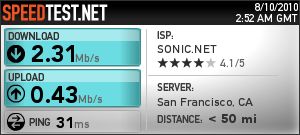 to this
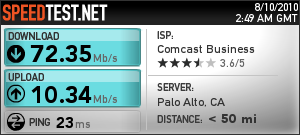 You really can't beat it. I'll still recommend Sonic to all and sundry, but
if you want some real speed (and with baby photos and videos galore to
upload, I was really more interested in additional upload capacity), it's
time to give DSL the flick.
 A fresh release of
 DebConf was really an awesome conference. I m happy that I have finally met so many of the fellow Debian people I only knew from the mailing lists or planet. There where lot s of interesting talks, the hacklabs where always busy, and the overall atmosphere was very good. Now that I m back in Berlin, I m already missing it I m by the way also missing my luggage which is apparently still at the JFK airport.
This was my first DebConf, but definitively not my last. I encourage people who never made it to DebConf: Get your butt up and register for the next conference! You don t know what you re missing. If money is an issue: there is a sponsoring which you can apply for and chances are good that you ll get at least partially sponsored.
Big thanks to all the volunteers who helped to organize and run this conference and to SPI for sponsoring my trip, food and accommodation!
I m looking forward seeing some of you again in three weeks at Steve s place in Cambridge for a nice BBQ and the rest of you next year in Bosnia and Herzegovina!
 You might remember that I




 So, DebConf is over and it was a blast. I wanted to blog
about my talks for a couple of days, but the conference was
so great that I did not get around to it until now.
The unique thing about this year's conference were the
outstanding contributions by non-Debian FLOSS people from
the east coast. I am really glad the organizers decided to
reach out to the communi
ty and take this opportunity when a lot of great minds were
just a couple of hours away. Also, discussing and hanging
out with the local team people was so much fun and
interesting that it was wor
th the visit alone.
The venue was just perfect, the dorms were on campus, the
cafeteria had an all-you-can-eat buffet, everything was in
short walking distance and the Columbia campus is beautiful.
I would have liked to go to a couple more places in the
evenings, but hanging out in the Carman basement lounge with
awesome people was just as good. A big thanks to Richard
Darst, Biella, Micah and the rest of the
crew.
The
 Playing with remove_if on stl::map.
Conclusion was that because stl::map has a const iterator,
remove_if algorithm doesn't work.
Still searching for a reasonable alternative, though it is
looking like there isn't a standard algorithm to do it.

 In the evening today (Tuesday), the Debconf organizers arranged for a screening of the Creative Commons licensed film "Sita Sings the Blues" by Nina Paley. I went to see it as I had missed it when it was first released among tales of trials and tribulation at the hands of copyright meanies.
So first let me say yay Free Culture!, boo Intellectual Property! etc. etc. Now we have that out of the way...
"Sita Sings the Blues" has two main narrative threads: The breakup of Ninas relationship with her boyfriend and the Ramayana particularly a story from the uttarakanda about how after Shri Rama returned from Lanka, Sita had to undergo the agnipravesha to prove her chastity and even after she passed that test was eventually banished to the forest. I had an adverse reaction to this film. In fact I stayed to the end to be polite but I left afterwards as soon as I could. I had almost a physical feeling of nausea and I was surprised by this. Since then I have been pondering why this is so.
It's not that its blasphemous. Shri Rama is not just a "perfect man", he is God (an avatar of Vishnu Bhagavan as is briefly touched upon in the film) for millions of people so, well, yes it is blasphemous but its more Rowan Atkinson style rather than Norwegian Black Metal style blasphemy. One never gets the impression that the author hates Hinduism or Indian culture the opposite in fact. And in fact it is not uncommon in our culture to speak of Sita and Rama in this way. They are not remote authority figures but as familiar to us as our own friends and family and the Ramayana is not just about events that happened long ago it is relevant to our lives right now. Even the "good woman done wrong by big dumb male jerk" narrative is not unknown. (See the Uttararamacharita of Bhavabhuti for instance.) though I would suggest reducing the Ramayana this way is akin to treating the Hitchhikers Guide to the Galaxy as a book about towels.
Even the milder criticism that it is not accurate is offbase because although the Sanskrit poem by Maharshi Valmiki is the canonical rendition of the Ramayana, there are other well-known versions. Not just in Sanskrit, the Hindi retelling by Sant Tulsidas called Ramacharitamanasa is more popular than Valmiki. Also speaking as someone who has preached Ramakatha "professionally" I can tell you that even the priests do not stick to the letter of the text. It is encouraged and expected that they will riff on the basic stories adding or removing details according to the needs and taste of the audience. And the device of the three narrators made me smile as this is exactly the kind of discussions that go on after hearing the Ramakatha. (I must say Paley picked a notably illiterate trio though.) One place where this fell flat was when they discussed the alleged discrepancy between Sita living simply in the forest and dropping a trail of jewellery on the way to Lanka. Although I can imagine someone at some point saying, "Do not question these stories" not at this point. Even the most retarded westernized Indian would know that removing ones ornaments is a sign of widowhood. A married woman would only do that in extremis certainly not just merely because she was a hermit. In a few cases some extra details might have helped the story. It was not explained that Ravana does not just have rakshasas in his command but he is one himself. (And he certainly wasn't a good guy until one day he got up and kidnapped Sita.) Shri Ramas brother Lakshamana accompanied the couple into the forest to Lanka and back but he only pops up (for no apparent reason) at the end. But look at me, I'm turning into one of those people who rant about Star Trek continuity errors or complain that the Romans in a gladiator movie have the wrong helmets for that time period etc. One has to cut a storyteller some slack and I entered the screening determined to be charitable.
It's also not because I don't really see much connection between the two stories. Getting dumped by someone who simply loses interest in you hardly seems equivalent to being trapped by a moral code that doesn't allow for individuals feelings. Paley could have easily made "Princess Leia Sings the Blues" and it wouldn't have changed the significance much. But in India people make far more tenuous connections between the epics and events in their own life so one can hardly complain about that.
Aesthetics are not the problem either. The first version of the Ramayana I ever read was the Amar Chitra Katha comicbook version which partly influenced the visual style of this film. (In fact you briefly see it in one scene when different editions of the Ramayana flash by.) Hindu popular culture is very gaudy. (See Ramanand Sagars '80s Ramayana Hindi TV serial, which was very reverential, insanely popular and tacky beyond belief.) The animation in this film is very good and quite artistic.
"So Jaldhar", you might be asking if you've read this far, "what exactly is your problem with this film?"
I have read the Valmiki Ramayana in Sanskrit with the commentaries from beginning to end. I've read other Ramayanas in Sanskrit, Gujarati, and English. I have read the comicbook, I've read anti-Ramayana polemics. When you learn Sanskrit in the traditional way the first lesson, in the declension of masculine gendered nouns ending in vowels is rAma.h rAmau rAmA.h ... I am well aware there are different emphases, different interpretations in various versions. Why can't I accept this as just another take on a story that has shown its fluidity over and over again? It's just...wrong on a subrational level. How can I put this? Imagine you are flipping through the TV channels and you see your grandparents amongst Lady Gaga's backup dancers. Or you came home one night to find everything that was on the floor meticulously glued to the ceiling. Over the course of my life (to hear my mother tell it my first exposure to the Ramayana was before I could speak.) I have developed a mental bond with this story a certain idea of how it should be. I think so has Nina Paley. And this is the problem. "Sita Sings the Blues" is Nina Paleys Ramayana not mine.