Search Results: "ina"

23 April 2013

Ulrich Dangel: Visualizing DPL votes

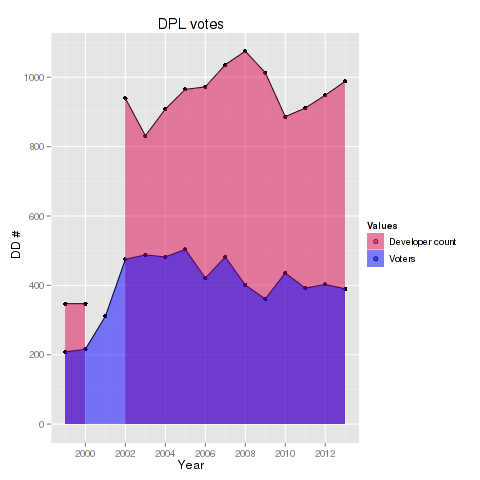
Axel XTaran Beckert recently asked in #debian-devel for a visualization of the Debian Project Leader Election results. Unfortunately there seems to be none, except the table in the mail. As I am currently trying to use ggplot2 for more things, I thought I would give it a try and convert the data into a csv file and process the data via R. For converting the original data i used vim to do a little text processing and created a csv file. By running the following code we can create a nice looking simple graphic:
library("ggplot2")
votes <- read.csv("dpl-2013.csv")
votes2 <- melt(subset(votes, select=c("Year", "DDs", "unique")), id="Year")
p <- ggplot(votes2, aes(Year, value, group=variable, fill=variable)) + ylab('DD #')
p <- p + geom_point() + geom_line() + geom_area(position='identity')
p <- p + scale_fill_manual("Values", values=c(alpha('#d70a53', 0.5),
alpha("blue", 0.5)), breaks=c("DDs", "unique"), labels=c("Developer count", "Voters"))
print(p)
DPL Votes 2013 I also created a little script for automatically processing the csv file and creating a similar plot. Feel free to fork/clone extend this script.

22 April 2013

Daniel Pocock: Action week for Google Summer of Code students

This week (22 - 28 April) is the week that really matters most for those students who want to participate in Google Summer of Code. The deadline for student applications is next Friday (3 May), but if you don't spend time exploring project ideas this week, you won't be able to make a strong enough application. Here are the key things I need to see for potential students for the project areas I have offered to co-mentor in:
  1. Register on the Google site, Click here to register yourself (registration opens 22 April and closes 3 May).
  2. Create a page about yourself on the Debian wiki, you must copy the template used by the other students. Make sure you create a link from the student list to your own page. Think carefully about your project: what will be the final result of your work this summer? Describe what it will look like, how Debian people will use it, and explain these things on your wiki page, this will be critical to having Debian accept you.
Those are the essential things you must do before the deadline on 3 May. There are other things you should do as well:
  • Join the Summer of Code co-ordination mailing list
  • Join the mailing lists for whichever open source project and/or Debian packaging team is relevant to your proposed GSoC project
  • On the mailing list, send an email introducing yourself, giving us the link to your wiki page.
To maximize the chance that the Debian project will accept you, it is very important that you interact with us and show us that you understand software development. I am going to try and make this easier: for each of my projects, I've put some wishlist items in the Debian bug tracker. These are all easy tasks that a student can potentially complete. Just do the following:
  • Pick a task from the bug tracker
  • Send an email to the bug tracker (e.g. <bug-number>@bugs.debian.org>) explaining that you will work on the task (and make sure nobody else is already working on it, just look to see if any other emails are attached to the bug report)
  • Write the patch, test it and email the patch to the bug report
Here are the links to the bug lists for each of the packages. You can also pick any other wishlist bug in any related package, but if you are not sure, just pick one of these: If you already have a history of contributing to free software, it is essential that you tell us about it. This will increase the chances that your application is successful. Specifically, on your Debian wiki page, you should include links to any of the following:
  • Emails you sent to open source communities contributing patches or analysis of bugs (give a link to your message in the email archive for the list)
  • Your github account profile page, if you have one
  • Your Sourceforge account profile page, if you have one
  • Any other similar links
Debian receives many applications every year. To help you succeed, you need to think about how Debian will benefit from your work. Use Google to search the Debian site for previous discussions about your idea. Find out the names of Debian Developers who are interested in the same subjects, and email us or email the public mailing lists of the Debian project, for example, debian-devel. Make sure your email includes links to previous discussions or wiki pages about the idea, explain how you can help and ask the community for suggestions and guidance to refine your project proposal. Debian is an open community and we are all very keen to discuss your ideas and help you get involved. DebConf For all students, attending free software events is a great opportunity to meet the community. Of particular relevance for those in Europe, attending DebConf13 in Switzerland is a great way to meet GSoC mentors and other developers. Switzerland's central location is extremely convenient for anybody in Western Europe and it is also Debian's 20th birthday, so it is anticipated DebConf could be more special than usual this year. Please put it in your calendar and subscribe to the debconf-discuss mailing list so you will know when registration opens and other practical details are announced.

21 April 2013

Lisandro Dami&aacute;n Nicanor P&eacute;rez Meyer: On the road to Qt 5: Qt 5 base, tools, jsbackend and xmlpatterns in experimental

The first Qt 5 packages have been accepted in Debian experimental.

What's there
To start building Qt 5 apps you will need to export QT_SELECT=qt5, install the package qt5-defaults or read qtchooser's man page. Note that exporting QT_SELECT has precedence over installing qt5-defaults.

What's not there
ArchitecturesAMD64 is already there because it's the arch used by maintainers to build the packages. i386 should be following as soon as buildds catch up. Most surely ARM-based archs will be there at some point too.

Other archs will need some love. Not strange, the Qt project supports amd64, i386 and ARM, but we Debian have normally prepared patches to make it build in other archs. And yes, we try to push them upstream for everyone's benefit. So, if you are missing it in your arch, take a look. You may be the one who enables Qt 5 in it :-)

GLES2 and WaylandWe don't have GLES2 or Wayland support yet. Building it will most probably break the desktop for people using proprietary video drivers (or at least I was told so). I'll surely provide non-official packages with GLES2/Wayland enabled to allow people testing it, but not soon.

This also means that we are not currently able to split X11 and framebuffer support. But we have time to work on it :-)

Non DFSGs compliant files
If you get the original source code tarball from Debian you will notice that it has dfsg in it's name. That means that we had to remove some non DFSG compliant stuff from the original tarball, namely:

  • Every RFC.
  • Three files used for testing the build, which are made of RFCs.
  • Some fonts.

What's following
Other parts of Qt 5 are on the way. And remember, this packages would not have been possible if it weren't for the great Debian's pkg-kde team. My kudos to them.

Charles Plessy: Do we really need contrib ?

The Debian project distributes software packages via its archive, propagated through a network of mirrors. This archive is organised in three areas, main, that contains the Debian system, and contrib and non-free, that contain accessory packages that are not Free. The packages in non-free contain files that have a proprietary license. The source packages in contrib contain only Free files, but produce binary packages that are either useless without the access to remote services, or contain non-Free files, or cause the installation of non-Free materials. The contrib area is an endless source of discussions, as it is not always easy to draw the line between what is usable and what is useless without remote services. I wonder if it would be better to replace the contrib area by a new priority level, remote , lower than extra. Packages that are entirely Free (source and binary) and that do not cause the installation of proprietary software would be fit for main. For the packages that can not function without non-Free software, given that the work to be done to free them is the same regardless whether the proprietary code is included in the source package (in non-free) or not (in contrib), I think that in both cases the package should be in non-free as it is not Free in practice. This would allow for a simple criterion: does the selection of a binary package trigger the installation of non-Free files? If yes, the package and its source belong to non-free. If not, they belong to main. Then, if they need to access a remote service that would not be possible to set up on a network where only Debian is available, their priority would be remote.

19 April 2013

Daniel Pocock: Switzerland Schilthorn with 007 (final leg)

Following up on the second and third legs of the cable car journey, we now have the final leg, rising up to the summit of the Schilthorn: <video controls="" height="340" poster="http://upload.wikimedia.org/wikipedia/commons/thumb/0/03/Schilthorn_with_Bernese_Alps%2C_2012_August.jpg/800px-Schilthorn_with_Bernese_Alps%2C_2012_August.jpg" width="560">
<source src="http://video.danielpocock.com/VID_20121025_123951.m4v" type="video/mp4"></source>
<source src="http://video.danielpocock.com/VID_20121025_123951.webm" type="video/webm"></source>
Video not appearing? Click here to access the page directly
</video> Unfortunately, the gangsters, guns and girls from On Her Majesty's Secret Service won't be waiting to greet you at the top, but there is a spectacular view. On a clear day, you can see all the way across to the venue of DebConf13 in Vaumarcus, Switzerland and also the Black Forest in Germany.

Rog rio Brito: Some recent Debian activities

I have been occasionally working on some Debian-related tasks. Chrony One of those was to get chrony is a slightly better shape, by using, at least, a patch system (indeed, I "modernized" its packaging with the format "3.0 (quilt)"), put it in a git repository and would like to receive some comments on what I have so far. The bug Debian bug #694690 contains a very brief description of my intentions and of the problems that I see in the current package. IMVHO, it is a very nice NTP client and server and it could even be used as the default for Debian, once it gets in shape. There is at least another high-profile distribution, namely Fedora, that switched to chrony as its default NTP software. We can certainly take a look at what they are doing and join forces here. MongoDB Another package where I spent some time was with mongodb: MongoDB is a tricky package that is only built for 2 arches: amd64 and i386. The version in unstable for i386 was 2.0.x (roughly the same as for wheezy), which the version in unstable for amd64 was 2.4.1, which has many features that 2.0 lacks. The packaging of it is a bit tricky, since the source tree has bazillion embedded/convenience libraries (e.g., Google's v8, Mozilla's spidermonkey, BOOST, Google's Snappy, PCRE 3 etc.). Up to version 2.4.1-2, it used all these convenience copies, which is of course, a problem for a distribution like Debian. I changed part of the build process to use the libraries that we already have in Debian and, as Antonin Kral uploaded this newer version, unsurprisingly the binary packages are smaller (especially if you take into account that a handful of the libraries may already be installed on the system). A few hours later, Antonin uploaded a new upstream version, which means that we now have better MongoDB packages to play with. I am, in fact, really playing with MongoDB as my first NoSQL database, since 10gen is giving an introductory course on how it works and my motivation was to get what we have in Debian in shape for the course. You can say that I am a firm believer of the "eat your own dogfood" principle. Regarding MongoDB only being built for i386 and amd64, the BTS has a patch to enable building for kFreeBSD, but the patch is for the 2.0 series and the code has changed so drastically in relation to the 2.4 series that there is no hope of it applying. It would be super nice to have MongoDB working on kFreeBSD and on HURD also, though. nocache There is a very nice command line program called nocache that was packaged by Dmitry Smirnov (and just approved by the FTP masters!) whose packaging I briefly reviewed per Dmitry's request and this is an amazing utility whose purpose is to bypass/minimize file system caching for a program. This is especially useful when you are making backups (reading lots of files that would, otherwise, fill the filesystem cache, even if they are not used frequently) or if you are just streaming one file (possibly larger than the system's RAM) to another computer and you have no need to use the file immediately after that. It performs its job by using the LD_PRELOAD mechanism and using posix_fadvise's flag POSIX_FADV_DONTNEED for the files that will be touched. Post note Oh, just one aside: for the readers of Debian Planet and other aggregation services which are not Debian Developers/Maintainers, I contributed to these packages without being the maintainer of them, just scratching some itches and contributing back what I produced.

Gunnar Wolf: Ten years already!

(actually, please set your calendars to the day before yesterday I had a mental tab on this, but it seems watching mental tabs is a low-priority task for brain.sched) Ten years ago today, I got that long awaited mail telling me I had passed all of the needed hurdles and was accepted as a Debian Developer. We were at the first third of a very long release cycle, and the general spirit of the project was clearly younger both as in "things moved easier" and "we were much more immature" Try to follow the mailing list discussions we had back then, and even with all the vitriol that's every now and then spilled on debian-whatever@lists.debian.org, it's clear we have more experience working together. And yes, the main change that ten years bring to a group of people is social. I was at DebConf in Oslo when the now-historic presentation that prompted the birth of the Debian-Women group was given Surely, Debian (and Free Software) still is by far predominantly male and white But I fel it's no longer a hostile group, much to the contrary. Over the years, I was first active (as was the norm by then) as a "solo" maintainer. When Joachim Breitner started the pkg-perl group in 2004, I joined, and was part of the group while an important part of my work was based in Perl. I joined pkg-ruby-extras, and slowly migrated my technical work from one to the other. For several years, I also maintained the Cherokee webserver. I started getting involved in DebConf organization in 2005, and (except for 2008, as I took a vacation from many topics due to personal issues). Back in 2009, I became an official delegate! I joined Jonathan McDowell handling keyring maintenance. One year later, another delegation: With Moray Allan and Holger Levsen, the three of us became the DebConf chairs. This last couple of months, I have been quite inactive in most of my Debian work. I took up teaching at the univerity, and have been devoting what amounts to basically a full time job to prepare material. I expect (hope!) this craze to reach back a "workable" level by late May, when the course finishes, and I can retake some of my usual Debian tasks. Anyway 10 years. Wow. This project is one of the longest commitments in my life. I am still very happy I joined, it still thrills me to say I am part fo this great project, it still makes me proud to be accepted as a peer by so many highly skilled and intelligent people But, as I have repeatedly stated, I see Debian more as a social project (with a technological product) than as a technical one. And as such, I am really happy to have made so many good, close friends in this project, to have the opportunity to work and exchange points of view about anything, and have this large, highly disfunctional but very closely regarded family of friends. So, guys, see you this August in Switzerland. I will be among the group celebrating we have been there for half of the project's history!

18 April 2013

Daniel Pocock: Getting to Switzerland, travel costs

With so many people contemplating the cost of travel to Switzerland this summer, I thought I would share some eye-opening insights into how to get a better deal. Let's look at some costs for a hypothetical DebConf13 visitor coming from New York. Flight prices taken today from a comparison site for 8 - 18 August, car hire prices from Europcar and rail prices from SBB (regular tickets) and Swiss Travel System (tourist rail passes):
Departure airport Arrival airport Flight cost Bus to Swiss border Rail pass Total (Flight+bus/train) Airport car hire, 10 days Total (Flight+car)
New York Geneva $1,153 n/a CHF 82
Return ticket
$1,235 CHF 668 $1,823
New York Milan $990 $20 CHF 315
Flexi pass
$1,350 EUR 413
CHF 496
$1,490
Warning: car rental prices based on advance booking - if you just arrive at a Swiss airport and hire a car on the spot, it is likely to be much more expensive, maybe CHF 200 per day For a single traveler, it is slightly cheaper to fly into Geneva (closest airport) and buy a return train ticket, as long as no other travel in Switzerland is desired and sleeping on-site at Vaumarcus, not using a bus every day. If traveling in Switzerland to see the mountains, then it works out cheaper to fly into Milan, Italy, which is very close to the Swiss border. Most of the journey from Milan to Vaumarcus can be covered using one of the Swiss railway travel passes, with stops for sight-seeing on the way, and the other days on the pass used for sight-seeing. Now imagine people arriving in a group: the rail ticket prices quickly add up. For a family of four, 4 * 315 = CHF 1,260. Car rental may be a better option. Hiring a car in Switzerland is expensive, hiring in Italy is much cheaper, the plane tickets to Italy are cheaper too, so there is a lot of money to be saved. But who wants the hassle of travelling to Switzerland via Italy? Of course that is the silliest rhetorical question you are going to see this week: visiting Italy is not a hassle at all. Even the Swiss enjoy going there so much that they just built the world's longest rail tunnel under the Alps to bring Como and Milan that little bit closer, the Gotthard Base Tunnel. The Italian connection could involve a few days in Como or Brunate. If designer fashion labels are appealing to you (or as a gift), Vertemate has one well known outlet for a major brand and the prices really are much cheaper than any of the cities. If you want a laugh, it's worth comparing the hotel prices in Lugano on the Swiss side of the border against prices in nearby Como. Traveling north from Como, taking a train to Luzern (and a connection to Vaumarcus), it is possible to stop in Goschenen and go up into the mountains to experience the Glacier Express featured in my earlier video or get off the train at Arth-Goldau to cross Rigi on the Rigi Bahn (from my other video), take a boat across the lake to Luzern and then continue to Vaumarcus. The Italian entry point isn't just an option for those coming from the US. Even a traveler from London will find that the budget airlines have largely snubbed the Swiss airports with their high operating costs. Easyjet offers a limited number of flights to Geneva and Zurich, but the prices are always higher than their other destinations. Ryanair offers flight's to Milan's Bergamo airport and Easyjet flies to Milan Malpensa.

17 April 2013

Daniel Pocock: Switzerland Schilthorn with 007 (leg 3)

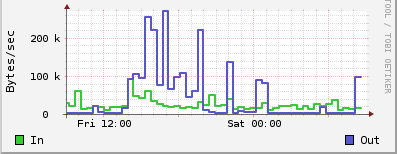
Friday's video of the 2nd leg of the cable car journey was quite popular, Ganglia stats for the video server can't be wrong: The first leg was skipped because of the low cloud cover. Weather reports in Switzerland, such as www.meteosuisse.ch often show a distinction between the low clouds and high clouds, because many Swiss mountain resorts are high enough to enjoy ample sunshine by virtue of their altitude even when cities like Zurich and Geneva are overcast. Now for the third leg, rising up to Berg. In the video, it is hard to gauge the size of the rocky cliffs along the route, but looking at the cable car's shadow will give a clue. As the cable car approaches the station in Berg, it feels like it takes forever to complete the journey. That is because the rocks are so much bigger than they appear from a distance. <video controls="" height="340" poster="http://upload.wikimedia.org/wikipedia/commons/thumb/0/03/Schilthorn_with_Bernese_Alps%2C_2012_August.jpg/800px-Schilthorn_with_Bernese_Alps%2C_2012_August.jpg" width="560">
<source src="http://video.danielpocock.com/VID_20121025_122453.m4v" type="video/mp4"></source>
<source src="http://video.danielpocock.com/VID_20121025_122453.webm" type="video/webm"></source>
</video> The final leg to the Schilthorn summit will appear shortly. I understand many people are starting to contemplate their DebConf13 travel and summer holidays - please feel free to email me if you'd like me to post a video of some other feature in Switzerland.
AttachmentSize
ganglia-schilthorn2.png8.71 KB

Joey Hess: Template Haskell on impossible architectures

Imagine you had an excellent successful Kickstarter campaign, and during it a lot of people asked for an Android port to be made of the software. Which is written in Haskell. No problem, you'd think -- the user interface can be written as a local webapp, which will be nicely platform agnostic and so make it easy to port. Also, it's easy to promise a lot of stuff during a Kickstarter campaign. Keeps the graph going up. What could go wrong? So, rather later you realize there is no Haskell compiler for Android. At all. But surely there will be eventually. And so you go off and build the webapp. Since Yesod seems to be the pinnacle of type-safe Haskell web frameworks, you use it. Hmm, there's this Template Haskell stuff that it uses a lot, but it only makes compiles a little slow, and the result is cool, so why not. Then, about half-way through the project, it seems time to get around to this Android port. And, amazingly, a Haskell compiler for Android has appeared in the meantime. Like the Haskell community has your back. (Which they generally seem to.) It's early days and rough, lots of libraries need to be hacked to work, but it only takes around 2 weeks to get a port of your program that basically works. But, no webapp. Cause nobody seems to know how to make a cross-compiling Haskell compiler do Template Haskell. (Even building a fully native compiler on Android doesn't do the trick. Perhaps you missed something though.) At this point you can give up and write a separate Android UI (perhaps using these new Android JNI bindings for Haskell that have also appeared in the meantime). Or you can procrastinate for a while, and mull it over; consider rewriting the webapp to not use Yesod but some other framework that doesn't need Template Haskell. Eventually you might think this: If I run ghc -ddump-splices when I'm building my Yesod code, I can see all the thousands of lines of delicious machine generated Haskell code. I just have to paste that in, in place of the Template Haskell that generated it, and I'll get a program I can build on Android! What could go wrong? And you even try it, and yeah, it seems to work. For small amounts of code that you paste in and carefully modify and get working. Not a whole big, constantly improving webapp where every single line of html gets converted to types and lambdas that are somehow screamingly fast. So then, let's automate this pasting. And so the EvilSplicer is born! That's a fairly general-purpose Template Haskell splicer. First do a native build with -ddump-splices output redirected to a log file. Run the EvilSplicer to fix up the code. Then run an Android cross-compile. But oh, the caveats. There are so many ways this can go wrong.. Anyway, if you struggle with it, or pay me vast quantities of money, your program will, eventually, link. And that's all I can promise for now.
PS, I hope nobody will ever find this blog post useful in their work. PPS, Also, if you let this put you off Haskell in any way .. well, don't. You just might want to wait a year or so before doing Haskell on Android.

16 April 2013

Aigars Mahinovs: na 6 internets

na ir slavena ne tikai ar savu akmens m ri valsts zieme os, bat ar ar Di o nas Ugunsm ri apk rt visam s valsts Internetam, kas blo visu p c k rtas un iebremzina visu p r jo. Man pirm person g saskarsme ar o pakalpojumu notika jau anhajas lidost , kad tri vien izr d j s, ka valst blo ts ir ne tikai Facebook, bet ar Twitter, kas iev rojami apgr tin ja manas iesp jas tri un viegli apzi ot visus, ka es esmu v l joproj m esmu dz vs un vesels. P c p ris eksperimentiem izr d j s, ka, lai ar no telefona nav pieejama Google+ m jas lapa un nav lejupl d jama Google+ (un WhatsApp) programma uz Android, tom r, ja t s jau ir telefon , ie abi servisi turpina no telefona str d t. T p c es s ku rakst t ce ojuma piez mes Google+ un da as dienas p c ce ojuma s kuma man pat izdev s nokonfigur t If This Then That servisu, lai tas pa em manus Google+ ierakstus un uztaisa no tiem Twitter ierakstus (kas jau t l k pa citiem kan liem izplat s uz Facebook un Draugiem un ar par d s k ned as kopsavilkums aj blog ). Google+ ir savi plusi, bet ar savi m nusi. Galvenais m nuss, ko es aj ce ojum paman ju ir tas, ka Google+ Android aplik cij nav iesp jams sagatavot vair kus ierakstu melnrakstus (v lams katru ar savu geolok ciju) bez Interneta var rakst t tikai vienu ierakstu un t ieraksta GPS koordin tes b s t s kur viet p c tam Internets par d sies. Es jau uzrakst ju Googlei par o probl mu. Galvenais pluss Google plusam (no pun intended) ir Instant Upload ja bild t fotogr fijas ar Android telefonu, s fotogr fijas autom tiski tiks aug upiel d tas un par d sies jaun ieraksta izveides interfeis , kur t s var pievienot ierakstam ar vienu klik i bez jebk das gaid anas. Diem l tas nestr d ar norm laj m kamer m. Pagaid m ;) Ta u es neb tu sts datori is, ja es nepam in tu uzlaust vai apiet o nelielo nas probl mu, ne? ;) Visvienk r akais veids k apiet nas Lielo Ugunsm ru ir izmantot jebk du VPN, kas at auj ne tikai piek t VPN t kla resursiem, bet ar at auj laist visu trafiku caur o VPN savienojumu. dus VPN piesl gumus var nopirkt, vai (ja ir Linux serveris vai routeris rpus nas) izveidot pa am. Man gad jum tas bija ar vienu klik i iesl gts OpenVPN uz Fonera routera, kas st v man s m j s. Diem l na ir sav da. Blo to lapu, portu un protokolu saraksts main s gan da dos rajonos, gan ar atkar b no t vai Internets ir mob lais vai wifi vai ar piesl gumu, gan ar vienk r i no dienas dien . Liel da gad jumu blo to lietu sarakst iekr t ar VPN savienojumi. Bie i vien ar priv tie. Man kaut k ne iet, ka mana m jas IP adrese ir nas ugunsm ra sarakstos, ta u da reiz ar tam VPN pievienoties es nevar ju. Un t d s situ cij s, lai apskat tu k du YouTube video, atliek tikai viens, eni ls risin jums sshuttle! is eni lais r ks izveido ko l dz gu VPN savienojumam caur parasto SSH portu un protokolu. Uz lok l s ma nas ir nepiecie ams Python un root ties bas, bet uz servera ir vajadz gas tikai ties bas palaist Python programmas. sshuttle pats aizs ta sevi uz serveri un palai s tur, pat ie ifr un p rs ta visus savienojumus un ar DNS piepras jumus, ja vi am to paprasa. Var p rs t t konkr tus t klus vai visu trafiku. Un trums man pieredz tas ir bija pat tr ks par parasto VPN. Kopum Interneta blok de un t visp r gais l nums ir viens oti spec gs m nuss nai. Aizskrienot mazliet uz priek u st st jum pateik u, ka Hong Kong das probl mas nav tur Internets ir lielisks! L k t ds t zeris san ca :)

Stefano Zacchiroli: bits from the DPL for March-April 2013

Dear Project Members,
   "Now that I have your attention, I would like to make the following
delegations:"

... nah, scrap that. In my last day in office I first of all owe you a report of DPL activities for the last reporting period of this term, i.e. March 8th until today. Here it is! Highlights Talks Over the past month or so I've attended and spoken on behalf of Debian in the following occasions: Assets I've approved the budget for the following forthcoming sprints: Also, we've bought a 3-year warranty pack for the disk array that powers ftp-master.d.o (~900 USD). On the income side, Brian Gupta has started an interesting matching fund experiment, in order to raise funds for the forthcoming DebConf13. The matching fund will be open until April 30th, so your help in spreading news would be welcome. Many thanks to Brian for the idea and to his company, Brandorr Group, for funding it. DPL helpers Three more DPL helpers IRC meetings have been held; minutes are available at the usual place. Legal Spring Cleaning I've finally cleaned up the pile of pending legal matters (but I'm sure new ones will show up for the delight of the next DPL :-P) Once again, I'd like to thank SFLC for the pro bono and very high quality legal advice they keep on offering to Debian. Miscellaneous
Now, before I get sentimental, let me thank Gergely, Lucas, and Moray for running in the recently concluded DPL election. Only thinking of running and then go through a campaign denote a very high commitment to the Project; we should all be thankful to them. Then I'd like to congratulate Lucas for his election. I've known him for a long time, and I can testify about his clear vision of the role Debian has to play in Free Software and on what Debian needs to improve to do so. Best wishes for the term ahead, Lucas! Finally, I'd like to thank you all for the support you've shown me over the past 3 years. Serving as DPL is a great honor, but also a very demanding job. Thank to you all, and to how cool Debian is, it has been for me an incredibly rewarding experience. I had no idea what I were doing when I embarked on this adventure, but in hindsight I don't regret any of it. See you around, as I don't plan to be anywhere far away from Debian anytime soon. Cheers.
PS the day-to-day activity logs for March and April 2013 are available at the usual place master:/srv/leader/news/bits-from-the-DPL.txt.20130 3,4

Michal &#268;iha&#345;: phpMyAdmin translations status

phpMyAdmin 4.0-rc2 is out and if your want to have your language in final release, it's last moment to start working on translation. So let's look at which translations are at 100% right now (new ones are bold): Almost complete: As you can see, there is still lot of languages missing, this might be your opportunity to contribute to phpMyAdmin. Also you are welcome to translate phpMyAdmin 4.0 using translation server. If your language is already fully translated and you want to help as well, you can translate our documentation as well.

Filed under: English Phpmyadmin 0 comments Flattr this!

Johannes Schauer: botch - the debian bootstrap software has a name

After nearly one year of development, the "Port bootstrap build-ordering tool" now finally has a name: botch. It stands for Bootstrap/Build Order Tool CHain. Now we dont have to call it "Port bootstrap build-ordering tool" anymore (nobody did that anyways) and also dont have to talk about it by referring to it as "the tools" in email, IRC or in my master thesis which is due in a few weeks. With this, the issue also doesnt block the creation of a Debian package anymore. Since only a handful of people have a clone of it anyway, I also renamed the gitorious git repository url (and updated all links in this blog and left a text file informing about the name change in the old location). The new url is: https://gitorious.org/debian-bootstrap/botch Further improvements since my last post in January include: In the mean time a paper about the theoretical aspects of this topic which Pietro Abate and I submitted to the CBSE 2013 conference got accepted (hurray!) and I will travel to the conference in Canada in June. Botch (yeey, I can call it by a name!) is also an integral part of one of the proposals for a Debian Google Summer of Code project this year, mentored by Wookey and co-mentored by myself. Lets hope it gets accepted and produces good results in the end of the summer!

13 April 2013

Paul Tagliamonte: Hy s got a new home (and team!) As some of you interested...


Hy s got a new home (and team!) As some of you interested folks know, I ve been hacking on Hy, and I m proud to announce it s new home at hylang.org and future deb repo at gethy.org. I ve posted this as an image for one very important reason - Hy is now a full community based project. There s been in insane reaction to hy, and I d like to keep it sustainable. So, come hack with us on #hy on freenode, or just help us come up with more puns. As always, try hy, and see if you don t have some feature requests!

12 April 2013

Daniel Pocock: Switzerland Schilthorn with 007 (leg 2)

What has DebConf13 got in common with James Bond? The connection with Switzerland of course. Bond creator Ian Flemming actually spent time living in Switzerland and this beautiful alpine country was featured in more than one of his books/movies, including Goldfinger On Her Majesty's Secret Service took Commander Bond to the summit of the Schilthorn, a distinctive peak of 2,970m altitude in the center of Switzerland. To follow up on my recent Glacier Express and Righ Bahn rack railway videos, here is a video of the second leg of the dramatic four-stage cable car journey to the top of Schilthorn: <video controls="" height="340" poster="http://upload.wikimedia.org/wikipedia/commons/thumb/0/03/Schilthorn_with_Bernese_Alps%2C_2012_August.jpg/800px-Schilthorn_with_Bernese_Alps%2C_2012_August.jpg" width="560">
<source src="http://video.danielpocock.com/VID_20121025_121324.m4v" type="video/mp4"></source>
<source src="http://video.danielpocock.com/VID_20121025_121324.webm" type="video/webm"></source>
</video> Download and watch later:
.m4v
.webm Some observations about Schilthorn visits:
  • There is a revolving restaurant at the top - to get a seat by the window, which is by far the best place to sit, ring and make a reservation the day before. Meal prices are no more extraordinary than any other Swiss restaurant, so it is worthwhile spending some time up there enjoying lunch and the views.
  • Jungfrau is higher - but from Schilthorn, you can see Jungfrau, which is a spectacular view, yet without paying the extraordinary price of a ticket for Jungfrau. The ride to Jungfrau (high altitude railway) is also slightly less spectacular, as much of it is in a tunnel through the rock, while the ride to Schilthorn is all cable car.
  • Almost all rail ticket passes give a 50% discount on the Schilthorn cable car.
  • The SBB sometimes offers an extra 30% discount on Schilthorn tickets, see the monthly railaway' offers, which can be combined with the 50% discount. This type of ticket can't be purchased in the same region, (e.g. within about 20km of Schilthorn)
  • An easy way to save another 50% on the ticket is to walk down from the top. If you do this, plan to start very early, but it is a spectacular walk (requires hiking boots and protective clothing, snowy/slippery at most times of the year)
  • All those discounts are cumulative: so if you use them all and walk down, you only pay 0.5 * 0.7 * 0.5 (which is 17.5%) of the full price.
The next leg of the cable car journey will appear soon...

11 April 2013

Martin Pitt: New fatrace released, Debian package coming

Paul Wise poked me this morning about uploading fatrace ( file access trace , see the original announcement for details) to Debian, thanks for the reminder! So I filed an Intent To Package, and will upload it in a few days, unless some discussion evolves. I also took the opportunity to do some modernization: The power-usage-report script now uses the current PowerTop 2.x instead of the old 1.13, uses Python 3 now, and includes the process device activity in the report. I released this as 0.5. The actual fatrace binary didn t change its behaviour, it just got some code optimizations; thanks to Yann Droneaud for those.

Matthew Palmer: RSpec the easy way

Anyone that has a fondness for good ol RSpec knows that there s a fair number of matchers and predicates and whatnot involved. Life isn t helped by the recent (as of 2.11) decision to switch to using expect everywhere instead of should (apparently should will be going away entirely at some point in the future). There is a good looking RSpec cheatsheet out on the net, but it dates from 2006, and things have changed since then. We re using RSpec at work a lot at the moment, though, so our tech writer kindly updated it for the new-style syntax, gave it a nice blue tint, and put it out there for the world at large to use. Here is our updated RSpec cheatsheet for anyone who is interested. I can tell you for certain that a double-sided, laminated version of this sucker looks very nice, and is a handy addition to the desk-of-many-things.

Russ Allbery: Review: Familiar

Review: Familiar, by J. Robert Lennon
Publisher: Greywolf
Copyright: 2012
ISBN: 1-55597-535-6
Format: Hardcover
Pages: 205
This is the first book of an experiment. I'm fairly well-read in science fiction and fantasy and increasingly well-read in non-fiction of interest (although there's always far more of that than I'll get to in a lifetime), but woefully unfamiliar with what's called "mainstream" literature. Under the principal that things people are excited about are probably exciting, I've wanted to read more and understand the appeal. Powell's, which I like to support anyway, has a very nice (albeit somewhat expensive) book club called Indiespensable, which sends its subscribers very nice editions of new works that Powell's thinks are interesting, with a special focus on independent publishers. So I signed up and hope to stick with it for at least a year. (The trick will be fitting these books in amongst my regular reading.) Familiar is the first feature selection I received. Elisa Brown is a mother with a dead son and a living one, a failing marriage, an affair, and a life that is, in short, falling apart. Then, while driving back from her annual pilgrimage from her son's grave, the world seems to twist and change. She finds herself dressed for business, wearing a nametag and apparently coming back from a work-related convention, driving a car that's entirely unfamiliar to her. When she gets home, everything else has changed too: her marriage seems to be on firmer ground, but based on rules she doesn't understand. She has a different job, different clothes, a different body in some subtle ways. And both of her sons are alive. I'm going to have to have a long argument with myself about where to (meaninglessly) categorize this on my review site, since in construction it is an alternate reality story and therefore a standard SF trope. Any SF reader is going to immediately assume Elisa has somehow been transported into an alternate reality with a key divergence point from her own. But that's not Lennon's focus. He stays ambiguous on the question of whether this is really happening or whether Elisa had some sort of nervous breakdown, and while some amount of investigation of the situation does take place, it's the sort of investigation that an average person with no access to special resources or scientific knowledge and a completely unbelievable story would be able to do: Internet conspiracy chatrooms and some rather dodgy characters. The focus is instead on Elisa's reaction to the situation, her choices about how to treat this new life, and on how she processes her complex emotions about her family and herself. I had profoundly mixed feelings about this book when I finished it, and revisiting it to review it, I still do. The writing is excellent: spare, evocative, and enjoyable to read. Lennon has a knack for subjective description of emotion and physical experience. The reader feels Elisa's deep discomfort with her changed body and her changed car, her swings between closed-off emotions and sudden emotional connection with a specific situation, and her struggle with the baffling question of how to come to terms with a whole new life. The part of the book from about the middle to nearly the end is excellent. Video games make an appearance and are handled surprisingly well. And when Elisa starts being blunt with people, I found myself both liking her and caring about what happens to her. On the other hand, Familiar also has some serious problems, and one of the biggest is the reaction I feared I'd have to mainstream literature: until Elisa started opening up and taking action, I found it extremely difficult to care about anyone in this book. They're all so profoundly petty, so closed off and engrossed in what seem like depressing and utterly boring lives. I'm sure that some of this is intentional and is there to lay the groundwork for Elisa's own self-discovery, but even towards the end of that self-discovery, everything here is so relentlessly middle-class suburbia that I felt stifled just reading about it. I think it's telling that no one in this book ever seems to have any substantial problem with money, or even with work. Elisa walks into a job that she's never done before and within a few weeks is doing it so well that she can take large amounts of time to wander around for plot purposes. This is a book about highly privileged people being miserable in a bubble. While those people certainly do exist, and I can believe that they act like this, I'm not sure how much I want to read about them. Thankfully, the plot does lead Elisa to poke some holes in that bubble, if never get out of it entirely. This is also another one of those stories in which every character has massive communication problems. Now, this deserves some caveats: Elisa's communication problems with her husband are part of the problem that starts the book and are clearly intentional, as are her communication difficulties with her children. And she's not really close enough to anyone to confide in them. But even with those caveats, no one in this book really talks to anyone else. It's amazing that anyone forms any connections at all, given how many walls and barriers they have around themselves. As someone with a bit of a thing for communication, this drove me nuts to read about, particularly in the first half of the book. But the worst problem is that Lennon completely blows the ending. And by that I don't just mean that I disliked the ending. I mean the ending is so unbelievable and so contrary to the entire rest of the book, at least the way I was reading and understanding it, that I think Familiar is a much better novel if you just remove the final scene entirely. It was such a bizarre and unnecessary twist that I found it infuriating. I don't want to spoil an ending, even a bad ending, so I'll only say this: it felt to me like Lennon just wasn't comfortable with his setting and plot driver and couldn't leave it alone. I think an experienced SF author wouldn't have made this mistake. There were two obvious possible conclusions to draw from the setting, plus a few interesting combinations, and I think someone comfortable with this sort of alternate reality story would have taken one of those options, any of which would have been a reasonable dismount for the plot. Alternately, they could have left it entirely ambiguous to the end and explored why the explanation may not actually matter. But Lennon seemed to me to have a tin ear for plausibility and for the normal flow of this sort of story and seems to have taken it as license for arbitrary events, thus completely violating the internal consistency and emergent rules that he'd spent the rest of the book building. I've mostly talked about my reactions to the characters and the writing and have not said much about the plot. That's somewhat intentional, since figuring out where the story will go is one of the best parts of this book. It's surprisingly tense and well-crafted for not having that much inherent dramatic tension. The excellent writing kept me reading through the first part, when I hated everyone in the story, and then Elisa started taking responsibility for her own life and actions and I started really enjoying the book while being constantly surprised. I think it's the sort of story that's best to take without too much foreknowledge of where it's going. I'm going to call this first experiment a qualfied success. Familiar was certainly interesting to read, and quite different from what I normally read despite the SF premise. If it weren't for the ending, I'd be recommending it to other people. Rating: 6 out of 10

Bdale Garbee: Batteries and Pyro Circuits

Keith and I have discovered a change in the behavior of the protection circuits integrated in the LiPo batteries we sell for use with Altus Metrum products that poses a risk for our customers. This post is meant to document what we now know, communicate changes we're planning as a result, and explain what we think flyers of our existing electronics and batteries may want to do to maximize their chances of successful flights. Background Choosing batteries and designing pyro circuits for high power rocketry avionics involves a variety of trade-offs. Reliability is the highest concern, both because nobody wants to lose an airframe due to a failed pyro event, and also because airframes recovering anomalously have safety implications. But we also care about other factors including cost and weight, and usually want to minimize the complexity of both the electronics and the overall installation. The objective of a pyro circuit is to dump enough energy rapidly into an electric match to cause it to catch fire. We need batteries both to power the electronics that decide when to fire the charge, and to provide the energy that actually ignites the match. The two most common battery types seen in the rocketry hobby are alkaline cells, often the nominal 9V rectangular variety, and rechargeable batteries based on Lithium Polymer (LiPo) chemistry. LiPo cells are 3.7 volts per cell nominal voltage, are very light, and have a high energy density. LiPo capacity is measured in units of current times time, so an 850mAh cell should be able to deliver 850 milliamps for an hour. The battery industry also uses something called a "C rate" to describe how fast the battery can be usefully discharged, wich is a multiplier relative to the battery capacity. So a battery with 850mAh capacity and a "2C" rating can deliver current at a sustained rate of 1700mA until discharged, while the same capacity at a "5C" rating can deliver 4250mA. By comparison, most 9V alkaline batteries are actually composed of 6 individual 1.5V cells enclosed in a wrapper. It's hard to get hard numbers for capacity and discharge rate, since in an alkaline cell the two are not independent, and the discharge rate is related to the volume of each individual cell. The data sheet for an Energizer 522 shows just over 600mAh at a 25mA discharge rate, dropping to about 300mAh at a 500mA discharge rate. Importantly for use in pyro circuits, LiPo cells have a very low source impedance, which means they can source immense amounts of current. It's not unusual for cells in the 1000mAh range to have ratings in excess of 30C! Because this rapid discharge ability can pose a risk of fire, it's common for LiPo cells to come with a "protection board" integrated into the battery assembly that is designed to limit the current to some rate such as 2C continuous duty. In large airframes, or projects that involve staging, air-starts, or other complex pyro event sequences, the most reliable approach will always be to use separate batteries for the control electronics and the source of pyro firing power. In the limit, having separate pyro batteries for each pyro charge with the control electronics only providing the switching to connect the batteries to the charges could even make sense. But for most airframes, this is overkill, and the increases in mass, volume, and wiring complexity just don't make sense. The challenge, then, is how to design electronics that will robustly initiate pyro events without negatively affecting the rest of the electronics when operating from a single shared battery. Altus Metrum Pyro Circuits The very first prototypes of TeleMetrum were designed to use a single-cell LiPo battery, and had an on-board 100mA charging circuit. Because we needed 5 volts to power the accelerometer, we had a small switching regulator that up-converted the LiPo voltage, and we used some of that regulator's output to charge a 1000uF capacitor. The pyro circuit used Fairchild FDN335N N-channel MOSFET switches in a low-side switching configuration to dump the energy stored in the capacitor through an attached ematch. Those FETs had an on resistance of under a tenth of an ohm in our operating conditions. The circuit worked very reliably, but the 1000uF electrolytic cap was huge and we struggled with the mechanics of such a large part hanging off the board... It turns out that 3.7 volts is way more than enough to fire a typical low-current e-match or equivalents like the Quest Q2G2 igniters. In fact, bench testing with a good digital oscilloscope showed that a typical e-match with resistance of 1.3-1.8 ohms will fire in approximately 13 microseconds when hit with the nominal 3.7 volts from a LiPo. So, starting with our v0.2 boards, we switched to using the LiPo battery voltage directly to fire the pyro charges, eliminating the clunky electrolytic capacitor entirely. We also switched to the Fairchild FDS9926A dual N-channel MOSFET whose specs are better in all regards for our application. The on resistance is down around 40 milli-ohms in our circuit, such that the current ratings are much higher (FET current limits are primarily driven by how much heat is generated due to current flowing through the channel's on resistance). Because using the LiPo voltage directly means we're effectively temporarily putting a very low resistance across the battery during the pyro events, the input voltage to the voltage regulator gets pulled down. To ensure the processor could "ride through" these events, we added a 100uF surface mount bulk capacitor on the 3.3 volt regulated voltage rail, which bench testing demonstrated was more than sufficient to maintain processor operation through pyro events. And that is essentially the same pyro circuit on all the boards, both TeleMetrum and TeleMini, that we have shipped to date. What's Changed The LiPo batteries we source and sell with our electronics come with a protection board and cable terminated in a 2-pin, 2mm "JST" connector. The specs on the protection board have always been "2C continuous", but we observed the ability to source much higher currents for short periods such as the 13 micro-seconds or so required to fire an e-match. Thus these protection circuits seemed just fine .. we could fire e-matches with a burst of current but were protected against short circuits in the wiring or our boards by the 2C continuous limit. Unfortunately, the most recent batch of batteries we sourced seem to have a much "twitchier" protection circuit. We can draw more than 2C for short bursts, but not as much as with prior boards, and not for as long an interval. With a 1 ohm power resistor on the pyro terminals of one of our boards, we get about 9 milliseconds of power before the protection circuit cuts in and shuts the battery down. The power stays down until all load is removed, which at least means the board is turned off and back on again, and in some cases could even mean the battery is unplugged and re-plugged since we draw trace current to keep the GPS memory alive even when the power is turned off, and at least some of the new batteries see that as enough to keep the power turned off after an over-current event. For many e-matches, this isn't an issue, since 9 milliseconds is way longer than the 13 microseconds needed to fire the charge. Unfortunately, we've discovered that many of the e-matches bought and used in the rocketry hobby are actually made for use in the fireworks industry, where it is desireable to retain continuity after firing so that series connections of e-matches all can fire even if some fire faster than others! This means that while the resistance goes up some after firing, sometimes the drain on the battery remains sufficient to cause the protection circuit to kick in even after the pyro charge has fired. What We're Doing About It If we remove the protection circuit from the LiPo (or jumper around it), all existing Altus Metrum products will operate successfully with pyro charges thave have an effective resistance of as low as 1 ohm. That's lower than any e-match or Q2G2 we've ever seen, so in effect what this means is that if you have an existing Altus Metrum flight computer, and you remove the LiPo protection circuit, you're good to go. This does not really make things any more "dangerous", since our battery chargers are all current limited and our discharge patterns will never cause heating of the battery. Frankly, in a rocket, the most likely way to cause a problem with a LiPo is by smashing or puncturing the actual battery during bench work or during a crash... and those cause the same problems with or without a protection board present. In the future, we will ship batteries that have either a much higher C rating on the protection circuit, or have no protection circuit at all. The number of problems reported by actual customers that we think should be attributed to LiPo protection circuit boards is very low, and we suspect most of our customers who are happily flying their boards can continue to do so. Ground testing where you fire pyro charges (or at least e-matches) using RF to issue the commands (not USB, since the LiPo charger is running any time USB is connected!) will confirm whether there's a problem. If the board resets (does startup beeps) after a pyro event, or shuts down completely (no LED activity), then you have a problem. If the matches light and the board keeps running, you're good to go. However, any Altus Metrum customer with LiPo batteries sourced from us or our distributors who is worried about this problem (even if you haven't seen problems in ground testing or previous flights), and who doesn't want to try soldering on the battery circuit board yourself, is welcome to contact us about removing the protection circuit for you. We won't charge anything other than shipping. To take advantage of this offer, just send email to fixmybattery@altusmetrum.org telling us how many of which capacity batteries you have that you'd like updated, and we'll respond with an RMA number and shipping details. Going Even Further As previously indicated, with the LiPo protection circuits removed, all of our current products will work reliably with at least 1 ohm across the pyro terminals. That should cover all real-world flying conditions just fine, but we're not satisfied yet. We've designed a new pyro control circuit that transfers the maximum possible energy to the load regardless of battery voltage without ever allowing the voltage to the processor to droop at all. We're testing this new circuit in various prototypes now, and if it pans out it will probably show up first in MegaMetrum and then trickle down to TeleMetrum and TeleMini as those products are updated later this year. The new pyro circuit tolerates 0 ohms (dead shorts) on the pyro terminals for as long as the battery can provide current, which is as good as it gets. We think the circuit is clever enough that we'll probably write more about it once we're finished validating it.
Next.

Previous.