
Search Results: "reg"

15 July 2008

David Welton: Misquoted

Well, to be charitable, it was a bit late and so perhaps what I said came out wrong, but in this article: http://www.theregister.co.uk/2008/07/14/android_developer_unrest/ I'm quoted as saying the problem is with "upper management", which I don't really believe to be the case, going by snippets of conversations and things I've read. Frankly, at this point in time, I have no idea why Google can't talk about Android. Also, I had several other positive things to say to the reporter, but I guess the 'focus' of the piece was about the problems that Android is currently experiencing. Notwithstanding the recent weirdness, I'm quite happy that someone with a lot of money and muscle is going to be backing an open source mobile phone system, and hope that the current troubles are merely a small speed bump.

14 July 2008

Matthew Garrett

Plans for the month:

18th-20th: Wolverhampton for Lugradio Live where I'll be doing some sort of presentation on some sort of power management stuff.
22nd-27th: Portland for OSCON and the Oregon Brewers Festival (which I guess settles any arguments about how to spell plumbers)
28th-30th: San Francisco for a meeting that's been moved to the week before I'm there
31st-4th: Boston in order to meet some of the people that I actually work with

Things not planned for the month:

Genocide
Puritanism
upskirt photos
Telling women who fail to cover their legs that they're asking for it

Benjamin Mako Hill: Autonomo.us and the Franklin Street Statement

Recently, I've been doing a lot of thinking -- and a bit of talking -- about what software freedom means in the context of network services. I gave a talk on this subject at the most recent FSF members meeting and at Sun's Community One. In a few days, I'll be giving another at Wikimania in Alexandria, Egypt. A few months ago, I worked with the FSF to organize a meeting of free software hackers and scholars to talk about the issues. Today, that group is announcing the first two concrete results of that project. The first is a blog and a wiki called autonomo.us. The project aims to provide a space to continue, expand, and open up the work that was done at the FSF in March. Our aim is to explore the implications and responses to network services in relation to software. We're going to do that by continuing to take notes in the wiki and by publishing articles, essays, and documents that help inform the discussion about software freedom and network policies. We will be working independently from, but closely with, the Free Software Foundation, and with others in the free and open source software communities. Our goal is not to set policy, but to explore the space and inform the discussion about autonomy and user freedom in cloud computing and software as a service. The second announcement is the first concrete product of autonomo.us's work: a statement we're calling the Franklin Street Statement on Freedom and Network Services. It lays out our initial consensus on positive steps that developers, service providers, and users can take. If you want to follow our work, please subscribe to the autonomo.us blog and check out some of our work so far. If you've got thoughts and things to contribute, you can mail or get to work in our wiki. You can read our about page for more information about us and our goals. In a coordinated move, the Open Knowledge Foundation (which I help advise) is launching the 1.0 version of their Open Software Service Definition. There is a whole lot we need to learn, think through, and do before we have reasonable answers to the problems to freedom posed by network services. Today marks the beginning of several wonderful steps toward some of these answers.

Neil Williams: State of play in Emdebian ARM

Autobuilder Summary:
138 packages built successfully. 19 packages failed to cross build. 2 packages are tagged for a manual upload. (Dependency issues - rather than break the archive, these packages will not be uploaded until relevant dependencies have been fixed and uploaded.)
Stats
87% built OK
12% failed
Notes:
  1. All these packages built previously and fail at the latest versions in Debian Sid. Many could be upstream errors. All exist in Emdebian at
    previous versions (only 1 failure is known to contain bugs in the current versions in Emdebian and this only affects GUI installations. Two other GUI packages contains bugs but build OK.).
  2. Some of the packages in the repository (including some of the failures) are not used in *any* of the default emsandbox configurations. Two need to be removed from the repository completely.
  3. Some fixes are waiting for updates in Debian, either new uploads migrating to mirrors or pending fixes awaiting upload by me. (Probably tomorrow.)
  4. The history of each package is now available via the Emdebian Autobuilder Report. The package name links to the history of previous build attempts for this package. The version string links to the repository data for the current version in Emdebian. The result of the build links to the build log.
  5. A comparison with Debian unstable is constantly updated.
  6. 254 source packages exist in Emdebian but only 137 are currently built by the autobuilder. The rest will be built when new versions are uploaded to Debian (in some cases, that won't be until after Lenny). If I get time, I'll add build logs for these packages.
  7. The repository contains a fair number of packages that we don't currently use. This is a reflection of the problems of determining the "path" through the dependencies when starting at the bottom (glibc uClibc etc.). Bear this in mind when considering new architectures and new package sets. The process involves a lot of trial and error, particularly as cross-building potentially alters the dependency path at each iteration.

Problems
  1. libselinux and libsepol have just been uploaded with a bug fix that is needed for e2fsprogs and file cross-builds, amongst others. Waiting
    for the ARM mirror to receive the new builds, hopefully tomorrow.
  2. gtk+2.0 fails to cross-build because the patches now try to build the udeb which comes up against a bug in dpkg-cross. I'll be uploading the new version (including a couple of other bug fixes) tonight. (Final testing currently in progress.). The Gtk package also needs some work to run /usr/lib/libgtk2.0-0/update-gdkpixbuf-loaders so that the icons can be read in the GUI.
  3. pango1.0 also needs a fix to update the pango modules. This is usually done at build time but it means running a cross-built binary. It is a minor task and not CPU intensive so I plan to do this in postinst. Without this fix, no text is rendered in the GUI, only empty glyphs.
  4. xfonts-base is way too large still. More work is needed here to optimise just what is meant by the 'fixed' font for X, precisely which font files can be removed, which might be needed outside C or English locales etc.
  5. Other packages not currently cross-building include: (NOTE: Some of these build logs are VERY large.)
    • adduser - needs to be removed from the repository, it is perl and we implement it via busybox.
    • cups cupsys - /usr/include/pthread.h:653: warning: '__regparm__' attribute directive ignored.
    • gcc-4.2 - needs to be removed from the repository, it no longer builds libgcc1 which was the main reason for cross-building it.
    • glib2.0 - more generated content: /bin/sh: line 2: /usr/bin/glib-genmarshal: No such file or directory
    • gnomevfs - hasn't built for ages and isn't usable anyway due to dependency issues. Currently preventing the use of gpe-filemanager. Due to be replaced by GIO in Debian.
    • libusb - build failure, so far resistant to usual fixes.
    • ncurses - build failure - uses gcc in wide char support build.
    • ntp - build failure - assembly error. authkeys.c:445: error: invalid 'asm': invalid operand for code 'w'
    • pcre3 - build failure - apparently simply unresolved symbols resistant to usual fixes.

    • slang2 - possibly needs a patch update, tries to build -pic archives and then fails.
    • xorg-server - build failure: make[4]: *** No rule to make target -L/usr/arm-linux-gnu/lib', needed by Xprt'. Stop.


Of the problems above, only problems 2, 3 and 4 (gtk, pango and xfonts-base) are "critical" as these are the only ones where the current packages are sufficiently broken that the new version is essential before Emdebian can make a "release" of a series of three root filesystems for ARM. Sizes are still larger than desired - a fix for that requires changes in glibc which I hope to investigate during DebConf.

Any help on the above issues is appreciated.

Problem-solving:
$ emsource -c $package
$ cd /path/to/$package
$ emdebuild

If you have SVN access, use 'emdebuild --svn-only' to commit your changes (even if your changes don't solve all the problems).

Without SVN access, post the result of 'svn diff ../emdebian*' to this list (or 'svn diff ../debian*' if you have added a patch for the upstream code to debian/patches/).

Platforms:
All the above is based solely on Emdebian ARM for balloon3:
Linux balloon 2.6.25.2-pxa270 #1 Sun May 18 22:38:11 BST 2008 armv5tel unknown
balloon3 in CUED case
http://balloonboard.org/gallery/300/balloon3-0v1-fpga.jpg

AFAICT no other ARM platforms have been tested. :-(

I have a few fixes for the balloon3-config package that also needs an update in Emdebian - I've had some feedback from the touchscreen driver
upstream that we might be trying to use the wrong device (/dev/input/mice is the wrong target for the symlink, we can set whatever device we want in /etc/X11/xorg.conf and the driver will use that in preference to /dev/event0). As this is device-specific, /etc/X11/xorg.conf will be put into balloon3-config which is available via Emdebian SVN.

13 July 2008

Christian Perrier: Churro as production server

'churro' is the name of the Debian i18n server (i18n.debian.net), hosted by the Extremadura region in Merida (IIRC). That server was setup back in september 2006, during the first Extremadura i18n meeting. Since then, a lot of hidden work happened on it, mostly moving all scripts that build statistics pages from Debian localization data, for instance the Central Debian translation statistics. Thomas Huriaux, then Nicolas Fran ois, have been the people building all this, with the help of Felipe Augusto van de Wiel for the system administration. Churro for instance has neat statistics pages, built by Nicolas Fran ois. These would just need to be packaged with nice web pages to give a great website for stats junkies(See that example showing how Swedish decreased over time, then revived recently....or that other one showing German reaching the 100% Grail). The DDTP also uses churro as server which is an important brick for having translated package descriptions (which is now an achieved lenny release goal). And now, since this week-end, I think we can say that Pootle is partly in production. The Pootle server is now hooked directly to the VCS of some parts of Debian-Installer related packages (including the core D-I itself) and, since last night, I am not the only one using it...:-) That small bit:
Author: pootle-guest
Date: Sun Jul 13 20:48:15 2008
New Revision: 54294
Log:
Commit from Debian/Pootle l10n server by user pi. 413 of 413 messages translated (0 fuzzy).
Modified:
   trunk/packages/po/sublevel3/eu.po
... indeed shows that Piarres Beobide Ega a, the Basque team coordinator, just committed an update to D-I SVN, through Pootle. We're still working on organizing all that scattered stuff, to finally turn churro into the central point for Debian localization and internationalization work but I think that the i18n team can really be proud of the achieved work, already. PS: as churro turned out to be hard to pronounce for German mouths, please note that it is also called 'spaetzle' :-)

William Pitcock: Thoughts about Dan Kaminsky s DNS vulnerability and it s effects for DNSBLs

Rumour has it that Kaminsky’s vulnerability is that it is possible to hijack the NS records for a TLD registry’s root servers, by spoofing the response from a hostile machine and guessing the transaction id. Obviously transaction spoofing is nothing new. Anyway, here’s a way how it works: Other methods on how to do this, including spoofing transaction IDs and UDP packets are left up to the reader. The problem in this case is that: So, that’s the vulnerability. Now, the important question I propose is, “can someone use this same concept to hijack a DNSBL?”. The answer is yes. By adjusting the values for the attack, one can still poison the cache for a specific domain if seen as desirable. This is a problem because spammers will now likely try to poison cache for DNSBLs in order to buy more time for their botnets… But maybe I am missing something. Luckily caching times out eventually so even if it’s poisoned, it won’t stay that way forever.

Russell Coker: Logic and Pants

I just read an interesting post about proposed new laws in the US prohibiting exposing underpants [1]. This is not a new thing and is part of a debate that has been taking place in many countries since the trend of “hip hop” saggy pants. The first thing that occurs to me is to wonder what the difference really is between underpants and bathers. It seems to me that bathers are simply underpants that don’t turn transparent when they get wet (and which are made of materials that don’t degrade easily when exposed to sea water, UV light, and chlorinated water from swimming pools. So it seems that unless there is some clear legal difference between bathers and underpants such laws will not be effective. Could an underwear company produce products that are essentially the same as it’s regular products but which say “swimming attire” on the label to allow it’s customers to escape silly laws? In fact why not label all underwear as “swimming attire” just in case? Would the prudes who object to a glimpse of underwear want police to go checking the labels of underwear to determine if they are permitted to be seen? The fascist trend in first-world countries is already quite bad, I don’t think we want to add underpants inspection to the list of police powers. Also it should be noted that a small portion of the police officers are corrupt, the idea of corrupt cops inspecting underpants is really not appealing… It would be possible to define any clothes worn under other clothes as “underwear”, but this has problems too. For example when I was younger I used to often wear jeans over my bathers when on the way to/from a beach (often there were no adequate facilities for changing clothes near a beach). If I was to wear jeans over my bathers while walking to a beach could I get booked for showing a small section of my bathers over the top of my jeans - and then legally entirely display my bathers while swimming? Of course there are legal nude beaches in many localities, but blurring the distinction between a regular beach and a nude beach by permitting activity that would be “indecent exposure” on all beaches seems likely to have results that would not make the prudes happy. The next logical implication of laws against exposing underpants is that they encourage wearing smaller underpants. My experience is that it is impossible to wear boxer-shorts without them being exposed above the top of my jeans. Should I be essentially prohibited from wearing boxer shorts because of the risk that if my shirt is not tucked in then someone might catch a glimpse of my underwear? Now if “underwear” was defined to be “anything work beneath the outer layer of clothes” then what about the situation of having multiple layers of clothes? For example when an athlete who wears a track-suit over shorts, are those shorts “underwear”? If so do they cease being “underwear” once the track-suit is removed? Is there a race condition [2] where an athlete can wear shorts on the track, a track-suit on the bench, but they have to remove the track-suit as fast as possible because they are committing indecent exposure while removing the track-suit? If underwear is defined as being the innermost layer of clothing, then what of the practice of “free-balling” (the practice of a man wearing a track-suit with no underpants) and the Scottish tradition of “nothing is worn under the kilt”? Can a track-suit or kilt be defined as underwear? If so how would it be enforced, would police look up the kilts of all men to ensure that the kilt is not the underwear? As for “plumber’s crack” the only solution seems to be to compel plumbers to wear overalls. Of course then plumbers would increase their rates to cover the expense and inconvenience involved in a forced change of attire. I think that most people would prefer to hire a cheap plumber who shows some “crack” than an expensive plumber.

Russell Coker: New SE Linux Policy for Lenny

I have just uploaded new SE Linux policy packages for Debian/Unstable which will go into Lenny (provided that the FTP masters approve the new packages in time). The big change is that there are no longer separate packages for strict and targeted policies. There is now a package named selinux-policy-default which has the features of both strict and targeted. When you install it you get the features of targeted. If you want the strict features then you need to run the following commands as root: semanage login -m -s user_u __default__
semanage login -m -s root root Then you can logout and login and you get the main benefit of the strict policy (users being constrained). IE you can convert from targeted to strict without a reboot! The above only changes the access for user login sessions (and cron jobs). To fully convert to the strict policy you need to remove the unconfined module with the command “semodule -r unconfined“, currently that results in a system that doesn’t boot - I’m working on this and will have it fixed before Lenny. Also it’s possible to have some users unconfined and some restricted in the way that strict policy always did. When running in the full strict configuration you need to run the command “newrole -r sysadm_r” immediately after logging in as root. When you login you default to staff_r which doesn’t give you the access needed to perform routine sys-admin tasks. Due to the change in the function of the policy packages (in terms of not having a strict package) it made sense to revise the naming (Fedora 9 has a package named selinux-policy-targeted which also provides the strict configuration - I don’t want to do that and don’t have as much legacy as Fedora). This is why I decided to not have package names that include the word “policy” twice. Of course all policy packages get new names, but the ones that matter needed new names anyway. Another new feature is the package selinux-policy-mls, as the name suggests this implements Multi Level Security [1]. I don’t expect that the MLS policy will boot in enforcing mode in a regular configuration at this time (you could probably hack it to boot in permissive mode and switch to enforcing mode just before it starts networking). I uploaded it in this state so that people can start testing it (there is a lot of testing that you can do in permissive mode) and so that it can get added to the package list in time for Lenny. I expect that I’ll have it booting shortly (it should not be much more difficult than getting the strict configuration booting). In terms of the use of MLS, I don’t expect that anyone will want to pay the money needed for LSPP [2] certification. NB The wikipedia page about LSPP really needs some work. I believe that the main benefit for having MLS in Debian is for the use of students. I periodically get requests from students for advice on how to get a job related to military computer security. Probably the best advice I can offer is to visit the career section of an agency from your government that works on computer security issues, for US readers the NSA careers page is here [3]. The second best advice I can offer is to work on MLS support in your favourite free OS. Not only will you learn about technology that is used in military systems but you will also learn a lot about how your OS works as MLS breaks things. ;) Finally I’d like to thank Manoj for all his work. For a while I didn’t have time to do much work on SE Linux and he did a lot of good work. Recently he seems to have been busy on other things and I’ve had a little more time so I’m taking over some of it.

12 July 2008

Kapil Paranjape: Balaram on Institutional Archives

Subbiah Arunachalam forwarded a link to an interview of Professor P. Balaram regarding Open Archives. (Balaram is currently the director of the Indian Institute of Science, Bangalore so he is in a position to influence national policy in such matters). I broadly agreed with his views and I posted a comment which I am reproducing here. Primarily, there are differences between different disciplines. The quotes below are from the interview.
If I publish a paper in Nature, for example, it can be made freely available in my institute's repository after six months. Some journals let archived papers be made available immediately.
... and again later ...
But many publishers have no problem with the open archives approach, even if some still require a delay.
In our discussions with Elsevier we were assured that the policy of that publisher is to allow authors to use institutional repositories at any time (but see the caveats below).
One issue that is yet to be resolved, however, is copyright. I argue that we should be permitted to put in the repository the full text article as it appears in a journal.
There is a difference between "full text" and "as it appears in the journal". If the journal has put in any effort at all into re-formatting your text/images in order to get it to conform with their journal standard, then the copyright for that re-formatting work (usually a combination of manual labour and software) belongs to the journal. For example, Elsevier insists that you do not put the PDF (or other) image file of the exact form of the journal publication in your institute repository. I personally find this quite acceptable since papers in the Mathematical Sciences are perfectly readable in the form in which the authors submit them to the journal. However, re-creating a distributable PDF or other online form of one's paper may be far more difficult in other disciplines --- I have no idea.
For this, countries such as India should have a law specifying that the copyright for articles published with publicly-funded research always vests with the authors and their institutions.
One need not wait for copyright law to change. The directors of each of the research institutes can insist that every paper sent for publication should be made available in the form of a research report with the institute library. By extension, the electronic form of this report would be in the institutional repository. One way to ensure compliance is to only allow reports that are available in the institute library to be used for evaluation (for promotions and the like). The scientists would then refrain from giving up all copyright to their publishers. In my (limited) experience, publishers will not object to authors retaining the right to make copies as long as such copies are not independently sold. Unfortunately, scientists as "the silent compliant mob" does not fit with my experience. In all matters which relate to science administration (and publications are at the centre of that), scientists are by-and-large "status quo"-ists. It will need a strong push from those at the top of the ladder to change the status quo. Professor P. Balaram is certainly one of those at "the top of the ladder" so I would like to see more action to match his words! Update: Fixed the URL thanks to Abhishek Dasgupta. Also clarified the last sentence.

11 July 2008

Gerfried Fuchs: Plug And Pray

Sometimes one stumbles upon interesting pictures. It happens too regularly in recent times and I don't think that it will end too soon. This new section of my blog will contain such photos from time to time.
I'll start off with a quite interesting poster we stumbled upon in my hometown. If you don't understand German, it's about church service targetted at youths—and everyone knows that young people always mix their language with english vocabulary all the time to sound hip, don't we... Don't forget to also read the small text at the bottom, or you don't know where the "Chill Out - Meet & Greet" is going to happen! Plug & Pray

Martin-Éric Racine: Ah, the wonders of e-commerce!

After excruciatingly long months of waiting for all pieces of the puzzle to fall into place, I am pleased to announce that the dayjob finally rolled out its very first online shop! The process of putting this together has been quite an experience: I had to learn about the wonders of payment authorization gateways, different taxation jurisdictions, etc. For instance, we have to deal with 4 taxation jurisdictions:
  1. Estonian corporates and individuals: always add 18% VAT.
  2. Other EU individuals: always add 18% VAT.
  3. Other EU corporates: can be exempted from VAT, if their EU tax registration number is valid. Otherwise, add 18% VAT.
  4. Corporates and individuals from outside EU: always exempted from VAT.
As much as we looked around, we could not find any e-commerce site engine that can handle all the intricacies of dealing with EU corporate customers who may or may not have a valid EU taxation exemption number so, for now, our online shop only handles cases 1, 2 and 4 properly. What can you find on our online shop? Anyhow, I'm really happy to finally see this online shop deployed. So many people had wanted to purchase a ThinCan using a credit card or from countries for which shipping costs were difficult to determine and we unfortunately could not easily accommodate them. This is now resolved. Enjoy!

10 July 2008

John Goerzen: My DNS happiness is complete

I have been using Gandi as my preferred register for some years now. They have probably the most customer-friendly AUP out there, are reliable, and good decent folks. I have liked everything about them.

Except the fact that they don't have whois privacy. But now they do! Woohoo! They did have whois spam protection all along, but your address and phone number was visible to everyone.

Whois privacy services are something that you have to keep a close eye on. What you want is for your name to still show up in the public whois database, but just nothing else. Some whois privacy services put *their* name there, which means technically they own the domain. I wouldn't trust that. Gandi is better about it. Your name, their address and phone number.

Of course, you still have to give Gandi your real contact info, and there are some situations in which it will be revealed. But all in all, I am very happy to see them doing this.

I had looked at other registrars that provided whois privacy, and never liked them for various reasons. Many happened to also have quite restrictive terms of service (hello Dynadot), maybe were good people but had restrictive ToS and crappy interface (register4less), etc.

Now I get to stick with Gandi and get the features I want. I'm very happy with that.

9 July 2008

David Welton: Google, Android, and the case of the missing communication

Like many people, I participated in the Google Android contest this spring, and like most of them, I didn't win, but I did enjoy working with the platform, and am very excited about the idea of an open source mobile platform that's relatively powerful. From the outset, due to the lack of actual source code for a lot of the system, there have been "doubters" about what Google is really up to. I'm not one of them, and am largely ok with their reasons for holding back: I buy their reasoning that the long term benefits of a strong, properly QA'ed launch probably outweigh the possibility of failure that might come from the press and the public at large that doesn't care much about software freedom seeing phones come out with half-baked, early implementations. I think most of us working with Android were ok with that strategy, and the ones who weren't self-selected out of the platform, most likely. However, lately Google has made something of a mess of their communications regarding Android. The problem stems from the fact that they gave an updated version of the SDK only to the winners of the competition, which for a lot of people felt like a bit of a slap in the face: they helped popularize the platform by participating in the contest and writing applications for it, and in return got excluded from the upgrade path. Personally, it's not really any skin off my nose, as I'm sanguine about the Hecl port proceeding apace when the new SDK is public, but I can see that if you were, say, a company porting your app to the platform and now are left behind the competition winners, you might be a bit irritated. The biggest mistake they've made though, is a big lack of communication regarding this business. As I said, I don't really have that much skin in the game, and if they explained in a convincing way why they needed to do things that way, they would go a long ways to allaying the frustrations felt by many. I'm not much of a believer in conspiracy theories and plots, especially where companies are concerned. Inept bumbling is a far more likely explanation in most cases, including this one. What is odd, though, is that Google has a lot of people who "get it". I met Dan Morrill at the Munich Android event, and he definitely gets it. He writes about his frustrations as a developer advocate and all the crazy things people say. Well, one way to reduce the number of batty internet theories (eliminating them is clearly impossible due to the alien mind control rays) is to consistently communicate quality information about what's really going on, something that has been lacking with regards to the SDK question. Here's another Google employee who understands this need to communicate, and apparently does so despite being worried about being "slapped for talking publicy about all this": http://groups.google.com/group/android-developers/msg/244edfad99870c63
But the root of the problem is certainly not licensing but that there hasn't been a new public SDK release since M5, while at the same time a small group of people received updated versions privately. I really don't know precisely why this happened; but I'm sure it has more to do with logistics and reducing the burden of support while we shift priorities (to shipping real devices) rather than politics or any will of our part to "hurt the community" (come one guys, we are not that stupid... !) While others in the team may disagree, I think it was very very unfortunate; some of us are trying to prepare a new SDK release, but it's a lot harder than I can comment on here, so don't hold your breath because it might not happen that soon.
This explains things in part, but still leaves us in the dark, and leaves me with the feeling that someone in power, somewhere at Google, despite his or her clued in colleagues, really doesn't get it with regards to open source. I'm still unconcerned about the Android source code: I think we'll see it, but to be a true open source project, Android will need an open community as well, not one where decisions are taken exclusively at Google, and not even communicated to the development community at large. All in all, this mistake is more molehill than mountain, but however you look at it, in terms of open source, it is a step backwards.

7 July 2008

Cameron Dale: blog software updated

I updated ikiwiki, the software used to generate this blog, to the version in backports (2.50 from 1.50). I tried very hard to not spam any aggregators, as the new version uses a different link format. Hopefully I succeeded, apologies if I didn't.

Russell Coker: New ZCAV Development

I have just been running some ZCAV tests on some new supposedly 1TB disks (10^40 bytes is about 931*2^30 so is about 931G according to almost everyone in the computer industry who doesn’t work for a hard disk vendor). I’ve added a new graph to my ZCAV results page [1] with the results. One interesting thing that I discovered is that the faster disks can deliver contiguous data at a speed of more than 110MB/s, previously the best I’d seen from a single disk was about 90MB/s. When I first wrote ZCAV the best disks I had to test with all had a maximum speed of about 10MB/s so KB/s was a reasonable unit. Now I plan to change the units to MB/s to make it easier to read the graphs. Of course it’s not that difficult to munge the data before graphing it, but I think that it will give a better result for most users if I just change the units. The next interesting thing I discovered is that by default GNUplot defaults to using exponential notation at the value of 1,000,000 (or 1e+06). I’m sure that I could override that but it would still make it difficult to read for the users. So I guess it’s time to change the units to GB. I idly considered using the hard drive manufacturer’s definition of GB so that a 1TB disk would actually display as having 1000GB (the Wikipedia page for Gibibyte has the different definitions [2]). But of course having decimal and binary prefixes used in the X and Y axis of a graph would be a horror. Also the block and chunk sizes used have to be multiples of a reasonably large power of two (at least 2^14) to get reasonable performance from the OS. The next implication of this is that it’s a bad idea to have a default block size that is not a power of two. The previous block sizes were 100M and 200M (for 1.0x and 1.9x branches respectively). Expressing these as 0.0976G and 0.1953G respectively would not be user-friendly. So I’m currently planning on 0.25G as the block size for both branches. While changing the format it makes sense to change as many things as possible at once to reduce the number of incompatable file formats that are out there. The next thing I’m considering is the precision. In the past the speed in K/s was an integer. Obviously an integer for the speed in M/s is not going to work well for some of the slower devices that are still in use (EG a 4* CD-ROM drive maxes out at 600KB/s). Of course the accuracy of this is determined by the accuracy of the system clock. The gettimeofday() system call returns the time in micro-seconds. I expect that most systems don’t approach miro-second accuracy. I expect that it’s not worth reporting with a precision that is greater than the accuracy. Then there’s no point in making the precision of the speed any greater than the precision of the time. Things were easier with the Bonnie++ program when I just reduced the precision as needed to fit in an 80 column display. ;) Finally I ran my tests on my new Dell T105 system. While I didn’t get time to do as many tests as I desired before putting the machine in production I did get to do a quick test of two disks running at full speed. Previously when testing desktop systems I had not found a system which when run with two disks of the same age as the machine could extract full performance from both disks simultaneously. While the Dell T105 is a server-class system, it is a rather low-end server and I had anticipated that it would lack performance in this regard. I was pleased to note that I could run both 1TB disks at full speed at the same time. I didn’t get a chance to test three or four disks though (maybe for scheduled down-time in the future).

6 July 2008

Russell Coker: Awful Computers for Kids

I have just observed demonstration units of the V-Smile system [1]. They have “educational games” aimed at ages 3-5, 4-7, and some similar ranges. The first thing I noticed was that children who were able to correctly play the games were a lot older than the designated ages. For example 10yo children were playing the Scooby-Doo addition game (supposedly teaching children to add single-digit numbers) and apparently finding the non-addition part of the game challenging (I tried it myself and found catching flying hamburgers while dodging birds to be challenging enough that it was difficult to find numbers). For children who were in the suggested age-range (and a suitable age for learning the basic lessons contained in the games) the only ones who actually managed to achieve the goals were the ones who were heavily directed by their father. So my observation is that the games will either be used by children who are too old for the basic lessons or be entirely directed by parents (I didn’t observe any mother giving the amount of assistance necessary for a 5yo to complete the games but assume that it happens sometimes). I doubt that there are many children who have the coordination needed for a platform game who have not yet learned to recognise printed letters (as supposedly taught in the Winnie the Pooh game). The Thomas the Tank Engine spelling game had a UI that was strange to say the least (using a joystick not to indicate which direction to go but instead to move a cursor between possible tracks) and I doubt that it does any good at teaching letter recognition. There was also a game that involved using a stylus for tracing the outline of a letter, as I had great difficulty in doing this (due to the poor interface and the low resolution of the touch-pad) it seems very unlikely that a young child who is just learning to write letters would gain anything from it. Strangely there was a game that involved using the touch-pad to indicate matching colors. Recognising matching colors is even easier than recognising letters and I don’t think that a child who can’t recognise the colors would be able to manage the touch-pad. The V-Smile system seems to primarily consist of a console designed for connection to a TV but also has hand-held units that take the same cartridges. The same company produces “laptops” which sell for $50 and have a very low resolution screen and only the most basic functionality (and presumably other useless games). Sometimes the old-fashioned methods are best. It seems that crayons are among the best tools for teaching letter recognition and writing. But if there is a desire to use a computer for teaching, then a regular PC or laptop should do. Letter recognition can be taught by reading the text menus needed to launch games. The variety of computer poker games can be used for recognising matching colors and numbers as can the Mahjong series of games. Counting can be taught through the patience games, and the GIMP can be used for teaching computer graphics and general control of the mouse and the GUI. NB I’m not advocating that all education be done on a computer, merely noting the fact that it can be done better with free software on an open platform than on the proprietary systems which are supposedly designed for education. Finally with a PC children can take it apart! I believe that an important part of learning comes from disassembling and re-building toys. While it’s obvious that a PC is not going to compare with a Lego set, I think it’s good for children (and adults) to know that a computer is not a magic box, it’s a machine that they can understand (to a limited extent) and which is comprised of a number of parts that they could also understand if they wanted to learn the details. This idea is advocated by Gever Tulley advocates such disassembly of household items in his TED talk “5 dangerous things you should let your kids do” [2]. Gever runs The Tinkering School [3] which teaches young children how to make and break things. Finally I just checked some auction sites and noticed that I can get reasonably new second-hand laptops for less than $300. A laptop for $250 running Linux should not be much more expensive than a proprietary laptop that starts at $50 once you include the price of all the extra games. For an older laptop (P3) the price is as low as $100 on an auction with an hour to go. Then of course for really cheap laptops you would buy from a company that is getting new machines for their staff. It’s not uncommon for companies to sell old laptops to employees for $50 each. At a recent LUG meeting I gave away a Thinkpad with a 233MHz Pentium-MMX CPU, 96M of RAM, and a 800*600 color display - by most objective criteria such a machine would be much more capable than one of those kids computers (either V-Smile or a competitor). Of course the OLPC [4] is the ideal solution to such problems. It’s a pity that they are not generally available. I have previously written about the planned design for future OLPC machines [5] which makes it a desirable machine for my own personal use.

John Goerzen: Look out Nebraska, Here Comes Jacob!

img_5195.jpg

This weekend, the three of us got in the car and drove up to Tekamah, NE for Blogstock 08 at Cliff's. That's Jacob when we were stopped at a park halfway there. Sure looks like he's about to do something ornery, doesn't it? I think he looks even more ornery than the photo of Cliff. That's saying something.

We all really enjoyed Blogstock. Ralph, Cliff, and the rest of the Morrows sure know how to have an event. Ralph said that Cliff's BBQ smoked chicken is the best we'll ever have, and he may just have been right.

I'm going to include a few of my photos in this post; you can see all of my 200+ Blogstock photos on Flickr. (In case anyone else uploads Blogstock photos, you might tag them blogstock08).

Jacob had a blast, and I think he took special pleasure in keeping Terah and me busy. I recall saying something like this, all strung together:

"Jacob, please stop throwing dirt at the cat. That cat doesn't like to have dirt thrown on it. Jacob, stop throwing grass on the cat. Jacob, stop hitting the cat. The cat doesn't like to be hit. Can you pet the cat gently like this? Good job! Jacob, stop sitting on the cat. That hurts the cat. Stop throwing dirt at the cat. Would you like to go play in the corn?"

The Morrow cat was the most tolerant cat I've ever seen, and didn't really seem to mind having a toddler sit on its head. However, we noticed this morning that Jacob's legs mysteriously have some scratches that look very much like cat scratches. We didn't see anything happen, and Jacob didn't come crying to us or anything. I suspect the cat found a way to communicate that it doesn't very much like to have someone sit on it. I also suspect that Jacob understood the message.

img_4996.jpg

As for corn -- Jacob loves corn. He first noticed it within the past week or two, and always gets excited when we drove past some. He calls it "koh!", and particularly tall corn is "koh-koh" or "ah-koh". Cliff has tall corn, and when I first asked Jacob if he wanted to see it, he immediately stopped pestering the cat, yelled "KOOHHHHH!!! KOH KOH KOH KOH!!!" and started running towards it. He started by carefully inspecting the corn from the edge of the field. (I can't help but thinking he looks a bit like is great-grandpa Yoder in this picture.) I can almost hear him saying "yep, this corn looks pretty good" in a couple of years.

img_5051.jpg

The real fun begins when you get into the corn, apparently. With a little bit of holding my hand to balance while walking over the rows of dirt, he'd get between the rows of corn and have a blast. That means mainly picking up a full handful of dirt, running to another random corn plant somewhere, throwing the dirt in the general direction of the corn, and cackling like this was the best thing ever. I had to watch out with the camera, because I didn't really care for it to be hit by dirt, and well, I was in the general direction of corn, too.

img_5062.jpg

And, in case you didn't know, having fun in the corn is serious business.

Now, what can a toddler possibly do after playing in the corn, eating some cherries off a tree, and smearing some dirt on his face with cherry juice?

img_5088.jpg

Well, plan his next activity, of course! From the look on his face, it will be another one to keep Terah and me busy.

Jacob seemed to get along really well with everyone. But Ralph said that everytime he came close, Jacob would give him a nasty glare. Here's Ralph holding Jacob. Was this the look, Ralph?
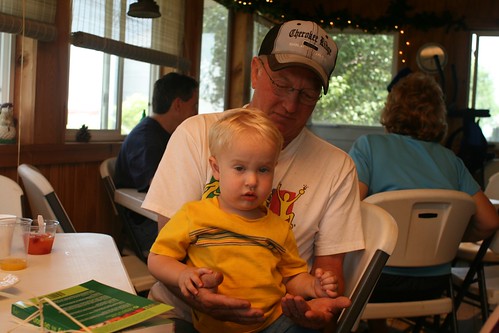
img_5078.jpg

Or maybe it was this:

img_5116.jpg

Friday evening, Cliff and Ralph made up some great hamburgers, hot dogs, and sausages. We all ate under the big tent, and had a nice time visiting. It was sort of an unusual thing -- meeting people you already know for the first time -- but very nice. We left somewhere around 8. Jacob enjoyed the hotel room, too.

img_5027r.jpg

That's Jacob talking on the telephone. Well, I would normally use it as a TV remote, but to Jacob it looks like a phone, so a phone it is. (I can see his point.) This is Jacob answering the phone by saying Hi! Jacob's word for a phone, by the way, is "hi." He'll find a remote by the TV in the room, point to it, and yell "hi!"

Jacob's usual bedtime is 6:30PM. He normally falls asleep fairly easily and sleeps soundly until 6:30AM. Well, we got him in bed well after 6:30PM. Then he made the discovery that the hotel crib/playpen has a mattress that is not attached to the bottom like our mattresses at home are. This was good for at least an hour of excited playing. As Terah and I were trying to sleep, we'd hear these cackles from Jacob's crib, and the noises of a very active boy. I'd peek around and see him using the mattress as a tent, as a peek-a-boo toy, or just as something to throw. I think he fell asleep at about 11.

And woke up promptly at 6:30 on Saturday, just like clockwork, ready to make some phone calls and start the day.

Now, just a tidbit for anyone that doesn't have kids: a toddler, low on sleep, and endless excitement all combine to make for busy parents. Jacob did pretty well, and got in a good long nap in the afternoon. We did take several trips to the corn field.

For most of us, Saturday was a day for brunch, for sitting around and visiting under the tent, for horse rides, and maybe a massage for those that wanted it. Terah got to ride a horse, and Jacob got to ride a pony, too.

For Jacob, it was a day to make new friends, too.
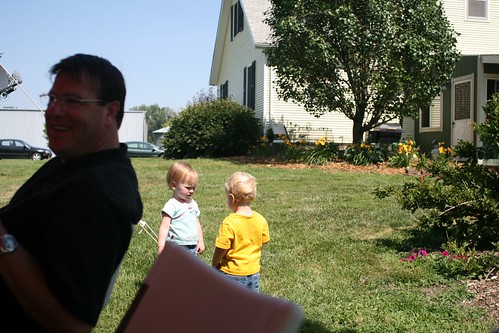
img_5095.jpg

I took this picture just a second after she had given him a hug. I was just a little too slow whipping out the camera.

But when it comes to cherry picking, it's all serious business once again.
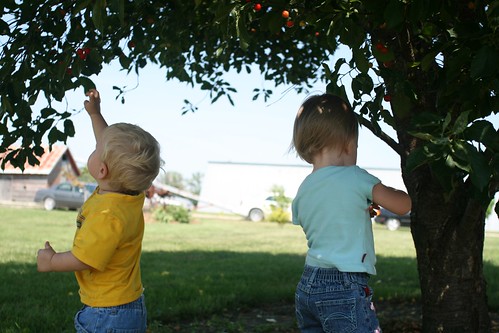
img_5098.jpg

Jacob loved eating these sour cherries. At first, he would pick one cherry off the tree, run over to the tent, give it to Terah for her to get the pit out, eat it, then go back to the tree for another one. He must have decided this was inefficient not long after I did. After a few roundtrips, he started trying to get the closest adult, whoever that might be, to pit the cherry for him. When he found one that would do it, he'd keep bringing cherries back to that person.

And then he was under the tree for a long time. Terah and I noticed, and had a conversation about just how many cherry pits it's OK to swallow. But when I checked it out, I found out that Jacob had figured out how to pit cherries himself. He did lose about half a cherry each time he did it, but I guess that was more efficient than pestering adults to do it for him. Though it may have also worked to carry two cherries to the tent at a time.
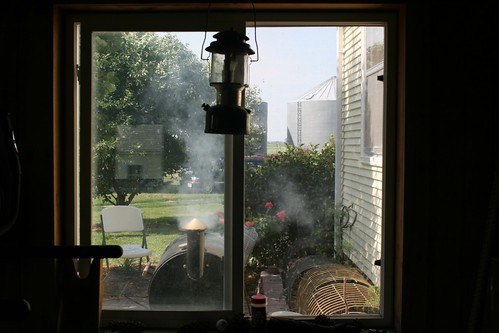
img_5123.jpg

Late in the afternoon, Cliff started up the smoker for the chicken. He had rented a big smoker for the occasion, but it wasn't working, so he made do with his regular smoker, ovens for the corn, and an array of dutch ovens or side grills for everything else. I couldn't keep track of it all, and I was just watching, but somehow it all turned out perfect.

img_5140.jpg

While the chicken was cooking, Ralph and son-of-Ralph (SOR) were having a conversation and patting their bellies. I couldn't hear, and didn't ask questions, so I'm choosing to believe that they were discussing how many pieces of chicken they could eat. When they heard my camera click, Ralph said, "He didn't just take a photo, did he?" Thereby guaranteeing a spot on my blog.

I had the distinction, I think, of being the least-read blogger at Blogstock. I can't quite remember how many times I'd meet someone, and they'd say, "Oh, you're the computer guy, right? I tried reading your blog, but I didn't understand it, sorry!" Completely understandable, I assure you!

After dinner Saturday, we talked about how we got started blogging (hi, Marty and Andy if you're reading), why we were there. Cliff said some very kind things about Terah and me, which really meant a lot.

Later, Cliff told me how Terah showed up in the kitchen with her tray of deviled eggs. Cliff saw them, and said, "Terah, I love you." Later, Cliff said "I love you" to someone else. From the next room, Terah piped up, "What food did she bring?"

Saturday evening, Terah took her horse ride. Jacob was quite tired by that point, and threw a tantrum about not being able to go with mom and ride a horse, too. We were talking about it when Rachel came over. Jacob asked her to pick him up, she did, and he instantly stopped fussing. Maybe it was a "so there" to me, since I had been holding him a minute before, and he took the opportunity to scream in my ear. But in any case, Jacob loved Rachel. She let him sit on a pony, carried him all around the yard, and he managed to hold it together until Terah came back at 9:30.

Saturday evening it was time for goodbyes. We all had a blast and I'm sure we'll do this again. If you weren't there, here's what Blogstock looks like:
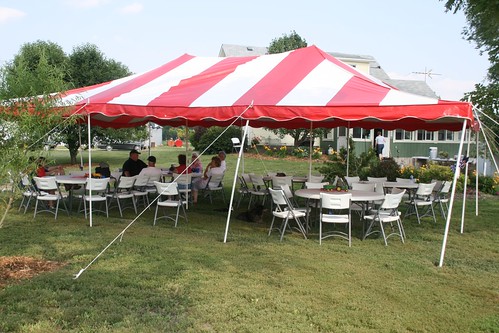
img_4991.jpg

A bunch of friends sitting around chatting under a tent pretty well sums it up.

(There was a full tent of people; some were just elsewhere when this particular photo was taken.)

Jacob shared his thoughts on the whole trip on the way home, too. Well put, Jacob.

img_5202.jpg

Mike Hommey: webkit 1.0.1 in unstable

There has finally been an official webkit release for the Gtk+ port, and I finally took the necessary time to package it. As you can guess from the screenshot above, it now has plugins support. It is also ber fast. You can compare with previous results for both gecko and webkit.

5 July 2008

Runa Sandvik: Like a kid on Christmas Eve

I can’t stop smiling now. I worked two stations tonight, one was Greg (PE2GRT), and I even have a picture to prove it. I had so much fun. Greg was recording everything, and I got his permission to upload it here so you can all listen. I’m still a bit nervous when I’m on the air, but I’m working on it.

4 July 2008

Daniel Burrows: CWidget tutoral 1: 'Hello, world!'

Late last year, I spent some time disentangling aptitude's internal UI library and packaging it as a separate library, which I named cwidget. This article is the first in what will hopefully become a series describing the basic concepts and APIs of cwidget. It applies to the versions of cwidget currently available in Debian sid and lenny, 0.5.11-1 and 0.5.12-1. Autogenerated documentation of cwidget can be found here (but beware that as of this writing it is somewhat incomplete).
In this tutorial, I will walk through a simple program (hello.cc) that initializes cwidget, displays a simple message box, and then terminates the program when the user confirms the message. I assume a basic familiarity with C++. Screenshot of the 'Hello, World' program The first thing to do is to include the portions of cwidget that our program will use. Most importantly, we need the top level cwidget routines. These are the global routines that initialize cwidget, shut it down, and control its main loop (among other things).
#include <cwidget/toplevel.h>
cwidget comes with a collection of stock dialog boxes for things like displaying messages to the user. To access the routines that build these dialogs, we write:
#include <cwidget/dialogs.h>
All the symbols provided by the cwidget library are in the cwidget namespace. Using the full library name means that there's a reasonable chance that its names will not conflict with the names provided by other libraries; however, it's a real pain to type cwidget over and over. Since this is the only namespaced library we are using in this program, it's handy to define cw as an alias for cwidget:
namespace cw = cwidget;
Now we're ready to write the main routine. The first interaction of client code with the cwidget library is to initialize it. This will initialize the ncurses library and put the terminal into a mode suitable for a full-screen curses program.
cw::toplevel::init();
Next, we create a dialog box that will be displayed to the user. There are two things to note about this code:
  1. cwidget is Unicode-aware and the ok() routine expects the message string to be a wide-character string. In this case, that means that we need to pass in a wide-character string (indicated by typing L in front of the string).
  2. The second argument tells cwidget what to do when the ok button is pressed. The expression
      sigc::ptr_fun(cw::toplevel::exitmain);
    
    creates a slot using libsigc++. Briefly, a slot is a reference to a function or to a method of a class instance. When invoked, this particular slot will call cwidget::toplevel::exitmain(), which causes the main cwidget loop to exit. The slot is wrapped in cwidget::util::arg, a utility function that handles passing slots as optional arguments.
cw::widgets::widget_ref dialog =
    cw::dialogs::ok(L"Hello, world!",
                    cw::util::arg(sigc::ptr_fun(cw::toplevel::exitmain)));
Now that we have a widget, the next step is to arrange for it to appear on the terminal. In cwidget, control of the terminal is assigned to a single top-level widget: whatever it displays is what gets displayed on the terminal, and all user input is passed directly to it. In a real program this widget will typically manage a collection of sub-widgets and assign each one a screen region, but for now let's just display the dialog box we created:
cw::toplevel::settoplevel(dialog);
With everything initialized, we're ready to start the main loop. mainloop() will keep the display up-to-date and dispatch incoming events (for instance, keystrokes and mouse presses) until exitmain() is invoked.
cw::toplevel::mainloop();
When the user presses Enter or clicks on the Ok button in the dialog, exitmain() will be invoked by the binding that we set up earlier. Once this happens, we need to shut down cwidget in order to restore the terminal to its original state. If you skip this step, the terminal will be garbled and will not work properly when your program exits.
cw::toplevel::shutdown();
And that's it! To compile the program, change to the directory containing hello.cc and run:
$ g++ -o hello hello.cc $(pkg-config --cflags --libs cwidget)
Of course, you'll need to have the g++ and libcwidget-dev packages installed for this to work!

Next.

Previous.