Search Results: "ron"

16 July 2010

Gustavo Noronha Silva: WebKitGTK+ 1.2.2 and 1.2.3 released!

Some of you may have noticed WebKitGTK+ 1.2.2 and 1.2.3 have been uploaded recently. Here s their announcement =). A quick summary: if you re running the 1.2.x series upgrade to 1.2.3. Here s some information regarding 1.2.2: 1.2.2 is an update to the 1.2.x stable series; along with a lot of crash, and misc fixes the biggest changes are: 1) the inclusion of a new API from the development branch (webkit_back_forward_list_clear()),
because it s simple and will help with fixing a problem in Epiphany stable, and 2) lots of drag and drop, and clipboard related work by Martin Robinson. Despite not being strictly fixes, we believe the stable series has a lot to gain from this work; a couple examples should illustrate this better: the changes included fix both a crash when dragging links from WebKit into other browsers, and the annoying bug that made the cursor get stuck in a grab when dragging, sometimes.
http://webkitgtk.org/webkit-1.2.2.tar.gz
MD5: 40338001324a38b977c163291e8816d3
Here s some information regarding 1.2.3: To some such a quick succession in releases may look like a brown paper bag was in order. Not strictly, but indeed 1.2.3 aims to fix some oversights with easy fixes. First of all, WebKit was not buildable with ICU 4.4.1, but thankfully a fix had already been checked in to trunk, so 1.2.3 includes that fix. Secondly, Debian s Michael Gilbert has done a great job going through all CVEs released about WebKit, and including patches in the Debian package. 1.2.3 includes all of the commits from trunk to fix those, too.
http://webkitgtk.org/webkit-1.2.3.tar.gz
MD5: 0ab5c478a6f5b74a1ae96bf13a456662
You can read some more details, including the list of CVEs that were addressed, in the NEWS file:
http://gitorious.org/webkitgtk/stable/blobs/master/WebKit/gtk/NEWS
Enjoy!

15 July 2010

Jordi Mallach: Hiking through the Pyrenean GR 11

Tomorrow, at this time, I'll probably be unsuccessfully trying to find a comfortable position on a seat of the Bilmanbus to Irun. Very early on Saturday, as soon as we get off the bus, Maria and I will quickly head to Hondarribia's beach in Cape Higer to symbolically wet our feet in the waters of the Cantabrian Sea. We won't have much time to enjoy the cold waters of the ocean, though. Soon after that, we'll have to take a deep breath, look East, and start walking if we want to achieve our utmost objective: take a bath in the beautiful beaches of the Cap de Creus, in the Mediterranean sea. In between, 30 days and 840 kilometres of thick woods, deep valleys, high peaks and cold waters, all of which shape incredible landscapes.


The Portella de Baiau, during our 2008 trip For a whole month, we'll be mostly disconnected from everything else that isn't our knee ache, our blisters, the Sun over our heads or where to get food. It's the first time I leave on a hiking trip as long and tough as this one, and I feel both uncertainty and eagerness. We've been so busy during the last few months that we've been unable to train at all for this, and I'm probably in the worst physical condition in a decade. It's too late to take care of that now, so we'll try to take good care of our legs and spine. In order to get back home in the Mediterranean, we'll have to be fast, some days joining two stages and skipping a few that we know are not that interesting (sections over asphalt, etc.). It's hard to make it in just one month, but we'll try our best. The plan is going to sleep not long after sunset, getting up at dawn, to be able to walk for a decent time before the heat starts being a handicap and just resting at midday, when the Sun is <strongest.> Of course, this means that I'm missing, yet again, this year's edition of DebConf in New York City, which is really sad because I was looking forward hanging around with Mako, Mika, Biella, micah, Clint and the rest of the NYC/ Boston gang, but when the idea of doing a long trip this summer popped up around January, it was clear DebConf seemed unlikely this year. I hope all of you have a lot of fun, and see you in a few weeks!

Enrico Zini: On python, frameworks and TOOWTDI

On python, frameworks and TOOWTDI The Python world is ridden with frameworks, microframeworks, metaframeworks and their likes. They are often very clever things, but more often than not they are a tool of despair. A very peculiar thing about Python web frameworkish things is that there are so many of them. There's cherrypy (in its various API redesigns), fapws, gunicorn, bottle and flask, paste, werkzeug and flup, tornado, pylons, turbogears 1 and 2, django, repoze who, what and whatnot, all the myriad of rendering engines and buffet as a metathing on top of them, diesel, twisted, and I apologise if I don't spend my day listing and hyperlinking them all, I hope I made my point. Frameworks are supposed to standardise some aspects of programming; the nice thing about standards is that there are so many of them to choose from, and they all suck, so I'll make my own. But wasn't Python supposed to be the world of TIOOWTDI? Ok, everbody knows it isn't. Just in the standard library there are 2 implementations of pickle and 2 urllibs. But people like the TIOOWTDI idea. I believe the reason people like the TIOOWTDI idea is because it creates a framework. It standardises some aspects of programming, and defines building blocks that guarantee that people doing similar jobs will be using similar sets of components. Let's take for example the datetime module in the standard library. It is an embarassing example of a badly designed module, so embarassing that the standard library documentation continuously fails to document its fundamental design flaws and common work-arounds hoping that noone notices them, but as a consequence each poor soul starting to use it for nontrivial things has to google for hours in despair to rediscover in how many ways it's broken. But still, datetime works as a structure to hold those values that make a date, time, or full UTC timestamp. For that job it's become the standard, and as such it's an important component of the Python TIOOWTDI framework: one can use it to exchange datetimes among different libraries: for example ORMs are using it instead of rolling their own, which makes database programming so much easier when date/time is involved. Even if the implementation is far from perfect, once we apply TIOOWTDI to dates and timestamps, python code from different authors can exchange dates without worries. This is much better than having 3 different superior datetime libraries and having to convert date objects from one to another when passing values from a web form to an ORM. There is an often overlooked Python framework. The Pyton framework. It's called TIOOWTDI. All the micro-mini-midi-maxi-meta-frameworks that people scatter around, are, or should be, just experiments, proofs of concept, competing ideas waiting to be distilled in The Only One Way, bringing the Python experience one step forward. What is unfortunate is that this last distillation thing happens so rarely that people get used to the idea of having to use proof of concept code to get things done. Update: this post apparently wasn't very clear, so here is some clarification:

Biella Coleman: A User s Guide to Lulzy Media, the Pleasure of Trickery, and the Politics of Spectacle: From the Luddities to Anonymous

One of my favorite conferences is HOPE, which I have missed the last 2 times as I was away from NYC, so I am glad I am around this year. I find it especially valuable when there is some controversy brewing in the air, as there is with Wikileaks, Adrian Lamo, and Manning. I am also giving a talk, description below, with a fabulous postdoctoral researcher, Finn Brunton, who works on spam! But we will be talking about pleasure, trickery, and exploitable media for activists. Our talk is late, like really late: 11:00 PM on Saturday night. At first I was a bit annoyed at the scheduling but then I figured, when will i ever give a talk at 11:00 PM?
Following a brief lecture on Project Chanology, the question will be posed: how can we harness the power of lulzy virality, of pleasure, of trickery, of spectacular trolling for purposes above and beyond sharing the wisdom of Advice Dog? It ll start with a brief look at great activist media in the past, from Guernica and the picture of the whole Earth to projects by the Yes Men - how they spread ideas and helped people get informed, organize, and act. What makes the creation of lulzy memes different? Learn about how to create exploitable forms and rapid variations, and mechanisms for bringing the best stuff forward. Can we make media memes with goals beyond lulz, and teach activists who ve never heard of 4chan to make them too? Part lecture, part workshop, this will feature cameos by Rageguy, Pablo Picasso, V, alt.pave.the.earth, Kathe Kollwitz, Courage Wolf, Stewart Brand, Sarah Palin, Batman, Goya, Philosoraptor, Adolf Hitler, Trollface, Shepard Fairey, Joseph Ducreux, David Cameron, lots of Spartan warriors, and lots and lots of (trollish) cats.

Biella Coleman: A User s Guide to Lulzy Media, the Pleasure of Trickery, and the Politics of Spectacle: From the Luddities to Anonymous

One of my favorite conferences is HOPE, which I have missed the last 2 times as I was away from NYC, so I am glad I am around this year. I find it especially valuable when there is some controversy brewing in the air, as there is with Wikileaks, Adrian Lamo, and Manning. I am also giving a talk, description below, with a fabulous postdoctoral researcher, Finn Brunton, who works on spam! But we will be talking about pleasure, trickery, and exploitable media for activists. Our talk is late, like really late: 11:00 PM on Saturday night. At first I was a bit annoyed at the scheduling but then I figured, when will i ever give a talk at 11:00 PM?
Following a brief lecture on Project Chanology, the question will be posed: how can we harness the power of lulzy virality, of pleasure, of trickery, of spectacular trolling for purposes above and beyond sharing the wisdom of Advice Dog? It ll start with a brief look at great activist media in the past, from Guernica and the picture of the whole Earth to projects by the Yes Men - how they spread ideas and helped people get informed, organize, and act. What makes the creation of lulzy memes different? Learn about how to create exploitable forms and rapid variations, and mechanisms for bringing the best stuff forward. Can we make media memes with goals beyond lulz, and teach activists who ve never heard of 4chan to make them too? Part lecture, part workshop, this will feature cameos by Rageguy, Pablo Picasso, V, alt.pave.the.earth, Kathe Kollwitz, Courage Wolf, Stewart Brand, Sarah Palin, Batman, Goya, Philosoraptor, Adolf Hitler, Trollface, Shepard Fairey, Joseph Ducreux, David Cameron, lots of Spartan warriors, and lots and lots of (trollish) cats.

Uwe Hermann: Using the HP Pavilion dv7-3127eg laptop with Debian GNU/Linux

HP Pavilion dv7-3127eg Yep, so I bought a new laptop recently, my IBM/Lenovo Thinkpad T40p was slowly getting really unbearably sloooow (Celeron 1.5 GHz, 2 GB RAM max). After comparing some models I set out to buy a certain laptop in a local store, which they didn't have in stock, so I spontaneously got another model, the HP Pavilion dv7-3127eg (HP product number VY554EA). Why this one? Well, the killer feature for me was that it has two SATA disks, hence allows me to run a RAID-1 in my laptop. This allows me to sleep better at night, knowing that the next dying disk will not necessarily lead to data loss (yes, I do still perform regular backups, of course). Other pros: Much faster than the old notebook, this one is an AMD Turion II Dual-Core Mobile M520 at 2.3 GHz per core, it has 4 GB RAM (8 GB max), and uses an AMD RS780 / SB700 chipset which is supported by the Free-Software / Open-Source BIOS / firmware project coreboot, so this might make the laptop a good coreboot-target on the long run. I'll probably start working on that when I'm willing to open / dissect it or when the warranty expires, whichever happens first. Anyway, I set up a page at randomprojects.org which contains lots more details about using Linux on this laptop:
http://randomprojects.org/wiki/HP_Pavilion_dv7-3127eg
Most of the hardware is supported out of the box, though I haven't yet tested everything. There may be issues with suspend-to-disk / suspend-to-RAM, sometimes it seems to hang (may be just a simple config change is needed in /etc/hibernate/disk.cfg). Cons: Pretty big and heavy (but that's OK, I use it mostly as "semi-mobile desktop replacement"), glossy screen, loud fans (probably due to the two disks). For reference, here's an lspci of the box:
  $ lspci -tvnn
  -[0000:00]-+-00.0  Advanced Micro Devices [AMD] RS780 Host Bridge Alternate [1022:9601]
           +-02.0-[01]--+-00.0  ATI Technologies Inc M96 [Mobility Radeon HD 4650] [1002:9480]
                        \-00.1  ATI Technologies Inc RV710/730 [1002:aa38]
           +-04.0-[02-07]--
           +-05.0-[08]----00.0  Atheros Communications Inc. AR9285 Wireless Network Adapter (PCI-Express) [168c:002b]
           +-06.0-[09]----00.0  Realtek Semiconductor Co., Ltd. RTL8111/8168B PCI Express Gigabit Ethernet controller [10ec:8168]
           +-0a.0-[0a]--
           +-11.0  ATI Technologies Inc SB700/SB800 SATA Controller [AHCI mode] [1002:4391]
           +-12.0  ATI Technologies Inc SB700/SB800 USB OHCI0 Controller [1002:4397]
           +-12.1  ATI Technologies Inc SB700 USB OHCI1 Controller [1002:4398]
           +-12.2  ATI Technologies Inc SB700/SB800 USB EHCI Controller [1002:4396]
           +-13.0  ATI Technologies Inc SB700/SB800 USB OHCI0 Controller [1002:4397]
           +-13.1  ATI Technologies Inc SB700 USB OHCI1 Controller [1002:4398]
           +-13.2  ATI Technologies Inc SB700/SB800 USB EHCI Controller [1002:4396]
           +-14.0  ATI Technologies Inc SBx00 SMBus Controller [1002:4385]
           +-14.2  ATI Technologies Inc SBx00 Azalia (Intel HDA) [1002:4383]
           +-14.3  ATI Technologies Inc SB700/SB800 LPC host controller [1002:439d]
           +-14.4-[0b]--
           +-18.0  Advanced Micro Devices [AMD] K10 [Opteron, Athlon64, Sempron] HyperTransport Configuration [1022:1200]
           +-18.1  Advanced Micro Devices [AMD] K10 [Opteron, Athlon64, Sempron] Address Map [1022:1201]
           +-18.2  Advanced Micro Devices [AMD] K10 [Opteron, Athlon64, Sempron] DRAM Controller [1022:1202]
           +-18.3  Advanced Micro Devices [AMD] K10 [Opteron, Athlon64, Sempron] Miscellaneous Control [1022:1203]
           \-18.4  Advanced Micro Devices [AMD] K10 [Opteron, Athlon64, Sempron] Link Control [1022:1204]
Full lspci -vvvxxxxnnn, lsusb -vvv, and a much more detailed list of tested hardware components is available in the wiki.

14 July 2010

Mike Hommey: I/O patterns on ELF binary initialization

[ I meant to finish this article much earlier, but i had to leave it in a half-written draft state for quite some time due to other activities ] One particular issue that arises with big binary files is that of I/O patterns. It looks like it is not something under the usual scope for both ld.so and programs/libraries, but it can have a dramatic influence on startup times. My analysis is far from complete, would need to be improved by actually investigating ld.so code further, and so far has been limited to libxul.so built from mozilla-central, with the help of icegrind, on x86-64 linux. As I wrote recently, icegrind allows to track memory accesses within mmap()ed memory ranges. As ld.so does mmap() the program and library binaries, tracking the memory accesses within these mmap()s allows to get a better idea at I/O patterns when an ELF binary is initialized. I only focused on local accesses within a single given binary file (libxul.so) because the case of Firefox loading many files at startup is already being scrutinized, and because most of the non-Firefox files being read at Firefox startup (system and GNOME libraries) are most likely already in the page cache. I also focused on that because it was an interesting case that could be helpful to understand how big (and maybe less big) binaries may be affected by the toolchain (compiler, linker and dynamic linker) and possibly by some coding practices. For the record, what I did to get these results is to use icegrind and elflog, with further additions to the sections file with some output from objdump -h : I added sections that elflog wouldn t give (such as .plt, .hash, .dynsym, etc.), and even down to the entry level for the .rela.dyn section. The latter is particularly interesting because icegrind only outputs the first access for any given section. To see sequential accesses within that section, you need to split it in smaller pieces, which I did for .rela.dyn entries (each one being 24 bytes on x86-64). Uncommenting some parts of the icegrind code was also useful to track where some accesses were made from, code-wise. Now, the interesting data: One of the first accesses is a nullification of a few variables within the .bss section. The .bss section is usually an anonymous piece of memory, that is, a range of mmap()ed memory that is not backed by a file, and filled with zeroes by the kernel (I think it even does that lazily). It is used for e.g. variables that are initialized with zeroes in the code, and obviously, any code accessing these variables would be addressing at some offset of the .bss section. It means the section needs to start in memory at the offset it has been assigned by the linker at build time. This is actually where problems begin. When the .bss section offset as assigned by the linker doesn t align on a page (usually 4KB), the mmap()ed .bss can t be at that location, and really starts on the next page. The remainder is still mmap()ed from the binary file, and ld.so will itself fill that part. As the .bss section doesn t start on a page boundary, any write at this location will trigger the kernel reading the entire page. This means one of the first set of data being read from the file is the end of the section preceding .bss, and the beginning of the following one. Most likely, respectively the .data and .comment sections. While this probably doesn t matter much when the binary file is small, when it is big enough, reading in a non sequential manner will trigger hard disk seeks, and we all know how they can hurt performance. Although thankfully, cheap SSDs should be coming some day, in the meanwhile, we still need to cope with the bad performance. The interesting part is, the .bss section is really empty in the binary file, so its virtual memory address could be anywhere. Why the linker wouldn t align it at a page boundary without having to resort to a linker script is beyond me. The next accesses go back and forth between .dynamic, .gnu.hash, .dynstr, .gnu.version_r, .gnu.version and .dynsym. These are probably all related to symbol version resolution and DT_NEEDED library loading. While most of these sections are at the beginning of the file (not necessarily in the order they are read from), the .dynamic section is much nearer to the end, but way before .data, so that it won t even have been loaded as a by-product of the .bss section loading. After that, the .rela.dyn section is read, and for each relocation entry it contains, the relocations are being applied. Relocations is one of the mechanisms by which position independent code (PIC) is made possible. When a library is loaded in memory, it is not necessarily loaded at the same address every time. The code and data contained in the library thus need to cope with that constraint. Fortunately, while the base address where the library is mmap()ed in memory is not necessary constant, the offsets of the various sections are still as codified in the binary. The library code can thus directly access data at the right offset if it knows the base offset of the library (which is what is done on the x86 ABI), or if it knows where the current instruction is located (which is what is done on the x86-64 ABI). Static data (initialized in e.g. a const or a global variable, or, in C++ case, vtables), on the other hand, may contain pointers to other locations. This is where relocation enters the scene. The .rela.dyn section contains a set of rules describing where in the binary some pointers need to be adjusted depending on the base library offset (or some other information), and how they should be updated. ld.so thus reads all .rela.dyn entries, and applies each relocation, which means that while .rela.dyn is being read sequentially, reads and writes are also performed at various places of the binary, depending on the content of the .rela.dyn entries. This is where this gets ugly for Firefox: there are near 200000 such relocations. On x86-64 an entry is 24 bytes (12 on x86), and each of these is going to read/write a pointer (8 bytes on x86-64, 4 on x86) at some random (though mostly ordered) location. The whole .rela.dyn section not being read ahead, what actually happens is that it is read in small batches, with seeks and reads of other data at various locations in between. In libxul.so case, this spreads over .ctors, .data.rel.ro, .got, and .data. The relocation entries are somehow ordered by address to be rewritten, though they occasionally jump backwards. Some of these relocations also appear to be touching to .gnu.version, .dynsym and .dynstr, because their type involves a symbol resolution. Once .rela.dyn relocation have been dealt with comes .rela.plt s turn. The principle is the same for this section: entries describe what kind of relocation must be done where, and how the result must be calculated. The scope of this section, though, is apparently limited to .got.plt. But before explaining these relocations, I ll explain what happens with the PLT. The PLT (Procedure Linkage Table) is used when calling functions from external libraries. For example, in a Hello World example, the PLT would be used for calls to the puts function. The function making the call would in fact call the corresponding PLT location. The PLT itself, on x86 and x86-64, at least, consists of 3 instructions (I ll skip the gory details, especially for x86, where the caller needs to also set some register before calling the PLT). The first instruction is the only one to be called most of the time: it reads the final destination in the .got.plt section, and jumps there. That final destination, obviously, is not fixed in the library file, since it needs to be resolved by its symbol. This is why the two subsequent instructions exist : originally, the destination stored in the .got.plt section points back to the second instruction ; the first instruction will effectively be a nop (no operation), and the following instructions will be executed. They will jump into code responsible for symbol resolution, update of the .got.plt entry for the next call, and call of the real function. But pointing back to the second instruction is like the pointers in static data we saw above : it s not possible in position independent code. So, the .rela.plt relocations are actually filling the .got.plt section with these pointers back to the PLT. There are a tad more than 3000 such relocations. All these relocations should be going away when prelinking the binaries, but from my several experimentations, it looks like prelinking only avoids relative relocations, and not the others, while it technically could skip all of them. prelink even properly applies all the relocations in the binary, but executing the binary rewrites the same information at startup for all but relative relocations. That could well be a bug in either ld.so not skipping enough relocations or prelink not marking enough relocations to be skipped. I haven t dug deep enough in the code to know how prelinking works exactly. Anyways, prelinking is not a perfect solution, as it also breaks ASLR. Sure, prelink can randomize library locations, but it relies on the user or a cron job doing so at arbitrary times, but that s far from satisfying. An interesting thing to note, though, is that a good part of the relocations prelinking doesn t rid us of in libxul.so (more than 25000) are due to the __cxa_pure_virtual symbol, which is used for, well, pure virtual methods. In other words, virtual methods that don t have an implementation in a given class. The __cxa_pure_virtual function is set as method in the corresponding field(s) of the class VTABLE in the .data.rel.ro section. This function is provided by libstdc++, and as such, is dynamically linked. But this function is just a dummy function, doing nothing. Defining an empty __cxa_pure_virtual function to be included in libxul.so makes these relocations become relative, thus taken care of by prelinking. After all relocations occur, the library initialization itself can begin, and the content of the .init section is executed. That section, indirectly, executes all functions stored in the .ctors section. This includes static initializers, which are unfortunately called backwards, as Taras pointed out already. Each of these static initializers are also accessing various locations in the .data or .bss sections, which may or may not have already been loaded during the relocation phase. The execution of these initializers will also (obviously) read various pieces of the .text section (despite its name, it contains executable sections, i.e. functions code). The initialization of the library ends there, and no access should happen until a function from the library is called. In libxul.so case, XRE_main is first called, then many other functions, but that s another story. All that needs to be remembered about the startup process past this point is that the .text section will be read heavily, as well as the various data, got, plt and dynamic symbol sections, in a very scattered way. While most of these sections may have been retrieved in memory already, as a byproduct of the various initialization processes described above, some may have not, increasing even more the need to seek at all places in the binary file. Now the main problem with all these I/O patterns at startup, is that it seems the only way reorganizing the binary layout may have a visible impact is by considering all the above, and not only a part of it, because only addressing a part of it is very likely to only move part of the problem to a different layer. All in all, making sure the relevant sections of libxul.so are read by the kernel before ld.so enters the game is a good short-term solution to avoid many seeks at startup.

13 July 2010

Christoph Berg: Cool Unix Features: date -d @

I've always been annoyed about how hard it is to convert seconds-since-epoch to strings. I've always been using "date -d '1970-01-01 + 1234 sec'", but as it turned out, that's wrong because it uses the wrong timezone. Luckily, there's a slick replacement:
$ date -d '@1234'
Do 1. Jan 01:20:34 CET 1970
The right version of the "long" version is:
$ date -d '1970-01-01 UTC + 1234 sec'
Do 1. Jan 01:20:34 CET 1970

12 July 2010

Gerfried Fuchs: On Becoming a MOTU

Working on and for Debian for the whole millennium already it would had been hard to not notice Ubuntu through the times. Given that fixing bugs in the package is in the interest of all involved parties I started to get curious for the packages I maintain in Debian what users of Ubuntu might have filed against them. Given that a fair amount of those actually do also apply to Debian I started to fix them too. Though, some bug status isn't able to use as an outsider, and given my approach to perfection not wanting to have packages in a bad shape in a release I started to dig a bit further into the procedures and applied to be accepted as a Ubuntu Developer, more specifically as a MOTU, which gives me the possibility to directly ask for syncrequest instead of having to go through a sponsor, or set wontfix status for bugreports in my packages that simply doesn't make sense to get implemented. Last week I got accepted into that state and I'd like to thank for all the nice and encouraging feedback along the path (including some "What? I thought you were MOTU since ages already??" responses). Let's see how much I really need it, my approach is rather to reduce Ubuntu diffs instead of having to work on them. I though understand that at times close to the releases there can be a need for them, as can be seen in that the package I have to put most effort into (wesnoth-1.8) has a Ubuntu diff in the last lucid release. And because Ubuntu already is in DebianImportFreeze I did a syncrequest for gitolite. Thanks for accepting me so quickly and rather bureaucratic! And no, Laney, I won't give the talk tomorrow because of this just on my own. ;)

10 July 2010

Enrico Zini: Importing OSM nodes into Spatialite

Importing OSM nodes into Spatialite Second step of my SoTM10 pet project: creating a searchable database with the points. What a fantastic opportunity to learn Spatialite. Learning Spatialite is easy. For example, you can use the two tutorials with catchy titles that assume your best wish in life is to create databases out of shapefiles using a pre-built, i386-only executable GUI binary downloaded over an insecure HTTP connection. To be fair, the second of those tutorials is called "An almost Idiot's Guide", thus expliciting the requirement of being an almost idiot in order to happily acquire and run software in that way. Alternatively, you can use A quick tutorial to SpatiaLite which is so quick it has examples that lead you to write SQL queries that trigger all sorts of vague exceptions at insert time. But at least it brought me a long way forward, at which point I could just cross reference things with PostGIS documentation to find out the right way of doing things. So, here's the importer script, which will probably become my reference example for how to get started with Spatialite, and how to use Spatialite from Python:
#!/usr/bin/python
#
# poiimport - import nodes from OSM into a spatialite DB
#
# Copyright (C) 2010  Enrico Zini <enrico@enricozini.org>
#
# This program is free software; you can redistribute it and/or modify
# it under the terms of the GNU General Public License as published by
# the Free Software Foundation; either version 2 of the License, or
# (at your option) any later version.
#
# This program is distributed in the hope that it will be useful,
# but WITHOUT ANY WARRANTY; without even the implied warranty of
# MERCHANTABILITY or FITNESS FOR A PARTICULAR PURPOSE.  See the
# GNU General Public License for more details.
#
# You should have received a copy of the GNU General Public License
# along with this program; if not, write to the Free Software
# Foundation, Inc., 59 Temple Place, Suite 330, Boston, MA  02111-1307  USA
#
import xml.sax
import xml.sax.handler
from pysqlite2 import dbapi2 as sqlite
import simplejson
import sys
import os
class OSMPOIReader(xml.sax.handler.ContentHandler):
    '''
    Filter SAX events in a OSM XML file to keep only nodes with names
    '''
    def __init__(self, consumer):
        self.consumer = consumer
    def startElement(self, name, attrs):
        if name == "node":
            self.attrs = attrs
            self.tags = dict()
        elif name == "tag":
            self.tags[attrs["k"]] = attrs["v"]
    def endElement(self, name):
        if name == "node":
            lat = float(self.attrs["lat"])
            lon = float(self.attrs["lon"])
            id = int(self.attrs["id"])
            #dt = parse(self.attrs["timestamp"])
            uid = self.attrs.get("uid", None)
            uid = int(uid) if uid is not None else None
            user = self.attrs.get("user", None)
            self.consumer(lat, lon, id, self.tags, user=user, uid=uid)
class Importer(object):
    '''
    Create the spatialite database and populate it
    '''
    TAG_WHITELIST = set(["amenity", "shop", "tourism", "place"])
    def __init__(self, filename):
        self.db = sqlite.connect(filename)
        self.db.enable_load_extension(True)
        self.db.execute("SELECT load_extension('libspatialite.so')")
        self.db.execute("SELECT InitSpatialMetaData()")
        self.db.execute("INSERT INTO spatial_ref_sys (srid, auth_name, auth_srid,"
                        " ref_sys_name, proj4text) VALUES (4326, 'epsg', 4326,"
                        " 'WGS 84', '+proj=longlat +ellps=WGS84 +datum=WGS84"
                        " +no_defs')")
        self.db.execute("CREATE TABLE poi (id int not null unique primary key,"
                        " name char, data text)")
        self.db.execute("SELECT AddGeometryColumn('poi', 'geom', 4326, 'POINT', 2)")
        self.db.execute("SELECT CreateSpatialIndex('poi', 'geom')")
        self.db.execute("CREATE TABLE tag (id integer primary key autoincrement,"
                        " name char, value char)")
        self.db.execute("CREATE UNIQUE INDEX tagidx ON tag (name, value)")
        self.db.execute("CREATE TABLE poitag (poi int not null, tag int not null)")
        self.db.execute("CREATE UNIQUE INDEX poitagidx ON poitag (poi, tag)")
        self.tagid_cache = dict()
    def tagid(self, k, v):
        key = (k, v)
        res = self.tagid_cache.get(key, None)
        if res is None:
            c = self.db.cursor()
            c.execute("SELECT id FROM tag WHERE name=? AND value=?", key)
            for row in c:
                self.tagid_cache[key] = row[0]
                return row[0]
            self.db.execute("INSERT INTO tag (id, name, value) VALUES (NULL, ?, ?)", key)
            c.execute("SELECT last_insert_rowid()")
            for row in c:
                res = row[0]
            self.tagid_cache[key] = res
        return res
    def __call__(self, lat, lon, id, tags, user=None, uid=None):
        # Acquire tag IDs
        tagids = []
        for k, v in tags.iteritems():
            if k not in self.TAG_WHITELIST: continue
            for val in v.split(";"):
                tagids.append(self.tagid(k, val))
        # Skip elements that don't have the tags we want
        if not tagids: return
        geom = "POINT(%f %f)" % (lon, lat)
        self.db.execute("INSERT INTO poi (id, geom, name, data)"
                        "     VALUES (?, GeomFromText(?, 4326), ?, ?)",
                (id, geom, tags["name"], simplejson.dumps(tags)))
        for tid in tagids:
            self.db.execute("INSERT INTO poitag (poi, tag) VALUES (?, ?)", (id, tid))
    def done(self):
        self.db.commit()
# Get the output file name
filename = sys.argv[1]
# Ensure we start from scratch
if os.path.exists(filename):
    print >>sys.stderr, filename, "already exists"
    sys.exit(1)
# Import
parser = xml.sax.make_parser()
importer = Importer(filename)
handler = OSMPOIReader(importer)
parser.setContentHandler(handler)
parser.parse(sys.stdin)
importer.done()
Let's run it:
$ ./poiimport pois.db < pois.osm 
SpatiaLite version ..: 2.4.0    Supported Extensions:
        - 'VirtualShape'        [direct Shapefile access]
        - 'VirtualDbf'          [direct Dbf access]
        - 'VirtualText'         [direct CSV/TXT access]
        - 'VirtualNetwork'      [Dijkstra shortest path]
        - 'RTree'               [Spatial Index - R*Tree]
        - 'MbrCache'            [Spatial Index - MBR cache]
        - 'VirtualFDO'          [FDO-OGR interoperability]
        - 'SpatiaLite'          [Spatial SQL - OGC]
PROJ.4 Rel. 4.7.1, 23 September 2009
GEOS version 3.2.0-CAPI-1.6.0
$ ls -l --si pois*
-rw-r--r-- 1 enrico enrico 17M Jul  9 23:44 pois.db
-rw-r--r-- 1 enrico enrico 37M Jul  9 16:20 pois.osm
$ spatialite pois.db
SpatiaLite version ..: 2.4.0    Supported Extensions:
        - 'VirtualShape'        [direct Shapefile access]
        - 'VirtualDbf'          [direct DBF access]
        - 'VirtualText'         [direct CSV/TXT access]
        - 'VirtualNetwork'      [Dijkstra shortest path]
        - 'RTree'               [Spatial Index - R*Tree]
        - 'MbrCache'            [Spatial Index - MBR cache]
        - 'VirtualFDO'          [FDO-OGR interoperability]
        - 'SpatiaLite'          [Spatial SQL - OGC]
PROJ.4 version ......: Rel. 4.7.1, 23 September 2009
GEOS version ........: 3.2.0-CAPI-1.6.0
SQLite version ......: 3.6.23.1
Enter ".help" for instructions
spatialite> select id from tag where name="amenity" and value="fountain";
24
spatialite> SELECT poi.name, poi.data, X(poi.geom), Y(poi.geom) FROM poi, poitag WHERE poi.rowid IN (SELECT pkid FROM idx_poi_geom WHERE (xmin >= 2.56 AND xmax <= 2.90 AND ymin >= 41.84 AND ymax <= 42.00) ) AND poitag.tag = 24 AND poitag.poi = poi.id;
Font Picant de la Cellera "amenity": "fountain", "name": "Font Picant de la Cellera" 2.616045 41.952449
Font de Can Pla "amenity": "fountain", "name": "Font de Can Pla" 2.622354 41.974724
Font de Can Ribes "amenity": "fountain", "name": "Font de Can Ribes" 2.62311 41.979193
It's impressive: I've got all sort of useful information for the whole of Spain in just 17Mb! Let's put it to practice: I'm thirsty, is there any water fountain nearby?
spatialite> SELECT count(1) FROM poi, poitag WHERE poi.rowid IN (SELECT pkid FROM idx_poi_geom WHERE (xmin >= 2.80 AND xmax <= 2.85 AND ymin >= 41.97 AND ymax <= 42.00) ) AND poitag.tag = 24 AND poitag.poi = poi.id;
0
Ouch! No water fountains mapped in Girona... yet. Problem 2 solved: now on to the next step, trying to show the results in some usable way.

9 July 2010

Enrico Zini: Filtering nodes out of OSM files

Filtering nodes out of OSM files I have a pet project here at SoTM10: create a tool for searching nearby POIs while offline. The idea is to have something in my pocket (FreeRunner or N900), which doesn't require an internet connection, and which can point me at the nearest fountains, post offices, atm machines, bars and so on. The first step is to obtain a list of POIs. In theory one can use Xapi but all the known Xapi servers appear to be down at the moment. Another attempt is to obtain it by filtering all nodes with the tags we want out of a planet OSM extract. I downloaded the Spanish one and set to work. First I tried with xmlstarlet, but it ate all the RAM and crashed my laptop, because for some reason, on my laptop the Linux kernels up to 2.6.32 (don't now about later ones) like to swap out ALL running apps to cache I/O operations, which mean that heavy I/O operations swap out the very programs performing them, so the system gets caught in some infinite I/O loop and dies. Or at least this is what I've figured out so far. So, we need SAX. I put together this prototype in Python, which can process a nice 8MB/s of OSM data for quite some time with a constant, low RAM usage:
#!/usr/bin/python
#
# poifilter - extract interesting nodes from OSM XML files
#
# Copyright (C) 2010  Enrico Zini <enrico@enricozini.org>
#
# This program is free software; you can redistribute it and/or modify
# it under the terms of the GNU General Public License as published by
# the Free Software Foundation; either version 2 of the License, or
# (at your option) any later version.
#
# This program is distributed in the hope that it will be useful,
# but WITHOUT ANY WARRANTY; without even the implied warranty of
# MERCHANTABILITY or FITNESS FOR A PARTICULAR PURPOSE.  See the
# GNU General Public License for more details.
#
# You should have received a copy of the GNU General Public License
# along with this program; if not, write to the Free Software
# Foundation, Inc., 59 Temple Place, Suite 330, Boston, MA  02111-1307  USA
#
import xml.sax
import xml.sax.handler
import xml.sax.saxutils
import sys
class XMLSAXFilter(xml.sax.handler.ContentHandler):
    '''
    A SAX filter that is a ContentHandler.

    There is xml.sax.saxutils.XMLFilterBase in the standard library but it is
    undocumented, and most of the examples using it you find online are wrong.
    You can look at its source code, and at that point you find out that it is
    an offensive practical joke.
    '''
    def __init__(self, downstream):
        self.downstream = downstream
    # ContentHandler methods
    def setDocumentLocator(self, locator):
        self.downstream.setDocumentLocator(locator)
    def startDocument(self):
        self.downstream.startDocument()
    def endDocument(self):
        self.downstream.endDocument()
    def startPrefixMapping(self, prefix, uri):
        self.downstream.startPrefixMapping(prefix, uri)
    def endPrefixMapping(self, prefix):
        self.downstream.endPrefixMapping(prefix)
    def startElement(self, name, attrs):
        self.downstream.startElement(name, attrs)
    def endElement(self, name):
        self.downstream.endElement(name)
    def startElementNS(self, name, qname, attrs):
        self.downstream.startElementNS(name, qname, attrs)
    def endElementNS(self, name, qname):
        self.downstream.endElementNS(name, qname)
    def characters(self, content):
        self.downstream.characters(content)
    def ignorableWhitespace(self, chars):
        self.downstream.ignorableWhitespace(chars)
    def processingInstruction(self, target, data):
        self.downstream.processingInstruction(target, data)
    def skippedEntity(self, name):
        self.downstream.skippedEntity(name)
class OSMPOIHandler(XMLSAXFilter):
    '''
    Filter SAX events in a OSM XML file to keep only nodes with names
    '''
    PASSTHROUGH = ["osm", "bound"]
    TAG_WHITELIST = set(["amenity", "shop", "tourism", "place"])
    def startElement(self, name, attrs):
        if name in self.PASSTHROUGH:
            self.downstream.startElement(name, attrs)
        elif name == "node":
            self.attrs = attrs
            self.tags = []
            self.propagate = False
        elif name == "tag":
            if self.tags is not None:
                self.tags.append(attrs)
                if attrs["k"] in self.TAG_WHITELIST:
                    self.propagate = True
        else:
            self.tags = None
            self.attrs = None
    def endElement(self, name):
        if name in self.PASSTHROUGH:
            self.downstream.endElement(name)
        elif name == "node":
            if self.propagate:
                self.downstream.startElement("node", self.attrs)
                for attrs in self.tags:
                    self.downstream.startElement("tag", attrs)
                    self.downstream.endElement("tag")
                self.downstream.endElement("node")
    def ignorableWhitespace(self, chars):
        pass
    def characters(self, content):
        pass
# Simple stdin->stdout XMl filter
parser = xml.sax.make_parser()
handler = OSMPOIHandler(xml.sax.saxutils.XMLGenerator(sys.stdout, "utf-8"))
parser.setContentHandler(handler)
parser.parse(sys.stdin)
Let's run it:
$ bzcat /store/osm/spain.osm.bz2   pv   ./poifilter > pois.osm
[...]
$ ls -l --si pois.osm
-rw-r--r-- 1 enrico enrico 19M Jul 10 23:56 pois.osm
$ xmlstarlet val pois.osm 
pois.osm - valid
Problem 1 solved: now on to the next step: importing the nodes in a database.

Petter Reinholdtsen: jXplorer, a very nice LDAP GUI

Since my last post about available LDAP tools in Debian, I was told about a LDAP GUI that is even better than luma. The java application jXplorer is claimed to be capable of moving LDAP objects and subtrees using drag-and-drop, and can authenticate using Kerberos. I have only tested the Kerberos authentication, but do not have a LDAP setup allowing me to rewrite LDAP with my test user yet. It is available in Debian testing and unstable at the moment. The only problem I have with it is how it handle errors. If something go wrong, its non-intuitive behaviour require me to go through some query work list and remove the failing query. Nothing big, but very annoying.

8 July 2010

Biella Coleman: Debian in the World: Buidling an Institution vs Managing a Crowd

So there are times that I think of course anyone remotely interested in Free Software, virtual projects, and similar endeavors knows about Debian and its strange rituals. I am pretty mistaken, actually. Recently I have attended various events where it has been made clear to me that there are hordes of folks interested in the politics of openness, access, and free software who have heard about Debian but don t really know what it takes, socially and politically, to manage such a project. Luckily I had the chance to spread some of the esoteric knowledge during a talk at MIT for the Knight News Challenge winners and I have received many emails, excited and some surprised about the governance structures of Debian. If interested, here is a video of my talk, which is quite short, so I don t go into as much detail as I would like. There is a great audio quote from a Debian developer, taken from this class visit for which there is a podcast and which I recommend as well. If you can t play flash, you can download the a video of the talk here (look at the right hand side of the page for download link). update: Interesting blog post on Why the open source way trumps the crowdsourcing way that explores some of the issues I raise in the panel talk. I don t think it always trumps open source but it is certainly a niche form of production that is useful in some cases but all too often confused with expert peer production in quite unproductive and empirically wrong ways.

Biella Coleman: Debian in the World: Buidling an Institution vs Managing a Crowd

So there are times that I think of course anyone remotely interested in Free Software, virtual projects, and similar endeavors knows about Debian and its strange rituals. I am pretty mistaken, actually. Recently I have attended various events where it has been made clear to me that there are hordes of folks interested in the politics of openness, access, and free software who have heard about Debian but don t really know what it takes, socially and politically, to manage such a project. Luckily I had the chance to spread some of the esoteric knowledge during a talk at MIT for the Knight News Challenge winners and I have received many emails, excited and some surprised about the governance structures of Debian. If interested, here is a video of my talk, which is quite short, so I don t go into as much detail as I would like. There is a great audio quote from a Debian developer, taken from this class visit for which there is a podcast and which I recommend as well. If you can t play flash, you can download the a video of the talk here (look at the right hand side of the page for download link). update: Interesting blog post on Why the open source way trumps the crowdsourcing way that explores some of the issues I raise in the panel talk. I don t think it always trumps open source but it is certainly a niche form of production that is useful in some cases but all too often confused with expert peer production in quite unproductive and empirically wrong ways.

Aigars Mahinovs: Phoning it in

Currently I own and use an iPhone 3G. I bought it almost two years ago, when the local phone provider LMT started offering the iPhone legally. I had a pretty good experience with it most of the time, but now it is showing its age: I will try to send my iPhone in for repair hoping to extend its usefulness, but frankly it looks that I might have to get a new phone at or before Debconf. So I am considering my options for a new phone and so far I have 3 main options each with some sub-options. The main options are: iPhone 4, MeeGo and Android. Each choice has its benefits and drawbacks and each also has several sub-options related either to specific phone models or to purchase methods. What I need is a phone with: calling function, contact information synchronised to Google, support for Google Mail/Contacts/Calendar simultaneously with one Exchange account also providing mail/contacts/calendars, music, audiobooks saving my place in the audio book and in the list of books, fully featured Twitter client with Twitpic and location support, encrypted password storage application (preferably open source), GPS with maps, ability to download maps for offline use, Geocaching support with offline cache info and logging, Skype client, ability to write in Latvian, English and Russian in all applications, reliable backup and restore of phones data including settings and data of installed apps. Optional features: last.fm streaming and reporting support, ebook applications with purchasable ebooks, high quality video and photo recording (for a phone), ability for me to write applications on the phone, ssh client, wireless data upload to the phone, ability to change the phones battery without loosing data in the phone (on the go), compass, physical keyboard, confidence in getting software upgrades and developer interest for the next 2 years. I ll try to describe all of the options here to organise my thoughts and maybe also help someone else make the choice. Option 1: iPhone 4 To get the iPhone 4 I have two options: LMT and unlocked. The official arrival of iPhone 4 to Latvia is expected in September and it will likely be sold by LMT for the same prices as iPhone 3GS is now. If I choose this scenario, I will need to survive with my semi-broken iPhone for 2-3 more months. Total price over 2 years (LVL): 131 (purchase price) + 24 * 8 (surcharge) = 323 LVL. Note: the surcharge is the extra cost of the iPhone call plan compared to a comparable regular plan (Vien dais 7 + Internets telefon 5). If I go and purchase an unlocked iPhone 4 in a country where such units are sold (UK is the most easily accessible choice, because a few of my workmates travel weekly to and from UK) then the total price over 2 years would be the purchase price: 499 GBP + 65 GBP (2 year warranty extension) = 505 LVL Now lets go over the general benefits and downsides of the iPhone 4, first the positives: Drawbacks: Option 2: Maemo/MeeGo Some of my colleagues at work (in the Riga office of Accenture) have N900 phones and I have been exposed to people with raw enthusiasm towards the Maemo platform ever since the Debconf in Helsinki, where we saw the first N700 devices in the hands of some lucky Debian/Nokia people using it as an Internet tablet. N900 has been a strong leap forward for the platform, before its head was teleported sideways by the whole MeeGo merger/debackle. Again I have two options here: Get a N900 either here in Latvia for 325 LVL (that would be the total cost over 2 years) or get it from USA during Debconf for 399 USD (+129 USD for 2 year warranty) = 317 LVL. And additional option would be to wait until October/November and then buy the new Nokia MeeGo device, rumoured to be N9-00 and likely to be around the same price as N900 was when it was introduced (around 500 LVL). Benefits: Drawbacks: Option 3 Android After looking trough the options for Android phones, I ve narrowed the selection to the ones that are either available from local carriers or can be easily gotten unlocked also the phones need to have announced plans to have at least Android 2.2 version. Currently the choice is limited to HTC Desire (from carrier or unlocked) and Samsung Galaxy S (unlocked). The prices over 2 years break down as follows: HTC Desire (locked to LMT): 69 + 9*24 = 285 LVL
HTC Desire (locked to Bite): 199 + 2*24 = 247 LVL (Note: only 500Mb of data per month available)
HTC Desire (locked to Tele2): 179 + 6*24 = 323 LVL
Note: all the above options would also require me to pay a 45 LVL early termination fee on my current iPhone contract if I choose to do this before September.
HTC Desire (unlocked): 311 LVL
Samsung Galaxy S (unlocked): 350 LVL (import from Germany) Benefits: Drawbacks: Please correct me if I am wrong with something!!! And also it would be cool if you expressed your own opinions in the comments. Currently I am very undecided about what I am going to do, but after completing this entry I am leaning towards an unlocked HTC Desire. Update:
Olivier Cr te shares a N900 vs. Nexus One experience Edit 01-07-2010: Handed my iPhone in for a warranty repair, got a dumbphone Nokia as a loaner during repairs. Very surprised about how long a battery can last on a low powered and cheap phone. In the mean time from all the comments here and elsewhere I am starting to see that I am too annoyed with the iPhone platform (mostly iTunes) to stay there and that I am also not convinced in the direction MeeGo is going (a lot of community developers are annoyed and are jumping ship), so N900 is also out. I will need to see 2-3 MeeGo smartphones and also see how Nokia will treat their smartphone users and developers on this platform, in the long term, before I ll be ready to trust them with my money. Therefore, my choice is becoming pretty clear look for the best Android phone (after my iPhone dies). We have this thing at Accenture, where we can get company phones at a discount and HTC Desire is on that list. If I can get that, it would slash 100 LVL (almost a third of the price!) off it, but to get there I either need to get a promotion (rather rare after just one year with the company) or prove the necessity of the phone for the needs of my project (kinda hard currently). Well, the situation will be a bit clearer next week when I get my iPhone back. (Apparently the Latvia s largest holiday Midsummer Festivities or J i/L go with tons of traditional outdoor activities, caused a lot of phones to become broken and there is a backlog of warranty service :) ) So at this point my plan is: get my iPhone repaired and get a promotion or a project where I can justify a company-paid HTC Desire and then hope that Nokia/Intel really get their stuff together and make MeeGo a great smartphone platform over the next year or two. Update: Got my iPhone 3G back from the warranty . It is in quotes because they just gave me a new iPhone 3G. The battery lasts for 3 days of minimal use and it has not crashed yet. The recovery process was a pain again caused by iTunes: iTunes refused to restore my backup onto the new phone, because my backup was made on a iOS 4.0, while the new phone I got from the warranty has 3.1.3 on it. So I had to set this phone as a new phone, initialise it, make a backup, upgrade to 4.0, restore from the (empty) backup, then reset the phone to factory settings again and only then I could start restoring data from my original (pre-warranty) backup and start copying my data on to the device. All in all it took nearly 3 hours if iTunes doing something and almost a dozen reboots of the phone. Almost half of that time was spent doing completely unnecessary steps to work around the fact that iTunes is braindead. I ll continue using my iPhone for now, keeping my eyes on the newest Android phones and also waiting for the long-promised first MeeGo phone from Nokia.

Michael Prokop: Report from FAI developer workshop 07/2010

Last weekend (2010-07-02 2010-07-04) nine people met at the FAI developer workshop at Linuxhotel in Essen/Germany. If you can t remember: FAI is a non-interactive system to install, customize and manage Linux systems and software configurations on computers as well as virtual machines and chroot environments, from small networks to large-scale infrastructures and clusters. The participants of the FAI meeting: picture of participants of the FAI developer workshop 2010 second row from left to right: Michael Goetze, Michael Prokop, Andreas Schuldei
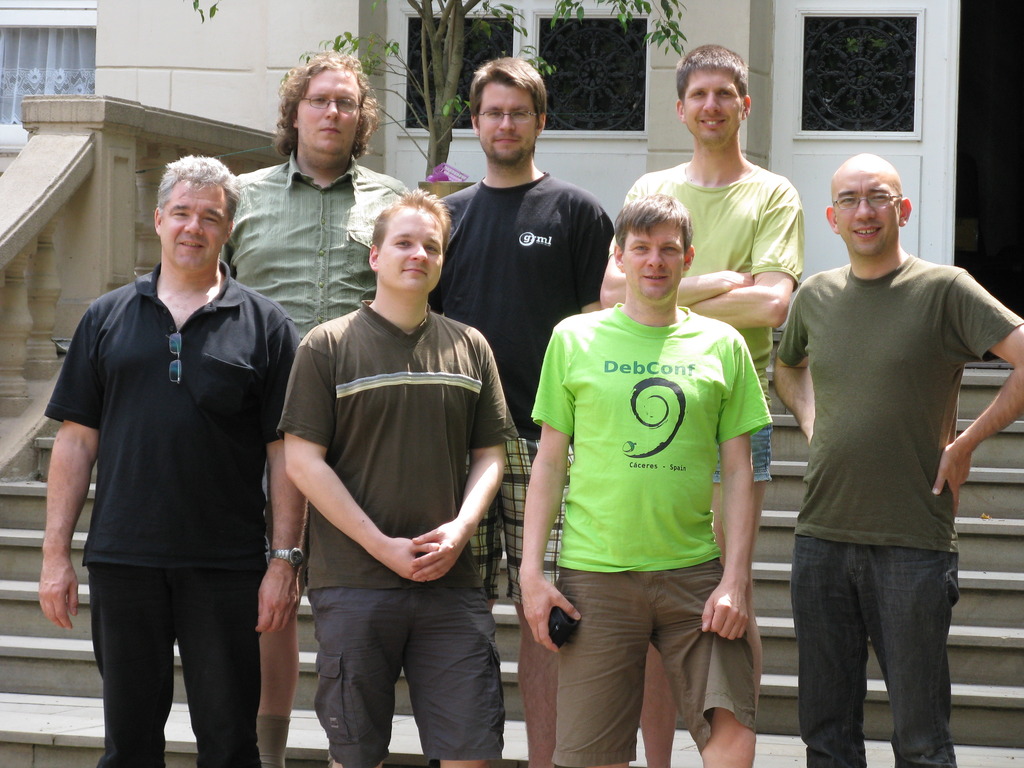
first row from left to right: Sebastian Hetze, Manuel Hachtkemper, Thomas Lange, Mattias Jansson
missing on the picture: Thomas Neumann (left on sunday midday) and Stephan Hermann (only part-time) Friday afternoon started with getting to know each other, continuing with discussions all around FAI. On saturday we started to hack on FAI. * Between the hack sessions and discussions the attending people presented their FAI usage and approaches. Some notes from the presentations:
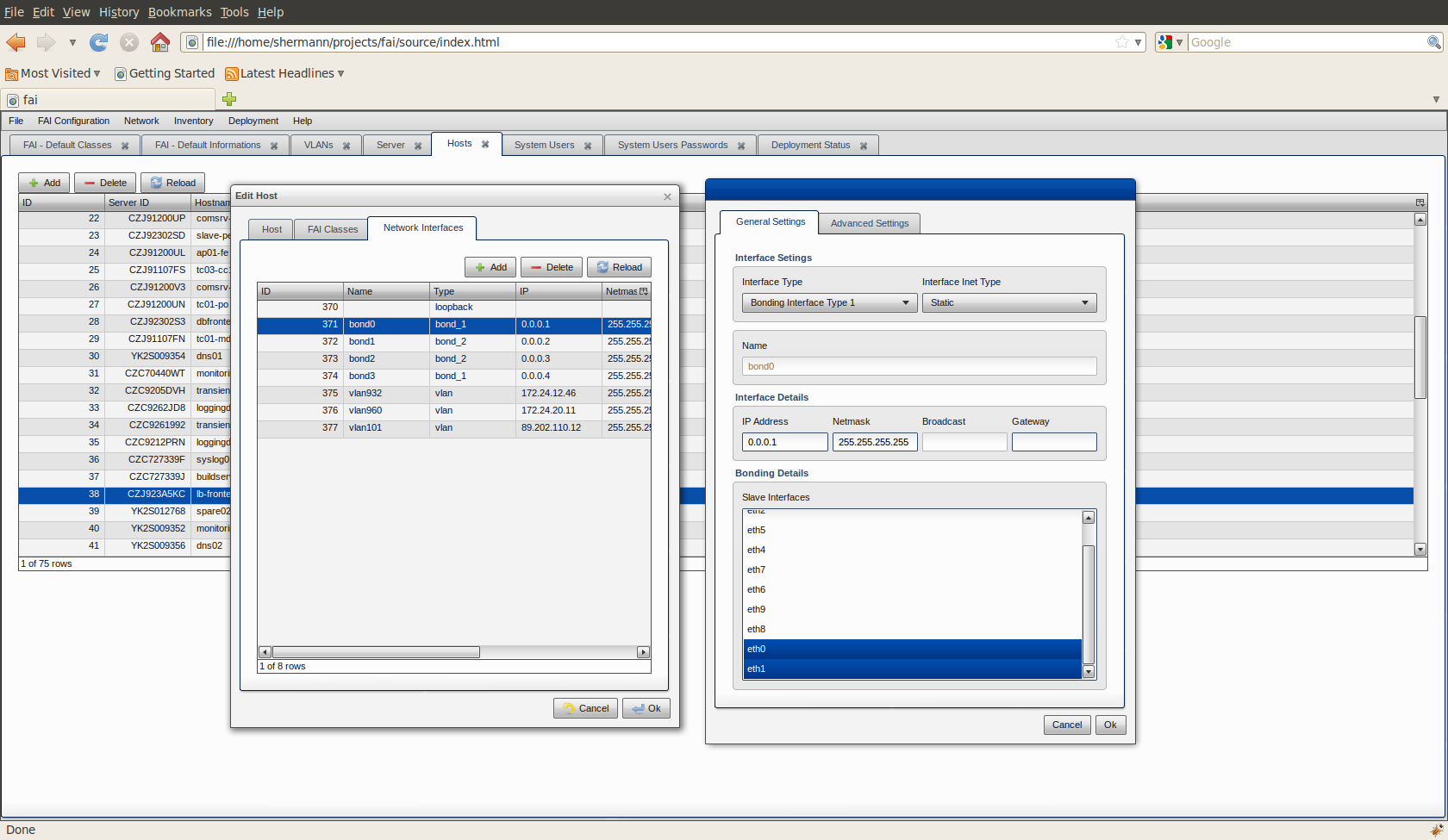
FAI Manager webfrontend / Stephan Hermann Stephan \sh Hermann presented his FAI web frontend which should be released under the GPL license in those days. The frontend uses qooxdoo whereas the backend is based on django, rpc4django and python-tftpy. Screenshot of FAI manager webfrontend A demo video is available at blip.tv. Currently Stephan is searching for a nice name for his FAI management tool please send suggestions either to him or to the linux-fai-devel mailinglist. Grml / Michael Prokop Grml is a Debian based Linux live system specially made for system administrators. Grml uses grml-live for building the ISOs, whereas grml-live itself uses FAI s dirinstall feature to build the live system. This provides the Grml team with a nice way to autobuild 18 ISOs per day, known as daily.grml.org. Mika also presented Grml s netscript bootoption and the ethdevice bootoption of live-initramfs which is useful for booting Grml/FAI via PXE. Host Europe / Michael Goetze Host Europe uses FAI for installing Debian and Ubuntu (32+64 bit) in the support center. They have ~20 FAI classes and use a Debian lenny NFSROOT as base for all deployed systems. Their main problems with FAI aren t related to FAI itself, but instead e.g. broadcom NICs with lack of support for it in Lenny s kernel. They are not using softupdate (yet) and currently use Kickstart for deploying CentOS but are working on deploying CentOS with FAI as well. LIS AG / Sebastian Hetze Linux Information Systems AG (LIS AG) are using FAI 3.2.17 and provide a luma and PyQt based GUI to their customers. They use DHCP, LDAP and DDNS for inventory, configuration and deployment. Mathematical Institute of the University of Bonn / Manuel Hachtkemper The Mathematical Institute of the University of Bonn uses FAI 3.1.8 and 3.3.5 for managing ~150 systems. They are automatically running softupdates every day, reporting how many hosts actually did run the softupdate and how many didn t run. The involved failogwatch tool supports two regex files, one for excluding specific hosts and the other one for grepping for known problems in the logs. Spotify / Andreas Schuldei + Mattias Jansson Spotify is a peer-to-peer music streaming service and the operating people at Spotify use FAI for deploying the systems. Currently they are using FAI 3.3.3 to deploy ~400 bare metal machines and ~150 virtualised machines. They have their class names in DNS using the txt/Text record entry. They are using a self written prepend_class script to manage dependencies between classes. University K ln / Thomas Lange Thomas uses FAI s trunk version (of course :) ), managing ~25 machines with less than 20 FAI classes. He s not using softupdates as Lenny s aptitude ignores the hold status of packages (this bug should be fixed for Squeeze). $COMPANY One of the big telecommunication providers in Germany uses FAI 3.3.3 for installing their bare-metal and virtual servers, providing Debian, Ubuntu and SLES. They are using Debian NFSROOT as a base for all systems as well and their main problems with FAI wasn t FAI itself but how to manage installation of virtual machines.
On Saturday evening we had a nice barbecue which included beer and K lsch *d&r*. ;) On Sunday we continued with discussions and development. Our work-log of the weekend: Important decisions made: We noticed that many FAI users implement their own way how to handle dependency management between classes, we will re-consider how we could provide such a mechanism through FAI s core. We also noted that it s important that any self-written scripts used within FAI are fully idempotent and users should be aware of this. Last but not least many thanks to the sponsors of the FAI developer workshop 07/2010! The workshop wouldn t have been possible without our generous sponsors, namely being:

7 July 2010

James Morrison: A speech that didn't happen

I have a lot of papers lying around. I now try to keep them organized, but I haven't got through the back log of when I didn't organize them. Sometimes I come across stuff that I'm happy I had in the pile. The following was my attempt at a valedictorian speech for the 2005 Math class at the University of Waterloo. I was not the valedictorian, but I tried, and thus have a speech.

Ladies, Gentlemen, Doctors and children of all ages. Thank you for spending our last day at Waterloo, here with us. I am one of those people who won't be staying here after day, but somehow I was still chosen to be the valedictorian. So, when I was asked to be the valedictorian by some friends of mine, I was thrilled. I also though I could do a good job, heck, I got my degree in CS, therefore, I can do anything. So, I accepted the nomination. I looked at the nomination form and didn't find any hints on what to talk about. At this point I realized that this speech may be a little underspecified. In fact, there was no specification at all.

I gathered what I could from the form, i.e. a speech had to be written by, and performed on the 18th of June 2005. Skip forward a few weeks, I'd accomplished nothing more than vague thoughts on what to talk about, then I got an email. All potential speeches had to be presented on the 6th of April 2005 (the deadline had moved up, and still no specification). However, a performance objective was given in that email -- each speech must be completed in 5 minutes. Given that I don't have a spec, I can only hope no one else has one.

What follows is my implementation of this unknown specification.

Another cycle in our lives is over. We are finished our latest round of education. This time from the University of Waterloo, in some Math program. Many of us have changed significantly while we've been here, but we are still the same people. We know we are older, we can guess that we are wiser, and we are certainly more educated. So, here is a quick tour of my cycle through Waterloo.

When I got here back in September 2000, I was amazed at how many smart people could be put together in one small place. I am actually still amazed by all the smart people here. I simply happen to know a bit more about some of these people and the amazing things they have done. With all these smart people here, I even had to do homework to keep up.

Skip forward to second year. Second year is when the university decided there is no more room for me in residence. In fact, they do that to almost all second year students. So, I found a sleezy place to live off-campus and started discovering what life is like outside the university bubble. For example, there are stores not in the plaza. There are a couple malls, a bus station, and a train station.

By third year Waterloo had become home despite working in two other cities and growing up on the other side of Toronto. I no longer had to fear being kicked out of CS since I had enough courses with good marks racked up that my cumulative average wouldn't drop too low unless I started failing, which would have been a bad thing to do.

In fourth year, I could see the end in sight. Grad school applications needed to be done pronto and some interesting job prospects lured me away from yet more years of school. Co-op didn't help keep me in school, I enjoyed the working world. I know there are others that used co-op to find that the working world wasn't for them. I expect those people to be in some school for a good long time.

Now we are at the end, and the cycle is complete. I've been across the country, lived over in sunny California, and biked through Scotland, but no where has compared to Waterloo, or the great people that make it such a wonderful place to be. I'm sad to go, as I'm sure many of you are, but I hope you are excited about the next step at the same time.

That was my 5 years, in a non-chronologically accurate order. But it's been even better to help and see people do amazing things. Small things, like getting a group of friends together to go get pints of Bubbletea. To large things like running frosh week for thousands of first year students.

Now that we have looked at the past, what about the future? One of the things I didn't wan to say during this speech is that "We are the future". What does that even mean? Are we useless now? I don't know what it means, it could even be partially true, but we are not useless. In fact our time is now! Among this graduating class are those who are doing cutting edge research. There are those we are already running their own companies. There are those who are already half-way through there plan to rule the world. There are even those of us who are simply going to help others do those things. So, we are not "the future", we are "the now".

Being "the now", (don't I sound like Dubya?) is one thing, but we should always be "the now". We can always make now be our time. We should do this because if we aren't the ones living happily and making the world a better place, in our own ways, then who is going to do it?

If nothing else, I really hope everyone lives happily. For me, I found if I can keep my hat then I can be happy. Well, I can be happy promoting "No Pants Day"!

DOWN WITH PANTS!!

At the end, I finally figured out the specification for this speech. It's simple: Remind people of the awesome things they have done here, the amazing people they shouldn't forget. Lastly, to convince people to keep doing the awesome things despite what might happen or what obstacles appear.

Thank you, I enjoyed being your VD today.

6 July 2010

Matt Zimmerman: We ve packaged all of the free software what now?

Today, virtually all of the free software available can be found in packaged form in distributions like Debian and Ubuntu. Users of these distributions have access to a library of thousands of applications, ranging from trivial to highly sophisticated software systems. Developers can find a vast array of programming languages, tools and libraries for constructing new applications. This is possible because we have a mature system for turning free software components into standardized modules (packages). Some software is more difficult to package and maintain, and I m occasionally surprised to find something very useful which isn t packaged yet, but in general, the software I want is packaged and ready before I realize I need it. Even the long tail of niche software is generally packaged very effectively. Thanks to coherent standards, sophisticated management tools, and the principles of software freedom, these packages can be mixed and matched to create complete software stacks for a wide range of devices, from netbooks to supercomputing clusters. These stacks are tightly integrated, and can be tested, released, maintained and upgraded as a unit. The Debian system is unparalleled for this purpose, which is why Ubuntu is based on it. The vision, for a free software operating system which is highly modular and customizable, has been achieved. Rough edges This is a momentous achievement, and the Debian packaging system fulfills its intended purpose very well. However, there are a number of areas where it introduces friction, because the package model doesn t quite fit some new problems. Most of these are becoming more common over time as technology evolves and changes shape. Why are we stuck?
I suppose it is tempting, if the only tool you have is a hammer, to treat everything as if it were a nail.
Abraham Maslow
The packaging ecosystem is very strong. Not only do we have powerful tools for working with packages, we also benefit from packages being a well-understood concept, and having established processes for developing, exchanging and talking about them. Once something is packaged, we know what it is and how to work with it, and it fits into everything else. So, it is tempting to package everything in sight, as we already know how to make sense of packages. However, this may not always be the right tool for the job. Various attempts have been made to extend the packaging concept to make it more general, for example: Other package managers aim to solve a specific problem, such as providing lightweight package management for embedded systems, or lazy dependency installation, or fixing the filesystem hierarchy. There is a long list of package managers of various levels which solve different problems. Most of these systems suffer from an important fundamental tradeoff: they are designed to manage the entire system, from the kernel through applications, and so they must be used wholesale in order to reap their full benefit. In other words, in their world, everything is a package, and anything which is not a package is out of scope. Therefore, each of these systems requires a separate collection of packages, and each time we invent a new one, its adherents set about packaging everything in the new format. It takes a very long time to do this, and most of them lose momentum before a mature ecosystem can form around them. This lock-in effect makes it difficult for new packaging technologies to succeed. Divide and Conquer No single package management framework is flexible enough to accommodate all of the needs we have today. Even more importantly, a generic solution won t account for the needs we will have tomorrow. I propose that in order to move forward, we must make it possible to solve packaging problems separately, rather than attempting to solve them all within a single system. But I like things how they are! We don t have a choice. The world is changing around us, and distributions need to evolve with it. If we don t adapt, we will eventually give way to systems which do solve these problems. Take, for example, modern web browsers like Firefox and Chromium. Arguably the most vital application for users, the browser is coming under increasing pressure to keep up with the breakneck pace of innovation on the web. The next wave of real-time collaboration and multimedia applications relies on the rapid development of new capabilities in web browsers. Browser makers are responding by accelerating deployment in the field: both aggressively push new releases to their users. A report from Google found that Chrome upgrades 97% of their users within 21 days of a new release, and Firefox 85% (both impressive numbers). Mozilla recently changed their maintenance policies, discontinuing maintenance of stable releases and forcing Ubuntu to ship new upstream releases to users. These applications are just the leading edge of the curve, and the pressure will only increase. Equally powerful trends are pressing server applications, embedded systems, and data to adapt as well. The ideas I ve presented here are only one possible way forward, and I m sure there are more and better ideas brewing in distribution communities. I m sure that I m not the only one thinking about these problems. Whatever it looks like in the end, I have no doubt that change is ahead.

5 July 2010

Julian Andres Klode: Review: Lenovo ThinkPad Edge 15

Wednesday, after some weeks with a flickering screen (or more precisely, something is causing GTK+ to redraw and the kernel to print ^@ in the terminal when you touch the screen, see http://jak-linux.org/tmp/20100628_002.mp4) in my 3 years old HP Compaq 6720s (which seems to be a software-hardware combination problem, at least it works in Ubuntu); I decided to buy a new laptop. It took me a few minutes to find the Lenovo ThinkPad Edge 15 NVL7VGE; which I ordered at notebooksbilliger.de at around 14:30 CEST using Express. On Thursday morning at 6:40 CEST, the device arrived. The laptop features an Intel Core i5 430 M processor with integrated graphics, 4 GiB of RAM, 320 GB hard disk storage, matte screen, and of course a TrackPoint. The machine comes pre-installed with Windows 7 Professional which is not very nice (and Lenovo does not take Windows licenses back). I booted Ubuntu 10.04 from an USB disk which worked a few times, but not always, so I upgraded the BIOS to make USB booting reliable (as Lenovo published multiple BIOS updates already, one fixing this USB booting issue). The first step was booting Ubuntu 10.04 from an USB hard disk to check the Linux support. Using Ubuntu, everything worked out of the box, including stuff like HDMI audio support or output switching. An exception may be the DVD drive, which only works if you set the SATA mode to compatibility. Non-DVD media also works in AHCI mode, but only if you start with a disc inserted in the drive. Playing DVDs requires setting a region code using setregion(8) [otherwise they do not work at all] and SATA compatibility mode [otherwise they only work partially]. Another issue is the HDMI output, as the TV is not correctly detected and some parts at the top and the bottom of the image are missing (that is, the GNOME panels) (but that happens with different screens and ATI cards as well). Oh, and closing the lid with a screen attached and the internal screen disabled works only as long as you do not open it again, because that causes the GPU to stop. On the input side, we have one keyboard, one TrackPoint, and a touch pad. All of them work out of the box, but they have a few problems on the hardware side: The cursor keys on the keyboard are incredibly small and the touchpad is very large. The keyboard is different from the one in the HP Compaq: First of all, there is space between the keys (like Apple keyboards); and secondly, you need to apply more pressure in order to use the keys. The device feels more solid than the HP Compaq 6720s, especially touching the screen does not change the colors on the screen. I don t know how long the keyboard will last, but I hope that I will still have symbols on them in 5 months (which was not the case for the HP Compaq 6720s keyboard). Power consumption is another interesting point. When the device is idle and the screen is disabled, the device seems to consume about 10W. With screen enabled, consumption varies between 13W (idle) 35W (building source code); if the values received via ACPI are correct. The device ships with a 48 Wh battery which after some time was displayed as 53 Wh in gnome-power-statistics (only the when loaded state, capacity is displayed as 47.5Wh). According to Lenovo, the laptop lasts 4.5 hours on battery, meaning consumption of 47.5 Wh / 4.5 h = 10.5 Wh which is a bit overly optimistic if you want to work on the device. After checking everything, I took over my Debian sid installation from my old laptop (which I installed in 2008). It runs happely now, although I still need to get accustomed to the new keyboard and the large touch pad. All in all, the price of 765 I paid for the device seems to be OK. Now I only need to remove the Windows 7 sticker and hope that the device lasts long enough until I want to buy a new one (probably 2013, if the aliens don t invade us 2012).
Filed under: General

4 July 2010

Torsten Landschoff: Postprocessing conference videos

I was planning to attend DebConf New York this year, but for a number of reasons I decided not to go. Fortunately, Ferdinand Thommes organized a MiniDebConf in Berlin at LinuxTag and I managed to attend. Thanks, Ferdinand! There were a number of interesting Talks. I especially liked the talk of our DPL, and those about piuparts and git-buildpackage. In contrast to the other LinuxTag talks, we had a livestream of our talks and recorded (most) of them. The kudos for setting this up goes to Alexander Wirt, who spent quite a few hours to get it up and running. I have to apologize for being late in bringing my Notebook, which was intended to do the theora encoding of the livestream. This was a misunderstanding on my part, I should have known that this is not going to be setup in the night before show time So to compensate the extra hours he had to put in for me, I offered to do the post processing of the videos. Basic approach for post processing The main goal of post processing the videos was (of course) to compress them to a usable size from the original 143 GB. I also wanted to have a title on each video, and show the sponsors at the end of the video. My basic idea to implement that consisted of the following steps:
  1. Create a title animation template.
  2. Generate title animations from template for all talks.
  3. Use a video editor to create a playlist of the parts title talk epilogue.
  4. Run the video editor in batch mode to generate the combined video.
  5. Encode the resulting video as ogg theora.
As always with technology, it turned out that the original plan needed a few modifications. Title animations
<video controls="controls" height="288" src="http://www.landschoff.net/blog/uploads/2010/07/mdc2010_title_anim1.ogv" width="360 "></video>
Originally I wanted to use Blender for the title animation, but I knew it is quite a complicated bit of software. So I looked for something simpler, and stumbled across an article that pointed me towards Synfig Studio for 2D animation. This is also in Debian, so I gave it a try. I was delighted that Synfig Studio has a command line renderer which is just called synfig and that the file format is XML, which would make it simple to batch-create the title animations. My title template can be found in this git repository. Batch creation of title animations I used a combination of make and a simple python script to replace the author name and the title of the talk into the synfig XML file. The data for all talks is another XML file talks.xml. Basically, I used a simple XPath expression to find the relevant text node and change the data using the ElementTree API of lxml python module. The same could be done using XSLT of course (for a constant replacement, see this file) but I found it easier to combine two XML files in python. Note that I create PNG files with synfig and use ffmpeg to generate a DV file from those. Originally, I had synfig create DV files directly but those turned out quite gray for some reason. I am now unable to reproduce this problem. Combining the title animation with the talk For joining the title animation with the talk, I originally went with OpenShot, which somebody of the video team had running at the conference. My idea was to mix a single video manually and just replace the underlying data files for each talk. I expected that this would be easy using the openshot-render command, which renders the output video from the input clips and the OpenShot project file. However, OpenShot stores the video lengths in the project file and will take those literally, so this did not work for talks of different play times I considered working with Kino or Kdenlive but they did not look more appropriate for this use case. I noticed that OpenShot and Kdenlive both use the Media Lovin Toolkit under the hood, and OpenShot actually serializes the MLT configuration to $HOME/.openshot/sequence.xml when rendering. I first tried to read that XML file from python (using the mlt python bindings from the python-mlt2 package) but did not find an API function to do that. So I just hard coded the video sequence in python. I ran into a few gotchas on the way: Things to improve While the results look quite okay for me now, there is a lot of room for improvement. Availability

Next.

Previous.