Search Results: "reg"

26 July 2008

MJ Ray: Good Tour for Software and Cooperatives Enters Final Weekend

This weekend, I will be mostly watching the Tour de France. It’s been a very good tour for software and cooperatives. Look at the current leaderboards:-
Teams
  1. Carlos Sastre Candil (also 2nd in King of Mountains) Team Computer Sciences Corporation - Saxo Bank
  2. Frank Schleck (3rd KoM) Team CSC - Saxo Bank
  3. Bernhard Kohl (1st KoM) Gerolsteiner bottled water - OK, not related
  4. Cadel Evans, Silence anti-snoring product - Lotto Belgium - also unrelated
  5. Denis Menchov, Rabobank cooperative
Points
  1. Oscar Freire Gomez, Rabobank
  2. Erik Zabel, Team Milram, a brand of Nordmilch cooperative
  3. Thor Hushovd, Cr dit Agricole cooperative banks
Teams
  1. Team CSC Saxo Bank
  2. AG2R-La Mondiale insurance mutuals
  3. Rabobank
  4. Euskaltel - Euskadi - privately-owned telco and a government
  5. Caisse d’Epargne cooperative bank
So however it finishes, I think it probably will have been a much better race for software and cooperatives than last year’s tour, likely to take 4 of the top 5 team positions and 1-2-3 in the green jersey contest… even the doping scandals have been for other teams this year, I think. One day, one of my companies will sponsor pro-cycling. I hope. Anyway, if you’d like to cheer on other Software and Cooperative firm teams until then, European TV coverage details are on another site of mine and Saturday’s time trial start times are posted on a sister site.

25 July 2008

Eric Warmenhoven: Strobist.

Recently, I was trying to take portraits of Lisa at home, and failing. There wasn’t enough light, and the (on-camera) flash I had simply wasn’t cutting it. I decided it was time for a more serious solution. Enter Strobist.com. I already had the 580EX II Flash, so I got a stand, umbrella, and reflector, told my sister-in-law to stand between it all, and the results turned out much better:
IMG_5319.jpg IMG_5319.jpg
The background there is actually an empty room with all of the lights turned off, which I was pretty impressed with. Since then, I’ve convinced Lisa to let me set up a photo studio in the garage, complete with backgrounds. I picked up a background stand (no backgrounds yet though) and a Calumet Genesis 200 1-Light Kit, which is pretty awesome. I’ve also signed up for some classes to try and pick up some tips on all of this. In other news, I picked up the WordPress iPhone app. Maybe I’ll actually start posting more regularly.

24 July 2008

Lior Kaplan: August Penguin 2008


In the last two months I’ve been less active regarding free software as life keep me busy with other stuff. Nerver the less I’ve been able to help with orginizing August Penguin - the annual Israeli free software conference (happening the 7th time in a row). The conference takes half a day and occurs on the first Friday of August. This year we’re back to a two track conference with a tehcnical and non-technical tracks. Each track has 5 lectures, 30 min. each. Non technical track: Technical Track: This year with also have ISOC-IL, Microsoft (yes, you’re reading correctly) and Sun as sponsors (and a few smaller companies). Cool to have the “big boys” helping. As I found out more and more open source people from around the world in Israel, I thought it will be a good idea to write about the conference and invite them. Please be aware that the lectures are in Hebrew. But you can also come to meet the community and talk with the people or take part in our GPG signing party. More info (in Hebrew) at http://august.penguin.org.il and in Facebook’s event info.

Joey Hess: disturbing thought

So for those of you who arn't aware, as of yesterday, it's easy for any spotty teenager/script kiddie to make you see content you didn't expect to when you go to google or your bank, etc. Maybe you're lucky and someone has fixed the problem on your network. Most likely you're not so lucky. (Confidential to Anna, Maggie, Adrianne, Errol, Barbara, Mark: You're lucky! But only when you're at home.) At the moment, the idea that DNS can be trivially poisoned seems like a really serious problem. Will there come to be a point when we just regard this as "DNS spam", basically accepting that it's happening all the time, indeed that a given DNS query is as likely spoofed than good, and nothing can be trusted, or indeed, fixed? If you don't think this can happen to a internet techology, just look at the average inbox now, and compare it to the average inbox circa 1993. I can't claim to be an expert in this area, but based on what I'm reading, the current "fix" increases the time-to-exploit from 11 seconds to maybe 1 week. (BTW, is there a reason why DNS servers are caching in-baliwick responses.. would it work to entirely disable that caching? Any chance for a second round of more targeted fixes now that the cat is out of the bag?) Also, I get the impression DNSSEC will never be successfully deployed, barring a miracle. And we seem to have just run out of miracles.

Christian Perrier: [life] 1 year after: 30, 19, 2, 200

30 C, 19 km, 2 hours, 200m positive slope Exactly one year after (re)starting to run regularly, that was my pace for today. Running on afternoon on a sunny and hot summer day lowers the pace quite severey, indeed, but I wanted to try it and see how I can resist. Considering that I still remember July 24th 2007 where my first run lead to the great performance of 3.5km in 30 minutes (and two stops because being too tired), this is not so bad. Ah, and the last number is 75....kilograms. On July 24th 2007, it was 82..:-)

23 July 2008

Gunnar Wolf: Virtually having fun

Several weeks ago, the people in charge of maintaining the Windows machines in my institute were desperate because of a series of virus outbreaks - Specially, as expected, in the public lab - but the whole network smell virulent. After seeing their desperation, I asked Rolman to help me come up with a solution. He suggested me to try replacing the Windows workstations by substituting local installations by a server having several virtual machines, all regenerated from a clean image every day, and exporting rdesktop sessions. He suggested using Xen for this, as it is the virtualization/paravirtualization solution until now best offered and supported by most Linux distributions (including, of course, RedHat, towards which he is biased, and Debian, towards I am... more than biased, even bent). So far, no hassle, right?
Of course, I could just stay clear of this mess, as everything related to Windows is off my hands... But in October, we will be renewing ~150 antivirus licences. I want to save that money by giving a better solution, even if part of that money gets translated to a big server.
Get the hardware
But problems soon arose. The first issue was hardware. Xen can act in its paravirtualization mode on basically any x86 machine - but it requires a patched guest kernel. That means, I can paravitualize many several different free OSs on just any computer I lay my hands on here, but Windows requires full- or hardware-assisted- virtualization. And, of course, only one of the over 300 computers we have (around 100 of which are recent enough for me to expect to be usable as a proof-of-concept for this) has a CPU with VT extensions - And I'm not going to de-comission my firewall to become a test server! ;-)
When software gets confused for hardware
So, I requested a Intel Core 2 Quad Q9300 CPU, which I could just drop in any box with a fitting motherboard. But, of course, I'm not the only person requiring computer-related stuff. So, after pestering the people in charge for buying stuff on a daily basis for three weeks, the head of acquisitions came smiling to my office with a little box in his hands.
But no, it was not my Core 2 Quad CPU.
It was a box containing... Microsoft Visio. Yes, they spent their effort looking for the wrong computer-related thingy :-/ And meanwhile, Debconf 8 is getting nearer and nearer. Why does that matter? Because I have a deadline: By October, I want the institute to decide not to buy 150 antivirus licenses! Debconf will take some time off that target from me.
Anyway... The university vacations started on July 5. The first week of vacations I went to sweat my ass off at Monterrey, by Monday 14 I came back to my office, and that same day I finally got the box, together with two 2GB DIMMs.
Experiences with a nice looking potential disaster
Anyway, by Tuesday I got the CPU running, and a regular Debian install in place. A very nice workhorse: 5GB RAM, quad core CPU at 2.5GHz, 6MB cache (which seems to be split in two 3MB banks, each for two cores - but that's pure speculation from me). I installed Lenny (Debian testing), which is very soon going to freeze and by the time this becomes a production server will be very close to being a stable release, and I wanted to take advantage of the newest Xen administration tools. Of course, the installation was for AMD64 - Because 64 bitness is a terrible thing to waste.
But I started playing with Xen - And all kind of disasters stroke. First, although there is a Xen-enabled 2.6.25 Linux kernel, it is -686 only (i.e. no 64 bit support). Ok, install a second system on a second partition. Oh, but this kernel is only domU-able (this is, it will correctly run in a Xen paravirtualized host), but not dom0-able (it cannot act as a root domain). Grmbl.
So, get Etch's 2.6.18 AMD64 Xen-enabled kernel, and hope for the best. After all, up to this point, I was basically aware of many of the facts I mentioned (i.e. up to this point I did reinstall once, but not three times)... And I hoped the kernel team would have good news regarding a forward-port of the Xen dom0 patches to 2.6.25 - because losing dom0 support was IMO a big regression.
But quite on time, this revealing thread came up on the debian-devel mailing list. In short: Xen is a disaster. The Xen developers have done their work quite far away from the kernel developers, and the last decent synchronization that was made was in 2.6.18, over two years ago. Not surprisingly, enterprise-editions of other Linux distributions also ship that kernel version. There are some forward-patches, but current support in Xen is... Lacking, to say the least. From my POV, Xen's future in the Linux kernel looks bleakish.
Now, on the lightweight side...
Xen is also a bit too complicated - Of course, its role is also complicated as well, and it has a great deal of tunability. But I decided to keep a clean Lenny AMD64 install, and give KVM, the Kernel Virtual Machine a go. My first gripe? What a bad choice of name. Not only Google searches for KVM gives completely unrelated answers (to a name that's already well known, even in the same context, even in the same community).
KVM takes a much, much simpler approach to virtualization (both para- and full-): We don't need no stinkin' hypervisors. The kernel can just do that task. And then, kvm becomes just another almost-regular process. How nice!
In fact, KVM borrows so very much from qemu that it even refers to qemu's manpage for everything but two command-line switches.
Qemu is a completely different project, which gets to a very similar place but from the other extreme - Qemu started off as Bochs, a very slow but very useful multi-architecture emulator. Qemu started adding all kinds of optimizations, and it is nearly useful (i.e. I use it in my desktop whenever I need a W2K machine).
Instead of a heavyweight framework... KVM is just a modprobe away - Just ask Linux to modprobe kvm, and kvm -hda /path/to/your/hd/image gets you a working machine.
Anyway - I was immediatly happy with KVM. It took me a week to get a whole "lab" of 15 virtual computers (256MB RAM works surprisingly well for a regular XP install!) configured to start at boot time off a single master image over qcow images.
KVM's shortcomings
Xen has already been a long time in the enterprise, and has a nice suite of administrative tools. While Xen depends on having a configuration file for each host, KVM expects them to be passed at the command line. To get a bird-eye view of the system, xen has a load of utilities - KVM does not. And although RedHat's virt-manager is said to support KVM and qemu virtualization (besides its native Xen, of course), it falls short of what I need (i.e. it relies on a configuration file... which lacks expresivity to specify a snapshot-based HD image).
To my surprise, KVM has attained much of Xen's most amazing capabilities, such as the live migration. And although it's easier to just use fully virtualized devices (i.e. to use an emulation of the RTL8139 network card), as they require no drivers extraneous to the operating system, performance can be greatly enhanced by using the VirtIO devices. KVM is quickly evolving, and I predict it will largely overtake Xen's (and of course, vmware and others) places.
Where I am now
So... Well, those of us that adopt KVM and want to get it into production now will have some work of building the tools to gracefully manage and report it, it seems. I won't be touching much my setup until after Debconf, but so far I've done some work over Freddie Cash's kvmctl script. I'm submitting him some patches to make his script (IMHO) more reliable and automatizable (if you are interested, you can get my current version of the script as well). And... Starting September, I expect to start working on a control interface able to cover my other needs (such as distributing configuration to the terminals-to-be, or centrally managing the configurations).

Pablo Lorenzzoni: The new Brazilian Internet surveillance

Here I am writing today to tell something that might not be known outside Brazil at least, I haven t read much in English about it the attempt to turn the Internet into a government surveillance device. This story goes back to 2006 (and even back), when we first successfully blocked the approval of a bill that would, in effect, turn the Brazilian Internet into a giant Big Brother. This bill was introduced by Senator Eduardo Azeredo as a replacement to a series of other similar bills that were attempted before and was followed by a strong resistance by civil organizations, one of those being ASL, of which I am proud of being one of the founders. By that time we ended having it postponed for more debate. It happened that the bill made a come back last weeks, and was pushed into approval by a subcommittee of the Senate (one that was suppose to deal with the constitutionality of bills) and now is heading to the Chamber of Deputies for appreciation. Apart from the first debates back in 2006, nothing happened between then and the approval. The bill have changed a little bit, but not much as to change its effects. In Brazil, we have two legislative houses, Federal Senate and Chamber of Deputies. If a Law Project is proposed by one, is revised by the other. So we have already lost 50% of the fight. Ronaldo Lemos, professor of Funda o Get lio Vargas (think about a Brazilian version of Harvard Law School ) have already stated how dangerous such a Law can be, once approved. In his own words: The wording of the law is too broad, and can be applied in several cases. The interpretation of what is a crime or not will be done by a criminal judge, who is used to deal with homicides and not with technology . Since its approval in Senate, several people have been putting together a resistance. Central to it is a Petition, hosted at Petition Online, that already holds 64-thousand signatures. One of the writers of that petition, Andr Lemos, a university professor and researcher, have said that the regular user will have the feeling of being watched, and not knowing if what he s doing in legal or not: For instance, if I disseminate a virus without knowing, will I be arrested? Can I exchange my files in P2P networks (my pictures, my musics, my text files) without asking for permission? How will the ISPs interpretate these exchanges? Can I copy a part of a text from a blog and paste it into mine? This law creates a feeling of insecurity and generalized fear . FGV s Center for Society and Technology have published an analysis of the Law Project, and have spotted a lot of problems in it. For instance: Thinking of how I can help, after sending an email to every Deputy whose email address I was able to get, I decided to translate the law into English (I also uploaded a version with indentation, since it s pretty hard to understand the whole law without it, if you re not used to), so the World can be made aware of what s going on in Brazil. I also just sent an email with it to EFF, asking for their help. Not that I think they can do much, but they surely will know one or two strings to pull in order to put more pressure on the Brazilian government. I also hope that, once this post reaches Planet Debian, even more people become aware of the issue. In a sense, this is an appeal for all the Freedom Culture lovers out there to take any actions they can to help us prevent this Law Project to become a Law. (In time, I d like to thank Alexandre Oliva, who revised the translation). Update (2008-07-23 11:50): Steve Langasek also revised the translation of the Law Project and I ve made a cherry-pick merge , which resulted in the version currently linked in the text above. Older version of the plain and the indented documents are still available. Thanks Steve!
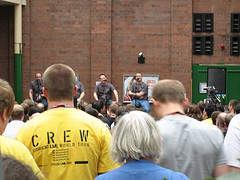
MJ Ray: LugRadio Live Event Review, Part Web2.0


LUGRadioLive 2008 by sheilaellen (cc-by-2.0) One aspect I didn’t mention in the LugRadio Live Event Review was how old-fashioned it seemed in some ways. I guess I’ve got used to seeing conferences experimenting with various web2.0 toys like live-blogging, feedback walls and so on, or the excellent live video streaming of DebConfs, but it was a bit of a surprise to find myself the only person in the audience who connected to the IRC channel from the event. One possible reason for that was that the wireless network was a bit difficult, or at least that was what I was told. I felt quite smug with my 3G smartphone IRC client (which I’ll blog about later) until Rufus Pollock mentioned the 800+ patents involved in 3G. Damn - I guess I hate freedom. In one way, I guess it’s appropriate if the network wasn’t up to the task. Broken networks were a regular feature of early ALUG meetings, as the end of this email hints. Web2.0 was there a little bit. There was a facebook page (which I accidentally spammed while travelling to the event), flickr:lugradiolive and a twitter link of #lugradiolive - but how does that work? There’s no user called lugradiolive and you can’t have usernames containing # Update: twitter:#lugradiolive (thanks to Dave Briggs for the explanation in a comment). Anyway, seeing as there will be another LUG Radio Live, maybe we can arrange something more interactive but free-software-friendly for 2009? More reviews I’ve read: davee: Lugradio-in makes me feel good , Peter Cannon: The party’s over for LugRadio Live and No’: Lugradio Undead - but why aren’t more people writing about this event? There seemed to be enough there. Or are they out there but I’m just not seeing them?

22 July 2008

Russell Coker: Bad Telstra

77020 packets transmitted, 18029 received, 76% packet loss, time 77049435ms
rtt min/avg/max/mdev = 20.026/130.848/2245.752/287.550 ms, pipe 3 Above are the ping results from pinging my server (hosted on a business DSL connection). Telstra stuffed up and appear to have entirely disconnected DSL for a few suburbs (based on reports from a client who has several clients in that region that all went offline simultaneously). It’s affected at least two ISPs (every DSL service uses Telstra’s backbone). The above ping results show almost 17 hours of outage, but it was really more like 18 (I didn’t start pinging until I realised it was down). Telstra’s response to the problem reports (which my client raised via two ISPs) was that it would take until the end of the next business day. The problem was reported at 10AM, so Telstra was apparently happy with two entire business days of outage. I think that the root cause of such problems is the terrible performance of Sol Trujillo [1] (or “Telstra’s Sole True Hero” as suggested in Crikey [2]). Under Sol’s leadership Telstra stock has not performed well (it’s a monopoly - it’s supposed to reap money), it’s lost market share in every area where competition is permitted and it hasn’t made it’s customers happy. Sol is taking an approach to business that works well for some big companies in the US (and for the mining and automative industries in Australia). He has been trying to force the government to extend the Telstra monopoly with the Fibre To The Node (FTTN) plan [3]. His idea was to have small Telstra boxes (nodes) spread around the suburbs with short copper runs to each home, each node would have absolutely no spare space for other ISP equipment and therefore the other ISPs would not be able to provide a service. The claim was that FTTN was needed for decent performance but ADSL2+ has been shown to work well in the areas where FTTN was proposed. Telstra even sent out brochures to stock-holders encouraging them to lobby members of Parliament on behalf of Telstra’s rent seeking [4]. However Australia is not like the US and this didn’t work, they couldn’t even get Telstra stock holders to support such plans. Speaking for myself, my interests as a Telstra stock-holder (and I own more Telstra shares than the median stock holder) are vastly outweighed by my interests as a consumer of telecommunications services. I would like to see the government nationalise the local loop and the exchange buildings and then provide fair and equal access to all telephone companies and ISPs (including Telstra). Then we can have true competition in this market and the companies that provide the best services will win. Currently Telstra resembles one of those inefficient Soviet monopolies. We need some capitalism in the telco industry!

21 July 2008

Runa Sandvik: Solskogen 2008: Shades in the sun

Friday morning was not much fun compared to the rest of the weekend. I rushed to the bus stop only to wait in the rain for ten minutes. All of a sudden a bird decided to dump its crap on me, leaving me with no jacket and only one pair of pants for the whole weekend. And then, just to top it all, the bus driver failed to see me - meaning I had to wait twenty minutes for the next bus. It quickly became much better once we got to Oslo; picked up a friend at the airport, met up with some other people at the train station, bought a tent and even managed to get on the train to s in time. During the weekend I learned that Kock sf l ny l is super cute, that Norwegian girls speaking Swedish sounds funny, that I should bring more warm clothes next time and to stay away from birds in the future. There’s a lot of moments that I’m never going to forget. Like spending four hours putting up a tent, the Danes dropping their pants, the free-beer-button, the moomin laptop and, of course, Duckers in a girly Outracks shirt. And there’s also one moment I won’t forget - but would like to; being hit on by a drunk, Finnish guy (Hi Sauli!) who wouldn’t take no for an answer. I must admit that I missed the wild compo because sleeping on the floor seemed like a good idea at the time. Even though every bone in my body hurt the next morning, I don’t regret it. Maybe I’ll just blame that on free alcohol and the organizers being late with the compos. I did have a great time with awesome people. The party was everything I hoped for and more.

Benjamin Mako Hill: OSCON and More

I'm in Portland, Oregon for the week where I'll be at OSCON. I'll be giving two talks on the final day of the conference (July 25): the first will be a 15 minute keynote on Revealing Errors at 8:45 in the Portland Ballroom; the second is a full-length normal talk on Selectricity at 11:35AM in Portland 255. It will be my first long-form talk about Selectricity and I'm looking forward to it. Because myself, a few Free Software Foundation staff members including Campaign Manager Joshua Gay, and quite a few FSF associate members will be in town, we're going to hold a small FSF Associate Members event in Portland (the first outside Boston!). It's going to be in the form of a pizza party with a few small talks from FSF folk including myself. Here are the details:

FSF Associate Members (& friends!) Event
July 22nd 6:30-9:00PM
Old Town Pizza
226 NW Davis St
Portland, OR 97209
It's free and open to all but is designed to provide a forum for members and friends. If you are an FSF member, please consider coming. If you're not a member yet, please don't let it keep you away; staff will be able to sign up new members there. RSVPs to Deborah Nicholson aren't necessary to attend but would be welcome. I'll be heading to Seattle right after the conference for a few days. If you would like to meet up in Seattle or Portland this week, please don't hesitate to get in contact.

20 July 2008

Christian Perrier: D-I (and related stuff) l10n completion

Last news I gave for D-I and related stuff l10n completion was on June 15th. We're now one month later, so let's see what happened since then. D-I "level 1" (ie the core D-I) had several templates changes which bringed the translation ratio from 100% to 99% and below several times, for all languages. Several teams have still been able to cope with that. Other levels had no changes and I therefore spent some time nagging them to complete the missing bits here and there. The current status is: Changes are still planned for level 1: D-I developers are really active these days, particularly with the great "come back" of J r my Bobbio and the constant QA work by Frans Pop. I also tried to merge in some work done in Ubuntu's Rosetta and then interest those people who translate there to collaborate to D-I "upstream". This lead me to merge updates for Icelandic, Kazakh, Afrikaans, Malay, Welsh and Serbian. Contacts were made with the relevant translators: My conclusion about all this is mitigated: I'm somewhat sorry to see some work happening in Rosetta, still without any connection with "upstream" work, with people apparently working without even some internal coordination and quite anonymously. I wonder if these people know that their work has few chances to end up anywhere, except in Ubuntu (for D-I translation, I even doubt it ends up somewhere: this is just unused work....until I grab it for D-I "suptream").

19 July 2008

Bastian Venthur: Rng 1.0 in unstable

I’ve finished the porting of rng from qt3 to qt4 and uploaded it to unstable. It has some minor regressions compared to the qt3 version, like the localization of the qt4 widgets which isn’t working yet and that the column which sorts the table isn’t saved and restored properly on startup, but it closes many other bugs and it doesn’t crash anymore. The new version doesn’t bring so much new features so far, but since it’s using much of the stuff which came with QT4, like the QTableModel and the QWebView, it runs much faster in many cases, e.g. when sorting or filtering the table. Ah, and last but but not least: thanks to WebKit rng even passes acid1 and acid2. Doesn’t yet pass acid3 but I guess someone is already working on it :) rng passing acid2

18 July 2008

Nicolas Valc rcel: Augeas

I’ve been writing a lot about Augeas and all the process i go through to get it included in debian/ubuntu. It seems that a lot of people was following it, but some of them don’t actually understand the whole picture and what is augeas for, so i’ve been asked to write a post explaining what it is, so here we go: From the upstream homepage:
Augeas is a configuration editing tool. It parses configuration files in their native formats and transforms them into a tree. Configuration changes are made by manipulating this tree and saving it back into native config files.
Actually, it is a library which does all that stuff and can be manipulated using its public API. But what does this actually means? I will explain it using augtool and /etc/hosts as an example. As you might know it has the information of the host names and their IP addresses, so let’s take this hosts as an example:
127.0.0.1 localhost localhost.localdomain host.domain
After parsing it on augeas we will end with:
/files/etc/hosts/
- - - - - - - - - - - 1/
- - - - - - - - - - - - ipaddr = 127.0.0.1
- - - - - - - - - - - - canonical = localhost
- - - - - - - - - - - - alias = localhost.localdomain
- - - - - - - - - - - - alias = host.domain
So, then we might want to change some values:
augtool> set /files/etc/hosts/1/alias[2] myhost.domain
Ending with:
/files/etc/hosts/
- - - - - - - - - - - 1/
- - - - - - - - - - - - ipaddr = 127.0.0.1
- - - - - - - - - - - - canonical = localhost
- - - - - - - - - - - - alias = localhost.localdomain
- - - - - - - - - - - - alias = myhost.domain
or add new values:
augtool> ins alias after /files/etc/hosts/1/alias[1]
what will turn into:
/files/etc/hosts/
- - - - - - - - - - - 1/
- - - - - - - - - - - - ipaddr = 127.0.0.1
- - - - - - - - - - - - canonical = localhost
- - - - - - - - - - - - alias = localhost.localdomain
- - - - - - - - - - - - alias
- - - - - - - - - - - - alias = myhost.domain
then we need to set a value since now it’s NULL:
augtool> set /files/etc/hosts/1/alias[2] myhost
ending like:
/files/etc/hosts/
- - - - - - - - - - - 1/
- - - - - - - - - - - - ipaddr = 127.0.0.1
- - - - - - - - - - - - canonical = localhost
- - - - - - - - - - - - alias = localhost.localdomain
- - - - - - - - - - - - alias = myhost
- - - - - - - - - - - - alias = myhost.domain
Then you can save it using:
augtool> save
Also you can add a new host, or whatever you want, just need to play with the tree. Ok, but how this Black Magic work and how can i expand it to read new configuration files? Augeas uses lenses which are a Meta Data type using regular expressions that is being used for parsing, reading and writing configuration files. If you want to play around with lenses you can check this step-by-step tutorial written by Raphael Pinson (Thank you!)

17 July 2008

Gunnar Wolf: Kept silent for a week...

Last week (July 7-13) was basically hell on Earth, for me and for the group that somehow got the name Cabras locas, of which I am part since I joined the National Pedagogical University, where I worked full-time 2003-2005.
It was, yes, the first of my officially three weeks of Summer holiday at IIEc-UNAM, so no problems here. So, why hell on Earth? Because we were in charge basically of anything related with information flow, retrieval and manipulation at the 11th International Congress on Mathematical Education, in Monterrey.
What we thought would basically be one or two days of hard work followed by six days of relaxed vacations (we had even planned to have an internal seminar, showing off the shiny stuff each of us is working on) became... A mind-boggling eight day experience where we worked over 12 hours a day on being human replacements for Google, SQL engines, full-text parsers, report generators, printer watchdogs, and in general lines, just a bunch of unhappy firemen, ready to be called off for whatever task was necessary.
We did have, of course, several calm periods every now and then. We even had to learn how to look busy while doing something compeltely unrelated (that would explain, for example, a couple of low-hanging bugs I fixed for Debian, or some dozens of lines of code I could get off my head).
But my advice for whoever reads this: Don't trust people with long database-handling experience. Specially when they insist that hand-capturing a thousand registers is preferrable (i.e. less error-prone) than parsing three separate databases and discarding duplicates. And, of course, specially when this person is your boss, which is enough of an argument to have it his way.

MJ Ray: Batting Against Three Strikes through the Back Door

One of the reasons that I didn’t post much last week was that I was contacting some of my MEPs as part of the Telecom Packet Action in order to help defend cooperative software distribution and use. This is a bit longer than my usual posts and no software is announced below, but I’m posting it here in the hope that more people will take part in this campaign that affects every EU internet user. In short, some MEPs that I remember from the Software Patent campaign proposed amendments that would enable the unpopular three-strikes regime, where internet users could be disconnected and fined if they had three allegations of copyright infringement made (not necessarily proved AIUI) against them, and ISPs could be required to block legal peer-to-peer cooperative distribution systems like BitTorrent. ISPs would also have to distribute official advice about proper internet use and I remember how good that often is. Note that three-strikes wasn’t explicit in the amendments, but there did appear to be loopholes which could be used to allow it, such as only prohibiting technical feature requirements. For longer descriptions, see articles by La Quadrature du Net (Squaring the Net) and The Open Rights Group. The UK Independence Party MEPs replied quickly that they would vote against, mainly because of the source of the legislation. I don’t completely agree with that, but at least UKIP does what it says on the tin. Neil Parish MEP of the Conservatives sent me back a reply which referred to unknown numbering (H1, K1 and so on) and generally seemed like a mish-mash of replies that other people had received. I replied with questions about several aspects, including asking where his numbering came from, and I’ve not seen an answer yet. I’ll email him again in a few days because it’s been over a week. I was really annoyed by the reported complaints by Malcolm Harbour (Conservatives lead MEP on this issue) about how voters have reacted to these amendments, where he called it “scaremongering” amongst other things. No mongering was required - those amendments are damn scary. See comments from a media solicitor at the end of a BBC report:-
“The amendment will cause several problems, firstly, many broadband users routinely transfer large files which are encrypted. “Many of these are acting quite legitimately and in order to determine whether or not such large files are or are not the produce of illicit file sharing the ISP will have to carry out an unprecedented degree of analysis of its customers’ traffic. “Furthermore, computers are frequently shared - within offices, within homes, within educational institutions and inadvertently, where wrong-doers “piggy back” on an inadequately secured Wi-Fi connection. “All this raises the spectre of people losing internet access - for reasons which are no fault of their own.”
The main thing that these actions over the last few years have taught me is the broken state of European Union decision-making. I know I’m sometimes dissatisfied with problems in local and civil democracy, but the EU is a good idea whose democracy and accountability seems broken on a massive scale. There are just too many disconnects, as far as the ordinary voter can see. We put things in to elections and consultations and get bizarre law-making like this. If we act to correct the bizarre law-making, some MEPs start criticising us quite severely. And what kind of stupid representative system allows the representatives to repeatedly blame the voters but still be safely elected because of their high position on their party’s list? I’d love a simple, reformist constitution that’s simple enough for people to actually understand, approve in referendums and participate in the EU effectively. I doubt it will happen in my lifetime, though.

16 July 2008

Stefano Zacchiroli: updating w3-recs

revamping w3-recs: new specs, misc improvements After quite a lot from my initial adoption, I've spent some time to update w3-recs. Beside the long overdue update of shipped recommendations (quite a few new specification was released, mostly related to SPARQL, but a few more have been edited, including CSS 1 and 2), I've also uploaded some pending improvements. A couple of bug fixes were about dangling links and registration of recommendations with the GNOME devhelp stuff. Additionally, I've also moved all the documents registered with doc-base under the new Help/Standards section of doc-base, which seems to be fit for W3C Recommendations. Apparently we have finally managed to have a proper section tree for doc-base, the decoupling of that tree from the Debian menu one will not be missed (at least not by me). During the process I've also discovered a (recent?) change in debhelper semantics. Thus far I used to have broken doc-base document IDs in w3-recs, as they contained uppercase letters, which are prohibited according to /usr/share/doc/doc-base/doc-base.txt.gz. My fault, I concur, but in the past the documents got installed anyhow without any problem. On the contrary, with the latest debhelper all documents got written to the very same file, apparently stripping away the part of their names which do not match the used lowercase regular expression. Well, not too bad, I fixed one more bug, but with a warning fixing that would have been quicker. Also, /me wonders, if everything (but package build :-) ) worked properly with uppercase document IDs, why the heck one should forbid them in the doc-base specification?

Russell Coker: Mobile SSH Client

There has been a lot of fuss recently about the release of the iPhone [1] in Australia. But I have not been impressed. I read an interesting post Why I don’t want an iPhone [2] which summarises some of the issues of it not being an open platform (and not having SSH client support). Given all the fuss about iPhones (which have just arrived in Australia) I had been thinking of writing my own post about this, but TK covered most of the issues that matter to me. One other thing I have to mention is the fact that I want a more fully powered PC with me. So even if I had a Green Phone (which doesn’t seem to be on general sale) [3] or OpenMoko [4] I would still want at least a PDA running Familiar and preferrably a laptop - I often carry both. A Nokia N8×0 series Internet Tablet [4] would satisfy my PDA needs (and also remove the need to carry an MP3/MP4 player and audio recorder). When doing serious travelling I carry a laptop, a PDA, and a MP3 player all areas of my digital needs are covered better than an iPhone could reasonably manage. Finally mobile phones tend to not work or not work well ($1 per minute calls is part of my definition of “not well”) in other countries. While I haven’t been doing a lot of traveling recently I still try to avoid buying things that won’t work in other countries. I had planned to just mention TK’s post in a links post. But then a client offered to buy me an iPhone. He wants me to be able to carry a ssh client with me most places that I go so that whenever his systems break I can login. Now apart from the lack of ssh client support an iPhone seems ideal. :-# The cheapest Optus iPhone plan seems to be $19 per month for calls and data (which includes 100M of data) and $21 per month over 24 months for the iPhone thus giving a cost of $40 per month for 100M of data transfer (and a nice phone). There is a plan ofr a $19 per month iPhone, but that has a $19 per month un-capped phone plan and doesn’t sound like a good way of saving $2 per month. The “Three” phone company offers USB 3G modems for $5 per month (on a 24 month contract) and their cheapest plan is $15 per month which gives you 1GB of data per month and $0.10/M for additional data transfer. So it’s $20 per month for 1G (which requires a laptop) vs $40 per month for 100M. Three also has a range of phone plans that allow 3G data access over bluetooth to a PC, it seems that a Nokia N8×0 tablet can be used with that which gives a result of two devices the size of mobile phones. But that costs $20 per month (on top of a regular Three bill) for a plan that offers 500M of data and still requires two devices while not giving the full PC benefits. In the past I’ve done a lot of support work with a Nokia Communicator, so I’ve found that anything less than a regular keyboard really slows things down. While a EeePC keyboard is not nearly as good as a full sized keyboard it is significantly better than a touch-screen keyboard on a PDA (IE the Nokia N8×0 or the OpenMoko). At the moment I’m looking at the option of carrying an EeePC with a USB Internet access device. That will cost $20 per month for net access. The cost of the EeePC is around $300 for a low-end model or about $650 for a 901 series that can run Xen (as noted in my previous post I’m considering the possibilities for having a mobile Xen simulation of a production network [5]). The savings of $20 per month over 24 months will entirely cover the cost of a low-end EeePC (ssh terminal, web browsing, and local storage of documentation) and cover most of the cost of a high-end EeePC. Another possibility to consider is using an old Toshiba Satellite I have hanging around (which I used to use as a mobile SE Linux demonstration machine) for a few months while the price on the EeePC 901 drops (as soon as the 70x series is entirely sold out and the 1000 series is available I expect that the 901 will get a lot cheaper).

15 July 2008

Sandro Tosi: Having fun fixing a bug (with ParallelPython)

Lenny general freeze is approaching, so I'm walking thru my packages bugs and I found this one reported against fdupes.

I got 4Gb of memory, so how to reproduce an OoM? Let's start with a rather large file base, but I need a script to generate it. With 4 cores and a fast Raptor hd, I want something to stess them while learning something: Python + ParallelPython was the answer!

I wrote a small script that takes 3 parameters: the destination directory, the number of dirs to create and the number of files (with random contents) to created inside each of the created dirs. I ran it with 1000 dirs and 1000 files, so it generated 1M files set to work on.

But even with so many files, fdupes ran fine... At that point I realized that ulimit could be my friend, and the "-v" option would have saved me some time, but without the fun to write the script :)

If you don't know pp, here is a little explanation of the main part of the script (I forgot to comment the script well enough):
ParallelPython is more powerful than this: for examples, it allows to send your jobs to job nodes, machine dedicated to execute tasks (while you keep your own machine as the administration one), and more! Give it a try ;)

Next.

Previous.