Search Results: "ag"

25 October 2016

Gunnar Wolf: On the results of vote "gr_private2"

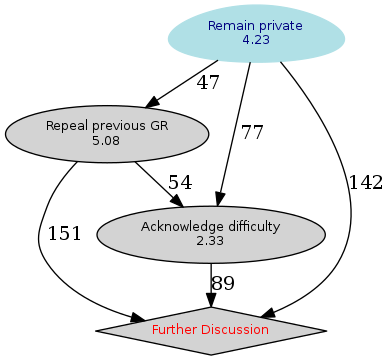
Given that I started the GR process, and that I called for discussion and votes, I feel somehow as my duty to also put a simple wrap-around to this process. Of course, I'll say many things already well-known to my fellow Debian people, but also non-debianers read this. So, for further context, if you need to, please read my previous blog post, where I was about to send a call for votes. It summarizes the situation and proposals; you will find we had a nice set of messages in debian-vote@lists.debian.org during September; I have to thank all the involved parties, much specially to Ian Jackson, who spent a lot of energy summing up the situation and clarifying the different bits to everyone involved. So, we held the vote; you can be interested in looking at the detailed vote statistics for the 235 correctly received votes, and most importantly, the results: Results for gr_private2 First of all, I'll say I'm actually surprised at the results, as I expected Ian's proposal (acknowledge difficulty; I actually voted this proposal as my top option) to win and mine (repeal previous GR) to be last; turns out, the winner option was Iain's (remain private). But all in all, I am happy with the results: As I said during the discussion, I was much disappointed with the results to the previous GR on this topic And, yes, it seems the breaking point was when many people thought the privacy status of posted messages was in jeopardy; we cannot really compare what I would have liked to have in said vote if we had followed the strategy of leaving the original resolution text instead of replacing it, but I believe it would have passed. In fact, one more surprise of this iteration was that I expected Further Discussion to be ranked higher, somewhere between the three explicit options. I am happy, of course, we got such an overwhelming clarity of what does the project as a whole prefer. And what was gained or lost with this whole excercise? Well, if nothing else, we gain to stop lying. For over ten years, we have had an accepted resolution binding us to release the messages sent to debian-private given such-and-such-conditions... But never got around to implement it. We now know that debian-private will remain private... But we should keep reminding ourselves to use the list as little as possible. For a project such as Debian, which is often seen as a beacon of doing the right thing no matter what, I feel being explicit about not lying to ourselves of great importance. Yes, we have the principle of not hiding our problems, but it has long been argued that the use of this list is not hiding or problems. Private communication can happen whenever you have humans involved, even if administratively we tried to avoid it. Any of the three running options could have won, and I'd be happy. My #1 didn't win, but my #2 did. And, I am sure, it's for the best of the project as a whole.

24 October 2016

Chris Lamb: Concorde

Today marks the 13th anniversary since the last passenger flight from New York arrived in the UK. Every seat was filled, a feat that had become increasingly rare for a plane that was a technological marvel but a commercial flop .


See also: A Rocket to Nowhere.

Reproducible builds folks: Reproducible Builds: week 78 in Stretch cycle

What happened in the Reproducible Builds effort between Sunday October 16 and Saturday October 22 2016: Media coverage Upcoming events buildinfo.debian.net In order to build packages reproducibly, you not only need identical sources but also some external definition of the environment used for a particular build. This definition includes the inputs and the outputs and, in the Debian case, are available in a $package_$architecture_$version.buildinfo file. We anticipate the next dpkg upload to sid will create .buildinfo files by default. Whilst it's clear that we also need to teach dak to deal with them (#763822) its not actually clear how to handle .buildinfo files after dak has processed them and how to make them available to the world. To this end, Chris Lamb has started development on a proof-of-concept .buildinfo server to see what issues arise. Source Reproducible work in other projects Packages reviewed and fixed, and bugs filed Reviews of unreproducible packages 99 package reviews have been added, 3 have been updated and 6 have been removed in this week, adding to our knowledge about identified issues. 6 issue types have been added: Weekly QA work During of reproducibility testing, some FTBFS bugs have been detected and reported by: diffoscope development tests.reproducible-builds.org Misc. Our poll to find a good time for an IRC meeting is still running until Tuesday, October 25st; please reply as soon as possible. We need a logo! Some ideas and requirements for a Reproducible Builds logo have been documented in the wiki. Contributions very welcome, even if simply by forwarding this information. This week's edition was written by Chris Lamb & Holger Levsen and reviewed by a bunch of Reproducible Builds folks on IRC.

Russ Allbery: Review: The Design of Everyday Things

Review: The Design of Everyday Things, by Don Norman
Publisher: Basic Books
Copyright: 2013
ISBN: 0-465-05065-4
Format: Trade paperback
Pages: 298
There are several editions of this book (the first under a different title, The Psychology of Everyday Things). This review is for the Revised and Expanded Edition, first published in 2013 and quite significantly revised compared to the original. I probably read at least some of the original for a class in human-computer interaction around 1994, but that was long enough ago that I didn't remember any of the details. I'm not sure how much impact this book has had outside of the computer field, but The Design of Everyday Things is a foundational text of HCI (human-computer interaction) despite the fact that many of its examples and much of its analysis is not specific to computers. Norman's goal is clearly to write a book that's fundamental to the entire field of design; not having studied the field, I don't know if he succeeded, but the impact on computing was certainly immense. This is the sort of book that everyone ends up hearing about, if not necessarily reading, in college. I was looking forward to filling a gap in my general knowledge. Having now read it cover-to-cover, would I recommend others invest the time? Maybe. But probably not. There are several things this book does well. One of the most significant is that it builds a lexicon and a set of general principles that provide a way of talking about design issues. Lexicons are not the most compelling reading material (see also Design Patterns), but having a common language is useful. I still remember affordances from college (probably from this book or something else based on it). Norman also adds, and defines, signifiers, constraints, mappings, and feedback, and talks about the human process of building a conceptual model of the objects with which one is interacting. Even more useful, at least in my opinion, is the discussion of human task-oriented behavior. The seven stages of action is a great systematic way of analyzing how humans perform tasks, where those actions can fail, and how designers can help minimize failure. One thing I particularly like about Norman's presentation here is the emphasis on the feedback cycle after performing a task, or a step in a task. That feedback, and what makes good or poor feedback, is (I think) an underappreciated part of design and something that too often goes missing. I thought Norman was a bit too dismissive of simple beeps as feedback (he thinks they don't carry enough information; while that's not wrong, I think they're far superior to no feedback at all), but the emphasis on this point was much appreciated. Beyond these dry but useful intellectual frameworks, though, Norman seems to have a larger purpose in The Design of Everyday Things: making a passionate argument for the importance of design and for not tolerating poor design. This is where I think his book goes a bit off the rails. I can appreciate the boosterism of someone who feels an aspect of creating products is underappreciated and underfunded. But Norman hammers on the unacceptability of bad design to the point of tedium, and seems remarkably intolerant of, and unwilling to confront, the reasons why products may be released with poor designs for their eventual users. Norman clearly wishes that we would all boycott products with poor designs and prize usability above most (all?) other factors in our decisions. Equally clearly, this is not happening, and Norman knows it. He even describes some of the reasons why not, most notably (and most difficultly) the fact that the purchasers of many products are not the eventual users. Stoves are largely sold to builders, not kitchen cooks. Light switches are laid out for the convenience of the electrician; here too, the motive for the builder to spend additional money on better lighting controls is unclear. So much business software is purchased by people who will never use it directly, and may have little or no contact with the people who do. These layers of economic separation result in deep disconnects of incentive structure between product manufacturers and eventual consumers. Norman acknowledges this, writes about it at some length, and then seems to ignore the point entirely, returning to ranting about the deficiencies of obviously poor design and encouraging people to care more about design. This seems weirdly superficial in this foundational of a book. I came away half-convinced that these disconnects of incentive (and some related problems, such as the unwillingness to invest in proper field research or the elaborate, expensive, and lengthy design process Norman lays out as ideal) are the primary obstacle in the way of better-designed consumer goods. If that's the case, then this is one of the largest, if not the largest, obstacle in the way of doing good design, and I would have expected this foundational of a book to tackle it head-on and provide some guidance for how to fight back against this problem. But Norman largely doesn't. There is some mention of this in the introduction. Apparently much of the discussion of the practical constraints on product design in the business world was added in this revised edition, and perhaps what I'm seeing is the limitations of attempting to revise an existing text. But that also implies that the original took an even harder line against poor design. Throughout, Norman is remarkably high-handed in his dismissal of bad design, focusing more on condemnation than on an investigation of why bad design might happen and what we, as readers, can learn from that process to avoid repeating it. Norman does provide extensive analysis of the design process and the psychology of human interaction, but still left me with the impression that he believes most design failures stem from laziness and stupidity. The negativity and frustration got a bit tedious by the middle of the book. There's quite a lot here that someone working in design, particularly interface design, should be at least somewhat familiar with: affordances, signifiers, the importance of feedback, the psychological model of tasks and actions, and the classification of errors, just to name a few. However, I'm not sure this book is the best medium for learning those things. I found it a bit tedious, a bit too arrogant, and weirdly unconcerned with feasible solutions to the challenge of mismatched incentives. I also didn't learn that much from it; while the concepts here are quite important, most of them I'd picked up by osmosis from working in the computing field for twenty years. In that way, The Design of Everyday Things reminded me a great deal of the Gang of Four's Design Patterns, even though it's a more readable book and less of an exercise in academic classification. The concepts presented are useful and important, but I'm not sure I can recommend the book as a book. It may be better to pick up the same concepts as you go, with the help of Internet searches and shorter essays. Rating: 6 out of 10

Dirk Eddelbuettel: Word Marathon Majors: Five Star Finisher!

A little over eight years ago, I wrote a short blog post which somewhat dryly noted that I had completed the five marathons constituting the World Marathon Majors. I had completed Boston, Chicago and New York during 2007, adding London and then Berlin (with a personal best) in 2008. The World Marathon Majors existed then, but I was not aware of a website. The organisation was aiming to raise the profile of the professional and very high-end aspect of the sport. But marathoning is funny as they let somewhat regular folks like you and me into the same race. And I always wondered if someone kept track of regular folks completing the suite... I have been running a little less the last few years, though I did get around to complete the Illinois Marathon earlier this year (only tweeted about it and still have not added anything to the running section of my blog). But two weeks ago, I was once again handing out water cups at the Chicago Marathon, sending along two tweets when the elite wheelchair and elite male runners flew by. To the first, the World Marathon Majors account replied, which lead me to their website. Which in turn lead me to the Five Star Finisher page, and the newer / larger Six Star Finisher page now that Tokyo has been added. And in short, one can now request one's record to be added (if they check out). So I did. And now I am on the Five Star Finisher page! I don't think I'll ever surpass that as a runner. The table header and my row look like this: Table header Dirk Eddelbuettel If only my fifth / sixth grade physical education teacher could see that---he was one of those early running nuts from the 1970s and made us run towards / around this (by now enlarged) pond and boy did I hate that :) Guess it did have some long lasting effects. And I casually circled the lake a few years ago, starting much further away from my parents place. Once you are in the groove for distance... But leaving that aside, running has been fun and I with some luck I may have another one or two marathons or Ragnar Relays left. The only really bad part about this is that I may have to get myself to Tokyo after all (for something that is not an ISM workshop) ...

This post by Dirk Eddelbuettel originated on his Thinking inside the box blog. Please report excessive re-aggregation in third-party for-profit settings.

Daniel Silverstone: Gitano - Approaching Release - Deprecated commands

As mentioned previously I am working toward getting Gitano into Stretch. Last time we spoke about lace, on which a colleague and friend of mine (Richard Maw) did a large pile of work. This time I'm going to discuss deprecation approaches and building more capability out of fewer features. First, a little background -- Gitano is written in Lua which is a deliberately small language whose authors spend more time thinking about what they can remove from the language spec than they do what they could add in. I first came to Lua in the 3.2 days, a little before 4.0 came out. (The authors provide a lovely timeline in case you're interested.) With each of the releases of Lua which came after 3.2, I was struck with how the authors looked to take a number of features which the language had, and collapse them into more generic, more powerful, smaller, fewer features. This approach to design stuck with me over the subsequent decade, and when I began Gitano I tried to have the smallest number of core features/behaviours, from which could grow the power and complexity I desired. Gitano is, at its core, a set of files in a single format (clod) stored in a consistent manner (Git) which mediate access to a resource (Git repositories). Some of those files result in emergent properties such as the concept of the 'owner' of a repository (though that can simply be considered the value of the project.owner property for the repository). Indeed the concept of the owner of a repository is a fiction generated by the ACL system with a very small amount of collusion from the core of Gitano. Yet until recently Gitano had a first class command set-owner which would alter that one configuration value.
[gitano]  set-description ---- Set the repo's short description (Takes a repo)
[gitano]         set-head ---- Set the repo's HEAD symbolic reference (Takes a repo)
[gitano]        set-owner ---- Sets the owner of a repository (Takes a repo)
Those of you with Gitano installations may see the above if you ask it for help. Yet you'll also likely see:
[gitano]           config ---- View and change configuration for a repository (Takes a repo)
The config command gives you access to the repository configuration file (which, yes, you could access over git instead, but the config command can be delegated in a more fine-grained fashion without having to write hooks). Given the config command has all the functionality of the three specific set-* commands shown above, it was time to remove the specific commands.

Migrating If you had automation which used the set-description, set-head, or set-owner commands then you will want to switch to the config command before you migrate your server to the current or any future version of Gitano. In brief, where you had:
ssh git@gitserver set-FOO repo something
You now need:
ssh git@gitserver config repo set project.FOO something
It looks a little more wordy but it is consistent with the other features that are keyed from the project configuration, such as:
ssh git@gitserver config repo set cgitrc.section Fooble Section Name
And, of course, you can see what configuration is present with:
ssh git@gitserver config repo show
Or look at a specific value with:
ssh git@gitserver config repo show specific.key
As always, you can get more detailed (if somewhat cryptic) help with:
ssh git@gitserver help config
Next time I'll try and touch on the new PGP/GPG integration support.

Francois Marier: Tweaking Referrers For Privacy in Firefox

The Referer header has been a part of the web for a long time. Websites rely on it for a few different purposes (e.g. analytics, ads, CSRF protection) but it can be quite problematic from a privacy perspective. Thankfully, there are now tools in Firefox to help users and developers mitigate some of these problems.

Description In a nutshell, the browser adds a Referer header to all outgoing HTTP requests, revealing to the server on the other end the URL of the page you were on when you placed the request. For example, it tells the server where you were when you followed a link to that site, or what page you were on when you requested an image or a script. There are, however, a few limitations to this simplified explanation. First of all, by default, browsers won't send a referrer if you place a request from an HTTPS page to an HTTP page. This would reveal potentially confidential information (such as the URL path and query string which could contain session tokens or other secret identifiers) from a secure page over an insecure HTTP channel. Firefox will however include a Referer header in HTTPS to HTTPS transitions unless network.http.sendSecureXSiteReferrer (removed in Firefox 52) is set to false in about:config. Secondly, using the new Referrer Policy specification web developers can override the default behaviour for their pages, including on a per-element basis. This can be used both to increase or reduce the amount of information present in the referrer.

Legitimate Uses Because the Referer header has been around for so long, a number of techniques rely on it. Armed with the Referer information, analytics tools can figure out:
  • where website traffic comes from, and
  • how users are navigating the site.
Another place where the Referer is useful is as a mitigation against cross-site request forgeries. In that case, a website receiving a form submission can reject that form submission if the request originated from a different website. It's worth pointing out that this CSRF mitigation might be better implemented via a separate header that could be restricted to particularly dangerous requests (i.e. POST and DELETE requests) and only include the information required for that security check (i.e. the origin).

Problems with the Referrer Unfortunately, this header also creates significant privacy and security concerns. The most obvious one is that it leaks part of your browsing history to sites you visit as well as all of the resources they pull in (e.g. ads and third-party scripts). It can be quite complicated to fix these leaks in a cross-browser way. These leaks can also lead to exposing private personally-identifiable information when they are part of the query string. One of the most high-profile example is the accidental leakage of user searches by healthcare.gov.

Solutions for Firefox Users While web developers can use the new mechanisms exposed through the Referrer Policy, Firefox users can also take steps to limit the amount of information they send to websites, advertisers and trackers. In addition to enabling Firefox's built-in tracking protection by setting privacy.trackingprotection.enabled to true in about:config, which will prevent all network connections to known trackers, users can control when the Referer header is sent by setting network.http.sendRefererHeader to:
  • 0 to never send the header
  • 1 to send the header only when clicking on links and similar elements
  • 2 (default) to send the header on all requests (e.g. images, links, etc.)
It's also possible to put a limit on the maximum amount of information that the header will contain by setting the network.http.referer.trimmingPolicy to:
  • 0 (default) to send the full URL
  • 1 to send the URL without its query string
  • 2 to only send the scheme, host and port
or using the network.http.referer.XOriginTrimmingPolicy option (added in Firefox 52) to only restrict the contents of referrers attached to cross-origin requests. Site owners can opt to share less information with other sites, but they can't share any more than what the user trimming policies allow. Another approach is to disable the Referer when doing cross-origin requests (from one site to another). The network.http.referer.XOriginPolicy preference can be set to:
  • 0 (default) to send the referrer in all cases
  • 1 to send a referrer only when the base domains are the same
  • 2 to send a referrer only when the full hostnames match

Breakage If you try to remove all referrers (i.e. network.http.sendRefererHeader = 0, you will most likely run into problems on a number of sites, for example: The first two have been worked-around successfully by setting network.http.referer.spoofSource to true, an advanced setting which always sends the destination URL as the referrer, thereby not leaking anything about the original page. Unfortunately, the last two are examples of the kind of breakage that can only be fixed through a whitelist (an approach supported by the smart referer add-on) or by temporarily using a different browser profile.

My Recommended Settings As with my cookie recommendations, I recommend strengthening your referrer settings but not disabling (or spoofing) it entirely. While spoofing does solve many the breakage problems mentioned above, it also effectively disables the anti-CSRF protections that some sites may rely on and that have tangible user benefits. A better approach is to limit the amount of information that leaks through cross-origin requests. If you are willing to live with some amount of breakage, you can simply restrict referrers to the same site by setting:
network.http.referer.XOriginPolicy = 2
or to sites which belong to the same organization (i.e. same ETLD/public suffix) using:
network.http.referer.XOriginPolicy = 1
This prevent leaks to third-parties while giving websites all of the information that they can already see in their own server logs. On the other hand, if you prefer a weaker but more compatible solution, you can trim cross-origin referrers down to just the scheme, hostname and port:
network.http.referer.XOriginTrimmingPolicy = 2
I have not yet found user-visible breakage using this last configuration. Let me know if you find any!

23 October 2016

Carl Chenet: PyMoneroWallet: the Python library for the Monero wallet

Do you know the Monero crytocurrency? It s a cryptocurrency, like Bitcoin, focused on the security, the privacy and the untracabily. That s a great project launched in 2014, today called XMR on all cryptocurrency exchange platforms (like Kraken or Poloniex). So what s new? In order to work with a Monero wallet from some Python applications, I just wrote a Python library to use the Monero wallet: PyMoneroWallet monero-logo Using PyMoneroWallet is as easy as:
$ python3
>>> from monerowallet import MoneroWallet
>>> mw = MoneroWallet()
>>> mw.getbalance()
 'unlocked_balance': 2262265030000, 'balance': 2262265030000 
Lots of features are included, you should have a look at the documentation of the monerowallet module to know them all, but quickly here are some of them: And so on. Have a look at the complete documentation for extensive available functions. UPDATE: I m trying to launch a crowdfunding of the PyMoneroWallet project. Feel free to comment in this thread of the official Monero forum to let them know you think that PyMoneroWallet is a great idea  Feel free to contribute to this starting project to help spreading the Monero use by using the PyMoneroWallet project with your Python applications

Vincent Sanders: Rabbit of Caerbannog

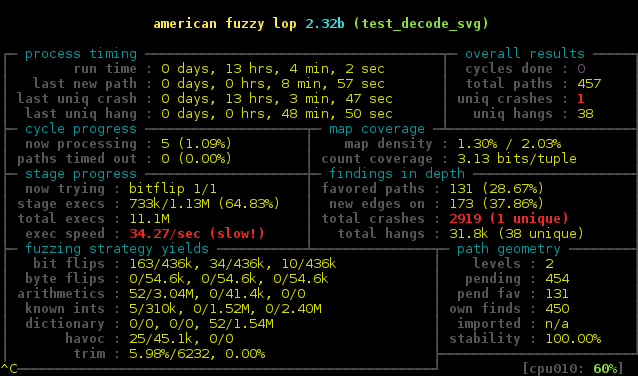
Subsequent to my previous use of American Fuzzy Lop (AFL) on the NetSurf bitmap image library I applied it to the gif library which, after fixing the test runner, failed to produce any crashes but did result in a better test corpus improving coverage above 90%

I then turned my attention to the SVG processing library. This was different to the bitmap libraries in that it required parsing a much lower density text format and performing operations on the resulting tree representation.

The test program for the SVG library needed some improvement but is very basic in operation. It takes the test SVG, parses it using libsvgtiny and then uses the parsed output to write out an imagemagick mvg file.

The libsvg processing uses the NetSurf DOM library which in turn uses an expat binding to parse the SVG XML text. To process this with AFL required instrumenting not only the XVG library but the DOM library. I did not initially understand this and my first run resulted in a "map coverage" indicating an issue. Helpfully the AFL docs do cover this so it was straightforward to rectify.

Once the test program was written and environment set up an AFL run was started and left to run. The next day I was somewhat alarmed to discover the fuzzer had made almost no progress and was running very slowly. I asked for help on the AFL mailing list and got a polite and helpful response, basically I needed to RTFM.

I must thank the members of the AFL mailing list for being so helpful and tolerating someone who ought to know better asking dumb questions.

After reading the fine manual I understood I needed to ensure all my test cases were as small as possible and further that the fuzzer needed a dictionary as a hint to the file format because the text file was of such low data density compared to binary formats.

Rabbit of Caerbannog. Death awaits you with pointy teeth
I crafted an SVG dictionary based on the XML one, ensured all the seed SVG files were as small as possible and tried again. The immediate result was thousands of crashes, nothing like being savaged by a rabbit to cause a surprise.

Not being in possession of the appropriate holy hand grenade I resorted instead to GDB and electric fence. Unlike the bitmap library crashes memory bounds issues simply did not feature in the crashes.Instead they mainly centered around actual logic errors when constructing and traversing the data structures.

For example Daniel Silverstone fixed an interesting bug where the XML parser binding would try and go "above" the root node in the tree if the source closed more tags than it opened which resulted in wild pointers and NULL references.

I found and squashed several others including dealing with SVG which has no valid root element and division by zero errors when things like colour gradients have no points.

I find it interesting that the type and texture of the crashes completely changed between the SVG and binary formats. Perhaps it is just the nature of the textural formats that causes this although it might be due to the techniques used to parse the formats.

Once all the immediately reproducible crashes were dealt with I performed a longer run. I used my monster system as previously described and ran the fuzzer for a whole week.

Summary stats
=============

Fuzzers alive : 10
Total run time : 68 days, 7 hours
Total execs : 9268 million
Cumulative speed : 15698 execs/sec
Pending paths : 0 faves, 2501 total
Pending per fuzzer : 0 faves, 250 total (on average)
Crashes found : 9 locally unique

After burning almost seventy days of processor time AFL found me another nine crashes and possibly more importantly a test corpus that generates over 90% coverage.

A useful tool that AFL provides is afl-cmin. This reduces the number of test files in a corpus to only those that are required to exercise all the code paths reached by the test set. In this case it reduced the number of files from 8242 to 2612

afl-cmin -i queue_all/ -o queue_cmin -- test_decode_svg @@ 1.0 /dev/null
corpus minimization tool for afl-fuzz by

[+] OK, 1447 tuples recorded.
[*] Obtaining traces for input files in 'queue_all/'...
Processing file 8242/8242...
[*] Sorting trace sets (this may take a while)...
[+] Found 23812 unique tuples across 8242 files.
[*] Finding best candidates for each tuple...
Processing file 8242/8242...
[*] Sorting candidate list (be patient)...
[*] Processing candidates and writing output files...
Processing tuple 23812/23812...
[+] Narrowed down to 2612 files, saved in 'queue_cmin'.

Additionally the actual information within the test files can be minimised with the afl-tmin tool. This must be run on each file individually and can take a relatively long time. Fortunately with GNU parallel one can run many of these jobs simultaneously which merely required another three days of CPU time to process. The resulting test corpus weighs in at a svelte 15 Megabytes or so against the 25 Megabytes before minimisation.

The result is yet another NetSurf library significantly improved by the use of AFL both from finding and squashing crashing bugs and from having a greatly improved test corpus to allow future library changes with a high confidence there will not be any regressions.

Jaldhar Vyas: What I Did During My Summer Vacation

Thats So Raven If I could sum up the past year in one word, that word would be distraction. There have been so many strange, confusing or simply unforseen things going on I have had trouble focusing like never before. For instance, on the opposite side of the street from me is one of Jersey City's old resorvoirs. It's not used for drinking water anymore and the city eventually plans on merging it into the park on the other side. In the meantime it has become something of a wildlife refuge. Which is nice except one of the newly settled critters was a bird of prey -- the consensus is possibly some kind of hawk or raven. Starting your morning commute under the eyes of a harbinger of death is very goth and I even learned to deal with the occasional piece of deconstructed rodent on my doorstep but nighttime was a big problem. For contrary to popular belief, ravens do not quoth "nevermore" but "KRRAAAA". Very loudly. Just as soon as you have drifted of to sleep. Eventually my sleep-deprived neighbors and I appealed to the NJ division of enviromental protection to get it removed but by the time they were ready to swing into action the bird had left for somewhere more congenial like Transylvania or Newark. Or here are some more complete wastes of time: I go the doctor for my annual physical. The insurance company codes it as Adult Onset Diabetes by accident. One day I opened the lid of my laptop and there's a "ping" sound and a piece of the hinge flies off. Apparently that also severed the connection to the screen and naturally the warranty had just expired so I had to spend the next month tethered to an external monitor until I could afford to buy a new one. Mix in all the usual social, political, family and work drama and you can see that it has been a very trying time for me. Dovecot I have managed to get some Debian work done. On Dovecot, my principal package, I have gotten tremendous support from Apollon Oikonomopolous who I belatedly welcome as a member of the Dovecot maintainer team. He has been particularly helpful in fixing our systemd support and cleaning out a lot of the old and invalid bugs. We're in pretty good shape for the freeze. Upstream has released an RC of 2.2.26 and hopefully the final version will be out in the next couple of days so we can include it in Stretch. We can always use more help with the package so let me know if you're interested. Debian-IN Most of the action has been going on without me but I've been lending support and sponsoring whenever I can. We have several new DDs and DMs but still no one north of the Vindhyas I'm afraid. Debian Perl Group gregoa did a ping of inactive maintainers and I regretfully had to admit to myself that I wasn't going to be of use anytime soon so I resigned. Perl remains my favorite language and I've actually been more involved in the meetings of my local Perlmongers group so hopefully I will be back again one day. And I still maintain the Perl modules I wrote myself. Debian-Axe-Murderers* May have gained a recruit. *Stricly speaking it should be called Debian-People-Who-Dont-Think-Faults-in-One-Moral-Domain-Such-As-For-Example-Axe-Murdering-Should-Leak-Into-Another-Moral-Domain-Such-As-For-Example-Debian but come on, that's just silly.

22 October 2016

Ingo Juergensmann: Automatically update TLSA records on new Letsencrypt Certs

I've been using DNSSEC for some quite time now and it is working quite well. When LetsEncrypt went public beta I jumped on the train and migrated many services to LE-based TLS. However there was still one small problem with LE certs: When there is a new cert, all of the old TLSA resource records are not valid anymore and might give problems to strict DNSSEC checking clients. It took some while until my pain was big enough to finally fix it by some scripts. There are at least two scripts involved: 1) dnssec.sh
This script does all of my DNSSEC handling. You can just do a "dnssec.sh enable-dnssec domain.tld" and everything is configured so that you only need to copy the appropriate keys into the webinterface of your DNS registry.
host:~/bin# dnssec.sh
No parameter given.
Usage: dnsec.sh MODE DOMAIN
MODE can be one of the following:
enable-dnssec : perform all steps to enable DNSSEC for your domain
edit-zone     : safely edit your zone after enabling DNSSEC
create-dnskey : create new dnskey only
load-dnskey   : loads new dnskeys and signs the zone with them
show-ds       : shows DS records of zone
zoneadd-ds    : adds DS records to the zone file
show-dnskey   : extract DNSKEY record that needs to uploaded to your registrar
update-tlsa   : update TLSA records with new TLSA hash, needs old and new TLSA hashes as additional parameters
For updating zone-files just do a "dnssech.sh edit-zone domain.tld" to add new records and such and the script will take care e.g. of increasing the serial of the zone file. I find this very convenient, so I often use this script for non-DNSSEC-enabled domains as well. However you can spot the command line option "update-tlsa". This option needs the old and the new TLSA hashes beside the domain.tld parameter. However, this option is used from the second script: 2) check_tlsa.sh
This is a quite simple Bash script that parses the domains.txt from letsencrypt.sh script, looking up the old TLSA hash in the zone files (structured in TLD/domain.tld directories), compare the old with the new hash (by invoking tlsagen.sh) and if there is a difference in hashes, call dnssec.sh with the proper parameters:
#!/bin/bash
set -e
LEPATH="/etc/letsencrypt.sh"
for i in  cat /etc/letsencrypt.sh/domains.txt   awk ' print $1 '  ; do
  domain= echo $i   awk 'BEGIN  FS="."  ;  print $(NF-1)"."$NF ' 
  #echo -n "Domain: $domain"
  TLD= echo $i   awk 'BEGIN  FS="." ;  print $NF ' 
  #echo ", TLD: $TLD"
  OLDTLSA= grep -i "in.*tlsa" /etc/bind/$ TLD /$ domain    grep $ i    head -n 1   awk ' print $NF ' 
  if [ -n "$ OLDTLSA " ] ; then
  #echo "--> $ OLDTLSA "
  # Usage: tlsagen.sh cert.pem host[:port] usage selector mtype
  NEWTLSA= /path/to/tlsagen.sh $LEPATH/certs/$ i /fullchain.pem $ i  3 1 1   awk ' print $NF ' 
  #echo "==> $NEWTLSA"
  if [ "$ OLDTLSA " != "$ NEWTLSA " ] ; then
  /path/to/dnssec.sh update-tlsa $ domain  $ OLDTLSA  $ NEWTLSA  > /dev/null
  echo "TLSA RR update for $ i "
  fi
  fi
done
So, quite simple and obviously a quick hack. For sure someone else can write a cleaner and more sophisticated implementation to do the same stuff, but at least it works for meTM. Use it on your own risk and do whatever you want with these scripts (licensed under public domain). You can invoke check_tlsa.sh right after your crontab call for letsencrypt.sh. In a more sophisticated way it should be fairly easy to invoke these scripts from letsencrypt.sh post hooks as well.
Please find the files attached to this page (remove the .txt extension after saving, of course).
AttachmentSize
check_tlsa.sh.txt812 bytes
dnssec.sh.txt3.88 KB
Kategorie:

Matthieu Caneill: Debugging 101

While teaching this semester a class on concurrent programming, I realized during the labs that most of the students couldn't properly debug their code. They are at the end of a 2-year cursus, know many different programming languages and frameworks, but when it comes to tracking down a bug in their own code, they often lacked the basics. Instead of debugging for them I tried to give them general directions that they could apply for the next bugs. I will try here to summarize the very first basic things to know about debugging. Because, remember, writing software is 90% debugging, and 10% introducing new bugs (that is not from me, but I could not find the original quote). So here is my take at Debugging 101. Use the right tools Many good tools exist to assist you in writing correct software, and it would put you behind in terms of productivity not to use them. Editors which catch syntax errors while you write them, for example, will help you a lot. And there are many features out there in editors, compilers, debuggers, which will prevent you from introducing trivial bugs. Your editor should be your friend; explore its features and customization options, and find an efficient workflow with them, that you like and can improve over time. The best way to fix bugs is not to have them in the first place, obviously. Test early, test often I've seen students writing code for one hour before running make, that would fail so hard that hundreds of lines of errors and warnings were outputted. There are two main reasons doing this is a bad idea: I recommend to test your code (compilation and execution) every few lines of code you write. When something breaks, chances are it will come from the last line(s) you wrote. Compiler errors will be shorter, and will point you to the same place in the code. Once you get more confident using a particular language or framework, you can write more lines at once without testing. That's a slow process, but it's ok. If you set up the right keybinding for compiling and executing from within your editor, it shouldn't be painful to test early and often. Read the logs Spot the places where your program/compiler/debugger writes text, and read it carefully. It can be your terminal (quite often), a file in your current directory, a file in /var/log/, a web page on a local server, anything. Learn where different software write logs on your system, and integrate reading them in your workflow. Often, it will be your only information about the bug. Often, it will tell you where the bug lies. Sometimes, it will even give you hints on how to fix it. You may have to filter out a lot of garbage to find relevant information about your bug. Learn to spot some keywords like error or warning. In long stacktraces, spot the lines concerning your files; because more often, your code is to be blamed, rather than deeper library code. grep the logs with relevant keywords. If you have the option, colorize the output. Use tail -f to follow a file getting updated. There are so many ways to grasp logs, so find what works best with you and never forget to use it! Print foobar That one doesn't concern compilation errors (unless it's a Makefile error, in that case this file is your code anyway). When the program logs and output failed to give you where an error occured (oh hi Segmentation fault!), and before having to dive into a memory debugger or system trace tool, spot the portion of your program that causes the bug and add in there some print statements. You can either print("foo") and print("bar"), just to know that your program reaches or not a certain place in your code, or print(some_faulty_var) to get more insights on your program state. It will give you precious information.
stderr >> "foo" >> endl;
my_db.connect(); // is this broken?
stderr >> "bar" >> endl;
In the example above, you can be sure it is the connection to the database my_db that is broken if you get foo and not bar on your standard error. (That is an hypothetical example. If you know something can break, such as a database connection, then you should always enclose it in a try/catch structure). Isolate and reproduce the bug This point is linked to the previous one. You may or may not have isolated the line(s) causing the bug, but maybe the issue is not always raised. It can depend on many other things: the program or function parameters, the network status, the amount of memory available, the decisions of the OS scheduler, the user rights on the system or on some files, etc. More generally, any assumption you made on any external dependency can appear to be wrong (even if it's right 99% of the time). According to the context, try to isolate the set of conditions that trigger the bug. It can be as simple as "when there is no internet connection", or as complicated as "when the CPU load of some external machine is too high, it's a leap year, and the input contains illegal utf-8 characters" (ok, that one is fucked up; but it surely happens!). But you need to reliably be able to reproduce the bug, in order to be sure later that you indeed fixed it. Of course when the bug is triggered at every run, it can be frustrating that your program never works but it will in general be easier to fix. RTFM Always read the documentation before reaching out for help. Be it man, a book, a website or a wiki, you will find precious information there to assist you in using a language or a specific library. It can be quite intimidating at first, but it's often organized the same way. You're likely to find a search tool, an API reference, a tutorial, and many examples. Compare your code against them. Check in the FAQ, maybe your bug and its solution are already referenced there. You'll rapidly find yourself getting used to the way documentation is organized, and you'll be more and more efficient at finding instantly what you need. Always keep the doc window open! Google and Stack Overflow are your friends Let's be honest: many of the bugs you'll encounter have been encountered before. Learn to write efficient queries on search engines, and use the knowledge you can find on questions&answers forums like Stack Overflow. Read the answers and comments. Be wise though, and never blindly copy and paste code from there. It can be as bad as introducing malicious security issues into your code, and you won't learn anything. Oh, and don't copy and paste anyway. You have to be sure you understand every single line, so better write them by hand; it's also better for memorizing the issue. Take notes Once you have identified and solved a particular bug, I advise to write about it. No need for shiny interfaces: keep a list of your bugs along with their solutions in one or many text files, organized by language or framework, that you can easily grep. It can seem slightly cumbersome to do so, but it proved (at least to me) to be very valuable. I can often recall I have encountered some buggy situation in the past, but don't always remember the solution. Instead of losing all the debugging time again, I search in my bug/solution list first, and when it's a hit I'm more than happy I kept it. Further reading degugging Remember this was only Debugging 101, that is, the very first steps on how to debug code on your own, instead of getting frustrated and helplessly stare at your screen without knowing where to begin. When you'll write more software, you'll get used to more efficient workflows, and you'll discover tools that are here to assist you in writing bug-free code and spotting complex bugs efficiently. Listed below are some of the tools or general ideas used to debug more complex software. They belong more to a software engineering course than a Debugging 101 blog post. But it's good to know as soon as possible these exist, and if you read the manuals there's no reason you can't rock with them! Don't hesitate to comment on this, and provide your debugging 101 tips! I'll be happy to update the article with valuable feedback. Happy debugging!

Iain R. Learmonth: The Domain Name System

As I posted yesterday, we released PATHspider 1.0.0. What I didn t talk about in that post was an event that occured only a few hours before the release. Everything was going fine, proofreading of the documentation was in progress, a quick git push with the documentation updates and CI FAILED!?! Our CI doesn t build the documentation, only tests the core code. I m planning to release real soon and something has broken. Starting to panic.
irl@orbiter# ./tests.sh
................
----------------------------------------------------------------------
Ran 16 tests in 0.984s
OK
This makes no sense. Maybe I forgot to add a dependency and it s been broken for a while? I scrutinise the dependencies list and it all looks fine. In fairness, probably the first thing I should have done is look at the build log in Jenkins, but I ve never had a failure that I couldn t reproduce locally before. It was at this point that I realised there was something screwy going on. A sigh of relief as I realise that there s not a catastrophic test failure but now it looks like maybe there s a problem with the University research group network, which is arguably worse. Being focussed on getting the release ready, I didn t realise that the Internet was falling apart. Unknown to me, a massive DDoS attack against Dyn, a major DNS host, was in progress. After a few attempts to debug the problem, I hardcoded a line into /etc/hosts, still believing it to be a localised issue.
192.30.253.112  github.com
I ve just removed this line as the problem seems to have resolved itself for now. There are two main points I ve taken away from this: This afternoon I read a post by [tj] on the 57North Planet, and this is where I learnt what had really happened. He mentions multicast DNS and Namecoin as distributed name system alternatives. I d like to add some more to that list: Only the first of these is really a distributed solution. My idea with ICMP Domain Name Messages is that you send an ICMP message to a webserver. Somewhere along the path, you ll hit either a surveillance or censorship middlebox. These middleboxes can provide value by caching any DNS replies that are seen so that an ICMP DNS request message will cause the message to not be forwarded but a reply is generated to provide the answer to the query. If the middlebox cannot generate a reply, it can still forward it to other surveillance and censorship boxes. I think this would be a great secondary use for the NSA and GCHQ boxen on the Internet, clearly fits within the scope of defending national security as if DNS is down the Internet is kinda dead, plus it d make it nice and easy to find the boxes with PATHspider.

Dirk Eddelbuettel: RcppArmadillo 0.7.500.0.0

armadillo image A few days ago, Conrad released Armadillo 7.500.0. The corresponding RcppArmadillo release 0.7.500.0.0 is now on CRAN (and will get into Debian shortly). Armadillo is a powerful and expressive C++ template library for linear algebra aiming towards a good balance between speed and ease of use with a syntax deliberately close to a Matlab. RcppArmadillo integrates this library with the R environment and language--and is widely used by (currently) 274 other packages on CRAN. Changes in this release relative to the previous CRAN release are as follows:

Changes in RcppArmadillo version 0.7.500.0.0 (2016-10-20)
  • Upgraded to Armadillo release 7.500.0 (Coup d'Etat)
    • Expanded qz() to optionally specify ordering of the Schur form
    • Expanded each_slice() to support matrix multiplication

Courtesy of CRANberries, there is a diffstat report. More detailed information is on the RcppArmadillo page. Questions, comments etc should go to the rcpp-devel mailing list off the R-Forge page.

This post by Dirk Eddelbuettel originated on his Thinking inside the box blog. Please report excessive re-aggregation in third-party for-profit settings.

Christoph Egger: Running Debian on the ClearFog

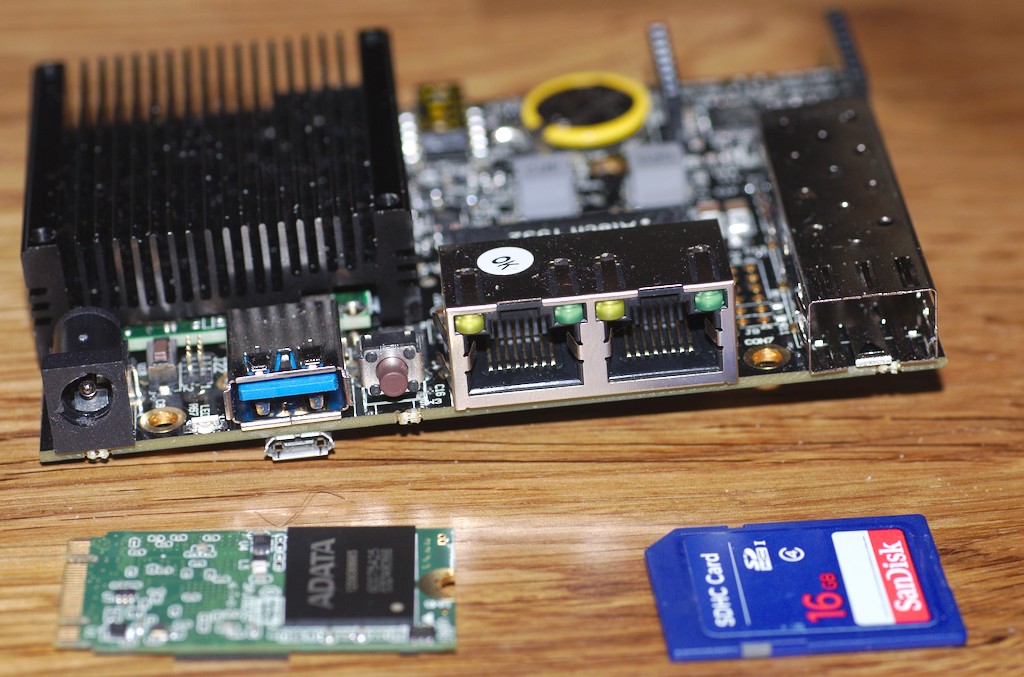
Back in August, I was looking for a Homeserver replacement. During FrOSCon I was then reminded of the Turris Omnia project by NIC.cz. The basic SoC (Marvel Armada 38x) seemed to be nice hand have decent mainline support (and, with the turris, users interested in keeping it working). Only I don't want any WIFI and I wasn't sure the standard case would be all that usefully. Fortunately, there's also a simple board available with the same SoC called ClearFog and so I got one of these (the Base version). With shipping and the SSD (the only 2242 M.2 SSD with 250 GiB I could find, a ADATA SP600) it slightly exceeds the budget but well. ClearFog with SSD When installing the machine, the obvious goal was to use mainline FOSS components only if possible. Fortunately there's mainline kernel support for the device as well as mainline U-Boot. First attempts to boot from a micro SD card did not work out at all, both with mainline U-Boot and the vendor version though. Turns out the eMMC version of the board does not support any micro SD cards at all, a fact that is documented but others failed to notice as well. U-Boot As the board does not come with any loader on eMMC and booting directly from M.2 requires removing some resistors from the board, the easiest way is using UART for booting. The vendor wiki has some shell script wrapping an included C fragment to feed U-Boot to the device but all that is really needed is U-Boot's kwboot utility. For some reason the SPL didn't properly detect UART booting on my device (wrong magic number) but patching the if (in arch-mvebu's spl.c) and always assume UART boot is an easy way around. The plan then was to boot a Debian armhf rootfs with a defconfig kernel from USB stick. and install U-Boot and the rootfs to eMMC from within that system. Unfortunately U-Boot seems to be unable to talk to the USB3 port so no kernel loading from there. One could probably make UART loading work but switching between screen for serial console and xmodem seemed somewhat fragile and I never got it working. However ethernet can be made to work, though you need to set eth1addr to eth3addr (or just the right one of these) in U-Boot, saveenv and reboot. After that TFTP works (but is somewhat slow). eMMC There's one last step required to allow U-Boot and Linux to access the eMMC. eMMC is wired to the same PINs as the SD card would be. However the SD card has an additional indicator pin showing whether a card is present. You might be lucky inserting a dummy card into the slot or go the clean route and remove the pin specification from the device tree.

--- a/arch/arm/dts/armada-388-clearfog.dts
+++ b/arch/arm/dts/armada-388-clearfog.dts
@@ -306,7 +307,6 @@
                        sdhci@d8000  
                                bus-width = <4>;
-                               cd-gpios = <&gpio0 20 GPIO_ACTIVE_LOW>;
                                no-1-8-v;
                                pinctrl-0 = <&clearfog_sdhci_pins
                                             &clearfog_sdhci_cd_pins>;
Next Up is flashing the U-Boot to eMMC. This seems to work with the vendor U-Boot but proves to be tricky with mainline. The fun part boils down to the fact that the boot firmware reads the first block from eMMC, but the second from SD card. If you write the mainline U-Boot, which was written and tested for SD card, to eMMC the SPL will try to load the main U-Boot starting from it's second sector from flash -- obviously resulting in garbage. This one took me several tries to figure out and made me read most of the SPL code for the device. The fix however is trivial (apart from the question on how to support all different variants from one codebase, which I'll leave to the U-Boot developers):
--- a/include/configs/clearfog.h
+++ b/include/configs/clearfog.h
@@ -143,8 +143,7 @@
 #define CONFIG_SPL_LIBDISK_SUPPORT
 #define CONFIG_SYS_MMC_U_BOOT_OFFS             (160 << 10)
 #define CONFIG_SYS_U_BOOT_OFFS                 CONFIG_SYS_MMC_U_BOOT_OFFS
-#define CONFIG_SYS_MMCSD_RAW_MODE_U_BOOT_SECTOR        ((CONFIG_SYS_U_BOOT_OFFS / 512)\
-                                                + 1)
+#define CONFIG_SYS_MMCSD_RAW_MODE_U_BOOT_SECTOR        (CONFIG_SYS_U_BOOT_OFFS / 512)
 #define CONFIG_SYS_U_BOOT_MAX_SIZE_SECTORS     ((512 << 10) / 512) /* 512KiB */
 #ifdef CONFIG_SPL_BUILD
 #define CONFIG_FIXED_SDHCI_ALIGNED_BUFFER      0x00180000      /* in SDRAM */
Linux Now we have a System booting from eMMC with mainline U-Boot (which is a most welcome speedup compared to the UART and TFTP combination from the beginning). Getting to fine-tune linux on the device -- we want to install the armmp Debian kernel and have it work. As all the drivers are build as modules for that kernel this also means initrd support. Funnily U-Boots bootz allows booting a plain vmlinux kernel but I couldn't get it to boot a plain initrd. Passing a uImage initrd and a normal kernel however works pretty well. Back when I first tried there were some modules missing and ethernet didn't work with the PHY driver built as a module. In the meantime the PHY problem was fixed in the Debian kernel and almost all modules already added. Ben then only added the USB3 module on my suggestion and as a result, unstable's armhf armmp kernel should work perfectly well on the device (you still need to patch the device tree similar to the patch above). Still missing is an updated flash-kernel to automatically generate the initrd uImage which is work in progress but got stalled until I fixed the U-Boot on eMMC problem and everything should be fine -- maybe get debian u-boot builds for that board. Pro versus Base The main difference so far between the Pro and the Base version of the ClearFog is the switch chip which is included on the Pro. The Base instead "just" has two gigabit ethernet ports and a SFP. Both, linux' and U-Boot's device tree are intended for the Pro version which makes on of the ethernet ports unusable (it tries to find the switch behind the ethernet port which isn't there). To get both ports working (or the one you settled on earlier) there's a second patch to the device tree (my version might be sub-optimal but works), U-Boot -- the linux-kernel version is a trivial adaption:
--- a/arch/arm/dts/armada-388-clearfog.dts
+++ b/arch/arm/dts/armada-388-clearfog.dts
@@ -89,13 +89,10 @@
                internal-regs  
                        ethernet@30000  
                                mac-address = [00 50 43 02 02 02];
+                               managed = "in-band-status";
+                               phy = <&phy1>;
                                phy-mode = "sgmii";
                                status = "okay";
-
-                               fixed-link  
-                                       speed = <1000>;
-                                       full-duplex;
-                                ;
                         ;
                        ethernet@34000  
@@ -227,6 +224,10 @@
                                pinctrl-0 = <&mdio_pins>;
                                pinctrl-names = "default";
+                               phy1: ethernet-phy@1   /* Marvell 88E1512 */
+                                    reg = <1>;
+                                ;
+
                                phy_dedicated: ethernet-phy@0  
                                        /*
                                         * Annoyingly, the marvell phy driver
@@ -386,62 +386,6 @@
                tx-fault-gpio = <&expander0 13 GPIO_ACTIVE_HIGH>;
         ;
-       dsa@0  
-               compatible = "marvell,dsa";
-               dsa,ethernet = <&eth1>;
-               dsa,mii-bus = <&mdio>;
-               pinctrl-0 = <&clearfog_dsa0_clk_pins &clearfog_dsa0_pins>;
-               pinctrl-names = "default";
-               #address-cells = <2>;
-               #size-cells = <0>;
-
-               switch@0  
-                       #address-cells = <1>;
-                       #size-cells = <0>;
-                       reg = <4 0>;
-
-                       port@0  
-                               reg = <0>;
-                               label = "lan1";
-                        ;
-
-                       port@1  
-                               reg = <1>;
-                               label = "lan2";
-                        ;
-
-                       port@2  
-                               reg = <2>;
-                               label = "lan3";
-                        ;
-
-                       port@3  
-                               reg = <3>;
-                               label = "lan4";
-                        ;
-
-                       port@4  
-                               reg = <4>;
-                               label = "lan5";
-                        ;
-
-                       port@5  
-                               reg = <5>;
-                               label = "cpu";
-                        ;
-
-                       port@6  
-                               /* 88E1512 external phy */
-                               reg = <6>;
-                               label = "lan6";
-                               fixed-link  
-                                       speed = <1000>;
-                                       full-duplex;
-                                ;
-                        ;
-                ;
-        ;
-
        gpio-keys  
                compatible = "gpio-keys";
                pinctrl-0 = <&rear_button_pins>;
Conclusion Apart from the mess with eMMC this seems to be a pretty nice device. It's now happily running with a M.2 SSD providing enough storage for now and still has a mSATA/mPCIe plug left for future journeys. It seems to be drawing around 5.5 Watts with SSD and one Ethernet connected while mostly idle and can feed around 500 Mb/s from disk over an encrypted ethernet connection which is, I guess, not too bad. My plans now include helping to finish flash-kernel support, creating a nice case and probably get it deployed. I might bring it to FOSDEM first though. Working on it was really quite some fun (apart from the frustrating parts finding the one-block-offset ..) and people were really helpful. Big thanks here to Debian's arm folks, Ben Hutchings the kernel maintainer and U-Boot upstream (especially Tom Rini and Stefan Roese)

Matthew Garrett: Fixing the IoT isn't going to be easy

A large part of the internet became inaccessible today after a botnet made up of IP cameras and digital video recorders was used to DoS a major DNS provider. This highlighted a bunch of things including how maybe having all your DNS handled by a single provider is not the best of plans, but in the long run there's no real amount of diversification that can fix this - malicious actors have control of a sufficiently large number of hosts that they could easily take out multiple providers simultaneously.

To fix this properly we need to get rid of the compromised systems. The question is how. Many of these devices are sold by resellers who have no resources to handle any kind of recall. The manufacturer may not have any kind of legal presence in many of the countries where their products are sold. There's no way anybody can compel a recall, and even if they could it probably wouldn't help. If I've paid a contractor to install a security camera in my office, and if I get a notification that my camera is being used to take down Twitter, what do I do? Pay someone to come and take the camera down again, wait for a fixed one and pay to get that put up? That's probably not going to happen. As long as the device carries on working, many users are going to ignore any voluntary request.

We're left with more aggressive remedies. If ISPs threaten to cut off customers who host compromised devices, we might get somewhere. But, inevitably, a number of small businesses and unskilled users will get cut off. Probably a large number. The economic damage is still going to be significant. And it doesn't necessarily help that much - if the US were to compel ISPs to do this, but nobody else did, public outcry would be massive, the botnet would not be much smaller and the attacks would continue. Do we start cutting off countries that fail to police their internet?

Ok, so maybe we just chalk this one up as a loss and have everyone build out enough infrastructure that we're able to withstand attacks from this botnet and take steps to ensure that nobody is ever able to build a bigger one. To do that, we'd need to ensure that all IoT devices are secure, all the time. So, uh, how do we do that?

These devices had trivial vulnerabilities in the form of hardcoded passwords and open telnet. It wouldn't take terribly strong skills to identify this at import time and block a shipment, so the "obvious" answer is to set up forces in customs who do a security analysis of each device. We'll ignore the fact that this would be a pretty huge set of people to keep up with the sheer quantity of crap being developed and skip straight to the explanation for why this wouldn't work.

Yeah, sure, this vulnerability was obvious. But what about the product from a well-known vendor that included a debug app listening on a high numbered UDP port that accepted a packet of the form "BackdoorPacketCmdLine_Req" and then executed the rest of the payload as root? A portscan's not going to show that up[1]. Finding this kind of thing involves pulling the device apart, dumping the firmware and reverse engineering the binaries. It typically takes me about a day to do that. Amazon has over 30,000 listings that match "IP camera" right now, so you're going to need 99 more of me and a year just to examine the cameras. And that's assuming nobody ships any new ones.

Even that's insufficient. Ok, with luck we've identified all the cases where the vendor has left an explicit backdoor in the code[2]. But these devices are still running software that's going to be full of bugs and which is almost certainly still vulnerable to at least half a dozen buffer overflows[3]. Who's going to audit that? All it takes is one attacker to find one flaw in one popular device line, and that's another botnet built.

If we can't stop the vulnerabilities getting into people's homes in the first place, can we at least fix them afterwards? From an economic perspective, demanding that vendors ship security updates whenever a vulnerability is discovered no matter how old the device is is just not going to work. Many of these vendors are small enough that it'd be more cost effective for them to simply fold the company and reopen under a new name than it would be to put the engineering work into fixing a decade old codebase. And how does this actually help? So far the attackers building these networks haven't been terribly competent. The first thing a competent attacker would do would be to silently disable the firmware update mechanism.

We can't easily fix the already broken devices, we can't easily stop more broken devices from being shipped and we can't easily guarantee that we can fix future devices that end up broken. The only solution I see working at all is to require ISPs to cut people off, and that's going to involve a great deal of pain. The harsh reality is that this is almost certainly just the tip of the iceberg, and things are going to get much worse before they get any better.

Right. I'm off to portscan another smart socket.

[1] UDP connection refused messages are typically ratelimited to one per second, so it'll take almost a day to do a full UDP portscan, and even then you have no idea what the service actually does.

[2] It's worth noting that this is usually leftover test or debug code, not an overtly malicious act. Vendors should have processes in place to ensure that this isn't left in release builds, but ha well.

[3] My vacuum cleaner crashes if I send certain malformed HTTP requests to the local API endpoint, which isn't a good sign

comment count unavailable comments

Russell Coker: Another Broken Nexus 5

In late 2013 I bought a Nexus 5 for my wife [1]. It s a good phone and I generally have no complaints about the way it works. In the middle of 2016 I had to make a warranty claim when the original Nexus 5 stopped working [2]. Google s warranty support was ok, the call-back was good but unfortunately there was some confusion which delayed replacement. Once the confusion about the IMEI was resolved the warranty replacement method was to bill my credit card for a replacement phone and reverse the charge if/when they got the original phone back and found it to have a defect covered by warranty. This policy meant that I got a new phone sooner as they didn t need to get the old phone first. This is a huge benefit for defects that don t make the phone unusable as you will never be without a phone. Also if the user determines that the breakage was their fault they can just refrain from sending in the old phone. Today my wife s latest Nexus 5 developed a problem. It turned itself off and went into a reboot loop when connected to the charger. Also one of the clips on the rear case had popped out and other clips popped out when I pushed it back in. It appears (without opening the phone) that the battery may have grown larger (which is a common symptom of battery related problems). The phone is slightly less than 3 years old, so if I had got the extended warranty then I would have got a replacement. Now I m about to buy a Nexus 6P (because the Pixel is ridiculously expensive) which is $700 including postage. Kogan offers me a 3 year warranty for an extra $108. Obviously in retrospect spending an extra $100 would have been a benefit for the Nexus 5. But the first question is whether new phone going to have a probability greater than 1/7 of failing due to something other than user error in years 2 and 3? For an extended warranty to provide any benefit the phone has to have a problem that doesn t occur in the first year (or a problem in a replacement phone after the first phone was replaced). The phone also has to not be lost, stolen, or dropped in a pool by it s owner. While my wife and I have a good record of not losing or breaking phones the probability of it happening isn t zero. The Nexus 5 that just died can be replaced for 2/3 of the original price. The value of the old Nexus 5 to me is less than 2/3 of the original price as buying a newer better phone is the option I want. The value of an old phone to me decreases faster than the replacement cost because I don t want to buy an old phone. For an extended warranty to be a good deal for me I think it would have to cost significantly less than 1/10 of the purchase price due to the low probability of failure in that time period and the decreasing value of a replacement outdated phone. So even though my last choice to skip an extended warranty ended up not paying out I expect that overall I will be financially ahead if I keep self-insuring, and I m sure that I have already saved money by self-insuring all my previous devices.

21 October 2016

Iain R. Learmonth: PATHspider 1.0.0 released!

In today s Internet we see an increasing deployment of middleboxes. While middleboxes provide in-network functionality that is necessary to keep networks manageable and economically viable, any packet mangling whether essential for the needed functionality or accidental as an unwanted side effect makes it more and more difficult to deploy new protocols or extensions of existing protocols. For the evolution of the protocol stack, it is important to know which network impairments exist and potentially need to be worked around. While classical network measurement tools are often focused on absolute performance values, PATHspider performs A/B testing between two different protocols or different protocol extensions to perform controlled experiments of protocol-dependent connectivity problems as well as differential treatment. PATHspider is a framework for performing and analyzing these measurements, while the actual A/B test can be easily customized. Late on the 21st October, we released version 1.0.0 of PATHspider and it s ready for production use (whatever that means for Internet research software). Our first real release of PATHspider was version 0.9.0 just in time for the presentation of PATHspider at the 2016 Applied Networking Research Workshop co-located with IETF 96 in Berlin earlier this year. Since this release we have made a lot of changes and I ll talk about some of the highlights here (in no particular order):

Switch from twisted.plugin to straight.plugin While we anticipate that some plugins may wish to use some features of Twisted, we didn t want to have Twisted as a core dependency for PATHspider. We found that straight.plugin was not just a drop-in replacement but it simplified the way in which 3rd-party plugins could be developed and it was worth the effort for that alone.

Library functions for the Observer PATHspider has an embedded flow-meter (think something like NetFlow but highly customisable). We found that even with the small selection of plugins that we had we were duplicating code across plugins for these customisations of the flow-meter. In this release we now provide library functions for common needs such as identifying TCP 3-way handshake completions or identifying ICMP Unreachable messages for flows.

New plugin: DSCP We ve added a new plugin for this release to detect breakage when using DiffServ code points to achieve differentiated services within a network.

Plugins are now subcommands Using the subparsers feature of argparse, all plugins including 3rd-party plugins will now appear as subcommands to the PATHspider command. This makes every plugin a first-class citizen and makes PATHspider truly generalised. We have an added benefit from this that plugins can also ask for extra arguments that are specific to the needs of the plugin, for example the DSCP plugin allows the user to select which code point to send for the experimental test.

Test Suite PATHspider now has a test suite! As the size of the PATHspider code base grows we need to be able to make changes and have confidence that we are not breaking code that another module relies on. We have so far only achieved 54% coverage of the codebase but we hope to improve this for the next release. We have focussed on the critical portions of data collection to ensure that all the results collected by PATHspider during experiments is valid.

DNS Resolver Utility Back when PATHspider was known as ECNSpider, it had a utility for resolving IP addresses from the Alexa top 1 million list. This utility has now been fully integrated into PATHspider and appears as a plugin to allow for repeated experiments against the same IP addresses even if the DNS resolver would have returned a different addresss.

Documentation Documentation is definitely not my favourite activity, but it has to be done. PATHspider 1.0.0 now ships with documentation covering commandline usage, input/output formats and development of new plugins.
If you d like to check out PATHspider, you can find the website at https://pathspider.net/. Debian packages will be appearing shortly and will find their way into stable-backports within the next 2 weeks (hopefully). Current development of PATHspider is supported by the European Union s Horizon 2020 project MAMI. This project has received funding from the European Union s Horizon 2020 research and innovation programme under grant agreement No 688421. The opinions expressed and arguments employed reflect only the authors view. The European Commission is not responsible for any use that may be made of that information.

Dirk Eddelbuettel: anytime 0.0.4: New features and fixes

A brand-new release of anytime is now on CRAN following the three earlier releases since mid-September. anytime aims to convert anything in integer, numeric, character, factor, ordered, ... format to POSIXct (or Date) objects -- and does so without requiring a format string. See the anytime page for a few examples. With release 0.0.4, we add two nice new features. First, NA, NaN and Inf are now simply skipped (similar to what the corresponding Base R functions do). Second, we now also accept large numeric values so that, _e.g., anytime(as.numeric(Sys.time()) also works, effectively adding another input type. We also have squashed an issue reported by the 'undefined behaviour' sanitizer, and the widened the test for when we try to deploy the gettz package get missing timezone information. A quick example of the new features:
anydate(c(NA, NaN, Inf, as.numeric(as.POSIXct("2016-09-01 10:11:12"))))
[1] NA           NA           NA           "2016-09-01"
The NEWS file summarises the release:

Changes in anytime version 0.0.4 (2016-10-20)
  • Before converting via lexical_cast, assign to atomic type via template logic to avoid an UBSAN issue (PR #15 closing issue #14)
  • More robust initialization and timezone information gathering.
  • More robust processing of non-finite input also coping with non-finite values such as NA, NaN and Inf which all return NA
  • Allow numeric POSIXt representation on input, also creating proper POSIXct (or, if requested, Date)

Courtesy of CRANberries, there is a comparison to the previous release. More information is on the anytime page. For questions or comments use the issue tracker off the GitHub repo.

This post by Dirk Eddelbuettel originated on his Thinking inside the box blog. Please report excessive re-aggregation in third-party for-profit settings.

20 October 2016

Kees Cook: CVE-2016-5195

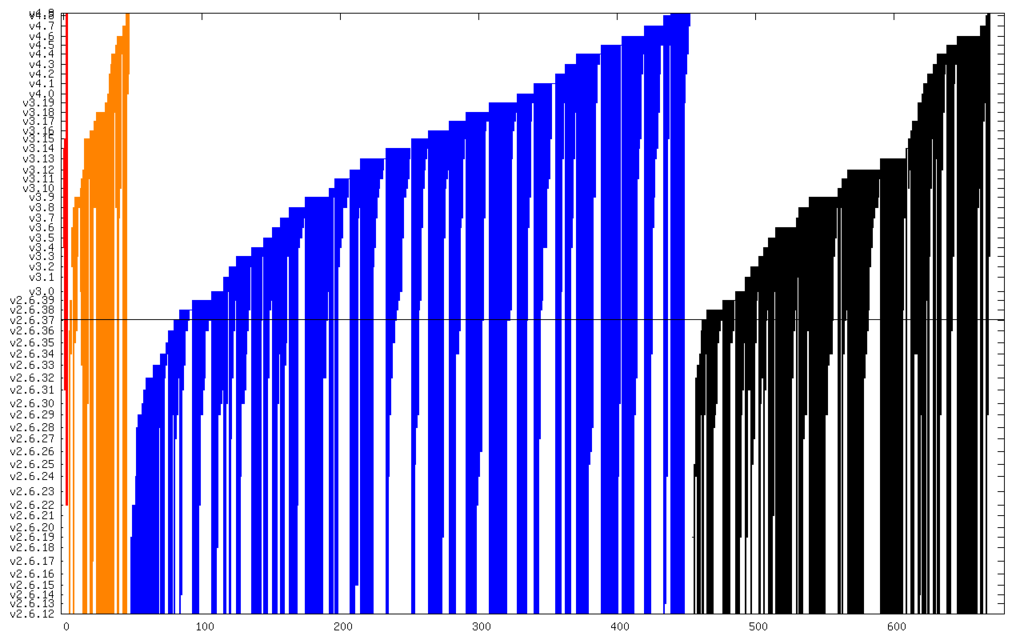
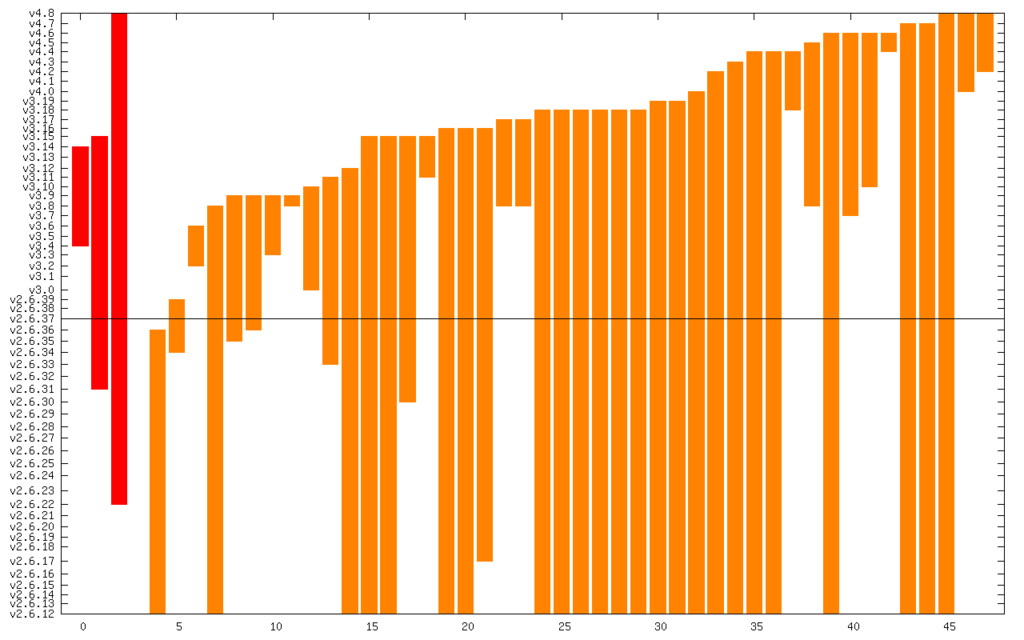
My prior post showed my research from earlier in the year at the 2016 Linux Security Summit on kernel security flaw lifetimes. Now that CVE-2016-5195 is public, here are updated graphs and statistics. Due to their rarity, the Critical bug average has now jumped from 3.3 years to 5.2 years. There aren t many, but, as I mentioned, they still exist, whether you know about them or not. CVE-2016-5195 was sitting on everyone s machine when I gave my LSS talk, and there are still other flaws on all our Linux machines right now. (And, I should note, this problem is not unique to Linux.) Dealing with knowing that there are always going to be bugs present requires proactive kernel self-protection (to minimize the effects of possible flaws) and vendors dedicated to updating their devices regularly and quickly (to keep the exposure window minimized once a flaw is widely known). So, here are the graphs updated for the 668 CVEs known today:

2016, Kees Cook. This work is licensed under a Creative Commons Attribution-ShareAlike 3.0 License.
Creative Commons License

Next.

Previous.