Search Results: "tach"

22 July 2013

Matthew Garrett: ARM and firmware specifications

Jon Masters, Chief ARM Architect at Red Hat, recently posted a description of his expectations for baseline arm64 servers. The quick summary is that systems should implement UEFI and ACPI, and any more traditional ARM boot mechanisms should be ignored. This is an interesting departure from the status quo in the ARM world, and it's worth thinking about the benefits and drawbacks of this approach.

It's very easy to build a generic kernel for most x86 systems, since the PC platform is fairly well defined even if not terribly well specified. Where system hardware does vary, it's almost always exposed on an enumerable bus (such as PCI or USB) which allows the OS to bind appropriate drivers. Things are different in the ARM world. Even once you're past the point of different SoC vendors requiring different kernel setup code and drivers, you still have to cope with the fact that system vendors can wire these SoCs up very differently. Hardware is often attached via GPIO lines without any means to enumerate them. The end result is that you've traditionally needed a different kernel for every ARM board. This is viable if you're selling the OS and hardware as a single product, but less viable if there's any desire to run a generic OS on the hardware.

The solution that's been adopted for this in the Linux world is called Device Tree. Device Tree actually has significant history, having been used as the device descriptor format in Open Firmware. Since there was already support for it in the Linux kernel, adapting it for use in ARM devices was straightforward. Device Tree aware devices can pass a descriptor blob to the kernel at startup[1], and devices without that knowledge can have a blob build into the kernel.

So, if this problem is already solved, why the push to move to UEFI and ACPI? This push didn't actually originate in the Linux world - Microsoft mandate that Windows RT devices implement UEFI and ACPI, and were they to launch a Windows ARM server product would probably carry that over. That makes sense for Microsoft, since recent versions of Windows have been x86 only and so have grown all kinds of support for ACPI and UEFI. Supporting Device Tree would require Microsoft to rewrite large parts of Windows, whereas mandating UEFI and ACPI allowed them to reuse most of their existing Windows boot and driver code. As a result, largely at Microsoft's behest, ACPI 5 has grown a range of additional features for describing things like GPIO pinouts and I2C connections. Whatever your weird device layout, you can probably express it via ACPI.

This argument works less well for Linux. Linux already supports Device Tree, whereas it currently doesn't support ACPI or UEFI on ARM[2]. Hardware vendors are already used to working with Device Tree. Moving to UEFI and ACPI has the potential to uncover a range of exciting new kernel issues and vendor bugs. It's not obviously an engineering win.

So how about users? There's an argument that since server vendors are now mostly shipping ACPI and UEFI systems, having ARM support these technologies makes it easier for customers to replace x86 systems with ARM systems. This really doesn't fly for ACPI, which is entirely invisible to the user. There are no standard ACPI entry points for system configuration, and the bits of ACPI that are generically useful (such as configuring system wakeup times) are already abstracted away to a standard interface by the kernel. It's somewhat more compelling for UEFI. UEFI supports a platform-independent bytecode language (EFI Byte Code, or EBC), which means that customers can write their own system management utilities, build them for EBC and then deploy them to their servers without caring about whether they're x86 or ARM. Want a bootloader that'll hit an internal HTTP server in order to determine which system image to deploy, and which works on both x86 and ARM? Straightforward.

Arnd Bergmann has a interesting counterargument. In a nutshell, ARM servers aren't currently aiming for the same market as x86 servers, and as a result customers are unlikely to gain any significant benefit from shared functionality between the two.

So if there's no real benefit to users, and if there's no benefit to kernel developers, what's the point? The main one that springs to mind is that there is a benefit to distributions. Moving to UEFI means that there's a standard mechanism for distributions to interact with the firmware and configure the bootloader. The traditional ARM approach has been for vendors to ship their own version of u-boot. If that's in flash then it's not much of a problem[3], but if it's on disk then you have to ship a range of different bootloaders and know which one to install (and let's not even talk about initial bootstrapping).

This seems like the most compelling argument. UEFI provides a genuine benefit for distributions, and long term it probably provides some benefit to customers. The question is whether that benefit is worth the flux. The same distribution benefit could be gained by simply mandating a minimum set of u-boot functionality, which would seem much more straightforward. The customer benefit is currently unclear.

In the end it'll probably be a market decision. If Red Hat produce an ARM product that has these requirements, and if Suse produce an ARM product that will work with u-boot and Device Tree, it'll be up to vendors to decide whether the additional work to support UEFI/ACPI is worth it in order to be able to sell to customers who want Red Hat. I expect that large vendors like HP and Dell will probably do it, but the smaller ones may not. The customer demand issue is also going to be unclear until we learn whether using UEFI is something that customers actually care about, rather than a theoretical benefit.

Overall, I'm on the fence as to whether a UEFI requirement is going to stick, and I suspect that the ACPI requirement is tilting at windmills. There's nothing stopping vendors from providing a Device Tree blob from UEFI, and I can't think of any benefits they gain from using ACPI instead. Vendor interest in the generic parts of the ACPI spec has been tepid even in the x86 world (the vast majority of ACPI spec updates come from Microsoft and Intel, not any of the system vendors), and I don't see that changing with the introduction of a range of ARM vendors who are already happy with Device Tree.

We'll see. Linux is going to need to gain the support for UEFI and ACPI on ARM in any case, since there's already hardware shipping in that configuration. But with ARM vendors still getting to grips with Device Tree, forcing them to go through another change in how they do things is going to be hard work. Red Hat may be successful in enforcing these requirements at the cost of some vendor unhappiness, or Red Hat may find that their product doesn't boot on most of the available hardware. It's an aggressive gamble, and while it'll be interesting to see how it plays out, I'm not that optimistic.

[1] The blob could be pulled from the firmware, but it's not uncommon for it to be built into u-boot instead. This does mean that you have a device-specific u-boot even if you have a generic kernel, but that's typically true anyway.
[2] Patches have been posted for ARM UEFI support. They're not mergeable in their current form, but they should be in the near future. ACPI support is in development.
[3] Although not all u-boots are created equal - some vendors ship versions that will only boot off FAT, some vendors ship versions that will only boot off ext2. Having to special case this stuff in your installer is a pain.

comment count unavailable comments

Riku Voipio: ACPI on ARM storm in teacup

A recent google+ post by Jon Masters caused some stormy and some less stormy responses. A lot of BIOS/UEFI/ACPI hate comes X86, where ACPI is used from everything from suspending devices to reading buttons and setting leds. So when X86 kernel suspends, it does magic calls to ACPI and prays that the firmware vendor did not screw it up. Now vendors do screw up, hence lots of cursing and ugly workarounds in the kernel follows. My Lenovo has a firwmare bug where the FN-buttons and Fan stops working if the laptop is attached on AC adapter for too long. The fan is probably a simple i2c device the kernel could control directly without jumping through ACPI hiding layer hoops. But the X86 people hold the view it is better to trust the firmware engineer to control devices instead of having the kernel folk to write device drivers to ... control devices! Now on ARM(64) the idea of using ACPI is to have none of that. Instead the idea is to use ACPI only to provide tables for enumerating what devices are available in the platform. Just like what device tree does. Now if this is the same as device tree, why bother? The main reason is to allow the distribution installer behave same on X86 / ARM / ARM64. This is crucial for distributions like fedora and RHEL where a cabal holds the point of view that X86 distribution development must not be constrained by ARM support. But it also important for everyone that the method of installing your favorite distribution to an ARM64 server is standard and works the same for any server from any vendor. Now while UEFI and ACPI are definitely not my preferred solutions, I can accept them as necessary evil for having a more standard platform.

12 July 2013

Daniel Pocock: Practical VPNs with strongSwan, Shorewall, Linux firewalls and OpenWRT routers

There is intense interest in communications privacy at the moment thanks to the Snowden scandal. Open source software has offered credible solutions for privacy and encryption for many years. Sadly, making these solutions work together is not always plug-and-play. In fact, secure networking, like VoIP, has been plagued by problems with interoperability and firewall/filtering issues although now the solutions are starting to become apparent. Here I will look at some of them, such as the use of firewall zones to simplify management or the use of ECDSA certificates to avoid UDP fragmentation problems. I've drawn together a lot of essential tips from different documents and mailing list discussions to demonstrate how to solve a real-world networking problem. A typical network scenario and requirements Here is a diagram of the network that will be used to help us examine the capabilities of these open source solutions. Some comments about the diagram:
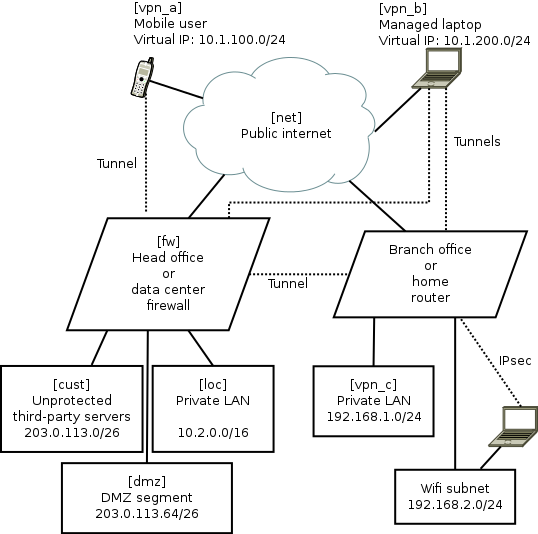
  • The names in square brackets are the zones for Shorewall, they are explained later.
  • The dotted lines are IPsec tunnels over the untrusted Internet.
  • The road-warrior users (mobiles and laptops) get virtual IP addresses from the VPN gateway. The branch offices/home routers do not use virtual IPs.
  • The mobile phones are largely untrusted: easily lost or stolen, many apps have malware, they can only tunnel to the central VPN and only access a very limited range of services.
  • The laptops are managed devices so they are trusted with access to more services. For efficiency they can connect directly to branch office/home VPNs as well as the central server.
  • Smart-phone user browsing habits are systematically monitored by mobile companies with insidious links into mass-media and advertising. Road-warriors sometimes plug-in at client sites or hotels where IT staff may monitor their browsing. Therefore, all these users want to tunnel all their browsing through the VPN.
  • The central VPN gateway/firewall is running strongSwan VPN and Shorewall firewall on Linux. It could be Debian, Fedora or Ubuntu. Other open source platforms such as OpenBSD are also very well respected for building firewall and VPN solutions, but Shorewall, which is one of the key ingredients in this recipe, only works on Linux at present.
  • The branch office/home network could be another strongSwan/Shorewall server or it could also be an OpenWRT router
  • The default configuration for most wifi routers creates a bridge joining wifi users with wired LAN users. Not here, it has been deliberately configured as an independent network. Road-warriors who attach to the wifi must use VPN tunnelling to access the local wired network. In OpenWRT, it is relatively easy to make the Wifi network an independent subnet. This is an essential security precaution because wifi passwords should not be considered secure: they are often transmitted to third parties, for example, by the cloud backup service in many newer smart phones.
Package mayhem The major components are packaged on all the major Linux distributions. Nonetheless, in every case, I found that it is necessary to re-compile fresh strongSwan packages from sources. It is not so hard to do but it is necessary and worth the effort. Here are related blog entries where I provide the details about how to re-build fresh versions of the official packages with all necessary features enabled: Using X.509 certificates as a standard feature of the VPN For convenience, many people building a point-to-point VPN start with passwords (sometimes referred to as pre-shared keys (PSK)) as a security mechanism. As the VPN grows, passwords become unmanageable. In this solution, we only look at how to build a VPN secured by X.509 certificates. The certificate concept is not hard. In this scenario, there are a few things that make it particularly easy to work with certificates:
  • strongSwan comes with a convenient command line tool, ipsec pki. Many of it's functions are equivalent to things you can do with OpenSSL or GnuTLS. However, the ipsec pki syntax is much more lightweight and simply provides a convenient way to do the things you need to do when maintaining a VPN.
  • Many of the routine activities involved in certificate maintainence can be scripted. My recent blog about using Android clients with strongSwan gives a sample script demonstrating how ipsec pki commands can be used to prepare a PKCS#12 (.p12) file that can be easily loaded into an Android device using the SD-card.
  • For building a VPN, there is no need to use a public certificate authority such as Verisign. Consequently, there is no need to fill in all their forms or make any payments for each device/certificate. Some larger organisations do choose to outsource their certificate management to such firms. For smaller organisations, an effective and sometimes better solution can be achieved by maintaining the process in-house with a private root CA.
UDP fragmentation during IPsec IKEv2 key exchange and ECDSA A common problem for IPsec VPNs using X.509 certificates is the fragmentation of key exchange datagrams during session setup. Sometimes it works, sometimes it doesn't. Various workarounds exist, such as keeping copies of all certificates from potential peers on every host. As the network grows, this becomes inconvenient to maintain and to some extent it eliminates the benefits of using PKI. Fortunately, there is a solution: Elliptic Curve Cryptography (ECC). Many people currently use RSA key-pairs. Best practice suggests using RSA keys of at least 2048 bits and often 4096 bits. Using ECC with a smaller 384-bit key is considered to be equivalent to a 7680 bit RSA key pair. Consequently, ECDSA certificates are much smaller than RSA certificates. Furthermore, at these key sizes, the key exchange packets are almost always smaller than the typical 1500 byte MTU. A further demand for ECDSA is arising due to the use of ECC within smart cards. Many smartcards don't support any RSA key larger than 2048 bits. The highly secure 384-bit ECC key is implemented in quite a few common smart cards. Smart card vendors have shown a preference for the ECC keys due to the US Government's preference for ECC and the lower computational overheads make them more suitable for constrained execution environments. Anyone who wants to use smart cards as part of their VPN or general IT security now, or in the future, needs to consider ECC/ECDSA. Making the network simple with Shorewall zones For this example, we are not just taking some easy point-to-point example. We have a real-world, multi-site, multi-device network with road warriors. Simplifying this architecture is important to help us understand and secure it. The solution? Each of these is abstracted to a "zone" in Shorewall. In the diagram above, the zone names are in square brackets. The purpose of each zone is described below:
Zone name Description
loc This is the private LAN and contains servers like databases, private source code respositories and NFS file servers
dmz This is the DMZ and contains web servers that are accessible from the public internet. Some of these servers talk to databases or message queues in the LAN network loc
vpn_a These are road warriors that are not very trustworthy, such as mobile devices. They are occasionally stolen and usually full of spyware (referred to by users as "apps"). They have limited access to ports on some DMZ servers, e.g. for sending and receiving mail using SMTP and IMAP (those ports are not exposed to the public Internet at large). They use the VPN tunnel for general internet access/browsing, to avoid surveillance by their mobile carrier.
vpn_b These are managed laptops that have a low probability of malware infection. They may well be using smart cards for access control. Consequently, they are more trusted than the vpn_a users and have access to some extra intranet pages and file servers. Like the smart-phone users, they use the VPN tunnel for general internet access/browsing, to avoid surveillance by third-party wifi hotspot operators.
vpn_c This firewall zone represents remote sites with managed hardware, such as branch offices or home networks with IPsec routers running OpenWRT.
cust These are servers hosted for third-parties or collaborative testing/development purposes. They have their own firewall arrangements if necessary.
net This zone represents traffic from the public Internet.
A practical Shorewall configuration Shorewall is chosen to manage the iptables and ip6tables firewall rules. Shorewall provides a level of abstraction that makes netfilter much more manageable than manual iptables scripting. The Shorewall concept of zones is very similar to the zones implemented in OpenWRT and this is an extremely useful paradigm for firewall management. Practical configuration of Shorewall is very well explained in the Shorewall quick start. The one thing that is not immediately obvious is a strategy for planning the contents of the /etc/shorewall/policy and /etc/shorewall/rules files. The exact details for making it work effectively with a modern IPsec VPN are not explained in a single document, so I've gathered those details below as well. An effective way to plan the Shorewall zone configuration is with a table like this:
Destination zone
loc dmz vpn_a vpn_b vpn_c cust net
Source zone loc \
dmz ? \ X X X
vpn_a ? ? \ X X
vpn_b ? ? X \ X
vpn_c X \
cust X ? X X X \
net X ? X X X \
The symbols in the table are defined:
Symbol Meaning
ACCEPT in policy file
X REJECT or DROP in policy file
? REJECT or DROP in policy file, but ACCEPT some specific ports in the rules file
Naturally, this modelling technique is valid for both IPv4 and IPv6 firewalling (with Shorewall6) Looking at the diagram in two dimensions, it is easy to spot patterns. Each pattern can be condensed into a single entry in the rules file. For example, it is clear from the first row that the loc zone can access all other zones. That can be expressed very concisely with a single line in the policy file:
loc all ACCEPT
Specific Shorewall tips for use with IPsec VPNs and strongSwan Shorewall has several web pages dedicated to VPNs, including the IPsec specific documentation.. Personally, I found that I had to gather a few details from several of these pages to make an optimal solution. Here are those tips:
  • Ignore everything about the /etc/shorewall/tunnels file. It is not needed and not used any more
  • Name the VPN zones (we call them vpn_a, vpn_b and vpn_c) in the zones file but there is no need to put them in the /etc/shorewall/interfaces file.
  • The /etc/shorewall/hosts file is not just for hosts and can be used to specify network ranges, such as those associated with the VPN virtual IP addresses. The ranges you put in this file should match the rightsourceip pool assignments in strongSwan's /etc/ipsec.conf
  • One of the examples suggests using mss=1400 in the /etc/shorewall/zones file. I found that is too big and leads to packets being dropped in some situations. To start with, try a small value such as 1024 and then try larger values later after you prove everything works. Setting mss for IPsec appears to be essential.
  • Do not use the routefilter feature in the /etc/shorewall/interfaces file as it is not compatible with IPsec
Otherwise, just follow the typical examples from the Shorewall quick start guide and configure it to work the way you want. Here is an example /etc/shorewall/zones file:
fw firewall
net ipv4
dmz ipv4
loc ipv4
cust ipv4
vpn_a ipsec mode=tunnel mss=1024
vpn_b ipsec mode=tunnel mss=1024
vpn_c ipsec mode=tunnel mss=1024
Here is an example /etc/shorewall/hosts file describing the VPN ranges from the diagram:
vpn_a eth0:10.1.100.0/24 ipsec
vpn_b eth0:10.1.200.0/24 ipsec
vpn_c eth0:192.168.1.0/24 ipsec
Here is an example /etc/shorewall/policy file based on the table above:
loc all ACCEPT
vpn_c all ACCEPT
cust net ACCEPT
net cust ACCEPT
all all REJECT
Here is an example /etc/shorewall/rules file based on the network:
SECTION ALL
# allow connections to the firewall itself to start VPNs:
# Rule  source    dest    protocol/port details
ACCEPT   all       fw                ah
ACCEPT   all       fw                esp
ACCEPT   all       fw                udp 500
ACCEPT   all       fw                udp 4500
# allow access to HTTP servers in DMZ:
ACCEPT   all       dmz               tcp 80
# allow connections from HTTP servers to MySQL database in private LAN:
ACCEPT   dmz       loc:10.2.0.43     tcp 3306
# allow connections from all VPN users to IMAPS server in private LAN:
ACCEPT vpn_a,vpn_b,vpn_c loc:10.2.0.58 tcp 993
# allow VPN users (but not the smartphones in vpn_a) to the
# PostgresQL database for PostBooks accounting system:
ACCEPT vpn_b,vpn_c loc:10.2.0.48      tcp 5432
SECTION ESTABLISHED
ACCEPT   all       all
SECTION RELATED
ACCEPT   all       all
Once the files are created, Shorewall can be easily activated with:
# shorewall compile && shorewall restart
strongSwan IPsec VPN setup Like Shorewall, strongSwan is also very well documented and I'm just going to focus on those specific areas that are relevant to this type of VPN project.
  • Allow the road-warriors to send all browsing traffic over the VPN means including leftsubnet=0.0.0.0/0 in the VPN server's /etc/ipsec.conf file. Be wary though: sometimes the road-warriors start sending the DHCP renewal over the tunnel instead of to their local DHCP server.
  • As we are using Shorewall zones for firewalling, you must set the options leftfirewall=no and lefthostaccess=no in ipsec.conf. Shorewall already knows about the remote networks as they are defined in the /etc/shorewall/hosts file and so firewall rules don't need to be manipulated each time a tunnel goes up or down.
  • As discussed above, X.509 certificates are used for peer authentication. In the certificate Distinguished Name (DN), store the zone name in the Organizational Unit (OU) component, for example, OU=vpn_c, CN=gw.branch1.example.org
  • In the ipsec.conf file, match the users to connections using wildcard specifications such as rightid="OU=vpn_a, CN=*"
  • Put a subjectAltName with hostname in every certificate. The --san option to the ipsec pki commands adds the subjectAltName.
  • Keep the certificate distinguished names (DN) short, this makes the certificate smaller and reduces the risk of fragmented authentication packets. Many examples show a long and verbose DN such as C=GB, O=Acme World Wide Widget Corporation, OU=Engineering, CN=laptop1.eng.acme.example.org. On a private VPN, it is rarely necessary to have all that in the DN, just include OU for the zone name and CN for the host name.
  • As discussed above, use the ECDSA scheme for keypairs (not RSA) to ensure that the key exchange datagrams don't suffer from fragmentation problems. For example, generate a keypair with the command ipsec pki --gen --type ecdsa --size 384 > user1Key.der
  • Road warriors should have leftid=%fromcert in their ipsec.conf file. This forces them to use the Distinguished Name and not the subjectAltName (SAN) to identify themselves.
  • For road warriors who require virtual tunnel IPs, configure them to request both IPv4 and IPv6 addresses (dual stack) with leftsourceip=%config4,%config6 and on the VPN gateway, configure the ranges as arguments to rightsourceip
  • To ensure that roadwarriors query the LAN DNS, add the DNS settings to strongswan.conf and make sure road warriors are using a more recent strongSwan version that can dynamically update /etc/resolv.conf. Protecting DNS traffic is important for privacy reasons. It also makes sure that the road-warriors can discover servers that are not advertised in public DNS records.
Central firewall/VPN gateway configuration Although they are not present in the diagram, IPv6 networks are also configured in these strongSwan examples. It is very easy to combine IPv4 and IPv6 into a single /etc/ipsec.conf file. As long as the road-warriors have leftsourceip=%config4,%config6 in their own configurations, they will operate dual-stack IPv4/IPv6 whenver they connect to the VPN. Here is an example /etc/ipsec.conf for the central VPN gateway:
config setup
        charonstart=yes
        charondebug=all
        plutostart=no
conn %default
        ikelifetime=60m
        keylife=20m
        rekeymargin=3m
        keyingtries=1
        keyexchange=ikev2
conn branch1
        left=198.51.100.1
        leftsubnet=203.0.113.0/24,10.0.0.0/8,2001:DB8:12:80:/64
        leftcert=fw1Cert.der
        leftid=@fw1.example.org
        leftfirewall=no
        lefthostaccess=no
        right=%any
        rightid=@branch1-fw.example.org
        rightsubnet=192.168.1.0/24
        auto=add
conn rw_vpn_a
        left=198.51.100.1
        leftsubnet=0.0.0.0/0,::0/0
        leftcert=fw1Cert.der
        leftid=@fw1.example.org
        leftfirewall=no
        lefthostaccess=no
        right=%any
        rightid="OU=vpn_a, CN=*"
        rightsourceip=10.1.100.0/24,2001:DB8:1000:100::/64
        auto=add
conn rw_vpn_b
        left=198.51.100.1
        leftsubnet=0.0.0.0/0,::0/0
        leftcert=fw1Cert.der
        leftid=@fw1.example.org
        leftfirewall=no
        lefthostaccess=no
        right=%any
        rightid="OU=vpn_b, CN=*"
        rightsourceip=10.1.200.0/24,2001:DB8:1000:200::/64
        auto=add
Sample branch office or home router VPN configuration Here is an example /etc/ipsec.conf for the Linux server or OpenWRT VPN at the branch office or home:
conn head_office
        left=%defaultroute
        leftid=@branch1-fw.example.org
        leftcert=branch1-fwCert.der
        leftsubnet=192.168.1.0/24,2001:DB8:12:80:/64
        leftfirewall=no
        lefthostaccess=no
        right=fw1.example.org
        rightid=@fw1.example.org
        rightsubnet=203.0.113.0/24,10.0.0.0/8,2001:DB8:1000::/52
        auto=start
# notice we only allow vpn_b users, not vpn_a
# these users are given virtual IPs from our own
# 192.168.1.0 subnet
conn rw_vpn_b
        left=branch1-fw.example.org
        leftsubnet=192.168.1.0/24,2001:DB8:12:80:/64
        leftcert=branch1-fwCert.der
        leftid=@branch1-fw.example.org
        leftfirewall=no
        lefthostaccess=no
        right=%any
        rightid="OU=vpn_b, CN=*"
        rightsourceip=192.168.1.160/27,2001:DB8:12:80::8000/116
        auto=add
Further topics Shorewall and Shorewall6 don't currently support a unified configuration. This can make it slightly tedious to duplicate rules between the two IP variations. However, the syntax for IPv4 and IPv6 configuration is virtually identical. Shorewall only currently supports Linux netfilter rules. In theory it could be extended to support other types of firewall API, such as pf used by OpenBSD and the related BSD family of systems. A more advanced architecture would split the single firewall into multiple firewall hosts, like the inner and outer walls of a large castle. The VPN gateway would also become a standalone host in the DMZ. This would require more complex routing table entries. Smart cards with PIN numbers provide an effective form of two-factor authentication that can protect certificates for remote users. Smart cards are documented well by strongSwan already so I haven't repeated any of that material in this article. Managing a private X.509 certificate authority in practice may require slightly more effort than I've described, especially when an organisation grows. Small networks and home users don't need to worry about these details too much, but for most deployments it is necessary to consider things like certificate revocation lists and special schemes to protect the root certificate's private key. EJBCA is one open source project that might help. Some users may want to consider ways to prevent the road-warriors from accidentally browsing the Internet when the IPsec tunnel is not active. Such policies could be implemented with some basic iptables firewalls rules in the road-warrior devices. Summary Using these strategies and configuration tips, planning and building a VPN will hopefully be much simpler. Please feel free to ask questions on the mailing lists for any of the projects discussed in this blog.

1 July 2013

Steve Kemp: So wheezy is fun..

Running a pristine operating system is fun. I keep going to run programs and finding they're not installed! For example I'd planned to re-deploy the Debian Administration code-base this evening, but couldn't because fabric is not contained in Wheezy (#714421). Thankfully backporting the package was trivial, but it was a minor stumbling block. I've hit a few of those recently. Still in happier new my lumail mail client can now handle both adding attachments to outgoing mails and extracting them from incoming mails. There are missing features which some people might expect and rely upon, such as: But that said the scripting primitives allow interesting things to be done and I'm enjoying the experience of writing something so "major". True I've got ~20 "stars" on github which isn't a great sign of popularity, but I have had some fun feedback and the client works for me. I'm going to have to spend a few days working on TAB-completion code that plays-nice with curses, because that's a major irritation (and you can't mix/match curses & readline, annoyingly). But otherwise I think we're getting close to being complete enough I'll slow down.

Russ Allbery: Review: Dark Lies the Island

Review: Dark Lies the Island, by Kevin Barry
Publisher: Greywolf
Copyright: 2012
Printing: 2013
ISBN: 1-55597-651-4
Format: ARC
Pages: 185
This is a literary short story collection by a mainstream Irish writer, rather far from my normal fare. It was the second book in a shipment of Powell's Indiespensable, which is generally (when there is one) a proof or Advanced Reading Copy of something relatively obscure. I'm not really the target audience, not being much of a short story aficionado, but the whole point of doing this Indiespensable experiment is to stretch my reading range. First off, as I would generally expect by mainstream fiction, the quality of the writing is excellent. One thing I particularly like about Barry is that he's refreshingly and unhesitatingly profane. His characters curse like I expect people to curse, some of them at the drop of a hat, and for me it gives a feel of solid realism to his dialogue. He's also very good with eye dialect, giving the impression of accents without making the text hard to read. Some of these stories I liked a great deal, rather more than I had expected. But if there was a general undermining flaw for me, it was that I prefer stories that go somewhere, that have a plot or lead up to a definite point. Some of Barry's do, but a lot of them seem more vignettes or just scenes, sketches of characters, that drift off without resolution. I can admire those as writing exercises, but for me they don't fill the desire I have when I sit down with a story. I'm not sure how useful these reviews will be, given that I don't have a lot of mainstream fiction background to compare them with, but here are some reactions, for whatever they're worth. "Across the Rooftops": This is one of those sketches, but it's one of the best of them. It's a single moment on the rooftops, an attempt to capture the moment of possibility around the first romantic overture. It's sadly quite conventional in gender roles (nervous man initiating, woman as relationship gatekeeper), but apart from that it's very well-written. This kind of thing is normally not to my taste, but Barry does such a great job capturing the sense of uncertainty and the sharp focus on detail that I couldn't help but like it. (7) "Wifey Redux": This is by far my favorite story of this book. I think it's both hilarious and brilliant, right from the starting line.
This is the story of a happy marriage but before you throw up and turn the page let me say that it will end with my face pressed hard into the cold metal of the Volvo's bonnet, my hands cuffed behind my back, and my rights droned into my ear this will occur in the car park of a big-box retail unit on the Naas Road in Dublin.
It's the story of a marriage and how it changes over time, but also the story of being a father and his baffled, flailing reactions to his daughter's sexual explorations. But that's not what makes the story. What makes the story is what leads up to the arrest at the end, which had me laughing out-loud in delight. Barry is great at writing a sort of devilish humor; I wish more of the collection was like this. (9) "Fjord of Killary": This is another one of the ones I enjoyed. It's about an author who buys a hotel (with a bar) on the fjord of Killary thinking that the local culture and contact along with the wild beauty would inspire his poetry. At the start of the story, he's thoroughly sick of both the climate and the people, and the collision between his idyllic dreams and the reality, as well as his acerbic first-person complaints, is quite entertaining. A huge storm and resulting flood provides the conflict and impetus for change, and a few moments of humor in the understated local reactions. I thought the closing epiphany was a bit too obvious and expected, and the ending didn't quite work for me, but it has some good moments. (7) "A Cruelty": Here's where the collection started losing me. This is still well-written and closely observed, but in the case of this story, I wish it weren't, since I found it extremely uncomfortable. The viewpoint character is vulnerable to an encounter of unalloyed nastiness. I'm sure that's the point, but, similar to how I avoid horror, it's the sort of story I'd rather not read. (3) "Beer Trip to Llandudno": This was my second-favorite story of the collection. It's about a group of men who take periodic beer-tasting trips and rate beers. They're just normal men, from a variety of backgrounds and professions, and I thought Barry did a great job capturing the sort of camaraderie that comes from long association with a hobby. That includes, here, the awkward limits on what one talks about and the tendency to use the hobby as a shield from anything that drifts into less certain territory. I thought the story suffered somewhat from not having much of a plot or conclusion, but that's also necessary from the setup. This group of people isn't actually going to solve problems, but will be there for each other in their own way. (8) "Ernestine and Kit": Another very dark story, although that's not quite as obvious at the start. As with "A Cruelty," it's well-written but disturbing and lacks any sort of positive resolution. Here, I think Barry went a bit far into portraying people who are a large part of the popular imagination but who are exceptionally rare in reality. It's the kind of story that, at least for me, plays badly with my brain's threat analysis: too memorable for the level of actual risk, and feeling like it was playing a bit too much with popular boogeymen. (4) "The Mainland Campaign": This one was just too subtle for me. Some of the summaries for this book hint at a meaning for the story that I didn't pick up at all on my first reading. On re-reading, I suspect that analysis is right, but even re-reading the story with that interpretation in mind (this is the sort of story where I'm not sure the average American would pick it up on first reading, but others might), I still don't understand exactly what happened. I think some mainstream writing, and some short stories, tends to err on the side of subtle. (4) "Wistful England": Another one that's way over on the sketch of a moment side of stories. Unlike "Across the Rooftops," it failed to make any impression on me whatsoever; I had to skim it just now to remind myself of any details at all, and by the time I edited this review for posting, I'd forgotten it again. I think it was aiming at capturing a mood, but the mopey viewpoint character didn't mean anything to me. (3) "Doctor Sot": This is another odd one, and I'm not quite sure what I think of it. Either it's another character sketch without much of a plot, or the plot was too subtle. The protagonist is a rather unlikable drunk who doubles as a small town's incompetent doctor. The story involves his encounter with a local sort of hippie encampment, which is moderately interesting even though I couldn't stand the man. Then it leads to an encounter that clearly meant something, but which was entirely lost on me. (4) "The Girls and the Dogs": And from an absence of plot back to the deeply disturbing. This story is about a moderately unlikable drug dealer who gets refuge from an extremely unlikable crazy person in a weird relationship with a woman and her sister. (As is sadly typical, polyamory only makes an appearance when the author wants to paint a scenario that's utterly fucked up and psychotic.) There's a pseudo-fantasy element here in that the characters talk about spells, but I think the only spell involved is authorial fiat to create a deeply broken and sick game that plays into a host of negative stereotypes. Despite myself, I did get drawn into the suspense of the story (Barry's undoubtedly a good writer), but it left me feeling dirty on several levels. (4) "White Hitachi": Finally, another story that I liked, although not as good as the ones earlier in the collection. This one follows a con man and two-bit thief as he gets his brother out of lockup and tries to resolve, or at least stay ahead of, various problems in his life. Again, no real ending, but I thought Barry did a good job at taking a snapshot of a life from a perspective that I don't read much in literature (along with all the sexism and racism that comes along with it). It sort of drifts off rather than ends (although the last sentence is a great bit of characterization), but I found it oddly enjoyable. (6) "Dark Lies the Island": I'm not sure what to make of this. It's another character sketch, a moment of deep psychological significance for a character, floating somewhat alone but described in detail. But the character is a girl struggling with cutting, from a male author whose other stories did not fill me with confidence in his handling of female characters. Barry makes this psychologically believable, but I'm a little nervous about trusting his portrayal of that mindset. It's also, again, just a bit too subtle; I had a hard time getting an emotional feel for how the events of the story connect. (5) "Berlin Arkonaplatz My Lesbian Summer": The final story of the collection is fairly typical of the problem I had with most of it. It seems reasonably well-written, I had a hard time connecting with the protagonist or understanding his motivations. It looks at a slice of life with which I have no familiarity at all (and is interesting for that reason), but I don't quite trust the story enough to submerge in it. Barry seems to write a lot of protagonists who seem aimless, befuddled, or just largely out of control, and I like a bit more agency in the primary character. Silvija is an interesting character, even shown from another's perspective, but the story is almost purely observational: showing her without comment, without obvious motive, and mostly without plot. It's strangely compelling, but not quite compelling enough that I'd actually seek it out. Which, really, is the whole book in a nutshell. (6) Rating: 6 out of 10

28 June 2013

Daniel Leidert: Idea: A new toy (ein neues Spielzeug) ... HP Microserver N54L

Ich fertige regelm ig Backups meiner Systeme an. Diese werden auf der Systemplatte meines Notebooks abgelegt und via rsync auf mobilen Speicher dupliziert. Hierzu verwende ich eine USB-Festplatte. Diese enth lt auch Medien-Dateien und wird regelm ig an den Fernseher angeschlossen. Prinzipiell halte ich meine Daten daher f r sicher. Aber vor kurzem stie ich an die Grenzen ihrer Kapazit t. Schon l nger habe ich nach einer Alternative gesucht, nicht zuletzt da heute viel gr ere Festplatten m glich sind und mein Laptop ber einen eSATA-Anschluss verf gt, der schneller als USB2.0 ist. Meine bevorzugte Variante war ein FANTEC DB-ALU3e Geh use mit einer WD Red WD20EFRX 2TB (5400 RPM) Festplatte, die f r den 24/7 Betrieb zertifiziert ist (und zudem ber eine ausgezeichnete Reputation verf gt). Die Kombination lief sehr gut und schnell, sieht edel aus, ben tigt aber eine externe Stromversorgung. Ich kann Sie als Speicherl sung absolut empfehlen. Allerdings hatte ich zu diesem Zeitpunkt noch weitere Anspr che, die mit der o.g. L sung nicht zu befriedigen sind. So trage ich mich bereits l nger mit dem Gedanken an ein RAID-1-NAS. Au erdem spiegelt sich die Beanspruchung meiner Notebook-Festplatte durch das Pakete-Bauen f r Debian im S.M.A.R.T.-Status wieder. Daher wollte ich diese Arbeit an einen robusten lokalen buildd-Boliden abgeben und habe ber den Kauf eines g nstigen Rechners nachgedacht. Ein NAS verbraucht aber deutlich weniger Strom als ein Desktop-Rechner. Also wie l sst sich ein buildd und ein energiesparendes NAS vereinen? Per Zufall stie ich bei einem lokalen H ndler auf den HP ProLiant MicroServer N40L. Das Angebot klang super und so entschied ich mich zum Kauf meines neuen Spielzeuges: ein HP ProLiant MicroServer N54L, der zuk nftig folgende Aufgaben verrichten soll:
Datensicherung
Die Sicherung der Daten erfolgt cron-gesteuert auf den RAID-Verbund in eine gesonderte (verschl sselte) Partition. Der S.M.A.R.T.-Status der Festplatten wird via smartd berwacht. Sollte eine Platte kaputt gehen, bestehen gute Aussichten, die Daten zu retten. Eine zuk nftige Option w re auch noch ein RAID-6 Verbund.
NAS / File-Server
Das Ger t verf gt ber bis zu 6 SATA Anschl sse. Davon werden vier standardm ig via Wechselrahmen belegt. Die mitgelieferte 250GB Festplatte wird vorerst das Betriebssystem aufnehmen und an den drei verbleibenden Anschl ssen werden zun chst drei WD Red WD20EFRX 2TB (5400 RPM) Festplatten als RAID-5-Verbund f r den notwendigen Platz sorgen. Letzterer l sst sich ohne Erweiterung nur via Software-Raid und mdadm realisieren.
buildd
Betriebssystem wird Debian GNU/Linux. Der Hauptspeicher wird auf mindestens 8GB ECC-Ram aufger stet.
HTPC (XBMC)
Der Microserver l sst sich nicht als Massenspeicher an einen Fernseher anschlie en. Daher soll vorr. XBMC in Verbindung mit einem USB3.0 BR/DVD-Player den Server zum Entertainment-Ger t erheben.
Das ganze soll m glichst wenig Strom verbrauchen und leise sein. Zum Anschluss an das lokale Netzwerk habe ich mich f r WLAN entschieden, da kein Gigabit-Ethernet vorhanden ist. Folgende Teile ben tige ich f r "meinen" Server:
Server
HP ProLiant N54L MicroServer mit Turion II Neo 2,2 GHz, 2GB RAM/250GB HDD - ca. 200 EUR (lokal)
Bel ftung / Lautst rke
Scythe Slip Stream Geh usel fter 120mm 800RPM 11dB - ca. 9 EUR (SY1225SL12L)
Scythe Slip Stream Geh usel fter 120mm 500RPM 7,5dB - ca. 8 EUR (SY1225SL12SL)
Netzwerk
TP-Link TL-WN722N(C) 150Mbps USB-Adapter - ca. 15 EUR (TL-WN722N(C))
File-Server
3x WD Red WD20EFRX 2TB 5400 RPM SATA600 f r NAS 24/7 - ca. 95 EUR / St. (WD20EFRX)
buildd
8GB (2x4GB) Kingston ValueRAM DDR3-1333 CL9 ECC Modul RAM-Kit - ca. 85 EUR (KVR1333D3E9SK2/8G)
16GB (2x8GB) Kingston ValueRAM DDR3-1333 CL9 ECC Modul RAM-Kit - ca. 145 EUR (KVR1333D3E9SK2/16G)
HTPC
Sapphire Radeon HD 5450/6450/6570/6670/7750 PCIe 16x Low-Profile passiv/aktiv - ca. 25..100 EUR (11166-45-20G, 11190-09-20G, 11191-27-20G, 11191-02-20G, 11192-18-20G, 11202-10-20G)
SILVERSTONE PCIe 1x USB3.0 2xInt 2xExt - ca. 21 EUR (SST-EC04-P)
Logitech K400 od. Keysonic ACK-540RF - ca. 40 EUR (920-003100 bzw. ACK-540 RF)
BR/DVD-Player od. Brenner mit USB3.0 Anschluss - 50..100 EUR
LCD-Mod
LDC Display Modul mind. 4x20 - ca. 10 EUR
Interessant ist auch noch die Option einer echten RAID-Karte. Ich stie dabei auf die IBM ServeRAID M1015 (46M0831) und diesen Hinweis. Kauft man stattdessen den "Schl ssel" zur Freischaltung des vollen Funktionsumfanges, dann bezahlt man (lokal) zus tzlich ca. 150 EUR! Aber das nur BTW. N tzliche Links:

Vincent Bernat: lan o: a task launcher powered by cgroups

A few months ago, I was looking for a piece of software to spawn long-running tasks on behalf of some daemon with the benefit of the tasks not being interrupted when this daemon is restarted. Here are the specifications: The last requirement explains why tasks are not spawned directly by the daemon requesting them: its complexity or the way it needs to be operated may need frequent restarts. Even if it is possible to re-execute a daemon while keeping its children, like stateful re-exec support in Upstart, this is quite difficult: internal state should be serialized and restored. Part of this state can be contained into a third-party library. While Upstart or systemd seemed to be good candidates for this purpose, I didn t find a straightforward way to run arbitrary tasks without any privilege1. Here comes lan o2. It is a very simple task launcher. It can run any tasks, stop them and check if they are still running. It leverages cgroups in recent Linux kernels and avoids the use of any daemon.

Quick tour Before looking at how lan o works, let s have a look at how it can be used. To avoid usage conflicts, each task is run in the context of a namespace that needs to be initialized:
$ sudo lanco testns init -u $(id -un) -g $(id -gn)
This is the only command that needs to be run as root. Subsequent ones can be run as a normal user. Let s run some task:
$ lanco testns run first-task openssl speed aes
$ lanco testns check first-task && echo "Still running"
Still running
$ lanco testns ls
testns
   first-task
      28456 openssl speed aes 
  
The output of the task is logged into a file:
$ head -3 /var/log/lanco-testns/task-first-task.log
Doing aes-128 cbc for 3s on 16 size blocks: 8678442 aes-128 cbc's in 2.85s
Doing aes-128 cbc for 3s on 64 size blocks: 2478283 aes-128 cbc's in 2.99s
Doing aes-128 cbc for 3s on 256 size blocks: 628105 aes-128 cbc's in 3.00s
If the task is too long, we can kill it:
$ lanco testns run first-task openssl speed aes
$ lanco testns stop first-task
You cannot run a task that already exists or kill a task that does not exist:
$ lanco testns run first-task openssl speed aes
2013-06-09T22:50:34 [WARN/run] task first-task is already running
$ lanco testns stop second-task
2013-06-09T22:50:45 [WARN/stop] task second-task is not running
Thanks to the use of cgroups, lan o is able to track multiple processes even when they are forking away3:
$ lanco testns run second-task sh -c \
>  "while true; do (sleep 30 &)& sleep 1; done"
$ lanco testns ls
testns
   first-task
      28456 openssl speed aes 
   second-task
      29572 sh -c while true; do (sleep 30 &)& sleep 1; done 
      29575 sleep 30 
      29593 sleep 30 
      29596 sleep 30 
      29599 sleep 30 
      29622 sleep 30 
      29644 sleep 1 
      29645 sleep 30 
  
$ lanco testns stop second-task
$ lanco testns check second-task   echo "Killed!"
Killed!
Also, there is a top-like command (lanco testns top): lanco top

Using cgroups Control groups (cgroups) is a mechanism to partition a set of tasks and their future children into hierarchical groups with a set of parameters.

Hierarchy Let s start with the hierarchical stuff first. To create a new hierarchy, you have to mount the cgroup filesystem on some empty directory. Usually, cgroups hierarchies are setup in /sys/fs/cgroups which is a tmpfs filesystem:
# mount -t tmpfs tmpfs /sys/fs/cgroup -o nosuid,nodev,noexec,relatime,mode=755
Now, we can create our first hierarchy:
# cd /sys/fs/cgroup
# mkdir my-first-hierarchy
# mount -t cgroup cgroup my-first-hierarchy -o name=my-first-hierarchy,none
# ls -1 my-first-hierarchy
cgroup.clone_children
cgroup.event_control
cgroup.procs
notify_on_release
release_agent
tasks
We ll see later the purpose of none. The most interesting file is tasks. It contains the PIDs of all processes in our group. Since there are currently no sub-group, all processes are part of it. Let s create a sub-group and attach a process to it:
# mkdir first-child
# cd first-child
# ls -1
cgroup.clone_children
cgroup.event_control
cgroup.procs
notify_on_release
tasks
# echo $$ > tasks
# cat tasks
23184
23311
# cat /proc/$$/cgroup 
9:name=my-first-hierarchy:/first-child
8:perf_event:/
7:blkio:/
6:net_cls:/
5:freezer:/
4:devices:/
3:cpuacct,cpu:/
2:cpuset:/
1:name=systemd:/user/bernat/1
We have added our shell to the new cgroup. Moreover, all its children will also be part of this group. This explains why we have two tasks: the shell and cat. The last command is quite interesting: for each hierarchy, it shows which cgroup the task belongs to. For a given hierarchy, each task is exactly in one group. The most useful features of lan o are done using just this: a namespace is a named hierarchy and each task is enclosed into a cgroup so it can be tracked properly.

Subsystems A subsystem makes use of the task grouping provided by cgroups to assign resources to a set of tasks. Each available subsystem can only be in one hierarchy, so the usual way to setup things is to assign a hierarchy for each subsystem4. Let s have a look at the cpuset subsystem: it allows to assign tasks to specific CPUs and memory nodes (for NUMA systems). Let s suppose we have 4 cores and we want to assign the first core to common system tasks and the three remaining ones to nginx:
# cd /sys/fs/cgroup
# mkdir cpuset
# mount -t cgroup cgroup cpuset -o cpuset
# echo 0-3 > cpuset/cpuset.cpus
# echo 0 > cpuset/cpuset.mems
# mkdir cpuset/system
# echo 0 > cpuset/system/cpuset.cpus
# echo 0 > cpuset/system/cpuset.mems
# for task in $(cat cpuset/tasks); do
>    echo $task > cpuset/system/tasks
> done
# mkdir cpuset/nginx
# echo 1-3 > cpuset/nginx/cpuset.cpus
# echo 0 > cpuset/nginx/cpuset.mems
# for task in $(pidof nginx); do
>    echo $task > cpuset/nginx/tasks
> done
The first mount is not needed if something else (like systemd) has setup the appropriate subsystem. Now, even if some system process is going crazy, it won t affect the performance of your webserver. The kernel comes with a more complete documentation if you need additional details on cgroups. There are high level tools to manipulate them, like the tools provided by libcg, but they are currently quite buggy and invasive.

Use in lan o Here are the features used by lan o:
  • For each namespace, a specific named hierarchy is created.
  • By setting the appropriate permissions on the hierarchy, an unprivileged user can create subgroups.
  • Each submitted task has its own sub-group for tracking purpose.
  • Actions can be executed when a task terminates by using the release agent mechanism5.
  • The cpuacct subsystem is used to track CPU usage: a group is created in this subsystem for this purpose.

  1. Both systemd and Upstart are difficult to run without being PID 1 and without being root. They both support user sessions but this requires to use them as PID 1 as well. I discovered later than runit would have been a good fit: it does not require to be PID 1, it does not need to be run as root and the service directory can be specified by an environment variable. It could have been tweaked to meet the above requirements.
  2. Lan o means launcher in esperanto. The unusual diacritic on the letter c is not present in many web fonts, so the rendering may be a little odd.
  3. Linux cgroups do not provide any facility to kill a whole group. We need to iterate through the processes and kill them one by one. lan o does not try to freeze processes before killing them and therefore may be inefficient against violent fork bombs.
  4. The cpu and cpuacct subsystems are the notable exception. There seems to be little use to keep them in separate hierarchies, so they are part of the same hierarchy.
  5. Unfortunately, only one global release agent per hierarchy can be used. Since lan o provides with the ability to execute an arbitrary command when a task terminates, the command needs to be stored on the filesystem for the release agent of the namespace to execute it.

Justus Winter: Getting into the mood - my second week

tl; dr version: shutdown works, Debian GNU/Hurd booting using sysvinit:
Loading GNU Mach ...
Loading the Hurd ...
GNU Mach 1.3.99-486
AT386 boot: physical memory map from 0x0 to 0x9f400
AT386 boot: physical memory map from 0x100000 to 0x1fffe000
AT386 boot: physical memory from 0x0 to 0x1fffe000
Enabling FXSR
pcibios_init : BIOS32 Service Directory structure at 0xfcff0
pcibios_init : BIOS32 Service Directory entry at 0xfc7ba
pcibios_init : PCI BIOS revision 2.10 entry at 0xfc78c
Probing PCI hardware.
ide: Intel 82371 PIIX3 (dual FIFO) DMA Bus Mastering IDE
    Controller on PCI bus 0 function 9
ide: BM-DMA feature is not enabled (BIOS), enabling
    ide0: BM-DMA at 0xc100-0xc107
    ide1: BM-DMA at 0xc108-0xc10f
hd0: got CHS=762/128/63 CTL=c8 from BIOS
hd0: QEMU HARDDISK, 3001MB w/256kB Cache, CHS=762/128/63, DMA
hd2: QEMU DVD-ROM, ATAPI CDROM drive
ide0 at 0x1f0-0x1f7,0x3f6 on irq 14
ide1 at 0x170-0x177,0x376 on irq 15
Floppy drive(s): fd0 is 1.44M
FDC 0 is a S82078B
probing scsi 5/22: Adapteco1542FInvalidiaddresseforishpnt.with 1542.
Invalid address for shpnt with 1542.
probing scsi 18/22:AWesternxDigitalAWD-7000nFailed9initialization of WD-7000 SCSI card!
probing eata on/1f0EATA0:Daddress 0x1f04in3use, skipping probe.
probing eata on 170EATA0: address 0x170 in use, skipping probe.
probing scsi 21/22: Iomega7parport ZIP drive ppa: Version 1.42
ppa: Probing port 03bc
ppa: Probing port 0378
ppa:         SPP port present
ppa:         PS/2 bidirectional port present
ppa: Probing port 0278
done
scsi : 0 hosts.
scsi : detected total.
Partition check (DOS partitions):
 hd0: hd0s1 hd0s2 < hd0s5 >
lpr0: at atbus0, port = 378, spl = 6, pic = 7.
2omultibootxmodulesd/execl$(exec-task=task-create)ne=$ kernel-command-line  --host-priv-port=$ host-port  --device-master-port=$ device-port  --exec-server-task=$ exec-task  -T typed $ root  $(task-create) $(task-resume)               task loaded: ext2fs --readonly --multiboot-command-line=root=device:hd0s1 console=com0 --host-priv-port=1 --device-master-port=2 --exec-server-task=3 -T typed device:hd0s1
task loaded: exec /hurd/exec
start ext2fs: Hurd server bootstrap: ext2fs[device:hd0s1] exec init proc auth
INIT: version 2.88 booting
Using makefile-style concurrent boot in runlevel S.
Activating swap...done.
Checking root file system...fsck from util-linux 2.20.1
hd2 : tray open or drive not ready
end_request: I/O error, dev 02:00, sector 0
ext2fs_check_if_mount: Can't check if filesystem is mounted due to missing mtab file while determining whether /dev/hd0s1 is mounted.
/dev/hd0s1: clean, 43930/181056 files, 281248/723200 blocks
done.
Cleaning up temporary files... /tmp.
/etc/rcS.d/S06mtab.sh: 48: /etc/rcS.d/S06mtab.sh: cannot open /proc/mounts: No such file
Activating lvm and md swap...(default pager): Already paging to partition hd0s5!
done.
Checking file systems...fsck from util-linux 2.20.1
hd2 : tray open or drive not ready
end_request: I/O error, dev 02:00, sector 0
done.
Mounting local filesystems...mount: invalid option -- 'O'
Try  mount --help' or  mount --usage' for more information.
failed.
Activating swapfile swap...(default pager): Already paging to partition hd0s5!
done.
df: Warning: cannot read table of mounted file systems: No such file or directory
Cleaning up temporary files....
Configuring network interfaces...inetutils-ifconfig: invalid arguments
ifup: failed to open pid file /run/network/ifup-/dev/eth0.pid: No such file or directory
Internet Systems Consortium DHCP Client 4.2.2
Copyright 2004-2011 Internet Systems Consortium.
All rights reserved.
For info, please visit https://www.isc.org/software/dhcp/
can't create /var/lib/dhcp/dhclient./dev/eth0.leases: No such file or directory
Listening on Socket//dev/eth0
Sending on   Socket//dev/eth0
DHCPDISCOVER on /dev/eth0 to 255.255.255.255 port 67 interval 6
DHCPREQUEST on /dev/eth0 to 255.255.255.255 port 67
DHCPOFFER from 10.0.2.2
DHCPACK from 10.0.2.2
can't create /var/lib/dhcp/dhclient./dev/eth0.leases: No such file or directory
bound to 10.0.2.15 -- renewal in 38544 seconds.
done.
Cleaning up temporary files....
Setting up X socket directories... /tmp/.X11-unix /tmp/.ICE-unix.
INIT: Entering runlevel: 2
Using makefile-style concurrent boot in runlevel 2.
Starting enhanced syslogd: rsyslogd.
Starting deferred execution scheduler: atd.
Starting periodic command scheduler: cron.
Starting system message bus: dbusFailed to set socket option"/var/run/dbus/system_bus_socket": Protocol not available.
Starting OpenBSD Secure Shell server: sshd.
GNU 0.3 (debian) (console)
login:
This is the result of: This yields a surprisingly functional Debian/Hurd system with sysvinit. There are still lot's of loose ends, I populated my status page with them. I spent quite some time in #hurd on freenode and Pino Toscano offered to send me some old notes of his about the sysvinit issue. This turned out to be most helpful as his notes were about plugging sysvinits init into the boot process. This was the next logical thing to do for me, so first thing Monday morning I just put his runsystem.sysv file with some very minor tweaks (my version) into my overlay and had a working system in front of my eyes. That certainly was a nice way to start a week of work :), so many thanks again Pino! For your convenience I've created an overlay with all necessary changes and recompiled binaries. Be careful though, you might want to backup /sbin/reboot first or you won't be able to reboot your system! Of course my tool does that for you, and I've managed to create a reasonably small (253 mb) image thanks to the zerofree tool, the process of compacting images is implemented in hurdtest as the compact subcommand. I also added sysvinit specific tests. So if you want to try hurdtest, download the image and unxz it, my tool expects the image to be in the current working directory and be named image.qcow2. Download and untar an overlay and execute:
% hurdtest -logfile log -sysvinit overlay path/to/second-week-overlay
If you specify -logfile you can execute tail -f path/to/log to see what the VM is printing to the console in real time. The sysvinit specific tests demonstrate that indeed sysvinit is managing the system and that e. g. init 0 or shutdown -r now works. There are at least three major problems that I will need to tackle for this project: I think the last issue is what I'm going to look at next week. There's information about this in the Hurd wiki and I've spoken with Richard Braun about it and he drilled me to think about the hurdish way to solve this. I think I've got a pretty good picture of how to implement this in my head and am eager to give it a go. This will involve adding a function to Hurds filesystem interface that allows one to query an active translator about his mount options and "source" and about all active and passive translators that are attached to one of its nodes. This is where the fun actually begins. This is changing an integral part of an operating system, but this is okay since it is just another program written in c, operating in userspace. But hey I know that, that's just c and if something goes wrong (and it always does) I fire up gdb and have a look. And mind you, I'm running all this as an unprivileged user, no need to jeopardize the entire system for that. Besides implementing /proc/mounts I will also add -O, --test-opts to mount, and -v, --verbose to swapo n,ff . PS: My blog is still not properly registered to planet.d.o. I asked planet@ about that, but got no response. Any help? I never imagined blogging being so stressful, I care about losing potential readers :/

27 June 2013

Andrea Veri: Two years later: Vim, Tmux and my Linux desktop

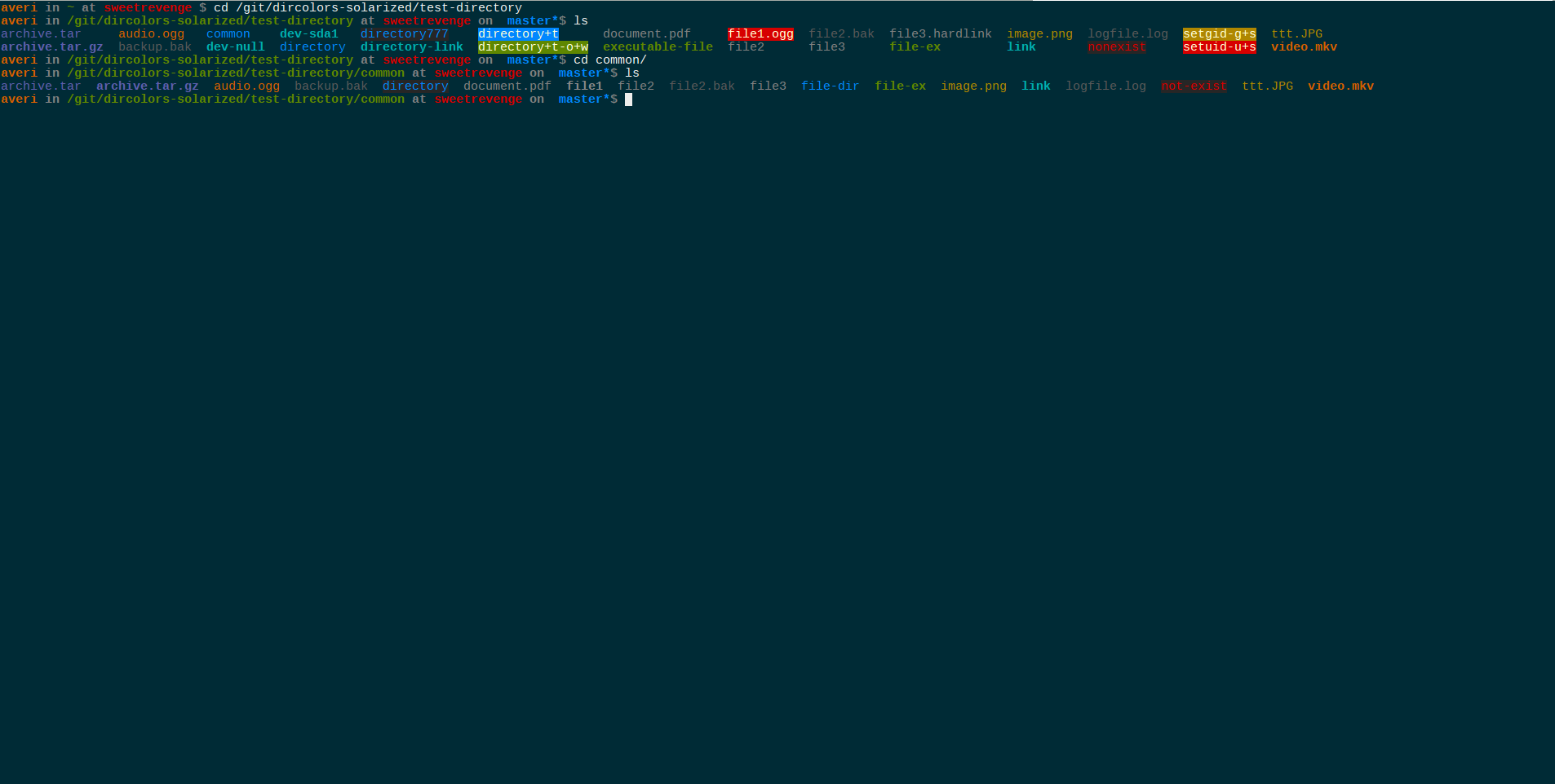
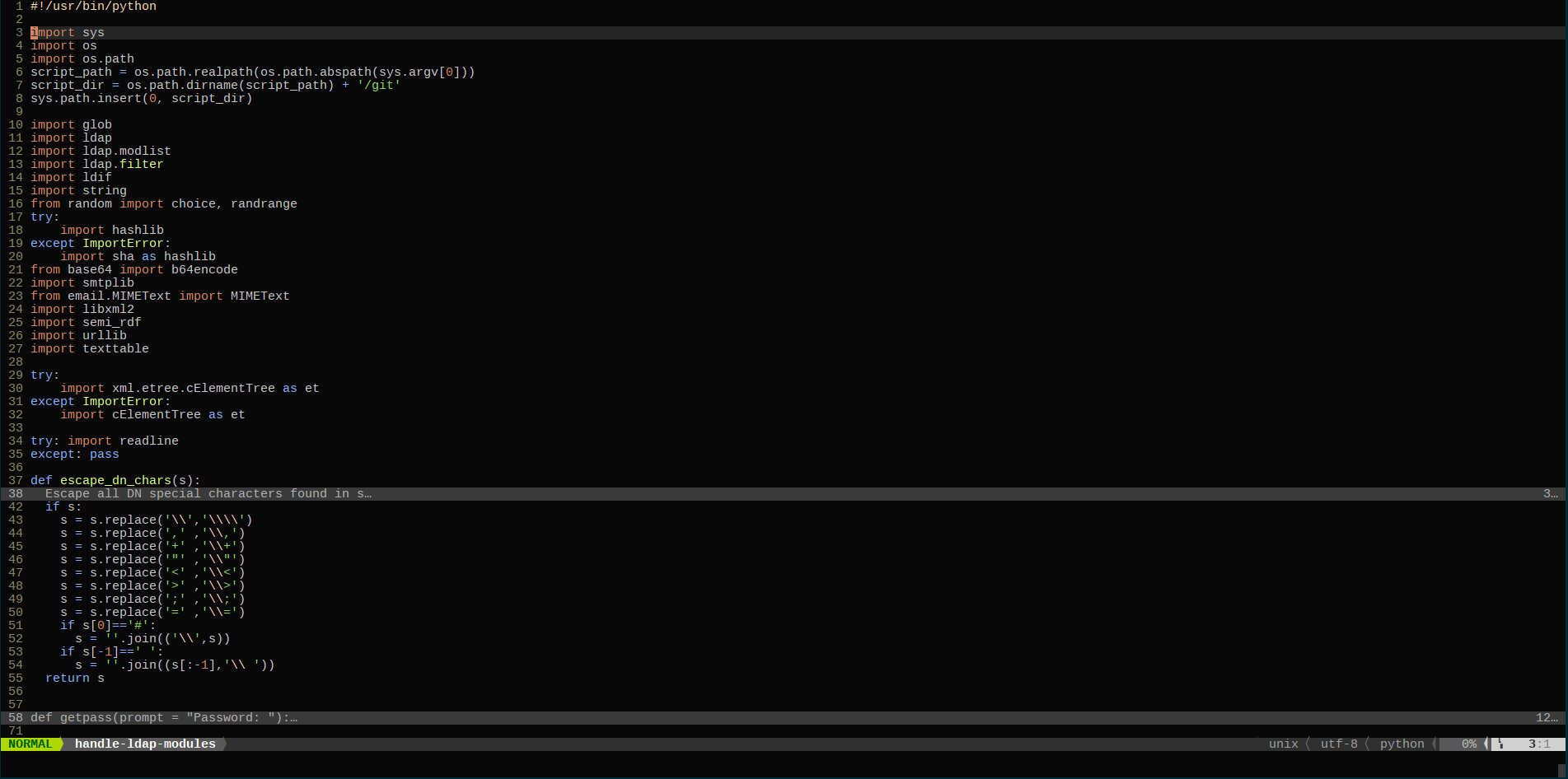
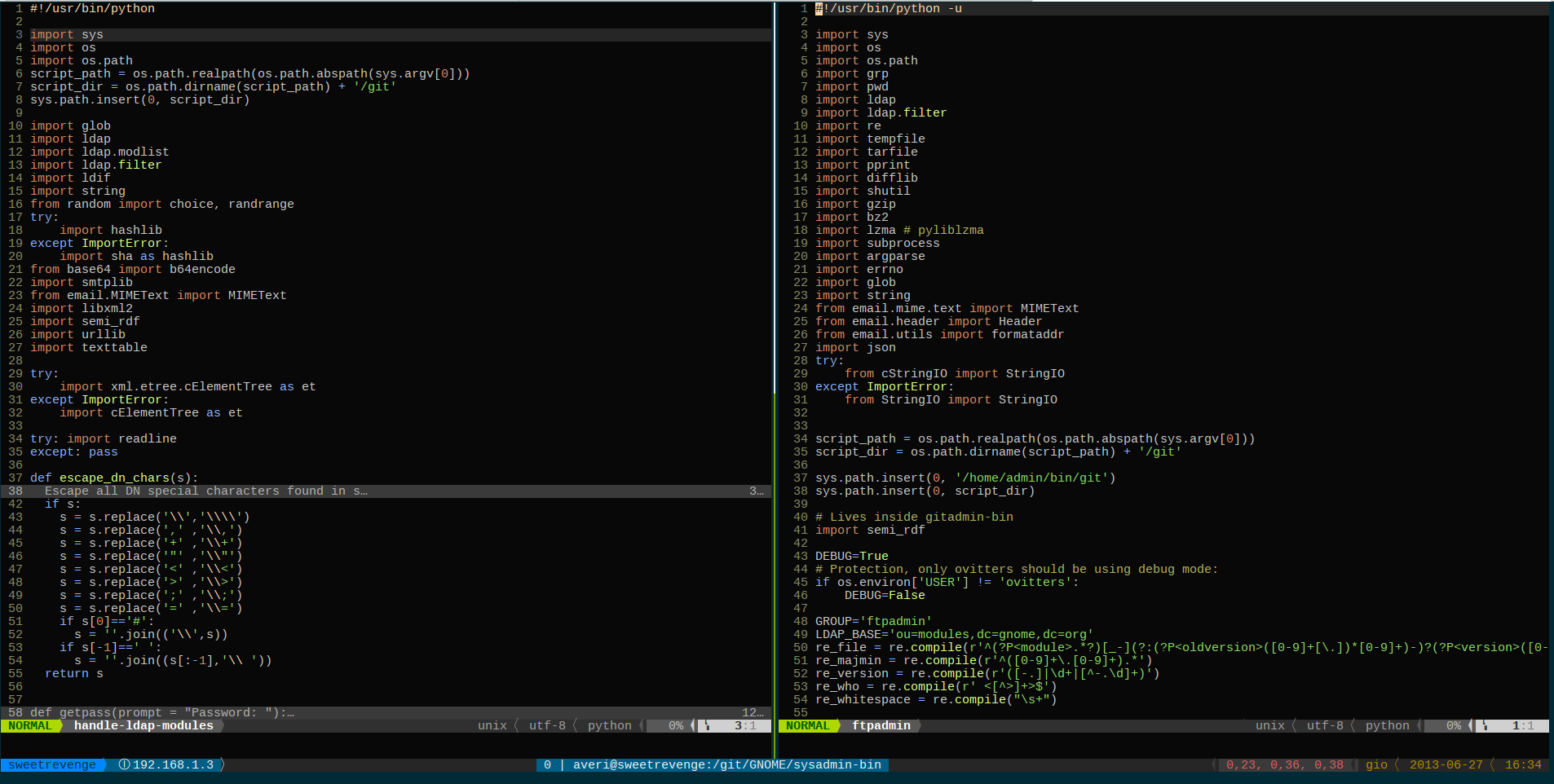
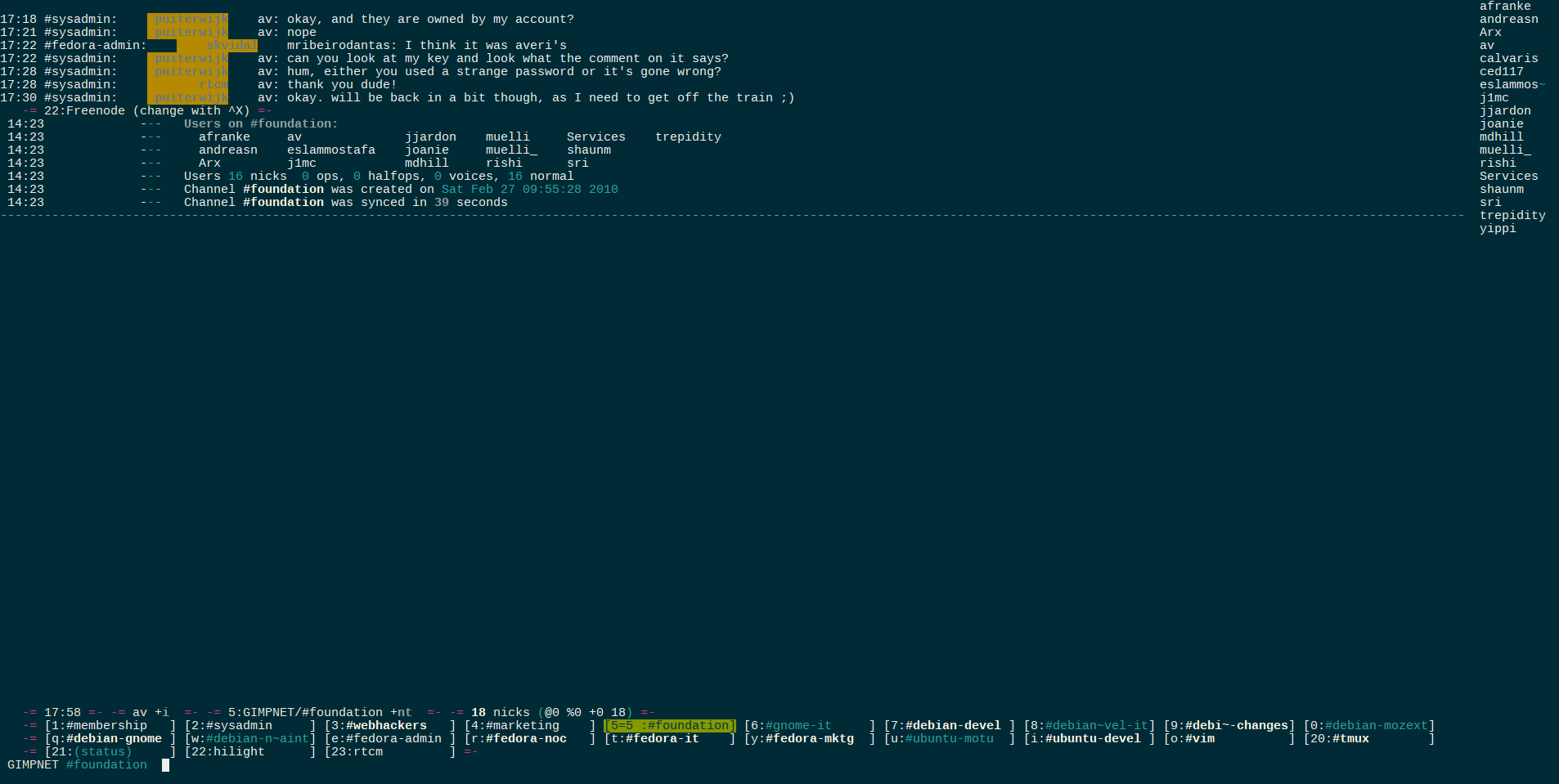
It s been two years since my latest blog post about my Linux desktop and many things have changed since then. I completely moved all my machines to GNOME 3, switched my main editor from nano to vim and my terminal multiplexer from screen to tmux. What didn t change at all except for a tweaks on the theme is my Irssi setup. dircolors_solarized Switching from nano to vim has been a pain at first, nano is really a straightforward editor, it does what you actually need from a CLI editor but while it works just fine when modifying configuration or text files, it s a bit limiting when it comes to programming. Vim on the other hand is highly customizable in every single part also thanks to its huge amount of plugins. Honestly I admit I spent several hours watching videos, reading documentation, trying out key bindings and I m not completely used to vim to be as much productive I would like to be with it. What I found to be the common error of vim s newcomers is their willingness to look around the web for a complete vimrc configuration file, full of key bindings, custom settings and personalizations. That s definitely something you should avoid when learning to use vim, the perfect vimrc doesn t objectively exist, each of us should spend some time investigating what is the best configuration for your needs and build a vimrc accordingly time by time. vimIt will probably take months to have a complex vimrc file matching your needs completely, until then you won t be able to define your vimrc to be ultimate . And that s actually why wgetting someone else s vimrc and copying it to your home folder won t make you an expert of vim, it ll probably make your life harder when trying a specific action with the stock settings will result in something you wouldn t have expected thanks to a particular key binding on the vimrc you downloaded. tmux The other tool that definitely improved my productivity is Tmux given the huge amount of open terminals I had every day during my sysadmin s duties at GNOME. Each day usually started with one or two open terminals mainly meant for random maintenance issues, after a few hours the amount of open terminals jumped to around 30. irssi Switching between tabs became a pain and the usual amount of time spent finding out which terminal had the the specific remote connection I needed was surprisingly sticking around 10 seconds. I looked around for a possible solution and found Tmux, it has been a joy finding out how easy it was to set it up and get used to it. I m now able to divide my 27 inches monitor into several panels and switch between them with a little keybinding, in addition you can set up as many windows (and consequently as many panels) as you wish, that way I can divide my programming windows from the ones specifically meant as remote consoles. From there I can detach / attach my previous Tmux session with one command and keep working on the same files and connections I had open the last time I used Tmux. In addition to the above tools I ve kept being an huge fan of Irssi and some of its plugins that have improved my overall productivity when daily chatting with Fedora, Debian and GNOME contributors. What actually changed on it since two years ago is the theme which is currently a mix between the Solarized and the XChat themes. Please don t hesitate to ask me any question if you are curious about learning something more about my current working setup! :-)

26 June 2013

Jon Dowland: Office suite UI and creativity

[pic]
For some reason I've always hated the layout of Office Suite tools such as LibreOffice, OpenOffice and Microsoft Office (I seem to find the Ribbon interface nicer than what has gone before, although I can't put my finger on why.) I always find the sheer quantity of UI in these programs have a real negative impact on creativity. I still haven't found anything as inspirational as a blank sheet of paper (or perhaps more accurately, less demotivating than a blank sheet of paper.)
[pic]
I've tried disabling and removing bits in the past, but I've never ended up with something I was happy with. Recently I tried attaching one of the two standard toolbars vertically, instead of horizontally. Surprisingly to me, the result feels a lot nicer. There's still some way to go, though. focuswriter is pretty good but I like to have some graphical features. By analogy when I write on paper it's not always straight lines of words, but sometimes bubbles, arrows, lines, strikethroughs, etc. At least I can get bullet points by remembering the write X compose key sequence (alt gr, dot, equals)

Matt Zimmerman: Scaling Human Systems: From implicit to explicit

This is part 2 in a series on organizational design and growth. What it means Carefully communicating about what s going on, and making fewer assumptions about what others know or think. Why it s important As companies grow, many new people join who don t have as much shared context. Many employees will also interact less frequently with each other, as we may not be able to maintain the same level of relationship with everyone. When we make assumptions about what our co-workers know, think or feel, we will increasingly be making errors of judgment. By replacing these tacit assumptions with explicit communication, we can help avoid mistakes and support cooperation within and between teams. Explicit communication is a vital tool for coming to agreement: by putting an agreement into words, we stand a better chance of understanding what we re agreeing to, and can change it together. Old status quo We take a lot for granted. We know quality when we see it, but can t explain it. New team members are expected to learn through osmosis or trial and error. Expectations are often ambiguous. Procedures live in our heads, and evolve in ad hoc fashion. New status quo We exercise care and thoughtfulness in our internal communications, telling others clearly what we expect and what they can expect from us. Key information and procedures are written down, and can be instantly shared with as many people as needed. We change them whenever we need to, and everyone concerned stays in the loop. Behaviors that help Obstacles that hold us back

22 June 2013

Justus Winter: My first week and some promising though hacky results

Hi Planet Debian :) my name is Justus Winter, I'm a computer science student at the University of Hamburg. I'm participating in the GSOC 2013, my task is to make Debian/Hurd systems boot using the same initialization scripts Debian/Linux uses. I spent the community bonding period with some gsoc related administrative tasks, updating my development machine and getting reacquainted with the Hurd system. It was nice to see how far Debian/Hurd has come since my last "serious" encounter with it. I've setup a continuous build solution on one of my Hurd VMs and prepared a package repository. I'll post details once I have some packages to share. I built the hurd, sysvinit and ifupdown packages and dived into the interesting world of literate programming. I'm going to write about that when I start looking into the ifupdown related issues. But most importantly I started writing a tool to automate all the tasks I would do during my work that could possibly be automated. As I'm working on the boot process, it makes sense to use some kind of virtualization software so I can work in the comfort of my usual development environment. My virtualization solution of choice is qemu and I actually wrote a qemu based black-box test solution for a former employer once, so I already was familiar with qemu and wrapping my own code around it. Without further ado, here it is: https://bitbucket.org/teythoon/hurdtest Provided that you have golang installed, you can compile it easily:
teythoon@europa /tmp % export GOPATH= pwd 
teythoon@europa /tmp % go get bitbucket.org/teythoon/hurdtest
teythoon@europa /tmp % bin/hurdtest
Usage: hurdtest [options] <command> [<arguments...>]
Currently it has the following subcommands:
test
Starts a VM, logs in as root, tests the interaction with the VM, verifies that certain VFS locations are writable, tests the network connectivity, the DNS resolution and installs and runs the hello package.
update
Executes aptitude update && aptitude full-upgrade, reboots the system and runs the test subcommand. If successful, it commits the changes to the virtual disk and creates a snapshot.
overlay
Takes as argument the path to a directory that is copied to the VM, reboots the machine and runs the test subcommand.
The update command is nice because it allows me to keep the VM up to date while ensuring that the image remains usable, with respect to what the test command considers a usable state of a Debian system. I'd really like to get some suggestions on how to test the "health" of a Debian system. You can look at how the tests are implemented in test.go, it's quite easy to add more and more interesting tests, and you don't even have to clean up after them or worry about any side-effects as the changes are not committed to the virtual disk. This is hurdtest doing an update:
teythoon@europa ~/repos/hurd/hurd-tests % bin/hurdtest update
2013/06/22 19:59:45 starting kvm [-drives file=image.qcow2,cache=writeback,snapshot=on -serial unix:/tmp/285813369/serial -monitor unix:/tmp/285813369/monitor -nographic -m 512]
2013/06/22 19:59:45 Waiting for grub...
2013/06/22 19:59:46 Waiting for login prompt...
2013/06/22 20:00:05 Updating system
2013/06/22 20:02:52 Get: 1 http://www.local unstable InRelease [8279 B]
Get: 2 http://http.debian.net sid InRelease [205 kB]
Get: 3 http://ftp.debian-ports.org unreleased InRelease [23.9 kB]
[...]
Setting up perl (5.14.2-21) ...
Reading package lists...
Building dependency tree...
Reading state information...
Reading extended state information...
Initializing package states...
Reading task descriptions...
2013/06/22 20:02:52 Update successful. Snapshotting system...
2013/06/22 20:02:53 Rebooting system...
2013/06/22 20:02:54 Waiting for grub...
2013/06/22 20:02:59 Waiting for login prompt...
2013/06/22 20:03:16 Running main.testTrue...
2013/06/22 20:03:16 Running main.testFalse...
2013/06/22 20:03:17 Running main.testClean...
[...]
2013/06/22 20:03:18 Running main.testNetwork...
2013/06/22 20:03:18 Running main.testResolver...
2013/06/22 20:03:20 Running main.testAptitudeInstall...
2013/06/22 20:03:46 Test successful. Reverting system...
2013/06/22 20:03:48 Halting system...
2013/06/22 20:03:53 Committing changes...
2013/06/22 20:03:57 Creating snapshot...
2013/06/22 20:04:04 All done.
bin/hurdtest update  157.31s user 69.71s system 87% cpu 4:18.94 total
The overlay command implements my work flow. I can edit scripts or drop hacked up executables onto my VM and see the results without any manual intervention. There's the -interactive flag that does this in a loop, avoiding the VM startup time using qemu snapshots. With this I can apply an overlay and see the results of the test suite in about a minute on my system. From early experiments I knew that simply running /etc/rcS.d/S* prevented the system from booting correctly, so I figured my first task should be to figure out what went wrong there. Using my tool (and developing it in that process) and many iterations later I came up with a surprisingly small diff of scripts in the initscripts and utilities shipped with the hurd package. For your convenience here is a tarball that you can extract to the root of your Debian/Hurd installation to reproduce my results (of course I invite you to use my tool for that purpose):
% bin/hurdtest overlay test
2013/06/22 21:35:31 starting kvm [-drive file=image.qcow2,cache=writeback,snapshot=on -serial unix:/tmp/345188134/serial -monitor unix:/tmp/345188134/monitor -nographic -m 512]
2013/06/22 21:35:31 Waiting for grub...
2013/06/22 21:35:31 Waiting for login prompt...
2013/06/22 21:35:48 Creating tarball...
./
./etc/
./etc/hurd/
./etc/hurd/rc
./etc/init.d/
./etc/init.d/checkroot.sh
./etc/init.d/mountall.sh
./runme
./lib/
./lib/init/
./lib/init/mount-functions.sh
./sbin/
./sbin/swapon
./bin/
./bin/mount
2013/06/22 21:35:48 Extracting overlay...
2013/06/22 21:35:49 Rebooting system...
2013/06/22 21:35:49 Waiting for grub...
2013/06/22 21:35:55 Writing log to /tmp/bootlog-802006344
2013/06/22 21:35:55 Waiting for login prompt...
2013/06/22 21:36:20 Booting successful.
2013/06/22 21:36:20 Running main.testTrue...
2013/06/22 21:36:21 Running main.testFalse...
2013/06/22 21:36:21 Running main.testClean...
2013/06/22 21:36:21 Running anonymous function...
2013/06/22 21:36:22 Running anonymous function...
2013/06/22 21:36:22 Running main.testUname...
2013/06/22 21:36:22 Running main.testNetwork...
2013/06/22 21:36:22 Running main.testResolver...
2013/06/22 21:36:23 Running main.testAptitudeInstall...
bin/hurdtest overlay ../hurd-tests-old/test  44.20s user 20.01s system 82% cpu 1:17.94 total
And here is the boot log:
Loading GNU Mach ...
Loading the Hurd ...
GNU Mach 1.3.99-486
AT386 boot: physical memory map from 0x0 to 0x9f400
AT386 boot: physical memory map from 0x100000 to 0x1fffe000
AT386 boot: physical memory from 0x0 to 0x1fffe000
Enabling FXSR
pcibios_init : BIOS32 Service Directory structure at 0xfcff0
pcibios_init : BIOS32 Service Directory entry at 0xfc7ba
pcibios_init : PCI BIOS revision 2.10 entry at 0xfc78c
Probing PCI hardware.
ide: Intel 82371 PIIX3 (dual FIFO) DMA Bus Mastering IDE
    Controller on PCI bus 0 function 9
ide: BM-DMA feature is not enabled (BIOS), enabling
    ide0: BM-DMA at 0xc100-0xc107
    ide1: BM-DMA at 0xc108-0xc10f
hd0: got CHS=762/128/63 CTL=c8 from BIOS
hd0: QEMU HARDDISK, 3001MB w/256kB Cache, CHS=762/128/63, DMA
hd2: QEMU DVD-ROM, ATAPI CDROM drive
ide0 at 0x1f0-0x1f7,0x3f6 on irq 14
ide1 at 0x170-0x177,0x376 on irq 15
Floppy drive(s): fd0 is 1.44M
FDC 0 is a S82078B
probing scsi 0/22: advansys probing scsi 1/22: BusLogic probing scsi 2/22: UltraStor 14F/34F rev. 4.33.00  probing scsi 3/22: UltraStor 14F/24F/34F probing scsi 4/22: Adaptec 152x SCSI driver; $Revision: 1.1 $ probing scsi 5/22: Adaptec 1542 Invalid address for shpnt with 1542.
Invalid address for shpnt with 1542.
probing scsi 6/22: Adaptec 174x (EISA) probing scsi 7/22:  probing scsi 8/22: Always IN2000 probing scsi 9/22:  probing scsi 10/22:  probing scsi 11/22:  probing scsi 12/22: Trantor T128/T128F/T228 probing scsi 13/22: DTC 3180/3280  probing scsi 14/22: Tekram DC390(T) V1.11 Feb-05-1997 probing scsi 15/22:  probing scsi 16/22: ncr53c8xx - revision 2.5f.1 probing scsi 17/22: EATA (Extended Attachment) PIO driver probing scsi 18/22: Western Digital WD-7000 Failed initialization of WD-7000 SCSI card!
probing scsi 19/22: EATA/DMA 2.0x rev. 4.33.00  probing eata on 1f0EATA0: address 0x1f0 in use, skipping probe.
probing eata on 1c88probing eata on 2c88probing eata on 3c88probing eata on 4c88probing eata on 5c88probing eata on 6c88probing eata on 7c88probing eata on 8c88probing eata on 9c88probing eata on ac88probing eata on bc88probing eata on cc88probing eata on dc88probing eata on ec88probing eata on fc88probing eata on 170EATA0: address 0x170 in use, skipping probe.
probing eata on 230probing eata on 330probing scsi 20/22: AM53C974 probing scsi 21/22: Iomega parport ZIP drive ppa: Version 1.42
ppa: Probing port 03bc
ppa: Probing port 0378
ppa:     SPP port present
ppa:     PS/2 bidirectional port present
ppa: Probing port 0278
done
scsi : 0 hosts.
scsi : detected total.
Partition check (DOS partitions):
 hd0: hd0s1 hd0s2 < hd0s5 >
lpr0: at atbus0, port = 378, spl = 6, pic = 7.
module 0: ext2fs --readonly --multiboot-command-line=$ kernel-command-line  --host-priv-port=$ host-port  --device-master-port=$ device-port  --exec-server-task=$ exec-task  -T typed $ root  $(task-create) $(task-resume) module 1: exec /hurd/exec $(exec-task=task-create)                                                                                                                                                                           2 multiboot modules                                                                                                                                                                                                                    task loaded: ext2fs --readonly --multiboot-command-line=root=device:hd0s1 console=com0 --host-priv-port=1 --device-master-port=2 --exec-server-task=3 -T typed device:hd0s1
task loaded: exec /hurd/exec
start ext2fs: Hurd server bootstrap: ext2fs[device:hd0s1] exec init proc auth
Using makefile-style concurrent boot in runlevel S.
ERROR: could not open /proc/stat: No such file or directory
Activating swap...done.
Checking root file system...fsck from util-linux 2.20.1
hd2 : tray open or drive not ready
end_request: I/O error, dev 02:00, sector 0
ext2fs_check_if_mount: Can't check if filesystem is mounted due to missing mtab file while determining whether /dev/hd0s1 is mounted.
/dev/hd0s1: clean, 44328/181056 files, 288266/723200 blocks
done.
Cleaning up temporary files... /tmp.
mount: /run: Unknown device or filesystem
mount: /run/lock: Unknown device or filesystem
mount: /proc: Unknown device or filesystem
mount: /run/shm: Unknown device or filesystem
/etc/rcS.d/S06mtab.sh: 48: /etc/rcS.d/S06mtab.sh: cannot open /proc/mounts: No such file
Activating lvm and md swap...(default pager): Already paging to partition hd0s5!
done.
Checking file systems...fsck from util-linux 2.20.1
hd2 : tray open or drive not ready
end_request: I/O error, dev 02:00, sector 0
done.
Mounting local filesystems...mount: invalid option -- 'O'
Try  mount --help' or  mount --usage' for more information.
failed.
Activating swapfile swap...(default pager): Already paging to partition hd0s5!
done.
df: Warning: cannot read table of mounted file systems: No such file or directory
Cleaning up temporary files....
Configuring network interfaces...inetutils-ifconfig: invalid arguments
ifup: failed to open pid file /run/network/ifup-/dev/eth0.pid: No such file or directory
Internet Systems Consortium DHCP Client 4.2.2
Copyright 2004-2011 Internet Systems Consortium.
All rights reserved.
For info, please visit https://www.isc.org/software/dhcp/
can't create /var/lib/dhcp/dhclient./dev/eth0.leases: No such file or directory
Listening on Socket//dev/eth0
Sending on   Socket//dev/eth0
DHCPDISCOVER on /dev/eth0 to 255.255.255.255 port 67 interval 5
DHCPREQUEST on /dev/eth0 to 255.255.255.255 port 67
DHCPOFFER from 10.0.2.2
DHCPACK from 10.0.2.2
can't create /var/lib/dhcp/dhclient./dev/eth0.leases: No such file or directory
bound to 10.0.2.15 -- renewal in 36884 seconds.
done.
Cleaning up temporary files....
Setting up X socket directories... /tmp/.X11-unix /tmp/.ICE-unix.
Using makefile-style concurrent boot in runlevel 2.
Starting enhanced syslogd: rsyslogd.
Starting deferred execution scheduler: atd.
Starting periodic command scheduler: cron.
Starting system message bus: dbusFailed to set socket option"/var/run/dbus/system_bus_socket": Protocol not available.
Starting OpenBSD Secure Shell server: sshd.
GNU 0.3 (debian) (console)
login:
I know it isn't that pretty, but it yields a working Debian/Hurd system that is more like a Debian/Linux system. For example /dev/shm and /run ,/* are connected to a tmpfs translator. I think this is a rather encouraging first result. I added my findings to the list of open issues. Another nice thing about hurdtest is that it is not even Hurd specific (only a tiny bit GNU Mach specific). I'm going to make it work nicely with Debian/Linux and Debian/kFreeBSD, since this is a very handy tool for anyone hacking on the Debian boot process (and with some changes for any OS). If anyone tries it out, I'd love to get feedback and patches. The tool requires the guest to be configured to use the first serial console for grub, the kernel and the userspace. The password for the user root must be empty. The guest has to have a working network connection setup at boot time. I will provide a suitable image as soon as I devise a good way to zero-fill the free space on the virtual disk. Is there any better way than to fill the disk with a huge file containing zeros? Without doing that the image is too large even compressed with xz. So this was my first week working for Debian. Next week I will focus on getting patches for the hurd and initscripts package in shape, I need to add some functionality to the mount utility shipped with the hurd package. It provides a mount-like experience on the Hurd, on which binding a translator (e. g. /hurd/ext2fs) to a filesystem node is an operation that does not involve the kernel (GNU Mach) at all, and is in fact a operation that any unprivileged user may perform. That is one of the nice features the Hurd has, it empowers its users.

20 June 2013

Daniel Pocock: Wrong cloud: Victorian schools and Ultranet

wrong cloud
"The blood, sweat and tears that has gone into the Ultranet and the work teachers put in it's soul destroying. I have to face parents who took me on face value when I said: 'This is the best thing since sliced bread every school is going to be using it in the future."
Those are the words of a school principal at Alkira Secondary College in Victoria, Australia. His school is receiving a real-life lesson in the the risks of cloud computing. Ultranet, the state-wide private cloud project for schools is at risk of being cancelled in 10 days due to budget cuts. It is not clear whether the vendor, NEC, is obliged to release data back to the users if the original four year contract is not extended. Commercial, confidential discussions It appears that the possibility of ending the contract was not supposed to be public knowledge. If the finance department had kept their intentions secret then it is possible that users would not even have had the opportunity to try and manually extract some of their data, as they are rushing to do now. Instead of getting on with the business of education itself, teachers and students are having to waste time trying to individually download student projects, photos, feedback and other meta data from the system in an ad-hoc manner. An opportunity for free and open source software This debacle may well be a huge opportunity for the free and open source software community to remind people that the value of retaining control over user data can not be forgotten when evaluating outsourced, private cloud solutions that claim to be "free" or offer low costs to get started. There were apparently 18 schools who initially trialed the program and many more have gradually joined up. This would be the perfect opportunity for advocates of genuinely free software solutions to contact them and let them know they are not alone and that many of us have anticipated these problems for years. While central government administrators tend to be hooked on the idea of administering big contracts with trusted' vendors, these local school administrators and the communities around them are probably more receptive to the free software message than at any other time. List of schools using Ultranet Many of the schools using Ultranet can be found with Google, as it appears to be integrated in their web sites. Click here for a Google search that finds many of the schools and related technical pages, support documents and other material A message to schools everywhere For schools facing this crisis or considering adopting such services in other countries, I would share this very simple advice: if you are offered a solution that doesn't give you complete control to conveniently extract all of your data in bulk whenever you want and use it in your own software on any computer, then it is not a good foundation to build on. The free software community has been actively working to provide truly free solutions for schools and I would strongly encourage schools to look at projects like Skolelinux/Debian-Edu and k12Linux that have been built by educators who also have a deep understanding of software and data freedom issues.

15 June 2013

C.J. Adams-Collier: Need help from Debian Developers, please.

Hi folks, I used to work at F5, and I pulled a bunch of equipment out of the recycle bin while I was there in order to help me populate the customer end premesis device inventory for a carrier network / ISP I am setting up. They decided to terminate my employment at the end of August last year, and I ve been wondering what to do with all of this equipment. I figured that it s been long enough that I can give them a call, so I did. I asked them whether I should consider buying BIG-IP hardware off of e-Bay if it said that it did not come with a license. The customer service agent told me that I should probably not consider doing any such thing, since I would have to pay a hefty fee to F5 before they would even provide a license. It looks like I d have to shell out fifty thousand dollars to get a proper F5 Networks Inc. license for these many surplus BIG-IP devices I have. I guess I ll just have to go with an improper (or maybe I mean not for profit) operating system like Debian. I wonder if I can get the current linux kernel to pick up these broadcom 10GE chips or whether I ll have to wait for someone to release Free as in speech firmware for them that I can make use of. Do any of you DDs want a shell on a linux box with a 10-port 10GE switch attached by PCI-e? I bet I could get a Debian chroot environment running in the system s stock rescue firmware. I bet I could then determine why the watchdog timer keeps tripping when I boot with other kernels If you decide to accept the offer of a shell on this box, please try to avoid rebooting it. It tends to pop my breakers and I have to run to the shop before the UPSs run out of juice.


10 June 2013

Patrick Matth i: Some photos of my Turkey/Belek vacation

Hola, now, where I will travel again for 15 days to Fuerteventura/Corralejo from the 21.06.2013 until 07.07.2013, I remember myself, that I forget to post some images from my last vacation in Turkey/Belek. Since my little realy cheap cam was damaged after a few days, I will post some photos of my buddy Robyn. DSC08514 DSC08423 DSC07583 DSC07562 DSC07499 DSC07214

1 June 2013

Daniel Pocock: Democracy down-under is not democracy

This weekend we have the AGM of a local community organisation. Like many organisations I am involved in, there will be a democratic process of decision making, board election and a low-budget social activity afterwards. We take it for granted that democracy is a good thing. In my own country, Australia, people are supposedly happier than they've ever been, no doubt people will suggest that our democracy is part of the recipe for success. While this example is from Australia, it could well happen anywhere. While everybody was slapping themselves on the back about our officially confirmed contentment, the politicians tried to slip something under the radar. With elections expected in September, the press exposed a secret deal between the two biggest political parties, raiding the public piggy bank for $60 million to prop up their campaign accounts. There is even a leaked copy of a letter confirming the deal. It was to be voted through parliament in a stitch-up within 48 hours after the happiness' announcement. Why would these two big political parties engage in a such a gross conspiracy? Weren't they already content with their whopping big pay increases that put our Prime Minister on a bigger salary than the US president or the UK Prime Minister? Well, you don't have to look hard to find out what this special funding was all about: Not long ago, the post office at the University of Melbourne where Wikileaks operates a post-office box was mysteriously shut down. While that may seem like it could just be a co-incidence on it's own, it's worth considering in the wider context: the Wikileaks party is one of the most widely recognised names in Australian politics right now. The party's leader, like the new pope, is seen as somebody who puts his principles ahead of his own comfort, living a humble life in exile while our politicians romp around with prostitutes paid for with stolen money. Whatever you think of Wikileaks or Mr Assange's private life, they are not the only example here. There are other democratic movements in our country that are equally frightening for those who are currently drunk on power. One of the independent MPs holding the balance of power is a former Lieutenant Colonel in Australia's spy agency who was ridiculed by a prior Government and forced out of his job when he exposed the sham of the Iraq war. Neither of the major political parties wants to continue being held accountable by someone who has shown such strong principles against their campaign of death and deception. That $60 million welfare payment to big political parties was intended to be something akin to a weapon of mass destruction, obliterating independent representatives out of the parliament. More recently, the same independent MP has been equally vigorous in his campagin to break the scourge of our mafia-style gambling industry with it's cosy links to Australian politicians. Now it is starting to become obvious just how scary democracy can be. Motivated by the spectacle of a few independents holding our incumbent politicians to account, other Australians have also volunteered to get in on the act and try their hand at running the country. One of Australia's richest men, Clive Palmer has found that even with his enormous wealth (and having started planning more than a year before the election), his plans to form a political party are dampened by the fact that it can't be registered with a proper name to be listed on the ballot paper and all the candidates have to be listed under his name, Palmer, or their own names, barely distinguishable from the independent candidates. This discriminatory approach to the creation of political parties clearly favours the two big incumbent groups. Now it is a lot clearer why existing politicians needed an extra $60 million war chest: like Lance Armstrong's illegal doping program, it was intended to keep themselves ahead of the pack. It all goes to show that people should not take democracy for granted: constant vigilence and involvement is needed to hold leaders to account or replace them when they deviate.
AttachmentSize
piggy-bank.jpg32.83 KB

31 May 2013

Gunnar Wolf: The joys of updating a webapp

I like Drupal. It's a very, very flexible CMS that evolved into a full-fledged Web development framework. Mind you, it's written in PHP, and that makes it a nightmare to develop for (in ~6 years I have used it for all of my important websites I have only got around to develop a set of related modules for it once). PHP programming sucks and makes my eyes and fingers bleed, but happily there are people who disagree with me And they tend to write code. All the better! Minor upgrades with Drupal are quite easy to handle. Not as easy as I'd like (i.e. whenever I upgrade the core system or a module, I have to log in as root^Wadmin^WUser #1 to ~15 different sites and run http://someurl/update.php It very seldom causes any pain. The updates that have to be run via this URL are usually on the database's structures, so I understand they have to be started (and watched) by a human. And yes, I know I could do that with Drush, the Drupal shell, but it is not very friendly to Debian-packaged Drupal... But easy enoguh. But major updates are a royal pain, and they usually amount to quite a bit. First, disable all of the modules and revert to a known-safe theme. Ok, it makes sense. Second, check whether the modules exist for the newer version (as they won't work Drupal changes enough between major versions that not only it's API-incompatible, I'd classify it as API-unrecognizable). Ok, all set? Now for the live migration itself... It has to be triggered from the browser. So yes, I am now staring at a window making clever AJAX status updates. I am sitting at 46 of 199, but following the lovely ways of programmers, it's impossible to forsee whether update #47 will just be an UPDATE foo SET bar=0 WHERE bar IS NULL or a full-scale conversion between unspeakable serialized binary structures while rearranging the whole database structure. And yes, while the meter progresses I stand in fear that update #n+1 will bomb giving me an ugly red error. I must keep the magic AJAX running, or the update might be botched. And, of course, the update has sat at #69 all while I wrote the last two paragraphs. Sometimes the updates can progress after an interruption... And it seems I have no choice but to interrupt it. /me crosses fingers... [update] Wow... I am happy I got bored of looking at the meter and decided to write this blog post: After several minutes, and just as I was about to launch a second update session (130 updates to go), the meter advanced! I'm now sitting watching it at #75. Will it ever reach 199? [update] And so it had to be... At around 115, I now got: *sigh* The update process was aborted prematurely while running update #7000 in biblio.module...
AttachmentSize
drupal_updating.png39.5 KB
drupal_updating_failed.png64.72 KB

Gerfried Fuchs: On Finding Words

There is still a lot of things going on inside me and turning, and I'd like to share two words that I grow attached to, one a fair amount longer now than the other, but both are terms that I seem to had lacking in my vocabulary which I tried to explain in a different way. After finding out about them, I noticed that both what I felt and believed were actual things that were not totally uncommon concepts, even though most people wouldn't know about them. The first term that I stumbled upon years ago was the term of pansexuality. (Do not dare to read the German Wikipedia article. It's ridiculous wrong, insulting and shows that they don't understand the topic at all.) I always had issues to explain my intimate preference to others. Especially after they found out about me being female on the inside. Questions arose (if they understood that I'm open about these things when I post the poem publicly) along the lines of "what are you now: gay, lesbian, hetero and if the latter, what does that mean?". My usual answer was that I fall in love with people, not with their bodies, and that things will eventually work out if meant to be. And thus even though I love my "Bi" shirt, it doesn't really describe properly how I swing, so to say. The latter term I discovered just recently. A friend of mine with whom I chat every now and then told me about it, and when we met again last autumn, they wore a button of the Italian community for Polyamory (I so much prefer the Italian logo to the "widely used symbol", to be honest). It was an eye opening moment for me. I often mentioned to people that I felt like I have a big heart, being able to store multiple people in it. It always puzzled me that when I'm together with someone (and I always was faithful) why I should feel bad and especially keep it a secret when there is someone else who touches my heart, too. Society seems to see this already as a breach of trust, no matter whether it gets pursued or not, just the thought is enough. But it never changed anything with respect to the person I was together with, so what's the deal? Finding out about this term explained so much to me and made a lot of sense. It is about honesty and communication, which I see lagging in a lot of relationships these days... So here you are, getting another inside view on me. And I'm sure that there will be again the one or the other person who considers to use this as ammunition against me, but you know, being open about it acts as a shield. It's not embarrassing for me, never was. And like always, I hope that I can help others feeling similar being lost for words or an understanding that it's not as weird as it might feel. Enjoy!

/personal permanent link Comments: 9 Flattr this

29 May 2013

Russell Coker: Nexus 4

My wife has had a LG Nexus 4 for about 4 months now so it s time for me to review it and compare it to my Samsung Galaxy S3. A Sealed Case The first thing to note about the Nexus 4 is that it doesn t support changing a battery or using micro-SD storage. The advantage of these design choices is that it allows reduced weight and greater strength compared to what the phone might otherwise be. Such choices would also allow the phone to be slightly cheaper which is a massive advantage, it s worth noting that the Nexus 4 is significantly cheaper than any other device I can buy with comparable specs. My wife s phone has 8G of storage (not RAM thanks Robin) and cost $369 at the start of the year while the current price is $349 for the 8G version and $399 for the 16G version. Of course one down-side of this is that if you need 16G of storage then you need to spend an extra $50 on the 16G phone instead of buying a phone with 8G of storage and inserting a 16GB micro-SD card which costs $19 from OfficeWorks. Also there s no option of using a 32G SD card (which costs less than $50) or a 64G SD card. Battery etc The battery on the Nexus 4 isn t nearly big enough, when playing Ingress it lasts about half as long as my Galaxy S3, about 90 minutes to fully discharge. If it was possible to buy a bigger battery from a company like Mugan Power then the lack of battery capacity wouldn t be such a problem. But as it s impossible to buy a bigger battery (unless you are willing to do some soldering) the only option is an external battery. I was unable to find a Nexus 4 case which includes a battery (which is probably because the Nexus 4 is a lot less common than the Galaxy S3) so my wife had to buy an external battery. If you are serious about playing Ingress with a Nexus 4 then you will end up with a battery in your pocket and cable going to your phone from the battery, this is a real annoyance. While being a cheap fast phone with a clear screen makes it well suited to Ingress the issue of having a cable permanently attached is a real down-side. One significant feature of the Nexus 4 is that it supports wireless charging. I have no immediate plans to use that feature and the wireless charger isn t even on sale in Australia. But if the USB connector was to break then I could buy a wireless charger from the US and keep using the phone, while for every other phone I own a broken connector would render the phone entirely useless. Screen Brightness I have problems with my Galaxy S3 not being bright enough at midday when on auto brightness. I have problems with my wife s Nexus 4 being too bright in most situations other than use at midday. Sometimes at night it s painfully bright. The brightness of the display probably contributes to the excessive battery use. I don t know whether all Nexus 4 devices are like this or whether there is some variance. In any case it would be nice if the automatic screen brightness could be tuned so I could make it brighter on my phone and less bright on my wife s. According to AndroSensor my Galaxy S3 thinks that the ambient light in my computer room is 28 lux while my wife s Nexus 4 claims it s 4 lux. So I guess that part of the problem is the accuracy of the light sensors in the phones. On-Screen Buttons I am a big fan of hardware buttons. Hardware buttons work reliably when your fingers are damp and can be used by feel at night. My first Android phone the Sony-Ericsson Xperia X10 had three hardware buttons for settings, home, and back as well as buttons for power, changing volume, and taking a photo which I found very convenient. My Galaxy S3 has hardware buttons for power, home, and volume control. I think that Android phones should have more hardware buttons not less. Unfortunately it seems that Google and the phone manufacturers disagree with me and the trend is towards less buttons. Now the Nexus 4 only has hardware buttons for power, and volume control. One significant advantage of the Galaxy S3 over the Nexus 4 is that the S3 s settings and back buttons while not implemented in hardware are outside the usable screen area. So the 4.8 1280*720 display is all for application data while the buttons for home, settings, and back on the Nexus 4 take up space on the screen so only a subset of the 4.7 1280*768 is usable by applications. While according to specs the Nexus 4 has a screen almost as big as the Galaxy S3 and a slightly higher resolution in practice it has an obviously smaller screen with fewer usable pixels. Also one of the changes related to having the buttons on-screen means that the settings button is often in the top right corner which I find annoying. I didn t like that aspect of the GUI the first time I used a tablet running Android 3.0 and I still don t like it now. GPS My wife s Nexus 4 seems to be much less accurate than my Galaxy S3 for GPS. I don t know how much of this is due to phone design and how much is due to random factors in manufacturing. I presume that a large portion of it is due to random manufacturing issues because other people aren t complaining about it. Maybe she just got unlucky with an inaccurate phone. Shape and Appearance One feature that I really like in the Samsung Galaxy S is that it has a significant ridge surrounding the screen. If you place a Galaxy S face-down on a desk that makes it a lot less likely to get a scratch on the screen. The LG U990 Viewty also had a similar ridge. Of course the gel case I have bought for every Android phone has solved this problem, but it would really be nice to have a phone that I consider usable without needing to buy such a case. The Nexus 4 has a screen that curves at the edges which if anything makes the problem worse than merely lacking a ridge around the edge. On the up-side the Nexus 4 looks and feels nice before you use it. The back of the Nexus 4 sparkles, that s nice but when you buy a gel case (which doesn t seem to be optional with modern design trends) you don t get to see it. The Nexus 4 is a very attractive package, it s really a pity that they didn t design it to be usable without a gel case. Conclusion Kogan is currently selling the Galaxy S3 with 16G of storage for $429. When comparing that to the 16G version of the Nexus 4 at $399 that means there s a price of $30 to get a SD socket, the option of replacing a battery, one more hardware button, and more screen space. So when comparing the Google offers for the Nexus 4 with the Kogan offer on the Galaxy S3 or the Galaxy Note which also has 16G of storage and sells for $429 the Google offer doesn t seem appealing to me. The Nexus 4 is still a good phone and is working well for my wife, but she doesn t need as much storage as I do. Also when she got her phone the Galaxy S3 was much more expensive than it is now. Also Kogan offer the 16G version of the Nexus 4 for $389 which makes it more appealing when compared to the Galaxy S3. It s surprising that they can beat Google on price. Generally I recommend the Nexus 4 without hesitation to anyone who wants a very capable phone for less than $400 and doesn t need a lot of storage. If you need more storage then the Galaxy S3 is more appealing. Also if you need to use a phone a lot then a Galaxy S3 with a power case works well in situations where the Nexus 4 performs poorly.

Russ Allbery: Review: The Making of the Indebted Man

Review: The Making of the Indebted Man, by Maurizio Lazzarato
Translator: Joshua David Jordan
Publisher: Semiotext(e)
Copyright: 2011, 2012
Printing: 2012
ISBN: 1-58435-115-2
Format: Trade paperback
Pages: 199
This is a continuation of my effort to catch up on Marxist thought while pondering workplace governance, this time following the recommendations of a friend after a related conversation (about pension systems and basic income guarantee in a Usenet group Usenet isn't dead yet). As opposed to Democracy at Work, which is a popularization, The Making of the Indebted Man has more of the density of a scholarly text. The version I'm reading is also in translation, which I suspect makes it even harder going in places. The basic thesis, though, is clear: debt is far more central to the way that we construct not only economic systems but social systems and even internal models of our own nature than is often realized. We prefer to think of societies as structured around mutual exchange, but in practice they're more often constructed around concepts of debt and credit that have been fully internalized and used to construct a moral code for a responsible debtor. And this is not a neutral construction; rather, it is a key support mechanism of capitalism and of the financial and economic status quo, used (both intentionally and accidentally) to reduce uncertainty and to support exploitation and economic domination. This is one of those perspectives that didn't occur to me prior to reading this book but which is startlingly obvious in retrospect. Once Lazzarato starts pointing it out, the prevelance and universality of debt as a basic structure of social and economic life is striking. The creditor and debtor concept extends not just to obvious examples, such as consumer credit or mortgages, but also to education (via student loans), law enforcement ("pay one's debt to society"), employment (most employers, particularly during economic downturns, have successfully inverted the natural direction of the creditor relationship and have made employees feel in debt to the employer for having a job), and social services (unemployment and welfare benefits come with significant, if often unstated, debt-like requirements). Debt is also the great leveller. It now cuts across race, gender, and social class. Apart from a small handful of extremely rich individuals and corporations, Lazzarato claims, convincingly, that nearly everyone is enmeshed to some extent in a network of debt, or at least in in attitudes and moral pressures of a debtor. Nor is this a static situation. The role of debt in our social lives seems to be constantly increasing. The past fifteen years in particular have seen drastic increases in debt during a debt-funded economic boom combined with debt-funded asset bubbles. Even after the financial collapse, much of that growth of debt persists. Lazzarato, probably in part because he's Italian, focuses on national debt (more on that in a moment); as an American, I'd identify student loan debt as a more compelling example in the United States. Other countries probably have their own examples. For a system to be this widespread, it must serve some social purpose. Lazzarato sees it as an instrument of control. Debt has been very effectively built up as a moral obligation, and (unlike a society of mutual support) it's a very one-sided moral obligation that strongly favors existing power. The debtor is held to a tight moral standard of repayment of debts, and is morally condemned by all of society, including their peers, for a failure to repay. But there is little or no corresponding moral pressure on the creditor: perhaps a half-hearted dislike of high interest rates or occasional pressure to not change previously agreed terms, but nothing like the moral pressure applied to the debtor. To be a creditor is to have an agreed-upon, one-sided right to dictate to the debtor the terms on which they must conduct a portion of their life, and the larger the debt, the larger the portion. The debtor is expected to realign their life, at least in part, around paying off the debt, including choice of profession, decisions about when to quit a job, about how to prioritize personal spending, and so forth. This is all so automatic and so deeply ingrained that, even while writing this, I'm nodding along and thinking "well, of course." Lazzarato offers an opportunity to take a step back and think about the implications, particularly of the deeply one-sided web of obligations this creates. A Marxist analysis adds another level of consideration. One of the basic questions of Marxist thought is why workers put up with exploitation by capitalists. In a Marxist analysis, workers provide the productive output of society, which is then redirected and controlled by a relatively small capitalists. The workers massively outnumber the capitalists. Why would they be content for this situation to continue? Marx, of course, thought they wouldn't be, that the periodic crises of capitalism would eventually result in a socialist revolution by the workers. But by and large this hasn't happened. Why? Lazzarato offers debt as a partial explanation. The profits redirected by capitalists are returned to workers to some extent, but as debt rather than payment. This allows workers to participate to some extent in the growth of societal wealth from constantly increasing productivity, while simultaneously entangling workers in a system of moral control. Company stores, starvation wages, and other confiscatory practices are clear mechanisms of external control that provoke directed outrage. Debt is something that the debtor has nominally agreed to (however much the situation is manipulated to make that agreement almost inevitable), and to which attaches a deep tradition of moral responsibility. The worker has respected grounds on which to object to inequitable treatment; the debtor is wholly responsible for repayment, and is rarely considered to have grounds to complain about the debt. Most of the historical attempts to balance those scales, such as laws and religious rules against usury or the historical Jewish rule of Jubilee, have fallen by the wayside. This is a rather extended summary of what I got out of the book. I'm doing that in part because the book itself is somewhat heavy going. Lazzarato makes extensive use of specialized terms (often not defined) and fills the book with references to other works without much in the way of useful summary. It's the sort of book where, if you're not already well-versed in the field, you may need to just keep reading through some passages to find a point of reference that makes the argument retroactively make sense. I had a particular difficulty with "subjectivation," a term that Wikipedia tells me is from the writings of Michel Foucault (a major source for this book), which Lazzarato uses extensively but never adequately defines. Some external research indicates that this is a very difficult term to define, which explains why I was never quite comfortable with my understanding. I think Lazzarato is using it to get at the process of internalization of the morality of debt and the way that a debt society forces individuals into a mode of economic individualism in which many of their personal choices are bent towards making themselves better (more reliable, more trustworthy) debtors. But I'm not completely sure. There are also places in which I think Lazzarato takes his argument too far, although one of those, I think, reflects a difference in national economic status. He makes quite a lot of national debt in this book, placing it in the universal position of the overarching debt that turns every citizen into a debtor even if they've avoided other debts. This is possibly true in countries whose national debts are held in other currencies, or in countries like Italy that are part of the Euro (which, if one is not Germany or France, amounts to much the same thing). It's a dubious assertion for countries like the UK, Japan, or the United States, where the national debt is held in their own free-floating currency and is largely owed domestically, and partly plays into some frustratingly incorrect political rhetoric. One of the key dynamics of debt, namely the extreme power imbalance between debtor and creditor, is missing in countries with sovereign debt in their own currency, since those countries can always (if they're willing to pay the inflation price) simply print money to pay off national debt. Creditors know this, and therefore interest rates are much lower, the amount of leverage the creditor has is quite limited, and the sorts of debt crises seen in Italy and elsewhere in the Euro periphery are not seen. Lazzarato is understandably writing from the Italian perspective, but I think he weakens his argument by lumping national debt so completely into the same category as the other types of exploitative debt he discusses. The principle does feel universal to me, but the best examples of debt vary by country, so one has to be careful about generalizing specific examples. Another place where I simply disagree with his conclusions is around some of the more dramatic presentations of subjectivation. Lazzarato talks, at one point, about how debt reduces debtors to mechanical components, and uses as an example an ATM machine, which he portrays as uniquely dehumanizing through the mechanical process that someone has to follow to withdraw money. There may be some point here about the dehumanization of debt and its subsumption into the foundation of day-to-day social interaction, but he lost me entirely with the unwarranted technophobia of the specific example. The idea that machines and automation make us less human is an old argument that's orthogonal to the thrust of his argument. It reminded me of old contentions that human relationships made on-line aren't real, which is nonsense. Overall, this is a fascinating and insightful discussion hampered by a difficult and sometimes overly elliptical presentation, a bit too much drama and grand theorizing, and a few poor choices of examples. I found the basic idea extremely valuable, but the amount of work required to extract it occasionally irritating. (This could be partly due to the limits of translation, but I suspect most of the difficulty was present in the original.) I'm not sure that I would recommend the book, but I definitely recommend considering the underlying ideas. Debt now works alongside the employment relationship as a primary means of reinforcing economic and social control and hierarchy. This is likely via accidental development rather than any grand plan, but it's now being actively exploited by the creditors of society, large corporations most notably. Viewed in that light, the explosive growth of student loan debt in the United States is particularly frightening. After Lazzarato's extensive examination of the distortive effects of permanent debt, not just on economics and society but on our own conceptions of our selves and our duties and roles in life, the idea of trapping a generation in debt from the moment of their financial independence is deeply troubling, even nauseating. Rating: 6 out of 10

Next.

Previous.