Search Results: "pm"

5 January 2023

Kentaro Hayashi: Rebuild mozc with Mozc UT Dictionary

When rebuilding mozc with Mozc UT Dictionary, it may be better to build in docker container because you don't want install unused IM development packages. In beforehand, download latest Mozc UT dictionary here. osdn.net In a debian/sid container, you need to do it:
# apt install -y devscripts
# (enable deb-src, modify /etc/apt/sources.list.d/debian.sources)
# apt source mozc
# cat mozcdic-ut-20221230/mozcdic-ut-20221230.txt >> mozc-2.28.4715.102+dfsg/src/data/dictionary_oss/dictionary00.txt 
# cd mozc-2.28.4715.102+dfsg/
# (edit debian/changelog such as 2.28.4715.102+dfsg-2.2.1 )
# debuild -us -uc -nc
After that, you can install
% sudo apt install ./emacs-mozc_2.28.4715.102+dfsg-2.2.1_amd64.deb ./emacs-mozc-bin_2.28.4715.102+dfsg-2.2.1_amd64.deb ./fcitx-mozc-data_2.28.4715.102+dfsg-2.2.1_all.deb ./fcitx5-mozc_2.28.4715.102+dfsg-2.2.1_amd64.deb ./ibus-mozc_2.28.4715.102+dfsg-2.2.1_amd64.deb ./mozc-data_2.28.4715.102+dfsg-2.2.1_all.deb ./mozc-server_2.28.4715.102+dfsg-2.2.1_amd64.deb ./mozc-utils-gui_2.28.4715.102+dfsg-2.2.1_amd64.deb
Then, you can use own build binaries.
% dpkg -l  \grep mozc
ii  emacs-mozc                               2.28.4715.102+dfsg-2.2.1               amd64        Mozc for Emacs
ii  emacs-mozc-bin                           2.28.4715.102+dfsg-2.2.1               amd64        Helper module for emacs-mozc
ii  fcitx-mozc-data                          2.28.4715.102+dfsg-2.2.1               all          Mozc input method - data files for fcitx
ii  fcitx5-mozc:amd64                        2.28.4715.102+dfsg-2.2.1               amd64        Mozc engine for fcitx5 - Client of the Mozc input method
ii  ibus-mozc                                2.28.4715.102+dfsg-2.2.1               amd64        Mozc engine for IBus - Client of the Mozc input method
ii  mozc-data                                2.28.4715.102+dfsg-2.2.1               all          Mozc input method - data files
ii  mozc-server                              2.28.4715.102+dfsg-2.2.1               amd64        Server of the Mozc input method
ii  mozc-utils-gui                           2.28.4715.102+dfsg-2.2.1               amd64        GUI utilities of the Mozc input method

1 January 2023

C.J. Adams-Collier: State of the racks, 20221231

Hi friends! I haven t written in a while. I ve been caught up in work. But between working, I ve put together some new equipment in a couple of new racks. I bought an audio dampened 15U rack a couple of years ago or so, and into it I ve placed the RAID array and an HP desktop form-factor ML110 server to drive the disks. The disk array controller is a two-port Broadcom / LSI SAS3008 PCI-Express Fusion-MPT SAS-3. I ve been thinking about getting the four-port variant, since I like this one and I ve got another 7 drive bays in the chassis that don t have disks in them. In the next rack over, which was gifted to me by one of my colleagues (Thank you Nahuel!), I have six qotom mini computers and a couple of 48-port Dell 6248 switches with two 6200-XGSF 10GE SFP+ modules. The mini computers are a sort of proto-cluster, and all have a whole bunch of network interfaces. The smallest of the group is a celeron with four gigabit ethernet ports, and the two fastest ones have i7 processors with 6x GE ports. Each of the mini computers is configured with all of their ethernet interfaces in a single LACP port-channel, thanks to the bonding Linux kernel module. On my desk, I have a Mikrotik CRS305. It is populated with three LR SMF transceivers. One attaches to my work desktop via a QLogic Corp. cLOM8214 PCIe card, one attaches via a thunderbolt 3 NIC to my work laptop, and the other is connected to the aforementioned Dell switch. My internet provider has installed a Optical Network Transceiver (ONT) device in my home which terminates the incoming Gigabit Passive Optical Network (GPON) services from the CO and delivers 940Mbit symmetric PPP over Ethernet via 8-pin copper out of the ONT. I connect the ONT to a Mikrotik CRS309-1G-8S+ router. That router is connected via LR SMF to the dell switch in the rack full of qotom hardware. This afternoon, I tested the throughput between my work desktop and my storage server and came up with these numbers:
$ iperf -c 100.64.79.102
------------------------------------------------------------
Client connecting to 100.64.79.102, TCP port 5001
TCP window size: 16.0 KByte (default)
------------------------------------------------------------
[  1] local 100.64.79.46 port 55216 connected with 100.64.79.102 port 5001 (icwnd/mss/irtt=14/1448/547)
[ ID] Interval       Transfer     Bandwidth
[  1] 0.0000-10.0129 sec  10.4 GBytes  8.95 Gbits/sec
That seems pretty good to me! The traffic hopped through my desk router and the dell switch to get to the Proliant server, and still nearly reached 9Gbit/s. That s a lot of blinkenlights.

31 December 2022

Guido G nther: Phosh 2022 in retrospect

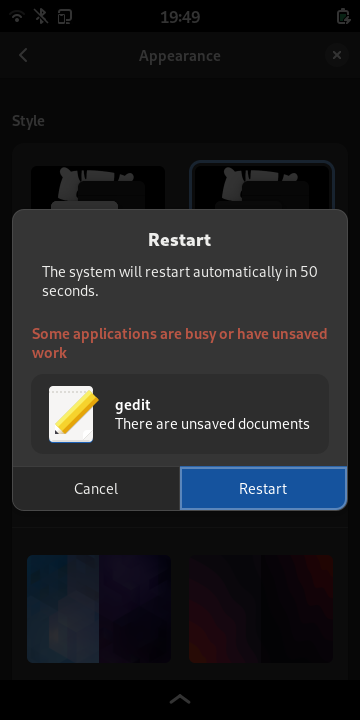
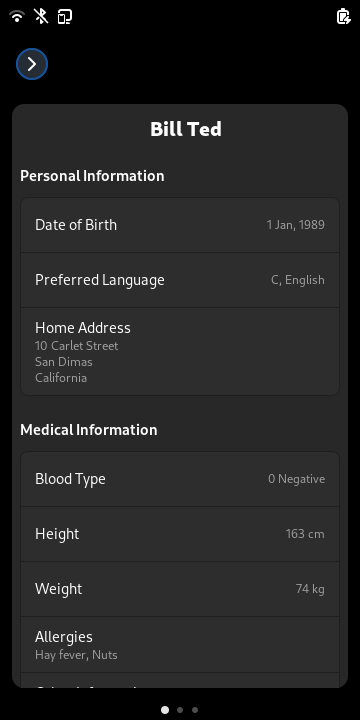
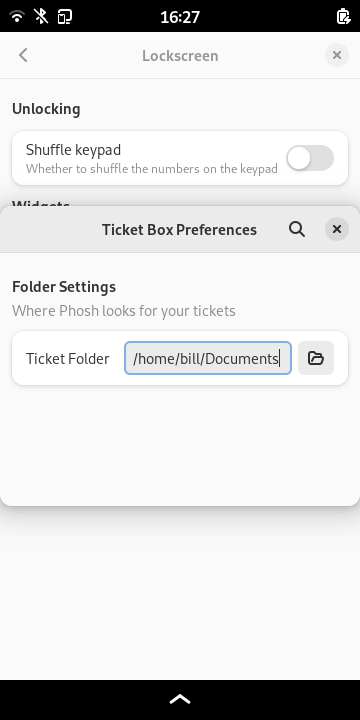
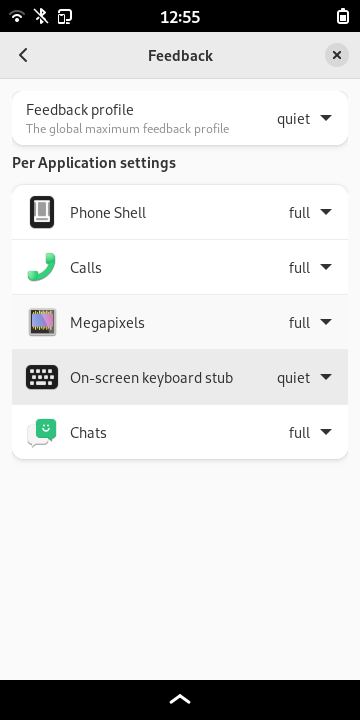
I wanted to look back at what changed in phosh in 2022 and figured I could share it with you. I'll be focusing on things very close to the mobile shell, for a broader overview see Evangelos upcoming FOSDEM talk. Some numbers We're usually aiming for a phosh release at the end of each month. In 2022 We did 10 releases like that, 7 major releases (bumping the middle version number) and three betas. We skipped the April and November releases. We also did one bug fix relesae out of line (bumping the last bit of the version number). I hope we can keep that cadence in 2023 as it allows us to get changes to users in a timely fashion (thus closing usability gaps as early as possible) as well as giving distributions a way to plan ahead. Ideally we'd not skip any release but sometimes real life just interferes. Those releases contain code contributions from about 20 different people and translations from about 30 translators. These numbers are roughly the same as 2021 which is great. Thanks everyone! In phosh's git repository we had a bit over 730 non-merge commits (roughly 2 per day), which is about 10% less than in 2021. Looking closer this is easily compensated by commits to phoc (which needed quite some work for the gestures) and phosh-mobile-settings which didn't exist in 2021. User visible features Most notable new features are likely the swipe gestures for top and bottom bar, the possibility to use the quick settings on the lock screen as well as the style refresh driven by Sam Hewitt that e.g. touched the modal dialogs (but also sliders, dialpads, etc): Style Refresh Swipe up gesture We also added the possibility to have custom widgets via loadable plugins on the lock screen so the user can decide which information should be available. We currently ship plugins to show These are maintained within phosh's source tree although out of tree plugins should be doable too. There's a settings application (the above mentioned phosh-mobile-settings) to enable these. It also allows those plugins to have individual preferences: TODO A Plugin Plugin Preferenes Speaking of configurability: Scale-to-fit settings (to work around applications that don't fit the screen) and haptic/led feedback are now configurable without resorting to the command line: Scale to fit Feedbackd settings We can also have device specific settings which helps to temporarily accumulate special workaround without affecting other phones. Other user visible features include the ability to shuffle the digits on the lockscreen's keypad, a VPN quick settings, improved screenshot support and automatic high contrast theme switching when in bright sunlight (based on ambient sensor readings) as shown here. As mentioned above Evangelos will talk at FOSDEM 2023 about the broader ecosystem improvements including GNOME, GTK, wlroots, phoc, feedbackd, ModemManager, mmsd, NetworkManager and many others without phosh wouldn't be possible. What else As I wanted a T-shirt for Debconf 2022 in Prizren so I created a logo heavily inspired by those cute tiger images you often see in Southeast Asia. Based on that I also made a first batch of stickers mostly distributed at FrOSCon 2022: Phosh stickers That's it for 2022. If you want to get involved into phosh testing, development or documentation then just drop by in the matrix room.

30 December 2022

Chris Lamb: Favourite books of 2022: Non-fiction

In my three most recent posts, I went over the memoirs and biographies, classics and fiction books that I enjoyed the most in 2022. But in the last of my book-related posts for 2022, I'll be going over my favourite works of non-fiction. Books that just missed the cut here include Adam Hochschild's King Leopold's Ghost (1998) on the role of Leopold II of Belgium in the Congo Free State, Johann Hari's Stolen Focus (2022) (a personal memoir on relating to how technology is increasingly fragmenting our attention), Amia Srinivasan's The Right to Sex (2021) (a misleadingly named set of philosophic essays on feminism), Dana Heller et al.'s The Selling of 9/11: How a National Tragedy Became a Commodity (2005), John Berger's mindbending Ways of Seeing (1972) and Louise Richardson's What Terrorists Want (2006).

The Great War and Modern Memory (1975)
Wartime: Understanding and Behavior in the Second World War (1989) Paul Fussell Rather than describe the battles, weapons, geopolitics or big personalities of the two World Wars, Paul Fussell's The Great War and Modern Memory & Wartime are focused instead on how the two wars have been remembered by their everyday participants. Drawing on the memoirs and memories of soldiers and civilians along with a brief comparison with the actual events that shaped them, Fussell's two books are a compassionate, insightful and moving piece of analysis. Fussell primarily sets himself against the admixture of nostalgia and trauma that obscures the origins and unimaginable experience of participating in these wars; two wars that were, in his view, a "perceptual and rhetorical scandal from which total recovery is unlikely." He takes particular aim at the dishonesty of hindsight:
For the past fifty years, the Allied war has been sanitised and romanticised almost beyond recognition by the sentimental, the loony patriotic, the ignorant and the bloodthirsty. I have tried to balance the scales. [And] in unbombed America especially, the meaning of the war [seems] inaccessible.
The author does not engage in any of the customary rose-tinted view of war, yet he remains understanding and compassionate towards those who try to locate a reason within what was quite often senseless barbarism. If anything, his despondency and pessimism about the Second World War (the war that Fussell himself fought in) shines through quite acutely, and this is especially the case in what he chooses to quote from others:
"It was common [ ] throughout the [Okinawa] campaign for replacements to get hit before we even knew their names. They came up confused, frightened, and hopeful, got wounded or killed, and went right back to the rear on the route by which they had come, shocked, bleeding, or stiff. They were forlorn figures coming up to the meat grinder and going right back out of it like homeless waifs, unknown and faceless to us, like unread books on a shelf."
It would take a rather heartless reader to fail to be sobered by this final simile, and an even colder one to view Fussell's citation of such an emotive anecdote to be manipulative. Still, stories and cruel ironies like this one infuse this often-angry book, but it is not without astute and shrewd analysis as well, especially on the many qualitative differences between the two conflicts that simply cannot be captured by facts and figures alone. For example:
A measure of the psychological distance of the Second [World] War from the First is the rarity, in 1914 1918, of drinking and drunkenness poems.
Indeed so. In fact, what makes Fussell's project so compelling and perhaps even unique is that he uses these non-quantitive measures to try and take stock of what happened. After all, this was a war conducted by humans, not the abstract school of statistics. And what is the value of a list of armaments destroyed by such-and-such a regiment when compared with truly consequential insights into both how the war affected, say, the psychology of postwar literature ("Prolonged trench warfare, whether enacted or remembered, fosters paranoid melodrama, which I take to be a primary mode in modern writing."), the specific words adopted by combatants ("It is a truism of military propaganda that monosyllabic enemies are easier to despise than others") as well as the very grammar of interaction:
The Field Service Post Card [in WW1] has the honour of being the first widespread exemplary of that kind of document which uniquely characterises the modern world: the "Form". [And] as the first widely known example of dehumanised, automated communication, the post card popularised a mode of rhetoric indispensable to the conduct of later wars fought by great faceless conscripted armies.
And this wouldn't be a book review without argument-ending observations that:
Indicative of the German wartime conception [of victory] would be Hitler and Speer's elaborate plans for the ultimate reconstruction of Berlin, which made no provision for a library.
Our myths about the two world wars possess an undisputed power, in part because they contain an essential truth the atrocities committed by Germany and its allies were not merely extreme or revolting, but their full dimensions (embodied in the Holocaust and the Holodomor) remain essentially inaccessible within our current ideological framework. Yet the two wars are better understood as an abyss in which we were all dragged into the depths of moral depravity, rather than a battle pitched by the forces of light against the forces of darkness. Fussell is one of the few observers that can truly accept and understand this truth and is still able to speak to us cogently on the topic from the vantage point of experience. The Second World War which looms so large in our contemporary understanding of the modern world (see below) may have been necessary and unavoidable, but Fussell convinces his reader that it was morally complicated "beyond the power of any literary or philosophic analysis to suggest," and that the only way to maintain a na ve belief in the myth that these wars were a Manichaean fight between good and evil is to overlook reality. There are many texts on the two World Wars that can either stir the intellect or move the emotions, but Fussell's two books do both. A uniquely perceptive and intelligent commentary; outstanding.

Longitude (1995) Dava Sobel Since Man first decided to sail the oceans, knowing one's location has always been critical. Yet doing so reliably used to be a serious problem if you didn't know where you were, you are far more likely to die and/or lose your valuable cargo. But whilst finding one's latitude (ie. your north south position) had effectively been solved by the beginning of the 17th century, finding one's (east west) longitude was far from trustworthy in comparison. This book first published in 1995 is therefore something of an anachronism. As in, we readily use the GPS facilities of our phones today without hesitation, so we find it difficult to imagine a reality in which knowing something fundamental like your own location is essentially unthinkable. It became clear in the 18th century, though, that in order to accurately determine one's longitude, what you actually needed was an accurate clock. In Longitude, therefore, we read of the remarkable story of John Harrison and his quest to create a timepiece that would not only keep time during a long sea voyage but would survive the rough ocean conditions as well. Self-educated and a carpenter by trade, Harrison made a number of important breakthroughs in keeping accurate time at sea, and Longitude describes his novel breakthroughs in a way that is both engaging and without talking down to the reader. Still, this book covers much more than that, including the development of accurate longitude going hand-in-hand with advancements in cartography as well as in scientific experiments to determine the speed of light: experiments that led to the formulation of quantum mechanics. It also outlines the work being done by Harrison's competitors. 'Competitors' is indeed the correct word here, as Parliament offered a huge prize to whoever could create such a device, and the ramifications of this tremendous financial incentive are an essential part of this story. For the most part, though, Longitude sticks to the story of Harrison and his evolving obsession with his creating the perfect timepiece. Indeed, one reason that Longitude is so resonant with readers is that many of the tropes of the archetypical 'English inventor' are embedded within Harrison himself. That is to say, here is a self-made man pushing against the establishment of the time, with his groundbreaking ideas being underappreciated in his life, or dishonestly purloined by his intellectual inferiors. At the level of allegory, then, I am minded to interpret this portrait of Harrison as a symbolic distillation of postwar Britain a nation acutely embarrassed by the loss of the Empire that is now repositioning itself as a resourceful but plucky underdog; a country that, with a combination of the brains of boffins and a healthy dose of charisma and PR, can still keep up with the big boys. (It is this same search for postimperial meaning I find in the fiction of John le Carr , and, far more famously, in the James Bond franchise.) All of this is left to the reader, of course, as what makes Longitute singularly compelling is its gentle manner and tone. Indeed, at times it was as if the doyenne of sci-fi Ursula K. LeGuin had a sideline in popular non-fiction. I realise it's a mark of critical distinction to downgrade the importance of popular science in favour of erudite academic texts, but Latitude is ample evidence that so-called 'pop' science need not be patronising or reductive at all.

Closed Chambers: The Rise, Fall, and Future of the Modern Supreme Court (1998) Edward Lazarus After the landmark decision by the U.S. Supreme Court in *Dobbs v. Jackson Women's Health Organization that ended the Constitutional right to abortion conferred by Roe v Wade, I prioritised a few books in the queue about the judicial branch of the United States. One of these books was Closed Chambers, which attempts to assay, according to its subtitle, "The Rise, Fall and Future of the Modern Supreme Court". This book is not merely simply a learned guide to the history and functioning of the Court (although it is completely creditable in this respect); it's actually an 'insider' view of the workings of the institution as Lazurus was a clerk for Justice Harry Blackmun during the October term of 1988. Lazarus has therefore combined his experience as a clerk and his personal reflections (along with a substantial body of subsequent research) in order to communicate the collapse in comity between the Justices. Part of this book is therefore a pure history of the Court, detailing its important nineteenth-century judgements (such as Dred Scott which ruled that the Constitution did not consider Blacks to be citizens; and Plessy v. Ferguson which failed to find protection in the Constitution against racial segregation laws), as well as many twentieth-century cases that touch on the rather technical principle of substantive due process. Other layers of Lazurus' book are explicitly opinionated, however, and they capture the author's assessment of the Court's actions in the past and present [1998] day. Given the role in which he served at the Court, particular attention is given by Lazarus to the function of its clerks. These are revealed as being far more than the mere amanuenses they were hitherto believed to be. Indeed, the book is potentially unique in its the claim that the clerks have played a pivotal role in the deliberations, machinations and eventual rulings of the Court. By implication, then, the clerks have plaedy a crucial role in the internal controversies that surround many of the high-profile Supreme Court decisions decisions that, to the outsider at least, are presented as disinterested interpretations of Constitution of the United States. This is of especial importance given that, to Lazarus, "for all the attention we now pay to it, the Court remains shrouded in confusion and misunderstanding." Throughout his book, Lazarus complicates the commonplace view that the Court is divided into two simple right vs. left political factions, and instead documents an ever-evolving series of loosely held but strongly felt series of cabals, quid pro quo exchanges, outright equivocation and pure personal prejudices. (The age and concomitant illnesses of the Justices also appears to have a not insignificant effect on the Court's rulings as well.) In other words, Closed Chambers is not a book that will be read in a typical civics class in America, and the only time the book resorts to the customary breathless rhetoric about the US federal government is in its opening chapter:
The Court itself, a Greek-style temple commanding the crest of Capitol Hill, loomed above them in the dim light of the storm. Set atop a broad marble plaza and thirty-six steps, the Court stands in splendid isolation appropriate to its place at the pinnacle of the national judiciary, one of the three independent and "coequal" branches of American government. Once dubbed the Ivory Tower by architecture critics, the Court has a Corinthian colonnade and massive twenty-foot-high bronze doors that guard the single most powerful judicial institution in the Western world. Lights still shone in several offices to the right of the Court's entrance, and [ ]
Et cetera, et cetera. But, of course, this encomium to the inherent 'nobility' of the Supreme Court is quickly revealed to be a narrative foil, as Lazarus soon razes this dangerously na ve conception to the ground:
[The] institution is [now] broken into unyielding factions that have largely given up on a meaningful exchange of their respective views or, for that matter, a meaningful explication or defense of their own views. It is of Justices who in many important cases resort to transparently deceitful and hypocritical arguments and factual distortions as they discard judicial philosophy and consistent interpretation in favor of bottom-line results. This is a Court so badly splintered, yet so intent on lawmaking, that shifting 5-4 majorities, or even mere pluralities, rewrite whole swaths of constitutional law on the authority of a single, often idiosyncratic vote. It is also a Court where Justices yield great and excessive power to immature, ideologically driven clerks, who in turn use that power to manipulate their bosses and the institution they ostensibly serve.
Lazurus does not put forward a single, overarching thesis, but in the final chapters, he does suggest a potential future for the Court:
In the short run, the cure for what ails the Court lies solely with the Justices. It is their duty, under the shield of life tenure, to recognize the pathologies affecting their work and to restore the vitality of American constitutionalism. Ultimately, though, the long-term health of the Court depends on our own resolve on whom [we] select to join that institution.
Back in 1998, Lazurus might have had room for this qualified optimism. But from the vantage point of 2022, it appears that the "resolve" of the United States citizenry was not muscular enough to meet his challenge. After all, Lazurus was writing before Bush v. Gore in 2000, which arrogated to the judicial branch the ability to decide a presidential election; the disillusionment of Barack Obama's failure to nominate a replacement for Scalia; and many other missteps in the Court as well. All of which have now been compounded by the Trump administration's appointment of three Republican-friendly justices to the Court, including hypocritically appointing Justice Barrett a mere 38 days before the 2020 election. And, of course, the leaking and ruling in Dobbs v. Jackson, the true extent of which has not been yet. Not of a bit of this is Lazarus' fault, of course, but the Court's recent decisions (as well as the liberal hagiographies of 'RBG') most perforce affect one's reading of the concluding chapters. The other slight defect of Closed Chambers is that, whilst it often implies the importance of the federal and state courts within the judiciary, it only briefly positions the Supreme Court's decisions in relation to what was happening in the House, Senate and White House at the time. This seems to be increasingly relevant as time goes on: after all, it seems fairly clear even to this Brit that relying on an activist Supreme Court to enact progressive laws must be interpreted as a failure of the legislative branch to overcome the perennial problems of the filibuster, culture wars and partisan bickering. Nevertheless, Lazarus' book is in equal parts ambitious, opinionated, scholarly and dare I admit it? wonderfully gossipy. By juxtaposing history, memoir, and analysis, Closed Chambers combines an exacting evaluation of the Court's decisions with a lively portrait of the intellectual and emotional intensity that has grown within the Supreme Court's pseudo-monastic environment all while it struggles with the most impactful legal issues of the day. This book is an excellent and well-written achievement that will likely never be repeated, and a must-read for anyone interested in this ever-increasingly important branch of the US government.

Crashed: How a Decade of Financial Crises Changed the World (2018)
Shutdown: How Covid Shook the World's Economy (2021) Adam Tooze The economic historian Adam Tooze has often been labelled as an unlikely celebrity, but in the fourteen years since the global financial crisis of 2008, a growing audience has been looking for answers about the various failures of the modern economy. Tooze, a professor of history at New York's Columbia University, has written much that is penetrative and thought-provoking on this topic, and as a result, he has generated something of a cult following amongst economists, historians and the online left. I actually read two Tooze books this year. The first, Crashed (2018), catalogues the scale of government intervention required to prop up global finance after the 2008 financial crisis, and it characterises the different ways that countries around the world failed to live up to the situation, such as doing far too little, or taking action far too late. The connections between the high-risk subprime loans, credit default swaps and the resulting liquidity crisis in the US in late 2008 is fairly well known today in part thanks to films such as Adam McKay's 2015 The Big Short and much improved economic literacy in media reportage. But Crashed makes the implicit claim that, whilst the specific and structural origins of the 2008 crisis are worth scrutinising in exacting detail, it is the reaction of states in the months and years after the crash that has been overlooked as a result. After all, this is a reaction that has not only shaped a new economic order, it has created one that does not fit any conventional idea about the way the world 'ought' to be run. Tooze connects the original American banking crisis to the (multiple) European debt crises with a larger crisis of liberalism. Indeed, Tooze somehow manages to cover all these topics and more, weaving in Trump, Brexit and Russia's 2014 annexation of Crimea, as well as the evolving role of China in the post-2008 economic order. Where Crashed focused on the constellation of consequences that followed the events of 2008, Shutdown is a clear and comprehensive account of the way the world responded to the economic impact of Covid-19. The figures are often jaw-dropping: soon after the disease spread around the world, 95% of the world's economies contracted simultaneously, and at one point, the global economy shrunk by approximately 20%. Tooze's keen and sobering analysis of what happened is made all the more remarkable by the fact that it came out whilst the pandemic was still unfolding. In fact, this leads quickly to one of the book's few flaws: by being published so quickly, Shutdown prematurely over-praises China's 'zero Covid' policy, and these remarks will make a reader today squirm in their chair. Still, despite the regularity of these references (after all, mentioning China is very useful when one is directly comparing economic figures in early 2021, for examples), these are actually minor blemishes on the book's overall thesis. That is to say, Crashed is not merely a retelling of what happened in such-and-such a country during the pandemic; it offers in effect a prediction about what might be coming next. Whilst the economic responses to Covid averted what could easily have been another Great Depression (and thus showed it had learned some lessons from 2008), it had only done so by truly discarding the economic rule book. The by-product of inverting this set of written and unwritten conventions that have governed the world for the past 50 years, this 'Washington consensus' if you well, has yet to be fully felt. Of course, there are many parallels between these two books by Tooze. Both the liquidity crisis outlined in Crashed and the economic response to Covid in Shutdown exposed the fact that one of the central tenets of the modern economy ie. that financial markets can be trusted to regulate themselves was entirely untrue, and likely was false from the very beginning. And whilst Adam Tooze does not offer a singular piercing insight (conveying a sense of rigorous mastery instead), he may as well be asking whether we're simply going to lurch along from one crisis to the next, relying on the technocrats in power to fix problems when everything blows up again. The answer may very well be yes.

Looking for the Good War: American Amnesia and the Violent Pursuit of Happiness (2021) Elizabeth D. Samet Elizabeth D. Samet's Looking for the Good War answers the following question what would be the result if you asked a professor of English to disentangle the complex mythology we have about WW2 in the context of the recent US exit of Afghanistan? Samet's book acts as a twenty-first-century update of a kind to Paul Fussell's two books (reviewed above), as well as a deeper meditation on the idea that each new war is seen through the lens of the previous one. Indeed, like The Great War and Modern Memory (1975) and Wartime (1989), Samet's book is a perceptive work of demystification, but whilst Fussell seems to have been inspired by his own traumatic war experience, Samet is not only informed by her teaching West Point military cadets but by the physical and ontological wars that have occurred during her own life as well. A more scholarly and dispassionate text is the result of Samet's relative distance from armed combat, but it doesn't mean Looking for the Good War lacks energy or inspiration. Samet shares John Adams' belief that no political project can entirely shed the innate corruptions of power and ambition and so it is crucial to analyse and re-analyse the role of WW2 in contemporary American life. She is surely correct that the Second World War has been universally elevated as a special, 'good' war. Even those with exceptionally giddy minds seem to treat WW2 as hallowed:
It is nevertheless telling that one of the few occasions to which Trump responded with any kind of restraint while he was in office was the 75th anniversary of D-Day in 2019.
What is the source of this restraint, and what has nurtured its growth in the eight decades since WW2 began? Samet posits several reasons for this, including the fact that almost all of the media about the Second World War is not only suffused with symbolism and nostalgia but, less obviously, it has been made by people who have no experience of the events that they depict. Take Stephen Ambrose, author of Steven Spielberg's Band of Brothers miniseries: "I was 10 years old when the war ended," Samet quotes of Ambrose. "I thought the returning veterans were giants who had saved the world from barbarism. I still think so. I remain a hero worshiper." If Looking for the Good War has a primary thesis, then, it is that childhood hero worship is no basis for a system of government, let alone a crusading foreign policy. There is a straight line (to quote this book's subtitle) from the "American Amnesia" that obscures the reality of war to the "Violent Pursuit of Happiness." Samet's book doesn't merely just provide a modern appendix to Fussell's two works, however, as it adds further layers and dimensions he overlooked. For example, Samet provides some excellent insight on the role of Western, gangster and superhero movies, and she is especially good when looking at noir films as a kind of kaleidoscopic response to the Second World War:
Noir is a world ruled by bad decisions but also by bad timing. Chance, which plays such a pivotal role in war, bleeds into this world, too.
Samet rightfully weaves the role of women into the narrative as well. Women in film noir are often celebrated as 'independent' and sassy, correctly reflecting their newly-found independence gained during WW2. But these 'liberated' roles are not exactly a ringing endorsement of this independence: the 'femme fatale' and the 'tart', etc., reflect a kind of conditional freedom permitted to women by a post-War culture which is still wedded to an outmoded honour culture. In effect, far from being novel and subversive, these roles for women actually underwrote the ambient cultural disapproval of women's presence in the workforce. Samet later connects this highly-conditional independence with the liberation of Afghan women, which:
is inarguably one of the more palatable outcomes of our invasion, and the protection of women's rights has been invoked on the right and the left as an argument for staying the course in Afghanistan. How easily consequence is becoming justification. How flattering it will be one day to reimagine it as original objective.
Samet has ensured her book has a predominantly US angle as well, for she ends her book with a chapter on the pseudohistorical Lost Cause of the Civil War. The legacy of the Civil War is still visible in the physical phenomena of Confederate statues, but it also exists in deep-rooted racial injustice that has been shrouded in euphemism and other psychological devices for over 150 years. Samet believes that a key part of what drives the American mythology about the Second World War is the way in which it subconsciously cleanses the horrors of brother-on-brother murder that were seen in the Civil War. This is a book that is not only of interest to historians of the Second World War; it is a work for anyone who wishes to understand almost any American historical event, social issue, politician or movie that has appeared since the end of WW2. That is for better or worse everyone on earth.

29 December 2022

Russ Allbery: Review: Sweep of the Heart

Review: Sweep of the Heart, by Ilona Andrews
Series: Innkeeper Chronicles #6
Publisher: NYLA Publishing
Copyright: 2022
ISBN: 1-64197-239-4
Format: Kindle
Pages: 440
Sweep of the Heart is the sixth book of the sci-fi urban fantasy, kitchen-sink-worldbuilding Innkeeper series by husband and wife writing pair Ilona Andrews, assuming one counts the novella Sweep with Me as a full entry (which I do). It's a direct sequel to One Fell Sweep, but also references the events of Sweep of the Blade and Sweep with Me enough to spoil them. Needless to say, don't start here. As always with this series, the book was originally published as a serial on Ilona Andrews's blog. I prefer to read my novels as novels, so I wait until the entries are collected and published, but you can read it on-line for free if you want. Sean and Dina's old friend Wilmos has been kidnapped by an enemy who looks familiar from One Fell Sweep. To get him back, they need to get to a world that is notoriously inaccessible. One player in galactic politics may be able to offer a portal, but it will come as a price. That price? Host a reality TV show. Specifically, a sci-fi version of The Bachelor, with aliens. And the bachelor is the ruler of a galactic empire, whose personal safety is now Dina's responsibility. There is a hand-waving explanation for why the Seven Star Dominion does spouse selection for their rulers this way, but let's be honest: it's a fairly transparent excuse to write a season of The Bachelor with strange aliens, political intrigue, inn-generated special effects and wallpaper-worthy backdrops, ulterior motives, and attempted murder. Oh, and competence porn, as Dina once again demonstrates just how good she's become at being an innkeeper. I'm not much of a reality TV fan, have never watched The Bachelor, and still thoroughly enjoyed this. It helps that the story is more about political intrigue than it is about superficial attraction or personal infighting, and the emperor at the center of the drama is calm, thoughtful, and juggling a large number of tricky problems (which Dina, somewhat improbably, becomes privy to). The contestants range from careful diplomats with hidden political goals to eye candy with the subtlety of a two by four, the latter sponsored by sentient murderous trees, so there's a delightful variety of tone and a ton of narrative momentum. A few of the twists and turns were obvious, but some of the cliches are less cliched than they initially look. This series always leans towards "play with every toy in the toy box at once!" rather than subtle and realistic. This entry is no exception, but the mish-mash of science fiction tropes with nigh-unlimited fantasy power is, as usual, done with so much verve and sheer creative joy that I can't help but love it. We do finally learn Caldenia's past, and... I kind of wish we hadn't? Or at least that her past had been a bit more complicated. I will avoid spoiling it by saying too much, but I thought it was an oddly flat and overdone trope that made Caldenia substantially less interesting than she was before this revelation. That was one mild disappointment. The other is that the opening of Sweep of the Heart teases some development of the overall series plot, but that remains mostly a tease. Wilmos's kidnapping and any relevance to deeper innkeeper problems is, at least in this entry, merely a framing story for the reality TV show that constitutes the bulk of the novel. There are a few small revelations in the conclusion, but only the type that raise more questions. Hopefully we'll get more series plot development in the next book, but even if we don't, I'm happily along for the ride. If you like this series, this is more of the thing you already like. If you haven't read it yet, I highly recommend it (start with Clean Sweep). It's not great literature, and most of the trappings will be familiar from a dozen other novels and TV shows, but it's unabashed fun with loads of competence porn and a wild internal logic that grows on you over time. Also, it has one of the most emotionally satisfying sentient buildings in SF. There will, presumably, be more entries in the series, but they have not yet been announced. Rating: 8 out of 10

28 December 2022

Chris Lamb: Favourite books of 2022: Classics

As a follow-up to yesterday's post detailing my favourite works of fiction from 2022, today I'll be listing my favourite fictional works that are typically filed under classics. Books that just missed the cut here include: E. M. Forster's A Room with a View (1908) and his later A Passage to India (1913), both gently nudged out by Forster's superb Howard's End (see below). Giuseppe Tomasi di Lampedusa's The Leopard (1958) also just missed out on a write-up here, but I can definitely recommend it to anyone interested in reading a modern Italian classic.

War and Peace (1867) Leo Tolstoy It's strange to think that there is almost no point in reviewing this novel: who hasn't heard of War and Peace? What more could possibly be said about it now? Still, when I was growing up, War and Peace was always the stereotypical example of the 'impossible book', and even start it was, at best, a pointless task, and an act of hubris at worst. And so there surely exists a parallel universe in which I never have and will never will read the book... Nevertheless, let us try to set the scene. Book nine of the novel opens as follows:
On the twelfth of June, 1812, the forces of Western Europe crossed the Russian frontier and war began; that is, an event took place opposed to human reason and to human nature. Millions of men perpetrated against one another such innumerable crimes, frauds, treacheries, thefts, forgeries, issues of false money, burglaries, incendiarisms and murders as in whole centuries are not recorded in the annals of all the law courts of the world, but which those who committed them did not at the time regard as being crimes. What produced this extraordinary occurrence? What were its causes? [ ] The more we try to explain such events in history reasonably, the more unreasonable and incomprehensible they become to us.
Set against the backdrop of the Napoleonic Wars and Napoleon's invasion of Russia, War and Peace follows the lives and fates of three aristocratic families: The Rostovs, The Bolkonskys and the Bezukhov's. These characters find themselves situated athwart (or against) history, and all this time, Napoleon is marching ever closer to Moscow. Still, Napoleon himself is essentially just a kind of wallpaper for a diverse set of personal stories touching on love, jealousy, hatred, retribution, naivety, nationalism, stupidity and much much more. As Elif Batuman wrote earlier this year, "the whole premise of the book was that you couldn t explain war without recourse to domesticity and interpersonal relations." The result is that Tolstoy has woven an incredibly intricate web that connects the war, noble families and the everyday Russian people to a degree that is surprising for a book started in 1865. Tolstoy's characters are probably timeless (especially the picaresque adventures and constantly changing thoughts Pierre Bezukhov), and the reader who has any social experience will immediately recognise characters' thoughts and actions. Some of this is at a 'micro' interpersonal level: for instance, take this example from the elegant party that opens the novel:
Each visitor performed the ceremony of greeting this old aunt whom not one of them knew, not one of them wanted to know, and not one of them cared about. The aunt spoke to each of them in the same words, about their health and her own and the health of Her Majesty, who, thank God, was better today. And each visitor, though politeness prevented his showing impatience, left the old woman with a sense of relief at having performed a vexatious duty and did not return to her the whole evening.
But then, some of the focus of the observations are at the 'macro' level of the entire continent. This section about cities that feel themselves in danger might suffice as an example:
At the approach of danger, there are always two voices that speak with equal power in the human soul: one very reasonably tells a man to consider the nature of the danger and the means of escaping it; the other, still more reasonably, says that it is too depressing and painful to think of the danger, since it is not in man s power to foresee everything and avert the general course of events, and it is therefore better to disregard what is painful till it comes and to think about what is pleasant. In solitude, a man generally listens to the first voice, but in society to the second.
And finally, in his lengthy epilogues, Tolstoy offers us a dissertation on the behaviour of large organisations, much of it through engagingly witty analogies. These epilogues actually turn out to be an oblique and sarcastic commentary on the idiocy of governments and the madness of war in general. Indeed, the thorough dismantling of the 'great man' theory of history is a common theme throughout the book:
During the whole of that period [of 1812], Napoleon, who seems to us to have been the leader of all these movements as the figurehead of a ship may seem to a savage to guide the vessel acted like a child who, holding a couple of strings inside a carriage, thinks he is driving it. [ ] Why do [we] all speak of a military genius ? Is a man a genius who can order bread to be brought up at the right time and say who is to go to the right and who to the left? It is only because military men are invested with pomp and power and crowds of sychophants flatter power, attributing to it qualities of genius it does not possess.
Unlike some other readers, I especially enjoyed these diversions into the accounting and workings of history, as well as our narrow-minded way of trying to 'explain' things in a singular way:
When an apple has ripened and falls, why does it fall? Because of its attraction to the earth, because its stalk withers, because it is dried by the sun, because it grows heavier, because the wind shakes it, or because the boy standing below wants to eat it? Nothing is the cause. All this is only the coincidence of conditions in which all vital organic and elemental events occur. And the botanist who finds that the apple falls because the cellular tissue decays and so forth is equally right with the child who stands under the tree and says the apple fell because he wanted to eat it and prayed for it.
Given all of these serious asides, I was also not expecting this book to be quite so funny. At the risk of boring the reader with citations, take this sarcastic remark about the ineptness of medicine men:
After his liberation, [Pierre] fell ill and was laid up for three months. He had what the doctors termed 'bilious fever.' But despite the fact that the doctors treated him, bled him and gave him medicines to drink he recovered.
There is actually a multitude of remarks that are not entirely complimentary towards Russian medical practice, but they are usually deployed with an eye to the human element involved rather than simply to the detriment of a doctor's reputation "How would the count have borne his dearly loved daughter s illness had he not known that it was costing him a thousand rubles?" Other elements of note include some stunning set literary pieces, such as when Prince Andrei encounters a gnarly oak tree under two different circumstances in his life, and when Nat sha's 'Russian' soul is awakened by the strains of a folk song on the balalaika. Still, despite all of these micro- and macro-level happenings, for a long time I felt that something else was going on in War and Peace. It was difficult to put into words precisely what it was until I came across this passage by E. M. Forster:
After one has read War and Peace for a bit, great chords begin to sound, and we cannot say exactly what struck them. They do not arise from the story [and] they do not come from the episodes nor yet from the characters. They come from the immense area of Russia, over which episodes and characters have been scattered, from the sum-total of bridges and frozen rivers, forests, roads, gardens and fields, which accumulate grandeur and sonority after we have passed them. Many novelists have the feeling for place, [but] very few have the sense of space, and the possession of it ranks high in Tolstoy s divine equipment. Space is the lord of War and Peace, not time.
'Space' indeed. Yes, potential readers should note the novel's great length, but the 365 chapters are actually remarkably short, so the sensation of reading it is not in the least overwhelming. And more importantly, once you become familiar with its large cast of characters, it is really not a difficult book to follow, especially when compared to the other Russian classics. My only regret is that it has taken me so long to read this magnificent novel and that I might find it hard to find time to re-read it within the next few years.

Coming Up for Air (1939) George Orwell It wouldn't be a roundup of mine without at least one entry from George Orwell, and, this year, that place is occupied by a book I hadn't haven't read in almost two decades Still, the George Bowling of Coming Up for Air is a middle-aged insurance salesman who lives in a distinctly average English suburban row house with his nuclear family. One day, after winning some money on a bet, he goes back to the village where he grew up in order to fish in a pool he remembers from thirty years before. Less important than the plot, however, is both the well-observed remarks and scathing criticisms that Bowling has of the town he has returned to, combined with an ominous sense of foreboding before the Second World War breaks out. At several times throughout the book, George's placid thoughts about his beloved carp pool are replaced by racing, anxious thoughts that overwhelm his inner peace:
War is coming. In 1941, they say. And there'll be plenty of broken crockery, and little houses ripped open like packing-cases, and the guts of the chartered accountant's clerk plastered over the piano that he's buying on the never-never. But what does that kind of thing matter, anyway? I'll tell you what my stay in Lower Binfield had taught me, and it was this. IT'S ALL GOING TO HAPPEN. All the things you've got at the back of your mind, the things you're terrified of, the things that you tell yourself are just a nightmare or only happen in foreign countries. The bombs, the food-queues, the rubber truncheons, the barbed wire, the coloured shirts, the slogans, the enormous faces, the machine-guns squirting out of bedroom windows. It's all going to happen. I know it - at any rate, I knew it then. There's no escape. Fight against it if you like, or look the other way and pretend not to notice, or grab your spanner and rush out to do a bit of face-smashing along with the others. But there's no way out. It's just something that's got to happen.
Already we can hear psychological madness that underpinned the Second World War. Indeed, there is no great story in Coming Up For Air, no wonderfully empathetic characters and no revelations or catharsis, so it is impressive that I was held by the descriptions, observations and nostalgic remembrances about life in modern Lower Binfield, its residents, and how it has changed over the years. It turns out, of course, that George's beloved pool has been filled in with rubbish, and the village has been perverted by modernity beyond recognition. And to cap it off, the principal event of George's holiday in Lower Binfield is an accidental bombing by the British Royal Air Force. Orwell is always good at descriptions of awful food, and this book is no exception:
The frankfurter had a rubber skin, of course, and my temporary teeth weren't much of a fit. I had to do a kind of sawing movement before I could get my teeth through the skin. And then suddenly pop! The thing burst in my mouth like a rotten pear. A sort of horrible soft stuff was oozing all over my tongue. But the taste! For a moment I just couldn't believe it. Then I rolled my tongue around it again and had another try. It was fish! A sausage, a thing calling itself a frankfurter, filled with fish! I got up and walked straight out without touching my coffee. God knows what that might have tasted of.
Many other tell-tale elements of Orwell's fictional writing are in attendance in this book as well, albeit worked out somewhat less successfully than elsewhere in his oeuvre. For example, the idea of a physical ailment also serving as a metaphor is present in George's false teeth, embodying his constant preoccupation with his ageing. (Readers may recall Winston Smith's varicose ulcer representing his repressed humanity in Nineteen Eighty-Four). And, of course, we have a prematurely middle-aged protagonist who almost but not quite resembles Orwell himself. Given this and a few other niggles (such as almost all the women being of the typical Orwell 'nagging wife' type), it is not exactly Orwell's magnum opus. But it remains a fascinating historical snapshot of the feeling felt by a vast number of people just prior to the Second World War breaking out, as well as a captivating insight into how the process of nostalgia functions and operates.

Howards End (1910) E. M. Forster Howards End begins with the following sentence:
One may as well begin with Helen s letters to her sister.
In fact, "one may as well begin with" my own assumptions about this book instead. I was actually primed to consider Howards End a much more 'Victorian' book: I had just finished Virginia Woolf's Mrs Dalloway and had found her 1925 book at once rather 'modern' but also very much constrained by its time. I must have then unconsciously surmised that a book written 15 years before would be even more inscrutable, and, with its Victorian social mores added on as well, Howards End would probably not undress itself so readily in front of the reader. No doubt there were also the usual expectations about 'the classics' as well. So imagine my surprise when I realised just how inordinately affable and witty Howards End turned out to be. It doesn't have that Wildean shine of humour, of course, but it's a couple of fields over in the English countryside, perhaps abutting the more mordant social satires of the earlier George Orwell novels (see Coming Up for Air above). But now let us return to the story itself. Howards End explores class warfare, conflict and the English character through a tale of three quite different families at the beginning of the twentieth century: the rich Wilcoxes; the gentle & idealistic Schlegels; and the lower-middle class Basts. As the Bloomsbury Group Schlegel sisters desperately try to help the Basts and educate the rich but close-minded Wilcoxes, the three families are drawn ever closer and closer together. Although the whole story does, I suppose, revolve around the house in the title (which is based on the Forster's own childhood home), Howards End is perhaps best described as a comedy of manners or a novel that shows up the hypocrisy of people and society. In fact, it is surprising how little of the story actually takes place in the eponymous house, with the overwhelming majority of the first half of the book taking place in London. But it is perhaps more illuminating to remark that the Howards End of the book is a house that the Wilcoxes who own it at the start of the novel do not really need or want. What I particularly liked about Howards End is how the main character's ideals alter as they age, and subsequently how they find their lives changing in different ways. Some of them find themselves better off at the end, others worse. And whilst it is also surprisingly funny, it still manages to trade in heavier social topics as well. This is apparent in the fact that, although the characters themselves are primarily in charge of their own destinies, their choices are still constrained by the changing world and shifting sense of morality around them. This shouldn't be too surprising: after all, Forster's novel was published just four years before the Great War, a distinctly uncertain time. Not for nothing did Virginia Woolf herself later observe that "on or about December 1910, human character changed" and that "all human relations have shifted: those between masters and servants, husbands and wives, parents and children." This process can undoubtedly be seen rehearsed throughout Forster's Howards End, and it's a credit to the author to be able to capture it so early on, if not even before it was widespread throughout Western Europe. I was also particularly taken by Forster's fertile use of simile. An extremely apposite example can be found in the description Tibby Schlegel gives of his fellow Cambridge undergraduates. Here, Timmy doesn't want to besmirch his lofty idealisation of them with any banal specificities, and wishes that the idea of them remain as ideal Platonic forms instead. Or, as Forster puts it, to Timmy it is if they are "pictures that must not walk out of their frames." Wilde, at his most weakest, is 'just' style, but Forster often deploys his flair for a deeper effect. Indeed, when you get to the end of this section mentioning picture frames, you realise Forster has actually just smuggled into the story a failed attempt on Tibby's part to engineer an anonymous homosexual encounter with another undergraduate. It is a credit to Forster's sleight-of-hand that you don't quite notice what has just happened underneath you and that the books' reticence to honestly describe what has happened is thus structually analogus Tibby's reluctance to admit his desires to himself. Another layer to the character of Tibby (and the novel as a whole) is thereby introduced without the imposition of clumsy literary scaffolding. In a similar vein, I felt very clever noticing the arch reference to Debussy's Pr lude l'apr s-midi d'un faune until I realised I just fell into the trap Forster set for the reader in that I had become even more like Tibby in his pseudo-scholarly views on classical music. Finally, I enjoyed that each chapter commences with an ironic and self-conscious bon mot about society which is only slightly overblown for effect. Particularly amusing are the ironic asides on "women" that run through the book, ventriloquising the narrow-minded views of people like the Wilcoxes. The omniscient and amiable narrator of the book also recalls those ironically distant voiceovers from various French New Wave films at times, yet Forster's narrator seems to have bigger concerns in his mordant asides: Forster seems to encourage some sympathy for all of the characters even the more contemptible ones at their worst moments. Highly recommended, as are Forster's A Room with a View (1908) and his slightly later A Passage to India (1913).

The Good Soldier (1915) Ford Madox Ford The Good Soldier starts off fairly simply as the narrator's account of his and his wife's relationship with some old friends, including the eponymous 'Good Soldier' of the book's title. It's an experience to read the beginning of this novel, as, like any account of endless praise of someone you've never met or care about, the pages of approving remarks about them appear to be intended to wash over you. Yet as the chapters of The Good Soldier go by, the account of the other characters in the book gets darker and darker. Although the author himself is uncritical of others' actions, your own critical faculties are slowgrly brought into play, and you gradully begin to question the narrator's retelling of events. Our narrator is an unreliable narrator in the strict sense of the term, but with the caveat that he is at least is telling us everything we need to know to come to our own conclusions. As the book unfolds further, the narrator's compromised credibility seems to infuse every element of the novel even the 'Good' of the book's title starts to seem like a minor dishonesty, perhaps serving as the inspiration for the irony embedded in the title of The 'Great' Gatsby. Much more effectively, however, the narrator's fixations, distractions and manner of speaking feel very much part of his dissimulation. It sometimes feels like he is unconsciously skirting over the crucial elements in his tale, exactly like one does in real life when recounting a story containing incriminating ingredients. Indeed, just how much the narrator is conscious of his own concealment is just one part of what makes this such an interesting book: Ford Madox Ford has gifted us with enough ambiguity that it is also possible that even the narrator cannot find it within himself to understand the events of the story he is narrating. It was initially hard to believe that such a carefully crafted analysis of a small group of characters could have been written so long ago, and despite being fairly easy to read, The Good Soldier is an almost infinitely subtle book even the jokes are of the subtle kind and will likely get a re-read within the next few years.

Anna Karenina (1878) Leo Tolstoy There are many similar themes running through War and Peace (reviewed above) and Anna Karenina. Unrequited love; a young man struggling to find a purpose in life; a loving family; an overwhelming love of nature and countless fascinating observations about the minuti of Russian society. Indeed, rather than primarily being about the eponymous Anna, Anna Karenina provides a vast panorama of contemporary life in Russia and of humanity in general. Nevertheless, our Anna is a sophisticated woman who abandons her empty existence as the wife of government official Alexei Karenin, a colourless man who has little personality of his own, and she turns to a certain Count Vronsky in order to fulfil her passionate nature. Needless to say, this results in tragic consequences as their (admittedly somewhat qualified) desire to live together crashes against the rocks of reality and Russian society. Parallel to Anna's narrative, though, Konstantin Levin serves as the novel's alter-protagonist. In contrast to Anna, Levin is a socially awkward individual who straddles many schools of thought within Russia at the time: he is neither a free-thinker (nor heavy-drinker) like his brother Nikolai, and neither is he a bookish intellectual like his half-brother Serge. In short, Levin is his own man, and it is generally agreed by commentators that he is Tolstoy's surrogate within the novel. Levin tends to come to his own version of an idea, and he would rather find his own way than adopt any prefabricated view, even if confusion and muddle is the eventual result. In a roughly isomorphic fashion then, he resembles Anna in this particular sense, whose story is a counterpart to Levin's in their respective searches for happiness and self-actualisation. Whilst many of the passionate and exciting passages are told on Anna's side of the story (I'm thinking horse race in particular, as thrilling as anything in cinema ), many of the broader political thoughts about the nature of the working classes are expressed on Levin's side instead. These are stirring and engaging in their own way, though, such as when he joins his peasants to mow the field and seems to enter the nineteenth-century version of 'flow':
The longer Levin mowed, the more often he felt those moments of oblivion during which it was no longer his arms that swung the scythe, but the scythe itself that lent motion to his whole body, full of life and conscious of itself, and, as if by magic, without a thought of it, the work got rightly and neatly done on its own. These were the most blissful moments.
Overall, Tolstoy poses no didactic moral message towards any of the characters in Anna Karenina, and merely invites us to watch rather than judge. (Still, there is a hilarious section that is scathing of contemporary classical music, presaging many of the ideas found in Tolstoy's 1897 What is Art?). In addition, just like the earlier War and Peace, the novel is run through with a number of uncannily accurate observations about daily life:
Anna smiled, as one smiles at the weaknesses of people one loves, and, putting her arm under his, accompanied him to the door of the study.
... as well as the usual sprinkling of Tolstoy's sardonic humour ("No one is pleased with his fortune, but everyone is pleased with his wit."). Fyodor Dostoyevsky, the other titan of Russian literature, once described Anna Karenina as a "flawless work of art," and if you re only going to read one Tolstoy novel in your life, it should probably be this one.

26 December 2022

Vincent Bernat: Managing infrastructure with Terraform, CDKTF, and NixOS

A few years ago, I downsized my personal infrastructure. Until 2018, there were a dozen containers running on a single Hetzner server.1 I migrated my emails to Fastmail and my DNS zones to Gandi. It left me with only my blog to self-host. As of today, my low-scale infrastructure is composed of 4 virtual machines running NixOS on Hetzner Cloud and Vultr, a handful of DNS zones on Gandi and Route 53, and a couple of Cloudfront distributions. It is managed by CDK for Terraform (CDKTF), while NixOS deployments are handled by NixOps. In this article, I provide a brief introduction to Terraform, CDKTF, and the Nix ecosystem. I also explain how to use Nix to access these tools within your shell, so you can quickly start using them.

CDKTF: infrastructure as code Terraform is an infrastructure-as-code tool. You can define your infrastructure by declaring resources with the HCL language. This language has some additional features like loops to declare several resources from a list, built-in functions you can call in expressions, and string templates. Terraform relies on a large set of providers to manage resources.

Managing servers Here is a short example using the Hetzner Cloud provider to spawn a virtual machine:
variable "hcloud_token"  
  sensitive = true
 
provider "hcloud"  
  token = var.hcloud_token
 
resource "hcloud_server" "web03"  
  name = "web03"
  server_type = "cpx11"
  image = "debian-11"
  datacenter = "nbg1-dc3"
 
resource "hcloud_rdns" "rdns4-web03"  
  server_id = hcloud_server.web03.id
  ip_address = hcloud_server.web03.ipv4_address
  dns_ptr = "web03.luffy.cx"
 
resource "hcloud_rdns" "rdns6-web03"  
  server_id = hcloud_server.web03.id
  ip_address = hcloud_server.web03.ipv6_address
  dns_ptr = "web03.luffy.cx"
 
HCL expressiveness is quite limited and I find a general-purpose language more convenient to describe all the resources. This is where CDK for Terraform comes in: you can manage your infrastructure using your preferred programming language, including TypeScript, Go, and Python. Here is the previous example using CDKTF and TypeScript:
import   App, TerraformStack, Fn   from "cdktf";
import   HcloudProvider   from "./.gen/providers/hcloud/provider";
import * as hcloud from "./.gen/providers/hcloud";
class MyStack extends TerraformStack  
  constructor(scope: Construct, name: string)  
    super(scope, name);
    const hcloudToken = new TerraformVariable(this, "hcloudToken",  
      type: "string",
      sensitive: true,
     );
    const hcloudProvider = new HcloudProvider(this, "hcloud",  
      token: hcloudToken.value,
     );
    const web03 = new hcloud.server.Server(this, "web03",  
      name: "web03",
      serverType: "cpx11",
      image: "debian-11",
      datacenter: "nbg1-dc3",
      provider: hcloudProvider,
     );
    new hcloud.rdns.Rdns(this, "rdns4-web03",  
      serverId: Fn.tonumber(web03.id),
      ipAddress: web03.ipv4Address,
      dnsPtr: "web03.luffy.cx",
      provider: hcloudProvider,
     );
    new hcloud.rdns.Rdns(this, "rdns6-web03",  
      serverId: Fn.tonumber(web03.id),
      ipAddress: web03.ipv6Address,
      dnsPtr: "web03.luffy.cx",
      provider: hcloudProvider,
     );
   
 
const app = new App();
new MyStack(app, "cdktf-take1");
app.synth();
Running cdktf synth generates a configuration file for Terraform, terraform plan previews the changes, and terraform apply applies them. Now that you have a general-purpose language, you can use functions.

Managing DNS records While using CDKTF for 4 web servers may seem a tad overkill, this is quite different when it comes to managing a few DNS zones. With DNSControl, which is using JavaScript as a domain-specific language, I was able to define the bernat.ch zone with this snippet of code:
D("bernat.ch", REG_NONE, DnsProvider(DNS_BIND, 0), DnsProvider(DNS_GANDI),
  DefaultTTL('2h'),
  FastMailMX('bernat.ch',  subdomains: ['vincent'] ),
  WebServers('@'),
  WebServers('vincent');
This generated 38 records. With CDKTF, I use:
new Route53Zone(this, "bernat.ch", providers.aws)
  .sign(dnsCMK)
  .registrar(providers.gandiVB)
  .www("@", servers)
  .www("vincent", servers)
  .www("media", servers)
  .fastmailMX(["vincent"]);
All the magic is in the code that I did not show you. You can check the dns.ts file in the cdktf-take1 repository to see how it works. Here is a quick explanation:
  • Route53Zone() creates a new zone hosted by Route 53,
  • sign() signs the zone with the provided master key,
  • registrar() registers the zone to the registrar of the domain and sets up DNSSEC,
  • www() creates A and AAAA records for the provided name pointing to the web servers,
  • fastmailMX() creates the MX records and other support records to direct emails to Fastmail.
Here is the content of the fastmailMX() function. It generates a few records and returns the current zone for chaining:
fastmailMX(subdomains?: string[])  
  (subdomains ?? [])
    .concat(["@", "*"])
    .forEach((subdomain) =>
      this.MX(subdomain, [
        "10 in1-smtp.messagingengine.com.",
        "20 in2-smtp.messagingengine.com.",
      ])
    );
  this.TXT("@", "v=spf1 include:spf.messagingengine.com ~all");
  ["mesmtp", "fm1", "fm2", "fm3"].forEach((dk) =>
    this.CNAME( $ dk ._domainkey ,  $ dk .$ this.name .dkim.fmhosted.com. )
  );
  this.TXT("_dmarc", "v=DMARC1; p=none; sp=none");
  return this;
 
I encourage you to browse the repository if you need more information.

About Pulumi My first tentative around Terraform was to use Pulumi. You can find this attempt on GitHub. This is quite similar to what I currently do with CDKTF. The main difference is that I am using Python instead of TypeScript because I was not familiar with TypeScript at the time.2 Pulumi predates CDKTF and it uses a slightly different approach. CDKTF generates a Terraform configuration (in JSON format instead of HCL), delegating planning, state management, and deployment to Terraform. It is therefore bound to the limitations of what can be expressed by Terraform, notably when you need to transform data obtained from one resource to another.3 Pulumi needs specific providers for each resource. Many Pulumi providers are thin wrappers encapsulating Terraform providers. While Pulumi provides a good user experience, I switched to CDKTF because writing providers for Pulumi is a chore. CDKTF does not require such a step. Outside the big players (AWS, Azure and Google Cloud), the existence, quality, and freshness of the Pulumi providers are inconsistent. Most providers rely on a Terraform provider and they may lag a few versions behind, miss a few resources, or have a few bugs of their own. When a provider does not exist, you can write one with the help of the pulumi-terraform-bridge library. The Pulumi project provides a boilerplate for this purpose. I had a bad experience with it when writing providers for Gandi and Vultr: the Makefile automatically installs Pulumi using a curl sh pattern and does not work with /bin/sh. There is a lack of interest for community-based contributions4 or even for providers for smaller players.

NixOS & NixOps Nix is a functional, purely-functional programming language. Nix is also the name of the package manager that is built on top of the Nix language. It allows users to declaratively install packages. nixpkgs is a repository of packages. You can install Nix on top of a regular Linux distribution. If you want more details, a good resource is the official website, and notably the learn section. There is a steep learning curve, but the reward is tremendous.

NixOS: declarative Linux distribution NixOS is a Linux distribution built on top of the Nix package manager. Here is a configuration snippet to add some packages:
environment.systemPackages = with pkgs;
  [
    bat
    htop
    liboping
    mg
    mtr
    ncdu
    tmux
  ];
It is possible to alter an existing derivation5 to use a different version, enable a specific feature, or apply a patch. Here is how I enable and configure Nginx to disable the stream module, add the Brotli compression module, and add the IP address anonymizer module. Moreover, instead of using OpenSSL 3, I keep using OpenSSL 1.1.6
services.nginx =  
  enable = true;
  package = (pkgs.nginxStable.override  
    withStream = false;
    modules = with pkgs.nginxModules; [
      brotli
      ipscrub
    ];
    openssl = pkgs.openssl_1_1;
   );
If you need to add some patches, it is also possible. Here are the patches I added in 2019 to circumvent the DoS vulnerabilities in Nginx until they were fixed in NixOS:7
services.nginx.package = pkgs.nginxStable.overrideAttrs (old:  
  patches = oldAttrs.patches ++ [
    # HTTP/2: reject zero length headers with PROTOCOL_ERROR.
    (pkgs.fetchpatch  
      url = https://github.com/nginx/nginx/commit/dbdd[ ].patch;
      sha256 = "a48190[ ]";
     )
    # HTTP/2: limited number of DATA frames.
    (pkgs.fetchpatch  
      url = https://github.com/nginx/nginx/commit/94c5[ ].patch;
      sha256 = "af591a[ ]";
     )
    #  HTTP/2: limited number of PRIORITY frames.
    (pkgs.fetchpatch  
      url = https://github.com/nginx/nginx/commit/39bb[ ].patch;
      sha256 = "1ad8fe[ ]";
     )
  ];
 );
If you are interested, have a look at my relatively small configuration: common.nix contains the configuration to be applied to any host (SSH, users, common software packages), web.nix contains the configuration for the web servers, isso.nix runs Isso into a systemd container.

NixOps: NixOS deployment tool On a single node, NixOS configuration is in the /etc/nixos/configuration.nix file. After modifying it, you have to run nixos-rebuild switch. Nix fetches all possible dependencies from the binary cache and builds the remaining packages. It creates a new entry in the boot loader menu and activates the new configuration. To manage several nodes, there exists several options, including NixOps, deploy-rs, Colmena, and morph. I do not know all of them, but from my point of view, the differences are not that important. It is also possible to build such a tool yourself as Nix provides the most important building blocks: nix build and nix copy. NixOps is one of the first tools available but I encourage you to explore the alternatives. NixOps configuration is written in Nix. Here is a simplified configuration to deploy znc01.luffy.cx, web01.luffy.cx, and web02.luffy.cx, with the help of the server and web functions:
let
  server = hardware: name: imports:  
    deployment.targetHost = "$ name .luffy.cx";
    networking.hostName = name;
    networking.domain = "luffy.cx";
    imports = [ (./hardware/. + "/$ hardware .nix") ] ++ imports;
   ;
  web = hardware: idx: imports:
    server hardware "web$ lib.fixedWidthNumber 2 idx " ([ ./web.nix ] ++ imports);
in  
  network.description = "Luffy infrastructure";
  network.enableRollback = true;
  defaults = import ./common.nix;
  znc01 = server "exoscale" [ ./znc.nix ];
  web01 = web "hetzner" 1 [ ./isso.nix ];
  web02 = web "hetzner" 2 [];
 

Tying everything together with Nix The Nix ecosystem is a unified solution to the various problems around software and configuration management. A very interesting feature is the declarative and reproducible developer environments. This is similar to Python virtual environments, except it is not language-specific.

Brief introduction to Nix flakes I am using flakes, a new Nix feature improving reproducibility by pinning all dependencies and making the build hermetic. While the feature is marked as experimental,8 it is widely used and you may see flake.nix and flake.lock at the root of some repositories. As a short example, here is the flake.nix content shipped with Snimpy, an interactive SNMP tool for Python relying on libsmi, a C library:
 
  inputs =  
    nixpkgs.url = "nixpkgs";
    flake-utils.url = "github:numtide/flake-utils";
   ;
  outputs =   self, ...  @inputs:
    inputs.flake-utils.lib.eachDefaultSystem (system:
      let
        pkgs = inputs.nixpkgs.legacyPackages."$ system ";
      in
       
        # nix build
        packages.default = pkgs.python3Packages.buildPythonPackage  
          name = "snimpy";
          src = self;
          preConfigure = ''echo "1.0.0-0-000000000000" > version.txt'';
          checkPhase = "pytest";
          checkInputs = with pkgs.python3Packages; [ pytest mock coverage ];
          propagatedBuildInputs = with pkgs.python3Packages; [ cffi pysnmp ipython ];
          buildInputs = [ pkgs.libsmi ];
         ;
        # nix run + nix shell
        apps.default =   
          type = "app";
          program = "$ self.packages."$ system ".default /bin/snimpy";
         ;
        # nix develop
        devShells.default = pkgs.mkShell  
          name = "snimpy-dev";
          buildInputs = [
            self.packages."$ system ".default.inputDerivation
            pkgs.python3Packages.ipython
          ];
         ;
       );
 
If you have Nix installed on your system:
  • nix run github:vincentbernat/snimpy runs Snimpy,
  • nix shell github:vincentbernat/snimpy provides a shell with Snimpy ready-to-use,
  • nix build github:vincentbernat/snimpy builds the Python package, tests included, and
  • nix develop . provides a shell to hack around Snimpy when run from a fresh checkout.9
For more information about Nix flakes, have a look at the tutorial from Tweag.

Nix and CDKTF At the root of the repository I use for CDKTF, there is a flake.nix file to set up a shell with Terraform and CDKTF installed and with the appropriate environment variables to automate my infrastructure. Terraform is already packaged in nixpkgs. However, I need to apply a patch on top of the Gandi provider. Not a problem with Nix!
terraform = pkgs.terraform.withPlugins (p: [
  p.aws
  p.hcloud
  p.vultr
  (p.gandi.overrideAttrs
    (old:  
      src = pkgs.fetchFromGitHub  
        owner = "vincentbernat";
        repo = "terraform-provider-gandi";
        rev = "feature/livedns-key";
        hash = "sha256-V16BIjo5/rloQ1xTQrdd0snoq1OPuDh3fQNW7kiv/kQ=";
       ;
     ))
]);
CDKTF is written in TypeScript. I have a package.json file with all the dependencies needed, including the ones to use TypeScript as the language to define infrastructure:
 
  "name": "cdktf-take1",
  "version": "1.0.0",
  "main": "main.js",
  "types": "main.ts",
  "private": true,
  "dependencies":  
    "@types/node": "^14.18.30",
    "cdktf": "^0.13.3",
    "cdktf-cli": "^0.13.3",
    "constructs": "^10.1.151",
    "eslint": "^8.27.0",
    "prettier": "^2.7.1",
    "ts-node": "^10.9.1",
    "typescript": "^3.9.10",
    "typescript-language-server": "^2.1.0"
   
 
I use Yarn to get a yarn.lock file that can be used directly to declare a derivation containing all the dependencies:
nodeEnv = pkgs.mkYarnModules  
  pname = "cdktf-take1-js-modules";
  version = "1.0.0";
  packageJSON = ./package.json;
  yarnLock = ./yarn.lock;
 ;
The next step is to generate the CDKTF providers from the Terraform providers and turn them into a derivation:
cdktfProviders = pkgs.stdenvNoCC.mkDerivation  
  name = "cdktf-providers";
  nativeBuildInputs = [
    pkgs.nodejs
    terraform
  ];
  src = nix-filter  
    root = ./.;
    include = [ ./cdktf.json ./tsconfig.json ];
   ;
  buildPhase = ''
    export HOME=$(mktemp -d)
    export CHECKPOINT_DISABLE=1
    export DISABLE_VERSION_CHECK=1
    export PATH=$ nodeEnv /node_modules/.bin:$PATH
    ln -nsf $ nodeEnv /node_modules node_modules
    # Build all providers we have in terraform
    for provider in $(cd $ terraform /libexec/terraform-providers; echo */*/*/*); do
      version=''$ provider##*/ 
      provider=''$ provider%/* 
      echo "Build $provider@$version"
      cdktf provider add --force-local $provider@$version   cat
    done
    echo "Compile TS   JS"
    tsc
  '';
  installPhase = ''
    mv .gen $out
    ln -nsf $ nodeEnv /node_modules $out/node_modules
  '';
 ;
Finally, we can define the development environment:
devShells.default = pkgs.mkShell  
  name = "cdktf-take1";
  buildInputs = [
    pkgs.nodejs
    pkgs.yarn
    terraform
  ];
  shellHook = ''
    # No telemetry
    export CHECKPOINT_DISABLE=1
    # No autoinstall of plugins
    export CDKTF_DISABLE_PLUGIN_CACHE_ENV=1
    # Do not check version
    export DISABLE_VERSION_CHECK=1
    # Access to node modules
    export PATH=$PWD/node_modules/.bin:$PATH
    ln -nsf $ nodeEnv /node_modules node_modules
    ln -nsf $ cdktfProviders  .gen
    # Credentials
    for p in \
      njf.nznmba.pbz/Nqzvavfgengbe \
      urgmare.pbz/ivaprag@oreang.pu \
      ihyge.pbz/ihyge@ivaprag.oreang.pu; do
        eval $(pass show $(echo $p   tr 'A-Za-z' 'N-ZA-Mn-za-m')   grep '^export')
    done
    eval $(pass show personal/cdktf/secrets   grep '^export')
    export TF_VAR_hcloudToken="$HCLOUD_TOKEN"
    export TF_VAR_vultrApiKey="$VULTR_API_KEY"
    unset VULTR_API_KEY HCLOUD_TOKEN
  '';
 ;
The derivations listed in buildInputs are available in the provided shell. The content of shellHook is sourced when starting the shell. It sets up some symbolic links to make the JavaScript environment built at an earlier step available, as well as the generated CDKTF providers. It also exports all the credentials.10 I am also using direnv with an .envrc to automatically load the development environment. This also enables the environment to be available from inside Emacs, notably when using lsp-mode to get TypeScript completions. Without direnv, nix develop . can activate the environment. I use the following commands to deploy the infrastructure:11
$ cdktf synth
$ cd cdktf.out/stacks/cdktf-take1
$ terraform plan --out plan
$ terraform apply plan
$ terraform output -json > ~-automation/nixops-take1/cdktf.json
The last command generates a JSON file containing various data to complete the deployment with NixOps.

NixOps The JSON file exported by Terraform contains the list of servers with various attributes:
 
  "hardware": "hetzner",
  "ipv4Address": "5.161.44.145",
  "ipv6Address": "2a01:4ff:f0:b91::1",
  "name": "web05.luffy.cx",
  "tags": [
    "web",
    "continent:NA",
    "continent:SA"
  ]
 
In network.nix, this list is imported and transformed into an attribute set describing the servers. A simplified version looks like this:
let
  lib = inputs.nixpkgs.lib;
  shortName = name: builtins.elemAt (lib.splitString "." name) 0;
  domainName = name: lib.concatStringsSep "." (builtins.tail (lib.splitString "." name));
  server = hardware: name: imports:  
    networking =  
      hostName = shortName name;
      domain = domainName name;
     ;
    deployment.targetHost = name;
    imports = [ (./hardware/. + "/$ hardware .nix") ] ++ imports;
   ;
  cdktf-servers-json = (lib.importJSON ./cdktf.json).servers.value;
  cdktf-servers = map
    (s:
      let
        tags-maybe-import = map (t: ./. + "/$ t .nix") s.tags;
        tags-import = builtins.filter (t: builtins.pathExists t) tags-maybe-import;
      in
       
        name = shortName s.name;
        value = server s.hardware s.name tags-import;
       )
    cdktf-servers-json;
in
 
  // [ ]
  // builtins.listToAttrs cdktf-servers
For web05, this expands to:
web05 =  
  networking =  
    hostName = "web05";
    domainName = "luffy.cx";
   ;
  deployment.targetHost = "web05.luffy.cx";
  imports = [ ./hardware/hetzner.nix ./web.nix ];
 ;
As for CDKTF, at the root of the repository I use for NixOps, there is a flake.nix file to set up a shell with NixOps configured. Because NixOps do not support rollouts, I usually use the following commands to deploy on a single server:12
$ nix flake update
$ nixops deploy --include=web04
$ ./tests web04.luffy.cx
If the tests are OK, I deploy the remaining nodes gradually with the following command:
$ (set -e; for h in web 03..06 ; do nixops deploy --include=$h; done)
nixops deploy rolls out all servers in parallel and therefore could cause a short outage where all Nginx are down at the same time.
This post has been a work-in-progress for the past three years, with the content being updated and refined as I experimented with different solutions. There is still much to explore13 but I feel there is enough content to publish now.

  1. It was an AMD Athlon 64 X2 5600+ with 2 GB of RAM and 2 400 GB disks with software RAID. I was paying something around 59 per month for it. While it was a good deal in 2008, by 2018 it was no longer cost-effective. It was running on Debian Wheezy with Linux-VServer for isolation, both of which were outdated in 2018.
  2. I also did not use Python because Poetry support in Nix was a bit broken around the time I started hacking around CDKTF.
  3. Pulumi can apply arbitrary functions with the apply() method on an output. It makes it easy to transform data that are not known during the planning stage. Terraform has functions to serve a similar purpose, but they are more limited.
  4. The two mentioned pull requests are not merged yet. The second one is superseded by PR #61, submitted two months later, which enforces the use of /bin/bash. I also submitted PR #56, which was merged 4 months later and quickly reverted without an explanation.
  5. You may consider packages and derivations to be synonyms in the Nix ecosystem.
  6. OpenSSL 3 has outstanding performance regressions.
  7. NixOS can be a bit slow to integrate patches since they need to rebuild parts of the binary cache before releasing the fixes. In this specific case, they were fast: the vulnerability and patches were released on August 13th 2019 and available in NixOS on August 15th. As a comparison, Debian only released the fixed version on August 22nd, which is unusually late.
  8. Because flakes are experimental, many documentations do not use them and it is an additional aspect to learn.
  9. It is possible to replace . with github:vincentbernat/snimpy, like in the other commands, but having Snimpy dependencies without Snimpy source code is less interesting.
  10. I am using pass as a password manager. The password names are only obfuscated to avoid spam.
  11. The cdktf command can wrap the terraform commands, but I prefer to use them directly as they are more flexible.
  12. If the change is risky, I disable the server with CDKTF. This removes it from the web service DNS records.
  13. I would like to replace NixOps with an alternative handling progressive rollouts and checks. I am also considering switching to Nomad or Kubernetes to deploy workloads.

24 December 2022

Simon Josefsson: OpenPGP key on FST-01SZ

I use GnuPG to compute cryptographic signatures for my emails, git commits/tags, and software release artifacts (tarballs). Part of GnuPG is gpg-agent which talks to OpenSSH, which I login to remote servers and to clone git repositories. I dislike storing cryptographic keys on general-purpose machines, and have used hardware-backed OpenPGP keys since around 2006 when I got a FSFE Fellowship Card. GnuPG via gpg-agent handles this well, and the private key never leaves the hardware. The ZeitControl cards were (to my knowledge) proprietary hardware running some non-free operating system and OpenPGP implementation. By late 2012 the YubiKey NEO supported OpenPGP, and while the hardware and operating system on it was not free, at least it ran a free software OpenPGP implementation and eventually I setup my primary RSA key on it. This worked well for a couple of years, and when I in 2019 wished to migrate to a new key, the FST-01G device with open hardware running free software that supported Ed25519 had become available. I created a key and have been using the FST-01G on my main laptop since then. This little device has been working, the signature counter on it is around 14501 which means around 10 signatures/day since then! Currently I am in the process of migrating towards a new laptop, and moving the FST-01G device between them is cumbersome, especially if I want to use both laptops in parallel. That s why I need to setup a new hardware device to hold my OpenPGP key, which can go with my new laptop. This is a good time to re-visit alternatives. I quickly decided that I did not want to create a new key, only to import my current one to keep everything working. My requirements on the device to chose hasn t changed since 2019, see my summary at the end of the earlier blog post. Unfortunately the FST-01G is out of stock and the newer FST-01SZ has also out of stock. While Tillitis looks promising (and I have one to play with), it does not support OpenPGP (yet). What to do? Fortunately, I found some FST-01SZ device in my drawer, and decided to use it pending a more satisfactory answer. Hopefully once I get around to generate a new OpenPGP key in a year or so, I will do a better survey of options that are available on the market then. What are your (freedom-respecting) OpenPGP hardware recommendations?
FST-01SZ circuit board
Similar to setting up the FST-01G, the FST-01SZ needs to be setup before use. I m doing the following from Trisquel 11 but any GNU/Linux system would work. When the device is inserted at first time, some kernel messages are shown (see /var/log/syslog or use the dmesg command):

usb 3-3: new full-speed USB device number 39 using xhci_hcd
usb 3-3: New USB device found, idVendor=234b, idProduct=0004, bcdDevice= 2.00
usb 3-3: New USB device strings: Mfr=1, Product=2, SerialNumber=3
usb 3-3: Product: Fraucheky
usb 3-3: Manufacturer: Free Software Initiative of Japan
usb 3-3: SerialNumber: FSIJ-0.0
usb-storage 3-3:1.0: USB Mass Storage device detected
scsi host1: usb-storage 3-3:1.0
scsi 1:0:0:0: Direct-Access     FSIJ     Fraucheky        1.0  PQ: 0 ANSI: 0
sd 1:0:0:0: Attached scsi generic sg2 type 0
sd 1:0:0:0: [sdc] 128 512-byte logical blocks: (65.5 kB/64.0 KiB)
sd 1:0:0:0: [sdc] Write Protect is off
sd 1:0:0:0: [sdc] Mode Sense: 03 00 00 00
sd 1:0:0:0: [sdc] No Caching mode page found
sd 1:0:0:0: [sdc] Assuming drive cache: write through
 sdc:
sd 1:0:0:0: [sdc] Attached SCSI removable disk
Interestingly, the NeuG software installed on the device I got appears to be version 1.0.9:

jas@kaka:~$ head /media/jas/Fraucheky/README
NeuG - a true random number generator implementation
						  Version 1.0.9
						     2018-11-20
					           Niibe Yutaka
			      Free Software Initiative of Japan
What's NeuG?
============
jas@kaka:~$ 
I could not find version 1.0.9 published anywhere, but the device came with a SD-card that contain a copy of the source, so I uploaded it until a more canonical place is located. Putting the device in the serial mode can be done using a sudo eject /dev/sdc command which results in the following syslog output.

usb 3-3: reset full-speed USB device number 39 using xhci_hcd
usb 3-3: device firmware changed
usb 3-3: USB disconnect, device number 39
sdc: detected capacity change from 128 to 0
usb 3-3: new full-speed USB device number 40 using xhci_hcd
usb 3-3: New USB device found, idVendor=234b, idProduct=0001, bcdDevice= 2.00
usb 3-3: New USB device strings: Mfr=1, Product=2, SerialNumber=3
usb 3-3: Product: NeuG True RNG
usb 3-3: Manufacturer: Free Software Initiative of Japan
usb 3-3: SerialNumber: FSIJ-1.0.9-42315277
cdc_acm 3-3:1.0: ttyACM0: USB ACM device
Now download Gnuk, verify its integrity and build it. You may need some additional packages installed, try apt-get install gcc-arm-none-eabi openocd python3-usb. As you can see, I m using the stable 1.2 branch of Gnuk, currently on version 1.2.20. The ./configure parameters deserve some explanation. The kdf_do=required sets up the device to require KDF usage. The --enable-factory-reset allows me to use the command factory-reset (with admin PIN) inside gpg --card-edit to completely wipe the card. Some may consider that too dangerous, but my view is that if someone has your admin PIN it is game over anyway. The --vidpid=234b:0000 is specifies the USB VID/PID to use, and --target=FST_01SZ is critical to set the platform (you ll may brick the device if you pick the wrong --target setting).

jas@kaka:~/src$ rm -rf gnuk neug
jas@kaka:~/src$ git clone https://gitlab.com/jas/neug.git
Cloning into 'neug'...
remote: Enumerating objects: 2034, done.
remote: Counting objects: 100% (2034/2034), done.
remote: Compressing objects: 100% (603/603), done.
remote: Total 2034 (delta 1405), reused 2013 (delta 1405), pack-reused 0
Receiving objects: 100% (2034/2034), 910.34 KiB   3.50 MiB/s, done.
Resolving deltas: 100% (1405/1405), done.
jas@kaka:~/src$ git clone https://salsa.debian.org/gnuk-team/gnuk/gnuk.git
Cloning into 'gnuk'...
remote: Enumerating objects: 13765, done.
remote: Counting objects: 100% (959/959), done.
remote: Compressing objects: 100% (337/337), done.
remote: Total 13765 (delta 629), reused 907 (delta 599), pack-reused 12806
Receiving objects: 100% (13765/13765), 12.59 MiB   3.05 MiB/s, done.
Resolving deltas: 100% (10077/10077), done.
jas@kaka:~/src$ cd neug
jas@kaka:~/src/neug$ git describe 
release/1.0.9
jas@kaka:~/src/neug$ git tag -v  git describe 
object 5d51022a97a5b7358d0ea62bbbc00628c6cec06a
type commit
tag release/1.0.9
tagger NIIBE Yutaka <gniibe@fsij.org> 1542701768 +0900
Version 1.0.9.
gpg: Signature made Tue Nov 20 09:16:08 2018 CET
gpg:                using EDDSA key 249CB3771750745D5CDD323CE267B052364F028D
gpg:                issuer "gniibe@fsij.org"
gpg: Good signature from "NIIBE Yutaka <gniibe@fsij.org>" [unknown]
gpg:                 aka "NIIBE Yutaka <gniibe@debian.org>" [unknown]
gpg: WARNING: This key is not certified with a trusted signature!
gpg:          There is no indication that the signature belongs to the owner.
Primary key fingerprint: 249C B377 1750 745D 5CDD  323C E267 B052 364F 028D
jas@kaka:~/src/neug$ cd ../gnuk/
jas@kaka:~/src/gnuk$ git checkout STABLE-BRANCH-1-2 
Branch 'STABLE-BRANCH-1-2' set up to track remote branch 'STABLE-BRANCH-1-2' from 'origin'.
Switched to a new branch 'STABLE-BRANCH-1-2'
jas@kaka:~/src/gnuk$ git describe
release/1.2.20
jas@kaka:~/src/gnuk$ git tag -v  git describe 
object 9d3c08bd2beb73ce942b016d4328f0a596096c02
type commit
tag release/1.2.20
tagger NIIBE Yutaka <gniibe@fsij.org> 1650594032 +0900
Gnuk: Version 1.2.20
gpg: Signature made Fri Apr 22 04:20:32 2022 CEST
gpg:                using EDDSA key 249CB3771750745D5CDD323CE267B052364F028D
gpg: Good signature from "NIIBE Yutaka <gniibe@fsij.org>" [unknown]
gpg:                 aka "NIIBE Yutaka <gniibe@debian.org>" [unknown]
gpg: WARNING: This key is not certified with a trusted signature!
gpg:          There is no indication that the signature belongs to the owner.
Primary key fingerprint: 249C B377 1750 745D 5CDD  323C E267 B052 364F 028D
jas@kaka:~/src/gnuk/src$ git submodule update --init
Submodule 'chopstx' (https://salsa.debian.org/gnuk-team/chopstx/chopstx.git) registered for path '../chopstx'
Cloning into '/home/jas/src/gnuk/chopstx'...
Submodule path '../chopstx': checked out 'e12a7e0bb3f004c7bca41cfdb24c8b66daf3db89'
jas@kaka:~/src/gnuk$ cd chopstx
jas@kaka:~/src/gnuk/chopstx$ git describe
release/1.21
jas@kaka:~/src/gnuk/chopstx$ git tag -v  git describe 
object e12a7e0bb3f004c7bca41cfdb24c8b66daf3db89
type commit
tag release/1.21
tagger NIIBE Yutaka <gniibe@fsij.org> 1650593697 +0900
Chopstx: Version 1.21
gpg: Signature made Fri Apr 22 04:14:57 2022 CEST
gpg:                using EDDSA key 249CB3771750745D5CDD323CE267B052364F028D
gpg: Good signature from "NIIBE Yutaka <gniibe@fsij.org>" [unknown]
gpg:                 aka "NIIBE Yutaka <gniibe@debian.org>" [unknown]
gpg: WARNING: This key is not certified with a trusted signature!
gpg:          There is no indication that the signature belongs to the owner.
Primary key fingerprint: 249C B377 1750 745D 5CDD  323C E267 B052 364F 028D
jas@kaka:~/src/gnuk/chopstx$ cd ../src
jas@kaka:~/src/gnuk/src$ kdf_do=required ./configure --enable-factory-reset --vidpid=234b:0000 --target=FST_01SZ
Header file is: board-fst-01sz.h
Debug option disabled
Configured for bare system (no-DFU)
PIN pad option disabled
CERT.3 Data Object is NOT supported
Card insert/removal by HID device is NOT supported
Life cycle management is supported
Acknowledge button is supported
KDF DO is required before key import/generation
jas@kaka:~/src/gnuk/src$ make   less
jas@kaka:~/src/gnuk/src$ cd ../regnual/
jas@kaka:~/src/gnuk/regnual$ make   less
jas@kaka:~/src/gnuk/regnual$ cd ../../
jas@kaka:~/src$ sudo python3 neug/tool/neug_upgrade.py -f gnuk/regnual/regnual.bin gnuk/src/build/gnuk.bin
gnuk/regnual/regnual.bin: 4608
gnuk/src/build/gnuk.bin: 109568
CRC32: b93ca829
Device: 
Configuration: 1
Interface: 1
20000e00:20005000
Downloading flash upgrade program...
start 20000e00
end   20002000
# 20002000: 32 : 4
Run flash upgrade program...
Wait 1 second...
Wait 1 second...
Device: 
08001000:08020000
Downloading the program
start 08001000
end   0801ac00
jas@kaka:~/src$ 
The kernel log will contain the following, and the card is ready to use as an OpenPGP card. You may unplug it and re-insert it as you wish.

usb 3-3: reset full-speed USB device number 41 using xhci_hcd
usb 3-3: device firmware changed
usb 3-3: USB disconnect, device number 41
usb 3-3: new full-speed USB device number 42 using xhci_hcd
usb 3-3: New USB device found, idVendor=234b, idProduct=0000, bcdDevice= 2.00
usb 3-3: New USB device strings: Mfr=1, Product=2, SerialNumber=3
usb 3-3: Product: Gnuk Token
usb 3-3: Manufacturer: Free Software Initiative of Japan
usb 3-3: SerialNumber: FSIJ-1.2.20-42315277
Setting up the card is the next step, and there are many tutorials around for this, eventually I settled with the following sequence. Let s start with setting the admin PIN. First make sure that pcscd nor scdaemon is running, which is good hygien since those processes cache some information and with a stale connection this easily leads to confusion. Cache invalidation sigh.

jas@kaka:~$ gpg-connect-agent "SCD KILLSCD" "SCD BYE" /bye
jas@kaka:~$ ps auxww grep -e pcsc -e scd
jas        30221  0.0  0.0   3468  1692 pts/3    R+   11:49   0:00 grep --color=auto -e pcsc -e scd
jas@kaka:~$ gpg --card-edit
Reader ...........: 234B:0000:FSIJ-1.2.20-42315277:0
Application ID ...: D276000124010200FFFE423152770000
Application type .: OpenPGP
Version ..........: 2.0
Manufacturer .....: unmanaged S/N range
Serial number ....: 42315277
Name of cardholder: [not set]
Language prefs ...: [not set]
Salutation .......: 
URL of public key : [not set]
Login data .......: [not set]
Signature PIN ....: forced
Key attributes ...: rsa2048 rsa2048 rsa2048
Max. PIN lengths .: 127 127 127
PIN retry counter : 3 3 3
Signature counter : 0
KDF setting ......: off
Signature key ....: [none]
Encryption key....: [none]
Authentication key: [none]
General key info..: [none]
gpg/card> admin
Admin commands are allowed
gpg/card> kdf-setup
gpg/card> passwd
gpg: OpenPGP card no. D276000124010200FFFE423152770000 detected
1 - change PIN
2 - unblock PIN
3 - change Admin PIN
4 - set the Reset Code
Q - quit
Your selection? 3
PIN changed.
1 - change PIN
2 - unblock PIN
3 - change Admin PIN
4 - set the Reset Code
Q - quit
Your selection? 
Now it would be natural to setup the PIN and reset code. However the Gnuk software is configured to not allow this until the keys are imported. You would get the following somewhat cryptical error messages if you try. This took me a while to understand, since this is device-specific, and some other OpenPGP implementations allows you to configure a PIN and reset code before key import.

Your selection? 4
Error setting the Reset Code: Card error
1 - change PIN
2 - unblock PIN
3 - change Admin PIN
4 - set the Reset Code
Q - quit
Your selection? 1
Error changing the PIN: Conditions of use not satisfied
1 - change PIN
2 - unblock PIN
3 - change Admin PIN
4 - set the Reset Code
Q - quit
Your selection? q
Continue to configure the card and make it ready for key import. Some settings deserve comments. The lang field may be used to setup the language, but I have rarely seen it use, and I set it to sv (Swedish) mostly to be able to experiment if any software adhears to it. The URL is important to point to somewhere where your public key is stored, the fetch command of gpg --card-edit downloads it and sets up GnuPG with it when you are on a clean new laptop. The forcesig command changes the default so that a PIN code is not required for every digital signature operation, remember that I averaged 10 signatures per day for the past 2-3 years? Think of the wasted energy typing those PIN codes every time! Changing the cryptographic key type is required when I import 25519-based keys.

gpg/card> name
Cardholder's surname: Josefsson
Cardholder's given name: Simon
gpg/card> lang
Language preferences: sv
gpg/card> sex
Salutation (M = Mr., F = Ms., or space): m
gpg/card> login
Login data (account name): jas
gpg/card> url
URL to retrieve public key: https://josefsson.org/key-20190320.txt
gpg/card> forcesig
gpg/card> key-attr
Changing card key attribute for: Signature key
Please select what kind of key you want:
   (1) RSA
   (2) ECC
Your selection? 2
Please select which elliptic curve you want:
   (1) Curve 25519
   (4) NIST P-384
Your selection? 1
The card will now be re-configured to generate a key of type: ed25519
Note: There is no guarantee that the card supports the requested size.
      If the key generation does not succeed, please check the
      documentation of your card to see what sizes are allowed.
Changing card key attribute for: Encryption key
Please select what kind of key you want:
   (1) RSA
   (2) ECC
Your selection? 2
Please select which elliptic curve you want:
   (1) Curve 25519
   (4) NIST P-384
Your selection? 1
The card will now be re-configured to generate a key of type: cv25519
Changing card key attribute for: Authentication key
Please select what kind of key you want:
   (1) RSA
   (2) ECC
Your selection? 2
Please select which elliptic curve you want:
   (1) Curve 25519
   (4) NIST P-384
Your selection? 1
The card will now be re-configured to generate a key of type: ed25519
gpg/card> 
Reader ...........: 234B:0000:FSIJ-1.2.20-42315277:0
Application ID ...: D276000124010200FFFE423152770000
Application type .: OpenPGP
Version ..........: 2.0
Manufacturer .....: unmanaged S/N range
Serial number ....: 42315277
Name of cardholder: Simon Josefsson
Language prefs ...: sv
Salutation .......: Mr.
URL of public key : https://josefsson.org/key-20190320.txt
Login data .......: jas
Signature PIN ....: not forced
Key attributes ...: ed25519 cv25519 ed25519
Max. PIN lengths .: 127 127 127
PIN retry counter : 3 3 3
Signature counter : 0
KDF setting ......: on
Signature key ....: [none]
Encryption key....: [none]
Authentication key: [none]
General key info..: [none]
gpg/card> 
The device is now ready for key import! Bring out your offline laptop and boot it and use the keytocard command on the subkeys to import them. This assumes you saved a copy of the GnuPG home directory after generating the master and subkeys before, which I did in my own previous tutorial when I generated the keys. This may be a bit unusual, and there are simpler ways to do this (e.g., import a copy of the secret keys into a fresh GnuPG home directory).

$ cp -a gnupghome-backup-mastersubkeys gnupghome-import-fst01sz-42315277-2022-12-24
$ ps auxww grep -e pcsc -e scd
$ gpg --homedir $PWD/gnupghome-import-fst01sz-42315277-2022-12-24 --edit-key B1D2BD1375BECB784CF4F8C4D73CF638C53C06BE
...
Secret key is available.
gpg: checking the trustdb
gpg: marginals needed: 3  completes needed: 1  trust model: pgp
gpg: depth: 0  valid:   1  signed:   0  trust: 0-, 0q, 0n, 0m, 0f, 1u
sec  ed25519/D73CF638C53C06BE
     created: 2019-03-20  expired: 2019-10-22  usage: SC  
     trust: ultimate      validity: expired
ssb  cv25519/02923D7EE76EBD60
     created: 2019-03-20  expired: 2019-10-22  usage: E   
ssb  ed25519/80260EE8A9B92B2B
     created: 2019-03-20  expired: 2019-10-22  usage: A   
ssb  ed25519/51722B08FE4745A2
     created: 2019-03-20  expired: 2019-10-22  usage: S   
[ expired] (1). Simon Josefsson <simon@josefsson.org>
gpg> key 1
sec  ed25519/D73CF638C53C06BE
     created: 2019-03-20  expired: 2019-10-22  usage: SC  
     trust: ultimate      validity: expired
ssb* cv25519/02923D7EE76EBD60
     created: 2019-03-20  expired: 2019-10-22  usage: E   
ssb  ed25519/80260EE8A9B92B2B
     created: 2019-03-20  expired: 2019-10-22  usage: A   
ssb  ed25519/51722B08FE4745A2
     created: 2019-03-20  expired: 2019-10-22  usage: S   
[ expired] (1). Simon Josefsson <simon@josefsson.org>
gpg> keytocard
Please select where to store the key:
   (2) Encryption key
Your selection? 2
sec  ed25519/D73CF638C53C06BE
     created: 2019-03-20  expired: 2019-10-22  usage: SC  
     trust: ultimate      validity: expired
ssb* cv25519/02923D7EE76EBD60
     created: 2019-03-20  expired: 2019-10-22  usage: E   
ssb  ed25519/80260EE8A9B92B2B
     created: 2019-03-20  expired: 2019-10-22  usage: A   
ssb  ed25519/51722B08FE4745A2
     created: 2019-03-20  expired: 2019-10-22  usage: S   
[ expired] (1). Simon Josefsson <simon@josefsson.org>
gpg> key 1
sec  ed25519/D73CF638C53C06BE
     created: 2019-03-20  expired: 2019-10-22  usage: SC  
     trust: ultimate      validity: expired
ssb  cv25519/02923D7EE76EBD60
     created: 2019-03-20  expired: 2019-10-22  usage: E   
ssb  ed25519/80260EE8A9B92B2B
     created: 2019-03-20  expired: 2019-10-22  usage: A   
ssb  ed25519/51722B08FE4745A2
     created: 2019-03-20  expired: 2019-10-22  usage: S   
[ expired] (1). Simon Josefsson <simon@josefsson.org>
gpg> key 2

sec  ed25519/D73CF638C53C06BE
     created: 2019-03-20  expired: 2019-10-22  usage: SC  
     trust: ultimate      validity: expired
ssb  cv25519/02923D7EE76EBD60
     created: 2019-03-20  expired: 2019-10-22  usage: E   
ssb* ed25519/80260EE8A9B92B2B
     created: 2019-03-20  expired: 2019-10-22  usage: A   
ssb  ed25519/51722B08FE4745A2
     created: 2019-03-20  expired: 2019-10-22  usage: S   
[ expired] (1). Simon Josefsson <simon@josefsson.org>
gpg> keytocard
Please select where to store the key:
   (3) Authentication key
Your selection? 3
sec  ed25519/D73CF638C53C06BE
     created: 2019-03-20  expired: 2019-10-22  usage: SC  
     trust: ultimate      validity: expired
ssb  cv25519/02923D7EE76EBD60
     created: 2019-03-20  expired: 2019-10-22  usage: E   
ssb* ed25519/80260EE8A9B92B2B
     created: 2019-03-20  expired: 2019-10-22  usage: A   
ssb  ed25519/51722B08FE4745A2
     created: 2019-03-20  expired: 2019-10-22  usage: S   
[ expired] (1). Simon Josefsson <simon@josefsson.org>
gpg> key 2
sec  ed25519/D73CF638C53C06BE
     created: 2019-03-20  expired: 2019-10-22  usage: SC  
     trust: ultimate      validity: expired
ssb  cv25519/02923D7EE76EBD60
     created: 2019-03-20  expired: 2019-10-22  usage: E   
ssb  ed25519/80260EE8A9B92B2B
     created: 2019-03-20  expired: 2019-10-22  usage: A   
ssb  ed25519/51722B08FE4745A2
     created: 2019-03-20  expired: 2019-10-22  usage: S   
[ expired] (1). Simon Josefsson <simon@josefsson.org>
gpg> key 3
sec  ed25519/D73CF638C53C06BE
     created: 2019-03-20  expired: 2019-10-22  usage: SC  
     trust: ultimate      validity: expired
ssb  cv25519/02923D7EE76EBD60
     created: 2019-03-20  expired: 2019-10-22  usage: E   
ssb  ed25519/80260EE8A9B92B2B
     created: 2019-03-20  expired: 2019-10-22  usage: A   
ssb* ed25519/51722B08FE4745A2
     created: 2019-03-20  expired: 2019-10-22  usage: S   
[ expired] (1). Simon Josefsson <simon@josefsson.org>
gpg> keytocard
Please select where to store the key:
   (1) Signature key
   (3) Authentication key
Your selection? 1
sec  ed25519/D73CF638C53C06BE
     created: 2019-03-20  expired: 2019-10-22  usage: SC  
     trust: ultimate      validity: expired
ssb  cv25519/02923D7EE76EBD60
     created: 2019-03-20  expired: 2019-10-22  usage: E   
ssb  ed25519/80260EE8A9B92B2B
     created: 2019-03-20  expired: 2019-10-22  usage: A   
ssb* ed25519/51722B08FE4745A2
     created: 2019-03-20  expired: 2019-10-22  usage: S   
[ expired] (1). Simon Josefsson <simon@josefsson.org>
gpg> quit
Save changes? (y/N) y
$ 
Now insert it into your daily laptop and have GnuPG and learn about the new private keys and forget about any earlier locally available card bindings this usually manifests itself by GnuPG asking you to insert a OpenPGP card with another serial number. Earlier I did rm -rf ~/.gnupg/private-keys-v1.d/ but the scd serialno followed by learn --force is nicer. I also sets up trust setting for my own key.

jas@kaka:~$ gpg-connect-agent "scd serialno" "learn --force" /bye
...
jas@kaka:~$ echo "B1D2BD1375BECB784CF4F8C4D73CF638C53C06BE:6:"   gpg --import-ownertrust
jas@kaka:~$ gpg --card-status
Reader ...........: 234B:0000:FSIJ-1.2.20-42315277:0
Application ID ...: D276000124010200FFFE423152770000
Application type .: OpenPGP
Version ..........: 2.0
Manufacturer .....: unmanaged S/N range
Serial number ....: 42315277
Name of cardholder: Simon Josefsson
Language prefs ...: sv
Salutation .......: Mr.
URL of public key : https://josefsson.org/key-20190320.txt
Login data .......: jas
Signature PIN ....: not forced
Key attributes ...: ed25519 cv25519 ed25519
Max. PIN lengths .: 127 127 127
PIN retry counter : 5 5 5
Signature counter : 3
KDF setting ......: on
Signature key ....: A3CC 9C87 0B9D 310A BAD4  CF2F 5172 2B08 FE47 45A2
      created ....: 2019-03-20 23:40:49
Encryption key....: A9EC 8F4D 7F1E 50ED 3DEF  49A9 0292 3D7E E76E BD60
      created ....: 2019-03-20 23:40:26
Authentication key: CA7E 3716 4342 DF31 33DF  3497 8026 0EE8 A9B9 2B2B
      created ....: 2019-03-20 23:40:37
General key info..: sub  ed25519/51722B08FE4745A2 2019-03-20 Simon Josefsson <simon@josefsson.org>
sec#  ed25519/D73CF638C53C06BE  created: 2019-03-20  expires: 2023-09-19
ssb>  ed25519/80260EE8A9B92B2B  created: 2019-03-20  expires: 2023-09-19
                                card-no: FFFE 42315277
ssb>  ed25519/51722B08FE4745A2  created: 2019-03-20  expires: 2023-09-19
                                card-no: FFFE 42315277
ssb>  cv25519/02923D7EE76EBD60  created: 2019-03-20  expires: 2023-09-19
                                card-no: FFFE 42315277
jas@kaka:~$ 
Verify that you can digitally sign and authenticate using the key and you are done!

jas@kaka:~$ echo foo gpg -a --sign gpg --verify
gpg: Signature made Sat Dec 24 13:49:59 2022 CET
gpg:                using EDDSA key A3CC9C870B9D310ABAD4CF2F51722B08FE4745A2
gpg: Good signature from "Simon Josefsson <simon@josefsson.org>" [ultimate]
jas@kaka:~$ ssh-add -L
ssh-ed25519 AAAAC3NzaC1lZDI1NTE5AAAAILzCFcHHrKzVSPDDarZPYqn89H5TPaxwcORgRg+4DagE cardno:FFFE42315277
jas@kaka:~$ 
So time to relax and celebrate christmas? Hold on not so fast! Astute readers will have noticed that the output said PIN retry counter: 5 5 5 . That s not the default PIN retry counter for Gnuk! How did that happen? Indeed, good catch and great question, my dear reader. I wanted to include how you can modify the Gnuk source code, re-build it and re-flash the Gnuk as well. This method is different than flashing Gnuk onto a device that is running NeuG so the commands I used to flash the firmware in the start of this blog post no longer works in a device running Gnuk. Fortunately modern Gnuk supports updating firmware by specifying the Admin PIN code only, and provides a simple script to achieve this as well. The PIN retry counter setting is hard coded in the openpgp-do.c file, and we run a a perl command to modify the file, rebuild Gnuk and upgrade the FST-01SZ. This of course wipes all your settings, so you will have the opportunity to practice all the commands earlier in this post once again!

jas@kaka:~/src/gnuk/src$ perl -pi -e 's/PASSWORD_ERRORS_MAX 3/PASSWORD_ERRORS_MAX 5/' openpgp-do.c
jas@kaka:~/src/gnuk/src$ make   less
jas@kaka:~/src/gnuk/src$ cd ../tool/
jas@kaka:~/src/gnuk/tool$ ./upgrade_by_passwd.py 
Admin password: 
Device: 
Configuration: 1
Interface: 0
../regnual/regnual.bin: 4608
../src/build/gnuk.bin: 110592
CRC32: b93ca829
Device: 
Configuration: 1
Interface: 0
20002a00:20005000
Downloading flash upgrade program...
start 20002a00
end   20003c00
Run flash upgrade program...
Waiting for device to appear:
  Wait 1 second...
  Wait 1 second...
Device: 
08001000:08020000
Downloading the program
start 08001000
end   0801b000
Protecting device
Finish flashing
Resetting device
Update procedure finished
jas@kaka:~/src/gnuk/tool$
Now finally, I wish you all a Merry Christmas and Happy Hacking!

20 December 2022

Ian Jackson: Rust for the Polyglot Programmer, December 2022 edition

I have reviewed, updated and revised my short book about the Rust programming language, Rust for the Polyglot Programmer. It now covers some language improvements from the past year (noting which versions of Rust they re available in), and has been updated for changes in the Rust library ecosystem. With (further) assistance from Mark Wooding, there is also a new table of recommendations for numerical conversion. Recap about Rust for the Polyglot Programmer There are many introductory materials about Rust. This one is rather different. Compared to much other information about Rust, Rust for the Polyglot Programmer is: After reading Rust for the Polyglot Programmer, you won t know everything you need to know to use Rust for any project, but should know where to find it. Comments are welcome of course, via the Dreamwidth comments or Salsa issue or MR. (If you re making a contribution, please indicate your agreement with the Developer Certificate of Origin.)
edited 2022-12-20 01:48 to fix a typo


comment count unavailable comments

18 December 2022

Russell Coker: Wall Facers

I m currently reading the second book of the TriSolar Sci-Fi series by Cixin Liu, I ve only just started it so this post can t have spoilers for it and I will also only have minimal spoilers for the first book (nothing more than you will get from pop culture references to it). In the second book there are people called Wall Facers who have broad powers to shape the course of the Human response to an alien invasion in 400+ years time. The idea is that as the aliens have an ability to see everything that can be seen on Earth any ideas that leave the brain of one person can be snooped on, so if some people act independently without communicating their plans they can take the aliens by surprise. While that is probably going to work out well in the books history in general seems to show that people who act independently without any useful feedback from others tend to perform poorly, every king and dictator seems to demonstrate this. Efficient Work I ve been thinking about what I would do if I had significant powers to guide the response to an alien threat in some hundreds of years. The first thing to do would be to get all people working as efficiently as possible. Without the imminent threat of alien invasion we can have debates about how much time to spend working vs leisure time. Should we make 24 hours per week the new normal work week? But if the threat of annihilation is looming then the discussion should be about how to get as many people as possible working as much as possible. Currently 1/4 of the world population lack access to safe drinking water [1], there s a plan to achieve universal and equitable access to safe and affordable drinking water for all by 2030 . But 2030 isn t soon enough, another 8 years where 1/4 of children born won t reach their potential due to poor water is unacceptable. Currently 13% of the world population don t have access to electricity and 40% don t have access to clean fuels for cooking [2]. Lack of energy access reduces health and opportunities for education. Healthcare is another major obstacle to human development and therefore economic development. Even some allegedly first-world countries like the US lack universal affordable healthcare. I think we could reasonably get safe water to 99% of the world population before 2025 if we tried hard (IE applied a small fraction of the resources of a single war to it). Getting electricity to 95% of the world population and clean cooking fuels to 90% of the world population are probably achievable goals for 2025 as well. Healthcare is a slightly harder problem as we need to train more nurses and doctors. A registered nurse apparently needs 3 years of training after completing high school. We may have to improve high schools to get more students up to the standard of nursing degrees. If it takes 3 years to improve schools in year 9+ and then 3 years to get more high school graduates that would mean that it would take about 9 years to get an increase in nurses. Doing this would require increasing the capacity of universities and making university almost free (as it was for decades). So in about 2031 we could start sending a significant number of nurses from developed countries to help out developing countries. Becoming a doctor apparently requires 8 years of study plus a minimum of 3 years residency . So if doctors were entirely trained in first world countries then we wouldn t be able to send many doctors to developing countries until 2039. If the residency was performed in other countries then it could be as early as 2036. According to the WHO currently only half the world s population have adequate healthcare [3]. To get adequate healthcare to the world we need to more than double the number of doctors because currently we don t have enough in countries with decent healthcare systems such as Australia. It would probably take to at least 2060 to get enough doctors trained. The end goal of course would be to have every country able to train enough of it s citizens to provide all medical services, but countries that have serious widespread healthcare problems that reduce the number of people who can pursue higher education will have difficulty in that until some of the healthcare problems are alleviated. Education Obviously education is important to all achievements. Currently education seems very poorly run, it is possible to create a school system that teaches children effectively without the bullying that is common in Australia and without the sort of pressure that South Korea is infamous for. One of the main issues to resolve with the school system is the idea that everyone should learn at the same speed, that goal can only be achieved by making the majority of the students learn slowly. Students should be able to freely skip ahead as their skill permits and finish school at any age. Also high school isn t for everyone, the tech schools that teach trades need to be brought back. Deceiving Aliens A plot point in the TriSolar series is that the aliens can see each other s thoughts, the local communication (their equivalent to talking) is based on reading each other s thoughts without the possibility of deception. While deceptive written communication is potentially possible for them they haven t developed skills in that area. As a first step towards exploiting this humans could focus more on linguistic development that increases language complexity, such as the way the English language adopts words from other languages and gives them slightly different meanings for example the difference between driver and chauffeur and the difference between dog and hound is not obvious to many Europeans who otherwise speak English fluently. When involved in conversation it s possible to convey meaning without directly stating things, this is used extensively by people who are interested in security. My observations of this are based on conversations with people who do government work, but I imagine that criminal organisations also do similar things for similar reasons. An increased focus on poetry in schools might be helpful in developing skills for conveying ideas to people who think in human ways where the message is unclear to non-humans who have no experience of deception. I wonder whether the ability to understand human poetry would make aliens less hostile to humans, if they can think like us then they would be less likely to want to exterminate us. Poker is a game that depends on the ability to deceive others, I ve never been any good at it. I wonder if making it part of the school curriculum would help improve the overall human ability to deceive aliens. I don t think that such schools would become dens of sociopathy as depicted in Kakegurui, but it might have some negative results. Spreading education to a larger portion of the world s population requires more use of electronic education. Anything learned via text can be more easily assimilated by aliens than things that are learned directly from other people. For high school and the basics of a university degree this is fine. But for more advanced education it seems that having a large face to face component might help keep the value away from the aliens. More Ideas? What do you think I missed on this list? I wasn t trying to list every possibility, just the more important ones. Also for any goals other than increasing inequality for it s own sake we should improve health and education for the world.

15 December 2022

Reproducible Builds: Supporter spotlight: David A. Wheeler on supply chain security

The Reproducible Builds project relies on several projects, supporters and sponsors for financial support, but they are also valued as ambassadors who spread the word about our project and the work that we do. This is the sixth instalment in a series featuring the projects, companies and individuals who support the Reproducible Builds project. We started this series by featuring the Civil Infrastructure Platform project and followed this up with a post about the Ford Foundation as well as a recent ones about ARDC, the Google Open Source Security Team (GOSST), Jan Nieuwenhuizen on Bootstrappable Builds, GNU Mes and GNU Guix and Hans-Christoph Steiner of the F-Droid project. Today, however, we will be talking with David A. Wheeler, the Director of Open Source Supply Chain Security at the Linux Foundation.

Holger Levsen: Welcome, David, thanks for taking the time to talk with us today. First, could you briefly tell me about yourself? David: Sure! I m David A. Wheeler and I work for the Linux Foundation as the Director of Open Source Supply Chain Security. That just means that my job is to help open source software projects improve their security, including its development, build, distribution, and incorporation in larger works, all the way out to its eventual use by end-users. In my copious free time I also teach at George Mason University (GMU); in particular, I teach a graduate course on how to design and implement secure software. My background is technical. I have a Bachelor s in Electronics Engineering, a Master s in Computer Science and a PhD in Information Technology. My PhD dissertation is connected to reproducible builds. My PhD dissertation was on countering the Trusting Trust attack, an attack that subverts fundamental build system tools such as compilers. The attack was discovered by Karger & Schell in the 1970s, and later demonstrated & popularized by Ken Thompson. In my dissertation on trusting trust I showed that a process called Diverse Double-Compiling (DDC) could detect trusting trust attacks. That process is a specialized kind of reproducible build specifically designed to detect trusting trust style attacks. In addition, countering the trusting trust attack primarily becomes more important only when reproducible builds become more common. Reproducible builds enable detection of build-time subversions. Most attackers wouldn t bother with a trusting trust attack if they could just directly use a build-time subversion of the software they actually want to subvert.
Holger: Thanks for taking the time to introduce yourself to us. What do you think are the biggest challenges today in computing? There are many big challenges in computing today. For example:
Holger: Do you think reproducible builds are an important part in secure computing today already? David: Yes, but first let s put things in context. Today, when attackers exploit software vulnerabilities, they re primarily exploiting unintentional vulnerabilities that were created by the software developers. There are a lot of efforts to counter this: We re just starting to get better at this, which is good. However, attackers always try to attack the easiest target. As our deployed software has started to be hardened against attack, attackers have dramatically increased their attacks on the software supply chain (Sonatype found in 2022 that there s been a 742% increase year-over-year). The software supply chain hasn t historically gotten much attention, making it the easy target. There are simple supply chain attacks with simple solutions: Unfortunately, attackers know there are other lines of attack. One of the most dangerous is subverted build systems, as demonstrated by the subversion of SolarWinds Orion system. In a subverted build system, developers can review the software source code all day and see no problem, because there is no problem there. Instead, the process to convert source code into the code people run, called the build system , is subverted by an attacker. One solution for countering subverted build systems is to make the build systems harder to attack. That s a good thing to do, but you can never be confident that it was good enough . How can you be sure it s not subverted, if there s no way to know? A stronger defense against subverted build systems is the idea of verified reproducible builds. A build is reproducible if given the same source code, build environment and build instructions, any party can recreate bit-by-bit identical copies of all specified artifacts. A build is verified if multiple different parties verify that they get the same result for that situation. When you have a verified reproducible build, either all the parties colluded (and you could always double-check it yourself), or the build process isn t subverted. There is one last turtle: What if the build system tools or machines are subverted themselves? This is not a common attack today, but it s important to know if we can address them when the time comes. The good news is that we can address this. For some situations reproducible builds can also counter such attacks. If there s a loop (that is, a compiler is used to generate itself), that s called the trusting trust attack, and that is more challenging. Thankfully, the trusting trust attack has been known about for decades and there are known solutions. The diverse double-compiling (DDC) process that I explained in my PhD dissertation, as well as the bootstrappable builds process, can both counter trusting trust attacks in the software space. So there is no reason to lose hope: there is a bottom turtle , as it were.
Holger: Thankfully, this has all slowly started to change and supply chain issues are now widely discussed, as evident by efforts like Securing the Software Supply Chain: Recommended Practices Guide for Developers which you shared on our mailing list. In there, Reproducible Builds are mentioned as recommended advanced practice, which is both pretty cool (we ve come a long way!), but to me it also sounds like this will take another decade until it s become standard normal procedure. Do you agree on that timeline? David: I don t think there will be any particular timeframe. Different projects and ecosystems will move at different speeds. I wouldn t be surprised if it took a decade or so for them to become relatively common there are good reasons for that. Today the most common kinds of attacks based on software vulnerabilities still involve unintentional vulnerabilities in operational systems. Attackers are starting to apply supply chain attacks, but the top such attacks today are typosquatting (creating packages with similar names) and dependency confusion) (convincing projects to download packages from the wrong repositories). Reproducible builds don t counter those kinds of attacks, they counter subverted builds. It s important to eventually have verified reproducible builds, but understandably other issues are currently getting prioritized first. That said, reproducible builds are important long term. Many people are working on countering unintentional vulnerabilities and the most common kinds of supply chain attacks. As these other threats are countered, attackers will increasingly target build systems. Attackers always go for the weakest link. We will eventually need verified reproducible builds in many situations, and it ll take a while to get build systems able to widely perform reproducible builds, so we need to start that work now. That s true for anything where you know you ll need it but it will take a long time to get ready you need to start now.
Holger: What are your suggestions to accelerate adoption? David: Reproducible builds need to be: I think there s a snowball effect. Once many projects packages are reproducible, it will be easier to convince other projects to make their packages reproducible. I also think there should be some prioritization. If a package is in wide use (e.g., part of minimum set of packages for a widely-used Linux distribution or framework), its reproducibility should be a special focus. If a package is vital for supporting some societally important critical infrastructure (e.g., running dams), it should also be considered important. You can then work on the ones that are less important over time.
Holger: How is the Best Practices Badge going? How many projects are participating and how many are missing? David: It s going very well. You can see some automatically-generated statistics, showing we have over 5,000 projects, adding more than 1/day on average. We have more than 900 projects that have earned at least the passing badge level.
Holger: How many of the projects participating in the Best Practices badge engaging with reproducible builds? David: As of this writing there are 168 projects that report meeting the reproducible builds criterion. That s a relatively small percentage of projects. However, note that this criterion (labelled build_reproducible) is only required for the gold badge. It s not required for the passing or silver level badge. Currently we ve been strategically focused on getting projects to at least earn a passing badge, and less on earning silver or gold badges. We would love for all projects to get earn a silver or gold badge, of course, but our theory is that projects that can t even earn a passing badge present the most risk to their users. That said, there are some projects we especially want to see implementing higher badge levels. Those include projects that are very widely used, so that vulnerabilities in them can impact many systems. Examples of such projects include the Linux kernel and curl. In addition, some projects are used within systems where it s important to society that they not have serious security vulnerabilities. Examples include projects used by chemical manufacturers, financial systems and weapons. We definitely encourage any of those kinds of projects to earn higher badge levels.
Holger: Many thanks for this interview, David, and for all of your work at the Linux Foundation and elsewhere!


For more information about the Reproducible Builds project, please see our website at reproducible-builds.org. If you are interested in ensuring the ongoing security of the software that underpins our civilisation and wish to sponsor the Reproducible Builds project, please reach out to the project by emailing contact@reproducible-builds.org.

Abhijith PA: Running PostmarketOS on my phone

Couple of weeks back I installed PostmarketOS on my idle phone Leeco Le 1s , which was paper weight for some time now. It all started with a roadtrip to Pondicherry (I will soon write about this trip). As I was sitting on the front seat where Praveen s Librem 5 kept charing on the car dashboard. And we had a small discussion about PostmarketOS and how much new ports are available now. My idle phone came to my mind. After reaching home I started setting up porting pmOS to this device. Going through pmOS website, to my surprise there is already a port for this device. The OEM unlock is quite easy even though a little hiccup at begin (I suspect it is solely of my cable). The Xiaomi users knows the pain of unlocking bootloader. With the pmOS community preferred practice of using pmbootstrap, I built image for my device, flashed it. And phone boot stopped with pmOS logo. I thought I went to bootloop. I tried sxmo, xfce4, everything same nothing happening after boot logo splash. The pmOS troubleshooting wiki is quite good. They have documented most issues. Though screen is stuck I can still ssh to the phone. From wiki I came to know its a screen refresh problem. I installed msm-fb-refresher package and ran it as a daemon. Voila, I have a mate desktop. Mate Mate desktop is not at all touch friendly even though I tried to scaled up to read and tap things on the screen. Wiki suggest xfce4 is little more touch friendly. I started moving to xfce. Then again same problem, stuck at boot loop. This time it was with lightdm, I turned off CanGraphical issue warning and now I have xfce desktop. pmos xfce seems great comparing with mate. Nothing works as of now from a Mobile phone point of view. The phone maintainer says the battery is working, but I couldn t get it working. Its always in battery mode and 50% status. I thought the hardware buttons will never work. But with xev, I can see the hardware key event triggering.

14 December 2022

Russ Allbery: Review: Contact

Review: Contact, by Carl Sagan
Publisher: Pocket Books
Copyright: 1985
Printing: October 1986
ISBN: 0-671-43422-5
Format: Mass market
Pages: 434
Contact is a standalone first-contact science fiction novel. Carl Sagan (1934 1996) was best known as a non-fiction writer, astronomer, and narrator of the PBS non-fiction program Cosmos. This is his first and only novel. Ellie Arroway is the director of Project Argus, a radio telescope array in the New Mexico desert whose primary mission is SETI: the search for extra-terrestrial intelligence by scanning the skies for unexpected radio signals. Its assignment to SETI is controversial; there are radio astronomy projects waiting, and although 25% of the telescope time is assigned to non-SETI projects, some astronomers think the SETI mission should be scrapped and Argus fully diverted to more useful research. That changes overnight when Argus picks up a signal from Vega, binary pulses representing the sequence of prime numbers. The signal of course doesn't stop when the Earth rotates, so Ellie and her team quickly notify every radio observatory they can get hold of to follow the signal as it passes out of their line of sight. Before long, nearly every country with a radio telescope is involved, and Russian help is particularly vital since they have ship-mounted equipment. The US military and intelligence establishment isn't happy about this and make a few attempts to shove the genie back into the bottle and keep any further discoveries secret, without a lot of success. (Sagan did not anticipate the end of the Cold War, and yet ironically relations with the Russians in his version of the 1990s are warmer by far than they are today. Not that this makes the military types any happier.) For better or worse, making sense of the alien signal becomes a global project. You may be familiar with this book through its 1997 movie adaptation starring Jodie Foster. What I didn't know before reading this book is that it started life as a movie treatment, co-written with Ann Druyan, in 1979. When the movie stalled, Sagan expanded it into a novel. (Given the thanks to Druyan in the author's note, it may not be far wrong to name her as a co-author.) If you've seen the movie, you will have a good idea of what will happen, but the book gives the project a more realistic international scope. Ellie has colleagues carefully selected from all over the world, including for the climactic moment of the story. The biggest problem with Contact as a novel is that Sagan is a non-fiction writer who didn't really know how to write a novel. The long, detailed descriptions of the science and the astronomical equipment fit a certain type of SF story, but the descriptions of the characters, even Ellie, are equally detailed and yet use the same style. The book starts with an account of Ellie's childhood and path into science written like a biography or a magazine profile, not like a novel in which she's the protagonist. The same is true of the other characters: we get characterization of a sort, but the tone ranges from Wikipedia article to long-form essay and never quite feels like a story. Ellie is the most interesting character in the book, partly because the way Sagan writes her is both distant but oddly compelling. Sagan (or perhaps Druyan?) tries hard to show what life is like for a woman born in the middle of the 20th century who is interested in science and I think mostly succeeds, although Ellie's reactions to sexism felt weirdly emotionless. The descriptions of her relationships are even odder and the parts where this book felt the least like a novel, but Sagan does sell some of that tone as reflective of Ellie's personality. She's a scientist, the work is the center of her life, and everything else, even when important, is secondary. It doesn't entirely make the writing style work, but it helps. Sagan does attempt to give Ellie a personal development arc related to her childhood and her relationships with her father and step-father. I thought the conclusion to that was neither believable nor anywhere near as important as Sagan thought it was, which was off-putting. Better were her ongoing arguments with evangelical Christians, one of whom is a close-minded ass and the other of which is a far more interesting character. They felt wedged into this book, and I'm dubious a realistic version of Ellie would have been the person to have those debates, but it's a subject Sagan clearly has deep personal interest in and that shows in how they're written. The other problem with Contact as a novel is that Sagan does not take science fiction seriously as a genre, instead treating it as a way to explore a thought experiment. To a science fiction reader, or at least to this science fiction reader, the interesting bits of this story involve the aliens. Those are not the bits Sagan is interested in. His attention is on how this sort of contact, and project, would affect humanity and human politics. We do get some more traditional science fiction near the end of the book, but Sagan then immediately backs away from it, minimizes that part of the story, and focuses exclusively on the emotional and philosophical implications for humans of his thought experiment. Since I found his philosophical musings about agnosticism and wonder and discovery less interesting than the actual science fiction bits, I found this somewhat annoying. The ending felt a bit more like a cheap trick than a satisfying conclusion. Interestingly, this entire novel is set in an alternate universe, for reasons entirely unexplained (at least that I noticed) in the book. It's set in the late 1990s but was written in 1985, so of course this is an alternate future, but the 1985 of this world still isn't ours. Yuri Gagarin was the first man to set foot on the moon, and the space program and the Cold War developed in subtly different ways. I'm not sure why Sagan made that choice, but it felt to me like he was separating his thought experiment farther from our world to give the ending more plausible deniability. There are, at the time of the novel, permanent orbital colonies for (mostly) rich people, because living in space turns out to greatly extend human lifespans. That gives Sagan an opportunity to wax poetic about the life-altering effects of seeing Earth from space, which in his alternate timeline rapidly sped up nuclear disarmament and made the rich more protective of the planet. This is an old bit of space boosterism that isn't as common these days, mostly because it's become abundantly clear that human psychology doesn't work this way. Sadly, rich sociopaths remain sociopaths even when you send them into space. I was a bit torn between finding Sagan's predictions charmingly hopeful and annoyingly daft. I don't think this novel is very successful as a novel. It's much longer than it needs to be and long parts of it drag. But it's still oddly readable; even knowing the rough shape of the ending in advance, I found it hard to put down once the plot properly kicks into gear about two-thirds of the way through. There's a lot in here that I'd argue with Sagan about, but he's thoughtful and makes a serious attempt to work out the political and scientific ramifications of such a discovery in detail. Despite the dry tone, he does a surprisingly good job capturing the anticipation and excitement of a very expensive and risky scientific experiment. I'm not sure I would recommend this book to anyone, but I'm also the person who found Gregory Benford's Timescape to be boring and tedious, despite its rave reviews as a science fiction novel about the practice of science. If that sort of book is more your jam, you may like Contact better than I did. Rating: 6 out of 10

13 December 2022

Matthew Garrett: Trying to remove the need to trust cloud providers

First up: what I'm covering here is probably not relevant for most people. That's ok! Different situations have different threat models, and if what I'm talking about here doesn't feel like you have to worry about it, that's great! Your life is easier as a result. But I have worked in situations where we had to care about some of the scenarios I'm going to describe here, and the technologies I'm going to talk about here solve a bunch of these problems.

So. You run a typical VM in the cloud. Who has access to that VM? Well, firstly, anyone who has the ability to log into the host machine with administrative capabilities. With enough effort, perhaps also anyone who has physical access to the host machine. But the hypervisor also has the ability to inspect what's running inside a VM, so anyone with the ability to install a backdoor into the hypervisor could theoretically target you. And who's to say the cloud platform launched the correct image in the first place? The control plane could have introduced a backdoor into your image and run that instead. Or the javascript running in the web UI that you used to configure the instance could have selected a different image without telling you. Anyone with the ability to get a (cleverly obfuscated) backdoor introduced into quite a lot of code could achieve that. Obviously you'd hope that everyone working for a cloud provider is honest, and you'd also hope that their security policies are good and that all code is well reviewed before being committed. But when you have several thousand people working on various components of a cloud platform, there's always the potential for something to slip up.

Let's imagine a large enterprise with a whole bunch of laptops used by developers. If someone has the ability to push a new package to one of those laptops, they're in a good position to obtain credentials belonging to the user of that laptop. That means anyone with that ability effectively has the ability to obtain arbitrary other privileges - they just need to target someone with the privilege they want. You can largely mitigate this by ensuring that the group of people able to do this is as small as possible, and put technical barriers in place to prevent them from pushing new packages unilaterally.

Now imagine this in the cloud scenario. Anyone able to interfere with the control plane (either directly or by getting code accepted that alters its behaviour) is in a position to obtain credentials belonging to anyone running in that cloud. That's probably a much larger set of people than have the ability to push stuff to laptops, but they have much the same level of power. You'll obviously have a whole bunch of processes and policies and oversights to make it difficult for a compromised user to do such a thing, but if you're a high enough profile target it's a plausible scenario.

How can we avoid this? The easiest way is to take the people able to interfere with the control plane out of the loop. The hypervisor knows what it booted, and if there's a mechanism for the VM to pass that information to a user in a trusted way, you'll be able to detect the control plane handing over the wrong image. This can be achieved using trusted boot. The hypervisor-provided firmware performs a "measurement" (basically a cryptographic hash of some data) of what it's booting, storing that information in a virtualised TPM. This TPM can later provide a signed copy of the measurements on demand. A remote system can look at these measurements and determine whether the system is trustworthy - if a modified image had been provided, the measurements would be different. As long as the hypervisor is trustworthy, it doesn't matter whether or not the control plane is - you can detect whether you were given the correct OS image, and you can build your trust on top of that.

(Of course, this depends on you being able to verify the key used to sign those measurements. On real hardware the TPM has a certificate that chains back to the manufacturer and uniquely identifies the TPM. On cloud platforms you typically have to retrieve the public key via the metadata channel, which means you're trusting the control plane to give you information about the hypervisor in order to verify what the control plane gave to the hypervisor. This is suboptimal, even though realistically the number of moving parts in that part of the control plane is much smaller than the number involved in provisioning the instance in the first place, so an attacker managing to compromise both is less realistic. Still, AWS doesn't even give you that, which does make it all rather more complicated)

Ok, so we can (largely) decouple our trust in the VM from having to trust the control plane. But we're still relying on the hypervisor to provide those attestations. What if the hypervisor isn't trustworthy? This sounds somewhat ridiculous (if you can't run a trusted app on top of an untrusted OS, how can you run a trusted OS on top of an untrusted hypervisor?), but AMD actually have a solution for that. SEV ("Secure Encrypted Virtualisation") is a technology where (handwavily) an encryption key is generated when a new VM is created, and the memory belonging to that VM is encrypted with that key. The hypervisor has no access to that encryption key, and any access to memory initiated by the hypervisor will only see the encrypted content. This means that nobody with the ability to tamper with the hypervisor can see what's going on inside the OS (and also means that nobody with physical access can either, so that's another threat dealt with).

But how do we know that the hypervisor set this up, and how do we know that the correct image was booted? SEV has support for a "Launch attestation", a CPU generated signed statement that it booted the current VM with SEV enabled. But it goes further than that! The attestation includes a measurement of what was booted, which means we don't need to trust the hypervisor at all - the CPU itself will tell us what image we were given. Perfect.

Except, well. There's a few problems. AWS just doesn't have any VMs that implement SEV yet (there are bare metal instances that do, but obviously you're building your own infrastructure to make that work). Google only seem to provide the launch measurement via the logging service - and they only include the parsed out data, not the original measurement. So, we still have to trust (a subset of) the control plane. Azure provides it via a separate attestation service, but again it doesn't seem to provide the raw attestation and so you're still trusting the attestation service. For the newest generation of SEV, SEV-SNP, this is less of a big deal because the guest can provide its own attestation. But Google doesn't offer SEV-SNP hardware yet, and the driver you need for this only shipped in Linux 5.19 and Azure's SEV Ubuntu images only offer up to 5.15 at the moment, so making use of that means you're putting your own image together at the moment.

And there's one other kind of major problem. A normal VM image provides a bootloader and a kernel and a filesystem. That bootloader needs to run on something. That "something" is typically hypervisor-provided "firmware" - for instance, OVMF. This probably has some level of cloud vendor patching, and they probably don't ship the source for it. You're just having to trust that the firmware is trustworthy, and we're talking about trying to avoid placing trust in the cloud provider. Azure has a private beta allowing users to upload images that include their own firmware, meaning that all the code you trust (outside the CPU itself) can be provided by the user, and once that's GA it ought to be possible to boot Azure VMs without having to trust any Microsoft-provided code.

Well, mostly. As AMD admit, SEV isn't guaranteed to be resistant to certain microarchitectural attacks. This is still much more restrictive than the status quo where the hypervisor could just read arbitrary content out of the VM whenever it wanted to, but it's still not ideal. Which, to be fair, is where we are with CPUs in general.

(Thanks to Leonard Cohnen who gave me a bunch of excellent pointers on this stuff while I was digging through it yesterday)

comment count unavailable comments

12 December 2022

Jonathan McDowell: Setting up FreshRSS in a subdirectory

Ever since the demise of Google Reader I have been looking for a suitable replacement RSS reader. In the past I used to use Liferea but that was when I used a single desktop machine; these days I want to be able to read on my phone and multiple machines. I moved to Feedly and it s been mostly ok, but I m hitting the limit of feeds available in the free tier, and $72/year is a bit more than I can justify to myself. Especially when I have machines already available to me where I could self host something. The problem, of course, is what to host. It seems the best options are all written in PHP, so I had to get over my adverse knee-jerk reaction to that. I ended up on FreshRSS but if it hadn t worked out I d have tried TinyTinyRSS. Of course I m hosting on Debian, and the machine I chose to use was already running nginx and PostgreSQL. So I needed to install PHP:
$ sudo apt install php7.4-fpm php-curl php-gmp php-intl php-mbstring \
	php-pgsql php-xml php-zip
I put my FreshRSS install in /srv/freshrss so I grabbed the 1.20.2 release from GitHub (actually 1.20.1 at the time, but I ve upgraded to the latest since) and untared it in there. I gave www-data access to the data directory (sudo chown -R www-data /srv/freshrss/data) (yes, yes, I could have created a new user specifically for FreshRSS, but I ve chosen not to for now). There s no actual need to configure things up on the filesystem, you can do the initial setup from the web interface. Which is where the trouble came. I ve been an Apache user since 1998 and as a result it s what I know and what I go to. nginx is new to me. And I wanted my FreshRSS instance to live in a subdirectory of an existing TLS-enabled host, rather than have it s own hostname. Now, at least FreshRSS copes with this (unlike far too many other projects), you just have to configure your webserver correctly. Which took me more experimentation than I d like, but I ve ended up with the following snippet:
    # PHP files handling
    location ~ ^/freshrss/.+?\.php(/.*)?$  
        root /srv/freshrss/p;
        fastcgi_pass unix:/run/php/php-fpm.sock;
        fastcgi_split_path_info ^/freshrss(/.+\.php)(/.*)?$;
        set $path_info $fastcgi_path_info;
        fastcgi_param PATH_INFO $path_info;
        include fastcgi_params;
        fastcgi_param SCRIPT_FILENAME $document_root$fastcgi_script_name;
     
    location ~ ^/freshrss(/.*)?$  
        root /srv/freshrss/p;
        try_files $1 /freshrss$1/index.php$is_args$args;
     
Other than the addition of the freshrss prefix this ends up differing slightly from the FreshRSS webserver configuration example. I ended up having to make the path info on the fastcgi_split_path_info optional, and my try_files in the bare directory location directive needed $is_args$args added or I just ended up in a redirect loop because the session parameters didn t get passed through. I m sure there s a better way to do it, but I did a bunch of searching and this is how I ended up making it work. Before firing up the web configuration I created a suitable database:
$ sudo -Hu postgres psql
psql (13.8 (Debian 13.8-0+deb11u1))
Type "help" for help.
postgres=# create database freshrss;
CREATE DATABASE
postgres=# create user freshrss with encrypted password 'hunter2';
CREATE ROLE
postgres=# grant all privileges on database freshrss to freshrss;
GRANT
postgres=# \q
I ran through the local configuration, creating myself a user and adding some feeds, then created a cronjob to fetch updates hourly and keep a log:
# mkdir /var/log/freshrss
# chown :www-data /var/log/freshrss
# chmod 775 /var/log/freshrss
# cat > /etc/cron.d/freshrss-refresh <EOF
33 * * * * www-data /srv/freshrss/app/actualize_script.php > /var/log/freshrss/update-$(date --iso-8601=minutes).log 2>&1
EOF
Experiences so far? Reasonably happy. The interface seems snappy enough, and works well both on mobile and desktop. I m only running a single user instance at present, but am considering opening it up to some other folk and will see how that scales. And it clearly indicated a number of my feeds that were broken, so I ve cleaned some up that are still around and deleted the missing ones. Now I just need to figure out what else I should be subscribed to that I ve been putting off due to the Feedly limit!

Matthew Garrett: Quick update on Pluton and Linux

I've been ridiculously burned out for a while now but I'm taking the month off to recover and that's giving me an opportunity to catch up on a lot of stuff. This has included me actually writing some code to work with the Pluton in my Thinkpad Z13. I've learned some more stuff in the process, but based on everything I know I'd still say that in its current form Pluton isn't a threat to free software.

So, first up: by default on the Z13, Pluton is disabled. It's not obviously exposed to the OS at all, which also means there's no obvious mechanism for Microsoft to push out a firmware update to it via Windows Update. The Windows drivers that bind to Pluton don't load in this configuration. It's theoretically possible that there's some hidden mechanism to re-enable it at runtime, but that code doesn't seem to be in Windows at the moment. I'm reasonably confident that "Disabled" is pretty genuinely disabled.

Second, when enabled, Pluton exposes two separate devices. The first of these has an MSFT0101 identifier in ACPI, which is the ID used for a TPM 2 device. The Pluton TPM implementation doesn't work out of the box with existing TPM 2 drivers, though, because it uses a custom start method. TPM 2 devices commonly use something called a "Command Response Buffer" architecture, where a command is written into a buffer, the TPM is told to do a thing, and the response to the command ends up in another buffer. The mechanism to tell the TPM to do a thing varies, and an ACPI table exposed to the OS defines which of those various things should be used for a given TPM. Pluton systems have a mechanism that isn't defined in the existing version of the spec (1.3 rev 8 at the time of writing), so I had to spend a while staring hard at the Windows drivers to figure out how to implement it. The good news is that I now have a patch that successfully gets the existing Linux TPM driver code work correctly with the Pluton implementation.

The second device has an MSFT0200 identifier, and is entirely not a TPM. The Windows driver appears to be a relatively thin layer that simply takes commands from userland and passes them on to the chip - I haven't found any userland applications that make use of this, so it's tough to figure out what functionality is actually available. But what does seem pretty clear from the code I've looked at is that it's a component that only responds when it's asked - if the OS never sends it any commands, it's not able to do anything.

One key point from this recently published Microsoft doc is that the whole "Microsoft can update Pluton firmware" thing does just seem to be the ability for the OS to push new code to the chip at runtime. That means Microsoft can't arbitrarily push new firmware to the chip - the OS needs to be involved. This is unsurprising, but it's nice to see some stronger confirmation of that.

Anyway. tl;dr - Pluton can (now) be used as a regular TPM. Pluton also exposes some additional functionality which is not yet clear, but there's no obvious mechanism for it to compromise user privacy or restrict what users can run on a Free operating system. The Pluton firmware update mechanism appears to be OS mediated, so users who control their OS can simply choose not to opt in to that.

comment count unavailable comments

11 December 2022

Vincent Bernat: Akvorado: a flow collector, enricher, and visualizer

Earlier this year, we released Akvorado, a flow collector, enricher, and visualizer. It receives network flows from your routers using either NetFlow v9, IPFIX, or sFlow. Several pieces of information are added, like GeoIP and interface names. The flows are exported to Apache Kafka, a distributed queue, then stored inside ClickHouse, a column-oriented database. A web frontend is provided to run queries. A live version is available for you to play.
Akvorado web interface displays the result of a simple query using stacked areas
Akvorado s web frontend
Several alternatives exist: Akvorado differentiates itself from these solutions because: The proposed deployment solution relies on Docker Compose to set up Akvorado, Zookeeper, Kafka, and ClickHouse. I hope it should be enough for anyone to get started quickly. Akvorado is performant enough to handle 100 000 flows per second with 64 GB of RAM and 24 vCPU. With 2 TB of disk, you should expect to keep data for a few years. I spent some time writing a fairly complete documentation. It seems redundant to repeat its content in this blog post. There is also a section about its internal design if you are interested in how it is built. I also did a FRnOG presentation earlier this year, and a ClickHouse meetup presentation, which focuses more on how ClickHouse is used. I plan to write more detailed articles on specific aspects of Akvorado. Stay tuned!

  1. While the collector could write directly to the database, the queue buffers flows if the database is unavailable. It also enables you to process flows with another piece of software (like an anti-DDoS system).

10 December 2022

Timo Jyrinki: Running Cockpit inside ALP

(quoted from my other blog at since a new OS might be interesting for many and this is published in separate planets)
ALP - The Adaptable Linux Platform is a new operating system from SUSE to run containerized and virtualized workloads. It is in early prototype phase, but the development is done completely openly so it s easy to jump in to try it.For this trying out, I used the latest encrypted build as of the writing, 22.1 from ALP images. I imported it in virt-manager as a Generic Linux 2022 image, using UEFI instead of BIOS, added a TPM device (which I m interested in otherwise) and referring to an Ignition JSON file in the XML config in virt-manager.The Ignition part is pretty much fully thanks to Paolo Stivanin who studied the secrets of it before me. But here it goes - and this is required for password login in Cockpit to work in addition to SSH key based login to the VM from host - first, create config.ign file:
 
"ignition": "version": "3.3.0" ,
"passwd":
"users": [

"name": "root",
"passwordHash": "YOURHASH",
"sshAuthorizedKeys": [
"ssh-... YOURKEY"
]

]
,
"systemd":
"units": [
"name": "sshd.service",
"enabled": true
]
,
"storage":
"files": [

"overwrite": true,
"path": "/etc/ssh/sshd_config.d/20-enable-passwords.conf",
"contents":
"source": "data:,PasswordAuthentication%20yes%0APermitRootLogin%20yes%0A"
,
"mode": 420

]


where password SHA512 hash can be obtained using openssl passwd -6 and the ssh key is your public ssh key.That file is put to eg /tmp and referred in the virt-manager s XML like follows:
  <sysinfo type="fwcfg">
<entry name="opt/com.coreos/config" file="/tmp/config.ign"/>
</sysinfo>
Now we can boot up the VM and ssh in - or you could log in directly too but it s easier to copy-paste commands when using ssh.Inside the VM, we can follow the ALP documentation to install and start Cockpit:
podman container runlabel install registry.opensuse.org/suse/alp/workloads/tumbleweed_containerfiles/suse/alp/workloads/cockpit-ws:latest
podman container runlabel --name cockpit-ws run registry.opensuse.org/suse/alp/workloads/tumbleweed_containerfiles/suse/alp/workloads/cockpit-ws:latest
systemctl enable --now cockpit.service
Check your host s IP address with ip -a, and open IP:9090 in your host s browser:Cockpit login screenLogin with root / your password and you shall get the front page:Cockpit front page and many other pages where you can manage your ALP deployment via browser:Cockpit podman pageAll in all, ALP is in early phases but I m really happy there s up-to-date documentation provided and people can start experimenting it whenever they want. The images from the linked directory should be fairly good, and test automation with openQA has been started upon as well.You can try out the other example workloads that are available just as well.

Matthew Garrett: On-device WebAuthn and what makes it hard to do well

WebAuthn improves login security a lot by making it significantly harder for a user's credentials to be misused - a WebAuthn token will only respond to a challenge if it's issued by the site a secret was issued to, and in general will only do so if the user provides proof of physical presence[1]. But giving people tokens is tedious and also I have a new laptop which only has USB-C but does have a working fingerprint reader and I hate the aesthetics of the Yubikey 5C Nano, so I've been thinking about what WebAuthn looks like done without extra hardware.

Let's talk about the broad set of problems first. For this to work you want to be able to generate a key in hardware (so it can't just be copied elsewhere if the machine is compromised), prove to a remote site that it's generated in hardware (so the remote site isn't confused about what security assertions you're making), and tie use of that key to the user being physically present (which may range from "I touched this object" to "I presented biometric evidence of identity"). What's important here is that a compromised OS shouldn't be able to just fake a response. For that to be possible, the chain between proof of physical presence to the secret needs to be outside the control of the OS.

For a physical security token like a Yubikey, this is pretty easy. The communication protocol involves the OS passing a challenge and the source of the challenge to the token. The token then waits for a physical touch, verifies that the source of the challenge corresponds to the secret it's being asked to respond to the challenge with, and provides a response. At the point where keys are being enrolled, the token can generate a signed attestation that it generated the key, and a remote site can then conclude that this key is legitimately sequestered away from the OS. This all takes place outside the control of the OS, meeting all the goals described above.

How about Macs? The easiest approach here is to make use of the secure enclave and TouchID. The secure enclave is a separate piece of hardware built into either a support chip (for x86-based Macs) or directly on the SoC (for ARM-based Macs). It's capable of generating keys and also capable of producing attestations that said key was generated on an Apple secure enclave ("Apple Anonymous Attestation", which has the interesting property of attesting that it was generated on Apple hardware, but not which Apple hardware, avoiding a lot of privacy concerns). These keys can have an associated policy that says they're only usable if the user provides a legitimate touch on the fingerprint sensor, which means it can not only assert physical presence of a user, it can assert physical presence of an authorised user. Communication between the fingerprint sensor and the secure enclave is a private channel that the OS can't meaningfully interfere with, which means even a compromised OS can't fake physical presence responses (eg, the OS can't record a legitimate fingerprint press and then send that to the secure enclave again in order to mimic the user being present - the secure enclave requires that each response from the fingerprint sensor be unique). This achieves our goals.

The PC space is more complicated. In the Mac case, communication between the biometric sensors (be that TouchID or FaceID) occurs in a controlled communication channel where all the hardware involved knows how to talk to the other hardware. In the PC case, the typical location where we'd store secrets is in the TPM, but TPMs conform to a standardised spec that has no understanding of this sort of communication, and biometric components on PCs have no way to communicate with the TPM other than via the OS. We can generate keys in the TPM, and the TPM can attest to those keys being TPM-generated, which means an attacker can't exfiltrate those secrets and mimic the user's token on another machine. But in the absence of any explicit binding between the TPM and the physical presence indicator, the association needs to be up to code running on the CPU. If that's in the OS, an attacker who compromises the OS can simply ask the TPM to respond to an challenge it wants, skipping the biometric validation entirely.

Windows solves this problem in an interesting way. The Windows Hello Enhanced Signin doesn't add new hardware, but relies on the use of virtualisation. The agent that handles WebAuthn responses isn't running in the OS, it's running in another VM that's entirely isolated from the OS. Hardware that supports this model has a mechanism for proving its identity to the local code (eg, fingerprint readers that support this can sign their responses with a key that has a certificate that chains back to Microsoft). Additionally, the secrets that are associated with the TPM can be held in this VM rather than in the OS, meaning that the OS can't use them directly. This means we have a flow where a browser asks for a WebAuthn response, that's passed to the VM, the VM asks the biometric device for proof of user presence (including some sort of random value to prevent the OS just replaying that), receives it, and then asks the TPM to generate a response to the challenge. Compromising the OS doesn't give you the ability to forge the responses between the biometric device and the VM, and doesn't give you access to the secrets in the TPM, so again we meet all our goals.

On Linux (and other free OSes), things are less good. Projects like tpm-fido generate keys on the TPM, but there's no secure channel between that code and whatever's providing proof of physical presence. An attacker who compromises the OS may not be able to copy the keys to their own system, but while they're on the compromised system they can respond to as many challenges as they like. That's not the same security assertion we have in the other cases.

Overall, Apple's approach is the simplest - having binding between the various hardware components involved means you can just ignore the OS entirely. Windows doesn't have the luxury of having as much control over what the hardware landscape looks like, so has to rely on virtualisation to provide a security barrier against a compromised OS. And in Linux land, we're fucked. Who do I have to pay to write a lightweight hypervisor that runs on commodity hardware and provides an environment where we can run this sort of code?


[1] As I discussed recently there are scenarios where these assertions are less strong, but even so

comment count unavailable comments

9 December 2022

Matthew Garrett: End-to-end encrypted messages need more than libsignal

(Disclaimer: I'm not a cryptographer, and I do not claim to be an expert in Signal. I've had this read over by a couple of people who are so with luck there's no egregious errors, but any mistakes here are mine)

There are indications that Twitter is working on end-to-end encrypted DMs, likely building on work that was done back in 2018. This made use of libsignal, the reference implementation of the protocol used by the Signal encrypted messaging app. There seems to be a fairly widespread perception that, since libsignal is widely deployed (it's also the basis for WhatsApp's e2e encryption) and open source and has been worked on by a whole bunch of cryptography experts, choosing to use libsignal means that 90% of the work has already been done. And in some ways this is true - the security of the protocol is probably just fine. But there's rather more to producing a secure and usable client than just sprinkling on some libsignal.

(Aside: To be clear, I have no reason to believe that the people who were working on this feature in 2018 were unaware of this. This thread kind of implies that the practical problems are why it didn't ship at the time. Given the reduction in Twitter's engineering headcount, and given the new leadership's espousal of political and social perspectives that don't line up terribly well with the bulk of the cryptography community, I have doubts that any implementation deployed in the near future will get all of these details right)

I was musing about this last night and someone pointed out some prior art. Bridgefy is a messaging app that uses Bluetooth as its transport layer, allowing messaging even in the absence of data services. The initial implementation involved a bunch of custom cryptography, enabling a range of attacks ranging from denial of service to extracting plaintext from encrypted messages. In response to criticism Bridgefy replaced their custom cryptographic protocol with libsignal, but that didn't fix everything. One issue is the potential for MITMing - keys are shared on first communication, but the client provided no mechanism to verify those keys, so a hostile actor could pretend to be a user, receive messages intended for that user, and then reencrypt them with the user's actual key. This isn't a weakness in libsignal, in the same way that the ability to add a custom certificate authority to a browser's trust store isn't a weakness in TLS. In Signal the app key distribution is all handled via Signal's servers, so if you're just using libsignal you need to implement the equivalent yourself.

The other issue was more subtle. libsignal has no awareness at all of the Bluetooth transport layer. Deciding where to send a message is up to the client, and these routing messages were spoofable. Any phone in the mesh could say "Send messages for Bob here", and other phones would do so. This should have been a denial of service at worst, since the messages for Bob would still be encrypted with Bob's key, so the attacker would be able to prevent Bob from receiving the messages but wouldn't be able to decrypt them. However, the code to decide where to send the message and the code to decide which key to encrypt the message with were separate, and the routing decision was made before the encryption key decision. An attacker could send a message saying "Route messages for Bob to me", and then another saying "Actually lol no I'm Mallory". If a message was sent between those two messages, the message intended for Bob would be delivered to Mallory's phone and encrypted with Mallory's key.

Again, this isn't a libsignal issue. libsignal encrypted the message using the key bundle it was told to encrypt it with, but the client code gave it a key bundle corresponding to the wrong user. A race condition in the client logic allowed messages intended for one person to be delivered to and readable by another.

This isn't the only case where client code has used libsignal poorly. The Bond Touch is a Bluetooth-connected bracelet that you wear. Tapping it or drawing gestures sends a signal to your phone, which culminates in a message being sent to someone else's phone which sends a signal to their bracelet, which then vibrates and glows in order to indicate a specific sentiment. The idea is that you can send brief indications of your feelings to someone you care about by simply tapping on your wrist, and they can know what you're thinking without having to interrupt whatever they're doing at the time. It's kind of sweet in a way that I'm not, but it also advertised "Private Spaces", a supposedly secure way to send chat messages and pictures, and that seemed more interesting. I grabbed the app and disassembled it, and found it was using libsignal. So I bought one and played with it, including dumping the traffic from the app. One important thing to realise is that libsignal is just the protocol library - it doesn't implement a server, and so you still need some way to get information between clients. And one of the bits of information you have to get between clients is the public key material.

Back when I played with this earlier this year, key distribution was implemented by uploading the public key to a database. The other end would download the public key, and everything works out fine. And this doesn't sound like a problem, given that the entire point of a public key is to be, well, public. Except that there was no access control on this database, and the filenames were simply phone numbers, so you could overwrite anyone's public key with one of your choosing. This didn't let you cause messages intended for them to be delivered to you, so exploiting this for anything other than a DoS would require another vulnerability somewhere, but there are contrived situations where this would potentially allow the privacy expectations to be broken.

Another issue with this app was its handling of one-time prekeys. When you send someone new a message via Signal, it's encrypted with a key derived from not only the recipient's identity key, but also from what's referred to as a "one-time prekey". Users generate a bunch of keypairs and upload the public half to the server. When you want to send a message to someone, you ask the server for one of their one-time prekeys and use that. Decrypting this message requires using the private half of the one-time prekey, and the recipient deletes it afterwards. This means that an attacker who intercepts a bunch of encrypted messages over the network and then later somehow obtains the long-term keys still won't be able to decrypt the messages, since they depended on keys that no longer exist. Since these one-time prekeys are only supposed to be used once (it's in the name!) there's a risk that they can all be consumed before they're replenished. The spec regarding pre-keys says that servers should consider rate-limiting this, but the protocol also supports falling back to just not using one-time prekeys if they're exhausted (you lose the forward secrecy benefits, but it's still end-to-end encrypted). This implementation not only implemented no rate-limiting, making it easy to exhaust the one-time prekeys, it then also failed to fall back to running without them. Another easy way to force DoS.

(And, remember, a successful DoS on an encrypted communications channel potentially results in the users falling back to an unencrypted communications channel instead. DoS may not break the encrypted protocol, but it may be sufficient to obtain plaintext anyway)

And finally, there's ClearSignal. I looked at this earlier this year - it's avoided many of these pitfalls by literally just being a modified version of the official Signal client and using the existing Signal servers (it's even interoperable with Actual Signal), but it's then got a bunch of other weirdness. The Signal database (I /think/ including the keys, but I haven't completely verified that) gets backed up to an AWS S3 bucket, identified using something derived from a key using KERI, and I've seen no external review of that whatsoever. So, who knows. It also has crash reporting enabled, and it's unclear how much internal state it sends on crashes, and it's also based on an extremely old version of Signal with the "You need to upgrade Signal" functionality disabled.

Three clients all using libsignal in one form or another, and three clients that do things wrong in ways that potentially have a privacy impact. Again, none of these issues are down to issues with libsignal, they're all in the code that surrounds it. And remember that Twitter probably has to worry about other issues as well! If I lose my phone I'm probably not going to worry too much about whether the messages sent through my weird bracelet app being gone forever, but losing all my Twitter DMs would be a significant change in behaviour from the status quo. But that's not an easy thing to do when you're not supposed to have access to any keys! Group chats? That's another significant problem to deal with. And making the messages readable through the web UI as well as on mobile means dealing with another set of key distribution issues. Get any of this wrong in one way and the user experience doesn't line up with expectations, get it wrong in another way and the worst case involves some of your users in countries with poor human rights records being executed.

Simply building something on top of libsignal doesn't mean it's secure. If you want meaningful functionality you need to build a lot of infrastructure around libsignal, and doing that well involves not just competent development and UX design, but also a strong understanding of security and cryptography. Given Twitter's lost most of their engineering and is led by someone who's alienated all the cryptographers I know, I wouldn't be optimistic.

comment count unavailable comments

Next.

Previous.