Search Results: "phil"

8 July 2010

Phil Hands: Debian Tartan: Batch 2 ready for cutting

The cloth is woven, so the tailors are busy collecting measurements. If you've ordered a kilt or whatever, and have not yet sent in your dimensions & money you need to do that within about 24 hours if you're hoping to get something in time for DebConf.We seem to have got about 20 yards more than we ordered (weaving's more of an art than a science) so if you've only just realised that you want a kilt, skirt, whatever, in glorious Debian Tartan, I suggest you get in touch promptly, as even if you don't want it in time for DebConf, I imagine the rest will get snapped up as soon as people see what they've been missing in New York.I'm getting some Ties made -- they'll cost about 25.00 GBP each. If you fancy one, tell me, and add yourself to this table on the wiki. There's more background on that page.

Neil Williams: check-deps.sh and xapt

check-deps.sh
Phil Hands and I devised a little script which is currently packaged as part of multistrap to check the dependencies of a .deb package before installing it - called check-deps.sh and can be found at /usr/share/multistrap/check-deps.sh. I just thought I'd publicise it a bit because it can help with one of my common test cases - when a binary package changes dependencies but you haven't uploaded it yet.

check-deps.sh takes a .deb to the command line -f --file option and outputs the dependencies of that .deb and whether those dependencies (at the requested versions) exist in your apt-cache policy. Optionally, you can use check-deps.sh to also then install those dependencies (not the dependencies that would come from the current version in the repository) and the package itself.

I've found this to be a much more friendly way of satisfying runtime dependencies of a package. Where things like pbuilder would just force install the .deb and then get apt-get -f install to try and fix things, check-deps.sh will fail if the required dependencies are not available in the first place.

The benefits are two-fold. First you get to see the full list and you can easily see if your work to drop a dependency has just resulted in another package bringing that dependency back in etc. Secondly, you can test whether your .deb is installable without breaking your system and then having to remove it - e.g. against backports or a Debian derivative test chroot. It should be possible to extend the script to read Build-Depends but that means reading the input from the source package, not the built binary. Might be just as easy to have a second script for Build-Depends.

(Comments are still disabled due to spammers and time-wasters, but if you would like to see check-deps.sh more widely used or extended it isn't that hard to find my email address at debian.org.)

xapt
Another new perl script, this time using the multistrap and apt-grip core to replace the apt-cross breakage to install cross-dependencies of a Debian source package. xapt has very few dependencies (dpkg-dev, dpkg-cross, apt, perl) and very simple logic. It doesn't try to second-guess which packages to use as dependencies of cross packages, it just gets them all. As such, it still isn't the tool we need for optimal cross-dependency resolution, but then neither is apt-cross - come to that, Multiarch or sysroot aren't going to provide the right tool any time soon either. So xapt at least gets over the worst of the design problems in apt-cross (by not using the apt perl bindings mainly) and seems to just work within clean chroots which is where apt-cross has the most problems.

xapt will be a new binary package, so it will need to go through NEW but I'm looking at using it as part of pdebuild-cross because it is faster than apt-cross and seems to work much more efficiently than apt-cross inside a clean chroot. xapt does not care about multiarch or sysroot, it just gets the packages and passes them to dpkg-cross. Normally, xapt cleans up after itself but you can choose to leave the built packages in /var/lib/xapt/output if that is useful.

3 July 2010

Tim Retout: Play

Bass 2 Thank you to everyone who came to see me sing in the Southampton Philharmonic Choir this evening, and to those supporting from afar. My favourite parts, naturally, were the phrases in Villa-Lobos's Choros 10 that include fortissimo low F notes. There's a low E at one point in Daphnis et Chloe, but it's pianissimo.

22 June 2010

Craig Small: Book: Do Androids Dream of Electric Sheep?

Actually they're more interested in freedom, to be no longer slaves to humans. I don't think it's any spoiler to mention that an electric sheep does appear in the book.

This is a classic science fiction story of a dark not-so-distant future. In fact given that it's over 40 years old it could be set in some alternate now. Some disaster has occurred and many have either left earth or died. Some andriods, or andys have escaped and bounty hunters are after them.

You may not know the book by its correct title, but you may of heard the movie that is based upon it, called Blade Runner. Like most movies based on books, it takes some of the concepts and ideas of the book but in my opinion is a pale imitation.

I'm glad I read this book. It hasn't aged that much and it's very though provoking. Sci-Fi often uses some alternate reality to put a mirror up to what happens in the real world and this book is no exception.

And a token link to Debian, if you want you own electric sheep you can install the screensaver electricsheep package which draw pretty fractals on your screen.

<script defer="defer" src="http://static.zemanta.com/readside/loader.js" type="text/javascript"></script>

25 May 2010

Matt Zimmerman: The behavioral economics of free software

People who use and promote free software cite various reasons for their choice, but do those reasons tell the whole story? If, as a community, we want free software to continue to grow in popularity, especially in the mainstream, we should understand better the true reasons for choosing it especially our own. Some believe that it offers higher quality, that the availability of source code results in a better product with higher reliability. Although it s difficult to do an apples-to-apples comparison of software, there are certainly instances where free software components have been judged superior to their proprietary counterparts. I m not aware of any comprehensive analysis of the general case, though, and there is plenty of anecdotal evidence on both sides of the debate. Others prefer it for humanitarian reasons, because it s better for society or brings us closer to the world we want to live in. These are more difficult to analyze objectively, as they are closely linked to the individual, their circumstances and their belief system. For developers, a popular reason is the possibility of modifying the software to suit their needs, as enshrined in the Free Software Foundation s freedom 1. This is reasonable enough, though the practical value of this opportunity will vary greatly depending on the software and circumstances. The list goes on: cost savings, educational benefits, universal availability, social rewards, etc. The wealth of evidence of cognitive bias indicates that we should not take these preferences at face value. Not only are human choices seldom rational, they are rarely well understood even by the human themselves. When asked to explain our preferences, we often have a ready answer indeed, we may never run out of reasons but they may not withstand analysis. We have many different ways of fooling ourselves with regard to our own past decisions and held beliefs, as well as those of others. Behavioral economics explores the way in which our irrational behavior affects economies, and the results are curious and subtle. For example, the riddle of experience versus memory (TED video), or the several examples in The Marketplace of Perception (Harvard Magazine article). I think it would be illuminating to examine free software through this lens, and consider that the vagaries of human perception may have a very strong influence on our choices. Some questions for thought: If you re aware of any studies along these lines, I would be interested to read about them.

17 May 2010

Kees Cook: yay for barriers

I find it surreal to have people guessing at my motivations when they could just ask me. On top of all that, I find it weird that people spend so much time with in-fighting. I just want my system not to suck. Some time ago (during in the Ubuntu Karmic development cycle maybe in September 2009), I started having giant problems with my build system. All I/O would start to stall, wait times would surge, and usually my entire system would just go unresponsive with the disk light on solid. This scared the crap out of me, and it wasn t entirely obvious what was triggering it. No one else seemed to be seeing it. I managed to start tracking things using latencytop , and saw stuff like liferea going crazy. As I eliminated more and more things, I eventually settled on it being a problem with umount, and I reported an Ubuntu bug. It seemed to look like an upstream bug that no one else but the reporter could reproduce either. Since no one else was seeing this issue, and it seemed related to LVM snapshots, I migrated off of snapshots, and started using aufs overlays for my builds. For a while, it seemed like things went away. It didn t, and I started hitting it again. I opened a new (now famous) bug in Ubuntu, since now snapshots weren t in the picture, and I didn t want to confuse the earlier history. I managed to find a relatively minimal test-case too. A few other people commenting on the bug were seeing the problem now too, but it was less pronounced for them. As an aside, this wasn t a just wait a few seconds longer kind of issue on my system. A single umount would last 30-40 minutes. And when I m doing parallel builds of security updates, this would turn into my system being unavailable for hours at a stretch. Since none of the kernel developers I was in contact with were able to track down the root cause, I asked Ted Ts o in email if he could just quickly peek in on this for me, since I figured he d be in a good position to confirm or deny it. I didn t want to start wasting upstream time with this if it wasn t reproducible (see earlier upstream kernel bug). To my great relief, Ted found a few minutes to check it, and was able to immediately confirm it and give me a viable work-around ( sync; umount ) for the time being. I confirmed the work-around, and went off to do other things. A while later, Ted came back to deliver a bit of a rant, the purpose of which was not clear to me, but I ultimately ignored it I didn t seem directed at me. I just wanted my system operating normally, and he d done me a favor to check in on it and got me a work-around. More time passes, and I eventually get caught in another I/O-wait melt-down. On investigation, it seemed that the in-kernel work-around in the Ubuntu kernel totally back-fired on me in some cases, rendering even the user-space work-around useless. After investigating the Ubuntu-specific work-around, I re-read Ted s rant in the course of researching what had happened during this bug s triage. It seemed that Ted was basically saying:
this is an upstream problem
RedHat hasn t run into it and he didn t know why I figured I should confirm for myself if Fedora was affected, so downloaded and installed Fedora to double-check there. Since I was able to reproduce it there, I opened an upstream bug, linking back to the original Ubuntu bug, and then went to open a bug in the Fedora tracker, linking back to upstream. And it seems to be these actions that everyone has jumped on. I will now bore you with the reality of my motivations: I wanted to fix the bug so no one would end up experiencing the same pain I d been through over the last 6 months. The bug was, from my perspective, a serious issue. Since I d managed to reproduce it in another distro, it was my duty as a Free Software developer to report it to them. And, in what I felt was an unambiguous gesture, I made sure to include the link to the upstream kernel bug. Reproducing it in Ubuntu, in Fedora, and with a stock kernel had me confident that it was an upstream issue. While Ted did correctly suspect the issue was upstream, I really didn t want to just open an upstream bug and have it be ignored. I wanted some additional proof of reproduction, which I got when I tested it on Fedora. So, I m rather saddened that so many people spent so much time questioning my motivations, making fun of Canonical, or doing anything other than trying to just simply solve this problem. I m totally disinterested in inter-distro fighting. Instead, I continue to assume we re all on the same team, fighting a philosophical battle against close-source software. And in that regard, I think it s still true. If I ignore the rants and jeering, I come away thankful for all the people that spent time trying reproduce the issue at Canonical, at RedHat, and in the larger community. I m hugely thankful that Ted made some time to let me know I wasn t crazy, and there was actually a problem. I m thankful for having some work-arounds, and I m thankful that the root cause was eventually ferreted out, with some possible solutions. I m even thankful that some people on the LWN thread saw that, far from malicious, I was trying to be helpful with the bug. I just wanted my filesystem not to eat my computer. And I was hoping other people could maybe help me, since I m not a filesystem expert. The drama around this bug is pathetic, and now by talking about it for almost 1000 words, I m just as guilty.

27 April 2010

Phil Hands: The rise of the Clan MacDebian

I've asked the weavers to start doing their job today, so with luck the tailors will still have time to make kilts ready to wear for DebConf10.If you've been wondering if you'd like some Debian Tartan, now's your chance. We've ordered a little over 16 yards more than we need, which will be enough to make about 2 extra kilts and a few ties (depending on exact details), so order early to avoid disappointment.Of course, kilts are not the only thing one can make out of tartan. The tailors make other things, but there's nothing stopping you from buying some cloth by the yard and being inventive (it costs about 25.00 GBP per yard). We'll also be making ties, so if you're interested in one of those, please add yourself to the relevant table on the wiki, and I'll get in touch with prices etc.Full details of this silliness are available on the wiki page -- send any questions to phil at hands dot comUpdate 16:00 UTC 27th: one 8-yard kilt snapped up already (numbers above updated)

25 April 2010

Matt Zimmerman: Ten TED talks I took in today

Starting about a year ago, I started following the release of videos from TED events. If one looked interesting, I would download the video to watch later. In this way, I accumulated a substantial collection of talks which I never managed to watch. I spent a Saturday evening working my way through the list. These are my favorites out of this batch.

22 April 2010

Matt Zimmerman: On Cloud

If you re convinced that cloud is a useless buzzword, being used to describe everything under the sun, old and new, then well, you re right that is, except for the useless part. It s true that this word is being (ab)used in many different products, services and technologies, which do not seem to relate to each other in any concrete way. Cloud in the abstract is being defined in many different ways, based on different fundamental characteristics of cloud technology . Nonetheless, there is something genuinely important going on here, and this is my view of what it s about. The hype Countless business which only had web sites or web applications in 2008 now call them cloud services . They aren t delivering any new benefits to their users, and they haven t redesigned their infrastructure. What do they mean by this? Cloud is defined, some say, by where your data is kept, and cloud means storing your data on remote servers instead of internal ones. Millions of Gmail and Flickr users have been in the cloud without even knowing it, and so has everyone who reads their mail over IMAP, or uses voicemail. In short, cloud is just data that is somewhere else.

Credit: jurvetson

Last September, I watched a presentation on Cloud computing where Symantec pitched their anti-virus product as having something like three different cloud computing technologies. These, it turned out, all involved downloading files over the Internet. In this view, cloud is essentially about the network, derived from our habit of using a drawing of a cloud in our network diagrams for so many years. Wikipedia currently shares this view, as its Cloud computing article opens with Cloud computing is Internet-based computing . No Internet, no cloud. Maybe cloud is just SaaS, and any service provided on a pay-per-use basis over the Internet is a cloud service. It would seem that cloud is about paying for things, especially on a utility basis. The cloud is computing by the hour; it s something you buy. Others maintain that cloud is just virtualization, so if you re using KVM or VMWare, you ve got a cloud already. In this view, cloud is about operating systems, and whether they re running on real or virtual hardware. Cloud means deploying applications as virtual appliances, and creating new servers entirely in software. If your servers only have one OS on them, then they re not cloud-ready. If this vagueness and contradiction irritates you, then you re not alone. It bugs me, and a lot of other people who are getting on with developing, using and providing technology and services. Cloud is not just a new name for these familiar technologies. In fact, it isn t a technology at all. I don t think it even makes sense to categorize technologies as cloud and non-cloud , though some may be more cloudy than others. Nonetheless, there is some meaning and validity in each of these interpretations of cloud. So what is it? A different perspective

Credit: TangYauHoong

Cloud is a transition, a trend, a paradigm shift. It isn t something which exists or not: it is happening, and we won t understand its essential nature until it s over. Simon Wardley explains this, in presentation format, much better than I could in this blog post, so if you haven t already, I suggest that you take 14 minutes of your time and go and watch him do his thing. This change doesn t have a clear beginning or an end. Early on, it was a disconnected set of ideas without any identity. We re now somewhere in the middle of the bell curve, with enough insight to give it a name, and sufficient momentum to guess at what happens next. In the end, it will be absorbed into the way things are . What s going on? So, what is actually changing? The key trends I see are:
  1. People and organizations are becoming more comfortable relying on resources which do not exist in any particular place. Rather than storing precious metals under our beds, we entrust our finances to banks, which store our data and provide us with services which let us use our money . In computing terms, we re no longer enamored with keeping all of our programs and our data on our hard drive: as it turns out, it s not very safe there after all, and in some ways we can actually exercise more control over programs and data out there than in here . We can no longer hoard our gold, or drive off would-be thieves with a pistol, but that wasn t a productive way to spend our energies anyway. While we can t put our hands on our money, we can know exactly what s happening with it from minute to minute, and use it in a variety of ways at a moment s notice.
  2. IT products are ceding ground to services. In many cases, we no longer need to build software, or even buy it: we can simply use it. As computing needs become better understood, and can be met by commodity products, it becomes more feasible to develop services to meet them on-demand. This is why we see a spike in acronyms ending in aaS . Simon explains the progression in detail in his talk, linked above.
  3. Hardware, software and data are being reorganized according to new models, in order to provide these services effectively. Architectural patterns, such as hardware/OS/framework/application are giving way to new ones, like hardware/OS/IaaS/OS/PaaS/SaaS/Internet/web browser/OS/hardware . These are still evolving, and the lines between them are blurry. It s a bit early to say what the dominant patterns will be, but system, network, data and application architecture are all being transformed. No single technology or architecture defines cloud, but virtualization (at the infrastructure level) and the web (at the application level) both seem to resonate strongly with cloudy design patterns.
These trends are reinforcing and accelerating each other, driving information technologies and businesses in a common direction. That, in a nutshell, is what cloud is all about. So what? This transformation is disruptive in many different ways, but the angles which most interest me at the moment are: I d like to explore some of these topics in future posts.

17 April 2010

Stefano Zacchiroli: oh my

let's face it After having tamed for a day and a half my INBOX, my IRC log, and my @replies, of an unexpected message flow about the election results, after having being pinged by the -press team to contribute a quote for a very nice and professional press release, after having fired mutt -s "Bits from the (newbie) DPL" debian-devel-announce@lists.debian.org, ... it's time to realize that I've been elected DPL. I still have a bunch of mixed feelings (happiness, fear, responsibility, etc.) to disentangle, but above all I'm really proud of our processes (well I don't mind the result either!). I'm grateful to the other candidates and to all the people that took part in campaigning discussions. As I've observed already, campaigning has been exciting for me. It wouldn't have been so without the courage of all candidates and the inquiries of all contributors. No wonder we have had both the highest percentage of voters of recent years (yes, WAT runs of course helped that), and an absolute number of voters close to that of past "heated" elections. In days in which most of the big players in the distro market are companies (and hence take money-driven decision), I can't be more proud to be a member of a huge volunteer project whose processes are driven by a truly do-ocratic and democratic constitution. See you in a bit. PS 1 in case you wondered, yes, I've fired mutt, but I'm far from having written something in the body of the mail! In the next few hours I'll first distill a personal TODO-list / detailed-plan out of my platform and of the inputs that I've already received. Then I'll finalize my first ever DPL bits to d-d-a. PS 2 In the meantime ... I'll surely be looking for a new "maintainer" for RCBW, any taker? :-) PS 3 shameless plug! The mythical Debian Kilt is being weaved again, and you still have your chance of getting one in time for DebConf10. If you're interested, check out this post by Phil Hands and sign up on the wiki, I'm definitely getting one!
9 April 2010

Phil Hands: Debian Tartan, in time for DebConf10

It looks like we have just enough interest for a second run of Debian Tartan. If we get it ordered in the next couple of weeks there will be time for kilts to be made in time be worn at DebConf10.The only issue at present is that it would be rather cheaper if more people were involved. For short runs the cloth costs 26.00 GBP per yard, and one also needs to find 400.00 GBP for the loom setup. Once you get to an order of 80 yards, the weavers will swallow the setup cost, and only charge 24.00 GBP per yard.In other words, if we're making only 46 yards (which seems like the current level) it's going to cost 10 GBP extra per yard, which is frustrating, as that then means that buying the remaining 36 yards to make it up to 80 yards will only cost another 365.00 GBP or a tenner a yard.If I wanted to make a profit out of this, I suppose I could speculate on the spare cloth, and then knock it out for 150% profit, but I have no desire to make money from my fellow developers, so while I'm chivying, and talking to the weavers, I'm not going to be underwriting the order like I did last time.So if you're even slightly tempted to join this cheerful clan then mail me now! Every extra kilt, skirt, tie, or other item ordered not only results in you owning a beautifully crafted item, but it also does your fellows good by making their orders cheaper too.At an order of 60 yards, the prices cross over, at which point there is no point in not making the full 80 yards, which can then be sold to late-comers to recoup costs for the early-birds.Go on -- you know you want one.Update: not sure what happened to the spam unfriendly mail link - use this: phil at hands dot com

7 April 2010

Biella Coleman: Nameless, Freak, Phreak

So I tend to focus on the cultural present but during grad school it was hammered into my brain that to understand the contemporary moment, history matters, a lot.. The problem with hacking and related activities is that the history is a bit sparse and fragmented. Recently I have been working on a piece that examines some of the aesthetics similarities between phrakers, underground hackers, and trollers and it sort of hit me that I had no idea when the term phreak or freak came into being. So I dropped a note to Phil Lapsely who is writing (finally) a proper history of phreaking and he was thoughtful enough to pen down a genealogy of the term.

25 March 2010

Russell Coker: Bose vs Bauhn/Aldi Noise Canceling Headphones

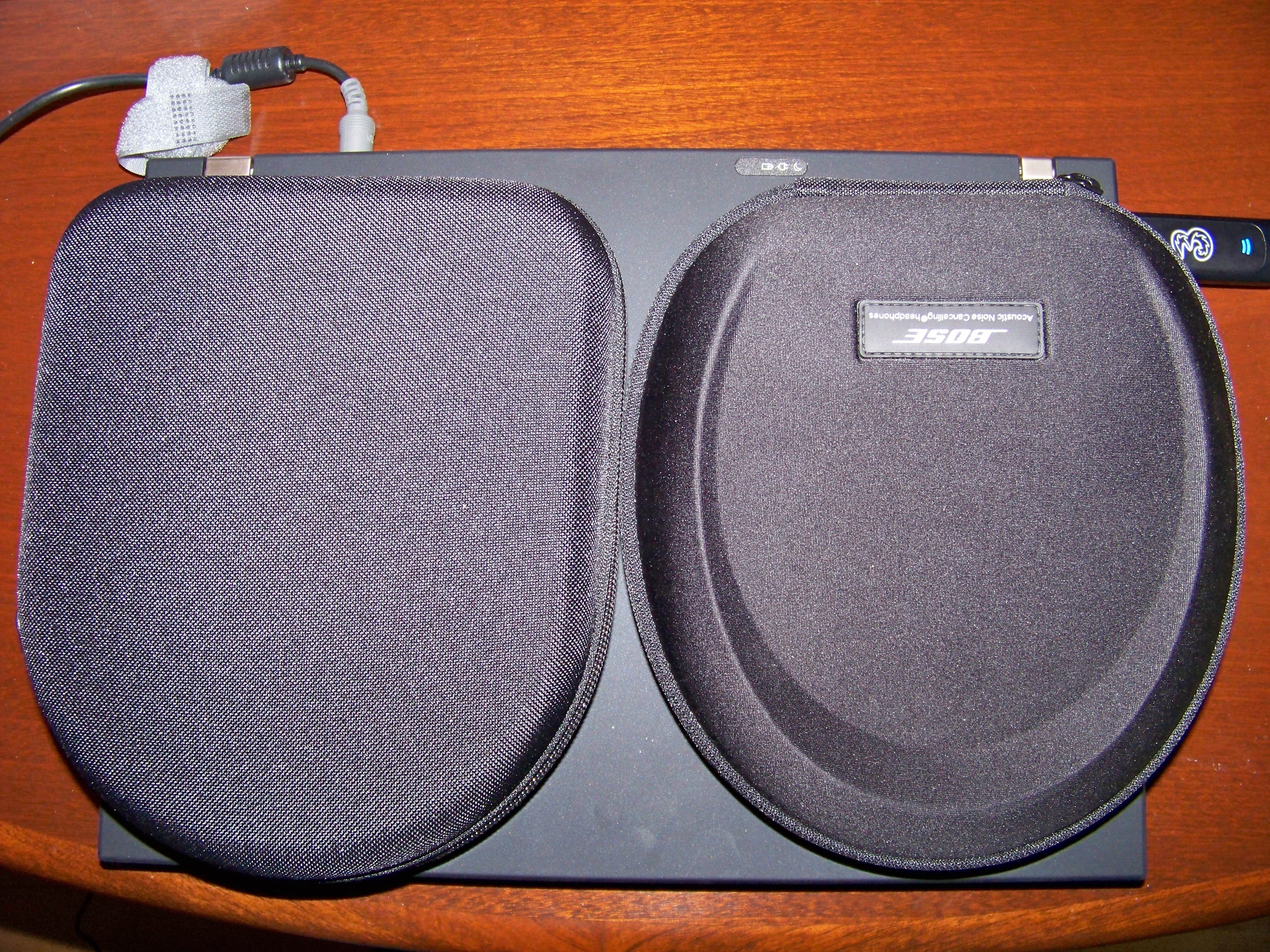
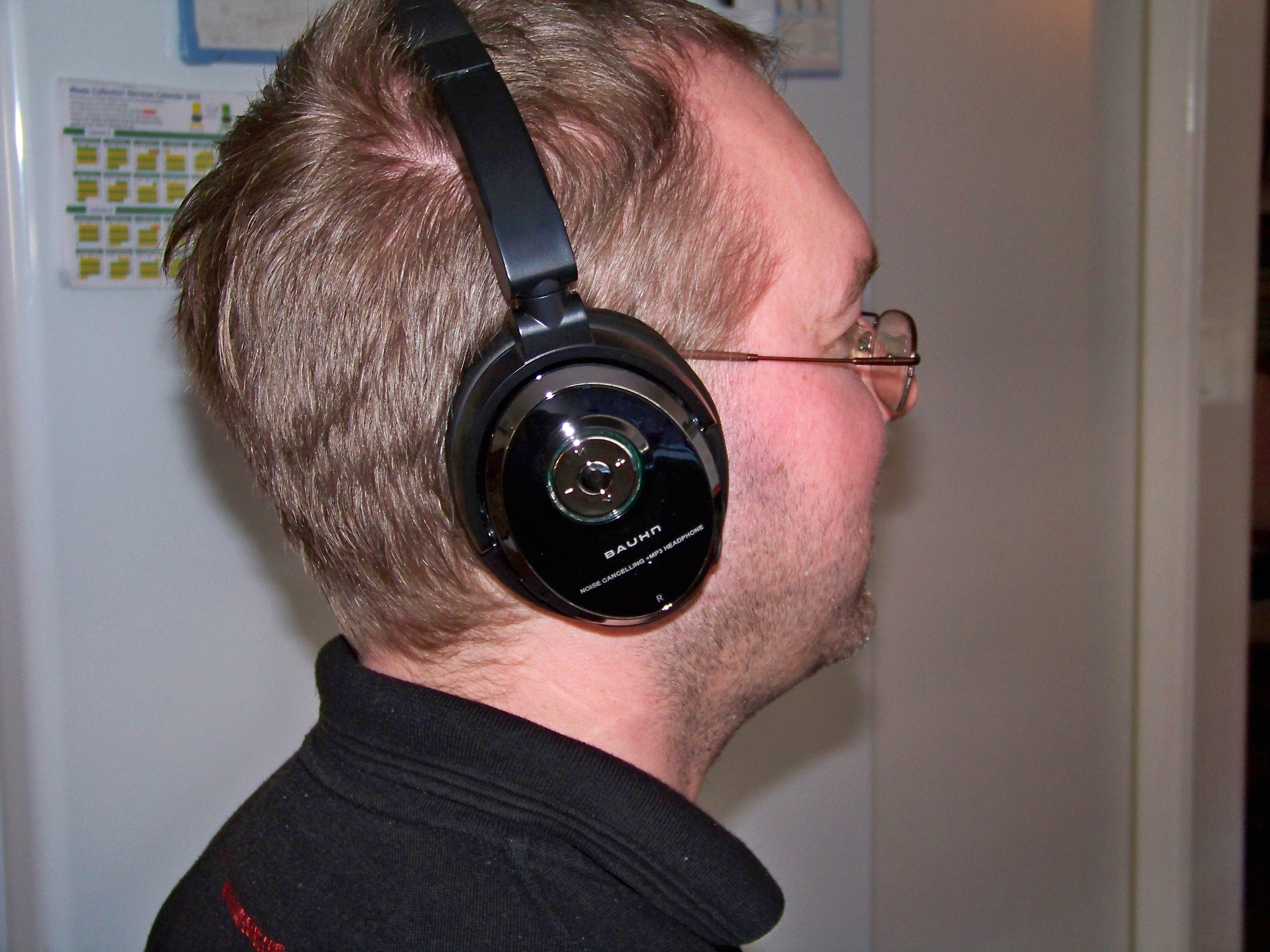
Me wearing Bauhn HeadphonesInside the case of Bauhn Noise Canceling Headphones showing the cable and connectorsOutside of the cases of Bauhn and Bose Headphones Overview The German supermarket chain Aldi has been running in Australia for 8 years now [1]. Their standard practice for a long time has been to offer regular special deals on a few items of consumer electronics every week, my chocolate fridge is one thing I bought from Aldi [2]. Today Aldi have started selling Noise Canceling Headphones [3]. These headphones are badged by Bauhn but that name is apparently applied to random products from cheap manufacturers, it may be an Aldi name that is applied to stuff that they sell. The headphones cost $69AU which is really cheap. But the deal will probably end in less than a week when stock runs out. Noise canceling headphones can be used in server rooms and other noisy environments. Every company that has a server room should buy a few sets. One of the features of noise-canceling is that it works best on low frequencies and on regular sounds it specifically doesn t block human voice well. In some noisy environments it will be easier to hear people talk if you wear such headphones! Noise canceling headphones are also very useful to people who are on the autism spectrum and other people who get more annoyed by noise pollution than average people. I have been wearing my Bose headphones on public transport and when walking around in the city, this not only stops traffic noise but it also helps to avoid people thinking that I want to talk to them. Features The first picture shows me wearing the Bauhn NC headphones, it s from the right to show the controls for the built-in MP3 player. I have not yet tested the MP3 functionality. It appears that as the controls are one power button, buttons for next/previous track, and for controlling the volume. This is fairly poor for MP3 functionality, ideally you would want to have a display to see a list of tracks, maybe have directories to store files, etc. I guess this could be a convenient feature on occasion, but you wouldn t buy the headphones for the MP3 functionality.
The next two pictures show a comparison of the Bauhn headset with the Bose QC-15 headset that I bought last year [4]. The cases of the Bauhn and Bose devices are almost exactly the same size and of a very similar shape, the Bose case is tapered and indented and also has a finer weave on the cloth covering it looks much nicer. Both devices come with an adapter for an airline socket and with a detachable cable. They also both have pouches attached to the inside of the case with velcro. But the Bauhn headphones come with an adapter for the 6.5mm TRS connector which could be convenient if you want to plug them in to a larger amplifier, the basic connector is 3.5mm in both cases. The Bauhn device uses a standard TRS connector at the headphone end while the Bose QC-15 use a special connector that matches the shape of the headset and which has a TRRS plug (to cater for the high/low volume switch), so it seems that a damaged Bauhn cable could be replaced cheaply while a replacement Bose cable would have to be purchased from Bose (presumably at great expense and delay). The Bauhn case also has a velcro attached pocket for storing business cards (or maybe a name tag or something). The supplied cable for the Bauhn is described as being 5 feet long which isn t quite long enough to reach a tower PC that is sitting on the floor. The Bose has a cable that is about a foot longer (maybe 6 feet total), but due to the non-standard connector you can t replace it. I presume that I could easily buy a 4 meter cable for the Bauhn headphones, but I could of course buy an extension cable to use with the Bose. Bose advertise the QC-15 headphones as having 35 hours of battery life from a single AAA battery. Aldi advertise the Bauhn headset as having 5 hours of battery life when NC is turned on and they use two AAA batteries. It s widely regarded that rechargeable batteries don t last as long as the batteries used for estimating the battery life (which presumably are the most expensive long-life batteries available). I ve found a single rechargeable AAA battery to last well over 5 hours in my Bose headphones, so it seems that battery life is considerably worse for the Bauhn device. One feature of the Bauhn device is that it can be used without any batteries for playing external music. The Bose headphones can t be used at all without a battery. So while the Bauhn will use the batteries faster it will at least be usable when the batteries run out. But if you are buying headphones for the purpose of avoiding noise then the Bose headphones are simply better. Comfort The Bose headphones have significantly deeper ear wells than the Bauhn about 23mm vs 18mm. If your ears stick out more than 18mm (as mine apparently do) then this is a good reason for choosing Bose. The Bose headphones are a tighter fit, the spring that pushes the ear-pieces together is stronger. But they have better padding so this doesn t cause me any discomfort. Also the Bose headphones have better passive noise reduction due to having a more snug fit around the ears. I ve worn my Bose headphones on a flight from the US to Australia with hardly a break and they were quite comfortable I would never want to do that with the Bauhn headphones. Noise Reduction I tested the Bose and Bauhn products against three noise scenarios, external music, an air-conditioner, and a car engine. The Bose headphones made good reductions of the noise from the external music (Numb by Linkin Park) and the air-conditioner. The Bauhn headphones did little to stop Linkin Park and was not very effective against the air-conditioner noise. I think that this is largely due to the lack of passive noise reduction, the air-conditioner in question makes little vibration noise and the sound of rushing air is generally immune to active noise cancellation. Both headphones were very effective when in a car with the engine idling. The engine noise of vehicles seems to fall in an ideal frequency range for active cancellation. Music Quality When listening to Youtube music played on my Thinkpad I could not notice any quality difference between the two sets of headphones. I did notice that the Bose headphones seemed to have a greater response in the higher frequency range, but that doesn t necessarily mean that one set is better than the other. Maybe if I was listening to FLAC0 encoded music that I had personally ripped from a CD then I would notice a difference. But for most people the Bauhn music quality should be good enough. Design Quality The Bose product is solidly designed, while the Bauhn product appears cheap in every way. Opening the battery compartment on the Bauhn headphones is difficult and if you do it wrong you could easily break the lid off, I expect that every set of Bauhn headphones that is used by children will be broken in a small amount of time but it should still be fully functional with a broken lid. The matt finish of the Bose headphones should hide minor scratches much better than the shiny Bauhn headphones. The Bauhn headphones also have lower quality plastic parts, it appears that the molds used were designed cheaply and without adequate care to prevent marking the final product. The design flaws that affect usage of the Bauhn product are the shallow ear wells, the poor fit of the cushions around the ears (which is probably mostly due to a weak spring pressing the ear cups to the wearer s head), and the battery compartment lid which is difficult to open and appears prone to breakage. The other flaws are all cosmetic. I wonder whether the Bauhn product was made by one of the big name manufacturers who deliberately reduced the quality to avoid competing with their more expensive products. It seems that the major flaws could have been corrected at design time with almost no increase in manufacturing costs. Recommendations If you can afford the Bose QuietComfort 15 Acoustic Noise Cancelling Headphones then they are really worth the extra expense, I have no regrets at all about spending about $320US (including tax) on my Bose QC-15. The Bauhn product is good for when you want something cheap, for example a set to be used in a server room, or for the use of children. I bought a Bauhn headset for a friend who is a pilot, he spent $1,100 on a noise-canceling headset for his plane but had never got around to buying one for recreational use I expect that he will allow his children to use his new Bauhn headphones, if they get broken it s only a $69 expense. The second cheapest NC headphones I ve seen on offer in Australia is Harvey Norman selling Phillips HN-110 Noise Canceling Headphones for $100AU [5]. Amazon sells Philips HN 110 Folding Noise-Canceling Headphones for $50US but doesn t seem to ship them outside the US (at least not to Australia). JB Hifi also has some NC headphones on sale in Australia [6], but they are more expensive at $219 for AKG and $319 for Sennheiser. Also the models they sell are on-ear which means that they will inherently have very little passive noise reduction and will also annoy anyone who doesn t like having their ears squashed. If I was buying NC headphones for my own use and didn t want to spend $300US then I would either buy the Philips HN 110 Folding Noise-Canceling Headphones from Amazon and get a friend in the US to post them to me or I would buy them from Harvey Norman. But the Bauhn product is good if you want cheap headphones to stop engine noise and give reasonable quality when playing music.

24 March 2010

John Goerzen: Review: Travel as a Political Act by Rick Steves

Rick Steves is known for writing books, and producing public TV shows, about travel to Europe. He encourages people to get out of their comfort zone, advocates staying in homes instead of hotels, and giving yourself permission to struggle to communicate in a land of unfamiliar language. That way, you get to experience not just the landmarks, but the culture and history. That was the approach we favored in our recent trip to Europe, and after being there (and seeing tour groups), I think Rick Steves is right on. On the plane to Europe, I read his Travel as a Political Act. This is not a guidebook, but more a book about the philosophy of travel. As usual with my book reviews, unless indicated otherwise, all quotes here come from the book. He starts out with this statement:
I ve taught people how to travel. I focus mostly on the logistics: finding the right hotel, avoiding long lines But that s not why we travel. We travel to have enlightening experiences, to meet inspirational people, to be stimulated, to learn, and to grow. Travel has taught me the fun in having my cultural furniture rearranged and my ethnocentric self-assuredness walloped.
I read this book mostly on the plane to Hamburg, or the week prior to leaving. I can credit Rick Steves directly for encouraging me to strike up a conversation with a random German on the bus from Hamburg to L beck, which I ll discuss here in a couple of days. Probably the biggest lament from Rick Steves is that the people that really ought to travel the ones that are so sure that their ways are correct and best are least likely to do so.
Make a decision that on any trip you take, you ll make a point to be open to new experiences, seek options that get you out of your comfort zone, and be a cultural chameleon trying on new ways of looking at things and striving to become a temporary local. My best vacations have been both fun and intensely educational Travel challenges truths that we were raised thinking were self-evident and God-given. Leaving home, we learn that other people find different truths to be self-evident. We realize that it just makes sense to give everyone a little wiggle room.
The book is set with an introductory encouragement to travel, followed by seven vignettes of different countries he s visited, and descriptions of how it s impacted him. He gave a lesson of the opening of the German Reichstag (parliament building), which he was present for in 1999. He was surrounded by teary-eyed Germans and a few tourists so preoccupied with trivialities forgotten camera batteries, needing a Coke, the lack of air-conditioning that they were missing out on this once-in-a-lifetime opportunity to celebrate a great moment with the German people. He comments that we can learn from other countries that no one country has a monopoly on good ideas, and it is plenty patriotic to insist what we adopt good ideas (such as drug policy) from other countries and adopt them for our own. Particularly touching to me was the description and photo of a memorial in El Salvador, very much looking like the American Vietnam memorial except that one remembering loved ones lost fighting the United States. How many Americans even know that we were involved in a damaging war in El Salvador? A large part of his book was, for me, preaching to the choir, as this comment illustrated:
In the European view, America is trapped in an inescapable cycle to feed its military-industrial complex: As we bulk up our military, we look for opportunities to make use of it. (When your only tool is a hammer, you treat every problem like a nail.) And then, when we employ our military unwisely, we create more enemies which makes us feel the need to grow our military even more. If an American diplomat complained to his European counterpart, America is doing all the heavly lifting when it comes to military, the European might respond, Well, you seem to be enjoying it. We re building roads and bridges instead.
That s a sentiment I ve agreed with for quite some time already, and as such, some parts of the book moved slowly for me though I imagine his target audience included people that had never seriously considered these arguments before. Then there were surprising facts:
by the end of World War I, an estimated half of all the men in France between the ages of 15 and 30 were casualties. When some Americans, frustrated at France s reluctance to follow us into a war, call the French surrender monkeys, I believe it shows their ignorance of history.
And again, I d agree with him on that point. The vignette on Iran was particularly interesting, as he described his experiences in person, they sounded far different than the picture we often get in the media. I have realized, incidentally, that I am terrible at writing book reviews. So rather than inflict more paragraphs upon you with this one, I ll summarize by saying that this is a touching, informative, and motivational book, which I highly recommend. I ll leave you with this quote:
Mark Twain wrote, Travel is fatal to prejudice, bigotry, and narrow-mindedness. These wise words can be a reallying cry for all travelers once comfortably back home. When courageous leaders in our community combat small-mindedness and ignorance travelers can stand with them in solidarity.
I didn t travel to make some sort of statement or as a political act. But I was enriched in many ways by travel of course the obvious ones of contemplating the history of a 900-year-old beautiful church, but also in seeing the different character of different cities, being with two families for a couple of days, and seeing different approaches to common problems. I am very glad I wasn t shut off from this behind a tinted window in a tour bus.

19 March 2010

Jon Dowland: The Dice Man and Generation X

The movie ' Fight Club' had a profound effect on me when I first saw it in 1999. I wasn't as fond of the originating novel, although there was something about the prose that Palahniuk used which I did enjoy. Since then I've read more of Palahniuk's work. My favourite of his books is actually Non-Fiction (a.k.a. Stranger than Fiction ): a collection of essays and interviews. Reading some of the stories in that collection, it becomes very clear where some of the concepts in his fiction originate. There are also a number of pieces on the craft of writing. He writes some really gushing praise about Amy Hempel:

When you study Minimalism in the novelist Tom Spanbauer's workshop, the first story you read is Amy Hempel's The Harvest. After that, you're ruined every other book you ever read will suck.
I recently read a couple of novels, both of which reminded me a lot of Fight Club. 'Generation X: Tales for an Accelerated Culture' by Douglas Coupland is an interesting tale of three or more societal drop-outs. Fight Club was written five years after Generation X and owes it a lot. 'Generation X' has curt, clipped passages and many dictionary-definition-esque side notes decoding hipster-slang, which add a lot of colour to the non-events of the story. These remind me both of the copous asides in Pratchett novels, or the chapter introductions in Philip K Dick's excellent 'Ubik'.
Historical Overdosing: To live in a period of time when too much seems to happen. Major symptoms include addiction to newspapers, magazines, and TV news broadcasts.
The novel goes absolutely nowhere, but that's actually one of the appealing things about it. When I mentioned this to my partner (who, as far as I know, has not read the book), she said that it sounded like the perfect tonic to a stressful life: imagine lying on a sunbed, doing nothing, reading about people lying on sunbeds, doing nothing. This is the first of Coupland's novels that I have read, but I managed to pick up a copy of 'Generation A' (so far as a I can tell, not a sequel, as such) 70% off as part of the closing-down sale at my local Borders store, so I will probably read that too. I also recently finished The Dice Man , by Luke Reinhart. It's a tongue-in-cheek pseudo-autobiography written under a pen-name about a psychiatrist who opts to delegate all life decisions to the throw of dice. Once again, Fight Club owes a lot to this book. The unhinged situations that occur are used to shine a satirical light on modern society. 'modern society' in the book is the 1970s. The distance between society then and now adds something to the novel's value now. Having said that, the narrator is not a particularly likeable character and it's hard to relate to him. Coincidentally my dad recently read this book and described it as 'misogynistic', which might be an understatement. Mind you, most of the characters, female or otherwise, are fairly 2D: perhaps intentionally the only fleshed out human is the narrator. In my favourite scene of the book, the narrator is in a situation under the influence of more than one drug. A TV set is on in the background. As the scene progresses, the events taking place on the TV are written about with increasing prominence compared to the main events of the scene. This escalates to a point where they are of equal importance and you can no longer easily distinguish the events taking place in the real world from those taking place on the television. This is the only part of the book that I can recall that employed any narrative tricks. The rest is by-the-numbers, and mostly internal monologue. The book is also at least 50% too long: the concept just doesn't stretch as far as it's forced to.

5 March 2010

Enrico Zini: Global trends

Global trends For some time I have been trying to pinpoint what it is that is brewing in Italy and risks spreading elsewhere, like it happened in the past. I don't need to be decent to stay in power While following a train of thought during a political/philosophical lecture I figured that a current growing trend is to have public figures that are more and more indecent. In Italy it is very hard to find a public figure you can look up to. It is hard to name a politician that is not involved in some shady exchange of favours or some abues of their powers, and we got used to seeing people in power implicated in major corruption scandals, perverted prostitution affairs, or dealings with international criminal organisations. They do not normally end up in jail, and in fact they keep being very firmly in power, because they manage to stretch or change the laws to get away, or at least to delay trials in order to trigger some statute of limitations. Is there a pattern here that, although maybe not as clearly defined as in Italy, can be found more or less globally? Yesterday I thought that this could be such a pattern:
I don't need to be decent to stay in power
If I think of it like that, then it is most definitely not just an Italian phenomenon. If you tell "one doesn't need to be decent to stay in power" to a British, or to a French, I would not expect them to see anything strange with it. We all find it depressing, but we are all used to it. It is a pattern with repercussions, though: once that becomes normal in a society, it means that people who get to be in power are free to abuse their power much as they want, as long as they are careful enough not to end up in jail. Because, well, nowadays one doesn't need to be decent to stay in power. I don't need to follow the law to stay in power That first pattern is already quite well accepted in Italy. So much well accepted, that I think we are starting to see what comes next. At the end of March we are going to have elections for some regional governors. Funnily enough, in Lazio, the very important region around Rome, the centre-right coalition failed to submit the paperwork on time, and is out of the elections. It is not just red tape: at some point someone will have to print out the ballots and dispatch them to the voting booths, so one expects to have the coalition logos and the names of the candidates submitted in time, together with signatures supporting the candidates and whatever else the election process needs. Well, they missed the deadline, they got there after closing time and the building was, well, closed. It was a fantastic opportunity for a laugh. Memes blossomed on the Italian intarwebs and we now have 2 or 3 new expressions to mean "stupid". However, now it's hard to tell what is going to happen. On one hand, you can't exclude one of the two major coalitions because of some bureaucratic detail like an office closing time. But on the other hand, several minor coalitions have been excluded in all sorts of past elections because of similar things, and it really would not be fair to start making exceptions now. But Lombardia, the region around Milan and Emilia Romagna, the one around Bologna, both very, very important, are having similar kinds of problems. In both regions the previous governors are running again, for the 3rd time in a row, and most likely they legally can't do it, and if elected one can sue and force them to resign, because they have been in power long enough. Lots of paper is being shuffled at the moment to figure if they can get away with it or not. Oh, and the lawyers of the candidate for the Milan region also managed to get to the tribunal after closing time, but apparently there was still someone inside and they managed to shout loud enough, or somesuch. Anyway, the situation is getting hot. The Lazio coalition that has been excluded because of their incompetence is now hard at work pushing their potential voters to mount a fracas. Chances are that eventually they'll get away with it, and manage to take part to the election. If that happens, they will likely get close to winning it. So this seems to be a new pattern that is emerging:
I don't need to follow the law to stay in power
Which, again, is a pattern with quite some repercussions. It is something much more radical than just an issue with morality: it means feudalism, it means we are culturally ready to accept dictatorship. So, please do me a favour: do not think for a moment that Italy is just a funny place with lemons and tomatoes, and watch out for these patterns emerging around you.

3 March 2010

Andreas Barth: Changes in wanna-build

During recent weeks, not only sbuild and buildd were changed, but also wanna-build. Many changes were small and don't have direct impact, but will ease our life in future. This includes a bunch of code cleanups. Most changes were done by Kurt Roeckx and me, but as usual Marc Brockschmidt and Philipp Kern were also involved. This round of changes was started with redoing our priority calculation. Up to now, any package had a fixed place in the list, and our list was built from top to bottom as far as buildd power was available (putting aside manual intervention by setting build-priority by admins). That meant of course that some packages could be stalled if buildd time isn't enough anymore, like currently on mipsen. (The queue order was determined by the following sort options: build-priority, (>= standard?), already built in the past, priority, section, name, and the first difference decided list order.) Now, of course >= standard packages are still built first, but waiting days increase priority so that old extra packages could be built before young optional package (in other words, they shouldn't stall. The new formula is about: required: 50, important: 40, standard: 30, optional: 5 [priority] + libs: 4, devel: 2 [section] + contrib: -20, non-free: -40 [component] + out-of-date: 20 [notes] + max(6, waitingdays) * 2 + manual priorities, and packages are ordered by this number, then by waitingdays, then by name.) While adding code to add bonus for long-waiting packages, we stumbled across the fact that there were non-C dates in the database stored, which in turn means that export of the database stopped to work. For fixing that we replaced the last change field in the database by an postgres now() on insert, and converted that field to an date field (instead of freetext). Which in turn broke mkstats and a few more things, which are fixed as of now. While doing that, we also introduced the format option, which allows to do queries like:
wanna-build --format='%t %u: %p/%v% +b B%B' -A mipsel --list=building
which gives output like:
2010-03-03 15:24:38.642988 buildd_mipsel-mayer: cracklib2/2.8.16-1
2010-03-03 15:30:00.341313 buildd_mipsel-rem: liblouisxml/2.1.0-1+b1
Of course, there are even better possibilities what one could do with that. :) More changes are pending, like the injector for log files was changed so that we record building times in the database. This will allow us to include build time on at least a few buildds, so that large packages cannot so easily stall all buildds completely anymore. So, more to come ...

19 February 2010

Matthew Garrett: Pittsburgh

As I mentioned, I headed to Pittsburgh last week to give some talks at CMU and find out something about what they're doing there. Despite the dire weather that had closed the airport the day before, I had no trouble getting into town and was soon safely in a hotel room with a heater that seemed oddly enthusiastic about blasting cold air at me for ten seconds every fifteen minutes. Unfortunately, it seems that life wasn't as easy for everyone - ten minutes after I arrived, I got a phone call telling me that the city had asked CMU to cancel classes the next day.

This turned out to be much less of a problem than I'd expected - whether because of their enthusiasm to learn about ACPI or because they simply hadn't noticed the alert telling them about the cancellation, a decent body of students turned up the next morning. After a brief chat with Mark Stehlik, the assistant dean for undergraduate education, I headed off to the lecture hall. The fact that I can now just plug my laptop into a VGA cable and have my desktop automatically extend itself continues to amaze me, as does OpenOffice's seemingly unerring ability to get confused about which screen should have my content and which should be showing me the next slide. Nevertheless, facts were imparted and knowledge dropped on those assembled. I'm even reasonably sure that the contents were factually accurate, which is a shame because the most attractive part of teaching always struck me as being able to lie to students who will then happily regurgitate whatever you tell them because in case it turns up on the exam. Perhaps this is why I'm safer out of academia.

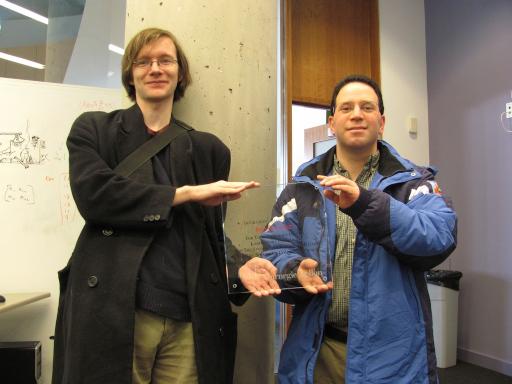
Lunch offered an opportunity to visit the Red Hat sponsored lab, which was pleasingly located somewhere other than a basement. The guy on the right of the picture is Greg Kesden, the director of undergraduate laboratories in CS there - it was wonderful to get an opportunity to see the machines getting used, and students seemed genuinely appreciative of the facility.

After lunch I spent a while talking to Satya about the Internet Suspend and Resume project. This is an impressive combination of virtualisation and migration, using a Fedora-based live image to bring up an OS on arbitrary hardware before downloading a machine image and launching it. The majority of the data is pulled in on demand, meaning that initial performance can be slow but ensuring that data is only downloaded if it's needed. When the user is finished, the delta between the original image and the new one can be pushed back to the server while remaining cached on the local machine in case the image is used again.

It's an interesting approach, combining the flexibility of thin clients with the advantages of having actually useful computing power at the local end. There's a few functional awkwardnesses, such as some VMs being unhappy if images are migrated between machines with different CPU features, and it obviously benefits from having significant bandwidth. But the idea of being able to combine the convenience of a floating session with the knowledge that you can still keep copies of your data on you is an attractive one, and I'd love a future where I can move my session between my laptop and a desktop.

After that there was some time to talk to Bill Scherlis and Philip Lehman about the software engineering courses that CMU run. Part of the minor in software engineering includes a course requirement to make a meaningful contribution to an existing software project, from design through to submission and upstream acceptance. I had the opportunity to talk to a couple of the students about this and the differences they found between working with the Mozilla and Chrome communities, which I'll try to write up at some point.

Finally I gave a presentation on Fedora and some of the issues that we face in providing a useful OS when patents and recalcitrant hardware vendors do their best to thwart us. Despite the ice outside and the significantly-below-freezing temperatures, enough people turned up that sorties had to be sent out to find extra chairs. It was great to see how interested people were in learning about what we do, although it's probably the case that the free pizza did help encourage people.

After that it was an early trip back to the airport, where I found that my plane was delayed and the only "restaurant" still open was McDonalds. Even so, I left with the feeling that it had been an interesting and educational visit. Many thanks to David Eckhardt, who runs the OS course I presented to and who looked after me all day - thanks too to Joshua Wise who picked me up when David was running late due to the ground being covered with blocks of ice.

16 February 2010

Russell Coker: Would you Short-Change a Pedophile?

For some time the film industry has been running an anti-piracy campaign with slogans such as you wouldn t steal a car [1] in an attempt to draw a false analogy between downloading a movie and stealing a significant and valuable object the modern equivalent to being a horse thief . One of the many ways that such poor analogies break down is the fact that downloading a movie is not a crime, it s copyright infringement. The best analogy that I can think of for non-commercial copyright infringement is the practice of short-changing. I expect that almost everyone has at some time received less change than they deserved when buying something at a shop, the cashier aims to collect $1 or $2 from each customer and can easily double the amount of money that they take home at the end of the day. When a customer complains they just pretend to have made a mistake and although short-changing is a crime (unlike copyright infringement) it almost never results in police action. The practice is tolerated to such a degree that some people know the shops where they are likely to be short-changed, they count their change more carefully and demand the full amount but don t bother complaining to the manager! The film industry also tries to portray itself as representing struggling artists who deserve the money, it s described as a moral issue good people pay for movies while bad people download movies and steal cars. But then there s the case of Roman Polanski who is a well known movie director and child rapist [2]. I expect that most store employees would gladly palm some of the change if Roman Polanski was a customer that is of course if they weren t too busy arranging a lynch mob. So instead of you wouldn t steal a car a more reasonable statement would be you would short-change a pedophile if you weren t organising a lynch mob . Please note that murdering a criminal as part of a lynch mob is a crime (unlike making an unauthorised copy of a DVD), so I encourage people not to perform lynchings. Many important people in the movie industry have different ideas, the Wall Street Journal has an article about the petition to free Roman Polanski which demonstrates the difference between Hollywood attitudes and those of the rest of the world [3]. For them, violent crime is no big deal if the criminal is famous and the victim isn t but anything which affects their own wealth is regarded as a serious issue. Indiewire has a copy of the petition to free Roman and a list of the names of 100 people who signed it [4] (I heard that the latest count was nearer 150 but couldn t find a reference). I believe that the matter of morals is not whether someone who rapes children deserves jail time (that issue is really clear) but whether it is morally acceptable to give money to such a criminal or their supporters. I suggest that the list of signatories to the pro-rape petition be black-listed, any movie that involves any of them should not be paid for either don t see the movie or download it without paying at your own whim. If anyone knows of a web site that is being regularly updated with a list of all past and current projects involving people who signed the petition for Roman then please let me know it would be good to have a list of movies that I will never pay for. Anyone who feels morally obliged to pay something for a movie and who has a great desire to watch a movie made by Roman Polanski or his supporters could download it and then make a donation to a charity equivalent to the purchase price rumor has it that women s refuges are always short of funds. As an aside I find Wikipedia a good reference for movies that I don t plan to see, I read the plot summary on the wiki page and then have no curiosity about what happens in the movie if that isn t adequate I ask friends for spoilers or do a Google search on the movie name and spoilers .

Next.

Previous.