Search Results: "mak"

11 April 2025

Bits from Debian: Bits from the DPL

Dear Debian community, this is bits from DPL for March (sorry for the delay, I was waiting for some additional input). Conferences In March, I attended two conferences, each with a distinct motivation. I joined FOSSASIA to address the imbalance in geographical developer representation. Encouraging more developers from Asia to contribute to Free Software is an important goal for me, and FOSSASIA provided a valuable opportunity to work towards this. I also attended Chemnitzer Linux-Tage, a conference I have been part of for over 20 years. To me, it remains a key gathering for the German Free Software community a place where contributors meet, collaborate, and exchange ideas. I have a remark about submitting an event proposal to both FOSDEM and FOSSASIA: Cross distribution experience exchange
As Debian Project Leader, I have often reflected on how other Free Software distributions address challenges we all face. I am interested in discussing how we can learn from each other to improve our work and better serve our users. Recognizing my limited understanding of other distributions, I aim to bridge this gap through open knowledge exchange. My hope is to foster a constructive dialogue that benefits the broader Free Software ecosystem. Representatives of other distributions are encouraged to participate in this BoF whether as contributors or official co-speakers. My intention is not to drive the discussion from a Debian-centric perspective but to ensure that all distributions have an equal voice in the conversation.
This event proposal was part of my commitment from my 2024 DPL platform, specifically under the section "Reaching Out to Learn". Had it been accepted, I would have also attended FOSDEM. However, both FOSDEM and FOSSASIA rejected the proposal. In hindsight, reaching out to other distribution contributors beforehand might have improved its chances. I may take this approach in the future if a similar opportunity arises. That said, rejecting an interdistribution discussion without any feedback is, in my view, a missed opportunity for collaboration. FOSSASIA Summit The 14th FOSSASIA Summit took place in Bangkok. As a leading open-source technology conference in Asia, it brings together developers, startups, and tech enthusiasts to collaborate on projects in AI, cloud computing, IoT, and more. With a strong focus on open innovation, the event features hands-on workshops, keynote speeches, and community-driven discussions, emphasizing open-source software, hardware, and digital freedom. It fosters a diverse, inclusive environment and highlights Asia's growing role in the global FOSS ecosystem. I presented a talk on Debian as a Global Project and led a packaging workshop. Additionally, to further support attendees interested in packaging, I hosted an extra self-organized workshop at a hacker caf , initiated by participants eager to deepen their skills. There was another Debian related talk given by Ananthu titled "The Herculean Task of OS Maintenance - The Debian Way!" To further my goal of increasing diversity within Debian particularly by encouraging more non-male contributors I actively engaged with attendees, seeking opportunities to involve new people in the project. Whether through discussions, mentoring, or hands-on sessions, I aimed to make Debian more approachable for those who might not yet see themselves as contributors. I was fortunate to have the support of Debian enthusiasts from India and China, who ran the Debian booth and helped create a welcoming environment for these conversations. Strengthening diversity in Free Software is a collective effort, and I hope these interactions will inspire more people to get involved. Chemnitzer Linuxtage The Chemnitzer Linux-Tage (CLT) is one of Germany's largest and longest-running community-driven Linux and open-source conferences, held annually in Chemnitz since 2000. It has been my favorite conference in Germany, and I have tried to attend every year. Focusing on Free Software, Linux, and digital sovereignty, CLT offers a mix of expert talks, workshops, and exhibitions, attracting hobbyists, professionals, and businesses alike. With a strong grassroots ethos, it emphasizes hands-on learning, privacy, and open-source advocacy while fostering a welcoming environment for both newcomers and experienced Linux users. Despite my appreciation for the diverse and high-quality talks at CLT, my main focus was on connecting with people who share the goal of attracting more newcomers to Debian. Engaging with both longtime contributors and potential new participants remains one of the most valuable aspects of the event for me. I was fortunate to be joined by Debian enthusiasts staffing the Debian booth, where I found myself among both experienced booth volunteers who have attended many previous CLT events and young newcomers. This was particularly reassuring, as I certainly can't answer every detailed question at the booth. I greatly appreciate the knowledgeable people who represent Debian at this event and help make it more accessible to visitors. As a small point of comparison while FOSSASIA and CLT are fundamentally different events the gender ratio stood out. FOSSASIA had a noticeably higher proportion of women compared to Chemnitz. This contrast highlighted the ongoing need to foster more diversity within Free Software communities in Europe. At CLT, I gave a talk titled "Tausend Freiwillige, ein Ziel" (Thousand Volunteers, One Goal), which was video recorded. It took place in the grand auditorium and attracted a mix of long-term contributors and newcomers, making for an engaging and rewarding experience. Kind regards Andreas.

10 April 2025

Thorsten Alteholz: My Debian Activities in March 2025

Debian LTS This was my hundred-twenty-ninth month that I did some work for the Debian LTS initiative, started by Raphael Hertzog at Freexian. During my allocated time I uploaded or worked on: Last but not least I started to work on the second batch of fixes for suricata CVEs and attended the monthly LTS/ELTS meeting. Debian ELTS This month was the eightieth ELTS month. During my allocated time I uploaded or worked on: Last but not least I started to work on the second batch of fixes for suricata CVEs and attended the monthly LTS/ELTS meeting. Debian Printing This month I uploaded new packages or new upstream or bugfix versions of: This work is generously funded by Freexian! Debian Matomo This month I uploaded new packages or new upstream or bugfix versions of: This work is generously funded by Freexian! Debian Astro This month I uploaded new packages or new upstream or bugfix versions of: Unfortunately I had a rather bad experience with package hijacking this month. Of course errors can always happen, but when I am forced into a discussion about the advantages of hijacking, I am speechless about such self-centered behavior. Oh fellow Debian Developers, is it really that hard to acknowledge a fault and tidy up afterwards? What a sad trend. Debian IoT Unfortunately I didn t found any time to work on this topic. Debian Mobcom This month I uploaded new upstream or bugfix versions of almost all packages. First I uploaded them to experimental and afterwards to unstable to get the latest upstream versions into Trixie. misc This month I uploaded new packages or new upstream or bugfix versions of: meep and meep-mpi-default are no longer supported on 32bit architectures. FTP master This month I accepted 343 and rejected 38 packages. The overall number of packages that got accepted was 347.

9 April 2025

Freexian Collaborators: Debian Contributions: Preparations for Trixie, Updated debvm, DebConf 25 registration website updates and more! (by Anupa Ann Joseph)

Debian Contributions: 2025-03 Contributing to Debian is part of Freexian s mission. This article covers the latest achievements of Freexian and their collaborators. All of this is made possible by organizations subscribing to our Long Term Support contracts and consulting services.

Preparing for Trixie, by Rapha l Hertzog As we are approaching the trixie freeze, it is customary for Debian developers to review their packages and clean them up in preparation for the next stable release. That s precisely what Rapha l did with publican, a package that had not seen any change since the last Debian release and that partially stopped working along the way due to a major Perl upgrade. While upstream s activity is close to zero, hope is not yet entirely gone as the git repository moved to a new location a couple of months ago and contained the required fix. Rapha l also developed another fix to avoid an annoying warning that was seen at runtime. Rapha l also ensured that the last upstream version of zim was uploaded to Debian unstable, and developed a fix for gnome-shell-extension-hamster to make it work with GNOME 48 and thus ensure that the package does not get removed from trixie.

Abseil and re2 transition in Debian, by Stefano Rivera One of the last transitions to happen for trixie was an update to abseil, bringing it up to 202407. This library is a dependency for one of Freexian s customers, as well as blocking newer versions of re2, a package maintained by Stefano. The transition had been stalled for several months while some issues with reverse dependencies were investigated and dealt with. It took a final push to make the transition happen, including fixing a few newly discovered problems downstream. The abseil package s autopkgtests were (trivially) broken by newer cmake versions, and some tests started failing on PPC64 (a known issue upstream).

debvm uploaded, by Helmut Grohne debvm is a command line tool for quickly creating a Debian-based virtual machine for testing purposes. Over time, it accumulated quite a few minor issues as well as CI failures. The most notorious one was an ARM32 failure present since August. It was diagnosed down to a glibc bug by Tj and Chris Hofstaedtler and little has happened since then. To have debvm work somewhat, it now contains a workaround for this situation. Few changes are expected to be noticeable, but related tools such as apt, file, linux, passwd, and qemu required quite a few adaptations all over the place. Much of the necessary debugging was contributed by others.

DebConf 25 Registration website, by Stefano Rivera and Santiago Ruano Rinc n DebConf 25, the annual Debian developer conference, is now open for registration. Other than preparing the conference website, getting there always requires some last minute changes to the software behind the registration interface and this year was no exception. Every year, the conference is a little different to previous years, and has some different details that need to be captured from attendees. And every year we make minor incremental improvements to fix long-standing problems. New concepts this year included: brunch, the closing talks on the departure day, venue security clearance, partial contributions towards food and accommodation bursaries, and attendee-selected bursary budgets.

Miscellaneous contributions
  • Helmut uploaded guess-concurrency incorporating feedback from others.
  • Helmut reacted to rebootstrap CI results and adapted it to cope with changes in unstable.
  • Helmut researched real world /usr-move fallout though little was actually attributable. He also NMUed systemd unsuccessfully.
  • Helmut sent 12 cross build patches.
  • Helmut looked into undeclared file conflicts in Debian more systematically and filed quite some bugs.
  • Helmut attended the cross/bootstrap sprint in W rzburg. A report of the event is pending.
  • Lucas worked on the CFP and tracks definition for DebConf 25.
  • Lucas worked on some bits involving Rails 7 transition.
  • Carles investigated why the job piuparts on salsa-ci/pipeline was passing but was failing on piuparts.debian.org for simplemonitor package. Created an issue and MR with a suggested fix, under discussion.
  • Carles improved the documentation of salsa-ci/pipeline: added documentation for different variables.
  • Carles made debian-history package reproducible (with help from Chris Lamb).
  • Carles updated simplemonitor package (new upstream version), prepared a new qdacco version (fixed bugs in qdacco, packaged with the upgrade from Qt 5 to Qt 6).
  • Carles reviewed and submitted translations to Catalan for adduser, apt, shadow, apt-listchanges.
  • Carles reviewed, created merge-requests for translations to Catalan of 38 packages (using po-debconf-manager tooling). Created 40 bug reports for some merge requests that haven t been actioned for some time.
  • Colin Watson fixed 59 RC bugs (including 26 packages broken by the long-overdue removal of dh-python s dependency on python3-setuptools), and upgraded 38 packages (mostly Python-related) to new upstream versions.
  • Colin worked with Pranav P to track down and fix a dnspython autopkgtest regression on s390x caused by an endianness bug in pylsqpack.
  • Colin fixed a time-based test failure in python-dateutil that would have triggered in 2027, and contributed the fix upstream.
  • Colin fixed debconf to automatically use the noninteractive frontend if stdin is not a terminal.
  • Stefano bisected and fixed a pypy translation regression on Debian stable and older on 32-bit ARM.
  • Emilio coordinated and helped finish various transitions in light of the transition freeze.
  • Thorsten Alteholz uploaded cups-filters to fix an FTBFS with a new upstream version of qpdf.
  • With the aim of enhancing the support for packages related to Software Bill of Materials (SBOMs) in recent industrial standards, Santiago has worked on finishing the packaging of and uploaded CycloneDX python library. There is on-going work about SPDX python tools, but it requires (build-)dependencies currently not shipped in Debian, such as owlrl and pyshacl.
  • Anupa worked with the Publicity team to announce the Debian 12.10 point release.
  • Anupa with the support of Santiago prepared an announcement and announced the opening of CfP and Registrations for DebConf 25.

Taavi V n nen: Writing a custom rsync server to automatically update a static site

Inspired by some friends,1 I too wanted to make a tiny website telling which event I am at this exact moment. Thankfully I already had an another toy project with that information easily available, so generating the web page was a matter of just querying that project's API and feeding that data to a HTML template. Now the obvious way to host that would be to hook up the HTML-generating code to a web server, maybe add some caching for the API calls, and then route external HTTPS traffic to it. However, that'd a) require that server to be constantly available to serve traffic, and b) be boring. For context: I have an existing setup called staticweb, which is effectively a fancy name for a couple of Puppet-managed servers that run Apache httpd to serve static web pages and have a bunch of systemd timers running rsync to ensure they're serving the same content. It works really well and I use it for things ranging from my website or whyisbetabroken.com to things like my internal apt repository. Now, there are two ways to get new content into that mechanism: it can be manually pushed in from e.g. a CI job, or the system can be configured to periodically pull it from a separate server. The latter mechanism was initially created so that I could pull the Debian packages from my separate reprepro server into the staticweb setup. It turns out that the latter makes a really neat method for handling other dynamically-generated static sites as well. So, for my "where is Taavi at" site, I ended up writing the server part in Go, and included an rsync server using the gokrazy/rsync package. Initially I just implemented a static temporary directory with a timer to regularly update the HTML file in it, but then I got an even more cursed idea: what if the HTML was dynamically generated when an rsync client connected to the server? So I did just that. For deployment, I slapped the entire server part in a container and deployed it to my Kubernetes cluster. The rsync server is exposed directly as a service to my internal network with no authentication or encryption - I think that's fine since that's a read-only service in a private LAN and the resulting HTML is going to be publicly exposed anyway. (Thanks to some DNS magic, just creating a LoadBalancer Service object with a special annotation is enough to have a DNS name provisioned for the assigned IP address, which is neat.) Overall the setup works nice, at least for now. I need to add some sort of a cache to not fetch unchanged information from the API since for every update. And I guess I could write some cursed rsyncd reverse proxy with per-module rules if I end up creating more sites like this to avoid creating new LoadBalancer services for each of them.

  1. Mostly from Sammy's where.fops.at.

5 April 2025

Russell Coker: HP z840

Many PCs with DDR4 RAM have started going cheap on ebay recently. I don t know how much of that is due to Windows 11 hardware requirements and how much is people replacing DDR4 systems with DDR5 systems. I recently bought a z840 system on ebay, it s much like the z640 that I recently made my workstation [1] but is designed strictly as a 2 CPU system. The z640 can run with 2 CPUs if you have a special expansion board for a second CPU which is very expensive on eBay and and which doesn t appear to have good airflow potential for cooling. The z840 also has a slightly larger case which supports more DIMM sockets and allows better cooling. The z640 and z840 take the same CPUs if you use the E5-2xxx series of CPU that is designed for running in 2-CPU mode. The z840 runs DDR4 RAM at 2400 as opposed to 2133 for the z640 for reasons that are not explained. The z840 has more PCIe slots which includes 4*16x slots that support bifurcation. The z840 that I have has the HP Z-Cooler [2] installed. The coolers are mounted on a 45 degree angle (the model depicted at the right top of the first page of that PDF) and the system has a CPU shroud with fans that mount exactly on top of the CPU heatsinks and duct the hot air out without going over other parts. The technology of the z840 cooling is very impressive. When running two E5-2699A CPUs which are listed as 145W typical TDP with all 44 cores in use the system is very quiet. It s noticeably louder than the z640 but is definitely fine to have at your desk. In a typical office you probably wouldn t hear it when it s running full bore. If I was to have one desktop PC or server in my home the z840 would definitely be the machine I choose for that. I decided to make the z840 a build server to share the resource with friends and to use for group coding projects. I often have friends visit with laptops to work on FOSS stuff and a 44 core build server is very useful for that. The system is by far the fastest system I ve ever owned even though I don t have fast storage for it yet. But 256G of RAM allows enough caching that storage speed doesn t matter too much. Here is building the SE Linux refpolicy package on the z640 with E5-2696 v3 CPU and the z840 with two E5-2699A v4 CPUs:
257.10user 47.18system 1:40.21elapsed 303%CPU (0avgtext+0avgdata 416408maxresident)k
66904inputs+1519912outputs (74major+8154395minor)pagefaults 0swaps
222.15user 24.17system 1:13.80elapsed 333%CPU (0avgtext+0avgdata 416192maxresident)k
5416inputs+0outputs (64major+8030451minor)pagefaults 0swaps
Here is building Warzone2100 on the z640 and the z840:
6887.71user 178.72system 16:15.09elapsed 724%CPU (0avgtext+0avgdata 1682160maxresident)k
1555480inputs+8918768outputs (114major+27133734minor)pagefaults 0swaps
6055.96user 77.05system 8:00.20elapsed 1277%CPU (0avgtext+0avgdata 1682100maxresident)k
117640inputs+0outputs (46major+11460968minor)pagefaults 0swaps
It seems that the refpolicy package can t use many more than 18 cores as it is only 37% faster when building with 44 cores available. Building Warzone is slightly more than twice as fast so it can really use all the available cores. According to Passmark the E5-2699A v4 is 22% faster than the E5-2696 v3. I highly recommend buying a z640 if you see one at a good price.

Russell Coker: More About the HP ML110 Gen9 and z640

In May 2021 I bought a ML110 Gen9 to use as a deskside workstation [1]. I started writing this post in April 2022 when it had been my main workstation for almost a year. While this post was in a draft state in Feb 2023 I upgraded it to an 18 core E5-2696 v3 CPU [2]. It s now March 2025 and I have replaced it. Hardware Issues My previous state with this was not having adequate cooling to allow it to boot and not having a PCIe power cable for a video card. As an experiment I connected the CPU fan to the PCIe fan power and discovered that all power and monitoring wires for the CPU and PCIe fans are identical. This allowed me to buy a CPU fan which was cheaper ($26.09 including postage) and easier to obtain than a PCIe fan (presumably due to CPU fans being more commonly used and manufactured in larger quantities). I had to be creative in attaching the CPU fan as it s cable wasn t long enough to reach the usual location for a PCIe fan. The PCIe fan also required a baffle to direct the air to the right place which annoyingly HP apparently doesn t ship with the low end servers, so I made one from a Corn Flakes packet and duct tape. The Wikipedia page listing AMD GPUs lists many newer ones that draw less than 80W and don t need a PCIe power cable. I ordered a Radeon RX560 4G video card which cost $246.75. It only uses 8 lanes of PCIe but that s enough for me, the only 3D game I play is Warzone 2100 which works well at 4K resolution on that card. It would be really annoying if I had to just spend $246.75 to get the system working, but I had another system in need of a better video card which had a PCIe power cable so the effective cost was small. I think of it as upgrading 2 systems for $123 each. The operation of the PCIe video card was a little different than non-server systems. The built in VGA card displayed the hardware status at the start and then kept displaying that after the system had transitioned to PCIe video. This could be handy in some situations if you know what it s doing but was confusing initially. Booting One insidious problem is that when booting in legacy mode the boot process takes an unreasonably long time and often hangs, the UEFI implementation on this system seems much more reliable and also supports booting from NVMe. Even with UEFI the boot process on this system was slow. Also the early stage of the power on process involves fans being off and the power light flickering which leads you to think that it s not booting and needs to have the power button pressed again which turns it off. The Dell power on sequence of turning most LEDs on and instantly running the fans at high speed leaves no room for misunderstanding. This is also something that companies making electric cars could address. When turning on a machine you should never be left wondering if it is actually on. Noise This was always a noisy system. When I upgraded the CPU from an 8 core with 85W typical TDP to an 18 core with 145W typical TDP it became even louder. Then over time as dust accumulated inside the machine it became louder still until it was annoyingly loud outside the room when all 18 cores were busy. Replacement I recently blogged about options for getting 8K video to work on Linux [3]. This requires PCIe power which the z640s have (all the ones I have seen have it I don t know if all that HP made have it) and which the cheaper models in the ML-110 line don t have. Since then I have ordered an Intel Arc card which apparently has 190W TDP. There are adaptors to provide PCIe power from SATA or SAS power which I could have used, but having a E5-2696 v3 CPU that draws 145W [4] and a GPU that draws 190W [4] in a system with a 350W PSU doesn t seem viable. I replaced it with one of the HP z640 workstations I got in 2023 [5]. The current configuration of the z640 has 3*32G RDIMMs compared to the ML110 having 8*32G, going from 256G to 96G is a significant decrease but most tasks run well enough like that. A limitation of the z640 is that when run with a single CPU it only has 4 DIMM slots which gives a maximum of 512G if you get 128G LRDIMMs, but as all DDR4 DIMMs larger than 32G are unreasonably expensive at this time the practical limit is 128G (which costs about $120AU). In this case I have 96G because the system I m using has a motherboard problem which makes the fourth DIMM slot unusable. Currently my desire to get more than 96G of RAM is less than my desire to avoid swapping CPUs. At this time I m not certain that I will make my main workstation the one that talks to an 8K display. But I really want to keep my options open and there are other benefits. The z640 boots faster. It supports PCIe bifurcation (with a recent BIOS) so I now have 4 NVMe devices in a single PCIe slot. It is very quiet, the difference is shocking. I initially found it disconcertingly quiet. The biggest problem with the z640 is having only 4 DIMM sockets and the particular one I m using has a problem limiting it to 3. Another problem with the z640 when compared to the ML110 Gen9 is that it runs the RAM at 2133 while the ML110 runs it at 2400, that s a significant performance reduction. But the benefits outweigh the disadvantages. Conclusion I have no regrets about buying the ML-110. It was the only DDR4 ECC system that was in the price range I wanted at the time. If I knew that the z640 systems would run so quietly then I might have replaced it earlier. But it was only late last year that 32G DIMMs became affordable, before then I had 8*16G DIMMs to give 128G because I had some issues of programs running out of memory when I had less.

4 April 2025

Gunnar Wolf: Naming things revisited

How long has it been since you last saw a conversation over different blogs syndicated at the same planet? Well, it s one of the good memories of the early 2010s. And there is an opportunity to re-engage! I came across Evgeni s post naming things is hard in Planet Debian. So, what names have I given my computers? I have had many since the mid-1990s I also had several during the decade before that, but before Linux, my computers didn t hve a formal name. Naming my computers something nice Linux gave me. I have forgotten many. Some of the names I have used:

Guido G nther: Booting an Android custom kernel on a Pixel 3a for QMI debugging

As you might know I'm not much of an Android user (let alone developer) but in order to figure out how something low level works you sometimes need to peek at how vendor kernels handles this. For that it is often useful to add additional debugging. One such case is QMI communication going on in Qualcomm SOCs. Joel Selvaraj wrote some nice tooling for this. To make use of this a rooted device and a small kernel patch is needed and what would be a no-brainer with Linux Mobile took me a moment to get it to work on Android. Here's the steps I took on a Pixel 3a to first root the device via Magisk, then build the patched kernel and put that into a boot.img to boot it. Flashing the factory image If you still have Android on the device you can skip this step. You can get Android 12 from developers.google.com. I've downloaded sargo-sp2a.220505.008-factory-071e368a.zip. Then put the device into Fastboot mode (Power + Vol-Down), connect it to your PC via USB, unzip/unpack the archive and reflash the phone:
unpack sargo-sp2a.220505.008-factory-071e368a.zip
./flash-all.sh
This wipes your device! I had to run it twice since it would time out on the first run. Note that this unpacked zip contains another zip (image-sargo-sp2a.220505.008.zip) which will become useful below. Enabling USB debugging Now boot Android and enable Developer mode by going to Settings About then touching Build Number (at the very bottom) 7 times. Go back one level, then go to System Developer Options and enable "USB Debugging". Obtaining boot.img There are several ways to get boot.img. If you just flashed Android above then you can fetch boot.img from the already mentioned image-sargo-sp2a.220505.008.zip:
unzip image-sargo-sp2a.220505.008.zip boot.img
If you want to fetch the exact boot.img from your device you can use TWRP (see the very end of this post). Becoming root with Magisk Being able to su via adb will later be useful to fetch kernel logs. For that we first download Magisk as APK. At the time of writing v28.1 is current. Once downloaded we upload the APK and the boot.img from the previous step onto the phone (which needs to have Android booted):
adb push Magisk-v28.1.apk /sdcard/Download
adb push boot.img /sdcard/Download
In Android open the Files app, navigate to /sdcard/Download and install the Magisk APK by opening the APK. We now want to patch boot.img to get su via adb to work (so we can run dmesg). This happens by hitting Install in the Magisk app, then "Select a file to patch". You then select the boot.img we just uploaded. The installation process will create a magisk_patched-<random>.img in /sdcard/Download. We can pull that file via adb back to our PC:
adb pull /sdcard/Download/magisk_patched-28100_3ucVs.img
Then reboot the phone into fastboot (adb reboot bootloader) and flash it (this is optional see below):
fastboot flash boot magisk_patched-28100_3ucVs.img
Now boot the phone again, open the Magisk app, go to SuperUser at the bottom and enable Shell. If you now connect to your phone via adb again and now su should work:
adb shell
su
As noted above if you want to keep your Android installation pristine you don't even need to flash this Magisk enabled boot.img. I've flashed it so I have su access for other operations too. If you don't want to flash it you can still test boot it via:
fastboot boot magisk_patched-28100_3ucVs.img
and then perform the same adb shell su check as above. Building the custom kernel For our QMI debugging to work we need to patch the kernel a bit and place that in boot.img too. So let's build the kernel first. For that we install the necessary tools (which are thankfully packaged in Debian) and fetch the Android kernel sources:
sudo apt install repo android-platform-tools-base kmod ccache build-essential mkbootimg
mkdir aosp-kernel && cd aosp-kernel
repo init -u https://android.googlesource.com/kernel/manifest -b android-msm-bonito-4.9-android12L
repo sync
With that we can apply Joel's kernel patches and also compile in the touch controller driver so we don't need to worry if the modules in the initramfs match the kernel. The kernel sources are in private/msm-google. I've just applied the diffs on top with patch and modified the defconfig and committed the changes. The resulting tree is here. We then build the kernel:
PATH=/usr/sbin:$PATH ./build_bonito.sh
The resulting kernel is at ./out/android-msm-pixel-4.9/private/msm-google/arch/arm64/boot/Image.lz4-dtb. In order to boot that kernel I found it to be the simplest to just replace the kernel in the Magisk patched boot.img as we have that already. In case you have already deleted that for any reason we can always fetch the current boot.img from the phone via TWRP (see below). Preparing a new boot.img To replace the kernel in our Magisk enabled magisk_patched-28100_3ucVs.img from above with the just built kernel we can use mkbootimgfor that. I basically copied the steps we're using when building the boot.img on the Linux Mobile side:
ARGS=$(unpack_bootimg --format mkbootimg --out tmp --boot_img magisk_patched-28100_3ucVs.img)
CLEAN_PARAMS="$(echo "$ ARGS "   sed -e "s/ --cmdline '.*'//" -e "s/ --board '.*'//")"
cp android-kernel/out/android-msm-pixel-4.9/private/msm-google/arch/arm64/boot/Image.lz4-dtb tmp/kernel
mkbootimg -o "boot.patched.img" $ CLEAN_PARAMS  --cmdline "$ ARGS "
This will give you a boot.patched.img with the just built kernel. Boot the new kernel via fastboot We can now boot the new boot.patched.img. No need to flash that onto the device for that:
fastboot boot boot.patched.img
Fetching the kernel logs With that we can fetch the kernel logs with the debug output via adb:
adb shell su -c 'dmesg -t' > dmesg_dump.xml
or already filtering out the QMI commands:
adb shell su -c 'dmesg -t'    grep "@QMI@"   sed -e "s/@QMI@//g" &> sargo_qmi_dump.xml
That's it. You can apply this method for testing out other kernel patches as well. If you want to apply the above to other devices you basically need to make sure you patch the right kernel sources, the other steps should be very similar. In case you just need a rooted boot.img for sargo you can find a patched one here. If this procedure can be improved / streamlined somehow please let me know. Appendix: Fetching boot.img from the phone If, for some reason you lost boot.img somewhere on the way you can always use TWRP to fetch the boot.img currently in use on your phone. First get TWRP for the Pixel 3a. You can boot that directly by putting your device into fastboot mode, then running:
fastboot boot twrp-3.7.1_12-1-sargo.img
Within TWRP select Backup Boot and backup the file. You can then use adb shell to locate the backup in /sdcard/TWRP/BACKUPS/ and pull it:
adb pull /sdcard/TWRP/BACKUPS/97GAY10PWS/2025-04-02--09-24-24_SP2A220505008/boot.emmc.win
You now have the device's boot.img on your PC and can e.g. replace the kernel or make modifications to the initramfs.

Johannes Schauer Marin Rodrigues: To boldly build what no one has built before

Last week, we (Helmut, Jochen, Holger, Gioele and josch) met in W rzburg for a Debian crossbuilding & bootstrap sprint. We would like to thank Angest pselt e. V. for generously providing us with their hacker space which we were able to use exclusively during the four-day-sprint. We d further like to thank Debian for their sponsorship of accommodation of Helmut and Jochen. The most important topics that we worked on together were: Our TODO items for after the sprint are: In addition to what was already listed above, people worked on the following tasks specifically: Thank you all for attending this sprint, for making it so productive and for the amazing atmosphere and enlightening discussions!

3 April 2025

Junichi Uekawa: I was hoping to go to debconf but the frequent travel is painful for me right now that I probably won't make it.

I was hoping to go to debconf but the frequent travel is painful for me right now that I probably won't make it.

2 April 2025

Dirk Eddelbuettel: nanotime 0.3.12 on CRAN: Maintenance

Another minor update 0.3.12 for our nanotime package is now on CRAN. nanotime relies on the RcppCCTZ package (as well as the RcppDate package for additional C++ operations) and offers efficient high(er) resolution time parsing and formatting up to nanosecond resolution, using the bit64 package for the actual integer64 arithmetic. Initially implemented using the S3 system, it has benefitted greatly from a rigorous refactoring by Leonardo who not only rejigged nanotime internals in S4 but also added new S4 types for periods, intervals and durations. This release responds to recent CRAN nag of also suggesting packages used in demos, makes a small update to the CI script, and improves one version comparison for conditional code. The NEWS snippet below has the fuller details.

Changes in version 0.3.12 (2025-04-02)
  • Update continuous integration to use r-ci action with bootstrap
  • Add ggplot2 to Suggests due to use in demo/ which is now scanned
  • Refine a version comparison for R 4.5.0 to be greater or equal

Thanks to my CRANberries, there is a diffstat report for this release. More details and examples are at the nanotime page; code, issue tickets etc at the GitHub repository and all documentation is provided at the nanotime documentation site.

This post by Dirk Eddelbuettel originated on his Thinking inside the box blog. If you like this or other open-source work I do, you can now sponsor me at GitHub.

1 April 2025

Guido G nther: Free Software Activities March 2025

Another short status update of what happened on my side last month. Some more ModemManager bits landed, Phosh 0.46 is out, haptic feedback is now better tunable plus some more. See below for details (no April 1st joke in there, I promise): phosh phoc phosh-osk-stub phosh-mobile-settings phosh-tour pfs xdg-desktop-portal-gtk xdg-desktop-portal-phosh meta-phosh feedbackd feedbackd-device-themes gmobile livi Debian git-buildpackage feedbackd-device-themes wlroots ModemManager Tuba xdg-spec gnome-calls Reviews This is not code by me but reviews on other peoples code. The list is (as usual) slightly incomplete. Thanks for the contributions! Help Development If you want to support my work see donations. Comments? Join the Fediverse thread

Michael Ablassmeier: qmpbackup 0.46 - add image fleecing

I ve released qmpbackup 0.46 which now utilizes the image fleecing technique for backup. Usually, during backup, Qemu will use a so called copy-before-write filter so that data for new guest writes is sent to the backup target first, the guest write blocks until this operation is finished. If the backup target is flaky, or becomes unavailable during backup operation, this could lead to high I/O wait times or even complete VM lockups. To fix this, a so called fleecing image is introduced during backup being used as temporary cache for write operations by the guest. This image can be placed on the same storage as the virtual machine disks, so is independent from the backup target performance. The documentation on which steps are required to get this going, using the Qemu QMP protocol is, lets say.. lacking.. The following examples show the general functionality, but should be enhanced to use transactions where possible. All commands are in qmp-shell command format. Lets start with a full backup:
# create a new bitmap
block-dirty-bitmap-add node=disk1 name=bitmap persistent=true
# add the fleece image to the virtual machine (same size as original disk required)
blockdev-add driver=qcow2 node-name=fleecie file= "driver":"file","filename":"/tmp/fleece.qcow2" 
# add the backup target file to the virtual machine
blockdev-add driver=qcow2 node-name=backup-target-file file= "driver":"file","filename":"/tmp/backup.qcow2" 
# enable the copy-before-writer for the first disk attached, utilizing the fleece image
blockdev-add driver=copy-before-write node-name=cbw file=disk1 target=fleecie
# "blockdev-replace": make the copy-before-writer filter the major device (use "query-block" to get path parameter value, qdev node)
qom-set path=/machine/unattached/device[20] property=drive value=cbw
# add the snapshot-access filter backing the copy-before-writer
blockdev-add driver=snapshot-access file=cbw node-name=snapshot-backup-source
# create a full backup
blockdev-backup device=snapshot-backup-source target=backup-target-file sync=full job-id=test
[ wait until block job finishes]
# remove the snapshot access filter from the virtual machine
blockdev-del node-name=snapshot-backup-source
# switch back to the regular disk
qom-set path=/machine/unattached/device[20] property=drive value=node-disk1
# remove the copy-before-writer
blockdev-del node-name=cbw
# remove the backup-target-file
blockdev-del node-name=backup-target-file
# detach the fleecing image
blockdev-del node-name=fleecie
After this process, the temporary fleecing image can be deleted/recreated. Now lets go for a incremental backup:
# add the fleecing and backup target image, like before
blockdev-add driver=qcow2 node-name=fleecie file= "driver":"file","filename":"/tmp/fleece.qcow2" 
blockdev-add driver=qcow2 node-name=backup-target-file file= "driver":"file","filename":"/tmp/backup-incremental.qcow2" 
# add the copy-before-write filter, but utilize the bitmap created during full backup
blockdev-add driver=copy-before-write node-name=cbw file=disk1 target=fleecie bitmap= "node":"disk1","name":"bitmap" 
# switch device to the copy-before-write filter
qom-set path=/machine/unattached/device[20] property=drive value=cbw
# add the snapshot-access filter
blockdev-add driver=snapshot-access file=cbw node-name=snapshot-backup-source
# merge the bitmap created during full backup to the snapshot-access device so
# the backup operation can access it. (you better use an transaction here)
block-dirty-bitmap-add node=snapshot-backup-source name=bitmap
block-dirty-bitmap-merge node=snapshot-backup-source target=bitmap bitmaps=[ "node":"disk1","name":"bitmap" ]
# create incremental backup (you better use an transaction here)
blockdev-backup device=snapshot-backup-source target=backup-target-file job-id=test sync=incremental bitmap=bitmap
 [ wait until backup has finished ]
 [ cleanup like before ]
# clear the dirty bitmap (you better use an transaction here)
block-dirty-bitmap-clear node=disk1 name=bitmap
Or, use a simple reproducer by directly passing qmp commands via stdio:
#!/usr/bin/bash
qemu-img create -f raw disk 1M
qemu-img create -f raw fleece 1M
qemu-img create -f raw backup 1M
qemu-system-x86_64 -drive node-name=disk,file=disk,format=file -qmp stdio -nographic -nodefaults <<EOF
 "execute": "qmp_capabilities" 
 "execute": "block-dirty-bitmap-add", "arguments":  "node": "disk", "name": "bitmap" 
 "execute": "blockdev-add", "arguments":  "node-name": "fleece", "driver": "file", "filename": "fleece" 
 "execute": "blockdev-add", "arguments":  "node-name": "backup", "driver": "file", "filename": "backup" 
 "execute": "blockdev-add", "arguments":  "node-name": "cbw", "driver": "copy-before-write", "file": "disk", "target": "fleece", "bitmap":  "node": "disk", "name": "bitmap" 
 "execute": "query-block" 
 "execute": "qom-set", "arguments":  "path": "/machine/unattached/device[4]", "property": "drive", "value": "cbw" 
 "execute": "blockdev-add", "arguments":  "node-name": "snapshot", "driver": "snapshot-access", "file": "cbw" 
 "execute": "block-dirty-bitmap-add", "arguments":  "node": "snapshot", "name": "tbitmap" 
 "execute": "block-dirty-bitmap-merge", "arguments":  "node": "snapshot", "target": "tbitmap", "bitmaps": [ "node": "disk", "name": "bitmap" ] 
[..]
 "execute": "quit" 
EOF

31 March 2025

Dirk Eddelbuettel: Rblpapi 0.3.15 on CRAN: Several Refinements

bloomberg terminal Version 0.3.16 of the Rblpapi package arrived on CRAN today. Rblpapi provides a direct interface between R and the Bloomberg Terminal via the C++ API provided by Bloomberg (but note that a valid Bloomberg license and installation is required). This is the sixteenth release since the package first appeared on CRAN in 2016. It contains several enhancements. Two contributed PRs improve an error message, and extended connection options. We cleaned up a bit of internal code. And this release also makes the build conditional on having a valid build environment. This has been driven by the fact CRAN continues to builder under macOS 13 for x86_64, but Bloomberg no longer supplies a library and headers. And our repeated requests to be able to opt out of the build were, well, roundly ignored. So now the builds will succeed, but on unviable platforms such as that one we will only offer empty functions. But no more build ERRORS yelling at us for three configurations. The detailed list of changes follow below.

Changes in Rblpapi version 0.3.16 (2025-03-31)
  • A quota error message is now improved (Rodolphe Duge in #400)
  • Convert remaining throw into Rcpp::stop (Dirk in #402 fixing #401)
  • Add optional appIdentityKey argument to blpConnect (Kai Lin in #404)
  • Rework build as function of Blp library availability (Dirk and John in #406, #409, #410 fixing #407, #408)

Courtesy of my CRANberries, there is also a diffstat report for the this release. As always, more detailed information is at the Rblpapi repo or the Rblpapi page. Questions, comments etc should go to the issue tickets system at the GitHub repo.

This post by Dirk Eddelbuettel originated on his Thinking inside the box blog. If you like this or other open-source work I do, you can sponsor me at GitHub.

Simon Josefsson: On Binary Distribution Rebuilds

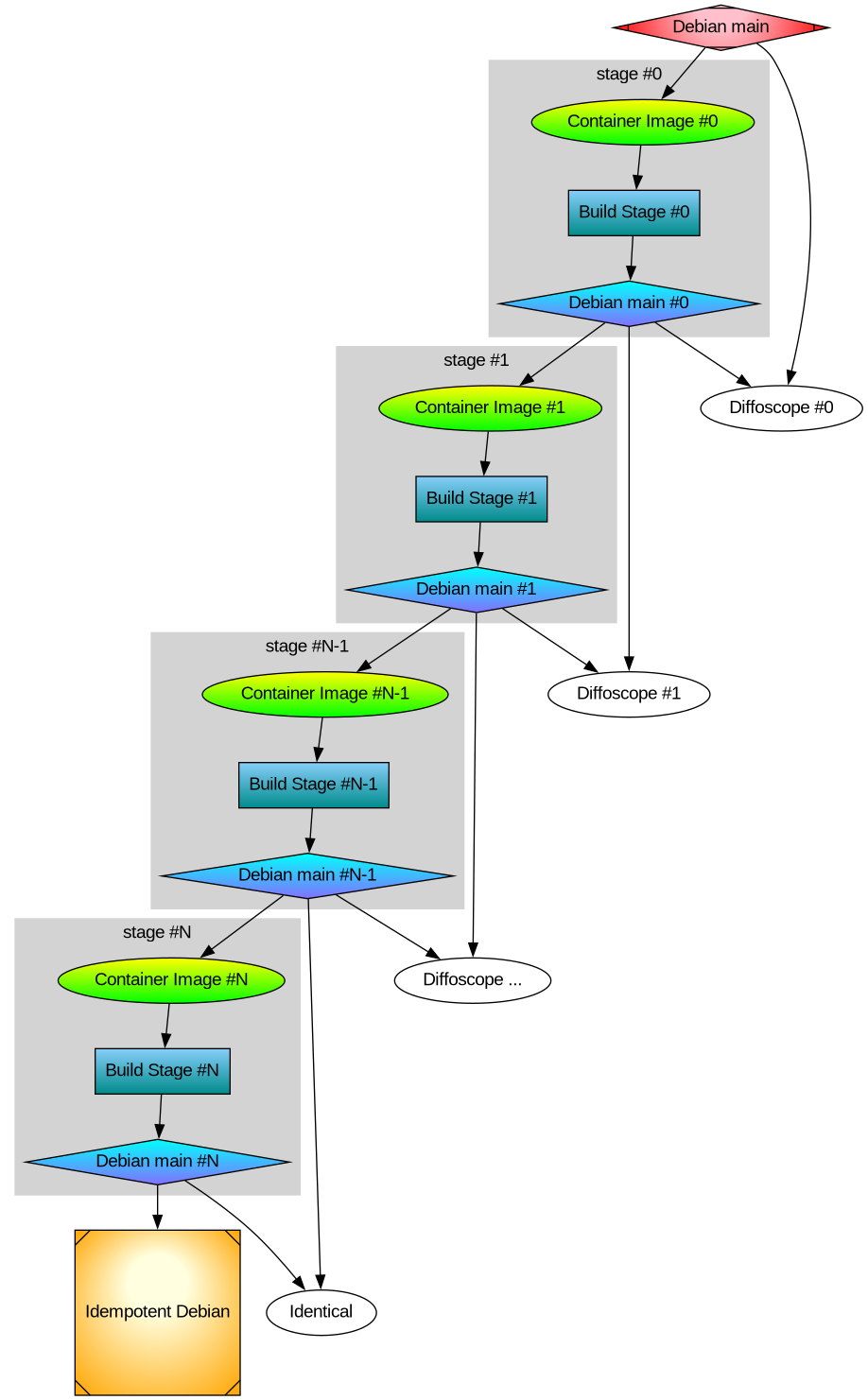
I rebuilt (the top-50 popcon) Debian and Ubuntu packages, on amd64 and arm64, and compared the results a couple of months ago. Since then the Reproduce.Debian.net effort has been launched. Unlike my small experiment, that effort is a full-scale rebuild with more architectures. Their goal is to reproduce what is published in the Debian archive. One differences between these two approaches are the build inputs: The Reproduce Debian effort use the same build inputs which were used to build the published packages. I m using the latest version of published packages for the rebuild. What does that difference imply? I believe reproduce.debian.net will be able to reproduce more of the packages in the archive. If you build a C program using one version of GCC you will get some binary output; and if you use a later GCC version you are likely to end up with a different binary output. This is a good thing: we want GCC to evolve and produce better output over time. However it means in order to reproduce the binaries we publish and use, we need to rebuild them using whatever build dependencies were used to prepare those binaries. The conclusion is that we need to use the old GCC to rebuild the program, and this appears to be the Reproduce.Debian.Net approach. It would be a huge success if the Reproduce.Debian.net effort were to reach 100% reproducibility, and this seems to be within reach. However I argue that we need go further than that. Being able to rebuild the packages reproducible using older binary packages only begs the question: can we rebuild those older packages? I fear attempting to do so ultimately leads to a need to rebuild 20+ year old packages, with a non-negligible amount of them being illegal to distribute or are unable to build anymore due to bit-rot. We won t solve the Trusting Trust concern if our rebuild effort assumes some initial binary blob that we can no longer build from source code. I ve made an illustration of the effort I m thinking of, to reach something that is stronger than reproducible rebuilds. I am calling this concept a Idempotent Rebuild, which is an old concept that I believe is the same as John Gilmore has described many years ago.
The illustration shows how the Debian main archive is used as input to rebuild another stage #0 archive. This stage #0 archive can be compared with diffoscope to the main archive, and all differences are things that would be nice to resolve. The packages in the stage #0 archive is used to prepare a new container image with build tools, and the stage #0 archive is used as input to rebuild another version of itself, called the stage #1 archive. The differences between stage #0 and stage #1 are also useful to analyse and resolve. This process can be repeated many times. I believe it would be a useful property if this process terminated at some point, where the stage #N archive was identical to the stage #N-1 archive. If this would happen, I label the output archive as an Idempotent Rebuild of the distribution. How big is N today? The simplest assumption is that it is infinity. Any build timestamp embedded into binary packages will change on every iteration. This will cause the process to never terminate. Fixing embedded timestamps is something that the Reproduce.Debian.Net effort will also run into, and will have to resolve. What other causes for differences could there be? It is easy to see that generally if some output is not deterministic, such as the sort order of assembler object code in binaries, then the output will be different. Trivial instances of this problem will be caught by the reproduce.debian.net effort as well. Could there be higher order chains that lead to infinite N? It is easy to imagine the existence of these, but I don t know how they would look like in practice. An ideal would be if we could get down to N=1. Is that technically possible? Compare building GCC, it performs an initial stage 0 build using the system compiler to produce a stage 1 intermediate, which is used to build itself again to stage 2. Stage 1 and 2 is compared, and on success (identical binaries), the compilation succeeds. Here N=2. But this is performed using some unknown system compiler that is normally different from the GCC version being built. When rebuilding a binary distribution, you start with the same source versions. So it seems N=1 could be possible. I m unhappy to not be able to report any further technical progress now. The next step in this effort is to publish the stage #0 build artifacts in a repository, so they can be used to build stage #1. I already showed that stage #0 was around ~30% reproducible compared to the official binaries, but I didn t save the artifacts in a reusable repository. Since the official binaries were not built using the latest versions, it is to be expected that the reproducibility number is low. But what happens at stage #1? The percentage should go up: we are now compare the rebuilds with an earlier rebuild, using the same build inputs. I m eager to see this materialize, and hope to eventually make progress on this. However to build stage #1 I believe I need to rebuild a much larger number packages in stage #0, it could be roughly similar to the build-essentials-depends package set. I believe the ultimate end goal of Idempotent Rebuilds is to be able to re-bootstrap a binary distribution like Debian from some other bootstrappable environment like Guix. In parallel to working on a achieving the 100% Idempotent Rebuild of Debian, we can setup a Guix environment that build Debian packages using Guix binaries. These builds ought to eventually converge to the same Debian binary packages, or there is something deeply problematic happening. This approach to re-bootstrap a binary distribution like Debian seems simpler than rebuilding all binaries going back to the beginning of time for that distribution. What do you think? PS. I fear that Debian main may have already went into a state where it is not able to rebuild itself at all anymore: the presence and assumption of non-free firmware and non-Debian signed binaries may have already corrupted the ability for Debian main to rebuild itself. To be able to complete the idempotent and bootstrapped rebuild of Debian, this needs to be worked out.

Russ Allbery: Review: Ghostdrift

Review: Ghostdrift, by Suzanne Palmer
Series: Finder Chronicles #4
Publisher: DAW
Copyright: May 2024
ISBN: 0-7564-1888-7
Format: Kindle
Pages: 378
Ghostdrift is a science fiction adventure and the fourth (and possibly final) book of the Finder Chronicles. You should definitely read this series in order and not start here, even though the plot of this book would stand alone. Following The Scavenger Door, in which he made enemies even more dramatically than he had in the previous books, Fergus Ferguson has retired to the beach on Coralla to become a tea master and take care of his cat. It's a relaxing, idyllic life and a much-needed total reset. Also, he's bored. The arrival of his alien friend Qai, in some kind of trouble and searching for him, is a complex balance between relief and disappointment. Bas Belos is one of the most notorious pirates of the Barrens. He has someone he wants Fergus to find: his twin sister, who disappeared ten years ago. Fergus has an unmatched reputation for finding things, so Belos kidnapped Qai's partner to coerce her into finding Fergus. It's not an auspicious beginning to a relationship, and Qai was ready to fight once they got her partner back, but Belos makes Fergus an offer of payment that, startlingly, is enough for him to take the job mostly voluntarily. Ghostdrift feels a bit like a return to Finder. Fergus is once again alone among strangers, on an assignment that he's mostly not discussing with others, piecing together clues and navigating tricky social dynamics. I missed his friends, particularly Ignatio, and while there are a few moments with AI ships, they play less of a role. But Fergus is so very good at what he does, and Palmer is so very good at writing it. This continues to be competence porn at its best. Belos's crew thinks Fergus is a pirate recruited from a prison colony, and he quietly sets out to win their trust with a careful balance of self-deprecation and unflappable skill, helped considerably by the hidden gift he acquired in Finder. The character development is subtle, but this feels like a Fergus who understands friendship and other people at a deeper and more satisfying level than the Fergus we first met three books ago. Palmer has a real talent for supporting characters and Ghostdrift is no exception. Belos's crew are criminals and murderers, and Palmer does remind the reader of that occasionally, but they're also humans with complex goals and relationships. Belos has earned their loyalty by being loyal and competent in a rough world where those attributes are rare. The morality of this story reminds me of infiltrating a gang: the existence of the gang is not a good thing, and the things they do are often indefensible, but they are an understandable reaction to a corrupt social system. The cops (in this case, the Alliance) are nearly as bad, as we've learned over the past couple of books, and considerably more insufferable. Fergus balances the ethical complexity in a way that I found satisfyingly nuanced, while quietly insisting on his own moral lines. There is a deep science fiction plot here, possibly the most complex of the series so far. The disappearance of Belos's sister is the tip of an iceberg that leads to novel astrophysics, dangerous aliens, mysterious ruins, and an extended period on a remote and wreck-strewn planet. I groaned a bit when the characters ended up on the planet, since treks across primitive alien terrain with jury-rigged technology are one of my least favorite science fiction tropes, but I need not have worried. Palmer knows what she's doing; the pace of the plot does slow a bit at first, but it quickly picks up again, adding enough new setting and plot complications that I never had a chance to be bored by alien plants. It helps that we get another batch of excellent supporting characters for Fergus to observe and win over. This series is such great science fiction. Each book becomes my new favorite, and Ghostdrift is no exception. The skeleton of its plot is a satisfying science fiction mystery with multiple competing factions, hints of fascinating galactic politics, complicated technological puzzles, and a sense of wonder that reminds me of reading Larry Niven's Known Space series. But the characters are so much better and more memorable than classic SF; compared to Fergus, Niven's Louis Wu barely exists and is readily forgotten as soon as the story is over. Fergus starts as a quiet problem-solver, but so much character depth unfolds over the course of this series. The ending of this book was delightfully consistent with everything we've learned about Fergus, but also the sort of ending that it's hard to imagine the Fergus from Finder knowing how to want. Ghostdrift, like each of the books in this series, reaches a satisfying stand-alone conclusion, but there is no reason within the story for this to be the last of the series. The author's acknowledgments, however, says that this the end. I admit to being disappointed, since I want to read more about Fergus and there are numerous loose ends that could be explored. More importantly, though, I hope Palmer will write more novels in any universe of her choosing so that I can buy and read them. This is fantastic stuff. This review comes too late for the Hugo nominating deadline, but I hope Palmer gets a Best Series nomination for the Finder Chronicles as a whole. She deserves it. Rating: 9 out of 10

30 March 2025

Dirk Eddelbuettel: RcppZiggurat 0.1.8 on CRAN: Build Refinements

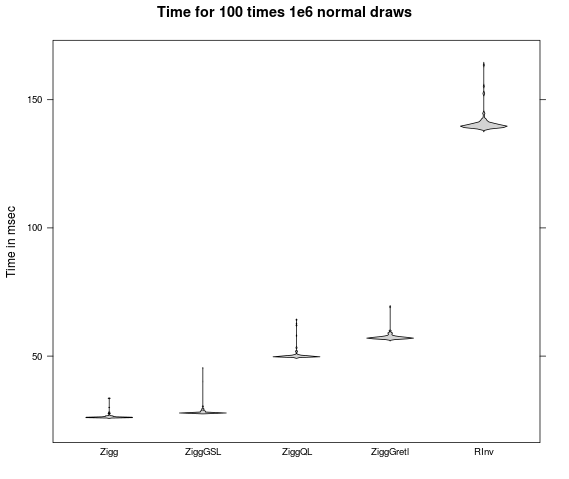
ziggurats A new release 0.1.8 of RcppZiggurat is now on the CRAN network for R, following up on the 0.1.7 release last week which was the first release in four and a half years. The RcppZiggurat package updates the code for the Ziggurat generator by Marsaglia and others which provides very fast draws from a Normal (or Exponential) distribution. The package provides a simple C++ wrapper class for the generator improving on the very basic macros, and permits comparison among several existing Ziggurat implementations. This can be seen in the figure where Ziggurat from this package dominates accessing the implementations from the GSL, QuantLib and Gretl all of which are still way faster than the default Normal generator in R (which is of course of higher code complexity). This release switches the vignette to the standard trick of premaking it as a pdf and including it in a short Sweave document that imports it via pdfpages; this minimizes build-time dependencies on other TeXLive components. It also incorporates a change contributed by Tomas to rely on the system build of the GSL on Windows as well if Rtools 42 or later is found. No other changes. The NEWS file entry below lists all changes.

Changes in version 0.1.8 (2025-03-30)
  • The vignette is now premade and rendered as Rnw via pdfpage to minimize the need for TeXLive package at build / install time (Dirk)
  • Windows builds now use the GNU GSL when Rtools is 42 or later (Tomas Kalibera in #25)

Courtesy of my CRANberries, there is a diffstat report relative to previous release. More detailed information is on the Rcppziggurat page or the GitHub repository.

This post by Dirk Eddelbuettel originated on his Thinking inside the box blog. If you like this or other open-source work I do, you can sponsor me at GitHub.

Utkarsh Gupta: FOSS Activites in March 2025

Here s my 66th monthly but brief update about the activities I ve done in the F/L/OSS world.

Debian
This was my 75th month of actively contributing to Debian. I became a DM in late March 2019 and a DD on Christmas 19! \o/ There s a bunch of things I do, both, technical and non-technical. Here s what I did:
  • Updating Rails to v7.2.2.1 for Trixie.
  • Updating Redmine to v6.0.4 for Trixie.
  • Kickstarting the bursary team for DC25.
  • Mentoring for newcomers.
  • Moderation of -project mailing list.

Ubuntu
This was my 50th month of actively contributing to Ubuntu. Now that I joined Canonical to work on Ubuntu full-time, there s a bunch of things I do! \o/ I mostly worked on different things, I guess. I was too lazy to maintain a list of things I worked on so there s no concrete list atm. Maybe I ll get back to this section later or will start to list stuff from the fall, as I was doing before. :D

Debian (E)LTS
Debian Long Term Support (LTS) is a project to extend the lifetime of all Debian stable releases to (at least) 5 years. Debian LTS is not handled by the Debian security team, but by a separate group of volunteers and companies interested in making it a success. And Debian Extended LTS (ELTS) is its sister project, extending support to the stretch and jessie release (+2 years after LTS support). This was my 66th month as a Debian LTS and 53rd month as a Debian ELTS paid contributor.
I worked for 15.00 hours for LTS and 7.50 hours for ELTS. I did the following things:
  • [ELTS] Worked on backporting patches for adminer.
  • [E/LTS] Working on the musl fixes for bullseye. Taking it forward from where it was left off by Chris.
    • Co-ordiating with Santiago to see how to best get the reproducer to test the update.
    • Plan is to reproduce it myself but then reach out to Adrian if that doesn t work out.
    • Also makes sense to upload to LTS first, let it settle there, and then look at ELTS.
  • [LTS] Attended the LTS meeting on IRC. Summary here.
  • [stable] Co-ordinated with the Security team to fix rails in bookworm via 2:6.1.7.10+dfsg-1~deb12u1.
    • Fixes: CVE-2023-28362, CVE-2023-38037, CVE-2024-26144, CVE-2024-28103, CVE-2024-41128, CVE-2024-47887, CVE-2024-47888, CVE-2024-47889, and CVE-2024-54133.
    • Released as DSA 5881-1.
  • [stable] Co-ordinated with the Security team to fix ruby-rack in bookworm via 2.2.13-1~deb12u1.
    • Fixes: CVE-2025-27610, CVE-2025-27111, and CVE-2025-25184.
    • Released as DSA 5886-1.
  • [stable] Partly co-ordinated with the Security team to fix ruby-saml in bookworm.

Until next time.
:wq for today.

Russ Allbery: Review: Cascade Failure

Review: Cascade Failure, by L.M. Sagas
Series: Ambit's Run #1
Publisher: Tor
Copyright: 2024
ISBN: 1-250-87126-3
Format: Kindle
Pages: 407
Cascade Failure is a far-future science fiction adventure with a small helping of cyberpunk vibes. It is the first of a (so far) two-book series, and was the author's first novel. The Ambit is an old and small Guild ship, not much to look at, but it holds a couple of surprises. One is its captain, Eoan, who is an AI with a deep and insatiable curiosity that has driven them and their ship farther and farther out into the Spiral. The other is its surprisingly competent crew: a battle-scarred veteran named Saint who handles the fighting, and a talented engineer named Nash who does literally everything else. The novel opens with them taking on supplies at Aron Outpost. A supposed Guild deserter named Jalsen wanders into the ship looking for work. An AI ship with a found-family crew is normally my catnip, so I wanted to love this book. Alas, I did not. There were parts I liked. Nash is great: snarky, competent, and direct. Eoan is a bit distant and slightly more simplistic of a character than I was expecting, but I appreciated the way Sagas put them firmly in charge of the ship and departed from the conventional AI character presentation. Once the plot starts in earnest (more on that in a moment), we meet Anke, the computer hacker, whose charming anxiety reaction is a complete inability to stop talking and who adds some needed depth to the character interactions. There's plenty of action, a plot that makes at least some sense, and a few moments that almost achieved the emotional payoff the author was attempting. Unfortunately, most of the story focuses on Saint and Jal, and both of them are irritatingly dense cliches. The moment Jal wanders onto the Ambit in the first chapter, the reader is informed that Jal, Saint, and Eoan have a history. The crew of the Ambit spent a year looking for Jal and aren't letting go of him now that they've found him. Jal, on the other hand, clearly blames Saint for something and is not inclined to trust him. Okay, fine, a bit generic of a setup but the writing moved right along and I was curious enough. It then takes a full 180 pages before the reader finds out what the hell is going on with Saint and Jal. Predictably, it's a stupid misunderstanding that could have been cleared up with one conversation in the second chapter. Cascade Failure does not contain a romance (and to the extent that it hints at one, it's a sapphic romance), but I swear Saint and Jal are both the male protagonist from a certain type of stereotypical heterosexual romance novel. They're both the brooding man with the past, who is too hurt to trust anyone and assumes the worst because he's unable to use his words or ask an open question and then listen to the answer. The first half of this book is them being sullen at each other at great length while both of them feel miserable. Jal keeps doing weird and suspicious things to resolve a problem that would have been far more easily resolved by the rest of the crew if he would offer any explanation at all. It's not even suspenseful; we've read about this character enough times to know that he'll turn out to have a heart of gold and everything will be a misunderstanding. I found it tedious. Maybe people who like slow burn romances with this character type will have a less negative reaction. The real plot starts at about the time Saint and Jal finally get their shit sorted out. It turns out to have almost nothing to do with either of them. The environmental control systems of worlds are suddenly failing (hence the book title), and Anke, the late-arriving computer programmer and terraforming specialist, has a rather wild theory about what's happening. This leads to a lot of action, some decent twists, and a plot that felt very cyberpunk to me, although unfortunately it culminates in an absurdly-cliched action climax. This book is an action movie that desperately wants to make you feel all the feels, and it worked about as well as that typically works in action movies for me. Jaded cynicism and an inability to communicate are not the ways to get me to have an emotional reaction to a book, and Jal (once he finally starts talking) is so ridiculously earnest that it's like reading the adventures of a Labrador puppy. There was enough going on that it kept me reading, but not enough for the story to feel satisfying. I needed a twist, some depth, way more Nash and Anke and way less of the men, something. Everyone is going to compare this book to Firefly, but Firefly had better banter, created more complex character interactions due to the larger and more varied crew, and played the cynical mercenary for laughs instead of straight, all of which suited me better. This is not a bad book, particularly once it gets past the halfway point, but it's not that memorable either, at least for me. If you're looking for a space adventure with heavy action hero and military SF vibes that wants to be about Big Feelings but gets there in mostly obvious ways, you could do worse. If you're looking for a found-family starship crew story more like Becky Chambers, I think you'll find this one a bit too shallow and obvious. Not really recommended, although there's nothing that wrong with it and I'm sure other people's experience will differ. Followed by Gravity Lost, which I'm unlikely to read. Rating: 6 out of 10

28 March 2025

John Goerzen: Why You Should (Still) Use Signal As Much As Possible

As I write this in March 2025, there is a lot of confusion about Signal messenger due to the recent news of people using Signal in government, and subsequent leaks. The short version is: there was no problem with Signal here. People were using it because they understood it to be secure, not the other way around. Both the government and the Electronic Frontier Foundation recommend people use Signal. This is an unusual alliance, and in the case of the government, was prompted because it understood other countries had a persistent attack against American telephone companies and SMS traffic. So let s dive in. I ll cover some basics of what security is, what happened in this situation, and why Signal is a good idea. This post isn t for programmers that work with cryptography every day. Rather, I hope it can make some of these concepts accessible to everyone else.

What makes communications secure? When most people are talking about secure communications, they mean some combination of these properties:
  1. Privacy - nobody except the intended recipient can decode a message.
  2. Authentication - guarantees that the person you are chatting with really is the intended recipient.
  3. Ephemerality - preventing a record of the communication from being stored. That is, making it more like a conversation around the table than a written email.
  4. Anonymity - keeping your set of contacts to yourself and even obfuscating the fact that communications are occurring.
If you think about it, most people care the most about the first two. In fact, authentication is a key part of privacy. There is an attack known as man in the middle in which somebody pretends to be the intended recipient. The interceptor reads the messages, and then passes them on to the real intended recipient. So we can t really have privacy without authentication. I ll have more to say about these later. For now, let s discuss attack scenarios.

What compromises security? There are a number of ways that security can be compromised. Let s think through some of them:

Communications infrastructure snooping Let s say you used no encryption at all, and connected to public WiFi in a coffee shop to send your message. Who all could potentially see it?
  • The owner of the coffee shop s WiFi
  • The coffee shop s Internet provider
  • The recipient s Internet provider
  • Any Internet providers along the network between the sender and the recipient
  • Any government or institution that can compel any of the above to hand over copies of the traffic
  • Any hackers that compromise any of the above systems
Back in the early days of the Internet, most traffic had no encryption. People were careful about putting their credit cards into webpages and emails because they knew it was easy to intercept them. We have been on a decades-long evolution towards more pervasive encryption, which is a good thing. Text messages (SMS) follow a similar path to the above scenario, and are unencrypted. We know that all of the above are ways people s texts can be compromised; for instance, governments can issue search warrants to obtain copies of texts, and China is believed to have a persistent hack into western telcos. SMS fails all four of our attributes of secure communication above (privacy, authentication, ephemerality, and anonymity). Also, think about what information is collected from SMS and by who. Texts you send could be retained in your phone, the recipient s phone, your phone company, their phone company, and so forth. They might also live in cloud backups of your devices. You only have control over your own phone s retention. So defenses against this involve things like:
  • Strong end-to-end encryption, so no intermediate party even the people that make the app can snoop on it.
  • Using strong authentication of your peers
  • Taking steps to prevent even app developers from being able to see your contact list or communication history
You may see some other apps saying they use strong encryption or use the Signal protocol. But while they may do that for some or all of your message content, they may still upload your contact list, history, location, etc. to a central location where it is still vulnerable to these kinds of attacks. When you think about anonymity, think about it like this: if you send a letter to a friend every week, every postal carrier that transports it even if they never open it or attempt to peak inside will be able to read the envelope and know that you communicate on a certain schedule with that friend. The same can be said of SMS, email, or most encrypted chat operators. Signal s design prevents it from retaining even this information, though nation-states or ISPs might still be able to notice patterns (every time you send something via Signal, your contact receives something from Signal a few milliseconds later). It is very difficult to provide perfect anonymity from well-funded adversaries, even if you can provide very good privacy.

Device compromise Let s say you use an app with strong end-to-end encryption. This takes away some of the easiest ways someone could get to your messages. But it doesn t take away all of them. What if somebody stole your phone? Perhaps the phone has a password, but if an attacker pulled out the storage unit, could they access your messages without a password? Or maybe they somehow trick or compel you into revealing your password. Now what? An even simpler attack doesn t require them to steal your device at all. All they need is a few minutes with it to steal your SIM card. Now they can receive any texts sent to your number - whether from your bank or your friend. Yikes, right? Signal stores your data in an encrypted form on your device. It can protect it in various ways. One of the most important protections is ephemerality - it can automatically delete your old texts. A text that is securely erased can never fall into the wrong hands if the device is compromised later. An actively-compromised phone, though, could still give up secrets. For instance, what if a malicious keyboard app sent every keypress to an adversary? Signal is only as secure as the phone it runs on but still, it protects against a wide variety of attacks.

Untrustworthy communication partner Perhaps you are sending sensitive information to a contact, but that person doesn t want to keep it in confidence. There is very little you can do about that technologically; with pretty much any tool out there, nothing stops them from taking a picture of your messages and handing the picture off.

Environmental compromise Perhaps your device is secure, but a hidden camera still captures what s on your screen. You can take some steps against things like this, of course.

Human error Sometimes humans make mistakes. For instance, the reason a reporter got copies of messages recently was because a participant in a group chat accidentally added him (presumably that participant meant to add someone else and just selected the wrong name). Phishing attacks can trick people into revealing passwords or other sensitive data. Humans are, quite often, the weakest link in the chain.

Protecting yourself So how can you protect yourself against these attacks? Let s consider:
  • Use a secure app like Signal that uses strong end-to-end encryption where even the provider can t access your messages
  • Keep your software and phone up-to-date
  • Be careful about phishing attacks and who you add to chat rooms
  • Be aware of your surroundings; don t send sensitive messages where people might be looking over your shoulder with their eyes or cameras
There are other methods besides Signal. For instance, you could install GnuPG (GPG) on a laptop that has no WiFi card or any other way to connect it to the Internet. You could always type your messages on that laptop, encrypt them, copy the encrypted text to a floppy disk (or USB device), take that USB drive to your Internet computer, and send the encrypted message by email or something. It would be exceptionally difficult to break the privacy of messages in that case (though anonymity would be mostly lost). Even if someone got the password to your secure laptop, it wouldn t do them any good unless they physically broke into your house or something. In some ways, it is probably safer than Signal. (For more on this, see my article How gapped is your air?) But, that approach is hard to use. Many people aren t familiar with GnuPG. You don t have the convenience of sending a quick text message from anywhere. Security that is hard to use most often simply isn t used. That is, you and your friends will probably just revert back to using insecure SMS instead of this GnuPG approach because SMS is so much easier. Signal strikes a unique balance of providing very good security while also being practical, easy, and useful. For most people, it is the most secure option available. Signal is also open source; you don t have to trust that it is as secure as it says, because you can inspect it for yourself. Also, while it s not federated, I previously addressed that.

Government use If you are a government, particularly one that is highly consequential to the world, you can imagine that you are a huge target. Other nations are likely spending billions of dollars to compromise your communications. Signal itself might be secure, but if some other government can add spyware to your phones, or conduct a successful phishing attack, you can still have your communications compromised. I have no direct knowledge, but I think it is generally understood that the US government maintains communications networks that are entirely separate from the Internet and can only be accessed from secure physical locations and secure rooms. These can be even more secure than the average person using Signal because they can protect against things like environmental compromise, human error, and so forth. The scandal in March of 2025 happened because government employees were using Signal rather than official government tools for sensitive information, had taken advantage of Signal s ephemerality (laws require records to be kept), and through apparent human error had directly shared this information with a reporter. Presumably a reporter would have lacked access to the restricted communications networks in the first place, so that wouldn t have been possible. This doesn t mean that Signal is bad. It just means that somebody that can spend billions of dollars on security can be more secure than you. Signal is still a great tool for people, and in many cases defeats even those that can spend lots of dollars trying to defeat it. And remember - to use those restricted networks, you have to go to specific rooms in specific buildings. They are still not as convenient as what you carry around in your pocket.

Conclusion Signal is practical security. Do you want phone companies reading your messages? How about Facebook or X? Have those companies demonstrated that they are completely trustworthy throughout their entire history? I say no. So, go install Signal. It s the best, most practical tool we have.
This post is also available on my website, where it may be periodically updated.

Next.

Previous.