Search Results: "eric"

3 May 2016

Jamie McClelland: Monitoring Deflect

May First/People Link has several members that are targets of politically motivated denial of service attacks (mostly groups that support reproductive justice for women and palestinian rights). To fight off the attacks, we work closely with Deflect - a non-governmental organization based in Canada that fights against this kind of censorship. When a site is down, it's not always easy to understand why. Deflect runs as many as 5 edge servers, any of them could be down. And, of course, the origin server could also be down. I tried using a commericial/free as in beer service for monitoring up time, but when it reported the site being down, I had no idea which part was down. So... httping to the rescue. Unfortunately, it depends on --divert-connect which is only available in Debian Stretch. I run the script via a cron job and output the results to a log file.
    #!/bin/bash
    # Test all given edges 
    domain="$1"
    origin="$2"
    proto=http
    if [ -n "$3" ]; then
        proto="$3"
    fi
    if [ -z "$domain" ]; then
        printf "Please pass the domain as first argument.\n"
        exit 1
    fi
    if ! ping -c 1 4.2.2.1 >/dev/null; then
        # printf "We are offline. Not running.\n"
        exit 1
    fi
    ips=$(dig +short "$domain")
    if [ "$?" -ne "0" ]; then
        # printf "DNS lookup failure. Not running.\n"
        exit 1
    fi
    if [ -n "$origin" ]; then
        ips="$ips $origin"
    fi
    l=
    if [ "$proto" = "https" ]; then
        l=-l
    fi
    for ip in $ips; do
        date=$(date +%Y.%m.%d-%H:%M)
        for i in 1 2 3; do
            out=$(httping $l -m -t 5 -c 1 --divert-connect "$ip" "$proto://$domain")
            [ -z "$out" ] && out=1
            printf "%s %s %s\n" "$date" "$ip" "$out"
        done
    done

2 May 2016

Russ Allbery: Review: The Girl with the Dragon Tattoo

Review: The Girl with the Dragon Tattoo, by Stieg Larsson
Translator: Reg Keeland
Series: Millennium #1
Publisher: Vintage Crime
Copyright: 2005, 2008
Printing: June 2009
ISBN: 0-307-47347-3
Format: Mass market
Pages: 644
As The Girl with the Dragon Tattoo opens, Mikael Blomkvist is losing a criminal libel suit in Swedish court. His magazine, Millennium, published his hard-hitting piece of investigative journalism that purported to reveal sketchy arms deals and financial crimes by Hans-Erik Wennerstr m, a major Swedish businessman. But the underlying evidence didn't hold up, and Blomkvist could offer no real defense at trial. The result is a short prison stint for him (postponed several months into this book) and serious economic danger for Millennium. Lisbeth Salander is a (very) freelance investigator for Milton Security. Her specialty is research and background checks: remarkably thorough, dispassionate, and comprehensive. She's almost impossible to talk to, tending to meet nearly all questions with stony silence, but Dragan Armansky, the CEO of Milton Security, has taken her partly under his wing. She, and Milton Security, were hired by a lawyer named Dirch Frode to do a comprehensive background check on Mikael Blomkvist, which she and Dragan present near the start of the book. The reason, as the reader discovers in a few more chapters, is that Frode's employer wants to offer Blomkvist a very strange job. Over forty years ago, Harriet Vanger, scion of one of Sweden's richest industrial families, disappeared. Her uncle, Henrik Vanger, has been obsessed with her disappearance ever since, but in forty years of investigation has never been able to discover what happened to her. There are some possibilities for how her body could have been transported off the island the Vangers (mostly) lived, and live, on, but motive and suspects are still complete unknowns. Vanger wants Blomkvist to try his hand under the cover of writing a book about the Vanger family. Payment is generous, but even more compelling is Henrik Vanger's offer to give Blomkvist documented, defensible evidence against Wennerstr m at the end of the year. The Girl with the Dragon Tattoo (the original Swedish title is M n som hatar kvinnor, "Men who hate women") is the first of three mystery novels written at the very end of Stieg Larsson's life, all published posthumously. They made quite a splash when they were published: won multiple awards, sold millions of copies, and have resulted in four movies to date. I've had a copy of the book sitting around for a while and finally picked it up when in the mood for something a bit different. A major disclaimer up front: I read very little crime and mystery fiction. Every genre has its own conventions and patterns, and regular genre readers often look for different things than people new to that genre. My review is from a somewhat outside and inexperienced perspective, which may not be useful for regular genre readers. I'm also a US reader, reading the book in translation. It appears to be a very good translation, but it was also quite obvious to me that The Girl with the Dragon Tattoo was written from a slightly different set of cultural assumptions than I brought to the book. This is one of the merits of reading books from other cultures in translation. It can be eye-opening, and can carry some of the same thrill as science fiction or fantasy, to hit the parts of the book that question your assumptions. But it can also be hard to tell whether some striking aspect of a book is due to a genre convention I wasn't familiar with, a Swedish cultural assumption that I don't share, or just the personal style of the author. A few things do leap out as cultural differences. Blomkvist has to spend a few months in prison in the middle of this book, and that entire experience is completely foreign to an American understanding of what prison is like. The degradation, violence, and awfulness that are synonymous with prison for an American are almost entirely absent. He even enjoys the experience as quiet time to focus on writing a history of the Vangers (Blomkvist early on decides to take his cover story seriously, since he doubts he'll make any inroads into the mystery of Harriet's disappearance but can at least get a book out of it). It's a minor element in the book, glossed over in a few pages, but it's certainly eye-opening for how minimum security prison could be structured in a civilized country. Similarly, as an American reader, I was struck by how hard Larsson has to work to ruin Salander's life. Although much of the book is written from Blomkvist's perspective (in tight third person), Lisbeth Salander is the titular girl with the dragon tattoo and becomes more and more involved in the story as it develops. The story Larsson wanted to tell requires that she be in a very precarious position legally and socially. In the US, this would be relatively easy, particularly for someone who acts like Salander does. In Sweden, Larsson has to go to monumental efforts to find ways for Salander to credibly fall through Sweden's comprehensive social safety net, and still mostly relies on Salander's complete refusal to assist or comply with any form of authority or support. I've read a lot about differences in policies around social support between the US and Scandinavian countries, but I've rarely read something that drove the point home more clearly than the amount of work a novelist has to go to in order to mess up their protagonist's life in Sweden. The actual plot is slow-moving and as much about the psychology of the characters as it is about the mystery. The reader gets inside the thoughts of the characters occasionally, but Larsson shows far more than tells and leaves it to the reader to draw more general conclusions. Blomkvist's relationship with his long-time partner and Millennium co-founder is an excellent example: so much is left unstated that I would have expected other books to lay down in black and white, and the characters seem surprisingly comfortable with ambiguity. (Some of this may be my genre unfamiliarity; SFF tends to be straightforward to a fault, and more literary fiction is more willing to embrace ambiguous relationships.) While the mystery of Harriet's disappearance forms the backbone of the story, rather more pages are spent on Blomkvist navigating the emotional waters of the near-collapse of his career and business, his principles around investigation and journalism, and the murky waters of the Vanger's deeply dysfunctional family. Harriet's disappearance is something of a locked room mystery. The day she disappeared, a huge crash closed the only bridge from the island to the mainland, both limiting suspects and raising significant questions about why her body was never found on the island. It's also forty years into the past, so Blomkvist has to rely on Henrik Vanger's obsessive archives, old photographs, and old police reports. I found the way it unfolded to be quite satisfying: there are just enough clues to let Blomkvist credibly untangle things with some hard work and research, but they're obscure enough to make it plausible that previous investigators missed them. Through most of this novel, I wasn't sure what I thought of it. I have a personal interest in Blomkvist's journalistic focus wrongdoing by rich financiers but I had trouble warming to Blomkvist himself. He's a very passive, inward character, who spends a lot of the early book reacting to things that are happening to him. Salander is more dynamic and honestly more likable, but she's also deeply messed up, self-destructive, and does some viciously awful things in this book. And the first half of the book is very slow: lots of long conversations, lots of character introduction, and lots of Blomkvist wandering somewhat aimlessly. It's only when Larsson gets the two protagonists together that I thought the book started to click. Salander sees Blomkvist's merits more clearly than the reader can, I think. I also need to give a substantial warning: The Girl with the Dragon Tattoo is a very violent novel, and a lot of that violence is sexual. By mid-book, Blomkvist realizes that Harriet's disappearance is somehow linked with a serial killer whose trademark is horrific, sexualized symbolism drawn from Leviticus. There is a lot of rape here, including revenge rape by a protagonist. If that sort of thing is likely to bother you, you may want to steer way clear. That said, despite the slow pace, the nauseating subject matter, the occasionally very questionable ethics of protagonists, and a twist of the knife at the very end of the novel that I thought was gratuitously nasty on Larsson's part and wasn't the conclusion I wanted, I found myself enjoying this. It has a different pace and a different flavor than what I normally read, the characters are deep and complex enough to play off each other in satisfying ways, and Salander is oddly compelling to read about. Given the length, it's a substantial investment of time, but I don't regret reading it, and I'm quite tempted to read the sequel. I'm not sure this is the sort of book I can recommend (or not recommend) given my lack of familiarity with the genre, but I think US readers might get an additional layer of enjoyment out of seeing how different of a slant the Swedish setting puts on some of the stock elements of a crime novel. Followed by The Girl Who Played with Fire. Rating: 7 out of 10

30 April 2016

Daniel Stender: What I've worked on for Debian this month

This month I've worked on the following things for Debian: To begin with that, I've set up a Debhelper sequencer script for dh-buildinfo1, this add-on now can be used with dh $@ --with buildinfo in deb/rules instead of having to explicitly call it somewhere in an override. Debops I've set up initial Debian packages of Debops2, a collection of fine crafted Ansible roles and playbooks especially for Debian servers, shipped with a couple of convenience and wrapper scripts in Python3. There are two binary packages, one for the toolset (debops), and the other for the playbooks and roles of the project (debops-playbooks). The application is easy to use, just initialize a new project with debops-init foo and add your server(s) to foo/ansible/inventory/hosts belonging to groups representing services and things you want to employ on them. Like the group [debops_gitlab] automatically installs a complete running Gitlab setup on one or a multitude of servers in the same run with the debops command4. Use other groups like [debops_mariadb_server] accordingly in the same host inventory. Ansible runs agent less, so you don't have to prepare freshly setup servers with nothing special to use that tool randomly (like on localhost). The list of things you could deploy with Debops is quite amazing and you've got dozens of services at your hand. The new packages are currently in experimental because they need some more fine tuning, like there are a couple of minor error messages which recently occur using it, but it works well. The (early staged) documentation unfortunately couldn't be packaged because of the scattered resp. collective nature of the project (all parts have their own Github repositories)5, and also how to generate the upstream tarball remains a bit of a challenge (currently, it's the outcome of debops-init)6. I'll have this package in unstable soon. More info on Debops is coming up, then. Hashicorp's Packer I'm very glad to announce that Packer7 is ready being available in unstable, and the two year old RFP bug could be finally closed8. It's another great and much convenient devops tool which does a lot of different things in an automated fashion using only a single "one-argument" CLI tool in combination with a couple of lines in a configuration script (thanks to Yaroslav Halchenko for the tip). Packer helps creating machine images for different platforms. This is like when you use e.g. Debian installations in a Qemu box for testing or development purposes. Instead of setting up a new virtual machine manually like installing Debian on another computer this process could be automated with Packer, like I've written about in this blog entry here9. You just need a template containing instructions for the included Qemu-builder and a preseeding script for the Debian installer, and there you go drinking your coffee while Packer does all the work for you: downloading the installation ISO image, creating the new virtual harddrive, booting the emulator, running the whole installation process automatically like answering questions, selecting things, rebooting without ISO image to complete the installation etc. A couple of minutes and you have a new pre-baked virtual machine image like from a vendoring machine, a fresh one everytime you need it. Packer10 supports a number of builders for different target platforms (desktop virtualization solutions as much as public cloud providers and private cloud software), can build in parallel, and also the full range of common provisioners can be employed in the process to equip the newly installed OSs. Vagrant boxes could be generated by one of the included postprocessors. I'll write more on Packer here on this blog, soon. There were more then two dozens of packages missing to complete Packer11, which is the achievement of combined forces within the pkg-go group. Much thanks esp. to Alexandre Viau who have worked on the most of the needed new packages. Thanks also to the FTP-masters which were always very quick in reviewing the Go packages, so that it could be proceeded to build and package the sub dependent new ones always consecutively. Squirrel3 I've didn't had the most work with it and just sponsored this for Fabian Wolff, but want to highlight here that there's a new package of Squirrel12 now available in Debian13. Squirrel is a lightweight scripting language, somewhat comparable to Lua. It's fully object-oriented and highly embeddable, it's used in a lot of commerical computer games under the hood for implementing intelligence for bots next to other things14, but also for the Internet of Things (it's embedded in hardware from Electric Imp). Squirrel functions could be called from C++15. I've filed an ITP bug for Squirrel already in 2011 (#651195), but always something else got in the way, and it ended up being an RFP. I'm really glad that it got picked up and completed. misc There were a couple of uploads on updated upstream tarballs and for fixing bugs, namely afl/2.10b-1 and 2.11b-1, python-afl/0.5.3-1, pyutilib/5.3.2-1, pyomo/4.3.11327-1, libvigraimpex/1.10.0+git20160211.167be93dfsg-2 (fix of #820429, thanks for Tobias Frost), and gamera/3.4.2+svn1454-1. For the pkg-go group, I've set up a new package of github-mitchellh-ioprogress (which is needed by the official DigitalOcean CLI tool doctl, now RFP #807956 instead of ITP due to the lack of time - again facing a lot of missing packages), and provided a little patch for dh-make-golang updating some standards16. For Packer I've also updated azure-go-autorest and azure-sdk as team upload (#821938, #821832), but it came out that the project which is currently under heavy development towards a new official release broke a lot in the past weeks (and no Git branching have been used), so that Packer as a matter of fact needed a vendored snapshot, although there have been only a couple of commits in between. Docker-registry hat the same problem with the new package of azure-sdk/2.1.1~beta1, so that it needed to be fixed, too (#822146). By the way, the tool ratt17 comes very handy for automatically test building down all reverse dependencies, not only for Go packages (thanks to Tianon Gravi for the tip). Finally, I've posted the needed reverse depencies as RFP bugs for Terraform18 (again quite a lot), Vuls19, and cve-dictionary20, which is needed for Vuls. I'll let them rest a while waiting to get picked up before working anything down.

Daniel Stender: My work for Debian in April

This month I've worked on the these things for Debian: To begin with that, I've set up a Debhelper sequencer script for dh-buildinfo1, this add-on now can be used with dh $@ --with buildinfo in deb/rules instead of having to explicitly call it somewhere in an override. Debops I've set up initial Debian packages of Debops2, a collection of fine crafted Ansible roles and playbooks especially for Debian servers (servers which run on Debian), which are shipped with a couple of helper and wrapper scripts in Python3. There are two binary packages, one for the toolset (debops), and the other for the playbooks and roles of the project (debops-playbooks). The application is easy to use, just initialize a new project with debops-init foo and add your server(s) to foo/ansible/inventory/hosts belonging to groups representing services and things you want to employ on them. For example, the group [debops_gitlab] automatically installs a complete running Gitlab setup on one or a multitude of servers in the same run with the debops command4. Other groups like [debops_mariadb_server] could be used accordingly in the same host inventory. Ansible works without agent, so you don't have to prepare freshly setup servers with nothing special to use that tool randomly (like on localhost). The list of things you could deploy with Debops is quite amazing and dozens of services are at hand. The new Debian packages are currently in experimental because they need some more fine tuning, e.g. there are a couple of minor error messages which recently occur using it, but it works well. The (early staged) documentation unfortunately couldn't be packaged because of the scattered resp. collective nature of the project (all parts have their own Github repositories)5, and also how to generate the upstream tarball remains a bit of a challenge (currently, it's the outcome of debops-init)6. I'll have this package in unstable soon. More info on Debops is coming up, then. HashiCorp's Packer I'm very glad to announce that Packer7 is ready being available in unstable, and the RFP bug could be finally closed after I've taken it over8. It's another great and much convenient devops tool which does a lot of different things in an automated fashion using only a single "one-argument" CLI tool in combination with a couple of lines in a configuration script (thanks to Yaroslav Halchenko for the tip). Packer helps creating machine images for different platforms. This is like when you use e.g. Debian installations in a Qemu box for testing or development purposes. Instead of setting up a new virtual machine manually the same way as installing Debian on another computer this process can be completely automated with Packer, like I've written about in this blog entry here9. You just need a template which contains instructions for the included Qemu builder and a preseeding script for the Debian installer, and there you go drinking your coffee while Packer does all the work: download the ISO image for installation, create the new virtual harddrive, boot the emulator, run the whole installation process automatically like with answering questions, selecting things, reboot without ISO image to complete the installation etc. A couple of minutes and you have a new pre-baked virtual machine image like from a vendoring machine, another fresh one could be created anytime. Packer10 supports a number of builders for different target platforms (desktop virtualization solutions as much as public cloud providers and private cloud software), can build in parallel, and also the full range of common provisioners can be employed in the process to equip the newly installed OSs with services and programs. Vagrant boxes could be generated by one of the included postprocessors. I'll write more on Packer here on this blog, soon. There were more then two dozens of packages missing to complete Packer11, which is the achievement of combined forces within the pkg-go group. Much thanks esp. to Alexandre Viau who have worked on the most of the needed new packages. Thanks also to the FTP masters which were always very quick in reviewing the Go packages, so that it could be proceeded to build and package the sub dependent new ones always consecutively. Squirrel3 I've didn't had the major work of that and just sponsored this for Fabian Wolff, but want to highlight here that there's a new package of Squirrel12 now available in Debian13. Squirrel is a lightweight scripting language, somewhat comparable to Lua. It's fully object-oriented and highly embeddable, it's used in a lot of commerical computer games under the hood for implementing intelligence for bots next to other things14, but also for the Internet of Things (it's embedded in hardware from Electric Imp). Squirrel functions could be called from C++15. I've filed an ITP bug for Squirrel already in 2011 (#651195), but always something else had a higher priority, and it ended up being an RFP. I'm really glad that it got picked up and completed quickly afterwards. misc There were a couple of uploads on updated upstream tarballs and for fixing bugs, namely afl/2.10b-1 and 2.11b-1, python-afl/0.5.3-1, pyutilib/5.3.2-1, pyomo/4.3.11327-1, libvigraimpex/1.10.0+git20160211.167be93dfsg-2 (fix of #820429, thanks to Tobias Frost), and gamera/3.4.2+svn1454-1. For the pkg-go group, I've set up a new package of github-mitchellh-ioprogress (which is needed by the official DigitalOcean CLI tool doctl, now RFP #807956 instead of ITP due to the lack of time, again a lot of missing packages are missing for that), and provided a little patch for dh-make-golang updating some standards16. For Packer I've also updated azure-go-autorest and azure-sdk as team upload (#821938, #821832), but it came out that the project which is currently under heavy development towards a new official release broke a lot in the past weeks (no Git branching have been used), so that Packer as a matter of fact needed a vendored snapshot, although there have been only a couple of commits in between. Docker-registry has the same problem with the new package of azure-sdk/2.1.1~beta1, so that it needed to be fixed, too (#822146). By the way, the tool ratt17 comes very handy for automatically test building down all reverse dependencies, not only for Go packages (thanks to Tianon Gravi for the tip). Finally, I've posted the needed reverse depencies as RFP bugs for Terraform18 (again quite a lot), Vuls19, and cve-dictionary20, which is needed for Vuls. I'll let them rest a while waiting to get picked up before working anything down.

27 April 2016

Niels Thykier: auto-decrufter in top 5 after 10 months

About 10 months ago, we enabled an auto-decrufter in dak. Then after 3 months it had become the top 11th remover . Today, there are only 3 humans left that have removed more packages than the auto-decrufter impressively enough, one of them is not even an active FTP-master (anymore). The current score board:
 5371 Luca Falavigna
 5121 Alexander Reichle-Schmehl
 4401 Ansgar Burchardt
 3928 DAK's auto-decrufter
 3257 Scott Kitterman
 2225 Joerg Jaspert
 1983 James Troup
 1793 Torsten Werner
 1025 Jeroen van Wolffelaar
  763 Ryan Murray
For comparison, here is the number removals by year for the past 6 years:
 5103 2011
 2765 2012
 3342 2013
 3394 2014
 3766 2015  (1842 removed by auto-decrufter)
 2845 2016  (2086 removed by auto-decrufter)
Which tells us that in 2015, the FTP masters and the decrufter performed on average over 10 removals a day. And by the looks of it, 2016 will surpass that. Of course, the auto-decrufter has a tendency to increase the number of removed items since it is an advocate of remove early, remove often! .:) Data is from https://ftp-master.debian.org/removals-full.txt. Scoreboard computed as:
  grep ftpmaster: removals-full.txt   \
   perl -pe 's/.*ftpmaster:\s+//; s/\]$//;'   \
   sort   uniq -c   sort --numeric --reverse   head -n10
Removals by year computed as:
 grep ftpmaster: removals-full.txt   \
   perl -pe 's/.* (\d 4 ) \d 2 :\d 2 :\d 2 .*/$1/'   uniq -c   tail -n6
(yes, both could be done with fewer commands)
Filed under: Debian

26 April 2016

Matthias Klumpp: Why are AppStream metainfo files XML data?

This is a question raised quite quite often, the last time in a blogpost by Thomas, so I thought it is a good idea to give a slightly longer explanation (and also create an article to link to ). There are basically three reasons for using XML as the default format for metainfo files: 1. XML is easily forward/backward compatible, while YAML is not This is a matter of extending the AppStream metainfo files with new entries, or adapt existing entries to new needs. Take this example XML line for defining an icon for an application:
<icon type="cached">foobar.png</icon>
and now the equivalent YAML:
Icons:
  cached: foobar.png
Now consider we want to add a width and height property to the icons, because we started to allow more than one icon size. Easy for the XML:
<icon type="cached" width="128" height="128">foobar.png</icon>
This line of XML can be read correctly by both old parsers, which will just see the icon as before without reading the size information, and new parsers, which can make use of the additional information if they want. The change is both forward and backward compatible. This looks differently with the YAML file. The foobar.png is a string-type, and parsers will expect a string as value for the cached key, while we would need a dictionary there to include the additional width/height information:
Icons:
  cached: name: foobar.png
          width: 128
          height: 128
The change shown above will break existing parsers though. Of course, we could add a cached2 key, but that would require people to write two entries, to keep compatibility with older parsers:
Icons:
  cached: foobar.png
  cached2: name: foobar.png
          width: 128
          height: 128
Less than ideal. While there are ways to break compatibility in XML documents too, as well as ways to design YAML documents in a way which minimizes the risk of breaking compatibility later, keeping the format future-proof is far easier with XML compared to YAML (and sometimes simply not possible with YAML documents). This makes XML a good choice for this usecase, since we can not do transitions with thousands of independent upstream projects easily, and need to care about backwards compatibility. 2. Translating YAML is not much fun A property of AppStream metainfo files is that they can be easily translated into multiple languages. For that, tools like intltool and itstool exist to aid with translating XML using Gettext files. This can be done at project build-time, keeping a clean, minimal XML file, or before, storing the translated strings directly in the XML document. Generally, YAML files can be translated too. Take the following example (shamelessly copied from Dolphin):
<summary>File Manager</summary>
<summary xml:lang="bs">Upravitelj datoteka</summary>
<summary xml:lang="cs">Spr vce soubor </summary>
<summary xml:lang="da">Filh ndtering</summary>
This would become something like this in YAML:
Summary:
  C: File Manager
  bs: Upravitelj datoteka
  cs: Spr vce soubor 
  da: Filh ndtering
Looks manageable, right? Now, AppStream also covers long descriptions, where individual paragraphs can be translated by the translators. This looks like this in XML:
<description>
  <p>Dolphin is a lightweight file manager. It has been designed with ease of use and simplicity in mind, while still allowing flexibility and customisation. This means that you can do your file management exactly the way you want to do it.</p>
  <p xml:lang="de">Dolphin ist ein schlankes Programm zur Dateiverwaltung. Es wurde mit dem Ziel entwickelt, einfach in der Anwendung, dabei aber auch flexibel und anpassungsf hig zu sein. Sie k nnen daher Ihre Dateiverwaltungsaufgaben genau nach Ihren Bed rfnissen ausf hren.</p>
  <p>Features:</p>
  <p xml:lang="de">Funktionen:</p>
  <p xml:lang="es">Caracter sticas:</p>
  <ul>
  <li>Navigation (or breadcrumb) bar for URLs, allowing you to quickly navigate through the hierarchy of files and folders.</li>
  <li xml:lang="de">Navigationsleiste f r Adressen (auch editierbar), mit der Sie schnell durch die Hierarchie der Dateien und Ordner navigieren k nnen.</li>
  <li xml:lang="es">barra de navegaci n (o de ruta completa) para URL que permite navegar r pidamente a trav s de la jerarqu a de archivos y carpetas.</li>
  <li>Supports several different kinds of view styles and properties and allows you to configure the view exactly how you want it.</li>
  ....
  </ul>
</description>
Now, how would you represent this in YAML? Since we need to preserve the paragraph and enumeration markup somehow, and creating a large chain of YAML dictionaries is not really a sane option, the only choices would be: In both cases, we would loose the ability to translate individual paragraphs, which also means that as soon as the developer changes the original text in YAML, translators would need to translate the whole bunch again, which is inconvenient. On top of that, there are no tools to translate YAML properly that I am aware of, so we would need to write those too. 3. Allowing XML and YAML makes a confusing story and adds complexity While adding YAML as a format would not be too hard, given that we already support it for DEP-11 distro metadata (Debian uses this), it would make the business of creating metainfo files more confusing. At time, we have a clear story: Write the XML, store it in /usr/share/metainfo, use standard tools to translate the translatable entries. Adding YAML to the mix adds an additional choice that needs to be supported for eternity and also has the problems mentioned above. I wanted to add YAML as format for AppStream, and we discussed this at the hackfest as well, but in the end I think it isn t worth the pain of supporting it for upstream projects (remember, someone needs to maintain the parsers and specification too and keep XML and YAML in sync and updated). Don t get me wrong, I love YAML, but for translated metadata which needs a guarantee on format stability it is not the ideal choice. So yeah, XML isn t fun to write by hand. But for this case, XML is a good choice.

Matthias Klumpp: A GNOME Software Hackfest report

Two weeks ago was the GNOME Software hackfest in London, and I ve been there! And I just now found the time to blog about it, but better do it late than never  . Arriving in London and finding the Red Hat offices After being stuck in trains for the weekend, but fortunately arriving at the airport in time, I finally made it to London with quite some delay due to the slow bus transfer from Stansted Airport. After finding the hotel, the next issue was to get food and a place which accepted my credit card, which was surprisingly hard in defence of London I must say though, that it was a Sunday, 7 p.m. and my card is somewhat special (in Canada, it managed to crash some card readers, so they needed a hard-reset). While searching for food, I also found the Red Hat offices where the hackfest was starting the next day by accident. My hotel, the office and the tower bridge were really close, which was awesome! I have been to London in 2008 the last time, and only for a day, so being that close to the city center was great. The hackfest didn t leave any time to visit the city much, but by being close to the center, one could hardly avoid the London experience  . Cool people working on great stuff towerbridge2016That s basically the summary for the hackfest  . It was awesome to meet with Richard Hughes again, since we haven t seen each other in person since 2011, but work on lots of stuff together. This was especially important, since we managed to solve quite some disagreements we had over stuff Richard even almost managed to make me give in to adding <kudos/> to the AppStream spec, something which I was pretty against supporting (it didn t make it yet, but I am no longer against the idea of having that the remaining issues are solvable). Meeting Iain Lane again (after FOSDEM) was also very nice, and also seeing other people I ve only worked with over IRC or bug reports (e.g. William, Kalev, ) was great. Also lots of new people were there, like guys from Endless, who build their low-budget computer for developing/emerging countries on top of GNOME and Linux technologies. It s pretty cool stuff they do, you should check out their website! (they also build their distribution on top of Debian, which is even more awesome, and something I didn t know before (because many Endless people I met before were associated with GNOME or Fedora, I kind of implicitly assumed the system was based on Fedora  )). The incarnation of GNOME Software used by endless looks pretty different from what the normal GNOME user sees, since it s adjusted for a different audience and input method. But it looks great, and is a good example for how versatile GS already is! And for upstream GNOME, we ve seen some pretty great mockups done by Endless too I hope those will make it into production somehow.
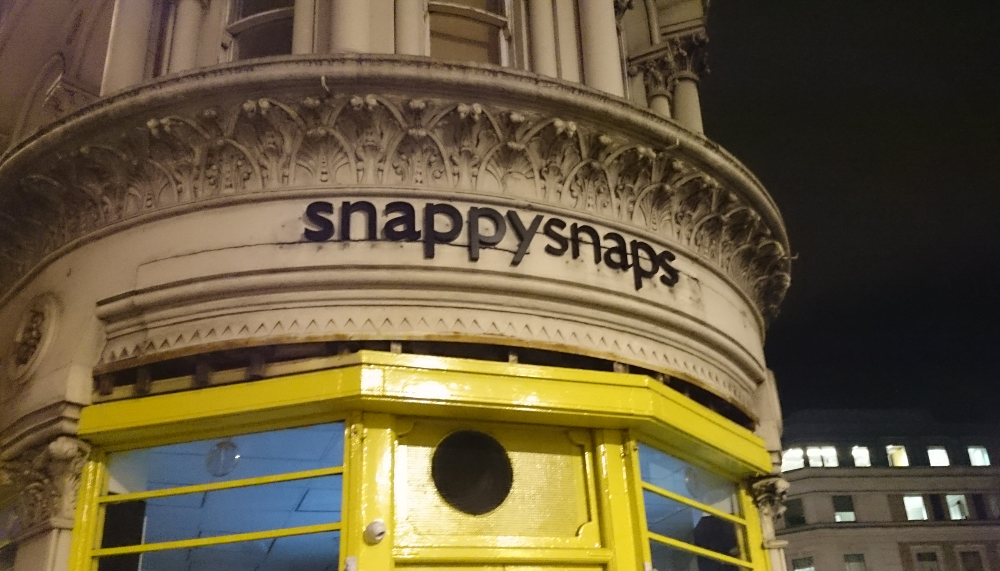
Ironically, a "snapstore" was close to the office ;-)

Ironically, a snapstore was close to the office ;-)

XdgApp and sandboxing of apps was also a big topic, aside from Ubuntu and Endless integration. Fortunately, Alexander Larsson was also there to answer all the sandboxing and XdgApp-questions. I used the time to follow up on a conversation with Alexander we started at FOSDEM this year, about the Limba vs. XdgApp bundling issue. While we are in-line on the sandboxing approach, the way how software is distributed is implemented differently in Limba and XdgApp, and it is bad to have too many bundling systems around (doesn t make for a good story where we can just tell developers ship as this bundling format, and it will be supported everywhere ). Talking with Alex about this was very nice, and I think there is a way out of the too-many-solutions dilemma, at least for Limba and XdgApp I will blog about that separately soon. On the Ubuntu side, a lot of bugs and issues were squashed and changes upstreamed to GNOME, and people were generally doing their best to reduce Richard s bus-factor on the project a little  . I mainly worked on AppStream issues, finishing up the last pieces of appstream-generator and running it against some sample package sets (and later that week against the whole Debian archive). I also started to implement support for showing AppStream issues in the Debian PTS (this work is not finished yet). I also managed to solve a few bugs in the old DEP-11 generator and prepare another release for Ubuntu. We also enjoyed some good Japanese food, and some incredibly great, but also suddenly very expensive Indian food (but that s a different story  ). The most important thing for me though was to get together with people actually using AppStream metadata in software centers and also more specialized places. This yielded some useful findings, e.g. that localized screenshots are not something weird, but actually a wanted feature of Endless for their curated AppStore. So localized screenshots will be part of the next AppStream spec. Also, there seems to be a general need to ship curation information for software centers somehow (which apps are featured? how are they styled? added special banners for some featured apps, app of the day features, etc.). This problem hasn t been solved, since it s highly implementation-specific, and AppStream should be distro-agnostic. But it is something we might be able to address in a generic way sooner or later (I need to talk to people at KDE and Elementary about it). In summary It was a great event! Going to conferences and hackfests always makes me feel like it moves projects leaps ahead, even if you do little coding. Sorting out issues together with people you see in person (rather than communicating with them via text messages or video chat), is IMHO always the most productive way to move forward (yeah, unless you do this every week, but I think you get my point  ). For me, being the only (and youngest ^^) developer at the hackfest who was not employed by any company in the FLOSS business, the hackfest was also motivating to continue to invest spare time into working on these projects. So, the only thing left to do is a huge shout out of THANK YOU to the Ubuntu Community Fund and therefore the Ubuntu community for sponsoring me! You rock! Also huge thanks to Canonical for organizing the sponsoring really quickly, so I didn t get into trouble with paying my flights.
Laney and attente walking on the Millennium Bridge after we walked the distance between Red Hat and Canonical's offices.

Laney and attente on the Millennium Bridge after we walked the distance between Red Hat and Canonical s offices.

To worried KDE people: No, I didn t leave the blue side I just generally work on cross-desktop stuff, and would like all desktops to work as well as possible

24 April 2016

Daniel Pocock: LinuxWochen, MiniDebConf Vienna and Linux Presentation Day

Over the coming week, there are a vast number of free software events taking place around the world. I'll be at the LinuxWochen Vienna and MiniDebConf Vienna, the events run over four days from Thursday, 28 April to Sunday, 1 May. At MiniDebConf Vienna, I'll be giving a talk on Saturday (schedule not finalized yet) about our progress with free Real-Time Communications (RTC) and welcoming 13 new GSoC students (and their mentors) working on this topic under the Debian umbrella. On Sunday, Iain Learmonth and I will be collaborating on a workshop/demonstration on Software Defined Radio from the perspective of ham radio and the Debian Ham Radio Pure Blend. If you want to be an active participant, an easy way to get involved is to bring an RTL-SDR dongle. It is highly recommended that instead of buying any cheap generic dongle, you buy one with a high quality temperature compensated crystal oscillator (TXCO), such as those promoted by RTL-SDR.com. Saturday, 30 April is also Linux Presentation Day in many places. There is an event in Switzerland organized by the local local FSFE group in Basel. DebConf16 is only a couple of months away now, Registration is still open and the team are keenly looking for additional sponsors. Sponsors are a vital part of such a large event, if your employer or any other organization you know benefits from Debian, please encourage them to contribute.

23 April 2016

Scott Kitterman: Computer System Security Policy Debate (Follow-up)

As a follow-up to my recent post on the debate in the US over new encryption restrictions, I thought a short addition might be relevant. This continues. There was a recent Congressional hearing on the topic that featured mostly what you would expect. Police always want access to any possible source of evidence and the tech industry tries to explain that the risks associated with mandates to do so are excessive with grandstanding legislators sprinkled throughout. What I found interesting (and I use that word with some trepidation as it is still a multi-hour video of a Congressional hearing) is that there was rather less grandstanding and and less absolutism from some parties than I was expecting.
There is overwhelming consensus that these requirements [for exceptional access] are incompatible with good security engineering practice Dr. Matthew Blaze
The challenge is that political people see everything as a political/policy issue, but this isn t that kind of issue. I get particularly frustrated when I read ignorant ramblings like this that dismiss the overwhelming consensus of the people that actually understand what needs to be done as emotional, hysterical obstructionism. Contrary to what seems to be that author s point, constructive dialogue and understanding values does nothing to change the technical risks of mandating exceptional access. Of course the opponents of Feinstein-Burr decry it as technologically illiterate, it is technologically illiterate. This doesn t quite rise to the level of that time the Indiana state legislature considered legislating a new value (or in fact multiple values) for the mathematical constant Pi, but it is in the same legislative domain.

19 April 2016

Norbert Preining: Gaming: Monument Valley

With a small baby invading your lifestyle, not much time for other activities is left over, especially for gaming. Most of the times even using my computer is a one-hand-action. In these times mobile games that can be played one-handed are greatly appreciated. And if it is one like Monument Valley, full of atmosphere and incredibly stimulating game play, then the level of gratitude is near infinite. monument-valley1 Set in an Escherian universe where space and distance is often an illusion, the player is guiding a small princess through several levels (10+1 in the basic game, 8 more in the In-App-Purchase) of astonishing simplicity and beauty at the same time. Carefully crafted graphics, atmospheric music, calm game play (no action, don t worry), and the lovely crows sitting around and craaaahing at the little princess. My favorite level was the first of the expansion pack Forgotten shores called The Chasm a wonderful homage to the Lord of the Rings and the descent to the Bridge of Khazad-d m. Not one of the difficult levels, but definitely one of the most funny. The middle image in the above collage is from that level. I guess my only complain about this game is that it doesn t last long. I remember only one really difficult level where I had to play around quite some time. Most of the others are quite straight forward, but despite of that, you cannot stop playing until you are all through it. Simply a wonderful game, that was well worth every Yen. Thanks to the developers for doing innovative things in a perfect setting. monument-valley2 Post scriptum: After finishing this game I also tried Evo Explores, a clone of Monument Valley. The difference cannot be more stunning: Evo Explores is mostly repetitive, with a focus on an irrelevant story, simple graphics, and riddles that miss the ingenuity of the original.

18 April 2016

Dirk Eddelbuettel: RcppCCTZ 0.0.4

A few days ago a new upstream version "2.0" of CCTZ was released. See here for the corresponding post on the Google OpenSource Blog. CCTZ is a C++ library for translating between absolute and civil times using the rules of a time zone. It requires only a proper C++11 compiler and the standard IANA time zone data base which standard Unix, Linux, OS X, ... computers tend to have in /usr/share/zoneinfo. RcppCCTZ connects this library to R by relying on Rcpp. This new version adds more support to the notion of civil time representation -- i.e. independent of timezones -- which can then be mapped to different time zone representations. Changes in this version are summarized here:
Changes in version 0.0.4 (2016-04-17)
  • Synchronized with CCTZ v2 upstream.
  • Updated examples.cpp accordingly
A quick example is provided here where we look at the time when Neil Armstrong first stepped on the moon as an absolute ("civil") time and two local representations:
// from examples/hello.cc
// 
// [[Rcpp::export]]
int helloMoon()  
    cctz::time_zone syd;
    if (!cctz::load_time_zone("Australia/Sydney", &syd)) return -1;
    // Neil Armstrong first walks on the moon
    const auto tp1 = cctz::convert(cctz::civil_second(1969, 7, 21, 12, 56, 0), syd);
    const std::string s = cctz::format("%F %T %z", tp1, syd);
    Rcpp::Rcout << s << "\n";
    cctz::time_zone nyc;
    cctz::load_time_zone("America/New_York", &nyc);
    const auto tp2 = cctz::convert(cctz::civil_second(1969, 7, 20, 22, 56, 0), nyc);
    return tp2 == tp1 ? 0 : 1;
 
We can call this from R, and get the expected result (of equivalence between the dates):
R> library(RcppCCTZ)
R> helloMoon()
1969-07-21 12:56:00 +1000
[1] 0
R>
We also have a diff to the previous version thanks to CRANberries. More details, issue tickets etc at the GitHub repository.

This post by Dirk Eddelbuettel originated on his Thinking inside the box blog. Please report excessive re-aggregation in third-party for-profit settings.

10 April 2016

Vincent Bernat: Testing network software with pytest and Linux namespaces

Started in 2008, lldpd is an implementation of IEEE 802.1AB-2005 (aka LLDP) written in C. While it contains some unit tests, like many other network-related software at the time, the coverage of those is pretty poor: they are hard to write because the code is written in an imperative style and tighly coupled with the system. It would require extensive mocking1. While a rewrite (complete or iterative) would help to make the code more test-friendly, it would be quite an effort and it will likely introduce operational bugs along the way. To get better test coverage, the major features of lldpd are now verified through integration tests. Those tests leverage Linux network namespaces to setup a lightweight and isolated environment for each test. They run through pytest, a powerful testing tool.

pytest in a nutshell pytest is a Python testing tool whose primary use is to write tests for Python applications but is versatile enough for other creative usages. It is bundled with three killer features:
  • you can directly use the assert keyword,
  • you can inject fixtures in any test function, and
  • you can parametrize tests.

Assertions With unittest, the unit testing framework included with Python, and many similar frameworks, unit tests have to be encapsulated into a class and use the provided assertion methods. For example:
class testArithmetics(unittest.TestCase):
    def test_addition(self):
        self.assertEqual(1 + 3, 4)
The equivalent with pytest is simpler and more readable:
def test_addition():
    assert 1 + 3 == 4
pytest will analyze the AST and display useful error messages in case of failure. For further information, see Benjamin Peterson s article.

Fixtures A fixture is the set of actions performed in order to prepare the system to run some tests. With classic frameworks, you can only define one fixture for a set of tests:
class testInVM(unittest.TestCase):
    def setUp(self):
        self.vm = VM('Test-VM')
        self.vm.start()
        self.ssh = SSHClient()
        self.ssh.connect(self.vm.public_ip)
    def tearDown(self):
        self.ssh.close()
        self.vm.destroy()
    def test_hello(self):
        stdin, stdout, stderr = self.ssh.exec_command("echo hello")
        stdin.close()
        self.assertEqual(stderr.read(), b"")
        self.assertEqual(stdout.read(), b"hello\n")
In the example above, we want to test various commands on a remote VM. The fixture launches a new VM and configure an SSH connection. However, if the SSH connection cannot be established, the fixture will fail and the tearDown() method won t be invoked. The VM will be left running. Instead, with pytest, we could do this:
@pytest.yield_fixture
def vm():
    r = VM('Test-VM')
    r.start()
    yield r
    r.destroy()
@pytest.yield_fixture
def ssh(vm):
    ssh = SSHClient()
    ssh.connect(vm.public_ip)
    yield ssh
    ssh.close()
def test_hello(ssh):
    stdin, stdout, stderr = ssh.exec_command("echo hello")
    stdin.close()
    stderr.read() == b""
    stdout.read() == b"hello\n"
The first fixture will provide a freshly booted VM. The second one will setup an SSH connection to the VM provided as an argument. Fixtures are used through dependency injection: just give their names in the signature of the test functions and fixtures that need them. Each fixture only handle the lifetime of one entity. Whatever a dependent test function or fixture succeeds or fails, the VM will always be finally destroyed.

Parameters If you want to run the same test several times with a varying parameter, you can dynamically create test functions or use one test function with a loop. With pytest, you can parametrize test functions and fixtures:
@pytest.mark.parametrize("n1, n2, expected", [
    (1, 3, 4),
    (8, 20, 28),
    (-4, 0, -4)])
def test_addition(n1, n2, expected):
    assert n1 + n2 == expected

Testing lldpd The general plan for to test a feature in lldpd is the following:
  1. Setup two namespaces.
  2. Create a virtual link between them.
  3. Spawn a lldpd process in each namespace.
  4. Test the feature in one namespace.
  5. Check with lldpcli we get the expected result in the other.
Here is a typical test using the most interesting features of pytest:
@pytest.mark.skipif('LLDP-MED' not in pytest.config.lldpd.features,
                    reason="LLDP-MED not supported")
@pytest.mark.parametrize("classe, expected", [
    (1, "Generic Endpoint (Class I)"),
    (2, "Media Endpoint (Class II)"),
    (3, "Communication Device Endpoint (Class III)"),
    (4, "Network Connectivity Device")])
def test_med_devicetype(lldpd, lldpcli, namespaces, links,
                        classe, expected):
    links(namespaces(1), namespaces(2))
    with namespaces(1):
        lldpd("-r")
    with namespaces(2):
        lldpd("-M", str(classe))
    with namespaces(1):
        out = lldpcli("-f", "keyvalue", "show", "neighbors", "details")
        assert out['lldp.eth0.lldp-med.device-type'] == expected
First, the test will be executed only if lldpd was compiled with LLDP-MED support. Second, the test is parametrized. We will execute four distinct tests, one for each role that lldpd should be able to take as an LLDP-MED-enabled endpoint. The signature of the test has four parameters that are not covered by the parametrize() decorator: lldpd, lldpcli, namespaces and links. They are fixtures. A lot of magic happen in those to keep the actual tests short:
  • lldpd is a factory to spawn an instance of lldpd. When called, it will setup the current namespace (setting up the chroot, creating the user and group for privilege separation, replacing some files to be distribution-agnostic, ), then call lldpd with the additional parameters provided. The output is recorded and added to the test report in case of failure. The module also contains the creation of the pytest.config.lldpd object that is used to record the features supported by lldpd and skip non-matching tests. You can read fixtures/programs.py for more details.
  • lldpcli is also a factory, but it spawns instances of lldpcli, the client to query lldpd. Moreover, it will parse the output in a dictionary to reduce boilerplate.
  • namespaces is one of the most interesting pieces. It is a factory for Linux namespaces. It will spawn a new namespace or refer to an existing one. It is possible to switch from one namespace to another (with with) as they are contexts. Behind the scene, the factory maintains the appropriate file descriptors for each namespace and switch to them with setns(). Once the test is done, everything is wipped out as the file descriptors are garbage collected. You can read fixtures/namespaces.py for more details. It is quite reusable in other projects2.
  • links contains helpers to handle network interfaces: creation of virtual ethernet link between namespaces, creation of bridges, bonds and VLAN, etc. It relies on the pyroute2 module. You can read fixtures/network.py for more details.
You can see an example of a test run on the Travis build for 0.9.2. Since each test is correctly isolated, it s possible to run parallel tests with pytest -n 10 --boxed. To catch even more bugs, both the address sanitizer (ASAN) and the undefined behavior sanitizer (UBSAN) are enabled. In case of a problem, notably a memory leak, the faulty program will exit with a non-zero exit code and the associated test will fail.

  1. A project like cwrap would definitely help. However, it lacks support for Netlink and raw sockets that are essential in lldpd operations.
  2. There are three main limitations in the use of namespaces with this fixture. First, when creating a user namespace, only root is mapped to the current user. With lldpd, we have two users (root and _lldpd). Therefore, the tests have to run as root. The second limitation is with the PID namespace. It s not possible for a process to switch from one PID namespace to another. When you call setns() on a PID namespace, only children of the current process will be in the new PID namespace. The PID namespace is convenient to ensure everyone gets killed once the tests are terminated but you must keep in mind that /proc must be mounted in children only. The third limitation is that, for some namespaces (PID and user), all threads of a process must be part of the same namespace. Therefore, don t use threads in tests. Use multiprocessing module instead.

7 April 2016

Dirk Eddelbuettel: RcppArmadillo 0.6.700.3.0

armadillo image A new Armadillo release 6.700.3 is out, and we uploaded RcppArmadillo 0.6.700.3.0 to CRAN and Debian. This followed the usual thorough reverse-dependecy checking of by now 216 packages using. Armadillo is a powerful and expressive C++ template library for linear algebra aiming towards a good balance between speed and ease of use with a syntax deliberately close to a Matlab. Changes in this release are as follows:
Changes in RcppArmadillo version 0.6.700.3.0 (2016-04-05)
  • Upgraded to Armadillo 6.700.3 (Catabolic Amalgamator Deluxe)
    • added logmat() for calcuating the matrix logarithm
    • added regspace() for generating vectors with regularly spaced elements
    • added logspace() for generating vectors with logarithmically spaced elements
    • added approx_equal() for determining approximate equality
    • added trapz() for numerical integration
    • expanded .save() and .load() with hdf5_binary_trans file type, to save/load data with columns transposed to rows
Courtesy of CRANberries, there is also a diffstat report for this release. As always, more detailed information is on the RcppArmadillo page. Questions, comments etc should go to the rcpp-devel mailing list off the R-Forge page.

This post by Dirk Eddelbuettel originated on his Thinking inside the box blog. Please report excessive re-aggregation in third-party for-profit settings.

5 April 2016

Ian Wienand: Image building in OpenStack CI

Also titled minimal images - maximal effort! The OpenStack Infrastructure Team manages a large continuous-integration system that provides the broad range of testing the OpenStack project requires. Tests are run thousands of times a day across every project, on multiple platforms and on multiple cloud-providers. There are essentially no manual steps in any part of the process, with every component being automated via scripting, a few home-grown tools and liberal doses of Puppet and Ansible. More importantly, every component resides in the public git trees right alongside every other OpenStack project, with contributions actively encouraged. As with any large system, technical debt can build up and start to affect stability and long-term maintainability. OpenStack Infrastructure can see some of this debt accumulating as more testing environments across more cloud-providers are being added to support ever-growing testing demands. Thus a strong focus of recent work has been consolidating testing platforms to be smaller, better defined and more maintainable. This post illustrates some of the background to the issues and describes how these new platforms are more reliable and maintainable.
OpenStack CI Overview Before getting into details, it's a good idea to get a basic big-picture conceptual model of how OpenStack CI testing works. If you look at the following diagram and follow the numbers with the explanation below, hopefully you'll have all the context you need. Overview of OpenStack CI
  1. The developer uploads their code to gerrit via the git-review tool. There is no further action required on their behalf and the developer simply waits for results.

  2. Gerrit provides a JSON-encoded "firehose" output of everything happening to it. New reviews, votes, updates and more all get sent out over this pipe. Zuul is the overall scheduler that subscribes itself to this information and is responsible for managing the CI jobs appropriate for each change.

  3. Zuul has a configuration that tells it what jobs to run for what projects. Zuul can do lots of interesting things, but for the purposes of this discussion we just consider that it puts the jobs it wants run into gearman for a Jenkins master to consume. gearman is a job-server; as they explain it "[gearman] provides a generic application framework to farm out work to other machines or processes that are better suited to do the work". Zuul puts into gearman basically a tuple (job-name, node-type) for each job it wants run, specifying the unique job name to run and what type of node it should be run on.

  4. A group of Jenkins masters are subscribed to gearman as workers. It is these Jenkins masters that will consume the job requests from the queue and actually get the tests running. However, Jenkins needs two things to be able to run a job a job definition (what to actually do) and a slave node (somewhere to do it). The first part what to do is provided by job-definitions stored in external YAML files and processed by Jenkins Job Builder (jjb) in to job configurations for Jenkins. Each Jenkins master gets these definitions pushed to it constantly by Puppet, thus each Jenkins master instance knows about all the jobs it can run automatically. Zuul also knows about these job definitions; this is the job-name part of the tuple we said it put into gearman. The second part somewhere to run the test takes some more explaining. To the next point...

  5. Several cloud companies donate capacity in their clouds for OpenStack to run CI tests. Overall, this capacity is managed by a customised orchestration tool called nodepool. Nodepool watches the gearman queue and sees what requests are coming out of Zuul. It looks at node-type of jobs in the queue and decides what types of nodes need to start and which cloud providers have capacity to satisfy demand. Nodepool will monitor the start-up of the virtual-machines and register the new nodes to the Jenkins master instances.

  6. At this point, the Jenkins master has what it needs to actually get jobs started. When nodepool registers a host to a Jenkins master as a slave, the Jenkins master can now advertise its ability to consume jobs. For example, if a ubuntu-trusty node is provided to the Jenkins master instance by nodepool, Jenkins can now consume from gearman any job it knows about that is intended to run on an ubuntu-trusty slave. Jekins will run the job as defined in the job-definition on that host ssh-ing in, running scripts, copying the logs and waiting for the result. (It is a gross oversimplification, but for the purposes of OpenStack CI, Jenkins is pretty much used as a glorified ssh/scp wrapper. Zuul Version 3, under development, is working to remove the need for Jenkins to be involved at all).

  7. Eventually, the test will finish. The Jenkins master will put the result back into gearman, which Zuul will consume. The slave will be released back to nodepool, which destroys it and starts all over again (slaves are not reused and also have no sensitive details on them, as they are essentially publicly accessible). Zuul will wait for the results of all jobs for the change and post the result back to Gerrit; it either gives a positive vote or the dreaded negative vote if required jobs failed (it also handles merges to git, but we'll ignore that bit for now).

In a nutshell, that is the CI work-flow that happens thousands-upon-thousands of times a day keeping OpenStack humming along.
Image builds So far we have glossed over how nodepool actually creates the images that it hands out for testing. Image creation, illustrated in step 8 above, contains a lot of important details. Firstly, what are these images and why build them at all? These images are where the "rubber hits the road" they are instantiated into the virtual-machines that will run DevStack, unit-testing or whatever else someone might want to test. The main goal is to provide a stable and consistent environment in which to run a wide-range of tests. A full OpenStack deployment results in hundreds of libraries and millions of lines of code all being exercised at once. The testing-images are right at the bottom of all this, so any instability or inconsistency affects everyone; leading to constant fire-firefighting and major inconvenience as all forward-progress stops when CI fails. We want to support a wide number of platforms interesting to developers such as Ubuntu, Debian, CentOS and Fedora, and we also want to and make it easy to handle new releases and add other platforms. We want to ensure this can be maintained without too much day-to-day hands-on. Caching is a big part of the role of these images. With thousands of jobs going on every day, an occasional network blip is not a minor annoyance, but creates constant and difficult to debug failures. We want jobs to rely on as few external resources as possible so tests are consistent and stable. This means caching things like the git trees tests might use (OpenStack just broke the 1000 repository mark), VM images, packages and other common bits and pieces. Obviously a cache is only as useful as the data in it, so we build these images up every day to keep them fresh.
Snapshot images If you log into almost any cloud-provider's interface, they almost certainly have a range of pre-canned images of common distributions for you to use. At first, the base images for OpenStack CI testing came from what the cloud-providers had as their public image types. However, over time, there are a number of issues that emerge:
  1. No two images, even for the same distribution or platform, are the same. Every provider seems to do something "helpful" to the images which requires some sort of workaround.
  2. Providers rarely leave these images alone. One day you would boot the image to find a bunch of Python libraries pip-installed, or a mount-point moved, or base packages removed (all happened).
  3. Even if the changes are helpful, it does not make for consistent and reproducible testing if every time you run, you're on a slightly different base system.
  4. Providers don't have some images you want (like a latest Fedora), or have different versions, or different point releases. All update asynchronously whenever they get around to it.
So the original incarnations of OpenStack CI images were based on these public images. Nodepool would start one of these provider images and then run a series of scripts on it these scripts would firstly try to work-around any quirks to make the images look as similar as possible across providers, and then do the caching, setup things like authorized keys and finish other configuration tasks. Nodepool would then snapshot this prepared image and start instantiating VM's from these snapshots into the pool for testing. If you hear someone talking about a "snapshot image" in OpenStack CI context, that's likely what they are referring to. Apart from the stability of the underlying images, the other issue you hit with this approach is that the number of images being built starts to explode when you take into account multiple providers and multiple regions. Even with just Rackspace and the (now defunct) HP Cloud we would end up creating snapshot images for 4 or 5 platforms across a total of about 8 regions meaning anywhere up to 40 separate image builds happening daily (you can see how ridiculous it was getting in the logging configuration used at the time). It was almost a fait accompli that some of these would fail every day nodepool can deal with this by reusing old snapshots but this leads to a inconsistent and heterogeneous testing environment. Naturally there was a desire for something more consistent a single image that could run across multiple providers in a much more tightly controlled manner.
Upstream-based builds Upstream distributions do provide "cloud-images", which are usually pre-canned .qcow2 format files suitable for uploading to your average cloud. So the diskimage-builder tool was put into use creating images for nodepool, based on these upstream-provided images. In essence, diskimage-builder uses a series of elements (each, as the name suggests, designed to do one thing) that allow you to build a completely customised image. It handles all the messy bits of laying out the image file, tries to be smart about caching large downloads and final things like conversion to qcow2 or vhd. nodepool has used diskimage-builder to create customised images based upon the upstream releases for some time. These are better, but still have some issues for the CI environment:
  1. You still really have no control over what does or does not go into the upstream base images. You don't notice a change until you deploy a new image based on an updated version and things break.
  2. The images still start with a fair amount of "stuff" on them. For example cloud-init is a rather large Python program and has a fair few dependencies. These dependencies can both conflict with parts of OpenStack or end up tacitly hiding real test requirements (the test doesn't specify it, but the package is there as part of another base dependency. Things then break when the base dependencies change). The whole idea of the CI is that (as much as possible) you're not making any assumptions about what is required to run your tests you want everything explicitly included.
  3. An image that "works everywhere" across multiple cloud-providers is quite a chore. cloud-init hasn't always had support for config-drive and Rackspace's DHCP-less environment, for example. Providers all have their various different networking schemes or configuration methods which needs to be handled consistently.
If you were starting this whole thing again, things like LXC/Docker to keep "systems within systems" might come into play and help alleviate some of the packaging conflicts. Indeed they may play a role in the future. But don't forget that DevStack, the major CI deployment mechanism, was started before Docker existed. And there's tricky stuff with networking and Neutron going on. And things like iSCSI kernel drivers that containers don't support well. And you need to support Ubuntu, Debian, CentOS and Fedora. And you have hundreds of developers already relying on what's there. So change happens incrementally, and in the mean time, there is a clear need for a stable, consistent environment.
Minimal builds To this end, diskimage-builder now has a serial of "minimal" builds that are really that systems with essentially nothing on them. For Debian and Ubuntu this is achieved via debootstrap, for Fedora and CentOS we replicate this with manual installs of base packages into a clean chroot environment. We add on a range of important elements that make the image useful; for example, for networking, we have simple-init which brings up the network consistently across all our providers but has no dependencies to mess with the base system. If you check the elements provided by project-config you can see a range of specific elements that OpenStack Infra runs at each image build (these are actually specified by in arguments to nodepool, see the config file, particularly diskimages section). These custom elements do things like caching, using puppet to install the right authorized_keys files and setup a few needed things to connect to the host. In general, you can see the logs of an image build provided by nodepool for each daily build. So now, each day at 14:14 UTC nodepool builds the daily images that will be used for CI testing. We have one image of each type that (theoretically) works across all our providers. After it finishes building, nodepool uploads the image to all providers (p.s. the process of doing this is so insanely terrible it spawned shade; this deserves many posts of its own) at which point it will start being used for CI jobs. If you wish to replicate this entire process, the build-image.sh script, run on an Ubuntu Trusty host in a virtualenv with diskimage-builder will get you pretty close (let us know of any issues!).
DevStack and bare nodes There are two major ways OpenStack projects test their changes:
  1. Running with DevStack, which brings up a small, but fully-functional, OpenStack cloud with the change-under-test applied. Generally tempest is then used to ensure the big-picture things like creating VM's, networks and storage are all working.
  2. Unit-testing within the project; i.e. what you do when you type tox -e py27 in basically any OpenStack project.
To support this testing, OpenStack CI ended up with the concept of bare nodes and devstack nodes.
  • A bare node was made for unit-testing. While tox has plenty of information about installing required Python packages into the virtualenv for testing, it doesn't know anything about the system packages required to build those Python packages. This means things like gcc and library -devel packages which many Python packages use to build bindings. Thus the bare nodes had an ever-growing and not well-defined list of packages that were pre-installed during the image-build to support unit-testing. Worse still, projects didn't really know their dependencies but just relied on their testing working with this global list that was pre-installed on the image.
  • In contrast to this, DevStack has always been able to bootstrap itself from a blank system to a working OpenStack deployment by ensuring it has the right dependencies installed. We don't want any packages pre-installed here because it hides actual dependencies that we want explicitly defined within DevStack otherwise, when a user goes to deploy DevStack for their development work, things break because their environment differs slightly to the CI one. If you look at all the job definitions in OpenStack, by convention any job running DevStack has a dsvm in the job name this referred to running on a "DevStack Virtual Machine" or a devstack node. As the CI environment has grown, we have more and more testing that isn't DevStack based (puppet apply tests, for example) that rather confusingly want to run on a devstack node because they do not want dependencies installed. While it's just a name, it can be difficult to explain!
Thus we ended up maintaining two node-types, where the difference between them is what was pre-installed on the host and yes, the bare node had more installed than a devstack node, so it wasn't that bare at all!
Specifying Dependencies Clearly it is useful to unify these node types, but we still need to provide a way for the unit-test environments to have their dependencies installed. This is where a tool called bindep comes in. This tool gives project authors a way to specify their system requirements in a similar manner to the way their Python requirements are kept. For example, OpenStack has the concept of global requirements those Python dependencies that are common across all projects so version skew becomes somewhat manageable. This project now has some extra information in the other-requirements.txt file, which lists the system packages required to build the Python packages in the global-requirements list. bindep knows how to look at these lists provided by projects and get the right packages for the platform it is running on. As part of the image-build, we have a cache-bindep element that can go through every project and build a list of the packages it requires. We can thus pre-cache all of these packages onto the images, knowing that they are required by jobs. This both reduces the dependency on external mirrors and improves job performance (as the packages are locally cached) but doesn't pollute the system by having everything pre-installed. Package installation can now happen via the way we really should be doing it as part of the CI job. There is a job-macro called install-distro-packages which a test can use to call bindep to install the packages specified by the project before the run. You might notice the script has a "fallback" list of packages if the project does not specify it's own dependencies this essentially replicates the environment of a bare node as we transition to projects more strictly specifying their system requirements. We can now start with a blank image and all the dependencies to run the job can be expressed by and within the project leading to a consistent and reproducible environment without any hidden dependencies. Several things have broken as part of removing bare nodes this is actually a good thing because it means we have revealed areas where we were making assumptions in jobs about what the underlying platform provides. There's a few other job-macros that can do things like provide MySQL/Postgres instances for testing or setup other common job requirements. By splitting these types of things out from base-images we also improve the performance of jobs who don't waste time doing things like setting up databases for jobs that don't need it. As of this writing, the bindep work is new and still a work-in-progress. But the end result is that we have no more need for a separate bare node type to run unit-tests. This essentially halves the number of image-builds required and brings us to the goal of a single image for each platform running all CI.
Conclusion While dealing with multiple providers, image-types and dependency chains has been a great effort for the infra team, to everyone's credit I don't think the project has really noticed much going on underneath. OpenStack CI has transitioned to a situation where there is a single image type for each platform we test that deploys unmodified across all our providers and runs all testing environments equally. We have better insight into our dependencies and better tools to manage them. This leads to greatly decreased maintenance burden, better consistency and better performance; all great things to bring to OpenStack CI!

4 April 2016

Ian Wienand: Image building for OpenStack CI -- Minimal images, big effort

A large part of OpenStack Infrastructure teams recent efforts has been focused on moving towards more stable and maintainable CI environments for testing.
OpenStack CI Overview Before getting into details, it's a good idea to get a basic big-picture conceptual model of how OpenStack CI testing works. If you look at the following diagram and follow the numbers with the explanation below, hopefully you'll have all the context you need. Overview of OpenStack CI
  1. The developer uploads their code to gerrit via the git-review tool. They wait.

  2. Gerrit provides a JSON-encoded "firehose" output of everything happening to it. New reviews, votes, updates and more all get sent out over this pipe. Zuul is the overall scheduler that subscribes itself to this information and is responsible for managing the CI jobs appropriate for each change.

  3. Zuul has a configuration that tells it what jobs to run for what projects. Zuul can do lots of interesting things, but for the purposes of this discussion we just consider that it puts the jobs it wants run into gearman for a Jenkins host to consume. gearman is a job-server; as they explain it "[gearman] provides a generic application framework to farm out work to other machines or processes that are better suited to do the work".

  4. A group of Jenkins hosts are subscribed to gearman as workers. It is these Jenkins hosts that will consume the job requests from the queue and actually get the tests running. Jenkins needs two things to be able to run a job -- a job definition (what to actually do) and a slave node (somewhere to do it). The first part -- what to do -- is provided by job-definitions stored in external YAML files and processed by Jenkins Job Builder (jjb) in to job configurations for Jenkins. Thus each Jenkins instance knows about all the jobs it might need to run. Zuul also knows about these job definitions, so you can see how we now have a mapping where Zuul can put a job into gearman saying "run test foo-bar-baz" and a Jenkins host can consume that request and know what to do. The second part -- somewhere to run the test -- takes some more explaining. To the next point...

  5. Several cloud companies donate capacity in their clouds for OpenStack to run CI tests. Overall, this capacity is managed by nodepool -- a customised orchestration tool. Nodepool watches the gearman queue and sees what requests are coming out of Zuul, and decides what type of capacity to provide and in what clouds to satisfy the outstanding job queue. Nodepool will start-up virtual-machines as required, and register those nodes to the Jenkins instances.

  6. At this point, Jenkins has what it needs to actually get jobs started. When nodepool registers a host to Jenkins as a slave, the Jenkins host can now advertise its ability to consume jobs. For example, if a ubuntu-trusty node is provided to the Jenkins instance by nodepool, Jenkins can now consume a job from the queue intended to run on an ubuntu-trusty host. It will run the job as defined in the job-definition -- ssh-ing into the host, running scripts, copying the logs and waiting for the result. (It is a gross oversimplification, but but Jenkins is pretty much a glorified ssh/scp wrapper to OpenStack CI. Zuul Version 3, under development, is working to remove the need for Jenkins to be involved at all).

  7. Eventually, the test will finish. Jenkins will put the result back into gearman, which Zuul will consume. The slave will be released back to nodepool, which destroys it and starts all over again (slaves are not reused and also have no sensitive details on them, as they are essentially publicly accessible). Zuul will wait for the results of all jobs and post the result back to Gerrit and give either a positive vote or the dreaded negative vote if required jobs failed (it also handles merges to git, but we'll ignore that bit for now).

In a nutshell, that is the CI work-flow that happens thousands-upon-thousands of times a day keeping OpenStack humming along.
Image builds There is, however, another more asynchronous part of the process that hides a lot of details the rest of the system relies on. Illustrated in step 8 above, this is the management of the images that tests are being run upon. Above we we said that a test runs on a ubuntu-trusty, centos, fedora or some other type of node, but glossed over where these images come from. Firstly, what are these images, and why build them at all? These images are where the "rubber hits the road" -- where DevStack, functional testing or whatever else someone might want to test is actually run for real. Caching is a big part of the role of these images. With thousands of jobs going on every day, an occasional network blip is not a minor annoyance, but creates constant and difficult to debug CI failures. We want the images that CI runs on to rely on as few external resources as possible so test runs are as stable as possible. This means caching all the git trees tests might use, VM images consumed by various tests and other common bits and pieces. Obviously a cache is only as useful as the data in it, so we build these images up every day to keep them fresh.
Provider images If you log into almost any cloud-provider's interface, they almost certainly have a range of pre-canned images of common distributions for you to use. At first, the base images for OpenStack CI testing came from what the cloud-providers had as their public image types. However, over time, there are a number of issues that emerge:
  1. No two images, even for the same distribution or platform, are the same. Every provider seems to do something "helpful" to the images which requires some sort of workaround.
  2. Providers rarely leave these images alone. One day you would boot the image to find a bunch of Python libraries pip-installed, or a mount-point moved, or base packages removed (all happened).
  3. Even if the changes are helpful, it does not make for consistent and reproducible testing if every time you run, you're on a slightly different base system.
  4. Providers don't have some images you want (like a latest Fedora), or have different versions, or different point releases. All update asynchronously whenever they get around to it.
So the original incarnations of building images was that nodepool would start one of these provider images, run a bunch of scripts on it to make a base-image (do the caching, setup keys, etc), snapshot it and then start putting VM's based on these images into the pool for testing (if you hear someone talking about a "snapshot image" in OpenStack CI context, that's what it means). The first problem you hit here is that the number of images being built starts to explode when you take into account multiple providers and multiple regions. Even with just Rackspace and the (now defunct) HP Cloud we would end up snapshot images for 4 or 5 platforms across a total of about 8 regions -- meaning anywhere up to 40 separate image builds happening. It was almost a fait accompli that some images would fail every day -- nodepool can deal with this by reusing old snapshots; but this leads to a inconsistent and heterogeneous testing environment. OpenStack is like a gigantic Jenga tower, with a full DevStack deployment resulting in hundreds of libraries and millions of lines of code all being exercised at once. The testing images are right at the bottom of all this, and it doesn't take much to make the whole thing fall over (see points about providers not leaving images alone). This leads to constant fire-firefighting and everyone annoyed as all CI stops. Naturally there was a desire for something much more consistent -- a single image that could run across multiple providers in a much more tightly controlled manner.
Upstream-based builds Upstream distributions do provide their "cloud-images", which are usually pre-canned .qcow2 format files suitable for uploading to your average cloud. So the diskimage-builder tool was put into use creating images for nodepool, based on these upstream-provided images. In essence, diskimage-builder uses a series of elements (each, as the name suggests, designed to do one thing) that allow you to build a completely customised image. It handles all the messy bits of laying out the image file, tries to be smart about caching large downloads and final things like conversion to qcow2 or vhd or whatever your cloud requires. nodepool has used diskimage-builder to create customised images based upon the upstream releases for some time. These are better, but still have some issues for the CI environment:
  1. You still really have no control over what does or does not go into the upstream base images. You don't notice a change until you deploy a new image based on an updated version and things break.
  2. The images still have a fair amount of "stuff" on them. For example cloud-init is a rather large Python program and has a fair few dependencies. These dependencies can both conflict with parts of OpenStack or end up tacitly hiding real test requirements (the test doesn't specify it, but the package is there as part of another base dependency -- things break when the base dependencies change). The whole idea of the CI is that (as much as possible) you're not making any assumptions about what is required to run your tests -- you want everything explicitly included. (If you were starting this whole thing again, things like Docker to keep "systems within systems" might come into play. Indeed they may be in the future. But don't forget that DevStack, the major CI deployment mechanism, was started before Docker existed. And there's tricky stuff with networking and Neutron etc going on).
  3. An image that "works everywhere" across multiple cloud-providers is quite a chore. cloud-init hasn't always had support for config-drive and Rackspace's DHCP-less environment, for example. Providers all have their various different networking schemes or configuration methods which needs to be handled consistently.
Minimal builds To this end, diskimage-builder now has a serial of "minimal" builds that are really that -- systems with essentially nothing on them. For Debian and Ubuntu, this is achieved via debootstrap, for Fedora and CentOS we replicate this with manual installs of base packages into a clean chroot environment. We add-on a range of important elements that make the image useful; for example, for networking, we have simple-init which brings up the network consistently across all our providers but has no dependencies to mess with the base system. If you check the elements provided by project-config you can see a range of specific elements that OpenStack Infra runs at each image build (these are actually specified by in arguments to nodepool, see the config file, particularly diskimages section). These custom elements do things like caching, using puppet to install the right authorized_keys files and setup a few needed things to connect to the host. In general, you can see the logs of an image build provided by nodepool for each daily build. So now, each day at 14:00 UTC nodepool builds the daily images that will be used for CI testing. We have one image of each type that (theoretically) works across all our providers. After it finishes building, nodepool uploads the image to all providers (p.s. the process of doing this is so insanely terrible it spawned shade; this deserves many posts of its own) at which point it will start being used for CI jobs. If you wish to replicate this entire process, the build-image.sh script, run on an Ubuntu Trusty host in a virtualenv with diskimage-builder will get you pretty close (let us know of any issues!).
Dependencies But guess what, there's more! Along the way, OpenStack CI ended up with the concept of bare nodes and devstack nodes. A bare node was one that was used for functional testing; i.e. what you do when you type tox -e py27 in basically any OpenStack project. The problem here is that tox has plenty of information about installing required Python packages into the virtualenv for testing; but it doesn't know anything about the system packages required to build the Python libraries. This means things like gcc and -devel packages which many Python libraries use to build library bindings. In contrast to this, DevStack has always been able to bootstrap itself from a blank system to a working OpenStack deployment, ensuring it has the right libraries, etc, installed to get everything working. If you look at all the job definitions, anything running DevStack has a dsvm in the job name; which referred to to "DevStack Virtual Machine"; or basically specifying what was installed on the host (and yes, the bare node had more installed, so it wasn't that bare at all!). Thus we don't want packages pre-installed for DevStack, because it hides actual devstack dependencies that we want explicitly defined. But the bare nodes, used for functional testing, were different -- there was an every-growing and not well-defined list of packages that were pre-installed on those nodes to make sure functional testing worked. In general, you don't want jobs relying on something like this; we want to be sure if jobs have a dependency, they require it explicitly. This is where a tool called bindep comes in. OpenStack has the concept of global requirements -- those Python dependencies that are common across all projects so version skew becomes somewhat manageable. This now has some extra information in the other-requirements.txt file, which lists the system-packages required to build the Python-packages in the requirements list. bindep knows how to look at this and get the right packages for the platform it is running on. Indeed -- remember how it was previously mentioned we want to minimise dependencies on external resources at runtime? Well we can pre-cache all of these packages onto the images, knowing that they are likely to be required by packages. How do we get the packages installed? The way we really should be doing it -- as part of the CI job. There is a macro called install-distro-packages which uses bindep to install those packages as required by the global-requirements list. The result -- no more need for the bare node type to run functional tests! In all cases we can start with essentially a blank image and all the dependencies to run the job are expressed by and within the job -- leading to a consistent and reproducible environment. Several things have broken as part of removing bare nodes -- this is actually a good thing because it means we have revealed areas where we were making assumptions in jobs about what the underlying platform provides; issues that get fixed by thinking about and ensuring we have correct dependencies bringing up jobs. There's a few other macros there that do things like provide MySQL/Postgres instances or setup other common job requirements. By splitting these out we also improve the performance of jobs who now only bring in the dependencies they need -- we don't waste time doing things like setting up databases for jobs that don't need it.
Conclusion While dealing with multiple providers, image-types and dependency chains has been a great effort for the infra team, to everyone's credit I don't think the project has really noticed much going on underneath. OpenStack CI has transitioned to a situation where there is a single image type for each platform we test that deploys unmodified across all our providers. We have better insight into our dependencies and better tools to manage them. This leads to greatly decreased maintenance burden, better consistency and better performance; all great things to bring to OpenStack CI!

30 March 2016

Ian Wienand: Durable photo workflow

Ever since my kids were born I have accumulated thousands of digital happy-snaps and I have finally gotten to a point where I'm quite happy with my work-flow. I have always been extremely dubious of using any sort of external all-in-one solution to managing my photos; so many things seem to shut-down, cease development or disappear, all leaving you to have to figure out how to migrate to the next latest thing (e.g. Picasa shutting down). So while there is nothing complicated or even generic about them, there are a few things in my photo-scripts repo that might help others who like to keep a self-contained archive. Firstly I have a simple script to copy the latest photos from the SD card (i.e. those new since the last copy -- this is obviously very camera specific). I then split by date so I have a simple flat directory layout with each week's photos in it. With the price of SD cards and my rate of filling them up, I don't even bother wiping them at this point, but just keep them in the safe as a backup. For some reason I have a bit of a thing about geotagging all the photos so I know where I took them. Certainly some cameras do this today, but mine does not. I have a two-progned approach; I have a geotag script and then a small website easygeotag.info which quickly lets met translate a point on Google maps to exiv2 command-line syntax. Since I take a lot of photos in the same place, the script can store points by name in a small file sourced by the script. Adding comments to the photos is done with perhaps the lesser-known cousin of EXIF -- IPTC. Some time ago I wrote python bindings for libiptcdata and it has been working just fine ever since. Debian's python-iptcdata comes with a inbuilt script to set title and caption, which is easily wrapped. What I like about this is that my photos are in a simple directory layout, with all metadata embedded within the actual image files in very standarised formats that should be readable by anywhere I choose to host them. For sharing, I then upload to Flickr. I used to have a command-line script for this, but have found the web uploader works even better these days. It reads the IPTC data for titles and comments, and gets the geotag info for nice map displays. I manually coralle them into albums, and the Flickr "guest pass" is perfect for then sharing albums to friends and family without making them jump through hoops to register on a site to get access to the photos, or worse, host them myself. I consider Flickr a cache, because (even though I pay) I expect it to shut-down or turn evil at any time. Interestingly, their AI tagging is often quite accurate, and I imagine will only get better. This is nice extra metadata that you don't have to spend time on yourself. The last piece has always been the "hit by a bus" component of all this. Can anyone figure out access to all these photos if I suddenly disappear? I've tried many things here -- at one point I was using rdiff-backup to sync encrypted bundles up to AWS for example; but I very clearly found the problem in that when I forgot the keep the key safe and couldn't unencrypt any of my backups (let alone anyone else figuring all this out). Finally Google Nearline seems to be just what I want. It's off-site, redundant and the price is right; but more importantly I can very easily give access to the backup bucket to anyone with a Google address, who can then just hit a website to download the originals from the bucket (I left the link with my other "hit by a bus" bits and pieces). Of course what they then do with this data is their problem, but at least I feel like they have a chance. This even has an rsync like interface in the client, so I can quickly upload the new stuff from my home NAS (where I keep the photos in a RAID0). I've been doing this now for 350 weeks and have worked through some 25,000 photos. I used to get an album up every week, but as the kids get older and we're closer to family I now do it in batches about once a month. I do wonder if my kids will ever be interested in tagged and commented photos with pretty much their exact location from their childhood ... I doubt it, but it's nice to feel like I have a good chance of still having them if they do.

28 March 2016

Joey Hess: type safe multi-OS Propellor

Propellor was recently ported to FreeBSD, by Evan Cofsky. This new feature led me down a two week long rabbit hole to make it type safe. In particular, Propellor needed to be taught that some properties work on Debian, others on FreeBSD, and others on both. The user shouldn't need to worry about making a mistake like this; the type checker should tell them they're asking for something that can't fly.
-- Is this a Debian or a FreeBSD host? I can't remember, let's use both package managers!
host "example.com" $ props
    & aptUpgraded
    & pkgUpgraded
As of propellor 3.0.0 (in git now; to be released soon), the type checker will catch such mistakes. Also, it's really easy to combine two OS-specific properties into a property that supports both OS's:
upgraded = aptUpgraded  pickOS  pkgUpgraded
type level lists and functions The magick making this work is type-level lists. A property has a metatypes list as part of its type. (So called because it's additional types describing the type, and I couldn't find a better name.) This list can contain one or more OS's targeted by the property:
aptUpgraded :: Property (MetaTypes '[ 'Targeting 'OSDebian, 'Targeting 'OSBuntish ])
pkgUpgraded :: Property (MetaTypes '[ 'Targeting 'OSFreeBSD ])
In Haskell type-level lists and other DataKinds are indicated by the ' if you have not seen that before. There are some convenience aliases and type operators, which let the same types be expressed more cleanly:
aptUpgraded :: Property (Debian + Buntish)
pkgUpgraded :: Property FreeBSD
Whenever two properties are combined, their metatypes are combined using a type-level function. Combining aptUpgraded and pkgUpgraded will yield a metatypes that targets no OS's, since they have none in common. So will fail to type check. My implementation of the metatypes lists is hundreds of lines of code, consisting entirely of types and type families. It includes a basic implementation of singletons, and is portable back to ghc 7.6 to support Debian stable. While it takes some contortions to support such an old version of ghc, it's pretty awesome that the ghc in Debian stable supports this stuff. extending beyond targeted OS's Before this change, Propellor's Property type had already been slightly refined, tagging them with HasInfo or NoInfo, as described in making propellor safer with GADTs and type families. I needed to keep that HasInfo in the type of properties. But, it seemed unnecessary verbose to have types like Property NoInfo Debian. Especially if I want to add even more information to Property types later. Property NoInfo Debian NoPortsOpen would be a real mouthful to need to write for every property. Luckily I now have this handy type-level list. So, I can shove more types into it, so Property (HasInfo + Debian) is used where necessary, and Property Debian can be used everywhere else. Since I can add more types to the type-level list, without affecting other properties, I expect to be able to implement type-level port conflict detection next. Should be fairly easy to do without changing the API except for properties that use ports. singletons As shown here, pickOS makes a property that decides which of two properties to use based on the host's OS.
aptUpgraded :: Property DebianLike
aptUpgraded = property "apt upgraded" (apt "upgrade"  requires  apt "update")
pkgUpgraded :: Property FreeBSD
pkgUpgraded = property "pkg upgraded" (pkg "upgrade")
    
upgraded :: Property UnixLike
upgraded = (aptUpgraded  pickOS  pkgUpgraded)
     describe  "OS upgraded"
Any number of OS's can be chained this way, to build a property that is super-portable out of simple little non-portable properties. This is a sweet combinator! Singletons are types that are inhabited by a single value. This lets the value be inferred from the type, which came in handy in building the pickOS property combinator. Its implementation needs to be able to look at each of the properties at runtime, to compare the OS's they target with the actial OS of the host. That's done by stashing a target list value inside a property. The target list value is inferred from the type of the property, thanks to singletons, and so does not need to be passed in to property. That saves keyboard time and avoids mistakes. is it worth it? It's important to consider whether more complicated types are a net benefit. Of course, opinions vary widely on that question in general! But let's consider it in light of my main goals for Propellor:
  1. Help save the user from pushing a broken configuration to their machines at a time when they're down in the trenches dealing with some urgent problem at 3 am.
  2. Advance the state of the art in configuration management by taking advantage of the state of the art in strongly typed haskell.
This change definitely meets both criteria. But there is a tradeoff; it got a little bit harder to write new propellor properties. Not only do new properties need to have their type set to target appropriate systems, but the more polymorphic code is, the more likely the type checker can't figure out all the types without some help. A simple example of this problem is as follows.
foo :: Property UnixLike
foo = p  requires  bar
  where
    p = property "foo" $ do
        ...
The type checker will complain that "The type variable metatypes1 is ambiguous". Problem is that it can't infer the type of p because many different types could be combined with the bar property and all would yield a Property UnixLike. The solution is simply to add a type signature like p :: Property UnixLike Since this only affects creating new properties, and not combining existing properties (which have known types), it seems like a reasonable tradeoff. things to improve later There are a few warts that I'm willing to live with for now... Currently, Property (HasInfo + Debian) is different than Property (Debian + HasInfo), but they should really be considered to be the same type. That is, I need type-level sets, not lists. While there's a type level sets library for hackage, it still seems to require a specific order of the set items when writing down a type signature. Also, using ensureProperty, which runs one property inside the action of another property, got complicated by the need to pass it a type witness.
foo = Property Debian
foo = property' $ \witness -> do
    ensureProperty witness (aptInstall "foo")
That witness is used to type check that the inner property targets every OS that the outer property targets. I think it might be possible to store the witness in the monad, and have ensureProperty read it, but it might complicate the type of the monad too much, since it would have to be parameterized on the type of the witness. Oh no, I mentioned monads. While type level lists and type functions and generally bending the type checker to my will is all well and good, I know most readers stop reading at "monad". So, I'll stop writing. ;) thanks Thanks to David Miani who answered my first tentative question with a big hunk of example code that got me on the right track. Also to many other people who answered increasingly esoteric Haskell type system questions. Also thanks to the Shuttleworth foundation, which funded this work by way of a Flash Grant.

26 March 2016

Gunnar Wolf: Yes! I can confirm that...

I am very very (very very very!) happy to confirm that... This year, and after many years of not being able to, I will cross the Atlantic. To do this, I will take my favorite excuse: Attending DebConf! So, yes, this image I am pasting here is as far as you can imagine from official promotional material. But, having bought my plane tickets, I have to start bragging about it ;-) In case it is of use to others (at least, to people from my general geographic roundabouts), I searched for plane tickets straight from Mexico. I was accepting my lack of luck, facing an over-36-hour trip(!!) and at very high prices. Most routes were Mexico- central_europe -Arab Emirates-South Africa... Great for collecting frequent-flier miles, but terrible for anything else. Of course, requesting a more logical route (say, via Sao Paulo in Brazil) resulted in a price hike to over US$3500. Not good. I found out that Mexico-Argentina tickets for that season were quite agreeable at US$800, so I booked our family vacation to visit the relatives, and will fly from there at US$1400. So, yes, in a 48-hr timespan I will do MEX-GRU-ROS, then (by land) Rosario to Buenos Aires, then AEP-GRU-JNB-CPT. But while I am at DebConf, Regina and the kids will be at home with the grandparents and family and friends. In the end, win-win with just an extra bit of jetlag for me ;-) I *really* expect flights to be saner for USians, Europeans, and those coming from further far away. But we have grown to have many Latin Americans, and I hope we can all meet in CPT for the most intense weeks of the year! See you all in South Africa!

13 March 2016

Antoine Beaupr : State of Mapping on the Debian Desktop

TL;DR: Mapbox Studio classic is not as good as Tilemill, Mapbox studio is very promising, but you still need to signup for access, and kosmtik seems to be working right now. Use kosmtik and help getting it in Debian.

The requirement I have been following the development of fascinating tools from the Development seed people, now seemingly all focused on the Mapbox brand. They created what seemed to me a revolutionary desktop tool called Tilemill. Tilemill allowed you to create custom map stylesheets on your desktop to outline specific areas or patterns or "things". My interest was to create outdoor maps - OSM has pretty good biking maps, but no generic outdoor tiles out there (I need stuff for skiing, canoeing, biking)... Mapbox has Mapbox outdoors but that's a paid plan as well. Oh and there's a place to download Garmin data files especially made for outdoors as well, and that could be loaded in Qmapshack, but they don't have coverage in Canada at all. Besides, I would like to print maps, I know, crazy... So I have been looking forward to seeing Tilemill packaged in Debian given how annoying it is to maintain Node apps (period). Unfortunately, by the time Debian people figured out all the Node dependencies, the Tilemill project stopped and has been stalled since 2012. It seems the Mapbox people have now been working on other products, and in the meantime, the community, scratching their heads, just switched to other projects.

Overview of alternatives I wrote this long post to the Debian bugtrackers to try to untangle all of this, but figured this would be interesting to a wider community than the narrow group of people working on Javascript packages, so I figured I would send this on Debian planet. So Here's a summary of what happened so far, after Tilemill development stopped. Hang on to your tiles boys and girls, there's a lot going on!

Mapbox Studio classic Mapbox people have released a new product in September 2014 named Mapbox studio classic. The code is still freely available and seems to be a fork of tilemill. Mapbox classic still has releases on github, last one is from November 2015. It looks like Mapbox studio classic has some sort of Mapbox.com lock-in, and there are certainly new copyright issues, if only with the bundled fonts, but it could probably be packaged after addressing those issues. There is an ITP for Mapbox Studio classic as well.

Mapbox Studio Then there's Mapbox Studio, which is a full rewrite of Mapbox Studio classic. You need to "signup" somehow to get access, even though parts of the code are free, namely the Mapbox GL studio project. It is an interesting project because it aims to make all this stuff happen in a web browser, which means it "should" work everywhere. Unfortunately for us, it means it doesn't work anywhere without a signup form, so that's out for me at least. There is an [ITP for Mapbox-studio][] yet it is unclear to me what that one means because the source code to Mapbox-studio doesn't seem to be available, as far as i can tell (and the ITP doesn't say either). That is actually the ITP for Mapbox studio classic.

Kosmtik The Openstreetmap-carto developers have mostly switched to kosmtik instead of Mapbox. Kosmtik is another Node desktop app that seems fairly lightweight and mostly based on plugins. Ross has an ITP for kosmtik. The package is waiting on other node dependencies to be uploaded (yes, again).

The future of Tilemill And there's still this RFP for tilemill, which should probably be closed now because the project seems dead and plenty of alternatives exist. I wonder if node some dependencies that were packaged for Tilemill actually now need to be removed from Debian, because they have become useless leaf packages... I am leaving the Tilemill RFP open for someone to clean that up.

CartoCSS Oh, and finally one could mention another Mapbox project, Carto, a command line CSS tools that implements some sort of standard CSS language that all those tools end up using to talk to Mapnik, more or less. There are no RFPs for that.

12 March 2016

Bits from Debian: Debian is looking for three interns in the Outreachy Program

Outreachy logo As part of its diversity outreach initiatives, Debian will be participating in the upcoming 12th round (May - August 2016) of Outreachy, an internship program open worldwide to women (cis and trans), trans men and genderqueer people, as well as nationals and residents of the United States of any gender who are Black/African American, Hispanic/Latin@, American Indian, Alaska Native, Native Hawaiian, or Pacific Islander. Thanks to the generosity of our donors, and specifically of our sponsor Intel who has given us funds specifically for one intern, Debian will be able to welcome three interns this round. Applications for the program are open until March 22nd, so don't wait up! Debian has a lot of interesting internship opportunities this year. More info about the program is available on the Debian specific program page, as well as on the official website. Feel free to contact the outreach team and mentors on our mailing list or IRC channel #debian-soc in irc.oftc.net If you want Debian to keep participating in such programs, and expand its outreach efforts, you can donate to one of the organizations supporting the Debian project, or volunteer some time by participating in discussions on our mailing list.

Next.

Previous.