Search Results: "edd"

2 December 2021

Dirk Eddelbuettel: drat 0.2.2 on CRAN: Package Maintenance

drat user A fresh and new minor release of drat arrived on CRAN overnight. This is another small update relative to the 0.2.0 release in April followed by a 0.2.1 update in July. This release follows the changes made in digest yesterday. We removed the YAML file (and badge) for the disgraced former continuous integration service we shall not name (yet that we all used to use). And we converted the vignette from using the minidown package to the (fairly new) simplermarkdown package which is so much more appropriate for our use of the minimal water.css style. drat stands for drat R Archive Template, and helps with easy-to-create and easy-to-use repositories for R packages. Since its inception in early 2015 it has found reasonably widespread adoption among R users because repositories with marked releases is the better way to distribute code. See below for a few custom reference examples. Because for once it really is as your mother told you: Friends don t let friends install random git commit snapshots. Properly rolled-up releases it is. Just how CRAN shows us: a model that has demonstrated for two-plus decades how to do this. And you can too: drat is easy to use, documented by six vignettes and just works. Detailed information about drat is at its documentation site. The NEWS file summarises the release as follows:

Changes in drat version 0.2.2 (2021-12-01)
  • Travis artifacts and badges have been pruned
  • Vignettes now use simplermarkdown

Courtesy of my CRANberries, there is a comparison to the previous release. More detailed information is on the drat page as well as at the documentation site. If you like this or other open-source work I do, you can now sponsor me at GitHub.

This post by Dirk Eddelbuettel originated on his Thinking inside the box blog. Please report excessive re-aggregation in third-party for-profit settings.

1 December 2021

Dirk Eddelbuettel: digest 0.6.29 on CRAN: Package Maintenance

Release 0.6.29 of the digest package arrived at CRAN earlier today, and will be uploaded Debian shortly. digest creates hash digests of arbitrary R objects (using the md5, sha-1, sha-256, sha-512, crc32, xxhash32, xxhash64, murmur32, spookyhash, and blake3 algorithms) permitting easy comparison of R language objects. It is a mature and widely-used as many tasks may involve caching of objects for which it provides convenient general-purpose hash key generation. This release only contains two smaller internal changes. We removed the YAML file (and badge) for the disgraced former continuous integration service we shall not name (yet that we all used to use). And we converted the vignette from using the minidown package to the (fairly new) simplermarkdown package which is so much more appropriate for our use of the minimal water.css style. My CRANberries provides the usual summary of changes to the previous version. For questions or comments use the issue tracker off the GitHub repo. If you like this or other open-source work I do, you can now sponsor me at GitHub.

This post by Dirk Eddelbuettel originated on his Thinking inside the box blog. Please report excessive re-aggregation in third-party for-profit settings.

24 November 2021

Dirk Eddelbuettel: nanotime 0.3.4 on CRAN: Maintenance Update

Another (minor) nanotime release, now at version 0.3.4, arrived at CRAN overnight. It exports some nanoperiod functionality via a C++ header, and Leonardo and I will use this in an upcoming package that we hope to talk about a little more in a few days. It also adds a few as.character.*() methods that had not been included before. nanotime relies on the RcppCCTZ package for (efficient) high(er) resolution time parsing and formatting up to nanosecond resolution, and the bit64 package for the actual integer64 arithmetic. Initially implemented using the S3 system, it has benefitted greatly from a rigorous refactoring by Leonardo who not only rejigged nanotime internals in S4 but also added new S4 types for periods, intervals and durations. The NEWS snippet adds more details.

Changes in version 0.3.4 (2021-11-24)
  • Added a few more as.character conversion function (Dirk)
  • Expose nanoperiod functionality via header file for use by other packages (Leonardo in #95 fixing #94).

Thanks to CRANberries there is also a diff to the previous version. More details and examples are at the nanotime page; code, issue tickets etc at the GitHub repository. If you like this or other open-source work I do, you can now sponsor me at GitHub.

This post by Dirk Eddelbuettel originated on his Thinking inside the box blog. Please report excessive re-aggregation in third-party for-profit settings.

19 November 2021

Dirk Eddelbuettel: RcppArmadillo 0.10.7.3.0 on CRAN: Bugfix, New Features

armadillo image Armadillo is a powerful and expressive C++ template library for linear algebra aiming towards a good balance between speed and ease of use with a syntax deliberately close to a Matlab. RcppArmadillo integrates this library with the R environment and language and is widely used by (currently) 928 other packages on CRAN. I somehow missed to blog and tweet about the recent release based on the Armadillo 10.7.3 upstream release. Conrad is in long-term support mode , and 10.7.* is meant to provide fixes and stability relative to the most recent release which we did on September 30. We did actually find a regression when checking reverse-dependencies requiring an upstream move to 10.7.3. At the same time, we folded pull request #352 in. It addresses an old bug of ours where Armadillo fields types were not converted correctly in all dimensions. So no we do have 0.10.7.3.0 on CRAN, as well as 0.10.7.3.1 with the (opt-in) field) fixes on the drat repo) repo. As the change perturbs a few existing packages, it is opt-in for now. We will likely aim at a proper deprecation of the old behaviour and give packages time to adjust. Stay tuned. With that, big thanks to Jonathan Berrisch for filing issue #351 and basically addressing it in pull request #352. Very nice work, and I basically just wrapped a few more tests around it. The full set of changes (since the last CRAN release 0.10.7.0.) follows.

Changes in RcppArmadillo version 0.10.7.3.1 (2021-11-18)
  • Correct dimensions setting in import/export of arma::field types, protected by #define (Jonathan Berrisch in #352 fixing #351)
  • Add unit tests for fields both with and without new #define (Dirk)

Changes in RcppArmadillo version 0.10.7.3.0 (2021-11-04)
  • Upgraded to Armadillo release 10.7.3
    • fix regression in alias handling by fliplr(), flipud(), reverse()

Changes in RcppArmadillo version 0.10.7.2.0 (2021-11-02)
  • Upgraded to Armadillo release 10.7.2
    • more robust handling of diagonal matrices by pinv()

Changes in RcppArmadillo version 0.10.7.1.0 (2021-10-08)
  • Upgraded to Armadillo release 10.7.1
    • fix regression in interactions between dense matrix subviews and sparse matrices

Courtesy of my CRANberries, there is a diffstat report relative to previous release. More detailed information is on the RcppArmadillo page. Questions, comments etc should go to the rcpp-devel mailing list off the R-Forge page. If you like this or other open-source work I do, you can sponsor me at GitHub.

This post by Dirk Eddelbuettel originated on his Thinking inside the box blog. Please report excessive re-aggregation in third-party for-profit settings.

4 November 2021

Sandro Tosi: Python: send emails with embedded images

to send emails with images you need to use MIMEMultipart, but the basic approach:
import smtplib

from email.mime.multipart import MIMEMultipart
from email.mime.image import MIMEImage

msg = MIMEMultipart('alternative')
msg['Subject'] = "subject"
msg['From'] = from_addr
msg['To'] = to_addr

part = MIMEImage(open('/path/to/image', 'rb').read())

s = smtplib.SMTP('localhost')
s.sendmail(from_addr, to_addr, msg.as_string())
s.quit()

will produce an email with empty body and the image as an attachment.The better way, ie to have the image as part of the body of the email, requires to write an HTML body that refers to that image:
import smtplib

from email.mime.multipart import MIMEMultipart
from email.mime.text import MIMEText
from email.mime.image import MIMEImage

msg = MIMEMultipart('alternative')
msg['Subject'] = "subject
msg['From'] = from_addr
msg['To'] = to_addr

text = MIMEText('<img src="cid:image1">', 'html')
msg.attach(text)

image = MIMEImage(open('/path/to/image', 'rb').read())

# Define the image's ID as referenced in the HTML body above
image.add_header('Content-ID', '<image1>')
msg.attach(image)

s = smtplib.SMTP('localhost')
s.sendmail(from_addr, to_addr, msg.as_string())
s.quit()

The trick is to define an image with a specific Content-ID and make that the only item in an HTML body: now you have an email with contains that specific image as the only content of the body, embedded in it.

Bonus point: if you want to take a snapshot of a webpage (which is kinda the reason i needed the code above) i found it extremely useful to use the Google PageSpeed Insights API; a good description on how to use that API with Python is available at this StackOverflow answer.

UPDATE (2020-12-26): I was made aware via email that some mail providers may not display images inline when the Content-ID value is too short (say, for example, Content-ID: 1). A solution that seems to work on most of the providers is using a sequence of random chars prefixed with a dot and suffixed with a valid mail domain.

Sandro Tosi: Python: send emails with embedded images

to send emails with images you need to use MIMEMultipart, but the basic approach:
import smtplib

from email.mime.multipart import MIMEMultipart
from email.mime.image import MIMEImage

msg = MIMEMultipart('alternative')
msg['Subject'] = "subject"
msg['From'] = from_addr
msg['To'] = to_addr

part = MIMEImage(open('/path/to/image', 'rb').read())

s = smtplib.SMTP('localhost')
s.sendmail(from_addr, to_addr, msg.as_string())
s.quit()

will produce an email with empty body and the image as an attachment.The better way, ie to have the image as part of the body of the email, requires to write an HTML body that refers to that image:
import smtplib

from email.mime.multipart import MIMEMultipart
from email.mime.text import MIMEText
from email.mime.image import MIMEImage

msg = MIMEMultipart('alternative')
msg['Subject'] = "subject
msg['From'] = from_addr
msg['To'] = to_addr

text = MIMEText('<img src="cid:image1">', 'html')
msg.attach(text)

image = MIMEImage(open('/path/to/image', 'rb').read())

# Define the image's ID as referenced in the HTML body above
image.add_header('Content-ID', '<image1>')
msg.attach(image)

s = smtplib.SMTP('localhost')
s.sendmail(from_addr, to_addr, msg.as_string())
s.quit()

The trick is to define an image with a specific Content-ID and make that the only item in an HTML body: now you have an email with contains that specific image as the only content of the body, embedded in it.

Bonus point: if you want to take a snapshot of a webpage (which is kinda the reason i needed the code above) i found it extremely useful to use the Google PageSpeed Insights API; a good description on how to use that API with Python is available at this StackOverflow answer.

UPDATE (2020-12-26): I was made aware via email that some mail providers may not display images inline when the Content-ID value is too short (say, for example, Content-ID: 1). A solution that seems to work on most of the providers is using a sequence of random chars prefixed with a dot and suffixed with a valid mail domain.

3 November 2021

Benjamin Mako Hill: Q&A about doing a PhD with my research group

Ever considered doing research about online communities, free culture/software, and peer production full time? It s PhD admission season and my research group the Community Data Science Collective is doing an open-to-anyone Q&A about PhD admissions this Friday November 5th. We ve got room in the session and its not too late to sign up to join us! The session will be a good opportunity to hear from and talk to faculty recruiting students to our various programs at the University of Washington, Purdue, and Northwestern and to talk with current and previous students in the group. I am hoping to admit at least one new PhD advisee to the Department of Communication at UW this year (maybe more) and am currently co-advising (and/or have previously co-advised) students in UW s Allen School of Computer Science & Engineering, Department of Human-Centered Design & Engineering, and Information School. One thing to keep in mind is that my primary/home department Communication has a deadline for PhD applications of November 15th this year. The registration deadline for the Q&A session is listed as today but we ll do what we can to sneak you in even if you register late. That said, please do register ASAP so we can get you the link to the session!

Dirk Eddelbuettel: RDieHarder 0.2.2 on CRAN: Simpler Build, Fixes

An updated version 0.2.2 of the random-number generator tester RDieHarder (based on the DieHarder suite developed / maintained by Robert Brown with contributions by David Bauer and myself) is now on CRAN. I should dub this the due to Brian Ripley release. He sent me a detailed five-point email a few days ago which detailed a change I could not have tested ( no access ), a change I would not have known ( somewhat obscure C language bit-level manipulation ), a change I had missed (how my build setup failed for M1mac), another advanced C level fix, and one more simple fix I actually knew. Speechless. The man (I presume) does not sleep and is just so generous with his time and expertise. So based on the input I rejigged the package over the weekend and made two more (substantial) changes. First, extending on what 0.2.0 brought, I will no longer attempt to use an external libdieharder library (or build one on the fly) that was issue one. Now we just declare all C files as dependents of the package shared library, and things are simpler and more consistent. Sadly, that also implies everything is in the package so I had to edit out a metric ton of stdout or exit() reference with the appropriate R C API hooks to appease the CRAN Policy deities. Win some, loose some. But the package is now simpler, and cleaner, and should be in good standing. (Or so one hopes. Earlier today, and within hours of it hitting CRAN, I got an issue ticket from a motivated user about yet another ( mostly harmless in the Douglas Adams sense) compiler warning Good now too.) Thanks to CRANberries, you can also look at the most recent diff. If you like this or other open-source work I do, you can now sponsor me at GitHub.

This post by Dirk Eddelbuettel originated on his Thinking inside the box blog. Please report excessive re-aggregation in third-party for-profit settings.

31 October 2021

Russ Allbery: Review: Shadow Scale

Review: Shadow Scale, by Rachel Hartman
Series: Seraphina #2
Publisher: Ember
Copyright: 2015
ISBN: 0-375-89659-7
Format: Kindle
Pages: 458
Shadow Scale, despite confusing publisher marketing that calls it a "companion" to Seraphina, is a direct sequel. It picks up shortly after Seraphina and resolves most of the loose ends of the previous book. This is a book for which my completionist tendencies did me no favors. The book I was intending to read, when I started on Hartman's work, is Tess of the Road, but I hate starting series in the middle and it was clear that Tess was set after Seraphina. (I have been repeatedly assured that this doesn't matter and that one can start with Tess. Such reassurances rarely work on me; do as I say, not as I do.) For Seraphina itself, this turned out fine; I'm mildly surprised by the book's Andre Norton award nomination, but it was enjoyable enough and I liked the first-person protagonist. Shadow Scale I approached with a bit more trepidation. I hadn't heard much about it and the few reviews I saw were lukewarm. Unfortunately, there's a reason for that. Seraphina left obvious room for a sequel, including a brewing war, significant unresolved interpersonal relationships, and Seraphina's own newfound understanding of the nature of her internal menagerie. Alas, the start of the book uses the war primarily as plot device (and introduces a brand-new bit of magic that I never found interesting), largely ignores the relationship, and focuses on that third plot element. And by focuses, I mean Seraphina is sent out of the country of Goredd on a journey of map exploration to collect plot coupons. The best description I have for the middle of this book is tedious and depressing. Like a lot of novels, it has a U-shaped plot: things get worse and worse until a crisis, and then start getting better. This plot can work, but the reader has to have a good reason to stick through the depressing bits. One of the better reasons is if the plot allows the main character some small triumphs, maintaining their agency throughout even if larger events are spiraling out of control. This is not one of those books. After some early successes tracking down some objects of her search, Seraphina encounters an antagonist from her own past (barely hinted at in the first book) who can systematically corrupt everything she is trying to do. She spends most of the book feeling like what she's doing is futile, or hoping for things the reader knows aren't going to happen. Given that this is happening during plodding map exploration fantasy through largely indistinguishable faux-medieval countries, or (later) somewhat more interesting but obviously irrelevant local politics in a remote trading city, it's hard to avoid sharing that sense of futility. The other structural problem with Shadow Scale is that the plot coupons are people, which means this book has an excessive cast size problem. Seraphina collects too many people for me to even keep straight, let alone care about. Critical developments (usually for the worst) in the lives of one of these characters were frequently met with reader mutterings like, "Now which one was Brasidas again, was he the plague doctor?" This tends to undermine the emotional impact. It didn't help that the plot was enough of a slog that I kept putting the book aside for a few days. This does get better, but not enough better to redeem the middle of the book, and one has to put up with a lot of helpless despair to get there. Shadow Scale is one of those stories where the protagonist has the innate power to resolve the plot, is told cryptically by various people that this is the case, but has absolutely no idea how to use it and her supposed mentors are essentially useless. The result is that she feels both hopeless and guilty, which was not the reading experience I wanted. I did enjoy the moment when she finally figures it out, and I thought Hartman's idea was reasonably clever, but it would have been better if that had happened faster. Like, 200 pages faster. At least. The major world-building in Seraphina was the dragons. The dragons also show up in this book (and feel less like autism spectrum archetypes, which I appreciated), and in theory are central to the plot, but I'm not entirely sure why? It was an odd reading experience. I think Hartman was attempting to set up dual villains posing different threats, but the dragon one is off-screen for nearly the entire book and never developed, so it feels perfunctory. Near the end of the book, Hartman abruptly picks up the dragons again, but that whole section felt oddly disconnected from the rest of the plot and is only barely relevant to the resolution. At least for me, the plot structure didn't cohere. Shadow Scale does go up a whole point in rating for me because of the romance plot and how Hartman resolves it, which I will not spoil but which I loved. The process of getting there is immensely frustrating because it feels like Hartman is forcing the characters into a corner where only stupid resolutions are possible, but in this case the U-shaped emotional structure worked on me. The ending is completely true to the characters in a way that I thought Hartman had made impossible (and which does a lovely bit of undermining of traditional roles), so full credit there. It helped that the relationship is put on ice for most of the book and only appears at the end (which is also the best part of the book), so it didn't drag on like the other parts of the plot. Overall, though, I tentatively agree with the general advice to skip this one, and suspect that advice will become less tentative once I read Tess of the Road. It's a largely unpleasant slog. There are some mildly interesting world-building revelations that fill in the background of Seraphina, the ending was reasonably good, and the relationships were much better than I was expecting through most of the book, but the amount of time and patience required to get there was not a good trade-off for me. Followed (in the sense that it's set in the same universe but is not a sequel and I suspect does not depend heavily on this plot) by Tess of the Road. Rating: 4 out of 10

30 October 2021

Dirk Eddelbuettel: RcppQuantuccia 0.1.0 on CRAN: Full QuantLib Business Calendar Support

Another new release of RcppQuantuccia arrived on CRAN today, just a week after the previous release which brought full calendaring support. RcppQuantuccia started from the Quantuccia header-only subset / variant of QuantLib which it brings it to R. As of this release, the QuantLib code is only minimally modified. In other words we no longer follow the Quantuccia route of header-izing the file but include both cpp and hpp directly. The minimal changes, documented in a diff file in the repo, consists chiefly of removing includes for headers we do not use (given the pure calendaring focus) and accomodating CRAN Policies (by eschewing #pragma directives). We do follow Quantuccia by not having any external linking requirement: the R package only depends on Rcpp (for the glue) and BH for the Boost headers (and system-level Boost headers can be used as drop-in). The our knowledge, this provides the only small and self-contained (apart from Boost headers) library with current (and regularly updated within QuantLib, which I intend to shadow here) calendaring code on a global scale. Every exchange that matters is likely included. The screenshot provides quick demo. The complete list changes for this release follows.

Changes in version 0.1.0 (2021-10-30)
  • Code reorganized to have minimal (documented) changes relative to upstream, essentially just removing unused headers, and pragma
  • Added example for full calendaring to README.md

Time permitting, I may look into other bindings from this sub-library; see a first email thread on this. Courtesy of CRANberries, there is also a diffstat report relative to the previous release. More information is on the RcppQuantuccia page. Issues and bugreports should go to the GitHub issue tracker. If you like this or other open-source work I do, you can now sponsor me at GitHub.

This post by Dirk Eddelbuettel originated on his Thinking inside the box blog. Please report excessive re-aggregation in third-party for-profit settings.

Dirk Eddelbuettel: dang 0.0.15: Small Correction

A bug-fix release of the dang package arrived at CRAN a little while ago. The dang package regroups a few functions of mine that had no other home as for example lsos() from a StackOverflow question from 2009 (!!), the overbought/oversold price band plotter from an older blog post, the market monitor from the last release as well the checkCRANStatus() function tweeted about by Tim Taylor. This release corrects a small mistake wrapping extern "C" ... around code that is not actually C but C++ which g++ kept silent about yet clang++ complains about, correctly. So CRAN asked me to correct this, which this version does. The NEWS entry follows.

Changes in version 0.0.15 (2021-10-26)
  • Corrected scope of 'extern "C"' declaration to the actually C-callable function (noticed by clang++, change requested by CRAN)

Courtesy of my CRANberries, there is a comparison to the previous release. For questions or comments use the issue tracker off the GitHub repo. If you like this or other open-source work I do, you can now sponsor me at GitHub.

This post by Dirk Eddelbuettel originated on his Thinking inside the box blog. Please report excessive re-aggregation in third-party for-profit settings.

28 October 2021

Dirk Eddelbuettel: td 0.0.5 on CRAN: New Reference Accessors

The td package for accessing the twelvedata API for financial data has been updated on CRAN to version 0.0.5. This is version is mostly the work of Kenneth who suggested to add accessors for reference data, and then did just that. So if you already use td, good news as you now have nine or so more functions getting data for you! The NEWS entry follows.

Changes in version 0.0.5 (2021-10-28)
  • New functions to access twelvedata reference data (Kenneth in #4 addressing #3)

Courtesy of my CRANberries, there is a comparison to the previous release. For questions or comments use the issue tracker off the GitHub repo. If you like this or other open-source work I do, you can now sponsor me at GitHub.

This post by Dirk Eddelbuettel originated on his Thinking inside the box blog. Please report excessive re-aggregation in third-party for-profit settings.

26 October 2021

Russell Coker: Links October 2021

Bloomburg has an insightful article about Juniper, the NSA, and the compromise of Netscreen [1]. It was worse than we previously thought and the Chinese government was involved. Haaretz has an amusing story about security issues at a credit card company based on a series of major WTFs [2]. They used WhatsApp for communicating with customers (despite the lack of support from Facebook for issues like account compromise), stored it on a phone (they should have used a desktop PC), didn t lock the phone down (should have been in a locked case and bolted down like any other financial security device), and allowed it to get stolen. Fortunately the thief was only after a free phone not the financial data stored on it. David Brin wrote an insightful blog post Should facts and successes matter in economics? Or politics? [3] which is part of his series about challenging conservatives to bet on their policies. Vice has an interesting article about a normal-looking USB-C to Lightning cable that intercepts data transfer and sends it out via an embedded Wifi AP [4]. Getting that into such a small space is an impressive engineering feat. The vendor already has a YSB-A to lightning cable with such features for $120 [5]. That s too expensive to just leave them lying around and hope that someone with interesting data finds them, but it s also quite cheap for a targeted attack. Interesting article about tracking people via Bluetooth MAC address or device name [6]. Most of the research is based on a man riding a bike around Norway and passively sniffing Bluetooth transmissions. You can buy commercial devices that can receive Bluetooth from 1Km away. A recent version of Bluetooth has random Mac addresses but that still allows tracking by device name which for many people is their own name. Cory Doctorow has a good summary of the ways that Facebook is rotten [7]. It s worse than you think. In 2019 almost all Facebook s top Christian pages were run by foreign troll farms [8]. This is partly due to Christians being gullible, but Facebook is also to blame for this. Cornell has an interesting article about using CRISPR to identify the gender of chicken eggs before they hatch [9]. This means that instead of killing roosters hatched from eggs for egg production they can just put those eggs for eating and save some money. Another option would be to genetically engineer more sexual dimorphism into chickens as the real problem is that hens for laying eggs are too thin to be good for eating so if you could have a breed of chicken with thin hens and fat cocks then all eggs could be hatched and the chickens used. The article claims that this is an ethical benefit of not killing baby roosters, but really it s about saving 50 cents per egg. Umair Haque wrote an insightful article about why everything will get more expensive as the externalities dating back to the industrial revolution have to be paid for [9]. Alexei Navalny (the jailed Russian opposition politician who Putin tried to murder) wrote an insightful article about why corruption is at the root of most world problems and how to solve it [10]. Cory Doctorow wrote an insightful article about breaking in to the writing industry which can apply to starting in most careers [11]. The main point is that people who have established careers have knowledge about starting a career that s at best outdated and at most totally irrelevant. Learning from people who are at most one step ahead of you is probably best. Peter Wehner wrote an insightful article for The Atlantic about the way churches in the US are breaking apart due to political issues [12]. Similar things appear to be happening in Australia for the same reason, conservative fear based politics which directly opposes everything in the Bible about Jesus is taking over churches. On the positive side this should destroy churches and the way churches are currently going they should be destroyed. The Guardian has an article about the incidence of reinfection with Covid19 [13]. The current expectation is that people who aren t vaccinated will probably get it about every 16 months if it becomes endemic (as it has in the US and will do in Australia if conservatives have their way). If the mortality rate is 2% each time then an unvaccinated person could expect a 15% chance of dying over the course of 10 years if there is no cumulative damage. However if damage to the heart and lungs accumulates over multiple courses of the disease then the probability of death over 10 years could be a lot higher. Psyche has an interesting article by Professor Jan-Willem van Prooijeni about the way that conspiracy theories bypass rationality [14]. The way that entertaining stories bypass rationality is particularly concerning given the way Facebook and other social media are driven by clickbait.

23 October 2021

Dirk Eddelbuettel: RcppQuantuccia 0.0.5 on CRAN: Updated and Calendar Focus

Another new release of RcppQuantuccia arrived on CRAN today, just a couple of days after the previous release. RcppQuantuccia started from the Quantuccia header-only subset / variant of QuantLib which it brings it to R. As of this release, it concentrates on calendaring functionality taking advantage of the extensive collection of country-specific holiday information in QuantLib. The release updates the included code to the most recent QuantLib release. We added one calendar (for Brazil) and one utility function (of exporting all business days in a given range, which is the simple complement to the existing holiday list getter). The complete list changes follows.

Changes in version 0.0.5 (2021-10-23)
  • Refocused on calendaring functionality only, removed daycounters/, math/, methods/, models/, plus other unused headers
  • Fully updated to (current) QuantLib release 0.2.4
  • Added getBusinessDays() to retrieve range of dates
  • Added Brazil calendar

Courtesy of CRANberries, there is also a diffstat report relative to the previous release. More information is on the RcppQuantuccia page. Issues and bugreports should go to the GitHub issue tracker. If you like this or other open-source work I do, you can now sponsor me at GitHub.

This post by Dirk Eddelbuettel originated on his Thinking inside the box blog. Please report excessive re-aggregation in third-party for-profit settings.

Antoine Beaupr : The Neo-Colonial Internet

I grew up with the Internet and its ethics and politics have always been important in my life. But I have also been involved at other levels, against police brutality, for Food, Not Bombs, worker autonomy, software freedom, etc. For a long time, that all seemed coherent. But the more I look at the modern Internet -- and the mega-corporations that control it -- and the less confidence I have in my original political analysis of the liberating potential of technology. I have come to believe that most of our technological development is harmful to the large majority of the population of the planet, and of course the rest of the biosphere. And now I feel this is not a new problem. This is because the Internet is a neo-colonial device, and has been from the start. Let me explain.

What is Neo-Colonialism? The term "neo-colonialism" was coined by Kwame Nkrumah, first president of Ghana. In Neo-Colonialism, the Last Stage of Imperialism (1965), he wrote:
In place of colonialism, as the main instrument of imperialism, we have today neo-colonialism ... [which] like colonialism, is an attempt to export the social conflicts of the capitalist countries. ... The result of neo-colonialism is that foreign capital is used for the exploitation rather than for the development of the less developed parts of the world. Investment, under neo-colonialism, increases, rather than decreases, the gap between the rich and the poor countries of the world.
So basically, if colonialism is Europeans bringing genocide, war, and its religion to the Africa, Asia, and the Americas, neo-colonialism is the Americans (note the "n") bringing capitalism to the world. Before we see how this applies to the Internet, we must therefore make a detour into US history. This matters, because anyone would be hard-pressed to decouple neo-colonialism from the empire under which it evolves, and here we can only name the United States of America.

US Declaration of Independence Let's start with the United States declaration of independence (1776). Many Americans may roll their eyes at this, possibly because that declaration is not actually part of the US constitution and therefore may have questionable legal standing. Still, it was obviously a driving philosophical force in the founding of the nation. As its author, Thomas Jefferson, stated:
it was intended to be an expression of the American mind, and to give to that expression the proper tone and spirit called for by the occasion
In that aging document, we find the following pearl:
We hold these truths to be self-evident, that all men are created equal, that they are endowed by their Creator with certain unalienable Rights, that among these are Life, Liberty and the pursuit of Happiness.
As a founding document, the Declaration still has an impact in the sense that the above quote has been called an:
"immortal declaration", and "perhaps [the] single phrase" of the American Revolutionary period with the greatest "continuing importance." (Wikipedia)
Let's read that "immortal declaration" again: "all men are created equal". "Men", in that context, is limited to a certain number of people, namely "property-owning or tax-paying white males, or about 6% of the population". Back when this was written, women didn't have the right to vote, and slavery was legal. Jefferson himself owned hundreds of slaves. The declaration was aimed at the King and was a list of grievances. A concern of the colonists was that the King:
has excited domestic insurrections amongst us, and has endeavoured to bring on the inhabitants of our frontiers, the merciless Indian Savages whose known rule of warfare, is an undistinguished destruction of all ages, sexes and conditions.
This is a clear mark of the frontier myth which paved the way for the US to exterminate and colonize the territory some now call the United States of America. The declaration of independence is obviously a colonial document, having being written by colonists. None of this is particularly surprising, historically, but I figured it serves as a good reminder of where the Internet is coming from, since it was born in the US.

A Declaration of the Independence of Cyberspace Two hundred and twenty years later, in 1996, John Perry Barlow wrote a declaration of independence of cyberspace. At this point, (almost) everyone has a right to vote (including women), slavery was abolished (although some argue it still exists in the form of the prison system); the US has made tremendous progress. Surely this text will have aged better than the previous declaration it is obviously derived from. Let's see how it reads today and how it maps to how the Internet is actually built now.

Borders of Independence One of the key ideas that Barlow brings up is that "cyberspace does not lie within your borders". In that sense, cyberspace is the final frontier: having failed to colonize the moon, Americans turn inwards, deeper into technology, but still in the frontier ideology. And indeed, Barlow is one of the co-founder of the Electronic Frontier Foundation (the beloved EFF), founded six years prior. But there are other problems with this idea. As Wikipedia quotes:
The declaration has been criticized for internal inconsistencies.[9] The declaration's assertion that 'cyberspace' is a place removed from the physical world has also been challenged by people who point to the fact that the Internet is always linked to its underlying geography.[10]
And indeed, the Internet is definitely a physical object. First controlled and severely restricted by "telcos" like AT&T, it was somewhat "liberated" from that monopoly in 1982 when an anti-trust lawsuit broke up the monopoly, a key historical event that, one could argue, made the Internet possible. (From there on, "backbone" providers could start competing and emerge, and eventually coalesce into new monopolies: Google has a monopoly on search and advertisement, Facebook on communications for a few generations, Amazon on storage and computing, Microsoft on hardware, etc. Even AT&T is now pretty much as consolidated as it was before.) The point is: all those companies have gigantic data centers and intercontinental cables. And those are definitely prioritizing the western world, the heart of the empire. Take for example Google's latest 3,900 mile undersea cable: it does not connect Argentina to South Africa or New Zealand, it connects the US to UK and Spain. Hardly a revolutionary prospect.

Private Internet But back to the Declaration:
Do not think that you can build it, as though it were a public construction project. You cannot. It is an act of nature and it grows itself through our collective actions.
In Barlow's mind, the "public" is bad, and private is good, natural. Or, in other words, a "public construction project" is unnatural. And indeed, the modern "nature" of development is private: most of the Internet is now privately owned and operated. I must admit that, as an anarchist, I loved that sentence when I read it. I was rooting for "us", the underdogs, the revolutionaries. And, in a way, I still do: I am on the board of Koumbit and work for a non-profit that has pivoted towards censorship and surveillance evasion. Yet I cannot help but think that, as a whole, we have failed to establish that independence and put too much trust in private companies. It is obvious in retrospect, but it was not, 30 years ago. Now, the infrastructure of the Internet has zero accountability to traditional political entities supposedly representing the people, or even its users. The situation is actually worse than when the US was founded (e.g. "6% of the population can vote"), because the owners of the tech giants are only a handful of people who can override any decision. There's only one Amazon CEO, he's called Jeff Bezos, and he has total control. (Update: Bezos actually ceded the CEO role to Andy Jassy, AWS and Amazon music founder, while remaining executive chairman. I would argue that, as the founder and the richest man on earth, he still has strong control over Amazon.)

Social Contract Here's another claim of the Declaration:
We are forming our own Social Contract.
I remember the early days, back when "netiquette" was a word, it did feel we had some sort of a contract. Not written in standards of course -- or barely (see RFC1855) -- but as a tacit agreement. How wrong we were. One just needs to look at Facebook to see how problematic that idea is on a global network. Facebook is the quintessential "hacker" ideology put in practice. Mark Zuckerberg explicitly refused to be "arbiter of truth" which implicitly means he will let lies take over its platforms. He also sees Facebook as place where everyone is equal, something that echoes the Declaration:
We are creating a world that all may enter without privilege or prejudice accorded by race, economic power, military force, or station of birth.
(We note, in passing, the omission of gender in that list, also mirroring the infamous "All men are created equal" claim of the US declaration.) As the Wall Street Journal's (WSJ) Facebook files later shown, both of those "contracts" have serious limitations inside Facebook. There are VIPs who systematically bypass moderation systems including fascists and rapists. Drug cartels and human traffickers thrive on the platform. Even when Zuckerberg himself tried to tame the platform -- to get people vaccinated or to make it healthier -- he failed: "vaxxer" conspiracies multiplied and Facebook got angrier. This is because the "social contract" behind Facebook and those large companies is a lie: their concern is profit and that means advertising, "engagement" with the platform, which causes increased anxiety and depression in teens, for example. Facebook's response to this is that they are working really hard on moderation. But the truth is that even that system is severely skewed. The WSJ showed that Facebook has translators for only 50 languages. It's a surprisingly hard to count human languages but estimates range the number of distinct languages between 2500 and 7000. So while 50 languages seems big at first, it's actually a tiny fraction of the human population using Facebook. Taking the first 50 of the Wikipedia list of languages by native speakers we omit languages like Dutch (52), Greek (74), and Hungarian (78), and that's just a few random nations picks from Europe. As an example, Facebook has trouble moderating even a major language like Arabic. It censored content from legitimate Arab news sources when they mentioned the word al-Aqsa because Facebook associates it with the al-Aqsa Martyrs' Brigades when they were talking about the Al-Aqsa Mosque... This bias against Arabs also shows how Facebook reproduces the American colonizer politics. The WSJ also pointed out that Facebook spends only 13% of its moderation efforts outside of the US, even if that represents 90% of its users. Facebook spends three more times moderating on "brand safety", which shows its priority is not the safety of its users, but of the advertisers.

Military Internet Sergey Brin and Larry Page are the Lewis and Clark of our generation. Just like the latter were sent by Jefferson (the same) to declare sovereignty over the entire US west coast, Google declared sovereignty over all human knowledge, with its mission statement "to organize the world's information and make it universally accessible and useful". (It should be noted that Page somewhat questioned that mission but only because it was not ambitious enough, Google having "outgrown" it.) The Lewis and Clark expedition, just like Google, had a scientific pretext, because that is what you do to colonize a world, presumably. Yet both men were military and had to receive scientific training before they left. The Corps of Discovery was made up of a few dozen enlisted men and a dozen civilians, including York an African American slave owned by Clark and sold after the expedition, with his final fate lost in history. And just like Lewis and Clark, Google has a strong military component. For example, Google Earth was not originally built at Google but is the acquisition of a company called Keyhole which had ties with the CIA. Those ties were brought inside Google during the acquisition. Google's increasing investment inside the military-industrial complex eventually led Google to workers organizing a revolt although it is currently unclear to me how much Google is involved in the military apparatus. Other companies, obviously, do not have such reserve, with Microsoft, Amazon, and plenty of others happily bidding on military contracts all the time.

Spreading the Internet I am obviously not the first to identify colonial structures in the Internet. In an article titled The Internet as an Extension of Colonialism, Heather McDonald correctly identifies fundamental problems with the "development" of new "markets" of Internet "consumers", primarily arguing that it creates a digital divide which creates a "lack of agency and individual freedom":
Many African people have gained access to these technologies but not the freedom to develop content such as web pages or social media platforms in their own way. Digital natives have much more power and therefore use this to create their own space with their own norms, shaping their online world according to their own outlook.
But the digital divide is certainly not the worst problem we have to deal with on the Internet today. Going back to the Declaration, we originally believed we were creating an entirely new world:
This governance will arise according to the conditions of our world, not yours. Our world is different.
How I dearly wished that was true. Unfortunately, the Internet is not that different from the offline world. Or, to be more accurate, the values we have embedded in the Internet, particularly of free speech absolutism, sexism, corporatism, and exploitation, are now exploding outside of the Internet, into the "real" world. The Internet was built with free software which, fundamentally, was based on quasi-volunteer labour of an elite force of white men with obviously too much time on their hands (and also: no children). The mythical writing of GCC and Emacs by Richard Stallman is a good example of this, but the entirety of the Internet now seems to be running on random bits and pieces built by hit-and-run programmers working on their copious free time. Whenever any of those fails, it can compromise or bring down entire systems. (Heck, I wrote this article on my day off...) This model of what is fundamentally "cheap labour" is spreading out from the Internet. Delivery workers are being exploited to the bone by apps like Uber -- although it should be noted that workers organise and fight back. Amazon workers are similarly exploited beyond belief, forbidden to take breaks until they pee in bottles, with ambulances nearby to carry out the bodies. During peak of the pandemic, workers were being dangerously exposed to the virus in warehouses. All this while Amazon is basically taking over the entire economy. The Declaration culminates with this prophecy:
We will spread ourselves across the Planet so that no one can arrest our thoughts.
This prediction, which first felt revolutionary, is now chilling.

Colonial Internet The Internet is, if not neo-colonial, plain colonial. The US colonies had cotton fields and slaves, we have disposable cell phones and Foxconn workers. Canada has its cultural genocide, Facebook has his own genocides in Ethiopia, Myanmar, and mob violence in India. Apple is at least implicitly accepting the Uyghur genocide. And just like the slaves of the colony, those atrocities are what makes the empire run. The Declaration actually ends like this, a quote which I have in my fortune cookies file:
We will create a civilization of the Mind in Cyberspace. May it be more humane and fair than the world your governments have made before.
That is still inspiring to me. But if we want to make "cyberspace" more humane, we need to decolonize it. Work on cyberpeace instead of cyberwar. Establish clear code of conduct, discuss ethics, and question your own privileges, biases, and culture. For me the first step in decolonizing my own mind is writing this article. Breaking up tech monopolies might be an important step, but it won't be enough: we have to do a culture shift as well, and that's the hard part.

Appendix: an apology to Barlow I kind of feel bad going through Barlow's declaration like this, point by point. It is somewhat unfair, especially since Barlow passed away a few years ago and cannot mount a response (even humbly assuming that he might read this). But then again, he himself recognized he was a bit too "optimistic" in 2009, saying: "we all get older and smarter":
I'm an optimist. In order to be libertarian, you have to be an optimist. You have to have a benign view of human nature, to believe that human beings left to their own devices are basically good. But I'm not so sure about human institutions, and I think the real point of argument here is whether or not large corporations are human institutions or some other entity we need to be thinking about curtailing. Most libertarians are worried about government but not worried about business. I think we need to be worrying about business in exactly the same way we are worrying about government.
And, in a sense, it was a little naive to expect Barlow to not be a colonist. Barlow is, among many things, a cattle rancher who grew up on a colonial ranch in Wyoming. The ranch was founded in 1907 by his great uncle, 17 years after the state joined the Union, and only a generation or two after the Powder River War (1866-1868) and Black Hills War (1876-1877) during which the US took over lands occupied by Lakota, Cheyenne, Arapaho, and other native American nations, in some of the last major First Nations Wars.

Appendix: further reading There is another article that almost has the same title as this one: Facebook and the New Colonialism. (Interestingly, the <title> tag on the article is actually "Facebook the Colonial Empire" which I also find appropriate.) The article is worth reading in full, but I loved this quote so much that I couldn't resist reproducing it here:
Representations of colonialism have long been present in digital landscapes. ( Even Super Mario Brothers, the video game designer Steven Fox told me last year. You run through the landscape, stomp on everything, and raise your flag at the end. ) But web-based colonialism is not an abstraction. The online forces that shape a new kind of imperialism go beyond Facebook.
It goes on:
Consider, for example, digitization projects that focus primarily on English-language literature. If the web is meant to be humanity s new Library of Alexandria, a living repository for all of humanity s knowledge, this is a problem. So is the fact that the vast majority of Wikipedia pages are about a relatively tiny square of the planet. For instance, 14 percent of the world s population lives in Africa, but less than 3 percent of the world s geotagged Wikipedia articles originate there, according to a 2014 Oxford Internet Institute report.
And they introduce another definition of Neo-colonialism, while warning about abusing the word like I am sort of doing here:
I m loath to toss around words like colonialism but it s hard to ignore the family resemblances and recognizable DNA, to wit, said Deepika Bahri, an English professor at Emory University who focuses on postcolonial studies. In an email, Bahri summed up those similarities in list form:
  1. ride in like the savior
  2. bandy about words like equality, democracy, basic rights
  3. mask the long-term profit motive (see 2 above)
  4. justify the logic of partial dissemination as better than nothing
  5. partner with local elites and vested interests
  6. accuse the critics of ingratitude
In the end, she told me, if it isn t a duck, it shouldn t quack like a duck.
Another good read is the classic Code and other laws of cyberspace (1999, free PDF) which is also critical of Barlow's Declaration. In "Code is law", Lawrence Lessig argues that:
computer code (or "West Coast Code", referring to Silicon Valley) regulates conduct in much the same way that legal code (or "East Coast Code", referring to Washington, D.C.) does (Wikipedia)
And now it feels like the west coast has won over the east coast, or maybe it recolonized it. In any case, Internet now christens emperors.

Arthur Diniz: Dropdown for GitHub workflows input parameters

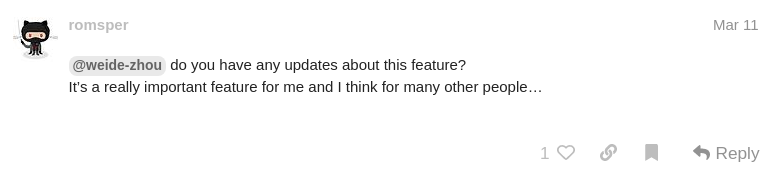
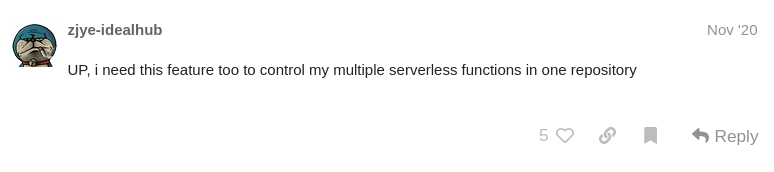
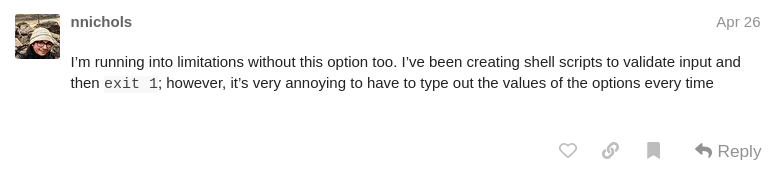
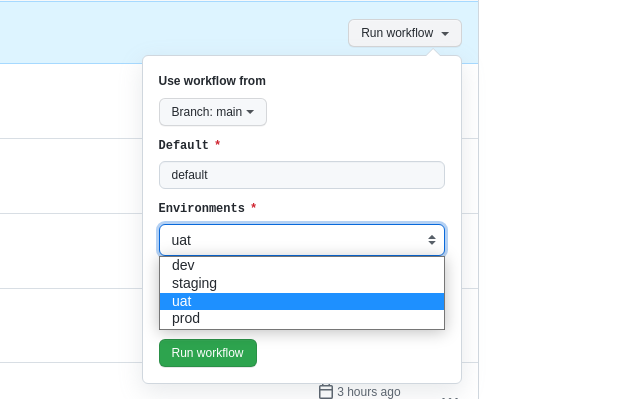
Dropdown for GitHub workflows input parameters Sometimes when we look at CI/CD tools embedded within git-based software repository manager like GitHub, GitLab or Bitbucket, we ran into a lack of some features. This time me and my DevOps/SRE team were facing a pain of not being able to have the option to create drop-downs within GitHub workflows using input parameters. Although this functionality is already available on other platforms such as Bitbucket, the specific client we were working on stored the code inside GitHub. At first I thought that someone has already solved this problem somehow, but doing an extensive search on the internet I found several angry GitHub users opening requests within the Support Community and even in the stack overflow. comment-1 comment-2 comment-3 comment-5 comment-4 So I decided to create a solution for this, always thinking about simplicity and in a way that makes it easy to get this missing functionality. I started by creating an input array pattern using commas and using a tag (the selector) e.g brackets as the default value marker. Here is an example of what an input string would look like:
name: gh-action-dropdown-list-input
on:
  workflow_dispatch:
    inputs:
      environment:
        description: 'Environment'
        required: true
        default: 'dev,staging,[uat],prod'
Now the final question that would turn out to be the most complicated to deal with. How can I change the GitHub Actions interface to replace the input pattern we created earlier to a dropdown? The simplest answer I thought was to create a chrome and firefox extension that would do all this logic behind the scenes and replace the HTML input element with the selected tag containing the array values and leaving the tag value (selector) always as the default. All code was developed in pure JavaScript, open-source licensed under Apache 2.0 and available at https://github.com/arthurbdiniz/gh-action-dropdown-list-input.

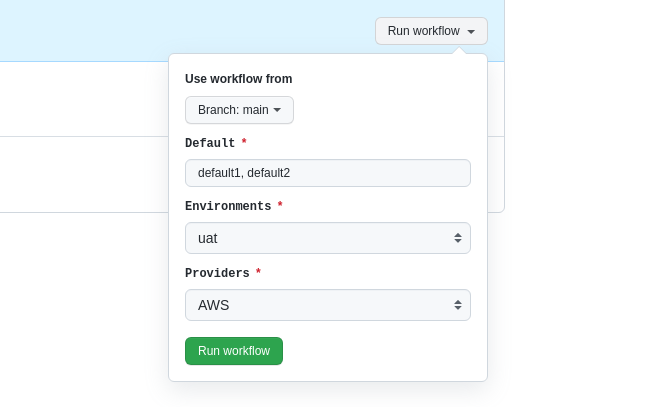
Install extension Once installed, the extension is ready to use and the final result we see is the Actions interface with drop-downs. :) showcase-1 showcase-2

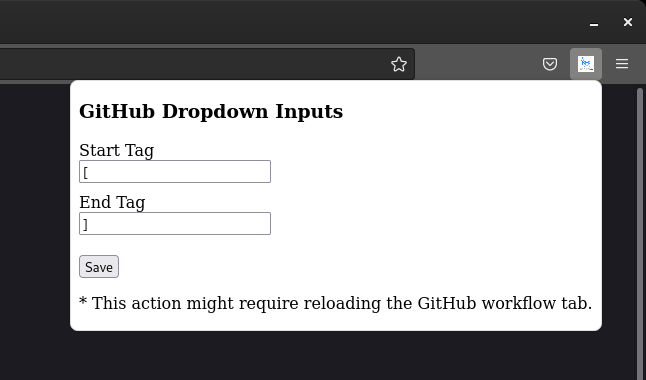
Configuring selectors Go to the top right corner of the browser you are using and click on the extension logo. A screen will popup with tag options. Choose the right tags for you and save it.
This action might require reloading the GitHub workflow tab. config

Have fun using drop-downs inside GitHub. If you liked this project please share this post and if possible star within the repository. Also feel free to connect with me on LinkedIn: https://www.linkedin.com/in/arthurbdiniz

References
  • https://github.community/t/can-workflow-dispatch-input-be-option-list/127338
  • https://stackoverflow.com/questions/69296314/dropdown-for-github-workflows-input-parameters

19 October 2021

Dirk Eddelbuettel: RVowpalWabbit 0.0.16: One More CRAN Request

Another maintenance RVowpalWabbit released brings us to version 0.0.16 on CRAN. This is last package for which configure.ac needed an update to current standards (see the updates of corels, RcppGSL, RQuantLib, and littler). The make matters more interesting we also had to address one UBSAN issue we could not reproduce locally (which, it turns out, was our fault because we had not rebuilt one package dependency under UBSAN). But Prof Ripley confirmed the issue as addressed so all is good for now. As noted before, there is a newer package rvw based on the excellent GSoC 2018 and beyond work by Ivan Pavlov (mentored by James and myself) so if you are into Vowpal Wabbit from R go check it out. CRANberries provides a summary of changes to the previous version. More information is on the RVowpalWabbit page. Issues and bugreports should go to the GitHub issue tracker. If you like this or other open-source work I do, you can now sponsor me at GitHub.

This post by Dirk Eddelbuettel originated on his Thinking inside the box blog. Please report excessive re-aggregation in third-party for-profit settings.

18 October 2021

Dirk Eddelbuettel: dang 0.0.14: Several Updates

A new release of the dang package arrived at CRAN a couple of hours ago, exactly eight months after the previous release. The dang package regroups a few functions of mine that had no other home as for example lsos() from a StackOverflow question from 2009 (!!), the overbought/oversold price band plotter from an older blog post, the market monitor from the last release as well the checkCRANStatus() function recently tweeted about by Tim Taylor. This release regroups a few small edits to several functions, adds a sample function for character encoding reading and conversion using a library already used by R (hence look Ma, no new depends ), adds a weekday helper, and a sample usage (computing rolling min/max values) of a new simple vector class added to tidyCpp (and the function and class need to get another blog post or study ), and an experimental git sha1sum and date marker (as I am not the fan of autogenerated binaries from repos as opposed to marked released meaning: we may see different binary release with the same version number). The full NEWS entry follows.

Changes in version 0.0.14 (2021-10-17)
  • Updated continuous integration to run on Linux only.
  • Edited checkNonAscii.cpp for readability.
  • More robust title display in intradayMarketMonitor.R.
  • New C++-based function to read and convert encoding via the R-supplied iconv library, noted a potential variability.
  • New function wday returning day of the week as integer.
  • The signature to as.data.table was standardized.
  • A new function rollMinMax was added illustrating use of the NumVec class from tidyCpp.
  • The configure script can record the last commit date and sha1 to automate timestamping builds, but not activated in this release.
  • checkCRANStatus() now works correctly for single-package lookups (Jordan Mark Barbone in #4).

Courtesy of my CRANberries, there is a comparison to the previous release. For questions or comments use the issue tracker off the GitHub repo. If you like this or other open-source work I do, you can now sponsor me at GitHub.

This post by Dirk Eddelbuettel originated on his Thinking inside the box blog. Please report excessive re-aggregation in third-party for-profit settings.

13 October 2021

Dirk Eddelbuettel: GitHub Streak: Round Eight

Seven years ago I referenced the Seinfeld Streak used in an earlier post of regular updates to to the Rcpp Gallery:
This is sometimes called Jerry Seinfeld s secret to productivity: Just keep at it. Don t break the streak.
and then showed the first chart of GitHub streaking 366 days:
github activity october 2013 to october 2014github activity october 2013 to october 2014
And six years ago a first follow-up appeared in this post about 731 days:
github activity october 2014 to october 2015github activity october 2014 to october 2015
And five years ago we had a followup at 1096 days
github activity october 2015 to october 2016github activity october 2015 to october 2016
And four years ago we had another one marking 1461 days
github activity october 2016 to october 2017github activity october 2016 to october 2017
And three years ago another one for 1826 days
github activity october 2017 to october 2018github activity october 2017 to october 2018
And two year another one bringing it to 2191 days
github activity october 2018 to october 2019github activity october 2018 to october 2019
And last year another one bringing it to 2257 days
github activity october 2019 to october 2020github activity october 2019 to october 2020
And as today is October 12, here is the newest one from 2020 to 2021 with a new total of 2922 days:
github activity october 2020 to october 2021github activity october 2020 to october 2021
Again, special thanks go to Alessandro Pezz for the Chrome add-on GithubOriginalStreak.

This post by Dirk Eddelbuettel originated on his Thinking inside the box blog. Please report excessive re-aggregation in third-party for-profit settings.

Dirk Eddelbuettel: RcppQuantuccia 0.0.4 on CRAN: Updated Calendar

A new release of RcppQuantuccia arrived on CRAN earlier today. RcppQuantuccia brings the Quantuccia header-only subset / variant of QuantLib to R. At the current stage, it mostly offers date and calendaring functions. This release is the first in two years and brings a few internal updates (such as a swift to continuous integration to the trusted r-ci setup) along with a first update of the United States calendar. Which, just like RQuantLib, now knows about two new calendars LiborUpdate and FederalReserve. So now we can for example look for holidays during June of next year under the Federal Reserve calendar and see
> library(RcppQuantuccia)
> setCalendar("UnitedStates/FederalReserve")
> getHolidays(as.Date("2022-06-01"), as.Date("2022-06-30"))
[1] "2022-06-20"
> 
that Juneteenth 2022 will be observed on (Monday) June 20th. We should note that Quantuccia itself was a bit of a trial balloon and is not actively maintained so we may concentrate on these calendaring functions to keep them in sync with QuantLib. Being a header-only subset is good, and the removal of the (very !!) expensive (in terms of compiled library size) Sobol sequence-based RNG in release 0.0.3 was the right call. So time permitting, a leaner, meaner RcppQuantuccia with a calendaring focus may emerge. The complete list changes follows.

Changes in version 0.0.4 (2021-10-12)
  • Allow for 'Null' calendar without weekends or holidays
  • Switch CI use to r-ci
  • Updated UnitedStates calendar to current QuantLib calendar
  • Small updates to DESCRIPTION and README.md

Courtesy of CRANberries, there is also a diffstat report relative to the previous release. More information is on the RcppQuantuccia page. Issues and bugreports should go to the GitHub issue tracker. If you like this or other open-source work I do, you can now sponsor me at GitHub.

This post by Dirk Eddelbuettel originated on his Thinking inside the box blog. Please report excessive re-aggregation in third-party for-profit settings.

Next.

Previous.