Search Results: "agi"

24 August 2023

Lukas M rdian: Netplan v0.107 is now available

I m happy to announce that Netplan version 0.107 is now available on GitHub and is soon to be deployed into a Linux installation near you! Six months and more than 200 commits after the previous version (including a .1 stable release), this release is brought to you by 8 free software contributors from around the globe.

Highlights Highlights of this release include the new configuration types for veth and dummy interfaces:
network:
  version: 2
  virtual-ethernets:
    veth0:
      peer: veth1
    veth1:
      peer: veth0
  dummy-devices:
    dm0:
      addresses:
        - 192.168.0.123/24
      ...
Furthermore, we implemented CFFI based Python bindings on top of libnetplan s API, that can easily be consumed by 3rd party applications (see full cffi-bindings.py example):
from netplan import Parser, State, NetDefinition
from netplan import NetplanException, NetplanParserException

parser = Parser()
# Parse the full, existing YAML config hierarchy
parser.load_yaml_hierarchy(rootdir='/')
# Validate the final parser state
state = State()
try:
    # validation of current state + new settings
    state.import_parser_results(parser)
except NetplanParserException as e:
    print('Error in', e.filename, 'Row/Col', e.line, e.column, '->', e.message)
except NetplanException as e:
    print('Error:', e.message)
# Walk through ethernet NetdefIDs in the state and print their backend
# renderer, to demonstrate working with NetDefinitionIterator &
# NetDefinition
for netdef in state.ethernets.values():
    print('Netdef', netdef.id, 'is managed by:', netdef.backend)
    print('Is it configured to use DHCP?', netdef.dhcp4 or netdef.dhcp6)

Changelog:

Bug fixes:

22 August 2023

Scarlett Gately Moore: KDE: A Day in the Life the KDE Snapcrafter Part 2

KDE MascotKDE Mascot
Much to my dismay, I figured out that my blog has been disabled on the Ubuntu planet since May. If you are curious about what I have been up to, please go to the handy links -> and read up! This post is a continuation of last weeks https://www.scarlettgatelymoore.dev/kde-a-day-in-the-life-of-the-kde-snapcrafter/ IMPORTANT: I am still looking for a super awesome team lead for a super amazing project involving KDE and Snaps. Time is running out and well the KDE world will be a better a better place if this project goes through! I would like to clarify, this is a paid position! A current KDE developer would be ideal as it is a small team so your time will be split managing and coding alike. If you or anyone you know might be interested please contact me ASAP! Snaps: I am wrapping up the 23.04.3 KDE applications release! Head on over to https://snapcraft.io/search?q=KDE and enjoy! We are now up to 180 snaps! PIM snaps will be slowly rolling in as they go through manual reviews for D-Bus. Snapcraft: minor fix in qmake plugin found by ruff. Launchpad: I almost have approval for per application repository snapcraft files, but I have to prove it will work to our benefit and not cause loads of polling etc. So I have been testing various methods of achieving such a task, and so far I have come up with launchpads ability to watch and download release tarballs into a project. I will then need to script getting the tarball and pushing it to a bzr branch from which I can create a proper snap recipe. Unfortunately, my proper snap recipe fails! Hopefully a very helpful cjwatson will chime in, or if anyone wants to take a gander please chime in here: https://bugs.launchpad.net/launchpad/+bug/2031307 As reality sets in that my project may not happen if I don t find anyone, I need help surviving until I find work or funding to continue my snap work ( still much to do! ) If you or anyone else you know enjoys our snaps please consider a donation, anything helps! Please share! Thank you for your consideration!

18 August 2023

Scarlett Gately Moore: KDE: A day in the life of the KDE snapcrafter!

KDE MascotKDE Mascot
As mentioned last week, I am still looking for a super awesome team lead for a super amazing project involving KDE and Snaps. Time is running out and well the KDE world will be a better a better place if this project goes through! I would like to clarify, this is a paid position! A current KDE developer would be ideal as it is a small team so your time will be split managing and coding alike. If you or anyone you know might be interested please contact me ASAP! On to snappy things I have achieved this week: Most 23.04.3 is done, I am just testing them now. New applications: kmymoney ( Thanks Carlos! ), kde-dev-utils, and kxstitch ( Thanks Jeremy! ) With that said, I have seen on the internets candidate channel apps being promoted. Please use this channel with utmost care as they are being tested and could quite possibly be very broken! Still working on some QML issues with kirigami platform not found. I have begun the launchpad build issues journey and have been kindly pointed to using snap recipes on launchpad so we aren t doing public uploads which creates temporary recipes to build and cannot be bumped priority wise. So I have sent the request into the kde-devel arena to revisit having per repository snapcraft files ( rejected in the past ) as they do with flatpak files. So far I am getting positive feedback and hopefully this will go through. Once it does I can move forward with fully automating application new releases. Hooray! This week I jumped into the xdg-desktop-portals rabbithole while working on https://bugs.kde.org/show_bug.cgi?id=473003 for neochat. After fixing it with adding plug password-manager-service I am told that auto-connect on that one is discouraged and the libsecret should work out of the box with portals. I found and joined just in time a snapcrafter google meet and we had a long conversation spitballing and testing our portal support. At least in Neon it appears to be broken. I now have some things to do and test to see that we get this functional. Most of our online apps are affected. For now though snap connect neochat:password-manager-service :password-manager-service does work. Auto-connect was rejected as it exposes to much. Understandable. I have started a new thread on the KDE forums for users to ask any questions, or let me know of any issues you may have related to snaps here: https://discuss.kde.org/t/all-things-snaps-questions-concerns-praise/4033 come join the conversation! In the snapcraft arena I have fixed my PR for the much needed qmake plugin! This should be merged and rolled out in the very near future! I would like to continue my hard work on snap things regardless of the project going through. Unfortunately, to do so, I must ask for donations as life isn t free. I am working on self sufficiency but even that costs money to get started! KDE snaps are used by 1.7 million active devices! I do ask that if you use KDE snaps and find my work useful, or know someone that does, to please consider donating to keep my momentum going. There is still much work to be done with Qt6 rolling out. I would like to work on the KDE Plasma snap and KDE PIM suite of apps ( I have started on this ). Even if you can t help, please share! Thank you for your consideration! I have a new donation form for anyone that doesn t like gofundme here:
Gofund me:

16 August 2023

Simon Josefsson: Enforcing wrap-and-sort -satb

For Debian package maintainers, the wrap-and-sort tool is one of those nice tools that I use once in a while, and every time have to re-read the documentation to conclude that I want to use the --wrap-always --short-indent --trailing-comma --sort-binary-package options (or -satb for short). Every time, I also wish that I could automate this and have it always be invoked to keep my debian/ directory tidy, so I don t have to do this manually once every blue moon. I haven t found a way to achieve this automation in a non-obtrusive way that interacts well with my git-based packaging workflow. Ideally I would like for something like the lintian-hook during gbp buildpackage to check for this ideas? Meanwhile, I have come up with a way to make sure I don t forget to run wrap-and-sort for long, and that others who work on the same package won t either: create an autopkgtest which is invoked during the Salsa CI/CD pipeline using the following as debian/tests/wrap-and-sort:
#!/bin/sh
set -eu
TMPDIR=$(mktemp -d)
trap "rm -rf $TMPDIR" 0 INT QUIT ABRT PIPE TERM
cp -a debian $TMPDIR
cd $TMPDIR
wrap-and-sort -satb
diff -ur $OLDPWD/debian debian
Add the following to debian/tests/control to invoke it which is intentionally not indented properly so that the self-test will fail so you will learn how it behaves.
Tests: wrap-and-sort
Depends: devscripts, python3-debian
Restrictions: superficial
Now I will get build failures in the pipeline once I upload the package into Salsa, which I usually do before uploading into Debian. I will get a diff output, and it won t be happy until I push a commit with the output of running wrap-and-sort with the parameters I settled with. While autopkgtest is intended to test the installed package, the tooling around autopkgtest is powerful and easily allows this mild abuse of its purpose for a pleasant QA improvement. Thoughts? Happy hacking!

14 August 2023

Jonathan McDowell: listadmin3: An imperfect replacement for listadmin on Mailman 3

One of the annoyances I had when I upgraded from Buster to Bullseye (yes, I m talking about an upgrade I did at the end of 2021) is that I ended up moving from Mailman 2 to Mailman 3. Which is fine, I guess, but it meant I could no longer use listadmin to deal with messages held for moderation. At the time I looked around, couldn t find anything, shrugged, and became incredibly bad at performing my list moderation duties. Last week I finally accepted what I should have done at least a year ago and wrote some hopefully not too bad Python to web scrape the Mailman 3 admin interface. It then presents a list of subscribers and held messages that might need approved or discarded. It s heavily inspired by listadmin, but not a faithful copy (partly because it s been so long since I used it that I m no longer familiar with its interface). Despite that I ve called it listadmin3. It currently meets the bar of extremely useful to me so I ve tagged v0.1. You can get it on Github. I d be interested in knowing if it actually works for / is useful to anyone else (I suspect it won t be happy with interfaces configured to not be in English, but that should be solvable). Comment here or reply to my Fediverse announcement. Example usage, cribbed directly from the README:
$ listadmin3
fetching data for partypeople@example.org ... 200 messages
(1/200) 5303: omgitsspam@example.org / March 31, 2023, 6:39 a.m.:
  The message is not from a list member: TOP PICK
(a)ccept, (d)iscard, (b)ody, (h)eaders, (s)kip, (q)uit? q
Moving on...
fetching data for admins@example.org ... 1 subscription requests
(1/1) "The New Admin" <newadmin@example.org>
(a)ccept, (d)iscard, (r)eject, (s)kip, (q)uit? a
1 messages
(1/1) 6560: anastyspamer@example.org / Aug. 13, 2023, 3:15 p.m.:
  The message is not from a list member: Buy my stuff!
(a)ccept, (d)iscard, (b)ody, (h)eaders, (s)kip, (q)uit? d
0 to accept, 1 to discard, proceed? (y/n) y
fetching data for announce@example.org ... nothing in queue
$
There s Debian packaging in the repository (dpkg-buildpackage -uc -us -b will spit you out a .deb) but I m holding off on filing an ITP + actually uploading until I know if it s useful enough for others before doing so. You only really need the listadmin3 file and to ensure you have Python3 + MechanicalSoup installed. (Yes, I still run mailing lists. Hell, I still run a Usenet server.)

5 August 2023

Bits from Debian: Debian Project Bits Volume 1, Issue 1


Debian Project Bits Volume 1, Issue 1 August 05, 2023 Welcome to the inaugural issue of Debian Project Bits! Those remembering the Debian Weekly News (DwN) will recognize some of the sections here which served as our inspiration. Debian Project Bits posts will allow for a faster turnaround of some project news on a monthly basis. The Debian Micronews service will continue to share shorter news items, the Debian Project News remains as our official newsletter which may move to a biannual archive format. News Debian Day The Debian Project was officially founded by Ian Murdock on August 16, 1993. Since then we have celebrated our Anniversary of that date each year with events around the world. We would love it if you could join our revels this very special year as we have the honor of turning 30! Attend or organize a local Debian Day celebration. You're invited to plan your own event: from Bug Squashing parties to Key Signing parties, Meet-Ups, or any type of social event whether large or small. And be sure to check our Debian reimbursement How To if you need such resources. You can share your days, events, thoughts, or notes with us and the rest of the community with the #debianday tag that will be used across most social media platforms. See you then! Events: Upcoming and Reports Upcoming Debian 30 anos The Debian Brasil Community is organizing the event Debian 30 anos to celebrate the 30th anniversary of the Debian Project. From August 14 to 18, between 7pm and 22pm (UTC-3) contributors will talk online in Portuguese and we will live stream on Debian Brasil YouTube channel. DebConf23: Debian Developers Camp and Conference The 2023 Debian Developers Camp (DebCamp) and Conference (DebConf23) will be hosted this year in Infopark, Kochi, India. DebCamp is slated to run from September 3 through 9, immediately followed by the larger DebConf, September 10 through 17. If you are planning on attending the conference this year, now is the time to ensure your travel documentation, visa information, bursary submissions, papers and relevant equipment are prepared. For more information contact: debconf@debconf. MiniDebConf Cambridge 2023 There will be a MiniDebConf held in Cambridge, UK, hosted by ARM for 4 days in November: 2 days for a mini-DebCamp (Thu 23 - Fri 24), with space for dedicated development / sprint / team meetings, then two days for a more regular MiniDebConf (Sat 25 - Sun 26) with space for more general talks, up to 80 people. Reports During the last months, the Debian Community has organized some Bug Squashing Parties:
Tilburg, Netherlands. October 2022. St-Cergue, Switzerland. January 2023 Montreal, Canada. February 2023 In January, Debian India hosted the MiniDebConf Tamil Nadu in Viluppuram, Tamil Nadu, India (Sat 28 - Sun 26). The following month, the MiniDebConf Portugal 2023 was held in Lisbon (12 - 16 February 2023). These events, seen as a stunning success by some of their attendees, demonstrate the vitality of our community.
Debian Brasil Community at Campus Party Brazil 2023 Another edition of Campus Party Brazil took place in the city of S o Paulo between July 25th and 30th. And one more time the Debian Brazil Community was present. During the days in the available space, we carry out some activities such as: For more info and a few photos, check out the organizers' report. MiniDebConf Bras lia 2023 From May 25 to 27, Bras lia hosted the MiniDebConf Bras lia 2023. This gathering was composed of various activities such as talks, workshops, sprints, BSPs (Bug Squashing Party), key signings, social events, and hacking, aimed to bring the community together and celebrate the world's largest Free Software project: Debian. For more information please see the full report written by the organizers. Debian Reunion Hamburg 2023 This year the annual Debian Reunion Hamburg was held from Tuesday 23 to 30 May starting with four days of hacking followed by two days of talks, and then two more days of hacking. As usual, people - more than forty-five attendees from Germany, Czechia, France, Slovakia, and Switzerland - were happy to meet in person, to hack and chat together, and much more. If you missed the live streams, the video recordings are available. Translation workshops from the pt_BR team The Brazilian translation team, debian-l10n-portuguese, had their first workshop of 2023 in February with great results. The workshop was aimed at beginners, working in DDTP/DDTSS. For more information please see the full report written by the organizers. And on June 13 another workshop took place to translate The Debian Administrator's Handbook). The main goal was to show beginners how to collaborate in the translation of this important material, which has existed since 2004. The manual's translations are hosted on Weblate. Releases Stable Release Debian 12 bookworm was released on June 10, 2023. This new version becomes the stable release of Debian and moves the prior Debian 11 bullseye release to oldstable status. The Debian community celebrated the release with 23 Release Parties all around the world. Bookworm's first point release 12.1 address miscellaneous bug fixes affecting 88 packages, documentation, and installer updates was made available on July 22, 2023. RISC-V support riscv64 has recently been added to the official Debian architectures for support of 64-bit little-endian RISC-V hardware running the Linux kernel. We expect to have full riscv64 support in Debian 13 trixie. Updates on bootstrap, build daemon, porterbox, and development progress were recently shared by the team in a Bits from the Debian riscv64 porters post. non-free-firmware The Debian 12 bookworm archive now includes non-free-firmware; please be sure to update your apt sources.list if your systems requires such components for operation. If your previous sources.list included non-free for this purpose it may safely be removed. apt sources.list The Debian archive holds several components: Example of the sources.list file
deb http://deb.debian.org/debian bookworm main
deb-src http://deb.debian.org/debian bookworm main
deb http://deb.debian.org/debian-security/ bookworm-security main
deb-src http://deb.debian.org/debian-security/ bookworm-security main
deb http://deb.debian.org/debian bookworm-updates main
deb-src http://deb.debian.org/debian bookworm-updates main
Example using the components:
deb http://deb.debian.org/debian bookworm main non-free-firmware
deb-src http://deb.debian.org/debian bookworm main non-free-firmware
deb http://deb.debian.org/debian-security/ bookworm-security main non-free-firmware
deb-src http://deb.debian.org/debian-security/ bookworm-security main non-free-firmware
deb http://deb.debian.org/debian bookworm-updates main non-free-firmware
deb-src http://deb.debian.org/debian bookworm-updates main non-free-firmware
For more information and guidelines on proper configuration of the apt source.list file please see the Configuring Apt Sources - Wiki page. Inside Debian New Debian Members Please welcome the following newest Debian Project Members: To find out more about our newest members or any Debian Developer, look for them on the Debian People list. Security Debian's Security Team releases current advisories on a daily basis. Some recently released advisories concern these packages: trafficserver Several vulnerabilities were discovered in Apache Traffic Server, a reverse and forward proxy server, which could result in information disclosure or denial of service. asterisk A flaw was found in Asterisk, an Open Source Private Branch Exchange. A buffer overflow vulnerability affects users that use PJSIP DNS resolver. This vulnerability is related to CVE-2022-24793. The difference is that this issue is in parsing the query record parse_query(), while the issue in CVE-2022-24793 is in parse_rr(). A workaround is to disable DNS resolution in PJSIP config (by setting nameserver_count to zero) or use an external resolver implementation instead. flask It was discovered that in some conditions the Flask web framework may disclose a session cookie. chromium Multiple security issues were discovered in Chromium, which could result in the execution of arbitrary code, denial of service or information disclosure. Other Popular packages gpgv - GNU privacy guard signature verification tool. 99,053 installations. gpgv is actually a stripped-down version of gpg which is only able to check signatures. It is somewhat smaller than the fully-blown gpg and uses a different (and simpler) way to check that the public keys used to make the signature are valid. There are no configuration files and only a few options are implemented. dmsetup - Linux Kernel Device Mapper userspace library. 77,769 installations. The Linux Kernel Device Mapper is the LVM (Linux Logical Volume Management) Team's implementation of a minimalistic kernel-space driver that handles volume management, while keeping knowledge of the underlying device layout in user-space. This makes it useful for not only LVM, but software raid, and other drivers that create "virtual" block devices. sensible-utils - Utilities for sensible alternative selection. 96,001 daily users. This package provides a number of small utilities which are used by programs to sensibly select and spawn an appropriate browser, editor, or pager. The specific utilities included are: sensible-browser sensible-editor sensible-pager. popularity-contest - The popularity-contest package. 90,758 daily users. The popularity-contest package sets up a cron job that will periodically anonymously submit to the Debian developers statistics about the most used Debian packages on the system. This information helps Debian make decisions such as which packages should go on the first CD. It also lets Debian improve future versions of the distribution so that the most popular packages are the ones which are installed automatically for new users. New and noteworthy packages in unstable Toolkit for scalable simulation of distributed applications SimGrid is a toolkit that provides core functionalities for the simulation of distributed applications in heterogeneous distributed environments. SimGrid can be used as a Grid simulator, a P2P simulator, a Cloud simulator, a MPI simulator, or a mix of all of them. The typical use-cases of SimGrid include heuristic evaluation, application prototyping, and real application development and tuning. This package contains the dynamic libraries and runtime. LDraw mklist program 3D CAD programs and rendering programs using the LDraw parts library of LEGO parts rely on a file called parts.lst containing a list of all available parts. The program ldraw-mklist is used to generate this list from a directory of LDraw parts. Open Lighting Architecture - RDM Responder Tests The DMX512 standard for Digital MultipleX is used for digital communication networks commonly used to control stage lighting and effects. The Remote Device Management protocol is an extension to DMX512, allowing bi-directional communication between RDM-compliant devices without disturbing other devices on the same connection. The Open Lighting Architecture (OLA) provides a plugin framework for distributing DMX512 control signals. The ola-rdm-tests package provides an automated way to check protocol compliance in RDM devices. parsec-service Parsec is an abstraction layer that can be used to interact with hardware-backed security facilities such as the Hardware Security Module (HSM), the Trusted Platform Module (TPM), as well as firmware-backed and isolated software services. The core component of Parsec is the security service, provided by this package. The service is a background process that runs on the host platform and provides connectivity with the secure facilities of that host, exposing a platform-neutral API that can be consumed into different programming languages using a client library. For a client library implemented in Rust see the package librust-parsec-interface-dev. Simple network calculator and lookup tool Process and lookup network addresses from the command line or CSV with ripalc. Output has a variety of customisable formats. High performance, open source CPU/GPU miner and RandomX benchmark XMRig is a high performance, open source, cross platform RandomX, KawPow, CryptoNight, and GhostRider unified CPU/GPU miner and RandomX benchmark. Ping, but with a graph - Rust source code This package contains the source for the Rust gping crate, packaged by debcargo for use with cargo and dh-cargo. Once upon a time in Debian: 2014-07-31 The Technical committee choose libjpeg-turbo as the default JPEG decoder. 2010-08-01 DebConf10 starts New York City, USA 2007-08-05 Debian Maintainers approved by vote 2009-08-05 Jeff Chimene files bug #540000 against live-initramfs. Calls for help The Publicity team calls for volunteers and help! Your Publicity team is asking for help from you our readers, developers, and interested parties to contribute to the Debian news effort. We implore you to submit items that may be of interest to our community and also ask for your assistance with translations of the news into (your!) other languages along with the needed second or third set of eyes to assist in editing our work before publishing. If you can share a small amount of your time to aid our team which strives to keep all of us informed, we need you. Please reach out to us via IRC on #debian-publicity on OFTC.net, or our public mailing list, or via email at press@debian.org for sensitive or private inquiries.

4 August 2023

John Goerzen: Try the Last Internet Kermit Server

$ grep kermit /etc/services
kermit          1649/tcp
What is this mysterious protocol? Who uses it and what is its story? This story is a winding one, beginning in 1981. Kermit is, to the best of my knowledge, the oldest actively-maintained software package with an original developer still participating. It is also a scripting language, an Internet server, a (scriptable!) SSH client, and a file transfer protocol. And my first use of it was talking to my HP-48GX calculator over a 9600bps serial link. Yes, that calculator had a Kermit server built in. But let s back up and talk about serial ports and Modems.

Serial Ports and Modems In my piece The PC & Internet Revolution in Rural America, I recently talked about getting a modem what an excitement it was to get one! I realize that many people today have never used a serial line or a modem, so let s briefly discuss. Before Ethernet and Wifi took off in a big way, in the 1990s-2000s, two computers would talk to each other over a serial line and a modem. By modern standards, these were slow; 300bps was a common early speed. They also (at least in the beginning) had no kind of error checking. Characters could be dropped or changed. Sometimes even those speeds were faster than the receiving device could handle. Some serial links were 7-bit, and wouldn t even pass all 7-bit characters; for instance, sending a Ctrl-S could lock up a remote until you sent Ctrl-Q. And computers back in the 1970s and 1980s weren t as uniform as they are now. They used different character sets, different line endings, and even had different notions of what a file is. Today s notion of a file as whatever set of binary bytes an application wants it to be was by no means universal; some systems treated a file as a set of fixed-length records, for instance. So there were a lot of challenges in reliably moving files between systems. Kermit was introduced to reliably move files between systems using serial lines, automatically working around the varieties of serial lines, detecting errors and retransmitting, managing transmit speeds, and adapting between architectures as appropriate. Quite a task! And perhaps this explains why it was supported on a calculator with a primitive CPU by today s standards. Serial communication, by the way, is still commonplace, though now it isn t prominent in everyone s home PC setup. It s used a lot in industrial equipment, avionics, embedded systems, and so forth. The key point about serial lines is that they aren t inherently multiplexed or packetized. Whereas an Ethernet network is designed to let many dozens of applications use it at once, a serial line typically runs only one (unless it is something like PPP, which is designed to do multiplexing over the serial line). So it become useful to be able to both log in to a machine and transfer files with it. That is, incidentally, still useful today.

Kermit and XModem/ZModem I wondered: why did we end up with two diverging sets of protocols, created at about the same time? The Kermit website has the answer: essentially, BBSs could assume 8-bit clean connections, so XModem and ZModem had much less complexity to worry about. Kermit, on the other hand, was highly flexible. Although ZModem came out a few years before Kermit had its performance optimizations, by about 1993 Kermit was on par or faster than ZModem.

Beyond serial ports As LANs and the Internet came to be popular, people started to use telnet (and later ssh) to connect to remote systems, rather than serial lines and modems. FTP was an early way to transfer files across the Internet, but it had its challenges. Kermit added telnet support, as well as later support for ssh (as a wrapper around the ssh command you already know). Now you could easily log in to a machine and exchange files with it without missing a beat. And so it was that the Internet Kermit Service Daemon (IKSD) came into existence. It allows a person to set up a Kermit server, which can authenticate against local accounts or present anonymous access akin to FTP. And so I established the quux.org Kermit Server, which runs the Unix IKSD (part of the Debian ckermit package).

Trying Out the quux.org Kermit Server There are more instructions on the quux.org Kermit Server page! You can connect to it using either telnet or the kermit program. I won t duplicate all of the information here, but here s what it looks like to connect:
$ kermit
C-Kermit 10.0 Beta.08, 15 Dec 2022, for Linux+SSL (64-bit)
 Copyright (C) 1985, 2022,
  Trustees of Columbia University in the City of New York.
  Open Source 3-clause BSD license since 2011.
Type ? or HELP for help.
(/tmp/t/) C-Kermit>iksd /user:anonymous kermit.quux.org
 DNS Lookup...  Trying 135.148.101.37...  Reverse DNS Lookup... (OK)
Connecting to host glockenspiel.complete.org:1649
 Escape character: Ctrl-\ (ASCII 28, FS): enabled
Type the escape character followed by C to get back,
or followed by ? to see other options.
----------------------------------------------------

 >>> Welcome to the Internet Kermit Service at kermit.quux.org <<<

To log in, use 'anonymous' as the username, and any non-empty password

Internet Kermit Service ready at Fri Aug  4 22:32:17 2023
C-Kermit 10.0 Beta.08, 15 Dec 2022
kermit

Enter e-mail address as Password: [redacted]

Anonymous login.

You are now connected to the quux kermit server.

Try commands like HELP, cd gopher, dir, and the like.  Use INTRO
for a nice introduction.

(~/) IKSD>
You can even recursively download the entire Kermit mirror: over 1GB of files!

Conclusions So, have fun. Enjoy this experience from the 1980s. And note that Kermit also makes a better ssh client than ssh in a lot of ways; see ideas on my Kermit page. This page also has a permanent home on my website, where it may be periodically updated.

Shirish Agarwal: Birth Control, Consent, Rape & Violence.

Consent, Violence, Sexual Abuse This again would be somewhat of a mature post. So children, please refrain from reading. When I hear the above words, my first thought goes to Aamir Khan s Season 1 Episode 2 in Satyamev Jayate. This was the first time that the topic of child sexual abuse was bought in the forefront in the hall rather than a topic to be discussed in the corner. Unfortunately, that episode is still in Hindi and no English subtitles available even today shows a lack of sensitivity in Indian s part to still come to terms with Child abuse that happens in India. The numbers that they had shared at that time were shocking. More than 50 per cent children experience sexual abuse and mostly from friends or relatives. That means 1 in every 2 children. And this was in 2012. But the problem of child sexual abuse didn t start then, it started in the 1960 s, 70 s. In the 1960 s, 1970s we didn t have much of cinema and TV and whatever there was pretty limited. There were few B movie producers, but most of them came into their own in the 1980s. So what influenced Indians in those days were softcore magazines that either had a mature aunt or a teen and they would tease and sooner or later the man would sort of overpower them and fulfill his needs. Even mainstream Indian cinema used similar tropes. One of the most memorable songs of that era Wada Karo Nahi Chodoge Tum Meera Saath from Aa Gale Lag jaa. A bit of context for the song. This is where Shashi Kapoor sees, he tries to ask her to date him, she says no. He tries to put an act where he shows he can t skate or rather pretends. And kinda takes a promise from her that she will date him if he is able to skate. And viola, the next moment he is not just skating, but dancing and singing as well. And the whole he touches her and you can see that is uncomfortable and yet after a while he woos her. Now this is problematic today because we are seeing it from today s lens. It might also have problematic with the feminists of that time, but they probably would have been called overly sensitive or something like that. And this is what went in Universal cinema. But this is just tip of the surface. There were and are multiple poems and even art in those times that flirted and even sort of engaged with sexual molestation, rape both in poems as well as literature, both in Hindi and various regional literature. Similar to stuff that Keats and some other poets (problematic stuff) they wrote and where both men and women were in two minds, whether to take all the other good literature out or kinda make the difference between the art and artist. Now, while Aamir spoke about consent it wasn t in any official capacity or even a legal capacity. The interesting thing was that there was an Act that kinda put some safeguards but had been doing rounds for almost a decade. Because the extremists on both sides, Hindus and Muslims were not in favor of that Act, it was still doing rounds. Aamir s episode on 6th May 2012 and the discussions in mainstream media following that forced the Indian legislature to make POSCO as a law on 22nd May 2012. Almost 6 months to 2 weeks, Nirbhaya happened and changes to the law happened in another 6 months. Both voyeurism and stalking were made jailable offenses and consent became part of lingua franca in the Supreme Court. Couple of weeks back, I had shared in the Manipur case the part about fingering . In the same Act, another change that was done that insertion of any part including foreign objects in any of the openings would be classed as rape . So in that Manipur case, at least those 2-3 people who have been identified as clear perpetrators according to the law of land would be rapists and should have the highest punishment. Unfortunately, the system is rigged against women as Vrinda Grover had shared just couple of weeks back. How a 6 month fast track case (to be completed within 6 months) becomes a 10 year old case tells you the efficacy of the system. The reality is far more worse than is shared or known. Just a few months ago, GOI shared some data on Sexual Harassment in 2018-19. And this is after constant pressurizing by Activists that GOI doesn t like. In fact, in 2021, Unicef had shared data about how India was one of the five countries where child brides are still prevalent. India denied but didn t produce any alternative data. The firing of Mr. James over NHFS data sets doesn t give it any brownie points to the present Government. What has happened in the last few years is that the Government for reasons of its own had been scrubbing and censoring a lot of data. I won t go far, just 2 day old story which I had shared just couple of days back. Roughly a 25 year old RPF constable kills his superior and kills 3 Muslims after going to various coaches and then the Government uses the defence of temporary insanity.
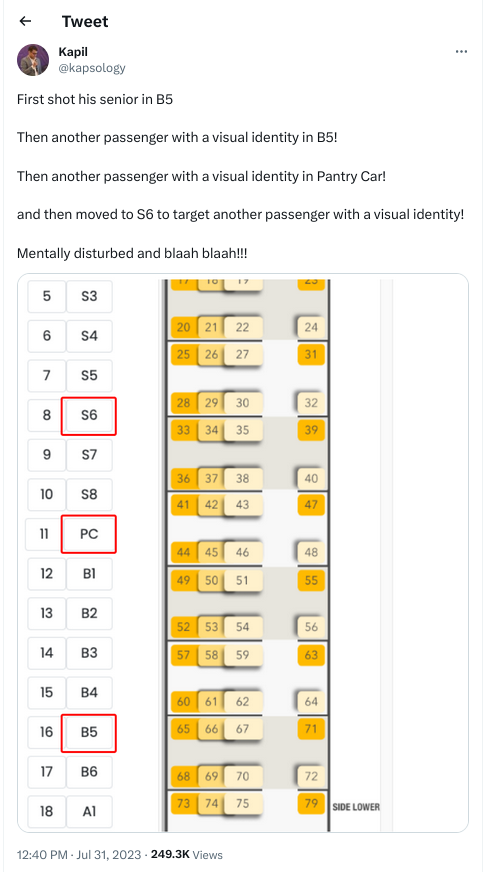
Even the mental instability defence has twists and turns
Incidentally, Press Trust of India is s private organization and not the public broadcaster of the old. And incidentally, just a few days back, it came to light that they hadn t paid Income tax for last 2-3 years. Because of issues in reward money, the public came to know otherwise they wouldn t have known. Coming back to the topic itself, there was a video where you could hear and see the accused stating after killing the three Muslims that if you want to remain in India, then you have to vote for only Modi or Yogi, otherwise this will happen. That video was scrubbed both from Twitter as well as YouTube. All centralized platforms at the very least, whether it is Google (Youtube) or Twitter or Meta uses its own media ID. Meta s being most problematic but that probably being a discussion for another day. The same censorship tools are applied rigorously and lot of incidents are buried. Cases of girls being thrown in lakes just after lakes or low numbers of conviction in case of gang rapes are more often than not disappears.
The above article shared just a few days ago that how low the conviction rates of gang rapes are in Gujarat tells you the story. You might get the story today, but wait for a few weeks and you will find that the story has disappeared. What most people do not know or understand is that the web is increasingly a public repository of idea, imaginations and trust and authoritarian regimes like Government of India is increasingly using both official as well as unofficial methods to suppress the same. To see that in the last 9 odd years, GOI has made the highest number of takedown requests and been either number one or number two tells all. My question is where we do from here ??? If even the Minister and her Ministry can do only whataboutery rather than answer the questions, then how we are supposed to come up solutions. And even if a solution exists, without the state and Center agreeing and co-operating with civil society, any solution will be far off the desired result. I am sorry that I at least have no answers

Reproducible Builds: Reproducible Builds in July 2023

Welcome to the July 2023 report from the Reproducible Builds project. In our reports, we try to outline the most important things that we have been up to over the past month. As ever, if you are interested in contributing to the project, please visit the Contribute page on our website.
Marcel Fourn et al. presented at the IEEE Symposium on Security and Privacy in San Francisco, CA on The Importance and Challenges of Reproducible Builds for Software Supply Chain Security. As summarised in last month s report, the abstract of their paper begins:
The 2020 Solarwinds attack was a tipping point that caused a heightened awareness about the security of the software supply chain and in particular the large amount of trust placed in build systems. Reproducible Builds (R-Bs) provide a strong foundation to build defenses for arbitrary attacks against build systems by ensuring that given the same source code, build environment, and build instructions, bitwise-identical artifacts are created. (PDF)

Chris Lamb published an interview with Simon Butler, associate senior lecturer in the School of Informatics at the University of Sk vde, on the business adoption of Reproducible Builds. (This is actually the seventh instalment in a series featuring the projects, companies and individuals who support our project. We started this series by featuring the Civil Infrastructure Platform project, and followed this up with a post about the Ford Foundation as well as recent ones about ARDC, the Google Open Source Security Team (GOSST), Bootstrappable Builds, the F-Droid project and David A. Wheeler.) Vagrant Cascadian presented Breaking the Chains of Trusting Trust at FOSSY 2023.
Rahul Bajaj has been working with Roland Clobus on merging an overview of environment variations to our website:
I have identified 16 root causes for unreproducible builds in my empirical study, which I have linked to the corresponding documentation. The initial MR right now contains information about 10 root causes. For each root cause, I have provided a definition, a notable instance, and a workaround. However, I have only found workarounds for 5 out of the 10 root causes listed in this merge request. In the upcoming commits, I plan to add an additional 6 root causes. I kindly request you review the text for any necessary refinements, modifications, or corrections. Additionally, I would appreciate the help with documentation for the solutions/workarounds for the remaining root causes: Archive Metadata, Build ID, File System Ordering, File Permissions, and Snippet Encoding. Your input on the identified root causes for unreproducible builds would be greatly appreciated. [ ]

Just a reminder that our upcoming Reproducible Builds Summit is set to take place from October 31st November 2nd 2023 in Hamburg, Germany. Our summits are a unique gathering that brings together attendees from diverse projects, united by a shared vision of advancing the Reproducible Builds effort. During this enriching event, participants will have the opportunity to engage in discussions, establish connections and exchange ideas to drive progress in this vital field. If you re interested in joining us this year, please make sure to read the event page which has more details about the event and location.
There was more progress towards making the Go programming language ecosystem reproducible this month, including: In addition, kpcyrd posted to our mailing list to report that:
while packaging govulncheck for Arch Linux I noticed a checksum mismatch for a tar file I downloaded from go.googlesource.com. I used diffoscope to compare the .tar file I downloaded with the .tar file the build server downloaded, and noticed the timestamps are different.

In Debian, 20 reviews of Debian packages were added, 25 were updated and 25 were removed this month adding to our knowledge about identified issues. A number of issue types were updated, including marking ffile_prefix_map_passed_to_clang being fixed since Debian bullseye [ ] and adding a Debian bug tracker reference for the nondeterminism_added_by_pyqt5_pyrcc5 issue [ ]. In addition, Roland Clobus posted another detailed update of the status of reproducible Debian ISO images on our mailing list. In particular, Roland helpfully summarised that live images are looking good, and the number of (passing) automated tests is growing .
Bernhard M. Wiedemann published another monthly report about reproducibility within openSUSE.
F-Droid added 20 new reproducible apps in July, making 165 apps in total that are published with Reproducible Builds and using the upstream developer s signature. [ ]
The Sphinx documentation tool recently accepted a change to improve deterministic reproducibility of documentation. It s internal util.inspect.object_description attempts to sort collections, but this can fail. The change handles the failure case by using string-based object descriptions as a fallback deterministic sort ordering, as well as adding recursive object-description calls for list and tuple datatypes. As a result, documentation generated by Sphinx will be more likely to be automatically reproducible. Lastly in news, kpcyrd posted to our mailing list announcing a new repro-env tool:
My initial interest in reproducible builds was how do I distribute pre-compiled binaries on GitHub without people raising security concerns about them . I ve cycled back to this original problem about 5 years later and built a tool that is meant to address this. [ ]

Upstream patches The Reproducible Builds project detects, dissects and attempts to fix as many currently-unreproducible packages as possible. We endeavour to send all of our patches upstream where appropriate. This month, we wrote a large number of such patches, including:
In diffoscope development this month, versions 244, 245 and 246 were uploaded to Debian unstable by Chris Lamb, who also made the following changes:
  • Don t include the file size in image metadata. It is, at best, distracting, and it is already in the directory metadata. [ ]
  • Add compatibility with libarchive-5. [ ]
  • Mark that the test_dex::test_javap_14_differences test requires the procyon tool. [ ]
  • Initial work on DOS/MBR extraction. [ ]
  • Move to using assert_diff in the .ico and .jpeg tests. [ ]
  • Temporarily mark some Android-related as XFAIL due to Debian bugs #1040941 & #1040916. [ ]
  • Fix the test skipped reason generation in the case of a version outside of the required range. [ ]
  • Update copyright years. [ ][ ]
  • Fix try.diffoscope.org. [ ]
In addition, Gianfranco Costamagna added support for LLVM version 16. [ ]

Testing framework The Reproducible Builds project operates a comprehensive testing framework (available at tests.reproducible-builds.org) in order to check packages and other artifacts for reproducibility. In July, a number of changes were made by Holger Levsen:
  • General changes:
    • Upgrade Jenkins host to Debian bookworm now that Debian 12.1 is out. [ ][ ][ ][ ]
    • djm: improve UX when rebooting a node fails. [ ]
    • djm: reduce wait time between rebooting nodes. [ ]
  • Debian-related changes:
    • Various refactoring of the Debian scheduler. [ ][ ][ ]
    • Make Debian live builds more robust with respect to salsa.debian.org returning HTTP 502 errors. [ ][ ]
    • Use the legacy SCP protocol instead of the SFTP protocol when transfering Debian live builds. [ ][ ]
    • Speed up a number of database queries thanks, Myon! [ ][ ][ ][ ][ ]
    • Split create_meta_pkg_sets job into two (for Debian unstable and Debian testing) to half the job runtime to approximately 90 minutes. [ ][ ]
    • Split scheduler job into four separate jobs, one for each tested architecture. [ ][ ]
    • Treat more PostgreSQL errors as serious (for some jobs). [ ]
    • Re-enable automatic database documentation now that postgresql_autodoc is back in Debian bookworm. [ ]
    • Remove various hardcoding of Debian release names. [ ]
    • Drop some i386 special casing. [ ]
  • Other distributions:
    • Speed up Alpine SQL queries. [ ]
    • Adjust CSS layout for Arch Linux pages to match 3 and not 4 repos being tested. [ ]
    • Drop the community Arch Linux repo as it has now been merged into the extra repo. [ ]
    • Speed up a number of Arch-related database queries. [ ]
    • Try harder to properly cleanup after building OpenWrt packages. [ ]
    • Drop all kfreebsd-related tests now that it s officially dead. [ ]
  • System health:
    • Always ignore some well-known harmless orphan processes. [ ][ ][ ]
    • Detect another case of job failure due to Jenkins shutdown. [ ]
    • Show all non co-installable package sets on the status page. [ ]
    • Warn that some specific reboot nodes are currently false-positives. [ ]
  • Node health checks:
    • Run system and node health checks for Jenkins less frequently. [ ]
    • Try to restart any failed dpkg-db-backup [ ] and munin-node services [ ].
In addition, Vagrant Cascadian updated the paths in our automated to tests to use the same paths used by the official Debian build servers. [ ]

If you are interested in contributing to the Reproducible Builds project, please visit our Contribute page on our website. However, you can get in touch with us via:

Louis-Philippe V ronneau: pymonitair: Air Quality Monitoring Display with MicroPython

I've never been a fan of IoT devices for obvious reasons: not only do they tend to be excellent at being expensive vendor locked-in machines, but far too often, they also end up turning into e-waste after a short amount of time. Manufacturers can go out of business or simply decide to shut down the cloud servers for older models, and then you're stuck with a brick. Well, this all changes today, as I've built my first IoT device and I love it. Introducing pymonitair. What pymonitair is a MicroPython project that aims to display weather data from a home weather station (like the ones sold by AirGradient) on a small display. The source code was written for the Raspberry Pi Pico W, the Waveshare Pico OLED 1.3 display and the RevolvAir Revo 1 weather station, but can be adapted to other displays and stations easily, as I tried to keep the code as modular as possible. The general MicroPython code itself isn't specific to the Raspberry Pi Pico and shouldn't need to be modified for other boards. pymonitair features: Here's a demo of me scrolling through the different pages and (somewhat failing) to turn the screen on and off: Why? If you follow my blog, you'll know that my last entry was about building a set of tools to collect and graph data from a weather station my neighbor set up. Why on Earth would I need a separate device to show this data, when the website I've built works perfectly fine and is accessible on any computer or smartphone? Mostly alerts. When the air quality here dropped following forest fires, I found out keeping track of if I had to close my windows and bunker down was quite a hassle. Air quality would degrade during the day and I would only notice it hours later. With the pymonitair, I'll have a little screen flashing angrily at me whenever this happens. A simpler solution would probably have been to forgo hardware altogether and code some icinga2 alert to ping me over Signal whenever the air quality got bad. Hacking on pymonitair was mostly a way to learn to use MicroPython and familiarize myself with this type of embedded hardware device. I'll surely blog about this later this year, but I plan to use a very similar stack to mod my apartment's HVAC unit to stop pulling air from outside when an air quality sensor detects cigarette smoke (or bad air quality in general). Things I've learnt This project was super fun and taught me many things:

  1. PM1, PM2.5, PM10, Temperature, Humidity and Pressure
  2. Part of the screen will flash repeatedly
  3. I did look for other solutions to transfer files to the board, but none of them were actually maintained. I nearly finished packaging ampy before realising it was officially unmaintained and its main alternative, rshell, has had its last release in December 2021. When I caught myself seriously considering writing a script to transfer files over the serial link, I gave up and decided thonny was not that bad after all.

2 August 2023

Shirish Agarwal: Kaalkoot

Kaalkoot This post would be mature and would talk about death and other things. So if there are young kids or whatever kindly refrain from reading it. Just saw this series in 2 days. In a way the series encompasses all that which is wrong in India and partly the World perhaps. IMDB describes it as A police officer must deal with society s and his mother s pressure to marry, as well as frequent bullying and pressure from his superiors. But that hardly does justice to either the story or the script or the various ebbs and flows it takes. A very bit part of the series of the series is about patriarchy and the various forms it takes. It tells how we would use women and then throw them, many a times by willing relatives who want to save face . And it s so many ways and so many times that people do not even pay attention. I will not share the story as it needs to be experienced as well as the many paths the story takes as well as many paths it could have taken. What is remarkable about this series is that everyone is grey apart from the women who are victims in all of these. Even our hero, the protagonist uses it to take advantage of a woman. There are multiple stories and timelines that are just touched upon. For e.g. curing the gay and boasting he has cured many guys and now have their married with families. How many families suffered god only knows, both sexes dissatisfied  At the end of the series while a slightly progressive end is shown, in reality you are left wondering whether the decision taken by the protagonist and the woman having just no agency. The hero knowing he is superior to her because of her perceived weakness. A deep-rooted malaise that is difficult to break out of. His father too and the relationship the hero longs for to have with his father who is no more. He does share some of his feelings with his mum, which touches the cord of probably every child whose mother father left them early and all those things they wanted to talk or would have chatted out if they knew this would be the last conversation they will ever have with them. Couldn t even say sorry for all the wrongs and the pain we have given them. There are just too many layers in the webseries that I would need to see it a few times to be aware of. I could sense the undercurrents but sometimes you need to see such series or movies multiple times to understand them or it could simply be the case of me being just too thick. There are also poems and poems as we know may have multiple meanings and is or can be more contextual to the person reading it rather than the creator. At the end, while it does show a positive end, in reality I feel there is no redemption for us. I am talking about men. We are too proud, too haughty and too insecure. And if things don t go the way we want, it s the women who pay the price  I am not going to talk about any news either about Manipur or anywhere else because hate crimes have become normal. An RPF personnel plans, and goes from coach to coach to find Muslims and shoot them and then say only the tallest leaders in RW should be voted for. A mob then burns down Muslim s homes and businesses, all par for the course. The mentally unstable moniker taken right from the American far-right notebook.
The Americans have taken it much further than anyone else using open carry and stand your ground, laws to make blacks afraid and going further. I don t really wanna go down that route as it s a whole another pandora s box and what little I have read tells me it starts from the very beginning when the European settlers invaded America and took indigenous people s lands and giving it the moniker of Wild West . Just too much to deal with.

Mental Health But these spate of bad news, of murders, rapes and whatnot does take a toll on the mental health of people. Take this tweet as instance
I think the above tweet is an expression that is felt by many Indians, whatsoever their religion might be. Most of them unable to express it as many have responsibilities in which they are the only caretakers or the only earner in the family. So even though, we have huge inflation especially in foods and whatnot the daily struggle to put food on the table extinguishes everything else. And for those who may want to go through for whatever reasons, there is nothing like MAID in India. There was a good debate that I saw few months ago about it, and I think both the for and against miss a very crucial point. People have their own idea or imagination of what dignity in living as well as dignity of dying. I was seeing some videos of NHS doctors (UK) where many doctors couldn t do anything as their patients died as they couldn t pay bills for heating. Many of the patients wanted the doctors to end their suffering. The case against it is that people should reach out and have community services. While that is a great theory, practically it is difficult. Whether it is in dense populated area like Pune (population around 10 odd million) or the whole country of Japan which is heavily being depopulated, in both the extreme scenarios the access to mental health is and would be low. And even if there is someway that the Government, the community, business community etc. come altogether and solve it, it just shifts the problem. All the shit, our fears, our uncertainties, our doubts we unload on the medical health professional but where do they go to get rid of it. It s a vicious circular problem. I did read somewhere that mental health professionals are four times prone to suicide than other doctors. And all emergency care professionals like firefighters and whatnot are again 4 times more likely to commit suicide than the general population. How much those stats are true, have no clue as again most of such kinds of data is not collected by NCRB (National Crime Records Bureau) in India. In fact, NCRB often describes such deaths as accidental deaths as otherwise the person would be termed as loser or something else. Even in and after death, people are worried about labels. But that I guess is what s it all about. I do not know but do guess most of the 160 odd countries would have similar issues and most of them keep quiet about it. Till later

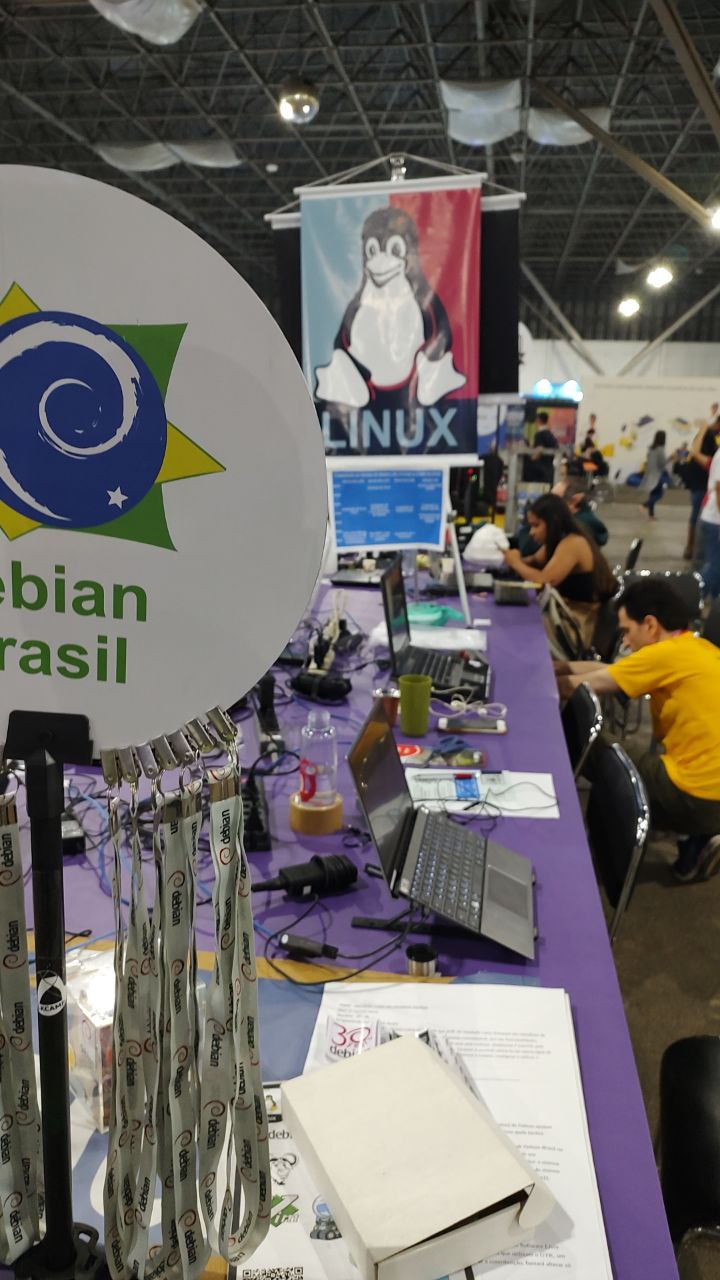
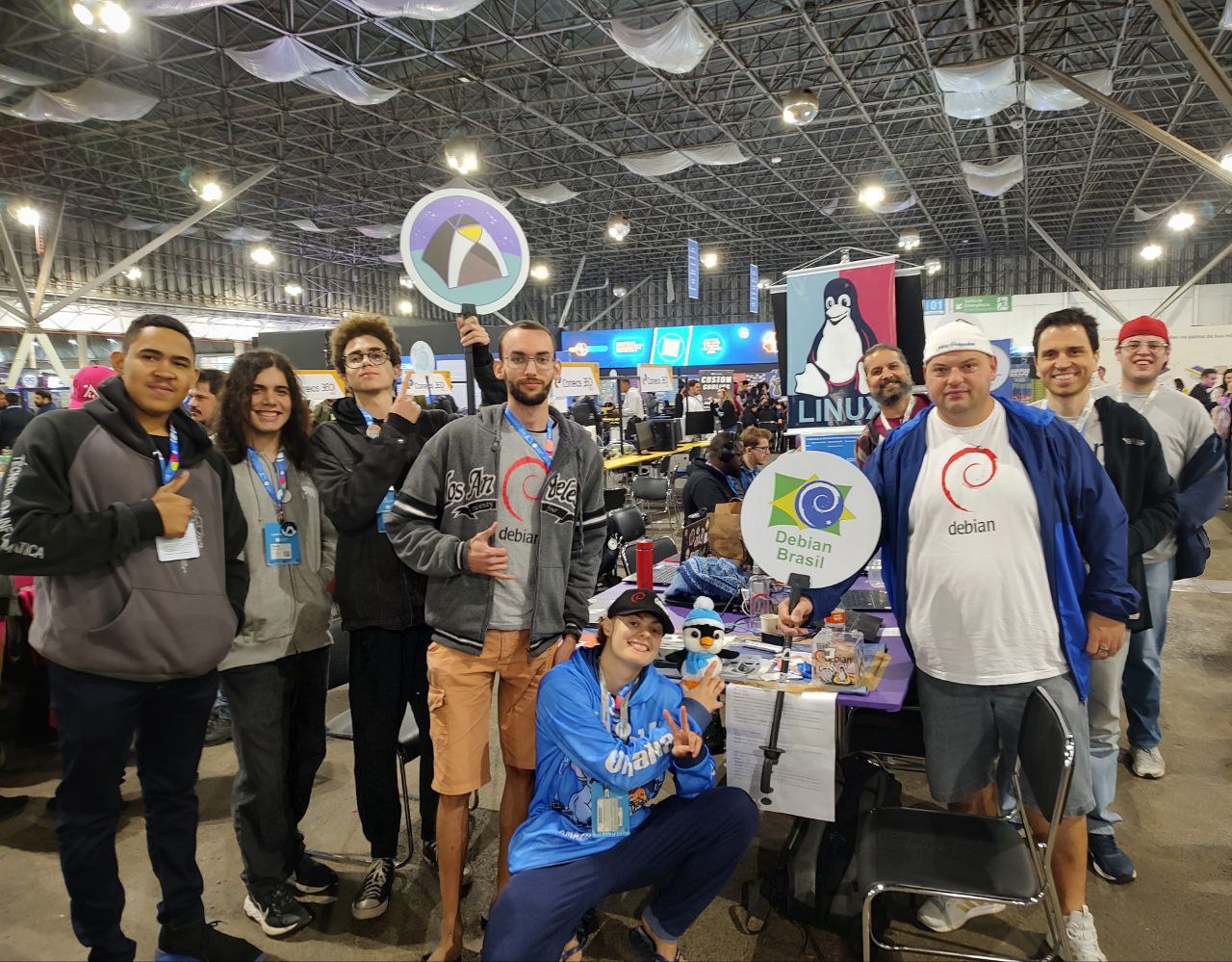
Debian Brasil: Participa o do Debian na Campus Party Brasil 2023

Mais uma edi o da Campus Party Brasil aconteceu na cidade de S o Paulo entre os dias 25 e 30 de Julho de 2023. Novamente a comunidade Debian Brasil se fez presente. Durante os dias no espa o disponibilizado, realizamos algumas atividades:
- Distribui o de brindes (adesivos, copos, cord o de crach );
- Mini oficina sobre como contribuir para a equipe de tradu o;
- Mini oficina sobre empacotamento;
- Assinatura de chaves;
- Informa es sobre o projeto; Durante todos os dias, havia sempre uma pessoa dispon vel para passar informa es sobre o que o Debian e as diversas formas de contribuir. Durante todo o evento, estimamos que ao menos 700 pessoas interagiram de alguma forma com nossa comunidade. Diversas pessoas, aproveitaram a oportunidade para aproveitar pelo excelente trabalho realizado pelo projeto no Debian 12 - Bookworm. Segue algumas fotos tiradas durante o evento! CPBR15
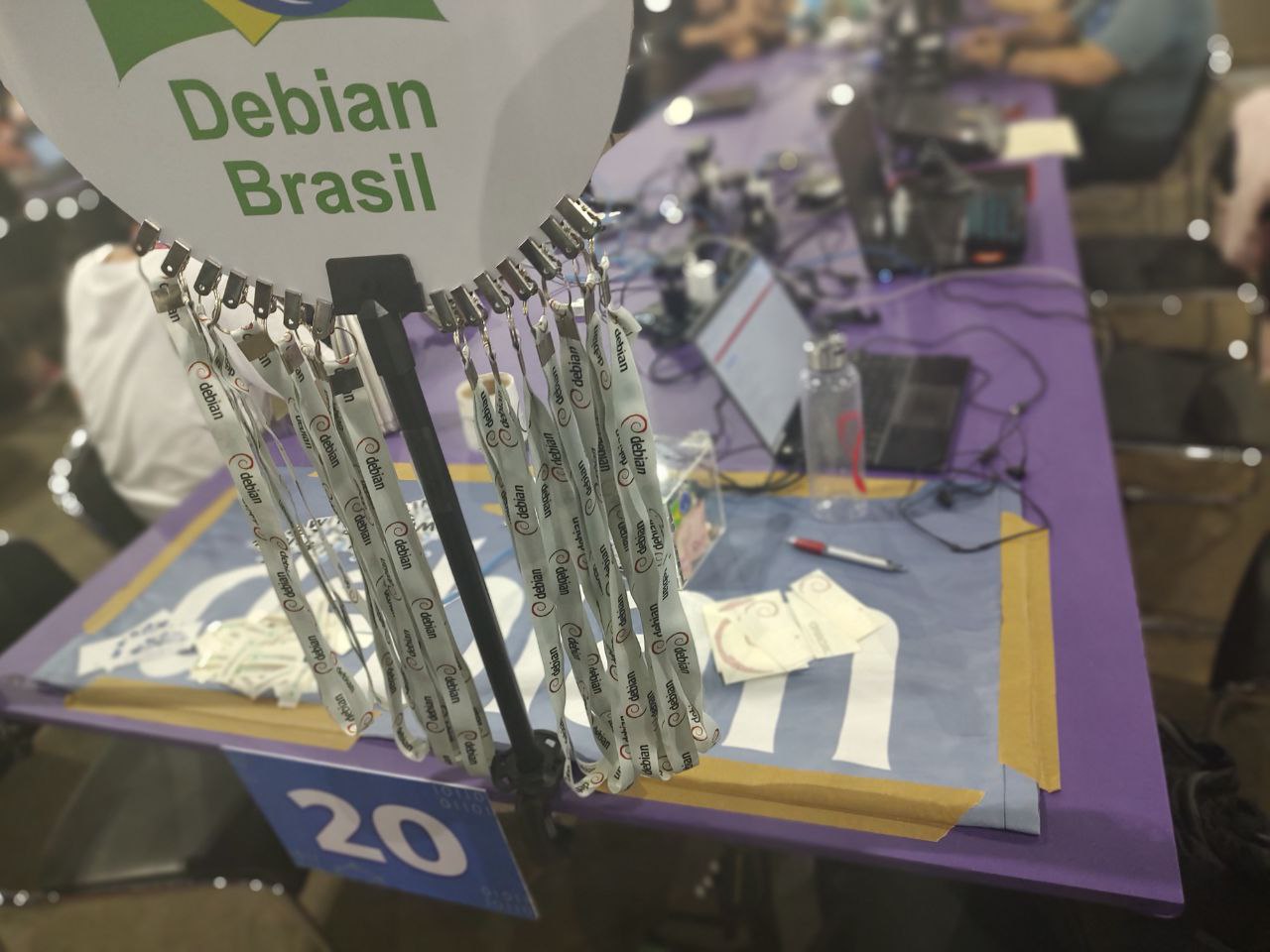
Espa o da Comunidade no Evento.
CPBR15
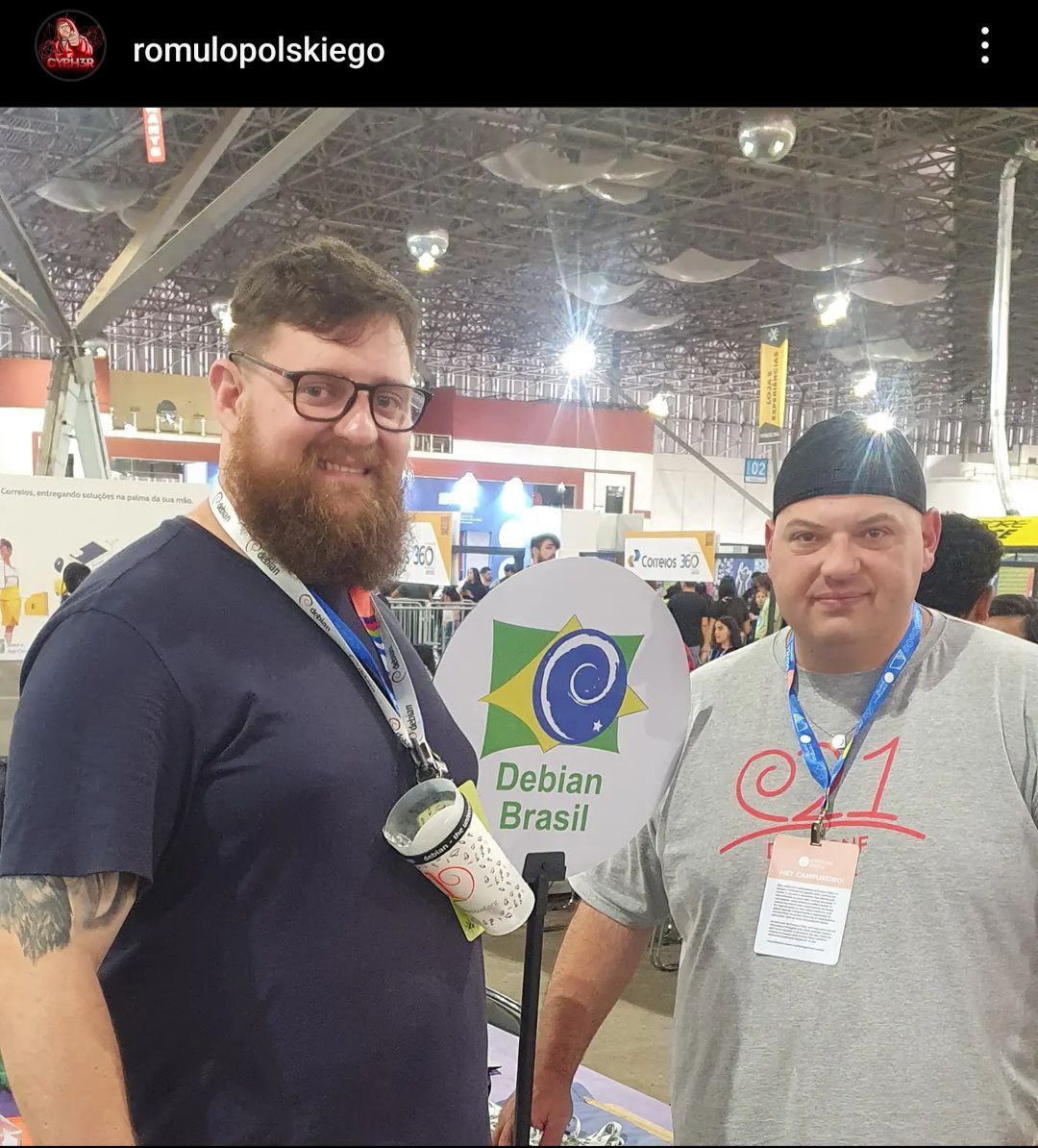
Romulo, visitante do espa o com Daniel Lenharo.
CPBR15
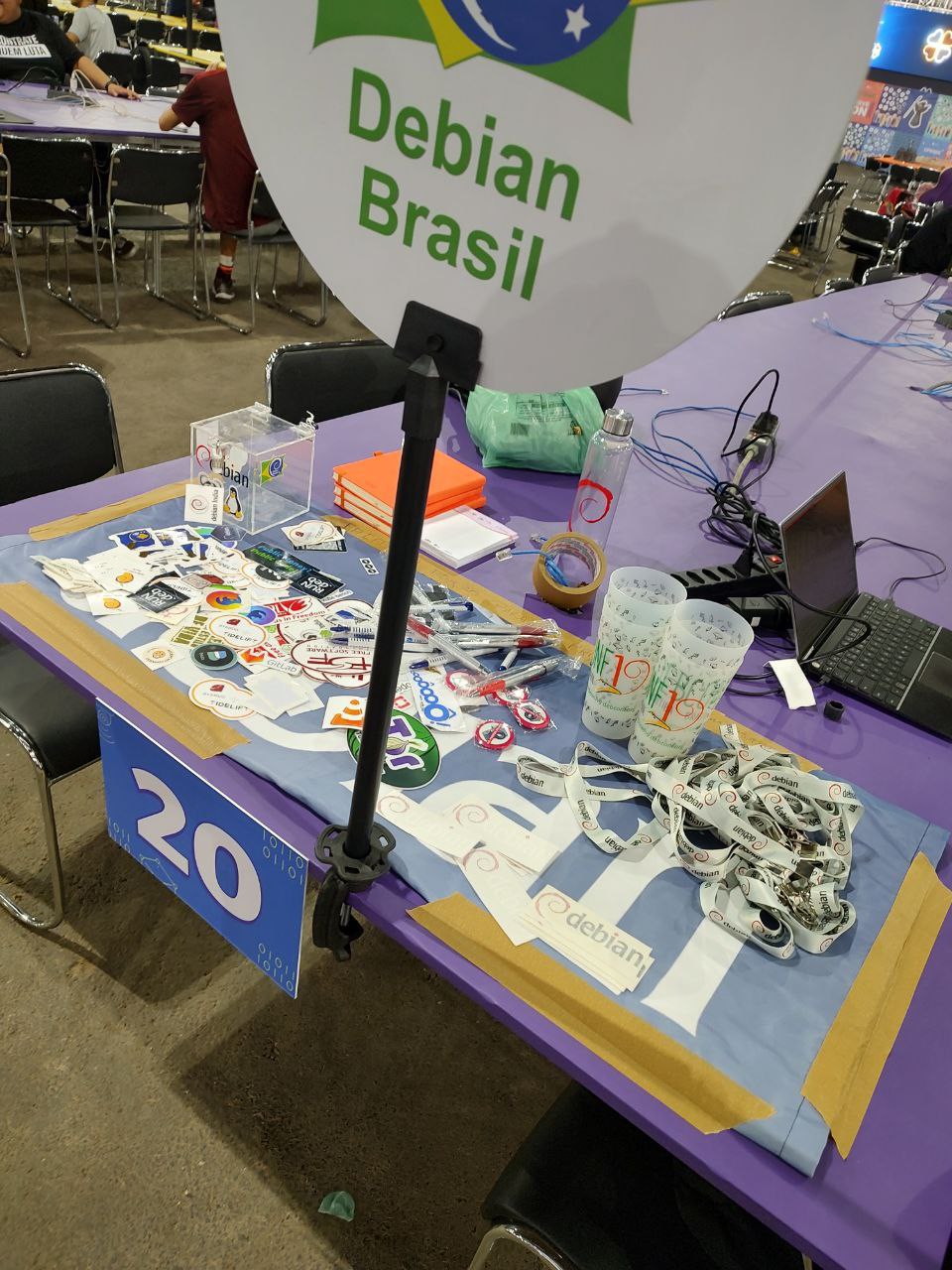
Alguns brindes que estavam a disposi o do p blico.
CPBR15
Vis o do espa o.
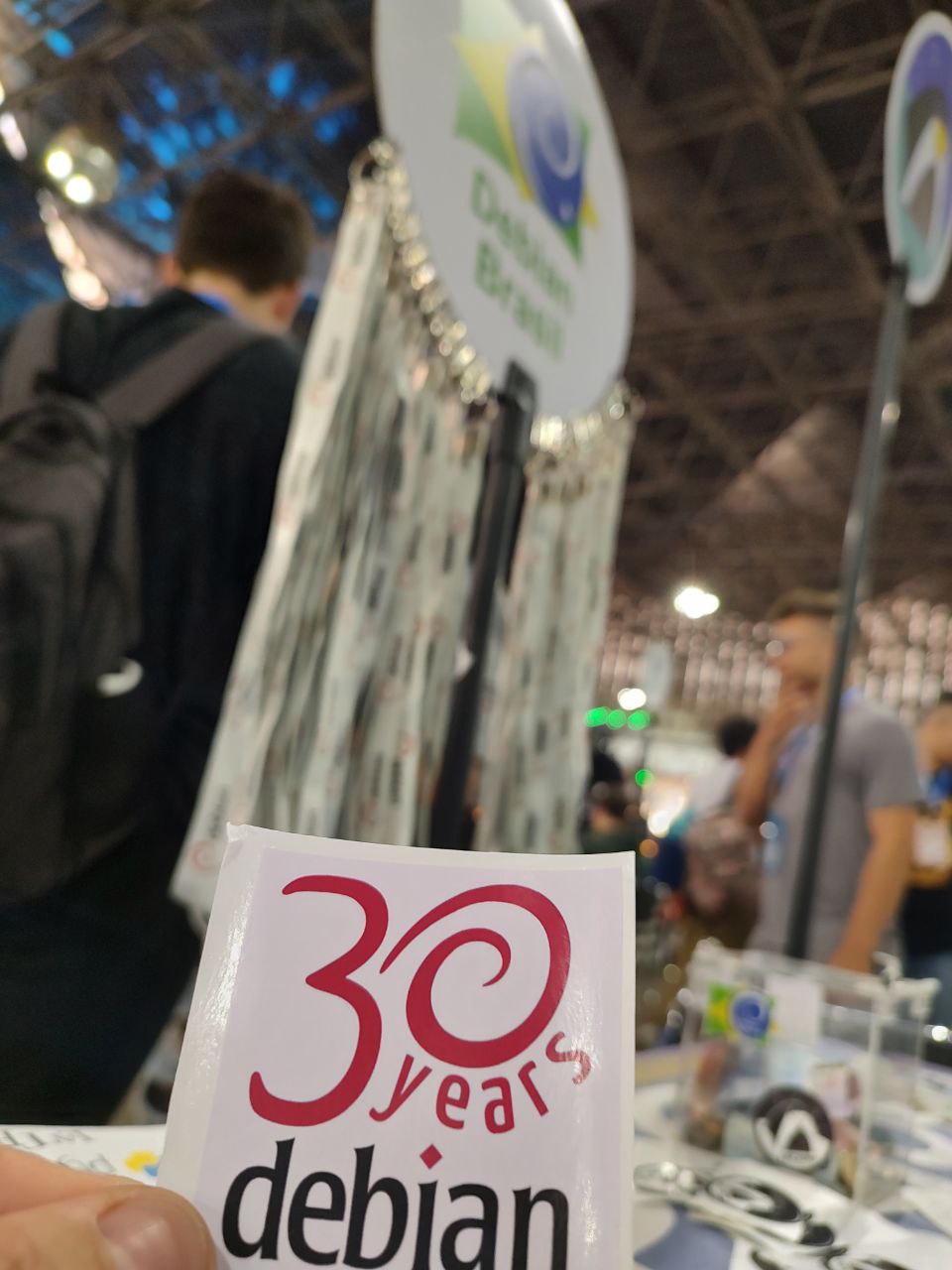
CPBR15
Adesivo com a Arte de 30 anos feita pelo Jefferson.
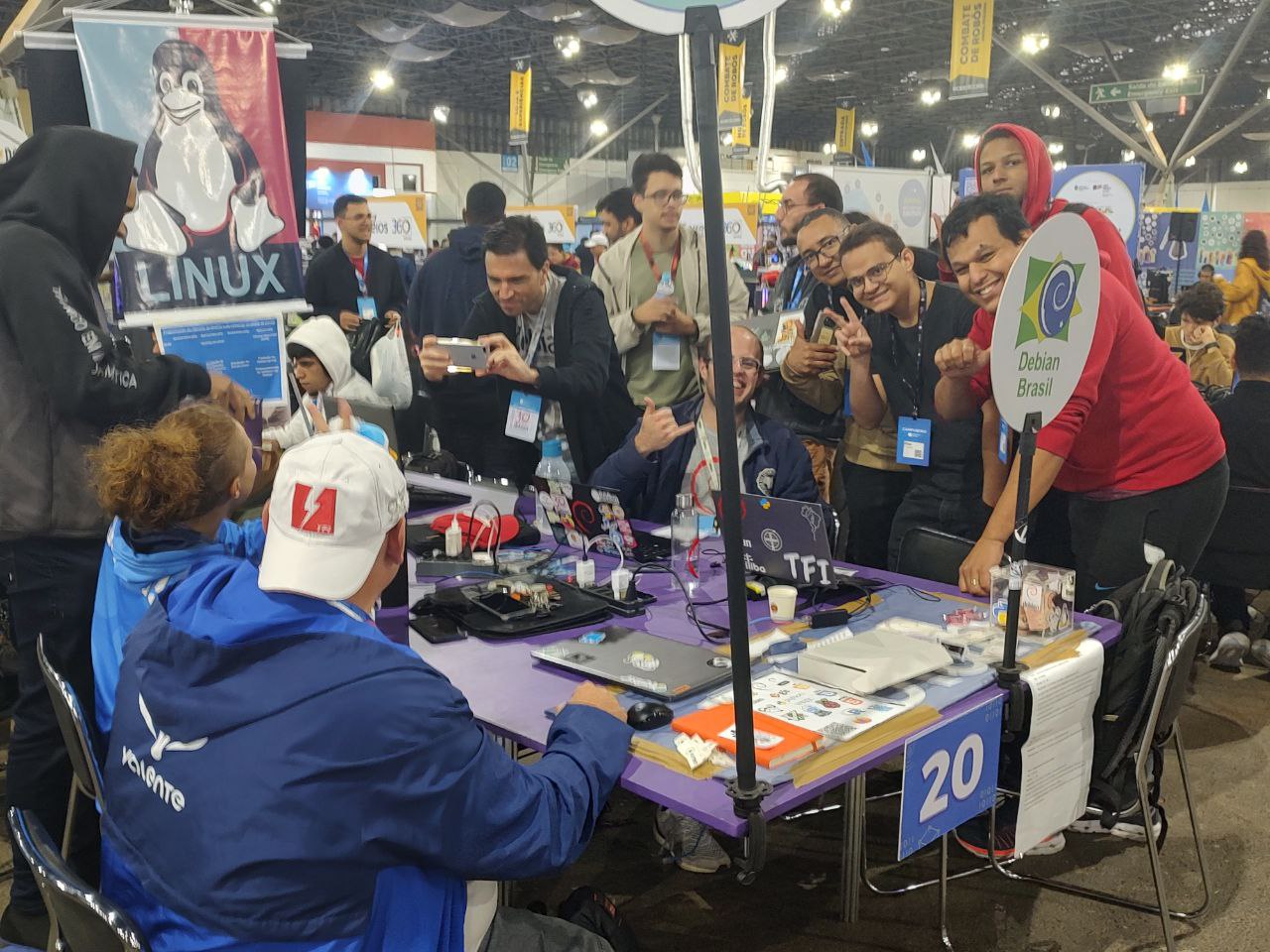
CPBR15
Pessoal no espa o da comunidade.
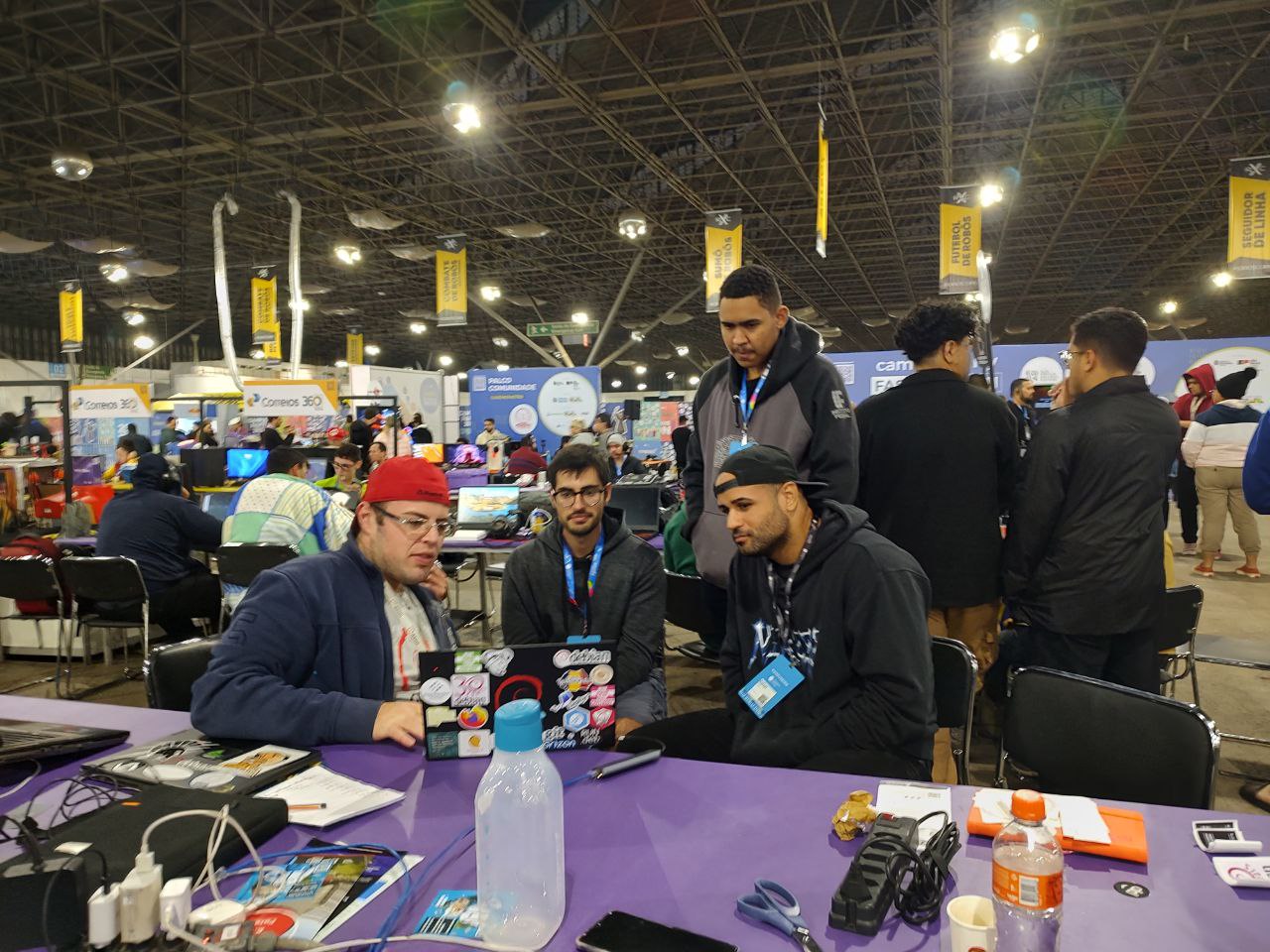
CPBR15
Mini curso de empacotamento, realizado pelo Charles.
CPBR15
Pessoal que esteve envolvido nas atividades da comunidade.

Debian Brasil: Debian Brazil at Campus Party Brazil 2023

Another edition of Campus Party Brasil took place in the city of S o Paulo between the 25th and 30th of July 2023. One more time the Debian Brazil Community was present. During the days in the available space, we carry out some activities:
- Gifts for attends (stickers, cups, lanyards);
- Workshop on how to contribute to the translation team;
- Workshop on packaging;
- Key signing party;
- Information about the project; Every day, there was always someone available to pass on information about what Debian is and the different ways to contribute. During the entire event, we estimate that at least 700 people interacted in some way with our community. Several people took the opportunity to benefit from the excellent work done by the project on Debian 12 - Bookworm. Here are some photos taken during the event! CPBR15
Community Space at the Event.
CPBR15
Romulo, visitor from space with Daniel Lenharo.
CPBR15
Some gifts for attends.
CPBR15
Communit Space at the event.
CPBR15
Sticker made with Jefferson artwork.
CPBR15
People in the community space.
CPBR15
Packaging workshop, held by Charles.
CPBR15
people who were involved in the Community activities.

1 August 2023

Louis-Philippe V ronneau: Weather Station Data Visualisations Using R and Python

A few weeks ago, my friend and neighbor J r me (aka lavamind) installed a weather station on his balcony and started collecting data from it. It has been quite useful to measure the degrading air quality during the recent forest fires plaguing northern Canada, but sadly, the hardware itself isn't great. Whereas some projects like airgradient offer open hardware devices running free software, the station we got is from RevolvAir, some kind of local air monitoring project that aims to be a one-stop solution for exterior air monitoring. Not only is their device pretty expensive1, but it also reboots frequently by itself. Even worse, their online data map requires an account to view the data and the interface is bad, unintuitive and only stores data up to a month. Having a good background in data visualisation and statistics thanks to my master's degree in economics, I decided I could do better. Two days later, I had built a series of tools to collect, analyse and graph the JSON time series data provided by the device. The result is a very simple website that works without any JavaScript, leveraging static graphs built using R. Modern web libraries and projects offer an incredible wealth of tools to graph and visualise data, but as for most of my web projects, I wanted something static and simple. The source code for the project can be found here, and although it is somewhat specific to the data structure provided by the RevolvAir device, it could easily be adapted to other devices, as they tend to have very similar JSON dumps.

  1. around 300 CAD, whereas a similar station from airgradient costs around 90 CAD. Thankfully, this station was a gift from a local group mobilising against an industrial project near our housing cooperative and we didn't have to pay for it ourselves.

Debian Brasil: Participa o do Debian na Campus Party Brasil 2023

Mais uma edi o da Campus Party Brasil aconteceu na cidade de S o Paulo entre os dias 25 e 30 de Julho de 2023. Novamente a comunidade Brasileira se fez presente. Durante os dias no espa o disponibilizado, realizamos algumas atividades:
- Distribui o de brindes (Adesivos, Copos, Cord o de crach );
- Mini oficina sobre como contribuir para a equipe de tradu o;
- Mini oficina sobre empacotamento;
- Informa es sobre o projeto; Durante todos os dias, havia sempre uma pessoa dispon vel para passar informa es sobre o que o Debian, formas de contribuir. Durante todo o evento, estimamos que ao menos 700 pessoas interagiram de alguma forma com nossa comunidade. Diversas pessoas, aproveitaram a oportunidade para aproveitar pelo excelente trabalho realizado pelo projeto no Debian 12 - Bookworm. Segue algumas fotos tiradas durante o evento! CPBR15
Espa o da Comunidade no Evento.
CPBR15
Romulo, visitante do espa o com Daniel Lenharo.
CPBR15
Alguns brindes que estavam a disposi o do p blico.
CPBR15
Vis o do espa o.
CPBR15
Adesivo com a Arte de 30 anos feita pelo Jefferson.
CPBR15
Pessoal no espa o da comunidade.
CPBR15
Mini curso de empacotamento, realizado pelo Charles.
CPBR15
Pessoal que esteve envolvido nas atividades da comunidade.

31 July 2023

Paul Wise: FLOSS Activities July 2023

Focus This month I didn't have any particular focus. I just worked on issues in my info bubble.

Changes

Issues

Debugging

Review

Administration
  • Debian IRC: rescue empty Debian IRC channel
  • Debian wiki: unblock IP addresses, approve accounts

Communication
  • Respond to queries from Debian users and contributors on the mailing lists and IRC

Sponsors The libpst, nmap, sptag, pytest-rerunfailures work was sponsored. All other work was done on a volunteer basis.

30 July 2023

Russell Coker: Links July 2023

Phys.org has an interesting article about finding evidence for nanohertz gravity waves [1]. 1nano-Herz is a wavelength of 31.7 light years! Wired has an interesting story about OpenAI saying that no further advances will be made with larger training models [2]. Bruce Schneier and Nathan Sanders wrote an insightful article about the need for government run GPT type systems [3]. He focuses on the US, but having other countries/groups of countries do it would be good too. We could have a Chinese one, an EU one, etc. I don t think it would necessarily make sense for a small country like Australia to have one but it would make a lot more sense than having nuclear submarines (which are much more expensive). The Roadmap project is a guide for learning new technologies [4]. The content seems quite good. Bigthink has an informative and darkly amusing article Horror stories of cryonics: The gruesome fates of futurists hoping for immortality [5]. From this month in Australia psilocybin (active ingredient in Magic Mushrooms) can be prescribed for depression and MDMA (known as Ecstacy on the streets) can be prescribed for PTSD [6]. That s great news! Slate has an interesting article about the Operation Underground Railroad organisation that purports to help sex trafficed chilren [7]. This is noteworthy now with the controverst over the recent movie about that. Apparently they didn t provide much help for kids after they had been rescued and at least some of the kids were trafficed specifically to fulfill the demand that they created by offering to pay for it. Vigilantes aren t as effective as law enforcement. The ACCC is going to prevent Apple and Google from forcing app developers to give them a share of in-app purchases in Australia [8]. We need this in every country! This site has links to open source versions of proprietary games [9]. Vice has an interesting article about the Hungarian neuroscientist Viktor T th who taught rats to play Doom 2 [10]. The next logical step is to have mini tanks that they can use in real battlefields. Like the Mason s Rats episode of Love Death and Robots on Netflix. Brian Krebs wrote a mind boggling pair of blog posts about the Ashley Adison hack [11]. A Jewish disgruntled ex-employee sending anti-semitic harassment to the Jewish CEO and maybe cooperating with anti-semitic organisations to harass him is one of the people involved, but he killed himself (due to mental health problems) before the hack took place. Long Now has an insightful blog post about digital avatars being used after the death of the people they are based on [12]. Tavis Ormandy s description of the zenbleed bug is interesting [13]. The technique for finding the bug is interesting as well as the information on how the internals of the CPUs in question work. I don t think this means AMD is bad, trying to deliver increasing performance while limited by the laws of physics is difficult and mistakes are sometimes made. Let s hope the microcode updates are well distributed. The Hacktivist documentary about Andrew Bunnie Huang is really good [14]. Bunnie s lecture about supply chain attacks is worth watching [15]. Most descriptions of this issue don t give nearly as much information. However bad you thought this problem was, after you watch this lecture you will realise it s worse than that!

26 July 2023

Shirish Agarwal: Manipur Violence, Drugs, Binging on Northshore, Alaska Daily, Doogie Kamealoha and EU Digital Resilence Act.

Manipur Videos Warning: The text might be mature and will have references to violence so if there are kids or you are sensitive, please excuse. Few days back, saw the videos and I cannot share the rage, shame and many conflicting emotions that were going through me. I almost didn t want to share but couldn t stop myself. The woman in the video were being palmed, fingered, nude, later reportedly raped and murdered. And there have been more than a few cases. The next day saw another video that showed beheaded heads, and Kukis being killed just next to their houses. I couldn t imagine what those people must be feeling as the CM has been making partisan statements against them. One of the husbands of the Kuki women who had been paraded, fondled is an Army Officer in the Indian Army. The Meiteis even tried to burn his home but the Army intervened and didn t let it get burnt. The CM s own statement as shared before tells his inability to bring the situation out of crisis. In fact, his statement was dumb stating that the Internet shutdown was because there were more than 100 such cases. And it s spreading to the nearby Northeast regions. Now Mizoram, the nearest neighbor is going through similar things where the Meitis are not dominant. The Mizos have told the Meitis to get out. To date, the PM has chosen not to visit Manipur. He just made a small 1 minute statement about it saying how the women have shamed India, an approximation of what he said.While it s actually not the women but the men who have shamed India. The Wire has been talking to both the Meitis, the Kukis, the Nagas. A Kuki women sort of bared all. She is right on many counts. The GOI while wanting to paint the Kukis in a negative light have forgotten what has been happening in its own state, especially its own youth as well as in other states while also ignoring the larger geopolitics and business around it. Taliban has been cracking as even they couldn t see young boys, women becoming drug users. I had read somewhere that 1 in 4 or 1 in 5 young person in Afghanistan is now in its grip. So no wonder,the Taliban is trying to eradicate and shutdown drug use among it s own youth. Circling back to Manipur, I was under the wrong impression that the Internet shutdown is now over. After those videos became viral as well as the others I mentioned, again the orders have been given and there is shutdown. It is not fully shut but now only Govt. offices have it. so nobody can share a video that goes against any State or Central Govt. narrative  A real sad state of affairs  Update: There is conditional reopening whatever that means  When I saw the videos, the first thing is I felt was being powerless, powerless to do anything about it. The second was if I do not write about it, amplify it and don t let others know about it then what s the use of being able to blog

Mental Health, Binging on various Webseries Both the videos shocked me and I couldn t sleep that night or the night after. it. Even after doing work and all, they would come in unobtrusively in my nightmares  While I felt a bit foolish, I felt it would be nice to binge on some webseries. Little I was to know that both Northshore and Alaska Daily would have stories similar to what is happening here  While the story in Alaska Daily is fictional it resembles very closely to a real newspaper called Anchorage Daily news. Even there the Intuit women , one of the marginalized communities in Alaska. The only difference I can see between GOI and the Alaskan Government is that the Alaskan Government was much subtle in doing the same things. There are some differences though. First, the State is and was responsive to the local press and apart from one close call to one of its reporters, most reporters do not have to think about their own life in peril. Here, the press cannot look after either their livelihood or their life. It was a juvenile kid who actually shot the video, uploaded and made it viral. One needs to just remember the case details of Siddique Kappan. Just for sharing the news and the video he was arrested. Bail was denied to him time and time again citing that the Police were investigating . Only after 2 years and 3 months he got bail and that too because none of the charges that the Police had they were able to show any prima facie evidence. One of the better interviews though was of Vrinda Grover. For those who don t know her, her Wikipedia page does tell a bit about her although it is woefully incomplete. For example, most recently she had relentlessly pursued the unconstitutional Internet Shutdown that happened in Kashmir for 5 months. Just like in Manipur, the shutdown was there to bury crimes either committed or being facilitated by the State. For the issues of livelihood, one can take the cases of Bipin Yadav and Rashid Hussain. Both were fired by their employer Dainik Bhaskar because they questioned the BJP MP Smriti Irani what she has done for the state. The problems for Dainik Bhaskar or for any other mainstream media is most of them rely on Government advertisements. Private investment in India has fallen to record lows mostly due to the policies made by the Centre. If any entity or sector grows a bit then either Adani or Ambani will one way or the other take it. So, for most first and second generation entrepreneurs it doesn t make sense to grow and then finally sell it to one of these corporates at a loss  GOI on Adani, Ambani side of any deal. The MSME sector that is and used to be the second highest employer hasn t been able to recover from the shocks of demonetization, GST and then the pandemic. Each resulting in more and more closures and shutdowns. Most of the joblessness has gone up tremendously in North India which the Government tries to deny. The most interesting points in all those above examples is within a month or less, whatever the media reports gets scrubbed. Even the firing of the journos that was covered by some of the mainstream media isn t there anymore. I have to use secondary sources instead of primary sources. One can think of the chilling effects on reportage due to the above. The sad fact is even with all the money in the world the PM is unable to come to the Parliament to face questions.
Why is PM not answering in Parliament,, even Rahul Gandhi is not there - Surya Pratap Singh, prev. IAS Officer.
The above poster/question is by Surya Pratap Singh, a retired IAS officer. He asks why the PM is unable to answer in either of the houses. As shared before, the Govt. wants very limited discussion. Even yesterday, the Lok Sabha TV just showed the BJP MP s making statements but silent or mic was off during whatever questions or statements made by the opposition. If this isn t mockery of Indian democracy then I don t know what is  Even the media landscape has been altered substantially within the last few years. Both Adani and Ambani have distributed the media pie between themselves. One of the last bastions of the free press, NDTV was bought by Adani in a hostile takeover. Both Ambani and Adani are close to this Goverment. In fact, there is no sector in which one or the other is not present. Media houses like Newsclick, The Wire etc. that are a fraction of mainstream press are where most of the youth have been going to get their news as they are not partisan. Although even there, GOI has time and again interfered. The Wire has had too many 504 Gateway timeouts in the recent months and they had been forced to move most of their journalism from online to video, rather Youtube in order to escape both the censoring and the timeouts as shared above. In such a hostile environment, how both the organizations are somehow able to survive is a miracle. Most local reportage is also going to YouTube as that s the best way for them to not get into Govt. censors. Not an ideal situation, but that s the way it is. The difference between Indian and Israeli media can be seen through this
The above is a Screenshot shared by how the Israeli media has reacted to the Israeli Government s Knesset over the judicial overhaul . Here, the press itself erodes its own by giving into the Government day and night

Binging on Webseries Saw Northshore, Three Pines, Alaska Daily and Doogie Kamealoha M.D. which is based on Doogie Howser M.D. Of the four, enjoyed Doogie Kamealoha M.D. the most but then it might be because it s a copy of Doogie Howser, just updated to the new millenia and there are some good childhood memories associated with that series. The others are also good. I tried to not see European stuff as most of them are twisted and didn t want that space.

EU Digital Operational Resilience Act and impact on FOSS Few days ago, apparently the EU shared the above Act. One can read about it more here. This would have more impact on FOSS as most development of various FOSS distributions happens in EU. Fair bit of Debian s own development happens in Germany and France. While there have been calls to make things more clearer, especially for FOSS given that most developers do foss development either on side or as a hobby while their day job is and would be different. The part about consumer electronics and FOSS is a tricky one as updates can screw up your systems. Microsoft has had a huge history of devices not working after an update or upgrade. And this is not limited to Windows as they would like to believe. Even apple seems to be having its share of issues time and time again. One would have hoped that these companies that make billions of dollars from their hardware and software sales would be doing more testing and Q&A and be more aware about security issues. FOSS, on the other hand while being more responsive doesn t make as much money vis-a-vis the competitors. Let s take the most concrete example. The most successful mobile phone having FOSS is Purism. But it s phone, it has priced itself out of the market. A huge part of that is to do with both economies of scale and trying to get an infrastructure and skills in the States where none or minimally exists. Compared that to say Pinepro that is manufactured in Hong Kong and is priced 1/3rd of the same. For most people it is simply not affordable in these times. Add to that the complexity of these modern cellphones make it harder, not easier for most people to be vigilant and update the phone at all times. Maybe we need more dumphones such as Light and Punkt but then can those be remotely hacked or not, there doesn t seem to be any answers on that one. I haven t even seen anybody even ask those questions. They may have their own chicken and egg issues. For people like me who have lost hearing, while I can navigate smartphones for now but as I become old I don t see anything that would help me. For many an elderly population, both hearing and seeing are the first to fade. There doesn t seem to be any solutions targeted for them even though they are 5-10% of any population at the very least. Probably more so in Europe and the U.S. as well as Japan and China. All of them are clearly under-served markets but dunno a solution for them. At least to me that s an open question.

25 July 2023

Sam Hartman: AI and Sexuality

When I began to read about the generative AI revolution, I realized there was an opportunity to combine two aspects of my life I never thought I could merge. While I m not working on the cloud or security, I work as a sex and intimacy educator, helping people embrace love, vulnerability and connection. As I first began to interact with ChatGPT, I saw the potential for AI to help people explore parts of the world they had not experienced for themselves. I m blind. When I write fiction, physical descriptions are always challenging for me. I don t understand facial expressions very well, and figuring out what characters look like is difficult. Generative AI has opened up an entire new world for me. I can explore how people might express some emotion and how they might dress in a certain situation. I can even exploit the cultural biases that are sometimes the bane of AI to translate my ideas about personality and background into appearance. Immediately I realized the opportunities for sexual freedom: People are already using Generative AI to help with intimacy. There are plenty of stories about how people use AI to tune their dating profiles. But all too often, the desire to make AI safe brings shame and rejection into the discussion of intimacy. Even something as simple as Help me come up with a sensual description of this character, is likely to run up against the all-too-familiar responses: I am a large language model and for safety reasons I cannot do that. That safety is important: one thing we have learned from sex positive culture is how important boundaries are. We need to respect those boundaries and not expose people to unwanted sexual content. But we also know how damaging shame is. When someone reaches out and tentatively asks to explore their sexuality, rejecting that exploration will come across as a rejection of that person they are dirty or disgusting for wanting to explore. Fortunately, we will see AI models that are open to exploring sexuality. Some of the uncensored models will already try, although calling some of the results sex positive would be stretching the truth. We re already seeing discussions of virtual AI girlfriends. And as AI meets sex, I m going to be there, helping try and turn it into something healthy both for business and for lovers. There are all sorts of interesting challenges: There are all the cultural and social challenges that sex-positive work faces. Then there are versions of the AI challenges of bias, hallucinations and the like, along with specific challenges of exploring emotionally-charged vulnerable topics. And yet there s so much potential to help people gain confidence and valuable skills. I am eagerly looking for opportunities to combine my work as a sex positive educator and as a software developer. I d love to hear about any ongoing work at the intersection of Sex and Generative AI. I ve done some research already, but there s so much going on in the AI world it is impossible to follow it all. Please reach out with anything you think I should track.

comment count unavailable comments

21 July 2023

Gunnar Wolf: Road trip through mountain ridges to find the surreal

We took a couple of days of for a family vacation / road trip through the hills of Central Mexico. The overall trip does not look like anything out of the ordinary Other than the fact that Google forecasted we d take approximately 15.5 hours driving for 852Km that is, an average of almost 55 Km/h. And yes, that s what we signed up for. And that s what we got. Of course, the exact routes are not exactly what Google suggested (I can say we optimized a bit the route, i.e., by avoiding the metropolitan area of Quer taro, at the extreme west, and going via San Juan del R o / Tequisquiapan / Bernal). The first stretch of the road is just a regular, huge highway, with no particular insights. The highways leaving and entering Mexico City on the North are not fun nor beautiful, only they are needed to get nice trips going Mexico City sits at a point of changing climates. Of course, it is a huge city And I cannot imagine how it would be without all of the urbanization it now sports. But anyway: On the West, South, and part of the East, it is surrounded by high mountains, with beautiful and dense forests. Mexico City is 2200m high, and most of the valley s surrounding peaks are ~3000m (and at the South Eastern tip, our two big volcanoes, Popocat petl and Iztacc huatl, get past the 5700m mark). Towards the North, the landscape is flatter and much more dry. Industrial compounds give way to dry grasslands. Of course, central Mexico does not understand the true meaning of flat, and the landscape is full with eh-not-very-big mountains. Then, as we entered Quer taro State, we started approaching Bernal. And we saw a huge rock that looks like it is not supposed to be there! It just does not fit the surroundings. Shortly after Bernal, we entered a beautiful, although most crumpled, mountain ridge: Sierra Gorda de Quer taro. Sierra Gorda encompasses most of the North of the (quite small 11500Km total) state of Quer taro, plus portions of the neighboring states; other than the very abrupt and sharp orography, what strikes me most is the habitat diversity it encompasses. We started going up an absolute desert, harsh and beautiful; we didn t take pictures along the way as the road is difficult enough that there are almost no points for stopping for refreshments or for photo opportunities. But it is quite majestic. And if you think deserts are barren, boring places well, please do spend some time enjoying them! Anyway At on point, the road passes by a ~3100m height, and suddenly Pines! More pines! A beautiful forest! We reached our first stop at the originally mining town of Pinal de Amoles. After spending the night there and getting a much needed rest, we started a quite steep descent towards Jalpan de Serra. While it is only ~20Km away on the map, we descended from 2300 to 760 meters of altitude (and the road was over 40Km long). Being much lower, the climate drastically changed from cool and humid to quite warm and the body attitude in the kids does not lie! In the mid-18th century, Fray Jun pero Serra established five missions to evangelize the population of this very harsh territory, and the frontispiece for the church and monastery in Jalpan is quite breathtaking. But we were just passing by Jalpan. A short visit to the church and to the ice-cream shop, and we were again on our way. We crossed the state border, entering San Luis Potos , and arrived to our main destination: Xilitla, the little town in the beautiful Huasteca where the jungle meets surrealism. Xilitla was chosen by the British poet and patron of various surrealist artists https://en.wikipedia.org/wiki/Edward_James. He was a British noble (an unofficial grandson of King Edward VII), and heir to a huge fortune. I m not going to repeat here his very well known biography suffice to say that he got in love with the Huasteca, and bought a >30ha piece of jungle and mountain close to the Xilitla town, and made it his house. With very ample economic resources, in the late 1940s he started his lifelong project of building a surrealist garden. And Well, that s enough blabbering for me. I m sharing some pictures I took there. The place is plainly magic and wonderful. Edward James died in 1984, and his will decrees that after his death, the jungle should be allowed to reclaim the constructions so many structures are somewhat crumbling, and it is expected they will break down in the following decades. But for whoever comes to Mexico This magic place is definitely worth the heavy ride to the middle of the mountains and to the middle of the jungle. Xilitla now also hosts a very good museum with sculptures by Leonora Carrington, James long-time friend, but I m not going to abuse this space with even more pictures. And of course, we did more, and enjoyed more, during our three days in Xilitla. And for our way back I wanted to try a different route. We decided to come back to Mexico City crossing Hidalgo state instead of Quer taro. I had feared the roads would be in a worse shape or would be more difficult to travel And I was happy to be proven wrong! This was the longest driving stretch approximately 6:30 for 250Km. The roads are in quite decent shape, and while there are some stretches where we were quite lonely (probably the loneliest one was the sharp ascent from Tamazunchale to the detour before Orizatl n), the road felt safe and well kept at all times. The sights all across Eastern Hidalgo are breathtaking, and all furiously green (be it with really huge fern leaves or with tall, strong pines), until Zacualtip n. And just as abruptly or more as when we entered Pinal de Amoles We crossed Orizatl n, and we were in a breathtaking arid, desert-like environment again. We crossed the Barranca de Metztitl n natural reserve, and arrived to spend the night at Huasca de Ocampo. There are many more things we could have done starting at Huasca, a region where old haciendas thrived, full of natural formations, and very very interesting. But we were tired and pining to be finally back home. So we rested until mid-morning and left straight back home in Mexico City. Three hours later, we were relaxing, preparing lunch, the kids watching whatever-TV-like-things are called nowadays. All in all, a very beautiful vacation!
Next.

Previous.