Search Results: "sto"

22 March 2012

Russell Coker: Links March 2012

Washington s Blog has an informative summary of recent articles about corporate psychopaths [1]. Including the fact that some banks deliberately hire psychopaths. Anu Partanen wrote an insightful article for The Atlantic about the difference between Finnish and American education systems [2]. It seems that Finland has achieved great educational success by aiming for equality with no private schools and giving the teachers and principals enough responsibility to do the job properly. Ramona Pierson gave an interesting TED talk about how she recovered from being run over by a drunk driver with the help of the residents of a senior citizens home [3]. Quyen Nguyen gave a very interesting TED talk about the use of fluorescent dyes in cancer surgery [4]. They can make cancer glow one color and nerves glow with a different color which makes it a much easier task to remove ALL the cancer without cutting the smaller nerves. James Fallows wrote an interesting article for The Atlantic about the experience of having his wife s Gmail account cracked [5]. She stored EVERYTHING in her Gmail account so this was a lot worse for her than for the typical Geek who doesn t use such accounts for storing much. James describes what the attacker did, how they did it, and what needed to be done to recover. When running a mail server it s worth considering what you would do to help a user who was attacked in that way. Charles Stross has written an interesting blog post trying to predict some future psychological and social changes [6]. Matthew Wright of Beyond Zero Emissions has written an informative article about how solar panels on home roofs save everyone money [7]. Mikko Hypponen gave an interesting TED talk about different types of online attack and how they can affect us [8]. Among other things he describes how online attacks can result in people dying. Scott Rickard gave an interesting TED talk about using maths to create SONAR pings without repitition and also the worst music ever created [9]. I found it entertaining to watch Michael Lindel (the director of chamber music for the New York Symphony) play the music, he obviously didn t enjoy that performance. Sheena Iyengar gave an interesting TED talk about the way people make choices [10]. It s useful for anyone who is going to prepare a set of options for someone else to choose from. ASD Aid is a project that uses Lego to encourage kids on the Autism Spectrum to socialise [11]. They have training manuals for using Lego in therapy. Unfortunately they have not been supported by the Lego corporation. Bilal Bomani gave an interesting and informative TED talk about NASA research into renewable aviation fuel [12]. The most interesting thing to me was the way that they were aiming for a sustainable lifecycle that didn t use resources that coule be used for food and which required minimal input once it was started. Alain de Botton gave an interesting TED talk about Atheism 2.0 [13]. He suggests that we adopt some ideas from religious organisations including lectures (sermons), celebrations, and rituals. It s interesting to think of a technology conference as a pilgrimage. Homaro Cantu and Ben Roche from Moto restaurant in Chicago gave an interesting talk about some of the unusual foods that they have produced [14]. If I visit the US again I will try and go to Chicago to eat there! Related posts:
  1. Links March 2009 Cory Doctorow has written a column for The Guardian titled...
  2. Links February 2012 Sociological Images has an interesting article about the attempts to...
  3. Links January 2012 Cops in Tennessee routinely steal cash from citizens [1]. They...

Richard Hartmann: Svalbard

Svalbard The things you find when cleaning out a disk; preparing for re-installation of your laptop on a larger disk once the laptop comes back from repair... I thought I had posted this in early January, but apparently not. As it would be a shame to just throw this away, here goes: I am sitting in the Oslo airport, waiting for boarding back home to start. Seeing the sun after a week of darkness still feels strange. Inital trouble It's been a very interesting week, starting with our trip to Oslo in the other direction. We spent New Year's Eve in Oslo, timing our forced overnight stay before reaching Svalbard to coincide with something interesting. The close timing of our travel meant that there was exactly one flight to Oslo we could take. Never having heard of Air Baltic before and finding out that they are a discount airline, my gut feeling told me to be be wary. I refuse to fly with those airlines on principle, not wanting to support their business model while hurting airlines with decent treatment of customers. Unfortunately, I was forced to book with them in this case. As it turns out, my gut was right. More on that below. Our plane was late in landing and my luggage was lost. As it was New Year's Eve, the staff at Oslo airport understandably wanted to be home, not at work. Still, getting them to file a report was tedious and finding out days later that the report was incomplete was, well, not good. The express train from the airport to Oslo central station had closed early without any advance notice or local signs, presumably because of NYE. The gates were simply closed and that's that. We figured out how the bus system worked, got our tickets from a vending machine, saw the one bus to central station drive away, and proceeded to wait in the outside waiting area; at least we had a front spot in the queue. While we don't get cold easily, it was funny to see Norwegians in thin clothes stand around in the biting wind, apparently being comfortable. A young mother with a baby, who didn't anticipate being forced to wait outside at -15C, as opposed to just sitting down in a train, had no warm clothes for her son; something that was fixed by wrapping him in spare clothes from Ilona's luggage. After waiting for about thirty minutes for the next bus to appear, it parked twenty or thirty meters away from the designated parking spot. The rough queue disintegrated and if not for Ilona's leaving me with luggage and backpacks and storming off to fight the masses, said mother with baby and ourselves would have waited for another thirty minutes. More than hundred people were left stranded at the airport to celebrate there or on the bus. Meh. We hurried, by taxi, from central station to hotel to harbour and arrived about five minutes to twelve. NYE itself was nice. We stood on top of the opera house and watched a rather impressive show of fireworks through the thickening mists. Norwegian fireworks pack lot more punch than German ones; you actually feel your clothes shake when they go off. Getting to Longyearbyen The flight from Troms to Longyearbyen had free in-flight Wi-Fi and flying over the edge of satellite coverage demonstrated how far we were from everywhere else rather impressively. Arriving at Longyearbyen, I fixed the lost luggage claim with the help of an extremely nice woman working at the airport. She confirmed that Air Baltic is legally required to reimburse me after an arcane system based on a virtual IMF currency to the tune of about 1.500. That may sound like a lot, but seeing as I had most of my scuba gear with me, that's not even half of what my luggage was worth. I was forced to get by New Years with what I had on my body and went shopping the next day when I could buy at least a few things. I got by with spending about 180 by going for non-fitting bargain bin clothes, wanting to reduce impact on Air Baltic. Shortly after that, my luggage arrived, unannounced. Air Baltic refused to reimburse me even though they are legally required to, again the airport staff confirmed this. But unless I sue in the country of destination, Norway, I won't see any money. Long story short: Avoid Air Baltic if possible. They will break the law to cheat you out of money when they have a reasonable expectation of getting away with it. Update: Yep, seems they got away with it unless I take legal measures. You have been warned. Longyearbyen itself was very nice. We started off with a short, guided taxi tour around the city, seeing literally everything of it as there's not a lot of Longyearbyen to start with. Dogsledding Next day, as noted earlier, we went shopping and spent the "evening" with dogsledding which turned out to be tons of fun. We helped with harnessing the dogs which is somewhat cumbersome as the dogs are so eager to burn off their energy that they want to run all over the place, not being put into a harness and snapped onto the pull-line. Never having been dogsledding before I was a bit wary, but riding over not too rough terrain is almost trivial once you get the hang of it; listen to what the musher in front of you yells and emulate the same shouts with your own dogs. If the dogs become too fast, step onto the brake pad which simply drives spikes into the snow. If the dogs slow down while going uphill, skate with one foot to help them. That's it for speed. As the dogs are following the musher's sled anyway, steering the dogs was not a concern. Fun fact: The musher used a laser pointer to steer his dogs; simple, efficient, and presumably fun. We learned, by demonstration, that sledding dogs can eat snow, take a leak, and take a dump while running at full speed and pretty much all at the same time. The dogs are left either in cages or on long chains far away from the city as they tend to bark and howl a lot. We were surprised to learn that, even when there are seals left to hang dry as dog food nearby, there are no problems with bear attacks. Apparently even the extremely aggressive and hungry one year old males will not go near dogs. Still, while out in the ice and snow, our guide carefully flooded all crevices and cliff bases to root out female bears with young ones early. They hide their children from the wind and they will attack, dogs and all, if we get too close. That's why our musher carried rifle in his sled and flare gun on his body. Snowmobile The next "morning", we drove around by snowmobile. This turned out to be extremely boring as it was a curated trip with over half a dozen snowmobiles in our group; a stark contrast to our two-sled tour the day before. The last time I went snowmobiling, we raced each other up and down a two-star black (i.e. steep, bumpy, and curvy) ski slope, jumping several meters when racing over larger bumps and crossing streets, so riding single file at 30 km/h was... anticlimatic. Again, the guide had rifle and flare gun with him. We spent the afternoon and evening walking around the city. Ice bears, part I As the ice caves and the glacier were still closed, we decided to have another walk around the city. Having planned make it a quick tour, we lost track of time due to lack of sun and ended up walking around for seven hours. A note about that trip.. If you are alone with your wife, unarmed, climbing up a very steep and slippery mountainside over a sheet of ice with deep snow underneath and loose rocks in between, and then start shining around with your flashlight under the stilts of an abandoned mine that looks like in a horror movie, the correct answer to "What are you doing?" is never ever "Looking for ice bears". Even if it's the truth, this is not an acceptable answer. I crawled up the last part on all fours, camera and tripod in hand while Ilona stayed about two dozen meters below the mines' entrance, refusing to go another step towards the mine. As soon I made it up the creaky and shaky, for a lack of a better word, let's call it ladder, she forced me to come down again. Bleh, but I guess I deserved that. Armed photographer Next day, we got final confirmation that we would not be allowed to rent snowmobiles to explore the hinterland on our own and that other for some, and I quote, "crazy Russians", no one would even attempt to cross over to Barentsburg. Thus, we ended up renting a car for the ~20 kilometers of total road length. That turned out to be a great idea as it allowed us to get away from the light and take some very nice long exposures. It was then that I got a rental rifle, as well. There is a law against leaving the town unarmed and I was not about to test my luck too much. Turns out that, as part of Germany's WWII reparations, Norway received our all hand guns and as they still function perfectly when dirty and in cold climate which makes them still popular in Svalbard, today. The Karabiner 98 Kurz which I received is built incredibly well. It's somewhat scary inasmuch every detail is designed to make this weapon ready to fire. If you hurry or are inexperienced, you will end up with an unlocked and loaded rifle after putting in the bolt. Putting the safety in and not chambering a bullet takes conscious effort and knowledge of the weapon. This is in stark contrast to other weapons I had the chance to dissect, which all defaulted to being safe. Even other military weapons such as the AK74 and the M4A1 are inherently more secure, designed to be locked and safe. The Mauser K98... not so much. As an aside, they didn't bother to remove the Reichsadler and Swastika from the rifle, contending themselves with striking out the German registration number and stamping the rifle with a Norwegian one. I guess Norwegians don't really "care" about these signs as much as we Germans do. In a way, that's a good thing I guess, at least as long as it's an indication of indifference towards the sign, not one of forgetting or ignoring the underlying issues. Still, I was very glad to have rented the rifle. While Ilona tended to stay in the running car with heat and lights on, I went out and away from the car. Even when standing near a street, a medium snow storm will make you appreciate the four powerful arguments against being eaten by a random bear which are at the ready over your shoulder. We even went to the shooting range so I could get some practice. The procedure is very trusting, as is anything in Longyearbyen. After accessing the interior of one of the houses in a particular way which I won't specify here, you simply switch on the floodlights, put up the red flag, position a target and write your name into the guest book. Once you're done shooting, toss a few coins into the bowl next to the guest book, remove the targets and flag, turn off the lights, close the door and that's that. Unfortunately, the way in was under a few meters of snow so I couldn't get in any practice shots. Ice bears, part II Later, as I was standing on a wind-polished slate of ice taking pictures of the Seed Vault (located here), I heard an ice bear roar behind (i.e. to the north of) me. I consciously remember hearing the bear, I consciously remember facing the other way around, half-crouched, rifle raised in the direction of the roar. I also consciously remember smacking the safety off and chambering a bullet after having regained control of my body. I do not remember spinning around on a wind-polished slate of ice, so treacherous I hand to balance with my arms and didn't even lift my feet when walking over it, without losing balance or footing, nor do I remember crouching and raising the gun. Evolution really is amazing; no matter what primal chord that roar struck, it certainly saved a ton of people over the years. In my case, thankfully, there was no bear to be seen down the slope. There may be no sun or anything, but the snow reflects the starlight so you tend to see surprisingly far and as I was on on the mountainside and the roar came from down from the coast, and as I had my rifle, I decided to finish the photo session while keeping the slope in close view. In hindsight, I am still glad I decided to do that as the shots came out rather nice. Next day, we drove out to Mine 12, the farthest you can away from Longyearbyen. The dump truck transporting coal alternated between driving a full load of coal back to the city and being its own snowplow. One quick trip to get coal, one slow and empty trip to plow away snow, rinse, repeat. If not for that, our 4WD would never have made it all the way up to the mine. Neither snow storms in North America nor around the Alps prepared me for what people on Longyearbyen consider normal wind in their backyard. This is where the word wind-swept was invented. The main reason that Svalbard is inhabited at all, other than the Gulf Stream, is coal. We have been told that the coal up there is of extremely high quality and while I can't say much about that, I can say that it's hard as stone. This is nice as it does not smear when you get coal all over yourself. Just shake out your jacket and pants and you are good as new. On our way back, we met two locals who had just prepared the glacier and ice caves for tourists. Had I known that in advance, I would have tried to go with them to take pictures completely away from all artificial light. Oh well, can't have everything. Speaking of not being able to have everything, the outdoor hot tub in our hotel which integrated ice bar and BBQ grill was still under several meters of snow so we couldn't use that, either. Finally, the few divers who are in Longyearbyen didn't have time to take me onto a trip while I was there. As I already missed my opportunity to dive the Arctic circle when the one diver on Gr msey happened to be on the mainland and barely missing it by diving Str tan instead, this was kind of a bummer. On the plus side, this has given me a goal to pursue and achieve. Random notes For the rest of my notes, I will resort to a largely unsorted list of bullet points as there's just too much to talk about in prose. All in all, it was well worth it. PS: If you know anyone working with Google Maps, ask them to consider improving their coverage of the Arctic. This is a real pity. As is the rest of the Arctic and the fact that Google Earth cheats you out of the North and South Pole by stretching adjacent tiles into and over them.

21 March 2012

Axel Beckert: aptitude-gtk will likely vanish

As Christian already wrote, there s an Aptitude revival ongoing. We already saw this young team releasing aptitude 0.6.5 about 6 weeks ago, more commits have been made, and now we re heading towards an 0.6.6 release quickly. But this revival mostly covers the well-known and loved curses interface (TUI) of aptitude and not the seldomly installed GTK interface, which unfortunately never really took off: While aptitude itself (i.e. the curses and commandline interface) is installed on nearly 99% of all Debian installations which take part in Debian s Popularity Contest statistics, aptitude-gtk is only installed on 0.42% of all these installations. One reason is likely that aptitude-gtk still hasn t all the neat features of the curses interface. And another reason is probably that it s still quite buggy. Since nobody from the current Aptitude Team has the experience, leisure or time to resurrect (or even complete) aptitude-gtk, the plan is to stop building aptitude-gtk from the aptitude source package soon, i.e. to remove it from Debian for now. Like the even less finished Qt interface of aptitude, its code will stay in the VCS, but will be unmaintained unless someone steps up to continue aptitude-gtk (or aptitude-qt, or both), maybe even as its own source package. So if you like aptitude-gtk so much that you re still using it and want to continue using it, please think about contributing by joining the Aptitude Team and getting aptitude s GUI interface(s) back in shape. Another option would be to find a mentor so that resurrecting (one of) aptitude s GUI interfaces could become (again) a potential project at Debian s participation at Google s Summer of Code. Please direct any questions about aptitude-gtk or aptitude-qt to the Aptitude Development Mailing List. Or even better, join the discussion in this thread.

20 March 2012

Andreas Barth: Traveling to DebConf 11 - in Sarajevo

Sarajevo gave a rainy look the next morning. That wasn't too bad, as I was able to walk around a bit without it being too crowded. Incidently I also saw the corner where Franz Ferdinand was shot in 1914, which started the first world war - Europe has many links beyond todays state borders, in good and bad times. It's not like transeuropean politics (or communications) are something too new.
Bazar in Sarajevo
Franz Ferdinand was shot here in 1914
Trolley buses
River, tram and city
nice building hidden by cars - should our cities be dominated that way?
more of the old city After having spent the morning exploring the old part of Sarajevo and along the river, I used the time after hotel checkout to use the tram link and take a few more pictures. I arrived at the train station as planned, but the train I wanted to take didn't go that day (in spite of checking it within the hotel in the morning). So, I ended with another bus trip (this time unplanned) to Banja Luca. Again, bus trips are worse than train trips - one cannot move in the vehicle, and there are delays for every stop. The events in Banja Luca are discussed elsewhere, so nothing about that here (except that DebConf was great - I enjoyed it very much).

Christoph Berg: Cool Unix Features: /usr/bin/time

Ever wondered how much memory a program needed? Install the "time" package:
$ /usr/bin/time ls
[...]
0.00user 0.00system 0:00.00elapsed 0%CPU (0avgtext+0avgdata 4000maxresident)k
0inputs+0outputs (0major+311minor)pagefaults 0swaps
Unfortunately the "time" bash built-in makes it necessary to use the full path. Thanks to youam for the tip. Update: aba notes that calling \time works as well. Thanks!

Russell Coker: An Introduction to Android

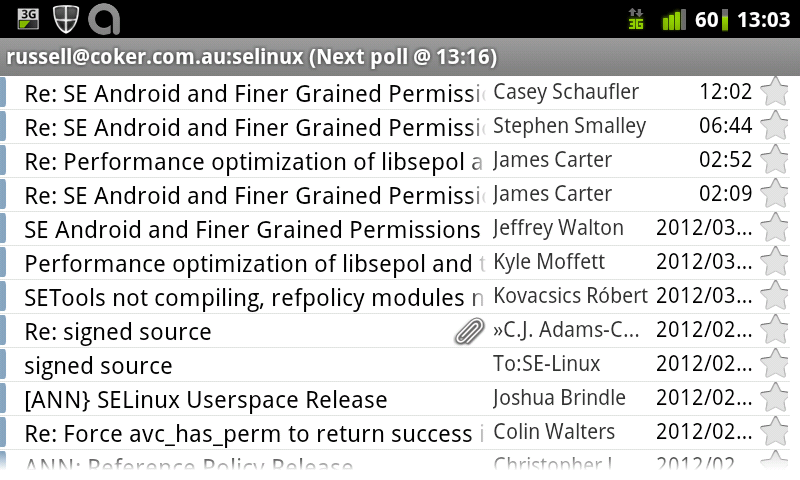
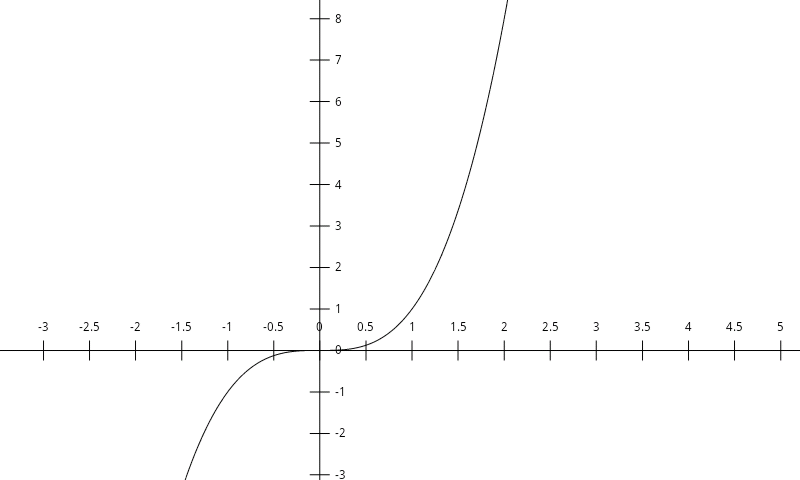
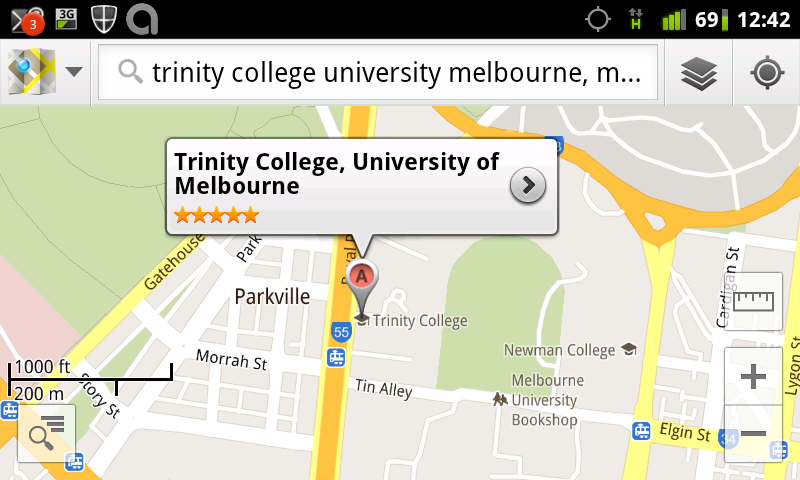
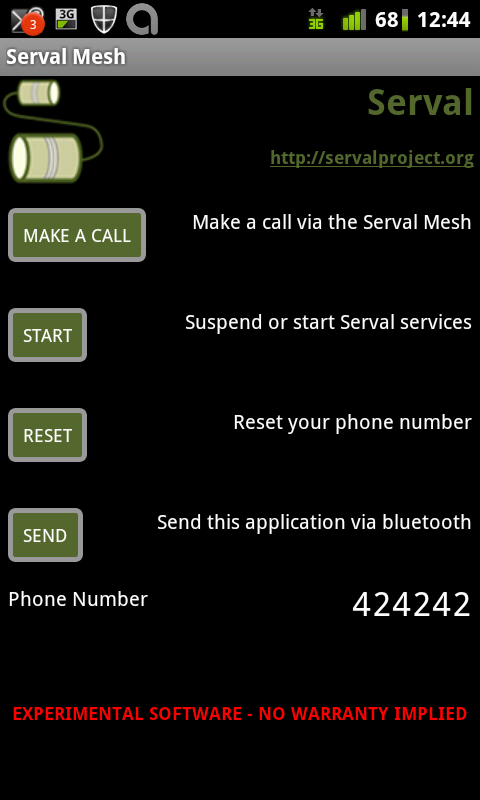
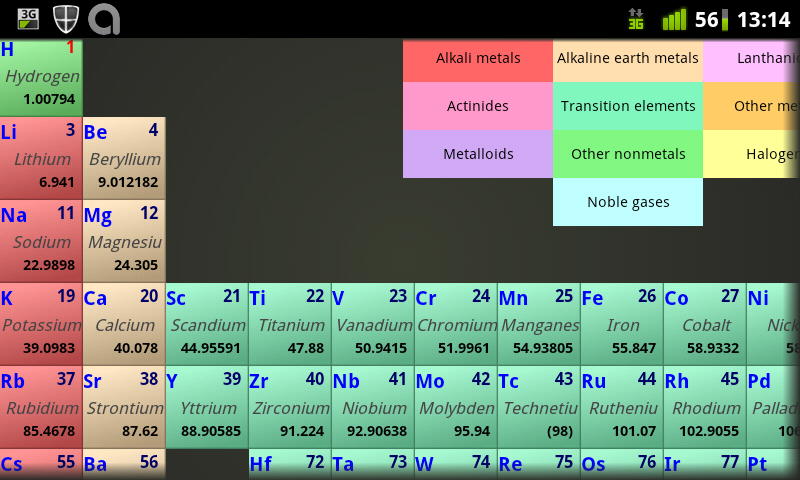
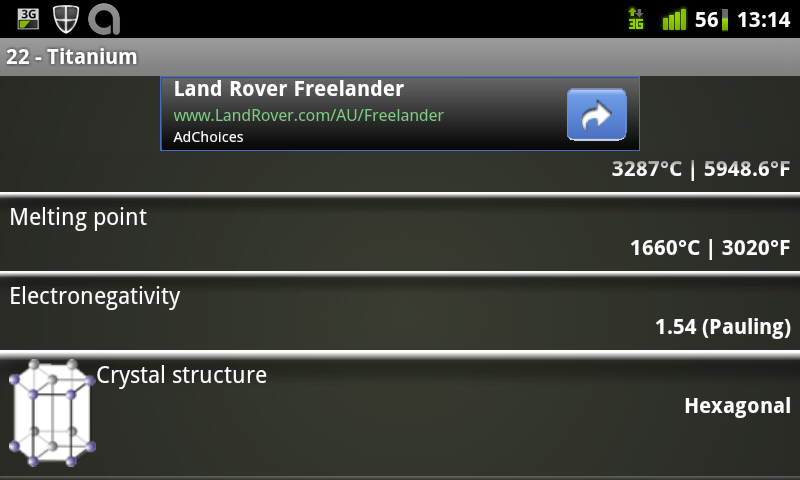
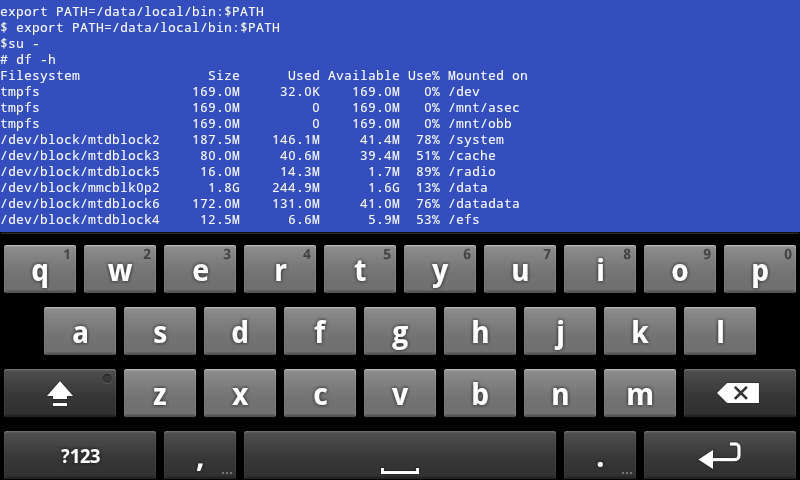
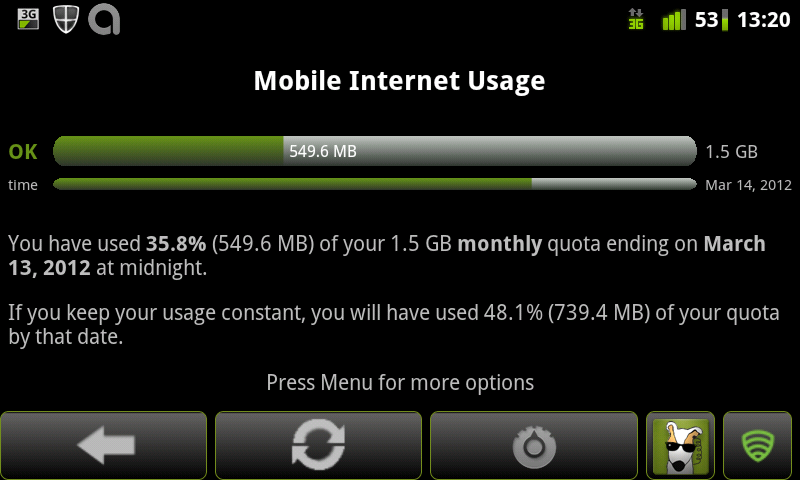
I gave a brief introductory talk about Android at this month s LUV meeting. Here are the slides with a brief description. All the screen-shots were made on a Samsung Galaxy S running Cyanogenmod version 7.1 [1] (Android version 2.3.7). With that build of Cyanogenmod you can press the power button for about 1.5 seconds to get a menu which gives an option to take a screen shot. The aim of the talk was to give an overview of what Android can do. I also gave some random commentary about Android such as explaining why it doesn t make a good phone. Most of the pictures in this post have links to the Android applications in question. Essential and Important Apps picture of root shell access running df I started by explaining why having root access to your system is really important, including the issue of backing up an Android phone [2]. Cyanogenmod includes a terminal program which allows you to run su - . Running a shell as root isn t generally that useful, what you really want is to be able to run programs such as Titanium Backup which can only work properly if given root access. When you run an OS that allows root access you can run su - at a terminal prompt and you can also have an application use a GUI to request root access. I recommend rooting and modding an Android phone immediately after buying it. However that takes some time which is somewhat equivalent to money and is a significant hidden cost to purchasing an Android phone. picture of 3g watchdog bandwidth monitor The business models of telephone companies seem to involve hidding users for unexpected fees and extra fees for excess bandwidth can be really expensive. 3G Watchdog is one app that can monitor bandwidth and disable data transfers if too much is used. Onavo is an alternative that allows tracking data use on a per-application basis, but it only runs on Android 2.3.x while 3G Watchdog works on Android 2.1. Official EBay app searching for Samsung Android phones EBay has an official app which is handy for searching for items. So far I ve only used it to get price estimates and have used a PC for buying. K9 viewing my SE Linux mailing list email K9 seems to be the best MUA for Android. The MUA that ships with Android 2.1 isn t nearly as good and K9 is good enough that I didn t even bother testing the MUA from Cyanogenmod. The above picture shows a list of mail in my SE Linux folder. graph by opticron grapher The Opticron Grapher is a good graphing calculator. I won t claim it s the best because I didn t seriously test such programs, but for the basic tests I ve done it has worked well. Google map of LUV location The Google Maps client comes with every Android system, the above shows the location of the LUV meeting. Open Street Map location of the LUV meeting Osmand is an Android client for the Open Street Map project. Here is the web site for the Open Street Map project [3]. One significant advantage of OSM over the Google Maps is that OSM is free, the data is all contributed by users like Wikipedia. Another significant advantage is that you can download as much data as you need to your phone, for example the entire dataset for Australia is about 200M. Storing 200M of data on your phone is no big deal when you consider the availability of phones with more than 16G of storage and the ability to use a map when offline is a real benefit. So far I ve used Osmand while waiting for a train at an underground station and I plan to use it to track my progress the next time I m on a cruise. serval mesh networking and VOIP Serval is a mesh networking application for Android that supports VOIP phone calls and distributing messages and files. It s designed to be used in disaster areas, but there are lots of other potential uses of the technology. The Serval Project blog has an article about the presentation they gave at LCA 2012 [4]. periodic table
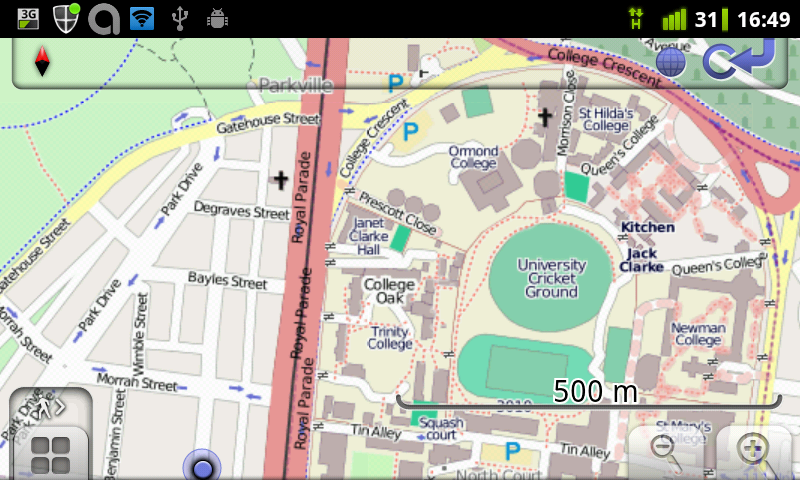
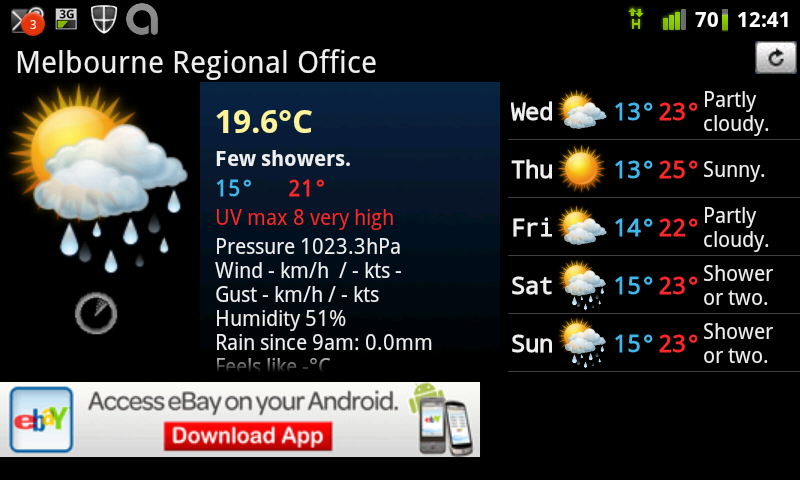
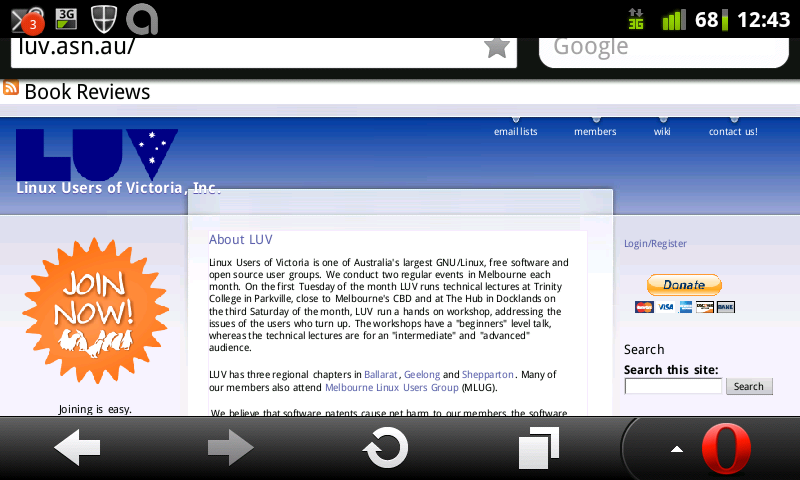
details about Titanium Periodic Droid is my favorite Periodic Table viewing program. tomfusion Au Weather forecast app The Tomfusion AU Weather forecast app seemed to be better than the one from the BoM last time I checked. It s probably the best weather app for Australia. screen-shot of LUV web site
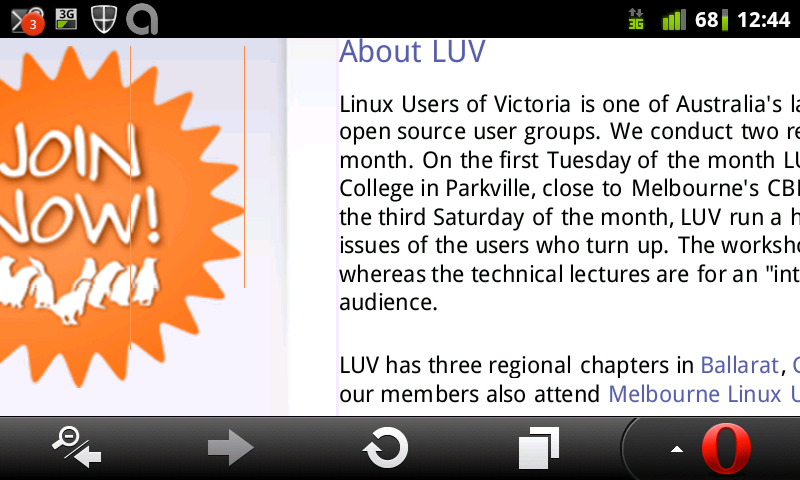
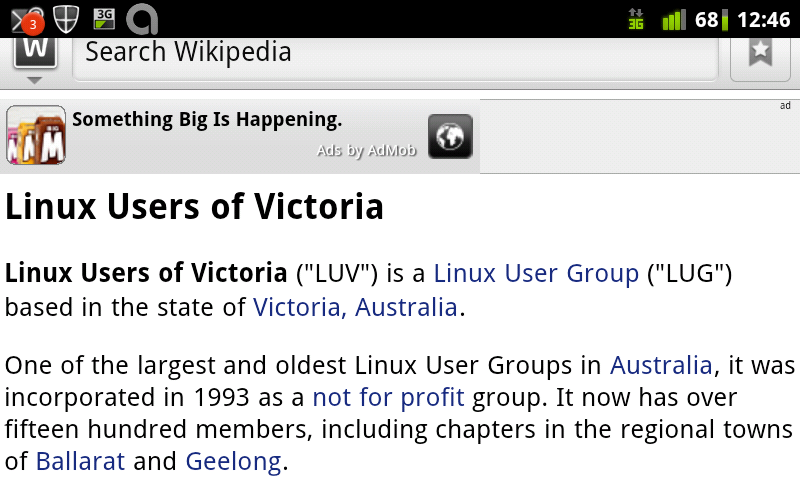
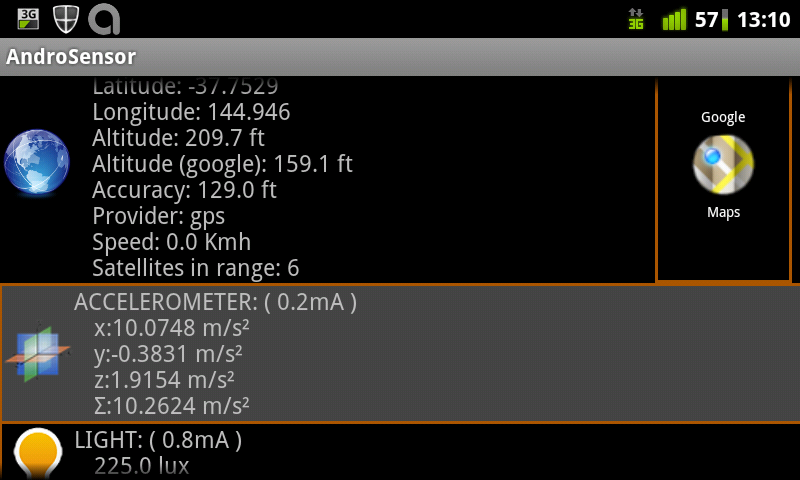
LUV web site zoomed in The Opera Mini browser is often faster than other browsers because it uses a compressing proxy run by Opera. It s not so good for privacy though LUV page on Wikipedia I have been using Wapedia for browsing Wikipedia. Since giving the talk I discovered the Official Wikipedia browser from the Wikimedia foundation [5] which is a better fit for my needs and I ve uninstalled Wapedia. As an aside modern phones have 16G of storage or more and could easily have a copy of the entire English text of Wikipedia on internal storage. It would be good if someone like Jason King (who is known for work on stand-alone DVD images for Wikipedia) was to write an Android program to do this. Handy Apps Androsensor showing GPS, accelleration, and light intensity
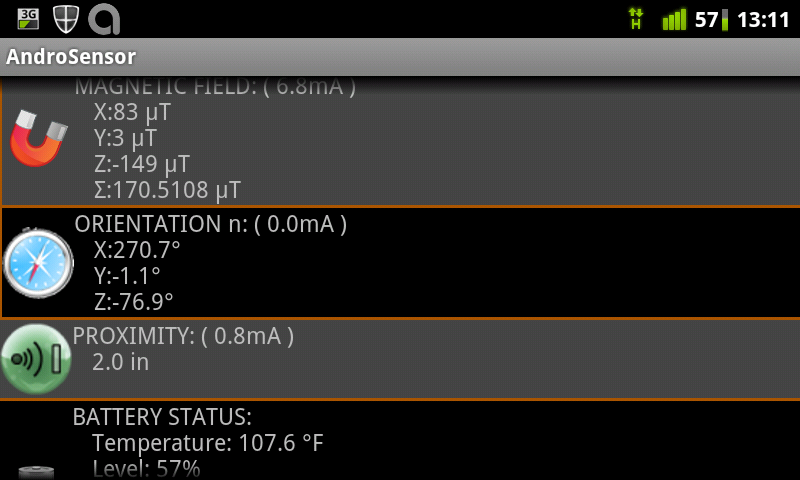
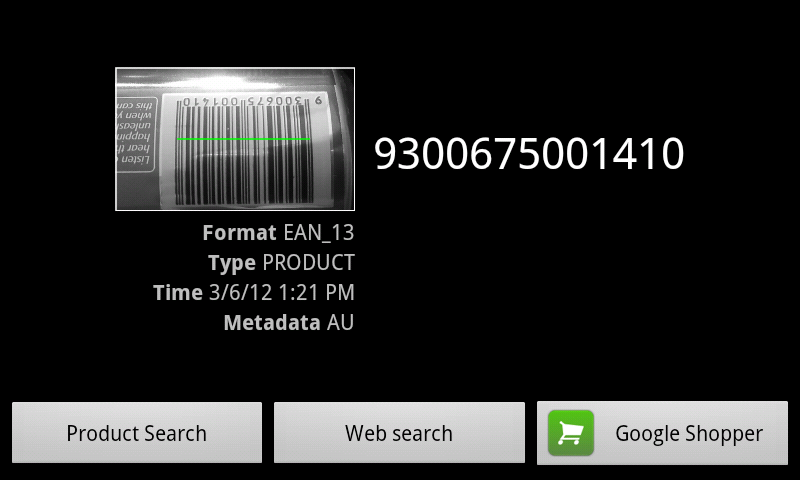
Androsensor showing magnetic field, orientation, and battery Androsensor is a program to display output from most (all?) of the sensors on your phone. The results aren t as accurate as one would hope, for example Earth s gravity is 9.81m/s^2 not the 10.26m/s^2 my phone registered. But they are a useful indication. picture of Coke can, scanning the barcode
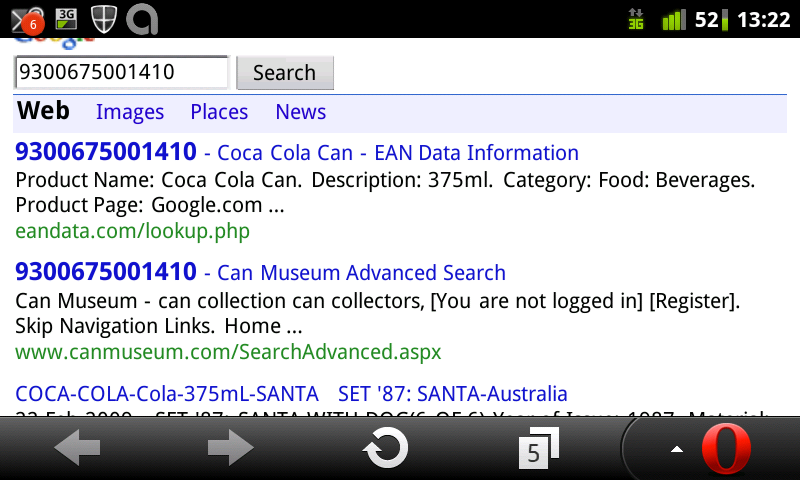
Google search on Coke can barcode
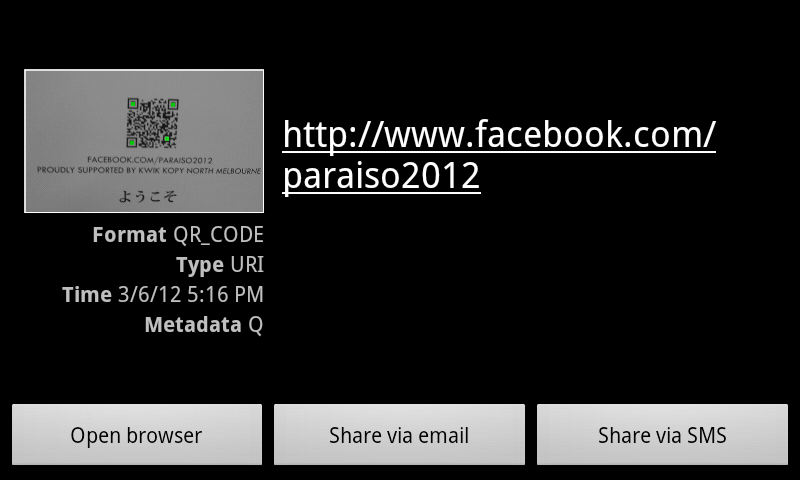
QR Code lookup of Facebook page The Zxing Barcode scanner is one of many programs that will scan barcodes with the camera in an Android phone. It can launch a Google search on a product code or open a URL from a
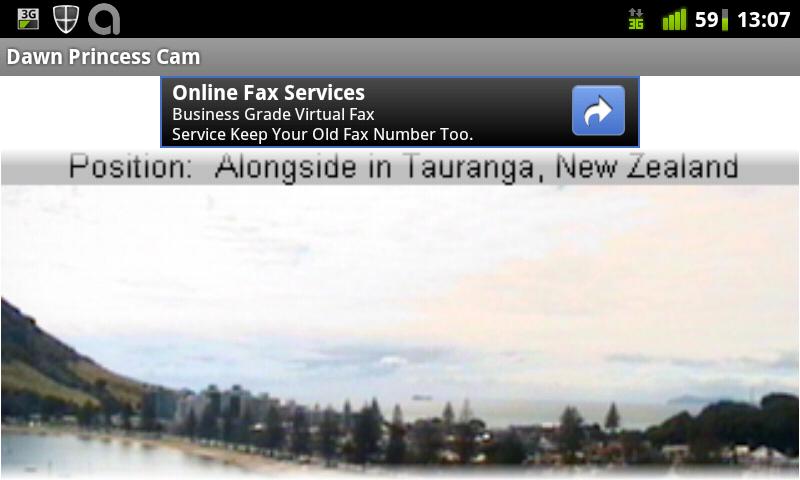
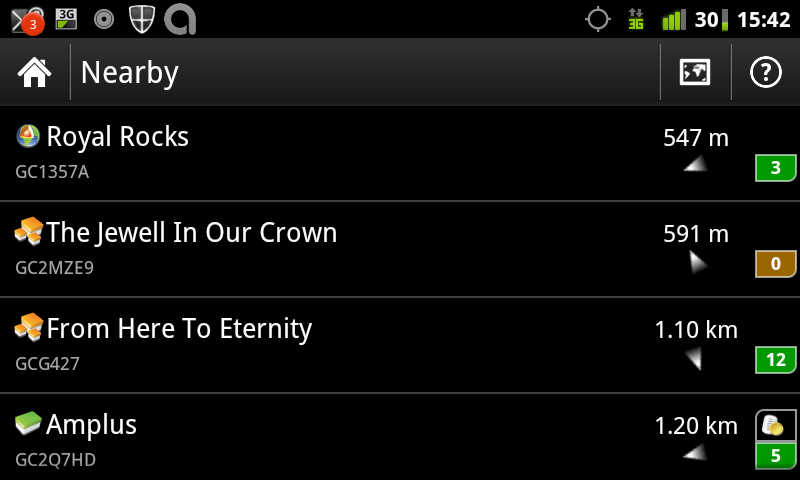
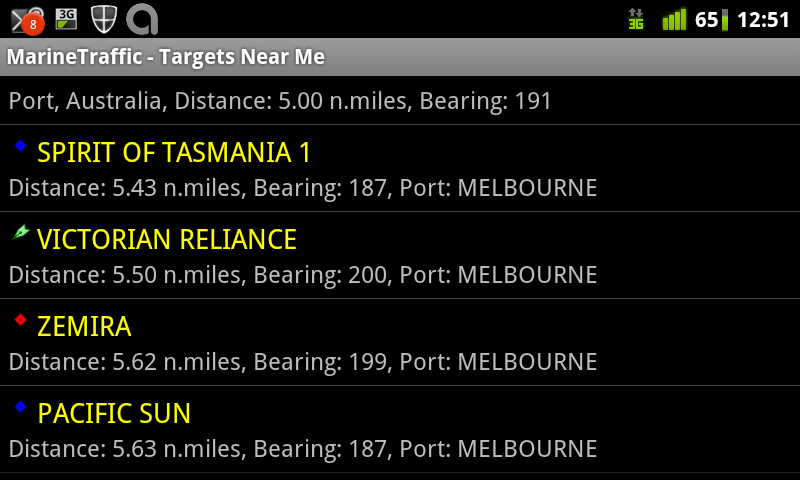
QR Code. The above pictures show it scanning a Coke can (the can and other background was displayed on the full screen before the screen capture program activated), doing a Google search on the can barcode, and looking up a QR code that was on an advertisment outside the LUV venue. picture from the bridge of the Dawn Princess in Tauranga NZ Cruise Cams allows you to download pictures from cruise ships. Some cruise ships have several cameras on different parts of the ship uploading pictures regularly so that people around the world can see what s happening. list of geo-caches near the park where I prepared most of my notes The c:geo opensource program allows you to get information on Geocaches and see a compass or map showing the location. This program has been getting an increasing number of features to do everything you might want to do related to Geocaching. The above picture shows some caches that are close to where I made the screen-shot, in a park a couple of Km from the meeting location. picture of Google Sky Map in the direction of Andromeda The Google Sky map uses augmented reality techniques to display stars in the direction that your phone is pointing along with their names and the names of the constellations. Marine Traffic showing ships near me
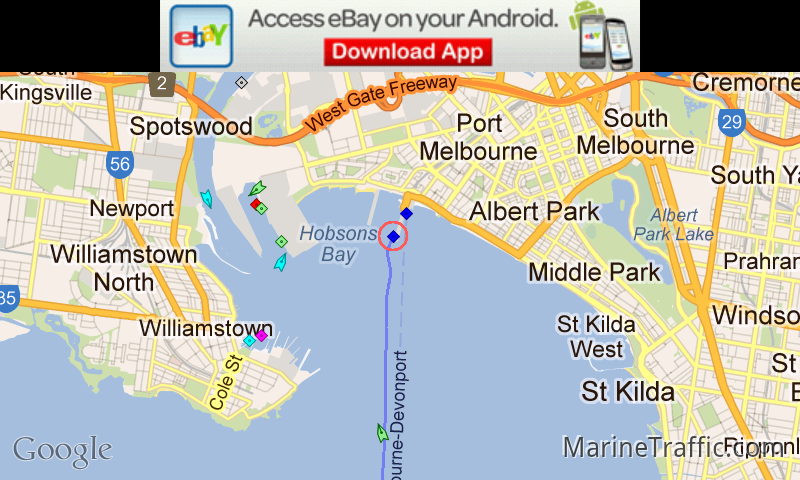
Marine Traffic showing the Pacific Sun highlighted on a Google Map
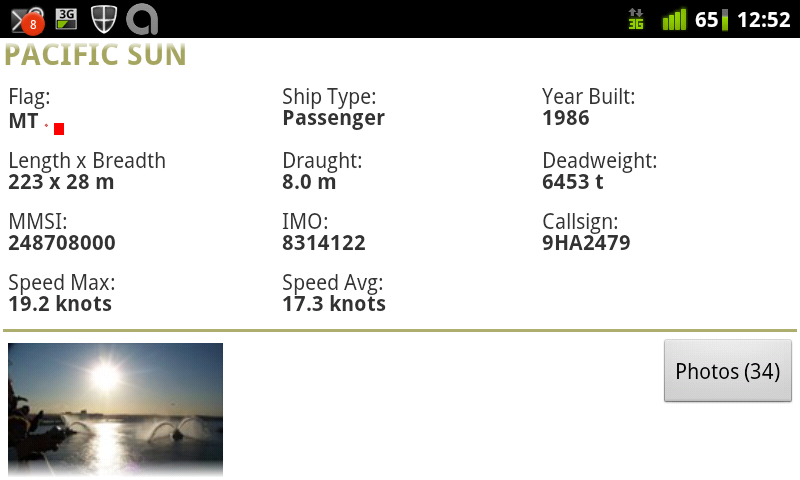
Marine Traffic showing details of the Pacific Sun
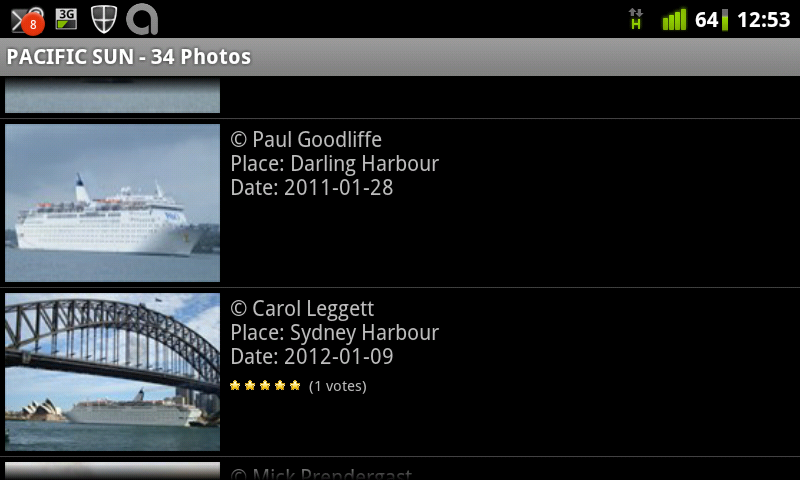
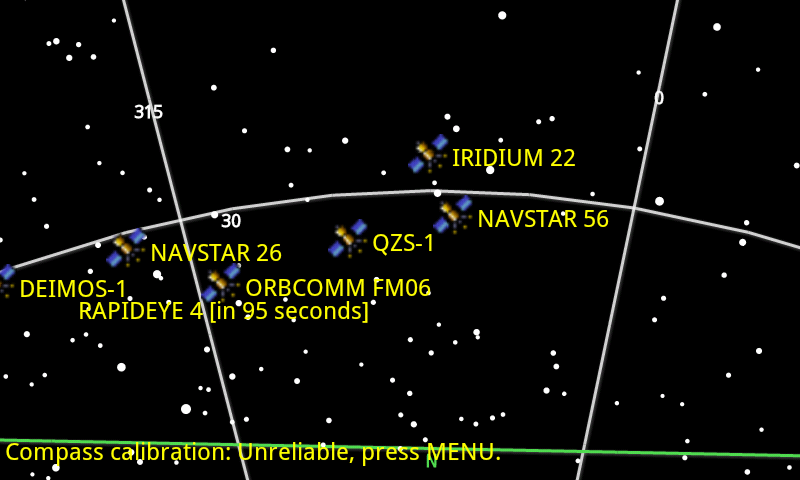
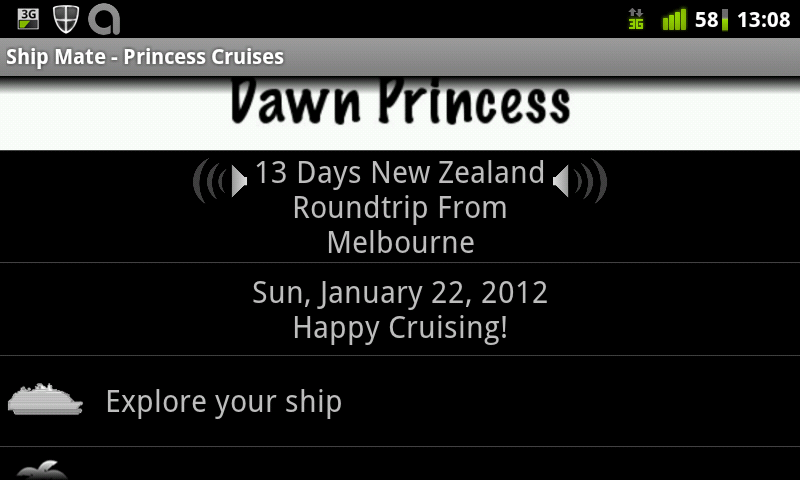
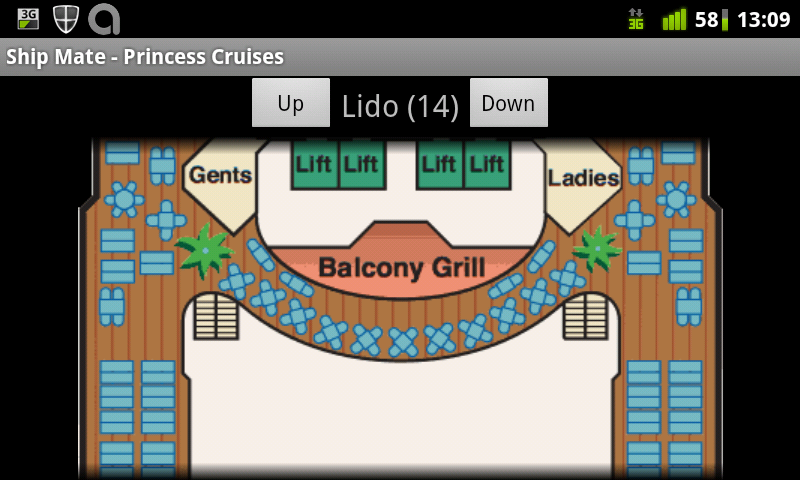
Photos of the Pacific sun taken by fans and shown by Marine Traffic The Marine Traffic program shows the locations of ships as well as lots of information about them. The above pictures show me discovering that the Pacific Sun was nearby, viewing it s location on Google Maps, seeing the details, and then viewing fan pictures. The developer s web site allows viewing all the same data without an Android phone [6]. Anyone can join the project by buying an Automatic Identification System (AIS) receiver and configuring a PC to take data from AIS and send it to the MarineTraffic.com servers. As an aside they seem to be missing coverage in western Victoria, so it would be good if someone near Apollo Bay or Warrnambool could install an AIS receiver and help out. Satellite map from Satellite AR Satellite AR uses augmented reality to show the location of satellites and other things in spare. Unfortunately the screen capture process turned off the camera as I had a sign advertising fast food positioned in an amusing location in the background. Shipmate overview of Dawn Princess
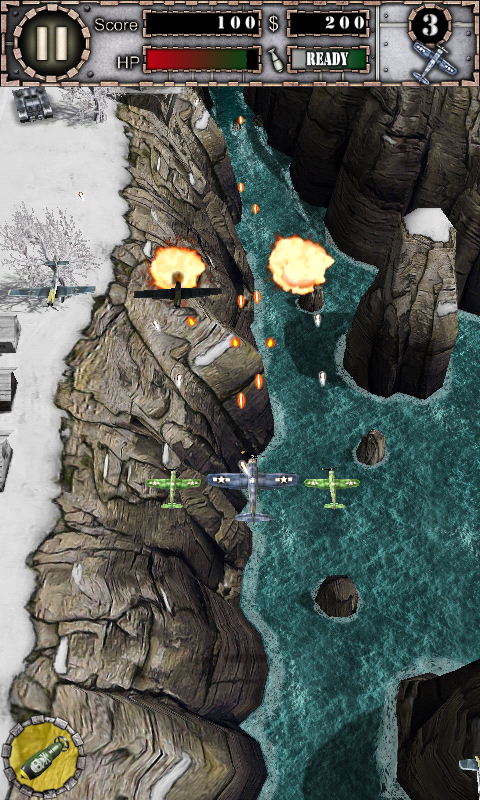
Shipmate map of Dawn Princess Shipmate publishes a set of programs giving information on cruise ships, they have one program for each cruise line. Above is the program for the Princess cruise line, the above pictures give information on the Dawn Princess. Unfortunately the program wasn t usable without net access when I tried to use it on a cruise ship. Games Air Attack HD game, clone of 1942 Air Attack HD is an entertaining game that demonstrates the capability of Android phones to run action games. Like many Android games it has a free version and paid versions if you want more. picture of Angry Birds Angry Birds is one of the most well known games for touch-screen devices. It has also spawned a huge line of merchandise. Labyrinth Lite
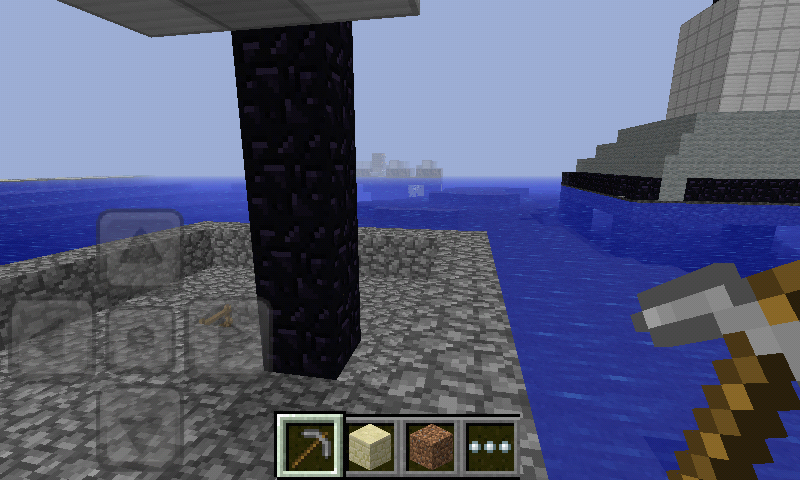
Labyrinth Lite from a different angle Labyrinth Lite is one of the many Android games based on the old mechanical game where you tilt a toy to roll a ball-bearing through a maze. It s free and is better than most of the free games in that genre. Minecraft Pocket Edtion Minecraft Pocket Edition allows you to play Minecraft on your phone. The demo version doesn t allow saving the game, you have to buy the game for about $5 if you want to do that. It also lacked the full features of the game last time I checked, it didn t have monsters. Paradise Island overview
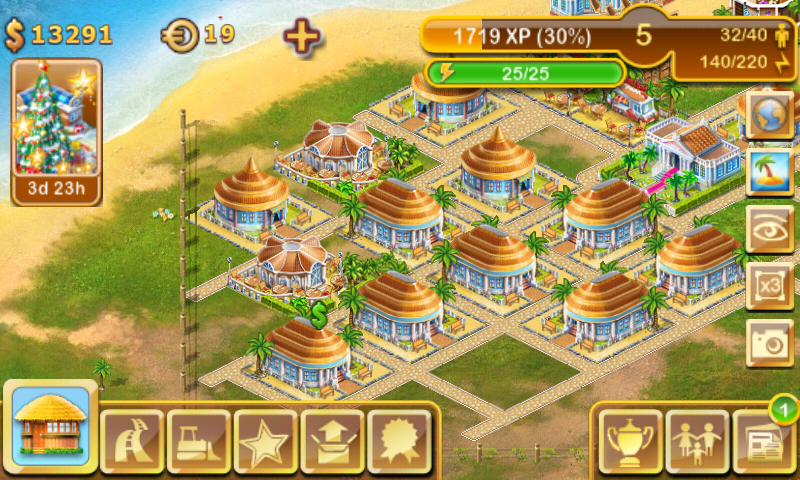
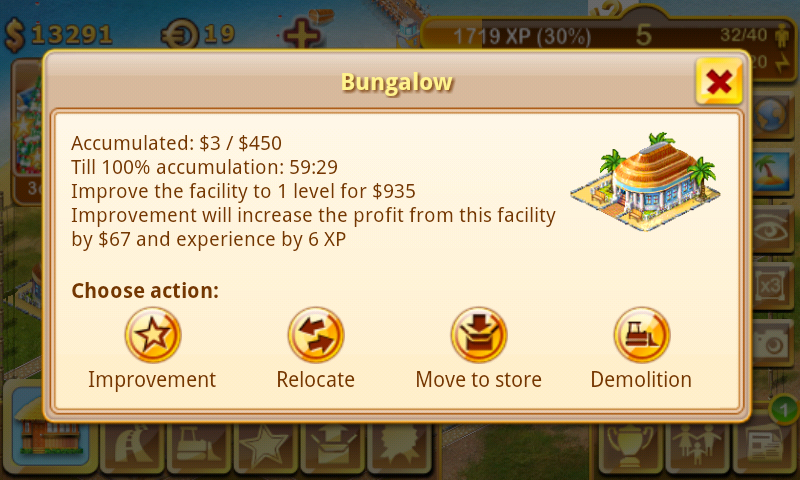
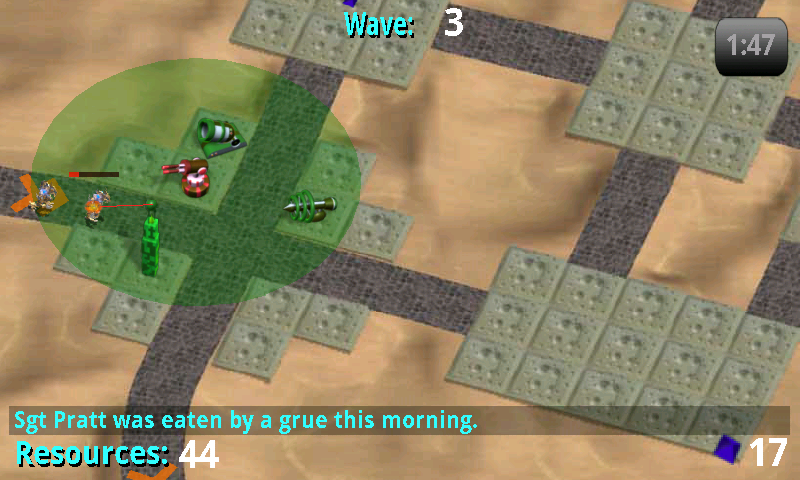
Paradise Island details of Bungalow Paradise Island is one of many business simulation games for Android. It s more playable than most and has very detailed graphics, but the down-side is that it s a memory hog and will crash if you don t have enough RAM. It s one of the games that are free to download but encourage you to pay money to level up, for some players it s probably a very expensive game. Tower Raiders 2, Pratt was eaten by a Grue Tower Raiders 2 is one of the better tower defense games for Android. Related posts:
  1. Choosing an Android Phone My phone contract ends in a few months, so I m...
  2. Galaxy S vs Xperia X10 and Android Network Access Galaxy S Review I ve just been given an indefinite loan...
  3. Standardising Android Don Marti wrote an amusing post about the lack of...

19 March 2012

Benjamin Mako Hill: A Manhattan Project for Clich Collection

This weekend, I launched an extremely ambitious effort to collect evidence of extremely ambitious efforts. The result was a short program that searched the web and revealed the: [Previously in this series: frailty, the invisible hand, science as dance.]

Jan Wagner: Chemnitzer Linuxtage 2012

As announced 3 weeks ago, the Debian project was present at Chemnitzer Linuxtage. Several talks and workshops where held by people related to the Debian project. At the booth we had talks and discussions with exhibitors and visitors, unfortunately I didn t had much time to visit more than small parts of two lectures. Unfortunately (for the visitors) we didn t had any merchandising on board, while we received several requests. On Sunday Axel surprised us with some leftovers from fosdem of debian.ch merch. At the booth we had a demo machine running Babelbox and xpenguins, which attracted visitors very well. Booth Babelbox We received also more than one Just thank you by satisfied users. :) Four different talks and one workshop were held by Debian people, but they were not specific to the Debian. The workshop was about OpenStreetMap, lectures was about commandline helpers, grep everything, quality analyzing and team management in opensource projects and Conkeror and other keyboard based webbrowsers. Many thanks to Jan Dittberner, Andreas Tille, Christian Hoffmann, Florian Baumann, Christoph Egger, Axel Beckert, Adam Schmalhofer, Markus Schnalke, Sebastian Harl and Patrick Matth i for running the booth, answering a wide range of questions or just chatting with visitors . A special thank to TMT GmbH & Co. KG for providing the complete equipment and sponsoring it s transportation. At the end we have to send a big thank to the organizing team of the Chemnitzer Linuxtage. It was fun and a pleasure to find new friends and meet old ones of the Free Software community. A small sidenote was anybody aware that OpenSuSE Package search is using screenshots.debian.net?

Russell Coker: Long Term Adverts

I ve just seen a mailing list post from someone who needs an ancient printer to work with their old software. As the printer is no longer manufactured and changing the software is expensive this puts them in a difficult situation which can be profitable for someone who happens to own an ancient printer that still works. This sort of thing is not uncommon at all. Ebay is a nice auction and online store site but it doesn t cater for long term personal adverts. I ve got a lot of old computer equipment that I keep because it might be useful at some time and it s a shame to throw away working equipment. I d like to be able to list that stuff on a sale site and have the adverts stay online for years just in case someone wants to pay a decent amount of money for it. If there was such a site I would also list all the systems in my test network, I can test software just as well with different hardware if someone wants to pay decent money for what I ve currently got. Storage space is pretty cheap and searching for keywords isn t that difficult either. The cost of running an online personal sale site for items that sell every few years isn t going to be much greater than running one that sells items after 10 days. But the profit in many cases will be a lot greater, an old printer that sells for $10 on Ebay could go for $200 or more if the seller could wait for a buyer who had some enterprise software that absolutely depended on that particular printer. Does anyone know of such an online sale site? If not does anyone want to start one? Related posts:
  1. Dear Magazines Please Publish Your Adverts Online When reading a magazine I often see an advert for...
  2. Friends and Adverts For some time I have been running Google Adsense adverts...
  3. Used Car Prices There is an interesting article in The Age about the...

18 March 2012

Gustavo Franco: Debian testing (wheezy) keyboardless install

I couldn't find an end-to-end document online about this just bits and pieces here and there. Let me describe how to install Debian testing (wheezy) without a keyboard using an USB flash drive and ssh.

I've got an HP Microserver a month or so ago and this is the step by step of my second install. The first one was also keyboardless but didn't involve an USB flash drive to bootstrap. I've used tftpd and dhcp from my laptop, but forgot to capture the notes to make a blog post. Shame on me.

Here's what you need:
The last two requirements are optional for hardcore preseeders. If you don't know what I mean. You aren't one of them. :)

Here's the step by step to install using SSH:
At this point you have all that you need to do a regular install using an USB flash drive and it's kinda of well documented. Well, we still need to change it to make it work without a keyboard and give you the ability to ssh into the installer.

Create a preseed.cfg in the root directory of the USB flash drive containing the following:
d-i netcfg/get_hostname string HOSTNAME
d-i netcfg/get_domain string DOMAIN
d-i anna/choose_modules string network-console
d-i network-console/password password INSERT_A_PASSWORD_HERE
d-i network-console/password-again password INSERT_A_PASSWORD_HERE

Edit syslinux.cfg in the root directory of the USB flash drive to look like this:
default netinst
prompt 0
timeout 5
label netinst
menu label netinst
 kernel linux
 append auto=true vga=normal file=/preseed.cfg initrd=initrd.gz priority=critical
My wishlist to the d-i hackers out there:
  • A boot-ssh.img.gz with the syslinux.cfg and preeseed.cfg above. In this case, it would be much more trivial to document in the installer manual how to use such a great feature.

Pablo Lorenzzoni: Time to change Window Manager again?

Ten years ago I was a fan of NEXTSTEP desktops and a die hard user of Window Maker. I love dockapps, and used to collect them. Things changed, and, as I moved from Desktops to Laptops, I began using simpler Window Managers. The powerful keyboard-shortcuts Fluxbox along with its capability to join windows with tabbing won me over and I began using it in my Laptop, while preserving Window Maker in my Desktop. In time, Fluxbox were used in both sides. Then the netbooks came and I bought an EeePC. The screen was so small that even the non-obstructive nature of Fluxbox were not enough. I began to try tiling window managers and I settle for Awesome. I was using Fluxbox in my Desktop and my Laptop, but Awesome was running in my Netbook. Tiling was making a lot of more sense and I could be productive, even in a small Netbook. Eventually, I started using Bluetile in my Laptop. Also, Bluetile was written in Haskell, and I was interested in Functional Languages by that time Now I got a new Laptop, and, since it features a Realtek 8191SE Wi-fi card, I had to install Wheezy (in my laptop, I usually run stable). Wheezy comes with the new GNOME 3 desktop, of which I read a lot. I decided to give it a try. I am missing advanced tiling (it seems that GNOME3 tiling works just in the side-by-side approach) and I also think that creating custom launchers should be improved but so far I am not disliking it, which is a good step toward adopting it. I ll give it a week to convince me. Let s see how it works its charm on me :-)

Andrew Pollock: [life] Guantanamo: My Journey

I first learned that David Hicks had written an autobiography when I saw some press coverage of there being an attempt by the Australian Government to ban the sale of it, so I asked my sister if she could get me a copy for my birthday before any ban happened. The book doesn't appear to be available on Amazon. I sat down and tried to read it almost immediately, but at the time found his writing style to be rather inarticulate, so I put the book down for a month or so. When I next had a platelet donation to make, I took it along with me, and forced myself to read it for duration of the donation. On the second reading, I managed to engage with the book, and from that point on, once I made it through his early years in that initial forced reading session, it ended up being quite enthralling. I plugged my way through the 456 pages in a bit over a month I guess. We'll never truly know the full story of David Hicks, because I'm sure that unless there's some sort of inquiry (and even then, there's multiple country's governments involved), the full story won't come out. I was always sympathetic to Hicks' plight, since I don't believe that anyone should be held without due process let alone for anywhere near as long as he was. Certainly, the way the book reads, Hicks comes across as a very young, naive, but principled individual. Like many Australians, he got the travel bug, and by way of it, got to interact with some different cultures, which awakened a hunger for social justice in him (at least that's my interpretation of his portrayal). I guess I have a different mental image of torture than Hicks did, because I didn't really find any incidences of what I'd consider torture in his story. There was plenty of despicable, inhumane treatment though, so I can see how the line might get blurry, particularly if you're the one experiencing it. Specifically on the (mis)treatment of the detainees: it was pretty bad, based on the book. I'm surprised there haven't been more whistle blowers that have come out. I can't believe that the many soldiers who were stationed there could treat detainees the way Hicks says they were treated and then can look themselves in the mirror. The ICRC seemed well apprised of the detainees conditions (since they seemed to have the most access to them of any non-military people). I don't know what confidentiality is imposed on them in return for that access, though. The fact that he's able to string a sentence together at all after the treatment he describes for the length of time he received it, I think is pretty amazing. I couldn't imagine having to endure what he says he went through. I did feel quite appalled by my own country's complete disregard for his plight, and similarly in the way the US Government treated these detainees for as long as they did. Given there are still 171 detainees in Guantanamo today, it makes me wonder what the conditions and treatment are like there now. It certainly seems to have fallen out of the mainstream press. Overall, not the most well written book, but a fascinating and shocking account of what happened to one person. I think Hicks should be congratulated for the courage to relive his experiences to get them down on paper, and Random House should also be congratulated for publishing his work, which I'm sure put them under some political pressure. I have no idea how well the book has sold, or how widely it has been read, but I certainly recommend it.

Charles Plessy: Debian-installer in a cloud.

Debian Med prepares a metapackage for multi-purpose image machines, containing packages for bioinformatics that can be used in command line or via scripts, and that do not depend on too many other packages. I would like to prepare such an image for the Amazon cloud in the most secure manner, and the simplest way is to build it automatically in order to not have to clean anything at the end of the process. I tried for months so use the Debian installer, but banged my head against walls repeatedly, as it was impossible to re-partition the volume on which the installer was started. In the end, I figured out that this was not necessary. For instance, one can start an image containing the installer on a micro instance (-t t1.micro), with an additional volume of one gibibyte (-b /dev/sdb=:1:false) to install Debian on, and preseed the installer via instance metadata (-f preseed.txt) using a file prepared in advance. When the installation finishes, the instance terminates instead of stopping (--instance-initiated-shutdown-behavior terminate), and its volumes disappear, except the one where Debian was installed (/dev/sdb=:1:false). Debian-installer in Stable is not often updated, and its size is very small. One can therefore think of releasing one machine image per zone and architecture. I did so for T ky (ap-northeast-1) on amd64. It contains the kernel, its initrd, and a GRUB 1 menu for pvgrub, that passes the following options: console=hvc0 auto=true priority=critical url=http://169.254.169.254/latest/user-data DEBIAN_FRONTEND=text. Two key pieces are missing in the resulting system. When the kernel is installed or updated, the GRUB 1 configuration file for pvgrub must be refreshed. Also, the system must be able to retrieve a public SSH key provided through the instance metadata, to allow one to log in without using a predefined password. These two functions are provided by the cloud-init package, available in Ubuntu and Fedora. I am looking for volunteers to maintain or co-maintain cloud-init in Debian.

17 March 2012

Kai Wasserb ch: The joy of building Wine in a non-multiarch environment

This is an updated and consolidated post for/of two previous blog entries. Before I continue, let me make it clear, that this post isn't intended to criticise anybody. It is meant as a instruction leaflet to go with my unofficial (source) package(s). The best idea, until all build dependencies of Wine have been made multiarch ready (we're almost there), is to create a base.tgz for pbuilder in which you make the required changes. So you don't have to remember applying them everytime (note, this is only needed for amd64 builds). After you created yourself a base.tgz for Wine, do the follwoing:
  1. Log into the chroot stored in your base.tgz for Wine: pbuilder --login --save-after-login --basetgz /path/to/your/wine.base.tgz
  2. Update the package list and installed packages with aptitude update && aptitude safe-upgrade unless you know, everything is updated.
  3. Install ia32-libs-dev and libjpeg-dev: aptitude install ia32-libs-dev libjpeg-dev
  4. Work around #638543:
    1. cd /usr/lib32
    2. rm libjpeg.so libjpeg.so.62* (you can also remove the libjpeg.a and libjpeg.la files)
    3. ln -s libjpeg.so.8 libjpeg.so
    4. cd /usr/include
    5. ln -s x86_64-linux-gnu/jconfig.h
  5. As we build build with GCC 4.5 (due to a problem with GCC 4.6, see WineHQ bug #22053 for more details) on amd64 (i386 isn't using GCC 4.5 anymore (since the 1.5.0-0.2 packages), because that resulted in linking errors), we hit #638418. To work around that, you need to create the symlink yourself. Execute ln -s x86_64-linux-gnu/asm asm in /usr/include.
  6. Exit the chroot, pbuilder should now update your base.tgz.
  7. Build the source package with pbuilder.
For i386 users this shouldn't be required. Not even the symlinking of the asm directory, as we don't use GCC 4.5 anylonger on i386 (due to various linking errors). Though that comes at the cost of potential issues with e.g. Steam.

16 March 2012

Matt Brown: Kindle Reading Stats

I ve written before about my initial investigations into the Kindle, and I ve learnt much more about the software and how it communicates with the Amazon servers since then, but it all requires detailed technical explanation which I can never seem to find the motivation to write down. Extracting reading data out of the system log files is however comparatively simple. I m a big fan of measurement and data so my motivation and goal for the Kindle log files was to see if I could extract some useful information about my Kindle use and reading patterns. In particular, I m interested in tracking my pace of reading, and how much time I spend reading over time. You ll recall from the previous post that the Kindle keeps a fairly detailed syslog containing many events, including power state changes, and changes in the Booklet software system including opening and closing books and position information. You can eyeball any one of those logfiles and understand what is going on fairly quickly, so the analysis scripts are at the core just a set of regexps to extract the relevant lines and a small bit of logic to link them together and calculate time spent in each state/book. You can find the scripts on Github: https://github.com/mattbnz/kindle-utils Of course, they re not quite that simple. The Kindle doesn t seem to have a proper hardware clock (or mine has a broken hardware clock). My Kindle comes back from every reboot thinking it s either at the epoch or somewhere in the middle of 2010, the time doesn t get corrected until it can find a network connection and ping an Amazon server for an update, so if you have the network disabled it might be many days or weeks of reading before the system time is updated to reality. Once it has a network connection it uses the MCC reported by the 3G modem to infer what timezone it should be in, and switches the system clock to local time. Unfortunately the log entries all look like this:
110703:193542 cvm[7908]: I TimezoneService:MCCChanged:mcc=310,old=GB,new=US:
110703:193542 cvm[7908]: I TimezoneService:TimeZoneChange:offset=-25200,zone=America/Los_Angeles,country=US:
110703:193542 cvm[7908]: I LipcService:EventArrived:source=com.lab126.wan,name=localTimeOffsetChanged,arg0=-25200,arg1=1309689302:
110703:193542 cvm[7908]: I TimezoneService:LTOChanged:time=1309689302000,lto=-25200000:
110703:183542 system: I wancontrol:pc:processing "pppstart"
110703:193542 cvm[7908]: I LipcService:EventArrived:source=com.lab126.wan,name=dataStateChanged,arg0=2,arg1=:
110703:183542 cvm[7908]: I ConnectionService:LipcEventArrived:source=com.lab126.cmd,name=intfPropertiesChanged,arg0=
,arg1=wan:
110703:183542 cvm[7908]: W ConnectionService:UnhandledLipcEvent:event=intfPropertiesChanged:
110703:193542 wifid[2486]: I wmgr:event:handleWpasupNotify(<2>CTRL-EVENT-DISCONNECTED), state=Searching:
110703:113542 wifid[2486]: I spectator:conn-assoc-fail:t=374931.469106, bssid=00:00:00:00:00:00:
110703:113542 wifid[2486]: I sysev:dispatch:code=Conn failed:
110703:183542 cvm[7908]: I LipcService:EventArrived:source=com.lab126.wifid,name=cmConnectionFailed,arg0=Failed to connect to WiFi network,arg1=
:
Notice how there is no timezone information associated with the date/time information on each line. Worse still the different daemons are logging in at least 3 different timezones/DST offsets all interspersed within the same logfile. Argh!! So our simple script that just extracts a few regexps and links them together nearly doubles in size to handle the various time and date convolutions that the logs present. Really, the world should just use UTC everywhere. Life would be so much simpler. The end result is a script that spits out information like:

B000FC1PJI: Quicksilver: Read 1 times. Last Finished: Fri Mar 16 18:30:57 2012
- Tue Feb 21 11:06:24 2012 => Fri Mar 16 18:30:57 2012. Reading time 19 hours, 29 mins (p9 => p914)
... Read 51 books in total. 9 days, 2 hours, 29 mins of reading time
I haven t got to the point of actually calculating reading pace yet, but the necessary data is all there and I find the overall reading time stats interesting enough for now. If you have a jailbroken Kindle, I d love for you to have a play and let me know what you think. You ll probably find logs going back at least 2-3 weeks still on your Kindle to start with, and you can use the fetch-logs script to regularly pull them down to more permanent storage if you desire.

Dirk Eddelbuettel: digest 0.5.2

A new version of the digest package (which generates hash function summaries for arbitrary (and possibly nested) R objects using any of the standard md5, sha-1, sha-256 or crc32 algorithms) is now on CRAN. Murray Stokely noticed a corner case where a file that was inaccessible lead to a segmentation fault. Thanks to his patch, this is now caught and flagged. He even added a test for it and fixed another one of my idioms. Nice work, so keep the patches coming folks :) CRANberries provides the usual summary of changes to version 0.5.1. As usual, our package is available via the R-Forge page leading to svn and tarball access, my digest page and the local directory here.

Pablo Lorenzzoni: Windows Laptop with Debian Recovery Partition

I was playing with my new Laptop (a Philco 14E-P686WP) that comes with (argh!) Windows 7. I was gathering information in order to avoid surprises with regards to drivers and hardware-compatibility so I can proceed with the Debian installation By doing that with a new machine, I, usually, peek and poke everywhere, including the Recovery System. I was shocked to find out that this (argh) Windows 7 laptop has a bootable recovery partition loaded with a customized Debian just to run Partclone which installs a Windows factory image. I was about to take some pictures of the process, but I managed to find some in a forum post. Debian is being used to re-install (argh) Windows How sad is that! ;-)

15 March 2012

Andreas Barth: Traveling to DebConf 11 - Mostar to Sarajevo

During daytime, I finally bought a train ticket from Mostar to Sarajevo. The ticket for the 100 kilometers trip was 10 KM, which are 5 Euro.
Mostar train station Right on time the train entered the station. However, we had a 30 minutes delay there without any obvious cause or communications. This train was (as well as the previous in Hrvatska) between full and overcrowded, in spite of the bad connections. I however learned soon why these carriages shouldn't go to other parts of europe: The window in our compartment was replaced, so it couldn't be opened any more (and we had no means of fresh air). That wasn't as bad as it sounded, as the train doors weren't locked, so someone opened the door while the train was moving and "locked" it with paper so we could get fresh air (and this configuration stayed all the way to Sarajevo at least, so it was that way for about 4 hours). After leaving Mostar, there were soon signs between the train and the river that the area was mined, so one shouldn't go there. The train drives through beautiful landscape. After it got dark, the electric light within the train was not working, so we had (at best) our mobil phones to provide us with light (strange modern times).
Mine warning between the train tracks and the River Neretva In spite (or: because?) of these technical issues, I meet a few local people from Sarajevo and from all parts of Europe. So the train trip proved to be nice and entertaining, and I learned a bit about government issues there. Along the tracks, the signals were non-functional. The trains were directed only by flags (and hand-lights) from personal. On entering any station the train had to slow down till I got shown the relevant flag or hand-light that allowed it to leave the station again. Another heritage from the last war. With due delay, the train arrived in Sarajevo. Due to missing information at the tram stop, I didn't know that the trams to the train station didn't run that late (but I had the information that there would be trams if the train was on time). As it was late, I shortcut that by taking a taxi to the hotel (if I were to arrive in Sarajevo again, I would walk one tram station to the main line - but well, travelling is also about experiences). Unplanned that evening was also the Sarajevo film festival, with one stage opposite of the hotel window. As this was almost closing down when I arrived in Sarajevo, nothing to worry but to enjoy.

Debian Med: Bits from Debian Med team (Posted by Andreas Tille)

Hi,

in this bits:
  1. Debian Med Bug Squashing Advent Calendar 2011
  2. Anniversary of Debian Med
  3. Second Debian Med sprint (Southport, 27th-29th January 2012)
  4. Mentoring of Month (MoM)
  5. DDs who came to Debian because of Debian Med
  6. Future plans
  7. General lessons learned

Debian Med Bug Squashing Advent Calendar 2011In December last year Thorsten Alteholz has started a nice QA initiative which might be interesting for other teams next Advent. The Debian Med team was able to fix about 70 bugs in this time. Thanks to Thorsten for this nice piece of motivation and thanks to everybody who took part in the bug squashing.

Anniversary of Debian MedOn Mon, 7 Jan 2002 the Debian Med project was first officially announced. I submitted a short blog posting about this and perhaps you might like to see a long sequence of talks about this topic.

Second Debian Med sprint (Southport, 27th-29th January 2012)In end of January 2012 the Debian Med team has met to the second sprint. As last year I would call this a very successfull event and I would recommend other teams to instanciate such meetings as well. Feel free to read my more verbose report.

Mentoring of Month (MoM)I have started this project for the following reasons:
I made a short summary how the first MoM project worked (see at bottom).

DDs who came to Debian because of Debian MedAfter realising that several members of the Debian Med team finally became DDs I made a little survey to find out about their reasons to become DD / DM. I came to the conclusion that a Blend could be a nice entry point for people to join Debian because newcomers can identify themselves with a known topic (the scope of the Blend - in this case medicine and bioinformatics) first and learn Debian rules in a team with common interest. This perfectly fits my expectation which I had from the beginning 10 years ago and I would be very happy if other Blends would follow this example to be nice, inviting and try to *actively* ask people for cooperation (see some simple rules which I learned in this process below). In the teammetrics GSOC project some graphs were created where you can see the level of contribution of these people (and other team members).

Future plansCurrently some heavy work regarding bringing bibliographic references about packages straight into package information is going on. This topic is specifically interesting in Biology because programs are frequently connected to some publication about the methods used inside the code. This topic is as well relevant to Debian Science and DebiChem. Thanks to the patient work done by Charles Plessy we now have about 70 packages featuring debian/upstream files featuring bibliographic references and there is ongoing work to move these data to UDD to enable further usage. We are in the process of final polishing the format and finishing scripts for the import. If people are interested to join this effort this would be the right moment to raise their hand.

General lessons learned
  1. Do not let wait anybody who wants to do work.
  2. Newcomers are frequently shy - try to invite them kindly and patiently.
  3. Tell people verbosely about your project - it is astonishing how less people know and what wrong assumptions they make about your project.

Kind regards
Andreas.

14 March 2012

Stefano Zacchiroli: not a catchy headline

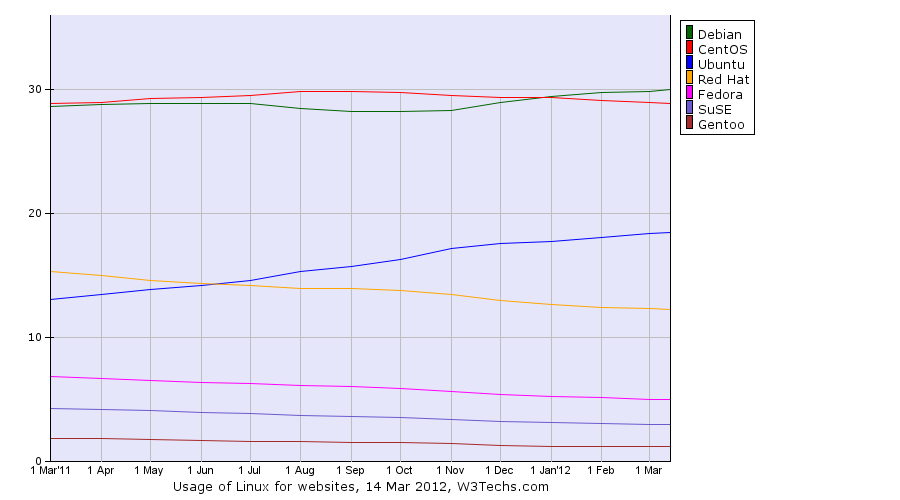
As we're doing trends today, I got curious about Debian. I don't particularly care about popularity contests other than popcon, and Debian choices surely aren't driven by them. But hey, curiosity is curiosity, right? So, here are today's w3techs trends for websites using GNU/Linux, with all lines shown:
Debian: 30%; CentOS: 28,9%; Ubuntu: 18,4%; Red Hat: 12,2%; Fedora: 5%; SuSE: 3%; Gentoo: 1,2%
(As thou shall always read methodologies before stats, here is the technologies overview page.) Debian is the top entrant with 30% of the websites using GNU/Linux. What I find interesting is that Debian has jumped at first place in January 2012, significantly after the release of our current stable release, Squeeze, that dates back to February 2011. It is also interesting to see community distros (Debian and CentOS) starkly ahead of commercially backed distros. That is what I find most fascinating about our projects. Whether that will remain the case or not is, for me, one of the big questions of the decade for the self-determination of Free Software communities.

Next.

Previous.