Search Results: "ron"

25 July 2010

Russell Coker: Links July 2010

David Byrne gave an interesting TED talk about how changes to architecture drove changes to musical styles [1]. I think he does stretch the point a little. To a certain extent people develop the most complex instruments and the largest music halls that can be supported by the level of technology in their society people with a hunter-gatherer civilisation play drums because they can build them and can carry them. The NY Times has an interesting article about paternity leave in Sweden [2]. The Swedish government pays for a total of 13 months leave that can be split between parents for every child. Of those 13 months 2 months can only be taken by the father and that is likely to increase to a minimum of 4 months of paternity leave after the next election. Dan Meyer gave an interesting TEDX talk about how the current math curriculum in the US (as well as Australia and lots of other countries that do the same thing) is totally wrong [3]. His main point is that maths problems should be based on real-world use cases where not all needed data is immediately available and there is also useless data that must be discarded. He believes that the most important thing is developing mathematical problem solving skills basically the things that I did for fun when I was in primary school are skills that need to be taught to high-school students The Atlantic magazine has an amusing article by Daniel Byman and Christine Fair about the incompetent Islamic terrorists [4]. In Afghanistan half the suicide bombers kill only themselves and the US government has a lot of evidence of Taliban soldiers practicing bestiality and collecting porn. Islamic extremist groups are staffed by people who are bad soldiers and bad Muslims. Jon Masters wrote an interesting post titled What Would Jesus Buy about ethical purchasing decisions [5]. Jon references The Church of Stop Shopping which isn t a real religious organisation but a street theatre activist group. ZeroHedga has an insightful article comparing corporations and the US government to street gangs [6]. The conclusion is that when gangs take over a neighbourhood everyone has to join a gang for their own protection. Hillel Cooperman gave an interesting TED talk about being obsessed with Lego [7]. He compares Lego fans to Furries and makes a good case for this comparison. Marian Bantjes gave an interesting TED talk about her graphic art / graphic design work [8]. I ve never seen anything quite like this. Business Insider has an interesting article about oil cleanup, it seems that most people who worked on the Exxon Valdez disaster are now dead [9], s opposed to most people who worked in almost every other occupation at that time who are either still working or enjoying their retirement. The current gulf disaster is bigger, will require more workers for the cleanup, and can be expected to have a higher death toll. Some people claim that measures to reduce oil efficiency will impact the economy, how will millions of people who are chronically ill for the rest of their lives impact the economy? The NY Times has an interesting article on circle lenses [10], contact lenses designed to make the eyes look larger. It s illegal to sell contact lenses in the US without a prescription, but the latest trend is for women to buy them online in a variety of colors. The FDA should probably approve them, it would be better to have the quality controls you expect from a medical supply company instead of having people rely on Malaysian mail-order companies for the safety of their eyes. Don Marti has written an interesting article about the economic decline in the US, he suggests making pension funds invest in local jobs [11]. Companies are supposed to act on behalf of their stock-holders, but US companies often have the majority of their stock owned by the pension funds of workers but they act on behalf of a small number of rich people who own a minority of the stock. Don s article was inspired by Andy Grove s article in Bloomberg about the stagnation in technological development that has been caused by off-shoring the manufacturing [12]. Neil Brown has completed a test release of a new Linux software RAID feature for arrays with multiple redundancy that have bad sectors [13]. When a disk gets a bad sector the current behavior is to kick it out of the array, if you have two such errors on a 3 disk RAID-1 or a RAID-6 array then you lose all redundancy and are at risk of catastrophic failure even though in most cases both disks will still mostly work. With this patch some regions of the disk may be excluded but it can provide redundancy for other stripes. Thanks Neil for your great work here, and all your previous work over the last 10+ years! The RSPCA has a new campaign titled Close the Puppy Factories [14]. Dogs are kept in very poor conditions and forced to churn out puppies for their entire lives to supply pet stores. The RSPCA recommends that people buy puppies from registered dog breeders (not registered dog breeding companies ) and ask to see the dog s parents. They also recommend not buying from classified adverts or pet stores. Animal shelters have to euthenise huge numbers of unwanted animals, you can buy a pet dog or cat from an animal shelter for a small fee that covers the expenses related to housing and spaying it and save that animal from being euthenised! Maureen Dowd criticises the Catholic Church properly in an article for the New York Times [15]. The Catholic Church officially regards ordaining a woman and raping a child to be equally bad offenses. Frank Rich wrote an interesting column for the New York Times about Mel Gibson [16]. He describes the destruction of Mel Gibson s reputation as a symptom of changes in the culture in the US and also links it to the fall of Ted Haggard (who supported Gibson s most notorious movie The Passion of the Christ).

Steve Kemp: My router serves Debian installer via gPXE

My Linksys router now serves the LAN with netboot images, allowing the simple installation of Debian GNU/Linux. I updated /etc/dnsmasq.conf on the router itself to read:
# gPXE sends a 175 option.
dhcp-match=gpxe,175
# serve the "undionly.kpxe" file by default.
dhcp-boot=net:#gpxe,undionly.kpxe
# which will then pull the config via HTTP
dhcp-boot=http://static.steve.org.uk/netboot/gpxe.cfg
Then placed /tftproot/undionly.kpxe in place on the router. This combination of files causes: I have only one problem - it seems that adding the expected entry to boot locally fails:
MENU TITLE Netboot
LABEL Local.Disk
   bootlocal 0
Update: After a fresh sleep and more trial and error I discovered this works:
LABEL Local.Boot
   KERNEL local/chain.c32
   APPEND -
It gives a temporary warning about invalid sector number - but actually does boot locally by default, on both my EEEPC and my desktop machine. If you want to snarf my netboot environment you are welcome to mirror : Why did I do this in the first place? I wanted to install Squeeze upon my EEEPC (now done.) ObQuote: Nice Cross. How'd you get the blood off? - Dead Like Me

Russell Coker: SE Linux status in Debian/Squeeze

ffmpeg I ve updated my SE Linux repository for Squeeze to include a modified version of the ffmpeg packages without MMX support for the i386 architecture. When MMX support is enabled it uses assembler code which requires text relocations (see Ulrich Drepper s documentation for the explanation of this [1]). This makes it possible to run programs such as mplayer under SE Linux without granting excessive access something which we really desire because mplayer will usually be dealing with untrusted data. In my past tests with such changes to ffmpeg on my EeePC701 have resulted in no difference to my ability to watch movies from my collection, the ones that could be played without quality loss on a system with such a slow CPU could still be viewed correctly with the patched ffmpeg. $ mplayer
mplayer: error while loading shared libraries: /usr/lib/i686/cmov/libswscale.so.0: cannot restore segment prot after reloc: Permission denied The AMD64 architecture has no need for such patches, presumably due to having plenty of registers. I don t know whether other architectures need such patches, they might the symptom is having mplayer abort with an error such as the above when running in Enforcing Mode. The below apt sources.list line can be used to add my SE Linux repository: deb http://www.coker.com.au squeeze selinux dpkg In my repository for i386 and AMD64 architectures I have included a build of dpkg that fixes bug #587949. This bug causes some sym-links and directories to be given the wrong label by dpkg when a package is installed. Usually this doesn t impact the operation of the system and I was unable to think of a situation where it could be a security hole, but it can deny access in situations where it should be granted. I would appreciate some help in getting the patch in a form that can be accepted by the main dpkg developers, the patch I sent in the bug report probably isn t ideal even though it works quite well someone who knows absolutely nothing about SE Linux but is a good C coder with some knowledge of dpkg could beat it into shape. In my repository I don t currently provide any support for architectures other than i386 and AMD64. I could be persuaded to do so if there is a demand. How many people are using Debian SE Linux on other architectures? Of course there s nothing stopping someone from downloading the source from my AMD64 repository and building it for another architecture, I would be happy to refer people to an APT repository that someone established for the purpose of porting my SE Linux packages to another architecture. Policy selinux-policy-default version 20100524-2 is now in Testing. It s got a lot of little fixes and among other things allows sepolgen-ifgen to work without error which allows using the -R option of audit2allow see my post about audit2allow and creating the policy for milters for defails [2]. I have uploaded selinux-policy-default version 20100524-3 to Unstable. It has a bunch of little fixes that are mostly related to desktop use. You can now run KDE4 on Unstable in enforcing mode, login via kdm and expect that everything will work probably some things won t work, but some of my desktop systems work well with it. I have to admit that not all of my desktop systems run my latest SE Linux code, I simply can t have all my systems run unstable and risk outages. Let me know if you find any problems with desktop use of the latest SE Linux code, it s the focus of my current work. But if you find problems with chrome (from Google) or the Debian package chromium-browser then don t report them to me. They each use their own version of ffmpeg in the shared object /usr/lib/chromium-browser/libffmpegsumo.so which has text relocations and I don t have time to rebuild chromium-browser without text relocations I ll make sure it does the right thing when they get it working with the standard ffmpeg libraries. That said the text relocation problem doesn t seem to impact the use of Chromium, Youtube doesn t work even when the browser is run in permissive mode. GNOME is a lower priority than KDE for me at this time. But the only area where problems are likely to occur is with gdm and everything associated with logging in. Once your X session starts up GNOME and KDE look pretty similar in terms of access control. I would appreciate it if someone could test gdm and let me know how it goes. I ll do it eventually if no-one else does, but I ve got some other things to fix first.

24 July 2010

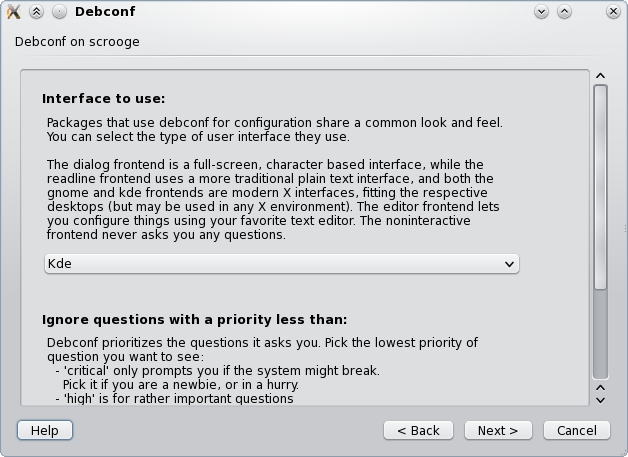
Sune Vuorela: debconf kde frontend

I wrote another blog post a while back talking about Debconf kde frontend. I spend some days at akademy looking at it, and then refined it a bit when I got home.
Results: debconf kde frontend in action. hopefully, the debconf people will accept it soon.

Andrew Pollock: [geek] Cleaning up from 20 years ago

I'm a terrible hoarder. I hang onto old stuff because I think it might be fun to have a look at again later, when I've got nothing to do. The problem is, I never have nothing to do, or when I do, I never think to go through the stuff I've hoarded. As time goes by, the technology becomes more and more obsolete to the point where it becomes impractical to look at it. Today's example: the 3.5" floppy disk. I've got a disk holder thingy with floppies in it dating back to the mid-nineties and earlier. Stuff from high school, which I thought might be a good for a giggle to look at again some time. In the spirit of recording stuff before I throw it out, I present the floppy disks I'm immediately tossing out.
MS-DOS 6.2 and 6.22
Ah the DOS days. I remember excitedly looking forward to new versions of MS-DOS to see what new features they brought. I remember DOS 5.0 being the revolutionary one. The dir command grew a ton of options.
XTreeGold
More from the DOS days, when file management was such a pain in the arse that there was a business model to do it better. ytree seems like a fairly good looking clone of it for Linux.
WinZip for Windows 95, Windows NT and Windows 3.1
Ha. I actually paid money for an official WinZip floppy disk.
Nissan Maxima Electronic Brochure
I'm amazed this fit on a floppy disk
Turbo Pascal 6.0
Excluding GW-BASIC, this was the first "real" language I dabbled in. I learned it in Information Processing & Technology in grades 11 and 12. I never got into the OO stuff that version 6.0 was particularly geared towards.
Where in the World is Carmen Sandiego?
Awesome educational game. I was first introduced to this on the Apple ][, and loved it. This deserves being resurrected for a console.
Captain Comic II
Good sequel to the original, but I never found a version that worked properly (I could never convince it to let me finish it)
HDM IV
Ah, Hard Disk Menu. A necessity from the DOS days when booting up to a C:\> prompt just really didn't cut it. I used to love customising this thing.
ARJ, LHA, PK-ZIP
Of course, you needed a bazillion different decompression programs back in the days of file trading. I guess things haven't changed much with Linux. There's gzip, bzip2, 7zip, etc.
Zeliard
I wasted so many hours playing this. The ending was so hard.
MicroSQL
This was some locally produced software from Brisbane, written in Turbo Pascal (I think). It was a good introduction to SQL, I used it in high school and my first stab at University.
DOOM and DOOM II
Classics. I don't seem to have media for it any more, but I also enjoyed playing Heretic and Hexen. Oooh, Hexen has been ported to Linux? Must check that out...
SimCity 2000
I wasn't a big fan of this game, but I liked the isometric view that 2000 had, compared to the previous version.

Biella Coleman: Silent Cry for Help: Debconf Volunteers


silent-cry-for-help, originally uploaded by the biella.
Hi Debcamper s and Debconfer s. I am currently coordinating volunteers and can use your help! Here is a list of our current and most pressing volunteer needs. If you are interested in volunteering and know what you would like to do, drop me a line with details. If you are interested in volunteering and are up for anything, drop me a line. If you want to volunteer but can only spare a couple of hours, drop me a line! You can reach me at biella(at)nyu.edu We are most in need of finding help for the front desk and for assisting with the talks (starting/ending on time and fielding questions). This year if you are a coordinator for a track you will be in charge of doing this, so we only need volunteers for non-track talks. Volunteers get a free, volunteer tee-shirt and a huge huge thanks from the orga team who simply cannot do this without you!

22 July 2010

Steve Kemp: My Linksys router now runs Linux and almost provides PXE.

I've been interesting in running Linux upon my router for a long time, but I never had a really compelling reason to do so. The potential for brickage was always too high to make me want to experiment for the sake of it. However last night I installed Gargoyle upon my Linksys WRT53GL. Although I have no single compelling reason to do so there were a few things on my mind which made me risk it:
Syslog
I thought it would be nice to log things to my desktop machine.
QoS
I often run rsync to mirror my photographs, videos, and files, to off-site locations. These are then replicated via chironfs. Being able to use QoS to prioritise SSH traffic, which is the transport I use for rsync, means I don't suffer from laggy connections.
Graphing & Statistics
Having statistics and traffic information is interesting.
Since I've only just installed it I've not had too much opportunity to experiment with it - and my initial forays were not so productive. For example "opkg install tcpdump" failed as the root filesystem wasn't big enough. However which was to update the router to function as PXE server. I installed the tftpd server:
opkg install tftpd-hpa
Then I added this to /etc/dnsmasq.conf:
dhcp-boot=pxelinux.0,router.my.flat,192.168.1.1
Only after I'd done this did I realise two things: Tomorrow, (after visiting the dentist. Uggh) I will experiment with this further. Right now it looks like I have two options: Either way I have to store the files upon another host, due to the constrained space on the router's filsystem. So the question becomes "Which service should I run externally: TFPTD or NFS?". Running TFTPD, upon my desktop, seems smaller, less of a security risk, and neater. Running TFTPD also avoids issues if I reboot both the router and my desktop at the same time as a stalling NFS mount could prevent a timely router-boot. ObQuote: Looking for a secret door. Places like this always have a secret door.

- St Trinian's 2: The Legend of Fritton's Gold

Raphaël Hertzog: Quick news: dpkg, collab-maint, alioth and the future

Dpkg got rid of Perl Let s start with the interesting part and the great news: dpkg 1.15.8 (to be uploaded soon) will no longer need perl! After my changes to rewrite update-alternatives in C, Guillem recently pushed the rewrite of dpkg-divert/mksplit in C. Please test it out (binary package for i386 or .dsc). This is rather exciting news for those who would like to use dpkg in embedded contexts. And it s great to see this completed in time for Squeeze. In Squeeze+1, we might go one step further and merge cdebconf, the C replacement for debconf. I got rid of some recurring administrative tasks I have been administrating the Alioth server since its inception (see the announce I sent in 2003) but I m no longer enjoying the day-to-day administrative work that it represents. That s why I just retired from the team. We recently recruited Tollef Fog Heen so the number of admins is still the same (that said, Alioth could benefit from some more help, if you re a DD and interested, drop a mail to admin@alioth.debian.org or come to #alioth). Same goes for the collab-maint project. I have dealt with hundreds of requests to add new contributors to the project since it s the central repository where all Debian developers have write access and where they put the VCS for their packages that do not belong to a more specialized team. The new administrator that will approve the requests is Xavier Oswald and he s doing the work under the umbrella of the New Maintainer s Front Desk. The future I will continue to spend the same amount of time on Debian, the time freed will quickly be reallocated to other Debian and free software related projects. In fact, I even anticipated a bit by launching Flattr FOSS last week but that s a relatively simple project. :-) The other projects that will never all fit in the freed time: I want to spend more time working on dpkg. I do plan to blog more often too, but I m sure you ll notice that yourself soon. I would like to see my Debian book translated into English (another post coming on the topic sometimes soon). In my dreams, I could even start yet another software project, I have some ideas that I really would like to see implemented but I don t see how that could fit in this year s planning unless I can convince someone else to implement them! Maybe I should blog about them. Flattr this Share/Bookmark 5 comments Support my work

Stefano Zacchiroli: debian podcast planning

This Week In Debian I've been contacted by Jonathan Nadeau of Frostbite Systems, a company selling computer hardware with pre-installed GNU/Linux distros, including Debian (of course!). (Usual disclaimer applies: I haven't tried their products, I've just skimmed through their website ...) Both for promotion and as a service to the communities, Jonathan has started various podcasts, such as This Week in Fedora. Jonathan has contacted me to check whether Debian is interested in having a This Week in Debian podcast, which will be discussing weekly Debian-related topics, interviewing at each episode someone from the community. So, folks, are you interested in seeing that happen?
Personally I like the idea, as I'm myself an eager podcast listener and I've always missed something Debian-specific. To make it a reality however we need to plan and record some episode in advance, to ensure the podcast will have enough "buffer" to start. That's why I've created the ThisWeekInDebian wiki page, where interested people should drop a line, proposing a topic and volunteering to speak about it. Any Debian-related topic is a good candidate: a team, an initiative, a general discussion about a relevant project aspect, etc. You don't even need any particular upfront preparation, as it'll be interview-like. So, what are you waiting for? Drop a line to the wiki page. Jonathan will attend DebConf10 so, in case you are attending, that can be a nice occasion to record some episode in person (otherwise recordings usually happen over the net).

John Goerzen: Once, We Were Makers

I saw an article on Wired today: The Lost Tribes of RadioShack. It is well worth the read even if you re not into electronics. A key quote:
[H]is shop is a lone outpost; in a single generation, the American who built, repaired, and tinkered with technology has evolved into an entirely new species: the American who prefers to slip that technology out of his pocket and show off its killer apps. Once, we were makers. Now most of us are users.
I remember as a kid eagerly awaiting each year s new RadioShack catalog. I d read them pretty much cover to cover for fun. And who wouldn t? The catalogs had fun things like radios, telephone gadgets, calculators, tape recorders, electronic lab kits , books, components, LEDs I loved the catalogs and loved the store. My parents bought me a electronic kit (if memory serves 20 years later, it s the deluxe 160-project electronic kit from page 156 of the 1988 catalog, though it may have been purchased a different year). I had endless fun with that thing. It had resistors, diode, capacitors, oscillator, speaker, LED, relay, etc plenty to make a bunch of kid-friendly projects. Just looking at the catalog makes me excited even today. On the next page from the kit I had is a $5 crystal radio kit which needs no power source Solderless. With earphone, instructions, theory. On page 28 there was a revolving red light, and some microcassette recorders on p. 36 (I had one of those for awhile). I had enthusiasm for building and figuring out things for a long time. My dad let me take apart an old lawn mower for fun once I m sure he knew ahead of time it would never be back together. One of his friends from work built homemade contraptions out of things like an old vacuum cleaner (attach a cardboard tube to the exhaust and you get a great tennis ball shooter). And there was always all sorts of fun junk to discover up in the barn. I eventually shifted to a different sort of making things : programming. It has kept me busy for quite a number of years. But the Wired article has a point. RadioShack is struggling. Many people have no interest in making or fixing things anymore. The best-selling smartphone in the world comes sealed in a metal case where not even the battery can be replaced, the software is dictated by a company in California, and good luck trying to program for it without signing your life away first. A far cry from the first computer I used, a TRS-80 Color Computer II, bought, yes, at RadioShack. Turn it on, and in a few seconds you get a BASIC prompt. Can t really use it without programming. Being able to read its manual was an early motivation for me to work at learning to read. It is sad that so many devices can t be worked on anymore, and that so many people don t care. It is difficult for me to give Jacob (and later, Oliver) the sort of experience I had as a child. Companies would love to sell us $50 DVD sets, $300 educational game systems, $40 educational games, and any number of $30 plastic toys (some of which we have and the boys enjoy). I d rather give him a $10 bag of resistors, capacitors, wire, battery holders, LEDs, and a book, and see what he can come up with (when he s a bit older, of course). And, in fact, he and I built his first computer together. We installed the ultimate in operating systems for tinkering: Linux. This all brings me back to RadioShack. I ve been working on ham radio lately, with an eye to that being a project for Jacob (age 3.5), Oliver (just turned 1), and me to enjoy in the future. I needed some cable, and had been told by many people to visit the RadioShack in Derby, KS. It s like the one mentioned in the Wired article: huge, selling everything from washing machines to bulk cable, except this one specializes in amateur radio. I asked Jacob if he would like to come with me to a radio store. Dad, I would LOVE that! He brought his little semi-broken walkie-talkies with him to use during the hour drive there. At one point, he was concerned that a radio store is like a library and he might have to leave them on a shelf. I assured him he could keep them. We got to the RadioShack and he loved it. He couldn t even really contain his excitement. He ran back and forth along the bright green stripe running down the middle of the carpet. He excitedly watched them measure out 60ft of RG-8 coax for me. He pushed buttons on the demo clothes dryer, looked at all the antennas, and just had a great time. And he s been interested in my radio, too. When I was talking to somebody on it the other day, he said, I think he is at the radio store. He is having fun there. Right now, everybody I talk to on the radio is at the radio store to him. Jacob loves the fact that the backlight on my FT-857D can change colors, and often comes into the office just so I can put it into setup mode and let him spin the big wheel to change the colors. He enjoys opening boxes of components, and came out to help (and run around) while I suspended a dipole from some trees last Friday. I had told Jacob when we got to the store that This radio store is called RadioShack. He obviously took that to heart, because now if he hears me talking about a radio store , he will say, Dad, actually it is radio SHACK. So I say thank you to the Derby RadioShack for keeping the magic of making things with your dad alive for another generation.

19 July 2010

Giuseppe Iuculano: Why would you prefer chromium-browser in sid over google-chrome

I ve seen a lot of Debian user asking: What is the difference between chromium-browser in sid and google-chrome (stable)? , Does chromium-browser support html5, h264, vp8? Why would I prefer chromium-browser in sid over google-chrome (stable)? BTW, the next step is to get chromium-browser into testing and upload a dev version (6.x) in experimental. Related posts:
  1. Chromium ready for unstable

Andreas Barth: How to autorotate images?

I'm still receiving messages by fax. Sometimes pages get inserted wrong (head-down). To make my life easier, I'd like to execute code which automatically rotates the page if it was inserted with bottom first - any idea if there is free software suiteable to recognize if it's wrong (I won't mind if hand-written pages appear wrong - if it works in 90% of the cases, I'm entirely happy).

18 July 2010

Steve McIntyre: Poulsbong redux

I wrote a while back about the "fun" Jo and I were having with her Acer Aspire One 751 netbook, a machine that was "blessed" with Intel's integrated GMA500 graphics. It was a PITA to set the machine up and the final installation of Ubuntu Jaunty was anything but reliable, locking up frequently. Well, there's more to the story. In the comments on that blog entry, Ben Armstrong pointed me at some very useful information from the Debian EeePC team: http://wiki.debian.org/DebianEeePC/Model/1101HA, specifically notes on how to use grub2 and the fbdev X driver to get native resolution on a 1366x768 screen. A couple of weeks back I finally managed to steal the laptop from Jo for a few minutes and try that setup. The results are very promising - X performance is perfectly acceptable and the X lockups have totally gone away. So (shock!) it looks like the crappy binary drivers were to blame. Jo is over the moon that finally her Linux laptop is happy and she has specifically asked me to blog again and thank Ben for his help. Thanks! I'm also hoping that this post will help other people searching for useful information on this nasty hardware and how to make it work as well as possible.

Petter Reinholdtsen: OpenStreetmap one step closer to having routing on its front page

Thanks to todays opengeodata blog entry, I just discovered that the OpenStreetmap.org site have gotten support for calculating routes. The support is still experimental and only available from the development server, until more experience is gathered on the user interface and any scalability issues. Earlier, the routing I knew about using the OpenStreetmap.org data was provided by Cloudmade, but having it on the main page is required to make everyone aware of the issue. I've had people reject Openstreetmap.org as a viable alternative for them because the front page lacked routing support, and I hope their needs will be catered for when routing show up on the www.openstreetmap.org front page.

Rog rio Brito: I am going to DebConf 10

I just bought my tickets today to NYC and I am glady to say that I am going to Debconf 10.
I am going to DebConf10

I am going to DebConf10

The tickets have this information: This represents a personal milestone for me, as I have many plans for the conference. In fact, this will be a trip of many firsts for me: I am thankful for the DebConf team sponsoring both accomodation and food. It is highly appreciated. See you in NYC! Any hints that you may happen to have are warmly welcome.

17 July 2010

Julien Blache: Grand Central Dispatch available in Debian

Thanks to the work of Mark Heily, both upstream and in Debian, this week saw the arrival of libdispatch in Debian. libdispatch is the userspace component of Apple s Grand Central Dispatch technology, designed to help write applications that really take advantage of multicore processors without having to fiddle directly with threads and locking (and getting it terribly wrong). To get that working on Linux, Mark wrote a userspace implementation of the pthread workqueues and a kqueue compatibility library (libkqueue). He also packaged the Blocks runtime (libblocksruntime) for Debian so as to build libdispatch with Blocks support. That means code using libdispatch must be built with CLang (or llvm-gcc-4.2) rather than gcc, as getting Blocks support in gcc in the near future looks highly improbable. On Mac OS X and FreeBSD, a kernel-based implementation of the pthread workqueues is used; we don t have that for Linux yet. The all-userspace implementation we have at the moment works really well; there are some caveats, though, but that s no reason for not starting to play with libdispatch right now! Try it out, it s great. Thanks again, Mark!

John Goerzen: KD0MJT

Wow tonight was thrilling. It s hard to explain why, but it s pretty exciting to have a radio setup that is all wrong in so many ways work well enough for me to sit in my kitchen in Kansas and talk to someone in Indianapolis using only two-way HF radios. I recently passed my technician and general amateur radio exams. I ve been talking to some very nice people locally on the 2m band, which permits local (say, 100-200mi radius) communication. It s been fun, but Kansas is sparsely populated enough that sometimes there just isn t any activity. At all. Earlier this week, my Yaesu FT-857D and two antennas arrived. I tried it first on VHF, and had a nice chat with Kent (KB0RWI) a few miles away. But tonight was the big experiment. I bought a 20m dipole antenna. This is basically a 30-foot-long wire, connected to a balun and a coax feed line in the middle. You re supposed to put it at least 30 feet off the ground, and away from trees, houses, etc. You re supposed to have a nice RF ground for your transmitter, power supply, antenna tuner, and all that stuff. You re not supposed to just run the coax under that (until today, annoying) small hole in the seal under the kitchen storm door. You re supposed to have to have the correct connectors on your coax, instead of soldering an RG-8 PL-259 onto some RG-8X because you re new at this and didn t realize that you need to buy an adapter. And, I m really pretty sure that you re not supposed to have an aggressive outdoor cat complete with a full set of claws and teeth attack the coax RG-8X cable as it s being pulled through the grass. Fail to do any of these things, and the thing might not work well, or might not work at all, or for people that use old equipment, might burn out your radio or something. So anyway I got out the ladder today, and I got the antenna maybe 10-15 feet in the air. I have three trees in a row with the perfect separation to hang each end and the center balun from. So while Jacob went around playing with water and trying out the ladder on occasion (with my help), I used some string to hang the antenna. In the trees, not far from them. Near the house. Not 30ft off the ground. I strung the feed line into the house, set up all my equipment on our kitchen table, flipped the switch. And nothing. Just the occasional familiar whine while tuning. I tried the 20m band, then the 40m, then even 15, 12, and 10. No activity anywhere. So what was wrong? I improvised some grounding extracted the ground conductor from an old strip of AC house wiring, shoved it into the ground, and grounded the tuner and transmitter. No difference. I unplugged the coax, and tested it with my multimeter. It tested out OK. I plugged it back in and wiggled the connector. Turns out the connector isn t in great shape, but it had been working. I tried transmitting. The tuner made a whole bunch of alarming-sounding clicking noises (sounded like a symphony of relays), indicated SWR over 3, and the ammeter on my power supply went a bit nuts. Later I realized that I just wasn t giving the tuner enough time to tune up; with a few more seconds, it tuned up just fine on every frequency. (So yes, it was supposed to do that.) And, it turns out, that all I needed to do was wait a little while longer to hear some signals. Pretty soon I was finding stuff all over the 40m band. I heard a discussion from Chicago, another from Oklahoma City, some apparent broadcasters from Africa. I decided I would try and transmit. I was hearing one side of a discussion very clearly and decided I would wait for an opportunity to try to contact that person. I heard his callsign, K9RM. I looked it up, and realized he was near Indianapolis, where I had lived for awhile. Eventually he invited a station trying to get in to participate. And: KD0MJT (I announced my callsign, as a request to join the conversation) He said he only made out the 0, but eventually we were talking quite well. It was a brief conversation, but interesting; the person he was talking to was in Portland, and couldn t hear me (and I could barely hear him, but not loud enough to make out). That with no phone lines, no Internet provider needed, etc. And with a rig that is far from being at peak efficiency. I had no idea what to expect tonight and was surprised that just tossing an antenna up in a tree let me talk to someone in Indiana. That s 650 miles away. I wonder what I ll be able to do once I get things done the right way. This hobby is going to be fun. Many thanks to Mike_W for equipment suggestions, Kent and Dan from Newton ARC for encouragement and coming out to the house to test things, Kent for being my first ham radio contact ever (on 2m while I was using an old 1981 radio), Chuck (K9RM) for taking a few minutes to be my first HF contact, and my dad for helping plan out exterior wall penetration methods that will eliminate this coax under the kitchen door and lack of grounding business. Jacob, by the way, still loves his radios and is starting to take an interest in mine. It wouldn t shock me at all of he s one of these kids that gets his technician license in the 2nd grade or something. I think he and I can do this together for a long time.

16 July 2010

Tim Retout: Starting the Emacs daemon

The daemon feature of Emacs is great. But when should the daemon be started? At one time I used an '@reboot' line in my crontab. But when you want to use things like Tramp mode (for editing files on remote servers transparently), you very quickly wish that emacs could talk to your ssh-agent. So if you accept that you will be running a desktop environment (not always true), you can add the daemon to your equivalent of "System >> Preferences >> Startup Programs". But then you find that Flymake (when used with cperl-mode) is not picking up any of your uninstalled, work-in-progress Perl modules. Wouldn't it be great if you could set $PERL5LIB to fix this? And doesn't M-x copyright require you to set "$ORGANIZATION"? Ever since Debian bug #411639 was fixed at the end of 2007, we have the option of "~/.xsessionrc" for setting environment variables that will cover everything in your desktop session, including things launched from panels and startup scripts. So now that's what I do. But I've yet to figure out a good equivalent for console-only systems. Maybe I don't need one?

Patrick Schoenfeld: Facebook aggressively advertising dubious features

Yesterday some confusion arised on my side when I saw a new facebook advertising campaign in my facebook account (yes, I am a member of facebook, although I'm aware of the privacy concerns). Basically it was saying that I should try the friends finder and that some of my friends (showing and naming me three of them) would have used it already.

Some background:
The friends finder feature of facebook is a feature that asks for the password of your e-mail account. It will then crawl through your emails to find contacts that might already be on facebook but not connected to you (in a facebook sense).

My first feeling was: Oh my god. How can it be that friends (and family) of mine are so naive? Especially since there were people included which I consider to be quiet clever. But honestly: Who would be so naive to give an unknown company direct unsupervised (you can't tell what they really do) access to your mail account? Would you give it to your friend? Your husband? Your father? I guess the answer will be "No" in the most cases and these people are most likely people you trust. Well, I know, you could state similar things for Googlemail who crawl your mails to show you personalized advertising. And in fact you are right. But if one decides to use gmail for your email hosting you have to trust them anyway. Like you have to trust anybody else you retain to host your mails (who could do the same but just don't tell you). But in this case its a third party, Facebook.

But if you now think that this becomes a rant against my friends: You are wrong. Over the day I found out that it basically shows up all my friends in a rotation. Every time I open the start page it randomly picks three people from my friend list and shows them to me, telling the same lie to me all over again.

So what do we have here? Facebook tries to advertise the most dubious feature they have in the most aggressive way one could imagine. By pretending wrong facts. Wouldn't that even be an element of crime in Germany ("Irref hrung" 5 UWG or maybe also 4 UWG, "unsachliche Beeinflussung")?

Facebook, you can do better.

Update: Stefano raised a good point. I didn't actually make clear that it has been verified that those people actually did not use the "feature":

1. I asked some of them. They said, they didn't use it and were in fact surprised that I asked.
2. Others told me they saw that ad stating that I used the feature. I definitely did not use this "feature".
3. Probably weak: IMHO its highly unlikely that all of my friends used that feature and at the point I've written this it had already shown my whole friend list.

Next.

Previous.