Search Results: "will"

7 June 2013

Daniel Pocock: "Do as we say, not as we do"

When I was preparing my blog entry about the Gold Standard in Free communications, I had absolutely no idea that The Guardian (another Ganglia user) would be hot on my heels with dramatic revelations about US Government surveillance of dangerous terrorists and maybe sucking up a little bit of data about a few hundred million of their own citizens and another 90% of the world's population for good measure. Some people even thought I've been a bit paranoid with my concerns about excessive surveillance. However, it is just remarkable to see that in the same week that the trial of Bradley Manning is getting under way for inappropriate use of his employer's computer, the US has been exposed plotting cyber attacks and setting a very bad example for all those little script kiddies out there. Practical questions for every one of us Is it time to start blocking email to and from sites like gmail and hotmail? What about the reports that the US Government was engineering back doors in the OpenBSD operating system? Have any open source projects actually been comprised in this way? Will spammers and other criminals take this as a cue that there is nothing morally wrong with hacking? Have certificate authorities been infiltrated too? They may well be the elephant in the room - while everybody was joking about the NSA key hidden in the depths of Microsoft Windows, maybe one or more of the well known trusted root certificates, right under our noses, is also a back door? The danger is real Anybody wondering about the practical implications of all this data gathering doesn't have to look very far to find out what can go wrong. In the same week as all these things were exposed, there have been more dramatic revelations about law enforcement officers selling private data for their own commercial gain. While the vast majority of police are surely good citizens, every organisation has it's bad apples and as Bradley Manning demonstrated so well, it only takes one person to breach security and enormous volumes of data can end up escaping.

Thomas Goirand: Compute node with 256 GB of RAM, 2CPU with 6 cores each (24 threads total)

Will that be enough? Let s load some VMs in that beast! :) too_much_ram_and_cpu

6 June 2013

Olivier Berger: New paper Authoritative linked data descriptions of debian source packages using ADMS.SW accepted at OSS 2013

I ll be presenting Authoritative linked data descriptions of debian source packages using ADMS.SW at OSS 2013. Here s the abstract :
The Debian Package Tracking System is a Web dashboard for Debian contributors and advanced users. This central tool publishes the status of subsequent releases of source packages in the Debian distribution. It has been improved to generate RDF meta-data documenting the source packages, their releases and links to other packaging artifacts, using the ADMS.SW 1.0 model. This constitutes an authoritative source of machine-readable Debian facts and proposes a reference URI naming scheme for Linked Data resources about Debian packages. This should enable the interlinking of these Debian package descriptions with other ADMS.SW or DOAP descriptions of FLOSS projects available on the Semantic Web also using Linked Data principles. This will be particularly interesting for traceability with upstream projects whose releases are packaged in Debian, derivative distributions reusing Debian source packages, or with other FLOSS distributions.
If you are interested, a previous paper which describes the same experiment is available online. See also previous installments on ADMS.SW in this blog.

5 June 2013

Daniel Pocock: The Gold Standard in Free Communications Technology

In a previous blog entry, I posed the question whether open source communications software is really free and came to the conclusion that additional principles need to be defined for free communications, above and beyond the normal expectations of free software. This is a fundamental problem that projects like the FreedomBox, Lumicall and other privacy-enabling free communications solutions must be familiar with. Otherwise there is a risk that development will never end as there is no finish line in sight. Practical solutions are not so easily defined though: so let's just imagine a perfect solution for a moment. Later, we can contemplate the trade-offs that are necessary to make it practical. Perfect privacy Here are some attributes that may exist for a perfect solution: Privacy must be the default: the user should not have to explicitly request privacy. If there is a risk that an incoming communication will establish a session without full privacy, the user should be able to decline the opportunity to participate. Only participants to a communication can receive the communication A third party should not be able to replay, modify or forge any aspect of the communication or the request to initiate a session Only participants to a communication are aware that a communication occurred Only participants to the communication are aware of who participated in the communication A participant may be anonymous: but in this case, all other participants will be aware that there is an anonymous party present in the communication Participants may not deduce any information about the other participants that is not explicitly shared (e.g. location, type of device, service provider) In the case of real-time communication, a participant may leave the communication without any other party even realising that they left or why. Communication is off-the-record: No participant can save and reproduce a copy of the communication in such a way that a third-party will know it was authentic. Anonymous reception of communications - the perfect post-office box: someone may create an anonymous identifier that allows other people to call them without being able to trace their location or identity Some consequences of a perfect solution Just imagine if all communications worked in this manner. There are many potential consequences. For example, if you call somebody and the call is not connected, you will get no feedback about whether their line is busy, out of service or whether they deliberately chose to reject your call. Another example is somebody who is driving while talking on a telephone. If they have an accident, there will be no way to prove that they were using the phone. This may already be the case if somebody uses a VoIP app on their phone - the police investigating the accident later will simply find no records of calls through the mobile phone account. Conclusion The perfect solution described here is something of a holy grail rather than a recipe that a developer can implement. It is unlikely that such a solution will fall out of the sky in the immediate future. Most software products that offer secure communications only address less than half the issues described above: for example, digital mobile phones prevent eavesdropping with arbitrary radio receivers, but they don't prevent shops detecting the IMEI (serial numbers) of phones that pass through their store and using that information to identify repeat visits to their store.

Lior Kaplan: Getting patches into PHP

One of the various ways to measure an open source project is the way it encourages and accepts patches from community members (or future members). The various open source projects I m involved with have many ways to send patches: mailing list, bug tracking systems and more recently pre-commit tools for peer review (such as gerrit). Another popular option is to use github s pull request feature for this. Personally, I find it too complex for simple patches and would prefer gerrit over it. As part of my work at Zend, I try to make sure patches are sent back upstream. Comparing to other open source projects I know, it seems to me that PHP isn t open enough for contributions. This might be just my private case, but if not, it would be discouraging people to contribute and blocking the community from expanding. 6 Months ago I submitted patch to #36103 (patch is at #63767), but no response. A month ago I submitted a simple patch to FPM s shell script (#64764), and no response there as well. To ease things up, I ve created a github fork of the php-src repository and sent pull requests with each of the patches (as suggested at http://php.net/git-php.php). Even edited the bugs reports with the pull request details (as they provide such integration). I m waiting to see if this will trigger a more rapid review process from the project. For the simple patch, I got a response very fast from a user, but still waiting for a core member to check it. Going over the pull requests (both open and closed), I m not too optimistic about having the patches merged, judging by past merged patches (most of them are at least 2 months) and by the open patches (e.g. a typos fix patch is waiting for month).
Filed under: PHP

Johannes Schauer: Reliable IMAP synchronization with IDLE support

The task: reliably synchronize my local MailDir with several remote IMAP mailboxes with IDLE support so that there is no need to poll with small time intervals to get new email immediately. Most graphical mail clients like icedove/thunderbird or evolution have IDLE support which means that their users get notified about new email as soon as it arrives. I prefer to handle email fetching/reading/sending using separate programs so after having used icedove for a long time, I switched to a offlineimap/mutt based setup a few years ago. Some while after that I discovered sup and later notmuch/alot which made me switch again. Now my only remaining problem is the synchronization between my local email and several remote IMAP servers. Using offlineimap worked fine in the beginning but soon I discovered some of its shortcomings. It would for example sometimes lock up or simply crash when I switched between different wireless networks or switched to ethernet or UMTS. Crashing was not a big problem as I just put it into a script which re-executed it every time it crashed. The problem was it locking up for one of its synchronizing email accounts while the others were kept in sync as usual. This once let to me missing five days of email because offlineimap was not crashing and I believed everything was fine (new messages from the other accounts were scrolling by as usual) while people were sending me worried emails whether I was okay or if something bad had happened. I nearly missed a paper submission deadline and another administrative deadline due to this. This was insanely annoying. It turned out that other mail synchronization programs suffered from the same lockup problem so I stuck with offlineimap and instead executed it as:
while true; do
timeout --signal=KILL 1m offlineimap
notmuch new
sleep 5m
done
Which would synchronize my email every five minutes and kill offlineimap if a synchronization took more than one minute. While I would've liked an email synchronizer which would not need this measure, this worked fine over the months. After some while it bugged me that icedove (which my girlfriend is using) was receiving email nearly instantaneously after they arrived and I couldnt have this feature with my setup. This instantaneous arrival of email works by using the IMAP IDLE command which allows the server to notify the client once new email arrives instead of the client having to poll for new email in small intervals. Unfortunately offlineimap (and any other email synchronizer I found) would not support the IDLE command. There is a fork of it which supports IDLE by using a newer python imap library but this is of little use to me as there is no possibility of a hook which executes when new email arrives so that I can execute notmuch new on the new email. At this point I could've used inotify to execute notmuch new upon arrival of new email but I went another way. Here is a short python script idle.py which connects to my IMAP servers and sends the IDLE command:
import imaplib
import select
import sys

class mysock():
def __init__(self, name, server, user, passwd, directory):
self.name = name
self.directory = directory
self.M = imaplib.IMAP4(server)
self.M.login(user, passwd)
self.M.select(self.directory)
self.M.send("%s IDLE\r\n"%(self.M._new_tag()))
if not self.M.readline().startswith('+'): # expect continuation response
exit(1)

def fileno(self):
return self.M.socket().fileno()

if __name__ == '__main__':
sockets = [
mysock("Name1", "imap.foo.bar", "user1", "pass1", "folder1"),
mysock("Name1", "imap.foo.bar", "user1", "pass1", "folder2"),
mysock("Name2", "imap.blub.bla", "user2", "pass2", "folder3")
]
readable, _, _ = select.select(sockets, [], [], 1980) # 33 mins timeout

found = False
for sock in readable:
if sock.M.readline().startswith('* BYE '): continue
print "-u basic -o -q -f %s -a %s"%(sock.directory, sock.name)
found = True
break

if not found:
print "-u basic -o"
It would create a connection to every directory I want to watch on every email account I want to synchronize. The select call will expire after 33 minutes as most email servers would drop the connection if nothing happens at around 30 minutes. If something happened within that time though, the script would output the arguments to offlineimap to do a quick check on just that mailbox on that account. If nothing happened, the script would output the arguments to offlineimap to do a full check on all my mailboxes.
while true; do
args= timeout --signal=KILL 35m python idle.py
echo "idle timed out" >&2;
args="-u basic -o";

echo "call offlineimap with: $args" >&2
timeout --signal=KILL 1m offlineimap $args
echo "offlineimap timed out" >&2;
continue;

notmuch new
done
Every call which interacts with the network is wrapped in a timeout command to avoid any funny effects. Should the python script timeout, a full synchronization with offlineimap is triggered. Should offlineimap timeout, an error message is written to stderr and the script continues. The above naturally has the disadvantage of not immediately responding to new email which arrives during the time that idle.py is not running. But as this email will be fetched once the next message arrives on the same account, there is no much waiting time and so far, this problem didnt bite me. Is there a better way to synchronize my email and at a same time make use of IDLE? I'm surprised I didnt find software which would offer this feature.

Raphael Geissert: The "let the tool do the work" update

Over the last few weeks I've been making several changes to http.debian.net to detect mirrors that don't follow Debian's mirroring guidelines and end up causing problems to the end users. The changes will mean less hash mismatches and similar errors.

As I wrote back in December, the redirector is becoming nicer but also stricter. Some of the changes I recently made caused over 30 mirrors to be completely disabled from the redirector. This is not ideal and I don't like having to disable mirrors. They are contributions afterall.

The only thing I can do, and can't stress enough, is encourage people to use an up to date ftpsync script (available at project/ftpsync/ on every mirror) to mirror Debian.
It takes care for you of all the little but important things needed. Really. A mirror that uses ftpsync is easier for the administrator to properly configure, and provides a consistent mirror for the benefit of the users.

Speaking of ftpsync, there is a new version! If you use ftpsync please upgrade it as soon as possible.

Other improvements are on their way. Contributions are welcome (if you like refactoring, there's quite a bit of explicitly-redundant code in check.pl that should now give a better idea of the way it needs to be refactored.)

4 June 2013

Keith Packard: dri3 extension

Completing the DRI3 Extension This week marks a pretty significant milestone for the glorious DRI3000 future. The first of the two new extensions is complete and running both full Gnome and KDE desktops. DRI3 Extension Overview The DRI3 extension provides facilities for building direct rendering libraries to work with the X window system. DRI3 provides three basic mechanisms:
  1. Open a DRM device.
  2. Share kernel objects associated with X pixmaps. The direct rendering client may allocate kernel objects itself and ask the X server to construct a pixmap referencing them, or the client may take an existing X pixmap and discover the underlying kernel object for it.
  3. Synchronize access to the kernel objects. Within the X server, Sync Fences are used to serialize access to objects. These Sync Fences are exposed via file descriptors which the underlying driver can use to implement synchronization. The current Intel DRM driver passes a shared page containing a Linux Futex.
Opening the DRM Device Ideally, the DRM application would be able to just open the graphics device and start drawing, sending the resulting buffers to the X server for display. There s work going on to make this possible, but the current situation has the X server in charge of blessing the file descriptors used by DRM clients. DRI2 does this by having the DRM client fetch a magic cookie from the kernel and pass that to the X server. The cookie is then passed to the kernel which matches it up with the DRM client and turns on rendering access for that application. For DRI3, things are much simpler the DRM client asks the X server to pass back a file descriptor for the device. The X server opens the device, does the magic cookie dance all by itself (at least for now), and then passes the file descriptor back to the application.
 
    DRI3Open
    drawable: DRAWABLE
    driverType: DRI3DRIVER
    provider: PROVIDER
       
    nfd: CARD8
    driver: STRING
    device: FD
 
    Errors: Drawable, Value, Match
    This requests that the X server open the direct rendering
    device associated with drawable, driverType and RandR
    provider. The provider must support SourceOutput or SourceOffload.
    The direct rendering library used to implement the specified
    'driverType' is returned in 'driver'. The file
    descriptor for the device is returned in 'device'. 'nfd' will
    be set to one (this is strictly a convenience for XCB which
    otherwise would need request-specific information about how
    many file descriptors were associated with this reply).
Sharing Kernel Pixel Buffers An explicit non-goal of DRI3 is support for sharing buffers that don t map directly to regular X pixmaps. So, GL ancillary buffers like depth and stencil just don t apply here. The shared buffers in DRI3 are regular X pixmaps in the X server. This provides a few obvious benefits over the DRI2 scheme: In the kernel, the buffers are referenced by DMA-BUF handles, which provides a nice driver-independent mechanism.
  1. Lifetimes are easily managed. Without being associated with a separate drawable, it s easy to know when to free the Pixmap.
  2. Regular X requests apply directly. For instance, copying between buffers can use the core CopyArea request.
To create back- and fake-front- buffers for Windows, the application creates a kernel buffer, associates a DMA-BUF file descriptor with that and then sends the fd to the X server with a pixmap ID to create the associated pixmap. Doing it in this direction avoids a round trip.
 
    DRI3PixmapFromBuffer
    pixmap: PIXMAP
    drawable: DRAWABLE
    size: CARD32
    width, height, stride: CARD16
    depth, bpp: CARD8
    buffer: FD
 
    Errors: Alloc, Drawable, IDChoice, Value, Match
    Creates a pixmap for the direct rendering object associated
    with 'buffer'. Changes to pixmap will be visible in that
    direct rendered object and changes to the direct rendered
    object will be visible in the pixmap.
    'size' specifies the total size of the buffer bytes. 'width',
    'height' describe the geometry (in pixels) of the underlying
    buffer. 'stride' specifies the number of bytes per scanline in
    the buffer. The pixels within the buffer may not be arranged
    in a simple linear fashion, but 'size' will be at least
    'height' * 'stride'.
    Precisely how any additional information about the buffer is
    shared is outside the scope of this extension.
    If buffer cannot be used with the screen associated with
    drawable, a Match error is returned.
    If depth or bpp are not supported by the screen, a Value error
    is returned.
To provide for texture-from-pixmap, the application takes the pixmap ID and passes that to the X server which returns the a file descriptor for a DMA-BUF which is associated with the underlying kernel buffer.
 
    DRI3BufferFromPixmap
    pixmap: PIXMAP
       
    depth: CARD8
    size: CARD32
    width, height, stride: CARD16
    depth, bpp: CARD8
    buffer: FD
 
    Errors: Pixmap, Match
    Pass back a direct rendering object associated with
    pixmap. Changes to pixmap will be visible in that
    direct rendered object and changes to the direct rendered
    object will be visible in the pixmap.
    'size' specifies the total size of the buffer bytes. 'width',
    'height' describe the geometry (in pixels) of the underlying
    buffer. 'stride' specifies the number of bytes per scanline in
    the buffer. The pixels within the buffer may not be arranged
    in a simple linear fashion, but 'size' will be at least
    'height' * 'stride'.
    Precisely how any additional information about the buffer is
    shared is outside the scope of this extension.
    If buffer cannot be used with the screen associated with
    drawable, a Match error is returned.
Tracking Window Size Changes When Eric Anholt and I first started discussing DRI3, we hoped to avoid needing to learn about the window size from the X server. The thought was that the union of all of the viewports specified by the application would form the bounds of the drawing area. When the window size changed, we expected the application would change the viewport. Alas, this simple plan isn t sufficient here a few GL functions are not limited to the viewport. So, we need to track the actual window size and monitor changes to it. DRI2 does this by delivering invalidate events to the application whenever the current buffer isn t valid; the application discovers that this event has been delivered and goes to as the X server for the new buffers. There are a couple of problems with this approach:
  1. Any outstanding DRM rendering requests will still draw to the old buffers.
  2. The Invalidate events must be captured before the application sees the related ConfigureNotify event so that the GL library can react appropriately.
The first problem is pretty intractable within DRI2 the application has no way of knowing whether a frame that it has drawn was delivered to the correct buffer as the underlying buffer object can change at any time. DRI3 fixes this by having the application in control of buffer management; it can easily copy data from the previous back buffer to the new back buffer synchronized to its own direct rendering. The second problem was solved in DRI2 by using the existing Xlib event hooks; the GL library directly implements the Xlib side of the DRI2 extension and captures the InvalidateBuffers events within that code, delivering those to the driver code. The problem with this solution is that Xlib holds the Display structure mutex across this whole mess, and Mesa must be very careful not to make any Xlib calls during the invalidate call. For DRI3, I considered placing the geometry data in a shared memory buffer, but my future plans for the Present extension led me to want an X event instead (more about the Present extension in a future posting). An X ConfigureNotify event is sufficient for the current requirements to track window sizes accurately. However, there s no easy way for the GL library to ensure that ConfigureNotify events will be delivered to the application other application code may (and probably will) adjust the window event mask for its own uses. I considered adding the necessary event mask tracking code within XCB, but again, knowing that the Present extension would probably need additional information anyhow, decided to create a new event instead. Using an event requires that XCB provide some mechanism to capture those events, keep them from the regular X event stream, and deliver them to the GL library. A further requirement is that the GL library be absolutely assured of receiving notification about these events before the regular event processing within the application will see a core ConfigureNotify event. The method I came up with for XCB is fairly specific to my requirements. The events are always XGE events, and are tagged with a special event context ID , an XID allocated for this purpose. The combination of the extension op-code, the event type and this event context ID are used to split off these events to custom event queues using the following APIs:
/**
 * @brief Listen for a special event
 */
xcb_special_event_t *xcb_register_for_special_event(xcb_connection_t *c,
                                                    uint8_t extension,
                                                    uint16_t evtype,
                                                    uint32_t eid,
                                                    uint32_t *stamp);
This creates a special event queue which will contain only events matching the specified extension/type/event-id triplet.
/**
 * @brief Returns the next event from a special queue
 */
xcb_generic_event_t *xcb_check_for_special_event(xcb_connection_t *c,
                                                 xcb_special_event_t *se);
This pulls an event from a special event queue. These events will not appear in the regular X event queue and so applications will never see them. There s one more piece of magic here the stamp value passed to xcbregisterforspecialevent. This pointer refers to a location in memory which will be incremented every time an event is placed in the special event queue. The application can cheaply monitor this memory location for changes and known when to check the queue for events. Within GL, the value used is the existing dri2 stamp value. That is checked at the top of the rendering operation; if it has changed, the drawing buffers will be re-acquired. Part of the buffer acquisition process is a check for special events related to the window. For now, I ve placed these events in the DRI3 extension. However, they will move to the Present extension once that is working.
 
    DRI3SelectInput
    eventContext: DRI3EVENTID
    window: WINDOW
    eventMask: SETofDRI3EVENT
 
    Errors: Window, Value, Match, IDchoice
    Selects the set of DRI3 events to be delivered for the
    specified window and event context. DRI3SelectInput can
    create, modify or delete event contexts. An event context is
    associated with a specific window; using an existing event
    context with a different window generates a Match error.
    If eventContext specifies an existing event context, then if
    eventMask is empty, DRI3SelectInput deletes the specified
    context, otherwise the specified event context is changed to
    select a different set of events.
    If eventContext is an unused XID, then if eventMask is empty
    no operation is performed. Otherwise, a new event context is
    created selecting the specified events.
The events themselves look a lot like a configure notify event:
 
    DRI3ConfigureNotify
    type: CARD8         XGE event type (35)
    extension: CARD8        DRI3 extension request number
    length: CARD16          2
    evtype: CARD16          DRI3_ConfigureNotify
    eventID: DRI3EVENTID
    window: WINDOW
    x: INT16
    y: INT16
    width: CARD16
    height: CARD16
    off_x: INT16
    off_y: INT16
    pixmap_width: CARD16
    pixmap_height: CARD16
    pixmap_flags: CARD32
 
    'x' and 'y' are the parent-relative location of 'window'.
Note that there are a couple of odd additional fields offx, offy, pixmapwidth, pixmapheight and pixmap_flags are all place-holders for what I expect to end up in the Present extension. For now, in DRI3, they should be ignored. Synchronization The DRM application needs to know when various X requests related to its buffers have finished. In particular, when performing a buffer swap, the client wants to know when that completes, and be able to block until it has. DRI2 does this by having the application make a synchronous request from the X server to get the names of the new back buffer for drawing the next frame. This has two problems:
  1. The synchronous round trip to the X server isn t free. Other running applications may cause fairly arbitrary delays in getting the reply back from the X server.
  2. Synchronizing with the X server doesn t ensure that GPU operations are necessarily serialized between the application and the X server.
What we want is a serialization guarantee between the X server and the DRM application that operates at the GPU level. I ve written a couple of times (dri3k first steps and Shared Memory Fences) about using X Sync extension Fences (created by James Jones and Aaron Plattner) for this synchronization and wanted to get a bit more specific here. With the X server, a Sync extension Fence is essentially driver-specific, allowing the hardware design to control how the actual synchronization is performed. DRI3 creates a way to share the underlying operating system object by passing a file descriptor from application to the X server which somehow references that device object. Both sides of the protocol need to tacitly agree on what it means.
 
    DRI3FenceFromFD
    drawable: DRAWABLE
    fence: FENCE
    initially-triggered: BOOL
    fd: FD
 
    Errors: IDchoice, Drawable
    Creates a Sync extension Fence that provides the regular Sync
    extension semantics along with a file descriptor that provides
    a device-specific mechanism to manipulate the fence directly.
    Details about the mechanism used with this file descriptor are
    outside the scope of the DRI3 extension.
For the current GEM kernel interface, because all GPU access is serialized at the kernel API, it s sufficient to serialize access to the kernel itself to ensure operations are serialized on the GPU. So, for GEM, I m using a shared memory futex for the DRI3 synchronization primitive. That does not mean that all GPUs will share this same mechanism. Eliminate the kernel serialization guarantee and some more GPU-centric design will be required. What about Swap Buffers? None of the above stuff actually gets bits onto the screen. For now, the GL implementation is simply taking the X pixmap and copying it to the window at SwapBuffers time. This is sufficient to run applications, but doesn t provide for all of the fancy swap options, like limiting to frame rate or optimizing full-screen swaps. I ve decided to relegate all of that functionality to the as-yet-unspecified Present extension. Because the whole goal of DRI3 was to get direct rendered application contents into X pixmaps, the Present extension will operate on those X objects directly. This means it will also be usable with non-DRM applications that use simple X pixmap based double buffering, a class which includes most existing non-GL based Gtk+ and Qt applications. So, I get to reduce the size of the DRI3 extension while providing additional functionality for non direct-rendered applications. Current Status As I said above, all of the above functionality is running on my systems and has booted both complete KDE and Gnome sessions. There have been some recent DMA-BUF related fixes in the kernel, so you ll need to run the latest 3.9.x stable release or a 3.10 release candidate. Here s references to all of the appropriate git repositories: DRI3 protocol and spec:
git://people.freedesktop.org/~keithp/dri3proto      master
XCB protocol
git://people.freedesktop.org/~keithp/xcb/proto.git  dri3
XCB library
git://people.freedesktop.org/~keithp/xcb/libxcb.git dri3
xshmfence library:
git://people.freedesktop.org/~keithp/libxshmfence.git   master
X server:
git://people.freedesktop.org/~keithp/xserver.git    dri3
Mesa:
git://people.freedesktop.org/~keithp/mesa.git       dri3
Next Steps Now it s time to go write the Present extension and get that working. I ll start coding and should have another posting here next week.

Daniel Pocock: Using reSIProcate to connect Asterisk with WebRTC

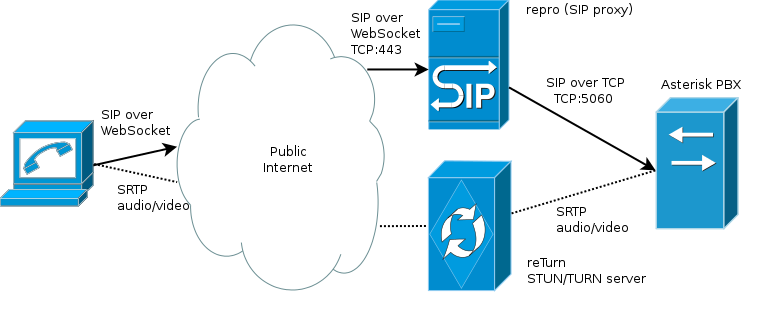
In my previous blog entry about how to get WebRTC going fast I looked at the basics of setting up a SIP proxy (also known as a SIP router) to accept connections from WebRTC clients. As in a traditional, non-WebRTC world, the SIP proxy simply facilitates calling between all the clients it knows. In practice, deployments usually want to add additional functionality in the form of a PBX with queues, voicemail, menus and conferencing. The recent Asterisk 11 release includes support for WebRTC although it is still evolving and I don't currently recomend connecting Asterisk directly to the public Internet. In particular, Asterisk doesn't support features like mutual TLS authentication with the WSS (secure WebSocket) transport. Here, we look at how repro can accept connections from Internet/web users and relay them to an internal Asterisk server. Here is an architecture diagram: Notice that the SIP messages are accepted over repro's WebSocket transport and relayed to Asterisk over a regular SIP TCP transport. This means that we benefit from repro's TLS support too, so the WebSocket client has a much higher chance of escaping their client-side firewall if port 443 is used (repro pretending to be a HTTPS server) and clients can be authenticated with certificates in their browser. Here are the steps to get it running: repro and reTurn setup Set up repro and reTurn server on a Debian server as per my previous blog post. Verify that the clients can talk to repro. Asterisk source build Digium, the creators of Asterisk, are not currently supporting Debian packages, but they do provide RPM packages in their Asterisk package repository However, the pre-built binary packages for Asterisk 11.4 don't include SRTP support. SRTP is a mandatory part of WebRTC. Therefore, we take the Source RPM (SRPM) and build it manually. First, it is recommended that you start with a completely fresh CentOS 6 or RHEL6 server. I built a fresh virtual machine in my XCP environment using a procedure similar to that documented by Grant. After installing and setting a root password, configure yum to access EPEL6 Make sure SELinux and firewall are disabled on the box (they are often enabled by default). A quick way to do this:
# sed -i s/SELINUX=enforcing/SELINUX=disabled/g /etc/selinux/config
# reboot
...
# iptables -I INPUT -j ACCEPT
Next you can tell yum about the Digium repository and install all the necessary dependencies for building Asterisk:
# rpm -Uvh http://packages.asterisk.org/centos/6/current/x86_64/RPMS/asterisknow-version-3.0.0-1_centos6.noarch.rpm
# yum update
# yum install rpm-build libsrtp-devel
In your home directory, set up a work tree for rpmbuild:
$ mkdir ~/rpmbuild
$ cd ~/rpmbuild
$ mkdir BUILD BUILDROOT RPMS SOURCES SPECS SRPMS
$ cd SPECS
$ wget http://danielpocock.com/sites/danielpocock.com/files/asterisk.spec
$ cd ../SRPMS
$ wget http://packages.asterisk.org/centos/6/asterisk-11/SRPMS/asterisk-11.4.0-1_centos6.src.rpm
$ rpmbuild --rebuild asterisk-11.4.0-1_centos6.src.rpm
At this stage, you will have some errors, but it has successfully extracted the tarball into the SOURCES directory:
$ ls -l ../SOURCES
-rw-r--r--   1 daniel daniel 11573400 May 20 23:07 asterisk-sources-11.4.0.tar.gz
$
It will also complain about missing dependencies, you install them using yum:
# yum install make gcc gcc-c++ ....
Notice that you have downloaded a slightly modified version of the asterisk.spec file, the reasons for this are explained in this mailing list discussion. The following should now trigger a successful build:
$ rpmbuild -bb \
  --without tds \
    --without misdn \
    --without odbc \
   ~/rpmbuild/SOURCES/asterisk.spec
Hopefully, Digium will add the SRTP support in the 11.4.1 packages so that source build won't be necessary for every future release. Asterisk configuration: demo application Here we just have to install the RPMs and make a quick configuration change:
$ cd ~/rpmbuild/RPMS/x86_64
$ su -
# rpm -i asterisk*rpm
# yum install asterisk-sounds-core-en-ulaw asterisk-sounds-extra-en-ulaw --enablerepo=asterisk-11
# ln -s /usr/share/asterisk/sounds/demo-* /var/lib/asterisk/sounds/en/
To enable connections from the proxy, we must set a few non-default settings. It is essential to use the TCP transport as the SIP messages from WebSocket clients are usually too big for UDP packets. It is also necessary to enable SRTP and AVPF, as these are mandatory in WebRTC. Here is a diff against the default /etc/asterisk/sip.conf:
--- /etc/asterisk.orig/sip.conf	2013-06-04 10:57:49.428617785 +0200
+++ /etc/asterisk/sip.conf	2013-06-04 11:18:17.825604261 +0200
@@ -207,7 +207,7 @@
 ; subject to change in any release.  If they are changed, the changes will
 ; be reflected in this sample configuration file, as well as in the UPGRADE.txt file.
 ;
-tcpenable=no                    ; Enable server for incoming TCP connections (default is no)
+tcpenable=yes                    ; Enable server for incoming TCP connections (default is no)
 tcpbindaddr=0.0.0.0             ; IP address for TCP server to bind to (0.0.0.0 binds to all interfaces)
                                 ; Optionally add a port number, 192.168.1.1:5062 (default is port 5060)
 
@@ -1371,6 +1371,13 @@
 ; ...
 ;
 
+[1001](public-phone,ulaw-phone)
+avpf = yes
+encryption = yes
+context = public
+icesupport = yes
+
+
 ; Standard configurations not using templates look like this:
 ;
 ;[grandstream1]
This assumes that the SIP user ID of your WebSocket user is 1001 Now you can start Asterisk:
# service asterisk start
Configuring the repro SIP proxy to send calls to Asterisk This is a relatively simple demonstration. The goal is to send calls for the number 1000 to the demo application in Asterisk In repro's web interface, click ADD ROUTE in the menu. Use the following parameters and leave all other options blank:
  • URI: ^sip:1000@
  • Destination: sip:$1@pbx.example.org?transport=tcp
Note: replace pbx.example.org with the hostname or IP address of the box running Asterisk Go to the ADD USER menu link and add a user called 1001. The user ID and password have to be placed in the custom.js file for JsSIP Testing from JsSIP I assume JsSIP was set up following the instructions from my previous blog post Asterisk doesn't support the video codec from a WebRTC client. To work around this, in the custom.js file for JsSIP, make sure video is disabled by default. In the WebRTC client, dial 1000. You should hear the demo greeting from Asterisk. Troubleshooting
  • Check the JavaScript log in the browser
  • Check the logs on the repro proxy and increase the verbosity of the logs if necessary. If the level is set to STACK, you will see full copies of each SIP message sent and received.
  • Connect to the Asterisk console (UNIX command: asterisk -r -vvv) and enable SIP message display: sip set debug on.

Raphaël Hertzog: My Free Software Activities in May 2013

This is my monthly summary of my free software related activities. If you re among the people who made a donation to support my work (70 , thanks everybody!), then you can learn how I spent your money. Otherwise it s just an interesting status update on my various projects. The Debian Administrator s Handbook Spanish translation completed. The Spanish team finished the translation of the book. The PDF build process was not yet ready to build translations so I had to fix this. At the same time, I also improved the mobipocket build script to make use of Amazon s kindlegen when available (since Amazon now requires the use of this tool to generate Mobipocket files that can be distributed on their platform). Once those issues were sorted I made some promotion of this first completed translation because they really deserve some big kudos ! Plans for the French translation. You know that the Debian Administrator s Handbook came to life as a translation of the French book Cahier de l Admin Debian (published by Eyrolles). This means that we currently have a free translation of a proprietary book. It s a bid of an odd situation that I always wanted to fix. I discussed with Eyrolles to find out how we could publish the original book under the same licenses that we picked for the English book and the result is that we setup a new crowdfunding campaign to liberate the French book and then make it an official French translation of the Debian Administrator s Handbook. Read the rest and support us on the ulule project page (a kickstarter like for people who are not based in the US). Liberate the Debian Handbook Debian France I updated our membership management application (galette) to version 0.7.4.1 with numerous bug fixes but the true highlight this month was Solutions Libres et Opensource , a tradeshow in Paris where Tanguy Ortolo, me, and other volunteers (C dric Boutillier, Arnaud G., and some that I have forgotten, thanks to them!), held a Debian booth for two consecutive days (May 28-29). For once we had lots of goodies to sell (buffs, mouse pad, polos, stickers, etc.) and the booth was very well attended. The Debian Booth (Tanguy on the left, Rapha l on the right) Google s Summer of Code Last month I was rater overwhelmed with queries from students who were interested in applying for the Package Tracking System Rewrite project that I offered to mentor as part of Google s Summer of Code. In the end, I got 6 good student applications that Stefano and me evaluated. We selected Marko Lalic. The Community Bonding Period is just starting and we re fleshing out details on how we will organize the work. We ll try to use the IRC channel #debian-qa on OFTC for questions and answers and weekly meetings. Misc Debian packaging I packaged zim 0.60 and with the release of Wheezy, I uploaded to unstable all the packages that I staged in experimental (cpputest, publican). I sponsored the upload of libmicrohttpd 0.9.27-1. I filed a couple of bug reports that I experienced with the upcoming dpkg 1.17.0 (#709172, #709009). In both cases, the package was using a wrongly hardcoded path to dpkg-divert (the binary moved from /usr/sbin/ to /usr/bin/ a while ago and the compatibility symlink is dropped now). I also dealt with #709064 where the user reported upgrade issues related to multiarch. I also filed an upstream bug report on publican to request some way to avoid so much duplication of files (actually I filed it as a response to the Debian bug #708705 that I received). Kali work I had to update OpenVAS for Kali but some parts failed to build in a Debian 7 environment. I diagnosed the problem and submitted a patch upstream. I also got in touch with the Debian OpenVAS maintainer as I wanted to contribute the package back to Debian, but timing issues have pushed this back for a little longer. Thanks See you next month for a new summary of my activities.

One comment Liked this article? Click here. My blog is Flattr-enabled.

3 June 2013

Matthew Garrett: Dealing with UEFI non-volatile memory quirks

Since I wrote this, we've made some worthwhile progress on avoiding damaging Samsung hardware. The first is that the samsung-laptop driver appeared to be causing the firmware to attempt to write to an area of memory that was marked in the chipset, triggering a Machine Check Exception. That was what generated the pstore output that caused the problem originally. The driver now refuses to load if EFI is enabled, which avoids the problem. It's not ideal, since it's currently the only mechanism we have for certain functionality on Samsung laptops, but there you go.

The second problem was that avoiding crashing on boot didn't actually fix the problem in any fundamental way. Even with pstore disabled, it was possible for userspace to fill the nvram and trigger the same problem. Our first approach to this was to prevent any writes to nvram if the UEFI QueryVariableInfo() call reported that more than 50% of the nvram storage space would be used. That was safe, but led to another issue. The nvram storage area is typically implemented as part of the same flash chip as the firmware. Flash isn't arbitrarily accessible - changing the contents of a block typically involves rewriting the entire block. It's impractical to rewrite the entire nvram area on every write, so what actually happens is that deleting variables just results in them being marked as inactive but doesn't actually free up the space. The firmware can later perform some sort of garbage collection to free it up.

This caused us problems, since inactive space that hasn't been garbage collected yet isn't actually available, and as a result firmware implementations tend to count it as used. Say you had 64KB of nvram and wrote 32KB of variables. We'd then refuse to write any more because you'd drop below 50%. So you delete 16KB of the variables you've created and try again. Unfortunately, the firmware still thinks that there's 32KB in use and Linux would still refuse.

If you were lucky, rebooting would trigger a garbage collection run. If you weren't, it wouldn't. Problematic. Our next approach was to try to account for the space actually actively used by the variables, rather than relying on what the firmware told us via QueryVariableInfo(). This seems simple enough - just add up the size of all the variables and subtract that from the overall size to determine how much of the "used" space is actually just old inactive variables that can be ignored. However, there's still some problems there. The first is that each variable has some additional overhead associated with it, and the size of that overhead varies depending on the system vendor. We had to make a conservative guess, which could cause problems if systems had large numbers of small variables. The second is that the only variables the kernel can see are those that are flagged as runtime-visible. There may also be a significant quantity of nvram used to store variables that are only visible in boot services code. We could work around this by adding up sizes while we're still in boot services code, but on some systems calling QueryVariableInfo() before ExitBootServices() results in later calls to GetNextVariable() jumping to invalid addresses and crashing the kernel. Not a great approach.

Meanwhile, Samsung got back to us and let us know that their systems didn't require more than 5KB of nvram space to be available, which meant we could get rid of the 50% value and replace it with 5KB. The hope was that any system that booted with only 5KB of space available in nvram would trigger a garbage collection run. Unfortunately, it turned out that that wasn't true - some systems will only trigger garbage collection if the OS actually makes an attempt to write a variable that won't otherwise fit.

Hence this patch. The new approach is to ask the firmware how much space is available. If the size of the new variable would reduce this to less than 5K, we attempt to create a variable bigger than the remaining space. This should cause the firmware to realise that it's out of room and either (depending on implementation) perform a garbage collection run at runtime or set a flag that will cause the system to perform garbage collection on the next reboot. We then call QueryVariableInfo() again to see whether a garbage collection run actually happened, and if so check whether we now have enough space. If so, we go ahead and write the variable. If not, we tell userspace that there's not enough space.

This seems to work in all the situations I've tested, and it should avoid ending up in a situation where a Samsung can end up bricked. However, it's firmware, so who knows whether it's going to break things for someone else.

comment count unavailable comments

Iain Lane: Helping others

A pattern I see quite often on help channels goes like this.
<new person> How do I foo the bar?
<experienced person> new person: Run baz --quux and look at ../wibble.bob 

at this point the new person has the information that they wanted and can carry on with whatever it was that they were trying to do. Quite often, however, the conversation continues thus.
<another experinced person> new person: Also, you could run flubble --grog --foo   mycoolscript > ../wibble.bob to get the same effect

Add in experienced person then trying to justify their initial recommendation, and another experienced person then counter-arguing (possibly highlighting new person all the way, if we're on IRC or a social network that allows this) and you have a confusing experience for the newcomer. Let's try to think about the information we're conveying to newcomers and how we're doing it. Easing people in to our projects gently is a friendlier approach, and will result in happier newcomers who are more likely to stick around.

2 June 2013

Thomas Goirand: dtc-xentop: monitoring of CPU, I/O and network for your Xen VMs

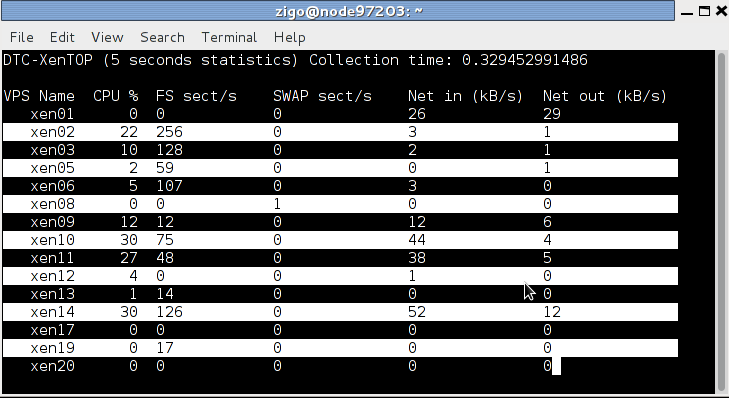
What has always been annoying me with Xen, is that xentop is well a piece of shit! It just displays the current numbers of sectors or network bytes read / write. But as an administrator, what you care about, is to know which of your VM is taking all the resources, making your whole server starve. The number of sectors read/write since the VM has started is of very low importance. What you care about is to have an idea of the current transfer rate. And the same apply for networking. So, tonight, within few hours, I hacked a small python shell script using ncurses to do what I needed, which tells how much resources have been used over the last 5 seconds (and not since the VM started). This way, it is easy to know which VM is killing your server. dtc-xentop The script is adapted to my own needs only. Which means that it works only for DTC-Xen VMs of GPLHost. In my case, VM uses exactly 2 partitions, one for the filesystem, and one for the swap, which means that I display exactly that. I m sure it wouldn t be hard to adapt it so that it would work for all cases (which would mean finding out what device uses a VM and getting the statistics from /sys using that information, instead of determining it using the name of the VM). But I don t need it, so the script will stay this way. Before writing this tonight, I didn t know ncurses. Well, it s really not hard, especially in Python! It took me about 2 hours to write^Whack the script (cheating on the dtc-xen soap server which I already had available).

Jelmer Vernooij: Migrating packaging from Bazaar to Git

A while ago I migrated most of my packages from Bazaar to Git. The rest of the world has decided to use Git for version control, and I don't have enough reason to stubbornly stick with Bazaar and make it harder for myself to collaborate with others. So I'm moving away from a workflow I know and have polished over the last few years - including the various bzr plugins and other tools involved. Trying to do the same thing using git is frustrating and time-consuming, but I'm sure that will improve with time. In particular, I haven't found a good way to merge in a new upstream release (from a tarball) while referencing the relevant upstream commits, like bzr merge-upstream can. Is there a good way to do this? What helper tools can you recommend for maintaining a Debian package in git? Having been upstream for bzr-git earlier, I used its git-remote-bzr implementation to do the conversions of the commits and tags:
% git clone bzr::/path/to/bzr/foo.bzr /path/to/git/foo.git
One of my last contributions to bzr-git was a bzr git-push-pristine-tar-deltas subcommand, which will export all bzr-builddeb-style pristine-tar metadata to a pristine-tar branch in a Git repository that can be used by pristine-tar directly or through something like git-buildpackage. Once you have created a git clone of your bzr branch, it should be a matter of running bzr git-push-pristine-tar-deltas with the target git repository and the Debian package name:
% cd /path/to/bzr/foo.bzr
% bzr git-push-pristine-tar-deltas /path/to/git/foo.git foo
% cd /path/to/git/foo.git foo
% git branch
*  master
   pristine-tar

1 June 2013

Lior Kaplan: Bye bye non-free PHP JSON extension

PHP 5.5 rc2 was recently uploaded to Debian unstable by Ond ej Sur . Along side the new PHP version and its features the PHP team has dealt with the JSON extension being non-free because of the The Software shall be used for Good, not Evil license (see debian #692613).
php5 (5.5.0~rc1+dfsg-1) experimental; urgency=low
    [...]
  * Add dfsg-repack.sh script to remove non-free JSON module
    (Closes: #692613)
  * Remove php5-json from Provides, since that's no longer true
 -- Ond ej Sur  <ondrej@debian.org>  Fri, 17 May 2013 14:41:41 +0200
A package with a DFSG replacement for the JSON extension is waiting in the NEW queue and should be available soon. The new JSON extension was done by Remi Collet (PHP developer and Fedora s PHP maintainer). Review and patches are welcomed, code is available at https://github.com/remicollet/pecl-json-c . I hope the PHP project will adopt the solution, after claiming they won t fix it themselves (see php.net #63520).
Filed under: Debian GNU/Linux, PHP

Daniel Pocock: Democracy down-under is not democracy

This weekend we have the AGM of a local community organisation. Like many organisations I am involved in, there will be a democratic process of decision making, board election and a low-budget social activity afterwards. We take it for granted that democracy is a good thing. In my own country, Australia, people are supposedly happier than they've ever been, no doubt people will suggest that our democracy is part of the recipe for success. While this example is from Australia, it could well happen anywhere. While everybody was slapping themselves on the back about our officially confirmed contentment, the politicians tried to slip something under the radar. With elections expected in September, the press exposed a secret deal between the two biggest political parties, raiding the public piggy bank for $60 million to prop up their campaign accounts. There is even a leaked copy of a letter confirming the deal. It was to be voted through parliament in a stitch-up within 48 hours after the happiness' announcement. Why would these two big political parties engage in a such a gross conspiracy? Weren't they already content with their whopping big pay increases that put our Prime Minister on a bigger salary than the US president or the UK Prime Minister? Well, you don't have to look hard to find out what this special funding was all about: Not long ago, the post office at the University of Melbourne where Wikileaks operates a post-office box was mysteriously shut down. While that may seem like it could just be a co-incidence on it's own, it's worth considering in the wider context: the Wikileaks party is one of the most widely recognised names in Australian politics right now. The party's leader, like the new pope, is seen as somebody who puts his principles ahead of his own comfort, living a humble life in exile while our politicians romp around with prostitutes paid for with stolen money. Whatever you think of Wikileaks or Mr Assange's private life, they are not the only example here. There are other democratic movements in our country that are equally frightening for those who are currently drunk on power. One of the independent MPs holding the balance of power is a former Lieutenant Colonel in Australia's spy agency who was ridiculed by a prior Government and forced out of his job when he exposed the sham of the Iraq war. Neither of the major political parties wants to continue being held accountable by someone who has shown such strong principles against their campaign of death and deception. That $60 million welfare payment to big political parties was intended to be something akin to a weapon of mass destruction, obliterating independent representatives out of the parliament. More recently, the same independent MP has been equally vigorous in his campagin to break the scourge of our mafia-style gambling industry with it's cosy links to Australian politicians. Now it is starting to become obvious just how scary democracy can be. Motivated by the spectacle of a few independents holding our incumbent politicians to account, other Australians have also volunteered to get in on the act and try their hand at running the country. One of Australia's richest men, Clive Palmer has found that even with his enormous wealth (and having started planning more than a year before the election), his plans to form a political party are dampened by the fact that it can't be registered with a proper name to be listed on the ballot paper and all the candidates have to be listed under his name, Palmer, or their own names, barely distinguishable from the independent candidates. This discriminatory approach to the creation of political parties clearly favours the two big incumbent groups. Now it is a lot clearer why existing politicians needed an extra $60 million war chest: like Lance Armstrong's illegal doping program, it was intended to keep themselves ahead of the pack. It all goes to show that people should not take democracy for granted: constant vigilence and involvement is needed to hold leaders to account or replace them when they deviate.
AttachmentSize
piggy-bank.jpg32.83 KB

31 May 2013

Richard Hartmann: Release Critical Bug report for Week 21

Hopefully hiding this post will work this time. Apologies if not. The UDD bugs interface currently knows about the following release critical bugs: How do we compare to the Squeeze release cycle?
Week Squeeze Wheezy Diff
43 284 (213+71) 468 (332+136) +184 (+119/+65)
44 261 (201+60) 408 (265+143) +147 (+64/+83)
45 261 (205+56) 425 (291+134) +164 (+86/+78)
46 271 (200+71) 401 (258+143) +130 (+58/+72)
47 283 (209+74) 366 (221+145) +83 (+12/+71)
48 256 (177+79) 378 (230+148) +122 (+53/+69)
49 256 (180+76) 360 (216+155) +104 (+36/+79)
50 204 (148+56) 339 (195+144) +135 (+47/+90)
51 178 (124+54) 323 (190+133) +145 (+66/+79)
52 115 (78+37) 289 (190+99) +174 (+112/+62)
1 93 (60+33) 287 (171+116) +194 (+111/+83)
2 82 (46+36) 271 (162+109) +189 (+116/+73)
3 25 (15+10) 249 (165+84) +224 (+150/+74)
4 14 (8+6) 244 (176+68) +230 (+168/+62)
5 2 (0+2) 224 (132+92) +222 (+132/+90)
6 release! 212 (129+83) +212 (+129/+83)
7 release+1 194 (128+66) +194 (+128/+66)
8 release+2 206 (144+62) +206 (+144/+62)
9 release+3 174 (105+69) +174 (+105/+69)
10 release+4 120 (72+48) +120 (+72/+48)
11 release+5 115 (74+41) +115 (+74/+41)
12 release+6 93 (47+46) +93 (+47/+46)
13 release+7 50 (24+26) +50 (+24/+26)
14 release+8 51 (32+19) +51 (+32/+19)
15 release+9 39 (32+7) +39 (+32/+7)
16 release+10 20 (12+8) +20 (+12/+8)
17 release+11 24 (19+5) +24 (+19/+5)
18 release+12 2 (2+0) +2 (+2/+0)
Graphical overview of bug stats thanks to azhag:

Gunnar Wolf: The joys of updating a webapp

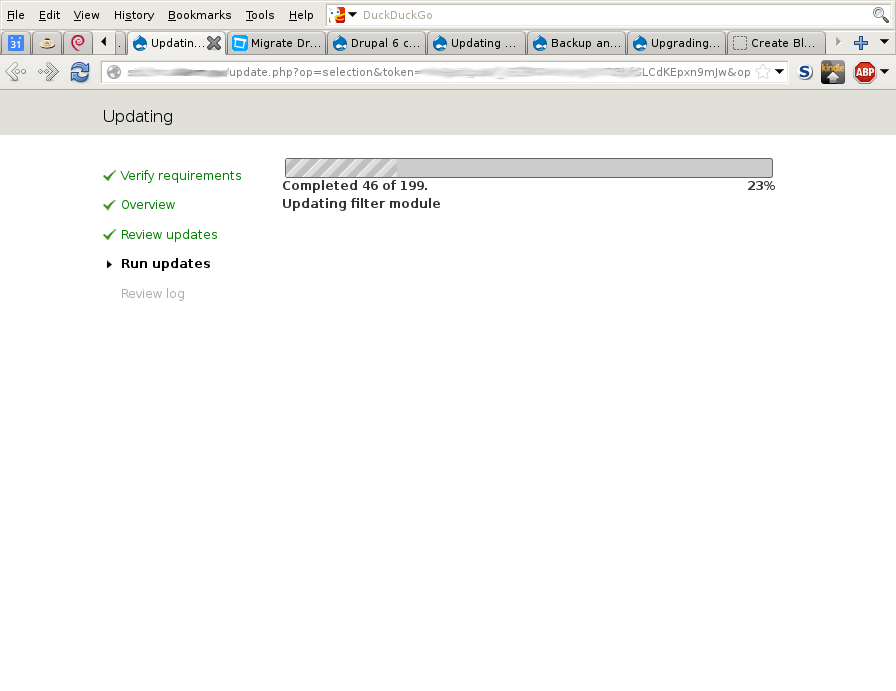
I like Drupal. It's a very, very flexible CMS that evolved into a full-fledged Web development framework. Mind you, it's written in PHP, and that makes it a nightmare to develop for (in ~6 years I have used it for all of my important websites I have only got around to develop a set of related modules for it once). PHP programming sucks and makes my eyes and fingers bleed, but happily there are people who disagree with me And they tend to write code. All the better! Minor upgrades with Drupal are quite easy to handle. Not as easy as I'd like (i.e. whenever I upgrade the core system or a module, I have to log in as root^Wadmin^WUser #1 to ~15 different sites and run http://someurl/update.php It very seldom causes any pain. The updates that have to be run via this URL are usually on the database's structures, so I understand they have to be started (and watched) by a human. And yes, I know I could do that with Drush, the Drupal shell, but it is not very friendly to Debian-packaged Drupal... But easy enoguh. But major updates are a royal pain, and they usually amount to quite a bit. First, disable all of the modules and revert to a known-safe theme. Ok, it makes sense. Second, check whether the modules exist for the newer version (as they won't work Drupal changes enough between major versions that not only it's API-incompatible, I'd classify it as API-unrecognizable). Ok, all set? Now for the live migration itself... It has to be triggered from the browser. So yes, I am now staring at a window making clever AJAX status updates. I am sitting at 46 of 199, but following the lovely ways of programmers, it's impossible to forsee whether update #47 will just be an UPDATE foo SET bar=0 WHERE bar IS NULL or a full-scale conversion between unspeakable serialized binary structures while rearranging the whole database structure. And yes, while the meter progresses I stand in fear that update #n+1 will bomb giving me an ugly red error. I must keep the magic AJAX running, or the update might be botched. And, of course, the update has sat at #69 all while I wrote the last two paragraphs. Sometimes the updates can progress after an interruption... And it seems I have no choice but to interrupt it. /me crosses fingers... [update] Wow... I am happy I got bored of looking at the meter and decided to write this blog post: After several minutes, and just as I was about to launch a second update session (130 updates to go), the meter advanced! I'm now sitting watching it at #75. Will it ever reach 199? [update] And so it had to be... At around 115, I now got: *sigh* The update process was aborted prematurely while running update #7000 in biblio.module...
AttachmentSize
drupal_updating.png39.5 KB
drupal_updating_failed.png64.72 KB

Gerfried Fuchs: On Finding Words

There is still a lot of things going on inside me and turning, and I'd like to share two words that I grow attached to, one a fair amount longer now than the other, but both are terms that I seem to had lacking in my vocabulary which I tried to explain in a different way. After finding out about them, I noticed that both what I felt and believed were actual things that were not totally uncommon concepts, even though most people wouldn't know about them. The first term that I stumbled upon years ago was the term of pansexuality. (Do not dare to read the German Wikipedia article. It's ridiculous wrong, insulting and shows that they don't understand the topic at all.) I always had issues to explain my intimate preference to others. Especially after they found out about me being female on the inside. Questions arose (if they understood that I'm open about these things when I post the poem publicly) along the lines of "what are you now: gay, lesbian, hetero and if the latter, what does that mean?". My usual answer was that I fall in love with people, not with their bodies, and that things will eventually work out if meant to be. And thus even though I love my "Bi" shirt, it doesn't really describe properly how I swing, so to say. The latter term I discovered just recently. A friend of mine with whom I chat every now and then told me about it, and when we met again last autumn, they wore a button of the Italian community for Polyamory (I so much prefer the Italian logo to the "widely used symbol", to be honest). It was an eye opening moment for me. I often mentioned to people that I felt like I have a big heart, being able to store multiple people in it. It always puzzled me that when I'm together with someone (and I always was faithful) why I should feel bad and especially keep it a secret when there is someone else who touches my heart, too. Society seems to see this already as a breach of trust, no matter whether it gets pursued or not, just the thought is enough. But it never changed anything with respect to the person I was together with, so what's the deal? Finding out about this term explained so much to me and made a lot of sense. It is about honesty and communication, which I see lagging in a lot of relationships these days... So here you are, getting another inside view on me. And I'm sure that there will be again the one or the other person who considers to use this as ammunition against me, but you know, being open about it acts as a shield. It's not embarrassing for me, never was. And like always, I hope that I can help others feeling similar being lost for words or an understanding that it's not as weird as it might feel. Enjoy!

/personal permanent link Comments: 9 Flattr this

Daniel Pocock: VoIP federation: another milestone

Slashdot recently picked out Federated VoIP as one of the compelling features in the upcoming Fedora 19 (Schrodinger's Cat) release. The same capability was recently part of the Debian 7 (wheezy) release and it is in Ubuntu too. It is ironic that the debates about Federated VoIP have long mirrored the debate about Schrodinger's famous feline - is it dead, is it alive, or is it just a theory? Well, the answer is here today (for VoIP, not the cat).

Does it work? Yes, it does work. Even better, users on all the supported platforms can call each other, for example, user1@debian.org should be able to seamlessly and securely place a call to user2@fedoraproject.org What is involved? Server: Each domain needs a SIP proxy, XMPP server or preferably both. They are alternatives and they happily co-exist. For convenience, they can run on an existing mail server as long as the load is not excessive. See the Real-time communcations (RTC) quick start guide for setting up the server, firewall rules, DNS entries and all other details Clients: Each user can have a hard phone, softphone such as Jitsi or Empathy or a mobile VoIP client like Lumicall. Each of these projects has their own email support lists where users can ask any questions about getting started. Is the server difficult to set up and maintain? Setting up fully featured Asterisk or FreeSWITCH servers and keeping them secure for public Internet use is a daunting task. That's why federated VoIP with a basic SIP proxy is so compelling. It is possible to set up the SIP proxy now, get people talking, and add in a soft PBX later if optional features like queues or menus are needed. The repro SIP proxy from reSIProcate is one of the easiest to set up. It can be configured through a web interface or directly entering users into the MySQL tables. Here is a screenshot: Where to next for federated VoIP? People should not be waiting for their ISP to deploy federated VoIP. Many of them are either looking for ways to monetize VoIP, or keen to keep costs low by just selling bandwidth. Rather, it will be up to power users (like those of us who run their own mail server at home), corporate IT departments and also the IT departments of universities and other large, distributed organisations to take leadership. There is huge opportunity here: by displacing the phone companies, IT departments can provide a wider range of services to their organisations. Money previously lost in contracts for phone systems can bolster the IT department as the one-stop-shop for technology, giving IT workers greater career opportunities and stability in their organisation. The organisation benefits from having a system designed and operated around their business needs with much better value for money and a visible support team.

Next.

Previous.