Search Results: "ron"

10 August 2010

Dirk Eddelbuettel: RQuantLib 0.3.4

A fresh release of RQuantLib is now on CRAN and in Debian. RQuantLib combines (some of) the quantitative analytics of QuantLib with the R statistical computing environment and language. This follows the 0.3.3 release from last week and has again a number of internal changes. All uses of objects from external namespaces are now explicit as I removed the remaining using namespace QuantLib;. This makes things a little more verbose, but should be much clearer to read, especially for those not yet up to speed on whether a given object comes from any one of the Boost, QuantLib or Rcpp namespaces. We also generalized an older three-dimensional plotting function used for option surfaces -- which had already been used in the demo() code -- and improved the code underlying this: arrays of option prices and analytics given two input vectors are now computed at the C++ level for a nice little gain in efficiency. This also illustrates the possible improvements from working with the new Rcpp API that is now used throughout the package, Full changelog details, examples and more details about this package are at my RQuantLib page.

9 August 2010

Petter Reinholdtsen: No hardcoded config on Debian Edu clients

As reported earlier, the last few days I have looked at how Debian Edu clients are configured, and tried to get rid of all hardcoded configuration settings on the clients. I believe the work to be mostly done, and the clients seem to work just fine with dynamically generated configuration. What is the point, you might ask? The point is to allow a Debian Edu desktop to integrate into an existing network infrastructure without any manual configuration. This is what happens when installing a Debian Edu client here at the University of Oslo using PXE. With the PXE installation, I am asked for language (Norwegian Bokm l), locality (Norway) and keyboard layout (no-latin1), Debian Edu profile (Roaming Workstation), if I accept to reformat the hard drive (yes), if I want to submit info to popcon.debian.org (no) and root password (secret). After answering these questions, the installer goes ahead and does its thing, and after around 50 minutes it is done. I press enter to finish the installation, and the machine reboots into KDE. When the machine is ready and kdm asks for login information, I enter my university username and password, am told by kdm that a local home directory has been created and that I must log in again, and finally log in with the same username and password to the KDE 4.4 desktop. At no point during this process did it ask for university specific settings, and all the required configuration was dynamically detected using information fetched via DHCP and DNS. The roaming workstation is now ready for use. How was this done, you might wonder? First of all, here is the list of things that need to be configured on the client to get it working properly out of the box: (Hm, did I forget anything? Let me knew if I did.) The points marked (*) are not required to be able to use the machine, but needed to provide central storage and allowing system administrators to track their machines. Since yesterday, everything but the sitesummary collector URL is dynamically discovered at boot and installation time in the svn version of Debian Edu. The IP and DNS setup is fetched during boot using DHCP as usual. When a DHCP update arrives, the proxy setup is updated by looking for http://wpat/wpad.dat and using the content of this WPAD file to configure the http and ftp proxy in /etc/environment and /etc/apt/apt.conf. I decided to update the proxy setup using a DHCP hook to ensure that the client stops using the Debian Edu proxy when it is moved outside the Debian Edu network, and instead uses any local proxy present on the new network when it moves around. The DNS names of the LDAP, Kerberos and syslog server and related configuration are generated using DNS information at boot. First the installer looks for a host named ldap in the current DNS domain. If not found, it looks for _ldap._tcp SRV records in DNS instead. If an LDAP server is found, its root DSE entry is requested and the attributes namingContexts and defaultNamingContext are used to determine which LDAP base to use for NSS. If there are several namingContexts attibutes and the defaultNamingContext is present, that LDAP subtree is used as the base. If defaultNamingContext is missing, the subtrees listed as namingContexts are searched in sequence for any object with class posixAccount or posixGroup, and the first one with such an object is used as the LDAP base. For Kerberos, a similar search is done by first looking for a host named kerberos, and then for the _kerberos._tcp SRV record. I've been unable to find a way to look up the Kerberos realm, so for this the upper case string of the current DNS domain is used. For the syslog server, the hosts syslog and loghost are searched for, and the _syslog._udp SRV record is consulted if no such host is found. This algorithm works for both Debian Edu and the University of Oslo. A similar strategy would work for locating the sitesummary server, but have not been implemented yet. I decided to fetch and save these settings during installation, to make sure moving to a different network does not change the set of users being allowed to log in nor the passwords required to log in. Usernames and passwords will be cached by sssd when the user logs in on the Debian Edu network, and will not change as the laptop move around. For a non-roaming machine, there is no caching, but given that it is supposed to stay in place it should not matter much. Perhaps we should switch those to use sssd too? The user's SMB mount point for the network home directory is located when the user logs in for the first time. The LDAP server is consulted to look for the user's LDAP object and the sambaHomePath attribute is used if found. If it isn't found, the home directory path fetched from NSS is used instead. Assuming the path is of the form /site/server/directory/username, the second part is looked up in DNS and used to generate a SMB URL of the form smb://server.domain/username. This algorithm works for both Debian edu and the University of Oslo. Perhaps there are better attributes to use or a better algorithm that works for more sites, but this will do for now. :) This work should make it easier to integrate the Debian Edu clients into any LDAP/Kerberos infrastructure, and make the current setup even more flexible than before. I suspect it will also work for thin client servers, allowing one to easily set up LTSP and hook it into a existing network infrastructure, but I have not had time to test this yet. If you want to help out with implementing these things for Debian Edu, please contact us on debian-edu@lists.debian.org. Update 2010-08-09: Simon Farnsworth gave me a heads-up on how to detect Kerberos realm from DNS, by looking for _kerberos TXT entries before falling back to the upper case DNS domain name. Will have to implement it for Debian Edu. :)

Gerfried Fuchs: On BTS usage

You might remember that I started to work on closing RC bugs for stable. This effort hasn't died off so I joined the RC Bug Squashing Contest that was going on during the Debian conference (which I was unable to attend). The rules did permit it, even though I was aware that it can't (and shouldn't) be compared to the unstable/testing squashers and thus it was split of into its own Special category. There still seems to be a lot of confusion on how our BTS works, especially with respect to version tracking. I was even accused of falsely claiming bug closing because the bug has been closed by someone else already. This wasn't the case, otherwise the bugs would had been archived a long time ago already[1] given that I had expected that person to know how bug archival works and also given the sheer amount of bugs that I simply had closed for stable, I guess it is needed to shine a light upon why some bugs won't get archived as expected. If you followed my IRC talk on BTS usage last month you might already have an idea of what's going on. There might be several different reasons why bugs aren't marked for archival yet. I'll try to explain them as I understand it (given that I neither have taken a look at the debbugs code nor am involved with its development) through my working on bugs over the last 10 years. I hope this will get others also interested to fix stuff for stable. Actually when I see something that potential falls into the last group I ping the maintainers of those packages to let them know about having them fixed. Some of you might already have received such a ping and I am thankful for those that received them well and actually already fixed some of those, too. Thanks for making stable a better place! Coming back to the RCBC, it was an interesting small competition (if only in my brain) between myself and the testing/unstable RC squashers going on. It would had been nice to get at least as many bugs in stable addressed as in testing/unstable because the amount is still a lot higher, but I can still be happy about the things done. And it is good to know that not everything seems to think that it's wasted effort to work on getting the RC count lower for stable, too (like I also was told about my effort). So thanks from that point of view!
[1] There are currently 2688 bugs still unarchived that were closed last year already! This UDD query helps you:
select count(*) from bugs where status = 'done' and last_modified <= '2009-12-31';

/debian permanent link Comments: 0 Flattr this

Gustavo Noronha Silva: WebKitGTK+ and the Web Inspector

When I started working on WebKitGTK+ I was a web developer, writing IT applications using Python and Django, and building features for content portals running Plone (argh). Even though I was an Epiphany user ever since it was forked off Galeon, I still had to use Firefox for my work, because I couldn t really live without Firebug. It should come as no surprise, then, that one of my first patches to WebKitGTK+ was actually making the awesome Web Inspector work in our port. After the initial support, though, not a lot has been done to further improve it, partly because it was already good enough for many uses, partly because I somehow started doing non-web development again ;). These last weeks, through my R&D efforts in Collabora, I have been able to push Web Inspector features and integration a bit further. A simple change that boosts the Inspector s usability quite a bit is having the nodes that are being hovered highlighted. Along with that, the ability to attach the inspector to Epiphany s window should make it easier to use for poking the DOM. The Web Inspector has a number of settings that control its behaviour. Since, for instance, enabling javascript debugging may slow down javascript performance, the inspector usually has it disabled by default, and provides a button to enable it. It also provides an option for always enabling that feature, but that does not work right now, because we are not saving/restoring the relevant settings. A solution to that is in the works using the GSettings infrastructure that was recently merged into glib. Here s a simple screencast, showing these improvements in action (click the video to check it out in full size): <video controls="controls" src="http://kov.eti.br/media/webkit/inspector.ogv" width="400"></video>

Russell Coker: The Lord of the Fries

Today I bought a box of fries from The Lord of the Fries [1]. I bought it from their new stand at Flinders St station because I was going past and saw no queue. In the past I had considered buying from their store on Elizabeth St but the queues were too long. The fries were nice probably among the best fries that I ve had from local fish and chip shops. Way better than any other fries that you can find in the center of Melbourne. The range of sauces is quite good if you like that thing (I just like vinegar on mine). However it should be noted that the quantity of chips that you would get for the same price at a local fish and chip shop is usually a lot greater. Overall I was a bit disappointed, sure it s nice to have someone hand-cut fresh potatoes and to actually care about making a quality product. But when compared to the other options for relatively fast food in the CBD it didn t seem that great to me. I m never going to join a queue that has more than 20 people to buy them! But I probably will buy from them on occasion if they don t have big queues. It seems to me that the best thing that they have done is to create a strong commitment to food quality and document it on their web site. I hope that this will inspire other fast-food companies to do the same thing and result in an overall increase in the food quality. On a related note Jamie Oliver has an IDEO project running with the aim of getting kids into fresh food [2].

Stefano Zacchiroli: missing DebConf10

It is not that I've missed DebConf10, I've totally been there (as some embarrassing video and photo evidence can prove ...).
Rather, I've just got back home and I already miss DebConf10, melancholy is in the air. It will probably stay around for a while and then leave room to a vivid memory of 2 weeks of Debian life, as strong as I've never experienced before. So, before I become too sentimental, let me just thank everyone who has made the conference possible: the orga team, the video team, all the volunteers, the sponsors, the speakers, the attendees, and everyone else I couldn't possibly remember. Specific kudos of mine goes to the Debian NYC cabal: DDs and non-DDs, new to our project and not-so-new. You guys made me remember what does living Debian mean, you guys made all this possible (emotions included!), you guys rock. Say whaaaaaat?

John Goerzen: Being A Butterfly

Well, I m back in Kansas after a bit over a week in New York for Debconf. I didn t have time to write much, so I ll probably be posting about it a few times. I already wrote about the trip to New York, and now will say just a bit about the time there and trip back home. I have to start with a quote from Jacob. We went on the Q train from Coney Island a few stops down to Brighton Beach. It s elevated, and provides an excellent view of the amusement park. Jacob s excited comment, face pressed to window, was: Wow! I see lots of everything! Which, come to think of it, sums up NYC itself pretty well. Speaking of faces pressed to windows: this was Jacob s default mode of operating in NYC. Get into any subway car, bus, whatever and he wants to stand on the seat nearest the window and look out it. It s a real problem if no such seats are available. More than once, though, we ll get on the subway and he ll run to the nearest window seat to claim it, no matter who will be his neighbors for the next few minutes. And after a few days of this, Oliver started picking up on it. Pretty soon both boys wanted to be pressed to the windows watching interesting things (to me, it was a dark tunnel with occasional lights, but interesting to them) go by. Which brings me to today. Today was Oliver s first time flying, and Jacob s second though he was an infant the first time he flew and doesn t remember it. Jacob has been perhaps cautiously optimistic about flying. The idea of it was exciting, but then again it s something completely new, which he doesn t care for so much. So we had no idea what to expect. What was got was excitement. And lots of it. From the La Guardia terminal, Dad, is this our plane? No, not that one. Well, is THIS our plane? No, not that one either. Well, is *THIS* our plane? At this point, a parent has to confront the question: which is worse, causing serious disappointment to a 3-year-old and possibly inviting a meltdown in the middle of the D concourse, or a bit of harmless encouragement that might not be 100% literally true? Uhmm . that might be it (Ah, so I went for the literally true but still exciting route ) YAY!! *jumping and clapping* Terah reminds me at this point of our security adventure. I, wearing socks, carried Oliver (1 year old) through the security checkpoint at La Guardia. But oh! I failed to remove his shoes (not really shoes). TSA made me go back through, put them in the bowl, and run them through the scanner. A nearby pilot, getting screened, noticed this and made this ironic comment well within TSA earshot: Look at his face! He s gonna get us all! Good thing you re checking his shoes! Terah and the pilot both just about bust up laughing. Meanwhile, I m carrying Oliver through, and the agent that made me take off his shoes had this look of I m sorry, I know this is stupid, but I have to. (For an excellent pilot s rant about TSA, read this). Anyhow, we got on the plane, and of course Jacob nabbed the window seat. IMG_4458.JPG There was plenty interesting to see. At each step of the way, I told him what was going to happen next, so there wouldn t be any surprises. I told him once we got in the air, and got a breathy Woooooooow .. I told him, Jacob, we are flying! And his reply has to be his best quote of the week:

Dad, I don t know that I ve ever been a butterfly before!
I pointed out that we were above the clouds, which was also exciting. About every 5 minutes, he d poke me, and say, Dad, look out the window. Look down. WE ARE UP IN THE SKY! Meanwhile, Oliver slept. IMG_4461.JPG On the second flight, Jacob slept (and was in a very foul mood when he woke up on the ground) while Oliver tried his best to squirm out of the seat and onto the ground. Now, to wind up this post, I would like to leave you with some statistics and photos comparing my home with New York.

Item NYC Marion County, KS
Land Area 469 sq mi 954 sq mi
Population 8,391,881 12,952 (6871 excluding the 3 largest towns quite some distance away)
Population Density 27,532/sq mi 14/sq mi (7 if excluding large towns)
I think of this as a wonderful difference! I ve said before how much fun it is to spend some time in NYC, where we can just walk to a fruit stand, any number of grocery stores, restaurants, etc. And finally, I leave you with two street scenes. The first is from our hotel s front door. IMG_4352.JPG That s our fruit guy there, and the bagel and roll place is across the street by the RadioShack. Now, the street view from our front door after we got home: IMG_4466.JPG OK, so that s sort of misleading. You can t actually see the street scene because it s on the other side of the hill. That s just our driveway to get to the street. (Not that the street looks much different. It has the weeds growing on the sides instead of in the middle, as one notable difference.) We loved New York and I m certain we ll go back again. It s also nice to be home and enjoy the peace of the countryside. Thanks to Debconf for a wonderful conference a topic I ll have more to say about in the coming days.

8 August 2010

Kumar Appaiah: Debconf10 and New York Visit

So, I have finally visited my first Debconf, and it was a phenomenal experience. To meet persons who have guided you, persons work with, and persons you respect face-to-face and have conversations with them about several topics ranging from their vision for Debian to their views on topics totally unrelated to software is something truly great. I am now convinced that events like this, which provide the right environment to socialize and discuss various issues concerning Debian, will go a long way into getting several aspects of the project moving along in the right directions, as well as create awareness to the outside world about what the project is about and how it benefits users.In terms of discussions, the Debian Science track was a nice way to see how contributors are putting Debian to good use for scientific research, and it was a nice opportunity to list out the things to be done to fill in the gaps and take Debian as a science platform forward. The Debian Python BoF was also a good place to meet many contributors face-to-face, and learn more about the technical concerns which people have in regard to the future of Python in Debian.While I didn't hack much during the conference, Christian's presence made me finish the Hindi translation of the Debian Installer. We can now shift focus to other aspects, such as getting packages in order for a short freeze-to-release cycle.Columbia University provides for a very nice venue, with easy access while maintaining a quaint environment within itself. Since this is my second visit to New York City, I had an idea of the common tourist locations, so I did not go around much during the conference. However, since I have a buffer day, I might try my hand at some photography around the place.Have a safe trip home, and a wonderful time ahead! I leave you with a photo I took when I went with a friend across the Brooklyn Bridge after Debconf.Downtown Manhattan Panorama - from the Brooklyn Heights Promenade, Brooklyn, NY

Petter Reinholdtsen: Testing if a file system can be used for home directories...

A few years ago, I was involved in a project planning to use Windows file servers as home directory servers for Debian Edu/Skolelinux machines. This was thought to be no problem, as the access would be through the SMB network file system protocol, and we knew other sites used SMB with unix and samba as the file server to mount home directories without any problems. But, after months of struggling, we had to conclude that our goal was impossible. The reason is simply that while SMB can be used for home directories when the file server is Samba running on Unix, this only work because of Samba have some extensions and the fact that the underlying file system is a unix file system. When using a Windows file server, the underlying file system do not have POSIX semantics, and several programs will fail if the users home directory where they want to store their configuration lack POSIX semantics. As part of this work, I wrote a small C program I want to share with you all, to replicate a few of the problematic applications (like OpenOffice.org and GCompris) and see if the file system was working as it should. If you find yourself in spooky file system land, it might help you find your way out again. This is the fs-test.c source:
/*
 * Some tests to check the file system sematics.  Used to verify that
 * CIFS from a windows server do not work properly as a linux home
 * directory.
 * License: GPL v2 or later
 * 
 * needs libsqlite3-dev and build-essential installed
 * compile with: gcc -Wall -lsqlite3 -DTEST_SQLITE fs-test.c -o fs-test
*/
#define _FILE_OFFSET_BITS 64
#define _LARGEFILE_SOURCE 1
#define _LARGEFILE64_SOURCE 1
#define _GNU_SOURCE /* for asprintf() */
#include <errno.h>
#include <fcntl.h>
#include <stdio.h>
#include <string.h>
#include <stdlib.h>
#include <sys/file.h>
#include <sys/stat.h>
#include <sys/types.h>
#include <unistd.h>
#ifdef TEST_SQLITE
/*
 * Test sqlite open, as done by gcompris require the libsqlite3-dev
 * package and linking with -lsqlite3.  A more low level test is
 * below.
 * See also <URL: http://www.sqlite.org./faq.html#q5 >.
 */
#include <sqlite3.h>
#define CREATE_TABLE_USERS                                              \
  "CREATE TABLE users (user_id INT UNIQUE, login TEXT, lastname TEXT, firstname TEXT, birthdate TEXT, class_id INT ); "
int test_sqlite_open(void)  
  char *zErrMsg;
  char *name = "testsqlite.db";
  sqlite3 *db=NULL;
  unlink(name);
  int rc = sqlite3_open(name, &db);
  if( rc ) 
    printf("error: sqlite open of %s failed: %s\n", name, sqlite3_errmsg(db));
    sqlite3_close(db);
    return -1;
   
  /* create tables */
  rc = sqlite3_exec(db,CREATE_TABLE_USERS, NULL,  0, &zErrMsg);
  if( rc != SQLITE_OK ) 
    printf("error: sqlite table create failed: %s\n", zErrMsg);
    sqlite3_close(db);
    return -1;
   
  printf("info: sqlite worked\n");
  sqlite3_close(db);
  return 0;
 
#endif /* TEST_SQLITE */
/*
 * Demonstrate locking issue found in gcompris using sqlite3.  This
 * work with ext3, but not with cifs server on Windows 2003.  This is
 * done in the sqlite3 library.
 * See also
 * <URL:http://www.cygwin.com/ml/cygwin/2001-08/msg00854.html> and the
 * POSIX specification
 * <URL:http://www.opengroup.org/onlinepubs/009695399/functions/fcntl.html>.
 */
int test_gcompris_locking(void)  
  struct flock fl;
  char *name = "testsqlite.db";
  unlink(name);
  int fd = open(name, O_RDWR O_CREAT O_LARGEFILE, 0644);
  printf("info: testing fcntl locking\n");
  fl.l_whence = SEEK_SET;
  fl.l_pid    = getpid();
  printf("  Read-locking 1 byte from 1073741824");
  fl.l_start  = 1073741824;
  fl.l_len    = 1;
  fl.l_type   = F_RDLCK;
  if (0 != fcntl(fd, F_SETLK, &fl) ) printf(" - error!\n"); else printf("\n");
  printf("  Read-locking 510 byte from 1073741826");
  fl.l_start  = 1073741826;
  fl.l_len    = 510;
  fl.l_type   = F_RDLCK;
  if (0 != fcntl(fd, F_SETLK, &fl) ) printf(" - error!\n"); else printf("\n");
  printf("  Unlocking 1 byte from 1073741824");
  fl.l_start  = 1073741824;
  fl.l_len    = 1;
  fl.l_type   = F_UNLCK;
  if (0 != fcntl(fd, F_SETLK, &fl) ) printf(" - error!\n"); else printf("\n");
  printf("  Write-locking 1 byte from 1073741824");
  fl.l_start  = 1073741824;
  fl.l_len    = 1;
  fl.l_type   = F_WRLCK;
  if (0 != fcntl(fd, F_SETLK, &fl) ) printf(" - error!\n"); else printf("\n");
  printf("  Write-locking 510 byte from 1073741826");
  fl.l_start  = 1073741826;
  fl.l_len    = 510;
  if (0 != fcntl(fd, F_SETLK, &fl) ) printf(" - error!\n"); else printf("\n");
  printf("  Unlocking 2 byte from 1073741824");
  fl.l_start  = 1073741824;
  fl.l_len    = 2;
  fl.l_type   = F_UNLCK;
  if (0 != fcntl(fd, F_SETLK, &fl) ) printf(" - error!\n"); else printf("\n");
  close(fd);
  return 0;
 
/*
 * Test if permissions of freshly created directories allow entries
 * below them.  This was a problem with OpenOffice.org and gcompris.
 * Mounting with option 'sync' seem to solve this problem while
 * slowing down file operations.
 */
int test_subdirectory_creation(void)  
#define LEVELS 5
  char *path = strdup("test");
  char *dirs[LEVELS];
  int level;
  printf("info: testing subdirectory creation\n");
  for (level = 0; level < LEVELS; level++)  
    char *newpath = NULL;
    if (-1 == mkdir(path, 0777))  
      printf("  error: Unable to create directory '%s': %s\n",
	     path, strerror(errno));
      break;
     
    asprintf(&newpath, "%s/%s", path, "test");
    free(path);
    path = newpath;
   
  return 0;
 
/*
 * Test if symlinks can be created.  This was a problem detected with
 * KDE.
 */
int test_symlinks(void)  
  printf("info: testing symlink creation\n");
  unlink("symlink");
  if (-1 == symlink("file", "symlink"))
    printf("  error: Unable to create symlink\n");
  return 0;
 
int main(int argc, char **argv)  
  printf("Testing POSIX/Unix sematics on file system\n");
  test_symlinks();
  test_subdirectory_creation();
#ifdef TEST_SQLITE
  test_sqlite_open();
#endif /* TEST_SQLITE */
  test_gcompris_locking();
  return 0;
 
When everything is working, it should print something like this:
Testing POSIX/Unix sematics on file system
info: testing symlink creation
info: testing subdirectory creation
info: sqlite worked
info: testing fcntl locking
  Read-locking 1 byte from 1073741824
  Read-locking 510 byte from 1073741826
  Unlocking 1 byte from 1073741824
  Write-locking 1 byte from 1073741824
  Write-locking 510 byte from 1073741826
  Unlocking 2 byte from 1073741824
I do not remember the exact details of the problems we saw, but one of them was with locking, where if I remember correctly, POSIX allow a read-only lock to be upgraded to a read-write lock without unlocking the read-only lock (while Windows do not). Another was a bug in the CIFS/SMB client implementation in the Linux kernel where directory meta information would be wrong for a fraction of a second, making OpenOffice.org fail to create its deep directory tree because it was not allowed to create files in its freshly created directory. Anyway, here is a nice tool for your tool box, might you never need it. :)

7 August 2010

Petter Reinholdtsen: Autodetecting Client setup for roaming workstations in Debian Edu

A few days ago, I tried to install a Roaming workation profile from Debian Edu/Squeeze while on the university network here at the University of Oslo, and noticed how much had to change to get it operational using the university infrastructure. It was fairly easy, but it occured to me that Debian Edu would improve a lot if I could get the client to connect without any changes at all, and thus let the client configure itself during installation and first boot to use the infrastructure around it. Now I am a huge step further along that road. With our current squeeze-test packages, I can select the roaming workstation profile and get a working laptop connecting to the university LDAP server for user and group and our active directory servers for Kerberos authentication. All this without any configuration at all during installation. My users home directory got a bookmark in the KDE menu to mount it via SMB, with the correct URL. In short, openldap and sssd is correctly configured. In addition to this, the client look for http://wpad/wpad.dat to configure a web proxy, and when it fail to find it no proxy settings are stored in /etc/environment and /etc/apt/apt.conf. Iceweasel and KDE is configured to look for the same wpad configuration and also do not use a proxy when at the university network. If the machine is moved to a network with such wpad setup, it would automatically use it when DHCP gave it a IP address. The LDAP server is located using DNS, by first looking for the DNS entry ldap.$domain. If this do not exist, it look for the _ldap._tcp.$domain SRV records and use the first one as the LDAP server. Next, it connects to the LDAP server and search all namingContexts entries for posixAccount or posixGroup objects, and pick the first one as the LDAP base. For Kerberos, a similar algorithm is used to locate the LDAP server, and the realm is the uppercase version of $domain. So, what is not working, you might ask. SMB mounting my home directory do not work. No idea why, but suspected the incorrect Kerberos settings in /etc/krb5.conf and /etc/samba/smb.conf might be the cause. These are not properly configured during installation, and had to be hand-edited to get the correct Kerberos realm and server, but SMB mounting still do not work. :( With this automatic configuration in place, I expect a Debian Edu roaming profile installation would be able to automatically detect and connect to any site using LDAP and Kerberos for NSS directory and PAM authentication. It should also work out of the box in a Active Directory environment providing posixAccount and posixGroup objects with UID and GID values. If you want to help out with implementing these things for Debian Edu, please contact us on debian-edu@lists.debian.org.

5 August 2010

Joey Hess: announcing Branchable

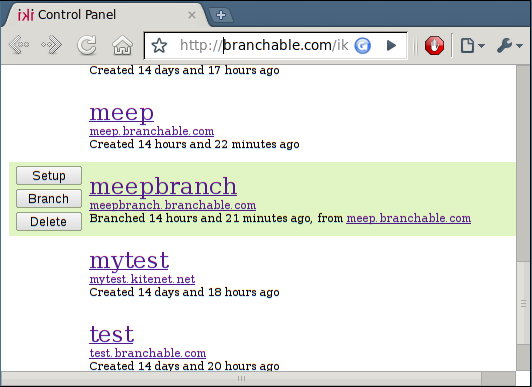
Time to introduce what I've been working on for these past too many months.. Branchable is an Ikiwiki hosting site, making it very easy to create blogs and wikis. The name "Branchable" was chosen because with its git backend, and ikiwiki-hosting frontend, sites hosted there can be easily branched by their owner (or by anyone, if the owner allows). branched site in control panel The ability to take your data and configuration and go home, as well as everything being free software, means Branchable follows the vision of the Franklin Street Statement on Freedom and Network Services, like identi.ca and last.fm. This is very important to me and to my cofounder, Lars Wirzenius. Branchable has a one month free trial, so if you've been meaning to do something with Ikiwiki, I hope you'll sign up. Also, we are offering free hosting for Free Software projects that sign up while Branchable is in beta.

Alexander Reichle-Schmehl: DDs, please feel free to commit to the DPN directly

The svn repository used to draft the Debian Project News just passed the sixth hundreds commit. If my calculations are correct, that's quite more than the number of edits done, back when the DPN was drafted in the wiki. I take it as a hint, that the new work flow works better than the old one. However, playing a bit with statistics (done by horrible shell one liners ;) I noticed, that - while every Debian Developer may commit to the subversion repository - not that many commits from other DDs where made: Of the 602 commits so far, only 70 where done by other DDs:
alex@melusine:~$ svn log --xml svn://svn.debian.org/svn/publicity \
 xmlstarlet sel -t -m "/log/logentry/author" -v "concat(.,' ')"   \
sed -e "s/ /\n/g" sort uniq -c sort -n grep -v guest grep -v tolimar
      1
      1 abe
      1 hertzog
      1 holger
      1 mika
      1 paravoid
      2 pabs
      3 alfie
     15 zobel
     20 gio
     25 spaillard
To give credit where credit is due, here are the guest commits:
     16 tpeteul-guest
     21 jeremiah-guest
     25 gmascellani-guest
     36 madamezou-guest
    122 taffit-guest
Many thanks so far, but I would like to advertise the Debian Project News and invite every DD to help us and to commit directly. It's quite easy: Run svn co svn+ssh://svn.debian.org/svn/publicity/dpn/en/current, edit the index.wml file, and then commit your changes back to the repository. (Well, ideally you would also honor Status flag and won't commit, if it's not open-for-edit.) As for the format: While we indeed use wml, you just need some basic HTML knowledge. To add a paragraph just use the following with proper content:
<a name="X"></a>
<h2>Fancy title</h2>
<p>More details about the topic.</p>
Usually the articles are kind of sorted by importance, so unless you are pretty sure it might be the easiest to just add your article at the end of the regular news, just before the other news sections. Should you not be able to fill an entire paragraph, feel free to just a one or two sentences to the other news section (just add a <p>...</p> with your content to the end of the other news). Don't worry about style, your English or syntax: It won't end up on the web page directly, it's reviewed and checked, so you can't do anything wrong. More details are available in the wiki at http://wiki.debian.org/ProjectNews/HowToContribute. Feel free to ask any questions unanswered on the publicity list at debian-publicity@lists.debian.org. Feel also free to contact us there, if you would like to help by translations or reviews. The more people help, the less work it's for everyone :) If you are not a Debian Developer, but still would like to help us, it's no problem. All you need is an account on our Alioth System (very easy to get, you just need to ask) and request to join the publicity project. See http://wiki.debian.org/ProjectNews/HowToContribute#Becominganeditoryourself for the respective links.

4 August 2010

Enrico Zini: My rule to see if a framework is worth of attention

My rule to see if a framework is worth of attention I came up with a little rule:
In order to be worth of any attention, a framework must be stable enough that I can charge money to train people to use it.
This probably applies to other kinds of software stacks, libraries, development environments and, well, to most software applications. In the context of python web frameworks, this means that: In light of this rule, I regret to notice that I see very few python web frameworks worth of any attention.

Dirk Eddelbuettel: RQuantLib 0.3.3

A new release (now at version 0.3.3) of RQuantLib is now on CRAN and in Debian. RQuantLib combines (some of) the quantitative analytics of QuantLib with the R statistical computing environment and language. Many of the changes in this new version are internal. The code was re-written using the new Rcpp API throughout, and the build system was further simplified using the LinkingTo: mechanism. The arithmetic average-price asian option pricer was added. A few other code updates were made as well. Full changelog details, examples and more details about this package are at my RQuantLib page.

Gerfried Fuchs: The Good, The Bad and The Ugly

Debian always was known for its communication "style". There were even shirts sold in memory of Espy Klecker with a quote he is known for: Morons. I'm surrounded by morons. Yes, I bought me one of those shirts too in the early days. And there were the talks that promoted Debian as a place to have Good flamewar training. And people considered that to be the fun part. After some years it got tiring. It got stressful. It got annoying. Bad feelings popped up, stirred you into the next flamewar, and it went down the gutter from there. It was almost becoming impossible to not be the target of a flamewar when one was doing more than just basic maintenance. Snide and extreme terse responses became the standard. In the end people are starting to give up and leave. The Ugly thing about this is that human resources are crucial. They aren't endless and can't be replaced as easily as broken hardware, especially when capable people or when people leave who invested an enormous amount of their spare time and effort. And given that a fair amount of people do put their heart into Debian, it feels like a small suicide to them and the public thinking about leaving is meant as a call for help which wasn't and isn't given. The solution to this death swirl? I'm not sure. When one looks over the edge of the plate and ignores for a moment all the bad feelings they one might have built up against Ubuntu because of their success and possibility to find new contributors on a regular basis one is able to find a much friendlier and productive environment there. This might be attributed to the Code of Conduct about which I wrote about last year already and which is an extremely well intended and useful document (the point I raised in there is already solved for a while, so I became a MOTU). And even if it might be hard to follow it at times, Mark Shuttleworth reminds and encourages its contributors to stick to these principles even in tough times. The result? When following the planets, one finds on Planet Ubuntu a very good rate of blog posts on things that had been done, compared to the good rate of blog posts of rants on Planet Debian. And even though people regularly complain about the communication style within Debian, the answers of this year's DPL candidates to the question about a code of conduct for Debian were rather rather disappointing. So it is just well too understandable that people go the path that hurts themself, take a cut and leave the project behind in its mess. For myself? I'm not too far from that point on a regular basis, and I can understand those who did the final step only too well. Regular abuse, especially when doing stuff that others neglect on a regular basis but needs to be done anyway, being belittled on that grounds and not being taken serious and getting disrespectful responses isn't improving the situation. It happens to way too many people, and the only thing that still keeps me on tracks is that I do not want to give in yet, that I don't think that it would improve Debian to leave the grounds to various destructive people. On the other hand, there is only so much abuse one can take...
ObTitle: Ennio Morricone - The Good, The Bad and The Ugly

/debian permanent link Comments: 5

Gerfried Fuchs: The Good, The Bad and The Ugly

Debian always was known for its communication "style". There were even shirts sold in memory of Espy Klecker with a quote he is known for: Morons. I'm surrounded by morons. Yes, I bought me one of those shirts too in the early days. And there were the talks that promoted Debian as a place to have Good flamewar training. And people considered that to be the fun part. After some years it got tiring. It got stressful. It got annoying. Bad feelings popped up, stirred you into the next flamewar, and it went down the gutter from there. It was almost becoming impossible to not be the target of a flamewar when one was doing more than just basic maintenance. Snide and extreme terse responses became the standard. In the end people are starting to give up and leave. The Ugly thing about this is that human resources are crucial. They aren't endless and can't be replaced as easily as broken hardware, especially when capable people or when people leave who invested an enormous amount of their spare time and effort. And given that a fair amount of people do put their heart into Debian, it feels like a small suicide to them and the public thinking about leaving is meant as a call for help which wasn't and isn't given. The solution to this death swirl? I'm not sure. When one looks over the edge of the plate and ignores for a moment all the bad feelings they one might have built up against Ubuntu because of their success and possibility to find new contributors on a regular basis one is able to find a much friendlier and productive environment there. This might be attributed to the Code of Conduct about which I wrote about last year already and which is an extremely well intended and useful document (the point I raised in there is already solved for a while, so I became a MOTU). And even if it might be hard to follow it at times, Mark Shuttleworth reminds and encourages its contributors to stick to these principles even in tough times. The result? When following the planets, one finds on Planet Ubuntu a very good rate of blog posts on things that had been done, compared to the good rate of blog posts of rants on Planet Debian. And even though people regularly complain about the communication style within Debian, the answers of this year's DPL candidates to the question about a code of conduct for Debian were rather rather disappointing. So it is just well too understandable that people go the path that hurts themself, take a cut and leave the project behind in its mess. For myself? I'm not too far from that point on a regular basis, and I can understand those who did the final step only too well. Regular abuse, especially when doing stuff that others neglect on a regular basis but needs to be done anyway, being belittled on that grounds and not being taken serious and getting disrespectful responses isn't improving the situation. It happens to way too many people, and the only thing that still keeps me on tracks is that I do not want to give in yet, that I don't think that it would improve Debian to leave the grounds to various destructive people. On the other hand, there is only so much abuse one can take...
ObTitle: Ennio Morricone - The Good, The Bad and The Ugly

/debian permanent link Comments: 8 Flattr this

Russell Coker: Why Clusters Usually Don t Work

It s widely regarded that to solve reliability problems you can just install a cluster. It s quite obvious that if instead of having one system of a particular type you have multiple systems of that type and a cluster configured such that broken systems aren t used then reliability will increase. Also in the case of routine maintenance a cluster configuration can allow one system to be maintained in a serious way (EG being rebooted for a kernel or BIOS upgrade) without interrupting service (apart from a very brief interruption that may be needed for resource failover). But there are some significant obstacles in the path of getting a good cluster going. Buying Suitable Hardware If you only have a single server that is doing something important and you have some budget for doing things properly then you really must do everything possible to keep it going. You need RAID storage with hot-swap disks, hot-swap redundant PSUs, and redundant ethernet cables bonded together. But if you have redundant servers then the requirement for making one server reliable is slightly reduced. Hardware is getting cheaper all the time, a Dell R300 1RU server configured with redundant hot-plug PSUs, two 250G hot-plug SATA disks in a RAID-1 array, 2G of RAM, and a dual-core Xeon Pro E3113 3.0GHz CPU apparently costs just under $2,800AU (when using Google Chrome I couldn t add some necessary jumper cables to the list so I couldn t determine the exact price). So a cluster of two of them would cost about $5,600 just for the servers. But a Dell R200 1RU server with no redundant PSUs, a single 250G SATA disk, 2G of RAM, and a Core 2 Duo E7400 2.8GHz CPU costs only $1,048.99AU. So if a low end server is required then you could buy two R200 servers that have no redundancy built in which cost less than a single server that has hardware RAID and redundant PSUs. Those two servers have different sets of CPU options and probably other differences in the technical specs, but for many applications they will probably both provide more than adequate performance. Using a server that doesn t even have RAID is a bad idea, a minimal RAID configuration is a software RAID-1 array which only requires an extra disk per server. That takes the price of a Dell R200 to $1,203. So it seems that two low-end 1RU servers from Dell that have minimal redundancy features will be cheaper than a single 1RU server that has the full set of features. If you want to serve static content then that s all you need, and a cluster can save you money on hardware! Of course we can debate whether any cluster node should be missing redundant hot-plug PSUs and disks. But that s not an issue I want to address in this post. Also serving static content is the simplest form of cluster, if you have a cluster for running a database server then you will need a dual-attached RAID array which will make things start to get expensive (or software for replicating the data over the network which is difficult to configure and may be expensive), so while a trivial cluster may not cost any extra money a real-world cluster deployment is likely to add significant expense. My observation is that most people who implement clusters tend to have problems getting budget for decent hardware. When you have redundancy via the cluster you can tolerate slightly less expected uptime from the individual servers. While we can debate about whether a cluster member should have redundant PSUs and other expensive features it does seem that using a cheap desktop system as a cluster node is a bad idea. Unfortunately some managers think that a cluster solves the reliability problem and therefore you can just use recycled desktop systems as cluster nodes, this doesn t give a good result. Even if it is agreed that server class hardware is used for all servers so features such as ECC RAM are used you will still have problems if someone decides to use different hardware specs for each of the cluster nodes. Testing a Cluster Testing a non-clustered server or some servers that use a load-balancing device at the front-end isn t that difficult in concept. Sure you have lots of use cases and exception conditions to test, but they are all mostly straight-through tests. With a cluster you need to test node failover at unexpected times. When a node is regarded as having an inconsistent state (which can mean that one service it runs could not be cleanly shutdown when it was due to be migrated) it will need to be rebooted which is sometimes known as a STONITH. A STONITH event usually involves something like IPMI to cut the power or a command such as reboot -nf , this loses cached data and can cause serious problems for any application which doesn t call fsync() as often as it should. It seems likely that the vast majority of sysadmins run programs which don t call fsync() often enough, but the probability of losing data is low and the probability of losing data in a way that you will notice (IE it doesn t get automatically regenerated) is even lower. The low probability of data loss due to race conditions combined with the fact that a server with a UPS and redundant PSUs doesn t unexpectedly halt that often means that problems don t get found easily. But when clusters have problems and start calling STONITH the probability starts increasing. Getting cluster software to work in a correct manner isn t easy. I filed Debian bug #430958 about dpkg (the Debian package manager) not calling fsync() and thus having the potential to leave systems in an inconsistent or unusable state if a STONITH happened at the wrong time. I was inspired to find this problem after finding the same problem with RPM on a SUSE system. The result of applying a patch to call fsync() on every file was bug report #578635 about the performance of doing so, the eventual solution was to call sync() after each package is installed. Next time I do any cluster work on Debian I will have to test whether the sync() code seems to work as desired. Getting software to work in a cluster requires that not only bugs in system software such as dpkg be fixed, but also bugs in 3rd party applications and in-house code. Please someone write a comment claiming that their favorite OS has no such bugs and the commercial and in-house software they use is also bug-free I could do with a cheap laugh. For the most expensive cluster I have ever installed (worth about 4,000,000 UK pounds back when the pound was worth something) I was not allowed to power-cycle the servers. Apparently the servers were too valuable to be rebooted in that way, so if they did happen to have any defective hardware or buggy software that would do something undesirable after a power problem it would become apparent in production rather than being a basic warranty or patching issue before the system went live. I have heard many people argue that if you install a reasonably common OS on a server from a reputable company and run reasonably common server software then the combination would have been tested before and therefore almost no testing is required. I think that some testing is always required (and I always seem to find some bugs when I do such tests), but I seem to be in a minority on this issue as less testing saves money unless of course something breaks. It seems that the need for testing systems before going live is much greater for clusters, but most managers don t allocate budget and other resources for this. Finally there is the issue of testing issues related to custom code and the user experience. What is the correct thing to do with an interactive application when one of the cluster nodes goes down and how would you implement it at the back-end? Running a Cluster Systems don t just sit there without changing, you have new versions of the OS and applications and requirements for configuration changes. This means that the people who run the cluster will ideally have some specialised cluster skills. If you hire sysadmins without regard to cluster skills then you will probably end up not hiring anyone who has any prior experience with the cluster configuration that you use. Learning to run a cluster is not like learning to run yet another typical Unix daemon, it requires some differences in the way things are done. All changes have to be strictly made to all nodes in the cluster, having a cluster fail-over to a node that wasn t upgraded and can t understand the new data is not fun at all! My observation is that the typical experience of having a team of sysadmins who have no prior cluster experience being hired to run a cluster usually involves learning experiences for everyone. It s probably best to assume that every member of the team will break the cluster and cause down-time on at least one occasion! This can be alleviated by only having one or two people ever work on the cluster and having everyone else delegate cluster work to them. Of course if something goes wrong when the cluster experts aren t available then the result is even more downtime than might otherwise be expected. Hiring sysadmins who have prior experience running a cluster with the software that you use is going to be very difficult. It seems that any organisation that is planning a cluster deployment should plan a training program for sysadmins. Have a set of test machines suitable for running a cluster and have every new hire install the cluster software and get it all working correctly. It s expensive to buy extra systems for such testing, but it s much more expensive to have people who lack necessary skills try and run your most important servers! The trend in recent years has been towards sysadmins not being system programmers. This may be a good thing in other areas but it seems that in the case of clustering it is very useful to have a degree of low level knowledge of the system that you can only gain by having some experience doing system coding in C. It s also a good idea to have a test network which has machines in an almost identical configuration to the production servers. Being able to deploy patches to test machines before applying them in production is a really good thing. Conclusion Running a cluster is something that you should either do properly or not at all. If you do it badly then the result can easily be less uptime than a single well-run system. I am not suggesting that people avoid running clusters. You can take this post as a list of suggestions for what to avoid doing if you want a successful cluster deployment.

Jaldhar Vyas: Sita Sings the Blues

In the evening today (Tuesday), the Debconf organizers arranged for a screening of the Creative Commons licensed film "Sita Sings the Blues" by Nina Paley. I went to see it as I had missed it when it was first released among tales of trials and tribulation at the hands of copyright meanies. So first let me say yay Free Culture!, boo Intellectual Property! etc. etc. Now we have that out of the way... "Sita Sings the Blues" has two main narrative threads: The breakup of Ninas relationship with her boyfriend and the Ramayana particularly a story from the uttarakanda about how after Shri Rama returned from Lanka, Sita had to undergo the agnipravesha to prove her chastity and even after she passed that test was eventually banished to the forest. I had an adverse reaction to this film. In fact I stayed to the end to be polite but I left afterwards as soon as I could. I had almost a physical feeling of nausea and I was surprised by this. Since then I have been pondering why this is so. It's not that its blasphemous. Shri Rama is not just a "perfect man", he is God (an avatar of Vishnu Bhagavan as is briefly touched upon in the film) for millions of people so, well, yes it is blasphemous but its more Rowan Atkinson style rather than Norwegian Black Metal style blasphemy. One never gets the impression that the author hates Hinduism or Indian culture the opposite in fact. And in fact it is not uncommon in our culture to speak of Sita and Rama in this way. They are not remote authority figures but as familiar to us as our own friends and family and the Ramayana is not just about events that happened long ago it is relevant to our lives right now. Even the "good woman done wrong by big dumb male jerk" narrative is not unknown. (See the Uttararamacharita of Bhavabhuti for instance.) though I would suggest reducing the Ramayana this way is akin to treating the Hitchhikers Guide to the Galaxy as a book about towels. Even the milder criticism that it is not accurate is offbase because although the Sanskrit poem by Maharshi Valmiki is the canonical rendition of the Ramayana, there are other well-known versions. Not just in Sanskrit, the Hindi retelling by Sant Tulsidas called Ramacharitamanasa is more popular than Valmiki. Also speaking as someone who has preached Ramakatha "professionally" I can tell you that even the priests do not stick to the letter of the text. It is encouraged and expected that they will riff on the basic stories adding or removing details according to the needs and taste of the audience. And the device of the three narrators made me smile as this is exactly the kind of discussions that go on after hearing the Ramakatha. (I must say Paley picked a notably illiterate trio though.) One place where this fell flat was when they discussed the alleged discrepancy between Sita living simply in the forest and dropping a trail of jewellery on the way to Lanka. Although I can imagine someone at some point saying, "Do not question these stories" not at this point. Even the most retarded westernized Indian would know that removing ones ornaments is a sign of widowhood. A married woman would only do that in extremis certainly not just merely because she was a hermit. In a few cases some extra details might have helped the story. It was not explained that Ravana does not just have rakshasas in his command but he is one himself. (And he certainly wasn't a good guy until one day he got up and kidnapped Sita.) Shri Ramas brother Lakshamana accompanied the couple into the forest to Lanka and back but he only pops up (for no apparent reason) at the end. But look at me, I'm turning into one of those people who rant about Star Trek continuity errors or complain that the Romans in a gladiator movie have the wrong helmets for that time period etc. One has to cut a storyteller some slack and I entered the screening determined to be charitable. It's also not because I don't really see much connection between the two stories. Getting dumped by someone who simply loses interest in you hardly seems equivalent to being trapped by a moral code that doesn't allow for individuals feelings. Paley could have easily made "Princess Leia Sings the Blues" and it wouldn't have changed the significance much. But in India people make far more tenuous connections between the epics and events in their own life so one can hardly complain about that. Aesthetics are not the problem either. The first version of the Ramayana I ever read was the Amar Chitra Katha comicbook version which partly influenced the visual style of this film. (In fact you briefly see it in one scene when different editions of the Ramayana flash by.) Hindu popular culture is very gaudy. (See Ramanand Sagars '80s Ramayana Hindi TV serial, which was very reverential, insanely popular and tacky beyond belief.) The animation in this film is very good and quite artistic. "So Jaldhar", you might be asking if you've read this far, "what exactly is your problem with this film?" I have read the Valmiki Ramayana in Sanskrit with the commentaries from beginning to end. I've read other Ramayanas in Sanskrit, Gujarati, and English. I have read the comicbook, I've read anti-Ramayana polemics. When you learn Sanskrit in the traditional way the first lesson, in the declension of masculine gendered nouns ending in vowels is rAma.h rAmau rAmA.h ... I am well aware there are different emphases, different interpretations in various versions. Why can't I accept this as just another take on a story that has shown its fluidity over and over again? It's just...wrong on a subrational level. How can I put this? Imagine you are flipping through the TV channels and you see your grandparents amongst Lady Gaga's backup dancers. Or you came home one night to find everything that was on the floor meticulously glued to the ceiling. Over the course of my life (to hear my mother tell it my first exposure to the Ramayana was before I could speak.) I have developed a mental bond with this story a certain idea of how it should be. I think so has Nina Paley. And this is the problem. "Sita Sings the Blues" is Nina Paleys Ramayana not mine.

Russell Coker: WordPress Maintainability

For a while I ve been maintaining my own WordPress packages. I use quite a few plugins that weren t included in Debian, some of them have unclear licenses so they can t go in Debian while the rest would have to go in Volatile at best because they update regularly and often have little or no information in the changelog to describe the reason for the update so we have to assume there is a potential security issue and update it reasonably quickly. As I m maintaining plugin packages it seems most reasonable to keep maintaining my own packages of WordPress itself which I started doing some time ago then the version in Debian became outdated. Now WordPress isn t a convenient package to maintain, the design of it is that a user will upload it to their web space via FTP or whatever, it s not designed to be managed by a packaging system with the option of rolling back upgrades that don t work, tracking dependencies, etc. One example of this is the fact that it comes with a couple of plugins included in the package, of which Akismet is widely used. The Akismet package is periodically updated asynchronously from the updates to the WordPress package with the apparent expectation that you can just FTP the files. Of course I have to build a new WordPress package whenever Akismet is changed. Now there is a new default theme for WordPress called TwentyTen [1]. This theme ships with WordPress and again has updates asynchronously. Just over a week ago my blog prompting me for an update to the theme even though I hadn t consciously installed it I have to update because I don t know whether one of the other users on the same system has chosen it and because having a message about an update being required is annoying. The Themes update page has no option for visiting the web site for the theme and only offered to send it to my server via FTP or SFTP, of course I m not going to give WordPress access to change it s own PHP files (and thus allow a trojan to be installed). So I had to do some Google searching to find the download page for TewntyTen which happens to not be in the first few results from a Google search (even though those pages look like they should have a link to it and thus waste the time of anyone who just wants to download it). After downloading the theme I had to build a new WordPress package containing it I could have split it out into a separate package and have the WordPress package depend on it, but I ve got enough little WordPress packages already. It doesn t seem worth-while to put too much effort into my private repository of WordPress packages that possibly aren t used by anyone other than me. Plugins aren t as bad, the list of plugins gives you a link to the main web page for each plugin which allows you to download it. I wonder what portion of the WordPress user-base install via FTP to a server that they don t understand and what portion of them use servers that are maintained properly with a packaging system, my guess is that with the possible exception of WordPress.com most bloggers are running on packaged code. It seems to me that optimising for Debian and CentOS is the smart thing to do for anyone who is developing a web service nowadays. That includes files managed by the packaging system, an option to downgrade (as well as upgrade) the database format (which changes with almost every release), and an option for upgrading the database from the command-line (so it can be done once for dozens or hundreds of users). deb http://www.coker.com.au lenny wordpress I have a repository of WordPress packages that anyone can use with the above APT sources.list line. There is no reason why they shouldn t work with Testing or Unstable (the packaging process mostly involves copying PHP files to the correct locations) but I only test them on Lenny.

3 August 2010

Wouter Verhelst: Something's very wrong...

I maintain NBD I have an irrational emotional dislike for python. (I know, I know). I needed to build nbd in a clean environment. So I set up the environment, install openssh-client (to get the sources across) and then do apt-get build-dep nbd. That pulls in python. Something is wrong with this world.

Next.

Previous.