Search Results: "nic"

16 September 2010

Adrian von Bidder: Remote Controlled

The Apple universe is happy to live with whatever Steve Jobs allows to get in. Numerous examples going back at least 20 years are available; most recent Apple's law action against a manufacturer offering compatible batteries and now an external harddisk for iPods. Microsoft is obviously the traditional enemy for many (personally, I think there's not much difference between MS, Apple and Google anymore.) So no surprise that MS Exchange plays a role in the story about a remote wipe function of many smartphones. Just being connected to a MS Exchange server allows the administrator of that server to remotely factory-reset the smartphone. I'm not sure if there's a complete list of vulnerable smartphones, but at least iOS, webOS and Android based phones are affected. Personally, I'd say this is a serious security issue. But of course, according to the manufacturers, it is a function for the convenience of network adminstrators so they can wipe stolen phones remotely. Update: Nico: If I'm somebody who is really after your data, I've got your smartphone and I'm clever enough not to connect it to the net before I got the data out. So you're only catching the Oh look what I accidentally found case, which I think is really just giving you a false sense of security. Anonymous: Google is the company with the Do Not Be Evil company motto and the very good press and marketing team touting everywhere how much they do for the good of everybody. Except when it cuts into their earnings. Like really cooperating with the Linux kernel folks. Like living up to what they announced they'd do in China. It's also the company covertly collecting WLAN data, and only admitting to exactly as little as they can get away with when it comes into the open. And, in the end, simple greed will do the rest: it's a powerful big company with plenty of very well paid career positions, and in my experience this company tends to attract people who will use this power in any way they can to increase their income. At this level of business, a company motto like the one of Google is just a few meaningless words. The real company motto is Earn Money. In Whatever Way. Other examples are told by anybody who needed to interact with their so called customer support, either because they got their free account locked or because they had a specific request as a paying customer placing ads on Google (and I'm talking about a company with at least several CHF 10k per year in ads, not just a small nobody.)

Andrew McMillan: Changing an old habit

I'm a keen amateur photographer and have been since I was at school. Of course back then it involved smelly chemicals, strange lights and dark rooms. The expense and hassle of film eventually did it in for me and in 2000 I bought my first digital camera. After a series of increasingly sophisticated devices, back in 2007 I bought a Nikon D80 and soon thereafter I discovered that you can do things with raw camera files that have some analogies to the darkroom processing of my youth. For most of the time since then I've used UFraw for processing my raw images, combined with increasingly sophisticated batch files to harass it into shape. It has increasingly frustrated me that UFraw doesn't do several things that are essential to processing most files, since once the image leaves that programming it usually ends up in an 8-bpp processing path. It seems to me that the saving the processed image into an 8bpp format like jpeg is the last step before leaving the image alone. Of course this can't always be the case since sometimes a judicious use of the 'Resynthesizer' plugin can make some unsightly elements just disappear, or one needs to carefully apply some censorship to the 14 year old in the background so that the 7 year-old's parents can put the photo on the mantelpiece without worrying about what Granny will say about how much better children's manners were in her day. I'm hoping too, that when I have grandchildren I'll be able to tell them that 'in my day we only had 8 bits per pixel, and we were lucky', but The Gimp isn't there yet, no matter how much promise Gegl seems to offer. The thing that has particularly annoyed me is sharpening. UFraw doesn't, and as a result my workflow has either involved applying some blanket sharpening, much like the camera does, or moving the image into a second tool just to apply some sharpening. This week has been particularly demanding, as the school asked me to 'take some photographs of the production'. So of course that's a thousand-odd photos that I want to do a cull down to a hundred or so, and then I want to quickly do justice to the good ones so I can move on to other stuff. Well this time my frustration with UFraw hit that ceiling that got me to try something else. I've done this in the past, and found myself going full circle and ending up right back at UFraw with a few extra lines added to my script, but this time I tried rawstudio and in processing the 'can you do the class shots overnight please' test it produced much nicer results in much less time than I have ever been able to with UFraw. So I've switched, and the more I use it the more convinced I am that UFraw will be getting uninstalled pretty soon. That's not to say that rawstudio is perfect: it isn't. In particular it has some user interface failures that are kind of annoying to me, but they aren't enough to stop me using it. In fact I liked it so much that I immediately had to pull the nightly repository and build that, just to get the new saturation handling. The user-interface niggles that do get to me are: Things that I immediately love, over what UFraw gave me: Things that I immediately miss from UFraw: There are a bunch of things that RawStudio also does that I haven't particularly found a use for yet, but which I suspect I will quite like when I do. The image classification and stuff seems likely to be useful, for sure. In choosing to switch RawStudio I also looked at RawTherapee, which has recently relicensed under the GPL, but I chose RawStudio because it has vastly better performance on my laptop, and because I found the interface much more immediately accessible. RawTherapee also exceeds what UFraw can do in many ways, and looks like it might be useful for the really difficult cases, but learning to drive it with any facility could take some time. Especially if you only have an i7 740QM with 6G RAM, it would seem.

Dirk Eddelbuettel: BLAS, BLASter, BLAStest: Some benchmark results, and a benchmarking framework

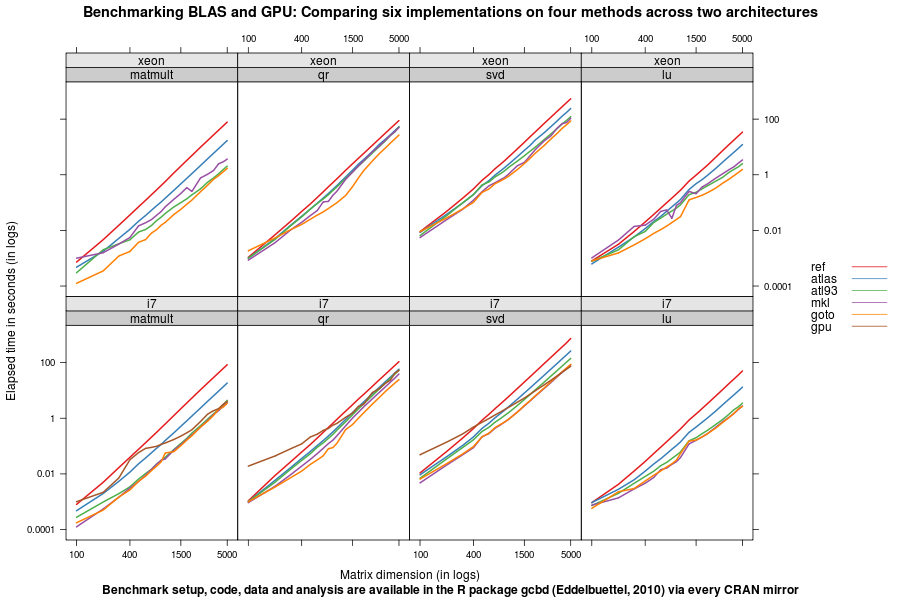
Usage of accelerated BLAS libraries seems to shrouded in some mystery, judging from somewhat regularly recurring requests for help on lists such as r-sig-hpc (gmane version), the R list dedicated to High-Performance Computing. Yet it doesn't have to be; installation can be really simple (on appropriate systems). Another issue that I felt needed addressing was a comparison between the different alternatives available, quite possibly including GPU computing. So a few weeks ago I sat down and wrote a small package to run, collect, analyse and visualize some benchmarks. That package, called gcbd (more about the name below) is now on CRAN as of this morning. The package both facilitates the data collection for the paper it also contains (in the vignette form common among R packages) and provides code to analyse the data---which is also included as a SQLite database. All this is done in the Debian and Ubuntu context by transparently installing and removing suitable packages providing BLAS implementations: that we can fully automate data collection over several competing implementations via a single script (which is also included). Contributions of benchmark results is encouraged---that is the idea of the package. The paper itself describes the background and technical details before presenting the results. The benchmark compares the basic reference BLAS, Atlas (both single- and multithreaded), Goto, Intel MKL and a GPU-based approach. This blog post is not the place to recap all results, so please do see the paper for more details. But one summary chart regrouping the main results fits well here: GPU/CPU Benchmark Results This chart, in a log/log form, shows how reference BLAS lags everything, how multithreaded newer Atlas improves over the standard Atlas package currently still the default in both distros, how the Intel MKL (available via Ubuntu) is fairly good but how Goto wins almost everything. GPU computing is compelling for really large sizes (at double precision) and too costly at small ones. It also illustrates variability and different computational cost across the methods tested: svd is more expensive than level-3 matrix multiplication, and the different implementations are less spread apart. More details are in the paper; code, data etc are in the package gcbd. The larger context is to do something like this benchmarking exercise, but across distributions, operating systems and possibly also GPU cards. Mark and I started to talk about this during and after R/Finance earlier this year and have some ideas. Time permitting, that work should be happening in the GPU/CPU Benchmarks (gdb) project, and that's why this got called gcbd as a simpler GPU/CPU Benchmarks on Debian Systems study.

15 September 2010

Gunnar Wolf: On enjoying history, opposed to what happens around me

Portadas de los discos de Diana Uribe I have always liked learning and understanding history. Since I discovered him, for a couple of years already I always try to catch Javier Garciadiego's program Conversaciones sobre historia, Saturday 9AM in the Horizonte 108 radio station (can be listened to online). This program started by going over the events just before the beginning of the 1910 revolution in Mexico - and along slightly over five years, one hour per week and following different threads, the program has reached the end of the Cristiada, in the early 1930s. Garciadiego has a very nice, followable, amenable way of telling history, and I have recommended his program to many friends. This last June, I spent some days in Guatemala City, for DrupalCamp Centroam rica. I stayed with my good Colombian friend, Dilson, and at his house he had framed a poster of the History of the Civilizations. Of course, I got my nose close to it, guessing as many faces as possible in the lot. And he showed me his last Christmas present: Two books, each of them with 6 CDs. One is Historia de las Civilizaciones, the second one is Historia de las independencias. They are made by Colombia's very well known and well regarded historian Diana Uribe. I copied the CDs in order to listen to them later And wow, was I impressed! Diana Uribe makes a great narrative about topics that to some people would seem boring and dry. As I said, I have always found passion in understanding the human processes that have shaped civilization and brought us all the way to where we stand now. Well, Diana Uribe manages to bring more "normal" people to this passion. While looking for information on her to share in this blog post, I found so many places offering download of her disks, with apparently young people talking about how she has got them all so excited and interested in history... That's, I think, the best "thank you" any academician can get: having non-specialists say how her work has opened up the passion of one of the world's least sexy professions to them. And yes there are so many "thank you" and "I want" commentaries, so much of what I would call "fan mail", that it took me a bit to find an online library carrying both works. And yes, at ~US$50 each, I do intend to buy them. Now, why am I writing this today? Well, yes, because I finished listening to the series today, but besides During this year, most of Latin American countries conmemorate their 200 years of existence. Most of the independentist struggles in the continent started in 1809-1810. And today is the "partying" day in Mexico Says the legend that in the night between September 15 and 16, 1810, a priest who is always painted as old and charismatic called on his small town urging the people to rise and fight for independence, and as a result of that, only 11 years later Mexico was a fully independent country, spanning from Costa Rica to California, and... well, a nice and very idealized myth. A century later, in 1910, after a very long stability and growth period (attained mostly through repression, the same abstract thing named as "the people" rose against the dictator Porfirio D az, who had been Mexico's president for 30 years. The revolution deeply changed the social face of the country, but politically... After ~15 years of fighting, the result was that a 30 year long dictatorship was replaced by a 70 year long one... And our political system still has not evolved beyond that model. Now, comparing what has not improved nor even stayed the same but went backwards... A century ago, the festivities of the hundred years of independence were a time for showing pride, for showing to the guests from more "civilized" countries how ours was by then a modern, thriving country worth believing in, worth investing in: Besides the important, majestic and well built monuments that were erected and still stand today (i.e. the Column of the Independence or Hemiciclo a Ju rez, many institutions that would socially shape the next century even after D az's death, even after he had been declared not the role model we wanted after all were born: The National University (nowadays the most important university in Latin America), the National School for Professors, the Railroad Technical School and many others (see Javier Aranda's note for some more details)... The celebration was well-thought and planned. Of course, it didn't go into some darker corners, the country was as uneven and unfair as it can be for the poorer indigenous population (which back then was a majority), and what not. But this year? Well, we are expecting an impressive show tonight (which I won't see, even though I'd like to, as I no longer have a TV and even if I had wanted to go downtown for the celebration, different government branches are insisting we should just sit and watch it by TV at home as it can be too crowded... so not even that was well thought out Of course not every Mexican can go to the same square and see the same de-facto president do the ritual, but some more redundancy could be thought, spreading acts through all of the city instead of concentrating the festivities all along Reforma. But anyway Leaving aside our current de-facto ruler's inabilities to do anything worthy, which are already well known and documented... I took this opportunity to listen to a great work, and am most happy to do it, and to be able to share it with you.

Iustin Pop: Virtual hardware failures

Note: The title is intentionally unclear; it can be read both as virtual failures and failures of virtual hardware , and I'm not sure which one is the better for the cases below. One of the funny things about virtualization is how virtual hardware fails. It often happens that my NFS-stored virtual machine images suffer an NFS glitch or something, at which point one can see in the kernel logs:
kernel: mptscsih: ioc0: attempting task abort! (sc=ffff880018320100)
kernel: sd 0:0:0:0: [sda] CDB: Read(10): 28 00 00 00 00 38 00 00 08 00
kernel: mptscsih: ioc0: task abort: FAILED (sc=ffff880018320100)
kernel: mptscsih: ioc0: attempting target reset! (sc=ffff880018320100)
kernel: sd 0:0:0:0: [sda] CDB: Read(10): 28 00 00 00 00 38 00 00 08 00
kernel: mptscsih: ioc0: target reset: SUCCESS (sc=ffff880018320100)
kernel: mptscsih: ioc0: attempting task abort! (sc=ffff880018320100)
kernel: sd 0:0:0:0: [sda] CDB: Read(10): 28 00 00 00 00 38 00 00 08 00
kernel: mptscsih: ioc0: task abort: FAILED (sc=ffff880018320100)
kernel: mptscsih: ioc0: attempting task abort! (sc=ffff88001eefcc00)
kernel: sd 0:0:0:0: [sda] CDB: Read(10): 28 00 00 98 01 a7 00 00 08 00
kernel: mptscsih: ioc0: task abort: FAILED (sc=ffff88001eefcc00)
kernel: mptscsih: ioc0: attempting target reset! (sc=ffff880018320100)
kernel: sd 0:0:0:0: [sda] CDB: Read(10): 28 00 00 00 00 38 00 00 08 00
kernel: mptscsih: ioc0: target reset: SUCCESS (sc=ffff880018320100)
While the NFS transient issues are probably a real bug, I have this image of a state machine inside the driver trying over and over the same error paths, in a futile attempt at fixing the hardware , and not locking onto/matching the real hardware behaviour. Or, this most recent case during boot and resource probing:
kernel:  e1000: 0000:00:08.0: e1000_probe: The EEPROM Checksum Is Not Valid
kernel:  /*********************/
kernel:  Current EEPROM Checksum : 0x031a
kernel:  Calculated              : 0x031a
kernel:  Offset    Values
kernel:  ========  ======
kernel:  00000000: 08 00 27 f6 f3 9b 00 00 ff ff 00 00 00 00 00 00
kernel:  00000010: 00 00 00 00 08 44 1e 00 86 80 0e 10 86 80 40 30
kernel:  00000020: 00 00 00 00 00 00 00 00 00 00 00 00 00 00 00 00
kernel:  00000030: 00 00 00 00 00 00 00 00 00 00 00 00 00 00 00 00
kernel:  00000040: 00 00 61 70 0c 28 c8 00 c8 00 00 00 00 00 00 00
kernel:  00000050: 00 00 00 00 00 00 00 00 00 00 00 00 00 00 02 06
kernel:  00000060: 00 00 00 00 00 00 00 00 00 00 00 00 00 00 00 00
kernel:  00000070: 00 00 00 00 00 00 00 00 00 00 00 00 00 00 1a 03
kernel:  Include this output when contacting your support provider.
kernel:  This is not a software error! Something bad happened to your hardware or
kernel:  EEPROM image. Ignoring this problem could result in further problems,
kernel:  possibly loss of data, corruption or system hangs!
kernel:  The MAC Address will be reset to 00:00:00:00:00:00, which is invalid
kernel:  and requires you to set the proper MAC address manually before continuing
kernel:  to enable this network device.
kernel:  Please inspect the EEPROM dump and report the issue to your hardware vendor
kernel:  or Intel Customer Support.
kernel:  /*********************/
kernel:  e1000: 0000:00:08.0: e1000_probe: Invalid MAC Address
kernel:  e1000: 0000:00:08.0: e1000_probe: (PCI:33MHz:32-bit) 00:00:00:00:00:00
kernel:  e1000: eth0: e1000_probe: Intel(R) PRO/1000 Network Connection
This is an emulated Intel NIC under VirtualBox. I have never seen it before, and it went away after a reboot. The most funny thing is the This is not a software error! message well, it definitely is :), but the driver has no way to know that. I think that these software-driven failures probably trigger some obscure error handling paths; I assume that the usual failures for real versus virtual hardware are quite different in nature, and that recovery is again different. This leads to using the wrong strategy for recovery, but fortunately nothing is really broken, just in the wrong state Since I'm not familiar with low-level driver details, I might be wrong of course; I'm just speculating on what I think goes on inside the driver. I'm not even mentioning virtual clock issues, as those are no longer funny

Matthew Garrett: Thoughts on upstreams

Last month I gave a presentation on the interaction between Android and kernel upstream at Linuxcon. The video for that is now available here (requires registration). Contrary to stories you may have heard, I do not dropkick anyone through a window.

There's some parallels between the Android/upstream scenario and Canonical's approach to upstream. Mark wrote a lengthy defence of Canonical's focus on components that they feel need development, while not putting development effort into things they feel are good enough already. That's pretty consistent with the discussions I had with him at the Ubuntu development meeting in Oxford over six years ago. Back then the focus was on taking all the excellent software that already existed and concentrating on providing it as a single polished and integrated product. It was successful - what's easy to forget now is that the first release of Ubuntu was massively more usable out of the box than any other Linux distribution available at the time, and it's absolutely undeniable that its release spurred increased efforts on the part of competitors. But I don't think the same focus is being applied any more.

The most obvious (and most controversial) example is the Ayatana project. Ayatana's a pretty explicit statement that Canonical don't view the existing Gnome UI as being suitable for their vision of the Linux desktop. That's absolutely fine. However, unlike many of the papercut projects, Ayatana is a set of complete reimplementations of functionality that behave differently to their upstream equivalents. There's no meaningful sense in which that's not a fork of Gnome. And, let me emphasise, I don't think that's a bad thing.

Let's go back to Android. While we talk about how much we'd have preferred it if Google had interacted with upstream before implementing wakelocks, the realistic outcome is that there's no way that we'd have accepted them even if they'd been posted years before hardware shipped. If there'd been a productive outcome to that aspect of the conversation it would have involved Android having a very different power management policy. Sometimes you're not going to convince people that something is better without implementing it and seeing how well it works. The problem with wakelocks is not that they exist or that Google feels they work better than the alternative, but that they end up integrated into drivers in a way that can cause divergence between mainline and Android.

Ayatana potentially has the same outcome. At some level, well-integrated applications have to be aware of the environment in which they're running. The application indicator patches are an example of that. Carrying conditional code increases maintenance burden, reduces test coverage and is a net loss in the long run. If upstream Gnome never gains support for this functionality, and if Ubuntu continues to depend on it, then Canonical have a delta that they'll have to carry forever. That benefits nobody.

Forking because you believe that your approach is better is a completely valid development model, but in the long run can cause problems if you don't have a long-term strategy for how to resolve that fork. For all we criticise Google's ability to get Android code into the mainline kernel, they've put orders of magnitude more effort into doing so than Canonical have in terms of getting Ayatana's code into mainline Gnome. This isn't a function of Google's relative size - the Android kernel team is on the order of 10 people. It's not enough of a difference to explain the disparity.

Canonical would be perceived as much better team players if there was an indication of their long-term plan in terms of Unity and the Ayatana projects and getting that code into mainline Gnome and integrating with the Gnome shell. It's completely unsurprising that they're viewed with distrust until that happens.

14 September 2010

Mohammed Sameer: Twitter OAuth Proxy

I'm using Twitter plugin for Contacts and Conversations to twitter on my N900.

Twitter recently moved to OAuth. Problem is the Maemo package is outdated and seems to be unmaintained.

I did some research and came across a blog entry about exploring OAuth-protected APIs and some code. Nice idea but not usable for me.

I ended up sitting down and writing a small python script that will re-route your HTTP requests to api.twitter.com after adding all the OAuth bills and whistles, read the reply from twitter and send it back. Neat ? :-)

There's also supertweet.net which I've discovered after I finished writing my script but seems they don't support all of the twitter API call while my script does that.

The script is simple without much error checking but it's been working for me for a few days already.

Last thing, I'm not interested in running a service like supertweet. I'll not be implementing the full OAuth protocol. Need to use it ? Register your own application.

Get the code while hot!

git clone git@gitorious.org:twitter-proxy/twitter-proxy.git

Next step: Thinking of maintaining the twitter plugin for Maemo. I already compiled the latest code and it sort of works fine :-) read more

Kees Cook: my part in the ecosystem

I was asked to write about what I do at Canonical and what I do in the Free Software community at large. There is obviously a great deal of overlap, but I ll start with the things I m involved with when I m wearing my Ubuntu hat. My primary job at Canonical is keeping Ubuntu secure. This means that I, along with the rest of the Ubuntu Security Team, coordinate with other Free Software distributions and upstream projects to publish fixes together so that everyone in the community has the smallest possible window of vulnerability, no matter if they re running Ubuntu, Debian, RedHat/Fedora, SUSE/openSUSE, Gentoo, etc. Between vendor-sec, oss-security, and the steady stream of new CVEs, there is plenty going on. In addition to updates, the Security Team works on pro-active security protections. I work on userspace security hardening via patches to gcc and the kernel, and via build-wrapper script packages. Much of this work has been related trying to coordinate these changes with Debian, and to clean up unfinished pieces that were left unsolved by RedHat, who had originally developed many of the hardening features. Things like proper /proc/$pid/maps permissions, real AT_RANDOM implementation, upstreaming executable stack fixing patches, upstreaming kernel NX-emu, etc. Most of the kernel work I ve done has gotten upstream, but lately some of the more aggressive protections have been hitting frustrating upstream roadblocks. Besides the hardening work, I also improve and support the AppArmor Mandatory Access Control system, as well as write and improve confinement profiles for processes on Ubuntu. This work ends up improving everyone s experience with AppArmor, especially now that it has gotten accepted upstream in the Linux kernel. I audit code from time to time, both on the clock with Canonical and in my free time. I m no Tavis Ormandy, but I try. ;) I ve found various security issues in Xorg, Koffice, smb4k, libgd2, Inkscape, curl+GnuTLS, hplip, wpa_supplicant, Flickr Drupal module, poppler/xpdf, LimeSurvey, tunapie, and the Linux kernel. With my Canonical hat off, I do all kinds of random things around the Free Software ecosystem. I m a sysadmin for kernel.org. In Debian, I maintain a few packages, continue to try to push for security hardening, and contribute to the CVE triage efforts of the Debian Security Team. I ve written or maintain several weird projects, including MythTVFS for browsing MythTV recordings, GOPchop for doing non-encoding editing of MPEG2-PS streams, Perl s Device::SerialPort module, and the TAP paging server Sendpage. For a selection of things I ve contributed to other project, I ve implemented TPM RNG access in rng-tools, made contributions to Inkscape s build and print systems, implemented CryptProtect for Wine, wrote a PayPal IPN agent in PHP that actually checks SSL certificates unlike every other implementation I could find, added additional protocol-specific STARTTLS negotiations to OpenSSL, implemented the initial DVD navigation support in MPlayer, updated serial port logic in Scantool for communicating with vehicle CAN interfaces, tried to add support for new types of timeouts in Snort and Ettercap, fixed bugs in mutt, and added HPUX audio support to the Apple ][ emulator XGS. As you can see, I like making weird/ancient protocols, unfriendly file formats, and security features more accessible to people using Free Software. I ve done this through patches, convincing people to take those patches, auditing code, testing fixes and features, and doing packaging work. When I go to conferences, I attend UDS, DefCon, OSCon, and LinuxCon. I ve presented in the past at OSCon on various topics including security, testing, and video formats, and presented at the Linux Security Summit (miniconf before LinuxCon this year) on the need to upstream various out-of-tree security features available to the Linux kernel. I love our ecosystem, and I love being part of it. :)

Michal Čihař: Learning graphviz

While working on new Gammu documentation I came to need to include some graphs showing some workflows. Looking into Sphinx documentation (which is used for the documentation for Gammu), I've discovered nice integration with graphviz. Fortunately it was pretty easy to learn the basics, though I've never used it before and here it comes - message processing workflows for SMSD.

13 September 2010

Iustin Pop: 3ware raid resize via pivot_root

How pivot_root won against a stupid RAID controller This post is brought to you by a very stupid 3ware 9650SE RAID controller, which doesn't understand the concept of growing a RAID array after all disks have been replaced by bigger ones. Or, well, it can, but the procedure, involving sending array dumps to the technical support, then receiving a program to run under DOS (!), doesn't inspire me with confidence. Furthermore, this stupid RAID card doesn't allow easy reordering (if it's possible, and I just missed it, please let me know) of the RAID arrays at runtime, only from the BIOS screen, and I didn't have access to that (only poor man's serial console under Linux). So, after buying new harddrives, and replacing the original ones in the RAID1 array with double the capacity, I realised I have to do a manual conversion. Basically, go into single-user mode, remount all read-only, split the RAID1 array into its (identical) components, change root directory to the second disk, re-partition the first disk, copy the data from the 2nd to the 1st disk, then re-add the 2nd disk to the 1st one (repartitioned) to re-establish the RAID1. All this, on a headless (no keyboard, no VGA) machine, just with a serial console. Of course, if this is just your local machine, you can easily reboot from an external media, and do all this easily from a full user-space. In any case, I'm writing this down, as there seem to be no easily findable guides on how to do the resize on a 3ware with its restrictions. Procedure Disclaimer: you might lose data via this, there are no guarantees. Have up-to-date backups. First, make sure you have power control (you can power-cycle the box if needed) and the serial console works. Also, make absolutely sure that the RAID array is fully consistent, and that you don't have any bad sectors on the drives, as you will lose redundancy during the operation. If /usr is not on your root file-system, then you need to copy /usr/sbin/chroot to somewhere on it. Also, if you have tools for the array that are not on your root file-system, you should copy them there now. In my case, that was tw_cli. First reboot Reboot into init=/bin/sh. Note: I've tried to simply go into single-user mode, or to reboot with emergency, but this doesn't work, because in both modes, beside the init process with PID 1 and your shell, there's another init process (the parent of the shell), and I didn't know how to tell it to re-execute itself. To the main init process it's easy, you just run telinit u, but that child keeps the old root directory mounted. If it's possible to re-exec that child too, then this step can be skipped please let me know how! Changing the root mount Make sure everything is mounted read-only (should be), then split the raid array into its component drives, using whatever tool the card needs. For me, it was:
# tw_cli /c0/u0 migrate type=single
The second drive now should be visible e.g. as /dev/sdc, so mount it somewhere, and pivot_root to it:
# mount -o ro /dev/sdcX /mnt
# cd /mnt/
# pivot_root . mnt/
# exec chroot .
At this point, the new root (on some partition on /dev/sdc) is mount at the root, and the exec call replaced the current shell with another one that has the right root directory. So nothing should keep the old root directory (at /dev/sdaX) in use, and umount /mnt (or umount /dev/sdaX) should succeed now. Recreate the first raid array Now, since it's no longer in use, you can delete and recreate the first raid array. Once it's available, you have two choices: I did the latter, since I wanted to use the new alignment standards (the initial installation was still using sector 63 for the boot partition, etc.) as a future preparation for either SSD or 4K-sector drives. So I used: In any case, either copy the entire disk, or each partition in turn, or possibly pvmove from the old to the new disk, etc. Switch back the root mount At this point, /dev/sdc is no longer used, and you can again change the root directory. This is similar to the first pivot_root, but now using /dev/sda as a target. All the instructions are the same. Convert back to RAID1 Now, since (in our example) /dev/sdc is no longer in-use, you can delete that drive and rejoin it to the first drive, recreating the RAID1 array. In my case:
# tw_cli
/> /c0/u2 delete
blah blah [y/n] y
/> /c0/u0 migrate type=raid1 disk=X
At this point, the machine is again redundant (or will be once the resync finishes), but it still needs one more step or it won't boot correctly. Reinstall the boot-loader Now, for reinstall the boot loader, you'll probably need to mount /boot (and mount it read-write), and do whatever you need. In my case, I re-ran lilo, but grub-install /dev/sda should also work. Final reboot And now, you only need to reboot into the normal, resized system. Since you can't easily use shutdown when booted with /bin/sh as init, just use /proc/sysrq-trigger to sync/unmount/reboot. Thoughts While I use a hardware RAID controller for the battery backup it offers, I have never thought it cannot do such a simple operation (compare with mdadm --grow /dev/mdX --size=max). Second, I knew about pivot_root but have not used it before. It's a very very nice thing, and the only downside is that you can't really use it with more than a few processes, since it's hard/impossible to change a random process' root directory. But anyway, it works, and it's damn handy for doing things to the root file-system or in general to the root drive (e.g. just repartitioning it) when you can't boot from another media (e.g. remote machine).

Amaya Rodrigo: Of inner peace and struggle

[Nothing related to Debian here, move on if you don't care about my recurring obsession with the end of the world, Cassandra pains, or Big Phat Living Room Revolution yearnings].

Although I am still looking for a community of anarcho-primitivists that want to accept me joining their frugal living, and simply slip off the social construct, the system, the fucking face of earth, call it what you will, I could find some comfort in my favourite feminist blogger's take on the subject of my midlife crisis regarding ecology, capitalism, patriarchy, child bearing, overpopulation, meat consumption and all the rumination of consuming thoughts that (still) make my life miserable and have kept me running away from human contact for a year.

[Emphasis mine]

At what point does human culture depart from the Natural? With the invention of computers? TV? Cars? The cotton gin? Electricity? Taco stands? Gunpowder? The printing press? Written language? Shoes? Crop cultivation? Yurts? The wheel? Did humans become unnatural when the good old days of picturesque, endless agrarian toil, feudal oppression, unchecked disease, ignorance, and death from dysentery at 35 turned into the bad new days of urban post-industrial capitalism where a pound of fair-trade organic coffee costs $12.99 and your email inbox is full of spam?

ah. Everything humans do, or have ever done, is natural. We can t do anything else. The idea that modern culture is un-natural is nostalgic and inaccurate. Living off the grid in a yurt is good in some absolute sense, whereas driving an SUV from a suburban bungalow to the stripmall is bad ? Come on. This a romantic, but misguided view. The cosmic reaction to a 20 Ford Expedition is the same as to a sanctimonious Prius: bupkis. The universe doesn t give a fuck about you or your lifestyle choices. It doesn t give a fuck about the economy, oil spills, or civil unrest in Blargistan. It doesn t give a fuck about katydids. Eventually our whole planet will be erased from space, and the galaxy won t bat an eye. The inevitable extinction of our species (imminent, according to research here at Spinster Laboratories) via the exhaustion of available resources is as natural as a fresh-picked peach. As Andre 3000 and other dude philosophers have observed, nothing is forever.

Yes, yes, when people use the word natural what they really mean is free of chemical additives and maybe some of the assorted hippie concepts that go with that narrative. Barter economies, home furnishings made from bamboo, vegan cookbooks, living in the country. While I would argue that it is just as natural for people to put chemical additives in things as it is to not put chemical additives in things, I admit that it is appealing to fantasize that the source of human misery is an unnatural isolation from Nature, and that doing yoga on an organic rubber mat and drinking organic spinach smoothies will put me back in sync with the cosmos.

But alas, I m already in sync with the cosmos, and so are you. In other words, this is it. This is what we ve become, and this is what we get. Which is not to say that a person can t fantasize about a verdant paradise full of songbirds and polar bears and Bengal tigers, untouched by human influence. Only, that world isn t a world we could actually live in. The minute you add contented children, lazy from a carefree day at the swimming hole, eating ripe plums on the porch at sunset to that scenario, natural history changes, and it s right back to our scorched-earth dystopia. Our giant brains use up resources, it s as simple as that.

As long as we re still here, though, we might as well try to make the best of it.

http://blog.iblamethepatriarchy.com/2010/06/19/heads-up-art-week-starts-on-monday/


Though the comfort is somewhat ephemeral, because deep inside, I know she's wrong, I know another way is feasible, but I have given up already, I have very well come to terms with extiction, I get an enormous pleasure from the thought of the very well deserved human mass suicide-by-cop^Wnature, and in fact, I trust and hope it will save me personally from facing the hard times ahead, as I am a damn coward, paralized by fear, hopeless about the flock ever getting it (is it so hard, really?), while doing as much as I can but completely overwhelmed by the need of changing a world everyone seems to like just as it is. I can certainly empathize with much more disturbed ways of airing similar anguish, among many other examples, such as The Unabomber, or The Weather Underground. I don't even want to go there as I know violence all too well and it is not fun to be on the receiving end. But I see the screaming desperation behind the motives of acts I am not at the liberty to discuss here. I wonder if consumption of resources in the form of books will numb the disorder or make it worse and what sort of medical arrangement the stablishment has for it. As you click away the previous links will mean nothing to you because a)it is Wikipedia after all, and b)you probably don't even understand what the problem of eating animal corpses is, humans are omnivores after all, and what is all this nonsense about dropping language altogether.

WTF, there was no comfort after all, and I am still a nutjob.

Robert Collins: What do I do @ work?

I recently moved withing Canonical from being a paid developer of Bazaar to take on a larger challenge Technical Architect for Launchpad. Its been two months now, and its time to put my head up out of the coal face, have a look around and regroup. When I worked on Bazaar, every day when I started work got up I was working on a tool anyone can use, designed for collaboration upon sourcecode, for people writing software. This is a toolchain component right at the heart of the free software world. Bazaar and tools like it get used everyday to manage, distribute and collaborate on the sourcecode that makes up the components of Ubuntu, Debian, Fedora and so forth. Every time someone new starts using Bazaar for a new free or open source project, well I felt happy happy that in my small part I m helping with this revolution we re carrying out. Launchpad is pretty similar to Bazaar in some ways. Obviously they are both free software, both are written in Python, and both are sponsored by Canonical, my employer. And they both are designed to assist in collaboration and communication between free software developers albeit in rather different ways. Bazaar is a tool anyone can install locally, run as a command line, GUI, or local webserver, and share code either centrally (e.g. by pushing to Launchpad), or in a peer to peer fashion, acting as their own server. Launchpad, by contrast is a website which (usually) folk will use as a service in their browser, from the comand line FTP (for package building), ssh (for Bazaar branch pushing or pulling), or even local GUI programs using the Launchpad API service. This makes it more approachable for first time collaborators, but its less able to be used offline, and it has all the usual caveats of web sites : it needs a username and password, it s availability depends on the operators on the team I m part of. So there s a lot less room for error: if we do something wrong, the system is unavailable, and users can t just apt-get install an older release. With Launchpad our goal is to to get all the infrastructure that open source need out of the way, so that they can focus on their code, collaboration within their team and almost uniquely collaboration with other teams. As well as being open source, Launchpad is free for all open source projects to use Ubuntu is our single biggest user they use it for all bugtracking, translation and package building, and have a hugefraction of the total storage overhead in the database. Launchpad is a pretty nice system, so people use it, and as a result (on a technical basis) it is suffering from its own success: small corner cases in the code turn up every day or two, code written years ago to deal with a relatively small data set now has to deal with data sets a thousand or more times larger (one table, for instance, has over 600,000,000 rows in it. For the last two months then, I ve been working on Launchpad. As Technical Architect, I need to ensure that the things that we (users, stakeholders and developers of Launchpad) want to do are supported by the structure of the system : the platform(s) we re building on, the way we approach problems, coding standards and diagnostic tools. That sounds pretty dry and hands off, but I m finding its actually very balanced. I wrote a presentation when I started the job, which encapsulated the challenges I saw in front of the team on this purely technical front, and what I thought I needed to do. I think I was about right in my expectations: On a typical day, I ll be hands on in a problem helping get it diagnosed, talking long term structural changes with someone around how to make things more efficient / flexible / maintainable, and writing a small patch here or there to help move things along. In the two months since I took on this challenge, we ve made significant headway on the problem of performance for Launchpad : many inefficient code paths have been identified and removed, some new infrastructure has been created as is being rolled out to make individual pages faster, and we ve massively increased the diagnostic data we get when things go wrong. We ve introduced facilities for responding more rapidly to issues in the software (but they have to be rolled out across the system) and I hope, over the next 4 months we ll reach the first of my performance goals: for any webpage in Launchpad, it will complete rendering in 99% of the time. (Note that we already meet this goal if you measure the whole system, but this is biased by some pages being very frequently hit and also being very small).

Eddy Petrișor: Fixing a bookmark corruption in Iceweasel/Firefox

At some point in the past my bookmarks broke in such a way that I wasn't able anymore to alter in any way the bookmarks, deletions, additions, reorganisation, nothing worked.

Way before this event I set up a git repo in my .mozilla directory and committed everything in the directory (except obvious cache files and such) in the repo. I didn't make a cronjob with this since I didn't thought of a proper way to make sure the browser wasn't started (the data might have been inconsistent at commit time), and, since most of the time I have the browser started, it seemed rather useless to try to automate for a very, very small window of time when the browser data would be in a consistent state. As a consequence, I did occasional manual commits in the git repo.

When the bookmarks issue appeared I realised that my last git commit was so old that it didn't made any sense to try to restore since I would have had lost bookmarks, passwords and plugins. So I made a checkpoint commit os the broken profile and resorted to all sorts of manual attempts at fixing the issue, but all my efforts of playing with the bookmarks.* files proved to be useless.

I concluded that icewesel/firefox 3.5.x was using some other mechanism and decided to dig into the issue at some latter time when time allowed me to analyse and fix it. Today was that day.

I began by creating a backup for the bookmarks via the Bookmarks Manager export function. After a hickup, it managed to save a proper bookmarks.html file. I tried to import that file, but the breakage remained.

Then I decided I should prepare for the worst, installed an addon which allowed me to save all stored passwords and created a new account (started firefox from the command line with 'firefox -ProfileManager') with the intention to transplant files from the old files into the new one. Short after that I realised that it would be smarter to commit the new profile, too, import the bookmarks from the backup file and replace the touched files back into the old profile.

After the import and closing the browser, git informed me that the modified files were:
XPC.mfasl
XUL.mfasl
cookies.sqlite
localstore.rdf
places.sqlite
pluginreg.dat
urlclassifier3.sqlite


At this point the modification of the binary .mfasl files looked very ugly to me, but I had a hunch that the only relevant file to my problem was the places.sqlite file and I went on to check the contents of the file with sqlitebrowser. After inspecting also the urlclassifier3.sqlite file (whose contents were unreadable), I decided to give it a try at simply placing the places.sqlite file in the old profile and see if the problem would be fixed that way. After all, I had the whole profile's state in git so any breakage could have been undone easily.

I started firefox using the old profile and the problem was fixed. Yay!

Now I have my bookmarks back and a suggestion for the mozilla people: please don't keep useless files like bookmarks.html in the profile once they become outdated, they are misleading.

P.S.: I still have to think of a way to make automated sane commits. Maybe I'll try to make an iceweasel/firefox addon. This could be a nice idea since I could learn something new, too.

12 September 2010

Theodore Ts'o: Moderate Muslims need a better PR Agency

There has been much made of recent reports that roughly half of Americans have an unfavorable view of Islam. And as usual, there are those who will try to claim that Muslims really aren t all that bad, and that Sharia is just set of nice, abstract principles which are all about the protection of life, family, education, religion, property, and human dignity. And on the other side, we have people pointing out that using Sharias as justification, there are countries which are stoning women and chopping off poor people s hands and then forbidding Muslims from arguing about whether such things are just. Worst yet, some of the more public moderate Muslims , such as Iman Rauf, refuse to criticize organizations such as Hamas, on the ground that he is a bridge builder , and it wouldn t help to criticize Hamas s terrorist activities as being anti-Isalmic. OK, so let s grant for the sake of argument the claims that Shariah really is far more than just criminal sanctions, but mainly about exhorting people to live a moral life, and that of the 1,081 pages of the two-volume Arabic text which Sherman A. Jackson (the Arthur F. Thurnau Prfessor of Arabic and Isalamic Studies at the University of Michigan) used to study Shariah, only 60 pages were devoted to criminal sanctions (i.e., the stoning and the cutting off of hands), and only 19 were devoted to Jihad. Let s even further grant the claims made by Humaira Awais Shahid that most Muslims reject Political Islam and are not even arabs. OK. But that case, wouldn t there be more Imans publically disavowing the people who advocate terrorism and suicide bombs as not being Islamic? Not all of them are bridge-builders, are they? And if so, some of them might be better deployed towards saying what Islam is not, and saying that perhaps people who espouse those beliefs are being profoundly unIslamic and saying this loudly outside of their Mosques. Oh, I understand that many Muslims feel that they shouldn t be asked to repudiate the sins of a few crazy terrorists ; just as all Christians shouldn t be held accountable for disturbed crazy rants of a small-time pastor from Gainsville, Florida. But at the same time, it seems to me that Islamic leaders should be eager to say, loudly, that what is being done in the name of their religion in Iran and Nigeria is wrong, and to denounce it. Maybe, some would say, that they are doing that and the media isn t paying attention to them. Well, the Media is surely paying attention to people like Iman Rauf, and he refuses to denounce Hamas! I would gently suggest to those Islamic leaders who feel that they and their faith haven t been given a fair shake, to hire a better PR agency; and make sure that active denunciations of that which they claim does not represent true Islam is shouted from the rooftops; published in press releases; made in press conferences. And actively denounce your fellow Muslims that you feel are shaming your religion, instead of complaining about American Islamophobia. Trying to pretend that there is absolutely no truth in why Americans might be afraid of terrorists who have been hiding under the mantle of your religion is not going to help your cause. There may be truth in the fact that many Americans don t know as much as they should about Islam and Shariah. And there may be truth that American unswerving support of Israel, despite the fact that they acted in profound and unjust ways against the Palestinians, is not only morally and ethically wrong, but has hurt American interests. I certainly believe that to be to true; I am no friend to fundamentalists of any stripe, whether they are Christian, Jewish, or Islamic; and I think the Jewish fundamentalists have almost completely taken over the Israeli political discourse. But all of that is irrelevant if the goal is reduce people e negative views towards Islam. And in any case, if you really believe that attacking innocents, and coercing religion by threatening Muslims who have fallen away from their faith with the death penalty is wrong, then it s wrong regardless of whether those innocents happened to vote for politicians who have been influenced by way too much money from AIPAC. So instead of trying to lecture Americans about their uncritical support of Israel, why not just stand witness to the fact that killing innocents is wrong, and that people who do that are not Islamic, no matter what they claim or how impressive their turban might happen to be? And maybe it might be a good idea to speak out against those who would lend support, whether moral, or financial or logistical, to people who do these unIslamic things in the name of Islam? And it may not be enough to say it once; it needs to be said again and again. Which is why it s important to hire a good PR agency. No related posts.

Iustin Pop: Xen PVM under VirtualBox

Most people won't need this, but for testing things like Debian bug #596009, it is very handy. A few posts on the internet say this doesn't work, or not reliably, so here is my recipe. System: VirtualBox from sid (3.2.8), and VMs created with Enable IO APIC, Enable PAE/NX, Enable VT-x/AMD-V (I have an AMD Phenom II 940), and finally Enable Nested Paging. I don't know if all these are absolutely needed, but with this config the final guest runs nicely for some quick tests. There are just a few gotchas that I stumbled upon: If however dom0 hangs, you should activate the first serial port in the VirtualBox config (raw file), and then you can get at least a kernel trace. As for the pure CPU, speed, the results are interesting; I've used openssl speed rsa to do a quick test. Host (non-virtualized):
                  sign    verify    sign/s verify/s
rsa  512 bits 0.000089s 0.000009s  11176.2 116018.4
rsa 1024 bits 0.000422s 0.000024s   2370.9  41914.3
rsa 2048 bits 0.002643s 0.000075s    378.4  13255.5
rsa 4096 bits 0.017623s 0.000272s     56.7   3680.9
And domU guest (double-virtualized, that is):
                  sign    verify    sign/s verify/s slowdown
rsa  512 bits 0.000051s 0.000009s  19620.1 111644.0    3.78%
rsa 1024 bits 0.000390s 0.000026s   2561.1  38929.4    7.13%
rsa 2048 bits 0.002752s 0.000080s    363.4  12566.9    5.20%
rsa 4096 bits 0.018628s 0.000288s     53.7   3474.3    5.62%
So we have less than 10% for pure CPU work, nice. I'm not able to do I/O testing since my VirtualBox machines are using write-back cache, not write-through, so I end with this unrealistic speed:
# dd if=/dev/zero of=big-file bs=1024k count=127 oflag=direct
127+0 records in
127+0 records out
133169152 bytes (133 MB) copied, 1.21597 s, 110 MB/s
So no, this should not be used for any kind of benchmarking; but for testing and debugging issues, it's a good way to fire up a Xen box without having to change any config or risk breaking your main machine

Luca Falavigna: Less cruft for a better release

Now that Squeeze is frozen, and release date is approaching, removing unused and buggy packages from the archive is a nice task to save maintenance burden which often involves several people (QA guys and Release Managers, mostly). A lot of removal bugs are coming to ftp.debian.org pseudo-package, so I d like to thank fellow contributors who spent part of their time on this task. A special thank goes to Moritz Muehlenhoff, who filed tons of bugs, and contributed to remove a lot of unused packages. If you re interested too, you could look at these guidelines. Keep up the good work, guys!

11 September 2010

Iustin Pop: New harddrive: WD6000HLHX

While SSDs are all the rage nowadays (and for good reason), I don't trust them yet for my important storage, as I'm not familiar with their failure behaviour. So when one of my hard-drives recently started misbehaving, I bought the new WD Raptor model. Since some people might be interested in how it performs in some synthetic tests under Linux, here are some fio results. Now, I admit that 10K RPM for desktop is a want versus need discussion, but nevertheless, these hard-drives are (for their capacity) quite affordable, compared to SSDs, and faster than a regular 7200 RPM drive. So:
# smartctl -i /dev/ 
 
Device Model:     WDC WD6000HLHX-01JJPV0
Serial Number:    WD-WXA1C20U0627
Firmware Version: 04.05G04
User Capacity:    600,127,266,816 bytes
The older hard-drive I'm comparing to is also a WD Raptor, the WD3000GLFS model (yes, I'm a sucker for shiny hardware). A few of the SMART capabilities seems to have changed (e.g. a new Phy Event Counter has been added, CRC errors within host-to-device FIS, and the SCT Status Version is now 3 instead of 2, the Temperature History Size is now 478 instead of 128), but nothing significantly different that I can see. First, the IOPS test: nothing changed here. To be honest, even the WD3000 model had pretty good performance. The fio job definition is:
[global]
filename=$ DRIVE 
iodepth=$ IODEPTH 
bs=$ BS 
ramp_time=10
runtime=120
[rate-iops]
rw=randread
ioscheduler=noop
ioengine=libaio
direct=1
I did tests for block sizes of 512 and 4096 bytes (but the results were so close that I only used the 512 bytes ones), and at queue depths of 1, 2, 4, 8, 16 and 24 (not 32 as AFAIK the SATA protocol only allows a max queue depth of 31, and I wanted to test only the drive's queue). So: IOPS graph As I said, nothing really changed, but starting at 130 IOPS and reaching more than 200 IOPS at queue depth 8 (which again, is not so much used at home) is nice. Next, the bandwidth tests. This uses the standard disk-zone-profile job shipped with fio:
[global]
bs=64k
direct=1
rw=read
ioengine=libaio
iodepth=2
zonesize=256m
zoneskip=2g
write_bw_log
[disk_zoning]
filename=$ DRIVE 
Here the changes are significant. Whereas the previous generation topped at around 110MB/s, the new model tops at over 140MB/s: Bandwidth graph I'm not sure what makes the old model vary so much at the start of the test (I repeated the measurement twice, and it looks the same), but in any case, there a few conclusions to be drawn: So, I can say I'm pretty happy. The 300GB model was a tiny bit too small for me, but the new size is great, and it seems the sequential read/write speed is also good. Let's see how long they will last though, HDD failures are (unwanted) friends of mine

Dirk Eddelbuettel: Billy Bragg

In the spur of the moment, I cycled over to Dominican, one of the two small colleges in town, to see if I could snag a remaining ticket to see Billy Bragg perform. Turned out I could, and it became a nice evening out. Darren Hanlon started up the evening as the opener for a good half hour, and was quite decent; somewhat charming in a good natured way, not taking himself too too seriously. I'd gladlt see him again. After a longer-than-needed break Billy Bragg came on stage and played for two straight hours, alternating between an electric and acoustic guitar. And also alternating between some newer material and (especially towards the end and the encore) some old crowd-pleasure. I don't know his material all that well but have of course know of his career over these last 25 years and am quite glad I went to see him. Nice way to end the week.

10 September 2010

Bernd Zeimetz: refactoring the guruplug server plus

As mentioned in my last blog post the GuruPlug Server Plus needs some major refactoring before it can be used. Not doing so will make you end up with a fried brick. There are various stories in the forums about cooling it properly, so you might want to have a look first instead of following mine blindly. And of course - whatever you do - it is your fault when you end up with a brick, not mine!.

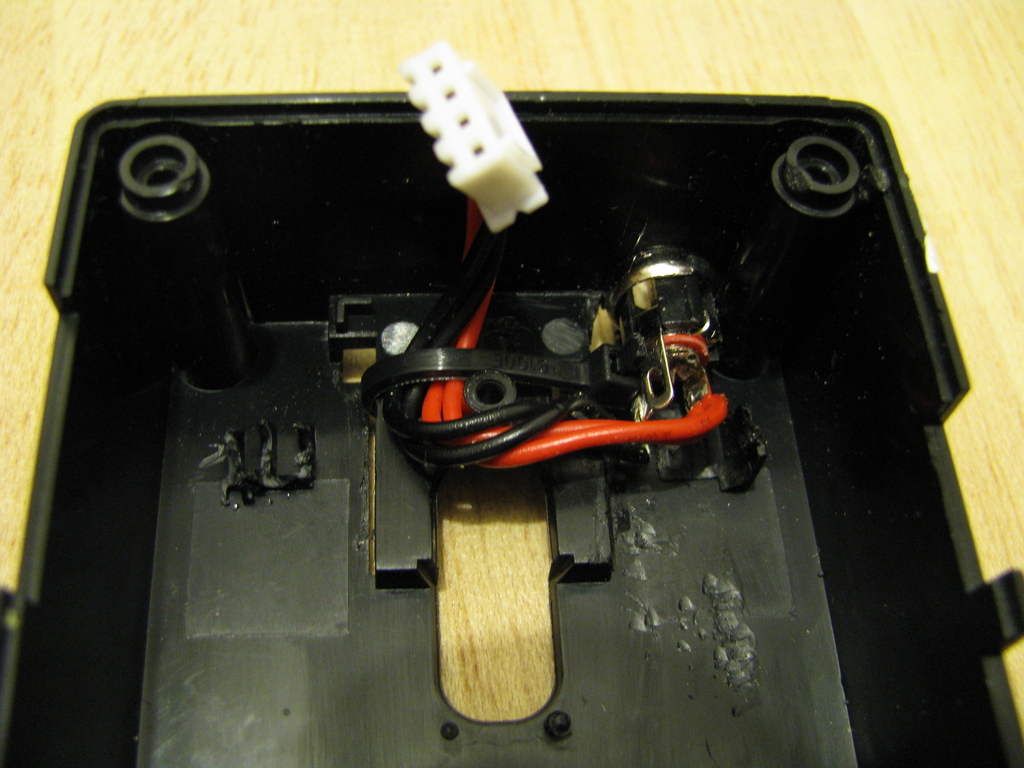
Replacing the power supply As I would never ever trust the PSU (see my last blog post for the gory details) and some additional free space in the case is necessary, it is time to rip it out. As replacement I've ordered an external 5V/20W PSU. To connect it to the plug I've drilled a hole into the case and added a proper connector after soldering the original cable from the old PSU to it. Make sure to add some retainer to stop the cable from touching the CPU/memory heat sinks later. GuruPlug Server Plus PSU replacement GuruPlug Server Plus PSU cabling

Proper heatsinks One of the biggest problems in the original GuruPlug design is the heat spreading and collecting piece of alloy, which probably makes things even worse than better. After some discussion in #debian-devel the idea came up, that the board should be able to run fine without a heatsink - at least when idling. That is the case, indeed. So let's get rid of that piece of alloy, together with the holders and springs. Unfortunately heat things are necessary to handle some work load. To mount them make sure you get some good thermal glue as you don't want to insulate the chips from their heat sinks. I've used Arctic Silver II thermal glue - not cheap, but working well. Make sure to clean the heat sinks and chips properly with alcohol (2-Propanol is my favourite for that), so there is no fat and dust left. When you use the glue be careful to read the documentation properly and make sure you apply only as much as necessary - a thin coating is enough. After applying the glue and mounting the heat sink you need a clamp to put some pressure on it while the glue dries.

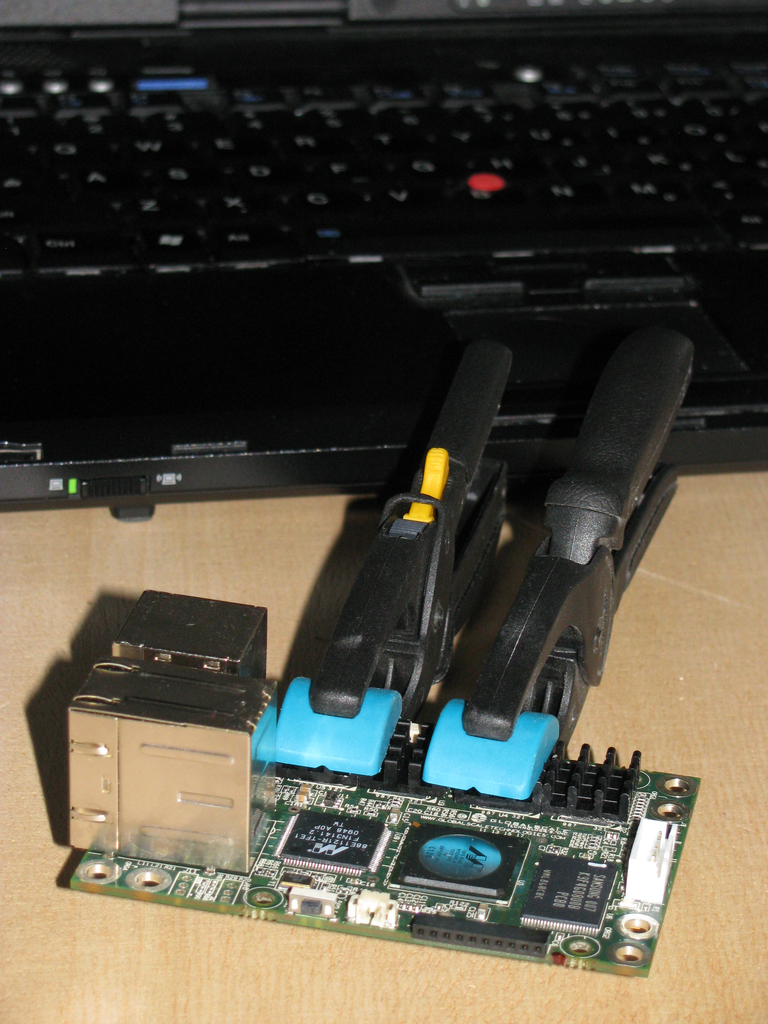
Heat sinks for the memory As there is a lot of space around the memory chips, I've got some 14x14x6mm heat sinks. Luckily there are only small parts on the other side of the board, so it was not hard to attach clamps to ensure the glue is able to dry properly. In case largish amounts of glue are squeezing out between heat sink and chip you probably want to start from scratch and clean everything (quickly!) with alcohol again. GuruPlug Server Plus memory heat sink clamping

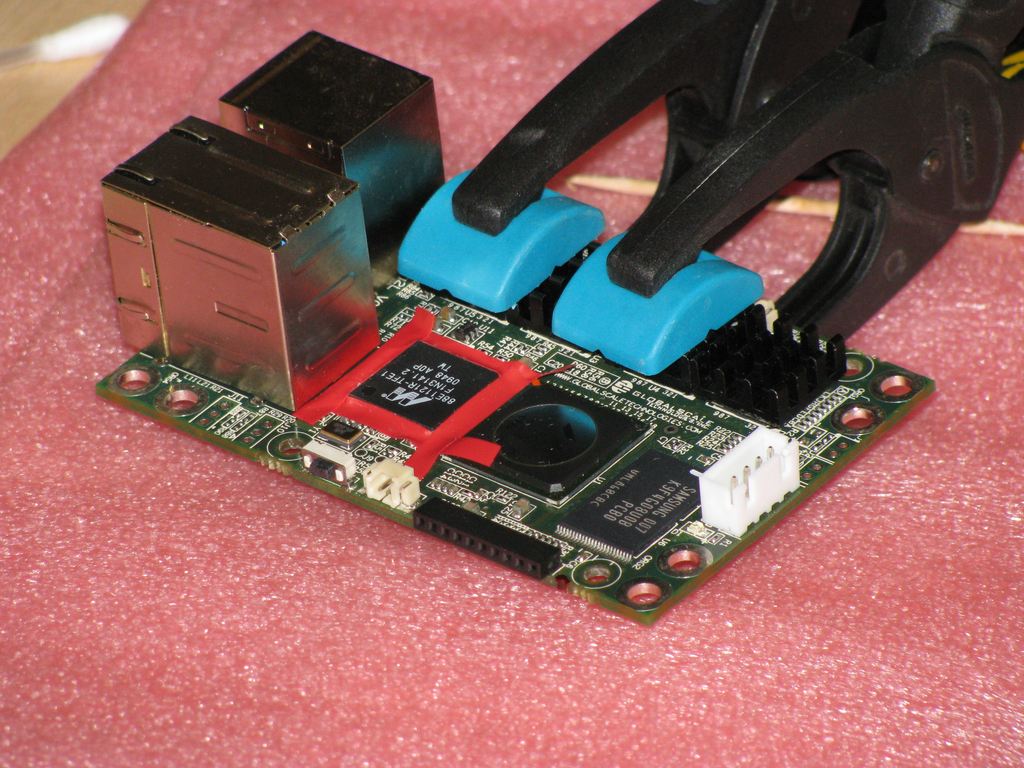
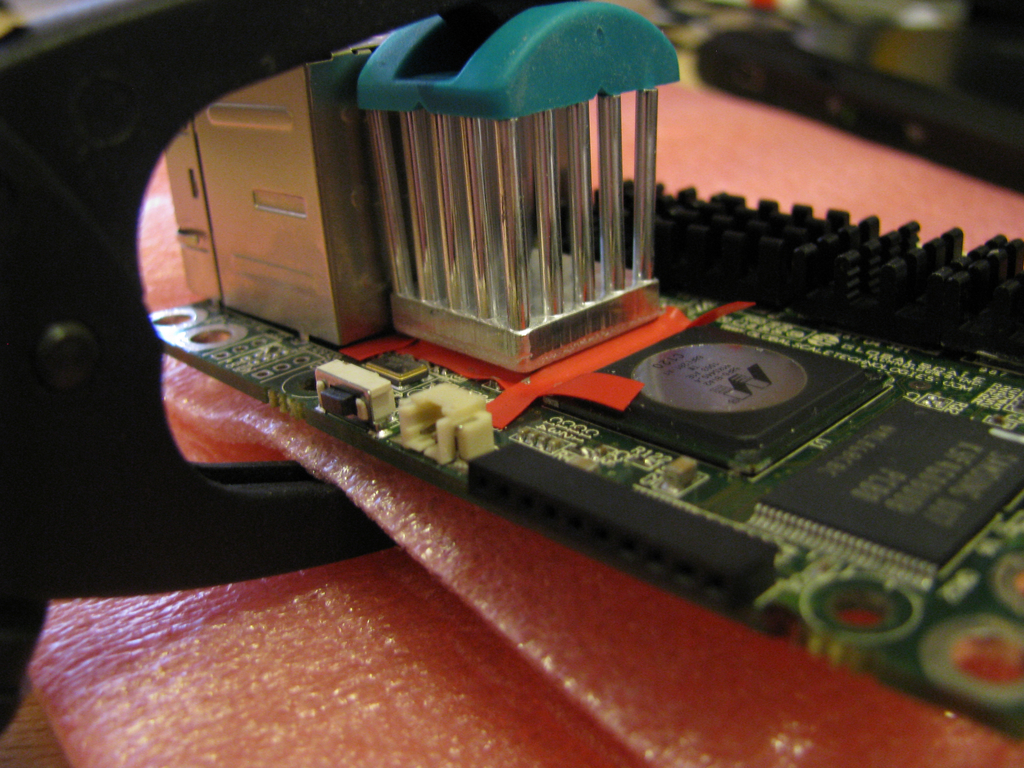
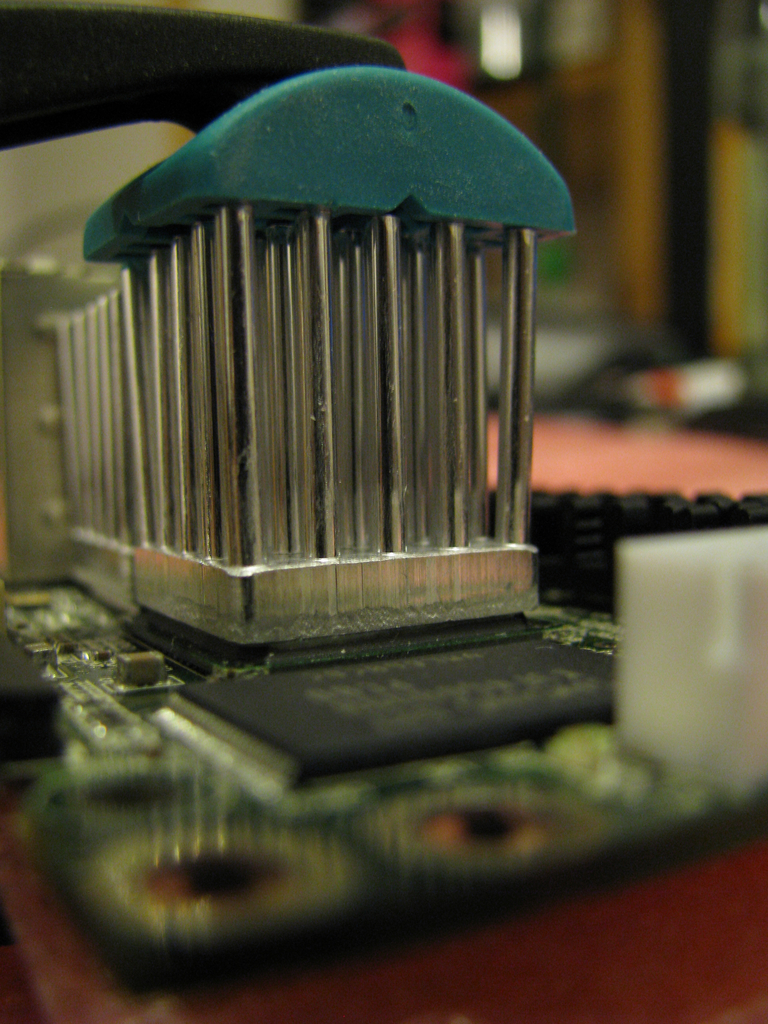
Gigabit Ethernet PHY and CPU heatsinks PHY and CPU need proper heatsinks as they're becoming pretty hot under load. Due to space limitations I had to stick with a 17x17x20mm heat sink for the PHY. I've tried to get a largish heat sink with BGA mount for the CPU, but I was not able to find one in short time and without ordering 1000 of them. So I've got another one of the 17x17x20mm model for the CPU. Later I found two other heat sinks which might fit on the GuruPlug's CPU: Malico 19x19x25mm or a Advanced Thermal Solutions Maxigrip. But for now the smaller one will have to do the job, also I'm scared to removed it without destroying the CPU. To mount the heat sink on the PHY a bit of preparation is necessary to ensure that the glue doesn't result in short cuts on the IC's pins. The arctic silver documentation recommends to use silicone on the pins to stop the glue. As I neither had the proper silicone nor did I want to make such a mess, I've decided to get a sticky insulating tape and some tooth picks to mount it properly on the IC pins. Make sure to do a proper job here! With good clamps you can work on the PHY while the memory heat sink glue is still drying. GuruPlug Server Plus - preparing the PHY The other problem on this side of the board is that some higher parts are mounted on the lower side of the board, so make sure to get some foam to protect them from your clamps. Except of the size of the heat sinks there is no real difference to the small ones: add glue, mount the heat sink and fix it with a clamp. GuruPlug Server Plus - mounting the PHY heatsink Before the glue dries completely make sure you remove the duct tape strips again. Be careful not to wipe any excess glue onto the IC pins. If you manage to do so you might want to remove and clean everything properly. So just be careful and everything should be fine. GuruPlug Server Plus - mounting the PHY heatsink 3 Mounting the heat sink on the CPU is easier as the CPU is a nice BGA package. No need to protect pins an there are none. GuruPlug Server Plus - mounting the CPU heatsink

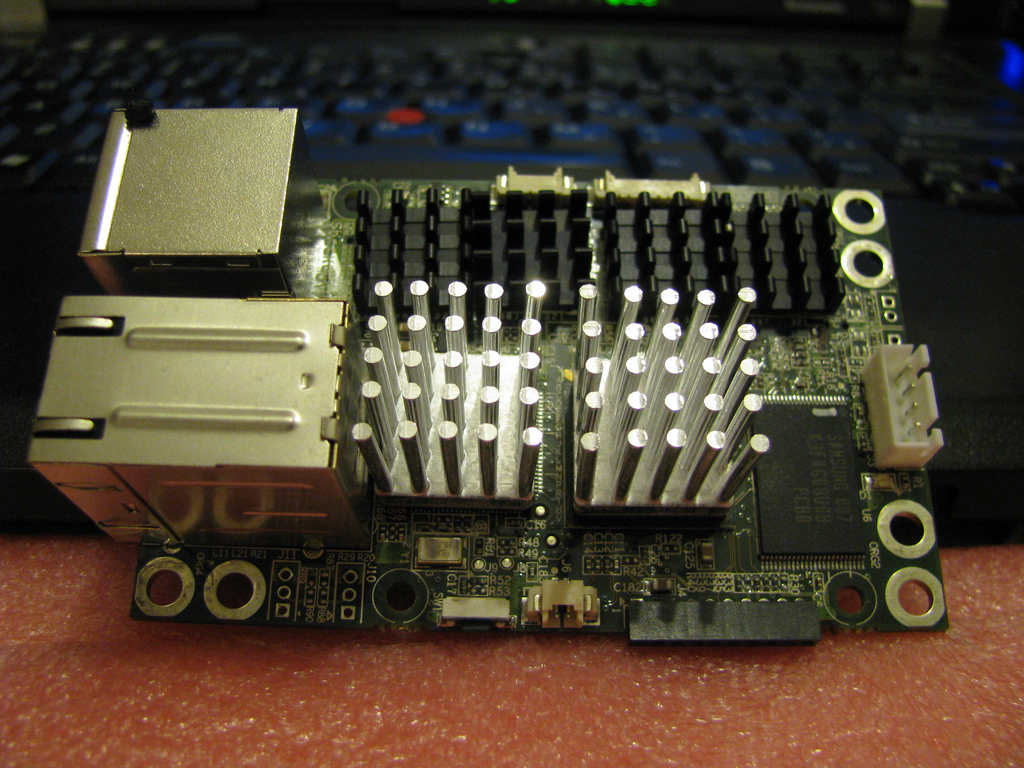
Finished As you're able to see on the photo I did not the very perfect job, but fine enough to work properly. GuruPlug Server Plus - heatsinks

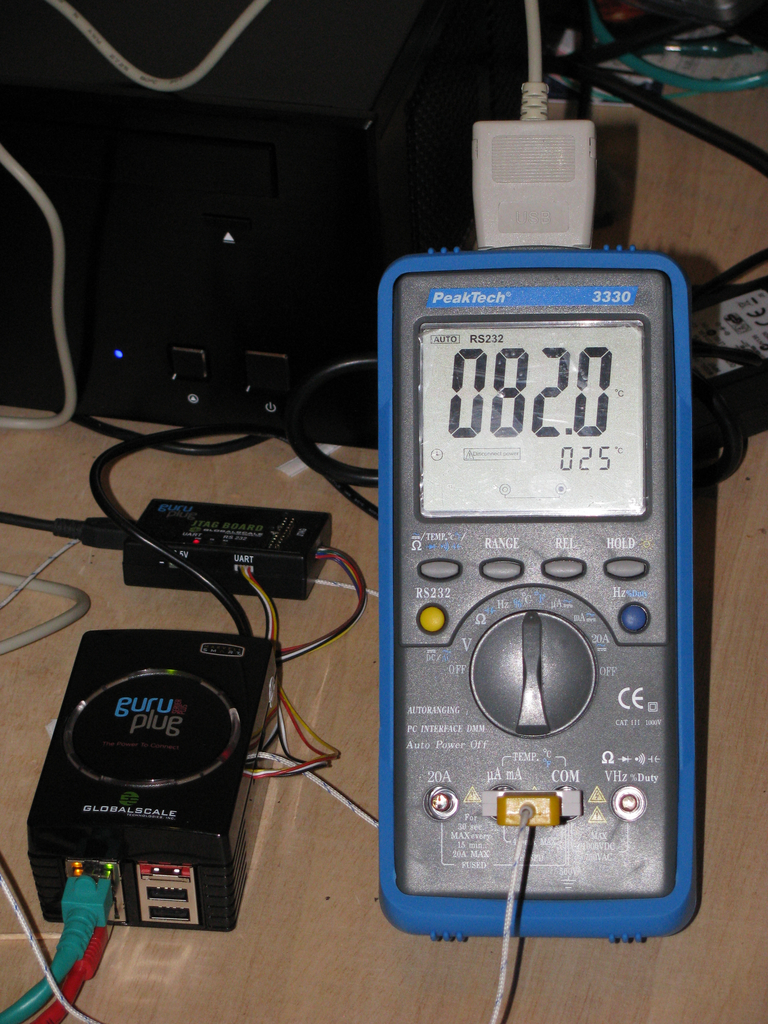
First tests with the new heatsinks Some tests with stress and some heavy network traffic showed quickly that the heat sinks are working well! But not well enough to be able to mount them into the original closed case (how the hell was this supposed to work before!?). Without any air to breath the temperature on the CPU heat sink went up to 85 deg C quickly. So on the CPU's die are > 100 deg C, which is at least close to the max allowed temperature. GuruPlug Server Plus - still too hot

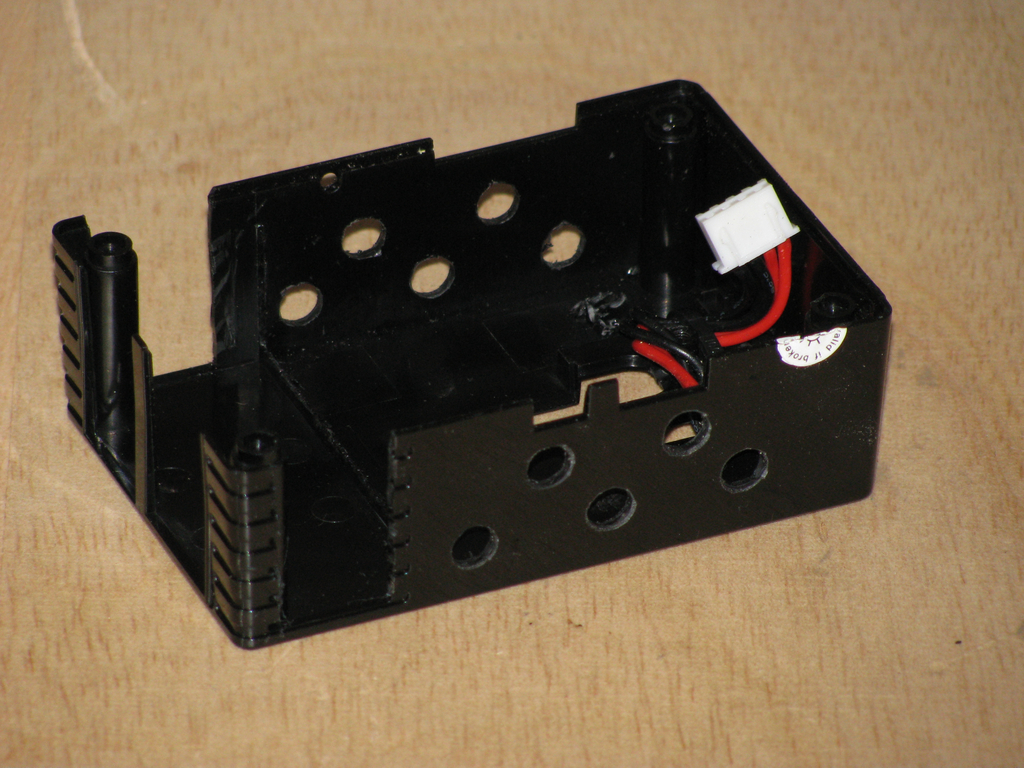
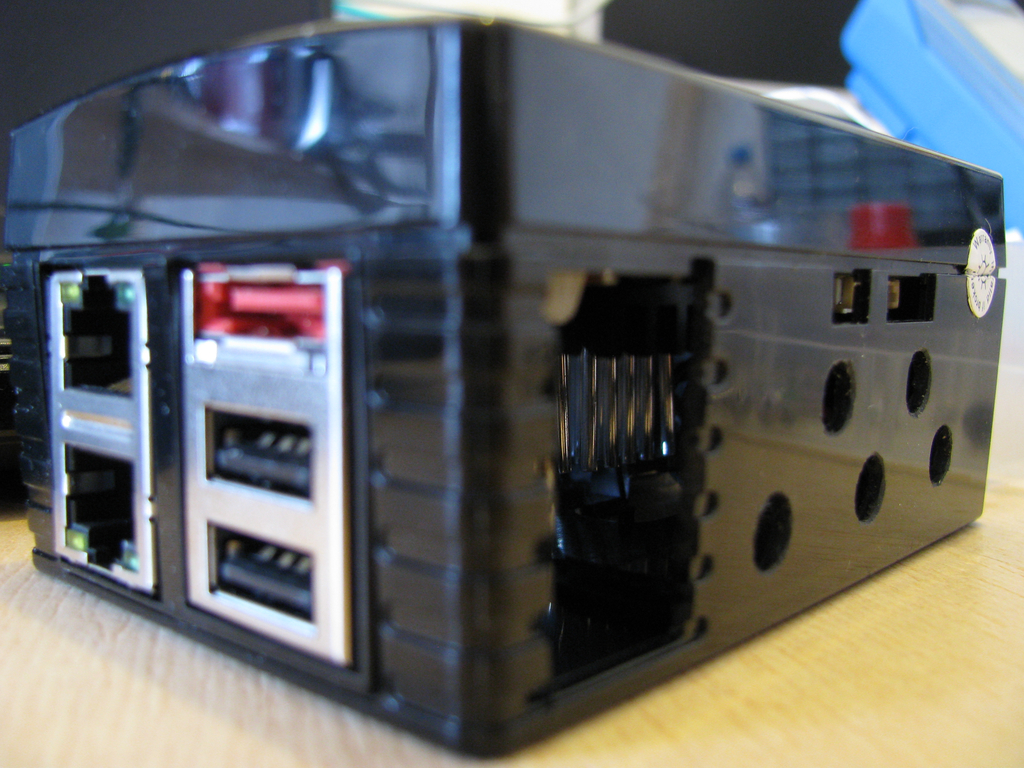
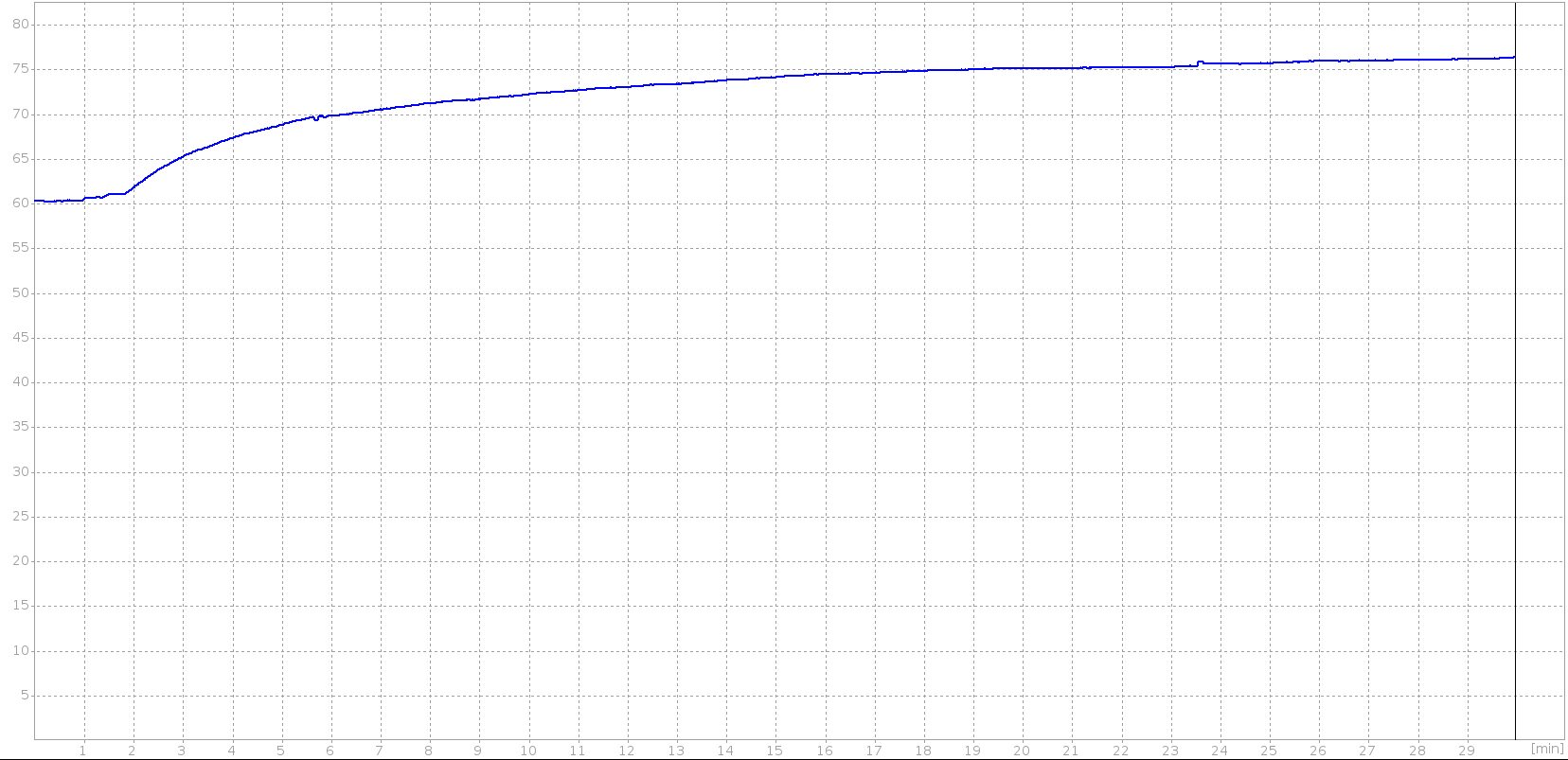
Adding air holes Obviously some additional air holes are necessary. After meeting my drill and cutter, the original case looks a bit like a piece of cheese now. GuruPlug Server Plus - case with air holes 1 GuruPlug Server Plus - case with air holes 2 Some more tests show that the temperature sticks around 76 deg C under heavy load now. That is still pretty hot, especially when the temperature in the room becomes hotter in summer. As I'm not going to run a lot of traffic trough it (my cable connection is limited to 20 MBit/s anyway), I guess it will work. Below is a graph I've recorded with my multimeter and qtdmm. It shows that the temperature rises to ~76 deg C and stays there. GuruPlug Server Plus - temperature curve Not sure if I could introuce some more load, the CPU had a load of 6 running stress. Network traffic was around 2x100MBit/s again. I could imagine with 2xGBit the CPU and PHY would become much hotter (no idea if it would be able to handle it at all, though). The PHY was usually a bit cooler than the CPU, so I didn't spend time to measure the temperature properly.

Conclusion My opinion is still the the original design of the plug is an insane QA and design failure. There is no way that it could ever work as shipped originally. If I'd have to design a new case for it, it should have a single insulated compartment for a PSU to ensure that no contact with high voltage is possible. The case around all other parts should be made of alloy with a lot of air holes. So the case could be used as heat sink (properly done, not with these insulating duct tape strips) and at the same time allow air circulation and a nice view on the LEDs on the board. Of course the case would be much more expensive than, but I'm sure it would work properly and would be worth the money. And if done peoperly, it would look much better than this blinking plastic thing. I could imagine it would sell well! So at the end I'm wondering what GlobalScale Technologies will do. I doubt it will be possible to create the 'professional upgrade kit' as they had announced before. Replacing all units is the only proper way. We'll see what happens. At least my GuruPlug is working well now and it will be used as replacement for my OpenWRT router soon. WiFi is not working, but that will be handled by my media center anyway. GuruPlug Server Plus - running plug

Evgeni Golov: For Facebook s Sake

I must admit, I do not really get the point of the ongoing discussion about having an official Facebook page. In my understanding it should be a source of information about Debian for Facebook users, technically a mirror of www.debian.org/News and debian-devel-announce@lists.debian.org. Yes, Facebook is a piece of non-free, data-harvesting sh*t. But there are users, maintainers and developers who use that service (they also use Twitter, Xing, Linkedin, StudiVZ, MeinVZ and so on). Why should we prohibit them to have an official source of information on their platform? If there is someone who wants to run that kind of service: go for it! Or would we prohibit someone to run a mirror of ftp.debian.org on a Windows machine just because the surrounding environment is non-free ? Most probably, that wouldn t be an official mirror listed on www.debian.org/distrib/ftplist, but it would still contain the official set of packages, signed with the official key of the archive. Btw, is @debian on Twitter official ? And please, do not compare this situation to SourceForge, GitHub, Google Code etc. It s just not the same! On SourceForge etc one relies on a non-free service as the primary way of distribution (that s not perfectly true for DVCS based services, as here one can push the tree to every service one has access to). On Facebook we d just have a mirror of the already freely available information. ) do not forget: almost every machine used for hosting/developing/whatsoever Debian has non-free hardware, firmware etc!

Next.

Previous.