Search Results: "mak"

9 January 2013

Petter Reinholdtsen: Lets make hardware dongles easier to use in Debian

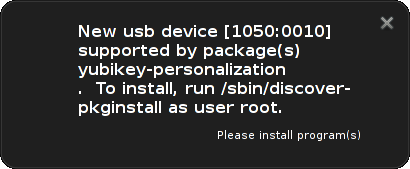
One thing that annoys me with Debian and Linux distributions in general, is that there is a great package management system with the ability to automatically install software packages by downloading them from the distribution mirrors, but no way to get it to automatically install the packages I need to use the hardware I plug into my machine. Even if the package to use it is easily available from the Linux distribution. When I plug in a LEGO Mindstorms NXT, it could suggest to automatically install the python-nxt, nbc and t2n packages I need to talk to it. When I plug in a Yubikey, it could propose the yubikey-personalization package. The information required to do this is available, but no-one have pulled all the pieces together. Some years ago, I proposed to use the discover subsystem to implement this. The idea is fairly simple: I am not sure what the best way to implement this is, but my initial idea was to use dbus events to discover new hardware, the discover database to find packages and PackageKit to install packages. Yesterday, I found time to try to implement this idea, and the draft package is now checked into the Debian Edu subversion repository. In the process, I updated the discover-data package to map the USB ids of LEGO Mindstorms and Yubikey devices to the relevant packages in Debian, and uploaded a new version 2.2013.01.09 to unstable. I also discovered that the current discover package in Debian no longer discovered any USB devices, because /proc/bus/usb/devices is no longer present. I ported it to use libusb as a fall back option to get it working. The fixed package version 2.1.2-6 is now in experimental (didn't upload it to unstable because of the freeze). With this prototype in place, I can insert my Yubikey, and get this desktop notification to show up (only once, the first time it is inserted):

For this prototype to be really useful, some way to automatically install the proposed packages by pressing the "Please install program(s)" button should to be implemented. If this idea seem useful to you, and you want to help make it happen, please help me update the discover-data database with mappings from hardware to Debian packages. Check if 'discover-pkginstall -l' list the package you would like to have installed when a given hardware device is inserted into your computer, and report bugs using reportbug if it isn't. Or, if you know of a better way to provide such mapping, please let me know. This prototype need more work, and there are several questions that should be considered before it is ready for production use. Is dbus the correct way to detect new hardware? At the moment I look for HAL dbus events on the system bus, because that is the events I could see on my Debian Squeeze KDE desktop. Are there better events to use? How should the user be notified? Is the desktop notification mechanism the best option, or should the background daemon raise a popup instead? How should packages be installed? When should they not be installed? If you want to help getting such feature implemented in Debian, please send me an email. :)

Raphael Geissert: A bashism a week: brace expansion

Brace expansion is well known and handy, but sadly it is not required by POSIX:2001. Shells that don't support it will simply and silently leave it as is.

If you use it to shorten commands, as in "echo Debian GNU/ Linux,kFreeBSD ", you have to spell it out or use some sort of loop.

When using brace expansion for sequences you will usually have to fall back to using the seq command or using loops. " 1..9 " can be replaced with "seq -s ' ' 1 9", " 1..9..2 " to "seq -s ' ' 1 2 9", and so on.
If you use brace expansion for sequences of characters then seq won't be of much help.

I must note that the seq command is not required by POSIX:2001, however.

Remember, if you rely on any non-standard behaviour or feature make sure you document it and, if feasible, check for it at run-time.

8 January 2013

Russell Coker: The Death of the Netbook

The Age has an interesting article about how Apple supposedly killed the Netbook [1]. It s one of many articles with a similar spin on the news that the last two companies making Netbooks are going to cease production. The main point of these articles is that Apple decided that Netbooks were crap and killed the market for them by producing tablets and light laptops that squeeze them out of the market. Is the Macbook Air a Netbook? According to the Wikipedia page the Macbook Air [2] weighs 1080g for the 11 version and 1340g for the 13 version. According to Wikipedia the EeePC 701 (the first EeePC) weighs 922g and the last EeePC weighs 1460g [3]. The last EeePC produced is heavier than ANY Macbook Air while the first (and lightest) EeePC is only 158g lighter than the 11 Macbook Air. The 11 Macbook Air is 300*192*17mm (979cm^3) in size while the EeePC 701 is 225*165*35mm (1299cm^3) and the biggest EeePC was 266*191*38mm (1931cm^3). So the 11 Macbook Air is 13% wider than the widest EeePC but takes less volume than any EeePC. The 13 Macbook Air is 325*227*17mm (1254cm^3) which is still less volume than any EeePC. The Wikipedia page about Netbooks defines them as being small, lightweight, legacy-free (in terms of hardware not software) and cheap [4]. The Macbook Air clearly meets all the criteria apart from price. The Apple US web site offers the version of the 11 Macbook Air with 64G of storage for $999 with free shipping, for comparison the EeePC 701 was on sale in stores for $500 in 2008. The CPI adjusted price for the EeePC 701 would be at least $550 in today s money. The Macbook is a bit less than twice as expensive as the EeePC was, but that s more of an issue of Apple being expensive a few years ago companies like HP were also selling Netbooks that were more expensive than the EeePC. Unless having an awful keyboard is a criteria for being a Netbook I think that the Macbook Air meets the criteria. As an aside, a relative recently asked me for advice on a device that is like a Macbook Air but cheaper. Does anyone know of a good option? Is Netbook Production Ceasing? Officeworks currently sells an ASUS Notebook that has a 11.6 display and weighs 1.3kg for $398, it s got a metal body that looks a bit like a Macbook Air (which is the latest fashion and is good for heat dissipation). That s not advertised as a Netbook or a Eee product but it s cheap, lighter than the heaviest EeePC, and not much bigger than an EeePC. It seems that the general prices of laptops other than Apple products (which have always had higher prices) have been dropping a lot recently. There are lots of good options if you want a laptop that costs $500 or less. Even Thinkpads (one of the most expensive and best designed ranges of laptops) are well below $1000. Do the Articles about Netbooks Make Sense? The claims being made are that Apple skipped Netbooks because they couldn t make a good profit. This disregards the fact that the iPhone and iPad (which are very profitable) are in the high end of the price range that was occupied by Netbooks. While Apple does make a good deal of money from the iPhone App Market it would be possible to make a Netbook with a lower production price than an iPhone because making things smaller requires more engineering work and often more expensive parts. This also disregards the fact that there are a range devices which work as an iPad case with keyboard, an iPad with such a keyboard meets most criteria for being a Netbook, so Apple is one iPad keyboard device away from selling Netbooks. It s interesting to note that I haven t yet seen an article about the profits from Netbooks which didn t make an issue of the MS-Windows license fees. The first Netbooks only ran Linux but later on they switched to Windows, that had to make a big impact on profits. An article about Netbooks which just assumes that everyone has to pay a MS license fee is missing too much of the Netbook history to be useful. I wonder if anyone could make products that are as profitable as the iPhone and Macbook Air if they had to pay for MS license fees and design their hardware to work with MS software (as opposed to Apple who can change their software to allow a cheaper hardware design). The articles also claim that Netbooks give a bad user experience. When I bought my EeePC 701 it was the fastest system I owned for loading OpenOffice, SSD random read speeds were really good (writes sucked but that didn t matter so much). The keyboard on an EeePC 701 is not nearly as good as a full size laptop but it is also a lot better than using a tablet, I ve used both a 10 Android tablet and an EeePC as a ssh client and there is no comparison. When I m going somewhere that requires random sysadmin work (or other serious typing) and I can t carry much weight then I still take my EeePC 701 and I don t consider taking a tablet. The low resolution of the screen is a major issue, but it s about the same as a Macbook Air so that s not an advantage for Apple. I knew some people who used an EeePC 701 for the majority of their work, I couldn t do that but obviously some people have different requirements. I now use my phone for many tasks that I used to do on my EeePC (even light sysadmin work) so my EeePC sometimes goes unused for months. But it s still an important part of my collection of computers. It works well for what it does and I don t feel any need to buy a replacement. When it wears out I ll probably buy something similar to an 11 Macbook Air to replace it unless there s a good option of a tablet with a detachable keyboard. My plans for computer ownership for the near future are based on a reasonably large Android phone (currently a Samsung Galaxy S3 but maybe a Galaxy Note 2 or similar next year), a small laptop or large tablet with hardware keyboard (currently an EeePC 701), a large laptop (currently a Thinkpad T61), and a workstation (currently a NEC system with an Intel E4600 CPU and a Dell U2711 27 monitor). A reasonably small and light system with a hardware keyboard and solid state storage is an important part of my computer needs. If tablet computers with hardware keyboards replace traditional Netbooks that s not really killing Netbooks but introducing a new version of the same thing. But a good way of getting web hits on an article is to claim that a once popular product is dead.

7 January 2013

Niels Thykier: Introducing Das Lintian-overrider 2000

Have you ever tried to add a Lintian override only to get it wrong? Fret not, with the Lintian-overrider 2000 such are problems of the past! Simply feed the tag emitted by Lintian to the Lintian-overrider 2000 and it will show you the correct format for the override plus the file to put said overide in. Furthermore, it will show you variants that you may (or may not) want to use instead.
$ echo "W: login: setuid-binary bin/su 4755 root/root"   \
     lintian-overrider --alternative-forms
  --8<-- debian/login.lintian-overrides --8<--
# If you want to override all (present and future) variants
# of this tag, use:
#  setuid-binary
setuid-binary bin/su 4755 root/root
# Alternative forms...
#   login: setuid-binary bin/su 4755 root/root
#   login binary: setuid-binary bin/su 4755 root/root
# For architecture specific overrides, use one of:
#   login [i386-any amd64-any other-archs] binary: setuid-binary bin/su 4755 root/root
#   login [!i386-any !amd64-any !other-archs] binary: setuid-binary bin/su 4755 root/root
  --8<-- End of debian/login.lintian-overrides --8<--
No more fiddling with that stupid syntax. Just feed it to the Lintian-overrider 2000 and instantly you will get the overrides you want! If you sometimes make a copy-waste mistake or just feel life is too short manually update those files, the Lintian-overrider 2000 is the tool for you! With its --source-dir command line option, your lintian overrrides are updated automatically! The Lintian-overrider 2000 can also automatically maintain your Lintian overrides for you! It is simple, just do:
$ lintian -o <path/to/your/changes-file.changes>   \
      lintian-overrider --there-are-no-issues --source-dir <path/to/unpacked/source-tree>
Alioth is ready to take your git clone (or HTTP GET) request, so go order your copy now! </tv-shop-ad>

6 January 2013

Neil Williams: bootstrapping arm64

I'm still working on perl-cross-debian (just uploaded 0.0.2) and there's more to do on that with upstream but part of the reason to work on perl cross-building is to do what I can to help with the ARM64 port.

So, I went back to Wookey's talk at DebConf12 which leads to the current list of cross-build results for arm64 and started through the list.

coreutils is listed as failing but that was an archive error (MD5sum hash mismatch), so that just needs a retry. I don't have access to that buildd, yet, so nothing I can do there.

Next on the list (excluding those just waiting for build-deps) was klibc.

aarch64-linux-gnu-gcc -Wp,-MD,usr/klibc/.__static_init.o.d -nostdinc -iwithprefix
include -I/ PKGBUILDDIR /usr/include/arch/x86_64 -Iusr/include/arch/x86_64
-I/ PKGBUILDDIR /usr/include/bits64
-Iusr/include/bits64 -I/ PKGBUILDDIR /usr/klibc/../include
-Iusr/klibc/../include -I/ PKGBUILDDIR /usr/include -Iusr/include
-I/ PKGBUILDDIR /linux/include -Ilinux/include
-I/ PKGBUILDDIR /linux/arch/x86/include -Ilinux/arch/x86/include
-D__KLIBC__=2 -D__KLIBC_MINOR__=0 -D_BITSIZE=64 -fno-stack-protector -fwrapv -m64 -Os
-fno-asynchronous-unwind-tables -fomit-frame-pointer -falign-functions=1 -falign-jumps=1 -falign-loops=1
-W -Wall -Wno-sign-compare -Wno-unused-parameter -c -o usr/klibc/__static_init.o usr/klibc/__static_init.c
aarch64-linux-gnu-gcc: error: unrecognized command line option '-m64'
make[4]: *** [usr/klibc/__static_init.o] Error 1


Turns out that this is a build failure I understood, at least initially. A little digging and a trivial patch was begun:

--- a/usr/klibc/arch/arm/MCONFIG
+++ b/usr/klibc/arch/arm/MCONFIG
@@ -30,6 +30,13 @@
ifeq ($(CONFIG_AEABI),y)
KLIBCREQFLAGS += -mabi=aapcs-linux -mno-thumb-interwork
else
+# aarch64
+ifeq ($(CONFIG_AARCH64),y)
+KLIBCREQFLAGS +=
+KLIBCOPTFLAGS += -mgeneral-regs-only
+else
KLIBCREQFLAGS += -mabi=apcs-gnu -mno-thumb-interwork
endif
endif
+endif
+

Alongside a trivial change to debian/rules

ifeq ($(DEB_HOST_ARCH),arm64)
DEB_MAKE_ENVVARS := ARCH=arm CONFIG_AARCH64=y CPU_ARCH=armv8-a CPU_TUNE=generic
endif

OK, then things get a bit more awkward,

....
code/debian/cross/klibc/klibc-2.0.1/linux/arch/arm/include -Ilinux/arch/arm/include -D__KLIBC__=2
-D__KLIBC_MINOR__=0 -D_BITSIZE=32 -fno-stack-protector -fwrapv -fno-exceptions -Os
-march=armv8-a -mtune=generic -mgeneral-regs-only -W -Wall -Wno-sign-compare -Wno-unused-parameter
-c -o ../foo.o usr/klibc/arch/arm/crt0.S
usr/klibc/arch/arm/crt0.S: Assembler messages:
usr/klibc/arch/arm/crt0.S:19: Error: operand 1 should be an integer register -- mov r0,sp'
usr/klibc/arch/arm/crt0.S:20: Error: operand 1 should be an integer register -- mov r1,#0'

Hmm. Assembly, well, yes, I've done assembly before, I know what mov should normally do, sp is likely to be the stack pointer .... where's my AARCH64 assembly PDF again... PRD03-GENC-010197 ...

OK, so maybe the r0 and r1 should be x0 and x1, hmm, that at least doesn't raise assembly errors. So a tentative change:

--- a/usr/klibc/arch/arm/crt0.S
+++ b/usr/klibc/arch/arm/crt0.S
@@ -15,9 +15,13 @@
#ifdef __thumb__
.thumb_func
#endif
-
+#ifdef __aarch64__
+_start: mov x0, sp
+ mov x1, #0
+ bl __libc_init
+#else
_start: mov r0, sp
mov r1, #0
bl __libc_init
-
+#endif
.size _start,.-_start

Next stage, however, leaves me quite a bit more lost:

....
klibc-2.0.1/linux/arch/arm/include -Ilinux/arch/arm/include
-D__KLIBC__=2 -D__KLIBC_MINOR__=0 -D_BITSIZE=32 -fno-stack-protector -fwrapv -fno-exceptions -Os
-march=armv8-a -mtune=generic -mgeneral-regs-only -W -Wall -Wno-sign-compare -Wno-unused-parameter
-c -o usr/klibc/arch/arm/setjmp.o usr/klibc/arch/arm/setjmp.S
usr/klibc/arch/arm/setjmp.S: Assembler messages:
usr/klibc/arch/arm/setjmp.S:32: Error: unknown mnemonic stmia' -- stmia r0, r4,r5,r6,r7,r8,r9,r10,fp,sp,lr '
usr/klibc/arch/arm/setjmp.S:33: Error: operand 1 should be an integer register -- mov r0,#0'
usr/klibc/arch/arm/setjmp.S:34: Error: operand 1 should be an integer register -- mov pc,lr'
usr/klibc/arch/arm/setjmp.S:42: Error: unknown mnemonic ldmia' -- ldmia r0, r4,r5,r6,r7,r8,r9,r10,fp,sp,lr '
usr/klibc/arch/arm/setjmp.S:43: Error: unknown mnemonic movs' -- movs r0,r1'
usr/klibc/arch/arm/setjmp.S:44: Error: unknown mnemonic moveq' -- moveq r0,#1'
usr/klibc/arch/arm/setjmp.S:45: Error: operand 1 should be an integer register -- mov pc,lr'
make[5]: *** [usr/klibc/arch/arm/setjmp.o] Error 1


So now I'm out of my depth of AARCH64 assembly (apart from the recurrence of mov r0 vs mov x0 etc.). If the above is useful then maybe someone can work out what is wrong with setjmp.S or whether AARCH64 just means that klibc needs to gain a arch/arm64/ directory and not try to duplicate each entire assembly block within #ifdef clauses.

I don't really know where else to put an incomplete investigation like this, so it's here for anyone to find.

(Oh, and if you're reading those arm64 cross-build logs, then a few hundred occurrences of ldconfig: /usr/lib/aarch64-linux-gnu/*.so is for unknown machine 183. in every build log (success or fail) is apparently entirely normal until more packages get fixed. Really slows down scanning the build log. :-(

I may try busybox or libusb next. libusb looks like a classic "you might have told me to cross-compile but I'm going to use g++ anyway because I know best" cross-building problem, indicative of yet another BDBS. sigh.

Resources:
Getting started with 64-bit ARM development
ARMv8 images for developers
AArch64 for everyone, Marcin Juszkiewicz
Howto/HelloAarch64 - Linaro wiki
AArch64 gcc options

5 January 2013

Ian Wienand: Position Independent Code and x86-64 libraries

A comment pointed out that the original article from 2008 made a few simplifications that were a bit misleading, so I have taken some time to update this. Thanks for the feedback. If you've ever tried to link non-position independent code into a shared library on x86-64, you should have seen a fairly cryptic error about invalid relocations and missing symbols. Hopefully this will clear it up a little. Let's start with a small program to illustrate.
int global = 100;
int function(int i)  
    return i + global;
 
Firstly, inspect the disassembley of this function:
$gcc -c function.c
$objdump --disassemble function.o
0000000000000000 <function>:
   0:   55                      push   %rbp
   1:   48 89 e5                mov    %rsp,%rbp
   4:   89 7d fc                mov    %edi,-0x4(%rbp)
   7:   8b 05 00 00 00 00       mov    0x0(%rip),%eax        # d <function+0xd>
   d:   03 45 fc                add    -0x4(%rbp),%eax
  10:   c9                      leaveq
  11:   c3                      retq
Lets just go through that for clarity: The IP relative move is really the trick here. We know from the code that it has to move the value of the global variable here. The zero value is simply a place holder - the compiler currently does not determine the required address (i.e. how far away from the instruction pointer the memory holding the global variable is). It leaves behind a relocation -- a note that says to the linker "you should determine the correct address of foo (global in our case), and then patch this bit of the code to point to that addresss". Relocations with addend The top portion of the image above gives some idea of how it works. We can examine relocations in binaries with the readelf tool.
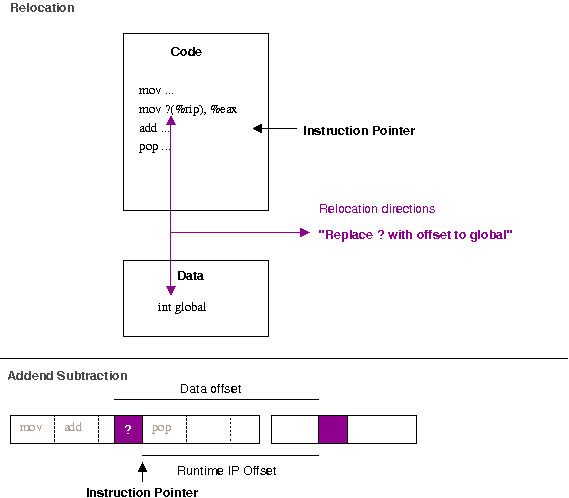
$ readelf --relocs ./function.o
Relocation section '.rela.text' at offset 0x518 contains 1 entries:
  Offset          Info           Type           Sym. Value    Sym. Name + Addend
000000000009  000800000002 R_X86_64_PC32     0000000000000000 global + fffffffffffffffc
There are many different types of relocations for different situations; the exact rules for different relocation types are described in the ABI documentation for the architecture. The R_X86_64_PC32 relocation is defined as "the base of the section the symbol is within, plus the symbol value, plus the addend". The addend makes it look more tricky than it is; remember that when an instruction is executing the instruction pointer points to the next instruction to be executed. Therefore, to correctly find the data relative to the instruction pointer, we need to subtract the extra. This can be seen more clearly when layed out in a linear fashion (as in the bottom of the above diagram). If you try and build a shared object (dynamic library) with an object file with this type of relocation, you should get something like:
$ gcc -shared function.c
/usr/bin/ld: /tmp/ccQ2ttcT.o: relocation R_X86_64_32 against  a local symbol' can not be used when making a shared object; recompile with -fPIC
/tmp/ccQ2ttcT.o: could not read symbols: Bad value
collect2: ld returned 1 exit status
If you look back at the disassembly, we notice that the R_X86_64_32 relocation has left only 4-bytes (32-bits) of space left for the relocation entry (the zeros in 7: 8b 15 00 00 00 00). So why does this matter when you're creating a shared library? The first thing to remember is that in a shared library situation, we can not depend on the local value of global actually being the one we want. Consider the following example, where we override the value of global with a LD_PRELOAD library.
$ cat function.c
int global = 100;
int function(int i)  
    return i + global;
 
$ gcc -fPIC -shared -o libfunction.so function.c
$ cat preload.c
int global = 200;
$ gcc -shared preload.c -o libpreload.so
$ cat program.c
#include <stdio.h>
int function(int i);
int main(void)  
   printf("%d\n", function(10));
 
$ gcc -L. -lfunction program.c -o program
$ LD_LIBRARY_PATH=. ./program
110
$ LD_PRELOAD=libpreload.so LD_LIBRARY_PATH=. ./program
210
If the code in libfunction.so were to have a fixed offset into its own data section, it will not be able to be overridden at run-time by the value provided by libpreload.so. Additionally, there are only 4-bytes available to patch in for the address of global -- since a shared library could conceivably be loaded anywhere in the 64-bit (8-byte) address space we therefore need 8-bytes of space to cover ourselves for all possible addresses global might turn up at. The two basic possibilities for an object file are to be either linked into an executable or linked into a shared-library. In the executable case, the value of global will be in the exectuable's data section, which should definitely be reachable with a 32-bit offset of the current instruction-pointer. The instruction-pointer relative address can simply be patched in and the executable is finalised. But what about the shared-library case, where we know the value of global could essentially be anywhere within the 64-bit address space? It is possible to leave 8-bytes of space for the address of global, by telling gcc to use the large-code model. e.g.
$ gcc -c -mcmodel=large function.c
$ objdump --disassemble ./function.o
./function.o:     file format elf64-x86-64
Disassembly of section .text:
0000000000000000 <function>:
   0:  55                      push   %rbp
   1:  48 89 e5                mov    %rsp,%rbp
   4:  89 7d fc                mov    %edi,-0x4(%rbp)
   7:  48 b8 00 00 00 00 00    movabs $0x0,%rax
   e:  00 00 00
  11:  8b 10                   mov    (%rax),%edx
  13:  8b 45 fc                mov    -0x4(%rbp),%eax
  16:  01 d0                   add    %edx,%eax
  18:  5d                      pop    %rbp
  19:  c3                      retq
However, this creates a problem if you really want to share this code. By having to patch in an address of global directly, this means the run-time code above does not remain unchanged. Two separate processes therefore can't share this code -- they each need separate copies that are identical but for their own addresses of global patched into it. By enabling Position Independent Code (PIC, with the flag -fPIC) you can ensure the code remains share-able. PIC means that the output binary does not expect to be loaded at a particular base address, but is happy being put anywhere in memory (compare the output of readelf --segments on a binary such as /bin/ls to that of any shared library). This is obviously critical for implementing lazy-loading (i.e. only loaded when required) shared-libraries, where you may have many libraries loaded in essentially any order at any location. Of course, any problem in computer science can be solved with a layer of abstraction and that is essentially what is done when compiling with -fPIC. To examine this case, let's see what happens with PIC turned on.
$ gcc -fPIC -shared -c  function.c
$ objdump --disassemble ./function.o
./function.o:     file format elf64-x86-64
Disassembly of section .text:
0000000000000000 <function>:
   0:   55                      push   %rbp
   1:   48 89 e5                mov    %rsp,%rbp
   4:   89 7d fc                mov    %edi,-0x4(%rbp)
   7:   48 8b 05 00 00 00 00    mov    0x0(%rip),%rax        # e <function+0xe>
   e:   8b 00                   mov    (%rax),%eax
  10:   03 45 fc                add    -0x4(%rbp),%eax
  13:   c9                      leaveq
  14:   c3                      retq
It's almost the same! We setup the frame pointer with the first two instructions as before. We push the first argument into memory in the pre-allocated "red-zone" as before. Then, however, we do an IP relative load of an address into rax. Next we de-reference this into eax (e.g. eax = *rax in C) before adding the incoming argument to it and returning.
$ readelf --relocs ./function.o
Relocation section '.rela.text' at offset 0x550 contains 1 entries:
  Offset          Info           Type           Sym. Value    Sym. Name + Addend
00000000000a  000800000009 R_X86_64_GOTPCREL 0000000000000000 global + fffffffffffffffc
The magic here is again in the relocations. Notice this time we have a P_X86_64_GOTPCREL relocation. This says "replace the data at offset 0xa with the global offset table (GOT) entry of global. Global Offset Table operation with data variables As shown above, the GOT ensures the abstraction required so symbols can be diverted as expected. Each entry is essentially a pointer to the real data (hence the extra dereference in the code above). Since we can assume the GOT is at a fixed offset from the program code within plus or minus 2Gib, the code can use a 32-bit IP relative address to gain access to the table entries. So, taking a look a the final shared-library binary we see a final offset hard-coded
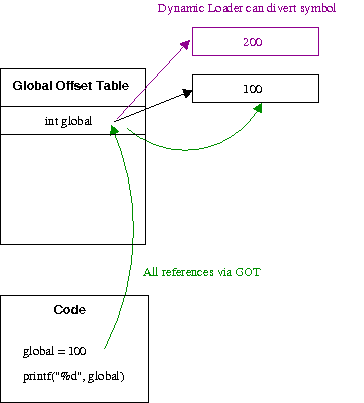
$ gcc -shared -fPIC -o libfunction.so function.c
$ objdump --disassemble ./libfunction.so
00000000000006b0 <function>:
 6b0:  55                      push   %rbp
 6b1:  48 89 e5                mov    %rsp,%rbp
 6b4:  89 7d fc                mov    %edi,-0x4(%rbp)
 6b7:  48 8b 05 8a 02 20 00    mov    0x20028a(%rip),%rax        # 200948 <_DYNAMIC+0x1d8>
 6be:  8b 10                   mov    (%rax),%edx
 6c0:  8b 45 fc                mov    -0x4(%rbp),%eax
 6c3:  01 d0                   add    %edx,%eax
 6c5:  5d                      pop    %rbp
 6c6:  c3                      retq
 6c7:  90                      nop
Every process who wants to share this code just needs to make sure they have their unique address of global at 0x20028a(%rip). Since each process has a separate address-space, this means they can all have different values for global but share the same code! Thus the default of the small-code model is sensible. It is exceedingly rare for an executable to need more than 4-byte offsets for a relative access to a variable in it's data region, so using a full 8-byte value would just be a waste of space. Although leaving 8-bytes would allow access to the variable anywhere in the 64-bit address space; when building a shared library, you really want to use -fPIC to ensure the library can actually be shared, which introduces a different relocation and access to data via the GOT. This should explain why gcc -shared function.c works on x86-32, but does not work on x86-64. Inspecting the code reveals why:
$ objdump --disassemble ./function.o
00000000 <function>:
   0:   55                      push   %ebp
   1:   89 e5                   mov    %esp,%ebp
   3:   a1 00 00 00 00          mov    0x0,%eax
   8:   03 45 08                add    0x8(%ebp),%eax
   b:   5d                      pop    %ebp
   c:   c3                      ret
$ readelf --relocs ./function.o
Relocation section '.rel.text' at offset 0x2ec contains 1 entries:
 Offset     Info    Type            Sym.Value  Sym. Name
00000004  00000701 R_386_32          00000000   global
We start out the same, with the first two instructions setting up the frame pointer. However, next we load a memory value into eax -- as we can see from the relocation information, the address of global. Next we add the incoming argument from the stack (0x8(%ebp)) to the value in this memory location; implicitly dereferencing it. But since we only have a 32-bit address-space, the 4-bytes allocated is enough to access any possible address. So while this can work, you're not creating position-independent code and hence not enabling code-sharing. The disadvantage of PIC code is that you require "bouncing" through the GOT, which requires more loads and reads to find an address than directly referencing it. However, if your program is at the point that this is becoming a performance issue you're probably not reading this blog! Hopefully, this helps clear up that possibly cryptic error message. Further searches around position-independent code, global-offset tables and code-sharing should also yield you more information if it remains unclear.
Jan Wagner: Brainfucked intellectual property rights

This issue is about a bit specific situation in Germany and it's (mainly tax-financed) public service broadcasting. If you think you are not interested, please skip this entry. :) Just beginning from scratch... In Germany we have (like most european countries) a public service broadcasting. Starting with 2013 the system collecting the funding of the public service broadcasting changed from GEZ to Beitragsservice.
To make it short (and a bit simplified) ... it changed from "most 'families' have to pay" to "every menage has to pay". This means, even if you don't have any device to use the service of the german public service broadcasting but are a menage, you have to pay for it. This sitiation is even more worse than pay-TV. Don't get me wrong ... I'm neither against public service broadcasting nor against paying for it in principle. In the rare cases I'm watching TV, this is most likely a channel of the public service broadcasting. Same counts for the rest of my small family. Mostly we are watching news and documentations ... also some movies are watched. The kids are watching KiKA, which we like cause it's Ads-free and it's not just some cartoons with hidden violence. So we most likely benefit from public service broadcasting. Anyways ... in common we are not using "TV" as most of the others may do. We still like some sort of the broadcast, but we are missing it cause various reasons. For our luck there is a service called 'Mediathek' provided by the most german public service broadcasting channels. If you missed a broadcast or are prevented for any reason, you may watch the broadcast there. Unfortunately the timeframe you can access the broadcast is very short, in most cases 7 days. This is manifested in the so called Rundfunkstaatsvertrag, more precisely in the 12. Rundfunk nderungsstaatsvertrag. The 'Tagesschau' has a good explanation about the issue. This means, in simple words, the tax payed broadcasts needs to be deleted after a (in my eyes) short time. WTF?!? Why do we wipe work we all payed for it? Guess what ... it was implemented by lobbying from commercial print media and private (e.g. ads-financed) TV-channels. A comment about a related problem, which I agree, can be found here. Another challenge ... How do you know there is a broadcasting your are interested in? How do you know when it is broadcasted? I remember, my parents was subscribed to a daily newspaper, which included an additional TV paper, my parents-in-law bought also one.
As we are neither subscribed to a daily newspaper nor buying a TV paper, we have to solve that differently (beside that a printed paper won't help us I think). When we use the opportunity to watch TV at the evening, I just use an electronical TV paper (-app). If we find something which fits, we are fine .. if not, we do other things. This sounds a bit like an old school behaviour and it is not, how I would like to use a media today. I like using a feedreader. You can subscribe differnt 'channels' of information feeds and it is a way I would love to use TV. In the past I used a tool called 'Mediathek', which is a tool for Mac OSX. With this tool it was easily possible to find broadcasts, you could subscribe to so called 'channels', which means broadcasts of a same series for example. You could also mark them as "unread" und "read" .. something like a feedreader.
On the other way, it was also possible to list recent broadcast per genres and popular broadcast of the recent and the last week. This was very comfortable as this was working for several mediathek sites for german public service broadcasting channels in one central place. For every broadcast you could just view it or download it to view it later. You could even download subscribed channels automatically. After using the Mediathek-App and being satisfied by the Mediathek sites of the german public service broadcasting channels for several years, this week the server(s) behind the App was shut down. What the f....?!? On Twitter the author stated that the shutdown was cause by problems with the copyright law. Das Erste, ZDF and WDR denied that they has anything todo with this recent issue. The question is ... what is the direct cause for shutting down such a good service. This smells a bit like the PirateBay issue, but in this case the content which is Mediathek providing access to isn't pirated, but legal hosted. So where is the real issue? In my mind, the german citizen has payed to produce this content and should have the right to access the content is an usable way. The Mediathek App did provide such a way and it is really pissing me off that this access isn't available anymore, at least for this reason. Actually I don't see any solution to access our payed content in a decent way. Footnote: I think it's obscenely, that publishing houses and commercial broadcaster trying to gain their turnover at the expense of the german citizen by forcing the german legislature to implement Depublication,.

Olly Betts: Empty Strings in C++

Gaurav (one of Xapian's GSoC students this year) queried my advice that it's better not to explicitly initialise a std::string in C++ like this:
std::string s = "";
but instead to write:
std::string s;
It could be argued that the former makes it clearer that the string is initialised (since C++ does inherit C's behaviour of not implicitly initialising variables of fundamental types, such as int and double). But objects aren't left uninitialised - the default constructor gets called (or if there isn't one, the code won't compile). The downside is that you get quite a lot more code from the first version than the second. Perhaps compilers will grow smarter and in future both the above will compile to the same code, but that's not true today. Here's a simple bit of test code:
#include <string>
std::string f()  
#ifdef EXPLICIT_INIT
    std::string s = "";
#else
    std::string s;
#endif
    return s;
 
And I'll compile it with GCC (g++ (Debian 4.7.2-4) 4.7.2) on x86-64 to produce assembler output:
$ g++ -O2 -S s.cc -o s1.s
$ g++ -DEXPLICIT_INIT -O2 -S s.cc -o s2.s
$ diff s1.s s2.s
1a2,4
>   .section        .rodata.str1.1,"aMS",@progbits,1
> .LC0:
>   .string ""
9,10c12,25
<   movq    %rdi, %rax
<   movq    $_ZNSs4_Rep20_S_empty_rep_storageE+24, (%rdi)
---
>   pushq   %rbx
>   .cfi_def_cfa_offset 16
>   .cfi_offset 3, -16
>   movl    $.LC0, %esi
>   movq    %rdi, %rbx
>   subq    $16, %rsp
>   .cfi_def_cfa_offset 32
>   leaq    15(%rsp), %rdx
>   call    _ZNSsC1EPKcRKSaIcE
>   addq    $16, %rsp
>   .cfi_def_cfa_offset 16
>   movq    %rbx, %rax
>   popq    %rbx
>   .cfi_def_cfa_offset 8
(As an aside, I wouldn't recommend spending a lot of time digging into the assembler your compiler produces, but if there's more than one equivalent way to write code for a common case (as here) and you want to know which is most efficient, it can be informative to see what code is produced for each). You don't really need to know x86-64 assembler to grasp what's happening above, which is lucky, since I don't really know x86-64 assembler. In the first hunk, we get an empty literal string being added to the rodata (read-only data) section; and in the second, instead of two instructions which copy a standard empty string representation, we get much more elaborate code, including a function call to _ZNSsC1EPKcRKSaIcE - the C++ mangled name for the std::string from const char * constructor:
$ c++filt _ZNSsC1EPKcRKSaIcE
std::basic_string<char, std::char_traits<char>, std::allocator<char> >::basic_string(char const*, std::allocator<char> const&)
I also tested the example above with clang (Debian clang version 3.0-6 (tags/RELEASE_30/final) (based on LLVM 3.0)) and the resultant code is fairly similar for each case. The overhead for doing this once isn't going to matter, but if it happens every time you declare a std::string variable, the cumulative effects may be measurable. And as well as taking longer to execute, the larger code will cause greater CPU cache pressure.

Russ Allbery: Automated Perl testing

I started several coding projects today, but none of them reached an announcable conclusion, so this seems like a good day to write up my current discoveries in automated Perl testing modules. This post isn't about test frameworks like Test::More and friends, or even about helper modules (although I do recommend Test::Warn if you want to test warning code in your modules). It's not about writing functionality tests. Rather, it's about various CPAN modules that can be used almost identically in just about every Perl module distribution (and in some other places, like Perl scripts inside a larger package written in another language). You can drop a small driver script into your t directory and (mostly) run make test with no further customization. If you want to see the driver scripts for all of the below that I'm currently using, see the t directory of the Term::ANSIColor distribution. They'll slowly make their way into my other modules, and probably, despite the name of the package, rra-c-util, since that's my equivalent of gnulib and I have tools to synchronize shared code from that package. The driver script generally tests whether the module is installed, skips the test if not, and otherwise dispatches to the "test everything" routine in the module. Test::MinimumVersion: This tests that you're not accidentally using a newer Perl feature than you were expecting. It's very handy if you want to support backward compatibility to a particular version of Perl. It knows about features as far back as 5.004_05. It won't be able to catch everything, but it will catch some of the most obvious things. Test::Perl::Critic: This is sort of the thousand-pound gorilla. Test::Perl::Critic runs all of your code through perlcritic and reports any errors. You will probably need to combine this with a perlcriticrc file in your distribution that you configure it to use, since otherwise the person running the tests may have customized perlcritic. If you let it run perltidy to check for formatting problems, you'll also want a perltidyrc. See the driver script mentioned above for how I set that up. I usually configure this test to only run for me (by checking an environment variable) since the results vary a lot depending on what version of perlcritic is installed, and it's likely new versions will cause the test to start failing. If you use this, expect to need to add ## no critic annotations to your code. Test::Pod: Checks for syntax errors in your POD documentation so that you won't have those embarassing POD ERRORS sections. Note that the latest version of podlators turns syntax errors into fatal errors, so soon you won't have to worry as much about this. But if you'd been using this module all along, you wouldn't have to worry about the fact that pod2man may start faliing due to syntax errors you never fixed! Test::Pod::Coverage: Only of interest to module distributions, not ramdom scripts, this checks that every sub provided by your module has POD documentation. It understands various subs that don't need to be documented (such as the ones you provide to implement a tied class) and lets you mark some subs as not requiring documentation. Test::Pod::Spelling: Checks your POD documentation for spelling mistakes with a spell checker. (Note that perlcritic, and hence Test::Perl::Critic, can also do this, but I use this module separately since I think the output is more readable.) You will almost certainly want to make this test maintainer-only, since spell checkers and spelling dictionaries vary a lot. But it prevents a lot of embarassment when you read your documentation on search.cpan.org and find that obvious spelling error you never saw before. Test::Strict: Checks all Perl code to ensure that it compiles, checks whether it has use strict, and optionally checks whether it has use warnings. This is great; I use this even with packages that just have a few Perl utility scripts in a package otherwise written in C, since I previously kept releasing packages with helper scripts with obvious syntax errors since I didn't run them much. Another place it's useful is if you have internal Debian packages that wrap up Perl utility scripts; just create a small test suite with this module and run it from override_dh_auto_check and you won't ever release a package with scripts that won't run. You can also do test suite coverage testing with this module (and Devel::Cover), but that you'll want to mark maintainer-only since it takes a while. Test::Synopsis: Checks the code in the SYNOPSIS section of any POD documentation to ensure that it compiles. No more syntax errors in your example code in the documentation! All of these modules are, of course, packaged for Debian (thanks largely to the wonderful Perl packaging team!), and otherwise available on CPAN. There are a variety of others, of course; these are just the main ones that I've found personally useful. One final whine, however: all this wonderful Perl testing infrastructure desperately needs a common module and a common interface for providing a list of files to check. Every one of these modules reinvents that wheel, and most of them do it a slightly different way than all the others. Most of them check in either blib or lib (or sometimes both). Most of them also add t. Most of them don't include Makefile.PL, but some of them do. Almost none of them look in examples. Some have a simple way to add more files or directories; some don't. Some can be run from the t directory and still find things, but most of them can't. And of course the syntax is different in every case! Most of the work in my driver scripts is finding the right way to add a few additional directories to the scope of the testing, and in one annoying case (Test::Synopsis), I actually had to use Perl::Critic::Utils (for lack of a better module) to build a list of files to check instead of using the build-in file list, since the build-in file list required all module code be in lib. A module to abstract out all of this and provide a common interface would be easy to write. Most of the work would involve talking to all the authors of all these different modules and asking them to use it. If someone in the Perl community felt like doing that, it would make life so much easier for everyone.

Paul Tagliamonte: Updates to dput-ng since version 1.0

Big release notes since 1.0: We ve got a new list dput-ng-maint@lists.alioth.debian.org feel free to subscribe!
1.3:
  * Avoid failing on upload if a pre/post upload hook is missing from the
    Filesystem.
  * Fix "dcut raises FtpUploadException" by correctly initializing the uploader
    classes from dcut (Closes: #696467)
1.2:
  * Add bash completions for dput-ng (Closes: #695412).
  * Add in a script to set the default profile depending on the building
    distro (Ubuntu support)
  * Fix a bug where meta-class info won't be loaded if the config file has the
    same name.
  * Add an Ubuntu upload target.
  * Added .udeb detection to the check debs hook.
  * Catch the correct exception falling out of bin/dcut
  * Fix the dput manpages to use --uid rather then the old --dm flag.
  * Fix the CLI flag registration by setting required=True
    in cancel and upload.
  * Move make_delayed_upload above the logging call for sanity's sake.
  * Fix "connects to the host even with -s" (Closes: #695347)
Thanks to everone who s contributed!
     7  Bernhard R. Link
     4  Ansgar Burchardt
     3  Luca Falavigna
     2  Michael Gilbert
     2  Salvatore Bonaccorso
     1  Benjamin Drung
     1  Gergely Nagy
     1  Jakub Wilk
     1  Jimmy Kaplowitz
     1  Luke Faraone
     1  Sandro Tosi
This has been your every-once-in-a-while dput-ng update. We re looking for more code contributions (to make sure everyone s happy), doc updates (etc) or ideas.

4 January 2013

Richard Hartmann: Release Critical Bug report for Week 01

Another gaffe Sorry for pushing this on Saturday, couldn't manage to do it earlier. I'm just glad that other than running my script, updating UDD source (the stats below) and then copying that one line over to here, there's no coherent thought required to publish this. Another gist The UDD bugs interface currently knows about the following release critical bugs: How do we compare to the Squeeze release cycle?
Week Squeeze Wheezy Diff
43 284 (213+71) 468 (332+136) +184 (+119/+65)
44 261 (201+60) 408 (265+143) +147 (+64/+83)
45 261 (205+56) 425 (291+134) +164 (+86/+78)
46 271 (200+71) 401 (258+143) +130 (+58/+72)
47 283 (209+74) 366 (221+145) +83 (+12/+71)
48 256 (177+79) 378 (230+148) +122 (+53/+69)
49 256 (180+76) 360 (216+155) +104 (+36/+79)
50 204 (148+56) 339 (195+144) +135 (+47/+90)
51 178 (124+54) 323 (190+133) +145 (+66/+79)
52 115 (78+37) 289 (190+99) +174 (+112/+62)
1 93 (60+33) 287 (171+116) +194 (111/+83)
2 82 (46+36)
3 25 (15+10)
4 14 (8+6)
5 2 (0+2)
6 release!
Graphical overview of bug stats thanks to azhag:

Thorsten Glaser: on the linguistic gender of hosts, with an xz reminder

Let s start a convention: bare-metal machines have the linguistic male gender ( der Computer , he needs to be rebooted), whereas VMs have the linguistic female gender ( die virtuelle Maschine , she runs better since the last upgrade of Linux-KVM), and neutral linguistic gender is used when you cannot or do not want or need to make such distinction.
This is, of course, entirely unrelated to human gender, but not unrelated to #debian-68k (on OFTC) discussions ;-) ObRant: DO NOT USE xz COMPRESSION LEVELS ABOVE 6! (For -7 we can make exceptions, for example in Debian *-dbg or *-source packages.) You may use -e if you absolutely need the better compression, but please think of the poor sods who have to create the archives. You must not use the highest compression levels -8 or -9 since they have absolutely insane memory requirements on compression and will still hinder machines with less RAM on decompression. (Using -e only affects CPU usage at compression time; decompression is exactly as fast and memory-consuming as without.) Furthermore, DO NOT CHOOSE A COMPRESSION LEVEL WITH A DICTIONARY SIZE MUCH LARGER THAN THE DATA TO COMPRESS, as that makes absolutely no sense and will rather worsen than improve compression. As a reminder, xz uses the following dictionary sizes: Decompression uses less than 1 MiB more than the dictionary size, but the dictionary must always be allocated wholly. (You re fine to use custom presets, but mind the RAM usage!) As a general rule, if you have something of up to 20 MiB to compress, -4 is fine, and -5 will only be better if you have similar data spread across the whole of the file instead of close to each other. When I make mksh distfiles, I instead put files close to each other that have related content, which improves compression much more nicely without penalising low-memory systems; for example, you could put documentation, Makefiles, scripts, m4(1) files, and C source code into groups before archiving, instead of doing it alphabetically. Another note on bzip2: its decompression is slow. I see no reason to use it any more, at all. Use gzip(1) if you care for compatibility or have an issue with xz not having a free copyright licence, and xz otherwise.

Stefano Zacchiroli: bits from the DPL for December 2012

Happy new year, Debian! To celebrate, here are some freshly posted, bits from the DPL for December 2012.
Dear Project Members, happy new year! Here goes another report of DPL activities, this time for December 2012. This issue of the DPL-monthly is skinnier than usual: during the past month I've been struck by the catastrophe also known as "family holiday season", enjoying a solid 10 day break from computer-related activities. Talks Assets DPL helpers Collaboration with the outer world That's all for last year, enjoy the new one, which will soon see a new Debian release out of the door. And to make it happen sooner, let's go back fix RC bugs! Cheers.
PS the day-to-day activity log for December 2012 is available at the usual place master:/srv/leader/news/bits-from-the-DPL.txt.201212

Julien Danjou: Integrating cl-irc and cl-async

Recently, I've started programming in Common Lisp. My idea here is to use cl-irc, an IRC library into an event loop. This can be really useful, for example to trigger action based on time, using timers. Creating a connection The first step is to create a basic cl-irc:connection object on our own. This can be achieved easily with this:
(require :cl-irc)

(defun connect (server)
(cl-irc:make-connection :connection-type 'cl-irc:connection
:client-stream t
:network-stream ?
:server-name server))

This will return a cl-irc:connection object, logging to stdout (:client-stream t) and having the server name server. Note that the server name could be any string. You probably noticed the ? I used as :network-stream value. This is not a real and working value: this should be a stream established to the IRC server you want to chat with. This is where we'll need to use cl-async:tcp-connect to establish a TCP connection. As you can read in this function's documentation, all we need to pass is the server address, two callbacks for read and general events, and the :stream option to get a stream rather than a socket. So you would do something like:
(require :cl-irc)
(require :cl-async)

(defun connection-socket-read (socket stream)
(format t "We should read the IRC message from ~a ~%" stream))

(defun connection-socket-event (ev)
(format t "Socket event: ~a~%" ev))

(defun connect (server &optional (port 6667))
(cl-irc:make-connection :connection-type 'cl-irc:connection
:client-stream t
:network-stream (as:tcp-connect server port
#'connection-socket-read
#'connection-socket-event
:stream t)
:server-name server))

(as:start-event-loop (lambda () (connect "irc.oftc.net")))

If you run this program, it will connect to the OFTC IRC server, and then notice you each time the server is sending you a message. Therefore our problem here is how we you treat the message read from the stream in connection-socket-read and handle them in the name of our connection object you used? We can't link both together at this point. We can't build a closure, because as the time we use as:tcp-connect we don't have the cl-irc:connection instance. Also we can't change easily the read-cb parameter of our network-stream established by as:tcp-connect, simply because cl-async doesn't use to do allow that. Building a closure So one solution here is to hack cl-irc:make-connection so we can build an cl-irc:connection instance without providing in advance the network-stream, allowing us to build a closure including the cl-irc:connection to read event for. This is what we're going to do in the connect function.
(require :cl-irc)
(require :cl-async)
(require :flexi-streams)

(defun connection-socket-read (connection)
(loop for message = (cl-irc::read-irc-message connection)
while message
do (cl-irc:irc-message-event connection message)))

(defun connection-socket-event (ev)
(format t "Socket event: ~a~%" ev))

(defun connect (server port nickname
&key
(username nil)
(realname nil)
(password nil))
;; Build an instance of cl-irc:connection, without any network/output stream
(let* ((connection (make-instance 'cl-irc:connection
:user username
:password password
:server-name server
:server-port port
:client-stream t))
;; Use as:tcp-connect to build our network stream, and build a
;; closure calling connection-socket-read' with our connection'
;; as arguments
(network-stream (as:tcp-connect server port
(lambda (socket stream)
(declare (ignore socket stream))
(connection-socket-read connection))
#'connection-socket-event
:stream t)))
;; Set the network stream on the connection
(setf (cl-irc:network-stream connection) network-stream)
;; Set the output stream on the connection
(setf (cl-irc:output-stream connection)
;; This is grabbed from cl-irc:make-connection
(flexi-streams:make-flexi-stream
network-stream
:element-type 'character
:external-format '(:utf8 :eol-style :crlf)))

;; Now handle the IRC protocol authentication pass
(unless (null password)
(cl-irc:pass connection password))
(cl-irc:nick connection nickname)
(cl-irc:user- connection (or username nickname) 0 (or realname nickname))
connection))

(as:start-event-loop (lambda () (connect "irc.oftc.net" 6667 "jd-blog")))

And here we are! If we run this, we're now using an event loop to run cl-irc. Each time the socket has something to read, the function connection-socket-read will be called on the non-blocking mode socket. If there's no message to be read, then the function will exit and the loop will continue to run. Using timers You can now modify the last line with this:
(defun say-hello (connection)
(cl-irc:privmsg connection "#jd-blog" "Hey I read your blog!")
(as:delay (lambda () (say-hello connection)) :time 60))

(as:start-event-loop (lambda ()
(let ((connection (connect "irc.oftc.net" 6667 "jd-blog")))
(cl-irc:join connection "#jd-blog")
(say-hello connection))))

This will connect to the IRC server, join a channel and then say the same sentence every minute. Challenge accomplished! And I'd like to thank Andrew Lyon, the author of cl-async, who has been incredibly helpful with my recent experimentations in this area.

Russ Allbery: cl2xhtml 1.10

cl2xhtml converts GNU ChangeLog files to XHTML for (hopefully) pretty web display. After making the most recent Term::ANSIColor release, I noticed that it didn't support the multi-author ChangeLog convention. This is not in the GNU standards, but it's become conventional to note changes by multiple authors with the syntax:
2013-01-03  Some Author <author@example.com>
            Another Person <person@example.com>
        * file.c: Some change.
cl2xhtml now understands that syntax, including with more than two authors, and turns it into a list of authors on the HTML page separated with commas and "and" as needed. You can get the latest version of cl2xhtml from my web tools page.

Russ Allbery: spin 1.79

spin is the program that I use to generate all of my web pages, including this journal, from a bespoke macro language. I've been slowly evolving it since 1999 and really do intend to turn it into a proper Perl module one of these days.... My web site was one of the few places left that I was still using Subversion, and I finally decided to do something about that during this vacation. The main reason why it wasn't trivial was that I was using Subversion Id strings to get a more accurate last change date for files rather than just using file timestamps. (Nit-picky, I know, but if I'm not allowed to be nit-picky on my own web site, where can I be?) This release recognizes when the source directory is a Git working tree and supports determining the last modification date from git log instead (by way of the Git::Repository Perl module). I also updated all my various (not released) helper scripts for maintaining the site to use Git rather than Subversion, which mostly involved changing svn to git and removing some fiddly bits that Git doesn't require. Of course, this means that I also removed the \id thread commands on all my pages, which in turn means that I just updated the last modification date of every file, making it somewhat hard to test since every thread-generated page on my site has now been modified today. *heh* You can get the latest release of spin from my web tools distribution page. I also released version 1.44 of my release utility, which I use to help automate some of the work of generating software releases. The change there is to use Git rather than Subversion to commit changes to the .versions file that drives some of the software-related parts of my web site. You can get the latest version of release from my scripts page.

3 January 2013

Tim Retout: New Year

Another year. 2012 was busy - I got moved house twice, changed jobs, and got married. In 2013, I should become a father, fingers crossed (due mid-April). Change is a familiar friend now. I just listened to Tom Armitage speaking about coding on Radio 4 - I /think/ the podcast mp3 link will work for people outside the UK, but the iPlayer probably won't. If you can get hold of it, it's worth the 20 minutes of your time. If I had to make a New Year's resolution, it would be to listen to more Radio 4 - there's such a lot of it, though. I'm going to try subscribing to some of their podcasts and listening to them on my commute - timeshifting some of the best bits. Might work.

Michal &#268;iha&#345;: Free software plans for 2013

Year 2013 has just started and it's time to think how to spend my free time during this year. Weblate Weblate was my toy project number one in last year and I expect it to stay for next year as well. I have several ideas for new features, but all that depends on free time. I will most likely spend my hackweek on that as well. phpMyAdmin I think my involvement will stay at about same level at phpMyAdmin - doing few random bugfixes, mostly security ones, taking care of infrastructure for translations and wiki and mentoring few GSoC students. Gammu and Wammu Gammu and Wammu has not seen much activity from me in past year and it will probably not change. I don't use the program anymore and this pretty much limits my interest in adding new features. In case somebody active will pop up on mailing list, I'd be happy to transfer the project ownership. Mobile apps I'd like to make some progress here, I was also thinking about making some of them working on Android as well, but this involves lot of learning and time is always an issue here. Anyway this might be good challenge for hackweek as well. Debian No changes expected here :-). Others I consider pretty much anything else from my software projects abandoned or finished.

Filed under: Debian English Gammu Phpmyadmin Suse Weblate 0 comments Flattr this!

Richard Hartmann: GnuPG key transition statement

-----BEGIN PGP SIGNED MESSAGE-----
Hash: SHA1,SHA512
I am transitioning GPG keys from an old 1024-bit DSA key to a new
4096-bit RSA key.  The old key will continue to be valid for some
time, but I prefer all new correspondance to be encrypted to the new
key, and will be making all signatures going forward with the new key.
This transition document is signed with both keys to validate the
transition.
If you have signed my old key, I would appreciate signatures on my new
key as well, provided that your signing policy permits that without
re-authenticating me.
The old key, which I am transitioning away from, is:
  pub   1024D/DFCA34A3 2007-10-07 [expires: 2013-10-24]
    Key fingerprint = FE23 BE62 DF18 72FB C58D  D637 FFAE 0427 DFCA 34A3
The new key, to which I am transitioning, is:
  pub   4096R/95206DD3 2013-01-02 [expires: 2016-01-02]
    Key fingerprint = DF0B FDFF 4A4D DA01 7944  1B8F 6906 4B01 9520 6DD3
To fetch the full new key from a public key server using GnuPG, run:
  gpg --keyserver keys.gnupg.net --recv-key 95206DD3
If you have already validated my old key, you can then validate that
the new key is signed by my old key:
  gpg --check-sigs 95206DD3
If you then want to sign my new key, a simple and safe way to do that
is by using caff (shipped in Debian as part of the "signing-party"
package) as follows:
  caff 95206DD3
Please contact me via e-mail at <richih.mailinglist@gmail.com>
if you have any questions about this document or this transition.
    Richard Hartmann
    richih.mailinglist@gmail.com
    2013-01-03
-----BEGIN PGP SIGNATURE-----
Version: GnuPG v1.4.12 (GNU/Linux)
iEYEARECAAYFAlDk27gACgkQ/64EJ9/KNKMGDgCeLyQy6yhEu3OB8UarJ6LYOfVY
ihgAnRSbYMrVxK+28souMHiLx4y0rSQ+iQIcBAEBCgAGBQJQ5Nu4AAoJEGkGSwGV
IG3TcbYP/je8mu+MCIiNNY8w/gN+/9S8gEGWd2p9LeN71xpCuSpBVSevAxxStV9R
2XRTfI8tf/nk27y+4073IscUTPaBkb2IhvIfCnFmOtZjP9slS2JMHOylqH3KLulQ
Cm/IbpKCAwTmQtRMzFxKoRjNPJDCVzZYpoD9r7TmIrs+iKtDQ/w/zQmtwEFWncYK
2JJqVEd+qN9REpWlKDDifcUDPGiugsICelAaUF8VMvp2ouVxQTGbz53IdAgvrX9G
vM+BAfel3W73nfF3L+08vgad0BGGMnEWcfcZ6r+DKu2WXgC8AXT0Y32sD8TiGJSd
JrWMqwec1iOd6lfOpFDdhSCFyMl5r1NiOLw5iNsETHYjysW2N1wZCicmF/8ukm/y
EpIXf3z8vtLrofGLN1jTC34Jugts8C5NNRil195Hkim36t2F97OJswNLhxt7nQ41
vhyXaBK3kwOZ1nVp6xM/yMnQzi5eVO1W/BE8Wr27O6pe3KqEx0Lv8zBzQjj4ly64
shyNRY3gzxs/KZ3p/3nrSn1AYOXIuCM3nILh89qQ/ynotrqYmpFkUorUSSOvraoQ
LN5IPH0wh8F2eDUCui2fGDEmnQ5S5mlHnIZmL3gkPVGLhNaoFQh0R8UwUO6HIxMQ
cTxv5TGL1YWtIvl0bvlEXK6MA4g0ZBXk15JZkWUD84zycr5cb79d
=DFzt
-----END PGP SIGNATURE-----

2 January 2013

Raphael Geissert: A bashism a week: read

Whether for interacting with the caller, for reading the output of some command, or a file descriptor in general, the read shell command can be found in many scripts.

Unless you stick to the POSIX:2001-required "read variable_name", possibly with the -r option, you should expect problems.


dash, for instance, supports prompts but nothing else.

Remember, if you rely on any non-standard behaviour or feature make sure you document it and, if feasible, check for it at run-time.

Next.

Previous.
