Search Results: "ana"

13 November 2009

Matthew Garrett: Legacy PC design misery

I've spent chunks of the last couple of days fighting a problem that's existed for about 25 years. The 8086 was a 16-bit processor with a 20-bit address space, limiting the maximum physical address that could be accessed to 1MB. However, quirks of the segmented memory system meant that addresses greater than 1MB could be constructed - these would wrap around to the bottom of memory. Because loading the segment registers was a time consuming operation, some programmers used this behaviour as a performance optimisation.

The 80286 introduced 24 bit address space. Unfortunately, this meant that the addresses that previously wrapped to the bottom of memory now pointed at real addresses - not ideal if you were expecting the old behaviour. IBM fixed this by tying the 21st address line (A20 - they're zero indexed) through an and gate, with the default behaviour being to keep it tied at 0 and thus maintaining the old wraparound behaviour. Applications that wanted to access the full address space needed to enable the A20 logic gate. IBM didn't want to add any extra hardware to their system if they could avoid it, so tied the other side of the and gate to a spare pin on the keyboard controller. By writing a couple of bytes to the keyboard controller, your PC-AT stopped pretending to be an XT and gave you access to all of the insanely expensive RAM it had stuffed in it. Hurray!

PCs have been emulating this behaviour since the AT was first cloned. Of course, this being the PC industry, many have got it wrong. There's a set of approaches for controlling the A20 gate that may work, varying in terms of performance and desirability. Most hardware will give the desired result (ie, I have no desire to run DOS executables from 1982, make my A20 work damnit) using any of the various methods of A20 enabling. Some hardware doesn't. The most common method used in bootloaders (where we still have access to system BIOS services) is to call int 15h with an ax of 0x2401, which asks the BIOS to enable A20 for us. This isn't implemented on all hardware, but we should get a failure back that lets us go and bang on the keyboard controller in an attempt to get it to pay attention[1].

Enter the Kohjinsha SC3.

I picked this up second hand in Japan. It's a ridiculously cute little tablet, only slightly larger than hardware that's comfortably in the MID range. It booted a Fedora liveCD perfectly, though having GMA500 graphics meant that what appeared wasn't terribly attractive. Installation proceeded happily enough, followed by a reboot and... nothing. Grub loaded the kernel and initrd, jumped to the kernel and everything hung.

So, for the past couple of days, I was stepping through the kernel setup code, trying to work out where and why it was hanging. I'd got it narrowed down to the region where the kernel tried to free the memory used by the initramfs, but the failure hopped around depending on my kernel build. Something was clearly very wrong. The strangest thing about this was that if I booted the liveCD boot menu and selected "Boot from local drive", everything worked perfectly. isolinux was clearly doing something that grub wasn't, but there's rather a lot of code to step through there.

Things became a lot easier once I found that the OpenSuse version of grub worked. Their grub has a rather smaller set of patches than ours, and only a few looked even plausibly relevant. It only took ten minutes or so to figure out that it was one that altered the A20 code. Things became much clearer then.

The main functional difference between the Suse A20 implementation and the upstream one[2] is that the Suse one explicitly tests whether the A20 enabling worked by putting values at two different addresses that would be the same if A20 is disabled. By comparing them, we know whether A20 is working properly or not. If not it can then fall back to other mechanisms. The Fedora code trusted the BIOS's claim that the int 15 call had worked. The Kohjinsha's BIOS lied, A20 remained disabled, grub copied the kernel and initramfs to chunks of address space that contained lies rather than RAM and everything fell over horribly.

Thankfully, not a difficult fix once the problem was identified. But seriously, people. How hard can it be not to screw this up?

(For an excrutiatingly detailed analysis of how hard it can be not to screw this up, see here)

[1] the Intel Macs don't implement the int 15 approach, but return a failure. They also don't have a legacy keyboard controller, so attempting to hit that resulted in grub falling over. The magic IO port approach works. Another example of how the Intel Macs aren't really PCs...

[2] grub2 implements the more paranoid check

Martin F. Krafft: Successful BIOS flash with flashrom

An older machine of mine previously ran off 7 harddisks, which were added over the years. Initially, there were two 80Gb drives, then one failed and I replaced it with a 160Gb drive, leaving 80Gb of unused space. At some point I had two 120Gb drives, which I also added, and then another 160Gb and a 250Gb drive, and finally I replaced the first 160Gb with a 320Gb one. Between the different RAID1 and RAID5 arrays across these disks, as well as the LVM configuration atop, I had completely lost overview of the assembly. It didn t help that the drives were all IDE (PATA), so you can imagine the cable mess! When two drives started reporting S.M.A.R.T. errors, I took the opportunity to replace the mess with the four 250Gb SATA drives I had lying around at home. The problem was that two of the four SATA ports apparently didn t work. Hence I went to try a BIOS upgrade for the plain Asus K8V motherboard (Via VT8237 chipset). I don t remember what floppies look like, and I hate all these DOS-based flasher programs anyway, so this time around I gave flashrom a try (using the outdated version in Debian lenny). I managed to read out the existing ROM image, but even after verifying that it looked very similar to the new one, I was still scared of turning my computer into a brick. While waiting for people on the #flashrom/irc.freenode.org channel to reassure me, I managed to wipe the saved image and essentially had no other way but to move forward. I used flashrom to verify that the image was written and rebooted and the system came back up, this time with support for all four SATA drives. Thank you, flashrom people!

12 November 2009

Russell Coker: Links November 2009

Credit Writedowns has a populist interpretation of the latest Boom-Bust cycle [1]. It s an interesting analysis of the way the US economy is working. Bono writes for the NY Times about Rebranding America [2]. He praises Barack Obama suggesting a different reason to believe that the peace prize is deserved and describes what he believes to be the world s hope for the US. IsMyBlogWorking.com is a useful site that analyses your blog [3]. It gives some advice on how to improve some things as well as links to feed validation sites. Evgeny Morozov gave an interesting TED talk How the Net Aids Dictatorships [4]. I don t agree with his conclusion, he has some evidence to support his claims but I think that a large part of that is due to people not using the Internet well. I expect things to improve. The one claim that was particularly weak was when he mentioned radio stations in Rwanda as an example of technology being used for bad purposes the entire point about the first-world discussion about such things is the radio vs the Internet. Ray Anderson gave an inspiring talk about The Business Logic of Sustainability [5]. He transformed his carpet company, decreasing it s environmental impact by 82% and it s impact per volume of product by more than 90% while also significantly increasing it s profitability. He says that corporate managers who don t protect the environment should be regarded as criminals. Making his company more environmentally friendly reduced expenses (through efficiency), attracted more skillful employees, and attracted environmentally aware customers. Managers who don t follow Ray s example are not only doing the wrong thing for the environment, they are doing the wrong thing for their stockholders! Ray s company Flor takes carpet orders over the web [6]. They won t ship a catalogue outside the US, so presumably they only sell carpet to the US too. Marc Koska gave an interesting TED talk about a new syringe design that prevents re-use [7]. His main aim is to prevent the spread of AIDS in the developing world where even hospital staff knowingly reuse syringes. It will also do some good in developed countries that try to prohibit drug use. David Logan gave an interesting TED talk about tribal leadership [8]. His use of the word tribe seems rather different from most other uses, and I am a bit dubious about some of his points. But it is definitely a talk worth seeing and considering. Deirdre Walker is a recently retired Assistant Chief of Police who has worked for 24 years as a police officer, she describes in detail her analysis of the flaws in the TSA security checks at US airports [9]. Brian Krebs wrote an article for the Washington Post recommending that Linux Live CDs be used for Internet banking [10]. Windows trojans have been used to take over bank accounts that were accessed by security tokens, that could only be accessed by certain IP addresses, and that required two people to login. It seems that nothing less than a Linux system that is solely used for banking is adequate when a lot of money is at stake. The NY Times has an interesting review of the book Ayn Rand and the World She Made [11]. It seems that Ayn was even madder than I thought. Gary Murphy has written an interesting analysis of the latest stage in the collapse of the US Republican party [12]. The ABC (AU) Law Report has an interesting article about Evony s (of China and the US) attempting to sue Bruce Everiss (of the UK) in Australia [13]. The Guardian has an insightful article about the IEA making bogus claims about the remaining oil reserves [14]. It seems that the experts who work for the IEA estimate that oil is running out rapidly while the US is forcing them to claim otherwise. Dean Baker of the Center for Economic and Policy Research has written an interesting article about the economic effects of the war in Iraq [15]. Apparently it caused the loss of over 2,000,000 jobs considerably more than the job losses that could ever result from efforts to combat global warming.

11 November 2009

John Goerzen: In-Depth Review: Motorola Droid (with some iPhone comparisons)

The Motorola Droid A855 is the first Android 2.0 phone. I have been using one since Monday, having switched from a BlackBerry Pearl. I also wrote about Terah s iPod Touch recently, so I ll be making comparisons to it too. Here s my review. Hardware Physically, the device is very nice. It fits well in my hand. It comes in a fairly small box. It s surprisingly heavy for such a small device, but it isn t so heavy as to be a problem. It feels solid, sturdy, and durable throughout. Terah has the most recent iPod Touch 8GB, and compared to that, the Droid is thicker and heavier. The Droid s screen is awesome; a little longer but not as wide as the iPod Touch s. The iPod Touch screen seemed to offer less friction as I d slide my finger over it, which was nice but not a terribly big deal. I don t share some other people s annoyance with the keyboard. It is far better than the BlackBerry Pearl, or many other BlackBerries I ve seen. Along the bottom of the screen are some silkscreened buttons. My gripe with them is that they are easy to accidentally press. I ve done that more than once while using the phone in speakerphone mode, but you can lock the phone keyboard while you re on a call. I also don t share the complaint about battery life. It is excellent compared to the Pearl. Despite having a long-life battery, if I had it charged fully when leaving work at 5PM, by the next morning at 7AM it would often be completely discharged (though sometimes only half discharged). I believe that has to do with my home being in a poor reception area, and it spending a lot of energy looking for signals. In any case, the Droid has impressed me with its battery life and I have no complaints there. The screen, as I said, is brilliant and sharp. It is readable in various lighting conditions. By default, its brightness adjusts with the brightness of the ambient light. That s normally fine, but it can be annoying to stand in front of a light with the Droid in a shadow, watch its screen darken, and then shift a bit and it becomes bright again. There is a setting to disable automatic brightness. Button-wise, it has four physical buttons: the power/lock button at the top, volume up/down on the side, and a camera button on the side. The camera button only works when the phone isn t suspended (locked), and disappointingly can t be remapped to something actually useful. Just beneath the screen are four touch buttons: back, menu, home, and search. These are the ones I complained were easy to accidentally press. MicroSD and USB The Droid comes by default with a 16GB MicroSD card already installed. This is one huge advantage over the iPhone or iPod Touch: you can actually put things on the phone yourself, directly, without having to use iTunes and its limited features. I have, for instance, downloaded a PDF on the Droid and later copied it to my PC. I also copied a KeePassX encrypted password database from my Linux computer to the Android, for use with KeePassDroid. The iPhone/iPod Touch password programs don t support this kind of copying of files from your PC to the device, though one will let you put a database up on a webserver you control and download it from there. Plugging in a MicroUSB cable will start charging the Droid automatically. In order to make the SD card mountable, you must simply drag down the notification bar (which is how you get detail about what it s telling you normally) and touch the USB icon. When the SD is mounted on the computer, the Droid won t see it, of course. Touch the USB icon again to mount it on the Droid again, or just unplug USB. Wireless and Wifi The wifi support works like you might expect: pretty well. The cell phone reception works well, as does its Bluetooth support. It has an easily-activated airplane mode which disables all wireless features, which can then later be re-enabled. You can also individually disable wifi and Bluetooth. Oddly, you can t disable the cell phone network individually. The only way I could find to disable it is via Airplane Mode. User Interface The user interface, overall, is very slick and polished. However, I would have to say it is not as slick and polished as the iPhone/Touch interface. A few of the animated effects have a low framerate, which isn t really a big deal. More of a big deal is that settings and options can be scattered in many different locations, making them hard to track down at times. The device also offers fewer visual cues than the iPhone/Touch, though that is perhaps not significant. Like Apple s device, the Android 2.0 UI offers you three home panels, which you switch between by dragging your finger left and right. The iPhone shows some dots at the bottom of the screen, a standard UI indicator on that device that you can flick left/right, while there is no such indication on the Android. This is somewhat nitpicky though. I would put Android 2.0 and iPhone in the same general class of user interfaces, way above any other such device I ve tried. The Droid has an on-screen keyboard similar to the iPhone/Touch, though somehow it felt like the keys were smaller or easier to mistype. I m not sure why that is; maybe they really are smaller. The physical keyboard can be used at any point too, of course. Background Apps This is an area where Android really shines over iPhone. Android supports background apps everywhere. That means that your weather widget can be always correct, instead of being hardcoded at the factory to show 73 degrees as iPhone s weather icon does until you tap to open it. It means that more apps remember where you were and what you were doing when you switch to/from them. And it means that you can do things while that PDF downloads. Finally, it means that you can have native Jabber clients on the Android without having to do some mess with Apple push notifications plus third party servers, significantly reducing the complexity of such apps. Browser Now moving on to the applications preloaded on the phone, I ll start with the browser. It is, in a word, awesome. It is far faster and reliable than the browser in my N810. Compared to BlackBerries, of course, this is a real browser, not their limited one; and even so, it is still faster. It is also faster than the iPhone/Touch browser, sometimes significantly so. The pinch to zoom feature of the iPhone/Touch is lacking, and it must be said is both useful and pretty. Zooming softkeys appear on the screen when you tap, and do work well. It also automatically zooms if you tap on the page to fill out a form, for instance. The bookmarks save thumbnail images similar to the iPhone, and you can put bookmarks on your home screens as well. Rotating the Droid to landscape orientation causes the browser to also rotate, and on most websites it will also zoom in by default at that point, since it s got a wider orientation and doesn t have to shrink stuff to fit as much. The physical keyboard is very nice for filling in usernames and passwords. iPhone-optimized sites, such as Bloglines, work great on the Android. Though many of them fail to autodetect the Android as an iPhone-like device, and thus you have to manually ferret out their iPhone-optimized URLs. Email This is both a strong and a weak spot of the Droid. First off, it comes with two email client apps preinstalled: one for Gmail, and one for everything else. I haven t used the Gmail one, so this review doesn t consider it. You can connect the email program to your IMAP, POP, SMTP, or Exchange (ActiveSync) accounts in the predictable way. Each account can be configured with its own notification preferences, so you can easily see an icon, vibration, or beep when you get new mail on one account and not the other. All folders on an IMAP account are accessible, which is a very nice feature that is not shared by the BlackBerry. You can view your mail as a unified INBOX if you prefer. In such a few, a thin color bar to the left of each message summary tells you which account it came from by its color. This is a nice way to quickly deal with all new email, wherever it may be from, and ought to be emulated by some desktop clients. You can, of course, also view each account individually. The email program supports attachments, both viewing and sending. It does not appear to have the iPhone/Touch bug if failing to display emails forwarded as attachments. Now to the drawbacks. First of all, it inexplicably doesn t support the IMAP IDLE command. As a result, IMAP accounts are polling-only; there is no near-instant notification of new mail as there is with Exchange accounts, even though IMAP supports that trivially. Like the iPhone/Touch, Android 2.0 s mail program has a great deal of trouble with self-signed SSL certs, or SSL certs that are unusual in any way. Both devices refuse, by default, to talk to mail servers with self-signed SSL certs. Neither one offers to let you add an exception to recognize a particular cert in the manner that the built-in web browser on these devices would do. On the iPhone/Touch, at this point you need to obtain the cert by other means, stick it up on a web server, browse to it from the device, and add it that way. This trick doesn t work on Android 2.0, nor does adding it using the import from SD option. There appears to be absolutely no way to teach the mail program to use a self-signed cert on Android. The good(?) news is that you can choose to have Android accept any certificate. Many people in forums suggest that, and it does let it connect. Of course, it also removes much of the security benefit of using SSL/TLS in the first place, and is a terrible excuse for the lack of proper self-signed cert support. Both iPhone and Android devices have a horrible user experience in this area Quickoffice The Droid comes with some sort of Quickoffice software pre-installed. It can be used to view PDF, Word, and Excel files (at least; maybe more). But it is a rather strange beast. It has no icon on the applications screen. The only way to open Quickoffice is by opening a file that it supports in another app. So, for instance, tap on a PDF in the browser or open a Word attachment in email. I haven t played with it much, but I can say that it s read-only but seems to have high-quality rendering of all document types. Its PDF viewer is glacially slow on any page that has graphics. Flip the page to one with graphics and up pops a progress bar. And good thing too, because it might take 15-30 seconds to render a page. I will be looking for better PDF viewers in the Market; there are quite a few. Lack of file manager And that brings us to the next surprising limitation: there is no built-in file manager. I downloaded a PDF from the browser, and saved it to the SD card, but there was no way to look at it from the phone! Absolutely none. No way to delete it, rename it, etc. Several people recommended Astro, which solved all of those problems. Not having such a program built in is a weird glaring oversight. Of course, the iPhone/Touch doesn t have one built in, but in their case the glaring oversight is not having any files to manage Calender, Contacts, and PIM features This is an area of exceptional strength for the Android. I believe it s got the best PIM features of any mobile device out there, though it s not without its quirks. There are two calendar apps on the Droid, and they both have virtually identical interfaces and feature sets. I am rather at a loss as to why we are burdened with two separate apps. In any case, the app called Calendar works with a local calendar, or with Google Calendar syncing. It supports all the features you d expect, and plenty you wouldn t, including excellent support for meetings, viewing other people s calendars that you ve configured access to on google.com/calendar, viewing subscribed iCal calendars, etc. It has push syncing with Google Calendar, so new events appear in about 10 seconds. It is well-executed and completely flawless in every way I could see. Corporate Calendar is the same, but for hooking into Exchange or Exchange-compatible calendars via ActiveSync. We are evaluating groupware, and have so far tested it with Zimbra and Scalix. It worked well with Zimbra, and not so well with Scalix. That s not to say there were no problems. The meeting invitation emails Corporate Calendar generated appeared to have no body in the Zimbra mail client, or in Thunderbird (though if you look at the raw email, you see it does have a vcal entry in it). Meeting invitations sent to the Android can be displayed in the Email program, but the Email program doesn t offer accept/decline buttons, so you have to manually pull up the event on your calendar to accept or decline it. Other than that, it worked flawlessly with Zimbra. Scalix exhibited several data integrity issues that will probably make it unsuitable for syncing with an Android at this time. There is a built-in Calendar widget you can put on your home screen. It will show you the date and info about your next appointment. I miss the BlackBerry Pearl theme that showed me the next two appointments. There are some apps that claim to do this, but none of them work well. Contacts are also quite powerful. The contacts viewer aggregates your contacts from multiple sources into a single view, which is nice. It can sync in Gmail contacts, ActiveSync, and Facebook contacts. (How s that for a device with corporate and personal appeal?) The viewer works better than Apple s, and creating a new contact lets you choose which source you d like to add it to if you have more than one available. Continuing the trend of many recent devices, the Droid has no task/todo list support built in. Maps I ve heard people be all excited about Google Maps, saying it s the best maps ever in a phone (though I suspect they have forgotten that Garmin has added on a phone to their GPS products in the past). In general, they are probably right. And also they are probably irrelevant. The first thing that must be said is that the maps on the Android, like the iPhone/Touch and other such devices, are not actually installed on the Android. Consequently, for mapping or navigation to work, you must have a data signal, either wifi or CDMA. That immediately turns this into a GPS accessory, not a go-to device, because who wants to be stuck without a working GPS someplace without cell phone reception? (Such as several areas right near my house) I have a Garmin Nuvi 500 (see my review), and despite not being a terribly expensive GPS, it runs circles around the mapping in Android 2.0 (or iPhone for that matter). The 3D display on the Nuvi is very helpful for driving in dense city streets, and that s not available on Android or iPhone. The Nuvi has nice features such as one-touch detour calculation, excellent geocaching integration, accurate and sensitive receiver, etc. I will not be leaving it at home for trips just because the Android supports maps. That said, there is something to be said for having maps of Android s quality. It can be a nice crutch if you re somewhere unfamiliar but didn t expect to be, and thus left your GPS at home. It also can give you routing on transit sources, which Garmin can t, so if you re in an urban area with bus/subway options, the Android maps could be very helpful. I will probably try that out when we re in Chicago next and still pack the Garmin unit for driving around rural Indiana. The Phone The last built-in app to discuss is the phone feature. Yes, the Android is a phone. As expected, the phone integrates well with the system. There is not much of any great interest to discuss here. It s a phone. It integrates with contacts. It works. I use Google Voice, and have had their BlackBerry app for some time now. The Google Voice android app is far nicer. You have the option to make all calls via Google Voice, none via Google Voice, prompt each time, or only international calls via GV (which is presumably cheaper for such than your carrier). A couple of annoyances, though. One is that you have to touch a button to activate the keypad (to send touch-tone digits while you re on a call). It should be activated by default. Android Market vs. App Store I know some people love it, but to me the Apple App Store is like a cross between the sleazy guy selling watches from his car trunk and the tourist trap strip malls that sell 50-cent useless plastic memorabilia for $20. Yes, there are some quality apps in the App Store that aren t overpriced, don t violate your privacy, and do something useful. But you ll have to look hard. It still boggles the mind that most of the secure password storage tools for Android think they need access to the GPS, Internet, and at least one of your contacts, phone number, logs, etc. Yes, you heard me right. A password storage tool wants GPS and Internet access. And, being Apple, we all know how tight they ve locked down the App Store. Emulators are banned. Useful apps get arbitrarily banned at various points. Now, the Android App Market is better than the Apple App Store in the sense that it has a lower percentage of the crappy apps, and perhaps more useful apps, at least to my taste. That s not to say it s without crappy apps. It boggles my mind why most weather applets on the Market think they need to know my phone s status and identity, and why some apps that have nothing to do with the Internet or location services want to know all of the above. I don t install such apps. But there are gems out there. The small 400K weather applets that do what they advertise, and do it well. My absolute favorite is droid48, an emulator for my beloved HP 48GX calculator. Yes, an emulator. You can also find various NES, SNES, and C-64 emulators on the Market; Apple famously removed the latter from their App Store recently. And you re not tied to the Market either; you can install apps from wherever you like. KeePassDroid is another one. It reads the same database as KeePassX for Linux or KeePass (.kdb format only) for Windows. It s a secure password management system, and I can periodically copy the file from my desktop over to the Droid and have all my passwords at my fingertips but encrypted, of course. There is simply nothing that convenient for the iPhone/Touch because the device doesn t permit it. Music and Video I haven t played with these much, but the music player seems to just see MP3s placed anywhere on the SD and presents them as you d expect a music player to do. It looks fully-functional and easy to use. Conclusion Overall, I think the Droid is a very nice phone. It isn t perfect, but it bests the iPhone in a number of areas. I think it s probably the best phone for many right now, and the iPhone for some others. Update Nov 11: Two other annoyances I forgot to mention. One is that the power-button shortcut menu, as well as the lock screen, have a quick shortcut to put the phone into silent mode. Very well. Except, confusingly, these buttons not only enable silent mode but also disable vibrate mode while checking the silent mode checkbox in settings does nothing to vibrate mode. There is no built-in shortcut to enable vibrate mode; you d have to unlock the device, use the volume keys to go down the vibrate. The app Silent Mode Jammer helps with this. Second is that the documentation is as poor as any other cell phone around. For instance, there s a setting that says Voice Privacy. It s a checkbox. The description is Enable enhanced privacy mode. Thanks, but that tells me nothing. Nobody online seems to know either. A few overconfident forum posters claim it s encryption, linking to posts from 2003 about a Sony phone with a checkbox with the same name. Maybe it is encryption, but that is hardly definitive. The bottom line is it s not documented anywhere. Neither of these change my conclusion above though.

Andrew Pollock: [life] Well this just sucks

I'd had bad feelings about this trip, mainly because it was so short. I didn't expect this to happen though... Back story: Smudge has always been fairly wary of Stumpy, for some unknown reason (perhaps her boisterousness?) It came to a head when we did our road trip to Atlanta. We got back home, and Smudge had pooped in all the wrong places, and was hissing and growling at Stumpy whenever Stumpy looked at her the wrong way. The cat sitter plead ignorance, but something must have happened while we were away. Smudge has been pretty hopeless around Stumpy ever since. One theory was that maybe Stumpy (or Smudge) had some health problem, so we had them both checked out and no red flags were raised. The other option was to put Smudge on Prozac for a while to see if she settled down. I didn't like the idea of drugging her, so we've opted to separate them for a while. Smudge is in our bedroom and Stumpy and Lily have the rest of the house. Smudge and Stumpy only have supervised time together. We've tried a bit of play therapy as time permits, but it hasn't made much of a difference. So fast forwarding to now, and we didn't want to leave Smudge in our bedroom all by herself for the week, so we thought we'd put Stumpy in a cat boarding place, since we figured she could handle it, and let Smudge and Lily have the run of the house. Our neighbour Carol was going to check in on Smudge and Lily. All good. I think it was yesterday (my brain is not dealing with the various timezones plus jet lag) Sarah got an email from Carol saying that the cat boarding place had called her because Stumpy hadn't been eating, and was all lethargic. Carol went and brought her home, and she didn't do much better at home, she was just lying around, so she took her to our vet. She was having breathing problems, and generally showing symptoms of congestive heart failure! Her blood work was otherwise okay. The vet said they couldn't do much and needed to send her to a specialist vet at Campbell, where they could do an ultrasound on her heart. This is where she currently is, in an oxygen tent on diuretics for fluid around the heart/lungs. The prognosis isn't very good at all. She managed to make it through the night, but I don't know if she's going to make it until I can get home. I've moved my flight a day earlier to Friday night, so I can get out to the vet's on Saturday. The vet was saying that even if she does make it through this, her long-term prospects aren't good. Maybe a year. This is only a four year old cat! The vet said she has an enlarged heart, so it's some sort of congenital condition she's always had, but was probably triggered by the stress of being in the boarding place. It's just come as a total shock to us as she's always been really healthy, and the most hyperactive of the three cats. Sarah, being the cat lover that she is, is particularly upset, because this is "her" cat, and she feels terrible because Stumpy is all by herself. I'm really hoping Stumpy can at least hang in there until I get there. I don't want her to die alone, despite how frustrating she can be. We owe an enormous debt of gratitude to our neighbour Carol for doing a lot of running around for us. I don't doubt for a moment that Stumpy would be dead by now if it weren't for her.

Jan Hauke Rahm: Long time no see

It s been quite a while since I posted something in my blog. I had to recover from not going to Debconf9 which was real sad. Right before the conference, I mean like a day before it, I got more or less sick and just couldn t fly the next day. I managed to rebook the flight (thanks to SwissAir) for the next day but it wasn t meant to be. I would have loved to meet the Debian crew , get my GnuPG key a bit more into the web of trust, discuss a few issues, envy the fast end evolved notebooks everyone else has You can imagine it wasn t easy to see the conference going its way via live stream when I was actually planned to be there. Again sorry to everyone who worked for me being sponsored and everything! Anyways, time goes by and a lot happens, none of which I d like to publish in a blog, except: I got a part time job. :) If you ve ever asked me about my experience with Linux vServers or web hosting in general, and if you even asked me where to get such with fair prices and good support, I might have mentioned a small firm in Germany which I m a customer of for a long time now. And about two months ago it just so happened that they called me. I admit, I know the owner of the company (haven t seen him in a too long time, though) and I already considered us friends. But I was still surprised when he asked me to work for him. It s not a big deal, he said, just administer the servers we re running and take care of them. It s a few hours a month, don t worry, you can do it! All that with a scary smile Now it turns out he had more in mind and I m working on different projects at the same time, but still have the system (all Debian of course) at first priority. I have no clue if he s satisfied with my work or if he s just afraid to tell me (you know, us being friends and all), yet the systems are up and running and I m learning every day. I even got the chance to write a small project in ruby which I wanted to do for a long time. Love it! So, this is the first time that I recommend him not only because I trusted him with my system but also because I know your system would be safe. ;-) Need an IT partner in Germany or the Netherlands? o-byte.com Uhhh, I have to ask for a raise after this hymn :) Something else I forgot? Well, I became a DD but that s also some time ago, so hmm no, that s it for now.

10 November 2009

Gunnar Wolf: PieSpy: Modelling IRC interactions

As some of you know, yesterday we started the two weeks of activities for the Fifth On-line Encounter of Free Education, Culture and Software. This year, the main topic for the conference is social networks, but not in the twitter-facebook sense Social networks as ways of understanding and modelling human-to-human interactions. Of course, there is interest from many attendees in using and taking advantage of said social network systems (and others), but the topic is far broader. One of the core tools of EDUSOL, and the only tool that is constantly active through our two weeks of activity, is IRC Which is somewhat of a challenge, as we receive some not-tech-savvy users from all over the world. The first year or two we asked everybody to connect via an IRC client (and we had even decided that it would be a technological filter We thought we would not cater for people without the technical skills to install and use IRC). Life proved us wrong, and we ended up using two web-to-IRC gateways: One of them, via an instance of CGI:IRC, and the other one via a third-party service, Mibbit. Now, the core mind behind EDUSOL is Alejandro Miranda, Pooka; I am not really into education (it is a very interesting topic but far from what I am good at). Pooka has been invovled in on-line communities analysis for several years already, since we worked together at FES Iztacala. For a long time he wanted to graph the interactions at EDUSOL, which was obviously possible given it was all centered on three tools (IRC for live chat, Drupal for generic information and Moodle for the talks and workshops' material This has changed this year, as we are giving much more weight to Drupal and taking it off Moodle), and so last year he was finally able to generate a EDUSOL 2008 conference photo (warning: 2MB image, 4311x3352px), where each person's avatar appears where most of his interactions were. This photo was (unfortunately) achieved using non-free software, but is very much looking at! Now, this year Pooka stumbled upon a great tool, PieSpy (available in Debian package piespy). Piespy generates very interesting interaction graph for IRC channels, as you can see here: Piespy is a bot that sits in the IRC channel logging everything that any given user "says" directly to another one, and graphs it. Not much to say here, only that it generates a very good (and practically real-time) view of what happens on the channel. For this particular channel, and during EDUSOL, you can see here the latest IRC snapshots. Very fun to see - and somewhat addictive how it morphs across time :)
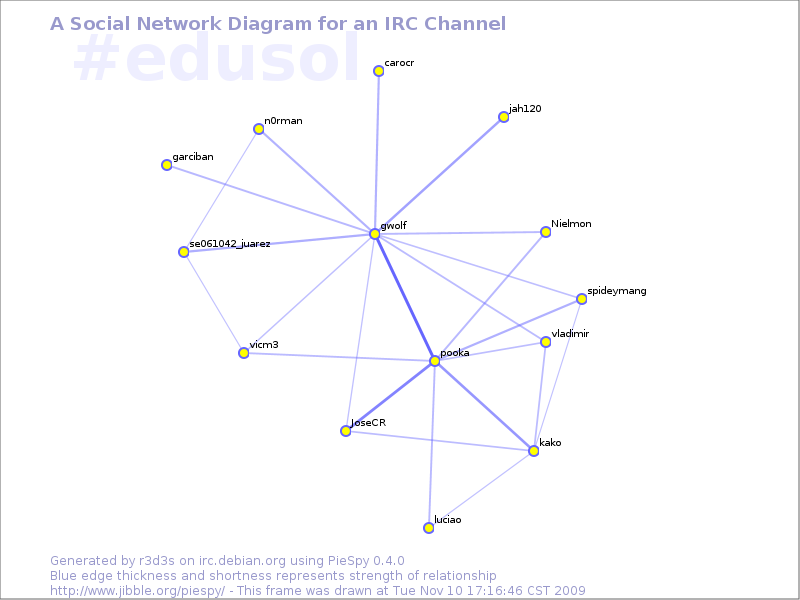
AttachmentSize
EDUSOL 2008 - Conference photo1.97 MB
Current (Monday+Tuesday) interaction graph for our IRC channel39.89 KB

Martin Michlmayr: Project management lessons from the FreeDOS Project

A lot of people seem to think that open source is a magic solution to project management and that open source projects will automatically attract a large and healthy community of contributors and users who will improve the software. This, of course, is not the case. In fact, creating a successful open source project is a really major and difficult effort. You have to deliver an initial promise that people find interesting, attract other people, then facilitate and lead the community, etc. You just have to look at all the failed projects on SourceForge that never delivered any code to see that "open source" is not a guarantee for success. Even though project management is a key element of every open source project, there are only few resources about this topic. That's why I always enjoy reading about the experience from open source project leaders. Jim Hall, the founder of the FreeDOS project, recently posted a series of four articles which I find particularly interesting. Here are links to the articles along with a quick summary: I really like these articles from Jim Hall since they contain a lot of great insights that apply to other projects, so I suggest you check them out! (Originally published on FOSSBazaar)

Matt Zimmerman: Amplify Your Effectiveness (AYE) Conference: Day 1


Morning Session: Project Patterns I chose to attend a session entitled: Is this the Way We Really Want to do Things? Seeing Project Patterns and Changing What You Don t Like (Johanna Rothman). My goal was to explore the causes of the troublesome patterns I see in projects at work. In particular, I see:
  • Too many projects starting up at once
  • Projects being instantiated without enough consideration for the probability of success ( is this a good idea? rather than can we realistically achieve this? )
  • Key people finding out too late about projects which affect them
All of these patterns lead to increased project risk, communication bottlenecks, low motivation, and high stress. In the session, we conducted a simulation of a team, with engineers, a project manager, a senior manager and a customer. I took on the role of the senior manager. In the course of the simulation, we received requirements from the customer, implemented them, and delivered products. While the team was working on implementation, I talked with the customer about what was coming next: what would happen when we delivered, what the next project would be, and so on. Part of the simulation was that I had to be separated from the group while they were working. When we delivered the first batch of products, and the customer was happy with them, it was time to decide what to do next. We gave the customer a choice of two projects we had discussed, one of which was similar to the previous one (but larger scale and more involved), while the other was different. Despite repeated attempts, we could not persuade the customer to prioritize one over the other. So, I decided that we should change gears and start work on the different project. It seemed to be of greater economic value to the customer, and simpler to execute. One of the engineers disagreed with this decision, but didn t explain why. The project manager seemed to agree, and I left the team to work. They produced a prototype, which the customer liked, and with a few small changes it was accepted as a finished product. To my surprise, though, I found out later that the team was in fact working on both projects at once, delivering two different types of products. The decision hadn t actually been made. These unexpected products were delivered to the customer, but didn t meet the expanded requirements, and that work was wasted. The debrief which followed was unfortunately too short, and I didn t feel that we were able to fully explore what the simulation had revealed. The project manager indicated that he hadn t understood the decision to have been made, pointing to a communication failure. This reminded me that while we often think of a decision as an event which happens at a point in time, it is more commonly a process of change, which takes time and must be revisited in order to check progress and evaluate. A decision is really just an idea for a change, and there is more work to be done in order to implement that idea. This can be true even when there is a very explicit decision point : it still takes time for that message to be received, interpreted and accepted. One of the tangents we followed during the debrief had to do with how humans think about numbers. Jerry asked each member of the group to write down a random number, and then we wrote them all on a flipchart. They were: 8, 75, 47, 72, 45, 44, 32, 6, 13 and 47. This reminded me of the analyses of election results which indicate fraud. Afternoon Session: Saying No After lunch, I decided to attend Jerry Weinberg s session, Saying No That Really Means No. This was much larger than the morning session, with over 40 people sitting in a large circle. The subject of discussion was the variety of difficulties that people face in saying no to things which don t seem right for them. For example, saying yes to a project which is doomed to failure. This seemed like a good follow-on to the morning s exercise. Jerry began by asking the audience to name some of their difficulties, and tell stories of times when they had trouble saying no . One of these stories was role-played and analyzed as an example. Most of the time, though, was filled with storytelling and discussion. This is a deeply complex topic, because this problem is rooted in self-image, social norms, egocentrism, misperception, and other cognitive phenomena. There was no key insight for me, just a reinforcement of the necessity of self-awareness. The only way to avoid patterns like this is to notice when they are happening, and that can be challenging, especially in a stressful situation. Once you realize what s happening, there are all sorts of tools which can be applied to the problem: negotiation, requests for help, problem-solving, even simple inaction.

Dirk Eddelbuettel: R / Finance 2010 Call for Papers

Jeff sent the following while I had connectivity issues and I hadn't gotten around to posting it here. So without further ado, and given the success of our initial R / Finance 2009 conference about R in Finance, here is the call for papers for next spring:
Call for Papers: R/Finance 2010: Applied Finance with R
April 16 and 17, 2010
Chicago, IL, USA
The second annual R/Finance conference for applied finance using R will be held this spring in Chicago, IL, USA on April 16 and 17, 2010. The two-day conference will cover topics including portfolio management, time series analysis, advanced risk tools, high-performance computing, market microstructure and econometrics. All will be discussed within the context of using R as a primary tool for financial risk management and trading. One-page abstracts or complete papers (in txt or pdf format) are invited for consideration. Academic and practitioner research proposals related to R are encouraged. We will accept submissions for full talks, abbreviated "lightning talks", and a limited number of pre-conference tutorial sessions. Please indicate with your submission if you would be willing to produce a formal paper (10-15 pages) for a peer-reviewed conference proceedings publication. Presenters are strongly encouraged to provide working R code to accompany the presentation/paper. Data sets should also be made public for the purposes of reproducibility (though we realize this may be limited due to contracts with data vendors). Preference may be given to presenters who have released R packages. Please send submissions to: committee at RinFinance.com The submission deadline is December 31st, 2009. Submissions will be evaluated and submitters notified via email on a rolling basis. Determination of whether a presentation will be a long presentation or a lightning talk will be made once the full list of presenters is known. R/Finance 2009 included keynote presentations by Patrick Burns, Robert Grossman, David Kane, Roger Koenker, David Ruppert, Diethelm Wuertz, and Eric Zivot. Attendees included practitioners, academics, and government officials. We anticipate another exciting line-up for 2010 and will announce details at the conference website http://www.RinFinance.com as they become available. For the program committee:
Gib Bassett, Peter Carl, Dirk Eddelbuettel, John Miller,
Brian Peterson, Dale Rosenthal, Jeffrey Ryan
See you in Chicago in April!

Matthew Garrett: ACPI general purpose events

ACPI is a confusing place. It's often thought of as a suspend/resume thing, though if you're unlucky you've learned that it's also involved in boot-time configuration because it's screwed up your interrupts again. But ACPI's also heavily involved in the runtime management of the system, and it's necessary for there to be a mechanism for the hardware to alert the OS of events. ACPI handles this case by providing a set of general purpose events (GPEs). The implementation of these is fairly straightforward - an ACPI table points at a defined system resource (typically an area of system io space, though in principle it could be something like mmio instead), and when the hardware fires an ACPI interrupt the kernel looks at this region to see which GPEs are flagged. Then things get more interesting. The majority of GPEs are implemented in the ACPI tables via methods with names like _Lxx or _Exx. The xx is the number of the GPE in hex, while the leading _L or _E indicates whether the GPE is level- or edge-triggered. If an ACPI interrupt is fired and GPE 0x1D is flagged as being the source of the interrupt, the ACPI interpreter will then look for an _L1D or _E1D method. Upon finding one, it'll execute it. What this method does is entirely up to the firmware - on most HP laptops, GPE 0x1D is hooked up to the lid switch[1] and so executing it will send a notification to the OS that the lid switch has changed state. The OS will then evaluate the state of the lid switch (generally by making another ACPI query) and send the event up to userspace. How does the lid end up triggering GPE 0x1D? Things get pretty hardware specific at this point. Intel motherboard chipsets have a set of general purpose io (GPIO) lines that can, for the most part[2], be used by the system vendor for anything they want. For a lid switch, one of these lines is hooked to the switch and the BIOS configures the GPIO as an input. Pressing the switch will cause the GPIO line to become active. The GPIO lines are mapped to GPEs in a 1:1 manner, though with an offset of 16 - ie, GPIO 0xd will map to GPE 0x1d. If GPIO 0xd becomes active, GPE 0x1d will be flagged and an ACPI interrupt sent. The ACPI code will then do something to quash the interrupts, such as inverting the polarity of the GPIO[3], as well as send the notification to the OS. Why are the GPIOs offset by 16 relative to the GPEs? The lower 16 GPEs (again, talking about Intel hardware) have pre-defined purposes[4]. These range from things like "Critically low battery" to "PCIe hotplug event" down to "This device triggered a wakeup". And the latter is what I'm most interested in here. Various pieces of modern hardware can be placed into power saving states when not in use. The problem with this is that the user experience of having to turn on hardware before you can use it is not a good one, so in order to make this the default behaviour we need the hardware to tell us that something happened that requires us to wake the hardware up. There's something of a chicken and egg problem here, but thankfully most of the relevant modern hardware has out of band mechanisms to tell us about things going on. The PCI spec defines something called Power Management Events (PME), which are driven by an additional current that's supplied to the hardware even when it's otherwise turned off. On plug-in PCI Express cards, firing a PME generates an interrupt on the root bridge and a native driver can interpret that, but for legacy PCI devices and integrated chipset devices the notification has to come via ACPI. The example I've been working on is USB. It's a good choice for various reasons - firstly, there's already support for detecting when the USB controller is idle. Secondly, modern USB host controllers have support for generating PMEs on device insertion, removal or (and this is important) remote wakeup. In other words, as long as the USB bus is idle we can power down the entire USB controller. If the OS tries to access a USB device, we'll power it back up. If the user unplugs or plugs a device, we'll power it back up. If a previously idle device suddenly responds to some external input, we'll power it back up. And it's all nicely invisible to the user. How does this work? The controller retains a small amount of power even when nominally pwoered down. This is used to keep the detection circuitry alive. When it receives a wakeup event, it asserts the PME line. The chipset detects this and fires a GPE. The OS runs this GPE and receives a device notification on the ACPI representation of the USB controller, telling us to power it back up. We do so and process whatever woke us - if the bus then goes idle again, we can power down once more. The astonishing thing is that this all works. The only problem we have is that it relies on the machine vendor to have provided the ACPI methods that are associated with the GPEs. If they haven't, we can't enable this functionality - even though the hardware is capable of generating the GPEs, we have no method to execute to let us know which device has to be woken up. The GPE is never answered, we never acknowledge the PME and the hardware keeps on screaming for attention without getting any. And, more to the point, it never gets powered up and your mouse doesn't work. There's a pretty gross hack to deal with this. In general, we know what the GPE to device mappings are - they're pretty static across Intel chipsets, and while AMD ones can be programmed differently by the BIOS we can read that information back and set up a mapping ourselves. This trick also comes in handy when some vendors (like, say, Dell) manage to implement one of the GPE events wrongly. Everything looks like it should work, but the method never sends a notification because it's buggy. In that case we can unregister the existing method and implement our own instead. This code isn't upstream yet, but patches have been posted to the linux-acpi mailing list and with luck it'll be there in the 2.6.33 timeframe. My tests suggest about 0.2W saving per machine, which isn't going to save all that many polar bears but seems worth it anyway. [1] _L1D = lid. Sigh. [2] There's a few that are reserved for specific purposes [3] So where before it had to be high to be active, it now has to be low to be active - this means that it'll now trigger on the switch being opened rather than closed, so you'll get another event when you open the lid again. [4] You can find a list in the documentation for the appropriate ICH chip - the relevant section is "GPE0_STS" under the LPC interface chapter.

9 November 2009

Joey Hess: king kong vs godzilla from a mouse's perspective

In Ubuntu Server Edition 9.10: No hardware required, Matt Zimmerman announces that from now on, "every release of Ubuntu Server Edition is simultaneously available on EC2". Amazon's EC2 documentation says: "the ability to create and publish kernels and ramdisks is restricted to Amazon EC2 and selected vendors". Canonical appears to be one of those vendors. Their newest EC2 AMI's contain modules from an Ubuntu build of linux-xen (2.6.27-23). Eric Hammond, who has been for a while making both Ubuntu and Debian images for EC2 says
Historically on EC2, neither Debian nor Ubuntu have had completely Debian and Ubuntu stacks from the kernel up. Instead, we've had to make do with patching the runtime on top of older kernels (2.6.16, 2.6.18, 2.6.21) built for other distros (Fedora Core). Amazingly, we've managed to hold this together and keep it running well for a couple years on EC2.
He goes on to describe current problems with eg, Debian's new udev version and the available EC2 kernels. Furthermore, anticipating today's news:
When the point comes where I am not publishing the base Ubuntu server AMIs, it will not make sense for me to publish new Debian AMIs either.
Those wanting to run Debian on EC2 will be stuck with duct-taping together Debian with the available kernels. Maybe I'm wrong. Maybe Ubuntu is actually working with Debian's kernel team, and will be letting them use Canonical's access to publish AKI's of official Debian kernels. Or maybe Ubuntu is working with Debian's kernel team to include identical linux-xen kernel in Debian, so the Ubuntu AKI's could be used. But appearances are that this is another case where Ubuntu has managed to take a situation that was less than ideal for all concerned, and turn it into an advantage for Ubuntu, while at the same time being a unfixable loss for Debian. My mouse's perspective is that a) we maybe only have so many losses left in us (altho we did get thru that whole dinosaur thing ok!) and b) King Kong is still oddly dependent on his mammilian heritage to be up there with his head in the cloud, tearing at Godzilla and stamping on us.

Matthew Garrett: Looking to the past

It s an oft-voiced suggestion that rather than looking at the bad things that happen in our communities, we should focus on the good things. There s a number of highly successful geek women already should we not be concentrating on encouraging more of them, rather than scaring people away with tales of thoughtlessness, discrimination and outright abuse?

Let s draw an analogy. One day, a $20 charge appears on your credit card. You didn t make it. You report it to your credit card company, who assure you that they take fraud seriously and then do nothing. A few days later, another $20 charge. Your credit card company tells you that such events are rare, unrepresentative of the general credit card experience and continue to do nothing. A week afterwards, another charge. This time your credit card company describes how they re planning on implementing a brand new anti-fraud system, but that this is unrelated to any events that may currently be occuring and will give no details as to when it s going to be rolled out. And proceed to ignore any further reports you make about fraudulant transactions.

Would you stay with this company? Or would you take your business somewhere else?

The problem with the Let s look to the future rather than spending too much time getting stuck in the present argument is that it assures people that things will get better without providing a roadmap for getting there. It does nothing to validate their concerns or make them feel wanted within a community. It assumes either that people will stick with a community that doesn t respond to their complaints, or that it s possible to construct a community that s welcome to an assortment of genders, ethnicities and lifestyles without any of those people being represented in the first place.

Ignoring people s concerns is an excellent way to drive them away from your community. Doing so because of a potential future that s probably conditional on you having those people in your community is short sighted and self defeating. Ignoring the present doesn t benefit the future. It benefits the status quo.

(Originally posted here)

Stefano Zacchiroli: on mail addresses and upload rights

1 I posted like 3 o 4 messages to an Ubuntu mailing list in my life; it happened when they discussed DEP-3, which I think can help in syncing patches between the 2 distros (or, if you want, in removing one more excuse for not doing that). When I did that, I posted with my @debian.org address. If I have upload rights to Ubuntu, I would certainly use my @debian.org address, to show to the Ubuntu community where I come from. Now, why then should a @ubuntu.com guy do anything different when uploading to Debian, no matter which rights he has earned in the (Debian) project? Or better, sure he can do it differently, but why should we ask he to do that? 2 DDs have different "philosophies" about which address they use in Maintainer/Uploaders fields: some of them consistently use @debian.org address in every package they (co-)maintain; some other use some of their non-Debian addresses. Shouldn't the latter choice be completely orthogonal to whether they have a @ubuntu.com address? 3 As Gaudenz has shown in his master thesis (there's a very nice DC9 talk about that), Debian has surely lost a lot of "contributors" (people that interact on lists, BTS, ...) in favor of Ubuntu, but has not lost "uploaders" (Gaudenz' names were actually different, but I can't remember them and the slides are in German, which I can't read :-/). In fact, there is a flow of people which become uploaders to Debian, that come from Ubuntu; that flow most likely compensates the decrease in the number of Debian contributors which become uploaders. So, let's face it, we will have at least for a while people coming from Ubuntu uploading to our archive, possibly/hopefully because they like more our free ideals and democratic project management. These are my personal reasons for finding some rants pointless. (But still, that rant finally gave me the opportunity to mention Gaudenz's work, which I've found pretty impressive!)

Matt Zimmerman: Ubuntu Server Edition 9.10: No hardware required


In the 9.10 release of Ubuntu Server Edition, we introduced something new for people who are exploring cloud computing using Amazon s Elastic Compute Cloud (EC2). If you haven t tried it yet, EC2 is essentially an API for managing virtual servers. Using a command line tool or script, you request a new VM, and moments later, it is ready for you to ssh in, preconfigured with your ssh public key. When you re finished, you shut it down, and receive a bill for only the time and Internet bandwidth you used (about $0.10 per hour and $0.10-$0.17 per gigabyte). There is no downloading, no installing, and no hardware required for you to set up a server. The first step is to boot it up. Starting with release 9.10, every release of Ubuntu Server Edition is simultaneously available on EC2. This means you can have a new Ubuntu server up and running using your EC2 account with a single command. Ready-to-run Ubuntu machine images are published on EC2 whenever a new Ubuntu release or milestone is available. All you need to know is the AMI, a short string which uniquely identifies the image you want. The AMIs for the 9.10 release are on the download page, in 32- and 64-bit versions for US and Europe zones. Similarly, all Server Edition development builds are available on EC2 as well. When the first builds of Lucid (Ubuntu 10.04) are created, there will be AMIs for those as well. If you want to test drive a new feature, or check compatibility with your application, just fire up a new instance on EC2, do your work, and then terminate it. The whole process can be completed in less than a minute. If you find a problem in our development builds, just run ubuntu-bug on the virtual machine as you normally would, and apport will automatically attach the relevant EC2 details to your bug report. As I mentioned above, EC2 does charge for Internet bandwidth. It does not charge for local bandwidth within your EC2 zone. For this reason, Canonical has set up Ubuntu archive mirrors within EC2, so that you can download all Ubuntu packages and updates for free. Ubuntu virtual machines inside EC2 are automatically configured to use the appropriate mirror, so you don t need to think about it. This is an exciting step forward in making Ubuntu more convenient and powerful to use on EC2, and I encourage you to give it a try. If you ve never used EC2 before, just follow our Starter s Guide to get set up.

Matt Zimmerman: Amplify Your Effectiveness (AYE) conference: Day 0


The AYE conference is an annual conference designed to increase your effectiveness in leadership, coaching, managing, influencing, and working in teams, whether you work in systems development, testing, product development, quality assurance, customer service, or consulting. It starts tomorrow, and I ve arrived today eager to meet the other attendees and see what the conference is like. My work involves all of those things, but the main reason I decided to attend was that I learned a lot at the Problem Solving Leadership workshop, which I attended in January and wrote about on this blog. When I heard about this event, organized in part by the same people, and realized I would be in the US that week anyway, I seized the opportunity to attend. The 2009 program is overflowing with sessions on topics I m interested in, some of which I have written about here previously. The speakers are all people whose insight I ve appreciated through their writing, speaking and teaching, so I expect I ll have a tough time deciding where to spend my time these next few days. The sessions are said to be experiential ones rather than lectures, so I don t think that I ll be able to hop between them, but I ll see tomorrow when the main program starts.

8 November 2009

Matt Zimmerman: Multivac emerging


Science fiction writer Isaac Asimov envisioned a computer called Multivac, powerful enough to process all of the planet s data. Humanity painstakingly collects massive quantities of information to submit to Multivac on a daily basis, in exchange for the opportunity to ask questions of it. With so much information at its disposal, Multivac is capable of amazing feats of analysis and prediction, which guide humanity to resolving global problems of war, poverty and so on. The corporate mission statement of Google, Inc. is to organize the world s information and make it universally accessible and useful. Google constantly processes information from the web, books, and photographic imagery from space and from the surface of the planet. Its famously simple search interface invites humans to ask it about anything, and it provides instantaneous answers in the form of references to information it has collected. Google is not yet capable, in general, of providing meaningful answers to natural language questions, though research is ongoing, and systems like Wolfram Alpha hint at more abstract manipulation of data at a global scale. We seem to be edging closer to Asimov s vision of Multivac. What would you ask Multivac, given the opportunity? How will our future reality differ from science fiction?

Russell Coker: I m an Aspie

I ve recently been diagnosed with Asperger Syndrome (AS) [1]. Among other things this means that I am genetically predisposed to have an interest in solving technical problems and give lectures about how I solved them, but that I tend not to be a people-person . AS is generally regarded as an Autism Spectrum Disorder (ASD), but there is a lot of debate among the experts about the exact relationship. Some people (such as the psychologist who assessed me) believe that AS is a synonym for High Functioning Autism (HFA), however one theory I ve heard is that HFA people are more sensory oriented and Aspies differ by being information oriented in that case I would not be regarded as HFA. I m not bothered by this issue, I m sure that in a few years time the experts will have some consistent definitions for such things that most people can agree on. There is no Boolean assessment for AS, the assessment is based on a sliding scale of number of criteria. People who are almost Aspies but don t quite pass the test (or more commonly don t get assessed because they don t think they would pass) are sometimes referred to as Asperger Cousins (AC), this is a slang term that is not formally recognised but is often used in online discussions. I m sure that a significant portion of the readers of my blog would regard themselves as being at least ACs if they investigated the issue. The test at Glenn Rowe s web site [2] can give you an idea of how you rate by some criteria but note that this is not at all conclusive and it s based on the theories of Professor Simon Baron-Cohen [3], not all of which have general agreement. Leif Ekblad is running a project to analyse long-term changes to the Aspie score of adults [4]. The main quiz for that project seems quite popular for self-diagnosis, but again it s not conclusive. I think that diagnosing oneself for an ASD is not nearly as crazy as most things which might fall in the category of being one s own psychologist, but I still strongly recommend getting a formal assessment if you believe that you are an Aspie. In Australia it costs about $600 and there s a waiting list of about 3 months. Chaotic Idealism has an insightful post about the pros and cons of self-diagnosis [5], if you suspect that you may be an Aspie then I recommend that you read it before doing the tests.

6 November 2009

Joachim Breitner: Releasing zpub as Free Software

Earlier this year, my brother and I developed a documentation management server for a small software developing company. They were sick of creating their documentation by sending around Word documents, having to manually merge them, losing changes and not getting a clean, consistent layout.So we created zpub for them: It is based on DocBook and Subversion, and adds a fairly nice web interface to it. Now their work flow is
  1. The editor checks out the DocBook source document via Subversion. With a client like TortoiseSVN, this is possible even for the less tech-savvy editor.
  2. He works on the document using the editor of his choice. We recommended an editor with a proper DocBook mode such as the XMLMind XML Editor or Serna Free, which was recently published as Free Software, to our customer.
  3. When satisfied, he commits his changes via Subversion, adding a comment describing his modifications.
  4. On the server, zpub renders the document in the various output formats (.html, .pdf, .chm), and makes the result available via the web interface. The commit messages are put there, and all previous revisions of the document can still be accessed.
  5. Optionally, an e-mail about the change is sent out to a per-document configurable list of recipients.
  6. Optionally, the documents are rendered with a DRAFT -Watermark on the pages, to avoid leaking wrong revisions to the outside. Only users with extended rights are allowed to release a document, thus causing a version without that watermark to be rendered.
For more details on the feature and usage of zpub, check out the documentation that you can find on the demo instance.We are actually quite satisfied by zpub, and it would be a petty if that was just it. Of course, there are quite a view programs out that that can provide these features plus many more, much more than a company the size of our customer would want to have (or even to worry about). So there is a niche between sending Word documents by mail and buying a very expensive, complicated product where zpub fits in.Being a fan of Free Software myself, and since zpub is based on Free Software, we decided that we want to release zpub itself under a Free License. We chose the EUPL, which is a GPL compatible license created by the European Commission, since our customer comes from a municipal environment. The code is hosted on gitorious now, so if you have a need for zpub, just give it a try.Also, if you run a Free Software project, manage your documentation in DocBook (or want to start to do so) and think that zpub might be a neat idea to allow more documentation writers to contribute, talk to me. I might well offer free hosting in that case. If you are a commercial user, I m still offering hosting (and support or feature development), just not for free any more. Note that the zpub user interface and documentation is currently only available in German.

5 November 2009

Eddy Petrișor: Know your rights!

It is only a few days since my last post about the referendum which is due to happen on the same day as the Presidential elections, but I am forced to make another post because there are lots of incorrect views on the subject.

So let's try take the issues one by one and see what is the problem with every one of them, using reason and the information we have available from more mature democracies than Romania's.

What's the referendum about

The referendum, in this case, is about two issues:

Information on the subject

For an election such as the referendum (basically asking the population on a subject of national importance) every citizen has the right to be correctly informed about the options of the referendum, what each implies, what are the pros and cons for every option, what problems does the referendum tries to resolve.

There is no information on the subject, no videos, no spots, no fliers, nothing, just biased posters (I'll explain later).

Debate on the subject

In order to have a correct information, a clear public debate which should happen, without the pressure of a presidential campaign at the same time as the debate.


Well, we have no debate, so I guess there is no problem of overlapping (sad, but true), but on the other hand, there is no information on the subject.

Analysis of the options

Now let's analyse the two proposed measures in opposition to the current situation.

  1. reducing the number of representatives
    • pros
      • reducing costs
      • minorities have a bigger influence (they can defend their rights - see comments for explanations)
    • cons
      • easier to corrupt (obtaining a corrupt 5% in a 300 seats parliament is easier than in a 500 seats parliament)
      • minorities have a bigger influence (they are disproportionally powerful, in regard to the population they represent - see comments)
      • absence of a representative with a big vote power could allow passing an abusive law (to pass a regular law there is a need of a majority relative to the number of present representatives, not the total number), but, in a numerous parliament, the absence of a person isn't that risky (other colleagues would be present to stop the abusive initiative)
  2. one chamber instead of two
    • pros
      • faster processing of decisions
      • less bureaucratic
    • cons
      • in the current system there can be a passive vote (law passes silently if not discussed) which has just one occasion to be caught, while in the current system silent passing is allowed only in one of the chambers, but needs to be discussed in the other
      • there is a chance that one chamber might amend/catch abusive initiatives with "two chambers", but with "one chamber" there is one chance only
      • more prone to power abuse

So, there are pros and cons for all solutions, but now we can make an informed decision and know the risks for each option.

This shouldn't have been taken in haste without any public debate.


I don't want to influence anyone's vote, so I'll abstain from telling my options.

The president has the right to associate his image with one of the options.

OK, let's analyse that.

The law doesn't explicitly forbids this, but there are some recommendations from Venice on fair elections (sorry, I couldn't find the link) which say that in a vote such as the presidential elections there shouldn't be an unfair advantage for one of the candidates. Why is that relevant? Because the current president actually uses the referendum as his campaign and he's speculating people's innate hatred for political figures.

His election material is only comprised of virulent attacks at the representatives or calls to the population to vote in favour of both questions.


Why is that unfair? Because the current president is using his current position (president) as launch ramp for his campaign as a candidate.

OTOH, if the seal of the presidency was used instead his face, the problem wouldn't have been that bad.


Organisational issues

There were various rumours about how the voting will take place. Here is a list of things I heard:
  1. there will be a single list for both presidential elections and referendum and there will be a single column for signature to confirm your presence at vote
  2. there will be one paper, but two columns for signatures
  3. no matter what the list looks like, you'll be given both sets of ballots, but you can annul the one you don't want to vote on
All the variants above are incorrect from a democratic pov, but to different degrees:

  1. a single signature covering for either of the vaiants "presidential vote only", "refrendum only", "both" asks for trouble because unused ballots in "only" variants might be added later to the valid votes as if they were expressed by voters; since there is no distinct count for each of the ballots to confront that with signatures, before the counting period one could use unused ballots and vote for you on the issue you didn't want to express an opinion on
  2. informing on what to do in some cases such as "only" vote is essential to prevent fraud; e.g.: strike through the cell corresponding to the the election you don't want to express a vote on, instead of signing
  3. giving the ballot unconditionally to everybody, leaving you to decide to annul it or not is abusive, because vote is not compulsory in Romania; more than that, this artificial presence burst (even with void votes) could end up validating the referendum since a 50%+1 presence is needed to pass Constitution modification, as we have here
So, recap:
  1. favours fraud by allowing inside people to obtain untraceable/unaccounted ballots
  2. preventing fraud isn't of any concern, it seems (and could be achieved)
  3. forced voting might lead to validation of the referendum because the voting presence is sufficient, even if there are many annuled ballots
Vote validation and artificial voter presence

Since validation of a referendum on the changes on the constitution depends on sufficient voter presence (there is some mandatory threshold, but I can't find references now), it is in the interest of people wanting to promote the changes to mobilize people to vote.

By different measures the vote presence at the referendum is artificially increased raising the risk of validation, when people, in fact, wouldn't want to validate it and would, to express neutrality, will be be forced to annul the ballot.

Also, a high presence in the referendum might increase the number of voters for presidency, and the people mobilized this way may have a high chance to be biased in favour of the current president because he associates himself with the violent message against the representatives.

What does it take to implement, if referendum passes

If the referendum passes, the changes aren't immediate. The proposed changes are discussed in the Parliament and a final proposal for the constitution changes is made; after approval of the proposals by the Parliament, the ball goes back to population for final approval.

This means it will take a while to see a changed parliament.

Conclusions

Romania is not a true democracy yet and there are areas where individuals should know what their rights are and not let authorities fool them into buying any argument uncritically.

Romanians must learn their rights so they can't be manipulated whenever somebody wants to trick them into some scheme by knowingly omitting issues and creating insane situations.


Romanians, wake up, learn you have rights, form your own oppinion, as distinct individuals, then we might see a change.

Next.

Previous.

