Search Results: "sto"

19 April 2012

Michal Čihař: Weblate appliance

Thanks to great SUSE Studio I've made available appliance with ready to run Weblate. It's based on openSUSE 12.1, with few packages coming from Python devel repository (where I had to push some package updates) and Weblate package, which is currently available in my home. After booting the appliance, you will get Weblate running as web service (it takes some time on first boot as database setup is done in that time). In case you will use it for more than playing, please remember to change default passwords as described in our documentation. Anyway let's stop talking, you can get the appliance at SUSE Studio Gallery.

Filed under: English Suse Weblate 2 comments Flattr this!

18 April 2012

Wouter Verhelst: Screen scraping sucks

At a customer, I've migrated a number of manually-maintained servers to having them be maintained through puppet not so long ago. Since then, some more machines have been added, and getting them up and running properly was a breeze: do a base install, install puppet, sign the certificate, restart puppet, and then wait and twiddle thumbs while puppet did its magic. Easy as pie. Now, a few months later, we needed to install a number of windows machines for a lab (not my choice), and the person involved asked me to figure out some diskspace so we could start creating images for those. Not a chance. Instead, I suggested looking for a configuration management system, similar to puppet. Since we're using Samba 3 to run the Windows network here, dropping everything in Active Directory was not an option. But a short while later, he came back with the note that puppet, in its 2.7 version, actually does support Windows as a platform for the managed machines. Interesting. The unfortunate bit was that puppet supports creating files and installing software when it is distributed as an MSI file, but not when it's distributed as a .exe file. This is not unexpected; MSI files can be installed noninteractively; but when something is distributed as a .exe file, it means it needs to be installed interactively; and puppet does not have the ability to interact with GUI software. The workaround: use something that does have that ability (in my case, autoit), and use an exec block in puppet to make it call those scripts. In effect, that's a bit like screenscraping. Add a creates stanza to the block, so that the installer isn't started again if the software at hand has already been installed. This 'autoit' thing also comes with a recording utility, allowing one to create an initial script by just doing the installation, and having the tool just record stuff. With that, the machines are installed 99% automated. I say 99%, because there are still some issues: I'll have to think about this some more, I guess. First, it's clear that while puppet does have some Windows functionality, it's not entirely ready yet. And somehow, using autoit to add to Puppet functionality feels like an ugly hack. We'll see what the future brings.

Richard Hartmann: Potpourri I

Google rant Seems venting can be a worthwhile once in a while; the content of this post made its way into Google. No promises of any kind were made, but it's good to know that this is getting some exposure within Google :) That was quick. moreutils et al Steve Kemp is right; moreutils is very useful in some situations. And yes, it's a pity that we all have our own scripts without a central repository to host them all. The problem is one of diminishing returns and information overload; if any given collection becomes too large, it becomes tedious to look through it. You may have the Most Awesome Ever solution to any given problem, but unless whoever needs it can find it quickly, it's useless to them. Thorsten Glaser suggested this collection, but it suffers from the same basic problem: Not enough content? You won't find what you need. Too much content? You won't find what you need. Finding the right balance is highly non-trivial. Linux storage Russell Coker shared yet another chapter of his continuing quest for modern, reliable, software-based storage on Linux. The short version is "ZFS is not that good on Linux while btrfs is not ready for prime time, yet." That's, unfortunately, not much of a surprise. fsck.btrfs is still too new and the lack of RAID 5/6 is an absolute show-stopper as far as I am concerned. COW solves the writing speed issues so, hopefully, that old argument can finally be laid to rest. And on top of the "wastng" of more disks for RAID 10, the minimum number of failed disks that can lead to data loss on RAID 10 is two whereas it's three for RAID 6. No-brainer, imo. Anyone who does not agree with Dell's pricing structure should seriously consider looking at SuperMicro, by the way. Cheap(ish), reliable, high disk densities. Password hashes Saku Ytti talks about password hashing and the relative merits of different algorithms. While I agree that bcrypt incorporates a good approach inasmuch it's designed to be slow to compute and can be made slower as needed, I think he focuses on one aspect while disregarding all others. Still, the premise that deterring brute force attacks on known hashes is the only concern is wrong. Avoiding collisions, reasonable certainty that there are no computational shortcuts, irreversibility, pseudo-random output, full use of the output's possible values, and thorough analysis by experts in the field are important concerns, as well. Brute forcing known hashes is hardly the only attack. When brute forcing a service, i.e. against an unknown hash, no matter if the system is remote or local, the computational cost of hashing is mostly irrelevant. Rainbow tables help mitigate computational cost when trying to extract clear text in case the hash is known. And if there are a lot of collisions or an easy way to find them, knowing the clear text password is not needed. Simply use whatever generates the correct output and you're done. Again, I am not saying that bcrypt is a bad idea; it's just that there are more concerns than computational cost alone. Travel If you know your way around Novosibirsk, please contact me. We have almost no idea what to do while there other than visiting the railroad museum; part of the reason why we are stopping there is to have a break after ~50 hours on the train and because Novosibirsk is just an awesome name. Our focus while there will be on seeing interesting industrial or research sites. Given that there are large industrial complexes and formerly secret cold war secret research cities situated around Novosibirsk it would be a pity not to see any of them. We may end up hiring a taxi via the hotel and having that drive us around a bit. Somewhat boring and potentially costly, but a feasible backup. Blogging frequency I have to admit being am a bit worried about spamming the various aggregators which are fed from this blog. Writing this catchall post is an attempt to mitigate this. While I am getting a surprising amount of positive feedback, I would be interested to hear anything negative, if applicable, as well. You know how to reach me.

Richard Hartmann: Woegle is me

Google seems to become more and more annoying. Package download http://dl.google.com/linux/chrome/deb/ is slow. Not just slow, but slow. Any random apt-get update will take ages; just sitting there waiting for Google's servers to send any data. Downloading actual packages is slow, as well. Ironically, Google's PageRank will punish sites for loading slowly; it's a pity they don't use their considerable server & bandwidth capacities to fix slowness they are causing, themselves. Chrome Copy and paste is a central part of what I use a mouse for. X has had two copy buffers for as long as I can remember, one for mouse selection, pasting with middle mouse button and one for CTRL-c/CTRL-v. Chrome merges the two. That's bad enough in and as of itself, but every time Chrome gets focus, it will clobber anything you may have in your copy buffers at that time with anything that's selected. No matter if you selected it via mouse, via keyboard, a context switch autoselected something. Selection goes into buffer. Every time. Every. Single. Time. To add insult to injury, this is dependent on which tab is active. And if you happen to search on the site (CTRL-f), it will always use what's in the search bar to clobber buffers, no matter if anything on the actual website has been selected. I can't find the bug report about this at the moment, but Google's stance is that this is a feature and introducing an option for traditional copy & paste handling is not desirable. Google+ I get that they feel a need to combat Facebook, but still, pushing Google+ on you is just annoying. At least the Android application has had a permission change on ICS so it can not auto-update. It's the little things ;) WWW Unified branding, the need to support touch-based devices in their UI, etc. Still, GMail's new interface sucks and the old one will be going away for good. And while making some UI elements larger or displaying them unconditionally makes sense for hand-held portrait displays, this is highly annoying on wide-screen landscape displays. 1366x768 may have overtaken 1024x768, but 768 is a constant here and still not a lot. As an aside, hopefully the Apple Effect and the iPad 3 will break the age-long stalemate with regards to screen resolution. More is better, here. Android Bloatware Using stock Android means you won't get Facebook and other useless apps pre-installed. Yet, uninstalling stock applications, like Google+, is impossible. Rights management It's nice that I get to see what kind of access an application would like to have. It's not nice that I can not choose what access I am willing to grant any given application. I can make a binary decision, install or not install, but I can't refuse random access rights to applications. There are custom versions of Android out there which allow you to do this and many applications seem to cope with being unable to do some things. This should be a standard feature. Access management The concept of "access to USB storage" meaning "whatver your SD card or, in the Galaxy Nexus' case, just a specific directory" is also broken. There is a middle ground between "this application needs access to a large chunk of storage" and "this application needs complete access to said large chunk". Just assign the application a specific directory to write into and read from and done's done. Multi-user I can not hand anyone my phone to play a game or surf the Internet without giving them the ability to look through all my email, contacts, calendar, you name it. While I only give my phone to people I trust completely, this still sucks. How hard can it be to create a minimal guest mode which allows people to access a few pre-selected applications with a custom setting of if they are allowed to use cellular data and/or WiFi? Data access Authorized Access Ah, the big one.... Keep in mind that I am using Google's latest and greatest, the Samsung Galaxy Nexus GSM. It's as cutting-edge as you can get. Yes, having one continuous storage device is nice. But MTP support on Linux is abysmal and you are forced to access your data by means of MTP or PTP. gphoto2, gwenview, and gthumb are all unable to import any photos via PTP; no program I tried can transfer anything via MTP. gphoto2 will transfer the background images which APOD (highly recommended, by the way; there's also a donation application for this) stores on my phone. That's it. So, unless I send email to myself, use WiFi-based hacks, or root my phone, I can not access my data. On the strongest mobile platform in the world. Using the most powerful and versatile OS with up-to-date packages. In 2012. Yay. Unauthorized Access Not being able to access my data is a Bad Thing. Even worse is when others can access my data. Contrary to older Android versions, someone decided that it would be a good idea to allow MTP or PTP, only. As in "you can not disable MTP and PTP. One of them has the be activated." This is awesome when you want to charge your phone at an airport or at an acquaintance's possibly malware-ridden Windows machine. Everyone and their bot-herder can potentially access my data while I can not. Usability And while MTP/PTP is an either/or decision, they are using check-boxes, not radio buttons. There's a decade or more of UI experience about check-box versus radio button, so why not use it? I know of at least one owner of a Galaxy Nexus who was not even aware that he couldn't turn off MTP (the default) as the UI pretends otherwise. Opaqueness And good luck trying to contact anybody about this. Having filed a few bugs against Google stuff in the past, I simply gave up on it. Back when Gmail's mailing list filtering and labelling system was somewhat broken, I spent months hunting down people who knew people who knew someone who was able to actually do something about it.

17 April 2012

Tanguy Ortolo: Camera with a standard USB cable?

Digital camera icon Since some years, there has been a movement towards standardization: mobile devices are now using Micro-USB for data transfer and charging, and SD or Micro-SD for storage extension (except Apple of course). One piece is lacking to this perfection, however; as far as I know, digital camera producers did realize that SD won for storage, but they do not seem to have acknowledged the Micro-USB standard yet. Now, since manufacturers and resellers do not indicate the connector type, I have no way to be sure that this is still the case. So, dear lazyweb, do you know if, by chance, there exists a compact digital camera that would use SD cards and a Micro-USB connector for data transfer and integrated charging?

Russell Coker: The Most Important things for running a Reliable Internet Service

One of my clients is currently investigating new hosting arrangements. It s a bit of a complex process because there are lots of architectural issues relating to things such as the storage and backup of some terabytes of data and some serious computation on the data. Among other options we are considering cheap servers in the EX range from Hetzner [1] which provide 3TB of RAID-1 storage per server along with reasonable CPU power and RAM and Amazon EC2 [2]. Hetzner and Amazon aren t the only companies providing services that can be used to solve my client s problems, but they both provide good value for what they provide and we have prior experience with them. To add an extra complication my client did some web research on hosting companies and found that Hetzner wasn t even in the list of reliable hosting companies (whichever list that was). This is in some ways not particularly surprising, Hetzner offers servers without a full management interface (you can t see a serial console or a KVM, you merely get access to reset it) and the best value servers (the only servers to consider for many terabytes of data) have SATA disks which presumably have a lower MTBF than SAS disks. But I don t think that this is a real problem. Even when hardware that s designed for the desktop is run in a server room the reliability tends to be reasonable. My experience is that a desktop PC with two hard drives in a RAID-1 array will give a level of reliability in practice that compares very well to an expensive server with ECC RAM, redundant fans, redundant PSUs, etc. My experience is that the most critical factor for server reliability is management. A server that is designed to be reliable can give very poor uptime if poorly maintained or if there is no rapid way of discovering and fixing problems. But a system that is designed to be cheap can give quite good uptime if well maintained, if problems can be repidly discovered and fixed. A Brief Overview of Managing Servers There are text books about how to manage servers, so obviously I can t cover the topic in detail in a blog post. But here are some quick points. Note that I m not claiming that this list includes everything, please add comments about anything particularly noteworthy that you think I ve missed.
  1. For a server to be well managed it needs to be kept up to date. It s probably a good idea for management to have this on the list of things to do. A plan to check for necessary updates and apply them at fixed times (at least once a week) would be a good thing. My experience is that usually managers don t have anything to do with this and sysadmins either apply patches or not at their own whim.
  2. It is really ideal for people to know how all the software works. For every piece of software that s running it should either have come from a source that provides some degree of support (EG a Linux distribution) or be maintained by someone who knows it well. When you install custom software from people who become unavailable then it puts the reliability of the entire system at risk if anything breaks then you won t be able to get it fixed quickly.
  3. It should be possible to rapidly discover problems, having a client phone you to tell you that your web site is offline is a bad thing. Ideally you will have software like Nagios monitoring the network and reporting problems via a SMS gateway service such as ClickaTell.com. I am not sure that Nagios is the best network monitoring system or that ClickaTell is the best SMS gateway, but they have both worked well in my experience. If you think that there are better options for either of those then please write a comment.
  4. It should be possible to rapidly fix problems. That means that a sysadmin must be available 24*7 to respond to SMS and you must have a backup sysadmin for when the main person takes a holiday, or ideally two backup sysadmins so that if one is on holiday and another has an emergency then problems can still be fixed. Another thing to consider is that an increasing number of hotels, resorts, and cruise ships are providing net access. So you could decrease your need for backup sysadmins if you give a holiday bonus to a sysadmin who uses a hotel, resort, or cruise ship that has good net access. ;)
  5. If it seems likely that there may be some staff changes then it s a really good idea to hire a potential replacement on a casual basis so that they can learn how things work. There have been a few occasions when I started a sysadmin contract after the old sysadmin ceased being on speaking terms with the company owner. This made it difficult for me to learn what s going on.
  6. If your network is in any way complex (IE it s something that needs some skill to manage) then it will probably be impossible to hire someone who has experience in all the areas of technology at a salary you are prepared to pay. So you should assume that whoever you hire will do some learning on the job. This isn t necessarily a problem but is something that needs to be considered. If you use some unusual hardware or software and want it to run reliably then you should have a spare system for testing so that the types of mistake which are typically made in the learning process are not made on your production network.
Conclusion If you have a business which depends on running servers on the Internet and you don t do all the things in the above list then the reliability of a service like Hetzner probably isn t going to be an issue at all. Related posts:
  1. Servers vs Phones Hetzner have recently updated their offerings to include servers with...
  2. Why Internet Access in Australia Sucks In a comment on my post about (relatively) Cheap Net...
  3. The National Cost of Slow Internet Access Australia has slow Internet access when compared to other first-world...

Russell Coker: ZFS vs BTRFS on Cheap Dell Servers

I previously wrote about my first experiences with BTRFS [1]. Since then I ve been using BTRFS on more systems and have had good results. The main problem I want to address is with the reliability of RAID [2]. Requirements for a File Server Now one of my clients has a need for a new fileserver. They need to reliably store terabytes of data (currently 6TB and growing) which is mostly comprised of data files in the 10MB 15MB size range. The data files will almost never be re-written and I anticiapte that the main bottleneck will be the latency of NFS and other network file sharing protocols. I would hope that saturating a GigE network when sending 10MB data files from SATA disks via NFS, AFS, or SMB wouldn t be a technical challenge. It seems that BTRFS is the way of the future. But it s still rather new and the lack of RAID-5 and RAID-6 is a serious issue when you need to store 10TB with today s technology (that would be 8*3TB disks for RAID-10 vs 5*3TB disks for RAID-5). Also the case of two disks entirely failing in a short period of time requires RAID-6 (or RAID-Z2 as the ZFS variant of RAID-6 is known). With BTRFS at it s current stage of development it seems that to recover from two disks failing you need to have BTRFS on another RAID-6 (maybe Linux software RAID-6). But for filesystems based on concepts similar to ZFS and BTRFS you want to have the filesystem run the RAID so that if a block has a filesystem hash mismatch then the correct copy can be reconstructed from parity. ZFS seems to be a lot more complex than BTRFS. While having more features is a good thing (BTRFS seems to be missing some sysadmin friendly features at this stage) complexity means that I need to learn more and test more before going live. But it seems that the built in RAID-5 and RAID-6 is the killer issue. Servers start becoming a lot more expensive if you want more than 8 disks and even going past 6 disks is a significant price point. As 3TB disks are available an 8 disk RAID-6 gives something like 18TB usable space vs 12TB on a RAID-10 and a 6 disk RAID-6 gives about 12TB vs 9TB on a RAID-10. With RAID-10 (IE BTRFS) my client couldn t use a 6 disk server such as the Dell PowerEdge T410 for $1500 as 9TB of usable storage isn t adequate and the Dell PowerEdge T610 which can support 8 disks and costs $2100 would be barely adequate for the near future with only 12TB of usable storage. Dell does sell significantly larger servers such that any of my clients needs could be covered by RAID-10, but in addition to costing more there are issues of power use and noise. When comparing a T610 and a T410 with a full set of disks the price difference is $1000 (assuming $200 per disk) which is probably worth paying to delay any future need for upgrades. Buying Disks The problem with the PowerEdge T610 server is that it uses hot-swap disks and the biggest disks available are 2TB for $586.30! 2TB*8 in RAID-6 gives 12TB of usable space for $4690.40! This compares poorly to the PowerEdge T410 which supports non-hot-swap disks so I can buy 6*3TB disks for something less than $200 each and get 12TB of usable space for $1200. If I could get hot-swap trays for Dell disks at a reasonable price then the T610 would be worth considering. But as 12TB of storage should do for at least the next 18 months it seems that the T410 is clearly the better option. Does anyone know how to get cheap disk trays for Dell servers? Implementation In mailing list discussions some people suggest using Solaris or FreeBSD for a ZFS server. ZFS was designed for and implemented on Solaris, and FreeBSD was the first port. However Solaris and FreeBSD aren t commonly used systems so it s harder to find skilled people to work with them and there is less of a guarantee that the desired software will work. Among other things it s really convenient to be able to run software for embedded Linux i386 systems on the server. The first port of ZFS to Linux was based on FUSE [3]. This allows a clean separation of ZFS code from the Linux kernel code to avoid license issues but does have some performance problems. I don t think that I will have any performance issues on this server as the data files are reasonably large, are received via an ADSL link, and which require quite a bit of CPU time to process them when they are accessed. But ZFS-FUSE doesn t seem to be particularly popular. The ZFS On Linux project provides source for a ZFS kernel module which you can compile and load [4]. As the module isn t distributed with or statically linked to the kernel the license conflict of the CDDL ZFS code and the GPL Linux kernel code is apparently solved. I ve read some positive reports from people who use this so it will be my preferred option. Related posts:
  1. ECC RAM in a Cheap Machine In a comment on my previous post about ECC RAM...
  2. Starting with BTRFS Based on my investigation of RAID reliability [1] I have...
  3. Dell PowerEdge T105 Today I received a Dell PowerEDGE T105 for use by...

15 April 2012

Iustin Pop: Running: GP der Stadt D bendorf 2012 and some stats

Another weekend, another running opportunity! This was a nice, simple, fast race. The announcer was claiming (if I understood correctly) it is the fastest race around Z rich: completely flat, on an airfield (which unfortunately meant all paved road). The weather was perfect (for running), a bit cold but no problems with overheating. So I managed my fastest time ever: according to the my Garmin (which for the first time recorded a slightly longer distance than the official one), I managed to run 10.18km in 50:39, which makes it 4:58/km! For the first time, below the 5:00 mark, yay! I'll ignore the official marking which claimed 10km in 50:57, since that ruins my nice result, hah! Back to earth however let's see some stats about this race. Just to put it in context: My current running speed is lower than the winner in the 70+ age category by a significant amount. Based on the graph shape, I would probably win at the 85+ category . Or to put it in a slightly different context, a cultural one. Back in my home country (Romania), a 70-year old person (especially male!) that is still able to move around well and to manage by himself is (most of the time) an exception. Of course there are many old men who are doing well, but in general old people are (usually) considered deprecated by this age. In comparison, in Switzerland, they are still active and are doing sport. And some of them, as you can see, doing it quite well. The difference between these two cultures in this regard (sport) is huge. Doing sports (except playing football) is considered something unusual, and in my home town there's a somewhat linear relation between people's age and their weight (both are monotonically increasing). When I first came to Switzerland, I was shocked to see so many people over 50 that are fit and active. Now, every time I go back to Romania, I'm shocked to see people so many people overweight and looking more than their actual age. I can't help but wonder what is the cause of this disregard for health or aversion to sports. Just the fact that "it's expected" for older people to be unhealthy? Is it somehow related to the difference in income/standard of life (I can't see a trivial connection)? Is it to lack of education about how to live a healthy life? Or maybe it's not a country difference, but rather the fact that I grew up in a quite small town; people in Bucharest are indeed looking more after their health than in my home town, and are therefore fitter. Who knows Anyway, rant over, and I'm still happy that I managed to beat my own record, thanks to a flat race and favourable weather!

Sam Hartman: Moonshot and RDSI

Moonshot continues to be busy. Lately we ve been focusing on finishing our core technical specs, better understanding how Moonshot will be deployed and working on our trust infrastructure. At the same time, we re beginning to watch organizations evaluate whether Moonshot addresses a need they have. I m excited by this process because I like to see technology I work on adopted and because the feedback we get is very valuable. This week though, I personally get to participate in such an exercise. Tomorrow I ll be speaking at the Australian Research Data Storage Initiative s workshop on Moonshot. I ll be giving background on the project, talking about community success, and talking about how Moonshot can help Australia. I m looking forward to that. I m also very excited about a brainstorming exercise I ll be participating in today. Several key participants in the RDSI project and I will get together to carefully evaluate their needs and see what it would take for a Moonshot solution. I hope Moonshot does end up being a good fit. Regardless, I enjoy this sort of problem solving session and am happy to have the opportunity to sit down with knowledgeable people and see how we can solve real problems!

Gregor Herrmann: RC bugs 2012/15

another weekend, another RCBW report:

Richard Hartmann: Choo choo two

Now that our departure is looming ahead of us, it's time to give a short update. (Turns out it's not so short, after all...) Preparation Visa Mongolian and Russian visas are done; we will apply for the Chinese ones next Monday. Travel All train tickets, hotels, hostels, and tents have been booked and both a horse-back tour through Mongolia and scuba diving in Lake Baikal have been pre-arranged. The Russian railway seems to do maintenance and development on the live website all the time which meant we were forced to book through a local travel agent. We paid a hefty extra charge for that privilege but still, that was less than half of what we would have paid if we had booked through a German agent. With the help of #china-lug on irc.freenode.net, we found accommodation in a traditional Siheyuan in an old Hutong. Hopefully, this will be a interesting as it sounds. Locals By the power of attending conferences and this blog, I now have local contacts in Moscow, Beijing, and Shanghai. Everyone who contacted me was extremely nice and helpful. I have been getting hints and tips galore; I doubt our preparations would be as neat as they are without this invaluable help. Thanks; you know who you are :) Packing list Apparently there's an interest in what we will be bringing; also, this will be a nice reminder for the future. Information and note-keeping Luggage Clothing Personal and computer security Fastening, storage, and tools Health Photography Minimal scuba gear Food Convenience Leisure That's it. Re-reading this list, I wonder how we managed to fit all of this into an 80-liter travel bag and a 15-liter backpack, but we did and with room to spare.

14 April 2012

Dominique Dumont: My setup for vdr automatic wake up and shutdown

Hello Like all kids, my kids really enjoy watching cartoons. Unfortunately, most of them are broadcast during the morning, sometimes very early in the morning. Since I don t want my kids to wake up (or wake me up ) too early in the morning to watch cartoon, I record the most interesting programs with vdr (I also edit out commercials before my kids watch them) To limit my carbon (or equivalent radio-active waste) footprint, I do not want to leave the computer on 24/24, so the machine has to power up by itself before a recording time. So I ve setup vdr to automatically setup the wake up time of the computer and shutdown the machine once the recording is finished. Note that this machine is also my main home machine, so it must not shutdown while I m working on it (typing this blog, for instance). This should have been easy and fairly documented. Well, it was not that easy. A lot of doc mentions nvram-wakeup which is more or less obsolete. Other docs were in German. So, here s a summary of the setup so other can benefit from my experience. First, this was done on a Debian/sid machine, this post should be usable on other distros, provided some adaptations. These adaptations are left as an exercise to the reader (which is marketing lingo for I don t have a clue ) First add this line in /etc/default/vdr:
 ENABLE_SHUTDOWN=1
When vdr has nothing to do, it will run some shutdown scripts, including /usr/share/vdr/shutdown-hooks/S90.custom, which is a link to /etc/vdr/shutdown-hooks/S90.custom. The output of this script will be eval ed by vdr, so vdr knows what to do next (e.g. abort shutdown, display a message to user, retry later ). Here are the possible output of a vdr shutdown script (list taken from vdr-wiki): This script will mess with /sys/class/rtc/rtc0/wakealarm so it must be run as root. But vdr will launch this script and does not run as root. Instead of setting a suid bit, let s setup sudo to enable this script to gain root privilege from vdr. Add this line in /etc/sudoers (with visudo):
vdr ALL= NOPASSWD: /etc/vdr/shutdown-hooks/S90.custom *
And here s a commented Perl script that handle the shutdown test:
#!/usr/bin/perl
use IO::File ;
use 5.10.0 ;
use English;
use Path::Class; 
use Sys::Syslog qw(:standard :macros);  # standard functions & macros
openlog('vdr-shutdown', "", "user");
Here s the call to sudo to gain root privilege (if not already run as root):
if ($EUID)  
    system('sudo','/etc/vdr/shutdown-hooks/S90.custom', @ARGV) ;
    syslog(info => "vdr-shutdown: sudo myself returned $@") ;
 
Get the next timer info from the command arguments provided by vdr:
my ($next_timer,$interval) = @ARGV ;
Setup the next alarm in the mother board:
if ( $next_timer)  
  my $dev_fh = IO::File->new("> /sys/class/rtc/rtc0/wakealarm");
  die "cannot open $dev_fh: $!" unless $dev_fh ;
  my $newtime = $next_timer - 300  ;  # Start 5 minutes earlier
  $dev_fh->print( "$newtime\n" ) ;
  $dev_fh->close ;
  syslog(info => "vdr-shutdown: set wakeup to $newtime") ;
 
Now, let s check if someone is logged on the system. Weirdly enough, forking a command from this Perl script does not work when it s run by vdr. Calling the who command always return empty. The trick to find if anyone is logged is to check the content of /dev/pts directory. No files in there means that nobody is logged:
my @pts  = dir('/dev/pts')->children;
syslog(info => "vdr-shutdown:  found pts @pts") ;
if (@pts > 1)  
    syslog(info => "vdr-shutdown: retry later: someone is logged") ;
    say 'ABORT_MESSAGE="someone is logged, shutting down deferred"';
    say 'TRY_AGAIN=30'
 
else  
    syslog(info => "vdr-shutdown: nobody is logged, halting") ;
 
Now some cleanup then exit:
closelog() ;
exit 0;
This script has been working for one month, and not a single programs was missed. My kids are happy. I m not so happy because I now have a lot of commercials to edit out ;-) All the best
Tagged: debian, Perl, vdr

13 April 2012

David Welton: Mr. Blank, we're outside the building, and we want eBooks!

Steve Blank is known for his teachings on the Silicon Valley type of entrepreneurship, with his ideas forming the basis for the "lean startup movement" amongst other things. He writes frequently on entrepreneurship, and with a great deal of credibility, having been involved in various startups in a number of roles. He has, without a doubt, walked the walk in terms of startups, and now seems to be spending his time helping other people learn how to walk the same path. That's a noble thing to be doing when, with the money he's made, he could probably be off doing pretty much whatever he wants. If you've heard of Steve Blank, you've probably also heard his famous phrase: "get out of the building", an admonition to startup founders to get out and talk with their customers to validate their ideas, rather than huddling in their offices building something that may or may not have a market. With that in mind, when I saw he had a new book out, The Startup Owner's Manual, I thought "great, that's one I'll get without hesitating!". Unfortunately, though, an eBook wont' be out until "2nd half of 2012"! Ouch. To me, his ignoring eBooks is indicative of a need to get a bit further outside the building, though. "I want an eBook" was probably the biggest request on his blog post announcing the new book, along side messages of thanks for writing the book. After reading, on Blank's blog about the availability of the book from BookDepository Ltd, who offer free worldwide shipping, I went ahead and ordered it even if I would have prefered the eBook. Since they're in the UK, and I'm in Italy, I figure it can't take that long, right? Wrong. I ordered on March 15th, and as of April 13th, it still isn't here. Compare and contrast with the other books I'm currently reading which I was able to order and start looking at in just a few minutes on my Kindle. Granted, Steve Blank surely isn't doing this for the money, and from that point of view has little real need to listen to his customers - it's not wrong to say he's doing the world a favor by writing the book in the first place. If he thinks a paper version is far superior, that's his perogative. However, I think he's doing a lot of his readers a disservice by not making the eBook available sooner. I know I would have liked to start reading what he had to say last month, rather than waiting for a paper book to make its way (by mule train?) down here to Italy. The crux of the matter is that while he may well be right in thinking a paper book is "better", for some people, an eBook is the only option, and for them, an "inferior" eBook is a heck of a lot better than no book at all. Also, on a more constructive note, with eBooks, you can get pretty creative. For instance, if you have a tabular worksheet, you can simply hyperlink to it in, say, Google Docs, so that those with more advanced devices like iPads can open up the link and start working with a real, live spreadsheet immediately, rather than a chart in a printed book. Granted, that means 'giving away' the worksheet, but presumably it's not that valuable on its own, and makes for great advertising if it gets a lot of attention. Finally, since I actually run a business that does eBook conversions , on the blog post announcing the book, I offered to donate our services, so he'd get his book done for free, so you can't accuse me of just complaining! Mr. Blank, get out of that building and make an eBook available, please!

Dirk Eddelbuettel: RDieHarder 0.1.2

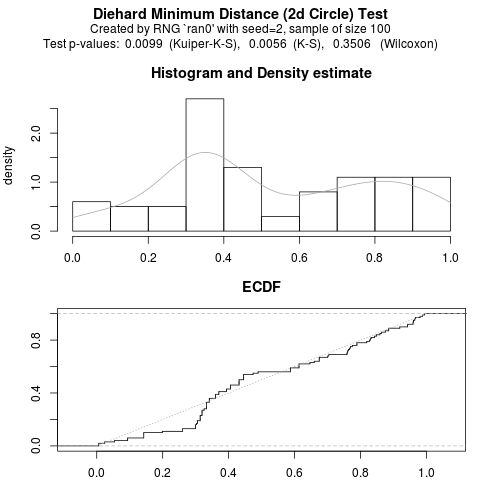
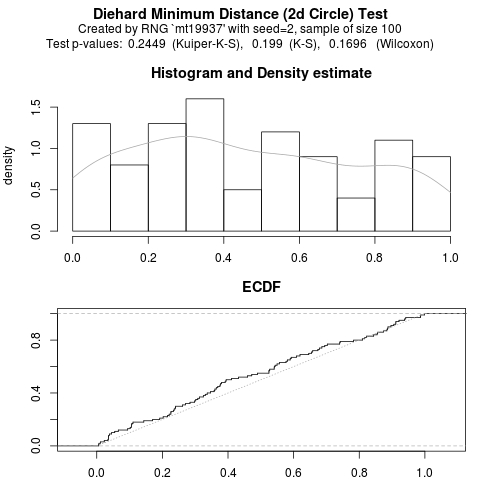
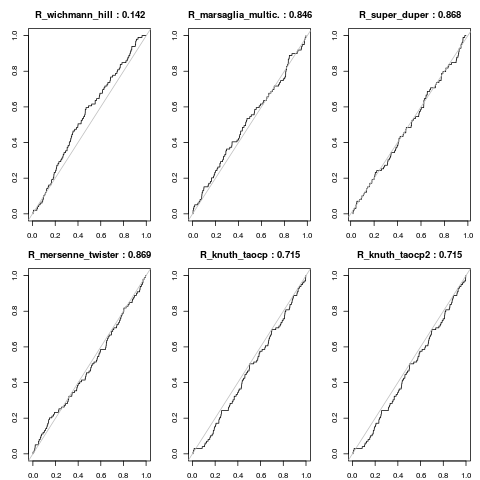
RDieHarder is an R package providing access to the DieHarder battery of tests for random number generators developed by Robert G. Brown and others. DieHarder had been updated to version 3.1.1 a while back, and I had been a little behind with updating RDieHarder. Version 0.1.2 rectifies this. The package still comes with a vignette describing both DieHarder and the RDieHarder package. And because pictures speak louder than a thousand (blogged) words, here is the first chart from the vignette: RDieHarder test of weak RNG RDieHarder test of stronger RNG On the left, we have a poor random-number generator (RNG), the older ran0 function. The histogram illustrating the distribution of test scores is somewhat uneven. An ideal (and asymptotic) outcode is a uniform distribution of p-values from the test. The empirical cumulative distribution function (ECDF) below indicates a somewhat pronounced departure from the diagonal. Informally speaking, this is what the (Kuiper-)Kolmogorov-Smirnov test quantifies, and we see (in the text in the chart) that the null of can be rejected an conventional levels. Based on this example (which had a short run-time with few samples) we would indeed mistrust this (known bad) RNG. On the right, we have a more recent and trusted RNG, the well-known Mersenne Twister. The ten histogram buckets are all closer to the expected value of one-tenth, the estimated density is closer to flat, the ECDF is closer to the diagonal and the tests don't reject---so no reason to mistrust this RNG based on this test alone. RDieHarder lets you run a battery of such tests against a boatload of known RNGs. Here is a second example, comparing the six RNGs built into R itself: RDieHarder test of RNGs in GNU R And these six look fine, as you'd expect. (And yes, the ECDF charts should each be on a square plot. Another time...) Courtesy of CRANberries, there is also a diffstat report for 0.1.2 relative to the older 0.1.1 release. More detailed information is on the RDieHarder page.

Martin F. Krafft: Mouse on Mars

The atmosphere in Munich s Backstage Werk just before the opening act to the Mouse on Mars was very chilled. People sat on the stairs or scattered themselves over the dance floor while low-fi ambient tunes came from the speakers. It wasn t loud, you had to try hard to hear the people mumble. I have no idea who the opening act was, and their first tune was very nice and groovy. Then ensued a noise explosion, one could only pity the electronic equipment that was being asked to perform in ways that may be described as everything else than you expect , and of course, the base beat shook the building; I am quite sure they didn t use treble at all, but I may also simply have been unable to hear it. Plus, it seemed to us that the musicians catered for what may be a widespread decrease of attention span: it was noticable how they jumped from one thing to the next, not leaving them (or their listeners) any time to get in the groove. My brother and I went outside for a bit and talked about today s music and its simplicity. We postulated the repetitiveness as the basis of a mass movement, considered scene clubs that played heavy techno to an audience that is so entirely different to who historically frequented such musical performances, and in general tried to avoid assuming a position between simplifying society and accepting that individual freedom is as eclectic as can be. When MoM opened, they continued pretty much in line with their openers and half way through the first tune, I started to wonder how long I would last, or when it would be reasonable to step outside again. I had been a little afraid this would happen, having bought and listened to their latest album Parastrophics in preparation of the concert and not being able to get into it. However, what then followed blew us away. Still heavy, still all over the place, but now they were developing sound scenes, ripping them apart, having fun playing with and teasing the audience, while putting on a groove that inevitably made your muscles twitch with the beat. David Bowie called MoM the next big thing and I have to give it to them: MoM have always had a certain aura of that s what your music is like? we can improve on that! to them, and yesterday, they continued along those lines with astounding consistency, and it felt fresh. It also felt real. They weren t just pushing buttons and computers making music, they were making music and the computers were their instruments. Between the two founding members of MoM sat Dodo Nkishi, drummer and microphone artist, and if you don t believe, fast, big breakbeat can be performed live, well, you re wrong. Most everyone in the room was dancing. And while I was more swaying in awe, watching and wondering how the heck they are doing what they are doing, I couldn t contain the bouncing any longer. They came back for an encore and there was no more stopping the crowd, Thomas or me. Three tracks later, they waved goodbye and left, but a bunch of us simply continued to dance. Thomas questioned who would last longer and I started yelling loudly for another encore. The lights turned on, I considered it a slap in the face, but I did not stop yelling. Others tuned in. And then the lights went off and the band came back. Following their 2.5 hour show, gosh was I exhausted. It was a magnificent show. If you aren t afraid of big beat electronica and you take pleasure in nonstandard art, I heartily recommend you ensure that MoM aren t soon playing near you without you there. PS: MoM will play at the (D sseldorf Open-Source Festival)[http://www.open-source-festival.de/en/] on 30 June 2012! PPS: Now I listen to Parastrophics and I am really enjoying it. NP: Mouse on Mars: Parastrophics

12 April 2012

Andrew Cater: Raspberry Pi credit card computer - first two thousand shipping

RS and Farnell have started contacting the first wave of customers: some of the first Raspberry Pi boards will be shipping tomorrow and over the weekend.

Similarly, the two distribution companies are ramping up for constant rolling production and mass volume shipping.

Raspberry Pi post

[Courtesy www.raspberrypi.org - Raspberry Pi is a trademark of the Raspberry Pi foundation which is a registered charity in the UK]

11 April 2012

Tim Retout: Weekend of change

Agile processes harness change for the customer's competitive advantage. Principles behind the Agile Manifesto
After two and a half years at Smoothwall, I'm moving on - Friday is my last day. Since I joined the development team, we have adopted Agile development, set up a pretty nifty Gerrit/Jenkins code review + integration system, and introduced dpkg for package management. Along the way, I helped with a bunch of important features for the business, like a ground-up rewrite of the web filter, and time-based browsing usage quotas. I will be starting at CV-Library on Monday, for a whole new set of challenges. They're based in Fleet, so I'll have an hour-long commute each way on the train. I've been assured by an expert in these matters that facilitating wage slavery is a comparatively more ethical pursuit than facilitating internet censorship. :) To make the commute somewhat more bearable, I'm moving house on Saturday. So far, the packing's going quite well...

Erich Schubert: Are likes still worth anything?

When Facebook became "the next big thing", you had the "like" buttons pop up on various web sites. An of course "going viral" was the big thing everybody talked about, in particular SEO experts (or those that would like to be that).
But things have changed. In particular Facebook has. In the beginning, any "like" would be announced in the newsfeed to all your friends. This was what allowed likes to go viral, when your friends re-liked the link. This is what made it attractive to have like buttons on your web pages. (Note that I'm not referring to "likes" of a single Facebook post; they are something quite different!)
Once that everybody "knew" how important this was, everbody tried to make the most out of it. In particular scammers, viruses and SEO people. Every other day, some clickjacking application would flood Facebook with likes. Every backwater website was trying to get more audience by getting "liked". But at some point Facebook just stopped showing "likes". This is not bad. It is the obvious reaction when people get too annoyed by the constant "like spam". Facebook had to put an end to this.

But now that a "like" is pretty much worthless (in my opinion). Still, many people following "SEO Tutorials" are all crazy about likes. Instead, we should reconsider whether we really want to slow down our site loading by having like buttons on every page. A like button is not as lightweight as you might think it is. It's a complex JavaScript that tries to detect clickjacking attacks, and in fact invades your users' privacy, up to the point where for example in Germany it may even be illegal to use the Facebook like button on a web site.
In a few months, the SEO people will realize that the "like"s are a fad now, and will likely all try to jump the Google+ bandwagon. Google+ is probably not half as much a "dud" as many think it is (because their friends are still on Facebook and because you cannot scribble birthday wishes on a wall in Google+). The point is that Google can actually use the "+1" likes to improve everyday search results. Google for something a friend liked, and it will show up higher in the search results, and Google will show the friend who recommended it. Facebook cannot do this, because it is not a search engine (well, you can use it for searching people, although Ark probably is better at this, and one does nowhere search as many people as one does regular web searches). Unless they go into a strong partnership with Microsoft Bing or Yahoo, the "like"s can never be as important as Google "+1" likes. So don't underestimate the Google+ strategy on the long run.
There are more points where Facebook by now is much less useful as it used to be. For example event invitations. When Facebook was in full growth, you could essentially invite all your friends to your events. You could also use lists to organize your friends, and invite only the appropriate subset, if you cared enough. The problem again was: nobody cared enough. Everybody would just invite all their friends, and you would end up getting "invitation spam" several times a day. So again Facebook had to change and limit the invitation capabilities. You can no longer invite all, or even just all on one particular list. There are some tools and tricks that can work around this to some extend, but once everybody uses that, Facebook will just have to cut it down even further.
Similarly, you might remember "superpoke" and all the "gift" applications. Facebook (and the app makers) probably made a fortune on them with premium pokes and gifts. But then this too reached a level that started to annoy the users, so they had to cut down the ability of applications to post to walls. And boom, this segment essentially imploded. I havn't seen numbers on Facebook gaming, and I figure that by doing some special setup for the games Facebook managed to keep them somewhat happy. But many will remember the time when the newsfeed would be full of Farmville and Mafia Wars crap ... it just does no longer work this way.

So when working with Facebook and such, you really need to be on the move. Right now it seems that groups and applications are more useful to get that viral dream going. A couple of apps such as Yahoo currently require you to install their app (which then may post to your wall on your behalf and get your personal information!) to follow a link shared this way, and then can actively encourage you to reshare. And messages sent to a "Facebook group" are more likely to reach people that aren't direct friends of yours. When friends actually "join" an event, this is currently showing up in the news feed. But all of this can change with 0 days notice.
It will be interesting to see if Facebook can on the long run keep up with Googles ability to integrate the +1 likes into search results. It probably takes just a few success stories in the SEO community to become the "next big thing" in SEO to get +1 instead of Facebook likes. Then Google just has to wait for them to virally spread +1 adoption. Google can wait - its Google Plus growth rates aren't bad, and they have a working business model already that doesn't rely on the extra growth - they are big already and make good profits.
Facebook however is walking on a surprisingly thin line. They need a tight control on the amount of data shared (which is probably why they try to do this with "magic"). People don't want to have the impression that Facebook is hiding something from them (although it is in fact suppressing a huge part of your friends activity!), but they also don't want to get all this data spammed onto them. And in particular, it needs to give the web publishers and app developers the right amount of that extra access to the users, while in turn keeping the major spam away from the users.

Independent of the technology and actual products, it will be really interesting to see if we manage to find some way to keep the balance in "social" one-to-many communication right. It's not a fault of Facebook that many people "spam" all their friends with all their "data". Googles Circles probably isn't the final answer either. The reason why email still works rather well was probably because it makes one-to-one communication easier than one-to-many, because it isn't realtime, and because people expect you to put enough effort into composing your mails and choosing the right receipients for the message. Current "social" communication is pretty much posting everything to everyone you know adressed as "to whoever it may concern". Much of it is in fact pretty non-personal or even non-social. We have definitely reached the point where more data is shared than is being read. Twitter is probably the most extreme example of a "write-only" medium. The average number a tweet is read by a human except the original poster must be way below 1, and definitely much less than the average number of "followers".
So in the end, the answer may actually be a good automatic address book, with automatic groups and rich clients, to enable everybody to easily use email more efficiently. On the other hand, separting "serious" communication from "entertainment" communication may be well worth having a separate communications channel, and email definitely is dated and is having spam problems.

Lars Wirzenius: Earth 2.0 by Soile Mottisenkangas

Soile made a short film, Earth 2.0 last week, for a film camp thing here in Manchester. It was all done in a couple of days. <iframe allowfullscreen="allowFullScreen" frameborder="0" height="225" mozallowfullscreen="mozallowfullscreen" src="http://player.vimeo.com/video/39984765?title=0&amp;byline=0&amp;portrait=0" webkitallowfullscreen="webkitAllowFullScreen" width="400"></iframe> Earth 2.0 from Soile Mottisenkangas on Vimeo. She's also set up a cafepress shop for those who want to support her filmmaking.

10 April 2012

MJ Ray: DLT is better than CAPTCHA

Stop using CAPTCHAs. It s time to switch to DLT: Design, Limit and Trapdoor.
[a certain website] has the evil bad wrong Google reCaptcha on the edit page to stop disabled users, so screw it. Google s reCaptcha seems to be spreading again, obstructing more people when accessing more websites. Is there a reason for that? The re in reCaptcha stands for replace with real anti-spam, please!
I wrote the above about two years ago and it s not getting any better. I ve written similar things over the last ten years, as have many others, and I ve always sought to avoid using physical ability tests as a way to cut down spammers. Why do people keep reaching for the reCaptcha non-captcha or things that use similar bad eyetests like Mollom? So most online messages may be spam, but those physical ability tests do nothing to test for spam. They re trying to detect computer submissions (the TCHA in CAPTCHA is meant to be Telling Computers and Humans Apart), but that s really bad when the computer is helping someone with a disability to access the internet. People from the home of the CAPTCHA describe access for sight and hearing-impaired users as an important open problem for the project (Luis von Ahn, Manuel Blum and John Langford. Telling Humans and Computers Apart Automatically. In Communications of the ACM). Until that problem is closed, CAPTCHAs should be considered defective and removed whenever possible. What webmasters should do instead is DLT:
  1. Design it well: Set up sites so the spammers cannot get a quick win in the first place. Configure permissions and things like that so people have to do some work before they are trusted to post links. This is similar to the basic theory behind my Open Activism paper Fighting in the Shadows. This is much easier to do if the system is Free and Open Source Software (FOSS), too.
  2. Limit the damage: include rate limits to stop one person causing you lots of work: even with computer-assistance, few people need to post 10 forum messages every minute. Join up in co-operative anti-spam networks like blogspam.net so if they hurt you, others can see them coming. Again, it s easier to hook into a network if you re using FOSS.
  3. Trapdoor: keep a way for people to contact you if they are really blocked by your design decisions and limitation and keep a way to exempt them from the limits if needed. Make it welcoming because disabled users are tired of reporting barriers to webmasters who don t care and will never fix the web. A good multi-step eyetest-free contact form is a basic way to do this.
Have you tried this? Have your experiences been as good as our co-op s? Are there sites you don t think it would work for? A comments form is on the original of this article, as ever.

Next.

Previous.