Search Results: "ema"

9 November 2008

Simon McVittie: Encrypted root filesystem on a Debian laptop

I've been meaning to document this for ages... My laptop is set up with an encrypted root filesystem using LVM and dmcrypt. It also has a small Debian stable system for recovery purposes (I don't have a CD drive, so if everything goes horribly wrong, I can't just boot from a live CD). Here's how to set up something similar:

Step 1. Set up the recovery system Start the Debian lenny (beta) installer as usual. (I originally used etch, but these instructions are for lenny - either should work.) When you get to "Partition disks", choose "Manual". Here's the partitioning scheme to use:
  • main partition for LVM, taking up the whole disk minus 1GB or so. select "Do not use", for now
  • 1GB recovery partition at the end of the disk (this will also be the main system's /boot, since /boot needs to be unencrypted anyway). Use the defaults: ext3 mounted at /.
Finish partitioning and write changes to disk, and wait for the base system to install. Say yes to installing Grub to the MBR for now (it might be possible to do the install more cleanly by installing Grub to the recovery partition's boot sector instead - I haven't tested that). Reboot into the freshly installed recovery system and satisfy yourself that it works.

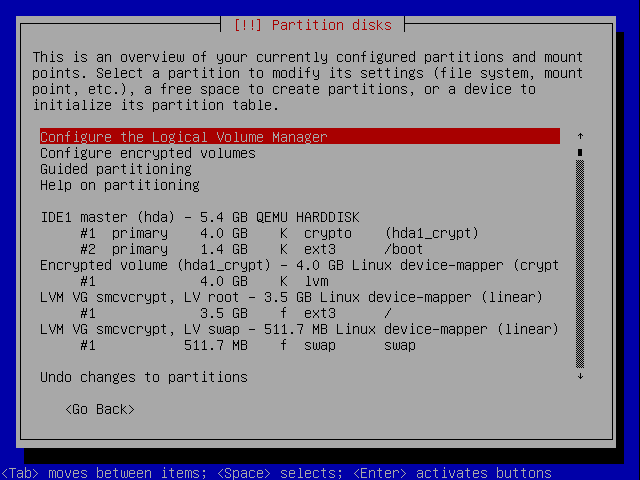
Step 2. Set up the main system Now boot the Debian installer again. This time it's for your installed system. At the "Partition disks" stage, choose "Manual" again. Select the main partition and choose "Use as: physical volume for encryption". Next select "Configure encrypted volumes". Your main partition will now be randomized - this is slow - and some time later you'll be asked for a passphrase. You'll have to type this in at each boot. Select the contents of the "disk" Encrypted volume (hda1_crypt) and choose Use as: physical volume for LVM. Now "Configure the Logical Volume Manager" and create a Volume Group. I always use the laptop's hostname as the VG name (this reduces confusion if you ever plug the disk into another machine for disaster recovery). Create a Logical Volume called swap, the size you want your swap space to be. If you plan to use suspend-to-disk, this needs to be at least as large as your RAM. Create a Logical Volume called root, for the root filesystem. If you want separate "partitions" for things like /home, now is a good time to create them too; if you want to use my schroot howto, leave some unallocated space in the VG for that. Set your swap LV to be used as a swap area, and your root LV to be used as ext3 mounted at /. If you wanted extra LVs, set them up too. Also set your recovery partition to be used as ext3, mounted on /boot, and not reformatted. It should now look something like this (smcvcrypt is the name of a KVM virtual machine in which I've been testing these instructions, normally you'd have the laptop's hostname there). Screenshot from d-i Proceed with the installation. Install Grub to the MBR - this will temporarily make the recovery system unbootable, but shrug never mind. Finish the installation and reboot into your new main system.

Step 3. Make them dual-boot Within the main system your recovery system is also visible, at /boot. Bind-mount /dev onto /boot/dev, chroot into /boot, and run "update-grub /dev/hda2", where hda2 is the partition where the recovery partition is. Leave the chroot. Edit /boot/grub/menu.lst and put this right at the end:
title Go to recovery system
root (hd0,1)
chainloader +1
(Replace (hd0,1) with what Grub thinks the recovery partition is - the second number is the partition number starting from 0, so /dev/hda5 would be (hd0,4) and so on.) Also edit /boot/boot/grub/menu.lst and put this right at the end:
title Back to main system
root (hd0)
chainloader +1
Also, still in /boot/boot/grub/menu.lst, go to the top of the file and change the colour scheme to something else (I used a red background) to indicate that this boot menu is for the recovery system. Reboot and try it out. You should now have an extra boot menu option, "Recovery system". Selecting it will switch to the recovery system's boot menu, which has an option to switch back, and so on. Each boot menu also has some entries for kernels, any of which will boot with the appropriate root filesystem (encrypted root for the main system, unencrypted for the recovery system). Success!

8 November 2008

Steve McIntyre: 3rd Free Software Congress in Valencia

I spent much of this week in Alicante. It was wonderful to have a few days away from the beginnings of Winter in Cambridge - Alicante's in South West Spain, right on the Mediterranean. It's a lovely city, although it was very quiet due to the time of year. I was invited down to Alicante by organisers of the Congr s de Programari Lliure, Comunitat Valenciana, to present a talk about Debian. That I did, and as always my slides and photos are available in case people are interested. I wasn't too sure about what level to aim the talk, so I deliberately went for a general introduction to Debian. That seems to have been the correct level - nobody threw anything at me, and nobody was visibly falling asleep. *grin* It's also the first time I've ever given a talk with official translators, which is a weird experience! The main topic for the conference was the new release of Lliurex, Valencia's own GNU/Linux distribution targeted primarily at use in schools. The conference was massive; I was told there were about 1500 attendees in all, most of whom were teachers who wanted to come and learn more about Free Software. There was a good spread of talks and workshops, covering topics from development through to deployment in the classroom. The level of enthusiasm for Free Software here was immense - lots of people were keen to learn more about it and get involved. I was told that out of the 15 regions/states of Spain, 11 of them have now started their own distributions to use in schools! Extremadura were the first region to experiment with Free Software like this, and their success with LinEx was a clear inspiration to their neighbours elsewhere in Spain. As well as the obvious cost advantages of moving from proprietary to Free Software, the local governments also love the freedom to use and modify their software however they like - including the ability to provide their own translations. Conference welcome I met up with a lot of cool people at the conference too. The local education minister (Alejandro Font de Mora) was keen to talk with all the speakers and very enthusiastic about the future of Free Software in his schools. As is increasingly common at FS events around the world, there were of course quite a few Debian people around too. Luciano and Miriam were also giving talks, and I bumped into Rene and Miguel and a whole bunch of others whose names I'm too crap to remember - sorry! I also spoke a lot with Kurt Gramlich, the mega-enthusiastic Skolelinux developer who was also happy to push Debian to everybody he spoke to *grin*. Jon "Maddog" Hall had some excellent ideas that I'm sure we'll all hear more about soon, and his talk was excellent. He did a very good job of explaining how Free Software makes such a difference, including how it helps people to make money. He also explained that due to travel he had missed Halloween at home and he wanted to share the experience of scary masks with the people at the conference: Maddog Bush I had a great time in Alicante, and I'm very grateful for the invitation to go there. I wish that the UK was as far as advanced as Spain in the use of Free Software in education - they've done a huge amount of good work in this area and I'm glad we can help them.

7 November 2008

Axel Beckert: e-mail.is-not-s.ms

When I first read http://two.sentenc.es/ in (if I remember correctly) madduck’s signature, I thought something like “This can’t be! Why are people castrating themself?” Although I really understand that the inventor has good reasons for such a personal policy, I notice how much time I waste by trying to fit all the information I want to transmit in the 160 characters a short messages allows — or, even worse, into the 140 characters microblogging services like identi.ca or Twitter allow. So I had to oppose something to this, but even to only reach the coolness level of the domain “sentenc.es” is hard, you probably can’t top it at all. For luck, I’m not alone and Venty had the right idea for a hostname which has at least some geeky niveau. So here it is, our pleading for e-mails as long and detailed as necessary:

http://e-mail.is-not-s.ms/ A German version will be available soon at http://e-mail.ist-nicht-s.ms/. Feel free to add either URL to your e-mail signature. :-) Oh, and thanks to the Government of Montserrat which allows strangers to register .ms domains without any hassles. :-) Update / FAQ Seems to be necessary to make a few things clear…

  1. No, I do not think that everyone using two.sentenc.es has neither style nor knows anything about grammar or punctuation. What I say is that the site two.sentenc.es itself with its comparision to short messages (and especially without reading the author’s blog post about the site’s background) indirectly suggests to drop grammar, punctuation and style by cramming all information into a limit number of characters as often done with short messages or microblogging. And the limitation in senctences leads to tapeworm sentences which I try to avoid since they’re considered bad style, too.
  2. And yes, it’s consciously written and designed to be the opposite of two.sentenc.es — even the colors and the font — and therefore is of course very close to the original. See it as it parody or satire if the closeness makes you angry.
  3. And no, I currently don’t care if the site makes less sense if you don’t know two.sentenc.es — people usually can follow hyperlinks on websites.
  4. We weren’t the first ones who noticed that e-mail is not SMS. An example of the problem described above from 2001.

6 November 2008

Martin-Éric Racine: Available for a new job

A couple of years ago, I started what has probably been the best job I've held so far, as a Business Development Manager for Artec Group where I focused on marketing and selling the ThinCan LTSP client. During that time, I used a combination of Guerrilla Marketing techniques to spread the word about this cool Estonian embedded platform in its LTSP client configuration and defined an extremely tight market-oriented focus that saw this relatively obscure electronic design start-up rise to the forefront of the LTSP hardware market and also brought the company commendable notoriety in the Coreboot community, thanks to its Programmable LPC Dongle, a low-cost ROM emulator that can be used to bootstrap various embedded hardware and test firmware images. Looking back at close to 3 years with Artec (if we include the stint I did at Linutop), I most fondly remember how I managed to bring the Estonian and Turkish nations closer together in collaborating on Innovation. On my first visit to Turkey, I had noticed that very little is know about Estonia in Turkey, even though both countries have a collaboration that dates back to the 1920's, so my tactic was to introduce Estonia's achievements as a whole, to establish confidence in Artec's offering. It worked: Among other things, my idea to organize an Estonian ICT Conference during the visit of Estonian PM Andrus Ansip in Turkey created a lot of extremely positive buzz that resulted in Estonia being mentioned as a trendy country in a prime time Turkish TV series. During this time, I've also made a lot of contacts among the Estonian and Turkish business communities and, more surprisingly, among the Estonian diplomacy who, much to my amazement, welcomed my ideas for better promoting Estonian interests abroad with great enthusiasm. Come December 2008, my time at Artec will become a page in my employment history. While the Thincan remains one of Artec's key products, current marketing and sales resources are focused on new markets and new technologies that completely fall outside my core expertise, which is why the company decided to let me go. I thus welcome offers from interested parties in Coreboot or LTSP markets. Other refreshing offers from outside the box - such as in business diplomacy - are equally welcome, as I've been pondering a career change for a long time.

Eddy Petrișor: Coordinating localization via git

Note: this is quite long and might not be interesting for people not involved with /in either of: debian i18n, debian l10n, git, shell scripting.


For some time now I have been the de-facto coordinator of the Romanian localization team. During this time I was faced multiple times with problems related to motivation of the team members, setting goals for a release, coordination of the changes inside the team, integration of new translators in the team, loosing team members, my lack of time on some occasions and other problems.

I thought a lot about how to improve on those points and I was never satisfied with the answers I got. What I think was the worst problem in the team was the inability to set clear goals, especially during lenny's development cycle.

During sarge's and etch's development cycles we were in an infancy state and setting as the goal to have a fully translated installation process was really enough to keep people motivated. For sarge we missed by a small margin, but the translations were of poor quality, while for etch we worked more on improving the translations.


But during lenny it was bad, really bad. My free time had been shrinking for a while, starting with etch's release, and we were unable to set clear goal, since for etch we managed to have the installation process fully translated and a few other translations. There was no way for us to reach 100% translations during lenny's development cycle, so setting that as a goal was really unrealistic. Percents by themselves don't mean anything for people, and as long as there's no substance to those numbers, there's no motivation to reach for one arbitrary percent.

I tried to set as a goal translating the packages installed by default in a new installation, but that hit the eternal question How do we know easily which are those packages?. This remained sometimes unanswered or got an unsatisfying answer. Also, there was a goal to have correct diacritics for Romanian in lenny, to have aspell-ro that uses the correct diacritics.

I even got to a point that I, myself, lost my motivation and set myself a personal goal of overrunning the level the translations that the language just above Romanian had in the po-debconf l10n statistics (ranking between languages). This was nice way for me to keep myself motivated, but I had my reserves in making this motivation public out of fear of being misinterpreted, because, by a strange coincidence, that next language was Hungarian, and in Romania's history there was some friction between Hungaria and Romania, while there are still some tensions with the Hungarian minority in Romania, in areas where they represent the local majority.

I managed to reach my personal goal, but this wasn't addressing the big picture.


So, sometime around the start of this year I started thinking about ways to coordinate the Romanian localization team in order to have:
For short, a tool that would allow the team to work more efficiently while having the possibility to set clear goals in order to keep people motivated.


So after some pondering, I thought that creating a repository with the translations and the helper tools that would do the funky sync, checks, stats would be the best way to do that. So I started hacking on that somewhere around July-August and I published the result, but without much publicity, since it is still incomplete.

Some of the technical details are still in a haze, but I have a general idea and I got some basic functionality.


Today I decided that I should announce this semi-officially though my blog, maybe I get some input, ideas, or even contributions (I really should write a TODO).


I give you the Debian L10n Romanian coordination repository.

This is a git repository that has some tools to facilitate translation coordination and the translations that are current in the distro for the team.


Can be cloned with:

git clone git://git.debian.org/git/users/eddyp-guest/debian-ro-repo.git

or, if you're behind a restrictive firewall:

git clone http://git.debian.org/git/users/eddyp-guest/debian-ro-repo.git


Currently the work flow for updating a translation is as follows:
  1. source _bin/polibs (. _bin/polibs)
  2. cd foo
  3. po_refresh
  4. complete the translation
  5. po_rearrange "ro.po"
  6. git add "ro.po" && git commit -m "updated translation for foo"
  7. send the translation ("git format-patch origin" and send the patches by mail, or, alternatively, just "git push")


Features:
Planned features:

Problems:

I was hoping that the release notes for lenny would facilitate from this infrastructure, but unfortunately I was lately in a really inactive period wrt Debian.


Questions, suggestions, ideas are welcome.

Martin Michlmayr: European Commission publishes guidelines on the procurement of FOSS

The Open Source Repository and Observatory (OSOR), a new site sponsored by the European Commission to foster the exchange of FOSS related information and software among European public administrations, recently published guidelines on the procurement of open source software. Public administrations in Europe have to follow public tender procedures and the new guidelines give practical and legal advice on how open source software and related services can be incorporated into the procurement process. Rishab Ghosh, who presented the guidelines at the Open Source World Conference in Malaga, argued that the procurement guidelines were needed because of two reasons. First, they studied recent tenders and found that many explicitly mentioned proprietary applications. 16% of 3615 software tenders explicitly asked for products from top 10 software vendors, such as Microsoft, SAP and Oracle. This practice may be illegal because public tenders generally have to describe functional requirements in a general way instead of specifying specific products. Second, many public administrations don't have any experience with the procurement of FOSS. In fact, they often don't know whether or under which circumstances they are allowed to adopt and ask for FOSS solutions. The guidelines are specifically designed in order to clearly and simply explain how public administrations can acquire open source and they don't assume that a country has adopted a specific policy regarding open source. The guidelines include a long section about open standards, open source and how they relate. Both open standards and open source align very well with the needs of public administrations who have an "obligation to support interoperability, transparency and flexibility, as well as economical use of public funds". The guidelines argue that the exit cost, i.e. the cost incurred in moving to another IT system, is also an important consideration but one that is often neglected. The adoption of a proprietary solution without open standards may limit the future choice, thereby increasing the long-time costs and giving the proprietary vendor an unfair advantage in future tenders. The procurement guidelines describe two ways of acquiring FOSS: it is possible to go the usual route of publishing a tender for the supply of software (possibly with related services). However, in the case of FOSS, it is also possible to download the software directly from the Internet. This is possible because the software is not only free of charge but comes with no contractual obligations. If there were any obligations involved with the download (such as fees, the agreement to an EULA or the requirement to purchase services in the future), software download is not an allowed method. What I like about the guidelines is that they explicitly say that downloading software has to be part of the formal procurement process. You have to think about your requirements, look at various alternatives, and so on, and not just blindly download something from the Internet. When it comes to the procurement of FOSS, the guidelines don't suggest that tenders should explicitly ask for FOSS. Instead, they should describe the functional requirements of the software as well as certain properties. For example, a tender could specify that the public administration as well as third parties must have the right to study, distribute and modify the software. In a sense, the guidelines suggest that tenders should include the principles of the Free Software Definition along with justifications for these requirements. Personally, I think there is a great need for these procurement guidelines. There are many public administrations that don't know how to acquire FOSS and these guidelines offer clear advice. Furthermore, I find the guidelines very balanced. They don't recommend that you should always ask for FOSS but incorporate FOSS principles into tenders where it makes sense. It remains to be seen whether the procurement guidelines will have an impact on the FOSS adoption in Europe, but I surely hope so. (Originally published on FOSSBazaar)

5 November 2008

Decklin Foster: Hello America, I missed you

As we walked back toward Mass Ave to catch the bus last night, fresh from the euphoria of my friend Josef's election-night party, I thought about how fortunate we are to be here, now. We cheered, we screamed, we sang the national anthem at the top of our lungs, popped champagne, and danced. I'm on some stranger's facebook somewhere, at the edge of a crowd of people smiling for what felt like the first time in years. I knew I'd remember, but I wanted to write something down. I'd been following along on Twitter all night, but I didn't know what to say when the good news finally came. I thought about our friends in California, where Prop 8 looked like it was going to win. Despite how far we've come, it's likely three states are about to write discrimination into their laws or constitutions rather than out of them. So I picked up my phone and just typed in, "charged." Everyone was excited, yes. I haven't felt electrified by the possibility of change like that in a very long time. But we also haven't automatically won change by changing our leaders. We have won a responsibility to make that change happen. "Yes we did", we joked to each other, and I emailed to my parents in the morning. But no one actually meant, "yes we can win an election". That's just the starting line. Now, we are charged with making America better. We are charged with protecting the liberties of everyone. I wanted to remember that too. That's why it matters that we won. Eight years from now, this could be a nation where the whole idea of "banning gay marriage" sounds as antiquated and offensive as segregated schools or not letting women vote. We have the ability to change our culture, nothing more. Mandates don't do that; people do. And yes, we can.

4 November 2008

Jaldhar Vyas: Oops!

Well That wasn't supposed to happen. But it did so nothing remains but to congratulate the victors and prepare for the next round. People seem to think I ought to be more upset about this but I'm not. While I'm sure there will be a round of recriminations or two, McCain-Palin gave it as good a shot as they were going to do under the circumstances so there's really no point in wondering about what might have been.

Russell Coker: Support Gay Marriage in case You Become Gay

A common idea among the less educated people who call themselves “conservative” seems to be that they should oppose tax cuts for themselves and support tax cuts for the rich because they might become rich and they want to prepare for that possibility. The US census data [1] shows that less than 1% of males aged 15+ earn $250K. For females it’s less than 0.2%. On the Wikipedia page about homosexuality [2] it is claimed that 2%-7% of the population are gay (and 12% of Norwegians have at least tried it out). Apparently homosexuality can strike suddenly, you never know when a right-wing politician or preacher will suddenly and unexpectedly be compelled to hire gay whores (as Ted Haggard [3] did) or come out of the closet (as Jim Kolbe [4] did). So it seems that based on percentages you are more likely to become gay than to become rich. So it would be prudent to prepare for that possibility and lobby for gay marriage in case your sexual preference ever changes. But on a serious note, of the people who earn $250K or more (an income level that has been suggested for higher tax rates) there will be a great correlation between the amount of education and the early start to a career. Go to a good university and earn more than the median income in your first job, and you will be well on track to earning $250K. A common misconception is that someone who has not had a great education can still be successful by starting their own company. While there are a few people who have done that, the vast majority of small companies fail in the first few years. Working hard doesn’t guarantee success, for a company to succeed you need to have the right product at the right time - this often depends on factors that you can’t predict (such as the general state of the economy and any new products released by larger companies).

Jeff Bailey: Watching an election go by...

Tomorrow I get the joy of watching an election go by that I can't participate in. I think Sen. Obama doesn't need one more voice from me at this point, but let's look at the California propositions:

Prop 1A - High speed rail. California really needs something like this. In fact, the whole US does, and maybe they'll get it once California shows that trains really can work on this side of the Atlantic.

Prop 2 - Increasing the sizes of cages for confined farm animals. I admit that I actually don't much care about this one either. I'd probably vote yet on it, but a cage is still a cage. =(

Prop 3 - Funding Children's hospitals. Uhhh. Why does this take a ballot measure? I'd do this one. Especially if it were seen as a path to the socialisation of health care.

Prop 4 - Parental notification before termination of pregnancy. Sounds like a great way to have more teen moms dead in back alleys. People either get illegal abortions or legal ones. Legal ones are much safer. This is a no-brainer for a no. If you think the incidence rate of abortions in teens is too high, fund some sex ed.

Prop 5 - Drug treatment facilities, good. Easier parole for drug-related offenses probably also good. Increased parole for serious and violent felonies? It's not clear to me that there's an actual problem here to solve. Is there really a problem with repeat offenders here that is going to be solved by this? I'd probably skip this one because there just isn't enough info.

Prop 6 - A bunch of gang related funding and such. It seems to me that if the legislature thought this was a real problem, they'd have solved it. The US already spends a stupid amount on policing, with the result of a lot of people in jail, and seemingly not alot of reduction in crime. Sounds like throwing good money after bad, then. I'd say no.

Prop 7 - Require utilities to focus on renewable energy. My electric company is already ~50% renewable according to their pamphlets. They also already are introducing smart meters, remote power cuts for air conditioning units, and have an offset program that isn't just cutting down trees. From what I understand, getting more than what they do is problematic because of reliability of supply. I don't think legislation will solve that. This legislation is probably too soon, sadly. A reluctant no from me here.

Prop 8 - A bill to remove existing rights from citizens. If you don't know my opinion on this one, you're clearly just tuning in. "no". It did occur to me today that what people should've been doing was trying to muddy the issue and put up billboards that said "In Defense of Marriage, No on prop 8". Because I really think that a yes here lessens the value of my marriage - it means that I'll be sharing in something I can't in turn wish for everyone else. And that would be sad.

Prop 9 - Victims rights bill. I wish there were more background on this site. It's not clear that there's a problem here that people are solving. A criminal sentence is supposed to be society's version of just punishment. Just because you personally still feel like crap doesn't mean that the punishment wasn't served. I don't see what relationship a person getting out of jail has to the victim at that point either than staying away from one another. No here.

Prop 10 - Funding for alternative fuels. I'm thinking back to "Who killed the electric car?" We're not doing what we can with the technology we already have. It would've been nice to perhaps see the old requirements kicked by in of a certain amount of cars having to be zero-emission or something like that now that we *know* we can do it. There are lots of electric car options now. I'd say no here.

Prop 11 - Redistricting. Nice to see that this includes people who belong to neither party in the requirements makeup. Taking the districts out of the hands of the representatives is probably a good idea. I hope the committee will opt to do something sane like simple cluster diagrams or something. I was talking with some folks at work about polling station finding and stuff, and it sounds really miserable.

Prop 12 - Veteran's bonds. Umm, sure? Are vets particularly hard hit by the current economic crisis? It seems odd to single them out. But the US has a culture of celebrating veterans that I've never understood. At home I suspect most people just don't know any. As opposed to a pile of their schoolmates *being* veterans.

Wow. That was exhausting. Do you guys have to do this every time you go to the polls?

3 November 2008

Enrico Zini: rc-buggy packages sorted by popularity

rc-buggy packages sorted by popularity After doing a round of tag reviews so that we release lenny with the latest tag contributions, I still had a bit of spare time. Since people are urging to fix the last bugs I thought I could contribute a list of RC-buggy packages sorted by popularity:
#!/usr/bin/python
import urllib2
import sys, re #, gzip
PKGRE = re.compile(r'<strong>Package: </strong><a href="[^"]+" name="([^"]+)">')
POPCONRE = re.compile(r'^(\d+)\s+(\S+)')
PKGMAPRE = re.compile(r'^([^(]+)\(([^)]+)')
COMMASPLIT = re.compile(r'\s*,\s*')
# Allow to download other package views
if len(sys.argv) > 1:
    url = sys.argv[1]
else:
    url = "http://bts.turmzimmer.net/details.php"
def read_packages(url):
    "Download the list of rc-buggy packages"
    fd = urllib2.urlopen(url)
    for line in fd:
        mo = PKGRE.search(line)
        if mo:
            yield mo.group(1)
# FIXME: this is a deprecated data source, but at the moment it is just what
#        is needed
def read_bintosrc(url = "http://qa.debian.org/data/ddpo/results/ddpo_packages"):
    "Download the binary to source package map"
    fd = urllib2.urlopen(url)
    for line in fd:
        mo = PKGMAPRE.search(line)
        if mo:
            src = mo.group(1)
            bin = COMMASPLIT.split(mo.group(2))
            for p in bin:   
                yield p, src
def read_popcon(url = "http://popcon.debian.org/by_inst"):
    "Download popcon information"
    fd = urllib2.urlopen(url)
    # It doesn't work on urllib2 objects because it wants tell()
    #fd = gzip.GzipFile(fileobj=fd, filename=url, mode="rb")
    for line in fd:
        mo = POPCONRE.match(line)
        if mo:
            yield mo.group(2), int(mo.group(1))
print "Reading mapping of binary packages to source packages..."
bin2src = dict(read_bintosrc())
print "Reading popcon scores..."
# We actually want the score of source packages, and for it we use the score of
# its binary package with the highest score
scores = dict()
for pkg, score in read_popcon():
    pkg = bin2src.get(pkg, pkg)
    if pkg not in scores:
        scores[pkg] = score
#scores = dict(read_popcon("http://popcon.debian.org/by_inst.gz"))
print "Reading list of rc-buggy packages..."
# The bug page has a mix of source and binary packages: convert all to source
# packages
packages = sorted(read_packages(url), key=lambda x:scores.get(bin2src.get(x,x), 0))
for p in packages:
    print scores.get(bin2src.get(p,p), 0), p
This can be run on people.debian.org as ~enrico/popzimmer (0 is the rank of packages that for some reason cannot be mapped to any rank):
$ ~enrico/popzimmer 
Reading mapping of binary packages to source packages...
Reading popcon scores...
Reading list of rc-buggy packages...
0 roxen-fonts-iso8859-2
2 dpkg
11 pam
61 glibc
61 libc6
123 initramfs-tools
149 bind9
150 grub
180 portmap
213 nfs-common
279 libgl1-mesa-dri
298 libsnmp-base
298 snmpd
309 avahi
397 mysql-dfsg-5.0
408 xserver-xorg-input-wacom
409 xserver-xorg-video-vesa
428 docbook-xml
499 openoffice.org-core
567 xine-lib
600 evolution-data-server
669 eog
671 xserver-xorg-video-intel
691 epiphany-browser
691 epiphany-gecko
695 kdelibs4c2a
698 uswsusp
754 guile-1.6
959 gpm
964 cups
990 kdebase
1002 ghostscript
1069 giflib
1076 xulrunner-1.9
1177 libapache2-mod-perl2
1217 vlc-nox
1229 kernel-package
1311 kdeutils-dev
1520 libparted1.8-10
1767 wireshark
1785 selinux-policy-default
1908 dia
1943 htop
1983 boost
2140 cantlr
2145 transmission
2159 emacs22
2312 swfdec-mozilla
2449 eclipse
2449 libswt3.2-gtk-java
2728 lilo
2898 libnss-ldap
3013 java-access-bridge
3051 blender
3099 libtemplate-perl
3499 fglrx-atieventsd
3602 virtualbox-ose
3619 jfsutils
3806 anjuta
3962 kbuild
4076 libgnustep-gui0.14
4222 libwebkit-1.0-1
4332 rosegarden
4412 matplotlib
4412 python-matplotlib
4950 mail-notification-evolution
5195 nut-cgi
5273 sbcl
5538 ruby1.9
5679 kmymoney2
6076 websvn
6147 miro
6264 gnat-4.1
6431 gallery2
6478 gnome-chess
6512 joystick
6862 istanbul
6937 wordpress
7476 luatex
7635 csound
7635 python-csoundac
8257 libpam-mount
8471 wmcpuload
8631 nbsmtp
8642 oxine
8774 axiom
8949 libengine-pkcs11-openssl
9052 clamav-getfiles
9221 open-iscsi
9262 ptex-bin
9701 egroupware-core
10012 debian-cd
10127 libjogl-java
10453 libjson-xs-perl
10698 gcjwebplugin
10736 request-tracker3.6
11294 python-extclass
11518 rkward
11600 alevt
12929 otrs2
13205 bindgraph
13956 icecc-monitor
14223 netmaze
14505 cdebconf
14526 mumble
14687 fnonlinear
14724 recite
14789 jbidwatcher
15766 libnss-ldapd
15812 glpi
15905 lustre-source
15982 win32-loader
16232 ampache
17168 libghc6-missingh-dev
17311 acl2
17830 apertium
18462 emacspeak
18469 glassfish
19257 isight-firmware-tools
19719 libnagios-object-perl
20144 libwx-perl
20465 dns2tcp
21614 python-kinterbasdb-dbg
21690 hf
21902 libcobra-java
22365 tomcat6
22573 libphp-snoopy
23501 coco-java
23926 boxbackup-server
24009 libghc6-wash-dev
26323 libdesktop-notify-perl
26439 opendb
28426 adolc
28795 xorp
29986 libgdata-java
31262 libjboss-serialization-java
31472 pixelpost
31658 cournol
32939 mediamate
34365 gforge-plugin-scmcvs
34659 libgearman-client-async-perl
42233 libhamcrest-java
48076 mahara
55303 mxallowd
85881 roxen-fonts-iso8859-1

So, if you don't know from what package to start fixing bugs, "Begin at the beginning,", the King said, very gravely, "and go on till you come to the end: then stop."

Jonathan McDowell: NM gets longer and longer

If you ask the old timers about how they got started in Debian they'll tell you about sending off an email saying they wanted to get involved and having an account setup the same day. By the time I got round to joining it was during tbm's blitz when NM opened up again and it took only a few days to get through the process. When I first AMed, back in 2002, it took anywhere from a few days to a few months to process an applicant. I've recently started AMing again and so far my NM and I have exchanged 9 mails over the course of 2 weeks and still aren't through Philosophy and Procedures.

This isn't due to any failing on the part of my NM. It's just that there's a lot more "paperwork" to get through these days. There's currently a lot of discussion going on about the idea of introducing new classes of Debian involvement. I think that's something that's definitely worth looking at; it's already in existence for Debian Maintainers vs Debian Developers. However anything new that's introduced really needs to make some effort to be lighter than NM; someone who just wants to handle a few packages is going to get put off by too many hoops and the current NM process is already largely constrained by available AM time rather than anything else. I don't pretend to know what the right solution is, but I think anyone attempting to produce one should be praised for that rather than attacked.

Biella Coleman: Gender Analyzer

I’ve always been up a bit skeptical of AI and here is one piece of AI software, Gender Analyzer that failed to predict my gender (than again I do write about the geek world). Thanks to Joe for pointing this out to me!

Biella Coleman: Gender Analyzer

I’ve always been up a bit skeptical of AI and here is one piece of AI software, Gender Analyzer that failed to predict my gender (than again I do write about the geek world). Thanks to Joe for pointing this out to me!

Russell Coker: Types of Cloud Computing

The term Cloud Computing seems to be poorly defined at the moment, as an example the Wikipedia page about it is rather incoherent [1]. The one area in which all definitions of the term agree is that a service is provided by a varying number of servers of which the details are unknown to the people who use the services - including the people who program them. There seem to be four main definitions of cloud computing. The first one is Distributed Computing [2] (multiple machines in different administrative domains being used to perform a single task or several tasks), this definition does not seem to be well accepted and will probably disappear. The next one is Software As A Service [3] which is usually based on the concept of outsourcing the ownership and management of some software and accessing it over the Internet. An example is the companies that offer outsourced management of mail servers that are compatible with MS Exchange (a notoriously difficult system to manage). For an annual fee per email address you can have someone else run an Exchange compatible mail server which can talk to Blackberries etc. The main benefit of SAAS is that it saves the risk and expense of managing the software, having the software deployed at a central location is merely a way of providing further cost reductions (some companies that offer SAAS services will also install the software on your servers at greater expense). The last two definitions are the ones that I consider the most interesting, that is virtual machines (also known as Cloud Infrastructure [4]) and virtual hosting of applications (also known as Cloud Platforms [5]). The Amazon EC2 (Elastic Cloud Computing) service [6] seems to be the leading virtual machine cloud service at the moment. Google App Engine [7] seems to be the leading cloud application hosting service at the moment. It is also claimed that “Cloud Storage” is part of cloud computing. It seems to me that storing data on servers all over the world is something that was done long before the term “Cloud Computing” was invented, so I don’t think it’s deserving of the term.

Adrian von Bidder: Out of Office Reply

I am not in the office at the moment.
On a traffic sign in Wales: the welsh text reads “I am not in the office at the moment. Please send any work to be translated.” and was received by the responsible agency in reply to their emailed request to translate the english text. (Reported widely, I've read it in the dead tree variant of my daily newspaper, the Neue Z rcher Zeitung; on the net, for example, here or on BBC.)

2 November 2008

Jonathan McDowell: Shrinking the keyring

Apparently I'm supposed to be blogging once a day, every day, for November. I missed yesterday and doubt I'll have something to say every day, but let's try...

Today I have been playing with the export-clean and import-clean options to gnupg, in particular in conjunction with the debian-keyring. The options result in only signatures that can be verified (ie that are from keys that exist in your keyring) being allowed, and remove signatures other than the revocation from revoked keys/uids.
Why is this interesting to me? Well, a number of reasons:There's an argument that this "weakens" the web of trust (after all, we're throwing away signatures from keys), but I'm not really convinced. The full keys can still be downloaded from the keyserver network and it's not like any of the Debian infrastructure scripts make use of web of trust; all that's important is that a key is present in the keyring. I've been asked about export-minimal (ie keys + self sigs only) in the past, but I prefer this method of keeping verifiable signatures as it provides some measure of checking key trust for people importing the keyrings locally or auditing the keyring.

(Note I haven't actually rolled any of this out, it's just something I've been playing with locally at present to get a feel for the savings/benefits to be had.)

Julien Valroff: Laptop as desktop computer replacement

I am currently studying the possibility to change my current desktop computer for a laptop. This is the first time I am looking at these powerful laptops, as I now only use cheap laptops for small office use (email, web etc.) when traveling. My aim is now to use a laptop for my daily tasks: picture editing, small development, multimedia etc.

Ideal features would be: I do not care about the weight, as it would mainly stay on my desktop. I currently have a desktop computer with 2Go RAM, an Intel 4400 Dual Core CPU (@ 2Ghz) with 200Gb hard disk - though it is enough at the moment, I would prefer the laptop to be more powerful in order to be able to run smoothly with future applications which will be released in 2 or 3 years! Ideally, it would be around 1,000 (obviously, the cheaper the better, but I want something reliable for a few years if possible). Last but not least, it needs to be 100% compatible with GNU/Linux (Debian in particular) - I do not care about compiling kernel modules, but would rather prefer they are free (as in free speech). Do you have any experiences with such laptops?
What would be your recommendations? Is my idea something totally weird (I mean, should I keep my current desktop computer)?!

1 November 2008

Biella Coleman: Voter Fraud

My colleague Mark Crispin Miller has written an excellent piece in the Wall Street Journal Will this Election Be Stolen?. The issue he raises–voter fraud of various stripes–is the single most important issue the American electorate faces. He concludes with the following powerful thought:
It is not the failure or success of any candidate or party that most matters but the exercise of voting rights, and, through them, our self-government. If either team prevails despite the disenfranchisement of some Americans, that victory will mean all that much less; and if your favorite wins, and then the U.S. doesn’t do anything to fix its voting system (and otherwise restore this faltering democracy), that victory of his won’t matter much at all, since We the People will have lost control for good.

Biella Coleman: FBI Etiquette

I am waiting in great anticipation for Phil Lapsley to publish his History of Phone Phreaking book. In the mean time, I get to enjoy tasty and funny morsels that emerge out of his research blog. Apparently, the FBI, even while invading privacy, also protect, I guess when some exceptional circumstances arise.

Next.

Previous.