Search Results: "nic"

4 October 2010

Jonny Lamb: Automatic Connections

My network blocks SIP on 3G, so when I start using its 3G service after leaving a wireless network my N900 goes absolutely crazy about not being to connect. Although this is a specific annoyance I have, it's a general problem with loads of similar cases, such as "I only want my work jabber/skype/MSN/etc. account enabled when I'm at work". So, I wrote a small daemon and a fun UI to make this easy. It's actually really simple: once you configure which connections accounts should listen for, it uses libconic to listen for connect/disconnect events and enables and disables accounts as appropriate. You should also be able to override its actions temporarily without it clobbering your setting. Click for full-sized image
A sneaky peek at the UI. See if you can guess where I've been visiting recently. I think the UI is pretty easy to use, and should cover most use cases. I just uploaded it to extras-devel. It's called Automatic Connections.

Iustin Pop: ICFP 2010 short report

I've recently returned from ICFP 2010 (International conference on functional programming). This was the second time I went there, and like last year, it was a very interesting conference. This year, I've even managed to do one keysigning with a fellow Debian Developer (hello Sylvain!) While there were many talks, I only mention a few key ones, that I have found very cool. Note: I'm a layman in this field. The text below is my own interpretation of the talks and contains many errors and wrong facts corrections are welcome! Workshop on ML I wasn't present at this workshop, but other people pointed me to this very cool talk: Mirage project The abstract, to be found at http://www.cs.rit.edu/~mtf/ml2010/program.html#Program (search for Mirage), says:
Our framework, dubbed Mirage, extends the Objective Caml language with I/O extensions and a custom runtime to emit binaries that execute as a paravirtual operating system directly under Xen. The custom run-time is significantly simpler than a general-purpose operating system, with a static single-process 64-bit address space, and "zero-copy" I/O that works directly with the OCaml garbage collector. As a result, Mirage applications exhibit significant performance speedups for I/O and memory handling versus the same code running under Linux/Xen.
It's extremely interesting, IMHO. You write your code as a more-or-less normal OCaml program, but you compile it with this special tool-chain, and you boot it directly on ton of Xen, as a domU, without the intermediate OS. The project Git repo is at http://github.com/avsm/mirage, and that links a bit older presentation (http://anil.recoil.org/papers/2010-hotcloud-lamp.pdf) which IMHO is a required read for anyone interested in cloud-related stuff. ICFP proper ICFP, the main conference, is as usual, full of math, designed to scare people away. Err, I mean, designed to tell about new developments in this field. The papers are gathered in this reddit post: http://www.reddit.com/r/haskell/comments/dji4v/papers_from_icfp_2010/. XenServer The paper http://anil.recoil.org/papers/2010-icfp-xen.pdf describes the XenServer project, and more specifically the management interface, which is written entirely in OCaml, by a team of ~10 people. They also have a bit of bin-packing code (http://xenbits.xen.org/xapi/xen-api.hg?file/95b9e4f1b9dd/ocaml/xapi/binpack.ml), but much simpler than the ganeti-htools project on which I'm working (no balancing or similar). On the other hand, it is interesting to see that they committed themselves to write the entire management suite in OCaml, as opposed to our Python plus just a few bits of Haskell. I envy them, very much so ;) The fun tidbit was how stable they found the OCaml tool-chain. In three years, they had just one bug related to this (the tool-chain), a segfault due to wrong formatting code in the handling path of a seldom-triggered Python exception, which led to a %s to be translated as is to C code, which meant printf got the wrong specifiers. So in an OCaml project, a serious bug was due to lack of type checking in string formatting in a Python component :) Overall I have found interesting parallels between their experience and my own with Haskell; from is this language/tool-chain stable enough for use to concerns about using FP for a significant project (but of course, orders of magnitude difference between their case and mine). Super-compilation There were two papers on this topic; one at ICFP proper and one at the Haskell symposium. If I understood things right, super-compilation is the opposite of lazy evaluation. But let's start a bit back. First, programs written in a functional languages contain many pure function. Pure functions, being side-effect-free, exhibit many interesting properties, and one of them is that they permit decoupling of the computation of a value from the declaration of such computation. One technique derived from this is lazy computations. Lazy computation means that even though you write y = sin(x) + 1, the actual call to sin and the increment is not actually done until you need the actual value of y (not just for storing it in y, that is). Super-compilation is the opposite of this. While laziness postpones doing a computation to as late as possible, in the hope it won't be needed at all, super-compilation runs the actual computation way ahead of time, even before the program starts, that is at compile time. Since programs use input data at runtime, which is not known at compile time, the trick is to pre-compute as much as possible at this stage, given incomplete information; and the papers showed that it's possible to pre-compute much more than you'd usually believe. Optimising compilers already do some form of CAF (constant applicative form) optimisation, but the techniques presented in both papers are going beyond simple CAFs. The details are in the papers, and are complicated, but one simple example is converting this:
ones = map inc [1..]
(note that is an infinite list, and you don't want to fully compute that at any time, neither at compile nor at runtime), into:
ones = [2..]
The details on how this is done depend on the exact super-compilation implementation, and not all implementations can do the same optimisations, but in the presentations at this ICFP the idea was to split things into static/non-static parts, and build on that, or to do partial evaluation, etc. The result is that super-compilation shows significant increases in speed (in some synthetic benchmarks up to 80%), with a few benchmarks not being sped up at all, but most are. The downside is an explosion in code size, as many more things are pre-computed. Still, as a research topic, this is very interesting. My own paper Surprisingly, it seems I survived giving my talk (just an experience report, not actually fancy stuff like the rest). Either the people actually found it interesting (less likely), or they were very polite (more probably). Anyway, the paper is on the papers page (shameless self-promotion) (if you care). Haskell symposium This is co-located with ICFP, and is more practical than ICFP (which is, as I said, way too much math). The papers are again available on reddit: http://www.reddit.com/r/haskell/comments/dkzn4/papers_from_the_haskell_symposium_2010/. Orc: Concurrent Orchestration in Haskell How to easily write code for synchronising concurrent work? As an example, how complicated is to solve this problem:
[from the Orc literature] we might wish to contact two airlines simultaneously seeking price quotes. If either quote comes back below a threshold price, say $300, then let's buy a ticket immediately. On the other hand if both quotes exceed the threshold, then buy the cheapest ticket. Additionally, buy a ticket if the other airline does not give a timely quote, or notify the user if neither airline provides a timely quote.
Now, in my experience, this would require manual management and synchronisation of threads, and for example in Python the early abort of querying the price from airline B if airline A returned a good price would be non-trivial; in addition, adding two extra conditions would be again not a simple composition of rules. In Orc however, it takes all of 10 lines of code to do this, safely. I won't copy the code here, see the paper for details, or the API docs. And the best part is, this is just a cabal install orc away! I'll be very interested to see how I can use this in practice, as it is seems indeed a very powerful library. Nikola: Embedding Compiled GPU Functions in Haskell Interesting project. Using almost 100% Haskell code, and it marshalls the data to/from the GPU; in the example given, the performance is as good as hand-written CUDA code of course, this doesn't happen in all cases. It it's interesting how they manage to compile the GPU-related code to actual object code at Haskell compile time, which makes it transparent for the user. Given the prevalence of high-speed GPUs, this could be a nice way to utilise them without learning yet another language (or two, since NVidia and ATI have different stacks). They've also developed some interesting techniques (e.g. manual control of sharing, to prevent inlining) as part of their project. Scalable Event Handling for GHC This is a paper co-authored by Johan Tibell of Google Switzerland and Bryan O'Sullivan of Real World Haskell fame. Very interesting serving 20K QPS from a Haskell process while having 16K+ idle clients connected:
[ ] the performance of the epoll back end does not begin to fall off significantly until we have 50,000 idle connections open.
The talk started with the idea that we're on the path to serving 10 clients from a single machine, and how to improve Haskell's I/O manager to achieve (almost) 10 concurrent clients. The slides (which I don't have a link for) were a bit more cool on numbers than the paper. Oh, and this will come with GHC 7.0, for free :) An LLVM Backend For GHC The eternal fight to get better than the C backend in other words, to not have to translate Haskell to C It is interesting to see how many languages target LLVM nowadays, as opposed to plain old C via gcc. A fun trivia item was that, according to the author, there are many features in LLVM that are not actually used by 90% of the languages targeting it (e.g. the garbage collector) (if I heard correctly in the talk). The results are interesting, although not too much overall speedup is gained; this seems to be due to the hard-to-optimise Cmm intermediate language inside GHC. In any case, a few benchmarks get more than 10% speedup, even in the current form. This will also come in GHC 7.0, although not enabled by default; probably needs to mature some more Conclusion I've enjoyed this conference a lot, and I've learned a lot from it. Given that many of the talks are about research topics, it's harder to apply them in day-to-day work, but I think the pay-offs will be long term rather than immediate.

Dirk Eddelbuettel: More BLAS, BLASter, BLAStest: Updates on gcbd

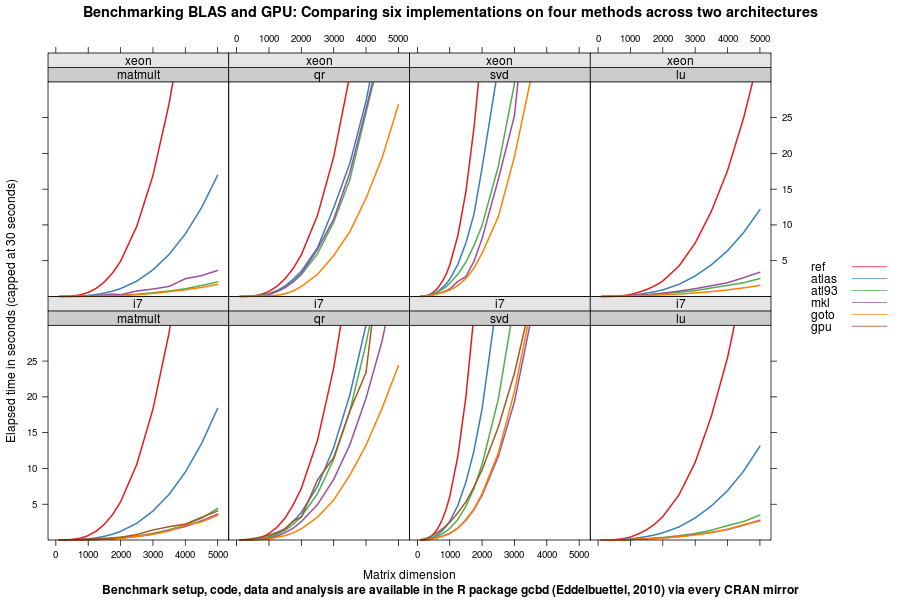
Following up on my initial post announcing gcbd, here is a brief note on a new version. The initial post announced version 0.2.2 which was the first CRAN version of gcbd. I updated to 0.2.3 when I made the aforementioned first blog post about gcbd with the lattice plot of the BLAS and GPU benchmark results across six different implementations (from reference BLAS to two Atlas versions, Goto, MKL and a GPU-based one). There is now a new version 0.2.4 of gcbd on CRAN. I revised the paper ever so slightly based on some more feedback, and focussed the results sections by concentrating on just the log-axes lattice blot and the corresponding lattice plot of raw results---where the y-axis is capped at 30 seconds: GPU/CPU Benchmark Results in levels This chart--in levels rather than using logarithmic axes is done here--nicely illustrates just how large the performance difference can be for for matrix multiplication and LU decomposition. QR and SVD are closer but accelerated BLAS libraries still win. GPUs can be compelling for some tasks and large sizes. More discussion is still available in the paper which is also included in the gcbd package for R.

3 October 2010

Colin Watson: Pipeline library

When I took over man-db in 2001, one of the major problems that became evident after maintaining it for a while was the way it handled subprocesses. The nature of man and friends means that it spends a lot of time calling sequences of programs such as zsoelim < input-file tbl nroff -mandoc -Tutf8. Back then, it was using C library facilities such as system and popen for all this, and I had to deal with several bugs where those functions were being called with untrusted input as arguments without properly escaping metacharacters. Of course it was possible to chase around every such call inserting appropriate escaping functions, but this was always bound to be error-prone and one of the tasks that rapidly became important to me was arranging to start subprocesses in a way that was fundamentally immune to this kind of bug. In higher-level languages, there are usually standard constructs which are safer than just passing a command line to the shell. For example, in Perl you can use system([$command, $arg1, $arg2, ...]) to invoke a program with arguments without the interference of the shell, and perlipc(1) describes various facilities for connecting them together. In Python, the subprocess module allows you to create pipelines easily and safely (as long as you remember the SIGPIPE gotcha). C has the fork and execve primitives, but assembling these to construct full-blown pipelines correctly is difficult and error-prone, so many programmers don't bother and use the simple but unsafe library facilities instead. I wrote a couple of thousand lines of library code in man-db to address this problem, loosely and now quite distantly based on code in groff. In the following examples, function names starting with command_, pipeline_, or decompress_ are real functions in the library, while any other function names are pseudocode. Constructing the simplified example pipeline from my first paragraph using this library looks like this:
pipeline *p;
int status;
p = pipeline_new ();
p->want_infile = "input-file";
pipeline_command_args (p, "zsoelim", NULL);
pipeline_command_args (p, "tbl", NULL);
pipeline_command_args (p, "nroff", "-mandoc", "-Tutf8", NULL);
pipeline_start (p);
status = pipeline_wait (p);
pipeline_free (p);
You might want to construct a command more dynamically:
command *manconv = command_new_args ("manconv", "-f", from_code,
                                     "-t", "UTF-8", NULL);
if (quiet)
	command_arg (manconv, "-q");
pipeline_command (p, manconv);
Perhaps you want an environment variable set only while running a certain command:
command *less = command_new ("less");
command_setenv (less, "LESSCHARSET", lesscharset);
You might find yourself needing to pass the output of one pipeline to several other pipelines, in a "tee" arrangement:
pipeline *source, *sink1, *sink2;
source = make_source ();
sink1 = make_sink1 ();
sink2 = make_sink2 ();
pipeline_connect (source, sink1, sink2, NULL);
/* Pump data among these pipelines until there's nothing left. */
pipeline_pump (source, sink1, sink2, NULL);
pipeline_free (sink2);
pipeline_free (sink1);
pipeline_free (source);
Maybe one of your commands is actually an in-process function, rather than an external program:
command *inproc = command_new_function ("in-process", &func, NULL, NULL);
pipeline_command (p, inproc);
Sometimes your program needs to consume the output of a pipeline, rather than sending it all to some other subprocess:
pipeline *p = make_pipeline ();
const char *line;
line = pipeline_peekline (p);
if (!strstr (line, "coding: UTF-8"))
	printf ("Unicode text follows:\n");
while (line = pipeline_readline (p))
	printf ("  %s", line);
pipeline_free (p);
man-db deals with compressed files a lot, so I wrote an add-on library for opening compressed files (which is somewhat man-db-specific, but the implementation wasn't difficult given the underlying library):
pipeline *decomp_file = decompress_open (compressed_filename);
pipeline *decomp_stdin = decompress_fdopen (fileno (stdin));
This library has been in production in man-db for over five years now. The very careful signal handling code has been reviewed independently and the whole thing has been run through multiple static analysis tools, although I would always welcome more review; in particular I have no idea what it would take to make it safe for use in threaded programs since I generally avoid threading wherever possible. There have been a handful of bugs, which I've fixed promptly, and I've added various new features to support particular requirements of man-db (though in as general a way as possible). Every so often I see somebody asking about subprocess handling in C, and I wonder if I should split this library out into a standalone package so that it can be used elsewhere. Web searches for things like "pipeline library" and "libpipeline" don't reveal anything that's a particularly close match for what I have. The licensing would be GPLv2 or later; this isn't likely to be negotiable since some of the original code wasn't mine and in any case I don't feel particularly bad about giving an advantage to GPLed programs. For more details on the interface, the header file is well-commented. Is there enough interest in this to make the effort of producing a separate library package worthwhile? As well as the general effort of creating a new package, I'd need to do some work to disentangle it from a few bits and pieces specific to man-db. If you maintain a specific package that could use this and you're interested, please contact me with details, mentioning any extensions you think you'd need. I intentionally haven't enabled comments on my blog for various reasons, but you can e-mail me at cjwatson at debian.org or man-db-devel at nongnu.org.

Erich Schubert: Google changing the web

Recently, Google started changing the web in some interesting ways. A lot by contributing code. It started with projects such as the Chrome web browser, which quickly achieved a market shares over 10%, which is more than Apple Safari and Opera together.And the good side, Chrome did not actually add "yet another incompatible platform", but by being closely related to Safari (or more precisely WebKit), it is not that different.Other stuff that belongs into this category is the Google Web Toolkit and the closure compiler (which essentially is a JavaScript code checker and optimizer).But recently, Google goes a step further. They started tackling internet file formats. First they proposed a new Video codec known as WebM or VP8. Now they extracted an image format out of this codec, known as WebP.There is some serious doubt on the quality, the images do appear to be a bit blurry and lose details. I concur with JPEG even being a bit better, despite the block artefacts. The blurry results of WebP are not really convincing.The h.264 based image looks best to me, but H.264 is patent-encumbered for all I know, so we might not see this new format in wide use until 2028. This already ruled out other image formats such as JBIG or FIF. Or look at audio formats: we're still using MP3 everywhere, because everyone tries to push another patent-encumbered audio format that the others are not going to adopt. So MP3 remains the only thing widely accepted (Ogg Vorbis is nice, but it looks as if companies such as Apple are not going to adopt it, probably because they have interest in other formats. Maybe the Ogg Vorbis support in Chrome will help here on the long run).In particular, why would you pay royalties for a tiny bit of image quality, given the constantly sinking prices of bandwidth? The H.264 patents may make a difference on video data, they probably won't pay of for still images.Given that WebM is sometimes claimed to be a simplified H.264 (minus the patent issues?), WebP probably is as good as we can get to the H.264 based quality without running into the same patent issues?But enough on the image data. There is one thing, I'd really like to see Google change on the web. The worst thing about the web is called JavaScript (or more accurately, ECMAScript). There is just so much wrong with this language that we really need to replace it ASAP.Some things that are wrong with JavaScript: So my biggest wishlist item of Google to contribute to the Web via Chrome and Firefox is a new web scripting language. As much as I love python, the whitespace syntax of Python doesn't work for the web (we need to be able to store complex statements in HTML attributes without newlines), so we'll have to look for something else. Maybe Ruby will work?

Petter Reinholdtsen: Links for 2010-10-03

Matt Zimmerman: Tips for frequent international travel

I travel pretty regularly, about 35% so far in 2010. When it goes wrong, travel can be exhausting, frustrating, complicated, stressful and even debilitating. I m always looking for ways to make my trips run more smoothly. On a recent flight to Taipei, I wrote down a few of the techniques which I ve successfully put into practice and found helpful. This is not an exhaustive list; I ve omitted a lot of the common and obvious tips I ve seen elsewhere.
  1. Make a packing list. This one may be obvious, but a lot of people neglect it. Perhaps they think making lists is boring and fussy, but really, it isn t. Without a packing list, it s easy to forget to do the things which will make your trip better. Use it every time, and bring a copy with you (or store it online) so you can add the things you wish you had brought or done. A simple, ever-improving packing list is the most effective technique I have found for making travel less stressful and more enjoyable.
  2. Carry a water bottle with a tight-fitting lid. I use a 32oz Nalgene bottle, which fits nicely into the seat next to me or under an armrest, and gives me enough water for even the longest flights. I fill it up after passing through security, at a cafe, bar or lounge, and generally decline the beverages offered by the cabin crew. Staying hydrated helps me feel better during the flight, and leaves me with less malaise when I arrive. I don t need to manage a tray table or armrest full of cups and other debris, so I can sit more comfortably, with the tray table folded away.
  3. Consolidate essential items using multipurpose equipment. For example, invest in a power adapter which has USB sockets onboard, and carry USB cables instead of wall chargers. Versatile items like this save on space and weight. I can charge two devices this way, but the equipment is smaller and lighter than even a single wall charger.
  4. Learn how to sleep on an airplane. Getting some sleep on a long flight really helps to offset the effects of traveling. There are several resources out there with practical advice on how to do it. One thing which really helped me was to buy a high quality eye mask which blocks out all of the light in the cabin. The one I use looks a little funny and is not cheap, but is very comfortable and effective. It s made of memory foam with a soft, washable cover and works much better than the ones the airlines give away for free. I no longer bother with a neck pillow, and use the flaps built into the seat to lean my head against. I m surprised at how many people don t know about this common aricraft feature: virtually every long-haul seat has something like this, even in economy, though it may not be obvious how to use it.
  5. Buy duplicates of things like toiletries, and keep them in your travel kit so you don t need to pack your everyday items (and risk forgetting them) each time. The less packing you need to do, the less time it will take, and the less opportunity there is for mistakes. This also saves time unpacking when you get home, and lets you buy a smaller size of the item where available.
  6. Optimize border crossings Carry the forms you ll need for customs, immigration, etc. in your carry-on. They don t always provide them at the counter or on board the plane, and it s a hassle to rush to fill in the form at the last minute. If you have a few of them with you, you can fill them out early (perhaps even before you fly) and then hustle to the front of the queue. For countries you enter frequently (especially your home country), programs like Global Entry (US) and IRIS (UK) will save you a lot of time by allowing you to use an automated kiosk to cross the border.

Alastair McKinstry: Zarmina!

So the exoplanet Gliese-581-g has a name: Zarmina!. Steve Vogt, who led the discovery team, named it after his wife. Good move. About time we named these things. Although personally I think GL 581 d, its neighbour, has a better chance of being habitable. Everyone is assuming Zarmina is tidally-locked: that is, it has one side facing the star at all times. This would mean that while one side of the star is scorching hot, the other freezing cold, all you have to do is go to the "Terminator", the part of the planet in continuous dusk (or dawn) to find a nice climate. Not necessarily so: it can be in orbital resonance like Mercury, which rotates in a 3:2 ratio. A better idea is to look below any oceans, if it has them, for life. Either way, this Gliese 581 is the direction to point a TPF at. Tags ,

Stefano Zacchiroli: Question and Answer support for Debian users

shapado.debian.net Since a few hours, a Shapado instance for Debian is available at: Shapado is a Question and Answer (QA) website, meant to provide user support to the community, by the community. Another way of seeing it is as a skill exchange website: users can ask questions about stuff they don't know and other users, possiby more expert on that topic, can answer those questions; everyone can then use peer review to evaluate and sort answers. Several proprietary web applications are based on the above notions and have proven useful for user support in several contexts, including other Free Software distributions. Shapado on the other hand is Free Software released under AGPL; as such it's the best match to give a try to something similar in the context of Debian. Shapado has also a couple of other niceties, e.g. offers login via OpenID and supports questions/answers in multiple languages. Will it work for us?
Will it not?
It's up to the community. This kind of user support works when it reaches a critical mass of both "newbie" users in need of help and of "expert" users willing to help them. No matter your category, give it a try: go to the website and look around, you'll probably find a question to ask, a question to answer, or an answer to evaluate. Acknowledgements
Update: add mention of multi-language support

2 October 2010

Roland Mas: For a truly acentric Internet

For some time, I've had this idea brewing for how the 'net would work without DNS. Initially I was mostly thinking of how to get rid of the dark side of the registrar business, but it appears that maybe it could help with security in general too. It may not be feasible at all, or I may have forgotten extremely crucial points. I'm not a DNS guru, so bear with me and consider this as a thought experiment. This is, however, a proposal for how the Internet could be made truly decentralized, or acentric. Made so, because it currently is very centralized on at least two counts: the DNS is an inherently hierarchical structure of authority; and so is the situation with the SSL certificates used for securing websites. Let's start with DNS, if you will. Basically, the idea is to replace the current Domain Name System, which is centralised in nature (even if subdomains can be delegated) with a fully decentralised system with no central authority. The point of current DNS is to map names to IP addresses in a unique way. It currently works by registering a this name is managed by such-and-such server, ask for details at such-and-such IP address message. Of course, since there's only one namespace (or a limited number thereof, if you consider that TLDs are different namespaces), there needs to be a central authority to resolve conflicts, because some names will be more popular than others. I propose to start with a cryptographic key pair (think GPG key). Anyone can create their key pair; we assume that it's extremely unlikely for two people to generate the same keys, and that it's also very hard for two people to generate keys with the same fingerprint. By (being the only one) knowing the secret part of a key, I am the authority on what can be signed with it. I could for instance sign records that say that www points to this set of IP addresses, and smtp points to that other address. Within my area of authority, which is to say within my domain. Which is identified by the fingerprint of my key pair. What do we have so far? A mechanism that allows in a decentralised way to verify who's authoritative on the F5566852EB92BD779CF137190EA756B5144843F5 domain . In DNS terms, more probably F55...3F5.some-tld. Now let's publish the signed records on a decentralised peer-to-peer network. I'm not up to date with the latest trends in that domain, but I think something like Gnutella or Freenet would qualify, since it doesn't need central hubs but only an initial list of nodes, and it does automatic discovery of new nodes. Projects such as the FreedomBox (name likely to be changed) will probably help with that. Anyway, when looking up www.F55...3F5.some-tld, the resolver gets the signed record (and the public part of the key) from the P2P network, checks the signature, and uses the contents of the record to determine the IP address. No central or delegated registry involved at any point. Lesser risk of a single point of failure, which means better resilience against outages. Also, a better resilience against DNS-based censorship, be it promoted by non-democratic states or by greedy corporations. Of course, F5566852EB92BD779CF137190EA756B5144843F5 isn't a terribly easy name to remember or transmit. But the string of hex could be presented to the user in some other form easier to recognize for people without geek super-powers. My favourite would be the bibi-binary representation, but I'm told that the bubble-babble method works equally well. It would still be unreasonable to expect people to remember such names, and especially to type them into their web browsers or e-mail agents. A possible solution to that would be to use a short form, such as 144843F5 (or its bibi-binary equivalent), complemented by a visual representation of the full fingerprint such as the one SSH does. That pair could be displayed on business cards, email signatures, glossy brochures, advertisements and so on, and allow users to just type the strange word or flash the 2D barcode, check that the funny picture matches (in case the strange word returns several results), and get the website they want. Which they can of course bookmark under a name they can remember, probably even the same name that everyone else uses to bookmark that website. And nothing precludes convenient directories mapping names to full URLs (like search engines currently do) as long as users check that the visual representation of the site they go to matches what they've seen elsewhere. That elsewhere could, of course, take advantage of the natural web of trust that emerges in of GPG-using communities. If I'm directed at a website whose key I don't immediately recognize, then I can see who trusts that key to be legitimate (by checking the signatures), and who trusts them, and so on. Ultimately, the decision is mine to make, and mine only. In any case, once I know what URL I want to visit, I can be sure this DNS replacement will give me the right IP address (or addresses). DNS servers replying with advertisement sites instead of correct ones, and DNS-based filtering, will be things of the past. Of course, having the right IP address only solves the attacks on the DNS part. Eavesdropping can also happen by diverting traffic at the IP level. But we have a trustable way to know information related to a domain, so let's use it: the signed record can also contain the fingerprint of cryptographic keys (SSL or SSH or whatever). So we can be sure we're actually talking to the correct server, rather than to some man-in-the-middle spy. With the same guarantees of correctness as the ones for the DNS, backed by the web of trust and out-of-band validation. Again, we get rid of the hierarchy of certification authorities , some of which have been known for helping organizations get at the (supposedly secret) data people exchange over the net. To summarize: with this scheme, if I know the site I want to access is F55...3F5, then I can be certain that a) I get the right IP address for it and b) I'm actually talking to it. And nobody in-between can intercept the traffic, if the site is properly administrated and its private key is kept secure. And from the site admin's point of view, there's no need to trust DNS registrars and SSL certification authorities not to fool around with the data, or blackmail me into paying increasing fees for keeping my URL working or my SSL key certified. There's still the problem of the allocation for the IP addresses themselves, but two major parts of the centralized and hierarchical net can be gotten rid of. There are proposals attempting to fix part of the problems already, but they're incomplete. DNSSEC only solves the authentication of DNS records, not the centralisation problem. Monkeysphere aims at adding a web of trust to the SSL certificates system, but the CA chain problem seems to persist (although I must admit I'm not up to speed with the actual details). This is of course only a rough draft, full of technical considerations yet certainly not exhaustive. I've thought about it though, and I believe there are no theoretical problems with the implementation of such a scheme (apart for the handling of expiration and revocations, probably). The main obstacle to mass-adoption I can envision is the UI part, and the entrenched habit of just typing a keyword into a search engine and implicitly trusting its results, then blindly trusting the website itself; but even if mass-adoption isn't reached, I can't see anything wrong with giving those who want to be careful a more secure Internet.

1 October 2010

Benjamin Mako Hill: On Feminism and Microcontrollers

A month or so ago, I published a paper with Leah Buechley that is mostly an analysis of how the LilyPad Arduino has been used. I read an earlier draft last year and loved it so, when the opportunity arose, I was honored to help out as the paper evolved. LilyPad is a microcontroller platform that Leah created a few years back and that is specifically designed to be more useful than other microcontroller platforms (like normal Arduino) in the context of crafting practices like textiles or painting. Leah's design goal with LilyPad was to create a sewable microcontroller that could be useful for making things that were qualitatively different from what most people made with microcontrollers and that, she hoped, would be of interest to women and girls. Our paper tries to measure the breadth of LilyPad's appeal and the degree to which it accomplished her goals. We used sales data from SparkFun (the largest retail source for both Arduino and LilyPad in the US) and a crowd-sourced dataset of high-visibility microcontroller projects. Our goal was to get a better sense of who it is that is using the two platforms and how these groups and their projects differ. We found evidence to support the suggestion that LilyPad is disproportionally appealing to women, as compared to Arduino (we estimated that about 9% of Arduino purchasers were female while 35% of LilyPad purchasers were). We found evidence that suggests that a very large proportion of people making high-visibility projects using LilyPad are female as compared to Arduino (65% for LilyPad, versus 2% for Arduino). Digging deeper, qualitative evidence suggests a reason. LilyPad users aren't just different. The projects they are making are different too. Although LilyPad and Arduino are the same chips and the same code, we suggest that LilyPad's design, and the way the platform is framed, leads to different types of projects that appeal to different types of people. For example, Arduino seems likely to find its way into an interaction design project or a fighting robot. LilyPad seems more likely to find its way into a smart and responsive textile. Very often, different types of people want to make these projects. Leah and I believe that there's a more general lesson to be learned about designing technologies for communities underrepresented in science, technology, engineering, and mathematics (STEM) -- and for women in particular. The dominant metaphor in the discussion on women in computer science is Margolis and Fisher's idea of "unlocking the clubhouse." The phrase provides a good description of the path that most projects aimed at broadening participation of women in computing projects seem to take. The metaphor is based around the idea that computing culture is a boys' club that is unfriendly to women. The solution is finding ways to make this club more accessible to those locked outside. It should go without saying that we share Margolis and Fisher's goal of increasing participation of women in STEM. That's LilyPad's point, after all. It it hopefully also clear that we're supportive of, and involved in, projects working to remove systematic barriers to participation by women and other groups. That work must continue. But I also think that Leah's work with LilyPad suggests another way forward based on addressing issues of self-selection that will affect even the most welcoming technological communities. Here's what we say in our paper:
Our experience suggests a different approach, one we call Building New Clubhouses. Instead of trying to fit people into existing engineering cultures, it may be more constructive to try to spark and support new cultures, to build new clubhouses. Our experiences have led us to believe that the problem is not so much that communities are prejudiced or exclusive but that they're limited in breadth--both intellectually and culturally. Some of the most revealing research in diversity in STEM found that women and other minorities don't join STEM communities not because they are intimidated or unqualified but rather because they're simply uninterested in these disciplines. One of our current research goals is thus to question traditional disciplinary boundaries and to expand disciplines to make room for more diverse interests and passions. To show, for example, that it is possible to build complex, innovative, technological artifacts that are colorful, soft, and beautiful. We want to provide alternative pathways to the rich intellectual possibilities of computation and engineering. We hope that our research shows that disciplines can grow both technically and culturally when we re-envision and re-contextualize them. When we build new clubhouses, new, surprising, and valuable things happen. As our findings on shared LilyPad projects seem to support, a new female-dominated electrical engineering/computer science community may emerge.
I have a strong belief that computing can be an empowering tool and that expanding users' control over technology is a critically important issue. Our paper argues that we should attempt to expand participation in computing by broadening the possibilities of computing, rather than only by broadening participation in extant, computing organizations, projects, and genres. Even if computing and electrical engineering communities were perfectly welcoming (which they are not) most people (both male and female, but disproportionately female) will choose not to participate. Building new clubhouses requires creativity of its proponents and risks charges of reinforcing stereotypes and existing status hierarchies. But, executed carefully and well (as I believe LilyPad has been), it suggests ways to reach the majority of people that no "unlocking" project will ever seem relevant to.

Wouter Verhelst: Grmbl

So we'll be doing a video recording of a musical in the second weekend of October. Since it worked so well last time, we're going to be doing it with DVswitch. One quite important bit of goodness that we had last time was the fact that we had an intercom; that is, some way for the camera people and the director to talk to eachother. I hadn't set that up; the theatre where the concert was just had that material, we could just use it. Since the place where we'll be doing this recording does not have such a thing, that meant that in order to repeat the success of last time, we'd be needing something else this time around. So I bought five USB headsets, set up an asterisk installation with conferencing, installed linphone-nox, and tried. Only to find that it didn't work. Fiddling with the settings didn't help. I got a bit angry, since there's sooo many sound systems in Linux that sometimes it's hard to figure out who's at fault. But no matter, whatever I tried I couldn't get it to work. After trying for a few hours, I tried using it on the PS3. The packaging did say 'PS3', after all, and perhaps it used some playstation-specific protocol? I'd be surprised if it did, since even their controller uses the standard USB HID protocol, but then it could be. Surprise, surprise, even on the PS3 I couldn't get the microphone to work. Open up another package, plug in the second headset, and yes, obviously, now the microphone works. Sigh. Oh well, that's what warranty is for.

Junichi Uekawa: I booted my ibook g4.

I booted my ibook g4. It has been a while since I last booted this machine. Memories. It feels pretty slick considering it is 7 years old machine.

30 September 2010

Evgeni Golov: What to flattr?

The month is coming to an end, and I d like to recommend you some things on flattr.com :)OpenRheinRuhr Ein Pott voll Software Die OpenRheinRuhr ist eine Messe mit Kongress rund um das Thema Freie Software . Die OpenRheinRuhr 2010 findet am 13. und 14. November im Rheinischen Industriemuseum in Oberhausen statt. Freie Software ist aus Firmen, Verwaltungen, Bildungseinrichtungen und Privathaushalten nicht mehr wegzudenken. In der bev lkerungsreichsten Region Europas bietet der OpenRheinRuhr e.V. durch Ausstellungen, Vortr ge und Workshops Informationen ber Freie Software. Auch Themen jenseits der Technik, wie B rgerrechte im Netz oder die Handhabung von Lizenzen werden behandelt. Vortr ge in mehreren Tracks sprechen Menschen mit unterschiedlichem Kenntnisstand an vom Anf nger bis zum Profi. Entwickler & Projekte bekommen die Gelegenheit zum Erfahrungsaustausch. Weitere Informationen und Anmeldem glichkeiten unter: http://openrheinruhr.deBitlBee The IRC geek s solution to instant messaging. Tunnels instant messaging traffic (supporting all popular IM protocols and Twitter) to a virtual IRC channel and virtual IRC queries. Can be installed locally, but also available as a public service for people who can t/don t want to install it.
KiBi s blog This blog mainly features Debian-related posts on various topics: X.Org package maintenance (including calls for help, and status updates towards users), Debian GNU/kFreeBSD (GNU userland running on a FreeBSD kernel), and Debian s Graphical Installer (now based on X.Org). Also some upstream stuff, like the bugzilla replica type for SD (Simple Defects).
phpMyAdmin phpMyAdmin is a tool intended to handle the administration of MySQL over the Web. It can create, rename, and drop databases, create/drop/alter tables, delete/edit/add fields, execute any SQL statement, manage keys on fields, create dumps of tables and databases, export/import CSV data, and administrate one single database and multiple MySQL servers.
Debian Backports Over the last years I did numerous backports for Debian and also run backports.org. Since September 2010 we moved backports.org to backports.debian.org so its an officialDescriptions shamelessly stolen from flattr.Some words on these things:

29 September 2010

Gunnar Wolf: Ruby dissonance with Debian, again

Lucas has written two long, insightful posts on the frustration about the social aspects of integrating Ruby stuff Debian The first one, on September 12 and the second one, on September 29. I cannot really blame (thoroughly) the Ruby guys for their position. After all, they have a vibrant community, and they are advancing great pieces of work. And they know who that code is meant for Fellow programmers. And yes, although it is a pain to follow their API changes (and several of the Gems I regularly use do often get refactorings and functionality enhancements which break compatibility but introduce very nice new features), they say that's solved with one of Gems' main features being the simultaneous installability of different versions. The key difference in Debian's worldview with Ruby's is they cater to Fellow programmers. Even leaving aside heaps of different positions and worldview/mindset, we have a fundamental difference: Debian cares about its users, whatever that means. So, our users should not even care what language a given application is implemented in They should only care that it works. We, as packagers, should take care of all the infrastructural stuff. And yes, that's where we find the conflicting spot: We don't want to ship many versions of a system library (that in this case would be a Gem). Specially if later versions fix known bugs in earlier versions and backports are not available or supported. Specially if upstream authors' only response to a bug in an older release will be "upgrade and rewrite whatever breaks in your application". As an example of this, I am not currently updating the gems I maintain, as Debian is on a freeze to get out the next stable release. Or if at all, I am targetting those uploads to our Experimental branch, in order not to create a huge backlog for me when the freeze is over (just a series of rebuilds targetted at unstable). And yes, I will have to be responsible for any bugs that will most likely not be supported by most of my upstreams during the next ~2 years. That's the role of a Linux distribution. And yes, as Lucas writes in the comments he got as responses to the first post This dissonance comes in no small part because the Ruby developer community is mostly made from non-linuxers. People coming from a background where (mostly propietary) applications bundle up everything they need, where static linking is more popular than dynamic libraries, where there is no coordination between parts of the system are much less likely to understand our work. And yes, the Perl community is a joy to work with in this regard. And that's the same I understand from the Python one. Because of their origins and where their main strength was grown and remains. PS - And yes, I will join the flock of people saying that... The specific person that attacked your work is a great programmer, but well known as intolerant and obnoxious. Fortunately, even if our respective cultures fail to mix so much, most of our interactions just end with a "sigh" of lack of understanding, and not with the flames you got targetted with :-/

Lucas Nussbaum: How to demotivate people (Re: Making Debian Responsible For Its Actions)

In my Ruby packaging in Debian and Ubuntu: Mythbusting and FAQ, I wrote The Ruby developers (or expert users) community is generally very hostile towards Debian. Many harsh words and insults are used in discussions mentioning Debian in the ruby-core@ mailing list, and there are frequent recommendations to avoid the Debian packages and install from sources, which is quite demotivating (Actually, what prompted that blog post is someone calling Debian-specific changes unforgivable). Zed A. Shaw just provided a very good example of that. Quoting the most juicy parts:
It s simply a tactic to make sure that you are stuck on Debian.
If we look at this problem from an open source perspective, Debian is at a minimum being a horrible citizen.
What is happening is control is not aligned with responsibility. Debian has taken control of the software package and recrafted it for their very narrow set of system administrator users. However, they refuse to take responsibility for the defect and quality problems they create. Instead I end up being responsible for their mistakes, which is wrong.
If Debian is in control, then Debian should be made responsible. That s the only way to get them to change it. If they don t want to be responsible, then they should let me be in control.
I m imagining a mass petition, maybe some funny ad campaigns, in-person confrontations meant to embarrass package maintainers, SEO tricks to get people off Debian, promotion of any alternative to Debian, anything to make them pay, apologize, and listen.
If you write software and you re sick of Debian screwing up your gear, then shoot me ideas for how we can make this happen. I think that if enough of us band together to make Debian responsible for its actions we can actually get them to start asking us before they package our software to find out how we think it should be packaged.
On the technical part of the post: The problem that Zed is experiencing is unknown to me, and also to the Debian and Ubuntu bug trackers. To my knowledge, rubygems doesn t not require openssl or net/scp to work, and a simple grep through the sources kind-of confirms that. But of course, that blog post was written as a rant, not as a proper bug report. My best guess is that the gem that Zed is installing requires openssl and net/scp. But of course, rubygems can t just depend on all the libraries that applications or libraries installed via rubygems could possibly require. Regarding openssl, we had a problem in Ruby because of the licensing situation of Ruby (dual licensed GPLv2+ and Ruby license, linked with openssl, which might raise some eyebrows), so it was split off the main standard library package until recently (and, apparently, in the version Zed is using). For net/scp, it is not part of the standard library, and not a dependency of rubygems, so I don t see why Zed expects it to be installed. On the rest of the post: Following my last post, several people volunteered to help with Ruby on Debian (and Ubuntu). In particular, Laurent Arnoud has been doing some fantastic work fixing the pkg-ruby-extras team s RC bugs. Also, all the messages of support both in the comments of my last post were very much appreciated. But I m really wondering why the Ruby community generates so many poisonous people. All my work on Debian is done on a volunteer basis, and it s really hard to get so much shit from it.

Evgeni Golov: PokerTH in Debian and Ubuntu

If you do not play PokerTH yet, you might want give it a try :)If you already do, read on :)PokerTH 0.8PokerTH 0.8 was released a couple of days ago. The most exciting feature of this new release is the online ranking feature: you can register at poker-heroes.com and login with these credentials in PokerTH, now your games will be logged and you might reach place 1 at the ranking site.However, you won t see 0.8 if you do not have experimental (for Debian) or the pkg-games PPA (for Ubuntu) in your sources.list. As the release is only a few days old, it won t be included in Squeeze or Maverick. Sorry for that. But I plan to provide needed backports as soon they are needed (currently experimental and PPA should be sufficient, tell me if they are not).PokerTH 0.7.1As written above, 0.8 won t be shipped in Squeeze and Maverick, but 0.7.1 will be. With the release of 0.8, upstream has moved their server to 0.8. This means that Debian and Ubuntu users won t be able to play internet games on the official server (as long they did not install 0.8). I ve set up pokerth.debian.net running 0.7.1 and have just uploaded 0.7.1-2 which uses this server as default one to unstable (sync to Maverick will follow in a couple of hours). However, default means default on new installs. If you have already played PokerTH, you have a ~/.pokerth/config.xml with the upstream server in it and you have to change this if you want to play on my server. Please read /usr/share/doc/pokerth/NEWS.Debian.gz for this:
 pokerth (0.7.1-2) unstable; urgency=low
  The server at PokerTH.net now runs the 0.8 version of the software,
  which is incompatible with 0.7.x we ship in Squeeze.
  Because of that a 0.7.x server is running on pokerth.debian.net.
  On new installations this will be the default server used.
  On old ones you have to reconfigure your client yourself.
  Either set "Serverlist Address" under Settings   Internet Game to
  "pokerth.debian.net/serverlist.xml.z" or use the "Manual Server
  Configuration" using "pokerth.debian.net" as the server address.
 -- Evgeni Golov  <evgeni@debian.org> Mon, 27 Sep 2010 14:09:17 +0200
Sorry for that and enjoy nice flops and raises :)

Russell Coker: Links September 2010

Kevin Stone gave an interesting TED talk about the biological future of joint replacement [1]. Using stem cells and animal tissue which has been prepared to destroy the chemicals that trigger immune responses the tissues can regrow. Replacing joints with titanium and ceramic lets people walk again, regrowing them with Kevin s methods allows them to compete at the highest levels of sporting contests! Derek Sivers gave a brief and interesting TED talk advising people to keep their goals secret if they want to achieve them [2]. The Parrot AR.Drone is an interesting device [3], it s a four-propeller helicopter that is controlled by WiFi. Apparently there is little security (it binds to the first WiFi client it sees) which is a significant down-side. It returns a video feed to the controlling iPhone as it flys and can hover when it loses it s connection. It will be interesting to see when people write software for other devices (Android etc). Also I wonder whether there will be open source weapons kits for it. If you could have those devices use either a nerf gun or a lance to attack each other s turbines then you could have drone jousting. Don Marti had an interesting new idea for a crime game [4]. The main concept is to use the element of mistrust that is present in real criminal gangs. The new guy you invite to join a job might inform the police and you won t know for sure. Sometimes a heist will be discovered by the police through bad luck (or good police work) and you will wonder whether there was an informant. The aim is for a simple game design and with the complexity in email discussions between the players. The C64 isn t dead, it s even on the Internet [5], an original C64 is running a web site! Tan Li gave an interesting TED talk about a new headset to read brain-waves [6]. The device in question can be applied in minutes, requires no gel or abrasion of the scalp, connects to the computer wirelessly and is relatively cheap at $300US. The developer s kit (which I think includes a headset) is $500US. I wonder if the community can develop a cheaper version of this which is more open. Lisa Margonelli gave an interesting TED talk about the politics of oil [7]. One of her insightful points is that the subsidies for oil should be shifted from the oil industry to middle-class consumers. But she goes off track a bit by suggesting gradual oil tax increases until 2020, according to the best estimates of groups such as the CSIRO they won t need to have taxes to give a high oil price in 2020! She is aiming for a 20% reduction in petrol use by 2020, but I m not aware of any serious group of scientists who have evidence to suggest that the production capacity in 2020 will be close to 80% what it is now. Slate has a good article about The Innocence Project which uses DNA tests to overturn false convictions [8], it s scarey how badly the justice system works. Rachel Sussman gave an interesting talk about the World s Oldest Living Things [9], nothing less than 2000 years old is included. Nicholas Negroponte gave an interesting EG 2007 talk about the OLPC project [10]. While some of the content about OLPC production is a little dated the OLPC history is relevant and his personal opinions regarding the benefits that children receive from computers are insightful. Jayne Poynter gave an interesting TED talk about life in Biosphere 2 [11]. Her work on mini-biospheres is also interesting. Let s hope we get a permanent Biosphere running outside the Earth sometime soon. Sheryl WuDunn gave an informative TED talk titled Our Century s Greatest Injustice about the plight of women in most of the world [12]. Daniel Kahn Gillmor wrote a good article about the use of ssh-agent [13]. You really should use it to secure your ssh keys. Mark Shuttleworth has described the development process for the Ubuntu font [14]. This is a very interesting project and IMHO one of the most significant things that Ubuntu has done. Prior to this an entirely closed development process has been used for font development. Now we are getting a major new font family developed with a free and open process and with some new legal developments for a font license! One thing to note that this project appears to have involved a lot of work from professional font designers, it sounds like Canonical spent a significant amount of money on this project.

Russ Allbery: Coding styles

I'm one of those people who tries to keep a very consistent coding style across all of my projects, including project documentation and build system layout, and also like reading other coding style guides to look for good ideas and clean ways of organizing packages. I first wrote a coding style guide for INN once I started working on it regularly, then moved and expanded on that guide and added Perl for my work at Stanford. Over time, I wrote a guide for C build systems and package documentation. These guides were all stranded in our old group web pages, which I'm working on retiring, and since they're my personal styles (although largely used by my group at work), it seemed to make the most sense to pull them back into my personal web pages. They're now available in a new coding style section of my technical notes. The build system document is heavily revised, since I originally wrote it before I started using Automake, and the documentation guide now has much more detailed documentation of how I lay out README files. The other documents just have minor revisions.

Runa Sandvik: Blackjack Essence: Well, I Suppose You re Taking Your First Expedition to Vegas?

Can you believe it? I still talk to people who don t know how to play blackjack. There must be something in the mechanics or tableau of blackjack that people find intimidating; for some reason, people can be a little cautious about taking the first move.
Photo courtesy of Winquerque on Net via Flickr. Clearly, there s no cause to hesitate. Players find quite quickly that it is actually not hard to figure out, and the strategies aren t even terribly complicated. For sure, if you re used to playing online slots, you are probably going to need to work a little harder to master the nuts and bolts. But it s still nothing like getting to grips with Texas Hold em from the beginning, for example!. Quite frankly, you very likely already know a fair portion of what most players have to know. I am able to give you the essentials in one simple little paragraph: If the card has aparticular number, that s the amount it will be worth. If it doesn t, it s worth 10. The only exception to this rule are Aces, which are worth either 1 or 11 (more about that later). Say hit when you have to get closer to 21, and/or stand when you don t. If you are closest to 21, you win. If you bust (get more than 21), you lose. Getting dealt blackjack (a natural 21 from the first two cards), makes you an instant winner (well, you and the dealer can also tie, or push ). Got it? OK, so it is not completely all you need to know. To begin with, most professional blackjack fans understand all too well that your goal has less to do with trying to get to 21, and just about everything to do with defeating an opponent. The dealer will not have the luxury of actually playing , precisely. Whether you re playing at a land-based casino or online (speaking of which, for additional info on USA casino players, all you have to do is click the link!), the house rules specify each individual play they can make. Mainly, she or he needs to take another card until their cards add up to the house rule limit (generally 17 and over). Of course, one of you will get an ill-fated draw and find themselves busted , but this decides a fewer number of games than you might expect. The tricky aspect of blackjack is the decision that you have to make if the cards add up somewhere around 12 and 16 (approximately, subject to other details). If you only had your own cards to consider, it would just be nothing but chance. Don t get me wrong, dumb luck has quite a lot to do with it. It is a card game, of course, and all card games are based on luck to some extent. But the serious gamer recognizes that luck is essentially a code word for statistics ; if you know what you have, and you possess a clue about the dealer s cards, you may make a knowledgeable judgment about which cards you re more inclined to end up with if you decide to hit another time. The most useful clue that you require to evaluate whether to play risky or conservative (sorry, I meant loose or tight ) is the dealer s upcard. Well, that s all for now, but for more information, you can always take a look at our friends at USA online casinos accepting Webmoney , who will get you up to speed. A bit later, we re going to get down to the serious nitty-gritty: doubling down, splitting, and much much more. Until then !

Next.

Previous.