Search Results: "reg"

2 October 2008

Russell Coker: How Many Singularities?

There is a lot of discussion and speculation about The Singularity. The term seems to be defined by Ray Kurzweil’s book “The Singularity Is Near” [1] which focuses on a near-future technological singularity defined by significant increases in medical science (life extension and methods to increase mental capacity) and an accelerating rate of scientific advance. In popular culture the idea that there will only be one singularity seems to be well accepted, so the discussion is based on when it will happen. One of the definitions for a singularity is that it is a set of events that change society in significant ways such that predictions are impossible - based on the concept of the Gravitational Singularity (black hole) [2]. Science fiction abounds with stories about what happens after someone enters a black hole, so the concept of a singularity not being a single event (sic) is not unknown, but it seems to me that based on our knowledge of science no-one considers there to be a black hole with multiple singularities - not even when confusing the event horizon with the singularity. If we consider a singularity to merely consist of a significant technological change (or set of changes) that change society in ways that could not have been predicted (not merely changes that were not predicted) then it seems that there have been several already, here are the ones that seem to be likely candidates: 0) The development of speech was a significant change for our species (and a significant change OF our species). Maybe we should consider that to be singularity 0 as hominids that can’t speak probably can’t be considered human. 1) The adoption of significant tool use and training children in making and using tools (as opposed to just letting them learn by observation) made a significant change to human society. I don’t think that with the knowledge available to bands of humans without tools it would have been possible to imagine that making stone axes and spears would enable them to dominate the environment and immediately become the top of the food chain. In fact as pre-tool hominids were generally not near the top of the food chain they probably would have had difficulty imagining being rulers of the world. I’m sure that it led to an immediate arms race too. 2) The development of agriculture was a significant change to society that seems to have greatly exceeded the expectations that anyone could have had at the time. I’m sure that people started farming as merely a way of ensuring that the next time they migrated to an area there was food available (just sowing seeds along traditional migration routes for a hunter-gatherer existence). They could not have expected that the result would be a significant increase in the ability to support children and a significant increase in the number of people who could be sustained by a given land area, massive population growth, new political structures to deal with greater population density, and then wiping out hunter-gatherer societies in surrounding regions. It seems likely to me that the mental processes needed to predict the actions of a domestic animal (in terms of making it a friend, worker, or docile source of food) differ from those needed to predict the actions of other humans (who’s mental processes are similar) and from those needed to predict the actions of prey that is being hunted (you only need to understand enough to kill it). 3) The invention of writing allowed the creation of larger empires through better administration. All manner of scientific and political development was permitted by writing. 4) The work of Louis Pasteur sparked a significant development in biology which led to much greater medical technology [3]. This permitted much greater population densities (both in cities and in armies) without the the limitation of significant disease problems. It seems that among other things the world-wars depended on developments in preventing disease which were linked to Louis’ work. Large populations densely congregated in urban areas permit larger universities and a better exchange of knowledge which permitted further significant developments in technology. It seems unlikely that a population suffering the health problems that were common in 1850 could have simultaneously supported large-scale industrial warfare and major research projects such as the Manhattan Project. 5) The latest significant change in society has been the development of the Internet and mobile phones. Mobile phones were fairly obvious in concept, but have made structural changes to society. For example I doubt that hand-writing is going to be needed to any great extent in the future [4], the traditional letter has disappeared, and “Dates” are now based on “I’ll call your mobile when I’m in the area” instead of meeting at a precise time - but this is the trivial stuff. Scientific development and education have dramatically increased due to using the Internet and business now moves a lot faster due to mobile phones. It seems that nowadays any young person who doesn’t want to be single and unemployed needs to have either a mobile phone or Internet access - and preferably both. When mobile phones were first released I never expected that almost everyone would feel compelled to have one, and when I first started using the Internet in 1992 I never expected it to have the rich collaborative environment of Wikipedia, blogging, social networking, etc (I didn’t imagine anything much more advanced than file exchange and email). Of these changes the latest (Internet and mobile phones) seems at first glance to be the least significant - but let’s not forget that it’s still an ongoing process. The other changes became standard parts of society long ago. So it seems that we could count as many as six singularities, but it seems that even the most conservative count would have three singularities (tool use, agriculture, and writing). It seems to me that the major factors for a singularity are an increased population density (through couples being able to support more children, through medical technology extending the life expectancy, through greater food supplies permitting more people to live in an area, or through social structures which manage the disputes that arise when there is a great population density) and increased mental abilities (which includes better education and communication). Research into education methods is continuing, so even without genetically modified humans, surgically connecting computers to human brains, or AI we can expect intelligent beings with a significant incremental advance over current humans in the near future. Communications technology is continually being improved, with some significant advances in the user-interfaces. Even if we don’t get surgically attached communications devices giving something similar to “telepathy” (which is not far from current technology), there are possibilities for significant increments in communication ability through 3D video-conferencing, better time management of communication (inappropriate instant communication destroys productivity), and increased communication skills (they really should replace some of the time-filler subjects at high-school with something useful like how to write effective diagrams). It seems to me that going from the current situation of something significantly less than one billion people with current (poor) education and limited communications access (which most people don’t know how to use properly) to six billion people with devices that are more user-friendly and powerful than today’s computers and mobile phones combined with better education as to how to use them has the potential to increase the overall rate of scientific development by more than an order of magnitude. This in itself might comprise a singularity depending on the criteria you use to assess it. Of course that would take at least a generation to implement, a significant advance in medical technology or AI could bring about a singularity much sooner. But I feel safe in predicting that people who expect the world to remain as it is forever will be proven wrong yet again, and I also feel safe in predicting that most of them will still be alive to see it. I believe that we will have a technological singularity (which will be nothing like the “rapture” which was invented by some of the most imaginative interpretations of the bible). I don’t believe that it will be the final singularity unless we happen to make our species extinct (in which case there will most likely be another species to take over the Earth and have it’s own singularities).

1 October 2008

Russell Coker: Could we have an Open Computing Cloud?

One of the most interesting new technologies that has come out recently is Cloud Computing, the most popular instance seems to be the Amazon EC2 (Elastic Cloud Computing). I think it would be good if there were some open alternatives to EC2. Amazon charges $0.10 per compute hour for a virtual machine that has one Compute Unit (equivalent to a 1.0 to 1.2GHz 2007 Opteron core) and 1.7G of RAM. Competing with this will be difficult as it’s difficult to be cheaper than 10 cents an hour ($876.60 per annum) to a sufficient extent to compensate for the great bandwidth that Amazon has on offer. The first alternative that seems obvious is a cooperative model. In the past I’ve run servers for the use of friends in the free software community. It would be easy for me to do such things in future, and Xen makes this a lot easier than it used to be. If anyone wants a DomU for testing something related to Debian SE Linux then I can set one up in a small amount of time. If there was free software to manage such things then it wuld be practical to have some sort of share system for community members. The next possibility is a commercial model. If I could get Xen to provide a single Amazon Compute Unit to one DomU (not less or more) then I wouldn’t notice it on some of my Xen servers. 1.7G of RAM is a moderate amount, but as 3G seems to be typical for new desktop systems (Intel is still making chipsets that support a maximum of 4G of address space [2], when you subtract the address space for video and PCI you might as well only get 3G) it would not be inconceivable to use 1.7G DomUs on idle desktop machines. But it’s probably more practical to have a model with less RAM. For my own use I run a number of DomUs with 256M of RAM for testing and development and the largest server DomU I run is 400M (that is for ClamAV, SpamAssassin, and Wordpress). While providing 1.7G of RAM and 1CU for less than 10 cents an hour may be difficult, but providing an option of 256M of RAM and 0.2CU (burstable to 0.5CU) for 2 cents an hour would give the same aggregate revenue for the hardware while also offering a cheaper service for people who want that. 2 cents an hour is more than the cost of some of the Xen server plans that ISPs offer [3] but if you only need a server for part of the time then it would have the potential to save some money. For storage Amazon has some serious bandwidth inside it’s own network for transferring the image to the machine for booting. To do things on the cheap the way to go would be to create a binary diff of a common image. If everyone who ran virtual servers had images of the common configurations of the popular distributions then creating an image to boot would only require sending a diff (maybe something based on XDelta [4]). Transferring 1GB of filesystem image over most network links is going to be unreasonably time consuming, transferring a binary diff of an up to date CentOS or Debian install vs a usable system image based on CentOS or Debian which has all the updates applied is going to be much faster. Of course something like this would not be suitable for anything that requires security. But there are many uses for servers that don’t require much security.

Ross Burton: Translation Nightmare

I just got a new bug titled Very weird translation template, need comments in .pot file to clarify, and giggled to myself. I was wondering how long it would be for this bug to be filed. The problem is that whilst most of the translatable strings in Tasks are pretty boring: "Tasks", "today", "Priority" and so on, all of a sudden the template goes a bit mental:
"^(?<task>.+) (?:by due on)? (?<month>\\w+) (?<day>\\d 1,2 )(?:st nd rd th)?$"
Apparently the average translator doesn't think that learning PCRE-style regular expressions, and reading the source that uses this string to understand how it is to be used, is appropriate. [note: this is sarcasm] Maybe I should have added some translator comments to clarify exactly what I meant by this. These monster strings (all in koto-date-parser.c) are GRegex regular expressions which are used to parse the user's input to try and extract meaningful date information. To translate these strings you'll need to have a basic understanding of regular expressions: if you don't then skip them and hopefully someone who does will finish the translation. If you know regular expressions then translating these strings is easy, honest. The golden rule is to never translate the words which look like this: (?<foo>. These are markers which identify portions of the input (such as task or month) and need to remain in English, although they can be moved around if required. The rest of the strings are translatable. I'll give an example using the French translation by Stéphane Raimbault. First, the string in English and a worked example:
"^(?<task>.+) (?:by due on)? (?<day>\\d 1,2 )(?:st nd rd th)? (?<month>\\w+)$"
First, we have a sequence of any characters identified as task, which magically expands to be as many as possible. This is optionally followed by one of the words "by", "due" or "on". This is followed by one or two digits identified as day followed by "st", "nd", "rd" or "th". Finally a sequence of characters which is identified as month. If the user had entered "pay bills on 2nd june" then task would be "pay bills", day would be "2", and month would be "june". Tasks can then turn "june" into a month number through other translations, and it now knows what date the user entered. In French, this translates as follows:
"^(?<task>.+) (?:pour pr vu pour le)? (?<day>\\d 1,2 )(?:er e)? (?<month>\\w+)$"
See, I said it was easy! All I need now is a legion of translators who understand regular expressions enough to correctly translate the new Tasks... [this, again, is sarcasm] Luckily, plans are afoot to move the Tasks source to the GNOME Subversion server, so the full fury of the GNOME translation team can attack this. NP: Trailer Park, Beth Orton

30 September 2008

Martin F. Krafft: Customer service how-not-to: Miles & More

I ve previously ranted about the Lufthansa website. Trying to help out a blind friend obtain some assistance from Miles & More, the Lufthansa frequent flyer programme, I can confidently say that the two companies have a common origin and probably read the same customer service guidelines, which must be somewhat along the following lines: If you follow the above guidelines carefully and possibly add a twist here or there, you can rest assured that you ll fit in quite perfectly with most of your competitors and companies in many other fields. You ll understand that the customer is evil and you have to protect your company and your customer service staff from them, by making it extraordinarily difficult and inconvenient to reach them, and ensuring that they won t get any further than the computerised guard at the front door. It s not like they are your most important asset. Interestingly, neither Swiss, SAS, nor Thai have read these guidelines. I hope they will never find them. NP: Porcupine Tree: The Sky Moves Sideways

29 September 2008

Wouter Verhelst: SSH with Belgian electronic ID card

OpenSSH can be compiled against OpenSC. Since the latter has support for the Belgian electronic ID card, that means you can use your eID card to log on to a remote server using OpenSSH. To do this is fairly simple, once you know how it works. First, obviously, you need to have ssh compiled against opensc. Unfortunately, the Debian package comes with that option disabled, but it's easy to enable that:
sudo apt-get build-dep openssh
sudo apt-get source openssh
cd openssh-*
$EDITOR debian/rules
Find the "Common build options", and add another line:
confflags += --with-opensc=/usr
Now add another changelog entry, so that your next apt-get upgrade won't overwrite your locally-modified SSH package:
dch -i
Next, build and install the package:
dpkg-buildpackage -rfakeroot -b -uc -us
cd ..
sudo dpkg -i openssh-client*
You now have an OpenSSH that can access smartcards. So, how do you use it to log on to a remote system? Simple:
pkcs15-tool -c
ssh-keygen -D 0
The first command will tell you the order of the certificates on the card. In my case, the Authentication certificate is first, while the Signature certificate is second. You do not want the Signature certificate; you only want the Authentication certificate. The second command will output the RSA public keys that are on the smartcard in both SSH1 and SSH2 format, in the same order as in the pkcs15-tool output. You only want the SSH2 version, and you only want to get the Authentication key. That key needs to be added to your ~/.ssh/authorized_keys on the remote host. Note that the '0' assumes that your smartcard is in slot 0; if that doesn't work, 'pkcs11-tool -L' should tell you which slot you need. After we've done this, we're ready to start using the smartcard to log in. While ssh-add has an option to load keys from a smartcard, this only works with smartcards that allow one to download the private key from the smartcard into the computer's RAM. This is not possible with the eID (and for good reason), so you can't use ssh-agent with your eID card. However, you don't really need it.
beid-pkcs11-tool -l -t
This will log in to the Authentication key on the smartcard (note that while it is possible to log in to the Authentication key, it is not possible to do the same with the Signature key). You will get the familiar belpic login window now, and the smartcard will now allow use of the private key. In order to actually use this key, you need to specify one extra option to ssh:
ssh -I 0
The -I option instructs SSH to use a smartcard key as a private key. Since we're already logged in to the smartcard, we do not need to enter a PIN code (and regardless, SSH does not know how to do that). You will now be logged on to the server. Note that there is no way to 'log out' of a smartcard; the proper way to do that is to remove your card from the cardreader...

Ian Wienand: Kernel Development Course

Here are some slides and examples I used for a kernel course I developed (some time ago now). The course was aimed at C developers who wanted an introduction to both general UNIX-style user-space and Linux kernel development with a focus on embedded systems issues. The course is aimed at two 8-hour days, and is pretty packed in even then. The first day is user-space development and kernel building, focusing on things like make, autotools, advanced gcc, getting cross-compilers working, configuring the kernel and building. The second day we get into kernel internals; building up a kernel module to produce some simple proc nodes, take data, crash and debug, etc, look at internals like concurrency and the driver model, and focus on USB quite a bit. Here is a tarball of the entire thing, including the examples. Hopefully these can help out anyone tackling the design of such a course.

Russell Coker: Never Trust a DRM Vendor

I was reading an interesting post about predicting the results of the invasion of Iraq [1]. One of the points made was that the author rejected every statement by a known liar (which includes all the world leaders who wanted the invasion). So basically regarding every statement by a known liar as potentially a lie led to a better than average prediction. It seems to me that a similar principle can be applied to other areas. A vendor or advocate of DRM (Digital Restrictions Management) [2] has already proven that they are not concerned about the best interests of the people who own the computers in question (who paid for the hardware and software) - they are in fact interested in preventing the owner of the computer from using it in ways that they desire. This focus on security in opposition to the best interests of the user can not result in a piece of software that protects the user’s best interests. I believe that any software with DRM features (other than those which are requested by people who purchase the software) should be considered to be malware. The best example of this is the Sony BMG copy protection scandal [3]. Note that I refer to the interests of the people who own the computers - not those who use them. It is quite acceptable to write software that serves the buyer not the end-user. Two examples are companies that want to prevent their employees doing “inappropriate” things and parents who want to restrict what their children can do. We can debate about what restrictions on the actions of employees and children are appropriate, but it seems clear that when software is purchased for their use the purchaser has the right to restrict their access. Also note that when I refer to someone owning a computer I refer to an honest relationship (such as parent/child or employer/worker) not the abusive relationships that mobile phone companies typically have with their customers (give the customer a “free” phone but lock it down and claim that they don’t own it). Mobile phones ARE computers, just rather limited ones at this time.

28 September 2008

Sune Vuorela: KDE and internal storage

Looking at KDE4 and related technologies, a few things about data storage hit me. Not that I know anything about it, but that does usually not prevent me from trying to be clever about it. Several parts needs to either index, cache or store data. Apps Among these, there is probably many other, but these I just noticed. How do these apps store their things As the smart reader has guessed, all these uses different storage methods. Strigi Indexes your data and store it in a clucene on disk format. If you remove your strigi indexes, all you lose is the cpu time used to generate it.
Strigi is not a KDE thing, but the KDE libraries depends on it. Akonadi Caches your PIM data and make it available easily for applications. Akonadi does not itself keep the data. Akonadi people has evaluated SQLite, but found it insufficient. Akonadi people also evaluated MySQL/Embedded, but did also have issues with that, so they ended up using a full MySQL server.
Akonadi is not a KDE thing, but it originates from KDE and is used by the KDE Pim libraries. Nepomuk Handles and stores metadata and tags on files, emails and other data. The nepomuk data is all in RDF format. Nepomuk uses Soprano for storage and soprano has pluggable backends.
One Soprano backend, probably the most used, is a Redland backend, which too slow for effective nepomuk usage, but is a C++ thing. Redland internally can use Berkeley DB or MySQL. The usage in Soprano is Berkeley DB format.
The other Soprano backend is using Sesame2, a java rdf storage. Quite some people are against this because it is java. Internally, it seems that it is using its own ondisk format, but is much more effective than the Redland/BDB backend, and the recommended one to use. Amarok Indexes and plays your music and does statistics over it. The amarok people have evaluated SQLite and found it not good enough for the job. The amarok people are going for MySQL/Embedded for now. Overview All in all, we have a clucene index, a full MySQL server, a BerkelyDB or custom format and a MySQL/Embedded used. I wonder how much communication between these projects there have been regarding the choice of storages. Wacky ideas Now that I already in the beginning said that I didn’t know enough about what I was talking about, I also feel well suited to make suggestions for the future. What if … That’s it for now, next up, maybe, interesting places to use plasma.

Kartik Mistry: DND: Why it doesnt work?


* Sometime back I got new connection of an Idea Prepaid Mobile. Now, from somedays I am getting too much spam kind of messages and pre-recorded messages (and that is during when I am taking sweet noon naps!). I first tried to call Customer Care 4444, It doesn’t contain even option to talk to customer care personal. I then tried their DND Webpage. Filled form, verified it by SMS and then I got message, “Dear Subscriber,As per process your request cannot be executed.We regret the same. Incase you require any clarification please get in touch with Helpline.” WTF. Where is helpline number. Ok, I tried thier 1909 number which allows to START DND as control kind of command to activate DND. Result? “Dear Customer, This is an invalid keyword. Please send ‘START DND’ to activate DND or ‘STOP DND’ to de-activate DND” OMG, I swear, I sent START DND. Nothing else. I will check with other option tomorrow. But, I am very annoyed and angry at moment..       

Jonathan McDowell: Which data contract?

I bought an EEE 901. More on that later.
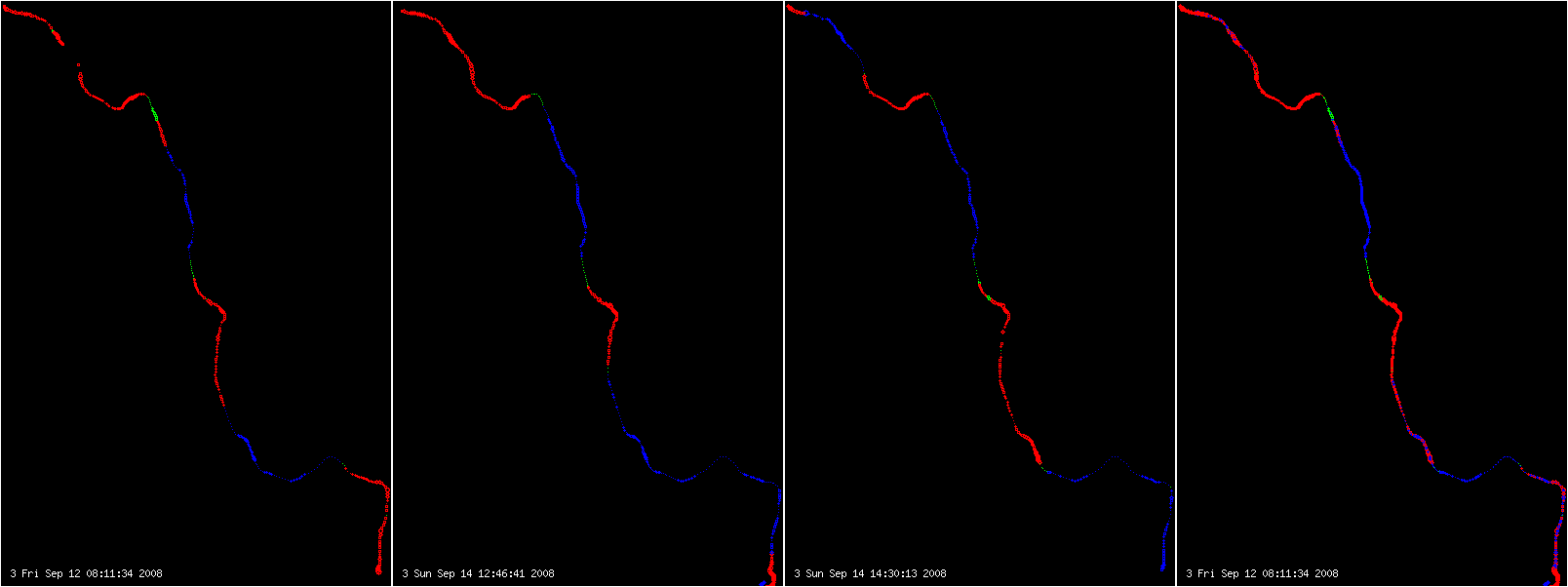
For the past few weeks I've been trying to work out which "mobile broadband" provider to go with for my daily commute. It's a train journey from the north coast of Northern Ireland to Belfast and goes through some sparsely populated areas, so I wasn't expecting to get anything that would provide 3G all the way. However I do want a provider that can do their best to keep a session up for the journey, handing over between 2G + 3G as necessary. Coverage maps/checkers aren't too bad if you just want to check a static point, but really even then it's better to actually try the provider in the location yourself. So, armed with a bluetooth GPS (Bl eNEXT BN-909GR), an Option GT 3G Quad PCMCIA card and my laptop I set about measuring signal strength along my train journey for each of the 5 providers available. I also made sure to actually try a session with them for at least one journey, because signal strength is not everything.

I wrote some Perl using Net::GPSD and Device::Gsm to query my current location, signal strength, 2G/3G status and network every 10 seconds. I did this for 3 train journeys (except for O2) and then also produced an "optimistic" file of all the data points combined for that provider.

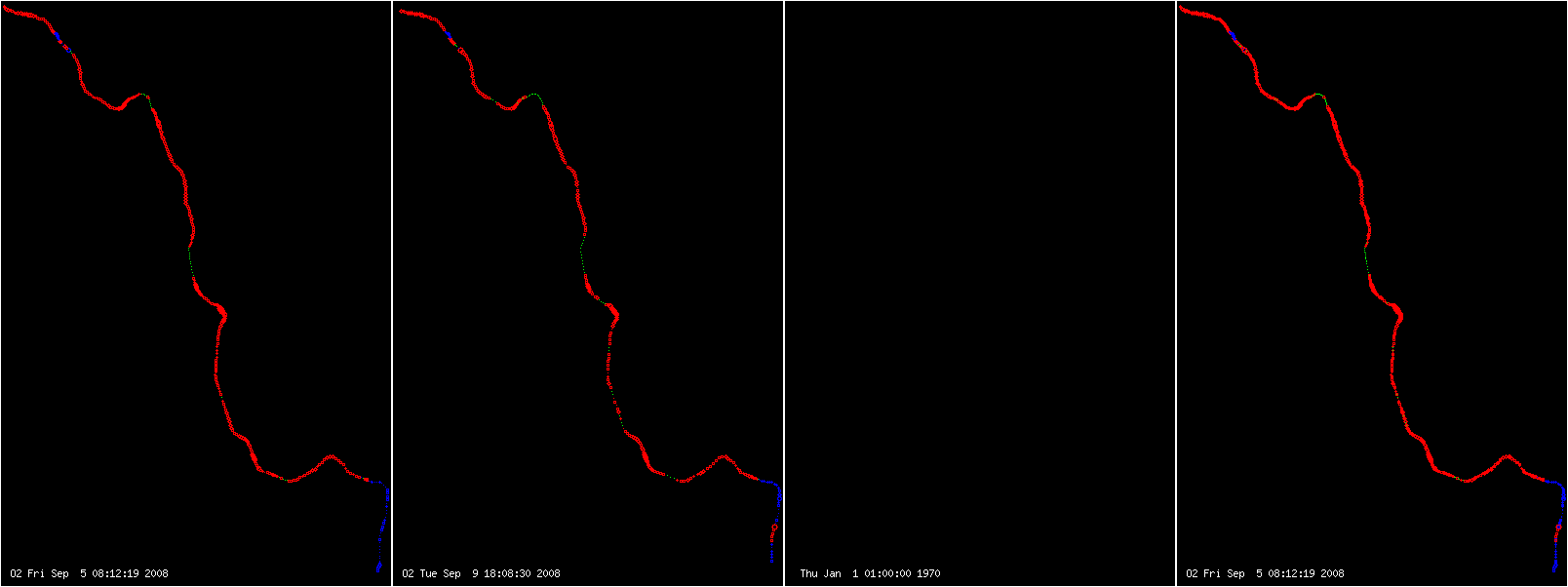
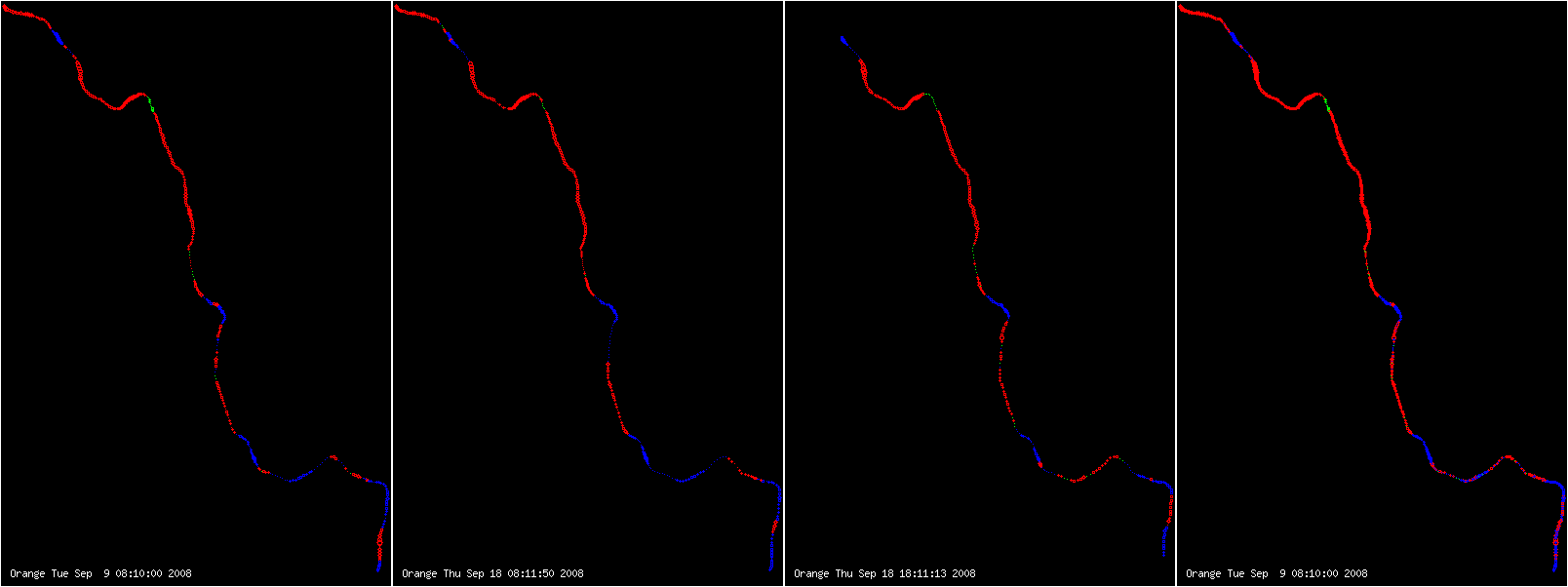
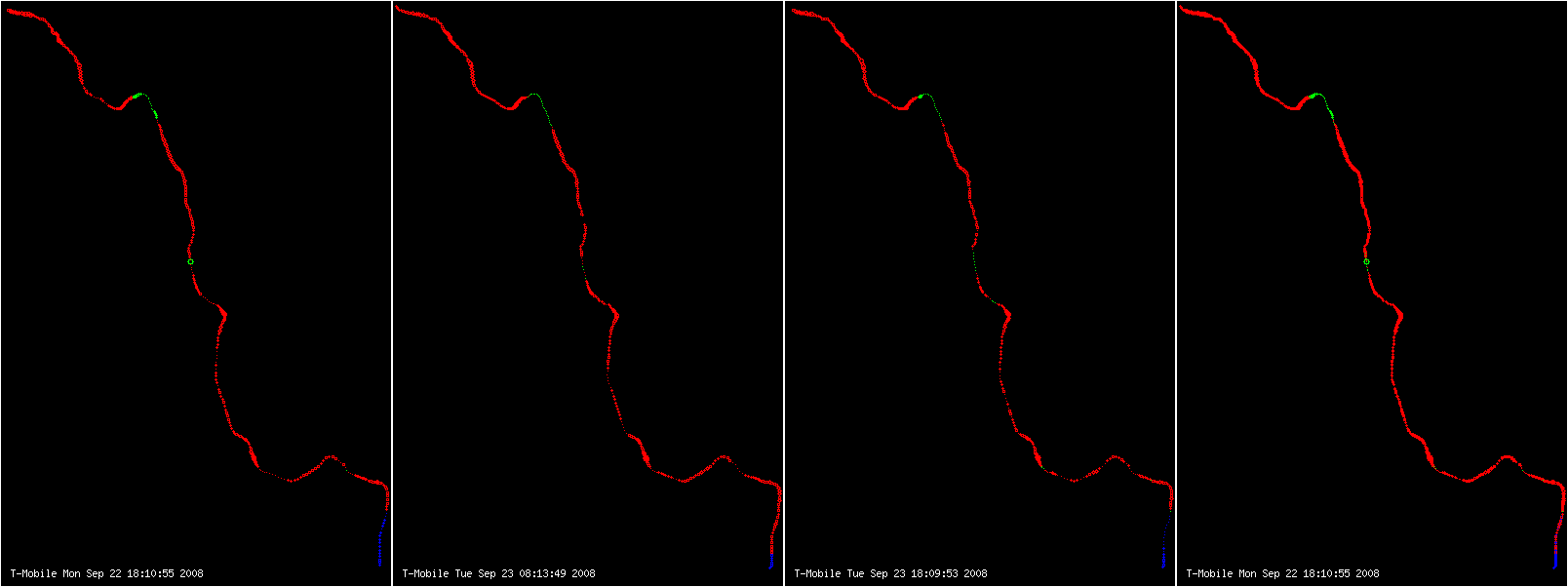
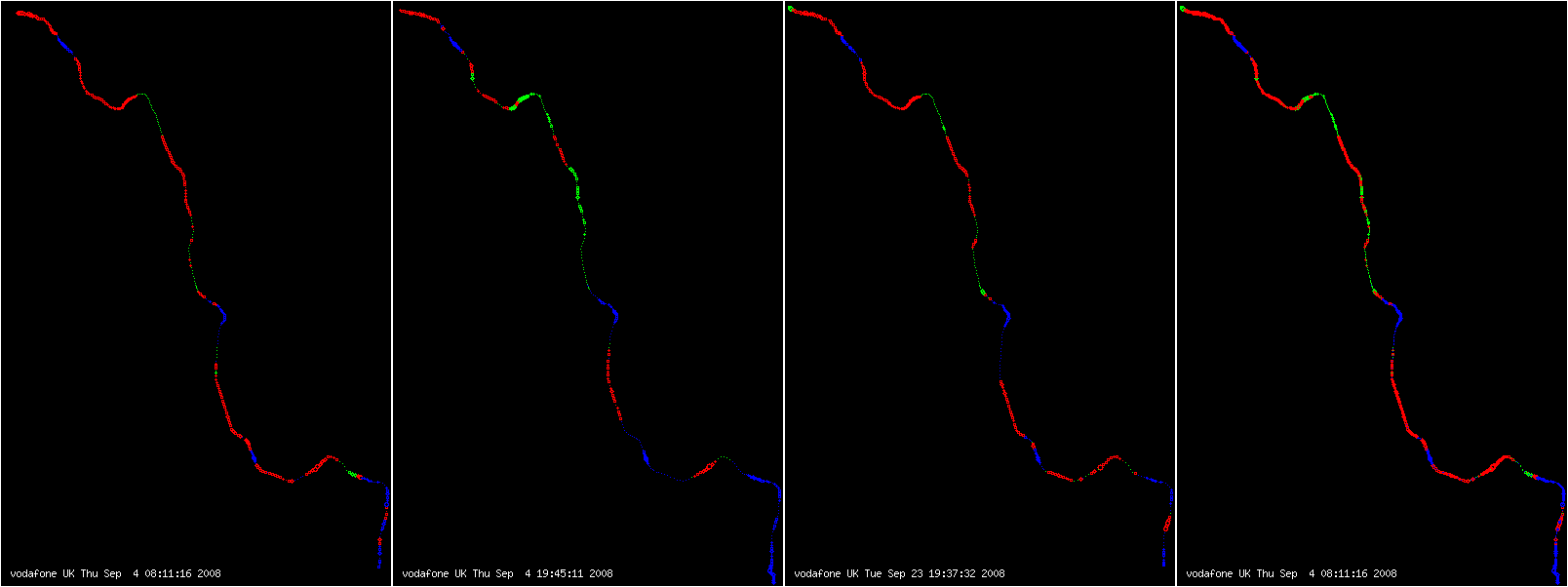
A second piece of Perl took this data and drew the maps you see below. The graph on the right for each provider is all data points. Red means 2G, blue means 3G, green means "Limited Service" (ie it could see a signal, but not one it was allowed to connect to). White means that we had a GPS location and no signal at all. Click on the maps for bigger versions. You can see the route on OpenStreetMap - my graphs are a little squished horizontally, but the journey is from Castlerock (top left on the coast near Coleraine) to Belfast (bottom right).

3
O2
Orange
T-Mobile
Vodafone

At first glance 3 look to be the best bet. Lots of blue, a reasonably priced data plan. Except they can't hold up a session to save themselves. Not only does a 2G/3G handover almost always seem to result in a drop, but I had periods of failing to get a 2G session up at all and had some random drops while in 3G coverage as well. So strike them off.

O2 and T-Mobile don't manage any 3G outside Belfast (that's the bottom right corner btw). I found that a few periods of 3G along the journey helped a lot; it meant I could do a quick mail sync rather than the long drawn out affair it was on a 2G connection. They can both handle handover between 2G/3G and keep a session up for most of the journey, but the lack of speed counts them out.

Vodafone managed the worst reception, which is disappointing. I found them quite good when I lived in England (my datacard is from a Vodafone Pay as You Use data contract). I did find sessions being dropped during the no signal regions, so they just don't seem to be a good bet.

Which leaves Orange. I've had issues with Orange and data in the past (pre 2004 IIRC) but in testing they were able to keep a session up between Belfast and Castlerock, handling 2G/3G handover fine. Coverage was reasonably good and they manage 3G at several points along the journey (the blue points roughly correspond to Coleraine, Ballymena, Antrim and Belfast). I understand Orange have some EDGE capability, but my card doesn't do EDGE so I've no idea if that'll be an extra gain or not. I had a few issues with getting dud DNS servers but this happened with the other providers too so I was beginning to suspect the datacard of playing up. Manually setting known good servers in resolv.conf worked fine.

So, before I go and sign up to an 18 month Orange contract, what have I forgotten?

27 September 2008

Adeodato Sim : A good window manager for me?

For some time now I’ve been wanting to find a window manager that allows me to improve my current “implementation” of my workflow. I currently use KWin. Since I’m a bit overwhelmed by the number of window managers available, some of them being perhaps too flexible, and since what I want is very, very specific, I thought I’d go for a lazy-web post. My workflow is simple: I don’t do tiling, and my sole wish is that a simple key combo (Mod + one letter) can activate the window designated by that combo. Ideally I can statically assign combos to each application (or, in general, window properties) from the configuration file, but I can also use a special combo to change on-the-fly the current keybindings for a particular window. At the moment I’m “faking” this with several methods combined: In my new world, I’d be able to just type Mod+M to activate Minirok, Mod+A to activate Akregator, Mod+B for the browser, and several others keybindings for each instance of my terminal emulator (one for my -release work, one for my ongoing Uni work, another for my ongoing programming work). I really, really want that’s it’s just one Mod plus a key, because I’m convinced that’d work out very well for me (though it should offer a way to cycle among all windows as well). As for the rest, ability to display Kicker (KDE’s panel) gracefully would be a plus. Please mail me with your suggestions, but I’d appreciate if you could include pointers to the relevant parts of the documentation, or even examples, of how to accomplish what I want. I’ve tried eg. awesome 3, and I only managed to get lost in Lua-land.

26 September 2008

Christian Perrier: Painful shoulder

This week, I sufferred and still suffer from a very painful left shoulder, which handicaps me for most activities. That happened when I falled during one of my regular runs, after hitting a stone on the floor. I probably falled right on my left shoulder and, since then, it is more and more painful. This is indeed an encore of something that happened already in July when I had a very bad fall while running in the woods, because of a stupid low-level fence meant to keep boars outside the forest. I unfortunately suspect a broken shoulder or so. No run for this week-end, then. Sad, as I was indeed on my way back to long distance runs (22km last week) in an attempt to break the 30km barrier until the end of the year. I'm even handicapped for typing on my keyboard which, as my wife says, should be the final argument to bring me to a doctor and have rido exams....(I hate seeing doctors!).

25 September 2008

Holger Levsen: RC bug a week - week 4+5

The last two weeks I've been too busy to do much work for the release or blog about my and our efforts to get lenny out of the door. Two weeks ago we were at 144 RC bugs which are open in lenny and not fixed in sid, today it's 138, thats not much progress :( OTOH, d-i has finally been frozen and the amount of bugs alone is not a good indicator per se, as can be seen with the 500k bug contest ;-)

So, what have I done in the last two weeks regarding the release? I sponsored two uploads, irusian for 497255 and poker-network for 498497, though poker-network was then removed from testing, because it was simply too buggy.

Then I up+downgraded 498852, because it very much sounded RC but then turned out to be unreproducible :-) Last friday I uploaded munin 1.2.6-6 which includes a fix for 494547 an annoying and important bug, leading to a useless mail every 5min...

And today I had fun finally closing 322762 after doing a (delayed-2) NMU to fix 359574, so lenny will not include code refering to /usr/doc anymore, a promise we already gave for woody. Yay.

I shall blog next monday or tuesday again about this and have fixed another RC bug by then. But, then, I will have to do my taxes next week...

24 September 2008

Biella Coleman: Request for Urgent Business Relationshiip

Dear American: I need to ask you to support an urgent secret business relationship with a transfer of funds of great magnitude. I am Ministry of the Treasury of the Republic of America. My country has had crisis that has caused the need for large transfer of funds of 800 billion dollars US. If you would assist me in this transfer, it would be most profitable to you. I am working with Mr. Phil Gram, lobbyist for UBS, who will be my replacement as Ministry of the Treasury in January. As a Senator, you may know him as the leader of the American banking deregulation movement in the 1990s. This transactin is 100% safe. This is a matter of great urgency. We need a blank check. We need the funds as quickly as possible. We can not directly transfer these funds in the names of our close friends because we are constantly under surveillance. My family lawyer advised me that I should look for a reliable and trustworthy person who will act as a next of kin so the funds can be transferred. Please reply with all of your bank account, IRA and college fund account numbers and those of your children and grandchildren to wallstreetbailout@treasury.gov so that we may speedily transfer your commision for this transaction. After I receive that information I will respond with detailed information about safeguards that will be used to protect the funds. Yours Faithfully Minister of Treasury Paulson **** The source of this? A former U of C graduate anthropology classmate. This actually may be the original source, or like all really good spam, somewhat (seemingly at least) sourceless.

Gunnar Wolf: FISOL, Tapachula / OpenStreetMap

I was invited to participate at Festival Internacional de Software Libre (FISOL), in Tapchula, Chiapas. The other invited speakers were Sandino Flores (tigrux), Alexandro Colorado (jza), Eric Herrera (crac), John Hall (maddog) and Fernando Romo (pop), all well-known due to very different contributions to the Free Software movement in Mexico and abroad. Several other people also presented tutorials, but I was not involved in that part, and mentioning one while not the rest would be unfair.
The conference was quite massive - Tapachula is a medium-sized city (~200,000 people) in Mexico's Southernmost point - Sadly, due to its geographical location, it is mainly famous for being the region where illegal immigrants from Central America enter Mexico towards the USA, and it is a known spot for all kind of abuses, both from the authorities and from gangs of thieves.
This is the third time I come to this conference. The first two years (2005, 2006) it was organized by the local CUCS university and it was reasonably large, but this year it counted also with many other universities in the region. Attendance was... HUGE. We were told around 1600 students were registered to participate, and I expect at least 1000 to have actually been there. Very amazing and encouraging!
It is, by far, a base-level conference - Most attendees had had no previous contact with Free Software at all, or had at most toyed around with a distro for some hours. Some people, of course, _are_ already working and involved, on various different degrees. All in all, quite encouraging.
But not only I had fun (and got extremely tired!) at the conference, or at the beer sessions afterwards. I also got to push some more publicity (and work, of course!) towards my new favorite pet project: OpenStreetMap.
As many other Debianers, I joined the fever last August, during Debconf. So far, I have been quite busy tracing and mapping; I am quite fortunate to get the OSM addiction while living on the edge of the well-mapped area of Mexico City. So far, I have mostly worked on the Ciudad Universitaria and Coyoac n areas, where some sensible improvement can be felt. Lots yet to do, for sure, but I'm making progress.
Still, mapping Coyoac n sometimes feels a bit futile. Why? Because all of my cycling/tracing/mapping sessions look almost like a little blip on the overall state of my city, which is way better than what I expected - Most of the central city is done (although lots of work is still pending on the very large outskirts - but getting there can be a trip just by itself!)...
But this time, I had the opportunity to do something new, something better and sensible. And, yes, it feels very good. How does the map of Tapachula look for just a weekend of mapping activity? And, yes, I only went out once (morning running) expressely to get some new traces, the rest of it was while being transported by car to the conference-related activities. And I didn't even have to say once "lets go by a different route"! ;-)
Just for comparison: Last week, Tapachula's state was quite similar to what they have today on Google Maps - Just the major highways in the area. Besides, if you look at the satellite map for Tapachula, I estimate I managed to map around between a fifth and a tenth of the city's surface.
So, have you got a GPS? Do you enjoy going out on the street, be it walking, running, cycling on driving? Or even if you don't enjoy it, are you sometimes forced into it? Start contributing to OpenStreetMap now!

23 September 2008

Jeff Bailey: AM_MAINTAINER_MODE - A decent solution

I don't really know why I found myself looking at the gitweb for automake just now, but I noticed that they've finally committed something I've wanted for a bit (but was, of course, too lazy to code myself)[0]

AM_MAINTAINER_MODE was the subject of huge debate when it first came out. It's the bit that can set itself so that the autotools scripts won't get regenerated even if the source files for those have been touched.

The problem is that by default, that's the wrong thing to do. A developer with the source (which I assume anyone with the source is. Otherwise their distro is probably handling all their compilation needs) *wants* those updates to happen automagically. In a distro, however, it's occasionally necessary to patch the autoconf bits, which means that you're trusting the installed autoconf on either the builder or your machine to consistently do the right thing in an automated fashion. And hopefully leave you with a readable debdiff in the end.

I'm hoping that AM_MAINTAINER_MODE([disabled]) becomes a standard thing to do with autoconf-based packages.

[0] http://git.savannah.gnu.org/gitweb/?p=automake.git;a=commit;h=861c19856121d8e875e30268dee6033ded6fc7ae

Russell Coker: OpenID Delegation

I’ve just installed Eran Sandler’s OpenID Delegation Plugin [1]. This means that I can now use my blog URL for OpenID authentication. I’ve also included the plugin in my Wordpress repository (which among other things has the latest version of Wordpress). One thing that I consider to be a bug in Eran’s plugin is the fact that it only adds the OpenID links to the main URL. This means that for example if I write a blog comment and want to refer to one of my own blog posts on the same topic (which is reasonably common - after more than two years of blogging and almost 700 posts I’ve probably written a post that is related to every topic I might want to comment on) then I can’t put the comment in the URL field. The problem here is that URLs in the body of a blog comment generally increase the spam-score (I use this term loosely to refer to a variety of anti-spam measures - I am not aware of anything like SpamAssassin being used on blog comments), and not having OpenID registration also does the same. So it seems that with the current functionality of Eran’s plugin I will potentially suffer in some way any time I want to enter a blog comment that refers to a particular post I wrote. deb http://www.coker.com.au etch wordpress My Wordpress Debian repository is currently available with the above APT repository. While it specifies etch it works with Lenny too (my blog currently runs on Lenny). I will eventually change it to use lenny in the name. For the OpenID server I am currently using the OpenID service provided by Yubico as part of the support for their Yubikey authentication token [2] (of which I will write more at a later date). I think that running their own OpenID server was a great idea, it doesn’t cost much to run such a service and it gives customers an immediate way of using their key. I expect that there are more than a few people who would be prepared to buy a Yubikey for the sole purpose of OpenID authentication and signing in to a blog server (which can also be via OpenID if you want to do it that way). I plan to use my Yubikey for logging in to my blog, but I still have to figure out the best way of doing it. One thing that has been discussed periodically over the years has been the topic of using smart-cards (or some similar devices) for accessing Debian servers and securing access to GPG keys used for Debian work by developers who are traveling. Based on recent events I would hazard a guess that such discussions are happening within the Fedora project and within Red Hat right now (if I worked for Red Hat I would be advocating such things). It seems that when such an idea is adopted a logical extension is to support services that users want such as OpenID at the same time, if nothing else it will make people more prone to use such devices. Disclaimer: Yubico gave me a free Yubikey for the purpose of review. Update: The OpenIDEnabled.com tool to test OpenID is useful when implementing such things [3].

David Welton: Caveat Emptor Dominium

Ok, my apologies, the Latin is incorrect, but the idea is this: I have run into an important limitation of Google's domain registration system. Buyer beware. Lately, I have been using Google Apps to register domains. At $10 a year for new domains, which come with all the nifty Google applications, email and so on, it's a really good deal. However, there appears to be a potentially crucial problem: you can't sell or transfer the domains, as far as I can tell. I would love to hear that I am wrong on this, but the person helping me through Google's support channel first told me to "enter the new credit card details in the Google Checkout account associated with the domain". Uh, sorry, but I want to transfer the whole thing, lock, stock and barrel. After another round of email, I got this:
To assign a different Google Account to the subscription you'll need to modify your billing information by following the steps listed below:
  • Enable automatic renewals for your account.
  • When you receive email notification of the impending charge, visit the link to the 'Ordering page.' - Authorize a new purchase for your domain registration renewal. This will replace the old subscription and charge your new billing information on the subscription expiration date. Automatic renewals will also be enabled going forward.
If you don't have automatic renewals enabled, your email notification won't include an 'Ordering page' link to change the Google Checkout account and purchase or renew Google Apps. You must first enable auto-renew to be sent this link.
I don't want to have to wait for the email notification, though! The domain won't be automatically renewed until sometime next spring. Hopefully this is either an oversight on my part or something Google will fix soonish, as buying a domain name that you can't sell or otherwise give to someone else is of very limited use for some things. No, I haven't gone into business as a domain name speculator/squatter, the domain in question is InnsbruckExpats.com, a site I registered for a friend a bit more than a year ago.

22 September 2008

Adam Rosi-Kessel: An Annotated Guide to the Financial Meltdown (Podcast Edition)

I don’t have the expertise to intelligently explain the entire global financial meltdown myself, but here are a few resources that merit wide dissemination, especially if you are a podcast-listener:
Thinking the bailout through What is this bailout supposed to do? Will it actually serve the purpose? What should we be doing instead? Let s talk. First, a capsule analysis of the crisis. 1. It all starts with the bursting of the housing bubble. This has led to sharply increased rates of default and foreclosure, which has led to large losses on mortgage-backed securities. 2. The losses in MBS, in turn, have left the financial system undercapitalized doubly so, because levels of leverage that were previously considered acceptable are no longer OK. 3. The financial system, in its efforts to deleverage, is contracting credit, placing everyone who depends on credit under strain. 4. There s also, to some extent, a vicious circle of deleveraging: as financial firms try to contract their balance sheets, they drive down the prices of assets, further reducing capital and forcing more deleveraging. So where in this process does the Temporary Asset Relief Plan offer any, well, relief? The answer is that it possibly offers some respite in stage 4: the Treasury steps in to buy assets that the financial system is trying to sell, thereby hopefully mitigating the downward spiral of asset prices. But the more I think about this, the more skeptical I get about the extent to which it s a solution. Problems: (a) Although the problem starts with mortgage-backed securities, the range of assets whose prices are being driven down by deleveraging is much broader than MBS. So this only cuts off, at most, part of the vicious circle. (b) Anyway, the vicious circle aspect is only part of the larger problem, and arguably not the most important part. Even without panic asset selling, the financial system would be seriously undercapitalized, causing a credit crunch and this plan does nothing to address that. Or I should say, the plan does nothing to address the lack of capital unless the Treasury overpays for assets. And if that s the real plan, Congress has every right to balk. So what should be done? Well, let s think about how, until Paulson hit the panic button, the private sector was supposed to work this out: financial firms were supposed to recapitalize, bringing in outside investors to bulk up their capital base. That is, the private sector was supposed to cut off the problem at stage 2. It now appears that isn t happening, and public intervention is needed. But in that case, shouldn t the public intervention also be at stage 2 that is, shouldn t it take the form of public injections of capital, in return for a stake in the upside? Let s not be railroaded into accepting an enormously expensive plan that doesn t seem to address the real problem.
If our regular discourse looked like this, I’m pretty sure we would have never ended up with this mess.
Finally, the On the Media podcast shows how the media is now actually doing a fairly decent job covering current financial events (having thankfully dropped the pig-makeup stories!), although it was apparently mostly asleep at the wheel in the events leading up to the crash. E.g.:
Actually, a couple of very interesting examples of false balance. Back in the day and no one remembers but back in 2003, New York had an [LAUGHS] attorney general named Eliot Spitzer. And he was going to war with the comptroller of the currency, and the war was over whether or not New York State anti-predatory lending laws could apply to nationally chartered banks. What happened was that almost all the states attorneys-general picked up on this issue and this is 2003, 2004 [LAUGHS], 2005 and they’re seeking to rein in nationally chartered banks and their lending practices in the subprime category. The press, predictably, and kind of shamefully, I think, treated this as some sort of ping-pong match between Eliot Spitzer and the Bush Administration. I’m telling you, beneath the fight between officials there were a lot of signs that something was sort of rotten going on between lenders and borrowers. That s a pretty good, you know, sort of smoke signal to the press to go out and explore the issue more deeply, and they really didn’t.
Technorati Tags: , , , , , ,

Tollef Fog Heen: Collaborative editing, Emacs and D-Bus

A little while ago, I discovered Emacs has D-Bus support now. I wanted to play around with it, and I discovered Alban's collaborative editing page. It seems like Emacs's D-Bus documentation is somewhat lacking, though CVS has some more docs. Alban's work seems to need a well-known name, something Emacs can't yet do, so I'll probably add a method to text-remote-control where any app can register and say "Hi, I support your interface" as I think this makes more sense. I don't have any code that does anything useful yet, but once text-remote-control is fixed, I don't think that's very hard.

Next.

Previous.