Search Results: "ms"

3 June 2014

Daniel Pocock: Click to dial for mobile users of your web sites

If there was a trivial way to let mobile phone users call you from your web site, just by adding a single HTML element to the page, would you do it? In fact, there is. It doesn't even require a mobile WebRTC browser. It works for virtually any smartphone and a growing number of desktops too. Introducing the tel: URI The tel: URI is defined in RFC 3966. For most mobile phone users, if they click a link to a tel: URI, their browser will copy the link into their dialer for convenience. To protect users against calls to 0900 premium rate numbers, the user still has to make one more click to confirm they want to dial. Examples Here is a tel: URI:

tel:+44-20-7135-7070
Here is how to create a link with it: <a href="tel:+44-20-7135-7070">020 7135 7070 (from abroad: +44 20 7135 7070)</a> and here is how it looks on the page:
Call me on 020 7135 7070 (from abroad: +44 20 7135 7070)
(Note: some planet aggregation sites block the link in the example) and here is what appears on the mobile device after a user clicks the tel: URI link: For desktop users too Many desktop users can also benefit from tel: URIs. If they have a modern telephone system in their office, the system administrator may have already added a tel: URI handler to their desktop. Anyone with a software PBX or a SIP account can also potentially use the TBDialOut extension for Thunderbird to help convert address book phone numbers into tel: or sip: URIs or even URLs for some bespoke dialer. For those who want extra convenience, the Telify extension for Firefox will look for phone numbers in any HTML page and display them as tel: URIs so you can click them even if the web developer overlooked this.


2 June 2014

Rapha&#235;l Hertzog: My Free Software Activities since January 2014

If you follow my blog closely, you noticed that I skipped all my usual monthly summaries in 2014. It s not that I stopped doing free software work, instead I was just too busy to be able to report about what I did. As an excuse, let me tell you that we just moved into a new house which was in construction since may last year. The lack of visible activity on my blog resulted in a steady decrease of the amount of donations received (January: 70.72 , February: 71.75 , March: 51.25 , April: 39.9 , May: 40.33 ). Special thanks to all the people who kept supporting my work even though I stopped reporting about it. So let s fix this. This report will be a bit less detailed since it covers the whole period since the start of the year. Debian France Preparations related to general assemblies. The year started with lots of work related to Debian France. First I took care of setting up limesurvey with Alexandre Delano to handle the vote to pick our new logo:

The new logo of Debian France I also helped Sylvestre Ledru to finalize and close the accounting books for 2013 in preparation for the general assembly that was due later in the month. I wrote the moral report of the president to be presented to the assembly. And last step, I collected vote mandates to ensure that we were going to meet the quorum for the extraordinary assembly that was planned just after the usual yearly assembly. The assemblies took place during a two days mini-debconf in Paris (January 17-18) where I was obviously present even though I gave no talk besides announcing the logo contest winner and thanking people for their participation.
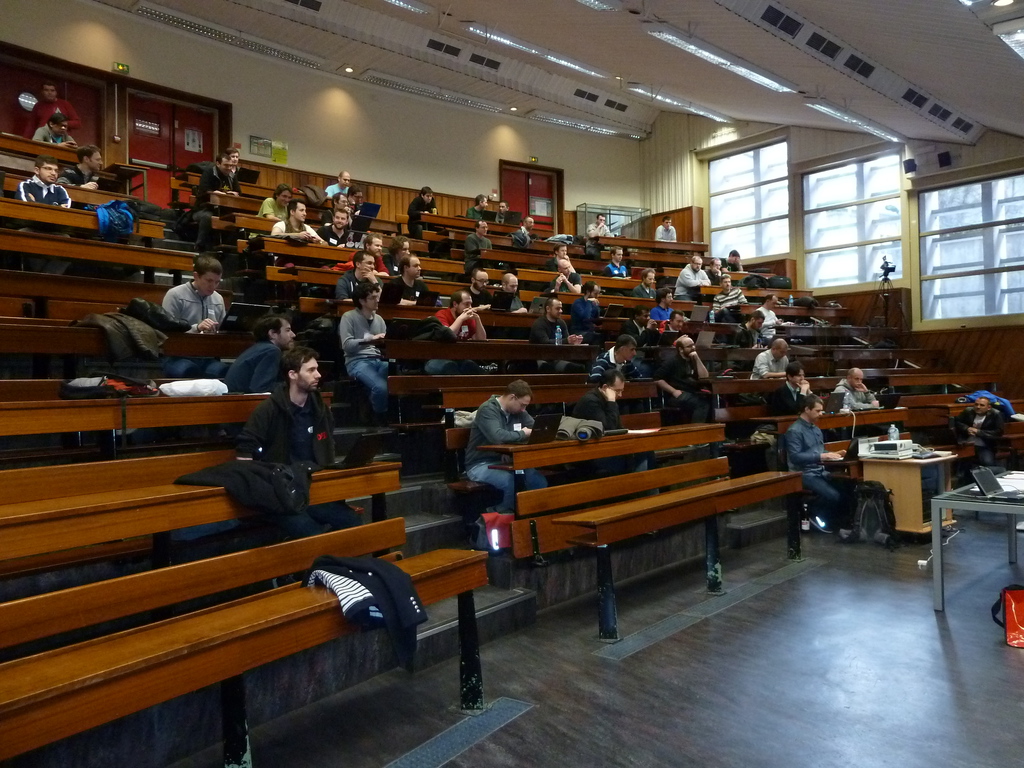
Assembl e g n rale 2014 de Debian France

The Debian France members during the general assembly

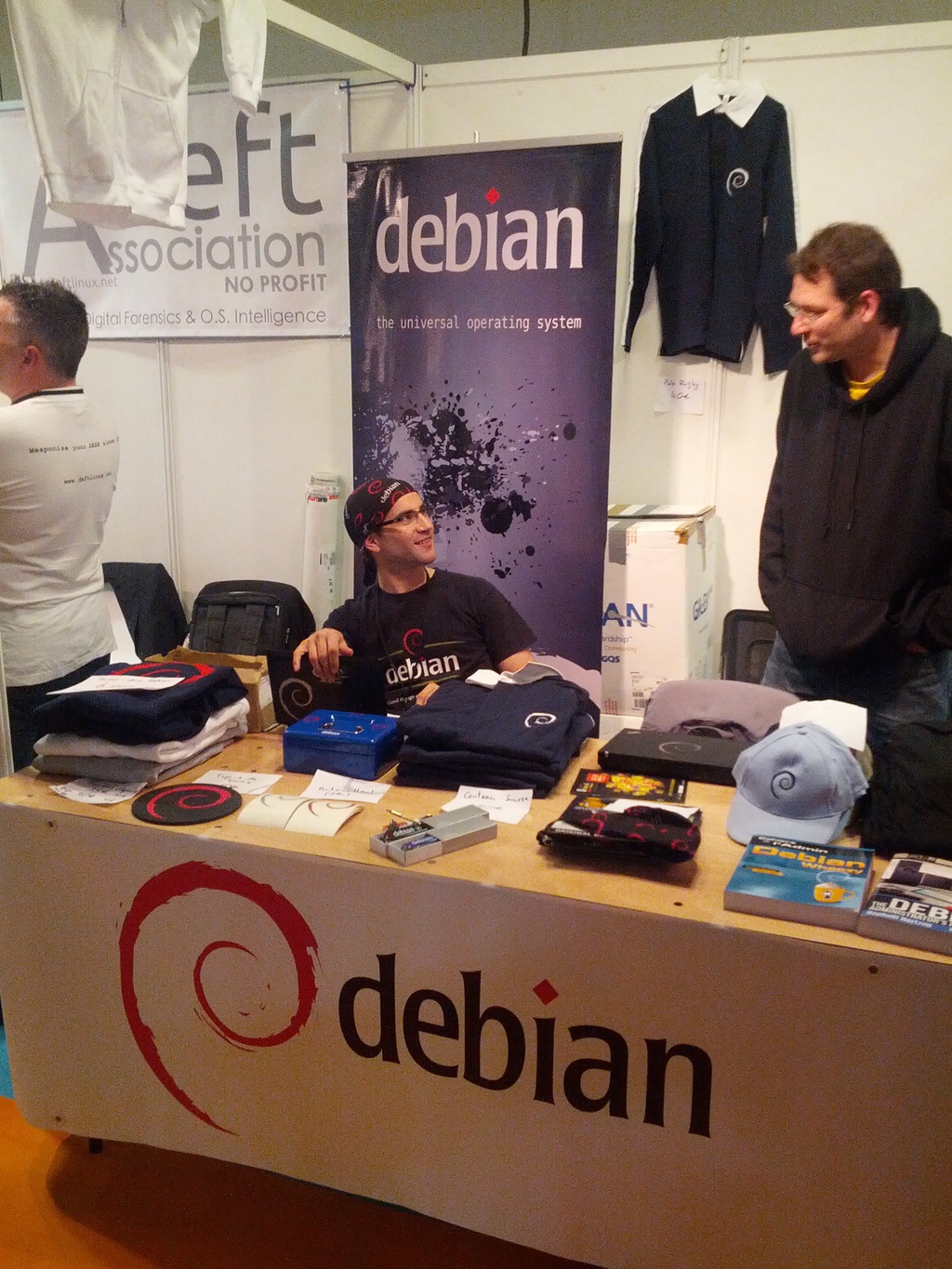
It s worth noting that the extraordinary assembly was meant primarily to enshrine in our bylaws the possibility to act as a trusted organization for Debian. This status should be officialized by the Debian project leader (Lucas Nussbaum) in the upcoming weeks since we answered satisfactorily to all questions. Our paypal donation form and the accounting tools behind it are ready. Galette packaging and members map. I managed to hand over the package maintenance of galette to Fran ois-R gis Vuillemin. I sponsored all his uploads and we packaged a new plugin that allows to create a map with all the members who accept to share their location. The idea was to let people meet each other when they don t live far away with the long term goal to have Debian France organized activities not only in Paris but everywhere in France. New contributor game. Last but not least, I organized a game to encourage people to do their first contribution to Debian by offering them a copy of my book if they managed to complete a small Debian project. We got many interesting projects but the result so far seem to be very mixed. Many people did not complete their project (yet) that said for the few that did substantial work, it was rather good and they seem to be interested to continue to contribute. Debian France booth at Solutions Linux in Paris. Like each year, I spent two days in Paris to help man the Debian France booth at Solutions Linux. We had lots of goodies on sale and we made more than 2000 EUR in earnings during the two days. I also used this opportunity to try to convince companies to support the new Debian LTS effort.
Debian France booth at Solutions Linux

Tanguy Ortolo and Fernando Lagrange behind the Debian France booth

The Debian Administrator s Handbook In the last days of 2013, we released the wheezy update of the book. Then I quickly organized everything needed so that the various translation teams can now focus their efforts on the latest release of the book. Later (in February) I announced the availability of the French and Spanish translations. Debian Squeeze LTS When the security team called for help to try to put in place long term support for Squeeze, I replied positively because I m convinced that it s very important if Debian wants to stay an acceptable choice in big deployments and because I knew that some of my customers would be interested Thus I followed all the discussions (on a semi-private list first and then on debian-lts@lists.debian.org) and contributed my own experience. I have also taken up the responsibility to coordinate with the Debian contributors who can be hired to work on Squeeze LTS so that we have a clear common offer for all the companies who have offered financial support towards Squeeze LTS. Expect further news on this front in the upcoming days/weeks. Tryton I have been a long time user of SQL-Ledger to manage the accounting of my company Freexian. But while the license is free software, the project is not. It s the work of a single developer who doesn t really accept help. I have thus been considering to move to something else for a long time but never did anything. This year, after some rough evaluation, I decided to switch to Tryton for my company. It s probably not a wise choice from a business perspective because that migration took me many hours of unpaid labor but from a free software perspective it s definitely better than everything else I saw. I contributed a lot of bug reports and a few patches already (#3596, #3631, #3633, #3665, #3667, #3694, #3695, #3696, #3697) mainly about problems found in the French chart of accounts but also about missing features for my use case. I also accepted to sponsor Matthias Berhle, who is maintaining the official Debian packages of Tryton. He s already a Debian maintainer so it s mainly a matter of reviewing new source packages and granting him the required rights. Misc Debian work Thanks See you next month for a new summary of my activities.

2 comments Liked this article? Click here. My blog is Flattr-enabled.

B lint R czey: I Can Hear Music again (thanks to forked-daapd/Debian)

When I started looking for a lightweight solution of serving a music library over LAN I did not expect so many complications. I expected it not to be a unique need to have something running on a SheevaPlug straight from the Debian repository. Apparently it kind of was. Debian used to have mt-daapd (popcon: 165), but now it is available from oldstable only and upstream is dead. There is tangerine (popcon: 98) with its Mono dependencies and GUI which seemed to me overkill and more like a demo of a networked application written in Mono than a music library server. The most promising candidate was forked-daapd (popcon: 220) but it was far from being a true winner. First, it had a series of dead upstreams. At the beginning it was forked from mt-daapd (hence the name) by Julien Blache who also served as the prior Debian maintainer. Then the code base was forked and converted to use Grand Central Dispatch. Then the GCD fork died off slowly as well a few years ago. When I found the package it had been unmaintained for a few years and was based on the GCD branch which prevented building it on many architectures and the server itself was crashing or quitting occasionally. Luckily there still existed a fork thanks to Espen J rgensen which was well maintained and could serve as a way out but examining it closely it turned out that it had switched to libevent from GCD but to a version (1.4) which is present only in oldstable! And some say Debian s software versions are ancient ;-). Moreover it was not simply libevent 1.4-based, but it included some heavily patched parts of it. Espen also liked the idea of packaging his version in Debian and we extracted the patches to libevent and slowly got them accepted to libevent s master. Forked-daapd s master works best with libevent 2.1.4-alpha, but thanks to Espen the development branch now also works with libevent 2.0.x giving up some performance and a little feature. This was a long journey, but finally Espen s forked-daapd became ready for being used as a new upstream of the Debian package thus please welcome 20.0+git20140530+gc740e6e-1, the first version of forked-daapd building on all architectures for a very long time and a prime candidate for being the music library server in Jessie (and wheezy-backports, soon)! Testing, bug reports are always welcome! From the package description:
 forked-daapd is an iTunes-compatible media server, originally intended
 as a rewrite of Firefly Media Server (also known as mt-daapd).
 It supports a wide range of audio formats, can stream video to iTunes,
 FrontRow and other compatible clients, has support for Apple's Remote
 iPhone/iPod application and can stream music to AirTunes devices like
 the AirPort Express.
 It also features RSP support for Roku's SoundBridge devices.
 Built-in, on-the-fly decoding support enables serving popular free music
 formats like FLAC, Ogg Vorbis or Musepack to those clients that do not
 otherwise support them.

Bernhard R. Link: beware of changed python Popen defaults

From the python subprocess documentation:
Changed in version 3.3.1: bufsize now defaults to -1 to enable buffering by default to match the behavior that most code expects. In versions prior to Python 3.2.4 and 3.3.1 it incorrectly defaulted to 0 which was unbuffered and allowed short reads. This was unintentional and did not match the behavior of Python 2 as most code expected.
So it was unintentional it seems that the previous documentation clearly documented the default to be 0 and the implementation matching the documentation. And it was unintentional that it was the only sane value for any non-trivial handling of pipes (without running into deadlocks). Yay for breaking programs that follow the documentation! Yay for changing such an important setting between 3.2.3 and 3.2.4 and introducing deathlocks into programs.

Daniel Pocock: Fixing WebRTC dropouts

A few people have observed dropouts using WebRTC, including the new Debian community service at rtc.debian.org I've been going over some of these problems and made some improvements. If you tried it before and had trouble, please try again (rtc.debian.org is running with some of the fixes already). If anybody else has seen these problems or continues to experience them, please let the reSIProcate community know about it through the repro-users mailing list. WebSocket link disconnects immediately when call starts In this case, you may see the picture of the other person for a split second and then the websocket link disconnects and JSCommunicator re-initializes itself. People observing this problem had sometimes found that audio-only calls would work more frequently. I believe one reason for this problem has been some incorrect handling of the OpenSSL error queue. I posted my observations about this on the resiprocate developer's list and included a fix for it in the recent 1.9.7 release. Call starts, no remote picture appears, call stops after 20 seconds or so In this case, if you look closely in the JavaScript console, you may see that one of the endpoints has sent a SIP BYE message. A BYE message usually includes a reason such as this: Reason: SIP ;cause=200; text="RTP Timeout"
This particular reason (RTP Timeout) may indicate that the TURN server is faulty, not running at all or is not reachable due to one or both users being behind a firewall. If you experience this problem but some other reason code appears, please share your observations on the repro-users mailing list so it can be improved. For those people who have firewall problems, this will eventually be resolved when the browsers support TURN over a TLS connection through a HTTP proxy. We also hope to provide better feedback in the JavaScript UI of JSCommunicator to tell people their call was blocked by a firewall.

Francesca Ciceri: 100 bugs triaged: achievement unlocked

After two weeks working as OPW intern for Mozilla, it's time for a recap!
What exactly I've been doing in these two weeks? 100 bugs triaged: achievement unlocked! Yes, this is the thing I'm most proud of. I'm a bit cheating here, as strictly speaking, since the beginning of the internship I've triaged only 44 bugs.
But I've decided to count from the beginning of my activity on bugzilla, at the end of March, since I've started work on that as part of the small contribution required for applying to OPW.
Therefore, it's all OPW related :) Here's the grand total. Right now, I've decided to work on an average of 5 bugs a day: it's mostly triage and/or verification, which is quite fun.
It consists in trying to have a more complete and detailed bug report for the developers: asking the right questions to the reporter, ensuring that the bug is filed against the right product or component and all the information about platforms and version are correct. Or verifying that the bug isn't a duplicate, which involves doing some voodoo with Bugzilla quicksearch (I'm not so good with that yet, mostly because I'm not imaginative enough in the queries... but I'm getting better!) Sometimes triaging means reading lots of documentation (to be sure that something is a bug and not a feature) and checking meta-bugs and release notes to be able to pinpoint the time when something was introduced and the reasoning behind it.
That takes a lot of time, but it makes you discover some funny things, like the Mighty Bouncing Unicorn. And while I know it sounds a bit cruel, it's really good when you're verifying a fix and you find it's not totally ok, or that it triggered another bug.
I've been assured that feeling satisfied after that it's an essential part of the sadistic QA work. Writing FAQs for new triager This started as a personal project even before knowing I've been selected for OPW, and it's now part of my internship: I've been writing a first draft of FAQ for those who approach for the first time the Bug Triaging and Verifying work in Mozilla. It meant taking a whole lot of IRC logs and scan them for the most asked questions during bugdays, and you can find here my first draft. I'll send a RFC today about it on dev-quality mailing list and link it to the main Bugdays page. Lessons learned So, what I've learned in these two weeks? That I'm pretty good at figuring things alone, but I like to have feedback on what I'm working on.
That testing things is an art, and perfectionism is a big plus.
That there are such things as stupid questions, but you have to ask them nonetheless.
That people in the Mozilla community are quite friendly and not scary at all. Not even in video! :) Wishlist I've been thinking about this a lot, and I think I'd like to have They will probably become my next pet project.

Russ Allbery: Review: Debt

Review: Debt, by David Graeber
Publisher: Melville House
Copyright: 2011, 2012
Printing: October 2012
ISBN: 1-61219-129-0
Format: Trade paperback
Pages: 453
You probably remember this story from introductory economics. Originally, people exchanged things through barter. I needed grain but had a cow. You had a farm but needed milk. I gave you milk for your grain. But this was tedious and awkward, and required finding the right combination of people who needed something the other person had on hand. Then, people invented money: small objects with an agreed-upon value that you could keep and use later when you needed something else. In other words, both a medium of exchange and a store of value. And that improved matters for a long time, although war-torn societies or societies that collapsed (the supposed "Dark Ages" often raises its head) would sometimes "revert to barter" for some period of time until things were stable enough for currency to reappear. Following that story was usually some story about the emergence of money based on credit: goldsmith shops that started a side business in storing other people's coins and giving them receipts, leading to the receipts trading like the coins since the shops were trustworthy, and from there into the Bank of England and eventually the fractional reserve banking system, fiat money, and all the modern machinery of finance. All of this was dated from the early Enlightenment and the development of modern finance in Europe. It's a very neat story, and it makes a great deal of intuitive sense. That barter system does feel like what you'd have to do without money, but one can immediately see how obnoxious and limiting it would be. These stories play into our intuitive sense of history: people started with emergent properties of the physical world (different people have different goods and different skills and want to exchange them) and then develop layers of abstraction on top of them, eventually leading to the sophistication of modern societies. However, David Graeber is not an economist. He's an anthropologist: the profession devoted to understanding how people actually do things rather than how we've reconstructed our history based on our modern perspective. And, as he points out, engagingly and comprehensively, in chapter two of Debt, there is no evidence that this story about economic history has anything whatsoever to do with reality. And quite a bit of evidence that it does not. As best as we've been able to determine, not only is there no society in the world that deals with routine, day-to-day needs like grain and milk through barter, there never has been such a society in human history. Instead, history and anthropology shows that credit is, in a sense, older than currency: the earliest recorded economic transactions were built on a rich system of credit, but in the form of purchases from shopkeepers on credit, or credit clearinghouses through the local government or temple. Those credit records were often denominated in some standardized commodity so many cattle or bushels of grain that could create the impression that the economy worked on barter. But the anthropological evidence indicates that this was more an accounting technique than a practical currency. People rarely brought the named commodity to the temple to pay off some debt. Rather, there was an agreed conversion from various other goods to that standardized commodity, and its primary purpose was consistent bookkeeping. Specie minted coins appear to come later, and wax and wane throughout history depending on local circumstance. For example, Europe did not "revert to barter" after the collapse of the Roman Empire, but the inhabitants did stop using specie and returned to a system of credit and record-keeping... records that continued to be denominated in Roman currency, even though few people still used the actual coins. That's one fascinating observation with which Graeber begins this book. The other is the question of why we have such a strong social and moral belief that people must pay their debts. This moral belief is ever-present in discussions about the 2008 financial collapse, and more broadly in discussions about the modern economy, but it's not as obvious of a belief as it might appear on the surface. After all, the banking and investment system is founded on the principle that not everyone will repay their debts, and therefore lenders receive a risk premium based on the likelihood that the debt won't be repaid. But, despite building the possibility of non-repayment into the system, debt forgiveness or intentional default is almost unthinkable and considered a huge moral problem. To this, Graeber brings the perspective of historical anthropology: human societies have struggled with the problems of debt and repayment from the beginning of recorded history, and have attempted a wide variety of solutions to those problems, including massive debt forgiveness. The jubilee described in the Bible was not novel; rather, it reflected a common practice to keep abuses of debt under control in ancient Sumer. The subtitle of Debt is The First 5,000 Years, and this book is a historical survey. But Graeber puts off the history to first lay an intellectual groundwork for our understanding of debt, and I found that preliminary discussion extremely valuable. Most memorable was the way Graeber divides human economic relationships into communism (in the old sense, not the political sense), exchange, and hierarchy. Capitalism has consumed our economic analysis to such a degree that exchange is the only economic basis that gets much discussion, but the other two are both obvious and pervasive once Graeber points them out. Human civilization could not exist without all three. And Graeber also points out one aspect of exchange-based economics that had not previously occurred to me: it's the economic relationship that one creates with strangers. Debt has the unique characteristic that it can be discharged, at which point the relationship ceases. This has far more complex and far-reaching moral and social implications than one might initially realize, and Graeber did a wonderful job opening my eyes to some of the subtleties. Debt is clearly a scholarly work, but Graeber's writing is clear and engaging. I found most of this book to be surprisingly easy reading. The hardest going was Graeber's discussion of societies that use a form of currency to arrange relationships between people (marriages, births, and deaths, primarily), but not day-to-day economic transactions. I suspect this area is closer to Graeber's areas of personal research and field work, which resulted in more technical detail. I'm still not sure I completely grasp the principles that Graeber was trying to communicate. But I was struck by the observation of alienation's role in turning a human being into a commodity, and how that links with debt's role as the economic transaction one has with strangers. Graeber covers slavery only glancingly, but makes some memorable points about the use of violence to rip someone out of their social context, and how that is necessary in human cultures before humans can be reduced to a commodity. There's a lot here, and I've only scratched the surface. I haven't mentioned, for example, the fascinatingly elegant theory that coining money and then requiring taxes be paid in the same money is a simple and highly effective way of funding armies, an explanation for specie that is largely unproven but that I find more compelling than the ones I've previously heard. Approaching debt from an anthropological instead of economic perspective is surprisingly enlightening. Debt is primarily a historical and cultural discussion rather than a set of proposed solutions, but Graeber does effectively show that debt as a moral obligation is not an unquestionable moral stance, but rather has a long history as one side of a two-sided political debate. I also came away from this book more conscious of the social implications and costs of debt-structured interactions, and wanting to push more of the language of debt out of my day-to-day dealings. Graeber is well known as one of the supporters of Occupy Wall Street, and Debt, while a well-defended academic work, certainly does advocate a position. But the academic analysis is more prominent than the advocacy, and I found his positions well-defended and well-argued. I do need to give the caveat that I don't have the anthropological background to distinguish the statements from Graeber that are well-established common knowledge in anthropology from the ones that are more controversial, and I would be a bit leery of taking this book as the final word on the topic. But it fully deserves its popularity and reputation as a thought-provoking and valuable contribution to the conversation. It's another book that I want to re-read someday to digest further, and the sort of book whose observations keep occurring to me in subsequent discussions or news stories. If you're at all interested in the way in which we construct the morality around economics and debt, I think this is a book that you should read. It's thoughtful, challenging, and surprising, and it passes my acid test for books of this sort with flying colors: after reading it, you realize that many things are more complicated, more historical, and less novel than you had originally thought. Highly recommended. Rating: 9 out of 10

1 June 2014

Antonio Terceiro: An introduction to the Debian Continuous Integration project

Debian is a big system. At the time of writing, looking at my local package list caches tells me that the unstable suite contains 21306 source packages, and 42867 binary packages on amd64. Between these 42867 binary packages, there is an unthinkable number of inter-package dependencies. For example the dependency graph of the ruby packages contains other 20-something packages. A new version of any of these packages can potentially break some functionality in the ruby package. And that dependency graph is very small. Looking at the dependency graph for, say, the rails package will make your eyes bleed. I tried it here, and GraphViz needed a PNG image with 7653 10003 pixels to draw it. It ain t pretty. Installing rails on a clean Debian system will pull in another 109 packages as part of the dependency chain. Again, as new versions of those packages are uploaded the archive, there is a probability that a backwards-incompatible change, or even a bug fix which was being worked around, might make some funcionality in rails stop working. Even if that probability is low for each package in the dependency chain, with enough packages the probability of any of them causing problems for rails is quite high. And still the rails dependency chain is not that big. libreoffice will pull in another 264 packages. gnome will pull in 1311 dependencies, and kde-full 1320 (!). With a system this big, problems will arrive, and that s a fact of life. As developers, what we can do is try to spot these problems as early as possible, and fixing them in time to make a solid release with the high quality Debian is known for. While automated testing is not the proverbial Silver Bullet of Software Engineering, it is an effective way of finding regressions. Back in 2006, Ian Jackson started the development of autopkgtest as a tool to test Debian packages in their installed form (as opposed to testing packages using their source tree). In 2011, the autopkgtest test suite format was proposed as a standard for the Debian project, in what we now know as the DEP-8 specification. Since then, some maintainers such as myself started experimenting with DEP-8 tests in their packages. There was an expectation in the air that someday, someone would run those tests for the entire archive, and that would be a precious source of QA information. Durign the holiday break last year, I decided to give it a shot. I initially called the codebase dep8. Later I renamed it to debci, since it could potentially also run other other types of test suites in the future. Since early January, ci.debian.net run an instance of debci for the Debian Project. The Debian continuous Integration will trigger tests at most 4 times a day, 3 hours after each dinstall run. It will update a local APT cache and look for packages that declare a DEP-8 test suite. Each package with a test suite will then have its test suite executed if there was any change in its dependency chain since the last test run. Existing test results are published at ci.debian.net every hour, and at the end of each batch a global status is updated. Maintainers can subscribe to a per package Atom feed to keep up with their package test results. People interested in the overall status can subscribe to a global Atom feed of events. Since the introduction of Debian CI in mid-January 2014, we have seen an amazing increase in the number of packages with test suites. We had little less than 200 packages with test suites back then, against around 350 now (early June 2014). The ratio of packages passing passing their test suite has also improved a lot, going from less than 50% to more than 75%. There is documentation available, including a FAQ for package maintainers with further information about how the system works, how to declare test suites in their packages and how to reproduce test runs locally. Also available is development information about debci itself, to those inclined to help improve the system. This is just the beginning. debci is under a good rate of development, and you can expect to see a constant flux of improvements. In special, I would like to mention a few people who are giving amazing contributions to the project:

Andrew Cater: Not quite the last of the 32 bit machines ...

I've just got back my daughter's netbook. About 5 years old. Originally cost me 100 as part of a deal with my ISP.

1.6GHz Atom N270 processor, 2GB of memory, 120GB of Samsung hard disk.
It's a "Freedom" netbook - almost certainly made by Quanta. Atheros chipset for wifi. [A9285 for wifi, Realtek 8101E for Ethernet]

This is the sort of machine that is probably going into landfill round about now. It's been running XP and mostly used by my father, who has given up on it now it won't update.

I used the unofficial Debian 7.5 cd which includes firmware because I was going to be using wifi to install Debian and because I didn't know what wifi chipset was in there. I had previously tested and run a Debian live USB image but faced problems - the cursor wouldn't play although the KDE desktop appeared fine.

An expert install selecting KDE worked fine but produced immediate problems: cursor was erratic, the screen blacked out and I couldn't switch it off - I had to remove the mains power and battery to kill it.

A second install over the top of this, wiping out the first install but selecting LXDE worked perfectly and works well. It's possible that a full KDE desktop is stressing this litle 10 inch laptop's 2GB and display memory a bit too much.

I'm very pleased to have rescued this machine and got a Linux that "just works" albeit a bit more slowly than I'm used to. Even if it gets used just as a terminal for amateur radio / a spare emergency machine in a corner somewhere, it's better than being junked. Best of all, installing vrms shows that, although I enabled non-free in the initial install, this machine requires no non-free firmware so has saved me the cost of buying an FSF approved secondhand Thinkpad.


30 May 2014

Julien Danjou: OpenStack Design Summit Juno, from a Ceilometer point of view

Last week was the OpenStack Design Summit in Atlanta, GA where we, developers, discussed and designed the new OpenStack release (Juno) coming up. I've been there mainly to discuss Ceilometer upcoming developments. The summit has been great. It was my third OpenStack design summit, and the first one not being a PTL, meaning it was a largely more relaxed summit for me! On Monday, we started by a 2.5 hours meeting with Ceilometer core developers and contributors about the Gnocchi experimental project that I've started a few weeks ago. It was a great and productive afternoon, and allowed me to introduce and cover this topic extensively, something that would not have been possible in the allocated session we had later in the week. Ceilometer had his design sessions running mainly during Wednesday. We noted a lot of things and commented during the sessions in our Etherpads instances. Here is a short summary of the sessions I've attended. Scaling the central agent I was in charge of the first session, and introduced the work that was done so far in the scaling of the central agent. Six months ago, during the Havana summit, I proposed to scale the central agent by distributing the tasks among several node, using a library to handle the group membership aspect of it. That led to the creation of the tooz library that we worked on at eNovance during the last 6 months. Now that we have this foundation available, Cyril Roelandt started to replace the Ceilometer alarming job repartition code by Taskflow and Tooz. Starting with the central agent is simpler and will be a first proof of concept to be used by the central agent then. We plan to get this merged for Juno. For the central agent, the same work needs to be done, but since it's a bit more complicated, it will be done after the alarming evaluators are converted. Test strategy The next session discussed the test strategy and how we could improve Ceilometer unit and functional testing. There is a lot in this area to be done, and this is going to be one of the main focus of the team in the upcoming weeks. Having Tempest tests run was a goal for Havana, and even if we made a lot of progress, we're still no there yet. Complex queries and per-user/project data collection This session, led by Ildik V ncsa, was about adding finer-grained configuration into the pipeline configuration to allow per-user and per-project data retrieval. This was not really controversial, though how to implement this exactly is still to be discussed, but the idea was well received. The other part of the session was about adding more in the complex queries feature provided by the v2 API. Rethinking Ceilometer as a Time-Series-as-a-Service This was my main session, the reason we met on Monday for a few hours, and one of the most promising session I hope of the week. It appears that the way Ceilometer designed its API and storage backends a long time ago is now a problem to scale the data storage. Also, the events API we introduced in the last release partially overlaps some of the functionality provided by the samples API that causes us scaling troubles. Therefore, I've started to rethink the Ceilometer API by building it as a time series read/write service, letting the audit part of our previous sample API to the event subsystem. After a few researches and experiments, I've designed a new project called Gnocchi, which provides exactly that functionality in a hopefully scalable way. Gnocchi is split in two parts: a time series API and its driver, and a resource indexing API with its own driver. Having two distinct driver sets allows it to use different technologies to store each data type in the best storage engine possible. The canonical driver for time series handling is based on Pandas and Swift. The canonical resource indexer driver is based on SQLAlchemy. The idea and project was well received and looked pretty exciting to most people. Our hope is to design a version 3 of the Ceilometer API around Gnocchi at some point during the Juno cycle, and have it ready as some sort of preview for the final release. Revisiting the Ceilometer data model This session led by Alexei Kornienko, kind of echoed the previous session, as it clearly also tried to address the Ceilometer scalability issue, but in a different way. Anyway, the SQL driver limitations have been discussed and Mehdi Abaakouk implemented some of the suggestions during the week, so we should very soon see more performances in Ceilometer with the current default storage driver. Ceilometer devops session We organized this session to get feedbacks from the devops community about deploying Ceilometer. It was very interesting, and the list of things we could improve is long, and I think will help us to drive our future efforts. SNMP inspectors This session, led by Lianhao Lu, discussed various details of the future of SNMP support in Ceilometer. Alarm and logs improvements This mixed session, led by Nejc Saje and Gordon Chung, was about possible improvements on the alarm evaluation system provided by Ceilometer, and making logging in Ceilometer more effective. Both half-sessions were interesting and led to several ideas on how to improve both systems. Conclusion Considering the current QA problems with Ceilometer, Eoghan Glynn, the new Project Technical Leader for Ceilometer, clearly indicated that this will be the main focus of the release cycle. Personally, I will be focused on working on Gnocchi, and will likely be joined by others in the next weeks. Our idea is to develop a complete solution with a high velocity in the next weeks, and then works on its integration with Ceilometer itself.

Maximilian Attems: xserver-xorg-video-intel 2.99.911+git20140529 in experimental

Since the release of xf86-video-intel 2.99.911 lots of changes landed in upstream git. Hence for better Haswell support it was decided to use latest git. Again testing is appreciated (positive tests known on Haswell-ULT HD 4400 and Haswell HD Graphics 5000): xserver-xorg-video-intel packages.

Tiago Bortoletto Vaz: On losing contacts with old friends

In 2010 I decided to stop using my google account. In 2011 I decided to leave facebook, twitter and other $cool stuff. This was a hard decision. Not because email migration was annoying, nor because I liked to do social networking. It's hard because most of friends depend on either google or facebook to chat. Since I moved to another country, phone calls and presencial meetings have been substantially reduced. So we keep in contact by using IRC and XMPP. I have good friends who use IRC, mostly Debian people, which is great. I also have lots of friends and contacts not using IRC. In the past they used ICQ, then moved to MSN and now they are using google talk and facebook. I used to explain them that we could talk by using their google account and my Jabber account due to an open standard called XMPP. I enjoy having short conversations in random times, which sometimes takes hours and helps us to keep affectionately connected. It used to work so well. Now it seems to be gone. I've noticed that I can't connect anymore with contacts using google talk, probably because google has finally put into action their decision to abandon open standards for instant messaging. I'm not going to list here all the good things that happened in my life when I stopped using all this crap services. But I have to admit that it really hurts to see my contacts disappearing day by day, feeling like my friends are being devoured by these companies, with zero critical sense. You'll say that good friends won't disappear like that if they are good friends. I agree, but the convenience of having people from one-click distance in random hours a day makes a difference, mainly when physical distance is a blocker.

Don Armstrong: Dropbox Recursive Downloader

I'm working on some analyses for the Genetic Analysis Workshop #19, which has placed it's data on Dropbox. Unfortunately, Dropbox doesn't allow for people to download zip archives larger than 1GB, and the data was made available in an unpacked structure with more than a hundred files. Some searching indicated that no one had written a recursive downloader for Dropbox, so 30 minutes of hacking with WWW::Mechanize later, I wrote a simple recursive downloader for Dropbox. Two hours later, all of the files had downloaded.

29 May 2014

Maximilian Attems: xerver-xorg-input-synaptics 1.8.0 in experimental

The new xf86-input-synaptics 1.8 release is available in experimental. It supports the new Lenovo *40 series and the cute Carbon X1 thingy. Testing is appreciated, as this might soon move to unstable: xerver-xorg-input-synaptics packages.

Enrico Zini: wheezy-for-industrial-development

Wheezy for industrial software development I'm helping with setting up a wheezy-based toolchain for industrial automation. The basic requirements are: live-build, C++11, Qt 5.3, and a frozen internal wheezy mirror. debmirror A good part of a day's work was lost because of #749734 and possibly #628779. Mirror rebuild is still ongoing, and fingers crossed. This is Italy, and you can't simply download 21Gb of debs just to see how it goes. C++11 Stable toolchains for C++11 now exist and have gained fast adoption. It makes sense, since given what is in C++11 it is unthinkable to start a new C++ project with the old standard nowadays. C++11 is supported by g++ 4.8+ or clang 3.3+. None of them is available on wheezy or wheezy-backports. Backports exist of g++ 4.8 only for Ubuntu 12.04, but they are uninstallable on wheezy due at least to a different libc6. I tried rebuilding g++4.8 on wheezy but quickly gave up. clang 3.3 has a build dependency on g++ 4.8. LOL. However, LLVM provides an APT repository with their most recent compiler, and it works, too. C++11 problem solved! Qt 5.3 Qt 5.3 is needed because of the range of platforms it can target. There is no wheezy backport that I can find. I cannot simply get it from Qt's Download page and install it, since we need it packaged, to build live ISOs with it. I'm attempting to backport the packages from experimental to wheezy. Here are its build dependencies: libxcb-1.10 (needed by qt5) Building this is reasonably straightforward. libxkbcommon 0.4.0 (needed by qt5) The version from jessie builds fine on wheezy, provided you remove --fail-missing from the dh_install invocation. libicu 52.1 (needed by harfbuzz) The jessie packages build on wheezy, provided that mentions of clang are deleted from source/configure.ac, since it fails to build with clang 3.5 (the one currently available for wheezy on llvm.org). libharfbuzz-dev Backporting this is a bloodbath: the Debian packages from jessie depend on a forest of gobject hipsterisms of doom, all unavailable on wheezy. I gave up. qt 5.3 qtbase-opensource-src-5.3.0+dfsg can be made to build with an embedded version of harfbuzz, with just this change:
diff -Naur a/debian/control a/debian/control
--- a/debian/control    2014-05-20 18:48:27.000000000 +0200
+++ b/debian/control    2014-05-29 17:45:31.037215786 +0200
@@ -28,7 +28,6 @@
                libgstreamer-plugins-base0.10-dev,
                libgstreamer0.10-dev,
                libgtk2.0-dev,
-               libharfbuzz-dev,
                libicu-dev,
                libjpeg-dev,
                libmysqlclient-dev,
diff -Naur a/debian/rules b/debian/rules
--- a/debian/rules  2014-05-18 01:56:37.000000000 +0200
+++ b/debian/rules  2014-05-29 17:45:25.738634371 +0200
@@ -108,7 +108,6 @@
                -plugin-sql-tds \
                -system-sqlite \
                -platform $(platform_arg) \
-               -system-harfbuzz \
                -system-zlib \
                -system-libpng \
                -system-libjpeg \
(thanks Lisandro Dami n Nicanor P rez Meyer for helping me there!) There are probably going to be further steps in the Qt5 toolchain. Actually, let's try prebuilt binaries The next day with a fresh mind we realised that it is preferable to reduce our tampering with the original wheezy to a minimum. Our current plan is to use wheezy's original Qt and Qt-using packages, and use Qt's prebuilt binaries in /opt for all our custom software. We run Qt's installer, tarred the result, and wrapped it in a Debian package like this:
$ cat debian/rules
#!/usr/bin/make -f
QT_VERSION = 5.3
%:
    dh $@
override_dh_auto_build:
    dh_auto_build
    sed -re 's/@QT_VERSION@/$(QT_VERSION)/g' debian-rules.inc.in > debian-rules.inc
override_dh_auto_install:
    dh_auto_install
    # Download and untar the prebuild Qt5 binaries
    install -d -o root -g root -m 0755 debian/our-qt5-sdk/opt/Qt
    curl http://localserver/Qt$(QT_VERSION).tar.xz   xz -d   tar -C debian/our-qt5-sdk/opt -xf -
    # Move the runtime part to our-qt5
    install -d -o root -g root -m 0755 debian/our-qt5/opt/Qt
    mv debian/our-qt5-sdk/opt/Qt/$(QT_VERSION) debian/our-qt5/opt/Qt/
    # Makes dpkg-shlibdeps work on packages built with Qt from /opt
    # Hack. Don't try this at home. Don't ever do this unless you
    # know what you are doing. This voids your warranty. If you
    # know what you are doing, you won't do this.
    find debian/our-qt5/opt/Qt/$(QT_VERSION)/gcc_64/lib -maxdepth 1 -type f -name "lib*.so*" \
          sed -re 's,^.+/(lib[^.]+)\.so.+$$,\1 5 our-qt5 (>= $(QT_VERSION)),' > debian/our-qt5.shlibs
$ cat debian-rules.inc.in
export PATH := /opt/Qt/@QT_VERSION@/gcc_64/bin:$(PATH)
export QMAKESPEC=/opt/Qt/@QT_VERSION@/gcc_64/mkspecs/linux-clang/
To build one of our packages using Qt5.3 and clang, we just add this to its debian/rules:
include /usr/share/our-qt5/debian-rules.inc
Wrap up We got the dependencies sorted. Hopefully the mirror will rebuild itself tonight and tomorrow we can resume working on our custom live system.

Russell Coker: Links May 2014

Charmian Gooch gave an interesting TED talk about her efforts to fight organised crime and corruption by prohibiting anonymous companies [1]. The idea of a company is to protect the owner from unlimited liability not to protect them from law enforcement. Dr Nerdlove has an insightful article about sexual harassment in geek culture [2]. Rebecca Rose wrote an insightful article for Jezebel about the worse bullying advice ever, her summary is that it should be called Ways We Can Get You Goddamn Kids to Act So We Never Have to Deal With Your Problems Ever [3]. In the wake of the Heardbleed bug Imperial Violet wrote an informative article explaining why revocation checks isn t the solution [4]. Martin Lukacs and Shiri Pasternak wrote an insightful article about the Canadian government s attempts to stop Canadian aboriginies from exercising their legal rights [5]. I bet that the Australian government is doing the same things. Nelson Groom wrote an interesting interview with Norrie May Welby, the first recognised agender person in Australia [6]. Marriage equality is bound to happen soon in Australia, now that the government officially recognises non-binary gender people it can t refuse them the right to get married and therefore the straight/gay marriage distinction isn t relevant. BDA Technology has an interesting article on choosing fonts to make text more readable for dyslexic people [7]. Eamon Waterford wrote an informative article for the ABC about how early-intervention social policies save significant amounts of tax money [8]. Conservatives claim to want to save money and try to cut such programs which costs everyone in the long term. Greta Christina wrote an insightful article for Salon about why religious people want atheists to lie and pretend to believe [9]. Chris Mooney wrote an informative URL about a machine to test whether someone is liberal or conservative [10]. Paul Rosenberg wrote an informative article on the link between conservatism, evil, and psychopathy [11]. The next logical step is to treat conservatism as a mental health problem. Sociological Images has an interesting article by Jay Livingston about the hypocrisy of conservative tax policies [12]. Scientific American reprinted an article from The Conversation by Elaine McKewon about the climate deniers who intimidated a journal into retracting an article about their belief in conspiracy theories [13]. It seems obvious that the climate deniers are the ones who conspire. Ben Caldecott wrote an interesting article for the ABC about the fossil fuel divestment campaign [14]. It seems that this is getting some success already, as renewable energy will soon be cheaper than coal power this could kill off coal. Mark Taylor wrote an interesting blog post titled Observations of an Internet Middleman about the operations of Level3 and Internet peering [15]. He explains how monopoly Telcos throttle their customers Internet access. Matt Savoy wrote an informative and disturbing article about the fact that US cops are twice as likely to beat their wives as the general population [16]. Apparently the police hierarchy aren t interested in prosecuting such crimes. Paul Rosenberg wrote an insightful article about mythos vs logos and the conservative approach to relity [17]. One interesting point he makes is that white men (and members of privileged groups generally) fear a loss of status more than more realistic concerns (such as global warming). Nick wrote an interesting blog post about using GPG encrypted email on an Android phone [18]. I should get this going on my phone.

28 May 2014

John Goerzen: Review: The Wheel of Time

Five years ago, I opened The Eye of the World, the first book in the Wheel of Time series, and read:
Lord of the Morning, he said, I have come for you.

On the island, the air shimmered and coalesced. The black-clad man stood staring at the fiery mountain rising out of the plain. His face twisted in rage and contempt. You cannot escape so easily, Dragon. It is not done between us. It will not be done until the end of time. Then he was gone, and the mountain and the island stood alone. Waiting.
And then, as often, Robert Jordan began books citing some of the prophecy he invented:
And it came to pass in those days, as it had come before and would come again, that the Dark lay heavy on the land and weighed down the hearts of men, and the green things failed, and hope died. And men cried out to the Creator, saying, O Light of the Heavens, Light of the World, let the Promised One be born of the mountain, according to the prophecies, as he was in ages past and will be in ages to come. Let the Prince of the Morning sing to the land that green things will grow and the valleys give forth lambs. Let the arm of the Lord of the Dawn shelter us from the Dark, and the great sword of justice defend us. Let the Dragon ride again on the winds of time. from Charal Drianaan to Calamon,
The Cycle of the Dragon.
Author unknown, the Fourth Age
And then, the grand opening to each of the books in the 11,000-page series, something like this:
The Wheel of Time turns, and Ages come and pass, leaving memories that become legend. Legend fades to myth, and even myth is long forgotten when the Age that gave it birth comes again. In one Age, called the Third Age by some, an Age yet to come, an Age long past, a wind rose in the Mountains of Mist. The wind was not the beginning. There are neither beginnings nor endings to the turning of the Wheel of Time. But it was a beginning. Born below the ever cloud-capped peaks that gave the mountains their name, the wind blew east, out across the Sand Hills, once the shore of a great ocean, before the Breaking of the World. Down it flailed into the Two Rivers, into the tangled forest called the Westwood, and beat at two men walking with a cart and horse down the rock-strewn track called the Quarry Road.
And yesterday, 11,000 pages later, I have completed the series. Really, how could I have put down a book with such a majestic beginning as that? It hinted at the epic that was to come, the amazing literature I was going to read. I didn t read it straight through; I enjoyed books like War and Peace along the way. But what a trip the Wheel of Time series was. The characters were so detailed, so deep, the setting so elaborate, the plots so grand and also so small everyone from servants to queens were well-represented in the books. Not every section was a page-turner; in fact, around the 4th or 5th book, the series started to plod for a thousand pages or two, reading more like a history book than a novel. Sometimes the prejudices and stereotypes of the characters, particularly the sexism that both the men and women displayed, were frustrating to read. I never quite figured out of this was brilliant writing (making the reader feel frustrated at the plodding pace of the book when it was describing characters being frustrated at the plodding pace of events), or if it could have been trimmed down by 2/3 in some places. But really, the number of brilliant endings, laugh-out-loud situations, and page-turning suspense that somehow managed to build over hundreds, and then even thousands of pages, outweighed the flaws.
Politics is a foggy mire full of snakes. - The Eye of the World
Ah. Furlan washed his hands in one direction, then rubbed them in the other. Ah. Forgive me, Master Andra, but Lady Alys is a fierce sounding woman. Only with those who displease her, Lan said blandly. Her bite is far worse than her bark. Ah. Ah. Ah. Your rooms are this way. . . - The Dragon Reborn
One of the marks of truly good writing is that I leave a book or series with a sense of sadness or nostalgia, leaving characters that seem almost like friends. I felt that after finishing the last book in the series, A Memory of Light. The ending was deep, and satisfying, but ultimately left me wanting even more even more than 11,000 pages, somehow.
Elienda and Briain woke from the dream. She might have been speaking of the weather rather than two deaths among women she knew. We all must wake eventually. - Knife of Dreams
I was often touched by the way the Aiel referred to each other. A desert people, their fond farewall was may you always find water and shade. A fitting metaphor for anyone s life, I think. And they referred to their spouse as shade of my heart. Jordan touched on quite a few themes of religion and philosophy. In that quote above, he has the Aiel referring to death as waking from a dream. An intriguing metaphor, isn t it? He even writes conflicts of philosophy, religion, and culture into the series. I was particularly impressed with his treatment of theodicy and the problem of evil (the argument and religious response relating to the presence of evil in the world in the face of a loving God.) It is the most impressive treatment I have seen in fiction, and does a better job of advancing the theodistic argument than many philosophers have, I suspect. It is hard to really go into that one here because of the length and potential for spoilers. I can, however, comment on his treatment of existential nihilism the theory that life and the universe is without meaning, and the sometimes-related comment that what does anything matter then anyway? Here are a couple of quotes:
In Maradon, I saw what had been done to men who followed me. I saw Light in them, Min. Defying the Dark One no matter the length of his shadow. We will live, that defiance said. We will love and we will hope. And I saw him trying so hard to destroy that. He knows that if he could break them, it would mean something. Something much more than Maradon. Breaking the spirit of men he thirsts for that. He struck far harder than he otherwise would have because he wanted to break my spirit. His voice grew softer and he opened his eyes, looking down at her. And so I stood against him. - Towers of Midnight
What if I think it s all meaningless? he demanded with the loud voice of a king. What if I don t want it to keep turning? We live our lives by the blood of others! And those others become forgotten. What good is it if everything we know will fade? Great deeds or great tragedies, neither means anything! They will become legends, then those legends will be forgotten, then it will all start over again!

Why? Rand thought with wonder. Because each time we live, we get to love again.

It felt relaxing to stare out at that distant light, so welcoming and noble. Storms will soon come, it seemed to say. But for now, I am here. I am here. - The Gathering Storm
I unfortunately can t put in in its proper context due to spoilers, but it is a pivotal turning point in the series, relating to the preservation of the world. By giving what we might normally call a characteristic or behavior evil an almost-human voice and character, it can be discussed in interesting ways.
We are always more afraid than we wish to be, but we can always be braver than we expect. Hold on to your heart, and the Aes Sedai cannot harm what is really you, your heart. They are not nearly so far above us as we believed. May you always find water and shade, Egwene. And always remember your heart. - Lord of Chaos
Eben is dead. Would you want to forget your pain if you lost that hulking giant of yours? Have your feelings for him cut away like some spoiled chunk of flesh in an otherwise good roast? - The Gathering Storm
These quotes are examples of characters in the series dealing with difficult situations. In one, a character is yelled at for offering to use her special powers to numb the pain of another person over a death. It brings up a question that those of us that have known pain might find interesting: would we really have wanted our pain erased? And suggests perhaps not. That there is a benefit to it. That we get through it by embracing it by embracing it while still being true to our heart.
He had four rules concerning action and information. Never make a plan without knowing as much as you can of the enemy. Never be afraid to change your plans when you receive new information. Never believe you know everything. And never wait to know everything. - Lord of Chaos
Sometimes the series treats us to logical thinkers, whether they are generals or innkeepers, and gives us little tidbits like this one.
Androl brushed off his hands, smiling. Children were so adaptable. Before them, centuries of tradition, terror and superstition could melt away like butter left too long in the sun. - Towers of Midnight
And sometimes, things to chew over. Isn t that an interesting comment on prejudice? Children aren t born prejudiced; we can see how easily they make friends with anyone. It is sad that we teach them to be, isn t it? Wheel of Time is a fine story, expertly woven. But it is not just a story. It is true, in the sense that it illuminates truths, just like Romeo and Juliet can. In it, I see lessons and echoes of the civil rights era, comments on what makes good leaders, characters wrestling with decisions without adequate data, people putting on a mask of emotions, sacrifice, and the overall theme of the entire series: the power of love and compassion. The inspiration of the series for me well, it is there, but it may take a few more days to figure it out. I think it has something to do with this: The wind rose high and free, to soar in an open sky with no clouds.

C.J. Adams-Collier: Juniper Olive VM XML

For use with http://web.dit.upm.es/vnxwiki/index.php/Vnx-rootfsolive and http://blog.gns3.net/2009/10/olive-juniper/2/
$ cd /var/lib/libvirt/images
$ sudo qemu-img create -f qcow2 vnx_rootfs_olive.qcow2 7G
$ sudo wget ftp://ftp-archive.freebsd.org/pub/FreeBSD-Archive/old-releases/i386/ISO-IMAGES/4.11/4.11-RELEASE-i386-miniinst.iso
$ sudo brctl addbr testnet
$ sudo ip addr add 172.18.36.2/24 dev testnet
$ sudo ip link set up dev testnet
$ wget -O /tmp/olive.xml https://wp.colliertech.org/cj/wp-content/uploads/2014/05/olive.xml
$ sudo virsh define /tmp/olive.xml
$ sudo virsh start olive
/tmp/olive.xml follows:
<domain type='kvm'>
  <name>olive</name>
  <memory unit='KiB'>1048576</memory>
  <currentMemory unit='KiB'>1048576</currentMemory>
  <vcpu placement='static'>2</vcpu>
  <os>
    <type arch='x86_64' machine='pc-1.1'>hvm</type>
    <boot dev='cdrom'/>
  </os>
  <features>
    <acpi/>
    <apic/>
    <pae/>
  </features>
  <clock offset='utc'/>
  <on_poweroff>destroy</on_poweroff>
  <on_reboot>restart</on_reboot>
  <on_crash>restart</on_crash>
  <devices>
    <emulator>/usr/bin/kvm</emulator>
    <disk type='file' device='disk'>
      <driver name='qemu' type='qcow2'/>
      <source file='/var/lib/libvirt/images/vnx_rootfs_olive.qcow2'/>
      <target dev='hda' bus='ide'/>
      <address type='drive' controller='0' bus='0' target='0' unit='0'/>
    </disk>
    <disk type='file' device='cdrom'>
      <driver name='qemu' type='raw'/>
      <source file='/var/lib/libvirt/images/4.11-RELEASE-i386-miniinst.iso'/>
      <target dev='hdc' bus='ide'/>
      <readonly/>
      <address type='drive' controller='0' bus='1' target='0' unit='0'/>
    </disk>
    <controller type='usb' index='0'>
      <address type='pci' domain='0x0000' bus='0x00' slot='0x01' function='0x2'/>
    </controller>
    <controller type='ide' index='0'>
      <address type='pci' domain='0x0000' bus='0x00' slot='0x01' function='0x1'/>
    </controller>
    <controller type='sata' index='0'>
      <address type='pci' domain='0x0000' bus='0x00' slot='0x03' function='0x0'/>
    </controller>
    <interface type='bridge'>
      <mac address='52:54:00:4d:b2:c8'/>
      <source bridge='testnet'/>
      <model type='e1000'/>
      <address type='pci' domain='0x0000' bus='0x00' slot='0x06' function='0x0'/>
    </interface>
    <serial type='pty'>
      <target port='0'/>
    </serial>
    <console type='pty'>
      <target type='serial' port='0'/>
    </console>
    <input type='mouse' bus='ps2'/>
    <graphics type='vnc' port='-1' autoport='yes'/>
    <video>
      <model type='cirrus' vram='9216' heads='1'/>
      <address type='pci' domain='0x0000' bus='0x00' slot='0x02' function='0x0'/>
    </video>
    <memballoon model='virtio'>
      <address type='pci' domain='0x0000' bus='0x00' slot='0x05' function='0x0'/>
    </memballoon>
  </devices>
</domain>

Tanguy Ortolo: GNU/Linux graphic sessions: allowing computer suspend and disabling a monitor

Allowing computer suspend Major desktop environments such as Xfce or KDE have a built-in computer suspend feature, but when you use a lighter alternative, things are a bit more complicated, because basically: only root can suspend the computer. Possible solutions include: With recent updates of the related Debian packages no idea of which one exactly the latter solution may not work any more, in which case it will only return the following error:
Error org.freedesktop.UPower.GeneralError: not authorized
It appears that this error is linked to ConsoleKit, a part of all this modern *Kit gizmo pile. If you are in this case, try prefixing your session launcher with the undocumented dark magic call ck-launch-session. For instance, this is what I have in my .xsession to launch my window manager i3:
exec ck-launch-session i3
Note: I do not know what ck-launch-session does exactly, why it is needed, and I do not want to know. To me, all that WhatsitKit pile is just some opaque, under-documented as in: no man page crap, that no one but their author really understand, designed to solve theoretical problems no one really cares about like: how to allow locally connected users to use the sound card while forbidding it to remote users while creating new issues such as this one. This stuff is too complex and under-documented for me to dive into it, so if it does not work out of the box, it is just some crap that gets in my way to using my computer as I wish. Disabling a monitor In some configurations, you have two monitors and want to disable one. For instance, in addition to my LCD monitor, I have a projector which I only use for movies. According to xorg.conf's man page, it can be disabled this way:
Section "Device"
    Identifier  "Internal graphic card"
    Option      "Monitor-DVI"   "LCD Monitor"
    Option      "Monitor-VGA"   "Projector"
EndSection
Section "Monitor"
    Identifier  "LCD Monitor"
EndSection
Section "Monitor"
    Identifier  "Projector"
    Option      "Enable"    "false"
EndSection
Except that does not work, because contrary to what the man page says the real option to use is not Enable but Disable! So here is the correct configuration to disable that monitor at start-up:
Section "Device"
    Identifier  "Internal graphic card"
    Option      "Monitor-DVI"   "LCD Monitor"
    Option      "Monitor-VGA"   "Projector"
EndSection
Section "Monitor"
    Identifier  "LCD Monitor"
EndSection
Section "Monitor"
    Identifier  "Projector"
    Option      "Disable"   "true"
EndSection
Note: yes, I will send a bug report with a patch against xorg.conf's man page.

27 May 2014

Jon Dowland: 2012 In Review

2013 is nearly all finished up and so I thought I'd spend a little time writing up what was noteable in the last twelve months. When I did so I found an unfinished draft from the year before. It would be a shame for it to go to waste, so here it is. 2012 was an interesting year in many respects with personal highs and lows. Every year I see a lots of "round-up"-style blog posts on the web, titled things like "2012 in music", which attempt to summarize the highlights of the year in that particular context. Here's JWZ's effort, for example. Often they are prefixed with statements like "2012 was a strong year for music" or whatever. For me, 2012 was not a particularly great year. I discovered quite a lot of stuff that I love that was new to me, but not new in any other sense. In Music, there were a bunch of come-back albums that made the headlines. I picked up both of Orbital's Wonky and Brian Eno's Lux (debatably a comeback: his first ambient record since 1983, his first solo effort since 2005, but his fourth collaborative effort on Warp in the naughties). I've enjoyed them both, but I've already forgotten Wonky and I still haven't fully embraced Lux (and On Land has not been knocked from the top spot when I want to listen to ambience.) There was also Throbbing Gristle's (or X-TG) final effort, a semi/post-TG, partly posthumous double-album swan song effort which, even more than Lux, I still haven't fully digested. In all honesty I think it was eclipsed by the surprise one-off release of a live recording of a TG side project featuring Nik Void of Factory Floor: Carter Tutti Void's Transverse, which is excellent. Ostensibly a four-track release, there's a studio excerpt V4 studio (Slap 1) which is available from (at least) Amazon. There's also a much more obscure fifth "unreleased" track cruX which I managed to "buy" from one of the web shops for zero cost. The other big musical surprise for me last year was Beth Jeans Houghton and the Hooves of Destiny: Yours Truly, Cellophane Nose. I knew nothing of BJH, although it turns out I've heard some of her singles repeatedly on Radio 6, but her band's guitarist Ed Blazey and his partner lived in the flat below me briefly. In that time I managed to get to the pub with him just once, but he kindly gave me a copy of their album on 12" afterwards. It reminds me a bit of Goldfrapp circa "Seventh Tree": I really like it and I'm looking forward to whatever they do next. Reznor's How To Destroy Angels squeezed out An Omen EP which failed to set my world on fire as a coherent collection, despite a few strong songs individually. In movies, sadly once again I'd say most of the things I recall seeing would be "also rans". Prometheus was a disappointment, although I will probably rewatch it in 2D at least once. The final Batman was fun although not groundbreaking to me and it didn't surpass Ledger's efforts in The Dark Knight. Inception remains my favourite Nolan by a long shot. Looper is perhaps the stand-out, not least because it came from nowhere and I managed to avoid any hype. In games, I moaned about having moaning about too many games, most of which are much older than 2012. I started Borderlands 2 after enjoying Borderlands (disqualified on age grounds) but to this day haven't persued it much further. I mostly played the two similar meta-games: The Playstation Plus download free games in a fixed time period and the more sporadic but bountiful humble bundle whack-a-mole. More on these another time. In reading, as is typical I mostly read stuff that was not written in 2012. Of that which was, Charles Stross's The Apocalypse Codex was an improvement over The Fuller Memorandum which I did not enjoy much, but in general I'm finding I much prefer Stross's older work to his newer; David Byrne's How Music Works was my first (and currently last) Google Books ebook purchase, and I read it entirely on a Nexus 7. I thoroughly enjoyed the book but the experience has not made a convert of me away from paper. He leans heavily on his own experiences which is inevitable but fortunately they are wide and numerous. Iain Banks' Stonemouth was an enjoyable romp around a fictional Scottish town (one which, I am reliably informed, is incredibly realistical rendered). One of his "mainstream" novels, It avoided a particular plot pattern that I've grown to dread with Banks, much to my suprise (and pleasure). Finally, the stand-out pleasant surprise novel of the year was Pratchett and Baxter's The Long Earth. With a plot device not unlike Banks' Transition or Stross's Family Trade series, the pair managed to write a journey-book capturing the sense-of-wonder that these multiverse plots are good for. (Or perhaps I have a weakness for them). It's hard to find the lines between Baxter and Pratchett's writing, but the debatably-reincarnated Tibetan Monk-cum-Artificial Intelligence 'Lobsang' must surely be Pratchett's. Pratchett managed to squeeze out another non-Discworld novel (Dodger) as well as a long-overdue short story collection, although I haven't read either of them yet. On to 2013's write-up...

Next.

Previous.