Search Results: "ag"

2 December 2016

Matthew Garrett: Ubuntu still isn't free software

Mark Shuttleworth just blogged about their stance against unofficial Ubuntu images. The assertion is that a cloud hoster is providing unofficial and modified Ubuntu images, and that these images are meaningfully different from upstream Ubuntu in terms of their functionality and security. Users are attempting to make use of these images, are finding that they don't work properly and are assuming that Ubuntu is a shoddy product. This is an entirely legitimate concern, and if Canonical are acting to reduce user confusion then they should be commended for that.

The appropriate means to handle this kind of issue is trademark law. If someone claims that something is Ubuntu when it isn't, that's probably an infringement of the trademark and it's entirely reasonable for the trademark owner to take action to protect the value associated with their trademark. But Canonical's IP policy goes much further than that - it can be interpreted as meaning[1] that you can't distribute works based on Ubuntu without paying Canonical for the privilege, even if you call it something other than Ubuntu.

This remains incompatible with the principles of free software. The freedom to take someone else's work and redistribute it is a vital part of the four freedoms. It's legitimate for Canonical to insist that you not pass it off as their work when doing so, but their IP policy continues to insist that you remove all references to Canonical's trademarks even if their use would not infringe trademark law.

If you ask a copyright holder if you can give a copy of their work to someone else (assuming it doesn't infringe trademark law), and they say no or insist you need an additional contract, it's not free software. If they insist that you recompile source code before you can give copies to someone else, it's not free software. Asking that you remove trademarks that would otherwise infringe trademark law is fine, but if you can't use their trademarks in non-infringing ways, that's still not free software.

Canonical's IP policy continues to impose restrictions on all of these things, and therefore Ubuntu is not free software.

[1] And by "interpreted as meaning" I mean that's what it says and Canonical refuse to say otherwise

comment count unavailable comments

1 December 2016

Thorsten Alteholz: My Debian Activities in November 2016

FTP assistant This month I marked 377 packages for accept and rejected 36 packages. I also sent 13 emails to maintainers asking questions. Debian LTS This was my twenty-ninth month that I did some work for the Debian LTS initiative, started by Raphael Hertzog at Freexian. This month my all in all workload has been 11h. During that time I did uploads of The upload of curl started as an embargoed one but the discussion about one fix took some time and the upload was a bit delayed. I also prepared a test package for jasper which takes care of nine CVEs and is available here. If you are interested in jasper, please download it and check whether everything is working in your environment. As upstream only takes care of CVEs/bugs at the moment, maybe we should not upload the old version with patches but the new version with all fixes. Any comments? Other stuff As it is again this time of the year, I would also like to draw some attention to the Debian Med Advent Calendar. Like the past years, the Debian Med team starts a bug squashing event from the December 1st to 24th. Every bug that is closed will be registered in the calendar. So instead of taking something from the calendar, this special one will be filled and at Christmas hopefully every Debian Med related bug is closed. Don t hestitate, start to squash :-). In November I also uploaded new versions of libmatthew-java, node-array-find-index, node-ejs, node-querystringify, node-require-dir, node-setimmediate, libkeepalive,
Further I added node-json5, node-emojis-list, node-big.js, node-eslint-plugin-flowtype to the NEW queue, sponsored an upload of node-lodash, adopted gnupg-pkcs11-scd, reverted the -fPIC-patch in libctl and fixed RC bugs in alljoyn-core-1504, alljoyn-core-1509, alljoyn-core-1604.

Daniel Pocock: Using a fully free OS for devices in the home

There are more and more devices around the home (and in many small offices) running a GNU/Linux-based firmware. Consider routers, entry-level NAS appliances, smart phones and home entertainment boxes. More and more people are coming to realize that there is a lack of security updates for these devices and a big risk that the proprietary parts of the code are either very badly engineered (if you don't plan to release your code, why code it properly?) or deliberately includes spyware that calls home to the vendor, ISP or other third parties. IoT botnet incidents, which are becoming more widely publicized, emphasize some of these risks. On top of this is the frustration of trying to become familiar with numerous different web interfaces (for your own devices and those of any friends and family members you give assistance to) and the fact that many of these devices have very limited feature sets. Many people hail OpenWRT as an example of a free alternative (for routers), but I recently discovered that OpenWRT's web interface won't let me enable both DHCP and DHCPv6 concurrently. The underlying OS and utilities fully support dual stack, but the UI designers haven't encountered that configuration before. Conclusion: move to a device running a full OS, probably Debian-based, but I would consider BSD-based solutions too. For many people, the benefit of this strategy is simple: use the same skills across all the different devices, at home and in a professional capacity. Get rapid access to security updates. Install extra packages or enable extra features if really necessary. For example, I already use Shorewall and strongSwan on various Debian boxes and I find it more convenient to configure firewall zones using Shorewall syntax rather than OpenWRT's UI. Which boxes to start with? There are various considerations when going down this path:
  • Start with existing hardware, or buy new devices that are easier to re-flash? Sometimes there are other reasons to buy new hardware, for example, when upgrading a broadband connection to Gigabit or when an older NAS gets a noisy fan or struggles with SSD performance and in these cases, the decision about what to buy can be limited to those devices that are optimal for replacing the OS.
  • How will the device be supported? Can other non-technical users do troubleshooting? If mixing and matching components, how will faults be identified? If buying a purpose-built NAS box and the CPU board fails, will the vendor provide next day replacement, or could it be gone for a month? Is it better to use generic components that you can replace yourself?
  • Is a completely silent/fanless solution necessary?
  • Is it possibly to completely avoid embedded microcode and firmware?
  • How many other free software developers are using the same box, or will you be first?
Discussing these options I recently started threads on the debian-user mailing list discussing options for routers and home NAS boxes. A range of interesting suggestions have already appeared, it would be great to see any other ideas that people have about these choices.

30 November 2016

Carl Chenet: My Free Software activities in November 2016

My Monthly report for Novembre 2016 gives an extended list of what were my Free Software related activities during this month. Personal projects: Journal du hacker: The Journal du hacker is a frenck-speaking Hacker News-like website dedicated to the french-speaking Free and Open source Software community. logo-journal-du-hacker That s all folks! See you next month!

Enrico Zini: Links for December 2016

German Cities Are Solving The Age-Old Public Toilet Problem [map]
City governments are paying local businesses to open up their restrooms to the public. The program, called Nette Toilette or Nice Toilet, is active in 210 cities and has been running since 2000. Cities pay from $34 to $112 per month to a business, and it puts a sticker in its window to tell people that they can come in and pee for free. Bremen, a city with a population of over half a million people, reckons it saves $1 million per year by using the network, which costs it $168,000 per year. So successful is the scheme that it has given Bremen the best ratio of public toilets to citizens in Germany.

Joey Hess: drought

Drought here since August. The small cistern ran dry a month ago, which has never happened before. The large cistern was down to some 900 gallons. I don't use anywhere near the national average of 400 gallons per day. More like 10 gallons. So could have managed for a few more months. Still, this was worrying, especially as the area moved from severe to extreme drought according to the US Drought Monitor. Two days of solid rain fixed it, yay! The small cistern has already refilled, and the large will probably be full by tomorrow. The winds preceeding that same rain storm fanned the flames that destroyed Gatlinburg. Earlier, fire got within 10 miles of here, although that may have been some kind of controlled burn. Climate change is leading to longer duration weather events in this area. What tended to be a couple of dry weeks in the fall, has become multiple months of drought and weeks of fire. What might have been a few days of winter weather and a few inches of snow before the front moved through has turned into multiple weeks of arctic air, with multiple 1 ft snowfalls. What might have been a few scorching summer days has become a week of 100-110 degree temperatures. I've seen all that over the past several years. After this, I'm adding "additional, larger cistern" to my todo list. Also "larger fire break around house".

Chris Lamb: Free software activities in November 2016

Here is my monthly update covering what I have been doing in the free software world (previous month):
Reproducible builds

Whilst anyone can inspect the source code of free software for malicious flaws, most software is distributed pre-compiled to end users. The motivation behind the Reproducible Builds effort is to permit verification that no flaws have been introduced either maliciously or accidentally during this compilation process by promising identical results are always generated from a given source, thus allowing multiple third-parties to come to a consensus on whether a build was compromised.

This month:

My work in the Reproducible Builds project was also covered in our weekly reports. (#80, #81, #82 #83.

Toolchain issues I submitted the following patches to fix reproducibility-related toolchain issues with Debian:

strip-nondeterminism

strip-nondeterminism is our tool to remove specific non-deterministic results from a completed build.


jenkins.debian.net

jenkins.debian.net runs our comprehensive testing framework.

  • buildinfo.debian.net has moved to SSL. (ac3b9e7)
  • Submit signing keys to keyservers after generation. (bdee6ff)
  • Various cosmetic changes, including
    • Prefer if X not in Y over if not X in Y. (bc23884)
    • No need for a dictionary; let's just use a set. (bf3fb6c)
    • Avoid DRY violation by using a for loop. (4125ec5)

I also submitted 9 patches to fix specific reproducibility issues in apktool, cairo-5c, lava-dispatcher, lava-server, node-rimraf, perlbrew, qsynth, tunnelx & zp.

Debian

Debian LTS This month I have been paid to work 11 hours on Debian Long Term Support (LTS). In that time I did the following:
  • "Frontdesk" duties, triaging CVEs, etc.
  • Issued DLA 697-1 for bsdiff fixing an arbitrary write vulnerability.
  • Issued DLA 705-1 for python-imaging correcting a number of memory overflow issues.
  • Issued DLA 713-1 for sniffit where a buffer overflow allowed a specially-crafted configuration file to provide a root shell.
  • Issued DLA 723-1 for libsoap-lite-perl preventing a Billion Laughs XML expansion attack.
  • Issued DLA 724-1 for mcabber fixing a roster push attack.

Uploads
  • redis:
    • 3.2.5-2 Tighten permissions of /var/ lib,log /redis. (#842987)
    • 3.2.5-3 & 3.2.5-4 Improve autopkgtest tests and install upstream's MANIFESTO and README.md documentation.
  • gunicorn (19.6.0-9) Adding autopkgtest tests.
  • libfiu:
    • 0.94-1 Add autopkgtest tests.
    • 0.95-1, 0.95-2 & 0.95-3 New upstream release and improve autopkgtest coverage.
  • python-django (1.10.3-1) New upstream release.
  • aptfs (0.8-3, 0.8-4 & 0.8-5) Adding and subsequently improving the autopkgtext tests.


I performed the following QA uploads:


Finally, I also made the following non-maintainer uploads:
  • libident (0.22-3.1) Move from obsolete Source-Version substvar to binary:Version. (#833195)
  • libpcl1 (1.6-1.1) Move from obsolete Source-Version substvar to binary:Version. (#833196)
  • pygopherd (2.0.18.4+nmu1) Move from obsolete Source-Version substvar to $ source:Version . (#833202)


RC bugs


I also filed 59 FTBFS bugs against arc-gui-clients, asyncpg, blhc, civicrm, d-feet, dpdk, fbpanel, freeciv, freeplane, gant, golang-github-googleapis-gax-go, golang-github-googleapis-proto-client-go, haskell-cabal-install, haskell-fail, haskell-monadcatchio-transformers, hg-git, htsjdk, hyperscan, jasperreports, json-simple, keystone, koji, libapache-mod-musicindex, libcoap, libdr-tarantool-perl, libmath-bigint-gmp-perl, libpng1.6, link-grammar, lua-sql, mediatomb, mitmproxy, ncrack, net-tools, node-dateformat, node-fuzzaldrin-plus, node-nopt, open-infrastructure-system-images, open-infrastructure-system-images, photofloat, ppp, ptlib, python-mpop, python-mysqldb, python-passlib, python-protobix, python-ttystatus, redland, ros-message-generation, ruby-ethon, ruby-nokogiri, salt-formula-ceilometer, spykeviewer, sssd, suil, torus-trooper, trash-cli, twisted-web2, uftp & wide-dhcpv6.

FTP Team

As a Debian FTP assistant I ACCEPTed 70 packages: bbqsql, coz-profiler, cross-toolchain-base, cross-toolchain-base-ports, dgit-test-dummy, django-anymail, django-hstore, django-html-sanitizer, django-impersonate, django-wkhtmltopdf, gcc-6-cross, gcc-defaults, gnome-shell-extension-dashtodock, golang-defaults, golang-github-btcsuite-fastsha256, golang-github-dnephin-cobra, golang-github-docker-go-events, golang-github-gogits-cron, golang-github-opencontainers-image-spec, haskell-debian, kpmcore, libdancer-logger-syslog-perl, libmoox-buildargs-perl, libmoox-role-cloneset-perl, libreoffice, linux-firmware-raspi3, linux-latest, node-babel-runtime, node-big.js, node-buffer-shims, node-charm, node-cliui, node-core-js, node-cpr, node-difflet, node-doctrine, node-duplexer2, node-emojis-list, node-eslint-plugin-flowtype, node-everything.js, node-execa, node-grunt-contrib-coffee, node-grunt-contrib-concat, node-jquery-textcomplete, node-js-tokens, node-json5, node-jsonfile, node-marked-man, node-os-locale, node-sparkles, node-tap-parser, node-time-stamp, node-wrap-ansi, ooniprobe, policycoreutils, pybind11, pygresql, pysynphot, python-axolotl, python-drizzle, python-geoip2, python-mockupdb, python-pyforge, python-sentinels, python-waiting, pythonmagick, r-cran-isocodes, ruby-unicode-display-width, suricata & voctomix-outcasts. I additionally filed 4 RC bugs against packages that had incomplete debian/copyright files against node-cliui, node-core-js, node-cpr & node-grunt-contrib-concat.

Jonas Meurer: debian lts report 2016.11

Debian LTS report for November 2016 Noevember 2016 was my third month as a Debian LTS team member. I was allocated 11 hours and had 1,75 hours left from October. This makes a total of 12,75 hours. In November I spent all 12,75 hours (and even a bit more) preparing security updates for spip, memcached and monit. In particular, the updates of spip and monit took a lot of time (each one more than six hours). The patches for both packages were horrible to backport as the affected codebase changed a lot between the Wheezy versions and current upstream versions. Still it was great fun and I learned a lot during the backporting work. Due to the intrusive nature of the patches, I also did much more extensive testing before uploading the packages, which took quite a bit of time as well. Monit 5.4-2+deb7u1 is not uploaded to wheezy-security yet as I decided to ask for further review and testing on the debian-lts mailinglist first. Below follows the list of items I worked on in November in the well known format:

Arturo Borrero Gonz lez: Creating a team for netfilter packages in debian

Debian - Netfilter There are about 15 Netfilter packages in Debian, and they are maintained by separate people. Yersterday, I contacted the maintainers of the main packages to propose the creation of a pkg-netfilter team to maintain all the packages together. The benefits of maintaining packages in a team is already known to all, and I would expect to rise the overall quality of the packages due to this movement. By now, the involved packages and maintainers are: We should probably ping Jochen Friedrich as well who maintains arptables and ebtables. Also, there are some other non-official Netfilter packages, like iptables-persistent. I m undecided to what to do with them, as my primary impulse is to only put in the team upstream packages. Given the release of Stretch is just some months ahead, the creation of this packaging team will happen after the release, so we don t have any hurry moving things now.

29 November 2016

Shirish Agarwal: The Iziko South African Museum

This would be a bit long on my stay in Cape Town, South Africa after Debconf16. Before I start, let me share the gallery works, you can see some photos that I have been able to upload to my gallery . It seems we are using gallery 2 while upstream had made gallery 3 and then it sort of died. I actually asked in softwarerecs stackexchange site if somebody knows of a drop-in replacement for gallery and was told/shared about Pwigo . I am sure the admin knows about it. There would be costs to probably migrate from gallery to Pwigo with the only benefit that it would be something which would perhaps be more maintainable. The issues I face with the current gallery system are few things a. There is no way to know how much your progress your upload has taken.
b. After it has submit, it gives a fake error message saying some error has occurred. This has happened on every occasion/attempt. Now I don t know whether it is because I have slow upload speeds or something else altogether. I had shared the error page last time in the blog post hence not sharing again. Although, all the pictures which would be shared in this blog post would be from the same gallery Another thing I would like to share is a small beginner article I wrote about why I like Debian. Another interesting/tit-bit of news I came to know few days back that both Singapore and Qatar have given 96 hours visa free stopovers for Indians for select destinations. Now to start with the story/experience due to some unknown miracle/angel looking upon me I got the chance to go to Debconf16, South Africa. I m sure there was lot of backend discussions but in the end I was given the opportunity to be part of Debcamp and Debconf. While I hope to recount my Debcamp and Debconf experience in another or two blog posts, this would be exclusively the Post-Debconf Experiences I had. As such opportunities to visit another country are rare, I wanted to make the most of it. Before starting from Pune, I had talked with Amey about Visas, about Debconf as he had just been to Debconf15 the year before and various things related to travel. He was instrumental in me having a bit more knowledge about how to approach things. I was also lucky to have both Graham and Bernelle who also suggested, advised and made it possible to have a pleasant stay both during Debcamp and Debconf. The only quibble is I didn t know heaters were being made available to us without any cost. Moving on, a day or two before Debconf was about to conclude, I asked Bernelle s help even though she was battling a burn-out I believe as I was totally clueless about Cape Town. She accepted my request and asked me to look at hostels near Longmarket Street. I had two conditions a. It should not be very far from the airport
b. It should be near to all or most cultural experiences the city has to offer. We looked at hostelworld and from the options listed, it looked like Homebasecapetown looked to be a perfect fit. It was one of the cheaper options and they also had breakfast included in the pricing. I booked through hostelworld for a mixed dorm for 2 days as I was unsure how it would be (the first night effect I have shared about previously) . When I reached there, I found it to be as good as the pictures shared were, the dorm was clean (most important), people were friendly (also important) as well as toilets and shower were also clean while the water was hot, so all in all it was a win-win situation for me. Posters I saw at homebasecapetown While I m not much of an adrenaline-junkie it was nice to know the activities that could be done/taken. Brochures and Condoms just left of main hall. This was again interesting. While apologies for the poor shaky quality of the picture, I believe it is easy to figure out. There were Brochures of the city attractions as well as condoms that people could discreetly use if need be. I had seen such condoms in few toilets during and around Debconf and it felt good that the public were aware and prioritizing safety for their guests and students instead of having fake holier than thou attitudes that many places have. For instance, you wouldn t find something like this in toilets of most colleges in India or anywhere else for that matter. There are few vending machines in what are termed as red light areas or where prostitution is known/infamous to happen and even then most times it is empty. I have 2-3 social workers as friends and they are a source of news on such things. While I went to few places and each had an attraction to it, the one which had my literally eyes out of socket was the Iziko South African Museum . I have been lucky to been quite a few museums in India, the best rated science museum in India in my limited experience has been the Visvesvaraya Industrial & Technological Museum, Bengaluru India . A beer from me if a European can get it right. Don t worry if you mispronounce it, I mispronounce it couple of times till I get it right . Looking up the word Iziko the meaning of the word seems to be the hearth and if you look at the range of collections in the museum, you would think it fits. I was lucky to find couple of friends, one of whom was living at homebase and we decided to go to the museum together. Making friends on the road So Eduardo, my friend on the left and his friend, we went to the museum. While viewing the museum, there were no adjectives to describe it other than Wow and Endless . See fossils of fish-whale-shark ? OR Giant fish-whale-dolphin-shark some million years ago. and Reminder of JAWS ;) While I have more than a few pictures, the point is easily made. It seems almost inconceivable that creatures of such masses actually were on earth. While I played with the model of the jaws of a whale/shark in reality if something like that happened, I would have been fighting for my life. The only thing I missed or could have been better if they had some interactive installations to showcase the now universally accepted Charles Darwin s On the Origin of Species I had never seen anything like this. Sadly, there was nobody around to help us figure out things as I had read that most species of fish don t leave a skeleton behind so how were these models made? It just boggles the mind. Apart from the Science Museum I was also introduced to the bloody history that South Africa had. I saw The 1913 native land act which was not honored . I had been under the impression that India had got a raw deal when it was under British rule but looking at South African history I don t know. While we got our freedom in 1947 they got rid of apartheid about 20 years+ . I talked to lot of young African males and there was lot of naked hostility for the Europeans even today. It was a bit depressing but could relate to their point of view as similar sentiments were echoed by our forefathers. I read in the newspapers and it seemed to be a pretty mixed picture. I can t comment as only South Africans can figure out the way forward. For me, it was enough to know and see that we both had similar political histories as nations. It seemed the racial divide and anger was much more highly pronounced towards Europeans and divisive then the caste divisions here between Indians. I also shared with them my limited knowledge and understanding of the Indian history (as history is re-written all the time) and it was clear to them that we had common/similar pasts. As a result, what was surprising (actually not) is that many South Africans have no knowledge of Indian history. as well otherwise the political differences that South Africa and India has in the current scenario wouldn t have been. In the end, the trip proved to be fun, stimulating, educative, thought-provoking as questions about self-identity , national identity, our place in the Universe kinda questions which should be asked all the time. Thank you Bremmer and the team for letting me experience Cape Town, South Africa, I would have been poorer if I hadn t had the experience.
Filed under: Miscellenous Tagged: #Debconf16, #Dinosaur Fishes, #gallery, #Identity, #Iziko South African Museum, #Nation-state Identity, #pwigo

Reproducible builds folks: Reproducible Builds: week 83 in Stretch cycle

What happened in the Reproducible Builds effort between Sunday November 20 and Saturday November 26 2016: Reproducible work in other projects Bugs filed Chris Lamb: Daniel Shahaf: Reiner Herrmann: Reviews of unreproducible packages 63 package reviews have been added, 73 have been updated and 41 have been removed in this week, adding to our knowledge about identified issues. 4 issue types have been added: Weekly QA work During our reproducibility testing, some FTBFS bugs have been detected and reported by: strip-nondeterminism development debrepatch development Continuous integration: tests.reproducible-builds.org Debian: Since the stretch freeze is getting closer, Holger made the following changes: Misc. This week's edition was written by Ximin Luo, Holger Levsen & Chris Lamb and reviewed by a bunch of Reproducible Builds folks on IRC.

Mike Hommey: Announcing git-cinnabar 0.4.0 release candidate

Git-cinnabar is a git remote helper to interact with mercurial repositories. It allows to clone, pull and push from/to mercurial remote repositories, using git. Get it on github. These release notes are also available on the git-cinnabar wiki. What s new since 0.4.0b3? And since I realize I didn t announce beta 3: What s new since 0.4.0b2?

28 November 2016

Michal Čihař: phpMyAdmin security issues

You might wonder why there is so high number of phpMyAdmin security announcements this year. This situations has two main reasons and I will comment a bit on those. First of all we've got quite a lot of attention of people doing security reviews this year. It has all started with Mozilla SOS Fund funded audit. It has discovered few minor issues which were fixed in the 4.6.2 release. However this was really just the beginning of the story and the announcement has attracted quite some attention to us. In upcoming weeks the security@phpmyadmin.net mailbox was full of reports and we really struggled to handle such amount. Handling that amount actually lead to creating more formalized approach to handling them as we clearly were no longer able to deal with them based on email only. Anyway most work here was done by Emanuel Bronshtein, who is really looking at every piece of our code and giving useful tips to harden our code base and infrastructure. Second thing which got changed is that we release security announcements for security hardening even when there might not be any practical attack possible. Typical example here might be PMASA-2016-61, where using hash_equals is definitely safer, but even if the timing attack would be doable here, the practical result of figuring out admin configured allow/deny rules is usually not critical. Many of the issues also cover quite rare setups (or server misconfigurations, which we've silently fixed in past) like PMASA-2016-54 being possibly caused by server executing shell scripts shipped together with phpMyAdmin. Overall phpMyAdmin indeed got safer this year. I don't think that there was any bug that would be really critical, on the other side we've made quite a lot of hardenings and we use current best practices when dealing with sensitive data. On the other side, I'm pretty sure our code was not in worse shape than any similarly sized projects with 18 years of history, we just become more visible thanks to security audit and people looked deeper into our code base. Besides security announcements this all lead to generic hardening of our code and infrastructure, what might be not that visible, but are important as well:

Filed under: Debian English phpMyAdmin SUSE 0 comments

Clint Adams: Not the Grace Hopper Conference

Do you love porting? For ideas on how to make GHC suck less on your favorite architecture, see this not-at-all ugly table.
Posted on 2016-11-28

Stefano Zacchiroli: last week to take part in the Debian Contributors Survey

Debian Contributors Survey 2016 About 3 weeks ago, together with Molly and Mathieu, we launched the first edition of the Debian Contributors Survey. I won't harp on it any further, because you can find all relevant information about it on the Debian blog or as part of the original announcement. But it's worth noting that you've now only one week left to participate if you want to: the deadline for participation is 4 December 2016, at 23:59 UTC. If you're a Debian contributor and would like to participate, just go to the survey participation page and fill in!

Pau Garcia i Quiles: Desktops DevRoom @ FOSDEM 2017: you are still on time to submit a talk

FOSDEM 2016 is going to be great (again!) and you still have the chance to be one of the stars. Have you submitted your talk to the Desktops DevRoom yet? No? Remember: we will only accept proposals until December 5th. After that, the Organization Team will get busy and vote and choose the talks. Here is the full Call for Participation, in case you need to check the details on how to submit: FOSDEM Desktops DevRoom 2017 Call for Participation Topics include anything related to the Desktop: desktop environments, software development for desktop/cross-platform, applications, UI, etc

27 November 2016

Dirk Eddelbuettel: anytime 0.1.1: More robust

CRAN just accepted the newest release 0.1.1 of anytime, following the previous five releases since September. anytime is a very focussed package aiming to do just one thing really well: to convert anything in integer, numeric, character, factor, ordered, ... format to POSIXct (or Date) objects -- and to do so without requiring a format string. See the anytime page, or the GitHub README.md for a few examples, or just consider the following illustration:
R> library(anytime)
R> anytime("20161107 202122")   ## all digits
[1] "2016-11-07 20:21:22 CST"
R> utctime("2016Nov07 202122")  ## UTC parse example
[1] "2016-11-07 14:21:22 CST"
R> 
Release 0.1.1 robustifies two aspects. The 'digits only' input above extends what Boost Date_Time can parse and relies on simple-enough pre-processing. This operation is now more robust. We also ensure that input already of class Date is simply passed through by anydate() or utcdate(). Last but not least we added code coverage support, which oh-so-predictably lead us to game this metric to reach the elusive 100% coverage. The NEWS file summarises the release:

Changes in anytime version 0.1.1 (2016-11-27)
  • Both anydate() and utcdate() no longer attempt to convert an input value that is already of type Date.
  • The string splitter (needed for the 'all-digits' formats extending Boost Date_time) is now more defensive about the input argument and more robust. Thanks to Bob Jansen for the heads-up (PR #30 closing issue #29).
  • Code coverage reporting has been added (PR #31).

Courtesy of CRANberries, there is a comparison to the previous release. More information is on the anytime page. For questions or comments use the issue tracker off the GitHub repo.

This post by Dirk Eddelbuettel originated on his Thinking inside the box blog. Please report excessive re-aggregation in third-party for-profit settings.

Eriberto Mota: Debian with three monitors under low cost graphics interface

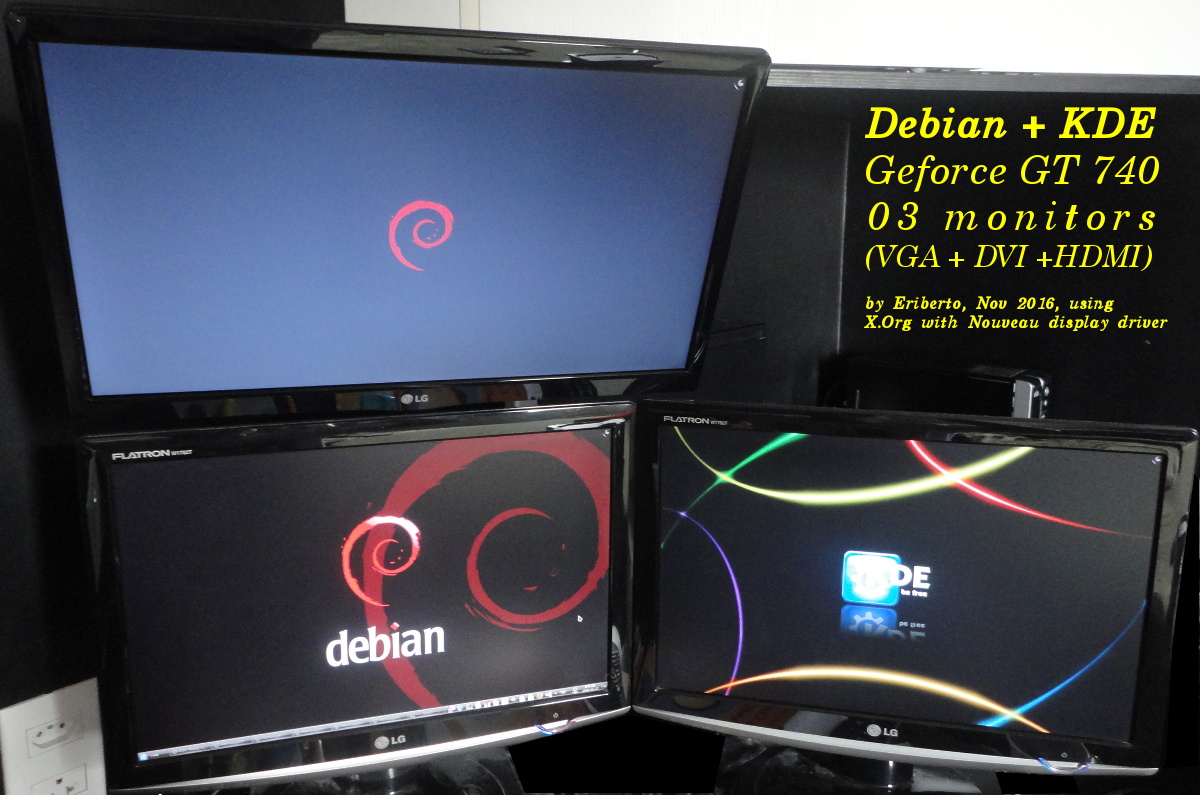
Since 2008 I use two monitors in my desktop. Yesterday I bought a new graphics interface and a third monitor. Some time I was looking for a low cost graphics interface. Ok, I am using GeForce GT 740 which has three output ports: VGA, DVI and HDMI. In Brazil this interface card can be found around R$ 400 (US$ 117, but my card was US$ 87 in Brazilian Black Friday). In Amazon.com, it is between US$ 51 and US$ 109. The chosen manufacturer was Zotac, but all GT 740 and 750 will work fine (I tested the GT 750 too). The GeForce GT 740 was imediatelly recognised by Debian Jessie with kernel Linux 4.7.0 from Backports (it is my default, so I didn't test with original 3.16 kernel). The driver used was the default X.Org Nouveau. I use KDE and the management was easy. I hope this post can help people interested in use 3 monitors. Enjoy! 03-monitors
25 November 2016

Julian Andres Klode: Starting the faster, more secure APT 1.4 series

We just released the first beta of APT 1.4 to Debian unstable (beta here means that we don t know any other big stuff to add to it, but are still open to further extensions). This is the release series that will be released with Debian stretch, Ubuntu zesty, and possibly Ubuntu zesty+1 (if the Debian freeze takes a very long time, even zesty+2 is possible). It should reach the master archive in a few hours, and your mirrors shortly after that. Security changes APT 1.4 by default disables support for repositories signed with SHA1 keys. I announced back in January that it was my intention to do this during the summer for development releases, but I only remembered the Jan 1st deadline for stable releases supporting that (APT 1.2 and 1.3), so better late than never. Around January 1st, the same or a similar change will occur in the APT 1.2 and 1.3 series in Ubuntu 16.04 and 16.10 (subject to approval by Ubuntu s release team). This should mean that repository provides had about one year to fix their repositories, and more than 8 months since the release of 16.04. I believe that 8 months is a reasonable time frame to upgrade a repository signing key, and hope that providers who have not updated their repositories yet will do so as soon as possible. Performance work APT 1.4 provides a 10-20% performance increase in cache generation (and according to callgrind, we went from approx 6.8 billion to 5.3 billion instructions for my laptop s configuration, a reduction of more than 21%). The major improvements are: We switched the parsing of Deb822 files (such as Packages files) to my perfect hash function TrieHash. TrieHash which generates C code from a set of words is about equal or twice as fast as the previously used hash function (and two to three times faster than gperf), and we save an additional 50% of that time as we only have to hash once during parsing now, instead of during look up as well. APT 1.4 marks the first time TrieHash is used in any software. I hope that it will spread to dpkg and other software at a later point in time.vendors. Another important change was to drop normalization of Description-MD5 values, the fields mapping a description in a Packages files to a translated description. We used to parse the hex digits into a native binary stream, and then compared it back to hex digits for comparisons, which cost us about 5% of the run time performance. We also optimized one of our hash functions the VersionHash that hashes the important fields of a package to recognize packages with the same version, but different content to not normalize data to a temporary buffer anymore. This buffer has been the subject of some bugs (overflow, incompleteness) in the recent past, and also caused some slowdown due to the additional writes to the stack. Instead, we now pass the bytes we are interested in directly to our CRC code, one byte at a time. There were also some other micro-optimisations: For example, the hash tables in the cache used to be ordered by standard compare (alphabetical followed by shortest). It is now ordered by size first, meaning we can avoid data comparisons for strings of different lengths. We also got rid of a std::string that cannot use short string optimisation in a hot path of the code. Finally, we also converted our case-insensitive djb hashes to not use a normal tolower_ascii(), but introduced tolower_ascii_unsafe() which just sets the lowercase bit ( 0x20) in the character. Others For a more complete overview of all changes, consult the changelog.
Filed under: Debian, Ubuntu

Petter Reinholdtsen: Quicker Debian installations using eatmydata

Two years ago, I did some experiments with eatmydata and the Debian installation system, observing how using eatmydata could speed up the installation quite a bit. My testing measured speedup around 20-40 percent for Debian Edu, where we install around 1000 packages from within the installer. The eatmydata package provide a way to disable/delay file system flushing. This is a bit risky in the general case, as files that should be stored on disk will stay only in memory a bit longer than expected, causing problems if a machine crashes at an inconvenient time. But for an installation, if the machine crashes during installation the process is normally restarted, and avoiding disk operations as much as possible to speed up the process make perfect sense. I added code in the Debian Edu specific installation code to enable eatmydata, but did not have time to push it any further. But a few months ago I picked it up again and worked with the libeatmydata package maintainer Mattia Rizzolo to make it easier for everyone to get this installation speedup in Debian. Thanks to our cooperation There is now an eatmydata-udeb package in Debian testing and unstable, and simply enabling/installing it in debian-installer (d-i) is enough to get the quicker installations. It can be enabled using preseeding. The following untested kernel argument should do the trick:
preseed/early_command="anna-install eatmydata-udeb"
This should ask d-i to install the package inside the d-i environment early in the installation sequence. Having it installed in d-i in turn will make sure the relevant scripts are called just after debootstrap filled /target/ with the freshly installed Debian system to configure apt to run dpkg with eatmydata. This is enough to speed up the installation process. There is a proposal to extend the idea a bit further by using /etc/ld.so.preload instead of apt.conf, but I have not tested its impact.

Next.

Previous.