Search Results: "tin"

25 August 2016

Joerg Jaspert: New gnupg-agent in Debian

In case you just upgraded to the latest gnupg-agent and used gnupg-agent as your ssh-agent you may find that ssh refuses to work with a simple but not helpful sign_and_send_pubkey: signing failed: agent refused operation This seems to come from systemd starting the agent, no longer a script at the start of the X session. And so it ends up with either no or an unusable tty. A simple
gpg-connect-agent updatestartuptty /bye
updates that and voila, ssh agent functionality is back in. Note: This assumes you have enable-ssh-support in your ~/.gnupg/gpg-agent.conf

Norbert Preining: Gaming: Deus Ex Go

Long flights and lazy afternoons relaxing from teaching, I tried out another game on my Android device, Deus Ex Go. It is a turn based game in the style of the Deus Ex series (long years ago I was beta tester for the Deus Ex version of LGP). A turn based game where you have to pass through a series of levels, each one consisting of an hexagonal grid with an entry and exit point, and some nasty villains or machines trying to kill you. Deus-ex-go Without any explanations given you are thrown into the game and it takes a few iterations until you understand what kind of attacks you are facing, but once you have figured that out, it is a more or less simple game of combination how to manage to get to the exit. I played through the around 50 levels of the story mode and I think it was only in the last five that I once or twice had to actually try and think hard to find a solution. I found the game quite amusing at the beginning, but soon it became repetitive. But since you can play through the whole story mode in probably one long afternoon, that is not so much of a problem. More a problem is the apparently incredible battery usage of this game. Playing without checking for some time leaves you soon with a near empty battery. Graphically well done, with more or less interesting gameplay, it still does not stand up to Monument Valley.

Francois Marier: Debugging gnome-session problems on Ubuntu 14.04

After upgrading an Ubuntu 14.04 ("trusty") machine to the latest 16.04 Hardware Enablement packages, I ran into login problems. I could log into my user account and see the GNOME desktop for a split second before getting thrown back into the LightDM login manager. The solution I found was to install this missing package:
apt install libwayland-egl1-mesa-lts-xenial

Looking for clues in the logs The first place I looked was the log file for the login manager (/var/log/lightdm/lightdm.log) where I found the following:
DEBUG: Session pid=12743: Running command /usr/sbin/lightdm-session gnome-session --session=gnome
DEBUG: Creating shared data directory /var/lib/lightdm-data/username
DEBUG: Session pid=12743: Logging to .xsession-errors
This told me that the login manager runs the gnome-session command and gets it to create a session of type gnome. That command line is defined in /usr/share/xsessions/gnome.desktop (look for Exec=):
[Desktop Entry]
Name=GNOME
Comment=This session logs you into GNOME
Exec=gnome-session --session=gnome
TryExec=gnome-shell
X-LightDM-DesktopName=GNOME
I couldn't see anything unexpected there, but it did point to another log file (~/.xsession-errors) which contained the following:
Script for ibus started at run_im.
Script for auto started at run_im.
Script for default started at run_im.
init: Le processus gnome-session (GNOME) main (11946) s'est achev  avec l' tat 1
init: D connect  du bus D-Bus notifi 
init: Le processus logrotate main (11831) a  t  tu  par le signal TERM
init: Le processus update-notifier-crash (/var/crash/_usr_bin_unattended-upgrade.0.crash) main (11908) a  t  tu  par le signal TERM
Seaching for French error messages isn't as useful as searching for English ones, so I took a look at /var/log/syslog and found this:
gnome-session[4134]: WARNING: App 'gnome-shell.desktop' exited with code 127
gnome-session[4134]: WARNING: App 'gnome-shell.desktop' respawning too quickly
gnome-session[4134]: CRITICAL: We failed, but the fail whale is dead. Sorry....
It looks like gnome-session is executing gnome-shell and that this last command is terminating prematurely. This would explain why gnome-session exits immediately after login.

Increasing the amount of logging In order to get more verbose debugging information out of gnome-session, I created a new type of session (GNOME debug) by copying the regular GNOME session:
cp /usr/share/xsessions/gnome.desktop /usr/share/xsessions/gnome-debug.desktop
and then adding --debug to the command line inside gnome-debug.desktop:
[Desktop Entry]
Name=GNOME debug
Comment=This session logs you into GNOME debug
Exec=gnome-session --debug --session=gnome
TryExec=gnome-shell
X-LightDM-DesktopName=GNOME debug
After restarting LightDM (service lightdm restart), I clicked the GNOME logo next to the password field and chose GNOME debug before trying to login again. This time, I had a lot more information in ~/.xsession-errors:
gnome-session[12878]: DEBUG(+): GsmAutostartApp: starting gnome-shell.desktop: command=/usr/bin/gnome-shell startup-id=10d41f1f5c81914ec61471971137183000000128780000
gnome-session[12878]: DEBUG(+): GsmAutostartApp: started pid:13121
...
/usr/bin/gnome-shell: error while loading shared libraries: libwayland-egl.so.1: cannot open shared object file: No such file or directory
gnome-session[12878]: DEBUG(+): GsmAutostartApp: (pid:13121) done (status:127)
gnome-session[12878]: WARNING: App 'gnome-shell.desktop' exited with code 127
which suggests that gnome-shell won't start because of a missing library.

Finding the missing library To find the missing library, I used the apt-file command:
apt-file update
apt-file search libwayland-egl.so.1
and found that this file is provided by the following packages:
  • libhybris
  • libwayland-egl1-mesa
  • libwayland-egl1-mesa-dbg
  • libwayland-egl1-mesa-lts-utopic
  • libwayland-egl1-mesa-lts-vivid
  • libwayland-egl1-mesa-lts-wily
  • libwayland-egl1-mesa-lts-xenial
Since I installed the LTS Enablement stack, the package I needed to install to fix this was libwayland-egl1-mesa-lts-xenial. I filed a bug for this on Launchpad.

24 August 2016

Don Armstrong: H3ABioNet Hackathon (Workflows)

I'm in Pretoria, South Africa at the H3ABioNet hackathon which is developing workflows for Illumina chip genotyping, imputation, 16S rRNA sequencing, and population structure/association testing. Currently, I'm working with the imputation stream and we're using Nextflow to deploy an IMPUTE-based imputation workflow with Docker and NCSA's openstack-based cloud (Nebula) underneath. The OpenStack command line clients (nova and cinder) seem to be pretty usable to automate bringing up a fleet of VMs and the cloud-init package which is present in the images makes configuring the images pretty simple. Now if I just knew of a better shared object store which was supported by Nextflow in OpenStack besides mounting an NFS share, things would be better. You can follow our progress in our git repo: [https://github.com/h3abionet/chipimputation]

Zlatan Todori : Take that boredom

While I was bored on Defcon, I took the smallest VPS in DO offering (512MB RAM, 20GB disk), configured nginx on it, bought domain zlatan.tech and cp'ed my blog data to blog.zlatan.tech. I thought it will just be out of boredom and tear it apart in a day or two but it is still there. Not only that, the droplet came with Debian 8.5 but I just added unstable and experimental to it and upgraded. Just to experiment and see what time will I need to break it. To make it even more adventurous (and also force me to not take it too much serious, at least at this point) I did something on what Lars would scream - I did not enable backups! While having fun with it I added letsencrypt certificate to it (wow, that was quite easy). Then I installed and configured Tor. Ende up adding an .onion domain for it! It is: pvgbzphm622hv4bo.onion My main blog is still going to be zgrimshell.github.io (for now at least) where I push my Nikola (static site generator written in python) generated content as git commits. To my other two domains (on my server) I just rsync the content now. Simple and efficient. I must admit I like my blog layout. It is simple, easy to read, efficient and fast, I don't bother with comments and writing a blog in markdown (inside terminal as all good behaving hacker citizen) while compiling it with Nikola is breeze (and yes, I did choose Nikola because of Nikola Tesla and python). Also I must admit that nginx is pretty nice webserver, no need to explain the beauty of git but I can't recommend enough of rsync. If anyone is interested in doing the same I am happy to talk about it but these tools are really simple (as I enjoy simple things and by simple I mean small tools, no complicated configs and easy execution).

23 August 2016

Reproducible builds folks: Reproducible Builds: week 69 in Stretch cycle

What happened in the Reproducible Builds effort between Sunday August 14 and Saturday August 20 2016: Fasten your seatbelts Important note: we enabled build path variation for unstable now, so your package(s) might become unreproducible, while previously it was said to be reproducible given a specific build path it probably still is reproducible but read on for the details below in the tests.reproducible-builds.org section! As said many times: this is still research and we are working to make it reality. Media coverage Daniel Stender blogged about python packaging and explained some caveats regarding reproducible builds. Toolchain developments Thomas Schmitt uploaded xorriso which now obeys SOURCE_DATE_EPOCH. As stated in its man pages:
ENVIRONMENT
[...]
SOURCE_DATE_EPOCH  belongs to the specs of reproducible-builds.org.  It
is supposed to be either undefined or to contain a decimal number which
tells the seconds since january 1st 1970. If it contains a number, then
it is used as time value to set the  default  of  --modification-date=,
--gpt_disk_guid,  and  --set_all_file_dates.  Startup files and program
options can override the effect of SOURCE_DATE_EPOCH.
Packages reviewed and fixed, and bugs filed The following packages have become reproducible after being fixed: The following updated packages appear to be reproducible now, for reasons we were not able to figure out. (Relevant changelogs did not mention reproducible builds.) The following 2 packages were not changed, but have become reproducible due to changes in their build-dependencies: tagsoup tclx8.4. Some uploads have addressed some reproducibility issues, but not all of them: Patches submitted that have not made their way to the archive yet: Bug tracker house keeping: Reviews of unreproducible packages 55 package reviews have been added, 161 have been updated and 136 have been removed in this week, adding to our knowledge about identified issues. 2 issue types have been updated: Weekly QA work FTBFS bugs have been reported by: diffoscope development Chris Lamb, Holger Levsen and Mattia Rizzolo worked on diffoscope this week. Improvements were made to SquashFS and JSON comparison, the https://try.diffoscope.org/ web service, documentation, packaging, and general code quality. diffoscope 57, 58, and 59 were uploaded to unstable by Chris Lamb. Versions 57 and 58 were both broken, so Holger set up a job on jenkins.debian.net to test diffoscope on each git commit. He also wrote a CONTRIBUTING document to help prevent this from happening in future. From these efforts, we were also able to learn that diffoscope is now reproducible even when built across multiple architectures:
< h01ger>   https://tests.reproducible-builds.org/debian/rb-pkg/unstable/amd64/diffoscope.html shows these packages were built on amd64:
< h01ger>    bd21db708fe91c01ba1c9cb35b9d41a7c9b0db2b 62288 diffoscope_59_all.deb
< h01ger>    366200bf2841136a4c8f8c30bdc87057d59a4cdd 20146 trydiffoscope_59_all.deb
< h01ger>   and on i386:
< h01ger>    bd21db708fe91c01ba1c9cb35b9d41a7c9b0db2b 62288 diffoscope_59_all.deb
< h01ger>    366200bf2841136a4c8f8c30bdc87057d59a4cdd 20146 trydiffoscope_59_all.deb
< h01ger>   and on armhf:
< h01ger>    bd21db708fe91c01ba1c9cb35b9d41a7c9b0db2b 62288 diffoscope_59_all.deb
< h01ger>    366200bf2841136a4c8f8c30bdc87057d59a4cdd 20146 trydiffoscope_59_all.deb
And those also match the binaries uploaded by Chris in his diffoscope 59 binary upload to ftp.debian.org, yay! Eating our own dogfood and enjoying it! tests.reproducible-builds.org Debian related: The last change probably will have an impact you will see: your package might become unreproducible in unstable and this will be shown on tracker.debian.org, while it will still be reproducible in testing. We've done this, because we think reproducible builds are possible with arbitrary build paths. But: we don't think those are a realistic goal for stretch, where we still recommend to use .buildinfo to record the build patch and then do rebuilds using that path. We are doing this, because besides doing theoretical groundwork we also have a practical goal: enable users to independently verify builds. And if they only can do this with a fixed path, so be it. For now :) To be clear: for Stretch we recommend that reproducible builds are done in the same build path as the "original" build. Finally, and just for our future references, when we enabled build path variation on Saturday, August 20th 2016, the numbers for unstable were:
suite all reproducible unreproducible ftbfs depwait not for this arch blacklisted
unstable/amd64 24693 21794 (88.2%) 1753 (7.1%) 972 (3.9%) 65 (0.2%) 95 (0.3%) 10 (0.0%)
unstable/i386 24693 21182 (85.7%) 2349 (9.5%) 972 (3.9%) 76 (0.3%) 103 (0.4%) 10 (0.0%)
unstable/armhf 24693 20889 (84.6%) 2050 (8.3%) 1126 (4.5%) 199 (0.8%) 296 (1.1%) 129 (0.5%)
Misc. Ximin Luo updated our git setup scripts to make it easier for people to write proper descriptions for our repositories. This week's edition was written by Ximin Luo and Holger Levsen and reviewed by a bunch of Reproducible Builds folks on IRC.

22 August 2016

Luciano Prestes Cavalcanti: AppRecommender - Last GSoC Report

My work on Google Summer of Code is to create a new strategy on AppRecommender, where this strategy should be able to get a referenced package, or a list of referenced packages, then analyze the packages that the user has already installed and make a recommendation using the referenced packages as a base, for example: if the user runs "$ sudo apt install vim", the AppRecommender uses "vim" as the referenced package, and should recommend packages with relation between "vim" and the other packages that the user has installed. This work is done and added to the official AppRecommender repository.
During the GSoC program, more contributions were done with the AppRecommender project helping the system to improve the recommendations, installation and configurations to help Debian package.
The following link contains my commits on AppRecommender:
https://github.com/tassia/AppRecommender/commits/master?author=LucianoPC
During the period destined to students get to know the community of the project, I talked with the Debian community about my project to get feedback and ideas. When talking to the Debian community on the IRC channels, we came up with the idea of using the popularity-contest data to improve the recommendations. I talked with my mentors, who approved the idea, then we increased the project scope to use the popularity-contest data to improve the AppRecommender recommendations.
The popularity-contest has several privacy political terms, then we did a research and published, on the Debian Planet, a post that explains why we need the popularity-contest data to improve the recommendations and how we use this data. This post also contains an explanation about the risks and the measures taken to minimize them.
Then two activities were added to be made. One of them is to create a script to be added on popularity-contest. This script is destined to get the popularity-contest data, which is the users' packages, and generate clusters that group these packages analyzing similar users. The other activity is to add collaborative data into the AppRecommender, where this will download the clusters data and use it to improve the recommendations.
The popularity-contest cluster script was done and reviewed by my mentor, but was not integrated into popularity-contest yet. The usage of clusters data into AppRecommender has been already implemented, but still not added on official repository because it is waiting the cluster cript's acceptance into the popularity-contest. This work is not complete, but I will continue working with AppRecommender and Debian community, and with my mentors' help, I will finish this work.
The following link contains my commits on repository with the popularity-contest cluster script's feature, as well as other scripts that I used to improve my work, but the only script that will be sent to popularity-contest is the create_popcon_clusters.py:
https://github.com/TCC-AppRecommender/scripts/commits/master?author=LucianoPC
The following link contains my commits on repository with the AppRecommender collaborative data feature:
Google Drive folder with the patch:
https://drive.google.com/drive/folders/0BzmGBlxBo2G3Q3F5YjBpRl9yWUk?usp=sharing

Lars Wirzenius: Linux 25 jubilee symposium

I gave a talk about the early days of Linux at the jubilee symposium arranged by the University of Helsinki CS department. Below is an outline of what I meant to speak about, but the actual talk didn't follow it exactly. You can compare these to the video once it comes online.

Satyam Zode: Google Summer of Code 2016 : Final Report

Project Title : Improving diffoscope tool and reproducibility of Debian packages Project details This project aims to improve diffoscope tool and fix Debian packages which are unreproducible in Reproducible builds testing framework. diffoscope recursively unpack archives of many kinds and transform various binary formats into more human readable form to compare them. As a part of this project I worked on argument completion feature and ignoring .buildinfo feature. This project is a part of Reproducible Builds effort Mentor and Co-Mentor Project Discussion Project Implementation Challenges and Work Left Future work Acknowledgement I would like to express my deepest gratitude to Lunar for mentoring me throughout Google Summer of Code program and for being cool. Lunar s deep knowledge regarding diffoscope and Python skills helped me a lot throughout the project and we literally had great discussions. I would also like to thank Debaian community and Google for giving me this opportunity. Special thanks to Reproducible Builds folks for all the guidance!

DebConf team: Proposing speakers for DebConf17 (Posted by DebConf17 team)

As you may already know, next DebConf will be held at Coll ge de Maisonneuve in Montreal from August 6 to August 12, 2017. We are already thinking about the conference schedule, and the content team is open to suggestions for invited speakers. Priority will be given to speakers who are not regular DebConf attendees, who are more likely to bring diverse viewpoints to the conference. Please keep in mind that some speakers may have very busy schedules and need to be booked far in advance. So, we would like to start inviting speakers in the middle of September 2016. If you would like to suggest a speaker to invite, please follow the procedure described on the Inviting Speakers page of the DebConf wiki.
DebConf17 team

Vincent Sanders: Down the rabbit hole

My descent began with a user reporting a bug and I fear I am still on my way down.

Like Alice I headed down the hole. https://commons.wikimedia.org/wiki/File:Rabbit_burrow_entrance.jpg
The bug was simple enough, a windows bitmap file caused NetSurf to crash. Pretty quickly this was tracked down to the libnsbmp library attempting to decode the file. As to why we have a heavily used library for bitmaps? I am afraid they are part of every icon file and many websites still have favicons using that format.

Some time with a hex editor and the file format specification soon showed that the image in question was malformed and had a bad offset header entry. So I was faced with two issues, firstly that the decoder crashed when presented with badly encoded data and secondly that it failed to deal with incorrect header data.

This is typical of bug reports from real users, the obvious issues have already been encountered by the developers and unit tests formed to prevent them, what remains is harder to produce. After a debugging session with Valgrind and electric fence I discovered the crash was actually caused by running off the front of an allocated block due to an incorrect bounds check. Fixing the bounds check was simple enough as was working round the bad header value and after adding a unit test for the issue I almost moved on.

Almost...

american fuzzy lop are almost as cute as cats https://commons.wikimedia.org/wiki/File:Rabbit_american_fuzzy_lop_buck_white.jpg
We already used the bitmap test suite of images to check the library decode which was giving us a good 75% or so line coverage (I long ago added coverage testing to our CI system) but I wondered if there was a test set that might increase the coverage and perhaps exercise some more of the bounds checking code. A bit of searching turned up the american fuzzy lop (AFL) projects synthetic corpora of bmp and ico images.

After checking with the AFL authors that the images were usable in our project I added them to our test corpus and discovered a whole heap of trouble. After fixing more bounds checks and signed issues I finally had a library I was pretty sure was solid with over 85% test coverage.

Then I had the idea of actually running AFL on the library. I had been avoiding this because my previous experimentation with other fuzzing utilities had been utter frustration and very poor return on investment of time. Following the quick start guide looked straightforward enough so I thought I would spend a short amount of time and maybe I would learn a useful tool.

I downloaded the AFL source and built it with a simple make which was an encouraging start. The library was compiled in debug mode with AFL instrumentation simply by changing the compiler and linker environment variables.

$ LD=afl-gcc CC=afl-gcc AFL_HARDEN=1 make VARIANT=debug test
afl-cc 2.32b by <lcamtuf@google.com>
COMPILE: src/libnsbmp.c
afl-cc 2.32b by <lcamtuf@google.com>
afl-as 2.32b by <lcamtuf@google.com>
[+] Instrumented 751 locations (64-bit, hardened mode, ratio 100%).
AR: build-x86_64-linux-gnu-x86_64-linux-gnu-debug-lib-static/libnsbmp.a
COMPILE: test/decode_bmp.c
afl-cc 2.32b by <lcamtuf@google.com>
afl-as 2.32b by <lcamtuf@google.com>
[+] Instrumented 52 locations (64-bit, hardened mode, ratio 100%).
LINK: build-x86_64-linux-gnu-x86_64-linux-gnu-debug-lib-static/test_decode_bmp
afl-cc 2.32b by <lcamtuf@google.com>
COMPILE: test/decode_ico.c
afl-cc 2.32b by <lcamtuf@google.com>
afl-as 2.32b by <lcamtuf@google.com>
[+] Instrumented 65 locations (64-bit, hardened mode, ratio 100%).
LINK: build-x86_64-linux-gnu-x86_64-linux-gnu-debug-lib-static/test_decode_ico
afl-cc 2.32b by <lcamtuf@google.com>
Test bitmap decode
Tests:606 Pass:606 Error:0
Test icon decode
Tests:392 Pass:392 Error:0
TEST: Testing complete

I stuffed the AFL build directory on the end of my PATH, created a directory for the output and ran afl-fuzz

afl-fuzz -i test/bmp -o findings_dir -- ./build-x86_64-linux-gnu-x86_64-linux-gnu-debug-lib-static/test_decode_bmp @@ /dev/null

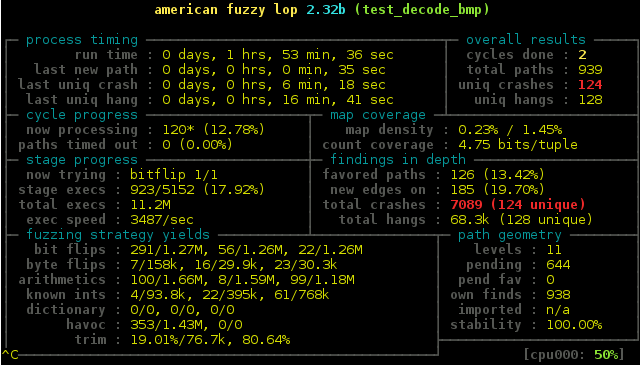
The result was immediate and not a little worrying, within seconds there were crashes and lots of them! Over the next couple of hours I watched as the unique crash total climbed into the triple digits.

I was forced to abort the run at this point as, despite clear warnings in the AFL documentation of the demands of the tool, my laptop was clearly not cut out to do this kind of work and had become distressingly hot.

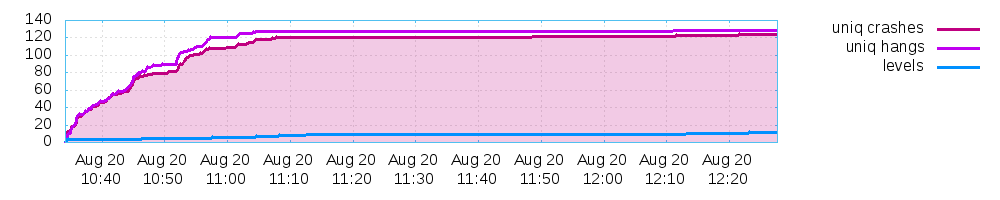
AFL has a visualisation tool so you can see what kind of progress it is making which produced a graph that showed just how fast it managed to produce crashes and how much the return plateaus after just a few cycles. Although it was finding a new unique crash every ten minutes or so when aborted.

I dove in to analyse the crashes and it immediately became obvious the main issue was caused when the test tool attempted allocations of absurdly large bitmaps. The browser itself uses a heuristic to determine the maximum image size based on used memory and several other values. I simply applied an upper bound of 48 megabytes per decoded image which fits easily within the fuzzers default heap limit of 50 megabytes.

The main source of "hangs" also came from large allocations so once the test was fixed afl-fuzz was re-run with a timeout parameter set to 100ms. This time after several minutes no crashes and only a single hang were found which came as a great relief, at which point my laptop had a hard shutdown due to thermal event!

Once the laptop cooled down I spooled up a more appropriate system to perform this kind of work a 24way 2.1GHz Xeon system. A Debian Jessie guest vm with 20 processors and 20 gigabytes of memory was created and the build replicated and instrumented.

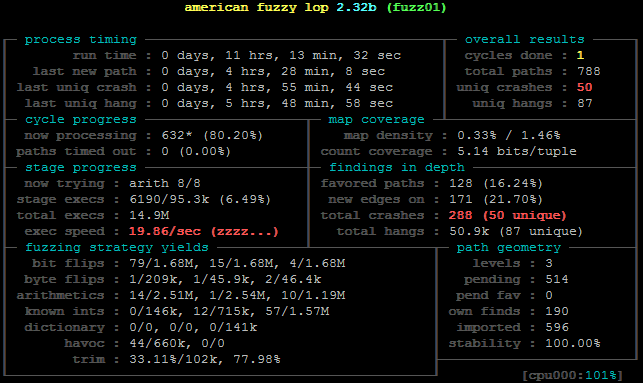
AFL master node display
To fully utilise this system the next test run would utilise AFL in parallel mode. In this mode there is a single "master" running all the deterministic checks and many "secondary" instances performing random tweaks.

If I have one tiny annoyance with AFL, it is that breeding and feeding a herd of rabbits by hand is annoying and something I would like to see a convenience utility for.

The warren was left overnight with 19 instances and by morning had generated crashes again. This time though the crashes actually appeared to be real failures.

$ afl-whatsup sync_dir/
Summary stats
=============

Fuzzers alive : 19
Total run time : 5 days, 12 hours
Total execs : 214 million
Cumulative speed : 8317 execs/sec
Pending paths : 0 faves, 542 total
Pending per fuzzer : 0 faves, 28 total (on average)
Crashes found : 554 locally unique

All the crashing test cases are available and a simple file command immediately showed that all the crashing test files had one thing in common the height of the image was -2147483648 This seemingly odd number is actually meaningful to a programmer, it is the largest negative number which can be stored in a 32bit integer (INT32_MIN) I immediately examined the source code that processes the height in the image header.

if ((width <= 0)   (height == 0))          
return BMP_DATA_ERROR;
if (height < 0)
bmp->reversed = true;
height = -height;

The bug is where the height is made a positive number and results in height being set to 0 after the existing check for zero and results in a crash later in execution. A simple fix was applied and test case added removing the crash and any possible future failure due to this.

Another AFL run has been started and after a few hours has yet to find a crash or non false positive hang so it looks like if there are any more crashes to find they are much harder to uncover.

Main lessons learned are:
I will of course be debugging any new crashes that occur and perhaps turning my sights to all the projects other unit tested libraries. I will also be investigating the generation of our own custom test corpus from AFL to replace the demo set, this will hopefully increase our unit test coverage even further.

Overall this has been my first successful use of a fuzzing tool and a very positive experience. I would wholeheartedly recommend using AFL to find errors and perhaps even integrate as part of a CI system.

Michal &#268;iha&#345;: Continuous integration on multiple platforms

Over the weekend I've played with continuous integration for Gammu to make it run on more platforms. I had to remember many things from the Windows world on the way and the solution is not yet complete, but the basic build is working, the only problematic part are external dependencies. First of all we already have Linux builds on Travis CI. These cover compilation with both GCC and Clang compilers, hopefully covering most of the possible problems. Recently I've added OS X builds on Travis CI, what was pretty much painless and worked out of the box. The next major architecture to support is Windows. Once I've discovered AppVeyor I thought it might be the way to go. The have free plans for open-source projects (though it has only one parallel build compared to four provided by Travis CI). As our build system is cross platform based on CMake, it should work pretty much out of the box, right? Well almost, tweaking the basics took some time (unfortunately there is no CMake support on AppVeyor, so you have to script it a bit). The most painful things on the way: You can check our current appveyor.yml in case you're going to try something similar. Current build results are on AppVeyor. As a nice side effect, we now have up to date Windows binaries for Gammu.

Filed under: Debian English Gammu 0 comments

Zlatan Todori : When you wake up with a feeling

I woke up at 5am. Somehow made myself to soon go back to sleep again. Woke up at 6am. Such is the life of jet-lag. Or I am just getting old for it. But the truth wouldn't be complete with only those assertion. I woke inspired and tired and the same time. Tired because I am doing very time consumable things. Also in the same time very emotional things. AND at the exact same time things that inspire me. On paper, I am technical leader of Purism. In reality, I have insanely good relations with my CEO for such a short time. So good that I for months were not leading the technical shift only, but also I overtook operations (getting orders and delivering them while working with our assembly line to automate most of the tasks in this field). I was playing also as first line of technical support (forums, IRC and email). Actually I was pretty much the only line of support for few months. I was doing some website changes: change some wording, updating bunch of plugins and making it sure all works, resolved (hopefully) Tor and Cloudflare issues for it, annoying caching system for forums, stopped forum spam and so on. I worked on better messaging for Purism public relations. I thought my team to use keys for signing and encryption. I interviewed (and read all mails) for people that were interested in working or helping Purism. In process of doing all that, I maybe wasn't the most speedy person for all our users needs but I hope they understand and forgive me. I was doing all that while I was researching and developing tablets (which ended up not being the most successful campaign but we now do have them as product). I was doing all that while seeing (and resolving) that our kernel builds were failing. Worked on pushing touchpad (not so good but we are still working on) patches upstream (and they ended being upstreamed). While seeing repos being down because of our host. Repos being down because of broken sync with Debian. Repos being down because of our key mis-management. Metadata not working well. PureBrowser getting broken all the time. Tor browser out of date. No real ISO updates. Wrong sources.list entries and so on. And the hardest part on work was, I was doing all this with very limited scope and even more limited resources. So what kept me on, what is pushing me forward and what am I doing? One philosophy - Free software. Let me not explain it as a technical debt. Let me explain it as social movement. In age, where people are "bombed" by media, by all-time lying politicians (which use fear of non-existent threats/terror as model to control population), in age where proprietary corporations are selling your freedom so you can gain temporary convenience the term Free software is like Giordano Bruno in age of Inquisitions. Free software does not only preserve your Freedom to software source usage but it preserves your Freedom to think and think out of the box and not being punished for that. It preserves the Freedom to live - to choose what and when to do, without having the negative impact on your or others people lives. The Freedom to be transparent and to share. Because not only ideas grow with sharing, but we, as human beings, grow as we share. The Freedom to say "NO". NO. I somehow learnt, and personally think, that the Freedom to say NO is the most important Freedom in our lives. No I will not obey some artificially created master that think they can plan and choose my life decision. No I will not negotiate my Freedom for your convenience (also, such Freedom is anyway not real and it is matter of time where you will be blown away by such illusion). No I will not accept your credit because it has STRINGS attached to it which you either don't present or you blur it in mountain of superficial wording. No I will not implant a chip inside me for sake of your research or my convenience. No I will not have social account on media where majority of people are. No, I will not have pacemaker which is a blackbox with proprietary (buggy) software and it harvesting my data without me being able to look at it. Yin-Yang. Yes, I want to collaborate on making world better place for us all. I don't agree with most of people, but that doesn't make them my enemies (although media would like us to feel and think like that). I will try to preserve everyones Freedom as much as I can. Yes I will share with my community and friends. Yes I want to learn from better than I am. Yes I want to have awesome mentors. Yes, I will try to be awesome mentor. Yes, I choose to care and not ignore facts and actions done by me and other people. Yes, I have the right to be imperfect and do mistakes as long as I will aknowledge and work on them. Bugfixing ourselves as humans is the most important task in our lives. As in software, it is very time consumable but also as in software, it is improvement and incredible satisfaction to see better version of yourself, getting more and more features (even if that sometimes means actually getting read of other/bad features). This all is blending with my work at Purism. I spend a lot of time thinking about projects, development and future. I must do that in order not to make grave mistakes. Failing hardware and software is not grave mistake. Serious, but not grave. Grave is if we betray ourselves and our community in pursue for Freedom. We are trying to unify many things - we want to give you security, privacy and FREEDOM with convenience. So I am pushing myself out of comfort zones and also out of conventional and sometimes even my standard way of thinking. I have seen that non-existing infrastructure for PureOS is hurting is a lot but I needed to cope with it to the time where I will be able to say: not anymore, we are starting to build our own infrastructure. I was coping with Cloudflare being assholes to Tor users but now we also shifting away from them. I came to team where people didn't properly understand what and why are we building this. Came to very small and not that efficient team. Now, we employed a dedicated and hard working person on operations (Goran) which I trust. We have dedicated support person (Mladen) which tries hard to work with people. A very creative visual mastermind (Francois). We have a capable Debian Developer (Matthias Klumpp) working on PureOS new infra. We have a capable and dedicated sysadmins (Theo and Stelio) which we didn't even have in past. We are trying to LEVEL UP Free software and unify them in convenient solution which is lead by Joey Hess. We have a hard-working PureOS developer (Hema) who is coping with current non-existent PureOS infra. We have GNOME Boards of Directors person (Jeff) who is trying to light up our image in world (working with James, to try bring some lights into our shadows caused by infinite supply chain delays). We have created Advisory Board for Freedom, Privacy and Security which I don't want to name now as we are preparing to announce soon that (and trust me, we have good people in here). But, the most important thing here is not that they are all capable or cool people. It is the core value in all of them - they care about Freedom and I trust them on their paths. The trust is always important but in Purism it is essential for our work. I built the workflow without time management (everyone spends their time every single day as they see it fit as long as the work gets done). And we don't create insane short deadlines because everyone else thinks it is important (and rarely something is more important than our time freedom). So the trust is built out of knowledge and the knowledge I have about them and their works is because we freely share with no strings attached. Because of them, and other good people from our community I have the energy to sacrifice my entire time for Purism. It is not white and black: CEO and me don't always agree, some members of my team don't always agree with me or I with them, some people in community are very rude, impolite and don't respect our work but even with disagreement everyone in Purism finds agreement at the end (we use facts in our judgments) and all the people who just try to disturb my and mine teams work aren't as efficient as all the lovely words of people who believe in us, who send us words of support and who share ideas and their thoughts with us. There is no more satisfaction for me than reading a personal mail giving us kudos for the work and their understanding of underlaying amount of work and issues. While we are limited with resources we had an occasional outcry from community to help us. Now I want to help them to help me (you see the Freedom of sharing here?). PureOS has now a wiki. It will be a community wiki which is endorsed by Purism as company. Yes you read it right, Purism considers its community part of company (you don't need to get paycheck to be Purism member). That is why a call upon contributors (technical but mostly non-technical too) to help us make PureOS wiki the best resource on net for our needs. Write tutorials for others, gather and put info on wiki, create an ideas page and vote on them so we can see what community wants to see, chat with us so we all understand what, why and how are we working on things. Make it as transparent as possible. Everyone interested please get in touch with our teams by either poking us online (IRC, social accounts) or via emails (our personal or [hr, pr, feedback]@puri.sm. To finish this writing (as it is 8am here and I still want to rest a bit because I will have meetings for 6 hours straight today) - I wanted to share some personal insight into few things from my point of view. I wanted to say despite all the troubles and people who tried to make our time even harder (and it is already hard by all the limitation which come naturally today with our kind of work), we still create products, we still ship them, we still improved step by step, we still hired and we are still building. Keeping all that together and making progress is for me a milestone greater than just creating a technical product. I just hope we will continue and improve our pace so we can start progressing towards my personal great goal - integrate and cooperate with most of FLOSS ecosystem. P.S. yes, I also (finally!) became an official Debian Developer - still didn't have time to sit and properly think and cry (as every good men) about it.

21 August 2016

Tomasz Buchert: A new version of pristine-tar

Some of you may have noticed that a new version of pristine-tar was released in Debian unstable. Well, actually, 3 versions were released recently, since very fast a regression was found (#835586) and, sure enough, I found another one after uploading a fix for the first one. The most important new feature is the ability to use xdelta3 instead of xdelta for delta generation. This doesn t concern 99.9% of users and is disabled by default for backwards compatibility, but is going to be default in the future. This new format supports bigger files (see #737499) and xdelta3 seems better maintained. Enjoy the new version and please report any problems you find.

Cyril Brulebois: Freelance Debian consultant: running DEBAMAX

Executive summary Since October 2015, I've been running a FLOSS consulting company, specialized on Debian, called DEBAMAX. DEBAMAX logo Longer version Everything started two years ago. Back then I blogged about one of the biggest changes in my life: trying to find the right balance between volunteer work as a Debian Developer, and entrepreneurship as a Freelance Debian consultant. Big change because it meant giving up the comfort of the salaried world, and figuring out whether working this way would be sufficient to earn a living I experimented for a while under a simplified status. It comes with a number of limitations but that s a huge win compared to France s heavy company-related administrativia. Here s what it looked like, everything being done online: A number of things became quite clear after a few months: Thankfully I was eligible to being accompanied by the local Chamber of Commerce and Industry (CCI Rennes), which provides teaching sessions for new entrepreneurs, coaching, and meeting opportunities (accountants, lawyers, insurance companies, ). Summer in France is traditionally rather quiet (read: almost everybody is on vacation), so DEBAMAX officially started operating in October 2015. Besides different administrative and accounting duties, running this company doesn't change the way I've been working since July 2014, so everything is fine! As before, I won't be writing much about it through my personal blog, except for an occasional update every other year; if you want to follow what's happening with DEBAMAX:

Gregor Herrmann: RC bugs 2016/30-33

not much to report but I got at least some RC bugs fixed in the last weeks. again mostly perl stuff:

David Moreno: WIP: Perl bindings for Facebook Messenger

A couple of weeks ago I started looking into wrapping the Facebook Messenger API into Perl. Since all the calls are extremely simple using a REST API, I thought it could be easier and simpler even, to provide a small framework to hook bots using PSGI/Plack. So I started putting some things together and with a very simple interface you could do a lot:
use strict;
use warnings;
use Facebook::Messenger::Bot;
my $bot = Facebook::Messenger::Bot->new( 
    access_token   => '...',
    app_secret     => '...',
    verify_token   => '...'
 );
$bot->register_hook_for('message', sub  
    my $bot = shift;
    my $message = shift;
    my $res = $bot->deliver( 
        recipient => $message->sender,
        message =>   text => "You said: " . $message->text()  
     );
    ...
 );
$bot->spin();
You can hook a script like that as a .psgi file and plug it in to whatever you want. Once you have some more decent user flow and whatnot, you can build something like:


using a simple script like this one. The work is not finished and not yet CPAN-ready but I m posting this in case someone wants to join me in this mini-project or have suggestions, the work in progress is here. Thanks!

Dirk Eddelbuettel: RcppEigen 0.3.2.9.0

A new upstream release 3.2.9 of Eigen is now reflected in a new RcppEigen release 0.3.2.9.0 which got onto CRAN late yesterday and is now going into Debian. Once again, Yixuan Qiu did the heavy lifting of merging upstream (and two local twists we need to keep around). Another change is by James "coatless" Balamuta who added a row exporter. The NEWS file entry follows.
Changes in RcppEigen version 0.3.2.9.0 (2016-08-20)
  • Updated to version 3.2.9 of Eigen (PR #37 by Yixuan closing #36 from Bob Carpenter of the Stan team)
  • An exporter for RowVectorX was added (thanks to PR #32 by James Balamuta)
Courtesy of CRANberries, there is also a diffstat report for the most recent release.

This post by Dirk Eddelbuettel originated on his Thinking inside the box blog. Please report excessive re-aggregation in third-party for-profit settings.

20 August 2016

Daniel Stender: Collected notes from Python packaging

Here are some collected notes on some particular problems from packaging Python stuff for Debian, and more are coming up like this in the future. Some of the issues discussed here might be rather simple and even benign for the experienced packager, but maybe this is be helpful for people coming across the same issues for the first time, wondering what's going wrong. But some of the things discussed aren't easy. Here are the notes for this posting, there is no particular order. UnicodeDecoreError on open() in Python 3 running in non-UTF-8 environments I've came across this problem again recently packaging httpbin 0.5.0. The build breaks the following way e.g. trying to build with sbuild in a chroot, that's the first run of setup.py with the default Python 3 interpreter:
I: pybuild base:184: python3.5 setup.py clean 
Traceback (most recent call last):
  File "setup.py", line 5, in <module>
    os.path.join(os.path.dirname(__file__), 'README.rst')).read()
  File "/usr/lib/python3.5/encodings/ascii.py", line 26, in decode
    return codecs.ascii_decode(input, self.errors)[0]
UnicodeDecodeError: 'ascii' codec can't decode byte 0xe2 in position 2386: ordinal not in range(128)
E: pybuild pybuild:274: clean: plugin distutils failed with: exit code=1: python3.5 setup.py clean 
One comes across UnicodeDecodeError-s quite oftenly on different occasions, mostly related to Python 2 packaging (like here). Here it's the case that in setup.py the long_description is tried to be read from the opened UTF-8 encoded file README.rst:
long_description = open(
    os.path.join(os.path.dirname(__file__), 'README.rst')).read()
This is a problem for Python 3.5 (and other Python 3 versions) when setup.py is executed by an interpreter run in a non-UTF-8 environment1:
$ LANG=C.UTF-8 python3.5 setup.py clean
running clean
$ LANG=C python3.5 setup.py clean
Traceback (most recent call last):
  File "setup.py", line 5, in <module>
    os.path.join(os.path.dirname(__file__), 'README.rst')).read()
  File "/usr/lib/python3.5/encodings/ascii.py", line 26, in decode
    return codecs.ascii_decode(input, self.errors)[0]
UnicodeDecodeError: 'ascii' codec can't decode byte 0xe2 in position 2386: ordinal not in range(128)
$ LANG=C python2.7 setup.py clean
running clean
The reason for this error is, the default encoding for file object returned by open() e.g. in Python 3.5 is platform dependent, so that read() fails on that when there's a mismatch:
>>> readme = open('README.rst')
>>> readme
<_io.TextIOWrapper name='README.rst' mode='r' encoding='ANSI_X3.4-1968'>
Non-UTF-8 build environments because $LANG isn't particularly set at all or set to C are common or even default in Debian packaging, like in the continuous integration resp. test building for reproducible builds the primary environment features that (see here). That's also true for the base system of the sbuild environment:
$ schroot -d / -c unstable-amd64-sbuild -u root
(unstable-amd64-sbuild)root@varuna:/# locale
LANG=
LANGUAGE=
LC_CTYPE="POSIX"
LC_NUMERIC="POSIX"
LC_TIME="POSIX"
LC_COLLATE="POSIX"
LC_MONETARY="POSIX"
LC_MESSAGES="POSIX"
LC_PAPER="POSIX"
LC_NAME="POSIX"
LC_ADDRESS="POSIX"
LC_TELEPHONE="POSIX"
LC_MEASUREMENT="POSIX"
LC_IDENTIFICATION="POSIX"
LC_ALL=
A problem like this is solved mostly elegant by installing some workaround in debian/rules. A quick and easy fix is to add export LC_ALL=C.UTF-8 here, which supersedes the locale settings of the build environment. $LC_ALL is commonly used to change the existing locale settings, it overrides all other locale variables with the same value (see here). C.UTF-8 is an UTF-8 locale which is available by default in a base system, it could be used without installing the locales package (or worse, the huge locales-all package):
(unstable-amd64-sbuild)root@varuna:/# locale -a
C
C.UTF-8
POSIX
This problem ideally should be taken care of upstream. In Python 3, the default open() is io.open(), for which the specific encoding could be given, so that the UnicodeDecodeError disappears. Python 2 uses os.open() for open(), which doesn't support that, but has io.open(), too. A fix which works for both Python branches goes like this:
import io
long_description = io.open(
    os.path.join(os.path.dirname(__file__), 'README.rst'), encoding='utf-8').read()
non-deterministic order of requirements in egg-info/requires.txt This problem appeared in prospector/0.11.7-5 in the reproducible builds test builds, that was the first package of Prospector running on Python 32. It was revealed that there were differences in the sorting order of the [with_everything] dependencies resp. requirements in prospector-0.11.7.egg-info/requires.txt if the package was build on varying systems:
$ debbindiff b1/prospector_0.11.7-5_amd64.changes b2/prospector_0.11.7-5_amd64.changes 
 ... 
  prospector_0.11.7-5_all.deb
      file list
      @@ -1,3 +1,3 @@
       -rw-r--r--   0        0        0        4 2016-04-01 20:01:56.000000 debian-binary
      --rw-r--r--   0        0        0     4343 2016-04-01 20:01:56.000000 control.tar.gz
      +-rw-r--r--   0        0        0     4344 2016-04-01 20:01:56.000000 control.tar.gz
       -rw-r--r--   0        0        0    74512 2016-04-01 20:01:56.000000 data.tar.xz
      control.tar.gz
          control.tar
              ./md5sums
                  md5sums
                  Files in package differ
      data.tar.xz
          data.tar
              ./usr/share/prospector/prospector-0.11.7.egg-info/requires.txt
              @@ -1,12 +1,12 @@
               
               [with_everything]
              +pyroma>=1.6,<2.0
               frosted>=1.4.1
               vulture>=0.6
              -pyroma>=1.6,<2.0
Reproducible builds folks recognized this to be a toolchain problem and set up the issue randonmness_in_python_setuptools_requires.txt to cover this. Plus, a wishlist bug against python-setuptools was filed to fix this. The patch which was provided by Chris Lamb adds sorting of dependencies in requires.txt for Setuptools by adding sorted() (stdlib) to _write_requirements() in command/egg_info.py:
--- a/setuptools/command/egg_info.py
+++ b/setuptools/command/egg_info.py
@@ -406,7 +406,7 @@ def warn_depends_obsolete(cmd, basename, filename):
 def _write_requirements(stream, reqs):
     lines = yield_lines(reqs or ())
     append_cr = lambda line: line + '\n'
-    lines = map(append_cr, lines)
+    lines = map(append_cr, sorted(lines))
     stream.writelines(lines)
O.k. In the toolchain, nothing sorts these requirements alphanumerically to make differences disappear, but what is the reason for these differences in the Prospector packages, though? The problem is somewhat subtle. In setup.py, [with_everything] is a dictionary entry of _OPTIONAL (which is used for extras_require) that is created by a list comprehension out of the other values in that dictionary. The code goes like this:
_OPTIONAL =  
    'with_frosted': ('frosted>=1.4.1',),
    'with_vulture': ('vulture>=0.6',),
    'with_pyroma': ('pyroma>=1.6,<2.0',),
    'with_pep257': (),  # note: this is no longer optional, so this option will be removed in a future release
 
_OPTIONAL['with_everything'] = [req for req_list in _OPTIONAL.values() for req in req_list]
The result, the new _OPTIONAL dictionary including the key with_everything (which w/o further sorting is the source of the list of requirements requires.txt) e.g. looks like this (code snipped run through in my IPython):
In [3]: _OPTIONAL
Out[3]: 
 'with_everything': ['vulture>=0.6', 'pyroma>=1.6,<2.0', 'frosted>=1.4.1'],
 'with_vulture': ('vulture>=0.6',),
 'with_pyroma': ('pyroma>=1.6,<2.0',),
 'with_frosted': ('frosted>=1.4.1',),
 'with_pep257': () 
That list comprehension iterates over the other dictionary entries to gather the value of with_everything, and Python programmers know that of course dictionaries are not indexed and therefore the order of the key-value pairs isn't fixed, but is determined by certain conditions. That's the source for the non-determinism of this Debian package revision of Prospector. This problem has been fixed by a patch, which just presorts the list of requirements before it gets added to _OPTIONAL:
@@ -76,8 +76,8 @@
     'with_pyroma': ('pyroma>=1.6,<2.0',),
     'with_pep257': (),  # note: this is no longer optional, so this option will be removed in a future release
  
-_OPTIONAL['with_everything'] = [req for req_list in _OPTIONAL.values() for req in req_list]
-
+with_everything = [req for req_list in _OPTIONAL.values() for req in req_list]
+_OPTIONAL['with_everything'] = sorted(with_everything)
In comparison to the list method sort(), the function sorted() does not change iterables in-place, but returns a new object. Both could be used. As a side note, egg-info/requires.txt isn't even needed, but that's another issue.

  1. As an alternative to prefixing LC_ALL, env -i could be used to get an empty environment.
  2. 0.11.7-4 already but this package revision was in experimental due to the switch to Python 3 and therefore not tested by reproducible builds continuous integration.

Russell Coker: Basics of Backups

I ve recently had some discussions about backups with people who aren t computer experts, so I decided to blog about this for the benefit of everyone. Note that this post will deliberately avoid issues that require great knowledge of computers. I have written other posts that will benefit experts. Essential Requirements Everything that matters must be stored in at least 3 places. Every storage device will die eventually. Every backup will die eventually. If you have 2 backups then you are covered for the primary storage failing and the first backup failing. Note that I m not saying only have 2 backups (I have many more) but 2 is the bare minimum. Backups must be in multiple places. One way of losing data is if your house burns down, if that happens all backup devices stored there will be destroyed. You must have backups off-site. A good option is to have backup devices stored by trusted people (friends and relatives are often good options). It must not be possible for one event to wipe out all backups. Some people use cloud backups, there are many ways of doing this with Dropbox, Google Drive, etc. Some of these even have free options for small amounts of storage, for example Google Drive appears to have 15G of free storage which is more than enough for all your best photos and all your financial records. The downside to cloud backups is that a computer criminal who gets access to your PC can wipe it and the backups. Cloud backup can be a part of a sensible backup strategy but it can t be relied on (also see the paragraph about having at least 2 backups). Backup Devices USB flash sticks are cheap and easy to use. The quality of some of those devices isn t too good, but the low price and small size means that you can buy more of them. It would be quite easy to buy 10 USB sticks for multiple copies of data. Stores that sell office-supplies sell USB attached hard drives which are quite affordable now. It s easy to buy a couple of those for backup use. The cheapest option for backing up moderate amounts of data is to get a USB-SATA device. This connects to the PC by USB and has a cradle to accept a SATA hard drive. That allows you to buy cheap SATA disks for backups and even use older disks as backups. With choosing backup devices consider the environment that they will be stored in. If you want to store a backup in the glove box of your car (which could be good when travelling) then a SD card or USB flash device would be a good choice because they are resistant to physical damage. Note that if you have no other options for off-site storage then the glove box of your car will probably survive if your house burns down. Multiple Backups It s not uncommon for data corruption or mistakes to be discovered some time after it happens. Also in recent times there is a variety of malware that encrypts files and then demands a ransom payment for the decryption key. To address these problems you should have older backups stored. It s not uncommon in a corporate environment to have backups every day stored for a week, backups every week stored for a month, and monthly backups stored for some years. For a home use scenario it s more common to make backups every week or so and take backups to store off-site when it s convenient. Offsite Backups One common form of off-site backup is to store backup devices at work. If you work in an office then you will probably have some space in a desk drawer for personal items. If you don t work in an office but have a locker at work then that s good for storage too, if there is high humidity then SD cards will survive better than hard drives. Make sure that you encrypt all data you store in such places or make sure that it s not the secret data! Banks have a variety of ways of storing items. Bank safe deposit boxes can be used for anything that fits and can fit hard drives. If you have a mortgage your bank might give you free storage of papers as part of the service (Commonwealth Bank of Australia used to offer that). A few USB sticks or SD cards in an envelope could fit the papers criteria. An accounting firm may also store documents for free for you. If you put a backup on USB or SD storage in your waller then that can also be a good offsite backup. For most people losing data from disk is more common than losing their wallet. A modern mobile phone can also be used for backing up data while travelling. For a few years I ve been doing that. But note that you have to encrypt all data stored on a phone so an attacker who compromises your phone can t steal it. In a typical phone configuration the mass storage area is much less protected than application data. Also note that customs and border control agents for some countries can compel you to provide the keys for encrypted data. A friend suggested burying a backup device in a sealed plastic container filled with dessicant. That would survive your house burning down and in theory should work. I don t know of anyone who s tried it. Testing On occasion you should try to read the data from your backups and compare it to the original data. It sometimes happens that backups are discovered to be useless after years of operation. Secret Data Before starting a backup it s worth considering which of the data is secret and which isn t. Data that is secret needs to be treated differently and a mixture of secret and less secret data needs to be treated as if it s all secret. One category of secret data is financial data. If your accountant provides document storage then they can store that, generally your accountant will have all of your secret financial data anyway. Passwords need to be kept secret but they are also very small. So making a written or printed copy of the passwords is part of a good backup strategy. There are options for backing up paper that don t apply to data. One category of data that is not secret is photos. Photos of holidays, friends, etc are generally not that secret and they can also comprise a large portion of the data volume that needs to be backed up. Apparently some people have a backup strategy for such photos that involves downloading from Facebook to restore, that will help with some problems but it s not adequate overall. But any data that is on Facebook isn t that secret and can be stored off-site without encryption. Backup Corruption With the amounts of data that are used nowadays the probability of data corruption is increasing. If you use any compression program with the data that is backed up (even data that can t be compressed such as JPEGs) then errors will be detected when you extract the data. So if you have backup ZIP files on 2 hard drives and one of them gets corrupt you will easily be able to determine which one has the correct data. Failing Systems update 2016-08-22 When a system starts to fail it may limp along for years and work reasonably well, or it may totally fail soon. At the first sign of trouble you should immediately make a full backup to separate media. Use different media to your regular backups in case the data is corrupt so you don t overwrite good backups with bad ones. One traditional sign of problems has been hard drives that make unusual sounds. Modern drives are fairly quiet so this might not be loud enough to notice. Another sign is hard drives that take unusually large amounts of time to read data. If a drive has some problems it might read a sector hundreds or even thousands of times until it gets the data which dramatically reduces system performance. There are lots of other performance problems that can occur (system overheating, software misconfiguration, and others), most of which are correlated with potential data loss. A modern SSD storage device (as used in a lot of the recent laptops) doesn t tend to go slow when it nears the end of it s life. It is more likely to just randomly fail entirely and then work again after a reboot. There are many causes of systems randomly hanging or crashing (of which overheating is common), but they are all correlated with data loss so a good backup is a good idea. When in doubt make a backup. Any Suggestions? If you have any other ideas for backups by typical home users then please leave a comment. Don t comment on expert issues though, I have other posts for that.

Next.

Previous.