Search Results: "mak"

5 February 2013

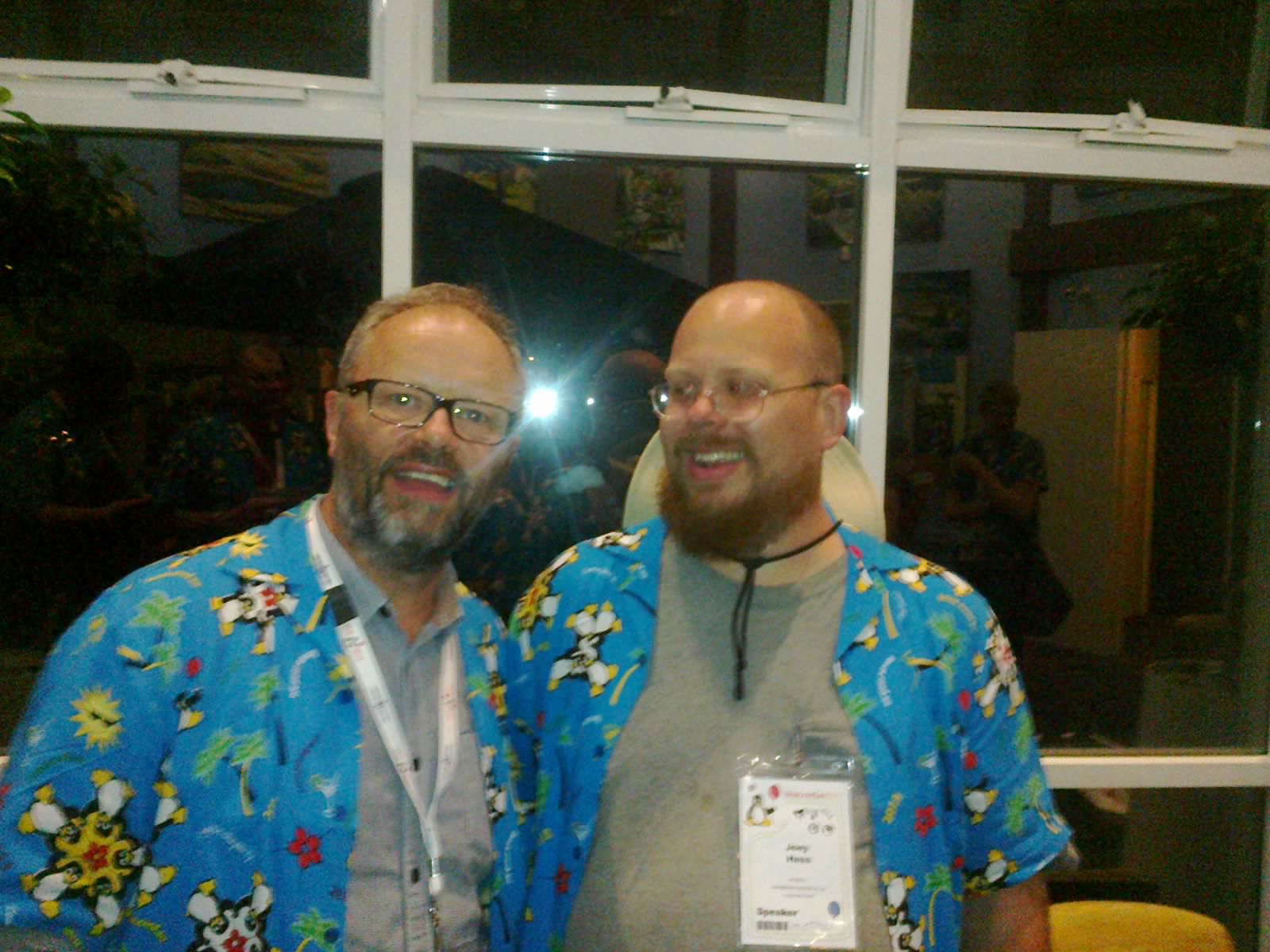
Joey Hess: LCA2013 wrapup

After 27 hours of travel, I'm finally back from my first Linux.conf.au. This was a great conference! Some of my favorite highlights:
My git-annex talk went ok, despite technical problems with the video output, which the video team did a great job of working around. The first demo went well, and the Q&A was excellent. The demo of the git-annex assistant webapp was marred by, apparently, a bad build of the webapp -- which I ironically used rather than my usual development build because I assumed it'd be less likely to fail. At least I may have a way to reproduce that hang somewhat reliably now, so I can get on with debugging it. I will be redoing a demo of the webapp as a screencast.
Here are some of the best talks I attended. (I have quite a lot more queued up to watch still, and had to cut several due to space.) Click titles for videos, or browse all the videos.

John Goerzen: The Superbowl Pirate Bus

I ll forgive you for not noticing the bus full of pirates at the Superbowl. Because, well, unless you saw my 6-year-old, you have a pretty good excuse for missing it. I ll give you the Goerzen Superbowl play-by-play, just to make sure you re caught up. It involved pirates, cops, tractors, cookies, a card game, and yes, even troubles with HDMI. We were invited to a Superbowl party, and were going to bring a party snack. The boys love to help cook, and I try to give them choices. I started naming off potential snacks, starting with healthy options. They listened attentively, until I mentioned cookies. COOKIES! ***COOKIES!*** Yes, cookies! This reaction was, I must say, not exactly a surprise. Then I asked them what KIND of cookies. Jacob immediately knew what he wanted, so of course Oliver took a minute to come up with something else. No matter; we could make two kinds of cookies. Jacob, of course, picked a kind of cookie that needs cherries, while Oliver picked one that needs chocolate chips. Thus they both had opportunities to have a small taste of ingredients while we prepared the batter. And so make cookies we did. Plus a loaf of bread. Anyhow, once we got to the party, Jacob and Oliver saw a huge tub of Legos and were at it in a flash. One of Jacob s friends was pretending everything was a tractor, but it wasn t long before Jacob started in on his evening s project: building the largest bus he could build. He was pleased when he got 4 lego people into it. Even more happy when he got 10 into it. And by the time he figured out how to get 35 into it, he was quite proud of himself indeed. Oliver, meanwhile, in classic little brother fashion, tried to corner the market on surplus lego people. He appears to have the hardline negotiation skill down already, and perhaps is appreciating the value of artificial scarcity in the lego market <grin> Eventually the bus seemed to hit the limits of engineering and joint strength, and Jacob gave up for a little while. He had a cookie and some carrots, commented on the exciting game of Uno going on, ( Who is the loudest? All of them! ), brought me some carrots, and periodically commented that The ball team is ahead of the SF team. Sure is. They have more points! (This from the BAL and SF text on the screen.) And then he went back to playing. And here s where the pirates come in. Jacob s new bus had a lego flag that he decided was a pirate flag. So the bus was a pirate bus. He built a platform out the back for them to use to steal things . So his pirate bus went around the lego area, stealing this from one pile, stealing that from another, until it got almost as long as his first bus. Pretty soon, along came a police boat to chase the pirates. But the police boat appeared to suffer a humorous series of logistical failures and never could quite disrupt the pirates. But never mind that, for little brother Oliver was getting bored with the lego mountain he was building and decided it would be more fun if he would disrupt the pirates. An opinion that Jacob quite strongly disagreed with. When it was time to go, Jacob tried to extract a promise from the party hosts to not let anyone take apart the pirate bus until next time we would be there. Then this morning, Jacob and I had a discussion about pirates. Dad, are pirates real? Yes, Jacob, they are. Do they steal things? Yes, but they are far away. There are no pirates here. Are there pirates in Kansas? No. There are some pirates in Africa though. Oh. What state is Africa in? Africa is so far away that it isn t even in a state. You d have to take a boat or a plane to get there. Or a train! Nope, a train couldn t get across the ocean. It s too wide! They d build a bridge! It s too wide for a bridge. It s more than a thousand miles! WOW a thousand miles! Great! OK dad, it s time for me to get on that school bus!

Antoine Beaupr : Why I don't like Pulseaudio

(This rant was originally part of the live streaming series, but I moved it to a separate article because people got stuck on it instead of responding to the actual subject of the article.) Before I get flamed for attacking Pulseaudio (PA), let's just settle this: I don't like it. I think PA is over-engineered and tries to do too many things at once. I used to (until just now) systematically purge pulseaudio-related packages from my system, mainly because PA has this awful tendency of automatically starting and staying around eternally, which wouldn't be so bad except PA has also the bad habit of hogging the audio device exclusively, which makes regular programs like mplayer, ogg123 fail to simply play audio, unless they go through the PA straight-jacket. (Update: this seems to be a bit better in newer versions of PA, where the audio device is released when sound is not being played. Thanks Philipp Kern for the correction.) In the GNU/Linux audio stack, we already have another system that supports multiple accesses: ALSA itself, so I believe that PA should at least behave nicely to other apps, and it seems I am always having problems with that. (The fact that ALSA itself is over-engineered is also telling of the poor state of the audio stack in GNU/Linux.) The other beef I have with PA is the Not Invented Here syndrome: instead of extending existing tools like ALSA or Jack, people just figured they could do everything better and start from scratch. So now we just have one more "standard" way of playing audio, good job Lennart.

4 February 2013

Michal &#268;iha&#345;: FOSDEM 2013 summary (Saturday)

FOSDEM 2013 is over and it's time to look what interesting I have seen there on Saturday. First of all the most important for me is to meet people. As usual, I came with SUSE folks, but it's not that unusual to meet people from company where you work :-). I've met some current and former phpMyAdmin developers and surprisingly I've met few Weblate users or people who consider using it on their project. This gave me some important feedback and one of first thing you will see in near future is remade Weblate website to give more information about some of it's unique features. As for the talks, I think I've managed to visit quite lot of them. How we made the Jenkins community explained some ways Jenkins has used to build good community - mostly focused on extensibility of the code and having everything as an extension, but with some focus on social things as well (and important thing that with Git people are not that motivated to join the team). Better software through user research was about various way to gather information of what your users hate on the software. It was pretty interesting, though many of that can not easily be used on small scale free software product. OSS code goes in and never comes out talk focused about licensing issues of various software as a service platforms. As I've never used Amazon cloud or such, it was quite surprising how these behave in relation to GPL and actually made me thing more about AGPL and attend related panel discussion later. An Integrated Localization Environment is Mozilla approach to online translation, quite different than anything we have before, but mostly for reasons which were explained later on Sunday talk on l20n. Maybe reverse ordering of these would make it easier to understand the motivation. Scale your Jenkins build pipeline automatically to minimize test time was not that useful as I thought - increasing test speed by buying EC2 instances and pushing part of the work to them is not something what will help me in near future. Trends in Open Source Security explained what is going on in distributions security, mostly focused on Redhat (but touching Debian as well). It has some interesting thoughts about sharing the information between vendors, so let's see if it will really work in future. QML s many faces showed some other ways to use QML besides using QtQuick. Some uses were quite interesting, though I'm not really fan of creating yet another buildsystem based on it. Panel Discussion: GNU Affero General Public License, version 3 was last thing I've visited on Sunday and it was really interesting to listen all that opinions on AGPL. Still I was not confirmed to consider switching to this license.

Filed under: Debian English Phpmyadmin Suse Weblate 0 comments Flattr this!

Matthew Garrett: Don't like Secure Boot? Don't buy a Chromebook.

(Edit: It's been suggested that the title of this could give the wrong impression. "Don't like Secure Boot? That's not a reason to buy a Chromebook" may have been better)

People are, unsurprisingly, upset that Microsoft have imposed UEFI Secure Boot on the x86 market. A situation in which one company gets to determine which software will boot on systems by default is obviously open to abuse. What's more surprising is that many of the people who are upset about this are completely fine with encouraging people to buy Chromebooks.

Out of the box, Chromebooks are even more locked down than Windows 8 machines. The Chromebook firmware validates the kernel, and the kernel verifies the filesystem. Want to run a version of Chrome you've built yourself? Denied. Thankfully, Google have provided a way around this - you can (depending on the machine) either flip a physical switch or perform a special keystroke in the firmware to disable the validation. Doing so deletes all your data in the process, in order to avoid the situation where a physically present attacker wants to steal your data or backdoor your system unnoticed, but after that it'll boot any OS you want. The downside is that you've lost the security that you previously had. If a remote attacker manages to replace your kernel with a backdoored one, the firmware will boot it anyway. Want the same level of security as the stock firmware? You can't. There's no way for you to install your own signing keys, and Google won't sign third party binaries. Chromebooks are either secure and running Google's software, or insecure and running your software.

Much like Chromebooks, Windows 8 certified systems are required to permit the user to disable Secure Boot. In contrast to Chromebooks, Windows 8 certified systems are required to permit the user to install their own keys. And, unlike Google, Microsoft will sign alternative operating systems. Windows 8 certified systems provide greater user freedom than Chromebooks.

Some people don't like Secure Boot because they don't trust Microsoft. If you trust Google more, then a Chromebook is a reasonable choice. But some people don't like Secure Boot because they see it as an attack on user freedom, and those people should be willing to criticise Google's stance. Unlike Microsoft, Chromebooks force the user to choose between security and freedom. Nobody should be forced to make that choice.

(Updated to add that some Chromebooks have a software interface for disabling validation)

comment count unavailable comments

Riku Voipio: On behalf of aarch64 porters

Public service announcementWhen porting GNU/Linux applications to a new architecture, such as 64-Bit ARM, one gets familiar with the following error message:

checking build system type... x86_64-pc-linux-gnu
checking host system type... Invalid configuration aarch64-oe-linux': machine aarch64-oe' not recognized
configure: error: /bin/sh config.sub aarch64-oe-linux failed
This in itself is trivial to fix - run autoreconf or just copy in new versions of config.sub and config.guess. However, when bootstrapping a distribution of 12000+ packages, this becomes quickly tiresome. Thus we have a small request:

If you are an upstream of a software that uses autoconf - Please run autoreconf against autotools-dev 20120210.1 or later, and make a release of your software. Aarch64 porters will be grateful as updated software trickles down to distributions. This was the most discussed point during my FOSDEM talk "Porting applications to 64-Bit ARM".

Antoine Beaupr : Live radio streaming with MPD, part 2: multicast RTP

The previous article was introducing basic streaming principles based on Icecast. The issue with this, of course, is lag and overhead of HTTP-based connexions. In this article we introduce RTP-based streaming system, (unfortunately) based on Pulseaudio and multicast. (Update: there was a rant here about Pulseaudio (PA) that I have moved out of this post because it's not what I was aiming to talk about. Those wanting to answer that troll are welcome to join the flamewar here.)

A word on multicast I took the opportunity of trying out Multicast (it's actually IP multicast, to be more precise), since I wanted to have only minimal configuration to perform on the client side. Plus, since the RTP frames are raw 44khz 16 bit audio, the traffic is actually quite heavy, 1.4mbps, to be more precise (punch in 44kHz * 16bit/Hz * 2 in the excellent Qalculate to see why), so I didn't want bandwidth to explode as more listeners joined in. As a comparison, also note that the Icecast Vorbis stream is around 64 or 128kbps depending on quality. Multicast allows packets to be sent only once for multiple listeners on the same network. It's actually quite cool, but doesn't work very well over the wider internet, for reasons that are still unclear to me. I presume that the fact there is virtual monopoly over traditional broadcasting systems (e.g. television and radio) means that multicast hasn't really kicked in yet... I hope this will make sense over the Montreal mesh, although the quality would probably need to be dialed down, or the audio streamed encoded instead of be sent as raw samples.

So why PA? VLC/pipe failures That aside, it seems that to stream through RTP, I have no choice. I have tried to use VLC as a pipe to stream data out of MPD as RTP, but somehow this config snippet just failed:
audio_output  
   type            "pipe"
   name            "RTP"
   command         "cvlc -q - --sout '#rtp dst=239.72.72.144,port=5004 '"
   encoder         "vorbis"                # optional, vorbis or lame
   format          "44100:16:2"
 
I don't know why - the multicast port wouldn't open properly and MPD would even hang when restarting. It seems the pipe plugin is somewhat broken. Note that the vlc command above actually works fine to stream audio content out through multicast, which is a good way to test if multicast works in the first place...

Shoving PA down MPD's throat Instead, I had to go to the clunky PA-way (also know as "my way or the highway"). The first step was to configure the default.pa to enable RTP streaming. I copied over the default /etc/pulse/default.pa file into ~mpd/.pulse/default.pa and uncommented the following lines:
# just to get the PA announced
load-module module-zeroconf-publish
# we need a null sink, no clue why, but without this glue, it fails
load-module module-null-sink sink_name=rtp format=s16be channels=2 rate=44100 sink_properties="device.description='RTP Multicast Sink'"
# port is specified otherwise it is random (?!)
# loop=1 is to broadcast locally too
# other useful setting: destination (defaults to 224.0.0.56)
load-module module-rtp-send source=rtp.monitor port=5004 loop=1
See the rtp-send module documentation for more information here. Then we need MPD to connect to that sink:
audio_output  
    type            "pulse"
    name            "Pulsaudio RTP"
    sink            "rtp"
 
Also, now that we got into the PA kitchen sink, we are kind of forced to use it for the local sound card output too, so we'll add this as a sink to:
audio_output  
    type            "pulse"
    name            "Pulseaudio sound card"
    sink            "alsa_output.pci-0000_00_1b.0.analog-stereo"
 
(Take a moment to admire the nice sink name. Yours may be different, have fun finding it in the output of pacmd list-sinks, but that works only once PA is started!) So now you need to restart MPD for those changes to take effect. Note that if the mpd user has already started PA, you're in luck: it won't restart it by itself, and you need to:
service mpd stop
killall pulseaudio
service mpd start
... yep. Basically because pulseaudio just detaches completely from the parent process when spawned automatically. Lots of fun.

Testing and listening Of course, you can listen to the stream using... Pulseaudio. I assume this would magically show up on the network thanks to avahi, if you run Pulseaudio on (say) your laptop. Since I still want to stay away from it, I would rather use a straight commandline tool to listen to the stream. According to this page, there aren't that many clients that could listen to such a funky stream. I chose VLC, since its commandline options actually make sense. Here's the magic mantra to repeat every night before you go to bed:
cvlc rtp://@224.0.0.56:5004
Yes, that's all. Drop the c if you want a GUI. With mplayer, it's more complicated - you need to specify a bitmask using a hexadecimal string (fun stuff):
mplayer -demuxer rawaudio -rawaudio format=0x20776172 rtp://224.0.0.56:5004
Yes, good old 0x20776172...

Results! We want results! All this work reduced the lag from 15 seconds to around 1 second. It's still present, and confusing to listen to, but maybe more acceptable. It seems most of the lag is in the vlc client buffering, when I enable debugging, I see:
[0x963c7bc] main input debug: Stream buffering done (1001 ms in 976 ms)
I was able to reduce that delay significantly by using the --rtp-caching option of vlc, as such:
cvlc --rtp-caching=48  rtp://@224.0.0.56:5004
The value is in miliseconds. Anything below 48ms introduces audible artifacts (probably buffer underruns). With that setting, there's still a noticeable delay, especially with isolated sounds that are naturally more noticeable. With more harmonious music, it sounds more like an echo. I have also tried to fiddle with similar settings with mplayer and simply failed to get any results. --no-cache simply drops samples like crazy. --cache 64 is the lowest I could push it down to, and it still has noticeable delay, which I couldn't measure, but I would assume would be around 400ms at least. Also note that contrarily to the previous setup I had, based on Icecast, VLC will automatically resume streaming from the RTP stream as it is stopped or started, which is also very nice - as it allows me to disable remote RTP streams easily and harmlessly.

Troubled areas Speaking of insane nonsense, here are a few pitfalls to avoid. Take care to disable the ALSA output, if it's not yet commented out, because MPD will freak out with the following error message:
Feb 03 20:25 : output: "Sound card" [alsa] failed to play: Resource temporarily unavailable
I have not been able to find a way to make PA let go of the audio sound card. I would have prefered MPD to open ALSA directly if PA wasn't needed (I need it only for RTP streaming), but it seems that PA assumes you'll want to play stuff locally. I have tried commenting out the following in default.pa:
load-module module-udev-detect
Seems like it's not enough. Also note that PA is designed with "dumb users" in mind (read: you need a GUI to operate it), so in the context of MPD, it's really annoying to debug things unless you can actually fire up a X11 session as the MPD user (which strikes me as a crazy idea) to configure PA properly with paprefs and all the graphical gizmos. I just gave up and went with PA all the way, and just added the RTP sink through the commandlines. Other guides can show you screenshots to clikety your way through inane graphical interfaces to do the above, if you are into that kind of stuff. With PA, you will want to get familiar with the pacmd and pactl commands. Why there are two different commands to basically do the same thing is completely beyond me.

Reference and more reading I got a lot of information in the Pulseaudio MPD wiki page and the Pulseaudio user documentation. The VLC manual about RTP streaming (server) (client) was also useful for debugging. The Pulseaudio Network documentation has a set of recipes for using pulseaudio for everything. This Ask Ubuntu question explains how to clikety your way through paprefs to essentially do the above.

Antoine Beaupr : Live radio streaming with MPD, part 1: basic setup

I have been using MPD for a good while as my media player, in conjunction with gmpc as a graphical interface (since MPD is just a server). It's really cute, works reasonably well, and is one of the only software that can handle my huge music collection gracefully. The cool thing with the setup is that, because MPD is a network-transparent server, I can control (and listen to!) my music remotely.

Basic HTTP / Icecast streaming For a while, I have also been streaming my music through Icecast so that I can basically listen to my music from anywhere there is an internet connection with sufficient bandwidth. This configuration is simple enough:
audio_output  
    type            "shout"
    name            "Currently listening to..."
    host            "localhost"
    port            "8000"
    mount           "/radio.ogg"
    password        "hackme"
    quality         "4.0"
    format          "44100:16:2"
    description     "My playlist of the day. High quality (4) OGG/Vorbis stream."
 
This will make a stream available at http://radio.example.com:8000/radio.ogg, provided Icecast is configured properly. That setup is a bit more complicated than necessary, because it needs an icecast server to be installed (which is just apt-get install icecast on Debian, but still). So an alternative, simpler setup, but which may not scale as well to many listeners, is:
audio_output  
   type            "httpd"
   name            "My HTTP Stream"
   encoder         "vorbis"                # optional, vorbis or lame
   port            "8000"
   quality         "5.0"                   # do not define if bitrate is defined
   bitrate         "128"                   # do not define if quality is defined
   format          "44100:16:1"
 
I haven't played around too much with that plugin, so I don't know how well it works - I am using the Icecast plugin instead.

Always on radio Another cool thing is that I have actually two MPD daemons running at the same time - one is my regular player, but the other is the "shuffle" player. The basic idea is that when the regular player stops, the shuffle starts, and vice versa, so there is always something playing on the stream. The shuffle, by default, doesn't play on the local sound card so that even though the radio stream is up, it doesn't blast random music through my living room speakers all day (and night!). This trick is accomplished through a hook in the Icecast daemon:
<mount>
    <mount-name>/radio.ogg</mount-name>
    <fallback-mount>/random.ogg</fallback-mount>
    <!-- when I listen to my radio, I turn off the random MPD stream to save CPU -->
    <on-connect>/home/anarcat/bin/mpd-stop-random</on-connect>
    <!-- ... and when I stop listening, the other stream just kicks in -->
    <on-disconnect>/home/anarcat/bin/mpd-start-random</on-disconnect>
    <!-- i put those here to try to display something on the stats page when there's no client, but it's not working -->
    <stream-name>Currently listening to...</stream-name>
    <stream-description>My playlist of the day. High quality (5) OGG/Vorbis stream. If I'm not listening to anything, you'll be redirected to the random playlist.</stream-description>
</mount>
<!-- final fallback: the random radio, which is started when the above playlist disconnects -->
<mount>
    <mount-name>/random.ogg</mount-name>
    <stream-name>Random!</stream-name>
    <stream-description>Random songs from a 33 days playlist</stream-description>
</mount>
The mpd-start-random script is rather idiotic:
#!/bin/sh
export MPD_HOST=hackme@radio.anarcat.ath.cx
export MPD_PORT=6601
mpc play
You can guess what the mpd-stop-random script does (hint: the opposite of play is pause). So that's the old way of doing things. The one problem I found with this setup is when I want to setup another listener in the same house - the problem is that the Icecast stream has significant delay: a good 14 seconds here, with ogg123 as a client. Here's the special configuration for the mpd-slave daemon that runs the random playlist:
# same as main player
music_directory         "/var/lib/mpd/music"
playlist_directory      "/var/lib/mpd/playlists"
# those need to be different
db_file                 "/var/lib/mpd-slave/tag_cache"
log_file                "/var/log/mpd/mpd-slave.log"
pid_file                "/var/run/mpd/slave.pid"
state_file         "/var/lib/mpd-slave/state"
# avoids having to update the database by hand all the time
auto_update    "yes"
# disabled by hand after daemon is started    
audio_output  
    type            "alsa"
    name            "Sound card"
 
# main icecast stream
audio_output  
    type            "shout"
    name            "Random!"
    host            "localhost"
    port            "8000"
    mount           "/random.ogg"
    password        "hackme"
    quality         "4.0"
    format          "44100:16:2"
    description     "Random songs from a 33 days playlist"
 
# another player for low bandwidth situations, disabled
audio_output  
    type            "shout"
    name            "Random! (lowfi)"
    host            "localhost"
    port            "8000"
    mount           "/random.ogg"
    password        "hackme"
    quality         "0.0"
    format          "44100:16:2"
    description     "Random songs from a 33 days playlist"
 
filesystem_charset "UTF-8"
user               "mpd"
default_permissions     "read"
port    "6601"
mixer_type                      "software"
volume_normalization            "yes"
The random playlist is done by simply adding the whole library to the playlist. MPD chokes a little the first time you do that, but it's surprisingly fast. I also went through the playlist to remove spoken words and other stuff I don't want to stumble upon, and after I shuffled the playlist.

Final notes Otherwise, this is a fairly standard MPD setup, although there are some special configuration that vary from the upstream default:
# this needs to be commented out for the server to be accessible from everywhere
#bind_to_address                "localhost"
# setup a password for remote access
password                "hackme@read,add,control"
# make sure the mixer controls don't affect the local hardware mixer
mixer_type                      "software"
# we are beyond the ASCII world, but MPD doesn't know
filesystem_charset              "UTF-8"
id3v1_encoding                  "UTF-8"
This is the first part of a series of articles I intend to write about my MPD configuration, next ones detail the configuration of a dumb player and RTP streaming.

3 February 2013

Dirk Eddelbuettel: The Rcpp Gallery and my Seinfeld Streak

A good three weeks ago, we introduced the Rcpp Gallery. While this is a joint effort by several of us on the Rcpp team, the backend was conceived and implemented entirely by JJ who also bootstrapped it with same first content, drawing on posts by Hadley, Romain and myself. As the How to contribute page makes plain, this is all backed by GitHub and all logs are public anyway. So after it was up and working, JJ and I refined the look and feel, and I started to add more content so that would have something by the time the initial announcement came around. A few years I read about an (attributed) secret to Seinfeld's producitivity: "Don't break the chain". Just keep writing, and write every day. I made my goal of a post every day for just over a month, and created this sequences: <quote> (20 Dec) simulating-pi, (21 Dec) vector-minimum, (22 Dec) gsl-colnorm-example, (23 Dec) fibonacci-sequence, (24 Dec) random-number-generation, (25 Dec) armadillo-sparse-matrix, (26 Dec) timing-rngs, (27 Dec) stl-inner-product, (28 Dec) stl-transform, (29 Dec) stl-transform-for-subsetting, (30 Dec) stl-random-shuffle, (31 Dec) stl-random-sample, (01 Jan) stl-for-each, (02 Jan) armadillo-subsetting, (03 Jan) accessing-environments, (04 Jan) armadillo-eigenvalues, (05 Jan) r-function-from-c++, (06 Jan) using-the-rcpp-timer, (07 Jan) sugar-function-clamp, (08 Jan) using-rcout, (09 Jan) first-steps-with-C++11, (10 Jan) simple-lambda-func-c++11, (11 Jan) eigen-eigenvalues, (12 Jan) getting-attributes-for-xts-example, (13 Jan) intro-to-exceptions, (14 Jan) a-first-boost-example, (15 Jan) a-second-boost-example, (16 Jan) timing-normal-rngs, (17 Jan) creating-xts-from-c++, (18 Jan) gsl-for-eigenvalues, (19 Jan) accessing-xts-api, (20 Jan) custom-as-and-wrap-example, (21 Jan) passing-cpp-function-pointers, </quote> The Rcpp Gallery continues to grow, we now have 58 posts from 7 different authors. And it is open for business: new contributions are always welcome.

2 February 2013

Steve Kemp: More competition for server management and automation is good

It was interesting to read recently from Martin F. Krafft a botnet-like configuration management proposal. Professionally I've used CFEngine, which in version 2.x, supported a bare minimum of primitives, along with a distribution systme to control access to a central server. Using thse minimal primitives you could do almost anything: Now I have my mini cluster (and even before that when I had 3-5 machines) it was time to look around for something for myself. I didn't like the overhead of puppet, and many of the other systems. Similarly I didn't want to mess around with weird configuration systems. From CFEngine I'd learned that using only a few simple primitives would be sufficient to manage many machines provided you could wrap them in a real language - for control flow, loops, conditionals, etc. What more natural choice was there than perl, the sysadmin army-knife? To that end slaughter was born: Over time it evolved so that HTTP wasn't the only transport. Now you can fetch your policies, and the files you might serve, via git, hg, rsync, http, and more. Today I've added one final addition, and now it is possible to distribute "modules" alongside policies and files. Modules are nothing more than perl modules, so they can be as portable as you are careful. I envisage writing a couple of sample modules; for example one allowing you to list available sites in Apache, disable the live ones, enable/disable mod_rewrite, etc. These modules will be decoupled from the policies, and will thus be shareable. Anyway , I'm always curious to learn about configuration management systems but I think that even though I've reinvented the wheel I've done so usefully. The DSL that other systems use can be fiddly and annoying - using a real language at the core of the system seems like a good win. There are systems layered upon SSH, such as fabric, ansible, etc, and that was almost a route I went down - but ultimately I prefer the notion of client-pull to server-push, although it is possible in the future we'll launche a mini-daemon to allow a central host/hosts to initial a run.

Richard Hartmann: Release Critical Bug report for Week 05

This is the "too late because FOSDEM" edition. On the plus side, we will be ready to release Squeeze next week... The UDD bugs interface currently knows about the following release critical bugs: How do we compare to the Squeeze release cycle?
Week Squeeze Wheezy Diff
43 284 (213+71) 468 (332+136) +184 (+119/+65)
44 261 (201+60) 408 (265+143) +147 (+64/+83)
45 261 (205+56) 425 (291+134) +164 (+86/+78)
46 271 (200+71) 401 (258+143) +130 (+58/+72)
47 283 (209+74) 366 (221+145) +83 (+12/+71)
48 256 (177+79) 378 (230+148) +122 (+53/+69)
49 256 (180+76) 360 (216+155) +104 (+36/+79)
50 204 (148+56) 339 (195+144) +135 (+47/+90)
51 178 (124+54) 323 (190+133) +145 (+66/+79)
52 115 (78+37) 289 (190+99) +174 (+112/+62)
1 93 (60+33) 287 (171+116) +194 (+111/+83)
2 82 (46+36) 271 (162+109) +189 (+116/+73)
3 25 (15+10) 249 (165+84) +224 (+150/+74)
4 14 (8+6) 244 (176+68) +230 (+168/+62)
5 2 (0+2) 224 (132+92) +222 (+132/+90)
6 release!
Graphical overview of bug stats thanks to azhag:

Petter Reinholdtsen: Bitcoin GUI now available from Debian/unstable (and Ubuntu/raring)

My last bitcoin related blog post mentioned that the new bitcoin package for Debian was waiting in NEW. It was accepted by the Debian ftp-masters 2013-01-19, and have been available in unstable since then. It was automatically copied to Ubuntu, and is available in their Raring version too. But there is a strange problem with the build that block this new version from being available on the i386 and kfreebsd-i386 architectures. For some strange reason, the autobuilders in Debian for these architectures fail to run the test suite on these architectures (BTS #672524). We are so far unable to reproduce it when building it manually, and no-one have been able to propose a fix. If you got an idea what is failing, please let us know via the BTS. One feature that is annoying me with of the bitcoin client, because I often run low on disk space, is the fact that the client will exit if it run short on space (BTS #696715). So make sure you have enough disk space when you run it. :) As usual, if you use bitcoin and want to show your support of my activities, please send Bitcoin donations to my address 15oWEoG9dUPovwmUL9KWAnYRtNJEkP1u1b.

1 February 2013

Daniel Kahn Gillmor: proprietary software activation fail

i have a colleague who is forced by work situations to use Windows. Somehow, I'm the idiot^W^W^W^W^Wfriendly guy who gets tapped to fix it when things break. Well, this time, the power supply broke. As in, dead, no lights, no fan, no nothing. No problem, though, the disk is still good, and i've got a spare machine lying around; and the spare is actually superior hardware to the old machine so it'll be an upgrade in addition to a fix. Nice! So i transplant the disk and fire up the new chassis. But WinXP fails to boot with a lovely "0x0000007b" BSOD. The internet tells me that this might mean it can't find its own disk. OK, pop into the new chassis' BIOS, tell it to run the SATA ports in "legacy IDE" mode, and try again. Now we get a "0x0000007e" BSOD. Some digging on the 'net makes me think it's now complaining now about the graphics driver. Hmm. Well, i figure i can probably work around that by installing new drivers from Safe Mode. So i reboot into Safe Mode. Success! It boots to the login screen in Safe Mode. And, mirabile dictu, i happen to know the Administrator password. I put it in, and get a message that this Windows installation isn't "activated" yet -- presumably because the hardware has changed out from under it. And by the way, i'm not allowed to log in via safe mode until it's activated. So please reboot to "normal" Windows and activate it first. Except, of course, the whole reason i'm booting into safe mode was because normal Windows gives a BSOD. Grrrr. Who thought up this particular lovely catch-22? OK, change tactics. Scavenging the scrap bin turns up a machine with a failed mainboard, but a power supply with all the right leads. It's rated for about 80W less than the old machine's failed supply, but i figure if i rip out the DVD-burner and the floppy drive maybe it will hold. Oh, and the replacement power supply doesn't physically fit the old chassis, but it hangs halfway out the back and sort of rattles around a bit. I sacrifice the rest of the scrap machine, rip out its power supply, stuff the power supply into the old chassis, swap the original disk back in, and ... it boots successfully, finally. That was the shorter version of the story :P So now my colleague has a horrible mess of a frankencomputer which is more likely to fail again in the future, instead of a nice shiny upgrade. Why? Because Microsoft's need to control the flow of software takes priority over the needs of their users. This is what you get when you let Marketing and BizDev drive your technical decisions. Do i still need to explain why i prefer free software? Tags: griping, windows

Joachim Breitner: Cologne Brussels Thalys ticket for today to give away

Since I can t got to FOSDEM, I can t make use of my Thalys train ticket. If anyone needs it, I ll happily give it away. It is a 1st class (which was cheaper than 2nd class at the time of booking) ticket for Thalys from Cologne, 18:42, to Brussles Midi, 20:32, today. Just send me mail if you have a use for it.

Johannes Schauer: Bootstrappable Debian FOSDEM talk

I will give a talk about the current status of automating Debian bootstrapping at FOSDEM 2013. There will also be a live demo of the developed toolchain. The talk will start 16:30 on Saturday, 2 February 2013 in room H.1302 as part of the Cross distro devroom track and will be half an hour long. Directly after my talk, at 17:00, Wookey will give his about bootstrapping Debian/Ubuntu for arm64 in the same location. The current version of the slides can be downloaded here. The latex beamer source is available in the git repository of the debian bootstrap project. If you can't make it to FOSDEM, then my last post about the topic gives away most of the things I will be talking about.

Olivier Berger: The Debian Package Tracking System now publishes Turtle RDF meta-data

The Debian PTS now speaks the Turtle representation format for the export of RDF meta-data about Debian source packages. Alongside HTML pages for humans, and the RDF/XML that had already been added to it this means that a new flavour of RDF is now available. The Turtle format offers the benefits of both machine-readable meta-data, and a somehow human readable textual format too. For instance, you may check the apache2 Turtle meta-data from the command-line with :
$ curl -L -s -H "Accept: text/turtle" http://packages.qa.debian.org/apache2 Here s a link to a colorized HTML preview of http://packages.qa.debian.org/a/apache2.ttl. Under the hood, the XSLT stylesheets of the PTS have been reworked to produce the Turtle format by default, and later convert them to RDF/XML. Every Debian source package then has a reference URI in the Linked Data word, in the form http://packages.qa.debian.org/PACKAGE_NAME, that redirects, through proper content-negociation (the HTTP Accept header) to the HTML, RDF/XML or Turtle documents. For apache2, these are, resp. at http://packages.qa.debian.org/a/apache2.html, http://packages.qa.debian.org/a/apache2.rdf and http://packages.qa.debian.org/a/apache2.ttl. The meta-data uses the model of the ADMS.SW ontology (1.0), and the content has also been slightly updated to make it more conformant to the ADMS.SW specifications (checks done with the ADMS.SW validator). Let s hope this makes RDF more familiar to Debian folks, and allows more Linked Data interlinking with other resources about FLOSS packages.

Martin F. Krafft: A botnet for configuration management

Following my last rant about configuration management, I've had a closer look at Salt, both for my personal use, as well as for a client who would like to deploy something that is not Puppet. Salt has some very good ideas, for instance: But there are also a couple of downsides to Salt: Those are the big issues. There are many small issues two, but those won't be around for too long as the project is moving along quickly and the community is vibrant. This is surely an important point that speaks for Salt. However, the above issues seem to hint at design choices that might well turn out to stand in the way later. Following a day of frustration, I now feel the overpowering urge to write my own configuration management system, because of course I feel that I could do it better than everyone else. Does this sound familiar to you? Let's just say hypothetically that I would, then I'd want to reuse as much existing functionality as possible. For instance, I'd want the entire remote execution framework to be independent from any configuration management implemented on top. So what does this mean? What would such a remote execution framework need? Here are some thoughts: Doesn't this sound like a Unix botnet to you? ;) I could imagine whacking this up with a bit of Python, some shell glue, socat and SSH: the server would have an authorized_keys file with forced commands connecting the client to the server process via sockets. Or I could imagine using twisted for that. But I would prefer if something like this already existed. Anyone? Comments are broken on my blog, and I cannot be bothered to work on them. If you have any input, please write to me. I will (eventually) condense all feedback into a new article. NP: Mouse on Mars: Parastrophics

Russell Coker: Speaking Stacks

Brianna Laugher wrote a blog post about the speaking stack used in the free software activism BoF at LCA 2013 [1]. Occupy Wall St uses what they call a progressive speaking stack this means that white men step back in the queue and people from marginalised groups step forward [2]. During the free software activism BoF the speaking queue that was used was that people who hadn t already spoken had priority over those who had spoken before. This was a really good idea and could be used a lot more in LCA and other conferences. It is fairly common that a small number of delegates take up the vast majority of question time. I suggest that all white men watch the questions and observe how many are asked by white men and how many are asked by everyone else. Also note the way that questions are asked, who shouts a question, who wins when two delegates ask at the same time, and who waits until the end of the talk. The Reasons for a Speaking Stack In Occupy Wall St there is a real benefit in giving priority to members of minority groups. The political needs of white men are generally reasonably well publicised due to disparities in media coverage. As the aim of the occupy movement is not to replace one group of white men with another there is an obvious need to get opinions from members of minority groups. Bugs in software generally affect members of all groups equally (with the exception of bugs related to accessibility features). But even so I think it is important to encourage diversity among people who ask questions. When someone is in the audience sees that no-one who is in their minority group is asking questions they will get the impression that they are just watching someone else s conference. We should aim to have a conference for everyone. How to Implement it When taking questions for one of my talks I generally try to give priority to people who find it difficult to be heard. But doing that requires some concentration and I often don t have any to spare when giving a demanding technical talk. I think that this needs to be managed by the moderator/MC/microphone holder. Someone who doesn t need to think much about the content of the talk can concentrate on choosing the best people to ask questions. Also a significant issue is questions that are called out during a talk. Some speakers insist that questions are only asked at the end of their talk. But I prefer some degree of interaction with the audience so my talks often end up being more about having a conversation with the audience than reading from a script. The difficulty with an interactive talk is that it strongly favors those who are prepared to shout a question over those who wait their turn. I think I ll try to make a strict policy of having people raise their hand to ask a question in future to address this issue, but I will need assistance from someone who s not concentrating on the technical issues. For a conference I think it would make sense for the people who hold the microphones to keep a mental list of who s asked questions. If someone asks their share of questions on the first day of the conference then they would deserve a lower priority for questions on later days. This would also encourage delegates to consider whether their question is really worth asking during the lecture or whether they should save their question quota and talk to the speaker afterwards. Also we could ask delegates to exercise restraint. One suggestion I heard was that people should set themselves a quota of 3 questions per conference or 1 per day. In a conference with ~600 delegates and ~33 sessions per day if everyone asked a question each day that would be about 18 questions per session more than is typical. So it seems that anyone who asks a single question per day is still likely to be asking more than 1/600 of all questions. Exceptions There are occasions when multiple questions and comments make sense. One example is where a member of the audience has significant expertise in the topic in question. Another is when a speaker completes significantly before the end of their allotted time and some questions from the MC or an experienced member of the audience can help them spend all their time educating the audience. But I think there needs to be a compelling reason that has a clear benefit for the audience. General Benefits How many of the repeat questions are useful to the audience? It seems to me that there is a correlation between multiple questions and questions that are more about the person asking than about clarifying issues that are likely to matter to the audience. Would such limits improve the quality of the discussion even for people who don t care about diversity? Also I have asked a disproportionate number of questions in the past. I am reducing the number of questions that I ask although I think I asked more than 3 at this conference.

Russ Allbery: WebAuth 4.4.1

WebAuth is the site-wide web authentication software that we use at Stanford. We're about to start another round of intensive development on multifactor authentication support, so I wanted to get a minor release out with the other things that have accumulated in the past month and a half. The main feature change in this release is to add support for another WebLogin configuration callback. This one is run whenever WebLogin is attempting to establish the user's identity and can return any identity it wishes, so it's available as a generic callback to determine identity information from the environment. The most likely use will be to inspect the results of client-side certificate authentication (which Apache puts in various environment variables) and interpret them in a site-specific way. Also in this release I refactored the WebLogin scripts so that they use FastCGI more correctly. The application objects are now instantiated only once and then reused for the lifetime of the FastCGI script, rather than torn down and set up for each new request. This is primarily of interest to those using the new features that require a memcached connection, since that connection will no longer be constantly set up and torn down, but it should help with speed in other situations. This is the riskiest change, since if I didn't get it exactly right it would be possible for information to leak from one request to the next. I've audited it fairly carefully, though, and think I've gotten everything. Finally, besides some documentation updates, I've switched the Perl build to Module::Build from ExtUtils::MakeMaker. This should mostly be transparent, but it means some additional Perl modules from CPAN will be required to build the distribution with --enable-webkdc for versions of Perl older than 5.10. (5.10 is fairly old, so I doubt this will be a serious issue.) You can get the latest release from the official WebAuth distribution site or from my WebAuth distribution pages.

31 January 2013

Russ Allbery: Consensus failure

As most people reading this have probably seen, xkcd found a particularly entertaining Wikipedia argument. (It is all true. There are at least 40,000 words arguing over whether to capitalize an "i" in a page title. I went and looked last night and spent several hours following the conversation.) This is, of course, funny, and I'm sure lots of people went away smiling at an excellent example of bikeshed painting on the Internet. But I think it's rather more serious than it appears to be. In fact, I would go so far as to say that it is a visible manifestation of a deeply-rooted problem that is the core of why I personally refuse to contribute to Wikipedia in any way that requires me to invest non-trivial time or become a member of that community. To explain that statement requires a bit of background. One of the very first services I found when I joined the Internet in 1993 was Usenet. Originally, I talked about comics collecting and then Magic: The Gathering, but I eventually ended up involved in Usenet governance. I spent more than ten years deeply invested in Usenet hierarchy administration; roughly, the process of agreeing on names for and sometimes moderators for global Usenet discussion groups, as well as all the supporting infrastructure for Usenet news server administrators to agree upon and share articles in those groups. Usenet newsgroup creation was, throughout that period, a consensus-driven process. There was a voting system that was used to measure consensus, but the voting system was largely designed to ensure that rough consensus existed (it was heavily skewed towards not changing anything). We took great pride in that fact. I'm sure that one could find many articles from me proudly championing the concept of a consensus-based decision-making process against many alternatives. That means I was also there when the toxic flaws at the heart of a consensus-based process completely destroyed it and, as a side effect, destroyed the community of people who had formed around it. I will never again invest my time and energy in a community that operates solely via a consensus process unless that community is small enough that consensus can actually work (which means not much more than twenty people). Consensus decision-making in large groups destroys communities and hurts people. These sorts of extended arguments on Wikipedia are not rare anomolies. They happen with some frequency; just by going through the debate xkcd references and looking at pointers, you can easily find others (Sega Genesis, cat ownership vs. companionship, endless notability debates... there are many). They look funny from outside, but from inside they're hugely demoralizing. Even when they don't get heated and spill over into personal animosity (and if they don't do that, you're lucky), they consume astonishingly vast quantities of time exactly not the resource that you want to be squandering in volunteer projects. And they do so without giving back anything emotionally. I know these arguments very well. One of the most contentious and angry arguments in the history of Usenet newsgroup creation was the argument over whether, when breaking up a group into multiple more focused groups, to rename the original group to end in *.misc or leave its existing name. This argument went on for years and led to deep, lingering hatred between the participants. It's the same sort of thing. These arguments happen in the way that they happen because there is toxic waste at the center of Wikipedia's governance process. And that toxic waste hurts people, wastes their time, and destroys their willingness to volunteer. It undermines community, which is sad and ironic because the whole point of consensus decision-making is to create, support, and empower community. But it doesn't work. It doesn't work for two very simple but very closely-related reasons: it's impossible to ever end an argument, and there is no incentive for anyone to shut up. As a result, it is nearly impossible to get the decision-making to cohere into something that is timely, consistent, unambiguous, and final. These are not optional requirements of a decision-making process. Without them, people will lose faith in the decision-making process itself, and some people will learn that, as long as they never stop talking about something, they can prolong the debate indefinitely and possibly eventually get their way. Now, of course, I'm deeply involved and invested in Debian. And on the surface, it may look like Debian also uses a consensus-based decision-making process. But while Debian decision-making has some problems, it's much healthier for a few reasons that are useful to examine:
  1. Individual packages in Debian are not managed by consensus, but rather fall under the authority of the package maintainer, who is either a single person or a small team. (Consensus works in small teams; it's great if the number of people involved is five or less.) This drastically limits the number of decisions that are subject to a large-scale consensus process. Nearly all decisions in Debian are made directly by the person doing the work, and only in exceptional circumstances can some larger process be invoked. This, on the surface, sounds like it could be similar to Wikipedia, but note that appeals to a larger process are much rarer in Debian than they are in Wikipedia. There is a strong bias in favor of letting the person working on the package do their job however they want to do it. This is more social than structural, but it's a core value (and we should be very careful about changing it). As a result, Debian operates less by mass consensus and more as a federation of semi-autonomous fiefdoms. This sounds worse: it sounds authoritarian and non-democratic. But it's significantly more functional, and it doesn't waste people's time.
  2. On appeal, and for broader questions that necessarily cut across multiple packages, there are several people in Debian who are perceived as having clear authority to make timely and relatively final decisions, who are almost never overruled, and who can therefore effectively end arguments. These include core teams like ftp-master or the release team, formal appeal bodies like the Technical Committee, and the Debian Project Leader. Not all of this ability is written in black and white in the governance process, but that's not the important part; the important part is that it works in practice to provide timely, consistent, unambiguous, and final decisions most of the time. (Some parts work better than others, and we do struggle with timely, but I've seen much, much worse.)
  3. There is a well-established ultimate appeal (a General Resolution), the ultimate appeal process is very specific and concrete, there is little or no ambiguity or human interpretation involved in analyzing the results, it is time-limited, and it's almost universally respected. Everyone abides by the result of a GR if matters get to that point, and while it's theoretically possible to propose another GR immediately to overturn the first one, this doesn't happen in practice. There's also substantial pushback against invoking the GR process for anything that isn't really important.
We still occasionally devolve into endless discussion, usually on some technical topic that cuts across the distribution and usually when the options haven't cohered enough for any authority to make a useful decision (often because it's too early for it to be possible to make a final decision). Those cases, such as the recurring systemd vs. upstart discussion, are still quite frustrating. But they're also relatively rare and largely ignorable because they have to be about just the right sort of issue. Wikipedia has these sorts of arguments all the time, and they're much less ignorable, because consensus is invoked for every minor dispute on any page in the entire project. You have to participate in endless consensus process or risk having your work undone, reverted, or removed. We would all like all decisions to be made by consensus, since we don't want anyone in a volunteer project to lose (and because we all love to convince other people we're right). And for small teams, consensus is wonderful. But that's precisely because governance in small teams is very easy; humans are naturally adapted for decision-making in small teams and have a huge variety of natural tools, tendencies, and abilities devoted to making those sorts of decisions. You rarely need any formal decision-making process; most decisions will just happen. You need a decision-making process when enough people are involved that mutual social pressure can't bring a dispute to resolution, and when you're in that situation, consensus is a horrible process. Due to my past experiences, I'm almost certainly at the extreme in dislike of consensus processes. Most people are not going to refuse to participate in communities solely on that basis. But be aware that 40,000 words of discussion about something that an outsider will not consider particularly important is not an accidental phenomenon. It's not something that just happens randomly on the Internet. It's an effect, and symptom, of a governance process, or lack thereof, and it's something that you can do something about if you want to.

Next.

Previous.