Jonathan Dowland: R.I.P. Terry Pratchett

 Pratchett and I, around 1998

/bin/bash -c "wget http://www.scala-lang.org/files/archive/scala-2.10.3.deb ; dpkg -x ./scala-2.10.3.deb /"Note that it doesn't even install the package properly, but extracts it to your root directory. The download does not check any signature, not even SSL certificates. (Source: Bigtop puppet manifests)
 ApologyAs a twisted turn of fate, I need to start my platform with an apology. Last year, I withdrew my nomination, because my life turned upside down, and the effects of that are still felt today, and will continue to have a considerable footprint for the rest of my life. But this is not what I want to apologise for! I want to apologise because my nomination, my platform, and my plans are rather uncommon - or so I believe. Unlike past Project Leaders, if elected, I will not have as much time to travel, as some of them. Nor will I have the resources to do all the things one may expect from a Project Leader. But - as you'll read later - I consider this both the biggest weakness and the greatest strength of my platform.Furthermore, I will not be available from the second half of the voting period until after the new Project Leader's term starts: I'll be getting married, and will enjoy a nice honeymoon, and as such, my email will remain unread from the 9th of April until we're back on the 21st of April.On the mouse behind the keyboardMy name is Gergely Nagy, or algernon, for those of you who may know me by my online presence. I used to be a lot of things: a flaming youth, an application manager, package maintainer, upstream, ftp-assistant, a student, a mentor, a hacker. In the end, however, I am but a simple, albeit sometimes crazy person. I imagine, a lot of people reading this will not know me, and that is actually not only fine, but in my case, desirable.The Role of the Project LeaderThe role of the Project Leader, what people perceive about the role, and what is actually done by one single person changed dramatically over time. In some ways for the better, some ways for the worse. It should be sufficiently clear by now that if we combine all the things past Project Leaders have done, and what people expect the Project Leader to do, then not even all the time in the world would be enough to accomplish everything. On the other hand, we should not cut the responsibilities back to constitution-granted ones only.There has been some discussion about this very topic on debian-project@, back in February, with excellent observations by both past Project Leaders and the current one. I encourage my dear readers to stop reading this platform now, and read at least Lucas's mail. I'll be right here when you get back.Back? Good.You may notice that unlike in previous years, I do not have a Grand Vision, not in the same sense at least. No matter what I envision, however noble that vision may be, it is not the Project Leader's job to save the world, so to say. While I still believe that we have serious problems with motivation, inspiration and innovation within the project, the Project Leader is the wrong person to try and solve these issues with.Apart from the constitutionally required responsibilities, the primary purpose of the Project Leader in my opinion, is to be an enabler: the Project Leader is not a front runner to lead the herd to victory, but a gentle shepherd to make them happy.HappyThere are many ways to make people happy. One such way is to enable them to pursue their passion - and not just enable them, but encourage and fuel that passion, too! -, to remove barriers, to empower them, or in a lot of cases, to include them in the first place. My vision is a project that is greater than just an amazing distribution. More than a role model for technical excellence. I want to do away with territorial pissings (with which I don't mean to imply that this would be the general atmosphere within the project - far from it!), and would rather see a warm, welcoming culture within the project - the kind of "I'm home!" feeling I had at the DebConfs I had the privilege to attend -, on public and private media alike.That is the vision I have, but I can't do it. At best, I can hope to enable people much better at the these things to do what needs to be done. I wish to take the burden of administration, bureaucracy off their shoulders, so they can focus on what they do best. I feel that this is the most important part of being a Project Leader: to enable the project to grow. And this is why I feel that most of you not knowing my name is an advantage here: When you look at a beautiful flower, you admire the flower itself, rarely the gardener.In the endI wish to be the Project Leader no one remembers. I'd rather see people remember all the great things the Project - as a whole - accomplished, for there are many. My purpose is to let You pursue your passion, which in turn enables even more people to pursue their happiness, and allows the greater Free Software community to bask in the warm glow of accomplished dreams.
 Getting on for seven years ago, I wrote an article on why the Linux kernel responds "False" to _OSI("Linux"). This week I discovered that vendors were making use of another behavioural difference between Linux and Windows to change the behaviour of their firmware and breaking things in the process.
 I want my 7drl game Scroll to have lots of interesting spells.
So, as I'm designing its spell system, I've been looking at the types, and
considering the whole universe of possible spells that fit within the
constraints of the types.
My first throught was that a spell would be a function from
World -> World.
That allows any kind of spell that manipulates the game map. Like, for
instance a "whiteout" that projects a stream of whitespace from the
player's mouth.
Since Scroll has a state monad, I quickly generalized that; making spell
actions a state monad M (), which lets spells reuse other monadic actions,
and affect the whole game state, including the player. Now I could write
a spell like "teleport", or "grow".
But it quickly became apparent this was too limiting: While spells could change
the World map, the player, and even change the list of supported spells, they
had no way to prompting for input.
I tried a few types of the Event -> M () variety, but they were all too
limiting. Finally, I settled on this type for spell actions:
M NextStep -> M NextStep.
And then I spent 3 hours exploring the universe of spells that type allows!
To understand them, it helps to see what a NextStep is:
type Step = Event -> M NextStep
data NextStep = NextStep View (Maybe Step)
NextStep is a continuation, spells take the original continuation,
and can not only modify the game state, but can return an altered
continuation. Such as one that prompts for input before performing the
spell, and then calls the original continuation to get on with the game.
That let me write "new", a most interesting spell, that lets the player
add a new way to cast an existing spell. Spells are cast using ingredients,
and so this prompts for a new ingredient to cast a spell. (I hope that
"new farming" will be one mode of play to possibly win Scroll.)
And, it lets me write spells that fail in game-ending ways. (Ie, "genocide @").
A spell can cause the game to end by returning a continuation that
has Nothing as its next step.
Even better, I could write spells that return a continuation that contains a
forked background task, using the 66 line contiuation based threading system I
built in day 3. This allows writing lots
of fun spells that have an effect that lasts for a while. Things like letting
the player quickly digest letters they eat, or slow down the speed of
events.
And then I thought of "dream". This spell stores the input continuation and
game state, and returns a modified continuation that lets the game continue
until it ends, and then restores from the point it saved. So, the player dreams
they're playing, and wakes back up where they cast the spell. A wild spell,
which can have different variants, like precognitive dreams where the same
random numbers are used as will be used upon awaking, or dreams where
knowledge carries back over to the real world in different ways.
(Supports Inception too..)
Look how easy it was to implement dreaming,
in this game that didn't have any notion of "save" or "restore"!
runDream :: M NextStep -> M NextStep -> (S -> S) -> M NextStep
runDream sleepcont wakecont wakeupstate = go =<< sleepcont
   where
         go (NextStep v ms) = return $ NextStep v $ Just $
        maybe wake (go <=<) ms
         wake _evt = do
                 modify wakeupstate
                 wakecont
Slow start today; I was pretty exhausted after yesterday and last night's
work. Somehow though, I got past the burn and made major progress today.
All the complex movement of both the player and the scroll is finished now,
and all that remains is to write interesting spells, and a system for
learning spells, and to balance out the game difficulty.
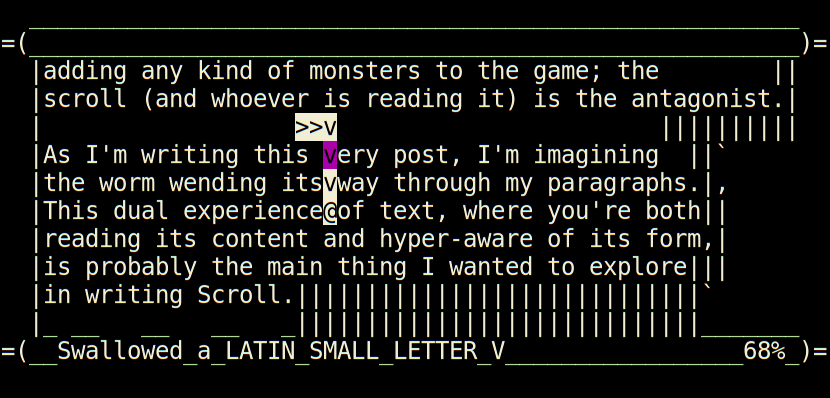 As to the text that fills the scroll, it's broadly procedurally generated,
in what I hope are unusual and repeatedly surprising (and amusing)
ways. I'm not showing any screenshots of the real text, because I don't want
to give that surprise away.
But, the other thing about Scroll is that it's
scroll, a completely usable (if rather difficult..) Unix pager!
 My LTS February
In February I didn't get much LTS work done, as other projects grabbed my attention. I started working on #761859 but that took a lot more time than initially thought, as the database design has been bended several times to make it fit for some new usecases. For example, "end-of-life" information is saved in the urgency field, making this one of several reasons why a bug can have different urgencies in different releases (despite that a CVE always only has one urgency). There are more oddities in the code base which was written with the (now long gone) assumption to be a tracker for security issues in testing. Constantly adding more requirements and use cases didn't really help to make it more maintainable. I'm glad that at least since yesterday https://security-tracker.debian.org/tracker/data/json provides valid JSON, though probably still a bit of finetuning is needed before I'll consider the output stable and close the bug.
In related news I've filed #780201: "new codename needed for oldstable (due to squeeze-lts) when stable becomes oldstable" today as else the security tracker will cease to work for squeeze LTS once we release jessie. And that would spoil that day a bit...
Got the player moving in the map! And, got the map to be deadly in its own
special way.
        HeadCrush -> do
                showMessage "You die."
                endThread
fork, that takes two continuations and combines them,
causing both to be run on each tick, and recursing to handle combining
the resulting continuations.
It was really quite simple to implement. Typechecked on the first try even!
fork :: M NextStep -> M NextStep -> M NextStep
fork job rest = do
        jn <- job
        rn <- rest
        runthread jn rn
  where
        runthread (NextStep _ (Just contjob)) (NextStep v (Just contr)) =
                return $ NextStep v $ Just $ \i -> do
                        jn <- contjob i
                        rn <- contr i
                        runthread jn rn
        runthread (NextStep _ Nothing) (NextStep v (Just contr)) =
                return $ NextStep v (Just contr)
        runthread _ (NextStep v Nothing) =
                return $ NextStep v Nothing
endThread :: M NextStep
endThread = nextStep Nothing
background :: M NextStep -> M NextStep
background job = fork job continue
demo :: M NextStep
demo = do
    showMessage "foo"
    background $ next $ const $
        clearMessage >> endThread
 Between december 9th 2014 and march 9th 2015 I ve been working as an intern for Debian on Improving AppArmor support in Debian.
Progress
Before the internship started, I had no clue about AppArmor at all. Reading the Wikipedia page and the AppArmor wiki did barely enlighten me. At least, until I got my hands dirty and installed and activated it. I was able to do this only because there was already some basic documentation on the Debian wiki on how to get AppArmor running on a Debian system.
When the internship started I felt a little bit lost. I started to read the documentation and to play around with some AppArmor profiles. But the error messages I saw and the profiles I opened for reading overwhelmed me. What did all these lines mean?
Then one mentor briefed me about the current status of AppArmor in Debian. I took many notes and tried to bring some order into the information I was being given. These notes became the first page of the documentation and my first blog post.
 -and others) has been very friendly and welcoming and I am very happy to be part of it.
 Dear Planet Debian,
the Debian Zsh Packaging Team (consisting of Michael Prokop, Frank
Terbeck, Richard Hartmann and myself) wonders if there s still a reason
to build and ship a zsh-static package in Debian.
There are multiple reasons:
the problem is that user/group lookups are disabled in the -static build because glibc s NSS ABI is unstable and static binaries still need to load NSS modules dynamically.One solution here would be to compile against dietlibc, but for that we d need an ncurses library built against dietlibc (#471208), too.
Do you need Debian s zsh-static package? If so, please send an e-mail to us Debian Zsh Maintainers <pkg-zsh-devel@lists.alioth.debian.org> and state that you use zsh-static, and, if you want, please also state why or how you re using it. Thanks in advance! Mika, Frank, RichiH and Axel
Dear Planet Debian,
the Debian Zsh Packaging Team (consisting of Michael Prokop, Frank
Terbeck, Richard Hartmann and myself) wonders if there s still a reason
to build and ship a zsh-static package in Debian.
There are multiple reasons:
the problem is that user/group lookups are disabled in the -static build because glibc s NSS ABI is unstable and static binaries still need to load NSS modules dynamically.One solution here would be to compile against dietlibc, but for that we d need an ncurses library built against dietlibc (#471208), too.
Do you need Debian s zsh-static package? If so, please send an e-mail to us Debian Zsh Maintainers <pkg-zsh-devel@lists.alioth.debian.org> and state that you use zsh-static, and, if you want, please also state why or how you re using it. Thanks in advance! Mika, Frank, RichiH and Axel
Much as I want to get my @ displayed and moving around screen,
last night and today have focused on level generation instead.
Scroll has kinda strange level generation method, compared to how
I suppose most roguelikes do it. There are only 3 calls to rand
in all of Scroll. Just a 3 random parameters, but that's enough to
ensure a different level each time.
-- Random level generation function.
level :: Bool -> StdGen -> [String]
level randomize r = concat
        [ final (length tutorial + extra) $ concat $ rand mariner1body
        , concat $ rand mariner1end
        , concatMap rand kubla
        ]
  where
    -- here be spoilers
import GPL
@
yet; that will need to wait for tonight or tomorrow!
I thinking archiving is important, archive.org is
great, and I'm proud of what little contribution I've made to
date.
Someone recently pointed out that an upload I had made is now inaccessible.
In it's place is a short message: this item is unavailable due to issues with its content.What issues are not made clear. I've never been contacted by
archive.org about this, not even to be
admonished, should they have felt that to be necessary. I've tried contacting
them to find out what the issues are but have heard nothing back.
It's worth remembering: Just because it's available now, even on archive.org,
doesn't mean it will be Tomorrow!
 finally, some simple RC bugs appeared, & I could contribute a bit
towards the jessie release:
 It's time once again for the Seven Day Roguelike Challenge but I've decided to try and force some discipline on myself and not participate until I actually complete one of my earlier entries into a properly playable game.
I did have some fun thinking of names though.
Scroll is a roguelike, with a twist, which I won't reveal until I've
finished building it. I'll just say: A playable roguelike pun, set in a
filesystem near you.
I'm creating Scroll as part of the 7DRL Challange.
If all goes well, I'll have a usable roguelike game finished in 7 days.
This is my first time developing a roguelike, and my first time writing a
game in Haskell, and my first time writing a game to a time limit. Wow!
-- Writes a Char to a position in the world.
writeWorld :: Pos -> Char -> M ()
writeWorld (x, y) c = modWorld $ \yv -> do
    xv <- V.read yv y
    V.write xv x c
showPlayer :: M ()
showPlayer = writeWorld (5,8) '@'
type M = StateT S (ST RealWorld). (It could be
forall s. StateT S (ST s), but I had some trouble getting that to type
check, so I fixed s to RealWorld, which is ok since it'll be run using
stToIO.
Next, a concept of time, and the main event loop. I decided to use a
continutation passing style, so the main loop takes
the current continuation, and runs it to get a snapshot of the state to
display, and a new continutation. The advantage of using continuations
this way is that all the game logic can be handled in the pure code.
I should probably be using the Cont monad in my monad stack, but
I've not learned it and lack time. For now I'm handling the
continuations by hand, which seems ok.
updateWorld :: Step
updateWorld (Just 'Q') = do
        addMessage "Are you sure you want to quit? [yn]"
        next $ \i -> case i of
                Just 'y' -> quit
                _ -> continue
updateWorld input = do
        addMessage ("pressed " ++ show input)
        continue
writeS :: forall a. ((Vec2 a -> ST RealWorld ()) -> M ()) -> Pos -> a -> M ()
mainSer :: (MonadAtomic m, MonadServerReadRequest m) => [String] -> COps -> (m () -> IO ()) -> (COps -> DebugModeCli -> ((FactionId -> ChanServer ResponseUI RequestUI -> IO ()) -> (FactionId -> ChanServer ResponseAI RequestAI -> IO ()) -> IO ()) -> IO ()) -> IO () Video from the reproducible builds talk at FOSDEM 2015 and testing experimental
The video from Lunar's and my talk Stretching out for trustworthy reproducible builds (follow this link if you're interested in the slides) given at the recent FOSDEM is finally available for download at both the FOSDEM video archive as well as the Debian video archive. (Update: the Debian video archive has a hires version now, I suspect the FOSDEM archive will follow soon.)
To encourage maintainers uploading fixes to experimental and thanks to lots of work from Mattia Rizzolo we are now also testing packages in experimental for reproducibility! And even better: behind the scenes the site is prepared for stretch!
Should you have wondered about the decrease in sid since we've been given the talk in early February: this is because we've added some more variations to the second build. Most notably building with a timezone difference of 25h lead to the decrease in the graphs showing the current prospects of reproducible builds...
More work and joy to come!
 I love reading Linux Weekly News. It's a
great source of high quality Linux and FOSS journalism, and I've been a
subscriber for years.
One mild annoyance I have with the site is the way articles are cross-linked.
All the article URIs are in the format /Article/531114/, which isn't
particularly descriptive about that article's content.
When faced with an article that links to another article, with perhaps a word
of anchor text, it's hard to tell if the new article is worth opening in a tab,
is indeed already open in a tab, or has been previously read. (Yes, the
"visited link" colour can help to a small degree, but even then, it doesn't
tell you which previously read article it is).
This is what
 I was writing in the previous post about Occasional Rsnapshot and how I ended up writing it.
Given a version number MAJOR.MINOR.PATCH, increment the:I just released Occasional Rsnapshot v1.3.1 which mainly fixed issue 4:MAJOR version when you make incompatible API changes,
MINOR version when you add functionality in a backwards-compatible manner, and
PATCH version when you make backwards-compatible bug fixes.

 My monthly report covers a large part of what I have been doing in the free software world. I write it for my donators (thanks to them!) but also for the wider Debian community because it can give ideas to newcomers and it s one of the best ways to find volunteers to work with me on projects that matter to me.
Debian LTS
This month I have been paid to work 14.5 hours on Debian LTS. I worked mostly on CVE triage (41 commits in the security tracker) and organizational issues. One maintainer complained that he had not been kept in the loop for an LTS update of his package. After some discussion, I decided to change the way I did CVE triage so that any time that I add a package to our list of packages needing an update, I also send a mail to the maintainer, thus offering him the opportunity to step in.
To make this sustainable, I wrote a small helper script that will generate a mail out of a template. And to kickstart the process I mailed all maintainers of packages that were already listed in our queue of packages to update.
To improve the email generated, I requested a JSON export of the security tracker data (see discussions in #761859). In the mean time, Holger worked on this already and after a few iterations we did converge on an output format that will be really useful both for my needs in terms of CVE triage but also for the Package Tracker to be able to display the list of security vulnerabilities affecting each release (see #761730).
Last but not least, I don t want to be the only one doing CVE triage for our LTS release so I documented the process in our wiki page.
As a side note, I sponsored an e2fsprogs update prepared by Nguyen Cong and I sent the DLA for the embargoed samba update that had been prepared by Ivo de Decker (thanks to both of them!).
Tryton
Like last month, I invested again a copious amount of time on Tryton, fixing some bugs that were affecting me and improving the French chart of accounts to properly manage purchases and sales within the European Union. Here are some links for more details:
One comment Liked this article? Click here. My blog is Flattr-enabled.
Next.
There was also a small syntax bugfix, but functionally nothing has changed because bash was doing the right thing even with that small error.
If you have started using Occasional Rsnapshot, you definitely want now Occasional Rsnapshot v1.3.1. If you haven't started and you don't have backups, please start doing backups, and while you're at it, you might want to try Occasional Rsnapshot (with Rsnapshot).