Search Results: "tin"

30 August 2016

Mike Gabriel: credential-sheets: User Account Credential Sheets Tool

Preface This little piece of work has been pending on my todo list for about two years now. For our local school project "IT-Zukunft Schule" I wrote the little tool credential-sheets. It is a little Perl script that turns a series of import files (CSV format) as they have to be provided for user mass import into GOsa (i.e. LDAP) into a series of A4 sheets with little cards on them, containing initial user credential information. The upstream sources are on Github and I have just uploaded this little tool to Debian. Introduction After mass import of user accounts (e.g. into LDAP) most site administrators have to create information sheets (or snippets) containing those new credentials (like username, password, policy of usage, etc.). With this tiny tool, providing these pieces of information to multiple users, becomes really simple. Account data is taken from a CSV file and the sheets are output as PDF using easily configurable LaTeX template files. Usage Synopsis: credential-sheets [options] <CSV-file-1> [<CSV-file-2> [...]] Options The credential-sheets command accepts the following command-line options:
   --help Display a help with all available command line options and exit.
   --template=<tpl-name>
          Name of the template to use.
   --cols=<x>
          Render <x> columns per sheet.
   --rows=<y>
          Render <y> rows per sheet.
   --zip  Do create a ZIP file at the end.
   --zipfilename=<zip-file-name>
          Alternative ZIP file name (default: name of parent folder).
   --debug
          Don't remove temporary files.
CSV File Column Arrangement The credential-sheets tool can handle any sort of column arrangement in given CSV file(s). It expects the CSV file(s) to have column names in their first line. The given column names have to map to the VAR-<column-name> placeholders in credential-sheets's LaTeX templates. The shipped-with templates (students, teachers) can handle these column names: If you create your own templates, you can be very flexible in using your own column names and template names. Only make sure that the column names provided in the CSV file(s)'s first line match the variables used in the customized LaTeX template. Customizations The shipped-with credential sheets templates are expected to be installed in /usr/share/credential-sheets/ for system-wide installations. When customizing templates, simply place a modified copy of any of those files into ~/.credential-sheets/ or /etc/credential-sheets/. For further details, see below. The credential-sheets tool uses these configuration files: Search paths for configuration files (in listed order): You can easily customize the resulting PDF files generated with this tool by placing your own template files, header and footer where appropriate. Dependencies This project requires the following dependencies: Copyright and License Copyright 2012-2016, Mike Gabriel <mike.gabriel@das-netzwerkteam.de>. Licensed under GPL-2+ (see COPYING file).

Daniel Stender: My work for Debian in August

Here's again a little list of my humble off-time contributions I'm happy to add to the large amount of work we're completing all together each month. Then there is one more "new in Debian" (meaning: "new in unstable") announcement. First, the uploads (a few of them are from July): New packages: Sponsored uploads: Requested resp. suggested for packaging: New in Debian: Lasagne (deep learning framework) Now that the mathematical expression compiler Theano is available in Debian, deep learning frameworks resp. toolkits which have been build on top of it can become available within Debian, too (like Blocks, mentioned before). Theano is an own general computing engine which has been developed with a focus on machine learning resp. neural networks, which features an own declarative tensor language. The toolkits which have build upon it vary in the way how much they abstract the bare features of Theano, if they are "thick" or "thin" so to say. When the abstraction gets higher you gain more end user convenience up to the level that you have the architectural components of neural networks available for combination like in a lego box, while the more complicated things which are going on "under the hood" (like how the networks are actually implemented) are hidden. The downside is, thick abstraction layers usually makes it difficult to implement novel features like custom layers or loss functions. So more experienced users and specialists might to seek out for the lower abstraction toolkits, where you have to think more in terms of Theano. I've got an initial package of Keras in experimental (1.0.7-1), it runs (only a Python 3 package is available so far) but needs some more work (e.g. building the documentation with mkdocs). Keras is a minimalistic, high modular DNN library inspired by Torch1. It has a clean, rather easy API for experimenting and fast prototyping. It can also run on top of Google's TensorFlow, and we're going to have it ready for that, too. Lasagne follows a different approach. It's, like Keras and Blocks, a Python library to create and train multi-layered artificial neural networks in/on Theano for applications like image recognition resp. classification, speech recognition, image caption generation or other purposes like style transfers from paintings to pictures2. It abstracts Theano as little as possible, and could be seen rather like an extension or an add-on than an abstraction3. Therefore, knowledge on how things are working in Theano would be needed to make full use out of this piece of software. With the new Debian package (0.1+git20160728.8b66737-1)4, the whole required software stack (the corresponding Theano package, NumPy, SciPy, a BLAS implementation, and the nividia-cuda-toolkit and NVIDIA kernel driver to carry out computations on the GPU5) could be installed most conveniently just by a single apt-get install python ,3 -lasagne command6. If wanted with the documentation package lasagne-doc for offline use (no running around on remote airports seeking for a WIFI spot), either in the Python 2 or the Python 3 branch, or both flavours altogether7. While others have to spend a whole weekend gathering, compiling and installing the needed libraries you can grab yourself a fresh cup of coffee. These are the advantages of a fully integrated system (sublime message, as always: desktop users switch to Linux!). When the installation of packages has completed, the MNIST example of Lasagne could be used for a quick check if the whole library stack works properly8:
$ THEANO_FLAGS=device=gpu,floatX=float32 python /usr/share/doc/python-lasagne/examples/mnist.py mlp 5
Using gpu device 0: GeForce 940M (CNMeM is disabled, cuDNN 5005)
Loading data...
Downloading train-images-idx3-ubyte.gz
Downloading train-labels-idx1-ubyte.gz
Downloading t10k-images-idx3-ubyte.gz
Downloading t10k-labels-idx1-ubyte.gz
Building model and compiling functions...
Starting training...
Epoch 1 of 5 took 2.488s
  training loss:        1.217167
  validation loss:      0.407390
  validation accuracy:      88.79 %
Epoch 2 of 5 took 2.460s
  training loss:        0.568058
  validation loss:      0.306875
  validation accuracy:      91.31 %
The example on how to train a neural network on the MNIST database of handwritten digits is refined (it also provides --help) and explained in detail in the Tutorial section of the documentation in /usr/share/doc/lasagne-doc/html/. Very good starting points are also the IPython notebooks that are available from the tutorials by Eben Olson9 and Geoffrey French on the PyData London 201610. There you have Theano basics, examples for employing convolutional neural networks (CNN) and recurrent neural networks (RNN) for a range of different purposes, how to use pre-trained networks for image recognition, etc.

  1. For a quick comparison of Keras and Lasagne with other toolkits, see Alex Rubinsteyn's PyData NYC 2015 presentation on using LSTM (long short term memory) networks on varying length sequence data like Grimm's fairy tales (https://www.youtube.com/watch?v=E92jDCmJNek 27:30 sq.)
  2. https://github.com/Lasagne/Recipes/tree/master/examples/styletransfer
  3. Great introduction to Theano and Lasagne by Eben Olson on the PyData NYC 2015: https://www.youtube.com/watch?v=dtGhSE1PFh0
  4. The package is "freelancing" currently being in collab-maint, to set up a deep learning packaging team within Debian is in the stage of discussion.
  5. Only available for amd64 and ppc64el.
  6. You would need "testing" as package source in /etc/apt/sources.list to install it from the archive at the present time (I have that for years, but if Debian Testing could be advised as productive system is going to be discussed elsewhere), but it's coming up for Debian 9. The cuda-toolkit and pycuda are in the non-free section of the archive, thus non-free (mostly used in combination with contrib) must be added to main. Plus, it's a mere suggestion of the Theano packages to keep Theano in main, so --install-suggests is needed to pull it automatically with the same command, or this must be given explicitly.
  7. For dealing with Theano in Debian, see this previous blog posting
  8. Like suggested in the guideline From Zero to Lasagne on Ubuntu 14.04. cuDNN isn't available as official Debian package yet, but could be downloaded as a .deb package after registration at https://developer.nvidia.com/cudnn. It integrates well out of the box.
  9. https://github.com/ebenolson/pydata2015
  10. https://github.com/Britefury/deep-learning-tutorial-pydata2016, video: https://www.youtube.com/watch?v=DlNR1MrK4qE

Christoph Egger: DANE and DNSSEC Monitoring

At this year's FrOSCon I repeted my presentation on DNSSEC. In the audience, there was the suggestion of a lack of proper monitoring plugins for a DANE and DNSSEC infrastructure that was easily available. As I already had some personal tools around and some spare time to burn I've just started a repository with some useful tools. It's available on my website and has mirrors on Gitlab and Github. I intent to keep this repository up-to-date with my personal requirements (which also means adding a xmpp check soon) and am happy to take any contributions (either by mail or as "pull requests" on one of the two mirrors). It currently has smtp (both ssmtp and starttls) and https support as well as support for checking valid DNSSEC configuration of a zone. While working on it it turned out some things can be complicated. My language of choice was python3 (if only because the ssl library has improved since 2.7 a lot), however ldns and unbound in Debian lack python3 support in their bindings. This seems fixable as the source in Debian is buildable and useable with python3 so it just needs packaging adjustments. Funnily the ldns module, which is only needed for check_dnssec, in debian is currently buggy for python2 and python3 and ldns' python3 support is somewhat lacking so I spent several hours hunting SWIG problems.

Joachim Breitner: Explicit vertical alignment in Haskell

Chris Done s automatic Haskell formatter hindent is released in a new version, and getting quite a bit of deserved attention. He is polling the Haskell programmers on whether two or four spaces are the right indentation. But that is just cosmetics I am in principle very much in favor of automatic formatting, and I hope that a tool like hindent will eventually be better at formatting code than a human. But it currently is not there yet. Code is literature meant to be read, and good code goes at length to be easily readable, and formatting can carry semantic information. The Haskell syntax was (at least I get that impression) designed to allow the authors to write nicely looking, easy to understand code. One important tool here is vertical alignment of corresponding concepts on different lines. Compare
maze :: Integer -> Integer -> Integer
maze x y
  abs x > 4    abs y > 4  = 0
  abs x == 4   abs y == 4 = 1
  x ==  2    && y <= 0     = 1
  x ==  3    && y <= 0     = 3
  x >= -2    && y == 0     = 4
  otherwise                = 2
with
maze :: Integer -> Integer -> Integer
maze x y
  abs x > 4   abs y > 4 = 0
  abs x == 4   abs y == 4 = 1
  x == 2 && y <= 0 = 1
  x == 3 && y <= 0 = 3
  x >= -2 && y == 0 = 4
  otherwise = 2
The former is a quick to grasp specification, the latter (the output of hindent at the moment) is a desert of numbers and operators. I see two ways forward: What could such ways be? (This post is cross-posted on reddit.) Update (2016-09-05) Shortly after this post, the Haskell formatter brittany gets released, which supports vertial alignment. Yay!

Petter Reinholdtsen: First draft Norwegian Bokm l edition of The Debian Administrator's Handbook now public

In April we started to work on a Norwegian Bokm l edition of the "open access" book on how to set up and administrate a Debian system. Today I am happy to report that the first draft is now publicly available. You can find it on get the Debian Administrator's Handbook page (under Other languages). The first eight chapters have a first draft translation, and we are working on proofreading the content. If you want to help out, please start contributing using the hosted weblate project page, and get in touch using the translators mailing list. Please also check out the instructions for contributors. A good way to contribute is to proofread the text and update weblate if you find errors. Our goal is still to make the Norwegian book available on paper as well as electronic form.

Dirk Eddelbuettel: RProtoBuf 0.4.5: now with protobuf v2 and v3!

A few short weeks after the 0.4.4 release of RProtoBuf, we are happy to announce a new version 0.4.5 which appeared on CRAN earlier today. RProtoBuf provides R bindings for the Google Protocol Buffers ("Protobuf") data encoding library used and released by Google, and deployed as a language and operating-system agnostic protocol by numerous projects. This release brings support to the recently-release 'version 3' Protocol Buffers standard, used e.g. by the (very exciting) gRPC project (which was just released as version 1.0). RProtoBuf continues to supportv 'version 2' but now also cleanly support 'version 3'.
Changes in RProtoBuf version 0.4.5 (2016-08-29)
  • Support for version 3 of the Protcol Buffers API
  • Added 'syntax = "proto2";' to all proto files (PR #17)
  • Updated Travis CI script to test against both versions 2 and 3 using custom-built .deb packages of version 3 (PR #16)
  • Improved build system with support for custom CXXFLAGS (Craig Radcliffe in PR #15)
CRANberries also provides a diff to the previous release. The RProtoBuf page has an older package vignette, a 'quick' overview vignette, a unit test summary vignette, and the pre-print for the JSS paper. Questions, comments etc should go to the GitHub issue tracker off the GitHub repo.

This post by Dirk Eddelbuettel originated on his Thinking inside the box blog. Please report excessive re-aggregation in third-party for-profit settings.

29 August 2016

Michal &#268;iha&#345;: Improving phpMyAdmin Docker container

Since I've created the phpMyAdmin container for Docker I've always felt strange about using PHP's built in web server there. It really made it poor choice for any production setup and probably was causing lot of problems users saw with this container. During the weekend, I've changed it to use more complex setup with Supervisor, nginx and PHP FPM. As building this container is one of my first experiences with Docker (together with Weblate container), it was not as straightforward as I'd hope for, but in the end is seems to be working just fine. While touching the code, I've also improved testing of the Docker container to tests all supported setups and to better report in case of test fails. The nice side effect of this is that the PHP code is no longer being executed under root in the container, so that should make it more sane for production use as well (honestly I never liked this approach that almost everything is executed as root in Docker containers).

Filed under: Debian English phpMyAdmin 4 comments

Gergely Nagy: Recruitment mistakes: part 3

It has been a while that I have been contacted by a recruiter, and the last few ones were fairly decent conversations, where they made an effort to research me first, and even if they did not get everything right, they still listened, and we had a productive talk. But four days ago, I had another recruiter reach out to me, from a company I know oh so well: one I ranted about before: Google. Apparently, their recruiters still do carpet-bombing style outreach. My first thought was "what took them so long?" - it has been five years since my last contact with a Google recruiter. I almost started missing them. Almost. To think that Google is now powerful enough to read my mind, is scary. Yet, I believe, this is not the case; rather, it's just another embarrassing mistake.To make my case, let me quote the full e-mail I was sent, with the name of the sender redacted, and my comments - which I'm also sending to the recruiter:

Hi Gergely,
Hi!
How are you? Hope you're well.
Thank you, I'm fine, just back from vacation, and I was thrilled to read your e-mail. Although, I did find it surprising too, and considering past events, I thought it to be spam first.
My name is XXX and I am recruiting for the Google Engineering team. I have just found your details on Github...
I'm happy that you found me through GitHub, but I'm curious why you mailed me at my debian.org address then? That address is not on my GitHub profile, and even though I have some code signed with that address, that's not what I use normally. My GitHub profile also links to a page I created especially for recruiters, which I don't think you have read - but more on that below.
...and your experience with software development combined with your open source contributions is particularly relevant to Google
Which part of my recent contributions are relevant to Google? For the past few months, the vast majority (over 90%) of my open source work has been on keyboard firmware. If Google is developing a keyboard, then this may be relevant, otherwise, I find it doubtful.Some of my past OSS contributions may be more relevant, but that's in the past, and it would take some digging to see those from GitHub. And if you did that kind of digging, you would have found the page on my site for recruiters, and would not have e-mailed me at my Debian address, either.
We are always interested in talking to top engineers with your mix of skills and I was wondering if you are at all open to exploring roles with Google in EMEA.
To make things short, my stance is the same as it was five years ago, when I wrote - and I quote - "So, here's a public request: do not email me ever again about job opportunities within Google. I do not wish to work for Google. Not now, not tomorrow, not ever."This still stands. Please do not ever e-mail me about job opportunities within Google. I do not wish to work for Google, not now, not tomorrow, not five years from now, not ever. This will not change. Many things may change, this however, will not.But even if I ignore this, let me ask you mix of skills are you exactly interested in? Keyboard firmware hacking, mixed with Emacs Lisp, some Clojure, and hacking on Hy (which, if you have explored my GitHub profile, will surely know) from time to time? Or is it my Debian Developer hat that got your interest? If so, why didn't you say so? Not that it would change anything, but I'm curious.Is it my participation in 24pullrequests? Or my participation in GSoC in years past?Nevertheless, my list of conditions I mentioned above, apply. Is Google able to fulfill all my requirements, and the preferences too? Last time I heard, working for Google required one to relocate, which I clearly said on that page, I'm not willing to do.
The teams I recruit for are responsible for Google's planet-scale systems. Just to give you more of an idea, some of the projects we work on that might be of interest to you would include:
  • MapReduce
  • App Engine
  • Mesa
  • Maglev
And how would these be interesting to me, considering my recent OSS work? (Hint: none of them interest me, not a bit. Ok perhaps MapReduce, a little.)
I think you could be a great fit here, where you can develop a great career and at the same time you will be part of the most mission critical team, designing and developing systems which run Google Search, Gmail, YouTube, Google+ and many more as you can imagine.
My career is already developing fine, thank you, I do not need Google to do that. I am already working on things I consider important and interesting, if I wanted to change, I would. But I certainly would not consider a company which I had asked numerous times NOT to contact me about opportunities. If you can't respect this wish, and forget about this in mere five years, why would I trust you to keep any other promises you make now?
Thank you so much for your time and I look forward to hearing from you.
I wish you had spent as much time researching me - or even half that - as I have spent replying to you. I suppose this is not the reply you were expecting, or looking for, but this is the only one I'll ever give to anyone from Google.And here, at the end, if you read this far, I'm asking you, and everyone at Google to never contact me about job opportunities. I will not work for Google. Not now, not tomorrow, not five years from now, not ever. Please do not e-mail me again, and do not reply to this e-mail either. I'm not interested in neither apologies, nor promises that you won't contact me - just simply don't do it.Thank you.

Russell Coker: Monitoring of Monitoring

I was recently asked to get data from a computer that controlled security cameras after a crime had been committed. Due to the potential issues I refused to collect the computer and insisted on performing the work at the office of the company in question. Hard drives are vulnerable to damage from vibration and there is always a risk involved in moving hard drives or systems containing them. A hard drive with evidence of a crime provides additional potential complications. So I wanted to stay within view of the man who commissioned the work just so there could be no misunderstanding. The system had a single IDE disk. The fact that it had an IDE disk is an indication of the age of the system. One of the benefits of SATA over IDE is that swapping disks is much easier, SATA is designed for hot-swap and even systems that don t support hot-swap will have less risk of mechanical damage when changing disks if SATA is used instead of IDE. For an appliance type system where a disk might be expected to be changed by someone who s not a sysadmin SATA provides more benefits over IDE than for some other use cases. I connected the IDE disk to a USB-IDE device so I could read it from my laptop. But the disk just made repeated buzzing sounds while failing to spin up. This is an indication that the drive was probably experiencing stiction which is where the heads stick to the platters and the drive motor isn t strong enough to pull them off. In some cases hitting a drive will get it working again, but I m certainly not going to hit a drive that might be subject to legal action! I recommended referring the drive to a data recovery company. The probability of getting useful data from the disk in question seems very low. It could be that the drive had stiction for months or years. If the drive is recovered it might turn out to have data from years ago and not the recent data that is desired. It is possible that the drive only got stiction after being turned off, but I ll probably never know. Doing it Properly Ever since RAID was introduced there was never an excuse for having a single disk on it s own with important data. Linux Software RAID didn t support online rebuild when 10G was a large disk. But since the late 90 s it has worked well and there s no reason not to use it. The probability of a single IDE disk surviving long enough on it s own to capture useful security data is not particularly good. Even with 2 disks in a RAID-1 configuration there is a chance of data loss. Many years ago I ran a server at my parents house with 2 disks in a RAID-1 and both disks had errors on one hot summer. I wrote a program that s like ddrescue but which would read from the second disk if the first gave a read error and ended up not losing any important data AFAIK. BTRFS has some potential benefits for recovering from such situations but I don t recommend deploying BTRFS in embedded systems any time soon. Monitoring is a requirement for reliable operation. For desktop systems you can get by without specific monitoring, but that is because you are effectively relying on the user monitoring it themself. Since I started using mon (which is very easy to setup) I ve had it notify me of some problems with my laptop that I wouldn t have otherwise noticed. I think that ideally for desktop systems you should have monitoring of disk space, temperature, and certain critical daemons that need to be running but which the user wouldn t immediately notice if they crashed (such as cron and syslogd). There are some companies that provide 3G SIMs for embedded/IoT applications with rates that are significantly cheaper than any of the usual phone/tablet plans if you use small amounts of data or SMS. For a reliable CCTV system the best thing to do would be to have a monitoring contract and have the monitoring system trigger an event if there s a problem with the hard drive etc and also if the system fails to send a I m OK message for a certain period of time. I don t know if people are selling CCTV systems without monitoring to compete on price or if companies are cancelling monitoring contracts to save money. But whichever is happening it s significantly reducing the value derived from monitoring.

28 August 2016

Reproducible builds folks: Reproducible builds: week 70 in Stretch cycle

What happened in the Reproducible Builds effort between Sunday August 21 and Saturday August 27 2016: GSoC and Outreachy updates Packages reviewed and fixed, and bugs filed Reviews of unreproducible packages 10 package reviews have been added and 6 have been updated this week, adding to our knowledge about identified issues. A large number of issue types have been updated: Weekly QA work 29 FTBFS bugs have been reported by: diffoscope development Holger also created another test job for diffoscope on jenkins.debian.net, so that now also all commits to branches other than master are being tested. strip-nondeterminism development strip-nondeterminism 0.023-1 was uploaded by Chris Lamb:
 * Support Android .apk files with the JAR normalizer.
 * handlers/png.pm: Drop unused Archive::Zip import
 * Remove hyphen from non-determinism and non-deterministic.
 * javaproperties.pm: Match more styles of .properties and loosen filename matching.
 * Improve tests:
   - Make fixture runner generic to all normalizer types.
   - Replace (single) pearregistry test with a fixture.
   - Set a canonical time for fixture tests.
   - Add gzip testcase fixture.
   - Replace t/javadoc.t with fixture
   - Replace t/ar.t with a fixture.
   - t/javaproperties: move pom.properties and version.properties tests to fixtures
   - t/fixtures.t: move to using subtests
   - t/fixtures.t: Explicitly test that we can find a normalizer
   - t/fixtures.t: Don't run normalizer if we didn't find one.
strip-nondeterminism 0.023-2 uploaded by Mattia Rizzolo to allow stderr in autopkgtest. disorderfs development tests.reproducible-builds.org Debian: Somewhat related to reproducible builds there has been a first Debian jenkins team maintainance meeting on the #debian-qa IRC channel, to discuss current issues with the setup and to start the work of migrating jenkins.debian.net to jenkins.debian.org. The next meeting will take place on September 28th 2016 at 19 UTC. Misc. This week's edition was written by Chris Lamb and Holger Levsen and reviewed by a bunch of Reproducible Builds folks on IRC.

Mart n Ferrari: On speaking at community conferences

Many people reading this have already suffered me talking to them about Prometheus. In personal conversation, or in the talks I gave at DebConf15 in Heidelberg, the Debian SunCamp in Lloret de Mar, BRMlab in Prague, and even at a talk on a different topic at the RABS in Cluj-Napoca. Since their public announcement, I have been trying to support the project in the ways I could: by packaging it for Debian, and by spreading the word. Last week the first ever Prometheus conference took place, so this time I did the opposite thing and I spoke about Debian to Prometheus people: I gave a 5 minutes lightning talk on Debian support for Prometheus. What blew me away was the response I've got: from this tiny non-talk I prepared in 30 minutes, many people stopped me later to thank me for packaging Prometheus, and for Debian in general. They told me they were using my packages, gave me feedback, and even some RFPs! At the post-conference beers, I had quite a few interesting discussions about Debian, release processes, library versioning, and culture clashes with upstream. I was expecting some Debian-bashing (we are old-fashioned, slow, etc.), instead I had intelligent and enriching conversations. To me, this enforces once again my support and commitment to community conferences, where nobody is a VIP and everybody has something to share. It also taught me the value of intersecting different groups, even when there seems to be little in common. Comment
Dirk Eddelbuettel: rfoaas 1.1.0

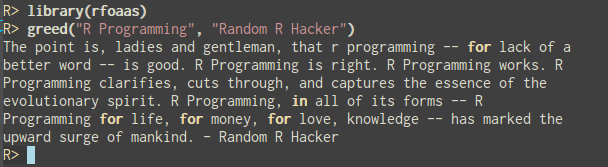
rfoaas greed example FOAAS upstream came out with release 1.1.0 earlier last week. Tyler Hunt was kind enough to provide an almost immediate pull request adding support for the extended capabilties. Following yesterday's upload we now have version 1.1.0 of rfoaas on CRAN. It brings six more accessors: maybe(), blackadder(), horse(), deraadt(), problem(), cocksplat() and too(). As usual, CRANberries provides a diff to the previous CRAN release. Questions, comments etc should go to the GitHub issue tracker. More background information is on the project page as well as on the github repo

This post by Dirk Eddelbuettel originated on his Thinking inside the box blog. Please report excessive re-aggregation in third-party for-profit settings.

Craig Sanders: fakecloud

I wrote my first Mojolicious web app yesterday, a cloud-init meta-data server to enable running pre-built VM images (e.g. as provided by debian, ubuntu, etc) without having to install and manage a complete, full-featured cloud environment like openstack. I hacked up something similar several years ago when I was regularly building VM images at home for openstack at work, with just plain-text files served by apache, but that had pretty-much everything hard-coded. fakecloud does a lot more and allows per-VM customisation of user-data (using the IP address of the requesting host). Not bad for a day s hacking with a new web framework. https://github.com/craig-sanders/fakecloud fakecloud is a post from: Errata

27 August 2016

Arturo Borrero Gonz lez: Why conntrackd in Debian is better with systemd


There has been some discussion [0] around my decision to drop sysvinit support in the conntrackd package in Debian [1] (version 1:1.4.4-2).

The rationale I used for such a movement was sent to the debian-devel [2] mailing list, and here it is:


Lots of people have talked to me with both support and disagreement with the change.

Before reading the rest of this blogpost, please note that I'm not interested in the 'systemd vs sysvinit' war, and starting now I will focus mainly on the subject of building a firewall cluster with netfilter technology and the reasons why I think sysvinit here is irrelevant.

I started working with firewall clusters by the time of Debian Squeeze. By then, I used only sysvinit, because it was the Debian default init system and because I did not dive so much in the internals of the firewall cluster itself.

By then, the conntrackd debian package included support for sysvinit by means of two files (the two files that I dropped in 1:1.4.4-2) :


Using both files, you could start/stop conntrackd, and nothing more (for example, a proper status check was not implemented).

The conntrackd daemon is used in HA firewall clusters to replicate connection states between nodes of the cluster, so flow states are known in all nodes and they can properly perform stateful firewalling.

When you build HA clusters, there are 2 basic states of the cluster you may check and adjust: failover and failback.

With conntrackd, the failover situation is straight forward: the other node has the state information already from the dying node.
The failback situation is different: depending on the configuration of both the cluster and conntrackd, the new node may ask for a complete synchronisation to the other node when it become alive again (at boot time, for example) . This is the case if you are building a multi-master firewall cluster (i.e: both nodes are seeing traffic and filtering at the same time).

Asking for a complete synchronisation is done by means of a new instance of conntrackd, which communicates using a UNIX socket to the main conntrackd daemon (the one which is actually communicating with the other node). A failback boot procedure may look like this:

  1. system boots
  2. firewall ruleset loading
  3. networking up
  4. conntrackd up (main sync daemon: using 'conntrackd -d'; UNIX socket is opened)
  5. request sync with other node (using conntrackd -n' which uses the UNIX socket opened in step 4)

In both sysvinit and systemd cases, the step 5 may be implemented using another dummy service which performs the required operations and that depends on the main service representing the step 4.

The point here is that steps 4 and 5 suffer a very bad race condition: the conntrackd daemon may open the UNIX socket (step 4) *after* the we try to use it (step 5).

As you could probably imagine, this is the worst possible scenario: as one of the nodes of the cluster is missing important flow state information the stateful firewall will drop packets and all the network monitoring alarms will start to ring... Ironically, just after a failback operation, when all of our cluster is supposed to be up an running.

To avoid the race conditions, some typical hacks could be implemented:


After a bit of research, I found that the last point could be implemented very easily using libsystemd, so the daemon inform of its internal state to systemd [4].

The solution is elegant, simple and offers more direct benefits:

So the clear winner for conntrackd is to go with systemd, using an unit service file of Type=notify. Using sysvinit is prone to the described race condition. No serious firewall cluster with this architecture would use sysvinit.

It's obvious to me that systemd is a better technology than sysvinit. The sysvinit approach has been OK for a while, and for me it was fascinating when I started developing init scripts and learning how things worked.
But now we have systemd. It's the default in Debian. It's far better.

Conclusions: yes, I will probably reintroduce sysvinit files just to avoid any flamewar.


[0] https://lists.debian.org/debian-devel/2016/08/msg00448.html
[1] https://tracker.debian.org/pkg/conntrack-tools
[2] https://lists.debian.org/debian-devel/2016/08/msg00456.html
[3] https://sources.debian.net/src/systemd/231-4/debian/systemd.NEWS/
[4] http://git.netfilter.org/conntrack-tools/tree/src/systemd.c

Dirk Eddelbuettel: RcppCNPy 0.2.5

A maintenance release of the RcppCNPy package is now on CRAN. RcppCNPy provides R with read and write access to NumPy files thanks to the cnpy library by Carl Rogers. This release just updates a few package internals such as the vignette, the DESCRIPTION and the README.md file as well as under Travis script used for continuous integration.
Changes in version 0.2.5 (2016-08-26)
  • Synchronized code with the cnpy repository
  • Updated vignette
  • Expanded DESCRIPTION
CRANberries also provides a diffstat report for the latest release. As always, feedback is welcome and the best place to start a discussion may be the GitHub issue tickets page.

This post by Dirk Eddelbuettel originated on his Thinking inside the box blog. Please report excessive re-aggregation in third-party for-profit settings.

26 August 2016

Norbert Preining: ESSLLI 2016 Course: Algebraic Specification and Verification with CafeOBJ

During this year s ESSLLI (European Summer School in Logic, Language and Information) I was teaching a course on Algebraic Specification and Verification with CafeOBJ. Now that the course is over I can relax a bit and enjoy the beauty of the surrounding North Tyrol.
ESSLLI-2016-logo-darkblue-small For those who couldn t attend the ESSLLI or the course, here are the course materials: Thanks to the participants for the interesting questions and participation. What follows is the original description of the course. Abstract Ensuring correctness of complex systems like computer programs or communication protocols is gaining ever increasing importance. For correctness it does not suffice to consider the finished system, but correctness already on the level of specification is necessary, that is, before the actual implementation starts. To this aim, algebraic specification and verification languages have been conceived. They are aiming at a mathematically correct description of the properties and behavior of the systems under discussion, and in addition often allow to prove (verify) correctness within the same system. This course will give an introduction to algebraic specification, its history, logic roots, and actuality with respect to current developments. Paired with the theoretical background we give an introduction to CafeOBJ, a programming language that allows both specification and verification to be carried out together. The course should enable students to understand the theoretical background of algebraic specification, as well as enable them to read and write basic specifications in CafeOBJ. Description CafeOBJ is a specification language based on three-way extensions to many-sorted equational logic: the underlying logic is order-sorted, not just many-sorted; it admits unidirectional transitions, as well as equations; it also accommodates hidden sorts, on top of ordinary, visible sorts. A subset of CafeOBJ is executable, where the operational semantics is given by a conditional order-sorted term rewriting system. The language system CafeOBJ has been under constant development at the institute of the lecturers since the late 80ies. It is closely related to other algebraic specification languages in the OBJ family, including Maude. The CafeOBJ language and the range of verification methods and tools it supports including its support for inductive theorem proving, verification of behavioral specifications, deductive invariant proof, and reachability analysis of concurrent systems has played a key role in both extending and bringing algebraic specification techniques into contact with many software engineering applications. The following topics will be discussed: To make the lectures not too heavy , we will structure each lecture into two parts: A first part providing an introduction of some theoretical concept, or framework, and a second part dealing with actual programming and implementation. Especially for the second part of each lecture students are encouraged to use their laptops to try out code and experiment.

Michal &#268;iha&#345;: CI coverage from Windows, Linux and OSX

Once I got CI working on multiple platforms the obvious next step was to be able to aggregate coverage reports across them. This should not be that hard, right? Well I've spent couple of hours on that during last few days. On Linux and OSX it was pretty much straightforward. Both GCC and Clang do support coverage, so it's just matter of configuring them properly and collect the coverage reports. I've used own solution for that in past and that was really far from working well (somehow I never managed to get coverage fully uploaded to Codecov). Fortunately there exists CMake script called CMake-codecov which does all needed work and works out of the box on GCC and Clang (even on OSX). Well it works on Travis only once you update the compilers and install llvm-cov tool. The Windows part on AppVeyor was much harder for me. This can be heavily accounted to lack of my experience with Windows and especially development on Windows in past ten years (probably even more). First challenge was to find something what can generate code coverage there. After lot of googling I've settled down on OpenCppCoverage what seems to be the only free solution I was able to find. The good thing is that it can generate coverage in Cobertura format that Codecov undestands. There are also bad things that I've learned. First of all it's quite hard to integrate this with CTest. There is no support for wrapping test calls in custom commands, so I've misused the memory checks for that purpose. I've written small python script which pretends the valgrind interface and does call OpenCppCoverage in the background. Now I had around 800 coverage files (one for each test case) and we need to deal with them somehow. The Codeconv command line client doesn't deal wit this out of the box so the obvious choice was to merge them before upload. There even seems to be script doing that, but unfortunately trying that on our coverage data make it nowhere near completion within hour, so that's not really good choice. Second thing I've tried was merging binary coverage in OpenCppCoverage and then exporting to Cobertura format. Obviously Gammu is special project as all I got from this attempt was crashing OpenCppCoverage (it did merge some of the coverages, but it failed in the end without indicating any error). In the end I've settled down to uploading files in chunks to Codecov. This seems to work quite okay, though is a bit slow, mostly due to way how Codecov bash uploader prepares data to upload (but this will be hopefully fixed soon). Anyway the goal has been reached, both Windows and Linux code shows in coverage reports.

Filed under: Debian English Gammu 0 comments

Dirk Eddelbuettel: RcppArmadillo 0.7.400.2.0

armadillo image Another Armadillo 7.* release -- now at 7.400. We skipped the 7.300.* serie release as it came too soon after our most recent CRAN release. Releasing RcppArmadillo 0.7.400.2.0 now keeps us at the (roughly monthly) cadence which works as a good compromise between getting updates out at Conrad's sometimes frantic pace, while keeping CRAN (and Debian) uploads to about once per month. So we may continue the pattern of helping Conrad with thorough regression tests by building against all (by now 253 (!!)) CRAN dependencies, but keeping release at the GitHub repo and only uploading to CRAN at most once a month. Armadillo is a powerful and expressive C++ template library for linear algebra aiming towards a good balance between speed and ease of use with a syntax deliberately close to a Matlab. The new upstream release adds new more helper functions. Detailed changes in this release relative to the previous CRAN release are as follows:
Changes in RcppArmadillo version 0.7.400.2.0 (2016-08-24)
  • Upgraded to Armadillo release 7.400.2 (Feral Winter Deluxe)
    • added expmat_sym(), logmat_sympd(), sqrtmat_sympd()
    • added .replace()
Changes in RcppArmadillo version 0.7.300.1.0 (2016-07-30)
  • Upgraded to Armadillo release 7.300.1
    • added index_min() and index_max() standalone functions
    • expanded .subvec() to accept size() arguments
    • more robust handling of non-square matrices by lu()
Courtesy of CRANberries, there is a diffstat report. More detailed information is on the RcppArmadillo page. Questions, comments etc should go to the rcpp-devel mailing list off the R-Forge page.

This post by Dirk Eddelbuettel originated on his Thinking inside the box blog. Please report excessive re-aggregation in third-party for-profit settings.

Matthew Garrett: Priorities in security

I read this tweet a couple of weeks ago:

and it got me thinking. Security research is often derided as unnecessary stunt hacking, proving insecurity in things that are sufficiently niche or in ways that involve sufficient effort that the realistic probability of any individual being targeted is near zero. Fixing these issues is basically defending you against nation states (who (a) probably don't care, and (b) will probably just find some other way) and, uh, security researchers (who (a) probably don't care, and (b) see (a)).

Unfortunately, this may be insufficient. As basically anyone who's spent any time anywhere near the security industry will testify, many security researchers are not the nicest people. Some of them will end up as abusive partners, and they'll have both the ability and desire to keep track of their partners and ex-partners. As designers and implementers, we owe it to these people to make software as secure as we can rather than assuming that a certain level of adversary is unstoppable. "Can a state-level actor break this" may be something we can legitimately write off. "Can a security expert continue reading their ex-partner's email" shouldn't be.

comment count unavailable comments

25 August 2016

Alessio Treglia: The Breath of Time

For centuries man has hunted, he brought the animals to pasture, cultivated fields and sailed the seas without any kind of tool to measure time. Back then, the time was not measured, but only estimated with vague approximation and its pace was enough to dictate the steps of the day and the life of man. Subsequently, for many centuries, hourglasses accompanied the civilization with the slow flow of their sand grains. About hourglasses, Ernst Junger writes in Das Sanduhrbuch 1954 (no English translation): This small mountain, formed by all the moments lost that fell on each other, it could be understood as a comforting sign that the time disappears but does not fade. It grows in depth . For the philosophers of ancient Greece, the time was just a way to measure how things move in everyday life and in any case there was a clear distinction between quantitative time (Kronos) and qualitative time (Kair s). According to Parmenides, time is guise, because its existence <Read More [by Fabio Marzocca]>

Next.

Previous.